The blog for Mets fans
who like to read
ABOUT US

Faith and Fear in Flushing made its debut on Feb. 16, 2005, the brainchild of two longtime friends and lifelong Met fans.
Greg Prince discovered the Mets when he was 6, during the magical summer of 1969. He is a Long Island-based writer, editor and communications consultant. Contact him here.
Jason Fry is a Brooklyn writer whose first memories include his mom leaping up and down cheering for Rusty Staub. Check out his other writing here.
Got something to say? Leave a comment, or email us at faithandfear@gmail.com. (Sorry, but we have no interest in ads, sponsored content or guest posts.)
Need our RSS feed? It's here.
Visit our Facebook page, or drop by the personal pages for Greg and Jason.
Or follow us on Twitter: Here's Greg, and here's Jason.
|
by Greg Prince on 14 August 2015 1:41 pm Welcome to Flashback Friday, a dormant Faith and Fear in Flushing tradition revived this particular Friday in recognition of where we are now and how far we’ve come to get here.
If you have been to Citi Field in 2015 and been at your seat just before the home team’s lineup is formally introduced, perhaps you’ve noticed the slick trip through Mets history presented on the 62% Larger Videoboard. It starts with Bob Murphy’s voice and Casey Stengel’s face and it takes the attentive viewer on a journey through Met space and time, hitting most of the high points in franchise lore while gliding skillfully over most of the lesser moments.
That’s typical of how this team tells its story. It’s acceptable to acknowledge the losing years at the start. They’re colorful and they’re redeemed quickly enough. But then there are gaps. Eleven years are invisible between the clips of 1973 and the clips of 1984. The ’90s are absent until 1999. Mike Piazza’s September 2001 swing for the ages directly precedes the 2006 oasis of excellence as if they occurred during the same weekend. Then, save for evidence of a no-hitter in 2012, we’re on to basking in the accomplishments of our present-day Mets.
The spaces between make for curious voids. Unless you’re committed to telling a lovingly detailed story, you choose your spots. Grand Slam Singles and leaps at the left field wall are first-round draft choices for these sorts of productions. The seasons that yield little in the way of inarguably indelible images are left to fend for themselves in the collective memory.
On August 13, 2015, the New York Mets defeated the Colorado Rockies, 12-3, noteworthy enough in contemporary context given the Mets’ suddenly serious pursuit of a divisional title. From a historical perspective, we’ll find out in relatively short order if Thursday’s win represented one more step on a gilded path to greater glories or if it will stand an unwanted test of time akin to what happened the previous instance when Met wins outnumbered Met losses by precisely so many.
By sweeping the Rockies, the Mets moved to eleven games over .500 for the first time since June 27, 2010. Eleven games over .500 implies a good team is at work. If eleven games over .500 wasn’t emblematic of quality, it wouldn’t have proved an elusive milestone for more than five years of Mets baseball.
Yet the Met club that last moved that far above the break-even point doesn’t make so much as a cameo appearance in that Citi Field montage. With the exception of a couple of run-into-the-ground Mets Classics on SNY, you don’t see much evidence of the 2010 Mets a half-decade after the fact. No wonder, really. Nobody builds monuments to 79-83 campaigns.
The Mets don’t build literal monuments to much of their history (don’t try to meet me by the Tom Seaver statue tonight), but you know what I mean. 2010 lasted 162 games, and when it was over, it was done with. The Mets couldn’t have been any more definitive about putting it behind them when they justifiably dismissed their general manager and manager about two minutes after the season’s final out.
If 2015 is going to live on as “2015” — if it’s going to be a brand-name staple of video montages yet to come — maybe it’s not too early to mine a touch of vaguely wistful, reflexively self-effacing nostalgia for the years that made its emergence such a blessed event. Years like 2010. Credentials-enhancing years we maintained our Metsdom during while waiting to live and die in the middle of August, not just find our hopes dead. Character-building years we’ll look back on fuzzily, perhaps gauzily, and say, “I was here in the lean years. I was here in 2010. You wouldn’t believe what that was like.”
What was that like? Is too soon to remember? Is it too soon to have forgotten?
I’m not looking to make a case for 2010 as overly underappreciated, exactly. And I’m in too good a mood these days to shame the Mets’ generally amnesiac ways (plus the montage is a really well-produced video, regardless of omissions). But I am curious as to how seasons we lived in for six months at a time are allowed to slip away from our consciousness so easily.
Make no mistake about it: we lived in 2010. Of course we did. We live in every season as if it’s our permanent residence. We inhabit them fully. Each one is the most important season of our lives while it is in progress. Across the entirety of 2010, I sat at this very spot and, in concert with my blogging partner sitting in whatever spot he was in, set in type that entire April-to-October effort. It mattered to me. It mattered to you.
Then it mattered no more.
Weird how that happens. OK, maybe it’s not weird — 79-83, fourth place, all downhill from late June onward — but it happened…y’know? It happened to us. Every day of 2010, the Mets of 2010 were our cause, our concern, our pride, our bane. It feels fickle to not easily recall its highlights, to not substantively retain its content, to not willingly share its legends and lessons, such as they are.
Yet the montages go on without contributions from years like 1981 and 1995 and 2010, the last of which has aged just long enough to turn into the perennially neglected five-year-old who asks, as the franchise flips through the pages of its family album, “Hey, how come there are no pictures of me in there?”
Seems wrong somehow. So if you don’t mind, I’m going to unspool my own reel. (For what it’s worth, I’m working here strictly from memory; no archives, no Baseball-Reference.)
It’s Opening Day. Citi Field’s dimensions are still too expansive and its outfield walls are still too charcoal, but over in the Rotunda, there’s now a neat little team museum. The weather outside is unseasonably warm. The sun beats down on the Pepsi Porch. The Mets beat down on the Florida Marlins. Mike Jacobs, Gary Matthews and Frank Catalanotto dot the roster. The training and medical personnel are booed in a mostly good-natured vein. We were hurt in 2009. We’re reasonably healthy as 2010 gets going.
Ruben Tejada, 20, and Jenrry Mejia, 20, are among the newcomers. Jose Reyes, 26, returns a little late, but he’s back from his endless injuries at last and, for at least a few games, bats third.
There’s a Saturday in St. Louis that threatens to plod into Sunday. It goes 20 innings. Tony LaRussa employs position players as pitchers. The Mets win. It’s not impressive.
Two days later, Ike Davis appears. He is the future. He and Tejada and Reyes and David Wright hint that they will hold down the infield together for years to come.
Reyes is spotted tripling and leading off. Wright is homering consistently after doing no such thing in ’09. Big-ticket acquisition Jason Bay is off to kind of a slow start, but he’s a pro, he’ll get it together. Daniel Murphy, last year’s home run leader (12), isn’t around at all. He got hurt in Spring Training, went to the minors to learn second base and got hurt again. Good thing Tejada’s getting a shot, lest we be forced to get by solely with Alex Cora and Luis Castillo.
The Mets are suddenly unbeatable at home. Johan Santana is, as ever, The Man. Rod Barajas pours on the power. He and fellow grizzled backstop Henry Blanco end consecutive games with walkoff home runs. Ike is hitting and fielding. He flips over railings in pursuit of foul balls and he catches them as if by second-nature.
Catalanotto, Jacobs and Matthews disappear. Bay struggles. Oliver Perez and John Maine frustrate. Maine goes on the DL and never materializes again. He’s replaced by an itinerant knuckleballer named R.A. Dickey. Dickey impresses. So does Angel Pagan, blossoming after several seasons on the big league fringes. Pagan, playing plenty in place of an injured Carlos Beltran, runs out an inside-the-park home run one night in Washington, the same night he starts a triple play in the field behind Dickey. The Mets lose anyway.
Perez expends everybody’s patience. He belongs in Buffalo, but won’t accept a demotion. Jerry Manuel sentences him to the back of the bullpen. The rotation is now populated by Santana, Dickey, young Jon Niese (who tosses a one-hitter at the Padres), maturing Mike Pelfrey and import Hisanori Takahashi. Francisco Rodriguez is saving games. Pedro Feliciano is perpetually on call. The Mets are up and down, but definitely more up than down as the first half proceeds.
They hold big, bad Philadelphia scoreless for an entire series at Citi Field; Gary Cohen labels it the Goose Egg Sweep. They put on a gaudy, ultimately successful push to elect Wright to the All-Star team. They welcome Jerry Seinfeld to their TV booth. They sweep an Interleague road trip to the lesser precincts of the junior circuit. For a few hours one early evening, after Atlanta is beaten by the White Sox and before the Mets take on the Tigers, New York slides into first place. When Detroit prevails, New York slides right out.
Nevertheless, on June 27, they rise eleven games above .500 for the fourth time in 2010. Despite Bay never quite finding his footing, despite the money pit Perez has transformed into, despite Jeff Francoeur never having met a base he liked being on, it’s hard to not take the Mets seriously. They’re kind of contending for the playoffs.
Then they’re not. Their detachment from the pennant race is gradual, but the cracks surface. They lose three of four in Puerto Rico to the lousy Marlins. Tejada receives a game-ending pickoff throw at second to seal a victory over the lousy Nats on a Friday night, and Dickey outlasts phenomenal Stephen Strasburg in D.C. the next day, but K-Rod blows that one in the end. Johan hits a home run against Cincinnati, but the Reds take two of three in that series. The “buts” are beginning to have it.
After the All-Star Game — Jose accompanies David but doesn’t play as precaution against aggravating yet another nagging pain — the descent accelerates. Tim Lincecum beats Dickey at Phone Company Park (though not for postgame quotes). Bay’s head hits a wall at Dodger Stadium and it (and he) are done for the year. The Mets limp home from the West Coast barely standing straight. On the first night the Mets communications staff welcomes bloggers as media, they lose in thirteen innings. On the first day in eight years that the Mets induct new members into their Hall of Fame (Gooden, Strawberry, Cashen, D. Johnson), they lose by thirteen runs. Oliver Perez pitches in that one and is greeted accordingly.
As August unfolds, the Mets unravel. Whoever can be moved is moved. Barajas is sent to L.A. Frenchy Francoeur joins the Texas Rangers. Cora wanders off to the American League as well. K-Rod is provoked into throwing a punch at his de facto father-in-law. He’s arrested. Then he comes back. Then he gets hurt and is, like Bay, out for the year. So, by early September, is Santana, followed soon after by Mejia, who bounced from reliever to starter to good luck, kid, get better soon.
Youth is getting served now. Josh Thole starts behind the plate. Lucas Duda gets a look in the outfield. Dillon Gee is one of the starters, and a pretty promising one. Feliciano is still warming up in the pen. Beltran, aching but playing, takes an anonymous but public hit from management when he doesn’t show up at Walter Reed to greet veterans (he had another commitment). Yet it’s Beltran who slides hard against Philadelphia when no other Met wishes to retaliate for a cheap takeout slide against Tejada.
The final weeks of the season arrive. The Mets miss .500. They shuffle through the likes of Chris “The Animal” Carter, Joaquin Arias (no known nickname) and Mike Hessman, who hit a slew of home runs in the minors but exactly one as a Met. They continue to intermittently trot out Luis Castillo long past his best-used-by date. They give a shot to Luis Hernandez, a middle infielder of little renown. This Luis fouls a ball off his foot, then blasts a homer off the Braves. He limps around the bases and never hits in the majors again. The Mets lose.
Thole becomes their third catcher this year to slug a walkoff homer. Feliciano pitches in his 92nd game, breaking all his own crazy durability records. Dickey earns a three-year contract and approaches cult status. It takes fourteen increasingly chilly innings (accented by the unwanted presence of Oliver Perez when nobody else is available) to send these Mets into winter with a Closing Day loss. Our permanent residence reverts to the summer rental it was destined to be. The Mets improve by nine games over the previous season, but it’s not processed as momentum. Omar Minaya is replaced by Sandy Alderson. Jerry Manuel is replaced by Terry Collins. Inevitably, 2010 is replaced by 2011.
No doubt we’re in a better place now. Still, where we were then…it wasn’t all bad all the time. Surely there’s a picture around here somewhere.
by Jason Fry on 14 August 2015 1:47 am In the early innings Thursday I tweeted out what I hoped would be reassuring counsel to Mets fans unhappy that we weren’t going to sweep four from the Rockies without a fair amount of work:
As I noted, Noah Syndergaard is 22 — and he’s a young 22 at that. By comparison, Matt Harvey is 26, while Jacob deGrom is 27. Whether you’re a flame-throwing pitcher or an acquisitions clerk, there’s a big difference between 22 and 26. You’re going to become a substantially different person just by having increased your days spent on Earth by nearly 20%, and you’re also going to learn critical lessons about your chosen profession.
Flame-throwing pitchers, like the rest of us, have to learn about getting along with colleagues and bosses. They also have to learn more specialized things. Their workplaces may have odd and unwritten codes of conduct governing lunch, for instance. That’s a relatively easy lesson; a harder one is learning that not even ungodly stuff will permit you to pitch in predictable patterns. Syndergaaard led with his fastball to excess against Tampa Bay and got smacked around; the same thing happened in the first against Colorado — he threw 10 of 12 fastballs and watched two of them disappear over the fence.
All part of the learning process. And hence my tweet.
There were things I didn’t expect, though. Like Syndergaard taking the lesson to heart in a matter of innings instead of days, for once. He gave up a single to Daniel Descalso to open the second, but then erased Descalso on a double play. Kyle Parker singled, but Syndergaard blew away opposing pitcher Eddie Butler — and didn’t allow another hit until his work was done after seven. He fed the Rockies curves and change-ups early, getting them off-balance, then erased them with that annihilating fastball.
The lesson: It’s nice to have the Hammer of Thor at your disposal, but it’s better to have a whole divine toolkit to choose from. Syndergaard learned today that you can write some pretty satisfying myths using the Screwdriver and Socket Wrench of Thor as well.
Meanwhile, the Mets were hitting the luckless Mr. Butler early and often. A trio of doubles in the first (Daniel Murphy, Juan Uribe, Kelly Johnson) made the Rockies’ lead disappear, two more (Yoenis Cespedes and Johnson again) followed in the third, and Curtis Granderson‘s fourth-inning homer signaled that the rout was on and the sweep was a reality.
A little more than a month ago (which is a lifetime in this topsy-turvy season), I lamented what the Mets could be if only they were capable of scoring four runs a game. Twelve a game? That will do.
Yes, that will do very nicely.
by Jason Fry on 13 August 2015 1:20 am Citi Field is loud, and it’s wonderful.
I reflexively started to type “loud again,” then stopped myself. Because that wouldn’t have been true. Citi never has been loud. This is the first run of games in which the crowd is a factor, in which the buzz is focused on the field and the players are aware of it.
Citi Field started off dealt a lousy hand. It opened during a wrenching recession, the third pitch thrown in its official history became an enemy home run, management missteps alienated hardcore fans, and that first season began with months of weather that was lousy to the point of peculiar. By the time it warmed up, the Mets were broken and bad and the season was lost, leaving acres of those new green seats empty.
That was 2009, and the story hasn’t been fundamentally different at any point since. The Mets fixed some of their park’s flaws and we got used to some others, but the biggest problem came to seem intractable: the Mets were never good enough long enough for enough people to notice. That left Citi Field a reasonably nice place with lots of good food, a really big HD screen … and a baseball game somewhere in the middle of it.
Until now.
The party started with Yoenis Cespedes and the Nationals arriving and hasn’t stopped. But Wednesday night was my first chance to see it for myself. I was sitting with my pal Jeff in the second row of the Pepsi Porch, barely in foul territory, and marveling at the sights and sounds around me.
First of all, I could see people. People in their seats, watching baseball. Sure, there were a few swathes of seats mostly unoccupied, but the field level was nearly full, and above that you saw blue and orange gear, waving arms, people getting up when the game demanded it, and directing their attention at the field.
And you could hear those people. The ones around us were talking about our young pitchers, and Cespedes and his contract, and David Wright down in St. Lucie, and the adventures of Wilmer Flores, and how the Nats might fare against Clayton Kershaw. (They lost, 3-0!) They were talking baseball, and cheering for it down on the field — roaring for it down on the field, in fact.
When Jacob deGrom reached two strikes they were up and howling for a third. When Juan Uribe rifled a ball over Charlie Blackmon‘s head in center they were yelling for Juan Lagares to hurry home, and then they did the same for Uribe when Michael Cuddyer smacked a ball into center. They roared for Cespedes’s first Citi Field clout (while wearing a yellow sleeve to match the feathers of a confused parakeet who’d taken up residence among the A/V cables), and at the end they stood and exhorted Jeurys Familia across the finish line.
Baseball is a different experience depending on whether you’re in the park or in front of the TV. I was 380-odd feet away in the Pepsi Porch, so don’t ask me to say anything smart about deGrom’s pitches — all I know is they resulted in Rockie after Rockie trudging away from home plate with barely used lumber. But the tradeoff was being borne up by the noise and fervor when deGrom was in a tight spot and looking for a little more life on the fastball, and being buffeted by the joy at seeing him find it.
None of the above is particularly extraordinary; it’s fun watching a good baseball team on a nice summer night as part of a big crowd. But it’s new for Citi Field — new, and oh so welcome.
I shed no tears for the demise of Shea, a battered rattletrap that exuded decay and bred hostility. But I have mourned the new place’s failure to engage us collectively, to feel like more than a short-term rental. Some of that failure reflects a sea change in parks and they crowds they attract: different economics and a different audience, the distraction of myriad non-baseball options, and the fact that we all now have ludicrously powerful pocket computers competing for our attention. But the real problem has been a lack of anything to engage us, to make us look up from our tweets and text messages and decide some other evening would be better for standing in line for burgers.
That’s no longer true. Now our eyes are on these Mets and their improbable summer story. We’ve found something that’s got us … well, that’s got us hollering and cheering and jumping in our seats, whether we’re butchers or bakers, or consultants or content providers. Some part of me had feared that never would happen again, that it had been lost somehow. But it’s not so. It’s happening right now — and however overdue it may be, it’s wonderful to find yourself part of it again.
by Greg Prince on 12 August 2015 3:52 am Welcome to Tuesday night, Citi Field, Flushing, New York, August, the 2010s. It is not by chance we are here. We make a date. We make this date.
August 10, 2010
August 9, 2011
August 21, 2012
August 6, 2013
August 12, 2014
August 11, 2015
Did we ever have a meeting to decide? Did it go through committee? Did we take a vote? I don’t think we did. It was more a matter of nomination by acclamation. See you in Tuesday in August…seconded…any objections?
The ayes had it. Every August, on a Tuesday night, we meet for baseball. We meet for Mets baseball, of course, usually coincidentally played against the Colorado Rockies. They have a knack for being available in August, four of the last six, including this one.
So there we were, the Chasins — Rob, the dad; Ryder, the son — and the Princes — Stephanie, the wife; Greg, the husband as well as designated chronicler. That’s me. I take the minutes of the annual meeting.
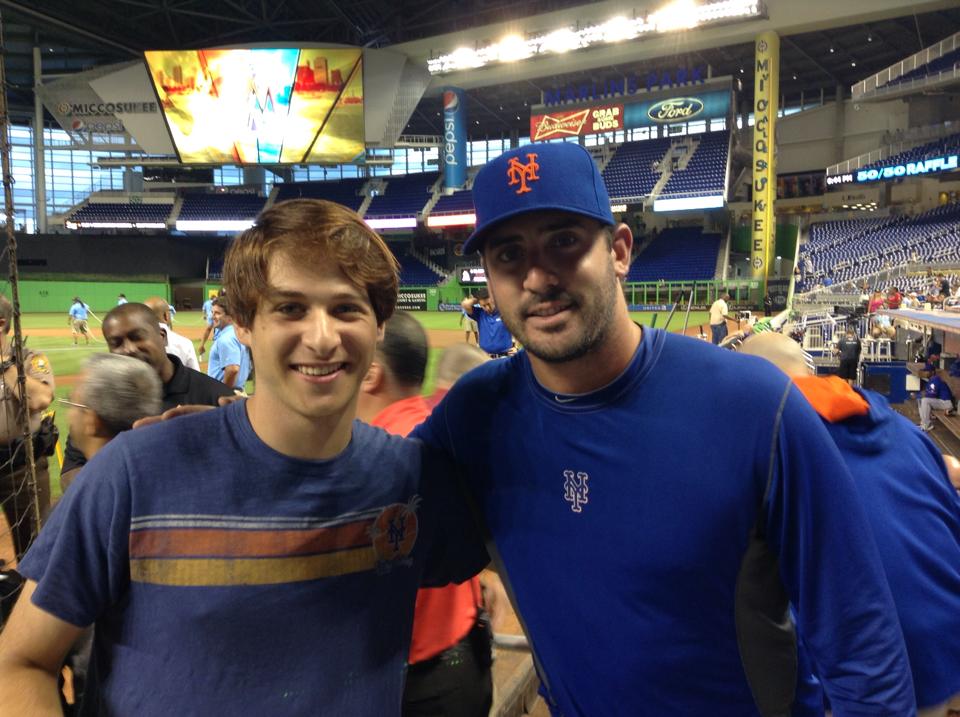
 In action Tuesday night: Ryder Chasin, Matt Harvey. Let the record show the principals met in a light drizzle outside the little-known and even less-understood Payson entrance shortly after 5:30 PM. Our tickets were waiting at an unfamiliar window, left by someone you’d call “a player,” but not someone you’d find in your $5 scorecard, and let’s leave it at that.
The seats for the 2015 edition of our confab were outstanding (and, it’s worth noting, given the events of the night before, tightly fastened, albeit uncushioned). A dead-on sightline for the baseball fans. Sufficient cover for foes of precipitation. The shelter aspect turned into a non-issue as the drizzle that accompanied us at the Payson entrance dissipated by the time we u-turned for the more famous, better known Jackie Robinson Rotunda.
My bag was searched. My beverages were left intact. I have learned the secret of not having my half-drunk water confiscated. I will share it only when Citi Field is no more, lest the terrorists win.
No more than two minutes inside the building, we run into Skid from Monday night, Skid from every night. Skid is doing laps around the Field Level. When you’ve relocated your life to a Major League Baseball stadium, you avail yourself of every opportunity it presents. Skid gets his walking in at Citi Field.
We get our walking in, too. We stroll to Shake Shack. We are drawn to it, as if by medium-rare magnets. It wasn’t our planned destination, but when we find ourselves before it with a line that is barely longer than Parnell to Clippard to Familia, we do what all sentient people would do: we get on it. Or do we get in it? Stephanie long ago noticed New Yorkers stand on line, while the rest of America stands in line. Whose colloquialism is it anyway?
However we stand, we don’t stand for long. The Shake Shack line moves like Jose Reyes once did or Michael Cuddyer suddenly does now just around the corner from this slice of hamburger heaven. Oh, the wonders of showing up just early enough for a short Shake Shack line. Behind us the queue has begun to snake in earnest. But we have broken the tape just in time.
Ryder and Rob have to wait for their shakes, which is weird when you realize “Shake” is technically the headline attraction, but that’s less onerous than waiting to order. It just is.
Did you know you can get a great deal on home heating oil at Citi Field? This is an even less understood element than the Payson entrance. On Monday night, Skid and I were accosted by a home heating oil salesman on three separate pregame occasions. On Tuesday night, Ryder and I were pitched twice. Inexpensive home heating oil will be a wonderful thing this winter. Like postseason baseball tickets, it might be the sort of thing a person would be best served by signing up for well in advance of needing it. Unlike postseason baseball, you can be certain cold weather is coming.
But why is a home heating oil concern allowed to accost baseball fans repeatedly in the middle of August inside their favorite team’s ballpark? (Even Shea’s voracious credit card hawkers of yore were relegated to Casey Stengel Plaza.) We were just four baseball fans carrying their Shake Shack to a table elsewhere on the grounds. I can’t imagine anyone among the 25,611 on hand will be perusing his or her home heating bill come February and cursing himself or herself out for not making the switch to this particular oil concern while at a baseball game between the New York Mets and the Colorado Rockies.
I’m not saying this as a natural gas customer. I’m saying this as a baseball fan who simply wants to get to the Shake Shack stuff while it’s still warm.
The oil men went about their accosting as we rode the escalator to Caesars Club, which is named for a gambling enterprise that no longer sponsors the Mets. Perhaps it’s just as well the name sticks to the establishment. Once you start referring to something as something, it’s hard to start calling it something else. Just ask the Avenue of the Americas; it’s over on Sixth Avenue. Or just ask me what stop I get off at to attend ballgames. The MTA says it’s Mets-Willets Point. I still call it Shea.
I’ve only recently ceased thinking of Ryder as “my Bar Mitzvah boy,” though that’s sort of understandable, as it was Ryder’s legendary Citi Field Bar Mitzvah and our unforeseen attendance at it in November 2009 that set the Tuesday Night Baseball Club’s annual meetings in motion. Ryder is nearly 19, sports facial hair and attends Northwestern University. He is nobody’s Bar Mitzvah Boy at this stage of his burgeoning life. (In a related development, time flies.)
As for the limbo in which the name “Caesars Club” lingers, why not use their absence from the Met sponsorship depth chart as a chance to rebrand? I offer, as I’m pretty sure I have before, these alternatives:
Seavers Club
41 Club
The Stork Club, with portraits of George Theodore everywhere and George Theodore himself on the premises if he so desires a sinecure.
We tuck into our Shake Shack in the club currently known as Caesars, until otherwise dubbed. “Tuck” is one of those words I only see in Times profiles of celebrities and politicians who are inevitably interviewed over lunch in chi-chi locales. They’re always “tucking into” steaks or salads. I have never heard anybody in real life refer to anybody tucking into food otherwise. So let’s just say we ate our Shake Shack and we were quite satisfied.
I was so satisfied, I left my denim overshirt draped on the back of my chair as we left Caesars. “Overshirt” is how Stephanie and I refer to whatever shirt we schlep along when we think it might get a tad chilly, but not cold enough for a jacket, let alone heating oil. I pride myself on leaving no shirt behind, but somewhere between the national anthem and first pitch, I realize I have blundered. I must return to our old table at once and see if it’s still there. Rob accompanies me, presumably to calm my nerves.
“There’s nothing but Mets fans here,” he assures me. “They’d never steal anything.” And he’s right (hell, the Mets barely steal bases). My ratty denim shirt is still draped where I left it. I snatch it back without ceremony. When we get back to our sensationally sightlined seats, we tell Stephanie and Ryder that some big galoot was wearing it and I had to resort to weaponry to fully secure it. Then, because accuracy is everything when you’re tasked with taking the minutes of the meeting, we let them know we’re kidding, it was just sitting there, neglected and ignored, sort of like the Mets most Augusts, though certainly not this one.
Say, you know who else we saw Tuesday night at Citi Field? Matt Harvey. He sports facial hair, too. The Rockies and their beards were more hirsute than Harvey, but were no match otherwise. The Mets didn’t score for the longest time, but it barely occurred to me to worry they wouldn’t win. Even with a Terry-rigged lineup that lacked Granderson and was noticeably Duda-free, I figured our first-place team would find a run draped over its chair eventually, and as long as they did, Matt Harvey and his facial hair weren’t going to be touched.
That’s basically what happened in the actual game that you probably came here to read about while I’ve been going on impressionistically about mood and circumstance and my wife and our friends the Chasins. (The blog for Mets fans who like to digress!) Harvey was Harvey for eight innings and the Mets eked out a run in the sixth. They added three in the eighth to make the lead safe for Eric O’Flaherty as Woodrow Wilson once strove to make the world safe for democracy. It’s what a first-place team does, you know. Victories achieved by first-place teams in games pitched by their premier ace are by no means automatic, yet it’s delightful to believe they’re more probable than possible on any given Tuesday night.
Ryder and Rob and Stephanie and I, across all these August Tuesday nights, had seen a lot of Mets and a bunch of Rockies, but never a first-place team. Well, to be baseball-retentive about it, we saw a pretty powerful first-place team last August. It was the Washington Nationals, our Rockies substitute in 2014. The Nationals rattled Rafael Montero pretty badly that night. That seems like more than twelve months ago.
Five years ago when we — the Princes and the Chasins — first did this, we saw 25 different players take the field as either Mets or Rockies. Ryder dutifully kept score of each of their official activities, just as he tracked each of the 24 Rockies and Mets who played Tuesday night. Was there, we wondered, any overlap? It turns out that five years later, only four of those from our 2010 meeting joined us again: Carlos Gonzalez, Rafael Betancourt, Ruben Tejada and Jose Reyes. Reyes was the only one to change outfits in the interim.
Tuesday night, as Jose batted against Matt Harvey, I honestly forgot who was playing for who. This was early in the game, when Reyes was batting and I was focusing intently on him and somebody sitting behind us was invoking a classic Jose-Jose-Jose and somebody next to him marveled that the last pitch was 96 miles per hour. My honest thought was, “Who on the Rockies is throwing that hard to Jose?”
Then I looked at the mound and remembered what was actually going on. I will cop to my mind wandering and our four-way conversation wandering. What do you want from us? We only go to one ballgame together every year.
You already know the Mets won Tuesday night. A little while ago I checked and saw the Nationals lost in L.A. I don’t recall the last time I pumped my fist in the wee small hours of a Wednesday morning. A pennant race will do that to a person.
The Mets are 61-52, which appears too impressive to belong to the Mets, doesn’t it? That’s the record of a good team. This year it’s the record of a first-place team. Our first-place team. Our first-place team that leads second-place Washington by 2½.
Don’t you love half-games? What other sport has half-games? I suppose basketball, but stay with me on this one. I’ve paid at least modest attention to the NBA all my sentient life and I’ve never heard anyone get excited over leads or deficits involving half-games. That’s a baseball quirk. Baseball, at its best, is defined by its quirks.
Did you know that on Tuesday night every home team beat every road team? That, according to the Elias Sports Bureau (and doesn’t “bureau” make Elias’s mission sound that much more pulsating?), had never previously happened with a slate of 15 games. That’s pretty quirky right there. It means that in every MLB park across the continent, those people who made a special point of getting together because it’s what they do every year at this time came away very happy.
Not that we in our little Tuesday Night Baseball Club wouldn’t have enjoyed ourselves (albeit less) had the road team prevailed. That’s the whole idea behind these annual meetings. We are happy to get together, we are sorry to adjourn, we are eager to resume more or less a year from now in the very same place.
First.
by Greg Prince on 11 August 2015 3:18 am Perhaps you’ve heard about the butcher and the baker and the people on the streets, all of whom have gone to Meet The Mets. More than 27,000, whatever the vocation, did so Monday night, myself included. We gave ’em a yell, gave ’em a hand and let ’em know we were rootin’ in the stand.
Yes, “stand,” which is the official lyric submitted by Ruth Roberts and Bill Katz in 1961 for an authorized team song that would be played twice this particular 2015 evening at Citi Field, once around 7 o’clock as we leaned forward with anticipation, once a little after 9:30 as we practically pranced toward the exits. I always thought it should have been “stands,” but during the course of Monday’s game, I understood why “stand” must stand.
It’s explained several lines earlier when Roberts and Katz detail what we do when we go to meet the Mets. We’re hollerin’ and cheerin’ and jumpin’ in our seats. Seats are not made for jumpin’. Some seats, I learned, aren’t even made for sittin’.
Let me back up here, if not into my seat, for that would be an impossibility.
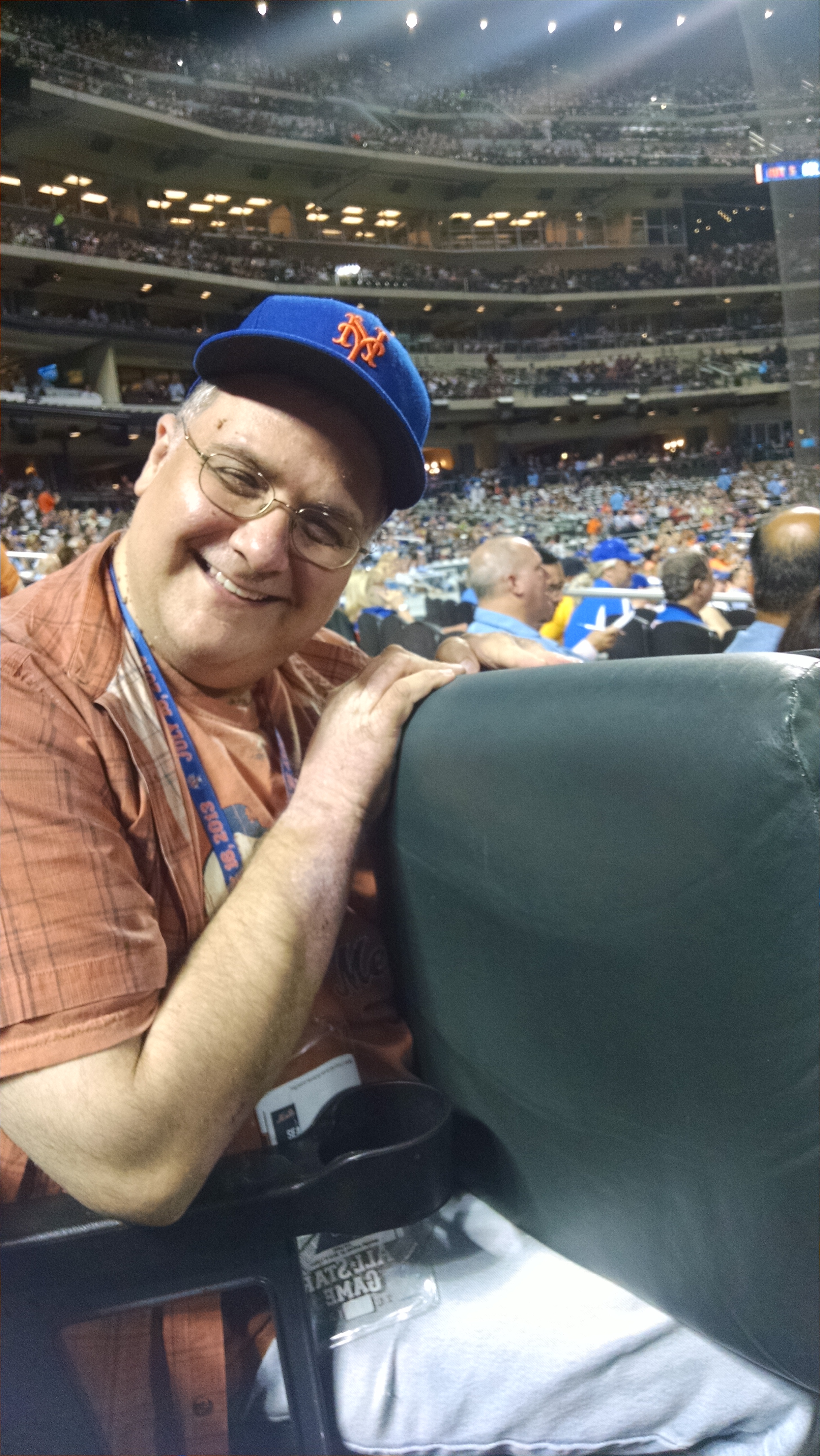
 My seat and I reconcile after it abandoned me. It’s the middle of the game between the Mets and Rockies. I’m sittin’ — not jumpin’ — in my luxuriously padded Delta Sky 360 Charles Montgomery Burns Club seat, brought to me for the evening by my good friend Skid, who you’ll recall is the Mets fan from California who decided to move to New York for six (hopefully seven) months and join his team every time they open their gates. Skid was celebrating his birthday Monday and opted to make his accommodations relatively ritzy for the evening, purchasing two of these seats and graciously inviting me along to occupy one of them.
Really, this whole season has been a birthday celebration for Skid. I’m thinking he wished for this on some previous August 10, blew out the candles and got what he asked for: every day he gets to go to a baseball game. Maybe he wished extra hard that one time and asked for a first-place team. Skid wishes very well.
Anyway, game’s going on, we’re not yet winning, but we’re not necessarily worried. These are our first-place Mets. If you can’t find the faith to tolerate a temporary one-run deficit, then you’ve chosen the wrong year to go to Citi Field. Me, I was delighted that we finally have a right year to go to Citi Field. I never went to see a first-place home team at this ballpark this late in any year. It’s the one feature they forgot to install when they were busy padding all those seats.
Ah yes, the seats. Specifically, my nice seat. I’m sitting in mine when I decided I’d like a nice Diet Pepsi, so I ask for one from one of those nice people who come around to ask if you’d like anything brought to your nice seat. (Everything and everybody is nice when you’re in first place.) To effect one of these transactions, you give the person the money, and the person places your order, and — an inning or three later — you get your soda.
OK then, let me just dig my wallet out of my pocket, which I shall do by shifting slightly in my seat and…
The next thing I feel is a slow drop. I don’t mean like Luis Castillo’s agonizingly torpid pursuit of a fly ball a veritable baseball generation ago. I mean more like that sensation you get in a dream where you’re falling and you’re falling and, oh, it’s all right. It’s just a dream.
But this wasn’t a dream. This was my seat, less falling than sinking. I’m not sure how it managed to completely unhinge, but it sunk all the way to the ground.
With me in it.
Fancy seat, yes. Exquisite bolting, not so much.
From six or so inches above ground, I hand the nice person — who is trying very hard to not laugh uncontrollably at the PLOP! her customer has just taken — the money for the soda. I take no offense, for I’m laughing, too. As is Skid. This would be funnier if it happened to someone like Mr. Burns or the man from the Monopoly board, but it’s still funny, even though it happened to me. My rear end was safely guarded from cement and the bag I’d had under my seat withstood the blow (good thing I decided to leave my Ming vase home). Because the attendance was 27,000 and not 42,000, I didn’t have to stand in the stand for long. There was no problem finding a replacement seat right next to the one that had unseated me.
This had never happened to me at Shea Stadium. This had never happened to me at Citi Field, though it had happened to somebody in the row in front of us maybe an inning earlier. Perhaps not the comic thud, but the same idea, making it two high-roller seats too banged up to stay in the game. I’m pretty sure each had to go on the furniture DL. (Keep Ray Ramirez away from the upholstery if you ever want to see them again.)
Meanwhile, Jon Niese pitched seven strong innings, Travis d’Arnaud belted a home run, Curtis Granderson conveniently let himself get hit by a bases-loaded pitch and Daniel Murphy snuck a sharp grounder by Jose Reyes, who I couldn’t help but instinctively applaud most of the evening despite his insistence on wearing a bizarre purple uniform to our pennant race party. A 4-2 lead was placed into the hands of Tyler Clippard and Jeurys Familia and they handled it with care. If there are openings in the carpenters union, they might want to apply. Nothing fell apart on their watch, allowing Skid and I and everybody else to watch our first-place team maintain its first-place lead.
Have I mentioned the Mets are in first place? It bears repeating until it gets old, which I don’t believe it will as long as it retains the benefit of truth. Citi Field, of which I’ve never exactly been a roaring advocate, sounded like it knew exactly what place it was in when Murphy broke the 2-2 tie in the seventh. If it didn’t vibrate as I’m told it did during the Nationals series that Changed Everything, it surely echoed of the promise from April, when the environs began to feel tangibly engaged in a manner they never had. Then came May, June, most of July…not wholly terrible for wins and losses, but you know that dream where you’re sitting in your seat at a ballgame and the ballgame itself very slowly plummets to the ground and you laugh uncontrollably because you don’t know what else to do?
It’s August and things are different in the best sense of the word. I’ve known it for a fact because I’ve seen it on TV, but sometimes you need to get your Skid on and see it for yourself. Prior to Monday, I’d been to 200 regular-season games at Citi Field between April 16, 2009, and July 30, 2015, but none whose result would keep a diehard up nights on account of ecstasy or misery. Then the Nats stopped by; and the Mets stymied them; and from a distance it was a revelation.
But there was perceptible distance between me and Citi Field when it seemed to matter most. Two-hundred games in that joint, yet I managed to miss the three that altered its equation. I felt like Roger Angell recounting where he wasn’t during the heart of 1969’s seminal eleven-game winning streak:
MAY 30-JUNE 1: Mets sweep Giants 3 games while I waste Memorial Day weekend in country. Bad planning.
Until I communed personally with my first-place ballclub, my giddiness was on an emotional seven-second delay.
Was this actually happening?
Were the Mets truly the team ahead of everybody?
Does Citi Field got lungs and know how to use them?
I now understand it all to be genuine, every bit as genuine as Skid, who is an excellent role model for us all (and should be toasted heartily this Thanksgiving at his ticket rep’s house). Skid never strays far from the Mets of New York town when they’re in the vicinity and look what they’ve done for him. Look what they’ve done for all of us rootin’ in the stand or wherever we happen to be jumpin’ from joy. When they play as they have lately, seats — no matter how lavishly cushioned — are essentially superfluous.
by Jason Fry on 9 August 2015 10:33 pm For the second night in a row, the Mets lost a one-run game amid a relapse of Narcoleptic Offense Syndrome. On Saturday night the problem was compounded by Noah Syndergaard having an off-night; on Sunday Bartolo Colon was good enough to win, but the Mets’ attack against hyperactive Chris Archer (who must cover at least two miles a game scurrying around the rubber) consisted of a whole bunch of watching balls and a single swing by Daniel Murphy.
That was worrisome, and not just because I’d gotten used to enjoying winning baseball in a state of gentlemanly repose. But you know what? I’d still rather be us than the Nationals.
“I’d rather be us than them” is a mantra I use when things are threatening to get out of hand in the ninth and the closer’s hyperventilating. (For instance, that final game in Miami.) Sure, it’s runners on first and second and none out and the lead’s a lone run, but hey, the lead is still ours. The other guys still have to do something positive to draw even, so exhale, willya? It’s one of those things I tell myself that’s half superstition and half a reminder of how baseball works.
Sometimes it even makes me feel better.
I’m using it in a larger sense now, in sizing up the Mets and their pursuers, Bryce Harper & Co. (Not that the aforementioned gentleman gives a crap about what we’re doing, you understand.)
Why would I rather be us than them?
First, to state the obvious, we’re 1 1/2 games up.
Second, the Mets are going home while the Nats are about to hit the west coast, facing a buzzsaw of good pitchers in L.A. and San Francisco before swinging back through Colorado, which always seems to be a kick-us-when-we’re-down town for East Coast teams whose minds are on home. After that their schedule’s a lot softer, it’s true, but I keep eyeing that makeup game awaiting them in the final days when they’ll really want a breather. Plus they play six with us, which is no longer quite the source of optimism it once seemed to be. You never make assumptions based on opponents and road trips — the 2015 Mets have certainly taught me that — but the Mets’ schedule looks less daunting. (Though that Yankees series smack in the middle of September is an evil scheduling quirk.)
Third, the Mets could soon get some more reinforcements and a spiritual lift. David Wright is going to play a minor-league game tomorrow, and thinks he’ll need 20-odd at-bats to get ready, which is about a week’s worth. Granted, we have no idea if all or any of that go well, or what kind of player Wright will be when he returns. (That’s been a question since 2009, if we’re being honest about it.) But potentially it’s another big bat as well as the return of a clubhouse leader. Throw in the expected returns of Erik Goeddel to help a pen going through some issues and Steven Matz to provide another starting weapon and there’s reason for hope. Hell, even Michael Cuddyer may look a whole lot better once he’s in the complementary role envisioned for him.
Fourth, while this isn’t exactly science, the Nats don’t look right — and it’s not just Jayson Werth‘s usual ate-the-whole-lemon-tree demeanor that makes me say that. They look tight and tentative and demoralized, losing leads they ought to keep and watching comebacks wind up short. They have time to fix that, but every day they don’t is a day less in which to do it.
Fifth and finally, the Mets are playing with house money. They’re not the team everybody picked back in February to be last standing in October, but the one we all wrote off as fatally wounded by injuries/bad luck/financial constraints/being the Mets. Every time the Nats lose, it’s accompanied by muttering and questions about why they aren’t what people thought they would be. Every time the Mets win, it’s a pinch-me, do-you-believe-this moment — even now that the pursuer has become the pursued. The pressure’s on Bryce and his Not-So-Merry Band, not Murph’s Irregulars.
I don’t know how all this will end up — no one does. But I do know I’d rather be us than them.
by Greg Prince on 9 August 2015 4:19 am In the top of the first inning Saturday night at Tropicana Field, Curtis Granderson homered, Daniel Murphy doubled, Yoenis Cespedes singled and Lucas Duda doubled. The Mets led the Rays, 3-0, with nobody out.
This, I said to myself, is in the bag. Not just the game, but the season, the postseason and the dynasty to come. It was time to place every last one of my chips on this sure thing to win the 2015 World Series, maybe the next five if they’d let me. With Juan Uribe coming to bat to drive in Duda and keep the score tilting eternally the Mets’ way, I booked passage to Vegas, packed a bag, got a ride to Kennedy, boarded my flight, flew cross-country, found a cab and was taken to my favorite sports book on the strip.
As I inquired about placing my wager, I was told the first inning was still in progress in St. Pete. Of course it was. The Mets were never going to stop hitting because the Mets were never going to stop winning. The Mets had won seven in a row. As we all know, seven comes before eight, just as eight comes before forever. Forever and ever, amen, when it comes to the Mets’ success.
Oh no, I must’ve misunderstood what I’d just been told, somebody said. The first inning had continued while I made my continental sojourn, but it had nothing to do with the Mets continuing to score. In fact, the Mets had stopped scoring the moment Uribe came to bat. They went down 1-2-3 after that resounding start. Noah Syndergaard then took to the mound, threw a thousand pitches, fell behind, 4-3, and was still trying to get out of the inning.
Did I still want to place that bet?
I shook my head, turned around, reversed my trip and returned home in time to see the Mets lose, 5-4, ending their winning streak at seven and beginning their losing streak at one. A one-game losing streak, as all followers of the Mets have learned through bitter experience, encompasses a 50% chance of becoming a two-game losing streak. These odds suggest the Mets are doomed. Doomed, I tell you. They’re 0-1 in their last one, losers of one of their previous eight.
What a discouraging trend. It must be nipped in the bud ASAP. Here is what must be done to commence nipping pronto:
1) Trade Syndergaard and Travis d’Arnaud for prospects. See if we can salvage something out of the wreckage of these two once-promising careers by bringing in a couple of fresh faces who aren’t responsible for this monstrosity of a one-game losing streak. The culture must be changed. Noah was ineffective over four innings. Travis went oh-for-four. It is there-four a four-gone conclusion that they are beyond repair. While I was in Las Vegas, I heard about a couple of kids named Black and Herrera; we might want to trade for them. Doesn’t matter who we get. Syndergaard and d’Arnaud are 0-2 as a major league battery. They are ruining each other’s futures just by being on the same field at the same time.
2) Remind Wilmer Flores he’s not so special. A Milwaukee Brewers uniform in his locker would be a wise first step. Then the installation of a Groan-o-meter at Citi Field for every time he steps to the plate. Wilmer was 0-for-1 as a pinch-hitter Saturday night. The adulation has gone to his head.
3) Relabel the nickname on Terry Collins’s parking spot. Previous plans to stencil in TONALLY CORRECT, TENACIOUSLY CONFIDENT and TERRIFICALLY COMPETENT were obviously premature. Collins, like his ballclub, is 0-1 in his last one. TOTALLY CLUELESS it is going to have to be.
4) Adjust Cespedes’s contract immediately. The Mets must negotiate a clause that allows them to release the outfielder five days before the World Series and then never re-sign him again. A World Series can go as long as seven games, and in his seventh game as a Met, Cespedes was among fourteen players who could not prevent the club’s first loss in eight games. Clearly, we have learned, he is not a November player.
5) Decline use of designated hitter in Sunday’s game. This isn’t necessarily a season-salvaging move. This is just good taste.
All of the above may seem rash, panicky and unjustified. But the first-place Mets lost while the second-place Nationals won, representing the opposite of what had been going on mostly without pause for the preceding week. During that week, when everything was going beautifully, no reaction of ours was anything but calm, cool and considered.
When the Mets do nothing but win, everything makes sense. When the Mets lose…don’t ask.
by Jason Fry on 8 August 2015 2:32 am It should be said that for the first eight innings that was a dull, lousy game.
Seriously. It was like soccer — no action but solo homers, with the Rays seemingly hellbound to one-up us in the Department of Dingers. Grady Sizemore homered (and later took a cheapie away from Wilmer Flores), Juan Uribe matched him, but then James Loney led off the very next inning with a solo shot off Jacob deGrom. Daniel Murphy erased that deficit with a home run in the eighth, but then in the bottom of the inning Evan Longoria homered right back at him, launching a ball that kissed the top of the wall and skimmed over it, like some antimatter version of the ball off the wall.
It sure looked like the Mets were going to lose by one lousy skinny run, and I was philosophical about it. You can’t win every game, and a six-game winning streak was nothing to be sad about.
But there are nine innings to play. No really. You could look it up.
The top of the ninth came with blinking signs of disaster — but they were for Tampa Bay. Normally reliable Brad Boxberger threw away a ball, leaving Lucas Duda safe at first. Then a ball in the dirt ate up catcher Curt Casali (hey, that’s fun to type!) for a wild pitch that moved Duda to second.
Uribe fouled out, leaving Michael Conforto facing the biggest at-bat of his life. And the kid delivered, slicing a low outside pitch up the left-center alley, a ball that seemed to accelerate in flight. Duda rumbled home with the tying run and Conforto saw Kevin Kiermaier‘s momentum had taken him away from the field, and so alertly grabbed second. The Rays’ Logan Forsythe rescued Tampa by smothering Travis d’Arnaud‘s ball up the middle, a hit that stayed on the infield and so left runners at the corners. Then Kelly Johnson lashed a ball that nearly took off Asdrubel Cabrera’s head at short, but wound up in his glove. Fortunately, it was hit so hard that neither Conforto nor d’Arnaud could be doubled up — they’d barely strayed from their bases.
Two outs, tie game. Would we play until dawn?
Up stepped Flores, supported by baying Mets fans — the Trop felt like an asterisked home game all night, and at that moment it was loud for us. Flores blooped a ball to right, seemingly destined for Brandon Guyer‘s glove … but Guyer was scrambling and the ball was losing altitude quickly, and it touched down just in front of Guyer’s mitt for an RBI single.
I expected the Mets to immediately give back that one-run lead, which wasn’t lack of belief in Jeurys Familia and his still-absent sinker/slider combo but a grim certitude that the game would keep following the night’s script. But no, things were about to get even wackier.
I’ve been watching baseball for a long time. I’ve seen tons of batters hit potential double-play balls to the third baseman, only to have them called foul. I’ve seen the occasional instance where the play progresses only to have all involved realize the umpire is signaling that there’s no purpose to what they’re doing. I’ve seen managers miffed about whether the ball was really foul or not.
But for all those things to happen twice in a row? I don’t believe I’d ever seen that until tonight. Guyer was bound and determined to hit the ball to Uribe, and Uribe was bound and determined to extract two outs from it, and the umpires were bound and determined to tell all involved that they had to do it again. It was like the Tampa Bay player had saved the game before Guyer’s at-bat and kept hitting RESTORE in hopes of a better outcome.
Guyer hit a third grounder to Uribe, of course. This one was fair, and Uribe settled for a fielder’s choice that still sapped the Rays’ rally. Two outs later, Familia had struck out Casali to save it, the Mets had won seven in a row, and the Rockies — bless their little purple hearts, at least until next week — had come back to take the lead against the Nationals. (Bryce Harper struck out to end it, and yes, Bryce, we most certainly do give a crap what the Nationals are doing.)
Seven in a row. It won’t last — these things never do — but for now just enjoy the fact that a bizarre, utterly unpredictable season has turned our way again.
by Greg Prince on 6 August 2015 8:23 am The constantly vigilant, uncommonly retentive (not to mention preternaturally anxious) baseball fan’s mind comes fully equipped with hyperlinks. He sees something and it reminds him of something he’s seen before. It may or may not be worth the trouble of clicking on, but he know it’s there.
For example, Wednesday night the Mets were ahead of the Marlins, 7-0. It was as glorious a setup as one could desire. Matt Harvey had been cruising. Juan Uribe had belted a three-run homer in the fifth. Yoenis Cespedes, Lucas Duda and Michael Conforto had combined to plate four in the third. The Nationals were cooperating by falling behind the Diamondbacks in D.C. You couldn’t have asked for a more ideal evening.
Terry Collins removed Harvey after seven. In another era, you wouldn’t take out your ace (or co-ace) after he’d given up two hits and walked nobody, especially after he’d thrown only 88 pitches. In that other era, nobody would know how many pitches had been thrown. But that era doesn’t exist today. Nobody’s concerned about burnishing individual credentials like complete games or shutouts. Everybody wants to limit wear and tear on a valuable surgically repaired right elbow. The Mets hope to need that elbow and the arm it’s attached to beyond the confines of the regular season.
Fine. Harvey’s out with a seven-run lead and two innings to go. It didn’t even feel controversial. Yet one of the hyperlinks in my mind clicked back on a game from ten years ago this month involving a situation at least passingly similar.
On August 20, 2005, at Shea Stadium, the Mets led the Nationals, 8-0. Neither team was in first place, but both were scrambling for a Wild Card. It was the Mets’ night, to be sure. Ramon Castro, Jose Reyes and David Wright had all homered with runners on base, chasing Liván Hernandez. The beneficiary of all this offensive largesse was the usually run-starved Pedro Martinez. He had taken a no-hitter deep into his last start, only to have the Mets score practically nothing for him and saddle him with a 2-1 loss. Even then, the primacy of the won-lost record was being severely questioned, but still, it was going to be satisfying to see Pedro get a win he deserved against the Nats and raise his record to 13-5.
Willie Randolph took Pedro out after six innings and 78 pitches. Martinez was feeling a bit of stiffness in his back, though that supposedly wasn’t the problem. Just a desire to “save some bullets,” according to the manager, who added, “We’re also going to try and be cautious with Pedro when we can. I understand we’re in a pennant race and every game’s important, but I just felt real comfortable at that point.”
Yes, at that point, quite comfortable. At points to come, less so. Danny Graves, Dae-Sung Koo and Aaron Heilman each pitched a third of an inning in the seventh. Willie getting his relievers some work? Not exactly. Among them, they gave up six runs. The Mets’ lead was down to 8-6. Heilman got through the eighth all right, handing the two-run edge to closer Braden Looper in the ninth. Looper recorded two quick outs before future Met Ryan Church singled, former Met Preston Wilson singled and future Met Brian Schneider doubled them both home.
It was 8-8. Or as Pedro termed it in his inimitable way, “It seemed like it was going to be an easy day at the office for the whole team. Seems like it was only easy for me.”
Ten years after the Mets blew that eight-run lead but not the game in which it had been mounted (Roberto Hernandez pitched a scoreless tenth and Chris Woodward drove in Gerald Williams with a walkoff single), another easy day at the office ensued unremarkably. In the top of the ninth at Marlins Park, Duda lifted a sacrifice fly and increased the Mets’ advantage to 8-0. All they needed to do was not give up eight or more runs in the time it took them to compile three outs and a series sweep and sixth consecutive victory would be theirs.
The only other thing that needed to happen was for nobody to assume it was a done deal…which is where I found myself bristling at beloved SNY analyst Ron Darling.
Oh, Darling. You were an All-Star 30 years ago; a World Champion 29 years ago. You know more about how the game is played than I ever will. So how is it you could breach protocol as you did in the bottom of the ninth inning when you said something to the effect of “If the Mets win…” and interrupted yourself to ask Gary Cohen, “Why do we have to say ‘if’?”
AAUUGGHH!!
That was me screaming superstitiously from my couch. My hyperlinks were all clicking at once to every time I or anybody prematurely declared a win was in the bag when the bag had yet to be sealed. Darling, with 136 more wins than I have in the big leagues, seemed to forget that when you’re sizing up a baseball game that has yet to encompass a final score you can’t…you can’t…you just can’t do that. You can’t do that if you’re some schlub muttering to yourself on a couch somewhere on Long Island and you can’t do that if you’re speaking into a microphone somewhere in Miami.
You just can’t. The baseball gods are always listening, and the baseball gods don’t care for that stuff.
Ronnie seemed to catch himself and tried to walk his presumptuousness back, but it was too late. The win wasn’t in the bag and the cat was out of it. Here came the stupid Marlins. Here came an unexpected flurry of Met relievers. Eric O’Flaherty quickly wore out his welcome by allowing hits to four of five batters to open the ninth. It was only 8-2 when Collins hooked him. No biggie, right? We’d learned our latest LOOGY maybe should be limited to one batter, like he was in the eighth.
Hansel Robles entered, but didn’t get out alive: an out, a walk and a three-run double. That made the proceedings 8-5. It wasn’t an easy day at the office for Hansel Robles.
But all right, 8-5 was still a cushioned margin. It was a charmed score, in fact. The Mets won their last World Series by taking an 8-5 decision from the Boston Red Sox. (Ron Darling stuck the Mets in a 3-0 hole in that game, but never mind that right now.) Robles was removed in favor of the closer, Jeurys Familia. Familia has stopped being automatic, but maybe he’s also stopped being perilous. He came through against Washington last weekend, which was a more recent example of his capabilities than that awful Thursday afternoon in the rain against San Diego when he turned a 7-5 lead into an 8-7 loss between tarpings.
Besides, that was in the Before Time. Before Cespedes. Before Citi Field became the beating heart of baseball. Before first place. Jeurys Familia would settle this nonsense ASAP and the slight difficulties in nailing down this win would be forgotten. It would be a win. That would be the important thing.
There was another single, which came attached to another RBI, making it Mets 8 Marlins 6, tying run coming to the plate. Then a little defensive indifference followed by another infield single. This brought the winning run to the plate with two out and two on.
Cue internal monologue:
Holy crap, it’s last week against the Padres again. It’s ten years ago against the Nationals again. It’s…no, no, no! It’s the present day. It’s not a game that will get away. It’s still a lead. It was an eight-run lead for a reason. It was an eight-run lead so in case the Mets somehow gave up as many as seven runs, it wouldn’t matter. It wouldn’t look good, it wouldn’t feel good, it was a bad idea to suggest “when,” rather than “if,” but we’re still up. Jeurys Familia is still Jeurys Familia. I still have faith in him. I still have faith in us.
Infield grounder to Duda.
Lucas steps on the bag.
Ballgame.
First-place Mets win again.
Second-place Nationals eventually lose again.
First-place Mets ahead by two.
That’s the important thing.
Nevertheless, consider the ninth an celestial warning issued to the proverbial “both dugouts,” specifically whichever dugout the Mets happen to occupy in a given game
.
Never give up if you’re losing by a lot.
Never let up if you’re winning by a lot.
And for crissake, Ronnie, if.
Not when.
If.
by Jason Fry on 5 August 2015 10:41 am Super-exciting spine-tingling headline-grabbing narrative-changing straight-to-the-SportsCenter-open wins are great, of course. But the key to playing in October is racking up the more mundane sort of victories. Which is exactly what the Mets did Tuesday night.
Of course, only by recent pinch-me standards could the Mets’ 5-1 dispatching of the Marlins be considered dull. Jon Niese pitched a terrific game, as has been the rule since Memorial Day, except for one night when his mind was understandably elsewhere. It looked like Niese might get nothing to show for it, however, as the Mets were hitting in buzzards’ luck, smacking balls right at Marlins when it most mattered.
But this is the 2.0 release of the 2015 Mets. In the days of lineups with Danny Muno and Darrell Ceciliani and Eric Campbell, I might have written off Florida’s 1-0 lead as too high a mountain to climb. Last night, though, I simply shrugged and waited. The Mets were getting good pitches and whacking them. The game, one imagined, would come to them.
Which is what happened. In the top of the eighth, with the game tied, Lucas Duda hammered a ball over the head of right-fielder Cole Gillespie, one of many Marlins who looks like he’d have trouble getting a legal drink. It was hit too hard to be a double, but Travis d’Arnaud promptly followed with a parachute over Adeiny Hechavarria‘s head to put runners on first and second with nobody out.
Enter Wilmer Flores, and a Terry Collins call that seemed far too conservative: He had Flores bunt. First and second with nobody out is the one situation where a successful sacrifice does increase the chances of scoring at least one run, but Flores has been cracking balls off and over walls. Curious. Wilmer popped up the bunt to the catcher, followed by a swinging strikeout from Ruben Tejada.
Terry then made another interesting decision, sending Campbell to the plate as the pinch-hitter.
Campbell didn’t hit the ball hard, but he hit it in exactly the right place to drop in, and the Mets had taken the lead. Then, merrily, the game’s luck sought its median, with Juan Lagares and Curtis Granderson rifling extra-base hits for a 5-1 lead that stood up.
If I sounded dismissive of Campbell earlier, it wasn’t in reference to his being on the Mets roster; rather, it referred to the role he was put in, something that wasn’t really his fault. Campbell isn’t an everyday player, at least not in this stage of his career. But there’s no shame in that; he has good baseball instincts and a sense of how to approach an at-bat, which makes him pretty valuable in his current, proper role as a reserve.
Before the Mets finally reloaded their offense, nearly every Met had been pushed into a role that was too much for him, with Quad-A guys asked to hold down starting jobs and poor Lucas Duda told to anchor an offensive attack that consisted of nothing but Lucas Duda. Now it’s different — guys can look up and down the lineup and see capable bats. Lone missed opportunities were frequently enough to kill the Mets earlier this year; now, they’re bumps in the road.
Which brings us to the title of this post. If you were thinking it referred to the pennant chase, well, absolutely. But I was also thinking of the original meaning, the one which puzzles kids and civic-minded adults reading the Declaration of Independence today. Jefferson and his fellow drafters didn’t mean “happiness” in the sense of gamboling about on a picnic, but something that reached back to Locke and Aristotle. Their meaning was more akin to using one’s talents fully in pursuit of excellence. Figuring out where you fit, essentially.
Which is what the Mets are finally doing.
And are still doing. After the game, the Mets sent away Alex Torres, he of the anti-concussion turban (laudable) and excessive walks (less so), for newly imported Eric O’Flaherty. David Wright (remember him?) plans to work out with the team this week and then start a rehab stint next week if all goes well; Terry is already talking about where he might fit in the batting order. And on the off-day, Terry will be in Port St. Lucie, explaining to Rafael Montero why the Frank Francisco Plan for Injury Management (remember this?) is unacceptable. If Montero emerges from that Come to Jesus moment the way the Mets hope, he could be another power arm to the pen and help keep his fellow young guns away from their dreaded innings limits.
Will all of that work out? Probably not — it’s baseball, after all. But if enough of it does, the Mets could wind up happy indeed — in every sense of the word.
|
|