The blog for Mets fans
who like to read
ABOUT US

Faith and Fear in Flushing made its debut on Feb. 16, 2005, the brainchild of two longtime friends and lifelong Met fans.
Greg Prince discovered the Mets when he was 6, during the magical summer of 1969. He is a Long Island-based writer, editor and communications consultant. Contact him here.
Jason Fry is a Brooklyn writer whose first memories include his mom leaping up and down cheering for Rusty Staub. Check out his other writing here.
Got something to say? Leave a comment, or email us at faithandfear@gmail.com. (Sorry, but we have no interest in ads, sponsored content or guest posts.)
Need our RSS feed? It's here.
Visit our Facebook page, or drop by the personal pages for Greg and Jason.
Or follow us on Twitter: Here's Greg, and here's Jason.
|
by Greg Prince on 30 May 2015 9:20 am Early on, it was the kind of game you watched with eyes wide open. By the time the postgame show rolled around, you didn’t mind that you were nodding off to the sounds of Gary Apple and Nelson Figueroa telling you what went wrong. You already knew what went wrong. The Mets didn’t hit enough and Matt Harvey was all too human.
We knew the Mets don’t hit enough. We didn’t think Matt Harvey was just another person, let alone just another ballplayer. What fun is that? Do regular ballplayers get invited onto The Daily Show for a full segment of fawning? Do regular ballplayers motivate lovely young ladies to blow off their senior prom because Harvey Day is the true social event of the spring? Do regular ballplayers encourage in-house marketers to construct a Matt Kave?
Do regular ballplayers take the mound in the top of the first as Matt Harvey did on Friday night and strike out three Marlins on ten pitches?
That’s Matt Harvey. He’s not just another ballplayer. He’s not instinctively eligible for “The If Told You Blues,” the ones whose refrain exists to buck you up when you’re moping the Mets haven’t been ten games over .500 in a month; the Mets are no longer in first place; the Mets no longer have a mammoth lead over the Nationals; the Mets have to scuffle for a Wild Card like almost everybody else; the Mets are getting by extraordinarily well in light of all the Mets they are missing. (Have you noticed no Met ever comes off a disabled list? I think George Theodore is still on the 60-day.)
“If I Told You” imagines you’re Rip Van Winkle emerging from a Hot Stove snooze just now finding out where the Mets are. But you haven’t been sleeping. You’ve been up and around and experienced an adrenaline shot of highs and you’ve developed an allergic reaction to the lows, which doctors would identify as simple regression to the mean, take two deGroms and call me in the morning. Not everybody responds so ideally.
And it’s totally tough to take a dose of “If I Told You” at the end of a Harvey Day in which not every inning he worked resembled the first…or the second…or the third. Through three, Matt Harvey was perfect. Through three, I think it’s fair to say we weren’t wondering if maybe Matt had the stuff and the demeanor (and the opponent) to throw a perfect game. I think it’s fair to say we were expecting it.
Expect nothing, Mets fans, not even Matt Harvey excelling while Matt Harvey excels. The fourth inning went totally awry. A bunt single to and steal by Dee Gordon, who was born to be a Miami Marlin, it turns out. A walk to Martin Prado. A flyout of Giancarlo Stanton, because it’s Stanton you worry about so you’re lulled into thinking, “OK, no-hitter’s gone, but the real fun is watching a master like Harvey disentangle himself from what to other pitchers would be a jam, but for Harvey is a mere bag of shells — and he just got Stanton to fly out!”
Then Justin Bour homers and it’s 3-0, Marlins, and your world is never again the same, at least not on Friday night. You’re pretty sure you hear that across Harvey’s career (which you forget hasn’t been that long) he’s given up only one three-run homer, to Cody Ross. You remember Ross’s home run. You couldn’t believe it then. You can’t believe it now. Who wants to believe anything that evokes Cody Ross?
The Mets get a run back when Lucas Duda blasts a solo job. The Marlins find another run, somehow. Curtis Granderson cuts their enhanced lead with a solo shot. In the ninth, the Mets put on the trappings of a game-tying rally except for the game-tying part. They come up short and lose, 4-3. Harvey has no doubt tried his best but not pitched his best, despite striking out eleven and walking only one in eight innings. Subtract the fourth and he’s a winning pitcher. Subtract the last seventeen games of Septembers 2007 and 2008 and think of the pennants we might have flown.
If I told you that after ten starts, one of the Mets’ key pitchers would be 5-3 with an ERA just a bit over three — and you didn’t ask “which one?” — you would have been as happy as you’d have conceivably been with 27-22 and no further questions. But knowing it’s Matt Harvey…and knowing how Matt Harvey started 2015…and balancing who Matt Harvey is with what Matt Harvey went through to get back to 2015…
You know, if it’s Matt Harvey and not just a hypothetical Mets starter, 5-3 and an ERA of 3.11 doesn’t do it for you on any level, even if you rightfully dismiss won-lost records and figure the earned run average might be puffed up by one really bad start in Pittsburgh. That really bad start came before this one. Then there was this one, which left him with a record comparable to Dan Haren (5-2, 3.03), who beat the Mets on Friday night. Nothing wrong with Dan Haren, nothing at all, but a) wasn’t Dan Haren threatening to retire over the winter? and b) nobody not named Max, Madison or Clayton is supposed to compare with Matt Harvey.
I stirred a few moments after drifting off during the postgame show. I saw Matt surrounded by reporters. He was trying to articulate what went wrong. He wasn’t much more encouraging than he was enlightening with an enraptured Jon Stewart the night before. It was a bad pitch to Bour, but otherwise, “The big thing was trying to keep the pitch count down and go as long as we could. I was happy that I got to eight innings and kind of kept the game somewhat within reach.”
That sentiment is not unreasonable. But it was unHarveylike. It’s what other pitchers say. The whole idea is that Matt Harvey is not just another pitcher.
I hope that’s more than just an idea.
by Jason Fry on 28 May 2015 1:52 am I first laid eyes on Noah Syndergaard in July 2013, when he pitched for the USA in the All-Star Futures Game at Citi Field. (His opponent: Rafael Montero.) The Futures Game was lightly attended, and I wound up sitting with my pal Will in the luxe seats, the ones with padding where people will bring you Shake Shack. Unfortunately, it was also approximately 9 billion degrees; I remember little about the day except a hazy dread that I was liquefying and would vanish into a puddle beneath my fancy seat.
After that Syndergaard was in Las Vegas, where the organizational guys said he had things to learn while the advanced stats suggested what he should learn was not to pay attention to PCL numbers. He didn’t get a September callup, which was one of those Big Deal in New York stories. Then he showed he was more than ready this year. He came up and sure doesn’t look like he’s leaving any time soon.
Syndergaard annihilated the Phillies today, sending high-90s heat in on their hands and away across the outer edges of the plate and mixing in a devious, borderline cruel curve and a serviceable change-up. He got all the help he’d need from Lucas Duda, who hit two more laser-beam home runs to continue his recent barrage; the rejuvenated Michael Cuddyer, who cracked a long drive into the second deck; and himself.
Duda’s first home run was a bolt off Phillie ham-n-egger Sean O’Sullivan that left the ballpark in approximately a tenth of a second; his second, also off the luckless O’Sullivan, nearly nailed a hapless Philadelphia reliever minding his own business in the bullpen. Yet it was Syndergaard who was the Mets’ most impressive slugger.
Syndergaard went 3-for-3, but nobody was talking about his two singles. What grabbed the attention, and justifiably so, was his fourth-inning blast off O’Sullivan. It was a pretty good pitch, actually — a fastball that tailed away over the outside of the plate. It didn’t matter — Syndergaard extended his long arms and drove it to the opposite field, just left of the apple 430 feet away. It was the kind of home run you take notice of no matter who hits it.
Syndergaard is just 22 and looks like he’s about 15, with a certain deer-in-the-headlights expression. It’s easy to forget that he’s 6′ 7″ and 245 pounds. Well, easy to forget from the couch: I guarantee opposing hitters are well aware, particularly since he can throw 100 miles an hour.
His hitting prowess was buzzworthy before he reached New York too — he hit .270 in the minors, and his final Las Vegas start (this year? ever?) was a 3-for-4 day with another mammoth homer.
Which got me thinking about the history of Mets’ pitchers as hitters.
The annals aren’t particularly glittering. The first home run hit by a Mets pitcher was a grand slam off the bat of Carlton Willey on July 15, 1963, helping beat Ken Johnson and the Colt .45’s. Lest fans get any ideas, Willey hit .111 that year. Jay Hook was a decent hitter among early Met hurlers, but couldn’t pitch. Galen Cisco, Al Jackson and Bob Shaw acquitted themselves reasonably well with the bat in the team’s early days, as did Don Cardwell.
Tom Seaver gets high marks as a hitter, but mostly that’s because he had a bit of power — Seaver hit .154 for his career but did have 12 home runs, and was good for nine or 10 RBIs a year. Dwight Gooden was a better hitter — he hit .197 as a Met, with eight homers, which makes you imagine what he could have done if allowed to hit from his natural side.
From the later years, Craig Swan could hit a bit, as could Hank Webb and Ray Sadecki. Walt Terrell broke in with a bang, hitting .182 with three homers in ’83, but then hit .080 the next year. Jason Isringhausen hit .255 with two homers in ’93. Rick Aguilera could hit, as could Sid Fernandez. Rick Reed wasn’t inept with the bat; neither was R.A. Dickey or T@m Gl@v!ne.
Among current Met hurlers, Matt Harvey‘s still living off memories of his big-league debut and his reputation as a mean hombre — he’s a career .129 hitter. Jacob deGrom‘s better, at .224 for his career. Jon Niese‘s career average is an uninspiring .155, but he’s hit over .200 three of the last four seasons.
The best years by a Met pitcher? George Stone hit .271 in 48 at-bats in ’72, driving in five. (Stone was a career .212 hitter.) But Mike Hampton was better: He didn’t hit a home run in 2000, but he lived up to his billing as a hitter, with 10 RBIs and a .274 average. Hampton’s career mark as a hitter was .246 with 16 homers, including seven for Colorado and its fine schools in 2001.
Can Syndergaard be better than that? The specter of Walt Terrell suggests not getting too excited. But it’s hard not to dream big when you see a 22-year-old kid drive a ball 430 feet to the opposite field. That stuff’s fun. But then right now everything Noah Syndergaard does is fun.
by Greg Prince on 26 May 2015 11:28 pm I love those interludes when a given Met can do no wrong. Wilmer Flores is in smack in the midst of one of them right now. It is his golden hour.
Nobody’s calling him a stiff after the last two games against the Phillies. I still think he looks stiff in the field, but has he done anything fatal with his glove in these last 36 hours? I haven’t noticed it. I’ve noticed the three-run homer that won Monday’s game, the sac fly that tied Tuesday’s game in the eighth and the line drive that won Tuesday’s game in the tenth.
Plus there’s Mark Simon writing up data and observation that says you could do worse for a defensive shortstop, which, let’s face it, is about as Andreltonian a scouting report as you’ll ever get on this kid.
It’s the sunny side of the street, no clouds allowed, when you’re on a winning streak, even a tiny winning streak of the two-game variety. Let us hail Wilmer’s minimally competent glove! Let us toast Wilmer’s fiery bat! Let us be very nice to that very nice young man!
And let us remember Jacob deGrom, who was about as unbeatable as unbeatable could be at Citi Field, which is his thing. The only detriment that can do deGrom in at home is the hook and the pen. I saw it for myself last September. I saw it again on TV tonight. I know we’re preserve arms for the future, and I don’t disagree with the impulse, but somehow you knew the unburied Phillies would kick up just enough dirt to no-decision deGrom once he exited in the eighth.
Thankfully the Phillies are the Phillies and Jeurys Familia isn’t the rest of the relievers and Wilmer Flores…we’re thankful for Wilmer Flores?
Sure, why not?
A tip of the walkoff cap, too, to Charles Prince and his admonition from our brief late-game conversation.
Dad from hospital: “How’s the game going?”
Me: “They’re losing.”
Dad: “Tell the Mets to buck up.”
Shortly thereafter, tie score. Not long after that, a friend whose father is in the midst of a similar battle offered hope that “their shared trajectories resemble a frozen rope off of Wilmer Flores’s bat”. That was after Wilmer’s sac fly tied it but before Wilmer’s line drive won it. Once that happened, we agreed we wanted to chip in and send Dr. Flores to medical school.
He’s making us all feel better.
by Jason Fry on 26 May 2015 1:30 am It’s an odd feeling when you’re away from your team and they’re doing poorly. You’re a bit relieved, because in your normal life you’d have flushed three hours down the drain but instead you get the bad news via a glance at a phone, paper or distant TV and then get on with whatever it is you’re doing instead. But hot on the heels of that comes guilt: You’re AWOL, a member of the faithful not pulling your weight, and someday some yet-to-be-revealed law of physics may establish what that little voice in your head keeps saying, which is that what’s gone wrong is, in fact, your fault.
I left early Thursday for Star Wars Weekends down in Orlando. This isn’t always bad news for the Mets — I was in the same place when Johan Santana no-hit the Cardinals, a happening I took in via At Bat while on rollercoasters and ferries and finally in the ESPN Club on the boardwalk. Thursday Jacob deGrom was Johanesque in dismantling those same Cardinals (or, more properly, other Cardinals), but nothing else went right for the Mets: They got mauled in Pittsburgh and introduced to the condition “spinal stenosis,” crawling back home Sunday about the same time I did. But even down in the Happiest Place on Earth the Mets’ misery was inescapable: On Saturday night I had a drink in the Boardwalk Inn’s lounge before heading out to dinner with Joshua, and noticed one guy at the bar who was practically radiating depression. When I drew closer to grab the bartender’s attention, I heard him talking about spinal stenosis and Dilson Herrera‘s finger and Wilmer Flores‘s errors, and it all made sense. As a Met fan, he’d brought his own little black cloud.
Anyway, back to New York I came. My parents are visiting this week, helping with the usual mess of half-conceived household projects and newly discovered disasters we foist upon them every few months. For Memorial Day Emily and I had decreed an outing to Citi Field. It would be my folks’ first — long-overdue compensation for having made me a Mets fan.
Well, unless it turned out to be revenge for saddling me with this mostly doomed obsession. The current Mets aren’t good — perhaps you’ve noticed — but we decided to hope for the best. They were playing the Phillies, after all, and even if things went poorly we’d get a day at the ballpark and eat at El Verano Taqueria, which is pretty good even when nothing else is.
As it turned out, the day was splendid and so were the Mets. They handled the Memorial Day observances with aplomb — I’m a bit suspicious of military rah-rah in ballparks these days, but the parachute jumpers from West Point were admirably precise, “The Star-Spangled Banner” was superbly rendered and the moment of silence for the fallen was presented and received with somber dignity.
I was curious to see if my folks would like the park, and they did. It’s interesting seeing a regular haunt through someone else’s eyes: My parents keep up with the Mets and this blog while not being diehards (it’s tough to be one in central Virginia), and they thought Citi Field was well-constructed and pleasant, with nice architectural touches and good food. Would they have changed their minds if lectured about the imbalance between Dodgers’ and Giants’ touches, the problems of sight lines and the late arrival of Mets images? Perhaps, but it’s also possible that some of these things are agate-type problems blown up to banner headlines by those of us for whom there is no small matter connected to the Mets.
It was a nice day and the Mets won, powered by a laser-beam home run from Lucas Duda, a convincing blast from not-dead-after-all Michael Cuddyer and a decisive corner-finder from Flores. It was a nice day and the Mets won. That’s more than enough for any day.
by Greg Prince on 24 May 2015 11:28 pm A 9-1 game in Pittsburgh. It sounded familiar. It should have. It was the score and scene of the first game the Mets ever won.
Oh, those Original Mets. Such infamy is attached to their shortcomings, but when the Mets played that first 9-1 game in Pittsburgh on April 23, 1962, and upped their record to 1-9, they proved a tough time-lapse act to follow.
Fifty-three years, one month and one day later, the Mets returned to Pittsburgh and participated in another 9-1 game against the Pirates. But it came out all wrong, and no wonder. They had the wrong personnel going for them.
The starting pitcher on 4/23/1962: Jay Hook, who scattered five hits for the complete game victory.
The starting pitcher on 5/24/2015: Jon Niese, who allowed eleven baserunners in less than five innings.
Mets starter you’d rather have? Jay Hook.
The top of the order on 4/23/1962: Felix Mantilla and Elio Chacon, who combined for six hits, four runs and three RBIs.
The top of the order on 5/24/2015: Curtis Granderson and Wilmer Flores, who combined for one hit and one RBI.
Players you’d rather have batting one and two for the Mets? Felix Mantilla and Elio Chacon.
Coming off the bench on 4/23/1962: Bobby Gene Smith and Gil Hodges, who collected three hits between them.
Coming off the bench on 5/24/2015: Eric Campbell, Johnny Monell and Kevin Plawecki, who went a collective 0-for-3.
The stronger Met reserves? Bobby Gene Smith and Gil Hodges.
On April 23, 1962, the Mets swung successfully versus four Pirate pitchers. Two of them — Tom Sturdivant and Jack Lamabe — would eventually join the Mets. A third — Harvey Haddix — was a future Mets pitching coach.
On May 24, 2015, Francisco Liriano struck out a dozen Mets in six innings. And the Pirates are welcome to Jon Niese anytime they’d like him.
Casey Stengel’s team was dead in the water pretty much from the word go in 1962, but he kept everybody’s spirits high no matter how many leagues under the sea they plunged.
Terry Collins’s team looked great from the word go in 2015. Sunday, after a three-game sweep at the hands of the Pirates, he felt compelled to declare, “We are not dead. We’re not dead in the water by any stretch of the imagination.” Not just “not dead,” mind you, but “not dead in the water”.
Whose spirits wouldn’t be high after that kind of pep talk?
Collins is right in theory. His Mets have already achieved 60% of the win total Stengel’s Mets managed across an entire year. They’re over .500 and statistically in the thick of a playoff battle.
But with Lucas Duda grabbing his hamstring, Juan Lagares sore in two spots, no kind of depth in evidence and momentum having disappeared, let’s just say if you find a horse named Dead In The Water running at Belmont this week, bet on him.
Bet on him before you bet on these Mets as currently constituted.
***
Vignette that maybe you had to be there for, but here goes…
Stephanie and I were driving home from visiting my father in the hospital. She noticed a robin perched in a tree for the second time today. When she saw the first one, when we were on our way up to see Dad, I broke into a jaunty chorus of “Rockin’ Robin” (because I’m adorable that way around my wife). When the second robin came into view, the radio was playing “All Right Now” by Free, a song I associate with trips around the bases by third baseman David Wright. They’d play it for him at Shea when he hit home runs…when he used to hit home runs, I added with a bit of bite…when he used to play, I felt necessary to emphasize.
I didn’t recall “Rockin’ Robin” ever playing for Robin Ventura, I said, but I was happy to compare and contrast third basemen and their times. “Remember how when Robin Ventura hit the grand slam single and I tackled you?” I asked, as I do about once a year. Stephanie, true to form, did not. “You sure I was there?” she replied sweetly. The fact that I hold tight to all kinds of mental minutiae (baseball and otherwise) while she efficiently purges nonessential data is a running gag with us.
Yes, I said, you were there. I recounted how once that ball left Shea on October 17, 1999, merely whooping and screaming and whatnot wasn’t enough. I saw her there on the floor, in front of the TV where we’d been watching that 3-3 tie in the 15th inning (trying to get close enough to the screen to help, I suppose), and I just let myself lunge all over her. Never did it before, never did it again.
In the present, “All Right Now” was still on the radio. David Wright was still on the disabled list, but now subject to the whims of a malady few of us had heard of until the day before. All of us Mets fans had earned medical degrees overnight and were diagnosing the worst spinal stenosis had to offer, even though all of us Mets fans are talking out our ascots. Nevertheless, no Wright; several third base options, none of them remotely adequate. The robin was long gone from our line of sight, but I couldn’t stop myself from framing Ventura’s moment in the context of Wright’s absence.
“Man,” I said to Stephanie, “that was when Mets third basemen came through. That was when the Mets came through. What a fun team that was. You remember that team, don’t you?”
She did.
Sometime in April I thought we were in another one of those years, with another one of those teams. Maybe we were then. Maybe we will be again. We are decidedly not now.
I miss those 1999 Mets, but not nearly as much as I miss those 2015 Mets.
***
Bless each and every one of you who — whether in the comments section or through other means — has sent best wishes, hopes, prayers and encouragement to my family after I shared what’s going on with my father. It means a ton to me.
Dad’s recovery continues apace, even as the Mets’ weekend foibles unfolded in the background on the hospital room TV. There was a brief juncture in the middle of Sunday afternoon when the game had everybody’s attention. Flores had driven in the tying run, the bases were loaded…and attention scattered. A couple of hours and four disappointing innings later, Florence, my father’s longtime significant other, asked “how’d they do?”
Not good, I said.
“But they had the bases loaded!” she said, with a mixture of sympathy and disbelief. “They still couldn’t do anything?”
That might have been the time to invoke Robin Ventura. Or activate him.
by Greg Prince on 23 May 2015 11:11 pm I’m one of the few Mets fans to have had an uplifting Harvey Day Saturday. You might say I had a Charlie Day.
Charlie’s my father. Charles, really. Dad to me. Dad doesn’t care about baseball, which is why he doesn’t show up often in these pages. But this week Dad has been front and center in my thoughts because on Wednesday something was found on a CAT scan that necessitated his being hospitalized immediately and being operated on in an extraordinarily serious manner by Friday.
How did he come through it? Let’s just say I have a hunch Charles Prince will be playing rehab games before David Wright and his stenosis are cleared again for a single baseball activity.
This is Bonnie Franklin territory: one day at a time. Yet the first day — Harvey Day in Pittsburgh — was a winner for the Prince home team. My dad was about as recovered as a person could ask for during his first full day of recovery from what amounted to life-saving surgery. What he had removed from his brain you shouldn’t know from. What he’ll be going through from here on out you shouldn’t know from. But you should know from championship form. We haven’t seen any in the Metsian sense since 1986; I’m seeing it this weekend from my 86-year-old father.
I also saw the Mets get Pirated on the TV in his hospital room, albeit with the sound mostly down and my attention mostly diverted. I tuned in to SNY while he was napping. We watched the last couple of innings of the 8-2 defeat together. I’m tempted to call the game a disaster. I know it was in competitive terms.
Truth be told, though, I’m relatively happy, even with our ace’s best stuff having last been seen floating somewhere between the Allegheny and the Monongahela. My father eked out his first post-op win. Matt Harvey will have another day.
by Greg Prince on 22 May 2015 10:56 pm The Mets played a lame, losing game in Pittsburgh Friday night. I won’t argue the point or by any means embrace the result. But I truly enjoyed watching young, strong Noah Syndergaard throw baseballs past as many Pirates as he could. And if I didn’t enjoy watching young, strong Gerrit Cole throw baseballs past as many Mets as he could, I can’t say I didn’t admire the way he stayed in command and hit his spots. Their kid’s been at it on this level a little longer than our kid. Cole’s kept getting better. Noah will do the same.
Come back for a rematch soon, boys. You’re encouraging for the future and you’re good for the sport. Some nights, if a fan can’t have a win, he’ll relish the pulsating parts of the process.
by Greg Prince on 22 May 2015 8:32 am What are the Mets historically on the field of play if not outstanding pitching, reliable defense and frustrating offense whose capability for power and speed emerges mostly in sporadic fashion? This is their personality profile through the years. Some seasons the composition varies, but this is what one has been conditioned to expect if things are going reasonably well.
On Thursday afternoon, the Mets were relatively true to who the Mets tend to be and things wound up going more than reasonably well. There were three components of their game against the Cardinals that stood out.
1) Jacob deGrom threw a Metsian start in the best sense of the phrase: Eight innings (that might have been — gasp! — nine except for concerns over body part soreness) in which he gave up one hit and no walks while striking out eleven. Allowing no earned runs, striking out double-digit opponents and walking nobody is a rarity in franchise annals. Tom Seaver had a start like that once; we know it as the Imperfect Game of July 9, 1969. Matt Harvey, two years ago as he unspooled the White Sox, had a start like that once. R.A. Dickey in that mythic 2012 one-hitter at St. Petersburg that the Mets clumsily attempted to litigate into a no-hitter also had that kind of start once. Now deGrom has one.
And those guys are it. Four pitchers, four starts matching the statistical criteria at hand. But a lot of starts in the Mets backstory were proximate enough to what deGrom did. This is who the Mets were the first time they were a pretty good to very good team. They pitched so well you couldn’t believe they didn’t win. Sometimes you had to believe it because they hit so poorly, they couldn’t score. it’s an identity they keep coming back to as if by reflex.
2) The Mets hit into four double plays in the first six innings, while Juan Lagares ended one of those other two innings by getting picked off first and thrown out at second. As Jacob was getting stronger, potential rallies on his behalf were getting snuffed out left and right, leading to the possibility he was in for a matinee version of what afflicted his staffmate Monday night. Harvey pitched great for eight innings; the Mets scored one run; Jeurys Familia gave it back in the ninth.
By the time the Mets fell victim to their fourth twin-killing, they had provided deGrom with two entire runs, so maybe the worst wouldn’t happen. Or maybe some Cardinal named Mark or Matt would detonate whatever portions of Citi Field they inadvertently left standing Tuesday and Wednesday when 19 Redbirds flew across the plate.
3) Lucas Duda blasted two home runs. I mean blasted. Maybe not Mark Reynolds “go see if the Iron Triangle has a dent in it” blasted, but authoritative and effective enough to count for four RBIs in bold type. John Mayberry’s second RBI grounder of the week notwithstanding, Lucas accounted for and embodied the bulk of the Met offense on Thursday. You’re not shocked to learn Lucas Duda hit a home run. You’re surprised but not stunned to learn Lucas Duda hit two home runs in the same game. Just on Mets fan instinct and roster DNA, you’re shocked that a Met is capable of hitting two home runs in any one game.
The New York Mets have traditionally been where imported lumber turns limp on arrival and where growing our own has yielded mostly a buzzkill. The powerful exceptions to the rule have been thrilling because they so rarely break the mold. Duda is a mold of his own. We saw it in the second half of last year. We got a big, hearty glimpse of it again Thursday. It was indeed thrilling. Duda’s two homers complemented rather than stole the thunder from deGrom’s eight brilliant innings. They obscured the DPs, the CS, the general lack of speed and the defense that’s nothing special outside of center field.
When the Mets reach an occasional apex, they have the kind of Harvey/deGrom pitching we automatically identify with them because we were exposed to Seaver or Gooden or have been taught to assume they represented the norm. When the Mets are so good that you never worry that they’re going to go bad, they have more Lagareses than Floreses in the field. When the Mets’ goal is winning rather than finishing, it usually means that somewhere along the way they got lucky and found a Mookie or a Jose to run the hell out of the bases. If the Mets have it all going on, it’s likely somebody like Strawberry or Piazza has emerged to regularly threaten the other team’s pitchers. And when the lower-case wild cards fall into place — the unhittable middle reliever, the lefty pinch-hitter who inevitably comes through, the scrap-heap veteran who suddenly fills a gaping void in the lineup — that’s when the Mets redefine “the Mets” completely for the better.
Those aren’t the Mets we are programmed from experience or legend to see on a recurring basis, but when we do see them, they are a sight to behold.
We don’t really have those Mets at the moment. But Thursday, when we won 5-0, we had enough of the elements that make those kind of Mets. We had deGrom. We had Duda. We made due. We did all right.
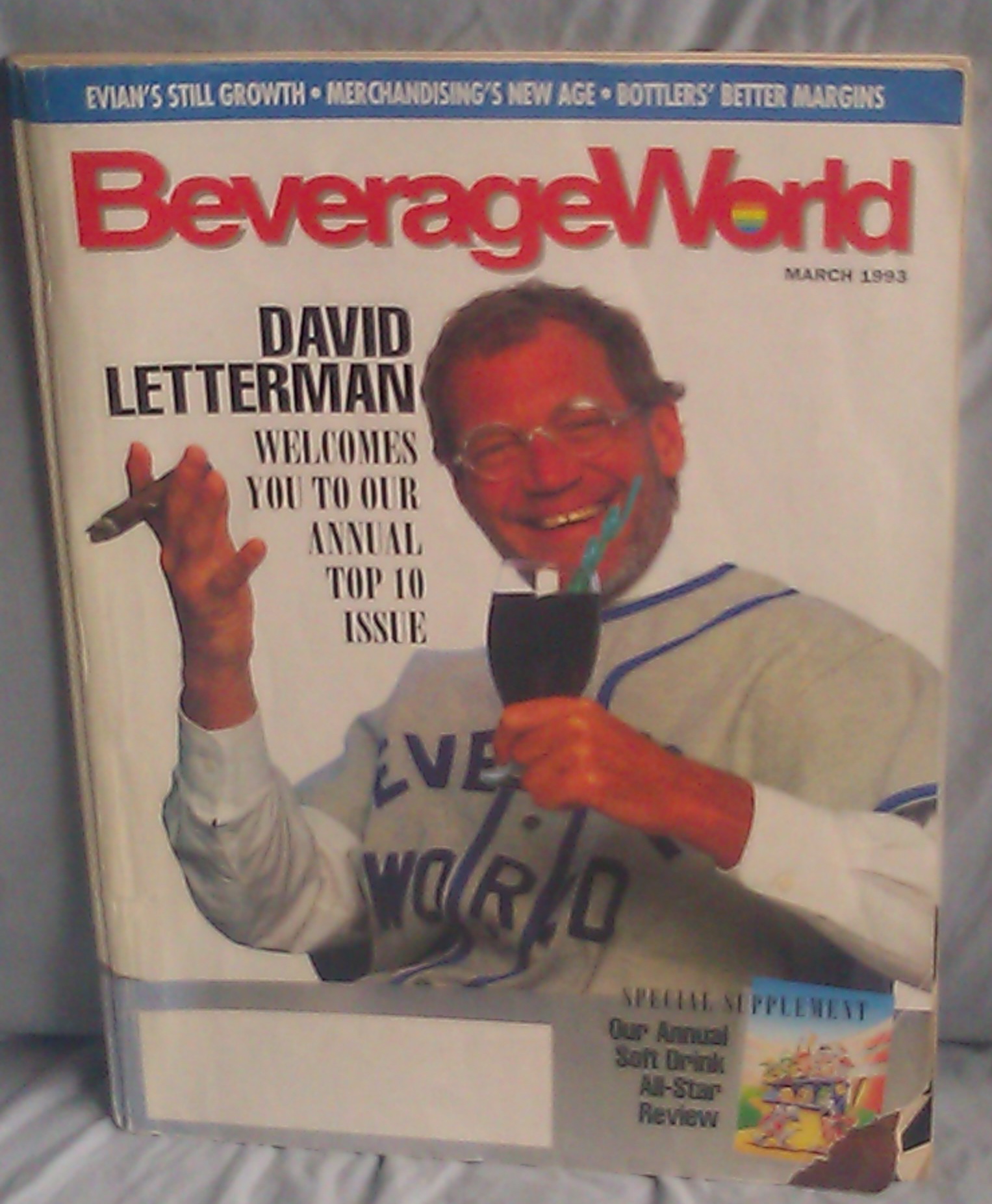
by Greg Prince on 21 May 2015 12:13 pm  Nice jersey, Dave. David Letterman built an impressive ratings lead once he moved from 12:35 AM on NBC and took over the 11:35 PM time slot on CBS in late August of 1993. All felt right with the comedic if not baseball world as that particular summer turned to fall. The guy who deserved to host The Tonight Show was kicking the ass of the pretender who wound up with the job. What Dave was doing on The Late Show was better, and I don’t just mean comedically. He took himself, his crew, his sensibility, his “brand” and built something from scratch that made Tonight irrelevant both critically and competitively.
Half of that equation didn’t last. The Jay Leno version of The Tonight Show never much improved, but the ratings flipped and eventually Letterman fell behind in the Nielsen standings. Dave couldn’t keep up with Jay and he also trailed Ted Koppel on Nightline. When NBC erected a billboard in Times Square to brag that their man was “#1 In Late Night!” CBS (at Dave’s urging) responded that theirs was “#3 In Late Night!”
Even Dave’s billboard was funnier.
The fleeting baseball point, if you haven’t inferred it coming down Broadway, is that the 2015 Mets are no longer #1 in the N.L. East. They topped the division for more than a month, but it didn’t last. Maybe it couldn’t last. The Washington Nationals have a powerhouse lineup, almost as strong as the one NBC fielded in prime time by the mid-1990s. Their ratings were bound to surge.
The Mets? They’re still the Mets. They’re still first in our hearts, despite nights like Wednesday, when it was obvious they were so looking forward to watching Letterman’s finale that they were distracted from the business at hand, a game they lost to St. Louis by the official score of a forfeit. When Bartolo Colon a) can’t parlay a ten-foot E-2 and advancement to second and third into a run because he doesn’t know from tagging up and b) finally walks a batter, you know it’s not their night.
By August 30, 1993, when Dave debuted on CBS, few nights of the season joined already in progress had belonged to the Mets. A victory over the Astros that Monday evening at Shea lifted their record to 46-85. They pulled to within 35 games of first place with the win.
Yes, that kind of year, one that had drawn decreasing amounts of attention, until a familiar voice spoke up. David Letterman, who’d been off the air for the two months when the Mets were definitively crashing through the floor of ineptitude and plunging into obscurity, had an instant, easy New York-based target for his nightly monologues and so forth. The 1993 Mets would no longer be allowed to fade into the offseason in private. In the last weeks of their conscious life, they were repositioned as a national joke.
Thus, Top 10 New York Mets Excuses, as broadcast by the host who was still very much #1 IN LATE NIGHT! on September 23, 1993.
10. All those empty seats are distracting
9. Part of a grand plan to make Florida Marlins overconfident next year
8. Pitchers on other teams throw the ball really fast!
7. Two words: Guaranteed contracts
6. Mistake to let Don Knotts bat cleanup
5. Play so much golf during season thought lowest score wins
4. Baseballs harder to throw than explosives
3. Drank Slurpee too fast; got a “brain-freeze”
2. Didn’t scratch themselves enough
1. No one named “Mookie”
In spirit if not fact, you couldn’t say any of this wasn’t accurate. The Mets’ record was 52-100 by then — were you really going to feel compelled to argue that Joe Orsulak and not Don Knotts was their previous game’s cleanup hitter?
I was a little miffed that Dave kept batting at the Mets piñata in the years to come, considering that no Mets team in what remained of his brilliant tenure was ever as awful as the one from 1993. Besides, I still remembered Dave winning a bet with the testy mayor of Houston in October of 1986 (an enormous photo of Mookie Wilson was supposed to be displayed at their city hall). I still remembered being giddily exhausted from having witnessed a tickertape parade on 10/28/86, listening to Bill Wendell introduce that night’s show as coming from “New York, home of the World Champion New York Mets,” and thinking that was the first time I’d heard a “straight” identification of Late Night’s hometown in the opening credits. I still remembered Dave, for no particular reason, setting up a projection screen in the Shea Stadium parking lot and beaming his show live to Flushing at 5:30 one summer afternoon when the Mets were out of town.
C’mon Dave, I thought as he took whack after whack at the perennially unsuccessful Mets, go easy on us. It wasn’t that long ago we were sort of there for each other.
But I couldn’t stay mad. He was Dave. He was the best. Besides, he had me on his show.
Albeit as a prop.
This was also in 1993, the first half of the year, when he was still the host of Late Night, though it was known that would be ending soon. This unfolded amidst the storm of coverage regarding the possibility Dave might replace Jay. Jay had succeeded Johnny Carson the previous May and it had been a debacle. Dave’s contract was running out. NBC wanted to keep him in literally the worst way — first by convincing him he should stay at 12:35, then by having him cover up their initial mistake for them.
Because the Late Night mind was always working, even under extraordinary stress, somebody there had an idea. Dave wasn’t doing traditional press…but what if he made his own kind of media tour?
With the conceit that he just wasn’t getting enough publicity, Dave’s people arranged for him to be on the cover of five aficionado/trade magazines you never would have heard of unless you had a very good reason to. One of them was the one I worked for.
We were contacted. Dave’s producer asked our editor-in-chief if he’d be interested in appearing. To our editor-in-chief’s everlasting credit, he asked if we could bring two editors: him and me. The producer said yes. We were also asked to bring a photographer or at least a camera to shoot him for our cover.
The bit was postponed once, what with Dave’s contractual limbo obscuring everything else at that moment, but we were rebooked once the dust settled. We were given a new date. I groaned when I realized I was scheduled to report for jury duty that day. I wrote a pleading letter to the judicial jurisdiction in question and asked for my own postponement in light of this singular opportunity. Bureaucracy had a heart and let me come later in the month.
Having been legally cleared to attend, I engaged the services of a legitimate fashion photographer, the husband of my wife’s co-worker. We were going to shoot David Letterman for the cover of Beverage World and were taking no chances on quality. Then we gathered four items: a curly straw (the photographer’s idea); a clear glass (from a set Stephanie and I had been given when we were married a little more than a year before); a can of a leading national brand of cola (we couldn’t show favoritism, which is why we needed the glass) and a custom-made BEVERAGE WORLD softball jersey. It had nothing to do with our company softball team. One of our advertisers made promotional items and the salesman whose account it was asked, in essence, “pretty please…?”
Come the big day, we gathered up our gear, ourselves and an offering for Dave (an assortment of oddball beverages they should feel free to use in Supermarket Finds, including a Lawrence Taylor sports drink which featured LT’s face on the label, which I was always disappointed didn’t come in a 56-pack) and alighted to 30 Rockefeller Plaza. Security signed us in and directed us to a dimly lit room that reminded me of the basement we had in our house when I was growing up. The segment producer met us there, allowed us to set up and, all of a sudden, we had our brush with greatness.
Dave walked in.
Dave. David Letterman. David Letterman whom I’d been watching since 1982. David Letterman who warmed my heart every time he made non sequitur reference to a “lovely beverage”. It was a natural that he and his staff chose us as one of the five magazines whose cover he’d grace. (The others, in case you’re interested, were Heavy Duty Trucking, Convenience Store News, Dog World and Cats.)
A few things I noticed right away: Dave was incredibly tall; Dave was incredibly tan in winter, having just returned from a post-CBS announcement vacation in sunny Bermuda; Dave hadn’t shaved; Dave was cordial; Dave introduced himself by name because how would have we known who he was otherwise?
From there, Dave put himself in our hands. We gave him the softball jersey. He threw it on over his shirt and tie and buttoned it up. We asked him to hold the glass with the unidentified cola and sip it through the curly straw. He immediately identified which leading brand it was. Whatever our photographer asked for in the way of posing, he went with. Our photographer shot Dave. Dave’s crew shot our photographer shooting Dave.
When the photo session was over, it was Late Night’s turn to use my colleague and me as props. We stood on either side of Dave and Dave riffed on beverages for several minutes. He wanted to know if 7UP was planning on “going brown” (which only true BevHeads by then recalled had happened in 1988 with 7UP Gold). He looked at me and told me it appeared I enjoyed a few beverages. I laughed. I knew enough not to attempt to match wits. Dave had enough wits for the three of us.
The segment producer decided they had enough and that was that. Dave shook each of our hands again, and was off, probably to prepare to knock out the next wacky magazine interaction. This was Monday, when they taped their bits. Everybody was on a schedule. We thanked Dave profusely. We thanked his crew profusely. We packed up our stuff. We left behind our Lawrence Taylor sports drink.
Not quite three months later, we were alerted we should watch the episode of April 30. It was our episode. We were part of a montage. Our names were on the screen. Dave was shown saying something funny to us. My colleague and I laughed. Dave’s BEVERAGE WORLD softball jersey was on television for the regular world to see. All the photo shoots were excerpted. At the end, each of the magazine covers came spiraling onto the screen. Ours was saved for last and landed in the middle, perhaps a testament to the value of hiring a fashion photographer, deploying an expert art director and putting some thought into context.
The other magazines were like, “Uh, here’s David Letterman on our cover for some reason.” We had serendipity on our side and decided to run with it. See, Dave was on the cover of our March issue, and the March issue of Beverage World was annually our Top Ten issue, the one where we published our rankings of the best-selling beverages in the U.S.A. I had written a Top 10 Reasons David Letterman is on the cover of this month’s Beverage World list to accompany the statistical feature. I’d share some of it with you, but little of it is funny 22 years later unless you were in the beverage business 22 years ago.
On the night of April 30, 1993, when I was a mostly silent and utterly cheerful component of David Letterman’s trademark “found comedy,” the New York Mets were 8-13. We didn’t yet know just how comical they were going to be by the time our host arrived at CBS. Dave, meanwhile, just kept getting better at what he did until he finally decided to stop in 2015, the night the Mets could no longer brag they were #1.
by Jason Fry on 20 May 2015 1:17 am Jon Niese has a suspect shoulder that demands periodic trips to the 15-day DL, and a mental approach to his craft that calls for the 80-year DL. He begins a game with a plan, and was born with the talent to execute it. But he’s incapable of adjusting if anything goes wrong, whether it’s his location or which pitches are working or his defense or the umpiring or bad luck or his horoscope or the U.S. dollar/Burundian franc exchange rate or whatever else doesn’t go exactly the way he thought it would go while he was in the consequence-free cradle of the bullpen.
Everybody has a plan until they get punched, to quote Mike Tyson (no, Baseball Reference, not that one) and Niese has a glass jaw.
But that’s not the real problem with Jon Niese.
(Nor is it that I detest him, though that’s also true.)
The real problem is that Niese is no longer better than the Mets’ other options for the starting rotation. Noah Syndergaard is ready for the big leagues — which doesn’t mean that he’ll dominate, just that he has nothing left to learn in Las Vegas. And Steven Matz is very close to that same status.
Last year this didn’t matter, because Syndergaard and Matz were part of the future. Now they’re part of the present, and the only way to discover what they’ll become is by watching them challenge big-league hitters and be challenged by them.
Niese’s days of becoming something, on the other hand, are over. He arrived in the big leagues seven years ago, and is one of four Mets with tenures that reach back to Shea Stadium. (Your others: David Wright, Daniel Murphy and Bobby Parnell.) We know Niese’s strengths, and oh boy do we know his weaknesses. He is what he is — a No. 4 starter who might have been more if not for injuries and his own limitations. That’s not news. What is news is that now he’s in a rotation with a bunch of potential No. 1s and No. 2s, and very soon there won’t be enough spots for everybody.
So trade Niese, right? Great idea, but who’d take him? Other teams see the injury history, the suspect mechanics and the dreadful body language on the mound. They hear the muttered postgame alibis and Terry Collins‘ barely suppressed frustration. (His comments tonight about Niese not using all his pitches were telling — as was Collins’ bafflement about what happened in Chicago.)
At the end of 2012 the prospect of having Niese under contract through 2016 (with two more years of club options) seemed like a bargain, but the Mets needed him then. Now that he’s in the way and the Mets don’t need him, the prospect of two more years of Niese is a gamble. The Mets are left hoping for a sucker at the table. Good luck with that.
* * *
Since we must, let’s talk about the game inflicted on us tonight. I seized a chance to catch up with an old friend and so saw the first two-thirds in snatches on a bar TV. Wait, Lagares didn’t catch that? Why is no one covering first? How many runs is that in this inning? What are the Nats doing? They’re playing them, really? Who the hell do I root for, plague?
When I got home I asked Emily if Niese had been unlucky or terrible. Her reply was that he’d been a little unlucky and then a lot terrible, which is too often the only Jon Niese scouting report you need. Beyond that, well, Murph had a quintessential Murph game, hitting a home run into the outermost precincts of Utleyville that delighted him and us, and then unaccountably abandoning his post on a bunt play that second basemen need to execute in their sleep. (Actually, narcolepsy would be a plausible explanation for some of Murph’s Murphiest moments.)
Oh, and Darrell Ceciliani — Met No. 996 if you’re scoring at home, which I hope the Mets are — got his first big-league hit. Soon after that, he got his first experience of ending a game by striking out. That kind of night. Really, the best thing about this one was that it ended.
|
|