The blog for Mets fans
who like to read
ABOUT US
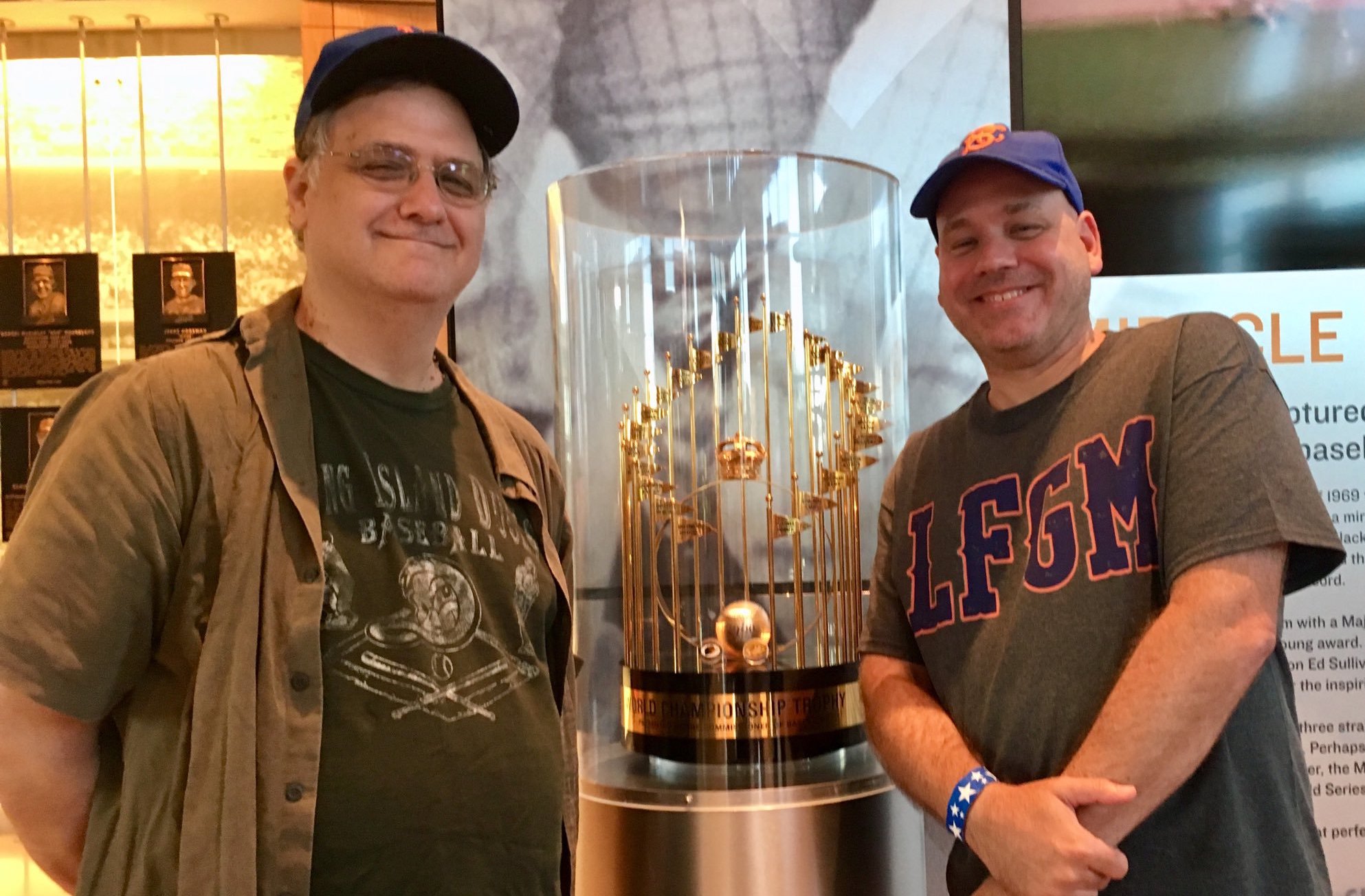
Faith and Fear in Flushing made its debut on Feb. 16, 2005, the brainchild of two longtime friends and lifelong Met fans.
Greg Prince discovered the Mets when he was 6, during the magical summer of 1969. He is a Long Island-based writer, editor and communications consultant. Contact him here.
Jason Fry is a Brooklyn writer whose first memories include his mom leaping up and down cheering for Rusty Staub. Check out his other writing here.
Got something to say? Leave a comment, or email us at faithandfear@gmail.com. (Sorry, but we have no interest in ads, sponsored content or guest posts.)
Need our RSS feed? It's here.
Visit our Facebook page, or drop by the personal pages for Greg and Jason.
Or follow us on Twitter: Here's Greg, and here's Jason.
|
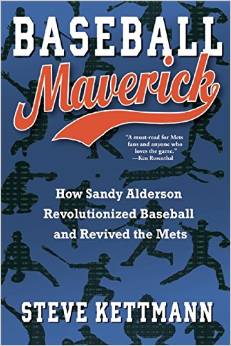
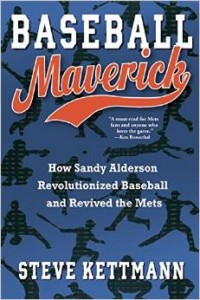
by Greg Prince on 8 May 2015 2:53 pm Not many books draw attention more for their subtitle than their title, but Baseball Maverick’s most striking come-on clearly sits below the marquee:
“How Sandy Alderson Revolutionized Baseball and Revived the Mets”
The unaffiliated reader might arch an eyebrow at the part in which one man is claimed to have transformed an entire sport, but that pales in comparison for shock value to the Mets fan who tried to comprehend, before the 2015 season began, that the Mets had been “revived”. It wasn’t difficult for an army of skeptics to summon contrary evidence.
Alderson took over from Omar Minaya as general manager following the 2010 season. The Mets’ record entering his GM tenure was 79-83. Four seasons later, their record was 79-83, with no higher spikes posted in the intervening years. Baseball revolutions notwithstanding, truth-in-advertising ethics suggested “…and Helped the Mets Hold Serve” might have been a more accurate, if not nearly as provocative, description.
 That’s some kind of subtitle. Between the time I picked up Baseball Maverick and the time I finished reading it, author Steve Kettmann (and/or the marketers at Atlantic Monthly Press) emerged as prophetic. The Mets had indeed revived, albeit in a small sample. When they rose to 13-3, I probably would have bought into anything that implied anybody having anything to do with the Mets was a maverick, a revolutionary, a benevolent wizard, what have you.
Things have settled down a bit from the loftiest heights of April, yet you would have to strain your inherent anti-Alderson animus to argue against the concept of a wholesale organizational revival at this moment. The big club is lodged in first place, the Triple-A affiliate has won fourteen in a row and three of the GM’s four top picks to date were, through Wednesday, batting at least .300 in the minors. While a clutch of holdovers from before Alderson’s takeover have played a major role at the major league level, the current team was, for primarily better if occasionally worse, Sandy-crafted.
Is there, then, a straight line to be drawn from the 2015 standings back to what Kettmann wrote? Do we leave his book’s final, post-2014 ruminations convinced Alderson transformed the Mets into something permanently better than they were — something they couldn’t possibly have been without the Maverick’s visionary leadership?
It’s hard to say that every time I watch something go right of late that I think I saw it coming because of a tidbit I read in Baseball Maverick. The book seems to take place in an adjacent if not exactly alternate universe to the one we’re used to seeing the Mets in.
In Baseball Maverick, the defining moment of the Alderson era is the trade of Carlos Beltran for Zack Wheeler, and Wheeler is a central figure in the revival of the Mets. Wheeler, you may have noticed, hasn’t pitched in 2015, when the supposed revival seems to bearing serious fruit. This, of course, could not have been foreseen by the author. Still, the emphasis on young Zack’s rise through the system, complete with recollections of how he preferred to sleep late when he was a Giant farmhand, feels a little off the beaten path, which is a direction Kettmann tends to wander toward a good bit. Besides tracking the ups and downs of Zack Wheeler’s minor league doings, there’s also a surprisingly lengthy visit in the midst of 2013 with Josh Satin, who might have been an engaging fellow but, save for a few hopeful weeks of on-base percentage, never loomed as more than a passing figure on the Met scene.
There are Aldersonian elements behind stressing Wheeler and including Satin. Zack was a big-deal prospect whose debut was hotly anticipated two years ago and he presumably continues to figure prominently in Met plans once he heals from Tommy John surgery. Satin’s plate approach was in line with that which the organization was known for preaching. You can make out what Kettmann is going for in these instances, it’s just that some of his pitches wind up a little off the plate.
Where the book fascinates and excels is in its first third, our introduction to Richard Lynn Alderson. Did you know only Sandy’s wife calls him Rich? Did you know Sandy ran a mild scam while he was in college so he could get into Vietnam? Did you know he was literally the poster boy for the United States Marine Corps? Did you know that his baseball baptism brought him into the crosshairs of one Billy Martin? This would be a spectacular life story to follow if you’d never heard of Sandy Alderson; it’s even better because you keep finding yourself thinking, “This guy? The guy from the Mets?”
Yeah, that guy. Kettmann draws him out and draws him well. Seeing how Sandy became “Sandy” was a treat. Perhaps it’s because of Kettmann’s background as an A’s beat reporter, when the proto-Moneyball Athletics epitomized baseball’s progressive movement, that Oakland Alderson comes across as a guy you really want to hang out with.
Eventually Sandy morphs into the version of himself we recognize in Queens, and the storytelling mission shifts from biography of a person to the instigation of that so-called revival. That’s the point where Baseball Maverick can frustrate the Mets fan reader. Kettmann brings an outsider’s perspective to our folkways, which can be valuable (a fresh set of eyes and all that), but it also gave me the sense that we were being viewed from an anthropologist’s remove.
Some of this results in a slightly hostile undercurrent. I can’t escape the feeling that Kettmann has little use for Mets fans, at least those who didn’t know enough (in his judgment) to sit quietly and wait patiently while the heroic Maverick built them a winner. “It’s very New York to celebrate one’s toughness,” the author writes, “and then mock new ideas and turn out in the end to be a follower. This is part of the charm of New York Sports fans; they grunt and scream and yell, but they also turn on a dime.” The Californian also doesn’t seem high on the traditional New York media, which he quotes for Greek chorus effect when it suits his narrative.
One passage struck me for what it didn’t mention. In a chapter focused on Alderson’s return to Oakland last summer, Kettmann notes Travis d’Arnaud homered against Scott Kazmir at the whatever it’s now called Coliseum. That pitcher-hitter confrontation occurred shortly after the one-decade anniversary of when Kazmir became a red-letter name in Met infamy, thanks to one of Alderson’s predecessors sending Scott packing in 2004. In hands more familiar with Met matters, I imagined a paragraph of background on the significance of the 2014 presence of Kazmir, the onetime prime pitching prospect in the Met scheme of things who had been traded too soon for too little. The surrender of Kazmir accelerated the path to the present Kettmann was exploring: the careless culture represented by the casting off of Kazmir; to the Madoff-fueled phase of Metsdom under Omar; to Sandy being hired to remake the Mets once more. It might have also been worth juxtaposing what Kazmir’s career turned out to be —occasionally very good but also injury-riddled and an illustration that nothing’s guaranteed in the company of surefire young arms — with what Alderson was hoping to derive from Wheeler, Harvey and everybody else.
Instead, Kazmir’s inclusion in the Oakland tableau went unremarked upon, while a couple of tweets from current A’s writers reporting Alderson’s hi’s and how-do-ya-do’s to old Coliseum friends were reprinted in full. It was a reminder that for all the delving into the Mets the author was doing, his background was in Alderson, not the ballclub.
Kettmann made some frankly weird choices along the way. In attempting to explain Mets history for the neophyte, he mined some esoteric detail: the scores of a pair of April 1969 losses to the Pirates; Cleon Jones’s 64 walks that championship season; Dwight Gooden raising his record to 4-0 on the day the Mets won their eleventh straight game in 1986. He mentions by name a buddy he brought to a game shortly after Juan Lagares was promoted, yet all we learn about “Dave” is that he preferred eating his hot dog to paying attention to the rookie center fielder. He goes to the trouble of describing a Las Vegas crowd on the night the Boston Marathon bombing case was cracked as having a “confused, edgy mood to it,” but there’s no payoff, 51s-related or otherwise, to that observation. His description of d’Arnaud’s early-2014 slump — “he’d wince like a guy who had just aggravated a nagging injury and mope on his way to the dugout, all but whistling a tune and crying out, ‘It’s so hard bein’ me!’” — simply overslid the metaphorical bag.
That said, there are a slew of delectable nuggets, gossipy and otherwise, scattered throughout Baseball Maverick. The “90-win” challenge, which was eventually dumped on Alderson’s head as if from an ice bucket, is well-dissected. Terry Collins, we discover, admires the hell out of Art Howe. Kettmann shares his experience as a Rookie of the Year voter and uses it to explain why Jacob deGrom broke through. Framing last year’s Mets as “a time-lapse photograph sequence showing growth in progress” fits perfectly. The last time we see that picture, with the Mets ending last season on a high note, it gives us a glimpse of Alderson processing what he and his lieutenants have wrought. On the final day of 2014, Kettmann finds Alderson (who doesn’t much like to watch a game at a game) in the Citi Field parking lot, listening in his car to a delayed satellite-radio signal when Lucas Duda strikes his 30th homer.
“I heard the roar of the crowd before I actually heard Howie describe the home run,” the GM said. “I knew something good had happened, but didn’t know what.”
I could say the same about Baseball Maverick, a work whose access to Alderson and attendant publicity makes it fairly essential reading for the history-minded Mets fan. Because this franchise’s time-lapse photo still had yet to be delivered from the dark room en route to 2015, it’s difficult to say this book provides the intensely curious reader a foolproof road map for How We Got Here. There are just too many odd little detours to keep the journey straight. But Kettmann built in enough fun pit stops along the way to make the trip legitimately enjoyable and reasonably enlightening.
by Jason Fry on 7 May 2015 12:21 am The Mets won a game tonight that was a little snoozy, frankly.
Jacob deGrom was pretty good, being more inclusive with the change-ups he’d left out of his repertoire in his last two starts. Kevin Plawecki came out during the game’s key at-bat by gigantic Orioles slugger Chris Davis and gave deGrom a little pep talk, after which everything went well. (Though deGrom kept missing his location rather thoroughly.) Dilson Herrera hit a home run. Daniel Murphy, our own Swobodan avatar of chaos, got between a runner and his route back to third base and everyone decided it was fine.
Oh, and Juan Lagares made a nice play in center. But honestly I could have that one on a hotkey.
That was really the entire game. One weird play by Murphy, just enough good hitting, the usual Metsian good starting pitching. Not a lot to wax poetic about, or that we’ll remember very long.
And you know what? That’s just fine.
 The Mets 11-game run of glory was exhilarating. Their 3-7 stumble while neither fielding nor hitting baseballs was deflating, to use a word much in the news today. The immediate proximity of these two states was exhausting — and it’s a long season. Too long to spend alternating laughing-gas euphoria and hide-under-the-bed despair. If that keeps up we’ll all look like end-stage Howard Hughes by Independence Day. The Mets 11-game run of glory was exhilarating. Their 3-7 stumble while neither fielding nor hitting baseballs was deflating, to use a word much in the news today. The immediate proximity of these two states was exhausting — and it’s a long season. Too long to spend alternating laughing-gas euphoria and hide-under-the-bed despair. If that keeps up we’ll all look like end-stage Howard Hughes by Independence Day.
An unmemorable 5-1 win? I’m fine with it. Just like I’d be fine with some 3-1, 5-2 and 4-1 snoozers, games you can watch with one eye half-open and a bit of drool on the pillow.
Though if they want to bulldoze the Great Philadelphia Tire Fire this weekend, I’d be fine with that too. Whatever works.
* * *
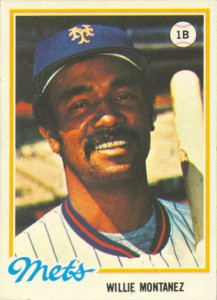
By the way, Willie Montanez got mentioned during Jim Breuer’s entertaining appearance in the booth tonight, which reminded me of the Montanez card I didn’t know existed until a few months ago.
That’s Montanez’s 1978 Topps “Zest” card. What the heck’s a Zest card? Well, in ’78 Topps was trying to market itself to Spanish-speaking baseball fans, and it chose to work with Procter & Gamble with a promotion tied to Zest soap. Send in (to Maple Plain, Minn., inevitably) two labels from Zest bars and an order form and you’d get (in six to eight weeks, inevitably) a pack of five baseball cards. (Here’s a bit more on the set.)
The players were Joaquin Andujar, Bert Campaneris, Manny Mota, Ed Figueroa and Montanez. Other than bilingual backs and different numbers, the cards looked the same as regular ’78s. Well, except Montanez was a newly minted Met. He’d been a Brave in the regular ’78 set, but for Zest he was remade as a Met, with a much better photo. (O-Pee-Chee also had him as a Met, though they kept the Brave photo.)
Great card, ain’t it? I’d go so far as to call it a cardboard classic. Nearly 40 years later, the Zest cards remain both plentiful and pretty cheap. Get yours today! Odds are you won’t even have to send money to Maple Plain or wait six to eight weeks.
by Greg Prince on 6 May 2015 12:40 am What the hell’s so funny about Bartolo Colon? After a year and a month of watching him practically every fifth day, I have to admit I don’t get the joke.
He’s older than everybody. He’s rounder than everybody. He says less than anybody. He swings through almost everything. His batting helmet flies off with little provocation.
Yeah? And?
The Orioles are probably wondering where the absurd aspect of one of the best pitchers in the National League lies. Every time they see him, no matter what jersey he’s wearing, he gives them nothing to grin about. He left them good and grim Tuesday night at Citi Field when he beat them as a Met, just as he has previously defeated them as an Indian, an Angel, both kinds of Sox…basically everything he’s ever been except an Expo.
We tend to laugh with rather than at Bartolo Colon, but we do laugh, probably because he’s so different from his modern pitching contemporaries and we are conditioned to respond to extreme otherness. Somewhere Colon probably chuckles at the fuss he inspires around here. Probably. Maybe. Really, I don’t know. He’s pretty serious where we usually see him, on the mound, busy locating his fastballs, picking up most of what’s hit into his vicinity and generally throwing what he finds where it’s supposed to go (an underrated aspect of his job).
His almost uniformly helpless at-bats I curmudgeonly don’t find as amusing as most do. Bartolo, I’m thinking, you’re not helping my anti-DH argument any. Lightning striking once or twice a generation by way of his bat hitting ball and him hitting the first base bag briefly restores my faith, but it also unleashes a thousand pats on his intermittently helmeted head. I think he deserves better; I think he deserves a little less condescension. If Colon had an ounce of offensive talent, we probably wouldn’t declare international holidays every time he did something at the plate other than draw applause for not falling down (and standing ovations when he comes perilously close to leaving his feet).
Then again, Sandy Koufax famously couldn’t hit water falling out of Fred Wilpon’s rowboat built for two and it wasn’t that big a deal — but they didn’t have GIFs in those days.
I doubt any of it bothers Bartolo. Does Bartolo seem perturbed? Does Bartolo seem anything, come to think of it? It’s all about “seem” since he hasn’t gone out of his way to communicate through translators to reporters to the rest of us what’s on his mind. His teammates swear by him, which is one of those things that usually gets said about guys who don’t say much to the media. Taciturn Eddie Murray’s teammates (save, perhaps, for Eric Hillman) swore by the future Hall of Famer. Bartolo Colon, who has been beating the Orioles so long that the lineups he used to thwart were peppered with ex-teammates of Murray’s, is never referred to as taciturn. He’s not exactly a sphinx, either. He certainly hasn’t gone indefinitely mum as Steve Carlton unappealingly did in his heyday.
Colon simply doesn’t speak for public consumption on any kind of regularly recurring basis. If you want to say he lets his pitching do the talking, then we don’t mind listening. Over 7⅔ innings, here’s what Bart told the O’s: 9 strikeouts, 0 walks, 6 hits, 1 run.
There wasn’t much they could say in return.
The Mets’ offensive juggernaut, meanwhile, revived for exactly one inning, the fourth. It was fueled by Lucas Duda (double), Daniel Murphy (single), Wilmer Flores (double) and Kevin Plawecki (double), allowing it to score three times off Bud Norris. Colon and Jeurys Familia each gave up a solo homer and Juan Lagares gave up nothing, especially ground to Michael Cuddyer, who apparently forgot his job on defense is to not get in the center fielder’s path, even if that path winds toward left. Lagares made a sensational catch, which isn’t news. He avoided getting kicked in the chest by Cuddyer while doing so, which is a relief.
It all added up to a 3-2 Mets victory, an end to the suspicion the Mets would neither score nor win ever again, and a little more to admire about the starting and prevailing pitcher. Bartolo Colon, inching up on 42, has a record of 5-1 and a legend that just won’t quit.
Nothing to laugh at there, but plenty to smile about.
I joined Vinnie and Mike on the Blue and Orange Nation podcast, where the name “Frank Taveras” got itself mentioned pretty quickly. Steal away and listen here.
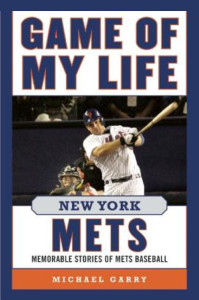
by Greg Prince on 4 May 2015 3:41 pm Of the 25 fine reasons to read Game Of My Life: New York Mets, perhaps the one that comes out of the farthest reaches of left field is the best. That’s the chapter author Michael Garry devotes to Eric Hillman.
Eric Hillman you probably remember if you were an active Mets fan between 1992 and 1994. The “game of his life” — a Sunday afternoon shutout at Dodger Stadium — you would need a very good reason to specifically recall. But Hillman was a Met for three years when the Mets weren’t very good, he beat L.A. when he was completely on, and thus it makes for an element worth telling within the larger Met story. Hillman is a character worth revisiting, especially when you learn, via Garry’s reporting, what the rest of his life’s been like, particularly a moment when he reconnected with a fan from his playing days.
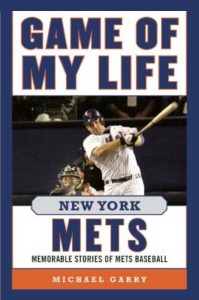 You don’t have to be a David Wright to have a great Mets story to tell. I won’t tell you what happened, but it’s a beautiful coda to the career of a Met you likely haven’t thought of lately. Game Of My Life has episodes like those sprinkled throughout, catching you up on an eclectic array of 25 Mets who laid down their historical markers between the 1960s and the 2010s. I’m guessing Garry’s publisher probably pushed him to pursue the biggest names possible (in his introduction he describes in detail who he went after and how his success rate varied), but the real treat lies within the chance to check in on Eric Hillman’s good day at Dodger Stadium; Anthony Young before he became known for an almost endless string of losses; Al Jackson, who keeps on instructing Met youngsters more than a half-century after he was one himself; and a few more guys you might or might not expect to read up on in a volume like this.
Garry gives us time with 1969 World Series Game Two hero Ed Charles, who we know never disappoints in his recollections. He drops in on Wally Backman, who takes us back to the day the Mets wouldn’t leave the Astrodome until 16 innings of heartstopping, pulsating baseball resulted in a New York pennant. He provides Bobby Jones an opportunity to piece together his clinching one-hitter from the 2000 NLDS. He shows us that not every “game of my life” is obvious when Daniel Murphy skips the opportunity to emphasize himself and prefers to retrace the final Saturday at Shea, Johan Santana’s breathtaking three-hitter to keep the 2008 Mets mathematically alive, the last time (until now, we hope) Daniel played for a contender. Murph doesn’t know it, but in doing so he echoes Buddy Harrelson, who chooses the day the Mets won it in all against the Orioles as the game of his life, even though Harrelson wasn’t one of the stars of glorious Game Five.
The book hits every era of plenty in Mets history and several of the eras of less-so. Each of the 25 players profiled (most of whom sat and talked to Garry, though a handful of chapters had to be cobbled from outside accounts) is given a respectful hearing and adds something to the overall theme. Our narrator presents himself as a lifelong Mets fan and gives the proceedings a light, loving touch.
We recently spent eleven consecutive games celebrating our ongoing affection for the Mets. Regardless of how often we’ll get to do that on a going basis for the rest of this season, Game Of My Life will give you plenty of cause to celebrate your fandom all over again
by Jason Fry on 4 May 2015 1:35 am My absence from Citi Field has ended. Thirteen months after I was last there, I returned with Emily and Joshua for a game under sparkling skies. We had tacos. We caught up with friends. We ate ice cream (with blue and orange Mets sprinkles). We eyed the new scoreboard and declared it a nice addition, though not one that cried out for multiple press releases. We complained about “Piano Man.” (Sorry, blog partner.) We navigated the new longer lines and seemingly randomly placed metal detectors. (A tip: Use the bullpen gate.) And we cheered for the Mets.
It was a wonderful day … except for whatever those guys in orange and blue down there on the field were doing.
We’re into the second month of the season, which isn’t too early for a scouting report on the 2015 Mets: They’ve got very good pitching, iffy hitting and wretched defense.
Dillon Gee was very good, and the relief corps was terrific, particularly turbaned Alex Torres, who came in with the bases loaded and nobody out and struck out the side.
The hitting, ugh. The Mets put two men on to begin the first and squandered the chance. Then, down 1-0 in the eighth, they were a Lucas Duda fly ball from tying it. Duda fanned on a diving slider that was low and outside. Michael Cuddyer then struck out on a check swing at a slider that hit the ground. Kevin Plawecki‘s double was the lone extra-base hit.
Yet once again, it was the defense that proved the Mets’ undoing by giving the Nationals extra outs. This time the culprit was Ruben Tejada, who botched a transfer on a double-play feed from Dilson Herrera. That led to a Ryan Zimmerman broken-bat parachute that plopped onto the outfield grass behind Duda, and the only run Washington would need.
In other words, it was pretty much a Xerox of Saturday’s game, and about as much fun.
Oh, Ruben Tejada. He made a terrific snag of a ball to his right on Saturday night, but the routine plays have eluded him. Which sounds like I’m describing Wilmer Flores, currently waiting out a head-clearing three-day vacation from shortstop. Except Flores can hit, to the extent that any Met can hit right now. Your answer to “Who the heck can keep us from losing games at shortstop?” appears to be someone not currently on the big-league roster.
That question is taking on increasing urgency. The Mets can’t outhit their own mistakes while missing David Wright and Travis d’Arnaud, absences that have left Duda basically naked in an underwhelming lineup. (I have faith that Cuddyer will hit — he’s done so his whole career — but really wish he’d start proving me right.)
Until Wright and d’Arnaud return, expect more games like today’s — games that will come down to which team converts outs more reliably.
Judging from the last week or so, that’s not a reason for optimism.
by Jason Fry on 3 May 2015 1:59 am Useful reminder: Baseball will drive you crazy if you let it.
Every so often a thought creeps into my head that I immediately try to shoo away: It’s that the team that wins the World Series will be the good team with the best luck, the one that has the fewest guys injured and the most bounces go its way.
For a small-scale illustration of the point, I present last night’s Mets-Nats tilts. It went 1-0 to the Nationals, with Gio Gonzalez topping Jonathon Niese in a matchup of pitchers who were pretty good and mainly separated by the quality of their luck.
It’s not exactly a secret that I don’t like Niese, but tonight there wasn’t much to criticize. His location was off, but he hung in there and pitched an excellent ballgame despite having to deal with an umpire’s random strike zone, a really good team trying to beat him, and a whole lot of bad luck.
Every time you looked up a ball was glancing off the end of a Met’s glove, or drifting just over a leaping Met’s head. The fatal blow struck by the Nats came in the second on an infield single that Daniel Murphy couldn’t quite reach at third. Meanwhile, everything went Gonzalez’s way. Lucas Duda‘s long drive to left in the third wasn’t quite long enough to escape Citi Field, and the Mets had two runners erased trying to push things against the Nats’ defense.
The first erasee was Juan Lagares, who tried to score from first in the first on a double by Duda. Lagares was out from me to you, sparking muttering, but I thought it was a good gamble by Tim Teufel. Look at the replay and you’ll see both Jayson Werth and Ian Desmond made terrific plays to get Lagares. If either man is less than perfect, Lagares probably scores, Duda’s on third and the Mets are threatening to grab a decent-sized early lead against Gio.
The second erasee was Dilson Herrera, who hit a Baltimore chop through Danny Espinosa with two out in the sixth and saw a chance for a 100-foot double. Herrera ran through first and immediately scooted for second, left unoccupied amid the tumult — but Desmond quickly retrieved the ball and Espinosa had the presence of mind to beat Herrera to the bag and record the out. An error of enthusiasm, Terry Collins called it, but I liked the instincts Herrera showed — runs were precious, and Washington had to do everything right to get him out. It didn’t work out, but it was far from a terrible idea.
That’s how it goes — baseball can be maddening, which is why players retreat into placid cliches. Sometimes things bounce your way and sometimes they don’t, and sometimes the bad breaks arrive one after the other. When that happens, the only thing you can do is hope it’s not true the next day.
So. I hope it’s not true the next day.
by Greg Prince on 2 May 2015 11:30 am The other day I visited my ophthamologist for one of those comprehensive examinations that includes drops in both eyes. Once it’s over and you step outside, you basically enter a Soundgarden video. Everything is ridiculously bright and slightly surreal. It’s why, in the event that you don’t carry shades, they give you a Rollens, not to be confused with a Rollins, which would probably be past its “best used by” date. The Rollens fancies itself “the largest selling wraparound lens in the medical market.” You know it better as that unattractive thing you wear until everything looks reasonably normal again. The effect is more dark night than Dark Knight. An hour or so from the sun refusing to glare demonically in my face, I reluctantly slipped my Rollens under my glasses, planted myself in my parked car and returned a phone call to my forever friend Chuck.
As I waited for my pupils to undialate, Chuck and I spent approximately the next 50 minutes catching up — 45 of them devoted to the Mets, probably 35 of those devoted to Matt Harvey. You might think I drove the agenda, but the Mets talk was Chuck’s idea. Chuck, you see, has been out of New York for more than a dozen years and isn’t as tuned in to Mets matters as he could be. I should also point out Chuck is something of a bandwagon fan. He wouldn’t take offense at that description. When the Mets are going well, he’ll alert me that he’s “back on the bandwagon”. It’s been a running joke of ours for more than 30 years. Pretty much everything has been a running joke of ours for more than 30 years. It’s when the Mets aren’t a running joke that we can sit on the phone and dissect the Mets for minutes (or hours) on end.
While I sat in my old Corolla wearing an old Mets jacket talking to my old friend, I remarked that this was, in fact, the 30th anniversary of the day I graduated from college, the place where Chuck and I met 31 years ago. If our alma matter issued eye tests in lieu of final exams, this was probably exactly how I would have killed the recovery time in 1985: same model of car, same model of jacket, though probably needing a pay phone with an exceedingly long cord. Not that much changes between Chuck and me. Thirty years earlier, he would have spent most of our conversation peppering me with several versions of the same question he asked me about Matt Harvey, except they would’ve been about Dwight Gooden.
“He seems really great. Is he that great?”
And I’d have the same answer.
“Yeah. He’s great. He’s really that great.”
Examples, anecdotes, quotes, statistics, repeated affirmations and apt comparisons would follow. Harvey to Gooden. Gooden to Seaver. Plus salutes to Carter and Hernandez and Strawberry, nowadays digressions to Duda and deGrom and Lagares (“Is he new?” Chuck asked earnestly from his geographically and psychologically remote location), back eventually to a) the ace of the staff and b) the state of the team, each of which, I was happy to confirm, was great…really that great.
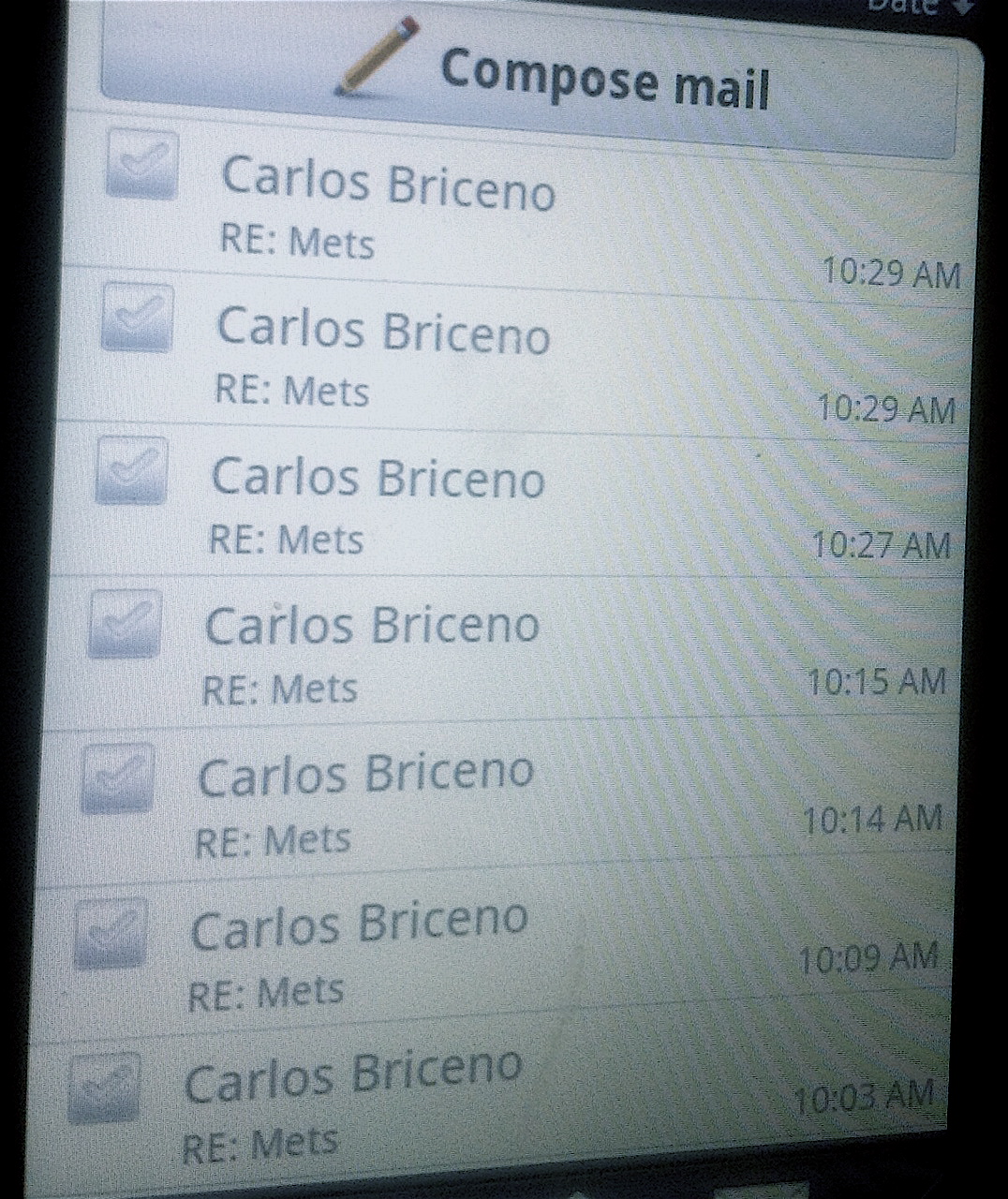
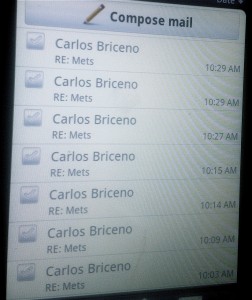 A conversation three decades in the making continues. This was Tuesday afternoon. By Friday morning, it was my turn to help him kill time. Chuck was getting his oil changed, so he reached out to me. Much of our interaction over the past decade has come while Chuck is taking care of an errand. When I hear from him, I usually also hear a loudspeaker voice instructing him to drive around, his order is ready. In this case, he chose to e-mail instead of call. The result was a rapid-fire exchange that filled up my phone’s screen with a stream of messages titled “RE: Mets”.
The tenor had changed in three days’ time. The Mets had done little to no wrong when he spoke with me in the eye doctor’s parking lot. Now, with him in a car dealership’s waiting room, everything had gone at least temporarily to hell. Or in the surest sign of the times imaginable, Chuck let me know, “I am another loss or two from jumping off the bandwagon.”
He was kidding. But he wasn’t.
Chuck always keeps one toenail permanently lodged upon the Metsopotamian conveyance, safe in the knowledge that I’ll always save space for the rest of him when he’s ready to fully commit again. The great thing about Chuck is when he’s in, he’s all in. He was more tangibly shaken by the Mets’ three-game losing streak than I was, ready to threaten unspeakable actions against any pitcher who doesn’t pitch to Harvey’s standards (which, given Chuck’s sense of righteousness and proportion, would lead to the need for many bandages and an overworked rotation of one). Sometimes I think Chuck is my Mets id, espousing deep-seated truths without a second thought wasted on consequences. Or maybe Chuck is just too in and out of the Mets loop to fully grasp they’re never as good as they look when things are going swell or as bad they look as they look when things are going lousy.
Actually, Chuck gets that, too. He signed off from Friday morning’s frenzied e-mail dialogue admitting, “I don’t know how you do this week after week, month after month, year after year. I’m not kidding. It’s exhausting worrying about a team over a 162-game season.”
And this was after only 23 games.
The 24th game came Friday night, and although I fell asleep not long after it was over (a symptom of being old enough to say “I graduated from college 30 years ago this week”), I came out of it rather refreshed. Not necessarily from Matt Harvey being as great as Chuck and I think he is — though that surely helped — but from getting it through my gray-templed head that this 162-game season indeed has to play itself out, otherwise I won’t be able to do this week after week, month after month.
I didn’t have to take a logic class my freshman year to understand that (though I did and it was quite useful), but every now and then a reminder comes in handy. When they caught lightning in that 11-game bottle recently, I was honestly intoxicated by the contents. Are these really the Mets? Is this what the Mets do now? Are we the kings of baseball in every discernible way?
Then came the Mets not being all that. There was a blessedly typical successful Harvey Day last Saturday and a ninth-inning bolt from the blue on Monday, and otherwise it was nothing but sucking for a solid week. We’re still emerging from nothing but sucking for a solid six years so don’t toy with me, Mets. Don’t send me mixed signals. Don’t make the bandwagon skid off course.
Friday night, as Harvey and Max Scherzer filled the roles once inhabited by Dwight Gooden and John Tudor (and Tom Seaver and Steve Carlton before them), I think I finally relaxed. A strange thing to do during a tense, taut affair that for eight innings could’ve gone either way, but it felt like neither an unsustainable coronation nor a plunge into the ditch off the side of the road. It felt like a competitive baseball game between two teams that belong on the same field.
Which is all I ever wanted. Well, all I ever wanted was 1986 over and over again, but I probably comprehend that was a once-in-a-lifetime happening (though even then, when the Mets followed their 20-4 start with a 2-5 stumble, I’m pretty sure I grew briefly but substantially antsy). This here isn’t 1986. For eleven games nothing went wrong except for injuries to key players. Injuries to key players are something wrong, even if it doesn’t register immediately. The important thing was that whatever goes wrong on an interim — we hope — basis, nobody is empowered to excise the 13-3 start out of the books. It served as a catapult, it remains a cushion and it should be a comfort as we go forward and try not to be the 1987 Brewers, a team that started 13-0 yet finished out of the running, albeit in the days when third-place teams couldn’t possibly gain entry to the postseason.
No disrespect to Teddy Higuera, Bill Wegman or Juan Nieves (author of a no-hitter in the midst of those lucky 13 consecutive wins), but the 1987 Brewers didn’t have Matt Harvey. As long as the 2015 Mets have Matt Harvey, it seems most losing streaks won’t have a chance to exceed four.
If Harvey was going to be beatable, it might have been Friday night against the nemesis Nationals playing at their Citi Field pied-à-tierre. Washington had Scherzer, who was totally on. Harvey wasn’t quite as formidable on the surface. Maybe it was just one of those nights when the fastball wasn’t his best friend, but he didn’t have his classic ace stuff. Classic aces, however, make other stuff feel just as friendly when they have to. Matt became a masterful offspeed pitcher for the night and the results were characteristically magnificent.
Seven innings for Harvey, no runs, not much trouble. Scherzer was more dominant over the same stretch — exactly as few hits (5) and walks (1) allowed, but 10 strikeouts (versus 3 from the Darkest of Knights). Max’s only problem was the Mets’ decision to pull in that right-center field fence, the one over which Michael Cuddyer’s fly ball flew in the fourth to stake Matt to a 1-0 lead.
It stayed 1-0 until both aces shuffled back into their decks. That was mostly from their mutual doing, with a cameo here and there via suspects usual (Juan Lagares’s glove, which stifled Ian Desmond’s extra-base initiative) and otherwise (video replay review, which found an angle to tag out Bryce Harper at second). The eighth became the bullpen show, which worked well for the Mets, when Jeurys Familia came on for an extended cameo, and less so for the Nats, when Matt Thornton and Blake Treinen teamed to load the bases for Daniel Murphy. Murphy lofted a sac fly to Jayson Werth who criminally mangled it into a three-run double. It was fun to watch Werth stumble around in left, but either way, the 1-0 lead was going to grow. It grew more than envisioned to 4-0, which Familia kept beautifully intact.
When it was over, the Mets were 4-0 winners, Harvey was a 5-0 pitcher and I was content that despite the recurring yips even a good season will give a seasoned observer — one who’s fearful Wilmer Flores’s range is where infield outs will inevitably go to die — the Mets are neither wholly unstoppable nor hopelessly incapable. They’ve won three of their last eight, after all.
As for Chuck, I’m pretty sure he is still on the bandwagon. He hasn’t contacted me yet to alert me otherwise.
by Jason Fry on 1 May 2015 12:35 am OK, show of hands. Back in February, who’d have taken ending April 15-8 and in first place by 4 1/2 games?
Yeah, I thought so.
And yet here we are in the opening hours of May and everybody’s unhappy.
The bullpen’s gone to pieces. The bats haven’t been productive. And most glaringly, the defense up the middle has fallen apart.
Thursday’s game started off happily enough. The Mets put two men on in the first but came up with nothing when Daniel Murphy scalded a ball straight at Bryce Harper in right. No matter: In the second they went to work against a discombobulated-looking Stephen Strasburg, following doubles by Wilmer Flores and Kevin Plawecki with a Curtis Granderson single for a 2-0 lead. Come the top of the fourth and Jacob deGrom was cruising, looking much stronger than he had against the Yankees. He walked Denard Span, giving the Nats their first baserunner of the game, but no worries: Yunel Escobar hit the Platonic ideal of a double-play ball to Flores. Five seconds later it was two out and none on, and —
SCREECH.
Ahem. Wilmer started to toss the ball to Murph while still corraling it and it squirted free. Two out and none on became its ghastly inverse. By the time the inning was over it was 3-2 Washington, all runs that shouldn’t have scored. Two innings later deGrom got whacked around and left down 5-2. Some shoddy bullpen work made it 8-2 if anyone was still paying attention. Meanwhile, Strasburg had settled in and the Mets were hitting balls with authority — and in woeful proximity to Nationals fielders.
So much for that unbeaten record at home — and for the giddiness of last week. I warned you it would happen, but it still hurts: That 11-game winning streak feels like something that happened a century ago, for fans in bowler hats to admire by the light of gas lamps.
The rest of this post was going to be an examination of Flores and a call for patience, albeit one made through gritted teeth: Can he play shortstop at the big-league level? (Too early to tell, but we all have a bad feeling about this.) Does he deserve more rope? (Yes — 40 games is generally considered a fair test.) Can he add more at the plate than he’ll subtract in the field? (Insufficient data but the early returns seem promising.) Was it fair for the cash-strapped, perennially Plan B-less Mets to thrust him into the responsibilities of shortstop? (No.) Are the fans who booed him tonight at Citi Field clueless cretins who should be kicked in the shins? (Definitely.)
With everyone still grumbling about the game, the Mets announced a roster move, and it isn’t one of their recent bench-dog-for-bullpen-cat swaps. Rather, they’re recalling Dilson Herrera.
Which made me happy, despite the attempt to be patient.
No, Herrera’s not a shortstop — putting him there would be unfair to two players instead of just one. But he is a second baseman, and Daniel Murphy hasn’t exactly covered himself with glory defensively in 2015 either. The smart money is that Herrera will spent the rest of David Wright‘s absence at second, with Murph moving over to third and Eric Campbell — who’s looked overexposed of late — going to the bench. (This isn’t meant to insult Campbell — he’s smart and a good asset, just probably not a big-league regular at this stage of his career.)
That leaves Flores at short, and we’ll see how that works out for the next week or so. So yeah, it addresses half the problem. But I find myself liking that the Mets aren’t waiting around until that hot start cools into nothing. They’re moving with a sense of urgency we haven’t seen for a while. Which isn’t the same as moving with a sense of urgency and the pocketbook of a major-market team, but one step at a time.
Dilson for a week and then we’ll see. Not the most stirring slogan, perhaps, but preferable to where we were a couple of hours ago. And hey, we are still 15-8 and in first place. You just said you would have taken that, remember?
by Greg Prince on 30 April 2015 9:17 am The phone rang while I was catching up on my Nashville — Juliette Barnes is quite the handful — after I finished watching whatever it was I watched the bulk of Wednesday evening. It was the copy desk calling. Apparently I was keeping them waiting.
“Yeah?”
“Where’s your recap?”
“What recap?”
“It’s your night to recap the Mets game.”
“No, I only do wins.”
“What do you mean you only do wins? You do games.”
“I do winning Mets games.
“Yes, when the Mets win, you do those. And when the Mets lose…”
“I don’t know what that is.”
“Don’t know what what is?”
“That phrase you used. ‘The Mets lose.’”
“Stop kidding around. The Mets lost to the Marlins, 7-3, Wednesday night. It sucked, but it’s your turn to write it.”
“I told you, I only do wins. I haven’t done a loss since April 8, which was the second game of the year, and I was pretty prickly about it then. I don’t think I know how to do that kind of game anymore.”
“Don’t give me that. You’ve been doing losses forever. They come with the territory.”
“That was the old me.”
“The old you?”
“Yeah, the one who could relate to the Mets losing, the one who’d figured the Mets were more likely to lose than not, the one who sometimes was vaguely disappointed when a win would get in the way of what I was planning to write about a loss. That’s not me anymore.”
“It’s not?”
“Hell no. The new me has been writing up wins and nothing but wins for eleven consecutive game recaps. The new me writes from a position of elation. The new me walks around in a state of bliss, accepting observations from strangers who see my Mets jacket and say things like, ‘You must be loving this,’ to which I say, ‘Oh, I definitely am!’ And I definitely have been. Now you want me to go back to moping around and nobody saying a thing to me when they see my Mets jacket or saying something like, ‘Tough break for you guys’? You want me to go back to that losing mindset after weeks of practically uninterrupted winning?”
“I want you to write about the game is what I want. Cuddyer homers, Leathersich debuts, Ichiro ruins everything. Plenty of angles to pick apart. Win or lose, it’s what you do.”
“But I like the new thing I do, where I write about the win and everybody reads about the win and we all congratulate each other on the win and then there’s another win. The Mets on a two-game losing streak? That’s beyond my current scope of comprehension.”
“Enough with the excuses. We need your recap. The Mets lost, deal with it.”
I hung up on the desk, finished watching Nashville and a couple of other things on the DVR, then fell asleep not wanting to think about the Mets not necessarily winning every single game, which I swear I had begun to think of as the norm, contrary to precedent, evidence and logic that said it couldn’t go on forever like that. That’s how I dealt with it.
Then I woke up and they still lost. Oh well, gotta deal with it eventually.
by Jason Fry on 29 April 2015 12:24 am First off, why do I always have to recap the losses? I need to speak to management.
If you thought a 15-6 start meant a moratorium on asking what Terry Collins is thinking, well, you weren’t checking in with Mets Twitter as tonight’s game got away.
Why pitch to Giancarlo Stanton when you don’t have to? Why have Ruben Tejada bunt with Daniel Murphy on second and no one out? Why, after it turned out Terry gave Ruben the choice to bunt or swing away, let Ruben Tejada choose to do anything? Why leave a struggling Carlos Torres in for the fatal pitch with Michael Morse? WHY GOD WHY?
I asked all of those questions myself, and agreed with some of the insta-rage when things went badly. But not all of it. Deep sigh. Where to start?
How about with the fact that Rafael Montero pitched pretty well? Unlike the loss in Atlanta, he mixed his pitches effectively instead of trying to set a record for most consecutive fastballs thrown. And the confrontation with Stanton came down to one missed location — Montero had craftily worked Stanton in and out on both corners, but one pitch drifted a little too far and one of the best hitters in the game didn’t miss it. The end result wasn’t good, but it seemed like a step forward for a pretty talented young pitcher.
As for Tejada bunting, well, I wasn’t against the idea. (I’ll take Tepid Endorsements for $100, Alex!) You’re trying to maximize the chance of scoring at least one run and thereby accepting less of a chance at a big inning, but with a cold Kirk Nieuwenhuis, Anthony Recker and the pitcher’s spot behind Tejada I was OK with trying to grab the lead and keep it for six outs. What I wasn’t OK with was Tejada bunting horribly so that Murph was a dead duck at third. The next time I’m for that idea will be the first.
Then there were Torres’s labors. Carlos walked Martin Prado, popped up Stanton, walked Marcell Ozuna and then gave up the liner up the middle by Morse. Ironically, for all that Terry’s been guilty of riding relievers into the ground, the problem might have been that Torres hasn’t worked enough recently and so wasn’t sharp. As for Terry preferring a veteran trying to figure it out on the fly to Erik Goeddel or Hansel Robles (let alone Jeurys Familia), what can you say? Definitely conservative with a hint of mustiness, but not out-and-out crazy.
Maybe I’m just tired, but I find it hard to get too worked up about managers’ decisions and tics. Managers do a lot more damage consistently giving innings and at-bats to bad players then they do selecting matchups and bunting in specific situations, and these days the Mets seem to be keeping Terry on a tight leash in terms of personnel by denying him the likes of Eric Young Jr. and Bobby Abreu. (No, I wouldn’t put Michael Cuddyer in that group — dude can still hit, and has had some terrible luck so far this year.) A good manager might get you a win or two over a season and a bad manager might take one or two away, but over 162 games that’s probably too little to worry about compared with the drift you’ll get from simple luck. (The same goes for batting orders, which simply don’t matter enough to get worked up over.)
Managing is also one spot where I think we get too hung up on quantitative analysis as the ideal lens for everything. We can’t see what managers are doing in the clubhouse, in their offices, and on the field during workouts, and having never spent eight months as a traveling band of baseball players we don’t know the importance of all that — we have to rely on beat writers’ reports and then infer stuff from there. I can’t quantify the value of Collins having a heart to heart with Dillon Gee about his unpleasant winter, but I’m glad he did it. Along the same lines, I don’t know what a guy heralded as an instructor’s doing at 5:30 pm before games, or how he navigates players’ expectations about their roles, decides when to give them days off, selects when to push them into spots they may not be ready for and when to pull them back, and so forth.
I can’t measure any of that stuff, but it has to have some effect on the Mets and whether they win more than they lose. So is Terry good at that stuff? It seems to me that he is. Is the effect of all that more important than the cumulative effect of in-game moves that make me throw the remote? I wish we had a way to measure that.
As for losing to the Marlins in front of Loria and his Red Grooms sculpture, I don’t need a quantitative lens. Because that sucks any way you measure it.
|
|