The blog for Mets fans
who like to read
ABOUT US

Faith and Fear in Flushing made its debut on Feb. 16, 2005, the brainchild of two longtime friends and lifelong Met fans.
Greg Prince discovered the Mets when he was 6, during the magical summer of 1969. He is a Long Island-based writer, editor and communications consultant. Contact him here.
Jason Fry is a Brooklyn writer whose first memories include his mom leaping up and down cheering for Rusty Staub. Check out his other writing here.
Got something to say? Leave a comment, or email us at faithandfear@gmail.com. (Sorry, but we have no interest in ads, sponsored content or guest posts.)
Need our RSS feed? It's here.
Visit our Facebook page, or drop by the personal pages for Greg and Jason.
Or follow us on Twitter: Here's Greg, and here's Jason.
|
by Greg Prince on 13 June 2013 7:55 pm Three weeks ago, though it seems longer, I experienced one of the true highlights of the 2013 season at Citi Field when, with two outs and the Mets down a run, Rick Ankiel tripled Daniel Murphy home from first to tie the Reds at four in the bottom of the seventh. That Rick Ankiel actually tripled — literally his third-to-last hit as a Met — was inconsequential. That the Mets would go on to lose, 7-4 (booted along by Ike Davis choosing to analyze a fair ball rather than field it), was secondary to that moment of triumph, for as soon as Murphy crossed the plate, the true goal of the day had been achieved.
Matt Harvey was taken off the hook.
“Harvey’s off the hook!” we exulted to one another in Excelsior. It was a line I distinctly recall having articulated eleven days earlier in a Promenade Box, and it was one that would echo from Promenade Infield seats on a Saturday that eventually trudged twenty innings deep. In this season when we step right up to greet the Mets at our own peril, our near-term aspirations for this team remain fairly reasonable. We don’t expect wins. We don’t much ask for wins. All we want is for our one shining hope to not be sullied by words like “lose,” “lost,” “loss” or anything in the “L” family.
Yet on this gloomy Thursday afternoon, when only a fraction of the “25,741” in attendance weren’t scared off by definitive forecasts calling for biblical floods, the offensive famine that has starved Harvey across the unlucky ’13 desert could no longer sustain the plump, delectable zero in his right-hand column. That scintilla of dignity — the sure, they didn’t score for Harvey, but at least he didn’t get stuck with the loss caveat that would probably make a good name for the Mets’ season highlight film if they still produced them as they did when the Winik boys made futility sing — was at last snatched from us.
Matt Harvey went seven innings, gave up one run and it was far too much for his teammates to overcome on his behalf. Score a run while Matt Harvey pitches? Why not ask rain to hold off for three hours?
The rain held off, but the Mets held no thunder in their sticks. They completely succumbed to Adam Wainwright for seven innings, and by the time they rallied in the ninth to ever so gently attempt wrap their feeble fingers around the hook in Harvey’s back, they trailed by two enormous runs. With one out, Marlon Byrd homered and John Buck doubled. Reverse that sequence and we’re reveling in Harvey staying hookless, but the Mets have far too many conditions in need of reversal. Buck’s pinch-runner Collin Cowgill got to third when Kirk Nieuwenhuis almost singled (the Cardinals are rat bastards about letting balls through infields), which set it up for Josh Satin…
Oh, c’mon. Look at these names. Nieuwenhuis. Cowgill. Satin. The Mets didn’t tie the game. Harvey was not taken off the hook. The best pitcher in the world is 5-1 instead of 5-0-9. He’s pitched poorly enough to lose once or twice (at Miami, of course), but otherwise should be topping double-digits in wins. Instead, Matt Harvey hasn’t been party to a personal positive decision since May 17, and in that one he had to do the batting as well as the pitching. Harvey’s near-impenetrability in every stadium that isn’t Marlins Park is so pervasive that Mike Matheny didn’t mind walking the Mets’ No. 8 hitter, Nieuwenhuis, with two outs and a runner on second just to force Terry Collins’s pinch-hitting hand in the bottom of the seventh. Collins took the bait and removed Harvey in favor of Justin Turner, who grounded out to end what other teams might call the threat.
The only real surprise in any of that is realizing the Mets had a runner on second to begin with.
In other news, save the Mets from their better/baser instincts and vote 35 times for David Wright to start the All-Star Game. At least you’ll be doing it because you’re enamored of his hitting and fielding.
It’s tempting to pivot toward making this latest Met defeat and corresponding lapse in decorum a platform from which to decry all that makes our fandom frustrating. But for the hell of it, let’s steer clear of the rampaging cougars for a night and consider a few other things worth knowing:
• Earl Monroe’s new autobiography is a New York sports fan’s delight, harking back to a great era when certain teams won championships and others came damn close. If you love a little basketball on the side, Earl The Pearl is definitely something to pick up and roll with.
• Once upon a time, there was a Met named Lastings Milledge, and in tribute, there was a blog called Blastings! Thrilledge. The Met left. The blog soldiered on. Then, like the 2013 Met offense, it more or less disappeared. Now it’s back, as Blastings! Trillage. It’s quite the lyric enterprise and heartily recommended for your perusing pleasure.
• I’ve never been a morning person, but mornings this season have brought the latest issue of The Slurve — Michael Dougherty’s sublime and comprehensive daily baseball newsletter — to Faith and Fear’s in-box, and we are better informed for having woken to receive it. Check out a sample after you’ve helped obliterate potential Panda sightings in Flushing this July 16.
by Jason Fry on 12 June 2013 11:43 pm It feels like a big deal, the Mets winning one of the 162 baseball games they’ll play this year.
It shouldn’t.
It shouldn’t but it does. Why, the Mets got great pitching from Dillon Gee, who looks like he’s shaken off whatever was ailing him to return to being a quietly effective pitcher, one of those guys who leaves enemy batters wondering exactly how an unprepossessing hurler can be so confounding. Hey, they got home runs from Lucas Duda, David Wright and Marlon Byrd. They even played the field without incident.
On Tuesday the Mets were a carefully walled-off distraction on a pleasant night at Citi Field. Tonight they were good company as Emily and I went through the lengthy checklist of things that need to go into our son’s mammoth duffel bag for summer camp. When I looked up, the Mets were doing something I approved of.
True, they only managed six hits. But they won handily — if your team’s winning even slightly more often than they’re losing, you don’t nitpick wins based on how they fall short of savage domination. You enjoy them, in whatever form, and hope for more.
I remember that kind of baseball. So do you. It’s nice — a lot nicer than being enraged or despairing or indifferent.
I wish I could see it more often.
by Jason Fry on 12 June 2013 12:48 am Tuesday night in New York was lovely, cool and not too humid. A few passing thunderstorms growled overhead, offering a spritz of rain before departing and leaving luminous orange and pink clouds in their wake. I spent the evening at the game and had a marvelous time. A friend who couldn’t be there was kind enough to pass along very good seats not far behind third base. Another friend and I spent a thoroughly grand three hours talking about baseball and kids and writing and the weird uniform of the mildly demented Mets fan across the aisle and other things besides. The young woman who sang the national anthem looked nervous but did a bang-up job. The security folks went about their business calmly and efficiently. The blue-uniformed woman providing in-seat food service was pleasant and speedy. The beer was cold and there was plenty of it. Our seatmates were at least 40% Cardinals fans, and they made more than 70% of the noise, but they were pleasant folk, as Cardinals fans tend to be. A little boy behind us practiced his Mets rooting at earsplitting volume, but all around smiled and encouraged him, as that’s exactly what lungs are for at the ballpark. The bathroom lines were short. The automatic towel dispensers worked without a bunch of kabuki gesturing. We left the park and the Super Express bore us speedily back to Brooklyn.
The baseball? I looked up from our conversation now and then and saw a Met heaving a ball over a teammate’s head, or craning his neck to spy a departing home run, or dropping a fly ball, or throwing ball four with the bases loaded. Whatever one of the teams on the field was doing seemed pretty incompetent, but I didn’t let it bother me — and the scattering of Mets rooters in the stands didn’t make much protest either, opting for shrugs of indifference. Which was a good choice: Why waste a nice evening dwelling on things nobody seems able to change?
by Greg Prince on 11 June 2013 12:07 pm Lousy team rebuilds, is mostly lousy while rebuilding.
Organization has few resources available, all of which have been preserved for theoretical future allocation.
Ownership group — never considered a franchise strong suit — remains somewhere between inept and abominable.
Unproven players prove mostly inadequate.
Manager and coaches haven’t made any of it materially better, yet can’t quite be held accountable for how much worse it’s gotten given the plethora of inadequacies surrounding them.
Front office demonstrates no knack for short-term improvement, but perhaps will live up to its advance notices in the long term.
Robust crowds don’t materialize to take it all in.
Yet we continue to love and identify with the concept of this thing if not exactly this thing as presently constituted/unraveled.
First pitch, 7:10 PM. But you already knew that.
Better Mets times, even in technically lesser Mets seasons, really did happen. You can read about them here. Makes a great gift for the enablee in your life.
by Jason Fry on 9 June 2013 11:24 pm I keep telling you to find something better to do with your summer, and today I took my own advice: a friend offered me and my kid a ride to Rockaway Beach to swim and drink on another friend’s convivial porch, and I said yes pretty much instantly. Frozen drinks, friends and the beach? Screw Jon Niese and screw worrying about the pathetic wreckage of the New York Mets.
It was a good choice: Just a cursory look at the after-reports showed me the Mets had made idiotic mistakes on the basepaths, failed at the fundamentals, committed horribly timed errors and given up home runs. Once again. To the Marlins, once again.
Yeah, I’m sure sorry I missed this.
Besides, I’d done my time: Joshua and I were there for all 20 innings and all six and a half hours on Saturday. It was kind of entertaining, in a sick way — once a third “Take Me Out to the Ballgame” loomed as a real possibility there was no way we were leaving, and it was a nice day and we had good company. But a marathon like that is a badge of honor if you wind up winning; if you don’t, it feels like a dunce cap. The Mets’ spellbinding incompetence with runners in scoring position — it was quite literally the worst performance in franchise history — was tough to take during the game, but even tougher to reflect on afterwards.
Today the Mets were arguably worse — less futile, perhaps, but more disaster-prone and more determined to play with their heads up their orange and blue behinds. And after the game some of those heads finally rolled: Ike Davis, Mike Baxter and Rob Carson were sent to Las Vegas. (Before you get excited, their replacements are supposedly Josh Satin, Collin Cowgill and Josh Edgin. Oh goody.)
Davis desperately needed to go down and have some coach slash through the Gordian knot of his approach to hitting, so I’ll spill no more pixels there. I’m not sure what Baxter did that was more glaringly inept than most of his teammates, and no Mets fan should ever let him buy his own beer, but he didn’t do enough right in 2013 to have me or anyone else leap to his defense. It was painfully obvious Carson wasn’t ready, but I don’t understand why he was on the roster in the first place — what’s it do to a young player’s confidence when his manager asks a second starter to toil for 100+ pitches instead of putting him in? Even Dallas Green turned to Mike Maddux before Terry Collins turned to Carson.
So that’s three guys down — four if you count Rick Ankiel, another guy who never should have been here to begin with.
It’s a start. But the Mets need to keep going.
Most obviously, I don’t understand why Jordany Valdespin’s still here — either play him every day or send him down. And Valdespin’s far from alone. The number of Mets for whom a demotion would be unjust is perilously small: If your name’s not Wright, Murphy, Harvey, Parnell, Niese or Byrd, you have no reason to squawk if someone’s preparing a pink slip or a 51s uniform with your name on it.
However much we’d welcome it, though, the Mets aren’t going to make like the judge in The Untouchables and swap the New York and Las Vegas franchises. (The 51s would lose bushels of games too.) So what can we hope for?
A trade — a move for a big bat. There’s no guarantee the free-agent market will solve what’s ailing the Mets, and there’s really no guarantee that the Mets will be able to spend free-agent money even if they want to. (Howard Megdal explains why here.) There have been rumblings about a franchise-remaking swap being in the works for a while, and I hope those rumblings are right. It needs to be done, even if it means giving up a painful number of good prospects, even if it means overpaying.
It needs to be done because the fanbase is in a perilous state. Saturday was a Matt Harvey start, on a beautiful day, against a supposedly weak opponent. When Harvey was flirting with no-hitters in April weather, we detected the buzz in the park and let ourselves dream about what Citi Field might sound like with Harveymania at work in the summertime.
The answer? It sounds empty.
There was nobody there by the end on Saturday, but there was nobody there at the beginning either. The fans don’t care, and that doesn’t make them crazy: It’s no fun watching a phenom lose 1-0 or 2-1.
As Mets fans, we’ve gone from angry to apathetic. We loathe the team we want to love … and increasingly we’re tuning them out, which is even worse. We’ve realized that yes, we can hitch a ride to Rockaway Beach.
I don’t know a single Mets fan who trusts the Wilpons or their surrogates to tell the truth about their finances, or who believes that the dead money coming off the books after 2013 will be replaced. Opinion is more divided about Sandy Alderson and the front office. I continue to think Alderson’s plan is sound but he’s been undermined by ownership’s ever-changing stories about when the coffers will be refilled.
But though my opinion hasn’t changed in that respect, it has in another: I think Sandy’s out of time.
It might have been different. Going into this season, it wasn’t crazy to hope that Davis would build on the second half of 2012, that Daniel Murphy would keep hitting and get better at second, that Lucas Duda’s eye for the strike zone and prodigious power would outweigh his scary defense, and that Ruben Tejada would keep evolving into a sound defender and a high-average hitter. Murph’s done his part, but Davis and Tejada have been disasters and Duda is confused at the plate and wretched in the field.
With three guys seen as complementary players performing indifferently or abysmally, the lineup has turned into a horror show, with the last eight weeks of baseball impossible to watch. And that’s eliminated Alderson’s already-limited room to maneuver. The fanbase can no longer wait until Opening Day 2014, or the offseason and potential free-agent moves. Something has to be done very, very soon to convince us that the wretched, contraction-worthy team we’re no longer watching isn’t what we’ll get in 2014 too. Starting pitching isn’t what’s ailing the Mets, meaning Zack Wheeler isn’t going to turn the tide. Of the Mets’ top offensive prospects, one doesn’t have a position and the other can’t stay on the field. If free agency isn’t the answer for the Mets’ hitting woes, that’s all the more reason to remake this lineup through trades.
I know it’s not much of a blueprint. That’s not what I’m good at it. All I know is that something has to change. A lot has to change. And it has to change quickly. Sending Davis down was a start. It better not be the finish.
by Greg Prince on 9 June 2013 2:05 am Sometimes you get what you wish for and then it doesn’t turn out so well for you, as it didn’t in this case.
—Earl Monroe, Earl the Pearl: My Story
In the bottom of the fourteenth, I figured I was golden. David Wright was on first, but there were two out. Shaun Marcum was up. No way Shaun Marcum does anything here, I thought, and when he doesn’t do anything, I will have what I’ve been sitting here in Promenade secretly craving. I will have my first fifteenth inning.
Then what happens? Kevin Slowey hits Marcum and now Wright is on second and Justin Turner is at the plate. I once saw Justin Turner take one for the team with the bases loaded in the bottom of the thirteenth. Turner robbed me of a potential fifteenth that endless night in 2011. Now I privately fretted that my shot at setting a Log record for longest game attended was going to wither when Turner did something characteristically clutch.
Silly me. Nobody on the Mets is characteristically clutch anymore. Of course Turner grounded into a fielder’s choice and of course the Mets didn’t score Wright from second and of course they played on.
Of course. I can say “of course” free and clear of overwrought woe-is-Mets-fan self-pity, because if you saw Saturday afternoon’s and evening’s twenty innings of still-life baseball, then you know there was an inevitability to the end result of the Mets sticking around for six hours and twenty-five minutes that simply trudged by.
But I got my record, so I should be satisfied. Funny, I’m not. Once the giddiness of sitting in on history wore off — which coincided with Daniel Murphy lining out for the, I’m guessing, hundredth Met out of the day — I transitioned from fascinated to fuming.
Same old Mets fan.
Four fourteenth innings in my past, in 1998, 1999, 2008 and 2010, but those seem puny and insignificant now that I’ve been where homestanding Mets fans had only been twice before. Fifteenth? Sixteenth? Seventeenth? Why ever stop? Call up Ed Kranepool from Buffalo! Play Willie Mays at shortstop! Turn a triple play! Hand Ed Sudol another lineup card! Get Dave Schneck a twelfth at-bat! Let’s see if we can pick off Bake McBride finally! (And won’t Hank and Ryan Webb have some stories to trade come Thanksgiving?)
I’ll let you in on another secret besides my quietly rooting for the Mets to not resolve this game prior to the fifteenth once it became apparent it was going to take way more than ten to get anything done. Twenty innings with the Mets and Marlins, whoever wound up winning, cannot be characterized as “fun,” but it was no great burden to sit through every last bit of it (save perhaps for the last bits of it). This wasn’t Colorado in the cold or Flushing in the rain with suspension of hostilities looming or the joy of Marlins Park fifteen innings after dark. This was a beautiful day on the heels of a tropical storm’s offshoot that kept the Mets out of action for the previous 63 or so hours. When the PA embraced the five o’clock folly of this extended mix of offensive torpor and talentless exhibitionism and featured Chuck Berry’s “No Particular Place To Go,” I was sold.
I indeed had nowhere else I had to be. I had nothing to take cover from. My phone battery ran down as it tends to in extra innings, so I was cut off from all non-Mets civilization. I had no immediate companionship after my visiting Oregonian friend Andee had to vamoose to catch a plane once the tenth was over, which was too bad for both of us, but in what became Saturday’s Game 2.0, I stretched out among the ample empty seats and relished my veritable solitude. It was just me, the inept Mets, the stupid Marlins and assorted kindred spirits making use of a public space. I was in no rush to leave. Neither club was in any hurry to score. The sun shone, I had an unopened bottle of water, I was plenty full from my annual pregame trip to Shake Shack…I was set for a fifteenth inning and whatever it brought.
It brought nothing, natch. These were the Mets and Marlins. They are the co-champions of nothingness. The Mets and Marlins threw dazzling young-gun aces at each other, delivered exactly what you’d want to see from Matt Harvey and Jose Fernandez and it was still nothingness. Were Harvey (who left with a tight back, god help us if it’s anything worse) and Fernandez really as good as they looked from above home plate in 514? Or could Terry Collins and Mike Redmond march a parade of random relievers to the mound and achieve much the same outcome?
Pretty much. After a fashion we were down to Shaun Marcum and Kevin Slowey, two starting pitchers who became those guys who are instructed to go out there and suck up innings until their appropriate arms detach from their shoulders. Each did marvelous work — or they were nothing special but looked fantastic given who they were facing. Who can tell with the Mets and Marlins? And who could take an affair slathered in absurdity seriously enough to dissect what any pitcher was throwing in the bottom of an eighteenth inning?
Holy fudge, I was at a baseball game that had an eighteenth inning, among nineteen others.
The Marlins would win, which doesn’t make them any less awful. They beat the Mets. That’s what the Marlins do. My advice is to stop treating their savantish knack for defeating our team and nobody else as anything out of the ordinary and just chalk it up as one of those things. You’ll feel less frustrated than you already do.
The Mets would lose, which doesn’t make them any more awful. If anything the already-awful Mets improved as a result of their twenty-inning loss to the approximately-as-awful Marlins because it nudged them to delete Rick Ankiel five seconds after it was over. Saturday wasn’t Ankiel’s fault. Saturday was everybody’s fault. But boy was Ankiel not helping. He was Dave Kingman in 1983 after Keith Hernandez came over, overswinging and completely missing. May he enjoy whatever he does with the rest of his days. If any of them are spent playing major league baseball after proving useless to the current editions of the Houston Astros and New York Mets, you can assume he has pictures of some GM doing something illegal, immoral or embarrassing.
Ankiel’s out. Can we get rid of most everybody else, too? Probably not. The answer to Ankiel is the return of Kirk Nieuwenhuis, supposedly better prepped this time around. Whatever. Send Kirk out there to share center with Juan Lagares. Juan Lagares started against a tough righty Saturday and, well, the Mets lost in twenty innings, but Lagares played smart defense and drove in the single, solitary run for the home team. He was overmatched as the day wore on, but so was each and every Met not named David Wright. We’ll suffer with Lagares and Nieuwenhuis in the short term, but at least there’ll be a theoretical point to their growing pains.
Snap judgments one makes after twenty innings of this:
Buck can go. Davis can go. Duda can more or less go but won’t. Turner is a cheerful sort, so he can stay. Quintanilla’s not supposed to be here anyway. Murphy has surpassed ragingly adequate as a defender but ran the bases like retro Angel Pagan in the twelfth when the Mets had their last, best chance of winning (with eight innings remaining, for crissake). But Daniel Murphy is the second-best everyday player the Mets have. As established the other day, Marlon Byrd is the third-best, and he’s Marlon Byrd.
I offer this ad hoc roll call because as I whiled away the hours in the sun, now and then offering an unsolicited comment to one of my two Promenade neighbors, it occurred to me that I had no faith whatsoever in anybody getting the big hit or even accidentally driving in the winning run. Other than Wright, that is, and, because what’s baseball without a touch of hope, Lagares. Murphy I’d have faith in on a good day, but this wasn’t a good day. The rest of them are Ankiel-plus. Catch me on a better day and I might not be as harsh. But the Mets are twenty-inning losers more on merit than by chance.
And stop with the bunting already. Terry can go, too.
The bullpen that succeeded Harvey and preceded Marcum was real good. Or they faced the Marlins. Whichever, it wasn’t their fault. David Aardsma looked Aa-OK as he knocked Don Aase from the top of the Mets’ all-time alphabetical chart. That and getting in on a fifteenth through twentieth inning should have made today a personal success. I live for such historical oddities. Plus the nice weather. And the leg room. Lots and lots of leg room. I like nice weather and stretching out.
I didn’t get sore until it was over, and even then it was good-natured “can you believe this team?” pique. I didn’t mutter about wasting six hours and twenty-five minutes on them because that was my choice and the day was so pleasant in so many ways. I don’t think it was until I arrived at Jamaica and saw dozens of temporarily horsy types returning from the Belmont Stakes. I’ve lived within theoretically easy reach of Belmont Park all my life and have, when not detained by a twenty-inning Mets-Marlins game, watched its big race on TV most every year. Yet I had absolutely no idea people dressed up for this thing. I mean dress up like they’re extras at Roger Sterling’s Derby Day party. And it’s so clearly a put-on. They’re not swells. They’re not even degenerate railbirds putting on the dog. They’re like 19 and pretending to be genuine gentlemen and real ladies. With hats.
Hats!
And? And they all looked like they had a nice time at a sporting event. Nothing makes me angrier after a Mets loss than discovering people are happy after a sporting event or looking forward to a different sporting event from the Mets loss I’m still brooding over. I don’t even like the non-Mets teams I usually like when I’m coming home from a Mets loss. I don’t like when people at a Mets game the Mets are losing discuss other sports. My universe is the Mets in those hours (in those hours, in particular, I mean). My universe is thus shattered by a Mets loss when I’ve so committed to it. How dare these children in their white linens and pastel sundresses laugh it up when the Mets have lost in twenty innings?
But that was later, after Marcum finally gave up a run and the Mets couldn’t short-sheet Steve Cishek. Before that, it was all as hunky-dory as twenty innings of the 2013 Mets could be if you’re predisposed to that sort of thing.
Which I apparently am.
by Jason Fry on 7 June 2013 1:36 am The Mets didn’t lose! Coincidentally, they didn’t play — their game against the Nats was washed away by the advance guard of Tropical Storm Andrea, which will also wash away tomorrow night’s game here against the Marlins. We’ve been saying for some time that you should make other plans, but this time we really mean it.
As a franchise the Mets were busy, though — with their first-round pick they selected a 17-year-old kid from Los Angeles named Dominic Smith, who has scouts and front-office types gushing about his sweet left-handed swing and defense and fans ready for him to replace Ike Davis tomorrow. On Twitter, Greg noted that Smith was two days old when he and I attended our first Mets game together — Bill Pulsipher’s debut. Back then the Astros hung a first-inning five-spot on Pulse, who lost; despite being an incontinent newborn Smith probably didn’t misbehave to that extent.
In other news, both of your bloggers are now deplorably old.
I had preloaded a tweet that I thought was amusing in a low-level way: “TRAID [name of draftee here]. I WANTED THAT OTHER GUY I’VE NEVER HEARD OF.” It did pretty well, too, probably because lots of Mets fans and/or baseball bloggers were watching the MLB draft, partially because it was kind of a train wreck and partially because there was nothing else to do.
I really, really love baseball, but it’s a reach to say the draft makes for good television, even when narrowcast on the MLB Network. It was painful to watch Bud Selig squint uncertainly out at the room after the 12th, 21st or 31st intonation of the same announcement from the podium. It was ludicrous to watch swollen former players pretend to be on the phone at desks festooned with team motley. But the real problem is this isn’t the NFL draft, where draftees actually can remake their teams in relatively short order, leaving their fans to exult or despair for good reason. Dominic Smith is quite literally not done growing into his adult body, so predicting what he will mean for the Mets one day is beyond laughable. We won’t begin to have an idea for two or three years, at which point the vast majority of Mets fans will need to be reminded who he is.
Given all this, I wasn’t exactly surprised to find a surplus of ironic tweets about Smith. And I was reminded of a guy from generations ago, a guy who never got drafted and never played for the Mets.
I was reminded of Wilbur Huckle.
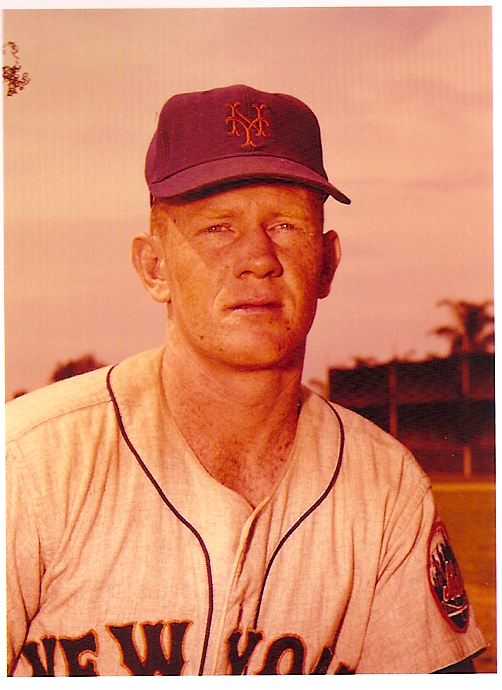
 Who’s Wilbur Huckle? First the basics: He was a career minor-leaguer who logged nine seasons, all in the Mets organization, beginning with the Raleigh Mets in 1963 and lasting until his last hurrah with the Double-A Memphis Blues in 1971, when Huckle was 33. After that, he managed the Batavia Trojans of the New York-Penn League for three not particularly notable years; a fan on Ultimate Mets Database says he then became a middle-school teacher in San Antonio, adding that “I must admit that he is one of the finest people I have ever met.” Who’s Wilbur Huckle? First the basics: He was a career minor-leaguer who logged nine seasons, all in the Mets organization, beginning with the Raleigh Mets in 1963 and lasting until his last hurrah with the Double-A Memphis Blues in 1971, when Huckle was 33. After that, he managed the Batavia Trojans of the New York-Penn League for three not particularly notable years; a fan on Ultimate Mets Database says he then became a middle-school teacher in San Antonio, adding that “I must admit that he is one of the finest people I have ever met.”
Huckle has some other claims to fame of a low-level sort. He was Tom Seaver’s first minor-league roommate, and every now and then Seaver pops up on TV or in the pages of a memoir for a Huckle chuckle — he inevitably claims he only saw Wilbur when he was asleep, as the infielder was otherwise either out or taking a long early-morning walk. A few years ago, Keith Olbermann floated Huckle as a member of his Bill Sharman Society, made up of luckless players who appeared on a big-league club’s regular-season roster but never got into a game. Mets by the Numbers then disputed — convincingly, I thought — whether Huckle was actually added to the roster and so really deserved this unfortunate notoreity.
(If you’re curious — and let’s not kid ourselves, you’re long gone if you’re not — the Mets’ all-time ranks can be expanded to include nine “ghosts.” These spectral semi-Mets are Jim Bibby, Randy Bobb, Billy Cotton, Jerry Moses, Terrell Hansen, Mac Suzuki, Justin Speier, Anderson Garcia and Ruddy Lugo. Cotton and Hansen never got into a major-league game, making them the franchise’s ambassadors to the Bill Sharman Society.)
But I wasn’t thinking about any of that when Huckle came to mind. I was thinking about irony, and fandom.
Irony, believe it or not, wasn’t invented when Twitter became the darling of SXSW or our friends at Amazin’ Avenue started mocking WFAN callers with #BlameBeltran and TRAID. It dates back at least a few decades earlier — and it’s always been familiar territory for Mets fans. The so-called New Breed were masterful ironists, bringing their bedsheets and placards to the Polo Grounds, making Marv Throneberry into a cult hero, and merrily proclaiming that they didn’t want to set the world on fire, they just wanted to finish ninth.
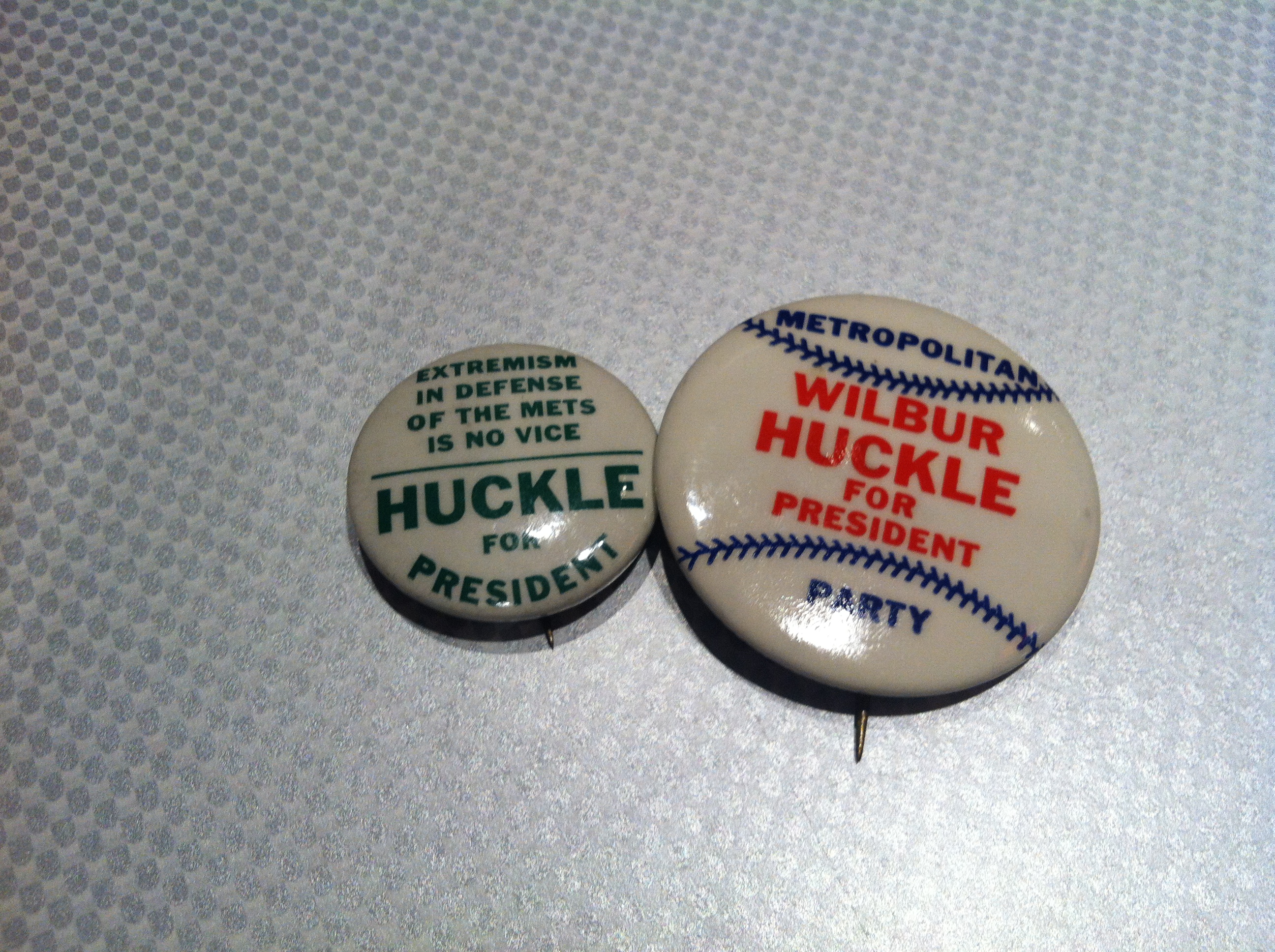
Some of this Metsian irony was the Sixties starting to flower, and some of it was long-suffering Giants and Dodgers rooting reimagined as an allergic reaction to the boring, antiseptic Yankees’ occupation of New York City. But it proved catching, and it found a hero in the unassuming Wilbur Huckle. Sometime in late 1964, after Barry Goldwater borrowed Cicero’s line that extremism in the defense of liberty is no vice, oddball political buttons started popping up at brand-new Shea Stadium. Some proclaimed EXTREMISM IN DEFENSE OF THE METS IS NO VICE, while others pledged fealty to the Metropolitan Party. Both had the same rallying cry: HUCKLE FOR PRESIDENT.
 And why not? Huckle was the perfect candidate — he had that marvelous name, an unassuming blue-collar affect and red hair, making him more or less the Justin Turner of his day, except with an ocean of freckles instead of pies and “Call Me Maybe.” And because Huckle was never actually a Met except in spring-training or news briefs, he could be a vessel of hope and possibilities, with the disappointment of reality kept from intruding. And why not? Huckle was the perfect candidate — he had that marvelous name, an unassuming blue-collar affect and red hair, making him more or less the Justin Turner of his day, except with an ocean of freckles instead of pies and “Call Me Maybe.” And because Huckle was never actually a Met except in spring-training or news briefs, he could be a vessel of hope and possibilities, with the disappointment of reality kept from intruding.
Some say the Huckle buttons were the work of the Mets PR department, which I’d like to believe but doubt — if anything, the team was more square and risk-averse then than it is now. I suspect they were instead the work of some clever, bored fan in one of New York City’s many creative industries — the Darren Meenan of his day. Whatever the case, they’re wonderful — I bought a pair on eBay last year and split them up, one for Greg and one for me. They make me laugh, and they make me admire my Mets forebears, who had to work a lot harder amid similarly depressing standings. It’s easy to be ironic through game threads and tweets, but a lot harder when all you have is buttons and word of mouth and a wink aimed at a kindred spirit.
Irony, of course, can be toxic instead of gentle — it can harden into armor that deflects real feeling and commitment. But that’s not at work with the HUCKLE FOR PRESIDENT buttons — there’s a sunny optimism beneath the laugh line, just as tonight’s jibes about never having heard of Dominic Smith weren’t mean-spirited. Despite the Mets’ meek history and lowly prospects, the fans of September ’64 would have cheered rapturously for Wilbur Huckle if he’d ever made it to the starting lineup; despite the Mets’ fiscal black clouds, the fans of June ’13 happily dream of what Dominic Smith might become. Yes we mock the Mets and ourselves, but we have hope — we laugh through the tough times so we can exult in the better days that we’re sure await us.
Huckle’s still remembered, and that makes me happy. Candidates will come and go and the issue of the day will change, but that aw-shucks hope will always be a plank in the platform of the Metropolitan Party.
by Greg Prince on 6 June 2013 10:04 am As a former 35-year-old myself — I held the position for twelve months in the late 1990s — I am cheered by Marlon Byrd’s two home runs Wednesday night and the role they played in the Mets’ drubbing of the Nationals. Byrd is considered ancient, washed up, capable of playing for no better than a desperate dweller of the second division that was doing somebody a favor when they signed him. Plus he’s 35. Talk about a relic…the guy has been in the majors since September 2002! Why, that’s a whole 22 months before David Wright arrived!
It’s all a matter of perspective, I guess. Nobody was amending their “what outfield?” cracks when Byrd landed amid the Mets’ pasture of uncertainty in Port St. Lucie. There was no sense of we’re only dealing with two-thirds of a mess because this Marlon Byrd, he who had suffered beanings and bannings in the previous two years, was gonna clear everything up.
He hasn’t. Yet on a team in which Razzies could be awarded to many, Byrd’s not close to being in the bottom five, which is like being one of the best players on a good team. Or, put another way, Byrd has actually been one of the best players on this bad team.
You know who leads Mets qualifiers in slugging percentage? Marlon Byrd (.489).
You know who’s second among qualifying Mets in OPS? Marlon Byrd (.799).
You know who has as many homers (8) and doubles (7) as perennial All-Star backup David Wright and only four fewer RBIs (28 vs. 32) in eighty fewer plate appearances? Why, yes, that would be Marlon Byrd.
Your up-to-the-minute Mets WAR offense/defense (not counting pitching) leaders, according to Baseball Reference: Wright, 2.9; Murphy, 1.3; Byrd, 1.3. Then comes Omar Quintanilla at 0.3 — “Quintanilla,” if you’re not sure, is Spanish for “been here a week”. Then there are two guys at 0.2: Andrew Brown, about whom you’ve forgotten; and Jonathon Niese, and this is for hitting and fielding only, mind you.
These may be somewhat narrowly selected criteria and they may reflect as much on the company Byrd is keeping as anything (hey, we said it’s a bad team), but, y’know…it’s pretty decent in context. Marlon Byrd has risen ever so slightly above the morass and shown himself over the season’s first third — give or take a menacing fly ball here or there — as a shade beyond the prevailing sub-mediocrity that has defined our year thus far.
So, yeah, while I’m philosophically aligned with the argument against reflexively leaning on decrepit veterans when we could be learning just how, uh, crepit our youngsters are, not all dogma hunts all the time. Byrd, for example, is hitting .556 lifetime against Dan Haren after last night. Prior to Wednesday, in 16 at-bats, he was hitting .500. It would have been irresponsible to not deploy him last night of all nights.
Rick Ankiel’s extended audition suggests he can sit down, maybe even pack up. Marlon Byrd, however, isn’t the same guy, whatever temptation exists to clump every limited-future outfielder into one large Hefty Bag. I don’t grant him 30 straight starts based on last night, but I don’t dismiss him altogether based on 35 years of age. Plus, it’s the first week of June. It’s waaaay too early to commit to every flawed Triple-A outfielder on the basis of our not yet knowing just how flawed they are and what it will take to fix them. If Nieuwenhuis is sizzling, sure, bring him back. If Cowgill isn’t, then, no, don’t. There has to be some balance struck between “we’ve given up” and “we’re trying to compete nine innings at a time.” Ankiel doesn’t really help you compete. Byrd kind of does.
Of course it’s not too early for showcasing veterans. The best-case scenario for Byrd is he’s splashing around in the fountain of youth and leading the Mets, at 37 or 38, to grand things. The next-best? That he continues to hit occasionally competently for another six weeks and nets you something promising by July 31. Now that Shaun Marcum has regained major league credibility, I’d consider him in the same realm. Some contender might have a use for a “proven” right arm and you benefit accordingly. So let’s run Byrd out there semi-regularly and Marcum every fifth or so day. And then, come August 1, when the Mets’ season is only technically still going, you play every kid you have.
Until then, enjoy Marlon Byrd when he’s homering twice and succeeding intermittently. He’s more or less your third-best everyday player. If that’s what’s facing you every day, sometimes you have to relish what the day presents.
by Greg Prince on 5 June 2013 1:36 pm I have so much to tell you. I don’t know where to start.
—Masha to Jerry Langford, The King Of Comedy
He’s just some fan. What do you expect?
—Alison the surly fact checker, Almost Famous
So many games like Tuesday night’s. So many road trips like the one that has wound winless from Miami to Washington. So many seasons like 2013. Too many eras like the current epoch through which we persevere while grasping at distant straws from before and after the short straw of the present as proof that things have been better and that things will get better.
Why are we Mets fans again?
Oh right, because we’re Mets fans, which is my easy and self-evident answer, or as my blogging partner once countered, “What are we gonna do — become Phillies fans?” You pick your team, or your team picks you, and you’re off to the pennant races if you’re lucky, or a long-term rental of fourth place if you’re not.
But you’re in it for the long term. You’re in it for sweeps by the Marlins and blows to the Nationals even if that’s not what you were looking for. Which you weren’t, of course, though sometimes (ofttimes, really) that’s what you get when you fall in love. Your team is your team. You root for them as Chaka Khan might: through the fire, to the limit, to the wall.
And if you were one of the very first Mets fans when you were just eight and you had a predilection for speaking into inanimate objects and pretending you could be heard by people who couldn’t see you when you were only five, you broadcast them that way. If that’s your story, then you’re Howie Rose, who lays out his life and times relatably, navigably and refreshingly in the aptly titled, recently released Put It In The Book!
I love Howie Rose’s book because I have spent more than a quarter-century kvelling that Howie Rose is the Mets fan he is and channels it so professionally. No “we/us” on the air for someone whose formative years quite obviously dripped with first-person plural. That’s OK when you’re a kid whose attachment to a team is as emotional as it is anything. It’s OK for an overgrown kid like me to say “we,” I figure, because I’m sitting here wrapping myself in blue and orange, investing my time, money and soul in a team for whom I’m intermittently answering out on the hustings. “Hey Greg,” I’ve heard once, twice or a thousand times in my life, “what’s wrong with your Mets?”
I never stop to correct my inquisitor that they’re not my Mets. Because they are, give or take a 50.1-percent ownership stake. And they’re Howie’s Mets as much as anybody’s. He made that clear when he introduced himself to me through the radio late in Spring Training 1987 when he voiced promos over WHN promising that his new show, Mets Extra, with its 75 minutes of pre- and 75 minutes of post-game depth, would be a “dream come true” for Mets fans. I could tell by the way he delivered that line that he wasn’t reading from somebody else’s script. Only a lifelong Mets fan would think a cumulative two-and-a-half hours spent dwelling on the Mets before and after at least two-and-a-half hours of a Mets game itself would be nirvana.
 Where dreams came true. Twenty-five years of Mets baseball was in the books by then and another 25 or so have passed since. Howie’s been around for all of it, first as an eight-year-old who quite reasonably inferred in 1962 that they were “a team created just for me,” and for decades as someone charged with communicating that sense of proprietariness to millions infused with the same illusion. None of us is wrong. Your team is your team…your team. You might conjure a fancy reason for it based on your psychological self-profile or you might be the kind of guy Howie and I are, if I may narrowly lump us together: we really like sports and we take our teams within them very seriously.
Listening to Howie in his five-hour nightly slot in WFAN’s early years — a period Rose quite frankly doesn’t miss — I knew I was listening to someone who got it. He didn’t talk down to me or around me. He talked with me. There were no pretensions of experthood and nothing shticky about it. It was informed, it was lively, it was engaging. I never called Howie Rose at (718) 937 et al, but I maintained a running dialogue with him from 1987 to 1995. He’d talk and his thoughts crackled across 50,000 watts. I’d think he’d made an interesting point and come up with one of my own in my head. Maybe I’d say something to the radio. It was never contentious. It was usually in agreement.
That give-and-take returned with Howie’s book. A lot of “yeah, that’s right.” Some “you think so?” Now and then, “no, no way!” It’s as much interaction as I needed amid what’s part fan memoir, part broadcasting manual, part Mets narrative. I already knew the Mets parts, but not exactly where Howie was at crucial stages of the franchise’s development. I knew he had a career in broadcasting before Mets Extra but didn’t know the extent of the ins and outs (particularly fascinating to me was his noting he never left New York to garner out-of-town experience the way young broadcasters from around here are traditionally instructed). I guessed he probably had some intriguing interactions with characters who’ve come and gone from the Mets dugout, and indeed our lead radio announcer shares quite a few insightfully. It’s not that I needed to know more than Howie Rose was a helluva talk show host and the most comforting sound AM radio can beam this side of a warm and sunny five-day forecast, but what a treat to get all that.
And speaking of treats, I finally got to talk to Howie Rose because of this book. Not in my head, not in the car, but by phone — the way Emmis Broadcasting always intended.
This is the fringe benefit of blogging (another discipline Howie expresses some dismay over on page 203, but never mind that right now). A publicist asks if you’d like the opportunity to have a conversation with someone you’ve been listening to for more than half your life. You put on one of those cartoon bursts of speed that lands you in the next frame before the publicist has had time to place the question mark at the end of his inquiry. Hell yes, I’d like to talk to Howie Rose, I essentially said.
My first mission was not to guest-host The Chris Farley Show. You know: “You’re Howie Rose…remember that time you had Lindsey Nelson come on the line to congratulate Bob Murphy on being voted the Ford C. Frick Award in 1994? Yeah, that was awesome!” Believe me, I could’ve done that all day, but I don’t think that would’ve served any purpose amid what I had to approach as a professional media interaction. Give me a wide enough opening and I’d be Sandra Bernhard knitting Jerry Lewis oversized sweaters, though hopefully not as I held Howie hostage while Rupert Pupkin sat in alongside Josh Lewin.
Still, Howie Rose…on the phone…with me…and no microphone or producer between us. It wasn’t a dream come true for this Mets fan because who would have dared dream such a thing?
I behaved myself. I kept it as professional as I could. I did allow myself a little coda to tell him that as much as I enjoy his play-by-play — the thing he always wanted to do — what I really loved was his unfailingly classy talk show hosting — a job he saw primarily as an avenue to a ballpark or arena booth somewhere…and, oh yeah, the thing I really loved about him was something he hasn’t done except in cameos for eighteen years. Maybe tomorrow I can catch Will Smith coming out of a theater and swoon over “Parents Just Don’t Understand” while I’m at it.
Howie was quite gracious about it anyway. The entire exchange was cordial all around. No oversized sweaters in sight, all of my Farleyesque instincts properly tamped (“you remember how you called Steve Somers from your hotel room after the Mets lost Game Seven to the Dodgers in 1988 and sounded legitimately disgusted…that was awesome, too, albeit in an unfortunate context”). I don’t get paid to blog, but I conducted myself like at least a semi-pro.
We talked about Matt Harvey, who at that moment wasn’t far removed from his “HARVEY’S BETTER!” start against Stephen Strasburg. Howie said the scene at Citi Field that Friday night was so reminiscent of Doc Gooden riding high in the mid-1980s that “the only thing missing was Huey Lewis doing the national anthem.” We talked about Citi Field maybe not shaking like Shea Stadium but giving a hint that it can get excited by a big moment. We talked a little about the status of the Mets Hall of Fame, on whose selection committee Howie serves, but he didn’t offer any revelations about who might be considered next and if anything will happen soon.
We talked about a passage in the book involving Billy Wagner and Latin players, with Howie mostly reiterating what he wrote. We talked in what I hoped would be a non-snarky way (on my part) about Wayne Hagin — the challenges of working with a partner who isn’t steeped in Mets lore the way every current Mets announcer is — but I think it came out a little snarky when I invoked Lorn Brown never having heard of Banner Day. We talked about one of my favorite theories of Mets fandom, that we take our team more personally than most other kinds of fans and that Howie deciding at the age of eight that the Mets were invented just for him is emblematic of that phenomenon, but he kind of shot that down with (and I’m paraphrasing), nah, he was just being a dopey kid.
And we talked about the night the Mets went seven over, which is the kind of memory that makes Howie Rose one of us; makes Howie Rose’s broadcasts the aural equivalent of bumping into a favorite old acquaintance; and makes Howie Rose’s Put It In The Book! such a satisfying read.
Howie has repeatedly mentioned the Jimmy Qualls game over the years and he details his presence at Shea for it in the book. He should. It was the milestone of initial Mets contention and, as he put it, the “turning point” toward their miraculous coming of age. There’s been a Mets no-hitter at last, thankfully, but nothing could ever precisely supplant the Tom Seaver masterpiece of July 9, 1969, a game ever so slightly besmirched by an utterly unknown Cub entity (if Jimmy Qualls played in 2013, he’d surely be a Mets outfielder, probably sitting behind Rick Ankiel) yet incapable of being tangibly sullied. It’s a night that lives eternally in the Met bone marrow.
I didn’t want to ask Howie about Qualls. I wanted to ask Howie if there’s another game whose heart goes on for him. Not Seaver’s one-hitter, not Swoboda winning that game in 1966 off Bill Henry, even (another gem from his youth that Howie generously reminisces about in his book). Give me, if you can, a game nobody ever mentions in Happiest Recap form — give me a game that stays with Howie Rose, maybe only with Howie Rose.
So he did. He remembered a Friday night at Shea in 1969. It took place, he estimated, before Qualls, but after Clendenon came over at the June 15 trade deadline. As long as he was sitting by his computer, he checked Retrosheet to confirm. Yup, it was in the time frame he thought: June 20, the Mets playing the Cardinals.
Howie was there as part of a paid crowd of 54,083 to witness Nolan Ryan taking on Bob Gibson. This, he explained, was before Mets fan thoughts had turned to challenging for the division, let alone the pennant or World Series. The question on everybody’s minds was, “Can we actually have a winning record for the first time?” The Mets entered the night at 33-27 and, after Ryan bested Gibson (with two RBIs from Cleon Jones and three relief innings from Tug McGraw), they were exiting it at 34-27. Remember, the Mets had never been anywhere near .500 for the first seven years of their existence.
Remember? Who could forget? Who among Mets fans could have imagined this dream coming true? It was as silly in 1969 as me thinking that at any time since 1987 I could be chatting with Howie Rose. Yet here they/we were, winning record well in hand with a smidge more than a hundred games to go. Howie certainly couldn’t forget.
Why not? Because as Howie waited for the Bayside-bound Q27 at Flushing-Main Street, some kid with his head in the exact same space yelled over to the 15-year-old future voice of the New York Mets, “Seven over!”
“I’ll always remember that,” Howie added. And now so will I.
Because you’re a Mets fan, purchase Put It In The Book! by Howie Rose, available via Amazon and other fine retailers. Give it for Father’s Day. Give it for Graduation Day. Give it to yourself any day. You may sometimes be sorry you hooked up with this team, but as long you’re attached, you might as well enjoy all that Metsdom has to offer. It doesn’t get a whole lot more Metsian than this…in a good way, I mean.
by Jason Fry on 4 June 2013 11:28 pm Monday was one of the better days to be a Mets fan of late.
Monday was also an off-day.
It’s always bad when it gets to this point. It’s worse when this point arrives not in the second half of August, that cruel period that has a way of revealing your maybe-sorta-kinda-.500 club as a 72-win team, but in early June.
Yet that’s where we are, with plenty of season left to play.
It’s a shame, too. Jeremy Hefner was terrific tonight, and I like Hefner — he’s a hard worker and a smart pitcher and the kind of guy that’s easy to root for. Nothing that happened out there was his fault.
I like Bobby Parnell, too. He’s evolved into a solid closer, having entered the evening with just two blown saves, neither of which were his fault. He seems to have gotten over the hyperventilating, MUSTTHROUGHBALLEVENHARDERANDSTRAIGHTER mentality that made him so frustrating as a younger pitcher. More significantly, he’s learned a fiendish knuckle-curve from Jason Isringhausen. One imagines he also learned a few things about the volatile, frustrating life of a late-innings reliever. The story interests me, because it’s an example of something statistics can’t capture: Parnell pretty clearly learned something from his apprenticeship with Izzy (and I mean something beyond the Will to Win or some other lazy sportswriter’s Just So Story), something that’s valuable but defies measurability.
This time, though, what happened out there was definitely Parnell’s fault. He was terrible, and got beaten so quickly and efficiently that you’d have thought his name was Mariano Rivera. If you’ve been a baseball fan for any amount of time, you witness such games and learn your own guy-on-the-couch version of the closer mentality: It happens, there often isn’t any reason for it, so forget about it.
This dose of philosophy doesn’t make games like that suck any less, of course.
Since the word “suck” was trotted out, let’s talk about the larger sense in which Parnell’s failings weren’t his fault: The Mets’ offensive was substantially aided by the Nationals’ ineptitude, and still produced only two runs, leaving their pitchers with zero margin for error. This team has a good hitter who can’t do it alone, a couple of OK hitters who run hot and cold, some bad hitters who should be in the minors or bettering their duck-hunting skills, and various other misfit toys that should not be amassing hundreds of at bats a year.
The Mets are a terrible offensive club. That puts them in a guaranteed hole most nights, forcing their not-bad starters to tiptoe across the high wire and hope their shaky defensive avoids numerous land mines and their so-so bullpen doesn’t implode. Most of the time this difficult-to-execute plan goes less than perfectly, with results that are predictable and depressing. It’s an excellent blueprint for losing games by the bushelful, and that’s what the Mets are doing.
And it’s what they’ll continue to do unless something significant changes. That something has nothing to do with Zack Wheeler, who could fulfill his potential and join his rotation-mates by dropping 3-2 and 2-1 decisions. Do the Mets have the stomach to make those changes? Do the Wilpons have the money to make them matter? Ask me again in another five losses. Or 10. Or 20.
|
|