The blog for Mets fans
who like to read
ABOUT US

Faith and Fear in Flushing made its debut on Feb. 16, 2005, the brainchild of two longtime friends and lifelong Met fans.
Greg Prince discovered the Mets when he was 6, during the magical summer of 1969. He is a Long Island-based writer, editor and communications consultant. Contact him here.
Jason Fry is a Brooklyn writer whose first memories include his mom leaping up and down cheering for Rusty Staub. Check out his other writing here.
Got something to say? Leave a comment, or email us at faithandfear@gmail.com. (Sorry, but we have no interest in ads, sponsored content or guest posts.)
Need our RSS feed? It's here.
Visit our Facebook page, or drop by the personal pages for Greg and Jason.
Or follow us on Twitter: Here's Greg, and here's Jason.
|
by Jason Fry on 15 May 2013 11:44 pm Instead of kicking a ball into foul territory and failing to cover home plate, Scott Rice found a way to lose more efficiently by throwing a wild pitch.
John Buck got caught off second base when he inexplicably thought a lineout to the outfield was up the gap falling in, and got thrown out inexplicably trying to steal.
David Wright had a ball flop out of his mitt on a tag play on John Jay, giving the Cardinals an extra out, which they turned into a run-scoring single.
Wright struck out with Daniel Murphy on third with one out. The Mets didn’t score.
Apparently discomfited by Carlos Beltran coming into second standing instead of sliding, Murph heaved one past Ike Davis, giving the Cards a runner on second with one out instead of nobody on with two out. Yadier Molina, to the surprise of no sentient Mets fan, promptly rapped a single to right to give the Cards an insurance run.
The amazing thing? This sad parade of boneheaded mistakes and failures actually amounts to progress for this broken, pathetic team.
How many times must you put your hand on this particular hot stove? Find something else to do with your summer.
by Jason Fry on 14 May 2013 11:14 pm Terrible pitching, crappy fielding, nonexistent hitting, a stupid media sideshow that will be an overstuffed brouhaha tomorrow — just another checkpoint in the Mets’ freefall.
There’s no point analyzing this game. There’s no point analyzing this team. The franchise has been starved of money until it’s baseball’s equivalent of a North Korean labor camp, with Bud Selig the China preventing reform. Until something gives, the vast majority of our recaps will be interchangeable. What’s the use of complaining, agitating or even watching?
Do something else. This abandoned shell of a franchise doesn’t even deserve your disdain.
by Greg Prince on 14 May 2013 4:16 am The Mets are bad and will continue to be bad for the rest of the season. That I’ve basically made my peace with.
They have the second-worst record in the National League. Since winning seven of their first eleven games, they’ve lost 17 of 24. Nobody’s scored fewer runs among N.L. teams dating back to the Sunday one month ago that the Mets were chased out of Minnesota by freezing rain, while only the Dodgers have allowed more runs. The Mets’ run differential of -43 over this period is the league’s worst. That indicates a team that doesn’t hit, doesn’t pitch and doesn’t field not doing all of it at once over a statistically significant span of the season.
On the season as a whole, the Mets are 6-2 when Matt Harvey starts, 8-19 when somebody else does, including 0-7 when Monday night’s starter, Jeremy Hefner, takes the mound. The last time the Mets began a season 14-21 was 2003, when they finished 66-95. The last time the Mets posted a worse mark through their first 35 games was 1993, when they commenced 12-23 and concluded 59-103.
Yet I watch these bad Mets. Their telecasts are entertaining because of their announcers. Their postgame shows are mesmerizing because of their excuses. Terry Collins can be counted on to mention how close the scores of these losses generally are, as if being “in it” is akin to winning. Hefner, whether he’s a genuinely emotional fellow or just has a vocal tic he can’t help, always speaks after he doesn’t win with a crack in his voice. When I first noticed how upset he sounded, I felt terrible that he takes the game so hard. Now I wonder if he’s Jerry Seinfeld’s girlfriend in the Bette Midler episode, the one who, as Jerry put it, didn’t cry when her grandmother died, but a hot dog made her lose control.
The name of that episode is “The Understudy,” which was supposed to be Hefner’s role in 2013. He’s pitching every five days instead because the Mets have no depth behind their Midler, Harvey. Hefner sometimes pitches well enough to win, but he never does. The Mets are often close to winning, but rarely right there.
It’s not an excuse — that’s another one you’ll hear when you listen in on the sorrow and the pity emanating from the postgame clubhouse. Rick Ankiel, the latest utterly random face to come tumbling out of the pack of cards Sandy Alderson uses to create his 14-21 roster, showed up in St. Louis to give the Mets a proven glove in center field. Except Ankiel — who surely isn’t here to pad the team’s on-base percentage — didn’t think to stash a glove in his carry-on luggage. So the former lefty pitcher used a current lefty pitcher’s glove (Jon Niese’s) and it wasn’t quite the proper length to snare Ty Wigginton’s sinking liner that Ankiel was going to make a very good if not great catch on. It’s not an excuse, Ankiel said, but no, it wasn’t the proper glove.
That was in the seventh, after Hefner had done all he could (6 IP, 3 ER) and, presumably, had taken all he could take. Wiggy, a Met from the last season the Mets lost 21 of their first 35 games, just kept going, just as he has in the nine years since he stopped being a Met. Indefatigable Wigginton hustled into second after Niese’s glove betrayed Ankiel. Next up was Matt Adams, who shot a ball off Scott Rice’s foot that clanged into foul territory…the ball, that is, not the foot. While Rice trailed behind John Buck in pursuit of the ball, home plate went wholly unoccupied. Wigginton raced by David Wright at third (returning the favor from 2004, you might say) and occupied home plate before Rice could evacuate him. A longstanding 3-3 tie was broken in favor of the Cardinals on a trip around the bases reminiscent of 2005 at Shea, when Dae-Sung Koo improbably stroked a ball to center off Randy Johnson and more improbably scored from second on a bunt when Jorge Posada couldn’t get back to the plate to tag him. Except then it all worked out for the Mets.
Monday night, nothing worked out for the Mets. Scott Atchison came in after Scott Rice and allowed a two-out, two-run homer to Matt Holliday that sealed the Mets’ 6-3 fate. Atchison’s been pitching nearly every day and his fingers were numb and he’ll probably be on the DL soon but, the pitcher said manfully in the clubhouse, it’s not an excuse.
No excuses. No wins, but no excuses. Ankiel was an unequipped center fielder trying to make a very good catch…and the Mets lost. He’s supposed to share time with Juan Lagares, a much younger, much more promising center fielder who made a spectacular catch Sunday…and the Mets lost. Adams didn’t hit his ball very far, but it bounced off somebody’s limb…and the Mets lost. The day before, Lucas Duda hit a ball that took a stranger bounce, one off the first base bag so high into the air that there was no way it wouldn’t become a two-out RBI that would pull the Mets even with the Pirates. Except the ball bounced into a Pittsburgh glove and Duda was forced easily…and the Mets lost.
And the Mets lost. It’s a familiar refrain. They’re in close games Sunday and Monday. They’re blown out Friday and Saturday. The starters who aren’t Harvey are fixing arm angles and gaining velocity and if they haven’t kept games close, well, the coaches are sure they’ve picked up something in their respective bullpens that are going to turn them around. The hitters who don’t hit with men in scoring position or at all for innings at a time…it’s just a matter of approach and patience…or is it approach and aggressiveness? The players who act a little too happy because they personally achieved something? Well, let ’em get whacked on the arm by an opponent. That’ll teach ’em to enjoy themselves. Better yet, let ’em get used to being Mets. That’ll flush the joy out of their systems altogether.
I don’t just watch Mets games and postgame shows. I listen to their flagship station sometimes when I hear their general manager will be on to explain just why the Mets are 14-20 going on 14-21. The GM, Alderson, told Mike Francesa Monday that this wretched start bothers him, too, as if he’s a fan, as detached from the process of roster construction as any of us. He said something about Zack Wheeler not being here because he’s not ready (which may be true) not because it will affect his contractual status (which is truth-shading at its shadiest). He said in all practicality Shaun Marcum is still going through Spring Training, except he’s using major league games that count to get the hang of pitching again. Marcum’s understudy was first Hefner, then Aaron Laffey. Alderson is out of understudies. Excuses he can find.
I’ve maintained faith that patience has been the better part of valor since Alderson and his all-star advisory council took the post-Minaya reins. I couldn’t get intensely upset about 2011 because whaddaya want from the guy? That was the deal in 2012, too. It’s the deal in 2013. But the product which Alderson has crafted and Collins shepherds gets progressively worse, not better. I convinced myself to the best of my ability — and cynicism is a tough obstacle when you combine reaching 50 and being a Mets fan most of your sentient life — that the Mets were building a foundation upon which the crown jewels of the pitching staff would be placed carefully and then, with completive standing enhanced and financial wherewithal no longer an overriding issue, we’d be on the cusp of a golden age. Or at least a less tarnished age.
Even after spending eight delightful starts salivating at Harvey and being encouraged by the reports of Wheeler’s progress, I really don’t believe that anymore. I look around and wonder, to paraphrase the GM, “What foundation?” There is little splendid about these Mets individually. There is plenty that is ordinary at best. What always bothers me about puffing up the guys we see day after day is forgetting that other teams have shortstops and first basemen and lefthanded starters. They have prospects and crown jewels. We sucker ourselves into believing ours are the most sparkling, rarely pausing to consider that fans of those other teams probably believe something similar about their inventory, and we can’t all be absolutely correct in our assessments.
Maybe I’m not supposed to be unduly swayed by 35 games or 24 games or a four-game losing streak, but the sum total of consuming as much Mets as I do has left me about as dismayed as I’ve been since dismay became my reflexive reaction to everything I witness. I thought we were putting that era behind us. Either we’re in darkest-before-dawn territory or the era will just keep on extending.
Which brings me back to Alderson, who is a human being, not a caricature, but that may cut both ways. He may just not be succeeding at producing a decent Mets team in the interim and he may not succeed at producing an enduring Mets contender in the long term. It happens. We just spent a weekend with the Pirates, who continue to haul around their two-decade stone of shame until further notice. Maybe this is their year to post a winning record, make a run at the playoffs and validate the love and loyalty shown by Buc-loving people (though not, I hope, the Western Pennsylvanian who sat behind me on Sunday constantly imploring Andrew McCutcheon to “C’MON ’CUTCH!”). Maybe some year soon will be the year of the Indians and their acolytes who have had little to cheer in this century and nothing to celebrate of an ultimate nature since the first half of the last one.
I bring up Cleveland because Alderson’s tenure brought to mind something I read about Gabe Paul several years ago. In Roger Kahn’s October Men, a revisitation of the 1978 Yankees, he mentions Paul’s resignation from George Steinbrenner’s employ prior to that season and the job he accepted as president of the Indians. This was the Tribe as it was reaching the 30th anniversary of its last world championship. Why, Kahn had asked the about-to-turn 68-year-old executive, would he take on the challenge of reviving an eternally moribund franchise, especially after building the 1977 world champs as GM of the Yankees? “Cleveland used to be a great baseball town,” Paul told him, “and it will be again. Right now it’s a sleeping giant. I’m going to start making some good deals for Cleveland and build another winner.”
Kahn, writing some 25 years later: “He never did.”
It happens. Or it doesn’t happen. Or it takes forever. Who the hell knows? If you’re an organization that seems to know what it’s doing, you’re never down for long. You lose your immortal first baseman to free agency and your Hall of Fame-bound manager to retirement and, if you’re the Cardinals, you find your way back to within one game of the World Series anyway. You lose your closer for the year the next year, you just pluck someone else from the ranks and you don’t miss a beat. St. Louis won a World Series without Adam Wainwright. They’re in first place without Chris Carpenter and Jason Motte. It’s downright icky the way Keith Hernandez swoons over them, but his admiration is not misplaced.
The Mets are not an organization about to be accused of knowing what it’s doing. No visiting broadcasters are marveling over their excellence or even competence. They’ve been down far too long. Barring a 68-59 turnaround, the Mets will file their fifth consecutive losing record in 2013. Whatever little goodwill lingered from their last decent spurt has disappeared. It probably disappeared for you an eon ago, but I tend to cling to anything positive and try to make it last. The Mets who won more than they lost every year from 2005 through 2008 (one division title and one playoff series victory plus two historic September collapses, a.k.a. the good old days) at least made me think 2009 and 2010 were maybe aberrations. Jaunty, spunky play for extended intervals of 2011 and 2012 made me think they were renewing themselves for something better.
I’ve ceased shopping at that theoretical store because I simply can’t buy that stuff in 2013. I’ve seen too much bad, blah baseball. I’ve seen the Mets play worse in recent years but I’ve never seen them quite so bad and quite so blah at their essence, not since I was too young to be so cynical about them. The players I trusted to form a foundation strike me more as the players you cycle through to get to the players who will be around when winning replaces losing. If it ever does.
Sunday I saw jerseys in the stands and on the escalators and all around Citi Field that reminded me of who have come and gone in the relatively recent past: REYES 7; DELGADO 21; BELTRAN 15; MARTINEZ 45; DICKEY 43; SANTANA 57. I wasn’t necessarily missing any of those individuals of late — a couple of them are long retired already — but the onslaught of their names and numbers struck me as positively ghostly. Remember good players? Remember thinking the Mets were going to win? Remember being surprised when they lost?
I actually do. It was a while ago and a similar state is probably a while ahead.
As for the games that make one glad to be a Mets fan, there is The Happiest Recap, a subject I was happy to discuss in depth with premier blogger Alex Belth. Read our discussion of Mets wins that stand the test of time at Bronx Banter.
by Jason Fry on 12 May 2013 5:52 pm All right, people. We’ve all get better things to do with what’s left of our day than complain about this listless horrible team. Start reading and we’ll rip this Band-Aid off quick as we can.
Matt Harvey: He was clearly struggling — the fastball velocity was down and the location was off, leading to very few swings and misses. It wasn’t odd to see him out there grimacing and fuming, because that’s the way Harvey pitches even when he’s got all his pitches working and going exactly where he tells them to, but it was odd to see him out there in charge of a repertoire that qualified as merely good. But he toughed it out — he scrapped and scrambled and improvised and wound up with a very good pitching line. That’s impressive any time a pitcher has to do it; for a sophomore pitcher it’s even more so. The legend of Matt Harvey grows even when he has far from legendary stuff.
Everybody Else: What a horror show. Mets swinging and missing, swinging and missing, tapping out, hitting weak fly balls, swinging and missing, tramping back to the dugout looking sad, squinting as they pull off their batting gloves, swinging and missing some more. And don’t try to lay this on Dave Hudgens — it’s not the hitting philosophy that’s lousy but the quality of the student body. Offensively, this is a bad team with one star who does himself no favors by trying to do too much, two guys who might grow into complementary players but might not, and a bunch of guys who are one-dimensional, miscast, too old, Triple-A quality or some fretful combination of those things. The Pirates — the Pirates — just thoroughly outplayed this sad disaster of a club; one shudders to think what damage the Cardinals will inflict over the next four days.
What Not to Do: Bring up Zack Wheeler. First of all, what kind of a reward is it to be chained to an oar as this pathetic ship takes on water? Second of all, given the financial uncertainty around this team and the certainty that they’ll be nowhere near the 2013 playoffs, why put him on the road for escalating paydays in arbitration? Bring Wheeler up in late June or the second half. Perhaps by then his future teammates will only be striking out nine or 10 times a night.
Silver Lining: Uhhhh … Juan Lagares made a catch you’ll see on ballpark highlight reels long after Juan Lagares is forgotten? Seriously, it was neat.
Another Silver Lining?: Nope, that one was already kind of a reach. Go be nice to your mothers. None of this was their fault.
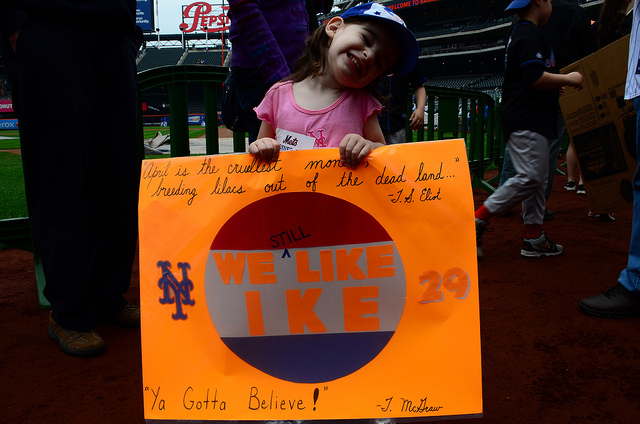
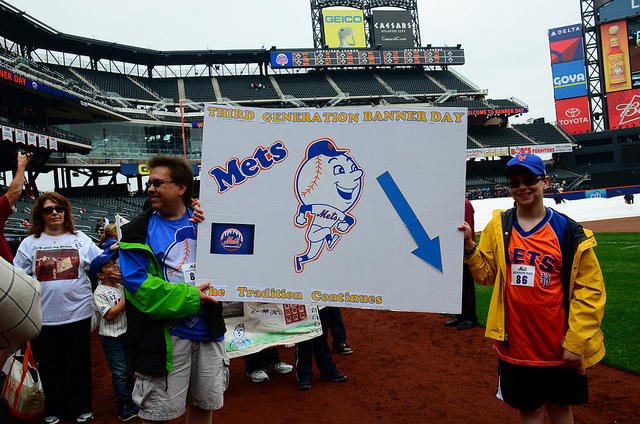
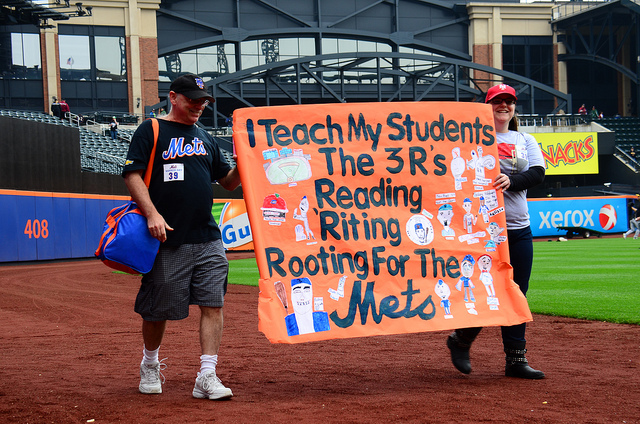
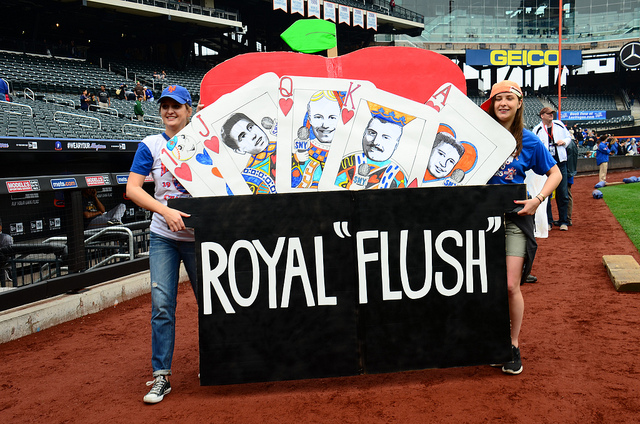
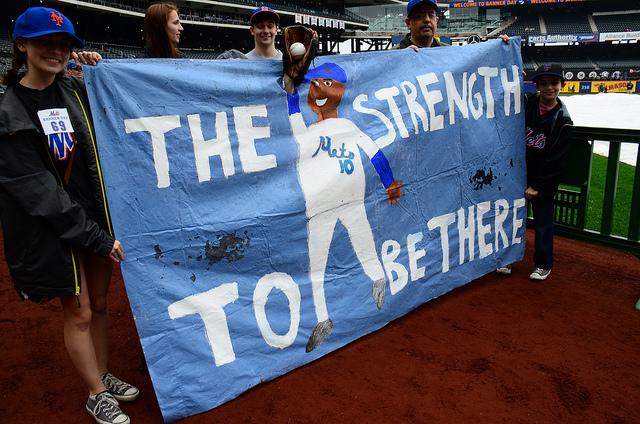
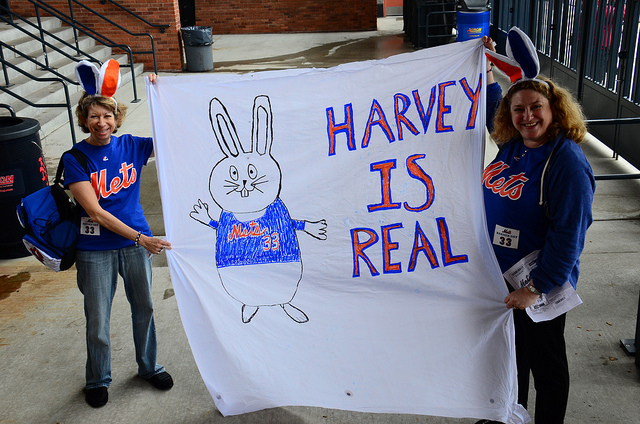
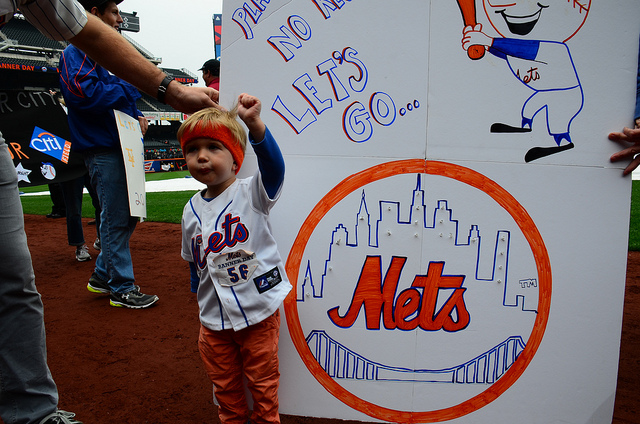
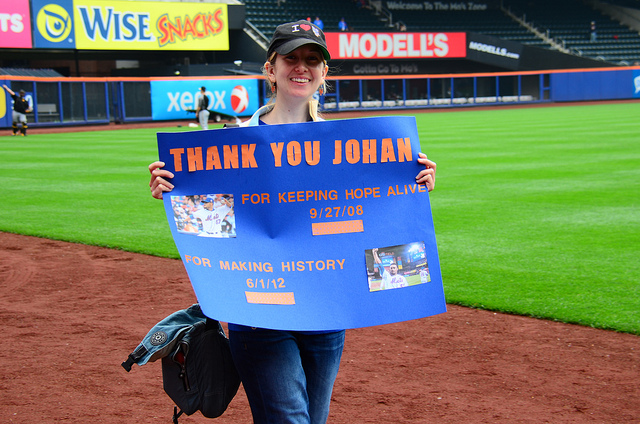
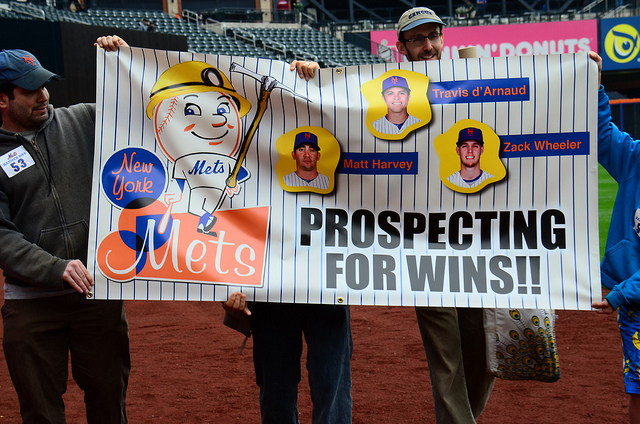
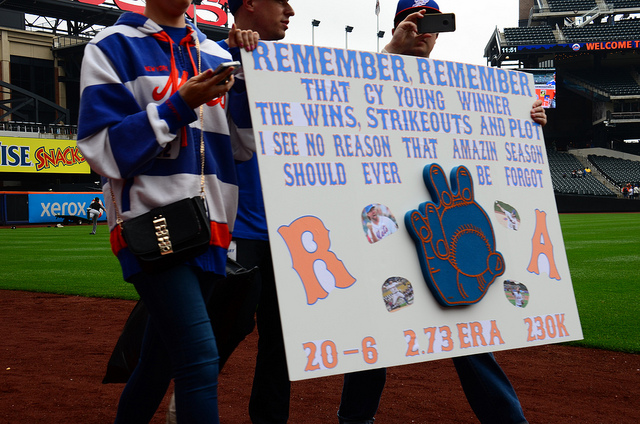
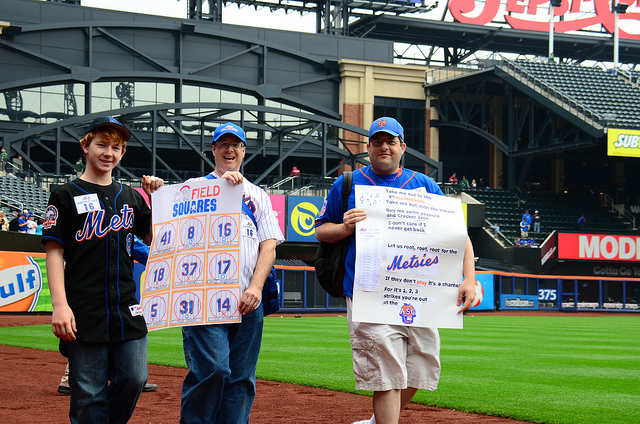
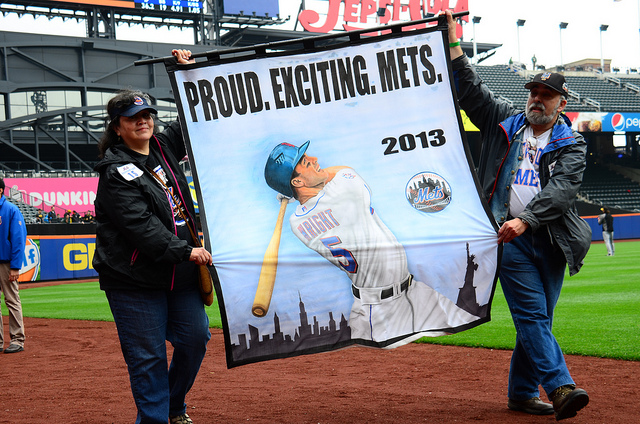
by Greg Prince on 11 May 2013 9:39 pm 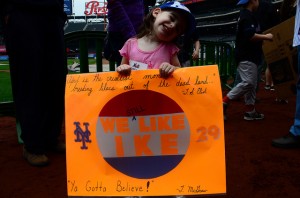 I’m just back from the village green of our small town, a town that likes its baseball and may even field a professional team one of these days. I’m just back from the village green of our small town, a town that likes its baseball and may even field a professional team one of these days.
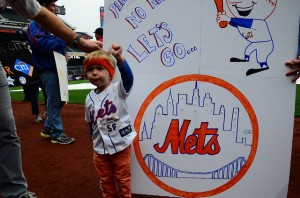
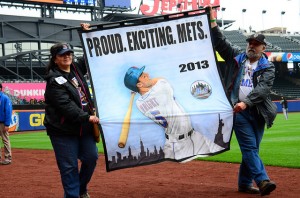
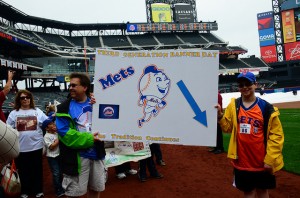 It’s got this quirky little parade it runs now and then, sometimes too early in the year for its own good, but the folks who march in it wear these big grins after they’ve carried their hopeful, sweet-natured signs, so it’s all in good fun. It’s got this quirky little parade it runs now and then, sometimes too early in the year for its own good, but the folks who march in it wear these big grins after they’ve carried their hopeful, sweet-natured signs, so it’s all in good fun.
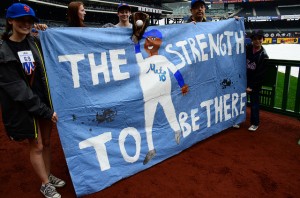
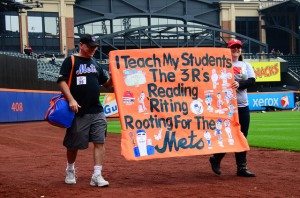 I try to show up in time to give ’em all a big hand, since otherwise there doesn’t seem to be anybody else around to watch ’em wave their homemade placards and such. The organizers aren’t too reliable about saying when the darn thing’ll start, however, so some years — like this year — I catch only the tail end. Maybe the tail end was about the same size as the front end. Either way, I saw the grins. I try to show up in time to give ’em all a big hand, since otherwise there doesn’t seem to be anybody else around to watch ’em wave their homemade placards and such. The organizers aren’t too reliable about saying when the darn thing’ll start, however, so some years — like this year — I catch only the tail end. Maybe the tail end was about the same size as the front end. Either way, I saw the grins.
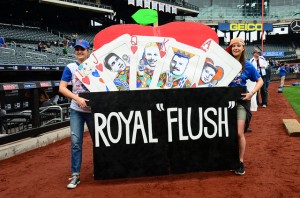 The town doesn’t lack for eats, which is nice. My wife’s treating an ulcer — maybe or maybe not related to watching our unprofessional team — so we couldn’t really partake of the big picnic. There was a girl selling gluten-free goodies, though, and she couldn’t have been nicer steering my wife through what she might be able to sample in her condition. Same for the lady inside the market right next to it. The niceness of the folks doesn’t always extend to the people who have to work in our town, but Saturday, we found quite a few kind souls. The town doesn’t lack for eats, which is nice. My wife’s treating an ulcer — maybe or maybe not related to watching our unprofessional team — so we couldn’t really partake of the big picnic. There was a girl selling gluten-free goodies, though, and she couldn’t have been nicer steering my wife through what she might be able to sample in her condition. Same for the lady inside the market right next to it. The niceness of the folks doesn’t always extend to the people who have to work in our town, but Saturday, we found quite a few kind souls.
 Funny thing about our town is though the baseball team can’t rightly be called professional, the people who put the team out there sure want to make you feel like they’re a big deal. Used to be there was just one enormous-headed mascot, but now he’s got company. Some fella dresses up as a coffee cup and all the folks try to help the one person who’s supposed to find him find him. Funny thing about our town is though the baseball team can’t rightly be called professional, the people who put the team out there sure want to make you feel like they’re a big deal. Used to be there was just one enormous-headed mascot, but now he’s got company. Some fella dresses up as a coffee cup and all the folks try to help the one person who’s supposed to find him find him.
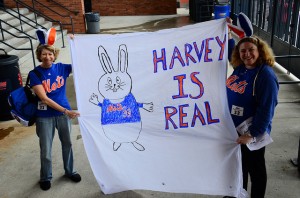 It’s not much, but our town’s pretty small. It’s not much, but our town’s pretty small.
 We’ve had the team so long, that it’s hard to remember how good it’s sometimes been. Now and then they tell us “facts” about what happened to the team on whatever date the day happens to be. It’s not uncommon for something to be wrong with the facts by the time they put ’em up where everybody can see ’em. For instance, they said our then-professional team split a doubleheader in Los Angeles 41 years ago Saturday. Actually, that doubleheader took place right next door to our current village green, and the kicker was it was the first day-night doubleheader our team had ever played at home. But they didn’t mention that. We’ve had the team so long, that it’s hard to remember how good it’s sometimes been. Now and then they tell us “facts” about what happened to the team on whatever date the day happens to be. It’s not uncommon for something to be wrong with the facts by the time they put ’em up where everybody can see ’em. For instance, they said our then-professional team split a doubleheader in Los Angeles 41 years ago Saturday. Actually, that doubleheader took place right next door to our current village green, and the kicker was it was the first day-night doubleheader our team had ever played at home. But they didn’t mention that.
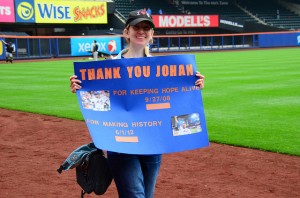 Easy mistakes to make if you’re not careful looking things up. The folks who run our village green are sometimes kind of careless that way. But we keep coming back anyway. I’m a bit of a stickler about details, yet I’m not all that particular overall. If I were, I probably wouldn’t be so fond of our unprofessional team. Easy mistakes to make if you’re not careful looking things up. The folks who run our village green are sometimes kind of careless that way. But we keep coming back anyway. I’m a bit of a stickler about details, yet I’m not all that particular overall. If I were, I probably wouldn’t be so fond of our unprofessional team.
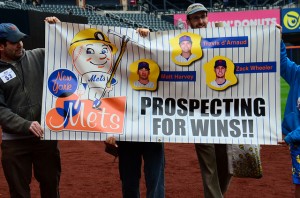 Yeah, you can call out this or that mistake or that or this silliness, but it’s our little town, with its peculiarities and oversized coffee cups, so you tend to let it go. You try to enjoy the grins instead. You see folks you know, and you chat, and you catch up on life away from the village green. You talk about the local team and its unprofessional performance, too, of course. You can’t help but notice it — or that ever since the village green was built, the team hasn’t had itself a winning season. Yeah, you can call out this or that mistake or that or this silliness, but it’s our little town, with its peculiarities and oversized coffee cups, so you tend to let it go. You try to enjoy the grins instead. You see folks you know, and you chat, and you catch up on life away from the village green. You talk about the local team and its unprofessional performance, too, of course. You can’t help but notice it — or that ever since the village green was built, the team hasn’t had itself a winning season.
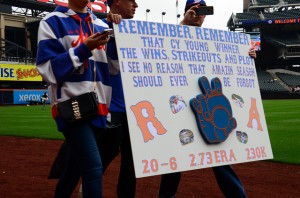 Saturday it played another team that built itself a pretty little park and has never had a winning season there, either, but my word! That team played like champions against our little band of amateurs. I wonder if they’ve suddenly gotten really good or if they just happen to benefit from the good fortune of having been visitors to our village green today. Saturday it played another team that built itself a pretty little park and has never had a winning season there, either, but my word! That team played like champions against our little band of amateurs. I wonder if they’ve suddenly gotten really good or if they just happen to benefit from the good fortune of having been visitors to our village green today.
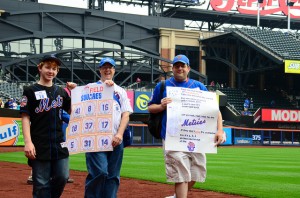 Our boys’ record isn’t what you’d call good right now, but I’ve seen it worse. Still, I can’t say I’ve seen them be worse in a very long time. Hmm…I suppose these things go in cycles. Our boys’ record isn’t what you’d call good right now, but I’ve seen it worse. Still, I can’t say I’ve seen them be worse in a very long time. Hmm…I suppose these things go in cycles.
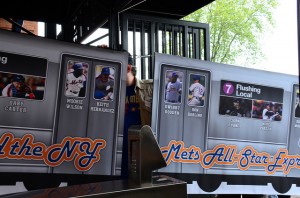
 Say, you know who played for our little team that has yet to requalify for professional status Saturday? Neither do I. The lineup our manger sent out there reminds me of the kinds of packs of baseball cards I got when I was a kid. I’d open the wax paper, let the smell of the freshly planted gum waft over me and then watch the players tumble out randomly before me. Always wished I could’ve gotten better players. Instead, it was either the same old discouraging faces or some no-names that left me wondering who stuffed them in the pack in the first place. Say, you know who played for our little team that has yet to requalify for professional status Saturday? Neither do I. The lineup our manger sent out there reminds me of the kinds of packs of baseball cards I got when I was a kid. I’d open the wax paper, let the smell of the freshly planted gum waft over me and then watch the players tumble out randomly before me. Always wished I could’ve gotten better players. Instead, it was either the same old discouraging faces or some no-names that left me wondering who stuffed them in the pack in the first place.
 Our players didn’t play too good Saturday. Our manager didn’t do anything much to help. One of our boys — one of the few we’ve got who’s come through for us lately — got hit with a baseball, but nobody seemed to mind. Not the longest stream of banners. Not many grins after what banners there were got put away. The girl with the gluten-free food was nice, though. And everybody pitched in to help pick out the coffee cup fella. It rained, but not to excess. Then we all dispersed. Our players didn’t play too good Saturday. Our manager didn’t do anything much to help. One of our boys — one of the few we’ve got who’s come through for us lately — got hit with a baseball, but nobody seemed to mind. Not the longest stream of banners. Not many grins after what banners there were got put away. The girl with the gluten-free food was nice, though. And everybody pitched in to help pick out the coffee cup fella. It rained, but not to excess. Then we all dispersed.
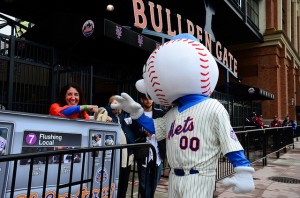 Just another day in our town. Just another season like the ones directly before it. Just another day in our town. Just another season like the ones directly before it.
Photographs by Sharon Chapman.
by Jason Fry on 11 May 2013 12:14 am Sometimes you really want to take a rolled-up newspaper to this mutt of a team.
A night after a taut, inspiring win, the Mets were horrible, from Shaun Marcum’s little bit of Jekyll and a whole lot of Hyde to the hitters’ grinding futility when it mattered. The highlight of the game was Gary, Ron and Kevin holding a respectful and open-minded discussion of sabermetrics — my only moment of disappointment was the disdain for BABIP, which isn’t a perfect stat (such a thing doesn’t exist) but in my opinion is a useful indicator that a player’s run of success or failure is unlikely to last. Nice to see, but when the highlight is something involving the announcers you can guess the game wasn’t anything you’ll want to remember for very long.
So where do we start?
I suppose we should remember that for Marcum’s arm it’s mid-March, and so not be too harsh about his inability to get through five innings, let alone do that having accomplished something positive. But man is it frustrating, and it’s getting old in much the same way Marcum is 31 but looks an Atchisonian 51.
Beyond that, well, if I were an opposing pitcher I’d consider immediately putting the first Met hitter in each inning on base, since that seems to terrify his teammates. The Mets got a leadoff double in the fourth, followed by a groundout and two pop outs; followed Anthony Recker’s leadoff home run in the fifth with a double, then flopped through a strikeout, pop out and groundout; got a leadoff single and a trio of groundouts in the sixth; and then got a leadoff single in the eighth followed by a groundout and a GIDP. See frustrating and getting old above.
Finally, why on earth are Mike Baxter and Jordany Valdespin limited to pinch-hitting roles? The Mets’ outfield is terrible (perhaps you’ve heard), but it’s not going to get better with two guys who have actually earned real playing time sitting on the bench. Sure, they’ve both shown a knack for pinch-hitting, but maybe that’s because they have a knack for hitting — Matt Harvey would undoubtedly be a solid ROOGY, but that’s not the same as it being a good idea. Baxter has never shown any ability against lefties, but he destroys righties, knows how to get on base and is an acceptable defender. Valdespin has had success against lefties in the minors, has shown that he can make adjustments and become a smarter hitter in the big leagues (which is really rare), and is a lot better outfielder than anyone thought. Isn’t their development more important than taking a flyer on Andrew Brown or watching Marlon Byrd get another day beyond whatever his peak was? Baxter should be platooning and Valdespin should be playing every day; I’m genuinely baffled that Terry doesn’t see this and the front office isn’t insisting that he do things differently.
On the plus side … well, the umpires had to go under the stands for a replay, emerged and made the proper call. Joe West can watch TV correctly, which is more than our old nemesis Angel Hernandez can say.
by Greg Prince on 10 May 2013 3:13 am In the heart of the communications capital of the world, I couldn’t say for sure what was going on one borough over. You can wire yourself up to the gills so you know everything at every minute the minute it happens, but if you find yourself one story beneath the sidewalk in an edgy Greenwich Village nightspot immune to the charms of 3G or 4G, then you simply have to accept sporadic word regarding Dillon Gee. There’s a TV on the wall, but it’s off. Does it even get SNY? There’s a radio in my bag. Could I even tune in the ’FAN here?
Wait a second…I’m not supposed to be watching or listening or browsing. I’m supposed to be reading — reading aloud. I asked other Mets fans to come be in an audience for me. But I did it while a Mets game was in progress. Surely this is a violation of the Greg Commandments, a sacred document handed down from Mt. Sinai (or was it Mt. Sadecki?) in ancient times, long before I had a book to promote.
Thus, for a couple of hours, I tried to make the most of temporarily Metless Thursday by filling its void with games where I knew the scores and eagerly transmitting the details that led to their satisfying conclusions.
Guys! Tommie Agee made two fantastic catches in the same World Series game…and I am on it!
Guys! Mookie Wilson hit a huge home run in this pennant race you’ve probably never of…and I am on it!
My games were old games. Great games — great wins (of course) — but games whose scores were established well in advance of Thursday night. 10/14/1969: Mets 5 Orioles 0. 9/20/1981: Mets 7 Cardinals 6. They and approximately 498 other great wins are lovingly described and contexted like crazy in my epic team history, the one I won’t come right out and demand “YOU GOTTA HAVE IT IF YOU LOVE THE METS!” because I’m not that kind of blogger, but between you, me and the home run apple from when the top hat was emblazoned with “Mets Magic,” I do think you gotta have it if you love the Mets.
You do love the Mets, right? And if you love the Mets, you love the hell out of the Mets. And if you love the hell out of the Mets, a four-volume history covering 50+ years and 500+ wins is not a surfeit. It’s a minimum. To be honest, I’m a little disappointed that each and every one of you hasn’t already written an epic team history.
But that’s OK, you can read mine.
You can also tell me the score of the game in progress on this rare occasion that I don’t have two eyes, two ears and assorted other senses and body parts committed to its proceedings. Here and there, in bits and pieces — to say nothing of dribs and drabs — I was able to make heads or tails of the action between the Mets and the Pirates through the kind updating of kindred spirits.
• Mets were up 1-0 early. Byrd with an RBI, apparently.
• Pirates tied it. Don’t know how.
• Gee taken out in the sixth. Probably the right move, it was hastily explained.
• 2-2 in the seventh, Ike allegedly with a big hit. (Note to self: must confirm Ike still capable of hit of any size.)
The deadlock is what I take into the street once the reading-aloud portion of the evening has reached The End. The flickering ESPN app beams that it is still tied in Queens. Or perhaps my phone claims it’s 2-2 but it isn’t updating. Curse you, technology, and how little I ultimately trust you. And why do I not spy a single television set in the window of a dining, drinking or other retail establishment doing its civic duty and showing the freaking Mets game?
But wait! The radio! Let me get out the radio! For the first time all night, voices that can directly guide me to the most current information possible! Josh Lewin! Ed Coleman!
Still 2-2! In the ninth! Parnell on in a tie game!
Then I’m underground. Then I’m technically still underground but in a spot where there is the slightest hint of AM reception. And then there is Joshie whispering in my ear what I needed to know and what I wanted to hear. “A happy final,” he says. “A walkoff,” he adds. A summation, he withholds until the postgame show, which will be airing while I am sitting on a train on a track under a station where I will just have to imagine what it entails, for there is no radio and no Internet to be had until the train leaves the station and the tunnel begins to give way to the fresh air of that borough where the mysterious doings of the reportedly victorious Mets unfolded in broad nightlight.
At last, the saving grace of #MetsTwitter: Umpteen #Mets fans and #Mets media communicating unto me the same welcome #Mets development in gratifying unison: Whitestone-Wondrous Mike Baxter was yet again the pie-faced pinch-hitter who made the happy final possible. Also, Parnell is 4-0. Also, Lagares did some fancy catching out in center. Maybe not Agee against the Orioles, but enough to put down the Pirates.
That’s basically all I needed and wanted to know. That’s basically all anybody who loves the hell out of the Mets needs and want to know.
Immense thanks once more to Gelf Magazine for inviting me to Varsity Letters and my gratitude to all who resisted the Mets and Pirates in favor of me and The Happiest Recap. Props as well to Christopher Frankie for surviving Lenny Dykstra and living to tell about it and Matthew Callan, who I could listen to Yell about 1999 and 2000 all night some night the Mets aren’t playing in 2013…and probably many nights when they are.
by Jason Fry on 9 May 2013 2:17 am Maybe there’s another world in which tonight’s game went down in history as the Juan Lagares game — the contest in which our young centerfielder hit a game-tying home run off Addison Reed, which led to the Mets winning the game in extras, Lagares securing a job with the Mets he’d never surrender, multiple World Series rings and No. 12 going up on the wall one evening in the 2030s.
But in this world Lagares struck out and this dull Mets loss will be remembered, if anyone actually bothers, as “wasn’t that the game where Justin Turner fell on his face?”
It was all that and less — torpid and annoying, over in a relatively tidy 3:09 yet seeming to last several hours longer. In terms of on-field happenings, Jeremy Hefner was unlucky and the Mets didn’t hit (again), which is sufficient recap because a very small number of fans were there and a far smaller number paid any attention. I’d normally tut-tut about such behavior, but the yappers and tappers of smartphones had the right idea tonight. If you ever get a chance to introduce someone to baseball, you pray to God that you aren’t stuck with a never-risen souffle like this one.
I was at the park for a blogger event, so I had a credential. But I decided I didn’t want to spend the game in the press box — unless it’s your workplace, the press box is interesting exactly once. Instead I wandered around Citi Field, changing levels and sitting in seats and sections I hadn’t seen in a long time, and then seeking out vantage points I’d wondered about but never gotten to investigate up close. (I didn’t try to get into the fancy clubs, terraces like the Party City deck, or the cushioned seats behind home plate where rumor has it they deliver Shake Shack — that would have been rude and wasn’t what I was interested in anyway.)
So off I went, spending a half-inning here and a half-inning there. First I headed for the Pepsi Porch, plopping myself not far from where Lucas Duda’s home run had landed a few minutes earlier. Then I hung out at the Shea Bridge and had some steak tacos and a beer. Then I marched upstairs, to the Promenade in left field, then worked my way around to the deck above the rotunda. Then it was down to try various spots on Field level. I sat in an oddly canted row of seats down the left-field line, then in the seats by the Home Run Apple that are normally taken by groups. (Not a problem tonight — “group” was a relative term and I could sit anywhere I fancied.) From there it was on to Utleyville, where I may have found the worst seats in Citi Field — Seat 2 in each row is directly behind the foul pole. Then I worked my way down the first-base line, trying out the oddball rows of two seats where the angles of different sections come together. And finally, I camped out right next to the mural of Gary Carter and Willie Mays (great views, it turns out), where I saw Turner fall down and the Mets kind of rally but not really.
For a while, Citi Field’s shortcomings and the differences between it and Shea were a topic of major conversation on this blog. (Here are two examples. There are many more.) But walking around tonight, I was struck by how much that has receded in my memory. Sitting up above left field in the Promenade, it’s true that I was left wondering once again how a team could design a park with vast swathes of seats from which a good chunk of the outfield is invisible. But I’ve gotten used to these things, just like I came to accept Shea’s North Korean prison vibe anywhere you couldn’t see green grass, and the Dallas police recruiting posters in the upper deck’s Superfund-worthy bathrooms, and many other horrors of the Mets’ old home. Shea had things I liked about it, of course — the happy march down the ramps after a win, the views of the distant city at sundown, and most of all the way the unassuming cement bowl would flex and reverberate and roar when enclosing a capacity crowd. By now I’ve come to like all sorts of things about the new place, too: the cheerful, rollercoaster-on-the-first-drop feel of the Pepsi Porch, the sharp angle of the Promenade stands above you as head for the plaza with the big baseball, the Shea Bridge with its constant tide of friends meeting and helloing, as well as the green seats and the graceful curve of the lights and the maroon and beige brickwork.
Mostly, though, I like that it feels like home — it’s where there’s baseball, even on nights when that baseball is indifferent and not particularly absorbing. I don’t go to ballgames alone very often, but I don’t think I’d feel lonesome if for some reason I did. There’s never a shortage of people to talk to and even the most tongue-tied fan is surrounded by conversation-starters. (Here are two: “Wow, Matt Harvey.” “Wow, Ike Davis.”) And even if you’re not in the mood to chat, you’re surrounded by baseball. You’ve got the familiar sounds of the game and the park, the rituals of players at bat and marketers between innings, and of course the many and varied rhythms of the game, from the ball being thrown around after a strikeout to the ump trudging out to intrude on a manager tending to a spooked-horse pitcher to the frantic carousel of a bases-loaded double. Whatever the park and whatever the angle of the seat, it’s the game. And being surrounded by it is a pleasure.
* * *
On Thursday night, Greg will return to Gelf’s Varsity Letters sports literature series, where he’ll be reading from and discussing The Happiest Recap. The event starts at 7 at Le Poisson Rouge, 158 Bleecker St. in Manhattan; directions are here. Also reading (and keeping things Metsie Metsie Metsie) will be Christopher Franke, author of Nailed!, an account of Lenny Dykstra’s rise and fall. As a warm-up, check out this interview of Mr. Prince conducted by Max Lakin.
To my sorrow, I can’t go. But you should.
by Greg Prince on 8 May 2013 2:01 pm I sat for a really fun interview regarding The Happiest Recap with Gelf Magazine’s Max Lakin, the results of which are here. Gelf runs the terrific Varsity Letters sports literature series, where I’ll be reading from and discussing The Happiest Recap Thursday night, starting at 7:30 (doors open at 7:00). The location is Le Poisson Rouge, 158 Bleecker St. in Manhattan; directions are here. I’ll be joined on the bill by Christopher Franke, author of Nailed!, an account of Lenny Dykstra’s rise and fall, along with Amazin’ Avenue blogger par excellence Matthew Callan. It will be a very Metsian evening and I hope to see you there.
by Greg Prince on 8 May 2013 2:23 am  Matt Harvey was not the only man in a Mets jersey to have the whole world in his back pocket Tuesday night. It could have been more perfect, I guess. There could have been a little less hole for Alex Rios’s seventh-inning two-out grounder to edge into. Ruben Tejada could have been overcome by a pre-emptive vision that shifted him just a touch more to his right. First base could have been planted 91 or 92 feet from home plate. Mark Carlson could have contracted a staggering case of the Tim McClellands and made the wrong call. The runner could have moved less like Rios and more like Adam Dunn.
Yet other than that slightest of infield-hit mustaches on the Matthew Lisa, the nine innings of pitching was flawproof. Matt Harvey did nothing wrong and everything right Tuesday night. It’s not often you can say that and mean it. But Matt Harvey defies hyperbole. There is no elevatory fact about Matt Harvey that isn’t true or doesn’t at least seem probable.
• Only David Cone’s 19-strikeout performance on the final day of 1991 produced a higher nine-inning game score — Bill James’s metric for measuring pitching dominance — among Mets starters than Harvey’s 12-K, one-hit bonanza. (That’s true; Cone’s was 99, Harvey’s was 97.)
• According to Elias, nobody in the past century besides Harvey has piled up at least 125 strikeouts while permitting 25 or fewer earned runs in the first 17 starts of his career. (That’s also true.)
• Iron Man was spotted at a local multiplex coming out of an early showing of Matt Harvey 3. (Maybe not true, but we could start a very credible urban legend and, really, who’d dispute us?)
It’s a shame Rios’s ground ball was just a little too wayward for Tejada to handle in time to throw him out at first. It’s a shame the Mets succumbed to coonskin-cap coiffed Hector Santiago in the same essential fashion the White Sox succumbed to Harvey and therefore had to hand a 0-0 tie to Bobby Parnell. There is no shame in winning 1-0 in 10 on Mike Baxter’s Whitestone Wondrous pinch-single, but it’s shameful that all Matt has to show for making the mound run red with the blood of White Sox outs is our undying admiration and continuing awe. A perfect game would have been, of course, perfect. A win for the starter would have been perfect justice.
Actually, what would have ratcheted up the perfection quotient a notch or two by my reckoning was my being at Citi Field to see Harvey awarded his W, and I don’t mean that at mere face value or even because I had a ticket for this game I didn’t get to use. See, long before it was known that Tuesday was going to be Harvey Night, it was supposed to be the day I stepped right up to greet one particular Mets fan.
Late last season, I shared with you excerpts of an e-mail I received from a Floridian named Ed Witty, someone who was born to be a Mets fan the way Matt Harvey was born to be a Mets ace. Ed, a contemporary of mine, read my memoir and reached out to tell me it helped awaken in him a latent sense of Metsdom, an allegiance traceable to his late father having been a Mets fan. His dad died when he was very young and, subsequently, sports weren’t part of his life growing up. Then the Mets came roaring back from the depths of his subconscious to his everyday thoughts. A Brooklynite by birth, Ed went to see the Mets visit Miami. He went to see the Mets train in St. Lucie. His next and biggest goal was to come home and see the Mets play at Citi Field.
My goal was to be the Mets fan who went with him. After a bit of back-and-forth over potentially ideal dates, we chose one that looked good: May 7 (when the White Sox would also finally be taking in their very first Mets home game). Ed planned to fly into LaGuardia and stay at a nearby hotel. I planned to meet him in the lobby and guide us on an expedition of our native terrain. Ed wanted to see “the big globe,” so I mapped out our route to the Unisphere. Ed wanted to see where Shea stood, and I was salivating to present it to him. And Ed wanted a Mets game where the Mets play for real, an experience I’ve enjoyed and occasionally endured hundreds of times.
Ed got all that Tuesday night, but not with me. Oh, I followed through on my end of our plans. I scoped out exactly the tickets I wanted and purchased them. I had it down to the half-hour which train I’d take and close to the minute when we’d shake hands. I did my due diligence.
But ultimately there was an unavoidable circumstance, and the game I was so focused on attending with the person I’d been so eager to meet became something I simply couldn’t make. I sent the tickets on ahead, wrapped in regrets and apologies. Ed, however, was totally cool about it. “You know what they say,” he reminded me. “Man plans and G-d laughs. I am not sure why that is, but maybe to remind us that we are not in charge.”
In my absence, Ed enlisted his wife (who was already in the on-deck circle for Wednesday night’s game) and he made the rounds around and inside Citi Field, now and then multimedia-texting to me to express the excitement only a Mets fan can feel — a Mets fan at the start of a long journey whose conclusion is uncertain.
There was Ed, adorned in blue cap and pinstriped jersey, standing in front of the big globe.
“You look very much at home,” I observed of the first of the pictures he forwarded.
“I feel like I am,” he responded.
Then came Ed and his wife with Citi Field in the background.
“This is the MECCA!!!!” he raved. (And Ed, mind you, is an Orthodox Jew.)
One image later, Ed and wife were sitting in 326, perhaps my favorite section of the ballpark.
“This place is unbelievable! Love the seats! Great view!”
And at the conclusion of ten victorious innings which came a couple of decelerated footsteps from going down as the first perfect game in New York Mets history, “Whoop hooo!!! What an experience!!!” It was “a shame Harvey gets bubkis in the win column,” Ed acknowledged, but a walkless, error-free Harvey-Parnell one-hitter would do quite nicely for a personal Flushing debut…though I imagine a happier homecoming for Robin Ventura, Joe McEwing and young Santiago — the Newark-bred Mets fan who picked the wrong night to try to craft a great pitching story of his own — wouldn’t have palpably dampened Ed’s enthusiasm.
“Yes it is worth coming up here for a few days just to see the Mets at home,” reported our expatriate. “There is nothing like it.” Marlins Park is fine by “Florida standards,” Ed allowed, “but it is nothing like the real thing at Citi. LGM!!!!
“And we get to do it all again tomorrow!”
In the opinion of the unofficial scorer, Ed Witty had himself a perfect game.
Come have a perfectly Metsian time Thursday night as I read from and discuss The Happiest Recap as part of the Varsity Letters sports literature series. Details on the downtown event here.
|
|