The blog for Mets fans
who like to read
ABOUT US

Faith and Fear in Flushing made its debut on Feb. 16, 2005, the brainchild of two longtime friends and lifelong Met fans.
Greg Prince discovered the Mets when he was 6, during the magical summer of 1969. He is a Long Island-based writer, editor and communications consultant. Contact him here.
Jason Fry is a Brooklyn writer whose first memories include his mom leaping up and down cheering for Rusty Staub. Check out his other writing here.
Got something to say? Leave a comment, or email us at faithandfear@gmail.com. (Sorry, but we have no interest in ads, sponsored content or guest posts.)
Need our RSS feed? It's here.
Visit our Facebook page, or drop by the personal pages for Greg and Jason.
Or follow us on Twitter: Here's Greg, and here's Jason.
|
by Greg Prince on 10 July 2012 4:12 am It’s tempting to overindulge in Metsopotamian indignation over the National League starting lineup’s two most gallingly glaring deficiencies, but instead I’ll defer to William DeVaughn’s judgment, circa 1974.
Just be thankful for what you’ve got.
David Wright, as previously discussed, should be starting at third in the All-Star Game. Instead he’s backing up a nickname who was catapulted past him via hyperaggressive promotional marketing…which is unfortunate, but a) David is an All-Star; b) David will no doubt play; and c) will ya look at the season David Wright is having for your New York Mets?
Mark Simon did so at ESPN New York, and what Mark found was David put together the kind of first half last seen in these National League parts by Duke Snider. No kidding: no New Yorker of the senior circuit persuasion — be he Dodger, Giant or Met — has matched the pre-All Star break baseline of .350 batting average, 1.000 OPS and 250 plate appearances since the Duke of Flatbush in 1954. Before him, David’s kind of performance was the stuff of Jackie Robinson in 1950 and 1951. Other than those two Hall of Famers and Pistol Pete Reiser in 1941, nobody else in the league in this town has been as productive as David Wright in 2012 from April to the All-Star Game.
Within the realm of Metsdom, Mark adds, David’s having just about the best first half ever. He’s right there with names like Olerud, Piazza, Hundley, Reyes…well, that part’s not surprising. We’ve been watching David since he went out with that fractured pinkie and marveled that he came Wright back to fracture National League pitching. He’s never really stopped.
Plus he’s incredibly reasonable about being jobbed out of his starting role. “It’s impossible for me to sit here and say that I’m mad or angry or upset to make an All-Star team,” David swears with his usual dollop of class. “It’s silly.”
As was Tony La Russa’s predictably wormlike decision to tab Matt Cain as National League starting pitcher over R.A. Dickey. Cain was a worthy candidate. But R.A. was the transcendent choice in every sense possible, 2012 pitching credentials included. La Russa went the other way anyway.
When Lifetime makes its terrible Movie of the Week about R.A.’s journey, they can include the scene in which the mulish manager character (think John Goodman as the Adams College coach in Revenge of the Nerds) tells the deserving hurler, “I’m going with Cain. He throws harder. His catcher can handle him. Besides, you’re a knuckleballer. You’re too odd.”
Granted, it probably didn’t go down this way in Kansas City (Dickey let it be known La Russa didn’t have the courtesy to inform him face-to-face that he wasn’t starting), but you can just feel The Genius’s thinking on this highly orthodox move. It’s another slap in the face to a striver who’s overcome plenty of them in rising to the top of his profession. It’s unlikely this one will deter R.A., either.
Beautifully, R.A. is being his own brand of reasonable regarding La Russa’s blatant misjudgment, which is to say that though he graciously tipped his cap to Cain, he wasn’t necessarily David Diplomat about it when questioned.
That wouldn’t have been authentic. And R.A.’s that, we may have noticed.
• “I’m not going to break down in tears over it. But at the same time, I’m a competitor. I want to pitch. I want to start. I had a good enough first half to be considered.”
• “I really felt like it would have been a neat thing for the Mets organization and the fan base. Having shared so much of my story with them, I feel like that would have been a neat culmination or apex of that story.”
• “I’m not the boss. I don’t necessarily have to agree with it, but I certainly have to respect it, and that’s the way it is.”
So R.A. Dickey doesn’t start the All-Star Game, but when you read Wayne Coffey’s story in the Daily News about the impact he made on one Mets fan’s life when that fan didn’t have long to live, you’ll be reminded that the man is an All-Star starter at life.
Let us remember one more thing: the Mets who have made the most difference in All-Star Games didn’t start them. Tug McGraw won in relief in 1972. Jon Matlack earned co-MVP honors as a reliever in 1975. Lee Mazzilli etched his name deep into our consciousness forever as a pinch-hitting slugger in 1979. Tom Seaver (1967), Jerry Koosman (1968) and Sid Fernandez (1987) each recorded saves. We won’t see Wright and Dickey up front. We’ll see them eventually. And we may see something great out of them.
As if we haven’t already.
by Jason Fry on 9 July 2012 4:19 am If the Mets get shellacked 7-0 by the Cubs, does it make a sound?
I ask because looking around the series of tubes, I see a lot of first-half-of-the-season stuff, and not a lot of stuff about a normally patient club making like nine Jeff Francoeurs so they could get in their SUVs and be somewhere else as quickly as possible. (Time of game: 128 minutes.) Jon Niese was unlucky in the first and made a bad pitch in the seventh and was pretty good between, but it didn’t matter, because the Mets were hacking like they were up nine runs in the bottom of the fourth with a hurricane coming in. Seriously — if you attended this one, you ought to ask Mr. Met for your money back.
Why worry, though? It’s inconceivable that one lousy game could ever mean the difference between making the postseason and having an entire fanbase think about starting the car in the garage, right?
After the Mets finished not bothering anybody in putting the closing touches on a .333 mark against the .388 Cubs, Emily and I headed down to Coney Island for a date with the Brooklyn Cyclones, home of Brandon Nimmo, Phillip Evans, Kevin Plawecki and other potential Mets. They lost, though the Cyclones put on their usual great, goofy show, entertaining fans and never taking themselves too seriously. This was actually my second Cyclones game in three days, and every summer it’s a pleasure to get reacquainted with MCU Park. I love how the day’s heat gives way to the cool of the breeze coming off the ocean from right field and how the neon rings on the light towers slowly emerge from the darkness as night falls, mimicking the flashing lights of the amusement parks behind the left-field fence. Though here’s a weird thing: There were postgame fireworks Friday night, but apparently 10 p.m. is the latest they can be shot off on Coney Island, and when that hour arrived the game wasn’t over. Solution? The Cyclones made a brief announcement that sounded half amused and half apologetic, and started the fireworks show while the game was still going on. So guys hit with red puffballs blooming and white stars descending and shells thud-thudding right over the batter’s eye. Never seen that before.
Hey, maybe it would have woken up today’s Mets.
This isn’t to be too negative: The first half was better than any of us could have hoped (though I didn’t think the Mets would be terrible), the team is right smack in the expanded playoff hunt, and whatever happens the rest of the way, we’re done with watching a ball plop down on the outfield grass and feeling resigned that we will go to our graves never having seen a friendly no-hitter. And though I’m wary given our record of recent second halves, I’m excited to see what moves the team makes and how it does. There’s clearly bullpen help coming, and a quest for a right-handed bat (which, if you’re enough of an optimist, could be Jason Bay), and something tells me Sandy will be looking for a bigger move to make if it’s available. And of course there’s plenty more baseball to be played, with attendant stories to be written.
I just hope the protagonists are a bit more engaged than they were today.
by Jason Fry on 8 July 2012 1:25 am Recent events suggest I was wrong about Dillon Gee. Recent events suggest I was right about Ruben Tejada. Both of these things make me happy.
That’s the fun of being a sports fan — it’s fun to be right, but sometimes you’re wrong and it makes you the happiest person in the room.
Last year Gee got off to a 5-0 start, which led to a rather anguished post here noting that advanced stats strongly suggested he would regress: He had a 3.08 ERA but an xFIP of 4.74, and he’d held opponents to a .233 batting average on balls in play (BABIP), a sign of trouble given that the usual range is around .290 to .310. Granted, you don’t have to be a statistical wizard to guess a 5-0 pitcher is due for a fall, but those stats basically said balls hit off Gee weren’t finding holes at nearly the same rate one would expect.
Gee finished with a rather neat 13-6 record, but his other numbers did indeed suggest a regression to the mean. His ERA ballooned to 4.46, winding up in line with his xFIP of 4.43, while his BABIP for the year wound up at .270 — still low, but up quite a bit from .233. This year, understandably, few expected an enormous amount from him, whether they were fans who like to crunch advanced stats and saw a guy whose stats didn’t suggest a 13-6 record or trust-my-eyes fans who saw a young pitcher who got tired late and faltered.
So what’s happened in 2012? Well, going into today’s game against the Cubs Gee had a pedestrian 5-7 record and a 4.34 ERA. Those advanced stats still forecast a regression to the mean, but this time it was in Gee’s favor: His xFIP stood at 3.46, while his BABIP was .303. (Quick translation: Stone gloves behind him.) Other peripherals, meanwhile, suggested a pitcher learning his craft: In 2011 Gee struck out 6.39 guys per nine innings while walking 3.98; going into tonight he’d struck out 8.23 and walked 2.57. Better by a good margin, and another indicator of future success.
One afternoon doesn’t tell the story of anything but one afternoon, but Gee was terrific: One run over eight innings on a hideously hot day, seven hits (six singles and a double), no walks, four Ks, one win. He carved the Cubs up with his fastball and change, and showed enough of his curveball to keep it an effective weapon despite battling for consistency with it.
Like I said, when it comes to baseball, being wrong can be wonderful.
As for Tejada, I touted him as an Edgardo Alfonzo type when that took some imagination, but it feels like every day he makes the comparison seem more apt — he fields his position more smoothly (dare I say it) than a certain beloved ex-Met with Predator dreads, has a precocious eye for the strike zone and a knack for working counts, and is the Met I most want up down by one with the tying run in scoring position. (Though he does have to stop crossing from second to third on balls hit to shortstops.) No, he doesn’t have Edgardo’s power, but neither did Edgardo in his first couple of seasons. It’ll come.
Today Tejada was 2 for 4 at the plate with a run scored, but it was his Rey Ordonez impression that made you leap off your couch: In the ninth, Bobby Parnell started off by allowing a double to Anthony Rizzo, got Alfonso Soriano to fly out deep to center, and then battled Bryan LaHair through a long at-bat. On the ninth pitch, LaHair hit a little parachute that was clearly destined to land in the undefinable space bordered by the responsibilities of the left fielder, center fielder and shortstop. The Cubs would have the tying run on second with one out, and who knows? But there was Tejada, back to the infield, letting his instincts guide him to the right place — and then flinging his glove out to corral LaHair’s ball as he crashed to the ground. Parnell pumped his fist. Tejada settled for a little nod, a gunfighter who’d done his duty.
I won’t say I’m surprised, because I was sure Tejada would grow both physically and instinctually. But I sure am pleased.
Like I said, when it comes to baseball, being right can be wonderful.
by Greg Prince on 7 July 2012 6:13 am But when my pace is falling slack
I catch myself thinking back
A certain night, a certain summer
Long gone long
—The Rainmakers
I suggested to my buddy Jim we get together Friday night to watch the Mets game at this place in Rockville Centre in whose present incarnation I’d never set foot but in whose confines I’d seen plenty. The place is called Monaghan’s now but back in the day, it was Copperthwaite’s. And when it was Copperthwaite’s, the Mets played a game that lasted from back in the day well into the day after that.
Twenty-seven years and two nights before Reed Johnson got Johan Santana off on the wrong foot — and later the wrong ankle — Rick Mahler picked Wally Backman off first base for the second out of the top of the first inning, but then gave up a double to Keith Hernandez and a single to Gary Carter, and with Doc Gooden (11-3) sitting in the other dugout ready to take the mound in the bottom of the first, Mahler must have known he and his Atlanta Brave teammates could be in for a very long night.
But how long he couldn’t have guessed.
That was July 4, 1985, long before it became July 5, 1985, by which time I was planted at Copperthwaite’s with my friend Joel. When it was still just the July 4 game on radio and TV, Joel dropped by the house and said let’s go watch the rest of this at Copperthwaite’s. We got there in the seventh or eighth. We left in the seventeenth or eighteenth. They had to throw us out not because we were trouble but because it was late. Rick Camp hit his home run while we were driving home. The five runs in response and Ron Darling in relief and the 4:01 AM fireworks came after.
I wasn’t looking for a repeat performance 27 years and, technically, one night later. I was just looking for the Mets of 2012 and Jim and maybe a nice chicken pot pie out of this particular Rockville Centre summer evening. That was the idea the day before when Jim said, yeah, sure, see ya tomorrow night. Soon enough, though, I was looking for Johan to straighten out from the second pitch of the top of the first, the one Johnson whacked over the left field fence while I was still home. I was feeling better about things when Lucas Duda returned the favor against Travis Wood while I was on my way over. And once we were seated, and Ronny Cedeño doubled in Ruben Tejada to put the Mets ahead, what was there to worry about? Johan was on the mound, the chicken pot pie was on the table and Jim was speaking in a bonnie Scottish brogue (or burr) whose context eludes explanation.
At Copperthwaite’s in 1985, I was glued to the TV as the Mets came back on the Braves and the Braves came back on the Mets. At Monaghan’s in 2012, I looked up every now and then, noticing the Cubs had tied the Mets, passed the Mets and made the Mets look like a lost cause. I think I saw a trainer look at Johan. I know I saw a ball sail toward the Shea Bridge. It went from 2-1 to 2-2 to 7-2 in the wrong direction really fast.
I grumbled. Jim didn’t, perhaps because his back was to the screen. Hey, he reasoned in his native Long Island accent, they gave us what they gave us against the Phillies. So tonight they won’t. It’s the way it goes.
The Scottish, I’ve since learned, more or less have a phrase for this kind of game: whit’s fur ye’ll no go past ye.
Loved the chicken pot pie. Loved the brogue. Loved everything about Friday night at Monaghan’s with Jim except for the score and whatever befell Johan. It was 7-2 and Ramon Ramirez was pitching. It was 8-3 and I didn’t notice who was pitching. It was 8-4 when Jordany Valdespin was pinch-hitting a home run in the ninth and looking way too happy about bringing the Mets to within three runs with one out.
Then I remembered these are the 2012 Mets, and being down three runs with two whole outs left to play through isn’t all that far removed from the 1985 Mets being a run down to Bruce Sutter in the ninth or withstanding an exchange of home runs between Howard Johnson and Terry Harper in the thirteenth or overcoming Rick Bloody Camp taking Tom Bleeping Gorman deep in the eighteenth as Bob Murphy admits that maybe some games you’re just not meant to win. The 2012 Mets’ DNA, tested thoroughly against the Phillies on the Fifth Of July, is just strong enough to remind you leaving them for dead by dint of a discouraging scoreboard reading is premature folly.
And weren’t these the Cubs? Who in the bloody hell were the Cubs to deny us hope? Who in the bloody hell was Carlos Marmol, except at this moment the guy who was in the midst of walking Tejada, then Daniel Murphy, then David Wright?
The bases were loaded! Ike Davis was up! Ike Davis may have been a .201 hitter as he strode to the plate, but he was less than that when he led off against Papelbon the night before. This was no time to bet the percentages or the Cubs.
Davis singled! Here came Tejada! Here came Murphy! It’s 8-7! Visions of ancient and revered comebacks raced through my head: the Phillies game from 24 hours earlier; the ninth inning against the stupid Cubs in 2007 that I was going to leave but didn’t and boy was I glad I stayed; a week in 1980 when the Mets kept coming back on the Dodgers and, more legendarily, the Giants; and, as I took stock of my surroundings, July 4 and July 5, 1985, right here at Monaghan’s, where I hadn’t been since it was still Copperthwaite’s in 1995 and hadn’t been before that since 1989 but I’ll always think of as the place where I watched from the seventh or eighth from Atlanta to the seventeenth or eighteenth from Atlanta until state regulations informed Joel and me we didn’t have to go home but we couldn’t stay here.
Ohmigod, I decided here and now in 2012, this game is going to go nineteen innings.
As if to assure me I wasn’t off in my confident projections, the cosmos screwed with Monaghan’s cable reception. The broadcast quality was suddenly Soviet-caliber during the depths of the Cold War. The screen kept freezing. Lines streaked across the picture. “What’s with this dog boy television?” Jim sneered (he has the best phrases for these moments). There’s Duda…I think. There’s Duda swinging…I think. There’s…
Ah dinnae ken, would say the Scottish in this situation — I don’t know. Did he bounce to Marmol? That’s what it looks like amid this Moscow mess. Marmol throws to first to retire Duda, but at least he advanced the runners to second and third…
Wait a second. Why does the first thing I can clearly make out on the screen in this sequence say “FINAL”?
It wasn’t a bouncer. It was a liner, snared by the pitcher. That throw to first doubled off Davis, and there would be no sensational comeback and there would be no more innings and there would be no immediate sequel to Mets 6 Phillies 5, just a lousy Cubs 8 Mets 7 whose array of dismaying details I’d pick up on later. I wasn’t exactly seething and I wasn’t exactly sulking, but I sure could have gone for Mets 9 Cubs 8, however long it might have taken. Jim was still being reasonable about the result, accepting that some miracle comebacks aren’t meant to be.
Whit’s fur ye’ll no go past ye, indeed.
by Greg Prince on 6 July 2012 3:25 am Games like these make you want to kiss the Mets logo smack between the “e” and the “t”…though maybe it would be more appropriate to kiss its “s,” considering it was Thursday’s tail end that made the whole thing so lovable.
There were enough isolated incidents across the 8½ innings that preceded this happiest of endings to admire, to enjoy, to nod toward with a blend of dispassionate appreciation and genuine affection, but as long as it appeared we were headed toward a final of Phillies 5 Mets 4, screw that. It was going to be the kind of game that made you want to tear down every Mets logo in your field of vision.
Which would be tough for me because I once tried to count how many Mets logos are in the same room I’m in now, and I lost track.
You don’t become a Mets fan because you assume you’re going to get games like Mets 6 Phillies 5. But you stay a Mets fan for those handfuls of games that wind up Mets 6 Phillies 5, specifically for the way they become Mets 6 Phillies 5.
It wasn’t an R.A. Dickey night the way you’ve been conditioned to expect. R.A. was intensely human against Cole Hamels, and not in the R.A. sense of humanity, just a guy who couldn’t get his pitches over. I vaguely recall it happening to him one or two other times this year. This time it had the knuckleballer from heaven in a hellish 2-0 hole by the middle of the second. All you can do on these anomalistic occasions is hold tight, hope Dickey the Mortal doesn’t completely implode and hope at least a couple of Mets have Hamels on speed dial.
Fortunately, Scott Hairston indeed has Cole’s number and he belted it over the left field fence in the second to get the Mets going. That’s the word with Scott’s home runs. Kingman launched. Strawberry walloped. HoJo punished. Hairston belts.
David Wright also rang up Hamels pretty good. There was an epic at-bat in the bottom of the third that if it took place in the bottom of the ninth of a Game Seven would be legendary, or even Tejadan. As was, David battled Cole for seven pitches before lining a single up the middle to score Dickey (his own cause helped with a base hit), tying the game at two.
Sadly, the Phillies jumped ugly once more on Mr. Dickey with just enough nonsense (Fontenot, Rollins and Pence all singling) to take back the lead at 3-2 in the fifth. Mr. Hamels, however, felt the wrath of Wright once more, as he drove a ball into the stands the way David does when his swing is going swimmingly. There was a man on, which means the Mets held a lovely lead of 4-3.
And then they didn’t. Fucking Hamels (that’s the Olde World spelling) singled, Fucking Rollins tripled and Fucking Pierre safety-squeezed his fucking teammate home all in the space of seven pitches. Mets down, 5-4, in the sixth. No dice for Dickey.
From the first inning, you could see it, hear it, feel it: R.A. doesn’t have his good knuckleball. In the world of high-stakes pitching, this was the latter-day equivalent of learning Frank Sinatra has caught the sniffles. “Sinatra with a cold,” Gay Talese wrote 46 years ago, “is Picasso without paint, Ferrari without fuel — only worse […] a Sinatra with a cold can, in a small way, send vibrations through the entertainment industry and beyond as surely as a President of the United States, suddenly sick, can shake the national economy.”
Dickey without his good knuckleball ensured the Citi Field scoreboard would read like the Dow. Mets down; Mets even; Mets down; Mets up; Mets down. The benefits of having the last at-bat in this game never loomed as more valuable.
Yet the rhythms of this game seemed to stall at 5-4. Dickey finally got a 1-2-3 inning, in the seventh, before departing with an awful line (5 ER, 11 H) that had nonetheless kept his team competitive. Shane Victorino swooped in on a sinking Tejada liner in the home seventh and for a change didn’t let it get by him. Nice catch, fucker. This Mike Fontenot creature made an annoyingly impressive catch somewhere in the late innings, too, and he doubled to start the eighth off Rauch, but he turned out to be a double-agent whose actions seemed designed to aid and abet truth, justice and the Metropolitan way. For it was when Chase Utley pinch-hit and singled off Byrdak that Fontenot (or “Contempt,” as my phone’s auto correct feature intuitively rechristened him) scampered home with delusional visions of Ty Wigginton in his head.
“Ty ran over Thole,” he appeared to have decided. “I’ll do the same!”
Except, Fontenot, schnook that he cleverly disguised himself as, overlooked Wiggy is a block of granite while he himself is, at best, a wisp of balsa. Plus Utley’s single to left was so shallow that even Hairston — a helluva slugger when it comes to his arm — could throw him out by the pitter-patter of twenty little feet…every one of them Fontenot’s. Miniature Mike slammed into Thole as Wigginton did, but the effect wasn’t the same. Josh brushed him off as if dusting away a spider, keeping the Mets just one run down. Shortly thereafter, the forgotten Pedro Beato trotted in from the corn field to retire John Mayberry and end the inning.
After nothing good happened in the bottom of the eighth against Antonio Bastardo and nothing bad happened in the top of the ninth on account of Bobby Parnell, it was still Phillies 5 Mets 4. Gary Cohen was touting this as a marvelous game, no matter the score, but I wasn’t detached enough to buy in to his legitimate observation. Too many Mets logos visible from where I sit. If it remained 5-4, it was a waste of nearly three hours of engagement.
But if our team could cobble together a run or perhaps string together a pair, then, oh what a night we would have spent in Metted bliss.
Here came Jonathan Papelbon, who is the Pete Campbell of elite closers. Mad Men fans will get the reference. If you don’t watch the show, here’s all you need to know: Pete got socked in the snooker three separate times in the season that just ended. By the finale, loyal viewers had come to think of him as Punchable Pete.
That’s Jonathan Papelbon. There’s something about that guy that makes you want to see him suffer the fate of a thousand Heath Bells. I once watched him, as a Red Sock, blow a save against the Yankees and I didn’t feel at all bad about it. Put him in a Phillies uniform and on the mound against the Mets when the Mets trail by one and you’re off to the exponential races where how much you want to see him fail is concerned.
Ike Davis was up first and lined a ball that a leaping Ruben Tejada probably would have caught but a leaping Jimmy Rollins didn’t. Surprisingly, its flight continued well into left field before rolling to the track. It went so far that even Davis, the model for last December’s Hess toy lumber truck, was able to reach second. In a fit of excellent managerial strategy, Terry Collins removed Ike for Ronny Cedeño, who doesn’t strike me as terribly fast but god knows he couldn’t be any slower than Ike Davis.
Then Terry contracted a touch too much of the managerial fever and ordered Josh Thole to bunt Cedeño to third, which seemed both the sensible thing to do and an extravagant waste of an out. If Josh did his job — and he did — Ronny would reach third easily (so what was the point of opting for the upgrade in speed?). But if lefthanded Josh was empowered to do a bigger job, against a righthanded closer who’d already given up a double, then maybe we’re tied and on our way to winning.
Debate it all you want, but the bunt was bunted, the out was sacrificed and Cedeño was on third, one out, and all we needed was a nice fly ball from Kirk Nieuwenhuis. A stat was flashed on TV that indicated young Kirk is exactly the man you’d want up to deliver such a blow. Seven times he’d been up with a runner on third and fewer than two outs, and five times the runner scored. But that was an eternity ago, when Nieuwenhuis was new and maybe not so contusioned on the hand. However the odds stacked up, they crumbled when Kirk fanned.
Two out, Cedeño just standing there. The next batter is pinch-hitter Jordany Valdespin, which is either delicious — because of course we know what he did to Jonathan Papelbon in Philadelphia two months ago — or the stuff of queasiness because, let’s face it, Papelbon is still Papelbon and Valdespin is what we’re still not sure. When he takes his hacks and one of those hacks goes flying, you rally ’round the kid and call him fearless, which is a friendly synonym for clueless because on a team where everybody’s taking pitches, he’s swinging for the fences in the on-deck circle. Yet there’s something about Jordany that transcends the queasiness he gives you. If he can distill that essence and not dilute its strength, then I want Valdespin spritzed all over my roster.
But that’s for the long term. For now, not making the last out would be just fine, and on a three-two pitch, he did not make the last out. He made contact: his thigh with ball four. Jordany, too young and too physically thick to feel pain, took his base.
First and third now, and your inclination was to make sure you had plenty of canned goods, bottled water and batteries for your flashlight because you knew you were going to be here a while. It was a Ruben Tejada at-bat, and those never end swiftly when they matter most.
Ball.
Ball.
Foul.
Called strike.
Ball, while Valdespin takes another base uncontested, Mets on second and third.
Foul.
Foul.
Ball.
Hey, that’s four balls, that’s a walk, that’s Tejada not at all surprisingly on first, that’s the bases loaded.
Papelbon was up to 22 pitches. A reliever comes on and throws 22 pitches with a one-run lead, and he’s cooked. Yet for all there was to enjoy from Papelbon’s tightly wound high-wire act, he was still one out away from leaving with a save for himself and a win for the Phils. If he accomplished that kind of escape, Jesus, the trip from cataclysmic to catastrophic to catatonic would take no time at all. How could we have loaded the bases against Fucking Papelbon and not scored?
It was a possibility. Valdespin was one strike from ending it badly. Tejada was one strike from ending it badly. Now here was Murphy…sweet, lovable Murphy…oh-and-two after two pitches, oh-and-two after fouling off the third pitch, then one-and-two, then…
HE LINES IT UP THE MIDDLE! IT’S GONNA…
No, it’s not…
IT WENT OFF PAPELBON’S LEG! IT’S…
Where is it?
IT’S IN FOUL TERRITORY! PAPELBON CAN’T PICK IT UP! CEDEÑO SCORES! MURPHY’S SAFE! EVERYBODY’S SAFE! TIE GAME! TIE GAME!
That was either a great thing or a thing not as great as it could have been since up the middle would have ended the game. But 27 pitches had been thrown, the game was still in progress, it wouldn’t end to our dissatisfaction in regulation and would ya look at who’s up next?
David Wright became the first Met to put a ball in play on the first pitch of an at-bat all inning long. He also became the first Met to reach the outfield since Davis’s liner barely eluded Rollins’s leap. Most relevantly, he became the most obvious star of a stellar ninth — let Pablo Sandoval be a starter in Kansas City; David Wright is a Finisher wherever he goes — when his looper fell in front of the easily baffled Hunter Pence in shallow right. Valdespin scored from second, nobody prematurely tackled anybody on the basepaths (though you almost expected Todd Pratt to clean and jerk somebody amid the mob that materialized between first and second), Justin Turner justified his existence with a shaving cream pie whose symbolism is sublime even if the ritual attached to it is lamely derivative, and the Mets were 6-5 winners.
The Mets were winners. The Mets are winners. The Mets demand to be taken seriously, so that’s the only way I plan to take them from here until they let me know otherwise. The Mets are wonderful when they do this. The Mets do this often enough so you actually recognize it when you see it developing. The Mets are Mets enough — and you are Mets fan enough — so that you don’t count on it happening, but you never, ever count them out. Not against a herd of Hamelses, not against a pack of Papelbons, not against any Fucking Phillie or anybody else.
The giddiness is talking. The love is talking. Where’s that logo? I’m gonna go give it such a smooch!
by Greg Prince on 5 July 2012 3:50 am When the Mets receive a really good start, as they did on Tuesday night, or plate a whole lot of runs, as they did on Tuesday night — or if they do both (Tuesday night again) — then they’re pretty damn unbeatable. I guess you could say that for any club in receipt of those happenstances, but we’ve seen it enough lately when Dickey or Santana or, increasingly, Niese pitches so that it’s almost a Met thing. Same for when they get such a plethora of two-out hits that you don’t notice the runners left behind when the third out comes.
But when the Mets get a start that’s really good and then just…stops; and when the Mets get hits but not enough of them in succession; and when the other team’s pitcher is the last guy you want to see show up in the middle of the season almost being owed a win for his trouble; and, finally, when Miguel Batista…
Miguel Batista. Tim Byrdak. Jeremy Hefner. These men and their companions are more or less the Budweiser bullpen, for when you’ve said the names of multiple Met relievers in recounting how a sixth-inning 2-0 lead became a nine-inning 9-2 loss, you’ve said it all.
The record will show it was Chris Young who had the lead and lost it along with the game when he allowed two too many flies. While Keith Hernandez was marinating lamb and consigning half the population to salad duty, Ron Darling was eerily prescient in letting us know Young was about to be skewered by a Phillie lineup that had seen enough of him to grill him but good. Out went Young, the Mets trailing, 3-2. In came Batista, like that would be a solution to anything. Then Byrdak, asked to do something besides retire one lefty. Then Hefner, who is no longer with us in the Metropolitan sense.
Then it was 9-2, with New York abstaining (courteously) from scoring since the fifth and that, as Thomas Jefferson assured John Hancock 236 years ago yesterday in some city relatively nearby, was all she wrote.
Ya wanna be a pal about it, and not spit too much marinade over an ostentatiously crummy final score that’s kind of an outlier in the feelgood context of what the first 50.6% of this season has been. Plus, sooner or later that fella on the mound in the offending colors was going to change that conspicuous “0” of his to a “1” where the W’s are concerned. His name is Clifford Phifer Lee and the loss column is not his home.
I looked up after five innings and noticed the Mets had totaled two runs on seven hits, with one of the hits being a solo home run, meaning too few runs were being produced in conjunction with so many hits. That might have been a function of the Mets not taking advantage of opportunities — or it might have been a function of Cliff Lee extricating himself from potential trouble before remembering how to avoid danger altogether. You can tell yourself the Mets are averaging 6.5 runs per game in this series and you wouldn’t necessarily be kidding yourself.
But there’s no excusing that bullpen, where the cast changes but the sense of dread as the final act opens never dissipates. Out goes Justin Hampson. Out goes Jeremy Hefner. In comes Pedro Beato. Back will come Frank Francisco soon enough. Parnell will have his ups and downs. Byrdak will have his ups and downs. Rauch will have his downs and ups. Ramirez…you know how every couple of winters we get some “sleeper” or “hidden gem” in whatever deal occupies our attention for 20 minutes? That was supposed to be Ramon Ramirez. I knew it wouldn’t be. I’d love to provide a link to prove I knew this in December, but the acquisitions of Ramirez, Rauch and Francisco didn’t seem worth commenting on, because I knew at least one of those guys would be hit and miss, the other would be stop and go and the third would just suck out loud. Since all the smart money was on Ramirez to be “the steal” in the Andres Torres deal, I assumed it would be him.
It’s always that guy. It’s been that way since Gene Walter was going to be death on lefthanders and it stayed that way clear through interesting weapon/real find/however they overhyped Sean Green. Ramon Ramirez? In through the out door, buddy.
The subject of Miguel Batista speaks for itself.
Even the bullpens we remember with revisionist fondness required injections of helium to stay afloat in the Julys and Augusts of their discontent. The 1999 Mets of relatively sainted reliever memory actually needed Billy Taylor badly enough so that they traded Jason Isringhausen 300 saves ahead of his time. It (like obtaining the ineffective Chuck McElroy) wasn’t crazy, it just wasn’t thought through. The Mets were loading up on bullpen help a year later despite the pretty good unit of Benitez, Franco, Wendell and Cook, reaching out for Rick White. The ’06 Mets, whose bullpen was, in case you’ve forgotten, a strength as they were building an insurmountable lead, were likely going to grope around for an extra arm even if Duaner Sanchez hadn’t hailed that cab in Miami. Duaner had stopped being invincible by late July, same for Heilman. You know one way or another Omar Minaya was going to find a reason to lunge for and come up with Roberto Hernandez redux and/or Guillermo Mota.
I seem to be off on one of my historical rambles here, but the point is even good Met bullpens need reinforcements if there’s any hope of contending, let alone winning — and this isn’t a good Met bullpen.
Oh, and as for contending, let alone winning, I have to confess I’m still grappling with that concept where our favorite baseball team is concerned. On a day like the Fourth of July, one was tempted to think it’s a bad bullpen that stands between us and Washington or us and leading the Wild Card pack instead of being jammed within the first tier of challengers. That’s until you look around at the catching and the outfield and the persistent question marks or at least ellipses that define much of the infield at any given moment and, oh yeah, Chris Young and that six-inning problem Ron Darling told us about in the seventh when he should have told Dan Warthen about it after six (though that would have meant earlier exposure to Batista, so who knows?).
The larger issue is the Mets…contending? The Mets…maybe winning? The Mets…seriously?
Seriously?
It wasn’t until we arrived at the halfway point of the schedule having won several more games than we’d lost and having lost many fewer games than most of the league that I was forced to do something it hadn’t even occurred to me that I might have to do: take the Mets seriously.
It’s a strange situation for a Mets fan to be in or at least to realize he’s in. The whole point of these baseball seasons is to want your team to win so often that of course you’re thinking about them winning it all. That’s the goal. That was the goal for me when I was a kid and not such a kid anymore. I always thought in those terms, certainly in a desired outcome sense. Even in the truly awful years, I wanted, in February, to see my way through a thousand obstacles to October, no matter that I’d be disabused of my most fanciful notions by the second week of April.
With these Mets at 44-37 after 81 games (now 44-38 after one more) and every day in proximity to a playoff spot, how could I not be thinking that there’s at least a possibility of greater things? I look at the standings. I check the schedule. I think about advancing at the close of every night’s business.
Yet honest to god, I really haven’t considered that it might lead where you’re supposed to be focused on it leading. I haven’t considered that by having one of the two best non-division title records in the National League, we’d be in the playoffs. I understand it statistically but I haven’t made sense of it. I see us within striking range of the Nationals, and I want us to make up ground on them, but I haven’t really put the pieces together in such a way to understand that that would mean we’d be in first place, and if we stayed there, we’d be a division champion and in those playoffs. Forget about calculating that a playoff berth qualifies you to keep playing and keep winning.
There’s a disconnect here. I’ve seen these Mets win at a respectable pace. I don’t see any other team being demonstrably better. I see Dickey every fifth day and Santana every fifth day and Niese every fifth day and Young for six innings every fifth day and Wright every darn day and a net positive from all those other guys who don’t seem to add up to much, yet there they are more often than not getting the job done…and I still don’t see it.
I want to see it, I think. I say “I think” because the bigger deal to me is not that I haven’t seen it but that I hadn’t even allowed it to enter my mind until 81 games were played.
As best as I can figure, I’ve never fully gotten over the denouement to the 2007 season, the spillover effect into the first half of 2008, the way the conclusion of 2008 sequeled 2007’s, the destruction of Shea, my initial dismay with Citi, everything about 2009, much about 2010, the sense I was being sold a bill of goods during 2011, all the Madoff stuff coalescing to make retaining Reyes prohibitive and those stupid Underdog shirts in Spring Training this year. The accumulated avalanche of ill will buried my “We Can Do It!” instinct to the point where digging it out didn’t seem worth the bother.
This season’s refreshing and resilient breeze, however, blew enough of the debris away so I was able to find my Met enthusiasm and feel it in ways I hadn’t since roughly the first half of 2007, yet the instinct’s been pretty badly bruised. I’m cheering mostly without inhibition again. I’m cautiously upbeat again. I now and then notice I’m expecting the Mets to win again, which is so much better than waiting for the next thing to go wrong. But I can’t quite push myself into believing they will continue to win enough so that “winning it all” remains in sight. It transcends the second-half dropoffs of recent vintage. It’s looking at the Mets and not being capable of seeing a team that you automatically take seriously in accordance with a seriously not bad or dare I say good record. Perhaps five years of self-defeating performance on, off and around the field has infected my instinct to believe. How could the Mets possibly win a playoff spot, a playoff series, a pennant or more when they’re…you know…the Mets?
I’m trying to catch up to my team. I just hope my enthusiasm doesn’t well surpass their reality by the time I do. Trust me, it’s more than a bad bullpen that’s holding me back.
by Jason Fry on 4 July 2012 1:12 pm 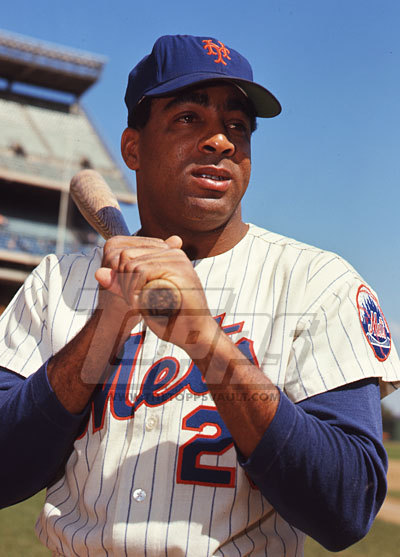
The latest batch of old photos auctioned off by Topps on eBay includes this gem — a shot of World Series hero Tommie Agee taken at Shea in 1970, if Topps’s records are to be believed.
The Topps Vault, as it’s called, has yielded lots of gems — I bought a photo of Hank McGraw, Tug’s brother, though I missed out on a Dave Schneck photo originally labeled as John Stearns. (Plus there are ironic gems — from the plane in the background to Stork himself, this George Theodore picture might be the most mid-70s Mets photo ever.) But this one is particularly great — I love the fact that Agee’s bat is pointing to more or less the exact spot where he hit the only fair ball to land in the upper deck at Shea, an April 10, 1969 shot commemorated with a marker in the old rattletrap’s final years.
Anyway, as you were. We won last night. With luck we’ll win again today. There’s 1776 and 1964, and the Hot Dog Eating Contest, and lots more. Happy 4th!
by Jason Fry on 4 July 2012 1:58 am So that was awesome.
An 11-1 pasting of the Phillies would be awesome any time.
An 11-1 pasting of the Phillies before a huge crowd is even more awesome.
An 11-1 pasting of the Phillies to finish the halfway point of the season on pace for 88 wins is more awesome still, particularly since the Phils are in the basement and shopping their players.
That said, we may as well break out the caveats. (Don’t worry, I promise this post gets fun again later.)
First off, the big crowd was there for postgame fireworks — the Mets said it was the biggest crowd in Citi Field history, but they’ve said that before and I get the feeling they’ve built a certain amount of elasticity into stadium capacity so they can keep trumpeting increasingly meaningless declarations.
Second, and of more note, the Mets looked somewhere between not bad and very good at the midpoint of the last three seasons too.
I’m sorry to say it, but it’s true. You could look it up.
In 2009 the Mets were a surprisingly OK 39-42 at the halfway point, four games out of the division lead. They went a horrifying 31-50 the rest of the way.
The 2010 Mets were a robust 45-36 at the midpoint, three games out of first and alone as your wild-card leaders. They stumbled home an anemic 34-47.
The 2011 Mets hit the midpoint with a glass-half-full 41-40 mark, three games out of first. They went a glass-mostly-empty 36-45 for the duration.
I know I’m being no fun, but this has been in the back of my head every time I fall in love with this year’s girl-with-a-curl club. They’re gutsy and resilient and promising and likeable, they really are … but I thought the same things in previous Julys about squads that included the likes of Omir Santos and Henry Blanco and Willie Harris, teams that have not gone down in our collective memory as particularly beloved. The second half of the season is when young players get fatigued, when BABIPs and FIPs regress to the cruel mean, when thin ice skated over finally cracks.
Can the Mets make October? Of course they can — I’m not sold on the Nationals, the Braves have plenty of their own problems, the Marlins are a disaster and the Phillies’ window may have slammed on their fingers faster than we thought. Not to mention there’s not one but two wild cards to play for now. But if the Mets stumble on the way to October and you’re surprised, well, you’ve forgotten recent events.
And with that, let’s get back to everything that did go right — which tonight was quite a lot.
There was Ruben Tejada, setting the tone immediately with a tough 11-pitch at-bat that resulted in an out, but also made Vance Worley work a lot harder than he wanted to, and gave everyone in the Mets’ dugout a good look at his pitches. Ruben was 3-for-4 the rest of the way and played sparkling defense, continuing his apparently trouble-free comeback from his injury and a season that could end with him as an emerging star. That’s something I find particularly gratifying, since I’ve believed in Tejada ever since he came up, and have enjoyed watching him get better and better seemingly every month. He reminds me of Edgardo Alfonzo — a player we saw grow before our eyes, and turn into a sure-handed fielder and deadly hitter with unerring instincts.
Daniel Murphy had a terrific game too, continuing to hit and contributing in a leaping grab of his own, part of our middle infielders’ plan to torment grasshopper-legged Hunter Pence whenever he tried to line one over the infield. The lone disappointment was that Murph didn’t collect the homer he needed for the cycle, settling instead for a two-run double and two RBIs in his final at-bat. (If he played in San Francisco, Giants fans would have tried to vote it into a home run.) On the subject of Murphy, his airborne leap for Pence’s liner was a useful reminder of something I tend to forget. Murph doesn’t have a lot of power, lacks a steady glove afield and strikes us as a lunch-pail scrapper compared with more accomplished teammates. But to snag Pence’s drive, he leapt higher than I could jump if I started out standing on my coffee table. When it comes to hand-eye coordination, fast-twitch muscles and other genetic gifts, Daniel Murphy and are barely the same species.
And David Wright was David Wright, from his thoroughly improved glovework at third to his booming homer into Apple Land late. (If you’re wondering, Pedro Sandoval went 1 for 2 tonight in a loss to the Nationals, an accomplishment Giants fans rewarded by voting that he get the key to the city.) Wright’s heroics were more impressive not only statistically but also morally: His fine fielding took a hit away from Shane Victorino, and whenever something bad happens to Shane Victorino, God creates a kitten.
And then there was Jonathon Niese, who shrugged off a second-inning summertime home run from Chico Ruiz to allow just two more hits over eight innings. Since the Come to Jesus session with Dan Warthen, Johan Santana and R.A. Dickey that followed Niese’s disaster in Toronto, he’s 6-1 and has lowered his ERA from 4.85 to 3.35. Like the previously discussed teams, Niese has had a history of second-half fades. But his recent run of success suggests he may be figuring it out.
And history isn’t destiny — as any broker will tell you, past performance is no guarantee of future returns. The Mets are 44-37, fun to watch, easy to root for and worth investing hope in. Those 42,000 folks who got in-game fireworks before the postgame variety had to have noticed that. Here’s hoping they’ll be back — and that the guys down there on the field are too.
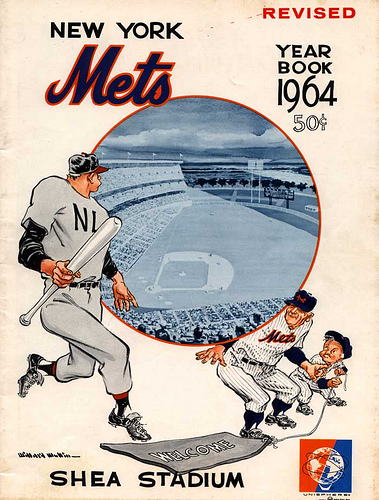
by Greg Prince on 2 July 2012 1:22 pm  Wednesday night, the Fourth of July, you’ll want to pause your annual viewing of 1776 to be reminded of another year that made our country great: 1964, as SNY debuts Mets Yearbook: 1964 at 6:30. As every Mets fan was taught in school, our ballpark was founded in 1964, sewn together from patches of orange and blue by team seamstress Betsy Ross, with the white stripes perfectly laid in by colonial groundskeeper Pete Flynn. Wednesday night, the Fourth of July, you’ll want to pause your annual viewing of 1776 to be reminded of another year that made our country great: 1964, as SNY debuts Mets Yearbook: 1964 at 6:30. As every Mets fan was taught in school, our ballpark was founded in 1964, sewn together from patches of orange and blue by team seamstress Betsy Ross, with the white stripes perfectly laid in by colonial groundskeeper Pete Flynn.
I may be confusing my patriotic folktales, but in any event, the highlight film that includes the opening of Shea Stadium is the highlight film that is not to be missed. If your DVR is like mine, it can handle two simultaneous recordings, which I mention because at the same time SNY shows 1964, TCM shows 1776. The greatest movie musical ever made airs there on the off chance you don’t already own the director’s cut on DVD. 1776 (or America Yearbook: 1776, as I’ve come to think of it) has been regularly anticipated Fourth of July viewing here since 1991, and its 22nd consecutive annual screening is as anticipated as all the others before it.
But I’m really looking forward to Mets Yearbook: 1964 to find out whether those escalators they mentioned in 1963 pan out.
Image courtesy of “Mario Mendoza…HOF lock” at Baseball-Fever.
by Jason Fry on 2 July 2012 12:48 am The o gers’ lone concession to competitiveness Sun ay night was sen ing the rather won erful Clayton Kershaw to the moun , but in the early going not even a Cy Young awar -winning lefty with an evil curveball was enough to ispel the funk that’s settle over o ger Sta ium for the last week — a week that ha seen the o gers possess a lea for a gran total of zero innings. The reason the collapse continue in those early frames? Mostly it was the presence of the luckless ee Gor on, son of Tom. He’ll be goo one ay, but right now he’s as ma ening as young players often are, a rather immature fiel er with his heart stuck on his sleeve to an unhealthy egree. The Mets an o gers were tie at 1-1 in the thir when Gor on turne an inning-en ing ouble play into a fiel er’s choice an a run-scoring error by heaving the ball into the ugout. Was Ruben Teja a further en earing himself to Mets fans with a nifty take-out sli e at secon , you ask? Nope — Gor on just messe it up. Then he promptly messe up the next play too, pulling James Loney off the bag — an Loney contribute a mini- avi Cone by arguing with the ump while avi Wright scampere home with a thir run.
It was enough to rive Kershaw to rink — but if he’ waite a few innings, he might have hit the town with illon Gee, who was un one by his own efense.
That first o ger run came on a Juan Rivera ouble over Lucas u a’s hea — a ball that most right fiel ers woul catch, but u a was frozen for a fatal secon an then lumbere after it to no avail, with the ball plopping own on the e ge of the warning track. Unfortunate, but as his own manager will attest, u a isn’t a right fiel er. Unless they eci e to shift him permanently to left (which woul n’t be a terrible i ea provi e it’s a one-way trip), the Mets will just have to live with such things.
What they shoul n’t have to live with is Ronny Ce eno making painful errors too. In the fifth, Ce eno turne Tony Gwynn Jr.’s attempt to hit into a fiel er’s choice into an all-han s-are-safe affair, failing to erase Juan Uribe at secon . Two hitters later, the Mets gave L.A. another extra out (an a run) when Justin Turner muffe Gor on’s little bouncer at first. Another run came in, an Gee ha given up three where he i n’t eserve to have surren ere any.
An , well, you ha the istinct impression this one wasn’t going the Mets’ way. There was Gor on, running wil in an effort to atone, an Kershaw hol ing the fort, an the Mets’ bullpen in too early for the walls not to start blee ing. Though give the pen mil cre it: With one out an the bases loa e in the seventh, Miguel Batista got Rivera to hit a little comebacker his way. Batista scoope it up an threw it to Mike Nickeas, waiting not terribly far away an rea y to continue what sure looke like an inning-en ing 1-2-3 ouble play, leaving the Mets own just 4-3 an with a puncher’s chance.
The ball went right by Nickeas. Of course it i . After all, it’s har to win baseball games when you’re lacking a certain something that’s conspicuous in its absence, something you take for grante an on’t miss till it’s gone an you realize how often you epen on it.
Long plane ri e back through the night — but a ay off tomorrow. Which is best, because I think it’s safe to say all of us involve — 25 guys in blue an orange an several million frustrate rooters — coul use a blank spot on the sche ule.
|
|