The blog for Mets fans
who like to read
ABOUT US

Faith and Fear in Flushing made its debut on Feb. 16, 2005, the brainchild of two longtime friends and lifelong Met fans.
Greg Prince discovered the Mets when he was 6, during the magical summer of 1969. He is a Long Island-based writer, editor and communications consultant. Contact him here.
Jason Fry is a Brooklyn writer whose first memories include his mom leaping up and down cheering for Rusty Staub. Check out his other writing here.
Got something to say? Leave a comment, or email us at faithandfear@gmail.com. (Sorry, but we have no interest in ads, sponsored content or guest posts.)
Need our RSS feed? It's here.
Visit our Facebook page, or drop by the personal pages for Greg and Jason.
Or follow us on Twitter: Here's Greg, and here's Jason.
|
by Greg Prince on 17 June 2012 10:38 am “I’m not sayin’ he should’ve killed her. But I understand.”
—Chris Rock on O.J. Simpson
Jon Niese threw one very bad pitch very early, Jay Bruce hit it very far and Saturday night’s ballgame was very over. Unfortunately another 8½ innings needed to be played and another 8½-thousand content-free words had to be needlessly issued via the flapping Red-tinged tongues of yappy Fox hounds Thom Brennaman and Sean Casey before the Mets could just leave all their runners on base and call it a night — a very blah night.
The Saturday Night at the Metsies miniseries, which began last weekend and runs for the next two weekends, is revealing itself as a prime-time disaster. Before Fox got its 7:15 PM hands on us, we were 8-1 on Saturday afternoons. Darkness, when enmeshed with Foxness, does not become us.
Nor, to go back to Friday night, does booing our left fielder when he’s going all out to haul in a deep, tailing fly ball, diving onto the warning track in his futile pursuit and inadvertently ramming his battle-scarred noggin into the base of the outfield wall to halt his skidding forward motion as the ball trickles away for an inside-the-park home run (Bruce’s, of course), leaving him to lay helplessly in the corner.
Jason Bay took a nasty spill and it elicited a nasty reception. The failure was jeered despite the effort involved in trying to execute a fairly hopeless catch. The result was loudly derided because who wants to fall behind when the bases had been empty and nothing traveled over a fence? And, quite clearly, the man in left was booed…and kept being booed while waiting to be medically attended to.
When the Mets got Bay on his feet and helped him off the field, there was some applause. Some, not a ton. Let’s say it wasn’t unanimous. Just as not everybody booed an injured Met at Citi Field, not everybody clapped in support of a banged-up Met who looked to have just courted another bout of head trauma. Brushing with broad strokes would be a mistake here.
Yet it’s clear two rules of baseball etiquette — unwritten Commandments, you might say — were breached by Mets fans or whoever goes to Mets games when they draw 34,716:
1) You don’t boo a guy when he is literally down;
2) You don’t not cheer a guy when they finally get him up.
It doesn’t matter that times have changed. It doesn’t matter that the main attraction at ballgames is apparently the electronic device in the palm of your hand. It doesn’t matter that Citi Field, like all modern fields, seems designed to detract from the traditional ballgame-going experience and certainly doesn’t nurture certain time-honored traditions. There are just things you don’t do and there are things you are compelled to do. There was poor behavior on both ends where Jason Bay’s second concussion in three seasons was concerned.
You don’t boo Jason Bay when he is down. And you don’t not cheer Jason Bay when he gets up.
It doesn’t matter that Jason Bay has been a deeply dug hole for tens of millions of dollars since 2010 and he’s owed tens of millions more through 2013.
It doesn’t matter that Jason Bay has shown next to no power and little production despite power and production being exactly the items for which he’s being handsomely compensated.
It doesn’t matter that Jason Bay has missed significant chunks of time in each of his three Met years to date — even managing to contract flu-like symptoms the moment he was restored to the active roster this season — meaning we always seem to be wishing him speedy recoveries and banking on his next fresh start to set everything right.
It doesn’t matter that while his performance has been utterly unlikable, his persona couldn’t be less worthy of bile and therefore Mets fans of decent upbringing can’t quite bring themselves to pour vitriol on his star-crossed coconut because Jason Bay is always hustling, always trying, always making the effort and never saying anything outwardly insulting (if not exactly saying anything inspiring).
It doesn’t matter that most of us have been trying our best to temper our criticism of him personally even as we legitimately excoriate his performance because Jason Bay doesn’t come off as a self-absorbed mercenary or a preening jerk, yet for all our thoughtful self-editing, he won’t return the favor and simply hit like he’s supposed to.
It doesn’t matter that every isolated now and then, he teases us with a taste of what we thought he’d do as a matter of course and then reverts to the Jason Bay form as we’ve come to know it.
It doesn’t matter that one game after Jason Bay helped the Mets sweep Tampa Bay, he immediately played a role in putting the Mets behind Cincinnati.
It doesn’t matter that when you see another player risk his well-being to make an impossible catch and then hurt himself, your instinct is to care deeply and support him wholeheartedly, yet somehow when it’s Jason Bay, you feel you’ve been around this cul-de-sac on multiple occasions, thus you’re incredibly frustrated just thinking about him and your empathetic baseball-fan instincts betray you.
None of it matters. Even if you don’t want to, you have to not boo Jason Bay when he appears to injure himself and you have to applaud Jason Bay when it is confirmed he hasn’t killed himself.
That’s just what you have to do — even for Jason Bay.
by Greg Prince on 16 June 2012 4:14 am 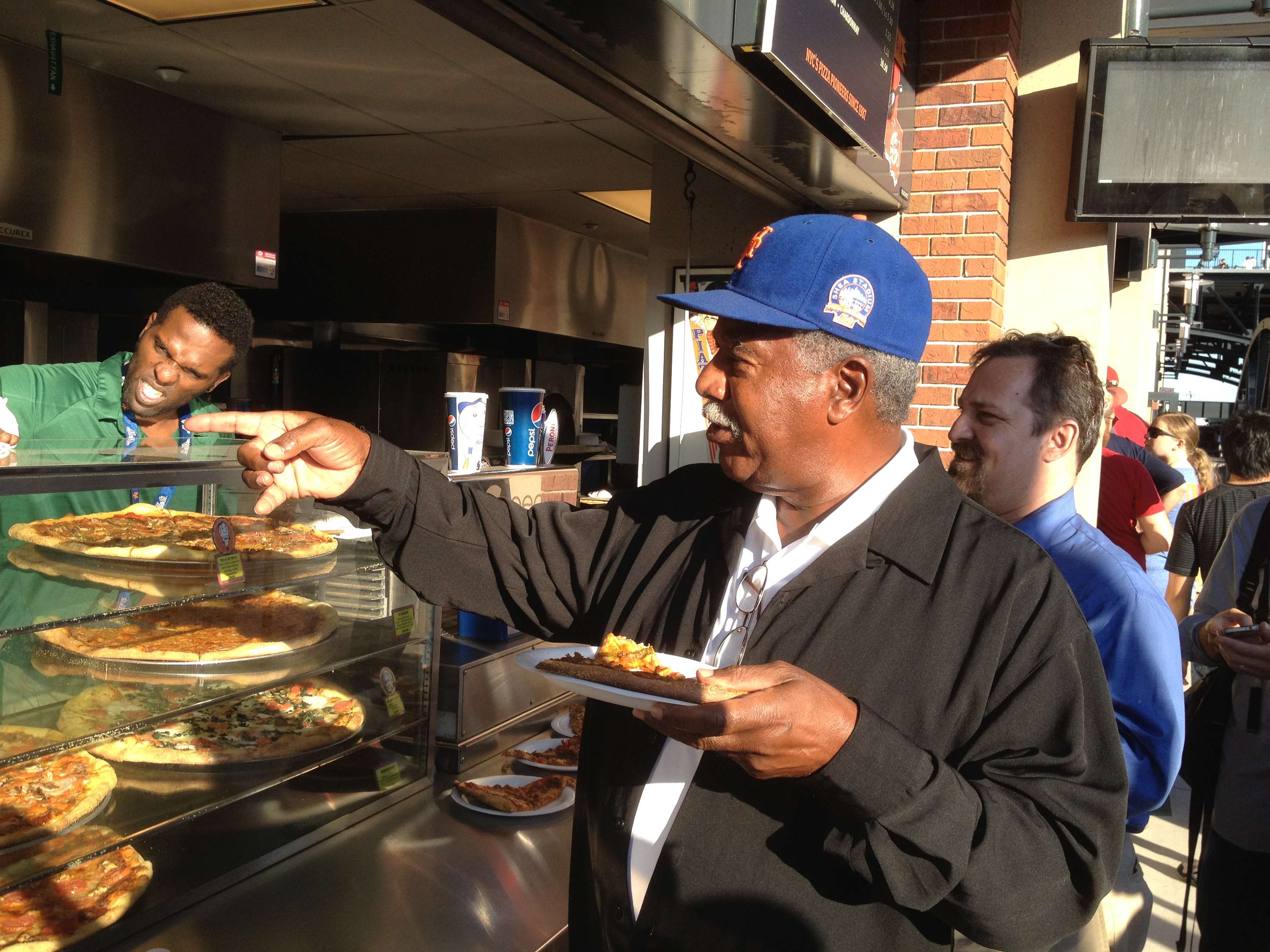 From hauling in the last out to partaking of the first slice, he’s still Cleon Jones. 10. Jason Bay. Ohmigod, wasn’t that awful? Naked Gun awful. I’m surprised the poor bastard’s head didn’t roll into foul territory. What’s left to say?
9. Scott Hairston. The Man for a night, albeit a lousy night on the field. But Scott’s a gamer coming off that bench where few Mets sit for long. Give ’em hell, Hairy!
8. Mike Baxter. Every conversation since June 1 is better because I can use the phrase “since the no-hitter” or words to that effect. Two weeks and I haven’t fully come down. Why should I? That’s all Baxter’s doing (well, his and Johan’s). Hoping the getting better is proceeding. And I hope I never receive another offer for a reprinted $50 ticket for a game for which I turned down a real one of lesser face value.
7. Dave Kingman. A visitor to four positions as a Met, a fixture at none, but when I envision Dave Kingman The First Time, I definitely see him as a left fielder. That tenure ended 35 years ago yesterday, June 15, 1977, which is hardly ever remembered as The Day Dave Kingman Was Traded.
6. Steve Henderson. Nor is June 15, 1977 remembered as The Day Steve Henderson Was Traded For. Nor should it be. But, oh, that home run 32 years and two days ago…
5. Cliff Floyd. I thought of Cliff as Rob Emproto and I discussed David Wright’s Met future in one of the nine innings in which the Mets looked hopeless Friday night. I wondered if the Mets’ bush-league appeal of the one hit in R.A. Dickey’s one-hitter might be remembered by David at contract time the way the mob remembered Tommy’s unauthorized whacking of Billy Batts in GoodFellas, though I agreed that ultimately money talks and nobody walks. Anyway, this got me thinking about how David has spent so many postgame media scrums as the sole go-to guy and how he’s often been left to explain away Met misfortunes and I remembered what a nice relationship Cliff and David seemed to have in David’s early days, and I began to miss ol’ Cliff.
4. REO Speedwagon. Pretty left field choice for a postgame concert in Flushing, Queens, New York in 2012, no? But they rocked…THEY ROCKED! per Beavis. I was glad to see and hear them as was Rob, who’s an ace classic rock guy in addition to being a baseball wise man. I get the group that gave us You Can Tune A Piano, But You Can’t Tuna Fish is not everybody’s cup of early ’80s tea, but what I didn’t get pre-Friday was how their impending Citi Field presence inspired so much snark of the “who can even name an REO Speedwagon song?” variety. Well, there was “Keep On Lovin’ You,” which was played every six minutes during my three final high school months. And there was “Keep The Fire Burnin’” which was on my car radio frequently as I drove back to Florida for my sophomore year of college. And there was “Roll With The Changes,” which received a recurrent life on multiple FM formats once Hi Infidelity hit. And there was überballad “Can’t Fight This Feeling,” which spent three weeks at No. 1 as winter 1985 became spring 1985. Turn your nose up at the Wagon if you must, but never be proud of not knowing something.
3. Endy Chavez. (No exposition necessary.)
2. Bernard Gilkey. His 1996 star turn as Mets RBI machine is vaguely recalled, but everybody remembers his 1997 Men In Black cameo.
1. Cleon Jones. Holy fudge, I stood right next to Cleon Jones as Cleon Jones took a bite of a slice of pizza named for Cleon Jones and when Cleon Jones wasn’t enjoying his Cleon Jones pizza, Cleon Jones was answering questions about 1969 being posed to him by a small cadre of shall we say senior bloggers (within a somewhat larger cadre of bloggers of all ages) that included me, and again I was reminded of how helpful it is to shed one’s cynicism and allow oneself to be impressed should the impulse present itself.
Brother, was I impressed to be standing inches from Cleon Jones.
See, he’s Cleon Jones, who hit .340 for the World Champion Mets and caught the ball that ensured they’d forever be referred to as such. I’m me, some little kid watching on a tiny Sony as it unfolded, except now I’m older, apparently. Yet on a Friday night in the same general vicinity where that catch was made a mere 42 years and eight months ago, we came into a proximity measured in inches and bridged by baseball. Cleon talked about Gil Hodges, Donn Clendenon, challenging for a batting title, being hit by Dave McNally, dealing with a midseason injury on a slick Shea surface and Gil Hodges some more, of whom he seems particularly fond still.
As it happened this Blogger Night, my little pastime here brought me into contact with Jerry Koosman and Edgardo Alfonzo (along with Cleon they helped City Harvest do a good deed, repacking sweet potatoes for NYC food pantries on Mets Plaza); Kooz again, this time with R.A. Dickey (meeting as scoreless inning maestros); top draft picks Gavin Cecchini and Kevin Plawecki (your Mets of tomorrow, tasting a bit of their future yesterday); and Randy from The Apple and Joe from Mets Merized Online (two of the many nice folks within the blogger cadre brought together by Mets media relations). Plus I was hooking up with Rob a little later for the actual game plus concert.
Yet chatting with Cleon Jones in front of the Two Boots in center field — reasonably interrupted now and then by a double-take, a gawk and an “excuse me, but you’re my favorite player…” autograph request — six days after I saw a fictional Cleon Jones make the last catch of the 1969 World Series in Men In Black 3…good lord, Cleon Jones! Cleon Jones! It’s not that Cleon Jones was my favorite player growing up. It’s that Cleon Jones was Cleon Jones and, better yet, still is.
So he wins.
by Jason Fry on 15 June 2012 2:52 am Good luck outguessing baseball: After kicking the ball around and losing two out of three to the Nats and then getting kicked around by the Yankees for a horrifying sweep, the Mets absolutely flattened the Tampa Bay Rays for a sweep of their own, turning an imminently horrific 1-5 road trip into a respectable 4-5 affair. They did it with booming hitting, mostly OK defense, mostly good bullpen work, a ridiculously dominant performance by R.A. Dickey, bad defense for the other guys and pretty much every advantage one can grab in winning a baseball game. The Rays walked away from Ben Zobrist’s final called strike three looking shellshocked, and with reason.
Johan Santana still doesn’t look good — he was missing his spots, and only some very effective pitching from Jon Rauch prevented Johan’s final line from looking a lot like it did following that mess in the Bronx. The narrative that we sold Johan’s shoulder for a no-hitter will continue to be explored unless or until Johan returns to his generally effective pitching of April and May; I’m certain it will rear its head in these parts again. For now, though, it’s something worthy of idle wondering rather than active worrying.
If your taste runs to active worrying (and you’re a Mets fan, so you’re at least acquainted), you’ll want to consider the defense, again. Ike Davis botched a pickoff of B.J. Upton, leading to a run. Then, with a 9-5 lead in the ninth and two outs to go, Omar Quintanilla inexplicably tried to race Desmond Jennings to second base instead of taking the 26th out at first. Fortunately, the bats had enough juice in them to make up for all that: Kirk Nieuwenhuis went deep twice, David Wright was on base four times, Davis reached base three times and even Jason Bay, the Charlie Brown of the gang, hit one out.
The Mets may not continue their winning ways; if I had to bet I’d wager that they won’t, as I suspect their ineffective bullpen and porous defense will do them in. Which won’t necessarily make the year a failure — not if some of the young Mets make the transition from prospects to pieces, if the minor-league arms keep developing, and if the financial future remains brighter than it’s been. (And hell, even if that looks iffy, we got a no-hitter. We’ll always remember 2012 fondly for that.)
Speaking of the financial future, Bay’s recent injury makes it unlikely that he’ll reach 500 plate appearances this year, which would turn his ridiculous $17 million Omarpalooza vesting option in 2014 into a $3 million buyout. (Well, unless he collects 600 PAs in ’13.) The Mets will also almost certainly buy out Santana’s 2014 $25.5 million deal for $5.5 million. Spending $8.5 million to have two players go away (accompanied, for Johan at least, by our devout thanks) is expensive, but it beats spending $42.5 million to watch them give you what would almost certainly be a lot less value than that.
So those are reasons to be hopeful, even while we search for a shortstop and hope Rauch has more days where he nods at Twitter praise instead of retweeting venom. The season will ebb and flow, with good days and bad — that’s the game. But I can think of another bright spot here: The Mets are doing more with less, I think, because they’ve bought into Dave Hudgens’ smart, patient approach to at-bats. They work counts, spoil pitches, tire starters out, and wait to take advantage of the diminished stuff brought about by elevated pitch counts or the less-effective arms of middle relievers. They did it to Alex Cobb on Tuesday night, to David Price yesterday (not that Dickey needed much help) and then to Jeremy Hellickson today.
Take the top of the fourth, 32 pitches of torment for Hellickson. Bay led off, looked at three balls, then flied out on a 3-2 pitch. Josh Thole grounded out on a 1-0 pitch, but Quintanilla then battled Hellickson through a tough nine-pitch at-bat, including four fouls on 2-2. He reached on an infield hit, then scored on Nieuwenhuis’s homer off a 1-2 pitch. Hellickson then hit Jordany Valdespin in the foot with an 0-1 pitch. He was clearly crumbling, and Joe Maddon started stalling. Wright then worked Hellickson for eight more pitches, yet another sign that the anxious, wildly swinging Wright of previous Citi Field seasons has been banished. Wright walked, and Maddon left Hellickson in against Lucas Duda. Faced with a tired, frustrated pitcher, Duda turned the game plan on its head, sensing that Hellickson might try a get-me-over pitch that would give him a 0-1 advantage and a better chance at escape. It was the right time to be aggressive, and Duda blasted Hellickson’s first pitch off the center-field wall. It was the last pitch Hellickson would throw.
There will be good days and bad, sure. But being smart is about as close to slump-proof as one can get — and with bats in their hands, so far the Mets look pretty smart.
by Greg Prince on 14 June 2012 3:11 am From: Clueless Editor <cluelesseditor@limitedimaginationpublishing.net>
Date: Wed, 13 Jun 2012 21:40:43 -0400
To: George Plimpton <gplimpton@celestialillustrated.com>
Subject: Re: Book Proposal
Dear Mr. Plimpton:
We are in receipt of your book proposal, The Curiouser Case of R.A. Dickey and regret to inform you it does not suit our needs at this time.
While your lead character R.A. Dickey is richly drawn, and his backstory is potentially appealing, we here at Limited Imagination agree there is no way he could exist. Since you insist on setting Dickey within the milieu of major league baseball, there needs to be at least some semblance of reality attached to your protagonist, and quite frankly, your Dickey may be the least fathomable sports character we’ve ever read.
 Truth stranger than fiction? (Photo by Sharon Chapman) According to our research department, most successful baseball pitchers attain a level of peak performance in their 20s, but your Dickey is supposedly a career journeyman derailed by the lack of an essential component in his throwing arm who attempts to learn a magic pitch in his 30s, takes years to master it and then, quite suddenly, takes it to a whole other level where he becomes all but impossible to hit. The sports reader may “root” for the unexpected, but that demographic is more and more grounded in statistical probability and the Dickey you describe in the latter chapters begins to do things that sound impossible.
We could accept a certain literary license in making Dickey fairly articulate as a contrast to the usual ballplayer, but having him write a searing memoir that lands on the New York Times bestseller list in advance of creating this pitching alchemy again stretches credulity (though I did chuckle at the idea of “R.A. Dickey” signing his book at a museum named for Yogi Berra — quite clever). More troubling is your climactic scene in St. Petersburg where your protagonist has the night of his professional life.
Where to begin with what’s wrong with this?
• First, you mention his team, the New York Mets, has recently had a no-hitter. Longtime baseball fans will immediately detect the inaccuracy there.
• Second, your key moment in the telling of the big game happens way too early. The first inning, Mr. Plimpton? And having the team’s All-Star third baseman make the mistake? That seems to be pushing it.
• Next, Dickey goes on to set a team record in the middle of all this. You might want to rethink pouring on so much melodrama.
• Also, the part where you have Dickey’s masterpiece disturbed once more by the same third baseman…you might want to do a little fact-checking to see if that is even possible.
• Finally, the aftermath of the one-hitter seems just plain bizarre. You have Dickey’s manager insisting the team will challenge the scorer’s big decision, and Dickey having the presence of mind to use a word like “purview” in his live postgame TV interview, and for some reason you layer on top of this a perfect game pitched across the country hours later by the same pitcher who once “beaned” the star-crossed star third baseman who made the two bad plays to cost Dickey his own bid at perfection.
Your conclusion carries with it its own set of holes. Where you indicate Dickey’s perfect game not being a perfect game is beside the point because the bigger victory is that he’s pitching so incredibly well throwing the magic pitch that maybe next time he’ll throw the perfect game — and even if he doesn’t, a string of shutouts and near-shutouts that are on par with what the best pitchers in his team’s history have done is plenty?
No disrespect, Mr. Plimpton, but we here at Limited Imagination Publishing wonder if you have any concept of telling a good sports story.
Nevertheless, we do see some promise in certain elements of The Curiouser Case of R.A. Dickey. I would suggest that instead of making him an intellectual Southerner who struggled for years in the minor leagues before emerging as a sensation in New York, you convert him to a different kind of protagonist. He could have an Eastern religious bent along the lines of Hermann Hesse’s Siddhartha. Since they have nicknames in baseball (by the way, “R.A.” isn’t much of a baseball name), you could shorten “Siddhartha” to maybe Sid. Or Sidd, even. I was thinking about how you worked Berra into your proposal, so let’s say He’s A Pitcher, Part Yogi And Part Recluse; Impressively Liberated From Our Opulent Life-Style, Sidd’s Deciding About Yoga — and his future in baseball.
This is just something that springs to mind. Hmmm, “springs”…say, here’s another suggestion: you may want to set your story in spring training. You already have the Mets in Florida. Maybe you can check and see if the Mets ever trained in St. Petersburg and play off that location (but in a venue more interesting than a domed stadium, which I’m pretty sure they don’t even have in baseball anymore; placing the action in the middle 1980s might solve that problem, but that’s up to you). St. Pete might be fertile ground for “Sidd” to do eccentric things like play the French horn and throw the baseball outlandishly hard.
Admittedly, it’s a little off the charts, but the idea that a fictional pitcher can get batters out with devastating fastballs at least seems, as they say, in the ballpark. This “R.A. Dickey” and his magic pitch that nobody’s ever thrown the way he’s throwing it in your book?
Honestly, Mr. Plimpton, who’s going to believe that could happen?
Good luck,
Clueless Editor
Limited Imagination Publishing
by Jason Fry on 13 June 2012 12:54 am It’s not a good sign when you miss nearly all of the Subway Series, then are relieved that your team has an off-day.
I was at my 25th high-school reunion over the weekend, and so the Debacle in the Bronx was reduced to occasional bleary, baleful glowers at my phone, with the exception of a couple of painful innings I heard while waiting for and sitting on the Delta Shuttle back to New York. The captain has indicated it’s time to switch off all electronic devices? No problem, ma’am — this one’s giving me nothing but pain as it is.
Tonight’s renewal of the thrilling rivalry between the Mets and Rays didn’t immediately promise a much better outcome. Besides the fact that the Rays are really, really good, the Mets played the first couple of innings like a dispirited team walking straight into another uppercut to the chin. Kirk Nieuwenhuis and Lucas Duda lost balls against the weirdly colored, weirdly canted Mad Max roof that feels like it’s going to slide off the top of Tropicana Field, with Gary Cohen’s sympathy extending up to but not including the fact that every other visitor plays in the same conditions. That was bad; worse, Chris Young couldn’t locate his curveball, leaving various Rays waiting on his rather pedestrian fastball. Forget bringing a knife to a gunfight — poor Young was facing a Wild West showdown with an empty holster.
But Young persevered, the Mets stopped dropping balls, and eventually they figured out that Alex Cobb was basically armed with nothing but his own fairly ordinary fastball, which he kept aiming at the hands of left-handed hitters. Perhaps the Mets heard Keith Hernandez howling about this rather metronomic plan in the booth, when he wasn’t registering crabby opposition to Moneyball, video review and Twitter. That last one was perhaps the least surprising statement in the universe for Tuesday, June 12, 2012 — Keith Hernandez Has No Use for Twitter — but an unfortunate one nonetheless, as Keith would be phenomenal on Twitter. I imagine his Twitter persona as a mix of Bill Murray and Buzz Bissinger — hell, I’d pay to follow him. The only thing more entertaining would be a Keith Hernandez reality show, which would instantly win “Keep Until I Delete” status on my TiVo. Surely SNY can make this happen. Option Keith TV and cancel, say, Loudmouths, and think what a better place the world would instantly be.
Anyway, Jordany Valdespin thrived at his natural position, racking up four RBIs, Ike Davis blasted a three-run homer into the seats, Daniel Murphy came through with the bases loaded and Jason Bay … well, Jason Bay tried his hardest. There were dicey moments as Young’s pitch count climbed above 100, with Terry Collins perhaps wondering whether a one-armed Young might be more effective than anybody he might bring in from the bullpen. (Honestly, it’s neck and neck.) But Jon Rauch got the last out in the sixth, ensuring he’ll have to retweet minimal amounts of cyber-venom, and after the commercial the rout was on.
We can’t know what tomorrow will bring, except that it includes the ferocious talent and heat of David Price (in what ought to be fascinating Strasburgian matchup with R.A. Dickey). But at least for tonight the Mets had what they and we sorely needed — a laugher.
While we’re being Twittery, you can follow me at jasoncfry and Greg at greg_prince. You know, if you want. C’mon, it’s fun.
by Greg Prince on 12 June 2012 1:07 pm We know best-selling author R.A. Dickey is a person as well as a top-notch pitcher, and we like that about him, because it gives us one more reason to find him, as he likes to say, trustworthy. If you’d like to discover more R.A. for yourself, as I did, he’ll be signing copies of Wherever I Wind Up at the Yogi Berra Museum & Learning Center at Montclair State in Little Falls, Thursday night, June 21, 6:00 to 7:30.
When you read Brian Costa’s profile of Andres Torres in the Wall Street Journal, you’ll learn our slumping center fielder is a person, too. Costa explores Torres’s ADHD, which helps explain why succeeding at baseball can be extra challenging even for a person who is a gifted athlete. It’s more rewarding knowing Dickey overcame personal obstacles to become a stellar Met than it is understanding Torres is held back by personal obstacles and has been an unproductive Met, but person-ness comes with the territory.
If you’ve followed any Metsian doings on Twitter in the past 24 hours, you’ve probably noticed Jon Rauch being a person — a person trying to laugh off the attacks of, technically, other persons. Rauch is one of several Mets very active with social media interactivity, which is all very lighthearted and friendly when things are going well (or at least not going badly), but can emit toxic overtones when things are a mess. By Rauch’s own admission, the end of Sunday’s game, when he gave up a home run to Russell Martin, was a mess. Surprise, surprise, Rauch was the subject of loathsome Tweets for his troubles. Rauch handled the onslaught not by checking out of Twitter when the criticism grew insanely nasty — as Josh Thole did last year — but by ReTweeting them to show, in every sense possible, he’s a bigger person than his most virulent detractors could dream of being.
Yeah, tattooed relief pitchers who give up walkoff homers are people every bit as much as soulful knuckleballers who are 9-1 and center fielders struggling with hyperactivity. Mets are people. (Rumor has it Yankees are people, too, but that can’t be confirmed at this time.)
I’m not sure how I feel about this revelation. We are party to uninhibited honesty from Dickey, insightful reporting on Torres and edgy but measured response from Rauch, and it helps us immensely in understanding we’re rooting for people, not names and numbers. Yet, let’s face it, this being informed and enlightened chips away at the barrier we had when we could sit back and mindlessly express our briefly considered opinion of who sucked and who sucked more. Not everybody worries about those barriers, as illustrated by the Tweets sent Rauch’s way, but for the rest of us, having to realize guys who screw up on “our” team are just people is a little bracing.
I’m charmed that many of my fellow Mets fans Tweeted to Rauch’s defense, telling him, in essence, you’re all right, you’re a good guy, you’ll get ’em next time, the jerks are just being jerks. That speaks to good fellowship and sportsmanship and decent humanity, yet I can’t help but suppress a grin because I know these good-hearted Mets fans, if they were not in some semblance of contact with a Met reliever who’d just allowed a Yankee to finish off a series sweep, would be muttering horrible things about Jon Rauch precisely because he’s a Met reliever who’d just allowed a Yankee to finish off a series sweep. But that’s Jon Rauch the Met. As Mets fans, we get mad at our Mets and impulsively declare them deserving of the most horrible of fates.
Twitter, however, has provided a sense of Jon Rauch the person…and maybe a taste of “knowing” Jon Rauch the Met. So, yeah, the Met who gives up a ninth-inning walkoff homer in the Bronx is going to inspire a little reflexive vitriol when he’s an abstract figure tethered to a 4.88 ERA. But good ol’ @jrauch60? He’s a good guy! Get off his sizable back!
I totally get it. It’s one thing to harass a Met from the stands or the couch. It’s another to mistreat a person who plays for the Mets. Once in a while, when it’s not the bottom of the ninth inning and the score isn’t being untied by a person who plays in another uniform, I even plan to remember that.
by Greg Prince on 10 June 2012 10:03 pm  And this was before the Subway Series. Movies are almost always better when there’s a Mets element to them, whether it’s outsized, as in the key 1969 scenes from the current release Men In Black 3, or subtle, as in 1987’s Moonstruck, which had nothing explicit to do with the Mets back in the day when it seemed everything had something to do with the Mets, but did offer a lingering shot of a Darryl Strawberry poster in the bar where Loretta Castorini (Cher) agrees to join Ronny Cammareri (Nicolas Cage) for a post-opera drink.
Though nobody mentions the Mets anywhere in Moonstruck, one of the eternal truths as regards the object of our ongoing affection was expressed in this exchange between Loretta and her mother Rose (Olympia Dukakis) when Rose learns Loretta and Ronny are engaged to be married:
“Do you love him, Loretta?”
“Aw ma, I love him awful.”
“Oh God, that’s too bad.”
Rose had earlier explained, when Loretta planned to settle and marry Ronny’s schlemiel of a brother, Johnny (Danny Aiello), “When you love them, they drive you crazy because they know they can.”
If you exulted with the 31-23 Mets last weekend, you know you love them. And if you’ve been tearing out what’s left of your hair for most of the past 1-6 week, culminating in the baldness-inducing sweep-capper in the Bronx Sunday afternoon, you know Rose Castorini must have had a Darryl Strawberry poster tacked up somewhere in that enormous house of theirs, because like she said, they drive us crazy seemingly because they know they can.
Even when we should know better; even when perhaps we shouldn’t hold them to major league standards when they’re fielding primarily Buffalo Bisons and Jason Bay; even when we heard a little voice last December telling us the alleged bullpen upgrade was a fraud because alleged bullpen upgrades announced in December are always a fraud; even when we understand they possess no killer instinct in innings in which many of them become runners but hardly any of them become runs; even when we’re in our sixteenth season of trying to succeed yet ultimately failing against the likes of Derek Jeter, Andruw Jones and Andy Pettitte…no, not the likes of them, but actually them; even when we mock the dimensions of an overblown Little League park yet can’t manage to hit anything out of it ourselves; even when the pitcher with the disturbing heartbeat has more heart than all the teammates allegedly supporting him; even when the Mets are the Mets are the Mets and they pick the freaking Subway Series to emphatically remind us of that fact.
We love them awful, anyway, which is exactly how they played in the Bronx.
Oh God, that’s too bad.
by Greg Prince on 10 June 2012 6:17 am  We want the Mets to get up now... “I just kind of felt dead tonight,” said Dillon Gee after losing to the Yankees, 4-2.
Didn’t we all inside? Didn’t everybody in a Mets uniform, with the possible exception of provisional savior Omar Quintanilla, look like Dillon felt?
Enough playing dead. Rise from the dead already.
It’s Sunday. It’s as good a day as any for a resurrection.
Photo by Sharon Chapman.
by Greg Prince on 9 June 2012 11:25 am As one who wasn’t keeping up on the Astros’ day-to-day machinations from 1994 to 1996 nor the Angel melodramas of 1997 to 1999, I have to admit I knew little about Terry Collins during his first two tenures as a major league manager, other than he looked kind of miserable in Houston and it ended rather miserably in Anaheim.
The Terry Collins who won few plaudits as the returns on his management style chronically diminished seems to have been left behind in the last century, replaced by a kinder, gentler, wiser, more empathetic character about whom nobody has a bad word to say personally (a few bunting and bullpen calls aside). Check out Ken Rosenthal’s piece on the Met-amorphosis of a skipper, from “notoriously high-strung” to someone who’s succeeded via “remarkable transformation” for a well-deserved pat on Terry’s back.
Recalling erstwhile Met David Cone’s assessment that the Yankees got him when he was in his calmer, more mature yet still effective “second husband” phase while we had him when he was wild and at least once wanted by the law, it’s nice knowing that for a change we got somebody at the stage of his career when he’s at his best. Not only is this Terry Collins preferable to the Astro/Angel model, he’s worn way better than his three predecessors — Jerry Manuel, Willie Randolph and Art Howe — and become the manager to finally put an end to the residual pining many of us long maintained for their predecessor, Bobby Valentine.
Can you feel the “but…” coming?
The but is more a sense than a complaint, because I have no concrete complaints with Terry Collins or the overall job he’s done. But my sense is he overcompensates sometimes for the manager he used to be, the well-meaning results coming out, well…weird.
Terry threw himself full-force under the bus for removing Jose Reyes a half-inning too soon for comfort on Closing Day last year. It was such a strange episode to begin with, and it got only stranger in the postgame when Terry attempted to explain his culpability in letting Reyes bolt from the box score in the top of the first to preserve his league-leading batting average. The premeditated protection of .337, fairly standard in baseball folkways, was far less the issue than the timing of Reyes taking a seat before many fans had a chance to take theirs. At least have him go to short, tip his cap, get a few more people in the ballpark for what turned out to be a Met icon’s last day on the job. As someone who grumbled in the right field stands over the incredible, disappearing shortstop, that’s all I wanted.
The manager took responsibility. Fine. He took the blame. Fine. He broke down and made an enormous and emotional admission of what it took for him and his staff to earn their players’ respect and if his star wanted to go out on these terms, then that was the way it was going to be, blame him the manager. It was human and thoughtful and, besides, it was Closing Day. If you can’t show yourself as blatantly sentimentally introspective as a baseball season is ending, what’s the point of being what they call a baseball man?
A few weeks ago — though it seems longer — Terry jumped on another grenade after another questionable decision involving another star player. That was the Brewers game in which D.J. Carrasco had so much trouble locating his sinker that it rose high enough to smack Ryan Braun in his left arm. Coming as it did on the heels of a Carrasco-surrendered home run in one of those (several) games the Mets were losing by a ton of runs, it all looked a little peculiar, intentionwise. Soon enough, Carrasco was an unmissed ex-Met, but not before another weird interlude in which Collins pulled David Wright from the lineup in advance of his imminent at-bat. SNY’s cameras found the manager and the .408-hitting third baseman in an animated exchange, the upshot of which didn’t require lip-reading expertise. It was clear David Wright did not want to come out of the game because David, de facto captain serving under Colonel Collins, did not want to be seen as ducking potential retaliation from Zack Greinke or not taking one — or, per usual, everything — for the team.
Right move for Collins? Maybe. The Mets, you may have noticed, are prone to injuries and if there was any risk to the N.L. batting leader at that moment, the season would have been on the endangered species list. There’s no telling what the Brewers were thinking, but my guess was Greinke, pitching a shutout and being Greinke, wasn’t going to headhunt just because Carrasco, immediately ejected (to only modest on-field objection from Collins), plunked his MVP teammate. But that was just a guess. It was 8-0 in the seventh inning. Never-say-dieness notwithstanding, the Mets weren’t coming back. Why not take David out for a little rest?
Better yet, why not, when the carnivorous gentlemen of the press asked what was up with that, answer, “I was resting my player. David’s been playing with a fractured pinkie and giving his all. He wanted to stay in, he’s such a competitor. That’s all there is to it. Next question.” Collins could have winked, the reporters could have rolled their eyes a little and baseball as we’ve known it for decades would have been served. Instead, the Full Terry 2.0 was on display as every ounce of angst seem to come pouring out of him, suggesting the Brewers might have wanted to have hit David…which made the manager and the Mets look guiltier than the actions of a lone wolf ineffective reliever should have. Yeah, the dugout discussion between Collins and Wright appeared fierce on TV, but as David himself said, as he is prone to as an expert issuer of controversy-defusing quotes, “You get caught up in the moment and things probably looked a lot worse than they really were.”
It all blew over as Carrasco was immediately DFA’d, the Brewers left town and new mini-dramas came and went, but by the next day I began to think that Terry Collins, for all the praise he’s rightfully received and for all the progress he’s admirably extracted, may not last as manager beyond this season. I just get the feeling this being a changed man business is way harder than it looks, that the combination of characteristic intensity and extra care he takes to watch his step and publicly blame himself when things go periodically awry isn’t good for a person.
Friday night in the Bronx, I sensed it again when Collins stood in front of the veritable Tiananmen Square tank and insisted Johan Santana’s lousy outing in a stadium where he’s historically been abymsal was all his fault. The extra day of rest, which became a huge story not just because of Johan’s huge last outing but because Terry so sweated and bled the arbitrary pitch count the previous Friday, apparently backfired. Johan, said the skipper, didn’t have a bad game in surrendering four home runs over five innings…the skipper had a bad game:
“I am responsible for the way he pitched. He was rusty. The command of his stuff was not as sharp as it’s been the past three or four or five starts. It was my doing tonight. We erred on the side of caution, and it cost us the game.”
Hiroki Kuroda and his seven innings of one-hit ball notwithstanding, it’s likely Santana was a little too well-rested, however understandable the precautionary fervor given his post-rehab status. If rotations really turned at their most optimal on that much rest, why are none of them regularly of the six-man variety? Teams carry twelve, sometimes thirteen pitchers. Every pitch is monitored as if it could be the last of a pitcher’s career. If this really worked, I bet somebody would try it and stick with it instead of saving it (as Valentine did in the late ’90s) for extraordinary circumstances.
Let’s say everything Collins says is true, that’s it all his fault, that Santana was merely an instrument for his managerial malfeasance, that the balls whacked by Cano, Jones and that dipstick Swisher were predetermined by Terry’s horrendous miscalculation, not because sometimes those things happen.
Even if we say all that, it’s a loss. It’s one loss. Even if it’s an unattractive 9-1 Subway Series loss, it’s just one demerit in a season when there’s plenty of goodwill and chits to go around and nobody’s falling out of a playoff race because of it. Johan was undeniably lousy, but he hung in, his arm didn’t fall off, we still have the Friday night from the week before and, better yet, we have today. Managers are always preaching the importance of putting it behind us and moving on. I suppose this is Terry’s attempt to do that. Yet why does it feel he’s laboring far more than Santana did against the Yankees?
Again, I really get the armchair feeling that Terry is trying so dadburn hard not to be who he used to be and is so dadburn dedicated to being New Age Terry that it’s not good for him. The “respect” thing he talked about last September seems to have paid off in how his players (who, blessedly, have no obvious prima donnas or malcontents in their visible ranks) view him and play for him, but I hope Terry has enough respect for himself to not tie himself up in unnecessary knots every time a star-related pothole materializes on the long season’s road. Because as I said, I don’t think it’s going to wear well ultimately, and if a team that’s played hard and responded to him falls out of contention and winds up in a competitive free-fall the way his team did last year anyway, I can imagine it not wearing at all.
I was wrong that Terry Collins would likely be a bad fit for the New York Mets. I hope I’m wrong again.
by Greg Prince on 8 June 2012 4:16 pm Just a reminder to the Mets: Increasingly, we fans say we don’t particularly care about the Subway Series, that the novelty wore off long ago, that six games a year is too many, that Interleague’s an unnecessary disruption to baseball’s beautifully synchronized rhythms and that the whole thing is played out. These statements may accurately reflect how we view the world philosophically, but from a visceral standpoint…not so much. Hence, when you’re playing these three games this weekend, do your best to win them.
I know you do your best to win all your games. But you know what I mean. Really do your best. Really.
Thanks.
|
|






