The blog for Mets fans
who like to read
ABOUT US

Faith and Fear in Flushing made its debut on Feb. 16, 2005, the brainchild of two longtime friends and lifelong Met fans.
Greg Prince discovered the Mets when he was 6, during the magical summer of 1969. He is a Long Island-based writer, editor and communications consultant. Contact him here.
Jason Fry is a Brooklyn writer whose first memories include his mom leaping up and down cheering for Rusty Staub. Check out his other writing here.
Got something to say? Leave a comment, or email us at faithandfear@gmail.com. (Sorry, but we have no interest in ads, sponsored content or guest posts.)
Need our RSS feed? It's here.
Visit our Facebook page, or drop by the personal pages for Greg and Jason.
Or follow us on Twitter: Here's Greg, and here's Jason.
|
by Greg Prince on 12 December 2011 4:28 am A friend and I were discussing recent Met developments over the weekend. He referred to “Gil and Reyes,” as in he perceives an anti-New York bias inherent in Gil Hodges not making the generally worthless National Baseball Hall of Fame and Jose Reyes not finishing in the Top Ten of the National League MVP voting. What struck me in his communiqué was Gil was dependably “Gil” yet Jose had been relegated to last-name status.
No way, I said.
Yeah, he retorted. Jose’s a Miamian now, thus he’s Reyes.
Nah, I fired back. Argenis Reyes, if he’s around anywhere in 2012, he can be Reyes. Jose is Jose. Jose will always be Jose to me.
I didn’t high-hat Fonzie into Alfonzo. Darryl didn’t become Strawberry. Doc in his darkest pinstriped hours never became Gooden. Rico was always Rico. Melvin was always Melvin. And Tom Seaver never stopped being my favorite Met.
I’ll allow Jose a little latitude when the Marlins come to Citi Field for the first of their forty or fifty annual games against the Mets on April 24. He’s granted a leadoff base hit; what’s one more night without a no-hitter? He’s permitted to steal second and take third on the throw. I’m undecided on whether he may score.
Then he can go into a six-year slump against Met pitching. He can tear up the rest of the National League the rest of the time as long as it doesn’t do the Marlins much good. The Marlins can beat the Phillies, Braves and Nationals just as the Phillies, Braves and Nationals can beat the Marlins. They can all beat each other up while the Mets sweep the whole lot of them into oblivion.
That’s the plan, though I suspect it doesn’t have much fiber to it.
I also suspect that the longer Jose Reyes is an actively competitive ex-Met — not just a West Coast rumor along the lines of John Olerud in Seattle — I’ll decrease my simmering sentimentality bit by bit. Forty or fifty games a year against the same team will do that. But unlike Olerud (another free agent whose departure left me groping for my December bearings), Jose grew up on my watch. It’s one thing to wave goodbye to the professionals when you previously knew them as something else. Gary Carter the Dodger or Rusty Staub the Tiger were essentially returns to form from when they were Expos. But the guys I never knew as anything but Mets…that’s tough. Rico Brogna morphed into a Phillie and a Brave yet I never didn’t applaud him when he swung by Shea. He was always a Met to me.
Tug McGraw was always a Met before he was traded, thus his Phillie incarnation — a pretty significant phase of his career and their history — never really seemed demonic in my eyes. Same for Lenny Dykstra when he wore a Phillie uniform instead of an orange jumpsuit. I wanted the Mets who faced them as rivals to prevail against them but I couldn’t root against them in any substantive “enemy” sense. Same for Wally Backman as a Pirate/Phillie when both identities were rather nauseating to a Mets fan of that era.
I’d have preferred some Met who broke in as a Met and blossomed as a Met had remained a Met for an entire enjoyable career and then tipped his cap on his last day as a Met. But that’s never happened. I mean never — neither Ed Kranepool nor Ron Hodges went out on their own terms, and they’re the only Mets of length to not sign somewhere else at some point.
Why I expected homegrown multitime All-Star Jose Reyes would be that Met I’m not sure. Cap-tipping lifetime one-franchise players are pretty rare to begin with these days. The best I can hope for is the Mets won’t pretend for years on end that Jose Reyes didn’t exist as an essential part of them for nine seasons; that his image won’t be erased from every 50th anniversary montage; that his pictures aren’t all shoved in storage; that bloggers of 2023 or whenever aren’t forced to demand to know when he’ll be inducted into the club’s Hall of Fame. The Mets can be chillingly Soviet that way.
Meanwhile, the Marlins of Miami are no more tenable as a taste than the Marlins of Florida, and a pox on Loria and the lot of them, but Jose is going to be Jose to me for a very long time. That much I know. When the Mets and Marlins are playing for low stakes, I’ll veer toward the Met on the mound, but a tiny bit of me won’t ever be not at least a smidgen happy when Jose gets the better of an isolated confrontation. Should they play for high stakes — meaningful games in September or a no-hitter on the line — that will almost certainly be a different story.
Right now, it’s all speculative and rather unknown. I’ve had to deal with beloved ex-Mets regularly but not at this level in a very long time. Not at the “he’s my favorite” tier. That’s a tough tier to negotiate. I regularly rooted for Fonzie to take the measure of the Gl@v!nes and Trachsels when he was a Giant and they were boring.
If you could convince me all this was part of a master strategic plan to improve the franchise, OK. Sometimes players have to go so as to bring in better or different players. I was in mad love with Melvin Mora in 2000 yet understood the need for a dependable defensive shortstop (even if what we got was Mike Bordick). If someday a champagne-soaked Sandy Alderson can trace a championship to the meeting he had with his braintrust in the fall of 2011 when they knew letting Jose Reyes go would be painful but ultimately baseball-beneficial, I’ll gather all the hindsight at my disposal and retroactively praise the thought process to the high heavens.
But this is about ownership not having the money to keep their best player in his prime because they figured out a way to lose it. It’s not about roster maximization and I don’t believe it’s about not giving six years to a dicey hamstring risk. No way Jose would have gone had Bernie Madoff not come along. This used to be a large-market, big-league operation. For the time being, we’re condemned to Bisonmania.
You’re welcome to your spin. Mine is our franchise, the one to which we pledge our fealty, has been diminished. Jose Reyes’s departure isn’t the cause of that but a symptom of it. I don’t have any idea when this trend will be reversed. I hope it won’t be too long.
I do a lot of hoping as a Mets fan.
by Greg Prince on 10 December 2011 4:17 pm An event and an image, each presented in the name of warmth…
Event: The Mets’ annual “Warm Up” Holiday Coat Drive, Wednesday, December 14, between 9 AM and 5 PM. Bring one or more coats to Citi Field’s Seaver entrance and receive a voucher redeemable for two tickets to a select April 2012 game and a 15%-off coupon for stuff at the Mets Team Store (valid December 14 only). If you’re a season ticket holder, you’ll get 20% off regularly priced items when you show your supersecret Season Ticket Holder ID card. The coat drive is thoughtfully presented in conjunction with SNY and New York Cares. And if you’re thoughtful enough to donate a coat, wear whatever you like while doing so.
Image: Discovered through the satisfyingly curious mind of Matthew Callan at Amazin’ Avenue.
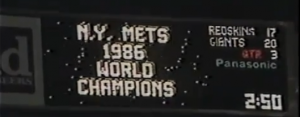 Mets win, Giants winning, all was calm, all was bright. October 27, 1986 was one of the great nights in the history of Western Civilization even before taking into account the extracurricular activities occurring at the Meadowlands. You didn’t need to be a total Bluenatic to appreciate the Met-Giant symmetry that Monday night, though allegiances to both teams probably helped. I remember it like it was yesterday despite it being too many yesterdays ago.
Sigh…
Anyway, donate a coat on Wednesday if you can and read Matthew’s piece and enjoy its attendant YouTube clip attesting to better times here.
by Greg Prince on 9 December 2011 8:18 am Monday night at 9, Tom Seaver is Bob Costas’s guest on MLB Network’s Studio 42. That’s an hour of Tom Seaver being interviewed about pitching…his own included, presumably. That looms as the best hour a Mets fan will have all December.
Your DVR has been warned.
by Jason Fry on 6 December 2011 10:16 pm So yesterday afternoon I tried to sum up my feelings about Jose Reyes leaving the sad, broken Mets for the temporarily nouveau riche Marlins. I wasn’t happy when I started writing that post, and I wasn’t any happier when I finished. I gave it a final read, posted it and promoted it.
But let me tell you what I did after that. It’s a little thing and a personal thing, but I think you’ll see why I’m sharing it, and maybe derive some comfort from it.
It was time to get my kid from school. I changed my shirt, settling after not particularly conscious thought on my orange ’69 Series Game 3 shirt, the one with a Nixon-era Mr. Met on it. Walking across my neighborhood, I pulled out my phone, put in my headphones and cranked a song I love — “Romance” by Wild Flag. This would be an awesome song to play at Citi Field, I thought idly — a conclusion that probably has to do with the line “sound is the blood between me and you” reminding me of the bond that develops, in good times, between a confident team and its hometown fans.
(This is a mildly insane idea. “Romance” is way too indie to work in the vast space of Citi Field. But that’s not the point. Bear with me.)
I listened to the song again, my footsteps drifting along the well-worn route, and found myself thinking of Ike Davis and Lucas Duda and Ruben Tejada in their new, much improved uniforms, of balls landing fair and clearing walls in walkoff victories yet to be. I thought about being at Shea for the Grand Slam Single and for Piazza lining a laser beam off Mulholland and how the stands had moved and flexed as we all bayed at the sky. I thought about getting your errands done early for that first weekend spring-training telecast and settling happily onto the couch, knowing that even though it was still vile outside, those players in mesh tops were a promise that kinder weather would be soon at hand. I thought about my family’s calendar defaulting to 1:10 and 7:10 and adjusting to the occasional 4:05 or 8:05 or enduring a hard week of 10:15s.
I walked along in my Mets shirt with all these thoughts playing tag in my head and the music in my ears, and I realized I was happy. I honestly was. I wasn’t thinking about Jose Reyes, or the Miami Marlins, or Bernie Madoff, or any of it. Not by a conscious act of will, but because my mind had wandered off somewhere better.
That’s my story. But if you read this blog, you’re not so different from me, or from Greg. And that’s why this will all be OK.
I’m not going to tell you exactly how it will be OK, or when. Because there’s more uncertainty and dismay and anger to work through before this star-crossed, scar-marked period in Mets’ history ends.
But it will end. There will be new players who we watch grow and learn before our eyes, going from coltish prospects to incandescent rookies to sturdy veterans, and we will love them all the more for having urged them through their early maybes. And even amid the gloom before they arrive, there will be gritty come-from-behind wins and unexpected laughers. There will be rising apples and Let’s Go Mets chants and hunches proved true and statistical glasses that all of a sudden you’re damn sure are half-full.
And even when you don’t feel that way, there will be Mets Classics and DVDs and just reliving the highlight reels in our own heads. There will be reconnections with old Mets fans and meetings with new ones, excited exchanges about first games seen and classics witnessed. There will be new fans drawn to impossible dreams and wise old heads who remember when those dreams came true.
There will even be nights when a little thing happens like a song proving evocative enough to lift you above the gloom and bad news, until you realize you’re happy not despite the fact that you’re a Mets fan, but because of it.
And that’s something nobody can take away from you. Bernie Madoff can’t steal it, Irving Picard can’t repossess it and Jeffrey Loria can’t buy it.
There is something beyond the reach of all these troubles, something that’s the Mets’ greatest strength — and it’s you. You, and me, and Greg, and all the rest of us. We’re the ones who define this franchise, who weave the thread of identity and life and hope even as the uniforms get tweaked and the stadiums go up and come down and the players arrive and depart and the win-loss records wax and wane. No matter how long you’ve been here, you’ve seen bright days of the baseball soul alongside dark nights. On the bright days, we add to the glitter and the gleam. In the dark nights, we are the only source of light. Either way, we’re there. And despite these recent trials and amid these current woes, we’re not going anywhere.
We are the silver lining.
by Jason Fry on 5 December 2011 4:40 pm Back in May I wondered what it would feel like when the number of Jose Reyes Mets highlights remaining were reduced to zero. Now we know.
It sucks.
Jose Reyes is no longer a Met. That’s awful enough right there, but of course it’s worse.
Jose Reyes is a Miami Marlin. Eighteen times a year, starting in late April, we’ll have to watch him take his accustomed spot on the field in an awful uniform next to the awful Hanley Ramirez. With the Mets of the foreseeable future put together from whatever can be scooped up from the factory floor, the Marlins are a good bet to win more of those games than they lose. Jose will beat us in some of them. He will drag his feet across third at the end of a head-first triple like a jet fighter getting arrested by the hook on the carrier deck. And then he’ll throw his arms out in joyous cruciform and do whatever the 2012 Marlins’ version of The Claw/Spotlight is, only this time David Wright will be standing there with a useless baseball looking glum.
It is going to suck. It sucks right now. Whatever you are — angry, sad, depressed, downhearted, blue, adrift — I’m feeling some pretty large measure of the same.
This is where the “yeah, but” comes in. You probably guessed that. But this isn’t your typical “yeah, but.”
I love Ruben Tejada — think he’ll be a star, even, and feel very sorry for him given all the stupid questions he’ll have to answer in Port St. Lucie. But he’s not Jose Reyes and I heartily wish he were going to become a star one defensive position to the right.
I trust Sandy Alderson and his front-office crew, but they’ve got a lot of desert to cross with nary an oasis in sight.
I do not trust the Wilpons, not one little bit. They give every indication of sticking around, with their worries and their lawyers and a commissioner to protect them. This protection comes at the expense of the rest of us.
Not much of a silver lining, is it? At the heart of these gray clouds you’ll find a bunch of black.
And yet here it is: The Marlins are going to give Jose Reyes six years and $106 million. In Sandy Alderson’s shoes, would you have done that even if you had the money? Thinking with your head instead of your broken heart, would you have done that?
I wouldn’t have.
The $106 million isn’t the problem as much as the sixth year. Five years for Jose is frankly scary. Six is insane. That makes this different from the Midnight Massacre, an indefensible trade driven by a culture clash and human pettiness. It makes it more like Darryl Strawberry heading west in the winter of 1990. It doesn’t make us feel any better, but that’s the fairer comparison here.
We cannot forget, on this day of misery, that every time Jose rounded first we held our breath a little. We asked the baseball gods to please not have him grab at his hamstring again. It happened way too often — in Jose’s stats we see a glorious four-year run, sandwiched by an uncertain beginning plagued by hamstring woes, a 2009 season lost to them, a merely OK 2010 season and then last year. And last year, we must remember, was really a tale of two seasons. Reyes I was the stuff of clapping your hand to your head and turning to hug your neighbor while screaming “Didja see THAT???!!!” But then Jose hurt his hamstring again, and when he came back for Reyes II, he was cautious and tentative and merely OK.
So how many years of Reyes I do the Marlins get, and how many years of Reyes II? In the last year of his new deal, he’ll be 34 years old. If he’s still a Marlin, it’s a good bet they’ll wish he weren’t. This is the Marlins’ Pedro contract, a premium paid by way of apology to their fans and as a beacon for other free agents. That Pedro contract didn’t work out so well. Worse, it was followed by other Omar Minaya specials that didn’t work out too well either. Those contracts are one of the reasons the current Mets are in their current mess.
But I’ve overcomplicated it. Again: Would you have given Jose Reyes six years and $106 million? If you would have, fine. I wouldn’t have. I thought that and said that, and being this sad and pissed and everything else won’t allow me to forget that that’s where I stood.
And given that, I’m not upset about some of the other things tormenting Mets fans. I don’t care that the Mets didn’t make a counteroffer, because there was no genuine counteroffer to be made. The Mets weren’t going to go six years, so they didn’t. The Mets probably weren’t going to go above $100 million, so they didn’t. Hearing that they’d offered four years and incentives to get Jose to $90 million wouldn’t have made Jose reconsider, or let me sleep any more soundly. The fewer lame gestures to paper over unpleasant truths, the better.
And forget the fact that under the new CBA, the draft-pick compensation is lousy. I didn’t want the Mets to trade Jose Reyes in July and neither did you and no one seriously advocated that they should, so no one is allowed to pretend otherwise.
Beyond that, well, lots of people think the Wilpons should sell the team. That’s an interesting one. The contrast between baseball’s treatment of the McCourts and the Wilpons is certainly thought-provoking, yes. But here, I’m torn. For one thing, it’s not a small thing to say people should be stripped of their property after a generation of being pretty good stewards overall. But I distrust the Wilpons enough to be willing to explore that. The real problem for me — and perhaps for Bud Selig — is not knowing whether the Wilpons’ current financial woes are the stuff of another year, or a few years, or forever.
If the Wilpons can settle the Madoff mess sometime this spring for somewhere north of $100 million, presumably the team’s payrolls can return to more-accustomed levels relatively soon, with a much smarter crew in charge of the checkbook. In that case, our crying for them to sell is raw emotion and strikes me as unfair, and no doubt strikes the commissioner’s office as chum for generations of very expensive lawyers.
If these penurious ways are to be the Mets’ fate forever, that makes me want to lie down in the road. I can’t stand the idea of Grant-De Roulet II. The thought of trying to raise Joshua as a Mets fan amid that level of pain makes me want to walk away from everything, and that idea terrifies me. I doubt Bud Selig’s feelings on the subject are quite that intense, but I’m sure he doesn’t want that either. Having New York’s National League franchise be a charity ward is not in the best interests of the game.
But what if the future of the Mets is somewhere in the messy middle between those two extremes? Well, then what the hell do you do?
But sadly, we have plenty of time to explore that one further. I’ll set a reminder for June, when the Mets’ latest losing streak is playing second fiddle to scenarios about what the inevitable trade of David Wright will bring. For now, I’m left with this: How will I greet Jose Reyes, Miami Marlin?
No, not when I first see him against us — when that happens, I’m going to cheer myself hoarse, giving him the ovation he deserved and didn’t get because of Terry Collins’ final-day pooch-screwing. I mean after that. I wish Jose the best, but the best for Jose means our task is even harder for the next six years. And yet I don’t want Jose to be Darryl Strawberry, though I think that’s more likely than six years of mid-Aughtsian glory. If the Marlins’ deal winds up looking wise, we are embittered. If it winds up looking dumb, Jose and baseball and all of us are diminished.
Like I said, today sucks.
by Greg Prince on 5 December 2011 6:42 am “When I’m finished, I’ll get the best seat to see him play. I’ll pay whatever price to see him play.”
—Pedro Martinez on Jose Reyes, July 23, 2005
Somewhere in the midst of the conference call Sandy Alderson held with some of us bloggers last Thursday night, the Mets’ general manager used an unremarkable phrase that caught my ear nonetheless. His front office, the GM said, was out to put a “better product on the field — better and more entertaining” in 2012.
I was instantly reminded of Mike “Meathead” Stivic’s reaction to a grocery item label that promised “NEW AND IMPROVED!” on All In The Family. What, he asked, were we using before: old and lousy? Whatever the Mets’ missteps over the years, it never occurred to me they were intentionally going for worse and more torpid.
What got me was the use of the word “entertaining,” as if it was a disparate competency from “better”. If winning is colorless, sign me up for the Monochromatic Pack at once. If the Mets are winning consistently, the fun generally reveals itself therein.
But embedded in Sandy’s well-chosen words, I supposed then (and feel certain of now), was a cushion of warning for Mets fans…as if we hadn’t figured where things were inevitably heading for ourselves. The Mets, he seemed to be saying, will strive to be entertaining next year, even if it doesn’t involve a ton of winning, let alone the presence of the most entertaining player we’ve ever employed.
No matter how drab the Mets turned post-2008, one colorful character leapt out from their tedious tableau. No matter what kind of film with which you metaphorically shot him in these digital days, there’s no way Jose Reyes would print in black and white.
I’ll miss that sense of dazzle. I’ll miss the runs, triples and stolen bases, of which he collected more than any Met in franchise history. I’ll miss the production at the plate and the prevention in the field (whatever your defensive metric of choice indicates). I’ll miss not having to wonder who would bat leadoff. I’ll miss the 1,300 hits and how somebody was finally going to catch Eddie Kranepool while wearing Eddie Kranepool’s number. I’ll miss that the last of the 2003 Mets was the one 2003 Met whose sudden presence and instant impact in 2003 cheered me up when I was as down as I’d ever been about the state of the Mets.
But that doesn’t even get to what I’ll miss most. Call it entertainment value if you like, though when you’re a fan of a team, you don’t worry about being entertained. You’re far too engaged for such superficial concerns. You want to be entertained? Download Adele. Go see George Clooney. Subscribe to the MLB package and watch the Miami Marlins. That’s dispassionate entertainment.
What it was to me was Jose being Jose. Jose lashing. Jose dashing. Jose gunning. Jose grinning. Jose and the Mets winning, Maybe not as much as they had been when they were an annual 89-win proposition (on average) for four straight years and he was leading off virtually every day, but enough so you could put together his legs and his arm and his bat and their fortunes. Gosh, it was fun to be in your seat by the start of the bottom of the first if you were going to the game or at your TV no later than 7:11 if they were on the road. Gosh, it was comforting crossed with exhilarating knowing the game couldn’t commence until Jose had the first of his ups. Gosh, he relished being a baseball player, and he did it as a New York Met.
Who else ever made us sing not just his praises but his name? Repeatedly? To say Jose was the most fun Met ever doesn’t quite get to his essence. It was more like he was funnest. You felt like a kid watching him play, so it’s only fitting to express yourself that way, too.
I joined in a knot of media last month at the event the Mets held to unveil their altered uniforms so I could hear what Ike Davis and David Wright each had to say about Jose Reyes. Ike was almost bubbly talking about how “excited” he was to have been Jose’s teammate. I asked David to share his thoughts on Ruben Tejada, noting he’d probably been asked plenty about Jose. I have to admit I wondered how much of a company man he’d be if given the opportunity to move on to the next shortstop. But David, bless his Metsian heart, didn’t bite. Jose was “one of a kind,” David said (before adding some respectful boilerplate about Ruben).
These tidbits occur to me because one of my favorite images from Jose Reyes’s nine years as a Met come from a game he didn’t play, the final Saturday night of last season, the second half of a day-nighter against the Phillies. The Mets won it with Jose on the bench, yet after the final out was made and the SNY cameras captured the lads funneling toward their clubhouse, the guy leading the charge — and the guy more ebullient than anybody else at having won an allegedly meaningless game — was Jose Reyes. You would have thought it was the Mets, not the Phillies, getting ready for the playoffs. In that moment, the notion that somebody was “just happy to be here” shone through as it rarely does. And this was no scrub. This was our star.
The Mets are fun to us because they’re the Mets; it’s the same reason the Mets are a pain to us. But some guys are just more fun and more meaningful than the rest. That was Jose. Jose made leading off a happening. Jose made his staying through the trade deadline a cause, even if it turned out to be a reprieve more than a pardon from the governor. Jose was a sunshine rod. If things were working even a little for him, you were having a better day because of it. You might not have trekked to Shea Stadium or Citi Field specifically to see him, but he was the one who drew you in once you were there.
It’s good to have that. It’s good to have someone to depend upon as a constant in your life as a fan. It’s a more sacred sensation than “entertainment”. If you’re caught up in the development and evolution of a player from the beginning of his career in your midst to the end, the entertainment takes care of itself. Your equity with your team tends to be tied up predominantly in a few special players at any one time. If you’re lucky enough, you have those players with you 100%, from hotly anticipated callup to final tip of the cap. Their ride is your ride.
Of course we never, ever have that over the long term, save for the aforementioned Kranepool and maybe Ron Hodges, depending on your definition of special player. I would have loved to have had it with Seaver, with Strawberry, with Alfonzo…but I didn’t get it. I won’t get it with Reyes, either. There are reasonable explanations for why this has come to pass, whether you count them to 70 million or 106 million, but it doesn’t make them feel any more legitimate.
I feel, on the most basic of levels, as if my trust in my team has been violated. For whatever reason I became a Mets fan at the age of six, it wasn’t to be calmly understanding of ownership when it led the club down a path of competitive ruin. And it wasn’t to make rationalizations on behalf of vague nods toward a better, more entertaining day after tomorrow. I’m pretty sure it was to root for a whole lot of players who played for my team and to fall in baseball love with one or two of them in every Met generation. Reyes was that guy for most of the past decade.
I have no idea who will be the next one or when/if it will happen again.
A little more recommended reading…
Last week’s Sandy Alderson conference call, still instructive despite being a little dated by now, was courteously transcribed by Amazin’ Avenue here.
Marvelous encomium to Jose Reyes from Patrick Flood, here.
The big picture, broken down stroke by insightful stroke by Metstradamus, here.
And one of my favorite Faith and Fear pieces, wherein Jason eavesdrops on a contentious conversation between scout and sabermetician as regards a young shortstop on the rise, here from 2005.
by Greg Prince on 4 December 2011 11:32 pm I’d take a reported $106 million for six years, even if it meant having to become a Miami Marlin through 2017 to do so. If that was Jose Reyes’s choice — as opposed to nothing for no years, which is what the Mets apparently offered him — it was an easy choice.
So congratulations to the New York Mets for not setting the market. That was important to them. Good luck setting the market for ticket sales in 2012. Good luck filling second base alongside neophyte shortstop Ruben Tejada. Good luck with the next few years. Good luck waiting for Mejia and Harvey and Wheeler and whoever to blossom. Good luck riding Pelfrey and Pagan. Good luck with the dynamic pricing and all that. Good luck in court and with selling those minority stakes, while we’re at it.
And congratulations to the Mets for however many fans you have who will rally to your side on this, that it was smart business to not pursue one of your best players ever, 28 years old this coming Opening Day, hard. Because, worst-case scenario, you might have lured Reyes back or, more likely, made the Marlins pay more. But this is better, I’m sure.
Maybe the Mets should switch from blue caps to teal. They have become the new Marlins.
by Greg Prince on 1 December 2011 11:24 am Bobby Valentine’s imminent hiring as manager of the Boston Red Sox is the best Mets thing to happen this offseason, even better than the overdue reinstatement of Banner Day. Banner Day’s date is TBD, whereas we get Bobby Valentine right now, and by “get Bobby Valentine,” I mean every time we turn on SNY or ESPN or MLB Network, we are treated to a loop of Bobby Valentine-era Mets highlights.
To me, the entire Valentine administration was a highlight, and I’ll even accept 2002 as part of the package if it means I receive extended glances of 1997 to 2001. The denser the Bobby V rumors became, the longer the loops grew. When the dispatches beamed forth that Bobby V was the choice, he was practically video wallpaper.
Fantastic, I thought — let me watch the Mets as I knew them best and loved them most, even if that was a while ago and anything he does next he’ll be doing for someone else.
Ah, those highlights…the Mets in the hunt when they weren’t supposed to be…the Mets overcoming obstacles, whether imposed by others or themselves…the Mets as postseason regulars…the Mets not knowing from quitting…the Mets never quite ultimately triumphant but coming oh so close, making us oh so proud.
And leading the charge, turning the ignition, masterminding the process, Bobby Valentine. He wore a lot of black back then, but make no mistake: to a Mets fan thirsting for a sip of success after a half-dozen drought-laden years, he was the good guy. More than that, he was The Man. He was Bobby V, the only Mets manager I’d follow into figurative battle, maybe even a real one if I was heavily armed.
Under Bobby V’s command, I know I’d be prepared. After a few years, I might be prepared to go AWOL, but I can’t think of any skipper who wasn’t thought to have “lost the clubhouse” or “let the game pass him by” on account of time’s march. Maybe Bobby Cox, but I couldn’t stand Bobby Cox.
Bobby Cox couldn’t stand Bobby Valentine. He has company. Lots of people can’t stand Bobby Valentine. It’s sort of thrilling absorbing the complaints of his detractors. The more the detractors complain, the better he looks to me. It’s a sensation born of hearing what a lousy strategist/communicator/human being he was when he managed the Mets…managed them clear into the NLCS one year and the World Series the next. Managed them out of obscurity, he did. Managed them like every game mattered. Every game did matter when Bobby V was here. Other men have managed the Mets. Bobby V was the Mets Manager.
Aside from the late ’90s/early ’00s Mets highlights currently airing somewhere, I’m happy about this because it restores in me some semblance of faith that somebody in baseball recognizes skill and passion. The Red Sox decided they needed a new manager. They went out and hired the best one available, the one who breathed life into an American League franchise in the 1980s, a National League franchise in the 1990s and a Pacific League franchise in the 2000s. I didn’t much care what he did in Arlington or Chiba City, but I sure got a contact high off everything he did in Flushing (up to and including his press conference illustration of how marijuana “is not a performance enhancer”). Bobby argued umpires out of bad calls. He knocked down orthodoxies and played capable players with whom other managers couldn’t be bothered. He defeated alleged geniuses in three October series. He honestly made me proud to be a Mets fan. No smack talked by anybody, no matter how authentically it is come by, can shake me loose of my affection for Bobby Valentine.
The most fascinating manager the Mets ever employed is managing in the major leagues again. As long as it’s not against us, that’s a win.
Neither of us posts for days, then we both inadvertently post on the same topic at virtually the same time. Oh well, more for you guys — read Jason’s take here.
by Jason Fry on 1 December 2011 11:18 am
Nostalgia is a product of dissatisfaction and rage. It´s a settling of grievances between the present and the past.
— Don DeLillo, White Noise
In all likelihood this will be the offseason in which we face the grim reality that our broke, troubled, outclassed team has become the Baltimore Orioles of the National League. We have been told that the Mets are enduring a temporary rebuilding phase, but it increasingly looks more like the start of semi-permanent downsizing, during which our franchise’s fortunes will be decided by accountants and lawyers instead of by a smart front office assembled to preside over very little.
Thank goodness, then, for distractions, such as much improved uniforms and the return of Banner Day. I actually don’t mean that to be cynical. Seriously — thank goodness for distractions. If we’re going to have to suffer Grant/de Roulet II, let’s at least do it without drop shadows and two-tone hats.
And thank goodness for the return of Bobby Valentine.
No, not to the Mets. As you’ve no doubt heard by now, he’s the new manager of the Boston Red Sox, sometimes known as the team with the second-most-visible baseball cap in New York. I don’t particularly regret that Bobby’s commute will take him north of Connecticut instead of south — baseball reunions tend to be bad ideas, and I always thought calls for Bobby’s return to Flushing were based more on revanchism than reality. Even if you disagree with me on that point, this is the next best thing: Given the endless soap opera that is Yankees-Red Sox, he’ll be a near-daily presence in this town, and tasked with doing harm to our enemies. That’s pretty good.
Why was he gone so long? Blame baseball’s Pleistocene worldview, the same one that packs the ownership ranks with undead moguls and interchangeable corporate weasels while the likes of Mark Cuban are barred from the door. Bobby Valentine’s greatest sin has been that he’s too interesting. Like most successful organizations, baseball teams are built by renegades and risk-takers but come to abhor such people once their focus shifts to self-perpetuation. It’s chiefly by accident that people like Valentine wind up getting second chances in such places.
But what a happy accident.
Because Bobby Valentine is certainly interesting. Many pixels have been lit up in praise of his knowledge of baseball and tactical experiments, but saying he’s an interesting baseball manager isn’t really such a compliment. By all accounts Valentine is an interesting person — intellectually restless and curious, approaching new challenges with arms wide open, and monomaniacal in pursuit of his goals. His tenure in Japan is a remarkable story that deserves more examination than it gets: Rather than treat the Japanese leagues as an Elba from which to brood and cash checks, Valentine taught himself the language, patiently reformed some of the etched-in-stone basics of the Japanese game and its associated trappings, turned a sad-sack team into champions, and left as a folk hero. Closer to home, of course, he was tireless and dogged in the awful days after 9/11, central to the effort to turn Shea into a mustering point for supplies sent to Ground Zero and seemingly everywhere helping people, whether anyone was watching or not. When leadership and sacrifice and caring were needed most, Valentine showed he had ample reserves of all three.
Does Valentine have faults? Of course he does. He loves the spotlight, he plays favorites, he nurses grudges and he shoots off his mouth while aiming at his own feet. And like many a manager before him, his tactical brilliance seems driven in part by paranoia, the middle-of-the-night anxiety that someone, somewhere is plotting against him.
But so what if he has faults? Most interesting people do.
I can’t wait to see him flash those pearly whites after the writers realize some unorthodox move he made has beaten the Yankees with everyone watching. I can’t wait to hear that he’s eviscerated Dan Shaughnessy in response to some manufactured controversy. And I really can’t wait to hear him say things that make Joe Girardi squirm and the Yankees brass sputter fatuously. Joe Torre was the perfect foil for Valentine: Bobby tended to look wounded and frantic when measured against Joe’s motionless, ironclad dignity. Girardi, by comparison, is a faintly pitiable mix of egotistical, needy and deeply boring. He has no chance in this fight. None.
Come February, pass the popcorn. I don’t know how it’s all going to turn out, but I’ll guarantee this: It will be interesting. Bobby Valentine always is.
Double your pleasure by reading Greg’s take on Bobby V.’s new gig.
by Greg Prince on 28 November 2011 12:45 pm In practice, I might not notice the Houston Astros’ disappearance from the National League all that much. With 162 games and oodles of non-divisional opponents on your dance card, what’s one home series and one road series in the scheme of things? But in theory and sentiment, I will surely miss our fraternal twins when they are snatched from our midst and set down in some foreign land.
The Mets and the Astros came into this world together. They have the commemorative patches to prove it. Their strongest bonds of commonality are their 1962 birthdate and their bloody 1986 civil war pitting expansion brother against expansion brother, but their paths have crossed 561 times besides. In the mind’s eye, the Mets and Astros are forever enmeshed, perhaps inside the Astrodome where each team is trying to push one lousy run across the plate as the innings pass through the teens and meander into the twenties…
Or the Astros are trotting by the Mets so relentlessly in the second game of a futile doubleheader at Shea Stadium that Cleon Jones loses interest, which isn’t a good idea when Gil Hodges is around…
Or Tom Seaver is flying out Art Howe to deep left before catching the next flight himself to Cincinnati…
Or Mike Piazza and Todd Hundley are making you wonder what might have been had they managed to stay in the same lineup through September…
Or Pedro Martinez is taming every Astro save for Chris Burke…
Or David Cone is doing the same, except the role of Chris Burke is being played by Brooklyn’s own Benny DiStefano…
Or Brooklyn’s own Nelson Figueroa is pitching the game of his life for the team of his (and Benny DiStefano’s) childhood, which turns out to be the last real chance the Mets will give him…
Or Dwight Gooden is climbing a fence so he can get on with the business of his major league debut…
Or Carlos Beltran is climbing a hill as he silences catcalls…
Or Ron Darling, Bobby Ojeda, Rick Aguilera and Tim Teufel are getting sprung on bail after a misguided trip to Cooter’s.
Or Lindsey Nelson is speaking into a microphone while embedded in a gondola…
Or Ralph Kiner is noting the thickness and blackness of the mosquitoes infesting Colt Stadium just in case he needs something to talk about on a future trip to town…
Or Casey Stengel, after a harrowing night of travel and 71-plus years on earth, is issuing orders to his traveling secretary that that if anybody at the hotel is looking for him, Lou Niss can “tell ’em I’m being embalmed.”
Or whatever private Met-Astro/Met-Colt .45 memory you carry with you from the Mets’ 50-year, 260-win, 306-loss, 1-tie relationship with the team that got on the field one day before the Mets did (it rained on the Mets in St. Louis, while it stayed dry if buggy in Houston), stayed out of the cellar on account of the Mets’ iron grip there (Colts’ first-year record: 64-96, two places and 24 games ahead of the maiden Mets) and have yet to be remotely as transcendent as the Mets have been (Championships: Mets 2, Astros 0; Myths: Mets countless, Astros fewer). To say it’s a rivalry might be pushing it, yet they are siblings in a way the Mets aren’t with any of their longtime National League East compatriots. Together they made the Senior Circuit modern.
From eight ancient franchises to a nice, round ten, the two newest were soon playing in pens that were harbingers of a slick, sleek future just up the road if you squinted purposefully enough. Shea Stadium gleamed with nary a pillar or post to block your vision of tomorrow. The Astrodome made the atmosphere outside irrelevant, except when the sun couldn’t shine through the glass ceiling to sufficiently grow the grass. The heck with that, Judge Roy Hofheinz said. The roof got painted and a carpet was laid down.
Indoor baseball! Astroturf! All the colors of the rainbow populating every stitch of polyester the Astros wore! The Houstonian version of tomorrow died out prematurely — except as nostalgia — and a franchise that paid homage to the space program moved into a throwback facility built on the site of an old train station. Maybe identities were destined to morph a little too easily in Houston. They, like us, were conceived in the Continental League. They, unlike us, could have started in the American League.
George Kirksey, their rough approximation of Bill Shea, “never stopped looking for wealthy men who could help him bring a major league team to Houston,” according to Michael Shapiro in Bottom of the Ninth, the illuminating tale of how baseball came to expand in the early 1960s. Kirksey and his conspirators weren’t necessarily picky about where they wound up. During the 1960 World Series, with matters still unresolved, Kirksey ran into Yankee co-owner Del Webb, chairman of the A.L. expansion committee. “I thought for a minute he was going to invite us to join the American League,” Kirksey recounted, but Webb kept mum.
Too bad, George thought, since the Yankees would be a swell draw in Houston. But major league was major league to Texas, so Kirksey reached out to Walter O’Malley. After telling the N.L.’s grand poobah that “Houston was prepared to commit to the National League, if the league would commit to him,” Shapiro wrote, O’Malley “looked at him for ‘what seemed like hours’ before he finally replied, ‘All right.’”
And with those words, Houston became what New York had been in spirit and was waiting to become again in fact: a National League town. That lasted 50 years — 51 counting next year. Then, per whatever sweet nothings Bud Selig whispered in Jim Crane’s ear, Houston flips. The Astros will set up camp in the American League West starting in 2013. They’ll get their visits from the Yankees. They’ll get their visits from the Mets in due time, too, as the 15-on-15 realignment scheme will likely allow for more Interleague play and definitely unleash more regular Interleague play. It has to, once you do the 30-team math.
One more barrier between the leagues has been knocked down. Nobody really talks about National League towns anymore. There are no more league offices. If Fall Classic combatants are unfamiliar to one another, as Texas and St. Louis were after not facing off since 2004, it’s a fluke, not the norm. Sooner or later, Selig’s successor will probably infect Citi Field and 14 other proper shrines to the game with the DHV, or Designated Hitter Virus.
On paper, it’s nice and logical that everybody playing baseball plays by the same rules and under the same tent. It goes on in the NFL all the time. Nobody blinks when the Giants draw the Bills or the Jets take on the Redskins. It goes on in the NBA all the time as long as they have their usual 82 games. East meets West as a matter of course. Baseball is on its way to becoming just another sport in that regard. Larger playoff fields, common jurisdiction, cross-pollination of the schedule just like they have in football, and the Houston and Dallas franchises in the same division, just like they have in basketball.
Yup, just another sport. We who were created by modernization as it was defined in 1962 maybe shouldn’t throw stones at the contemporary house it has wrought on the eve of 2012. Baseball didn’t freeze in 1952 with eight teams competing for one pennant in two leagues, anchoring the Braves in Boston, the Browns in St. Louis, the A’s in Philadelphia or the Giants and Dodgers forever in the five boroughs. If the last pair doesn’t leave, we don’t arrive with Houston in tow. Then there are no Mets, no Astros, no certifiable classic NLCS in 1986.
For which, unless the descendants of those participants — slated to play their final National League HOU-NYM game on August 26 in Flushing — effect a sharp turnaround immediately, there will never be a rematch…unless it’s in a Mets-Astros World Series in an extremely distant future.
|
|






