The blog for Mets fans
who like to read
ABOUT US

Faith and Fear in Flushing made its debut on Feb. 16, 2005, the brainchild of two longtime friends and lifelong Met fans.
Greg Prince discovered the Mets when he was 6, during the magical summer of 1969. He is a Long Island-based writer, editor and communications consultant. Contact him here.
Jason Fry is a Brooklyn writer whose first memories include his mom leaping up and down cheering for Rusty Staub. Check out his other writing here.
Got something to say? Leave a comment, or email us at faithandfear@gmail.com. (Sorry, but we have no interest in ads, sponsored content or guest posts.)
Need our RSS feed? It's here.
Visit our Facebook page, or drop by the personal pages for Greg and Jason.
Or follow us on Twitter: Here's Greg, and here's Jason.
|
by Greg Prince on 12 August 2011 8:05 am Welcome to The Happiest Recap, a solid gold slate of New York Mets games culled from every schedule the Mets have ever played en route to this, their fiftieth year in baseball. We’ve created a dream season that includes the “best” 112th game in any Mets season, the “best” 113th game in any Mets season, the “best” 114th game in any Mets season…and we keep going from there until we have a completed schedule worthy of Bob Murphy coming back with the Happy Recap after this word from our sponsor on the WFAN Mets Radio Network.
GAME 112: August 15, 1985 — METS 10 Phillies 7
(Mets All-Time Game 112 Record: 20-29; Mets 1985 Record: 69-43)
What happens when two of the three greatest starting pitchers in Mets history hook up at Shea Stadium? Not the pitching duel you might imagine, not when it was Dwight Gooden briefly off the top of his game and Jerry Koosman at the end of the line…and not when it was stiflingly hot at Shea and the ball was carrying into a dimension momentarily unmarked by time and space.
Now that we mention it, Gooden vs. Koosman does sound a little Twilight Zone-esque, offering as it does a blurring of noncontiguous Mets eras. Jerry Koosman was the lefty anchor of Mets staffs from 1967 through 1978. Doc Gooden headed Mets rotations from 1984 until 1994. The gap between their tenures would imply a stark separation of their careers. Yet while Gooden, 20, was taking the National League by storm as a sophomore in ’85, Koosman was hanging on as 42-year-old Philadelphia Phillie. The veteran of the Mets’ first two pennant-winning clubs actually hadn’t pitched that badly in his twilight — entering this Thursday matinee with a 6-3 record, 3.71 ERA and three complete game wins to his credit on the year — but this was neither 1969 nor 1973 any longer.
Then again, by the time the day was over, it wouldn’t look like the same 1985 Gooden had been steamrolling through since April.
Koosman took his licking first. Three Mets batters in Davey Johnson’s righty-stacked lineup — perhaps a sign of respect for the old southpaw who flied him to left for the final out of the ’69 World Series — showed no sentimentality in the bottom of the first when, with the Mets down 1-0, they made Kooz feel every one of his 42 years. Pennant-race pickup Tom Paciorek, Gary Carter (making a rare start at first base) and Ray Knight all homered. It was the first time three Mets had homered in one inning in eleven years. The Mets took a 5-1 lead and figured Doc would cruise, per usual, from there.
Gooden promptly gave back a run when Koosman’s second-inning groundout scored Glenn Wilson to make it 5-2. It was the 46th RBI of Jerry’s career, and it would be the last positive accomplishment of Koosman’s baseball-playing life. In the bottom of the second, after recording two quick outs, Paciorek walked, Carter singled and Darryl Strawberry singled to bring home Paciorek. That put the Mets up 6-2 and brought John Felske out of the Phils’ dugout to remove Kooz.
Jerry would make one more start six days hence, against the Dodgers at Veterans Stadium. He’d give up a grand slam to Mike Marshall, follow it with a homer to Candy Maldonado and leave in the top of the first with five earned runs in two-thirds of an inning pitched. Between his abbreviated outing at Shea and that nightmare at the Vet, Koosman saw his ERA climb from 3.71 to 4.62. He’d go on the DL shortly thereafter in deference to a chronic knee problem and never pitch again. Kooz would retire from the game after 19 seasons with 222 wins and a perfect mark of 4-0 for the Mets in six postseason appearances. (He always did prefer pitching in cooler weather.)
Koosman was already the distant past for Mets fans in 1985. Gooden was the scintillating present. He could do no wrong all summer — except for this sweltering day at Shea when he couldn’t do much right. Mike Schmidt tagged Doc for a two-run home run in the third and Rick Schu reached him for a leadoff shot in the fourth. After Dwight enjoyed his first scoreless inning of the day in the fifth, Davey figured five runs and eight hits were enough in the 95-degree heat and lifted his prodigy with a 6-5 lead. It was his shortest outing of the year, save for the rain-soaked night in Atlanta that became the 16-13, 19-inning marathon of July 4 & 5. Following that epic strangeness, Gooden won each of next his seven starts, completing five of them.
“It was a weird day,” Gooden assessed of his most unDoclike effort in this otherwise magical season. “I just didn’t do my part.”
Still, if the Mets’ bullpen could pick up for him, Doc was in position to improve his record to an otherworldly 19-3, showing that even when he didn’t do his part, Gooden still knew how to gain at least partial credit.
Unfortunately for the Doctor’s ledger, the bullpen didn’t do its part all that well. In the seventh, Terry Leach’s bout of wildness and Rafael Santana’s error on a Von Hayes ground ball led to the Phillies’ sixth run, tying the game and costing Doc a decision. Strawberry’s fielder’s choice grounder regained the lead for the Mets in the bottom of the seventh, but Doug Sisk and Jesse Orosco combined to re-create a tie in the top of the eighth, making the score 7-7.
Salvation, with an air-conditioned chaser, awaited in the bottom of the eighth when Lenny Dykstra broke the deadlock with a wind-assisted RBI ground-rule double. Then Hayes, beneficiary of Santana’s E-6, discovered the fates could be fickle when he overran a Strawberry pop fly in left (where Felske had just moved Von from center) and two more Met runs scored. The Mets went out in front 10-7, and Orosco pitched an uneventful ninth for what became his fourth win of the year instead of Doc’s nineteenth.
Koosman might have been done for good, but Gooden would be back to being Gooden circa 1985 soon enough. He still hadn’t lost since late May, he was still riding a franchise-record 12-game winning streak and the Mets were still undefeated in his starts dating back to late June. The Mets, meanwhile, had just finished a stretch where you could say they had given it their all. On July 1, the fourth-place Mets lost 1-0 to the Pirates to fall to three games over .500, five games behind the frontrunning Cardinals. Then the Mets took off on one of their all-time Amazin’ tears: 30 victories in 37 games, bracketed by two nine-game winning streaks.
Yet no matter the confidence expressed by the likes of rookie Dykstra — “if we keep playing like this, with everybody contributing, I don’t see why we can’t walk away with it” — the portion of the schedule when the Mets routinely dominated their competition was over. This 10-7 sloppy slugfest the day after a vexing defeat — the automatically clutch Keith Hernandez mysteriously grounded into a game-ending double play with the bases loaded in the bottom of the ninth with the Mets down 2-1 — left the Mets only a half-game up on the Cards for the division lead. They had played so well for so long, yet they couldn’t shake the Redbirds. On the other hand, the Redbirds had played very well themselves and couldn’t shake the Mets.
Neither the Mets nor the weather would stay as hot as they had been from July 2 to August 13, but arguably the Mets’ hottest pennant race ever hadn’t even begun to reach its boiling point.
ALSO QUITE HAPPY: On August 9, 2006, a Mets legend’s homecoming was on the verge of overstaying its welcome. Shea Stadium stood and cheered the night before when Mike Piazza returned to the scene of his most dramatic triumphs. That Piazza was wearing a San Diego Padres uniform didn’t bother too many people. With the first-place Mets rampaging through the N.L. East and leading 3-2, Mets fans could be magnanimous with its applause as good ol’ Mike singled in the sixth off Steve Trachsel. The Mets held on, Mike had his hit, all vibes were good.
Now it was the second night of Piazza’s return, and everybody who didn’t get a chance to greet him the night before was just as welcoming. The bonus this Wednesday was Pedro Martinez’s inclusion in the script. Pedro was a pretty popular figure at Shea himself, and his start was more than incidental. It was the first appearance at home in almost seven weeks for the injury-plagued ace. The good news for Mets fans was Pedro looked perfectly healthy, giving up only two runs and three hits in 7⅓ innings. The other good news was Piazza evoked the halcyon turn-of-the-millennium days at Shea when he rocketed a solo home run off Martinez with one out in the fourth. The Mets were still ahead 4-1 at that point and, again, magnanimity could rule — Piazza received a huge ovation as he rounded the bases. He even received a curtain call afterwards.
“The last thing I want to do is show up the other team,” Mike explained, with typical humility. “When they ask you to do it, it’s one of those things.”
Then Mike did it again, this time with two out in the sixth, also with nobody on. This second home run off Pedro cut the Mets’ lead to 4-2 and some grumbling could definitely be detected in the crowd. The warm feelings for Piazza would never dissipate from Flushing airspace, but this was suddenly a game and the 2006 Mets were most definitely the home team in the present.
Mike: “I think after the second one, it wasn’t as warm. I felt the energy shift.”
Which is why Piazza’s final attempt to awake the ghosts of Mets past became so suddenly irksome. He made his bid in the eighth, the Padres down two, with two on. Aaron Heilman was pitching after Pedro had walked Brian Giles and ex-Met Mike Cameron. Piazza stepped up with a chance to put his new team ahead. He was not being cheered lustily anymore. He was actually booed by a significant percentage of the crowd that adored him when he represented benign nostalgia innings earlier.
Being Mike Piazza, he brought the drama, taking Heilman deep…deep enough for breath-holding, though not deep enough for soul-crushing. Piazza’s long fly came down in front of the center field wall, caught by Carlos Beltran. Mike could return to the gauzy pedestal he built for himself from 1998 to 2005, and the post-Piazza Mets of 2006 could hold on to win again, 4-3.
GAME 113: August 13, 1982 — METS 6 Cubs 4
(Mets All-Time Game 113 Record: 23-26; Mets 1982 Record: 49-64)
Some years what little that goes right eventually leads to more wrong. For proof of that sad phenomenon in the lost Mets season of 1982, look no further than right field at Shea, where for one Friday night, everything seemed just fine.
Ellis Valentine was as much the personification of that benighted campaign as anyone. Acquired in 1981 for promising reliever Jeff Reardon, the Mets looked to him as a buy-low bargain. Valentine was one of those five-tool players: hit, hit with power, run, field and especially throw. Injury had derailed him in Montreal. Perhaps he’d put it all together once more in New York.
He didn’t, not even when the Mets put him together with George Foster and Dave Kingman in the middle of a lineup that, as the ads had it, promised to light up the city via Metropolitan power surge. The lights no more than flickered with Valentine starting in right and batting fifth. The club began falling apart in June and Ellis did little to keep it together as summer took its toll on the Mets’ chances. He showed little power, almost no speed and his batting average was meandering around .250 as August approached.
His arm, though, was still golden. The rest of his game may have been less Dave Parker than Dorothy Parker, but Valentine could throw with the best of them any day of the week, a skill he demonstrated on a Friday night in Flushing against the Cubs before an intimate gathering of 12,617.
In the top of the fifth, Bill Buckner led off with a walk versus Pat Zachry. Leon “Bull” Durham singled to right. Buckner, who could still run, raced for third. Valentine pulled the trigger on his rifle of a right arm and shot him down. Buckner was thrown out at third. The Cubs didn’t score.
One inning later, it was ex-Met Steve Henderson’s turn to lead off, and he doubled. Junior Kennedy lifted a fly to right, catchable by Valentine, but deep enough, to Hendu’s thinking, that he could dart to third and get in scoring position. But no — it was rifle time again. Valentine gunned down the erstwhile Stevie Wonder for his second outfield assist at third base of the night. And the Cubs didn’t score in that inning either.
Ellis Valentine’s arm was just one tool, but it had a brilliant evening. His bat didn’t do too badly, either, as Valentine’s single in the bottom of the seventh (his second of the night), proved the key hit in a three-run inning. Ellis’s hit put the Mets ahead 5-4 in an eventual 6-4 win. But Valentine’s bat wasn’t the story. It was his arm. Twice. Ellis Valentine, who not long before was fighting the since-traded Joel Youngblood for playing time, didn’t seem like such a bad acquisition after all.
“Valentine has the best throwing arm among right fielders in the National League,” George Bamberger told reporters afterwards. “No one is close. He has won the job, and no one is going to take it away from him.”
What a nice night for a guy who’d had too many rough ones. And what a nice note to leave Ellis Valentine’s Mets career on…but we can’t quite say goodbye on two dynamite outfield assists because Ellis stepped on his own storyline.
His arm had barely cooled off when his mouth got going. Given the media’s attention the afternoon after finally starring in a Mets win, Valentine didn’t waste it, at least not to his thinking at the time. He announced that he considered the Mets “the worst organization in baseball,” that “they can offer all the money in the world, and I wouldn’t stay” and, oh yeah, “I believe there’s a conspiracy against me in this organization.”
Mind you, this was one day after his shining moment in the field. It was perfect, in its way, for 1982, a season that began with some promise — 27-21 — and had spiraled well down Flushing’s plumbing system since (and was about to get a whole lot worse; a 15-game losing streak was literally a day away when Ellis voiced his discontent). Bamberger was compelled to readjust his attitude toward his right fielder: “If a man walks in that door and says he doesn’t want to play, I will do all I can to get him off [the club].” The manager added he’d keep playing Valentine every day, but “if he comes in here and tells me he doesn’t want to play, boom — that’s it.” Frank Cashen, meanwhile, called the situation “distressing”.
Funny thing was Youngblood’s August 4 trade to Montreal, best known for positioning Joel to collect two base hits in two cities in the same day, was a boon to Valentine in the short term; he had gone 14-for-32 in the week-and-a-half since it happened. But don’t get Ellis Valentine started on the Joel Youngblood trade: “They traded him right back into our division. I thought that was very stupid.”
He may have had a point, actually, but there would be latent bright sides to this dark lining in the silver cloud of the Met win Valentine made possible with his arm on August 13.
The Mets withstood their right fielder’s tantrum in decent shape. Valentine, who was in the final year of a three-contract that paid him $200,000 annually, wasn’t given “all the money in the world” to stay. Bamberger played him plenty the rest of the way, and Valentine did raise his average cosmetically, to .288, but it was over for him and the Mets. That was fine because the Mets had another right fielder who was almost ready to play full-time. Kid named Darryl Strawberry…from the same Los Angeles high school as Valentine, as it happened. The Mets were desperate for credibility and power when they traded for Valentine in 1981. With Strawberry and others in the pipeline for 1983 and beyond, their desperation days were ending, and they’d make few godawful trades like Reardon for Valentine in the immediate future.
As for Ellis Valentine himself, he knocked around baseball a couple more years before finding himself out of the game at age 31. Beset by drug and alcohol problems, he realized his life wasn’t going to get better without help…which he found. He worked to overcome his demons and has devoted his life since baseball to proactively advising kids to not make the same mistakes he did.
That, too, should be scored an assist for Ellis Valentine.
ALSO QUITE HAPPY: On August 10, 2005, the baseball world was still buzzing from the highlight that was beamed from Petco Park late the night before. It was the seventh inning in San Diego. Brian Giles was the batter with nobody on and one out. He swung at a Dae-Sung Koo delivery and blooped it off the end of his bat into short left field…or deep short, depending on your perspective. It was going to fall in, because the only fielder with any kind of angle on it was third baseman David Wright, and Wright is a righty, so his glove hand was…
…of no consequence whatsoever.
Wright reached out and grabbed Giles’s ball with his bare right hand; he grabbed it, he fell with it, he held on to it. Petco gasped and then applauded. Because everybody probably needed to catch their breath after that most unroutine flyout, Willie Randolph made a pitching change. The audience that stayed up late in New York was treated to a dozen more replays. It never got old. The only problem was it didn’t get the Mets back into the game. They were trailing 6-3 and wound up losing 8-3.
So how does Wright react the next night? He takes matter into both of his hands this Wednesday evening at Petco: He singles home the Mets’ first run in the top of the first; he takes second on a double steal four pitches later as Carlos Beltran steals home to make it 2-0; he doubles home two more in the top of the third to make it 4-0; he smashes a three-run homer off Brian Lawrence in the fourth to make it 8-0; he tops it of with an ninth-inning single that helps build a run to make it 9-0. The final is Mets 9 Padres 1, David Wright going 4-for-5 with 6 RBI, 3 runs scored, a homer, a double, a stolen base…and in the field, on the heels of his making quite possibly the most astonishing regular-season catch in New York Mets history?
Nothing. No chances for Wright, as the Padres learned not to hit any balls anywhere near either of his hands.
GAME 114: August 9, 1963 — METS 7 Cubs 3
(Mets All-Time Game 114 Record: 29-19; Mets 1963 Record: 37-77)
Forget that line about how you have to be a pretty good pitcher to lose twenty games. You have to be a plenty strong human being to endure being a twenty-game loser by the first week of August. And to arrive at such a humbling mark in a fashion in which you’d have to believe Somebody Upstairs (besides George Weiss) was telling you to find another profession?
Let’s just say Roger Craig dug deep to persevere as long as he did in 1963. The veteran of two world champion Dodger clubs already knew what he was in the midst of after emerging as the ace of the 1962 Mets. That team was loaded with “pretty good pitchers,” which is to say four of its hurlers lost at least 17 games. Nobody lost more than Craig, who took 24 defeats in the Mets’ inaugural season. On the flip side, he led those Mets in wins with 10 — or exactly a quarter of their 40 victories. By comparison, that year’s Cy Young winner, Craig’s old Los Angeles teammate Don Drysdale, won 25 games, but his total represented a lesser percentage of his team’s 102 wins.
Hard to believe the Cy Young voters overlooked Roger completely.
Come 1963, Craig commenced to setting a much more encouraging pace for himself. When he beat L.A. on April 29, he evened his record at 2-2. Maybe his second year as a Met would be different from his first.
It would. Oh, it would.
Only one of the “2’s” in Roger Craig’s record would hold steady and it wasn’t the one on the right. The win column remained stubbornly unchanging for Craig, but the other column, where they keep track of the losses? The updates would be frequent. Beginning on May 4, with a 17-4 shellacking at the Polo Grounds at the hands of the Giants, and winding through the spring and into summer, Craig did nothing but lose.
There would be a few blowouts, to be sure, but most of Craig’s losing was of the excruciating variety: 4-2…4-3…1-0…like that. As the defeats mounted, the luck grew harder. When Roger lost his 18th consecutive decision on August 4 — the one that made him a 20-game loser with 52 games to go in the season — it was in a 2-1 game at Milwaukee’s County Stadium. Twelve of those 18 straight losses charged to Craig were contests he lost by one, two or three runs. His luck was typified by the way he lost the eighteenth: the Brave run that beat him scored when a pickoff attempt went awry. And Craig was known to have a great pickoff move.
“If he bought a graveyard,” Tracey Stallard said of his teammate, “Nobody would die.”
Craig somehow kept his perspective alive as long as his unwanted streak insisted on living, too. “I try not to think about how many games I’ve lost, or think about how many I might lose,” he said after the 17th consecutive defeat. “Sure, maybe I joke about it after a game, but I’ll tell you this: If I ever find myself thinking about losing during a game, I’ll know it’s time to quit.”
Roger’s fellow Mets certainly thought of ways to make him a winner. Long before a black cat would take on more positive connotations in Mets lore, catcher Norm Sherry sought to track one down for Craig to bring to the mound with him when he warmed up. That didn’t exactly work out, but anything would go as far as a change of luck was concerned. When the streak was at 13 of all numbers, Stallard loaned Craig his uniform digits, 36. Craig pitched beautifully in them, carrying a 1-0 lead into the bottom of the ninth at Philadelphia. Alas, with one out, he surrendered a triple to Tony Gonzalez and a game-losing home run to Roy Sievers. With 36 having yielded him nothing more than a 14th straight loss, Craig returned to wearing No. 38.
Still, nothing was beyond trying, including yet another numerical stab in the dark. At the behest of a dream Polo Grounds clubhouse guard Ted Decker shared with him — as chronicled in Jerry Mitchell’s The Amazing Mets — Craig switched from 38 to 13 before his August 9 home outing against the Cubs. Decker told Roger he dreamt he saw him winning a game with No. 13 on his shirt. That’s all a pitcher with a 2-20 mark needs to hear to be spurred to sartorial action.
No Met had yet worn 13, according to Mets By The Numbers by Jon Springer and Matt Silverman. Baseball was as superstitious as any endeavor in 1963. You didn’t see 13th floors in skyscrapers or Row 13 on any airplane, either. But few of those entities had suffered luck as rotten as Roger Craig’s, so why not tempt fate? And why not up the stakes, as Craig did at the end of the pregame meeting Roger ran as part of his duties as Mets player representative? He completed the business at hand and then added an addendum:
“I’d really like to win this one tonight, boys.”
Maybe that’s what was holding Roger back all those months — maybe he simply forgot to tell his teammates what he wanted. Or maybe it was the sight of No. 13 taking the hill under Coogan’s Bluff that appeased the baseball gods. Or perhaps it was just the streak’s time to take a powder.
Whatever it was, it wasn’t going to be easy, not even with Craig holding Chicago in check for seven innings and the Mets clinging to a 3-2 lead. As had happened so often before, one bad pitch bit the pitcher, in this case, one that resulted in a leadoff eighth-inning triple for Billy Williams, which was followed by a Ron Santo fly to center that tied the score at three and put Craig’s streakbusting in jeopardy. Roger hung in there and didn’t give up anything else in the eighth or ninth. It stayed 3-3 heading to the bottom of the final inning of regulation.
With one out, the Mets tried to rescue Roger from an 0-19 span — which would have matched Philadelphia Athletic Jack Nabors’s all-time worst single-season losing streak from 1916 — and a 2-21 overall mark for the year. Joe Hicks singled off Cubs starter Paul Toth. Choo Choo Coleman struck out, but Al Moran doubled, sending Hicks to third. Lindy McDaniel relieved Toth. Casey Stengel had no choice but to pinch-hit for Craig. He chose Tim Harkness, a hero earlier in the season when he beat these very same Cubs on a fourteenth-inning grand slam. Cubs head coach Bob Kennedy wouldn’t give Tim that kind of chance again, intentionally walking him. That loaded the bases with two outs and brought up Jim Hickman.
Jim Hickman happily played the role of Tim Harkness this time around, working the count to three-and-two before lifting a fly to left field that took advantage of the Polo Grounds’ singularly weird dimensions. “It just ticked the overhang of the upper stands,” Mitchell wrote, “before falling to the field.”
All that mattered is it left the field of play fair for a grand slam home run — the grand slam home run that gave the Mets the 7-3 victory to make a winner at long last out of Roger Craig. Of course no one was quicker out of the dugout to greet Hickman than the winning pitcher.
“The first thing I had in mind,” Craig said, “was to make sure he touched home plate. I’d have tackled him to make him do it if I had to.”
As of Friday the 9th, No. 13 was 3-20 and keeping a death grip on that uniform for the rest of the season. It proved sort of lucky, as Roger went on a three-game winning streak before backsliding to a final record of 5-22, 15-46 in two seasons as a Met. Finally, the fates smiled on him by getting him traded to St. Louis after the season for outfielder George Altman and reliever Bill Wakefield. By October of 1964, he’d be pitching in the Fall Classic and earning his third world championship, as a Cardinal. As Mitchell put it, “No prisoner ever received a pardon with more sincere expressions of gratitude.”
Indeed, Craig evinced no bitterness over his experience in New York, just as he never pointed fingers at an offense that didn’t score for him or fielders who might have made a few more plays on his behalf. “My two seasons with the Mets were a blessing,” he said. “It taught me how to cope with adversity.”
ALSO QUITE HAPPY: On August 11, 1988, the answer to the question, “It has to happen eventually, doesn’t it?” was answered in the affirmative, albeit after an unexpected delay of what felt like epic proportions. “It” was Gary Carter’s 300th career home run, a milestone that figured to belong to the All-Star catcher sooner rather than later as the ’88 season got underway. Carter started the year with 291 home runs and enjoyed a hellacious (or, in the clean-living Kid’s case, “heckacious”) April, belting seven homers in the Mets’ first 18 games. When No. 299 sailed out of Jack Murphy Stadium on May 16, it figured to be only a matter of time before Carter could take a very enthusiastic curtain call in honor or reaching a very significant round number.
But nobody defined “matter of time,” so it became an open-ended chase. Gary went homerless over the second half of May. And didn’t go deep once in all of June. And lit up no skies on the Fourth or any other date of July. Carter’s plate appearances without the one hit he really wanted were mounting at such a rate that they threatened to reach 300 before his home run total did.
In fact, you could honestly say, “there’ll be lights attached to Wrigley Field before Gary Carter hits his 300th homer.” It was true. The Mets came to Chicago in the second week of August to play what turned out to be (thanks to a rainout) the first official night game in the old ballpark’s history. Carter started in that one, on August 9, came to bat four times, walked and doubled, but extended his homerless streak to 255 consecutive plate appearances.
Two days later, Carter took another shot at 300. And this time, lit by nothing but Thursday afternoon sunshine, he got it, taking a 2-2 pitch from Al Nipper into Wrigley’s left field bleachers to give the Mets an early 1-0 lead. All at once, Carter could relax after nearly three months of letting the chase weigh on him. “I pressed pretty often,” he admitted once No. 300 was tucked away. “It was brought to my attention all the time. Everyday somebody brought it up.” Not that Carter ever shied away from the spotlight, but “when you try for home runs, they never come.”
Two more Met home runs would come that day, one a solo blast from Lenny Dykstra and the other the game-deciding ninth-inning grand slam Kevin McReynolds launched to put the Mets ahead for good, 9-6.
by Greg Prince on 11 August 2011 8:17 pm The Mets never say die, but sometimes they die anyway. They won’t say die for the next 45 games but I suspect what remains unspoken will occur more or less half the time no matter their best intentions.
Of the choice between “more or less,” more would certainly be preferable. When a team that isn’t supposed to be very good flirts with a winning record, you hate to see that marker fall away. Play like they did for most of this homestand (save for about five innings when their reluctance to die meshed with a refusal to lose), and we’ll have a hard time remembering the Mets were several games over .500 at one point relatively late in 2011.
Hopefully it won’t come to that. Hopefully the Mets who made us hopeful will give us a statistically substantive souvenir to take into that gaping maw that opens wide when the next 45 games are over. Hopefully this team that is currently one game under .500 for the year can go three games over .500 for the remainder of the season and finish with more than 81 wins. Hopefully those of us with notoriously sticky memories won’t be trying to convince the rest of you that those 2011 Mets played better than their record for the ages indicates.
The Mets never say die, but I say hopefully quite a bit.
Hopefulness is a preoccupational hazard of being a Mets fan, given all the hope you allow to fill you in your ruminatory interludes. Even when the Mets are hopeless, you are hopeful. Or you hope to be hopeful. That’s about all we had in 2009, where there wasn’t anything in front of us to make us hopeful after 117 games. That’s probably also about all we had in 2010, when our legitimate modicum of hope (we were eleven games over. 500 once; you could look it up) had turned to tatters after 117 games.
This here, after 117 games of 2011, permits greater, deeper hope. Sure, we’ve dropped eight of eleven, and yeah, an offense- and defense-challenged matinee is not much of an advertisement for short-term enthusiasm as the Mets wing their way west, but you can’t deny the hopefulness the Mets have brought us. Maybe it won’t yield the most pleasing of results over the course of the remainder of 2011, but at some indeterminate date to be named…you’ll be able to hope and not feel like a dope.
Are the Mets building a surefire contender for 2012? Many roster machinations await before one can dare to formulate any kind of remotely accurate answer, so I’ll pass on predicting. Yet if playing the game admirably counts for anything, they’re going in the right direction. Granted, a close contest decided on a pickoff attempt that didn’t become a pickoff and an E-6 that should have been a third out isn’t the best symbol for Baseball Like It Oughta Be, but I am…yes…hopeful that type of stuff, as shepherded by a diligent manager and monitored by a sensible front office, will work itself out.
Despite intermittent bouts of frustration that come from rooting for a .500-ish team, I try to remember that all I asked out of this bunch when the season was young was that they keep hustling, keep charging, keep trying. They’ve been pretty good about keeping their end of the bargain. The bottom-line satisfaction’s been sporadic — and it shouldn’t utterly demoralize us if their final record lands north of 2009’s 70-92 but south of 2010’s 79-83 — but you can’t help but appreciate the overall effort. If you can’t revel in a team in contention, the next best thing if relishing a team that almost always plays like it thinks it is.
The Mets never say die. Someday they won’t die nearly as often, either. Maybe some of these Mets will still be some of those Mets when that day comes.
Of that, too, I am hopeful.
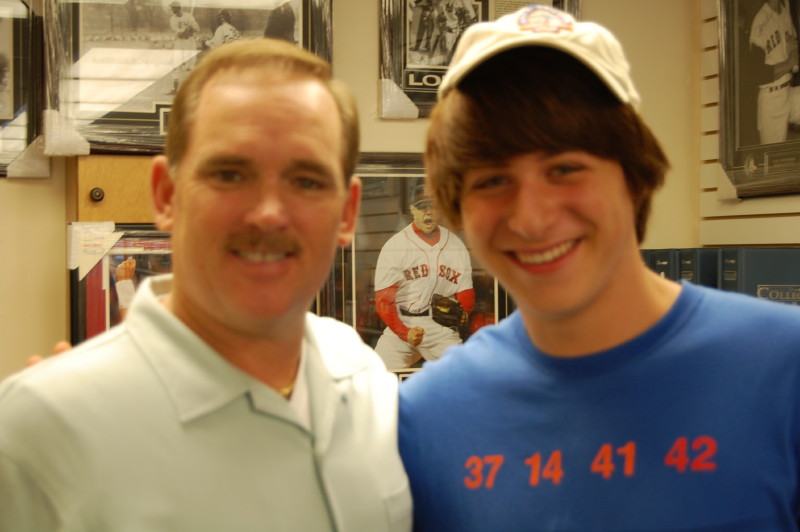
by Greg Prince on 11 August 2011 5:16 pm  Howard Johnson, Ryder Chasin and the shirt heard ’round the world. Howard Johnson could hit home runs and steal bases in tandem (if not simultaneously; the rules don’t allow that) like no Met before him and no Met after him. Only Darryl Strawberry could do it — 30 home runs and 30 stolen bases in the same season — like HoJo at approximately same time as him, and Darryl did it “only” once, in 1987. Johnson did it that year, two years later and two years after that. You don’t see 30/30 much anymore, and since he was eased out from his role as Mets hitting coach, we haven’t seen HoJo at all lately.
But we do see HoJo here, posing alongside the official Faith and Fear t-shirt, making him the third 1986 Met to take in the retired numbers (even though no 1986 Met has had his number retired…which is another story for another day). For bringing Mr. Johnson into the FAFIF fold — alongside Mr. Strawberry and Mr. Knight — we have our buddy Ryder Chasin to thank. Ryder and his dad Rob recently met up with the man of steal/power not at a Ramada Inn or a Hyatt, but at a sports memorabilia shop in Connecticut where Howard Johnson was briefly lodging (or at least appearing).
Ryder, longtime readers might remember, was the young man who invited Stephanie and me to join him at his Bar Mitzvah two Novembers ago at the Acela Club after reading the book version of Faith and Fear in Flushing. We’ve stayed in touch since, returning to Citi Field with Ryder and Rob on the second Tuesday night in August twice, each occasion resulting in a rousing one-run victory and a lot of fun for all.
Aside from graciously introducing our line of apparel to another Mets great, Ryder’s kept busy editing his high school paper’s sports section; throwing a nasty, tailing fastball — it certainly took care of the “Padre” at the Hershey’s Dunk Tank; figuring out what had been plaguing Jon Niese; and growing tall enough so that Mike Pelfrey might soon be going eyeball to eyeball with him (at which point I hope Ryder can straighten out the relatively Big Pelf).
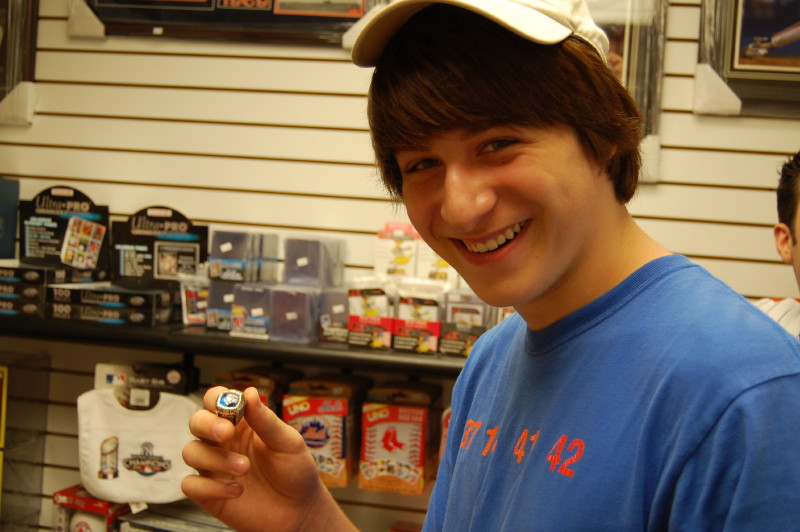
 HoJo’s ring, in good hands. Oh, and Ryder’s also been checking out 1986 World Series rings. The one he’s holding here is HoJo’s. Howard’s a great guy for trusting a 14-year-old with such a valuable piece of jewelry…or, perhaps, given his exploits of 1987, 1989 and 1991, HoJo knew that if Ryder tried to make off with it, he could always steal it back.
That’s purely hypothetical, of course. People who wear the FAFIF t-shirt are honorable folk.
by Jason Fry on 11 August 2011 2:55 am The last two nights, the Mets offered us a stirring reminder that while the playoffs may be out of reach, there’s still plenty of baseball to be enjoyed, whether you’re out at Citi Field, parked in front of the TV or wandering around with the radio as your companion. They played scrappy, fundamentally sound ball, authoring two late-inning comebacks against the Padres and leaving us all whooping and hollering like rising a game over .500 was our ticket to October.
But baseball will humble you, whether you play it or manage it or try to construct teams for it or just live vicariously through the people who do all those other things. And tonight, well, it was humbling.
The Mets, as is their habit, came back from an early deficit to put a scare in San Diego. (And then did it again in a several-bridges-too-far ninth.) But they’d gotten themselves into that early deficit by not delivering in the clutch, by making physical and mental errors, by getting lousy pitching, and by generally looking like a team of office guys playing softball with a keg at second. We’re looking at you, Dickey and Baxter and Pagan and Turner and basically everybody. Typifying the night, regrettably, was Ruben Tejada not sliding into home in the fourth, turning a Jason Pridie sac fly for a run into a mind-boggling third out. Asked by Terry Collins if he’d seen Justin Turner telling him to slide, Tejada said he had, leaving Collins understandably nonplussed. I flashed back to the ancient story of the hitter who ignored Charlie Dressen’s bunt sign, resulting in a blown suicide squeeze, and afterwards told his flabbergasted manager, “I didn’t think you meant it.”
At least Tejada turned in some admirable work elsewhere. Bobby Parnell was awful whether pitching or fielding, re-establishing a deficit once the Mets tried to claw out of it, and by then the game was basically down to whatever pleasures one could gleam from random sights and sounds. On the radio, there was Howie Rose taking the factoid about the last time the Mets had two eighth-inning comebacks in a row and spinning it into a great reminiscence about Danny Napoleon and how first-year-player rules of the time crippled his development. (Somewhere Casey Stengel is yelling, “Vive la France!”) On SNY, there was a good trivia question: Which four NL teams have never had a batting champ? (Us, the D-Backs, the Brewers and the Astros.) I found myself wondering why on earth Collins has one of those four-color pens, and if he’s the first person in history to find a use for green. (Emily and I decided the pen probably lets Terry click it about 14,000 times a minute to burn off excess energy.)
And what the heck kind of name is Tekotte, anyway?
These are the things you wonder when baseball turns humbling again. That, and when the next game is — the one that hopefully will wash away all traces of this one.
And that, at least, is where the good news comes in: Unless you’re a night owl, by the time you read this it won’t be so far away.
by Greg Prince on 10 August 2011 3:58 am “Woo! We win again! Way to go, Ruben!”
“Thanks, Ronny. I’m just glad it was quiet enough out there for me to concentrate on working that go-ahead bases-loaded walk.”
“I know what you mean. I don’t know if I could have walked to load the bases for you if the fans were making a lot of noise.”
“Hey, are you guys talking about how quiet it was in the eighth inning when we put together that three-run rally that won the game?”
“Sure are, Justin. Great, wasn’t it?”
“Oh man, totally! I can just relax and listen to the pitches when our fans make almost no noise whatsoever.”
“Fans? What fans?”
“Good one, Nick. Looking around the stands tonight, I’m pretty sure we have almost no fans.”
“Yeah, it’s better that way. No pressure. You know, I was doing pretty well in Buffalo, where nobody came to see us. It felt just like that in the eighth when I lifted that game-tying sacrifice fly. Very minor league — in a good way.”
“Lucas, nice bunt! I didn’t know you could lay ’em down like that.”
“Gotta tell ya, it wasn’t easy making contact with that guy in Section 106 yelling LET’S GO METS! the whole time I was up.”
“Yeah, what was that about? I heard a few people doing that without the scoreboard directing them to. Don’t they know we’re trying to concentrate? Glad they stopped. The silence is…what’s that word R.A. uses? Conducive! The silence is so conducive to quietude. Something like that.”
“Um, David, can I ask you a question?”
“Sure, Mike. Go ahead.”
“Well, I grew up around here. I went to games at Shea Stadium as much as I could when I was a kid. I idolized the Mets, and playing for the Mets is a dream come true for me.”
“That’s wonderful, Mike.”
“Yeah, anyway, I thought I’d ask you since you’ve been here longer than anybody…”
“What, Mike?”
“Well, when I was a kid coming to Mets games we made lots of noise. We got all excited during games like this one and we had every reason to believe we were helping the Mets.”
“Uh-huh.”
“And you know, I thought that’s the way it was supposed to be.”
“Uh-huh.”
“And, well, I’m real happy we won tonight, and I’m happy the guys are happy, and goodness knows I’m just happy to be here…”
“Uh-huh.”
“But it’s weird that it’s so quiet at Mets games nowadays and everybody in our clubhouse seems to have just gotten used to it.”
“Uh-huh…”
“David? You all right?”
“Oh, sorry Mike. You just got me thinking about what it used to be like at Shea.”
“I know. I played there once, in high school, but you got to play there for real for like five years.”
“Yeah, I sure did.”
“How did you like it?”
“Like it? I loved it! I loved it for all the reasons you said. It was loud and passionate and crazy, and when we were winning, it was like we had a tenth man on the field with us. During that first game of the Dodger series in the playoffs, when Paulie tagged the two runners at the plate, I could hardly hear myself breathe. But that was all right. I was in my third year in the big leagues and I figured that was the way it was supposed to be.”
“So what happened?”
“Whaddaya mean?”
“Why isn’t it like that anymore?”
“Look around. There’s no Shea anymore.”
“Yeah, but it’s still the Mets and we’re still basically in the same place. Doesn’t anybody care about us? I mean we’ve had all the injuries yet nobody quits. We win from behind late in the game two nights in a row. I think Mr. Horwitz said that hadn’t happened quite that way since like 1965.”
“I dunno, Mike. I dunno. It’s gotten awfully quiet the last few years. That I do know.”
“Say, what are you guys talking about?”
“Oh, hey Izzy. Nice pitching tonight. One more for 300.”
“Yeah, I guess. I’m just glad you kept the rally going.”
“Excuse me? Mr. Isringhausen?”
“What’s with the ‘Mr. Isringhausen’?”
“Iz, I think the kid is starstruck.”
“Starstruck for an old relief pitcher? Seriously, Dave, how much you pay him to say that?”
“Mr. Isringhausen, you gave me an autograph when I was a kid.”
“What the hell are you talking about?”
“I came to a game when you were a rookie. I was like ten years old and you were just up from Norfolk. I waved my program at you and Pulse and Jerry DiPoto and you all signed it. I called out, ‘Hey, Izzy!’ and you signed it.”
“If you called me Izzy then, you can call me Izzy now.”
“Damn…‘Izzy’. I’m in the same clubhouse with Jason Isringhausen.”
“Seriously, Dave, what is this costing you?”
“The kid’s for real, Iz.”
“Geez.”
“Mister…uh, Izzy, maybe you can tell me. I was remembering for David what it was like when I came here as a kid, and it was always so noisy…”
“No, it wasn’t.”
“Huh?”
“It wasn’t. When I was a rookie, it was mostly dead. Same thing the next year. We sucked and it was dead.”
“That’s not how I remember it.”
“Well, maybe for you when you were ten. And I’m not saying some fans didn’t cheer us or whatever, but I came up during lean times and we couldn’t draw flies most nights.”
“No way! I came here this one Sunday, on cap day, and…”
“Well, sure, cap day or whatever, we’d draw. But on a Tuesday night like tonight when it rained late in the afternoon and we were playing some team that wasn’t in it, like the Padres, and we weren’t in it…”
“Mr. Collins says we’re not out of it yet.”
“Sure, kid. Anyway, all I’m saying is the Mets may have had some great teams who played in front of some big crowds — like when I was injured or once I was traded — but there’ve been a lot of dull nights around here. When the team’s not going anywhere, sometimes the fans don’t show up. It’s just the way it goes. Besides, not everybody makes as much money as we do or gets comps.”
“Yeah, but I’m sure we made a lot of noise when we did show up. I made a banner once that said IZZY FOR PREZIDENT, with a ‘z’.”
“I don’t remember that, but thanks.”
“You’re welcome. And me and my friends paraded it around the field level until an usher told us to sit our butts down already.”
“Now that you mention it, I guess I do remember there being a little more excitement around the Mets at Shea, even when we weren’t very good.”
“And you guys were good! You had Huskey! And Brogna! And Tim Bogar!”
“Yeah, we weren’t so bad there for a little while.”
“I was at this one game, you were losing like 9-2, but you got a couple of runners on and you made it 9-4 or something, and we were screaming.”
“’Cause the DiamondVision told you to?”
“I don’t think so. We just screamed because we were Mets fans, y’know? We figured that’s what we were supposed to do.”
“Hey kid, that game where it was 9-2 or 9-4 or whatever — did we come back to win?”
“I don’t think so. The Mets never seemed to win when I came to games.”
“Yeah. Me neither.”
“Anyway, I’m a Met now, and it’s awesome and all. It’s awesome that my family can come and see me, and it’s awesome I come to work and see Mookie Wilson, and it’s even awesome that the planes fly overhead in and out of LaGuardia, but…”
“But what, kid?”
“But here the team is, playing its heart out, and hardly anybody shows up and those who do show up don’t seem to get very excited when we’re in the middle of a comeback like tonight. I heard the one guy sitting in the right field seats — him and his buddies — yelling LET’S GO METS! and I couldn’t for the life of me figure out why nobody was joining in.”
“I couldn’t tell ya, kid. I’m just pitching until I can’t. I like coming through the players’ entrance. Y’know what I mean?”
“I guess I do.”
“Anyway, hang in there, kid. I gotta go ice.”
“Sure thing, Izzy!”
“Wow, David. Jason Isringhausen just talked to me! I can’t wait to tell my dad.”
“Uh-huh.”
“David? Seriously, you want me to get the trainer or something? You look like you’ve got something caught in your eye.”
“No, Mike. I’m fine. Just thinking about that Dodger series. That’s all.”
***
The New York Mets are offering half-price tickets in all sections for Wednesday night and Thursday afternoon. Details here.
by Greg Prince on 9 August 2011 1:00 pm Welcome to The Happiest Recap, a solid gold slate of New York Mets games culled from every schedule the Mets have ever played en route to this, their fiftieth year in baseball. We’ve created a dream season that includes the “best” 109th game in any Mets season, the “best” 110th game in any Mets season, the “best” 111th game in any Mets season…and we keep going from there until we have a completed schedule worthy of Bob Murphy coming back with the Happy Recap after this word from our sponsor on the WFAN Mets Radio Network.
GAME 109: August 6, 1983 — Mets 4 CUBS 1
(Mets All-Time Game 109 Record: 19-30; Mets 1983 Record: 43-66)
The designated hitter be damned. A pitcher should be capable of helping his own cause. One Met moundsman demonstrated that capability like none before or after him.
In the first two decades and change of Mets baseball, eighteen home runs had been hit by Mets pitchers. A couple of those swingin’ hurlers were more prolific than others. Don Cardwell, for example, hit one home run per year from 1967 through 1969. Tom Seaver homered every year between 1970 and 1973, producing three round-trippers in 1972 alone. Jack Hamilton once blasted a grand slam, albeit in a loss. Tug McGraw and Skip Lockwood came in from the bullpen to pitch before going over the fence from the batter’s box. Pete Falcone enjoyed a truly complete game in 1981, going the distance to throw a shutout and going yard to increase his winning margin.
But nobody did what Walt Terrell did this Saturday afternoon at Wrigley Field. It bears repeating: Nobody did what Walt Terrell did this Saturday afternoon at Wrigley field.
Walt Terrell, after all, repeated his feat.
Terrell, a rookie righty who was half of what the Mets got back from Texas for Lee Mazzilli the year before (Ron Darling was the other half), matched up with 40-year-old Ferguson Jenkins. The career gap between them on the mound was a mere 279 wins entering play — and Fergie, despite an eight-year exile in the DH league, led Walt 16-0 when it came to home runs hit. Jenkins once slugged six in one season, 1971.
If Walt wanted to start making up ground on a likely Hall of Famer, he’d better get going on all fronts.
So he did, in the top of the third of a scoreless game. After Ron Hodges singled to lead off the inning, Terrell whacked a Jenkins delivery clear over Wrigley’s ivy to help himself to a 2-0 lead. A pitcher hitting a home run — always a thrill, especially to the pitcher who hit it. The 25-year-old Terrell liked the feeling so much, he decided to experience it again.
One inning later, Jenkins hit Brian Giles, who stole second. With two out, Terrell came up and, just as he had in the third, Terrell went deep. The Mets’ starting pitcher hit his second home run of the game, another two-run shot. Terrell now led Jenkins 4-0 and trailed him homerwise by only fourteen.
Terrell’s fame was instantly slugging but his cause, like that of all baseball players who conducted their business sixty feet and sixty inches from home plate, was pitching. Walt remembered that and concentrated on making his lead stand up. He did it well, surrendering only a sacrifice fly to Ryne Sandberg before departing with one out in the eighth. Carlos Diaz finished the game for him, a 4-1 victory in which the starter drove in all four Met runs.
Only eight National League pitchers have matched Terrell’s single-game, two-homer performance since 1983, including one ex-Met, Mike Hampton, and two who did it against the Mets: Derek Lilliquist and Dontrelle Willis. No Mets among the fifteen pitchers who have homered since Terrell — not even Dwight Gooden, author of a franchise-best seven career pitcher home runs — has concentrated his power so effectively inside of one game.
For Jenkins, the role of the opposing batter might have been relatively novel — he also gave up a dinger to Craig Swan, in 1982 — but the result wasn’t. Fergie allowed 484 home runs in his 19-season career, third most in baseball history. He also totaled 284 wins when he retired after the 1983 campaign. Jenkins, like the pitcher just ahead of him on the home runs given up chart (Robin Roberts) is enshrined in Cooperstown. You have to be a pretty good pitcher for a very long time to give up that many homers.
And Terrell? He had to be a pretty good hitter to take that good a pitcher, even one in his twilight, over the wall twice in one game. Mets fans giddily expecting to go on a power trip every time Walt batted were sated soon enough when, three starts later, the kid tagged San Diego reliever Gary Lucas for a three-run shot. That gave Terrell three home runs in one season, tying Seaver’s team record.
It also marked Walt Terrell’s final major league home run. He pitched until 1992, but mostly in the American League, where pitchers haven’t been asked to help their own cause with a bat since 1972. Thus, Walt’s true home run legacy where the Mets are concerned isn’t so much the two in one game or three in one year, but the 192 smacked by Howard Johnson between 1985 and 1993. The Mets acquired Johnson for Terrell in December 1984, and HoJo ranks third on the franchise’s all-time home run list, behind only Darryl Strawberry (252) and Mike Piazza (220)…and 189 ahead of Walt Terrell.
ALSO QUITE HAPPY: On August 6, 1989, two sluggers bookended the extraordinary efforts of one workhorse middleman. The Mets were in this Sunday afternoon marathon at Shea versus the Expos because Darryl Strawberry belted a leadoff home run in the seventh inning off Kevin Gross to knot the score at one and didn’t let Sid Fernandez’s eight stellar innings (1 ER, 5 H, 10 SO) go to waste. They won it because Kevin McReynolds hit a leadoff home run seven innings later off former Mets farmhand Steve Frey. But the 2-1, 14-inning victory owes something big to Jeff Innis, who inherited a one-out, bases-loaded mess from Randy Myers in the top of the tenth. With no margin for error, Innis popped up Tim Wallach and grounded Andres Gallaraga to short, keeping the game tied. Fellow unsung relievers Don Aase and Jeff Musselman held the fort over the next four innings, making possible McReynolds’ walkoff exploits.
The nearly five-hour triumph gave the Mets a three-game sweep of the first-place Expos and was their fifth win in the six games they’d played since acquiring Frank Viola at the trading deadline. With the 1988 American League Cy Young winner on board, the Mets had moved from seven to four out in less than a week.
GAME 110: August 4, 1998 — METS 7 Giants 6 (10)
(Mets All-Time Game 110 Record: 25-24; Mets 1998 Record: 59-51)
Sometimes it’s not enough to hope for a Mets win. Sometimes you have to remind the Mets not to lose, particularly on a night when their worst instincts seem destined to get the best of them.
Take this Tuesday night at Shea, against the Giants, a game in which the Mets battled from behind and came close to blowing one from ahead with apparently equal gusto.
First, the charge uphill: Down 4-0 in the sixth, the Mets loaded the bases against Mark Gardner. Dusty Baker replaced his starter with lefty specialist Rich Rodriguez, a move Mets fans would come to dread when Rodriguez materialized in a Mets uniform, but that wouldn’t happen for another two years. For now, it was great news, as attested to by a two-run Todd Pratt single, a Tony Phillips RBI base hit and an Edgardo Alfonzo groundout that tied the score at four.
On came Turk Wendell, who was just beginning to climb the Mets bullpen food chain. After pitching in mostly low-leverage situations through the season’s first four months, Bobby Valentine handed Turk the tie and Wendell won over a crowd that was conditioned to grow antsy any time it saw a Met reliever. Turk retired Shawon Dunston, Ellis Burks and Barry Bonds in order in the seventh, and — after Carlos Baerga and Luis Lopez drove in runs off the downtrodden Rodriguez — did the same with Jeff Kent, Charlie Hayes and Joe Carter in the eighth. Wendell left the game with two perfect innings strung onto his animal-teeth necklace, a prospective win on his record and emerging cult-hero status as everybody seemed to notice at once the way he slammed the rosin bag down before taking on each batter.
A win would have been a great reward for an outstanding middle-relief performance, but Turk was going to have to settle for being the reliever at whom Mets fans didn’t snarl their discontent. By the time Wendell’s line was in the books, the usual suspect was eliciting the usual Shea reaction.
John Franco…as much a part of the Shea scenery by 1998 as the Home Run Apple and puddles in the parking lot. And just that afternoon, the Bensonhurst boy was rewarded for his long and mostly meritorious service with a two-year contract extension worth $6.15 million…or about $6.15 million more than anyone with any kind of short-term memory in Flushing would have fronted him at that moment in time. Johnny was enduring a tough summer, having blown three saves and taken five losses in July as the Mets were scratching and clawing for every possible win in their quest for the National League Wild Card.
Nobody’s perfect, but when you’re a closer who’s noticeably imperfect, and your team’s every game carries pennant race implications, your imperfections tend to get noticed. Franco’s sure were. At the press conference announcing his new deal, the longest tenured Met, per Steve Popper of the Times, “had talked of his ability to withstand the boos”. Hours later, in the ninth, Brooklyn’s favorite son found himself with a chance to avoid eliciting more of them.
No dice.
Franco retired his first batter but gave up a double to fellow Brooklynite Rich Aurilia. J.T. Snow drove him home with a single, and now it was 6-5. Dunston (also of Brooklyn) forced Snow at second for the second out. Then Franco finally got some good luck, picking Dunston off first base. John Olerud fired to Rey Ordoñez to complete what was about to be the third out and…as previously reported, no dice. The best defensive shortstop in the National League dropped the throw, keeping Dunston on the basepaths. After walking Ellis Burks, Franco gave up a bloop single to Bonds, and the game was retied.
Boos ensued.
“It’s a tough city,” Franco reasoned. “They only want the best.” But for Franco, lucrative contract extension or not, his fortune was the worst: “You pick a guy off, and your Gold Glove shortstop makes an error. What else can go wrong?”
One might mention there was that leadoff double, the succeeding single and the walk to Burks to bring up Barry Bonds, but closers who aren’t closing have to create their own logic. Or as Franco put it, “It’s almost to the point that I’ve got to laugh about it.”
The Mets didn’t score in their half of the ninth, and southpaw Dennis Cook — unlike lefties Rodriguez and Franco — was impenetrable for as extra innings began. The home team then took its best shot against another accomplished reliever who’d suffered his brushes with infamy: Jose Mesa, he who, as an Indian, gave up the tying run in the ninth inning of the seventh game of the previous fall’s World Series against the Marlins.
If Mesa and Franco could empathize with one another out of professional courtesy, who could blame them? Still, it seemed Mets hitters were showing their opponent a bit too much sympathy in the way they seemed to go out of their way to try and avoid adding to Mesa’s misery.
Phillips singled to lead off the Mets’ tenth and took second on a wild pitch. Fonzie walked. Olerud managed an infield single to load the bases. Nobody was out. Surely, the Mets were poised to win.
Except Mike Piazza grounded to Aurilia at short, who threw to Doug Mirabelli at home to nail Phillips for the first out.
And Brian McRae grounded to Snow at first, who threw home to Mirabelli to nail Alfonzo for the second out.
Two batters. Two bases-loaded situations. Two force plays at the plate. It was almost to the point where you had to laugh about it.
Lenny Harris was the Mets’ last hope for immediate redemption. If he didn’t come through against Mesa here, there’d be an eleventh inning, but, honestly, if he didn’t come through against Mesa here, it would mean the Mets blew the most golden opportunity this side of “plastics” in The Graduate. And lord knew John Franco wasn’t going to be alone among the booed at Shea Stadium.
Mesa and Harris extended this comic drama as far as they could. Three balls to Lenny. Then two strikes. Then?
Fastball. Inside. Ball four. Harris goes to first and everybody else moves up a base — most notably Olerud, who trots home to make the final 7-6 Mets.
“I sure am proud of that group,” Valentine said in the euphoria attendant to any kind of walkoff success. “That was a heck of a win.”
Even better, it wasn’t a heck of a loss. Or something begging far worse adjectives.
ALSO QUITE HAPPY: On August 6, 1975, the luck of a legendary baseball man considered — Lou Gehrig notwithstanding — as lucky as they came had finally run out. Yogi Berra’s nearly four-season tenure as Mets manager came to an end when the Mets were swept a doubleheader by Montreal, both by scores of 7-0. Tabbed to replace him in the short term was well-regarded first base coach and former Met shortstop Roy McMillan, looked to as just the leader to guide the team from its dog days dismay and back into the N.L. East race. Given that the Mets were mired in third place, 9½ behind front-running Pittsburgh, McMillan could use all the luck he could get.
That and some scoring this soggy Wednesday evening at Shea. The Mets trailed Montreal 4-2 in McMillan’s debut as skipper when they exploded for seven runs in the bottom of the sixth. The first big blow was a three-run triple from Del Unser, with Felix Millan and Ed Kranepool contributing run-scoring doubles immediately thereafter. The Mets went up 9-4 and appeared headed toward giving Roy a 1-0 record when the same relief pitching that undermined Berra reared its inconsistent head in the top of the ninth. Bob Apodaca came on to protect the five-run lead and allowed two singles, a ground ball mishandled by shortstop Mike Phillips and consecutive walks, the second of them to Pepe Mangual with the bases loaded. All of a sudden, it was 9-6, there were Expos on every bag, there was nobody out and…
…and the rain the teams were playing through grew too steady to ignore. The tarp was ordered onto the field, the players retreated to their clubhouses, and, when the weather didn’t clear up after an hour and fifteen minutes of mandatory waiting, the game was called a 9-6 final in favor of the Mets. Shea may have been all wet, but Roy was undefeated. Yogi himself on his best days couldn’t have been more soaked in serendipity.
GAME 111: August 7, 1971 — Mets 20 BRAVES 6
(Mets All-Time Game 111 Record: 17-32; Mets 1971 Record: 57-54)
They called Atlanta Stadium — later Atlanta-Fulton County Stadium — the Launching Pad. On this Saturday night in Dixie, there was an obvious reason for the nickname: it was the ballpark that launched the 1971 Mets into the record books.
In an era when NASA still counted down to moon launches at Cape Kennedy (née Canaveral), the Mets took the reverse tack in the first inning: not so much 3-2-1…but lifting off with 1…2…3 runs to get their exploration of line score space going against Braves righty Ron Reed. An error by Brave shortstop Marty Perez on Bud Harrelson’s leadoff grounder was just the nudge the Mets needed to start soaring. Agee singled, sending Harrelson to third. Agee stole second. And then the Mets orbited their average 1971 per-game run total of 3.6 via a Cleon Jones single, an Ed Kranepool sac fly and a Ken Boswell double that right fielder Mike Lum leapt and batted down at the fence before it could shed its booster rocket and become a two-run homer.
Nice effort, though one is tempted to say Mike needn’t have bothered.
Because of the right fielder’s effort, the Mets were limited to three runs — not an inauspicious start, but not necessarily ostentatious. And once Lum nicked Nolan Ryan for an RBI single in the bottom of the first, you would have guessed both teams would avail themselves of the offensive amenability of the Launching Pad.
You would have guessed wrong. The top of the second proved the only glare rockets would give off at Atlanta Stadium would be of the blue and orange variety.
This is how the Mets blasted off toward double-digits:
Jerry Grote singled.
Nolan Ryan bunted him to second and was safe at first.
Harrelson bunted them over and was also safe at first.
Wayne Garrett lifted a fly ball to Sonny Jackson in center to make it Mets 4 Braves 1, as Grote scored and the other baserunners moved up.
Jones was intentionally walked to set up a double play. Except it set up an RBI single for Cleon, increasing the Mets’ lead to 5-1.
Ron Reed handed the ball to manager Lum Harris who handed it to lefty reliever Mike McQueen who threw it four times out of the strike zone past the righthanded Donn Clendenon, inserted by a run-ravenous Gil Hodges to pinch-hit (or, technically, pinch-walk) for lefty Kranepool..
That made it 6-1 Mets. And that was as close as the Braves would be until Sunday, because McQueen didn’t miss the strike zone with the next batter, Boswell. Didn’t miss his bat, either. The only thing McQueen’s pitch of greatest consequence missed was a landing spot within the chummy confines of Atlanta Stadium. Ken struck it but good, blasting it off the right field foul pole for a grand slam that brought the moon, the stars and the heavens down on the Atlanta Braves.
Mets 10 Braves 1 in the top of the second. A long night was at hand for at least one of those teams.
Sometimes somebody gets that big a lead and things settle down. Sure enough, a combination of Ryan, McQueen and complacency transpired to keep the score unchanged through the fourth. But come the fifth, the Mets’ bats grew restless once more. After two outs, Grote singled, Ryan singled, Harrelson walked and Garrett singled to drive in two. 12-1, Mets. Mike McQueen’s evening ended and Steve Barber’s began…but not happily, as Agee singled home another to make it 13-1, Mets.
Nolan Ryan needed just three outs to qualify for the win, assuming the Mets didn’t blow a twelve-run lead. Only the most nervous Mets fan would have considered that a possibility, but Ryan wasn’t sharp. Earl Williams singled in Hank Aaron and Zolio Versalles belted a three-run homer to cut the Braves’ deficit to 13-5. Under just about any other circumstance imaginable, Hodges would have pulled Ryan, but Nolan had some cushion with which to work. He got the next two outs and would go eight.
Besides, the Mets got back most of what their pitcher gave up when they batted in the top of the sixth. Grote drove in one and Tim Foli, having taken over short for Harrelson, singled in two more. The Mets finished their half of the inning up 16-5. Ryan gave up another run in the bottom of the sixth, but Clendenon answered with a two-run homer in the top of the seventh to give the Mets a comfortable 18-6 lead.
Comfortable? More like luxurious. But what about historic? A record was at hand if the Mets could grab it. Seven years earlier in Chicago, the Mets famously put 19 runs on the Wrigley Field scoreboard. If it wasn’t famous enough for simply being 19 runs or for the notion of the perpetually cellar-dwelling 1964 Mets of all people scoring 19 runs, it took on the stuff of legend when the story got out that somebody called a newspaper somewhere and asked a) if it was true the Mets had scored 19 runs that day and — once that was confirmed as fact — b) did the Mets win?
The Mets were futile enough to be funny back then. By 1971, however, they weren’t particularly amusing or terribly exciting. They offered generally superb pitching and reliable defense most nights, but rarely the kind of hitting that would send fans scurrying to their phones to verify their run totals — or, for that matter, enough hitting to make large run totals seem not all that newsworthy. A 9-20 July knocked the Mets out of contention for the first time in three years, making them, by objective standards as they groped about the .500 mark, a fairly run-of-the-mill operation.
“Everything considered,” Leonard Koppett would write just a couple of years later, “1971 was probably the least satisfying year the Mets had ever experienced. Not only were the mini-rewards of the pre-championship days no longer possible, but also the status of champion was officially gone.” By Koppett’s reckoning, “The Mets moved into complete ordinariness.”
Against this drab backdrop, the Mets aimed for the extraordinary, just as they had done for more than six months two seasons before; just as the U.S. space program had done that very same season. The Mets and man landed on the moon in 1969. For this one night in Atlanta, the Mets were shooting for it again.
In the ninth inning, it was still 18-6 when the Braves’ Bob Priddy got two quick outs. But then mission control transmitted word of one final rally to make this Metropolitan score truly astronomical. Clendenon walked. Boswell singled. Ken Singleton singled. The bases were loaded and the stage was set.
Grote grounded to Versalles at third…and the former American League MVP booted it. In came Boswell. In came Clendenon. The Mets had their 20th run — their most ever. The 20-6 win went into the Mets record book and, like Neil Armstrong’s American flag, stayed planted there long after NASA stopped scheduling lunar excursions.
One big night for the Mets. One giant leap for Ken Boswell.
ALSO QUITE HAPPY: On August 5, 2007, the Mets’ starting pitcher was aiming to win his 58th game in a New York Mets uniform. Doing so would pull him to within one victory of tying Rick Reed and Craig Swan for eleventh place on the all-time franchise win chart. That alone probably wouldn’t have motivated this lefthanded hurler as he prepared for his Sunday night start against the Cubs at Wrigley Field. What really stoked T#m Gl@v!ne was the 242 wins he piled up as an Atlanta Brave between 1987 and 2002 (16 of them against the Mets) when added to the 57 he’d accumulated while under contract to New York since 2003. Put them together in the 21st season of an illustrious career, and you could figure out T#m Gl@v!ne was going for his 300th win.
Warren Spahn, also known best as a Brave, already had more than 300 wins on his résumé when he joined the Mets for a short stint in 1965. Homegrown Mets Tom Seaver (White Sox) and Nolan Ryan (Rangers) would each attain a 300th win after departing their original club. Gl@v!ne, then, became the first man destined to try to reach 300 while collecting a paycheck from the Mets.
T#m missed out in his first attempt, in Milwaukee — when Gl@v!ne’s reliever successors couldn’t hold a 2-1 lead on his behalf — but accomplished his personal goal in Chicago, when he left with one out in the seventh, ahead 5-1, and the Mets’ bullpen overcame its self-destructive tendencies. Spahn and Seaver threw complete games for their 300th wins, while Ryan went 7⅔, exiting with a big lead in Texas. The record will show Gl@v!ne’s milestone victory was earned on 6⅓ innings of six-hit pitching, and that he required Guillermo Mota, Pedro Feliciano, Aaron Heilman, Jorge Sosa and Billy Wagner to finish up for him.
But a decision is a decision, and when Wagner got Mike Fontenot to ground to Ruben Gotay for the final out, the Mets prevailed, 8-3, and T#m Gl@v!ne indeed notched his 300th win. The 23rd 300-game winner in baseball history would add three more Met wins to his bottom line in 2007 — the last of them on September 8 — before returning to Atlanta to finish his career with a lifetime mark of 305-203.
by Jason Fry on 9 August 2011 2:28 am I saw this New York Times piece on my iPad and spent the next couple of hours trying to keep my blood from boiling.
I love the Times, but Jim Luttrell’s post is tone-deaf about Mets fans specifically, baseball fans in general, and ignores the actually interesting currents and tribes of the city in favor of shaking a tin cup for the permanently shallow and professionally bored. From the assumption that Mets fans check out once there’s no chance of the postseason to the invitation for readers to submit cutesy Lettermanesque items, the target audience is fair-weather fans, brainless NYC drones and snarky douchebags without portfolio, none of whom I have the slightest interest in reading about or hearing from in the paper of record.
Besides, those deluded enough to still go to Citi Field last night saw a whale of a ballgame — and were reminded that this year’s Mets team just keeps somehow finding a way. On Sunday the season flat-lined as the Mets lost Jose Reyes and then Daniel Murphy in the finale of their series with the Braves. Yet for all that, they came roaring back, tying Atlanta before succumbing to Chipper Jones for what only feels like the 58,000th time. But they fell short, and listening up in Maine, I just shook my head. Nine games out. Murph gone for the year. Back to baby steps for Reyes. Now it’s really over.
Tonight, after the Mets Pelfrey’d a 4-1 lead into a 4-4 tie, I figured they’d roll over and die. They’d lose to San Diego, then start losing two of three and three of four. And I thought to myself that I wouldn’t particularly blame them. Eventually even the best-motivated bunch has to conclude that’s five or six snakebites more than a reasonable person ought to bear. (I think one reason for my fury with the Times was their juxtaposition of the Getty Images snap of an anguished, white-faced Murphy being helped off the field with silly comment-trolling. Murph was one of the real feel-good stories of the year, and now his year was turned to ashes, too.) And indeed, things got worse as the potentially useful Pedro Beato continued to struggle and the singularly useless Ryota Igarashi continued to pitch like he normally does, landing the Mets in an 8-4 hole going to the bottom of the eighth.
But there were pleasures to be had after that anyway.
Like seeing Mike Baxter take his first swing as a Met and line a ball to deep left, where it clanked off Kyle Blanks’ glove for a gift double. Baxter’s from Whitestone and grew up a Mets fan, so he had people in the park by the dozens, and SNY caught them practically levitating with happiness — a nice moment even if we never hear from Mike Baxter again. After Ronny Paulino added a sac fly it was 8-6, and hey, youneverknow.
Like seeing David Wright, recently recovered from A FREAKING BROKEN BACK, spearing the third out of the top of the ninth with a headlong dive into foul territory despite the game being pretty clearly meaningless, at least as far as the Times is concerned. Still down by two, and prodigal son Heath Bell was coming in with chip still firmly on shoulder, but there’s a reason they play 27 outs, so we’d see.
Like seeing Jason Pridie hang in there for a tough at-bat against Bell, followed by an even better at-bat by Justin Turner, whose response to wearing the goat horns has apparently been to play even harder. Then Wright spanked a single up the middle and what the hey, it was 8-7. They’re going to kill me, I thought, imagining Jason Bartlett spearing a sharp Lucas Duda grounder behind second and turning it into a game-ending double play. But then the Mets had already done more than I’d expected — if they lost, I knew I’d be disappointed, but I was pretty sure I wouldn’t be mad.
Like seeing Duda — a hulking kid who seems painfully shy, doesn’t really have a position and has committed the cardinal sin of admitting to struggling with his self-confidence — get a bit lucky, rolling one past Bell lunging this way and Orlando Hudson sprawling that way to score Turner and Wright for a 9-8 win and a happy dogpile and a face full of whipped cream.
The Mets aren’t going anywhere this year — we know it and they know it and just in case any of us momentarily forget it, the baseball gods will remind us by trotting out back fractures and rolled ankles and old shoulder injuries and new shoulder injuries and hamstrings and high slides and who knows what else. But despite their open October calendars, these Mets keep scratching and clawing and biting and kicking. They win more than we think they can; when they lose, they often make us proud to be their fans anyway.
And so it turns out there are pleasures left to be had in this bizarre, star-crossed season.
You might even call them reasons someone who loves baseball might continue to go see it played somewhere.
You know what? Let’s not tell the New York Times.
by Greg Prince on 7 August 2011 7:36 pm This is what it sounded like during Terry Collins’s postgame press conference Sunday, where the primary subject was the status of Jose Reyes and Daniel Murphy:
“Terry, have you ever seen this many injuries on one team?”
“Terry, this is tough, isn’t it?”
“Terry, can you believe how many injuries your team has had?”
“Terry, your team has had to overcome a lot of injuries. How are you going to overcome these?”
“Terry, aren’t these injuries tough?”
“Terry, your team is going to have to regroup. They’ve done it before, but can they do it again? It’s really going to be tough, isn’t it?”
“Terry, so many injuries — have you ever seen anything like this?”
“Terry, you’ve had to keep your team together through a lot of tough injuries. Now you’re going to have to do it again. How will you do that? It’s gotta be tough.”
“Terry, you’ve lost some of your key players before, and now you’ve lost two more — and you lost a tough game. Is it tough?”
“Terry, the injuries…have you ever seen anything like them and where do you go from there?”
I’m not sure what else there was to ask, but I do know there was no chance there’d be any answer beyond some version of, “No, I haven’t seen this many injuries; yes, this is tough; we’ll have to see what happens next.”
So I’m not sure why the same essential question needed to be asked over and over. It’s just what those guys do, I guess. Then they ran to David Wright’s locker and repeated the exercise.
Best to Jose and Daniel for speedy recoveries. Best to Terry on figuring out how to get through the rest of the season with a continually depleted roster. And to those who cover the team, good luck coming up with a second-day angle — you can start by not asking everybody else if they’ve ever seen anything like this.
You know damn well they haven’t.
by Greg Prince on 7 August 2011 4:05 am I’d forgotten how great home runs could be. Seriously. Saturday night was a perfect illustration of why they’re such superb creatures when they’re on your side. The Mets hit four home runs. Nothing showy — two guys hit one, one hit two; two came with nobody on, the other two with one on.
Four swings. Six runs. Talk about the efficiencies of the market.
Seeing as how three of the home runs were mashed by players who have no track record as sluggers, the powerful output was a reminder of how enjoyable a random clout can be. Justin Turner and Josh Thole — members in good standing of the Jolly Taters club for one night — are Mets who might hit one out more often if they played in more amenable surroundings. Jason Bay, too. Bay has a track record for home runs, though it would be more comforting had he converted his records to MP3 files so they would play more readily these days, but he’s on his version of a tear, so we’ll just enjoy that for now.
This wasn’t a Citizens Bank Park-style explosion (like the night the Mets hit seven there on April 19, 2005, the most a Mets team ever popped in one game). It wasn’t some kind of one-Met epic display (last seen at Coors Field on May 12, when Carlos Beltran became the most recent Met to put three over a fence). Though it lopped off a losing streak, it didn’t signal overwhelming deliverance from an arid desert where a certain kind of home run would grow only for the enemy (the grand slam bonanza of Bay and Beltran in Detroit on June 28). And it wasn’t exactly homer or bust, either, the way it was the last time there were four Mets homers at Citi Field (May 7, 2010: two by Ike Davis, two by Rod Barajas, including a most necessary walkoff blast from the latter).
These, against Atlanta, were four home runs hit as part of a nutritionally balanced offensive attack.
In the very same game in which Turner homered twice and Thole and Bay homered once apiece, there were three doubles; there were four stolen bases; there were two singles by the…if you’ll excuse the expression…previously slumping Jose Reyes. There were sixteen hits, all told, and there were five runs batted in without the aid of a home run. Seeing as how the Braves scored seven times themselves, the Mets couldn’t have won solely via power surge. But they also couldn’t have won without their four dingers.
It was just nice to have those arrows in the quiver. I’m not sure why Citi Field suddenly decided to loosen up and permit such frolic, but I’m glad it did. I dig triples as much as the next fan, yet I detest the Mets playing in a ballpark pretentiously built to enable them at the expense of the ordinarily attained home run. Triples instead of home runs: talk about lowering your sights — the Mets can’t afford to give away that many bases one bag at a time. Besides, Lance Johnson once collected 21 triples in a season with Shea Stadium as his home park; Jose Reyes came up with 17 receiving his mail in the same place.
Meanwhile, most nights (Friday night, for example) David Wright booms a ball toward the heavens and then soldiers into second base because, well, balls that would go out of any other park in captivity remain captive to Jeff Wilpon’s cutesy-poo blueprints. Let’s make our ballpark triple-friendly! And while we’re at it, let’s let Wright’s power stroke go largely to waste.
But that’s most nights. For one night, for Saturday night, Citi Field played like a regulation facility, and the Mets played like they knew how to take advantage. For one night, no matter the reported stem fatigue incurred by the center field Apple, it was a lot of fun.
Hope there’s more where that came from.
***
Thank you to those kind enough to express concern, curative suggestions and best wishes where my headaches are concerned. I was subject to another attack after Saturday night’s game — sort of like Tommy Hanson during Saturday night’s game — and found relief in a dose of some powerful stuff I keep handy. I have cobbled together a pretty good idea as to why these episodes have returned after a relatively long absence (it has nothing to do with either Wilpon) and will take steps to prevent them as best I can. But, again, I just wanted to say thanks for caring.
by Greg Prince on 6 August 2011 12:59 am What was farther out of the realm of possibility: that the Mets would make a stand against the Braves or that I’d be there to see them attempt it?
Not long ago both happenstances seemed reasonably reasonable. My part should have been a breeze: I made plans to see Friday night’s game with a friend who happens to possess one of the greatest Mets minds ever; I picked up the tickets the other night; we set a meeting time by the Apple; and…ohmigod I am in such pain.
My merry way to Citi Field was interrupted by the return of that early 2000s sensation, the cluster headache, something I used to contract all too regularly but in recent years has faded from my recurring concerns. For whatever reason, el diablo that used to periodically invade mi cabeza chose this afternoon to rematerialize — perhaps it knew Fiesta Latina was at hand.
I tried to delude myself that this wasn’t a cluster headache, a.k.a. a suicide headache. For all I know, it was something else altogether. It felt as if a nail was being drilled into my left sinus, it was accompanied by simmering nausea and, in an unprecedented twist, it came with a steady stream of perspiration dripping from my forehead (which was, for the record, as pale as any three members of ABBA). Yet I wasn’t fevered and I didn’t have any kind of stomach virus that I could detect. All told, it was awful, but I had those tickets, I was meeting my friend to go to a game with him for the first time all season, there was a Jose Reyes banner with my (or Jose Reyes’s) name on it, thus I went into self-delusion mode.
I’m fine…
I’ll be fine…
I’ll take a later train and maybe I’ll leave the game early if I absolutely have to…
I won’t eat anything, obviously…
And when I get home, I’ll take that special migraine pill my doctor gave me a sample of a few months ago if I’m still feeling in as much pain as I am right now and have been all day…
Yes, I’m fine. I can go to the game.
Suitably self-deluded, I stood up to leave for the LIRR — and I realized I had as much chance of getting to the Apple as the Mets did of getting back in the Wild Card race they were never really in. Hence, I communicated my regrets to my friend via voice mail, text message and e-mail and gave into reality.
I took the special pill.
Boy, was it special.
It, like LL Cool J’s mama, circa 1991, all but knocked me out from roughly the second to the seventh inning. I have to say “roughly” because I had no concept of time as expressed by innings. And I say “all but knocked me out” because I was intermittently alert enough to absorb three elements of the broadcast on my television:
1) The Los Mets uniform tops, which were a definite improvement over past editions but not necessarily something I want to see again, lest I recall the Friday evening my forehead was soaked and I had to place an unexpected call to Ralph Milliard on the big white phone.
2) “Major medical!” Oy, with the CGI duck and pigeons already. Like I didn’t already know from major medical in my state.
3) Constanza. I just kept hearing the name Constanza. Every time I managed to open one eye, I kept seeing Constanza. Thought about my friend Mark whom I left to his own devices at the Apple and how he more than anybody I know was likely making hay with Constanza. If we have to ditch the blue and orange softball tops, the Braves have to ditch Jose Constanza. He will also always remind me of how low I was feeling.
As will the final score, something I saw come together as I emerged from my vapors and comprehended what was and wasn’t going on.
What was going on was a Braves victory.
What wasn’t going on was the post-Beltran 2011 Mets, to whom I apologize for recently placing unrealistic if modest expectations upon as much as I apologize (again) to Mark for standing him up at the Apple. The Mets were fun while they lasted, but they stopped lasting once they noticed Carlos was missing from their ranks. I drank the same Alderson-enhanced Kool-Aid as everyone else and signed off on the deal for business reasons, yet as I made like a less Balabusta version of Johnny Cammareri’s mother in Moonstruck…
The breath had almost totally left her body. She was as white as snow. And then she completely pulled back from death and stood up and put on her clothes and began to cook for everyone in the house. The mourners. And me. And herself! She ate a meal that would choke a pig!
…and focused on the potential rally in the bottom of the eighth rather than my rapidly receding headache, I couldn’t help but think a team with any kind of playoff aspiration doesn’t trade its veteran slugger who, his San Franciscan incarnation notwithstanding, can still slug. It keeps him and keeps going and gives you as a Mets fan something worth watching besides novelty jerseys and ubiquitous AFLAC commercials.
I know, I know, it had to be done, all hail Alderson and his forward-thinking genius, but damn I miss having an extraordinarily dangerous hitter in the middle of the lineup. My playoff fantasies were pretty limited to begin with, but now they’ve utterly vanished. When Murphy was on second and Wright was on first in the eighth, and Pagan flied out and Bay grounded out while Beltran was taking BP or stretching or whatever he was doing on the other side of the continent, I had my moments of clarity:
• Our season, save for 51 games in which baseball will be played — and will be kind of fun because it’s baseball but will be less fun because there will be less to play for — is over. (Throw the impending non-returns of Davis and Santana onto that conclusion as well.)
• I hope the Alderson-enhanced Kool-Aid is spiked with something as strong as Maxalt and that it’s time-released so that in a couple of Augusts, instead of congratulating our GM for cleverly giving up on a longshot season, we’re intensely invested in a contending team that includes Zack Wheeler pitching and Jose Reyes playing shortstop — and I also hope the proceeds from the crisp pair of bookmarks that my Friday night tickets became go to the Re-Sign Jose fund, no matter how many triples Jose Can’t-Stand-Ya robbed him of while I, if not my team, rallied from the depths of despair.
This was one of those headaches (and then some) from which you’re sure you’ll never recover. That’s why they’re known as suicide headaches. But hours later, I’m feeling better physically if not Met-aphysically. I really couldn’t have gone to this game, no matter how much I wanted. I wondered if it was a postseason game if I could have or would have pushed myself to the train no matter the headache, the sweating, the nausea and the paleness. How sick would a Mets fan have to be to miss a playoff game?
Then I stopped wondering about it because, in 2011, that’s a purely hypothetical problem.
|
|