The blog for Mets fans
who like to read
ABOUT US

Faith and Fear in Flushing made its debut on Feb. 16, 2005, the brainchild of two longtime friends and lifelong Met fans.
Greg Prince discovered the Mets when he was 6, during the magical summer of 1969. He is a Long Island-based writer, editor and communications consultant. Contact him here.
Jason Fry is a Brooklyn writer whose first memories include his mom leaping up and down cheering for Rusty Staub. Check out his other writing here.
Got something to say? Leave a comment, or email us at faithandfear@gmail.com. (Sorry, but we have no interest in ads, sponsored content or guest posts.)
Need our RSS feed? It's here.
Visit our Facebook page, or drop by the personal pages for Greg and Jason.
Or follow us on Twitter: Here's Greg, and here's Jason.
|
by Jason Fry on 23 July 2011 2:46 am How many duck-and-cover games have the Mets played in Soilmaster Stadium, anyway? And how many of those ended with some fleet, scrappity Marlin hitting a ball just past the first baseman’s glove, or just through the drawn-in infield, or just hugging the third-base line, or just catastrophic enough in some unanticipated way to spell doom for the Mets?
It didn’t escape me that Emilio Bonifacio was perfectly cast as the latest in that long line of spoilers, but for some reason I figured we had this one, despite Mike Pelfrey pitching like Mike Pelfrey and the Marlins clawing back more often than a movie serial killer. Maybe I was just in a good mood. Or maybe it was that the Mets, for once, had added a presumably capable player to the lineup instead of being deprived of one.
Yes, David Wright was back, and looking every bit as thrilled to be back as you figured David Wright would look. And he played pretty well too — his pair of opposite-field RBI doubles were very welcome, even if some ducks were left paddling serenely on the pond in between those at-bats. Plus it was pretty funny watching him succumb to peer pressure and display the Claw or the Spotlight or whatever that hand gesture is.
But Wright wasn’t the only source of positive vibes. Tonight I realized that at some point in the past couple of weeks I stopped thinking of Daniel Murphy as an enigmatic player on a hot streak and started thinking of him as what he actually might be: a pure hitter who’s good enough with the bat that his average (at best) defense is more than aceptable. And I found myself nodding my head at Terry Collins’ postgame discussion of how Bobby Parnell’s learned to use his fastball to make his slider an effective weapon even when he’s not perfect with it. (Witness the one he used to erase Bonifacio — the location wasn’t great, but the change in speeds and the surprise were enough to freeze Emilio.) Parnell seems like he’s gaining confidence by the day, and could take over the closer duties after a little more mentoring (and five saves) from Jason Isringhausen.
Which is where I began floating off into a reverie. Suppose the Mets re-sign Jose Reyes — as I loyally/stubbornly/crazily think they will. To Jose, add a healthy Wright and Ike Davis, the decent-enough Angel Pagan, whatever we can get out of Jason Bay and another year of bringing Josh Thole along in tandem with a veteran at catcher. Plug Murphy in at second, with late-inning help from Ruben Tejada. Right field comes from a prospect who replaces Carlos Beltran, or perhaps Lucas Duda emerges, or if all else fails something can be made up out of hopefuls and platoons and spare parts. That’s not a bad lineup. (Oh, and here’s betting they eliminate the Mo Zone with Wright’s sanity in mind.)
On the pitching side, you’ve got Jonathon Niese, Dillon Gee, R.A. Dickey, Johan Santana and a fifth starter. (I don’t want to talk about Pelfrey, because he’s horrible and I can barely stand to look at him any more. If you’re in a more rational frame of mind, there’s a great discussion of Pelf and his future here.) Parnell closes and the middle relief is the same crapshoot everybody deals with. That’s not a terrible staff.
Would that team make the Phillies quake in their boots? No — but it would be a pretty good squad with mileage left on the odometer, several Omarpalooza contracts off the books, and the chance to take a next step forward and be truly formidable even as the Phillies find themselves spending too much money on players who aren’t aging well. (On Opening Day 2013 Ryan Howard will have the range of an old car up on blocks and five years left on his mega-contract. Good luck with that one.)
Watching your team lose a baseball game can make you think nothing will ever go right again, so I should be careful about even daring to think positive about this team, with its uncertain finances and horrific luck staying healthy. But I can’t help myself, and right now I don’t want to be talked out of it.
by Greg Prince on 22 July 2011 3:53 pm Welcome to The Happiest Recap, a solid gold slate of New York Mets games culled from every schedule the Mets have ever played en route to this, their fiftieth year in baseball. We’ve created a dream season that includes the “best” 94th game in any Mets season, the “best” 95th game in any Mets season, the “best” 96th game in any Mets season…and we keep going from there until we have a completed schedule worthy of Bob Murphy coming back with the Happy Recap after this word from our sponsor on the WFAN Mets Radio Network.
GAME 094: July 24, 1984 — METS 9 Cardinals 8 (10)
(Mets All-Time Game 094 Record: 31-18; Mets 1984 Record: 57-37)
Sometimes trades don’t work out. Sometimes they work out very well. And once in a while you’re fortunate enough to be reminded a particular trade could not have worked out better.
Nobody in New York had any complaints about the Keith Hernandez trade of June 15, 1983, a year after it happened. The only person in these parts who might have any problem with it when it occurred was Keith Hernandez himself. In If At First, he (with Mike Bryan) wrote, “In 1983, it wasn’t easy being the Mets. You can read a losing team a mile away — on the field, in the dugout, everywhere […] The Mets deserved and received no respect, and here I was, coming over from the world champions to a team with four last-place finishes in the previous six years, and the other two years next-to-last. Banished. Shipped to the Siberia of baseball.”
Thirteen months later, Siberia had morphed into something more readily resembling Nirvana. The Mets were a first-place club and Shea was the place to be. The reasons were many, but no single individual’s contributions loomed larger than Hernandez’s. With the second half of the Mets’ renaissance 1984 season well underway, Keith was batting above .300, driving in key runs regularly, nursing a trio of young starting pitchers (and a rookie catcher) through their first full season in the bigs, making the region around first base impenetrable for batted balls, earning All-Star status for the third time in his career and establishing himself as one of the franchise’s true icons. To Mets fans waiting for someone like him, Keith Hernandez had long ago ceased to be a former St. Louis Cardinal. “Mex” was all New York Met.
Lost in the rearview mirror to most was the primary player on the other end of the Keith Hernandez trade, Neil Allen. Allen and Rick Ownbey were the bounty Frank Cashen gladly dispatched to Whitey Herzog to obtain Hernandez. As of June 1983, Ownbey was considered a top pitching prospect while Allen had been one of the leading relievers in the National League for several years…though 1983 hadn’t been one of them. Neil lost his late-innings assignments to Doug Sisk and Jesse Orosco, making him a dispensable piece of Cashen’s rebuilding efforts. Herzog may not have been dying to add Neil Allen to his defending world champs — he wanted to be rid of Hernandez (“I deserved it,” Mex allowed upon Whitey’s Hall of Fame induction in 2010, attributing their strained relationship to himself not having “the best of attitudes”) — but he found a way to make the most of the former fireman. Herzog installed Allen in his starting rotation and Allen rewarded his new manager’s confidence with five wins in his first eight starts, including three complete games, two shutouts and a pair of impressive victories over his old club. Hernandez, the Met, was 0-for-8 in those two contests versus Allen, the Cardinal.
That was 1983. By 1984, while Hernandez starred in New York (and Ownbey toiled mostly in the minors), Allen had returned to the Redbird bullpen, filling a supporting role behind Bruce Sutter. He did so with generally unspectacular results. On July 23, the Cardinals came into Shea to begin a three-game series with the Mets. Herzog inserted Allen into a 3-3 tie in the ninth and left him in there the rest of the way. Neil allowed no hits until the twelfth, when he eventually gave up the game-winning single to Wally Backman.
The next night, a Tuesday, the Mets and Cardinals were at it again, and scoring was far more plentiful, thanks in no small part to Keith Hernandez.
In the bottom of the third, Keith lofted a fly ball to left field that brought starting pitcher Bruce Berenyi home from third, part of a three-run inning that put the Mets up 3-0.
In the bottom of the fourth, after the Cardinals had posted a four-spot of their own, Keith singled Mookie Wilson in from third, helping to build a four-run Met response. The Mets now led 7-4.
In the bottom of the eighth, as the Mets trailed 8-7, Keith brought Jerry Martin around from second on a two-out single to knot the score at eight.
In the bottom of the tenth, Herzog once again called for Allen, who chalked up two quick outs but then allowed a single and a steal to Wilson before walking Backman. With runners on first and second, Hernandez stepped up. The 36,000-plus at Shea recognized the game within a game immediately: It was the guy the Mets traded versus the guy the Mets traded for…the guy who had made their Mets a first-place team.
And Keith Hernandez kept the Mets a first-place team. He singled up the middle, past Allen, to deliver Wilson with the winning run. Given opportunity after opportunity to remind Whitey Herzog who got the best of the Keith Hernandez deal, Keith Hernandez just kept delivering. Keith collected four RBI, one each in four separate plate appearances.
“I always hit better with men on base,” Hernandez said after the 9-8 win that increased the Mets’ N.L. East lead to 3½ games. “You won’t last long hitting third in a lineup if you don’t produce.”
Keith Hernandez hit third in the Mets’ lineup through 1989, including two postseasons and one world championship. And Allen, who Herzog sold to the Yankees a year after Hernandez beat him in that tenth-inning showdown? He preferred to remember the good times in Queens when approached by ESPN’s Mark Simon in 2011:
“The New York fans made me. From the day I arrived, they were nothing but great. I feel now that I helped the Mets get a championship by getting them one heck of a first baseman. I always tell myself that I must have been doing something right for the Mets to get someone like that.”
ALSO QUITE HAPPY: On July 12, 2008, it took a veritable team effort to achieve what celebrated individuals like Tom Seaver, Nolan Ryan, Dwight Gooden and David Cone had done on their own. Pedro Martinez (a pretty celebrated individual himself) looked sharp against the Colorado Rockies on a Saturday afternoon at Shea, allowing no hits through three innings. Bothered by a sore groin in the fourth, however, Martinez allowed a single to Brad Hawpe and was removed from the game as a precaution against further injury. Pedro was succeeded on the mound by Carlos Muñiz, Aaron Heilman, Scott Schoeneweis and Billy Wagner. None of them gave up a hit to any more Rockies, leading to a five-man one-hitter, the largest such combined one-hit victory in Mets history…or just one bad Hawpe away from the franchise’s first no-hitter. The 2008 Mets’ staff, bullpen and all, was having a particularly good week. The 3-0 win was the Mets’ fifth in a row in which they permitted three or fewer hits, a modern major league record.
GAME 095: July 24, 1970 — METS 2 Dodgers 1 (10)
(Mets All-Time Game 095 Record: 26-23; Mets 1970 Record: 51-44)
For every runner who ever danced off third to distract a pitcher with a game on the line, Tommie Agee has a question:
Why are you just dancing? Why aren’t you running?
Tommie Agee ran this particular Friday night, in a game against the Dodgers when the score was tied at one in the bottom of the tenth and, apparently, Tommie wasn’t in the mood to hang around all night.
Jerry Koosman and Bill Singer pitched as if hardly anybody was going to score for a very long time, each of them going nine, each of them giving up just a run apiece. Extra innings was handed over to the screwballers, Tug McGraw for the Mets, Jim Brewer for L.A. Tug pitched a swift 1-2-3 top of the tenth. Brewer’s bottom of the frame, however, loomed as more complicated.
Gil Hodges liked what he saw out of Tug’s arm because he left him in to bat, leading off the tenth. McGraw must have known a screwball when he saw one, because he singled off of Brewer. Now the order would turn over and traditional leadoff hitter Agee found himself in the unusual position of being asked to bunt a pitcher to second. Agee bunted, but not all that effectively. Six-time Gold Glove first baseman Wes Parker snared Tommie’s bunt and fired it to second, where Dodger shortstop Billy Grabarkewitz attempted to force McGraw. But the plan became Mission: Impossible when the first four letters of Billy’s last name proved something of a misnomer. Grabarkewitz could not grab the ball, and his drop of Parker’s relay meant McGraw was safe at second and Agee was on at first.
At this point, Gil, smelling a win, removed McGraw for Al Weis. And Brewer, smelling redemption, picked off the pinch-runner.
And Agee? He stole second.
So now the Mets have a runner on second — one who’s stolen 22 bases on the season — with one out. Buddy Harrelson is at the plate (and has been the whole time Weis and Agee were doing their respective things). And Buddy will continue to stand there as Brewer uncorks a wild pitch. It doesn’t get very far from catcher Tom Haller, but it had enough distance to allow Agee to zip to third.
After all that activity, Buddy strikes out. But Ken Singleton walks. And Donn Clendenon, pinch-hitting for Mike Jorgensen, also walks. Now the bases are loaded, and Cleon Jones is at bat. He works the count to 1-1 when…
…when he hears his Alabama amigo Agee shouting, “LOOK OUT! LOOK OUT!”
Tommie Agee has decided to steal home. He’s watched Brewer’s long windup, seen the pitcher was paying him no mind and figured he could make it. He had tried something similar in the playoffs against Atlanta the October before. At that time, Jones didn’t see him coming and fouled a liner that nearly took off Agee’s head.
Not this time, though. Cleon faked a swing and Agee slid home ahead of Haller’s tag, inciting “the capacity crowd at Shea Stadium” to a fine froth of “standing and roaring,” per Bob Murphy. The Mets won 2-1 on Tommie Agee’s second steal of the inning, his second steal of home of the season, the first and only time a Met has ended a game by stealing home.
“I was almost 80 percent sure I could make it,” Agee estimated. “If [Brewer] had just looked over at me, I couldn’t have gone.”
Hodges had another take on playing the percentages: “Ninety-nine and nine-tenths of the time, you always steal home on your own. And I’ve never given the sign for the other one-tenth. It was a very nice time to be safe.”
ALSO QUITE HAPPY: On July 23, 1965, something that occurred 1,904 previous times occurs for the final time, though it can’t be confirmed for a little while longer that it will never happen again.
On a Friday night, the Mets are where they’ve been since they were born, in last place. Progress is slow for New York’s expansion beloveds, but goodness knows they’re trying. They get to the tenth inning at Shea, tied at two with the Phillies. With one out, the Mets’ first great hope, Ed Kranepool, singles. Chuck Hiller follows with a single of his own. Then it’s up to Johnny Stephenson, he who struck out to end Jim Bunning’s perfect game against these same Phillies a year earlier. Facing Jack Baldschun, Stephenson singles to right. Kranepool barrels home with the winning run. Mets win 3-2. And congratulating his players is the man who’s been there for every all-too-rare Mets win, manager Casey Stengel. That night, Stengel will go home after leading his club to its 175th win ever and look forward to managing another game the next day.
He’ll never be able to do that again, for the next game is played on the heels of Old Timers Day. After the festivities (and the Mets’ 404th-ever loss — to Bunning, no less), Stengel, the embodiment of old-time baseball, goes out on the town with his comrades from days gone by for the Old Timers’ party at Toots Shor’s. Casey’s no wallflower when it comes to having a few. He’s been in baseball for more than fifty years. He knows his way around. But on this Saturday night/Sunday morning (by now), he can’t do it anymore. He loses his footing getting into or perhaps out of a club employee’s car and breaks his hip. Stengel winds up in the hospital in no condition to manage the Sunday doubleheader at Shea nor partake of the 75th birthday cake he was to be presented.
Soon enough, it will become apparent that Casey Stengel, after 3,766 games and nearly as many legends, is finished as a major league manager. Thus, that Friday night walkoff win — with two Original Mets (Jim Hickman and Chris Cannizzaro) and two Miracle Mets (Kranepool and Ron Swoboda) in the lineup — will go down as his 1,905th and last victory…not counting those he accumulated in the postseason nor his most enduring triumph: creating a positive, public face for his Amazin’, Amazin’, Amazin’, Amazin’ New York Mets.
GAME 096: July 18, 2001 — METS 4 Marlins 3 (11)
(Mets All-Time Game 096 Record: 26-23; Mets 2001 Record: 44-52)
Leave off the plural from the phrase that would soon become the title of a book and movie about a nefarious energy concern. And forget about those supposed geniuses who ran Enron into the ground. Early in the new millennium, Bobby Valentine is the smartest guy in the room…any room. On this Wednesday night, the room was Shea Stadium and nobody else stood a chance in a battle of wits.
In the midst of the 2001 season, the Mets were mostly marching in circles, but at least their general was always thinking. The people for whom he worked thought enough of him to honor him before this game for having lately won his 1,000th game as a major league manager. Most of those wins to date came for the Texas Rangers, but well over 400 came as he helmed the Mets.
Bobby V thanked one and all for the honor, and showed why he had gotten as far as he had in the bottom of the fourth inning, when the Mets and Marlins were tied at one.
Todd Zeile led off by singling. Rey Ordoñez moved him to third on a one-out ground-rule double. Valentine’s opposite number, Marlin skipper Tony Perez, ordered his infield to play in as Kevin Appier batted. Appier chopped a ball to shortstop Alex Gonzalez. Zeile, having broken on contact, found himself in a rundown while Rey-Rey raced to third…the same base to which Zeile was being chased back toward by Florida catcher Charles Johnson. In an instant, there’d be an impromptu Players Association meeting on third: Zeile, Ordoñez and Johnson — he’s the one bringing the ball.
Here’s how T.J. Quinn reported the get-together in the Daily News:
Johnson touched Zeile, whose foot appeared to be an inch from the bag, but third base umpire Kerwin Danley appeared to be watching the base and did not make a call.
After Johnson tagged Zeile, Zeile put his foot on the bag and Johnson tagged Ordoñez. Danley told Zeile he was out and Zeile went back to the dugout.
Perez was not satisfied. He thought Johnson had effected an inning-ending double play. Per his request, the umpires huddled and agreed. Both runners were called out.
Quinn cited Rule 7.03 — “if two runners are on the same base, the lead runner is entitled to it and the following runner is out once he is tagged” — and explained, “the only way they both could have been out is if Ordoñez was tagged out while they were both on the bag and Zeile subsequently abandoned the base.”
If a relatively obscure baseball rule was involved, however, there was no way Valentine was not going to a) know it and b) work it.
Quinn:
Once both men were called out and the Marlins ran off the field, Valentine rushed out of the dugout, arguing vehemently with the entire crew that there was no way they could both be out. The umpires huddled again, and this time they declared Zeile was entitled to go back to third because Danley told the wrong runner to leave the base. In the words of crew chief Charlie Reliford, it was Danley’s error.
Perez’s dissatisfaction returned and increased exponentially. He argued not only to no avail, but enough to get himself ejected. Valentine, meanwhile, resumed his post in the Met dugout, accurate and about to be triumphant, for once everybody got back to business, the next batter, Joe McEwing, doubled and scored Zeile for the 2-1 lead.
All courtesy of Bobby V, smartest guy in the room.
Out of confusion, only Bobby Valentine managed to remain cocksure. “Abandoned the base” became the buzzphrase of the night, followed by “comeback”. In the bottom of the ninth, with the Mets trailing 3-2, Gonzalez threw away a Mike Piazza grounder, which allowed Desi Relaford to score from second. And in the eleventh, McEwing scored from first on Tsuyoshi Shinjo’s double to win it 4-3.
No doubt that was Valentine’s idea, too.
ALSO QUITE HAPPY: On July 27, 1984, head-to-head pennant pressure returned to Shea, and who better to relieve pressure than the Doctor? True, this “reliever” was a starter and the doctor in question was 19 years old, but Dwight Gooden had already earned his Doctor K sobriquet in this, his rookie season…and nobody was more qualified to begin the most crucial series the Mets had played in more than a decade. The Doctor did not disappoint, as he led the first-place Mets by the second-place Cubs, 2-1, on a rollicking Friday night at Shea.
It turned out to be a high-water mark for the 1984 Mets, who moved 22 games over .500 and 4½ games up for the first and only time all season. The 51,102 who showed up anticipant and left ecstatic couldn’t have known the Mets wouldn’t keep up their blistering pace (the Cubs would win the final three games of the series and take first by early August) but they were certainly prescient if they figured they’d be seeing more and better from Doc, who struck out eight in eight innings as he raised his record to 9-6. Over the final two months of 1984, Gooden would record eight more wins and strike out 114 batters — with at least nine K’s per start in each of his final nine starts.
by Jason Fry on 21 July 2011 11:28 pm Nevertheless, we will tire of Carlos Beltran. Let me be the first to welcome him to Flushing and show him the door. Not for at least five years, I hope, but it’ll happen. He or his swing will slow down. The strange breezes and thunderous flight path to LaGuardia will get to him. He won’t lead us to the promised land nearly enough and his salary will become unmanageable. He will get booed. Not now, but eventually. It always happens.
That’s Greg, from the second-ever post on Faith and Fear in Flushing. Seven years is a long time, in baseball years or the more mundane variety. But even a long time turns into a short time, and then trickles down into its final days. And now that we stand near the end, we can see that everything Greg predicted came true. Even sooner than we thought, in fact.
That first year was poor by Beltran’s standards, and by the impossible standards of $119 million deals, and he was booed. It wasn’t until his delayed curtain call early the next year that peace was reached between player and fans. He put up a monstrous year in 2006 — one of the best individual performances in Mets history for one of the best teams in Mets history — but it got tainted by an unhittable curve ball at the worst possible time. Then came two more wonderful seasons in which the team stumbled at the end despite Beltran’s best efforts, and then injuries and worse things. There was the shameful farce of the Mets not being able to speak with one voice on Beltran’s knee surgery, then trying to blame the player for their inability to get their act together. That was followed by his employers throwing him to the media wolves with an unseemly glee for not visiting Walter Reed, only to discover Beltran had a previous engagement with his own foundation, which builds schools in Puerto Rico.
So yeah, a lot of stuff happened in those first six years.
Yeah, some in the crowd tired of him.
Yeah, he slowed down.
Yeah, things got to him.
No, he didn’t lead us to the promised land nearly enough.
Yeah, his salary was seen as unmanageable.
Yeah, he got booed.
But there was a seventh year — and one of the many nice things about that seventh year is that it’s swept a lot of that nonsense away, forcing all but the most rabidly small-minded fans to admit what’s long been true: That Carlos Beltran is one of the greatest position players to ever wear a New York Mets uniform. (His career WAR of 32.1 is second in club history, behind only Darryl Strawberry.) When his reflexive naysayers predicted he wouldn’t yield center field in 2011, Beltran snuffed the fuse on a media controversy by volunteering to go to right. He’s been a leader and a mentor. He’s been durable. And he’s carried the team as it’s been shorn of one bat after another. It’s been a good enough year to shut up the yahoo choir, which in New York City is no easy trick.
Somehow those seven years have turned into 10 or 11 weeks, which combines with the logic of payrolls and prospects to turn into the very real possibility of 10 days: The Mets don’t return home until Aug. 1, which means Beltran probably won’t be with them when they do. (Yes, there’s been talk of the Mets trading him and then re-signing him, and Beltran has said the right things about that. But if you were Beltran, would you come back to an organization that’s treated you this shabbily?) I understand the logic for trading him, and if Beltran becomes a Giant or a Red Sock or an Indian or a Phillie or a Brave I’ll be philosophical about it, particularly if he yields a good prospect or two. The alternative is polite December words about New York and its fans, which won’t be much good for the rebuilding process.
But all that’s to argue about and worry over when it happens. Today was about taking a last look at him in our park. That was why I went to Citi Field, despite conditions being more appropriate for a Mercury Mets game. That’s why I sat in the molten sun of the Pepsi Porch with my friend Will watching the Mets do not a lot against Jake Westbrook and the Cardinals. (They at least had the decency to lose in a tidy 127 minutes.) But the game was secondary. Uppermost in my mind was Beltran, and being able to say I said farewell to him as best I could.
Beltran didn’t do much today — but then one Jose Reyes triple aside, nobody did. I watched his deceptively easy glide in right, and smiled at the growing constellation of sunflower hulls surrounding him in the grass, and stood and cheered when he came to the plate, and worriedly did the math in the late innings to figure out if he’d come up again.
He did, and in what might have been his final home at-bat, Mets fans who knew what was happening mostly stood and applauded long and loud. But we were outnumbered by day-campers, who were more interested in Spongebob than a potential change of eras. And all of us, campers and faithful alike, were in an advanced state of mummification by then.
So no, Beltran didn’t win it in a walkoff. I wish he had. But I wished a lot of things for Beltran that never happened. I wish he’d sent one up the gap off Adam Wainwright and been carried off the field by his giddy teammates, who refused to let his feet touch the ground until Detroit. If that’s too much to ask, I wish he’d hit a long drive that was caught, rather than been frozen by an unhittable curve and have to hear about it from talk-radio sluggers. None of those things happened, and Beltran’s final home game may well turn out to be a run-of-the-mill loss.
But he was out there at the end, in the new position he’d volunteered to play, during a scorching day game after a night game, doing his best. He didn’t get the standing ovation he deserved, but those of us who knew what was going on applauded. But that’s always been the case. And if that’s Beltran’s epitaph, at least it’s a fitting one.
by Greg Prince on 21 July 2011 2:36 am I like hellos. I appreciate goodbyes. Those are the two interpersonal ceremonies I stand on.
Hellos aren’t hard to come by. You’re seeing somebody as planned, you say hello. You’re seeing somebody for the first time in a long time, you say hello. You’re meeting somebody for the first time ever, you say hello. Granted, you can feel swarmed by hellos when introductions are plentiful and you’re reasonably certain that everyone you’re hello-ing is someone you’ll never see again, but that’s part of the social contract. It’s nice.
Goodbyes, however, seem to be seeping away from our common discourse. I’m surprised at how often during the past few years I’ve spent innings or hours or evenings in the company of people who disappear before I can say goodbye. To be fair, sometimes I disappear before they can say goodbye. I don’t think anybody means anything by it. I know I don’t.
Life moves fast and all that — far faster than it did in Ferris Bueller’s analog day off. Who has time to put a period on a sentence when we jump from ellipse to new paragraph to next page, and that’s taking into account that we hardly bother with paper anymore? Maybe there’s a generational shift at work here. Maybe Facebook and Twitter and their perpetual, multiheaded dialogues have warped the concept of boundaries. Maybe finite conversational transactions are simply going the way of men’s fedoras. Maybe people just have trains to catch. I know I do.
I bring this up for two primary reasons:
1) I didn’t get to say a proper goodbye to the people with whom I immensely enjoyed Wednesday night’s game.
2) I immensely enjoyed Wednesday night’s game because Angel Pagan showed us what a proper goodbye consists of.
My agenda first: Thanks to Jeff, Dylan, David, Lyle and, well, the stream of people whose names I’ve already forgotten but seemed pleasant and pro-Met, which is all I ask of anybody, whether I’m at a Mets game or anywhere. Though texts have been exchanged and closure has been obtained, I thought you guys (the ones whose names I know) were following me to the car I had in mind on the Super Express. Why you didn’t read my mind, I’m not sure, but the doors were closing and Woodside was waiting and this seems to happen to me a few times per season. Sorry I didn’t get to shake everybody’s hand — though I surely relished high-fiving them minutes earlier.
As for the Mets, it is to their credit that they held off on their goodbyes as long as they did. This was one of those games, when it was 4-0 in the middle of the third, that you could sense was in danger of slipping into oblivion. So many nights you tell yourself an early 4-0 deficit isn’t insurmountable. So few nights do you actually believe yourself.
Wednesday, it was OK to believe. It was OK to believe R.A. Dickey would straighten himself out from his various jams. It was OK to believe Josh Thole — having just said hello to Camden Thole on Tuesday night — would greet a couple of big pitches with big swings. It was OK to believe Carlos Beltran would know how to milk his not-long-enough goodbye in powerful Pepsi Porch fashion. It was OK to believe Pedro Beato could bid adieu to Albert Pujols in three pitches and that Jason Isringhausen could persevere across 34 pitches. It was even OK to believe Gerald Laird’s safety squeeze that put the Cards up 5-4 in the eighth wasn’t a dagger to the Met heart. Not every St. Louis catcher is necessarily a lethal weapon.
And it was definitely OK to believe in Angel, a Met vouched for by everybody who knows him as the finest of young men, yet when he’s in one of those slumps to which he has a hard time saying “farewell” — or at least “smell ya later” — belief gets strained. Thus, when Angel (to whom I’d like to believe Carlos told, “son, you may have to be the man of the outfield around here soon”) transcends doubt and transforms it into affirmation, and suddenly a long, scary night filled with visions of Pujols, Holliday and Berkman batting again and again and again becomes truncated into Mets 6 Cardinals 5 in 10 innings because Angel Pagan goes yard…
…then, good night for now and I look forward to seeing you again real soon.
by Greg Prince on 20 July 2011 4:12 am I haven’t enjoyed too many Citi Field nights more than I enjoyed Tuesday’s. You know you’re on the literal right track to a fine evening when your LIRR conductor announces that “for tonight only,” you won’t have to change at Jamaica for Woodside. All the dominoes fell favorably from there.
Stay on for Woodside and you…
• Get the Shea…I mean Mets-Willets Point connection across the track at Woodside
• Don’t get checked for a ticket, so — in transitspeak — you’re saved both a Metrocard swipe and a ten-trip punch.
• Meet up with two-sport blogger extraordinaire Matthew Artus (late of Always Amazin’, lately with Amazin’ Avenue, plus with the soccer) in plenty of time to secure BobbleIke, quite possibly the only Ike we’ll see ’til next year.
• Enjoy a ringside Promenade seat for Dillon Gee’s four-some innings of no-hit threatening.
• Shake off dissipation of potential no-hitter when the Mets actually begin to cash in their own bounty of hits for a couple of runs here and a couple of runs there.
• Analyze the efficacy of Tony La Russa’s insistence on batting his pitcher eighth and remaining baffled despite our (and Kyle Lohse’s) best efforts as to why if it’s so bleeping genius, why hasn’t anybody else adopted it?
• Boo Yadier Molina.
• Wonder why Daniel Murphy is so mad at his batting helmet.
• Welcome back Jose Reyes with open arms, smoking bats, ready gloves, healthy legs, contract extensions — welcome him back with everything we have, really.
• Stare agog, agape and aghast as Lance Berkman drills a pothole in the Shea Bridge, but that’s almost all right, because nobody’s on and it kind of gets us past the idea that Gee should have stopped those two balls up the middle that cost him his no-hitter, like we were really going to see a no-hitter, but as Matt admitted, “I was thinking no-hitter from the second inning.” Anyway, Berkman’s shot was a sight to behold, as long as it came in a losing cause.
• Be joined in our section (right in front of one of our several weird, incomprehensible, yelling neighbors who wasn’t particularly invested in either the Mets or the Cardinals, he just liked yelling weirdly and incomprehensibly) by Matthew Silverman, who drops by for the late innings.
• Settle down in our newly reconfigured bullpen with Bobby Parnell and Jason Isringhausen making us all most comfortable.
• Put it in the books, or in my case, once I get home, The Log II, the steno pad in which I record the essential details of every game I’ve ever been to at Citi Field, just the way I used to at Shea Stadium.
• Make an eastbound train at Woodside that requires no changing at Jamaica. If you ride the Long Island Rail Road on any line but Port Washington, you understand what a luxury that is.
The seamless commuting, the no-resemblance Ike, the pair of Matts, the ultimately harmless Bridge job, the return of Jose and of course, of course, of course that 4-2 win all get filed under why we count off the days in winter until it’s spring. We do it so we have summer nights like this one. Amid what amounted to an infomercial for baseball, however, something nagged at the Metsopotamian soul:
We were probably watching the beginning of the last series Carlos Beltran ever plays in a Mets home uniform.
If we were — and it’s tough to doubt, considering that the Mets are on the road starting Friday and through the trade deadline — then what a way to begin to go out, for him and for us.
First off, I’m impressed most not that he went for 3-for-3, smacked two doubles, reached base five times and showed no ill effects from the flu he was sweating out during the previous few days.
I’m most impressed that he showed up for work on the heels of a reported 105-degree fever. Either impressed or horrified.
I don’t know if he showed his face Saturday, but I saw him on the bench Sunday and Monday. Maybe coming to Citi Field to take advantage of its convenient I.V. drips was better for him than turning up his bedroom AC to full blast and trying to forget how sick he was by seeking out reruns of Match Game ’75 on the Game Show Network, but geez: a 105-degree fever? In this heat? The players have a strong enough union so they get a couple of sick days, don’t they?
Carlos Beltran doesn’t take sick days, not willingly. Do you realize that with Josh Thole on paternity leave, the only Met position players to spend every moment of this season on the active roster are Beltran, Murphy and Scott Hairston? And as evidenced by his “oh, by the way” streak of reaching base in 25 consecutive games, I’d say Carlos is the leading candidate for Met Employee of the Month, no matter where he ends July.
This is who Carlos Beltran has been for the bulk of seven Met seasons, even the two that injuries curtailed into veritable half-years — even during the first one, back when he was still trying to dash to third while carrying the weight of outsized expectations on his shoulders. He didn’t meet them in 2005. He exceeded them in 2006. He stayed ahead of them in 2007 and 2008, for the most part. He did what he could with them as lack of physical well-being dictated in 2009 and 2010.
In 2011, at least now that July 31 is coming into view, the expectation is he’ll be traded sometime in the next eleven days. It’s one of the few expectations I’d prefer Carlos Beltran not meet. He shattered what little was thought in store for him this spring. Beltran was projected to be a part-timer and a fairly gimpy one at that. There’s no gimp in this man. There’s no quit in this man. What concerns me is there will be no Met in this man’s uniform when the Mets come home from Miami, Cincinnati and Washington.
I get it. I understand the financial realities. I see the benefit of getting something in a trade now as opposed to nothing when he leaves later, and I grudgingly accept there is no next year where this team and this increasingly pricey free agent to be are concerned. I also maintain no illusions that even as the Mets scrap and claw, their Wild Card chances are probably too remote for even Lance Berkman to reach on the fly. Beltran 2011 isn’t Reyes 2011 in terms of allocating future resources.
But Beltran 2011 is a joy in whatever’s left of the present. And the vision of Beltran in a Mets uniform, putting every one of his five or six tools to brilliant use, just keeps looking better and better in the rearview mirror of the mind. When I summon a mental highlight package of No. 15 for whatever reason I might in the coming years, I’ll make a note to ask the truck to include the night he went for 3-for-3, smacked two doubles, reached base five times and showed no ill effects from the flu he was sweating out during the previous few days. That what Carlos Beltran did on quite likely the second-to-last night I got to see him play in a Mets home uniform.
Why do we count off the days in winter until it’s spring? We do it so we have summer nights like this one, so we can watch players like that one.
by Greg Prince on 19 July 2011 1:00 pm Welcome to The Happiest Recap, a solid gold slate of New York Mets games culled from every schedule the Mets have ever played en route to this, their fiftieth year in baseball. We’ve created a dream season that includes the “best” 91st game in any Mets season, the “best” 92nd game in any Mets season, the “best” 93rd game in any Mets season…and we keep going from there until we have a completed schedule worthy of Bob Murphy coming back with the Happy Recap after this word from our sponsor on the WFAN Mets Radio Network.
GAME 091: July 22, 1975 — METS 3 Reds 1
(Mets All-Time Game 091 Record: 23-26; Mets 1975 Record: 47-44)
If you were a pitcher who just watched your team engage in record-setting offensive futility, you might very well be determined to take your fate into your own hands.
Or feet.
To understand what Jerry Koosman might have thought he was up against, you have to rewind the Mets clock some 24 hours from this Tuesday night, to the way the Mets found to lose to the Astros, or at least how they undermined themselves.
After Dave Kingman exploded for two homers and six ribbies on Sunday afternoon, Felix Millan took his turn at being the offensive star of Shea Stadium Monday night, collecting four singles in four at-bats. Yet all of Millan’s best efforts went to waste as the hitter who followed him in the order, Joe Torre, hit four ground balls in four at-bats, every one of them to a spot in the infield that meant death to the Mets’ attack.
1-6-3.
6-4-3.
4-6-3.
6-4-3.
That’s four twin-killings. Four ground ball double plays. Four erasures of Felix Millan and, of course, quadruple-futility for Joe Torre in what became a 6-2 Mets loss. The four GIDPs established a National League record nobody in their right mind would want any part of. Nobody ever accused Torre of lacking sanity, so the third baseman joked to keep all of his.
“You gotta be lucky to hit into four double plays.”
“I couldn’t have set a record without Millan. He ought to get an assist.”
“When I retire, I’m gonna buy a shortstop and put him in my den. At night, when I’m lonely, I’m gonna go down there and hit grounders to him.”
Laugh, Joe, laugh if that’s all you can do besides create eight outs in four swings. Jerry Koosman couldn’t have been all that amused contemplating how the Mets could rustle up 11 hits yet score only two runs. And with Reds-hot Cincinnati coming in to open a series at Shea on his night to pitch, Kooz had to know not to take any run-generating opportunities for granted.
Leading 1-0, Jerry batted against Jack Billingham in the bottom of the third and singled. Jerry Koosman getting a hit was not unheard of in 1975; he was batting .184 entering the evening’s action. But what happened next was unheard of.
Jerry Koosman stole second base.
Credit Kooz with paying attention, and not just to the Mets’ offensive anemia the night before: “Their shortstop and second baseman were laying pack. And I figured it would be easy for me to do.” Perhaps he noticed that Johnny Bench was taking the night off, too. The catcher for the Reds that night was Bill Plummer. Plummer, who didn’t get much playing time behind Bench, attempted to throw out Koosman. Unfortunately for him, neither Dave Concepcion nor Joe Morgan was covering second.
So Plummer’s throw sailed through to the outfield and Jerry Koosman went on to third. He scored what proved to be the decisive run of the game when he came home on Wayne Garrett’s fly ball to left. Spurred on by his legs, Kooz went the distance on the mound, tossing a six-hitter and striking out eight in defeating the Big Red Machine in their greatest year, 3-1.
“We certainly didn’t give him the green light to steal,” manager Yogi Berra said after the game. “When he did, I said, ‘Uh-oh, he’s out.’ But as it turned out, it was a good play. Of course, if he had been thrown out, I would have given him hell.”
But because he was safe and because the Mets won, the team gave him something better. In a pregame ceremony the next night, Tom Seaver (who stole four bases as a Met himself) presented his teammate the very bag he pilfered, complete with the number 2 — for second base. The number 2, however, would be absent from Koosman’s career stolen base ledger. He’d retire in 1985, with exactly that one stolen base to his credit, one of nineteen swiped by Mets pitchers in the fifty years there have been Mets pitchers.
Koosman’s bag was the last swiped by a Mets pitcher until Tim Leary would dare to take one in 1984. No Mets pitcher has been similarly gutsy on the basepaths since Oliver Perez stole second against the Reds in 2008.
ALSO QUITE HAPPY: On July 21, 1991, Dwight Gooden was notching K’s at Shea Stadium while Darryl Strawberry was looming as a home run threat, yet something was wrong with this picture. Doc was a Met, but Straw was visiting with Los Angeles. Straw was one of three former Mets dotting the Dodger lineup this Sunday, joining starter Bobby Ojeda and catcher Gary Carter — and before the Dodger box score was complete, a fourth, Juan Samuel, would appear in the game (as would four future Mets: Eddie Murray, Brett Butler, Dennis Cook and Lenny Harris). But the main attraction was Doc and Darryl, facing each other for the first time in their respective superstar careers.
The results? A single for Darryl in the second; a strikeout for Doc in the third and, in their final-ever head-to-head at Shea, victory for the Doctor. Gooden had Strawberry oh-and-two as he reared back and fired a strike by his old buddy, who swung and missed, much to the delight of Doc’s new buddies, Daryl Boston and Vince Coleman, each cheering vociferously from the Mets’ dugout. Doc revealed later that he wouldn’t look directly at Darryl as he pitched against him. He said he learned his lesson after making eye contact with Wally Backman the first time he faced him and “he stuck his tongue out at me” before singling.
Gooden’s strikeout preserved an 8-3 lead that became a 9-4 win that served as a milestone in retrospect. It raised the Mets’ record to 53-38 and kept them four behind the Pirates for first place in the N.L. East. The team then left for the West Coast, lost twelve of fourteen and would sink below .500 within a month. The Mets wouldn’t be as many as fifteen games above break-even again — or legitimately compete for a playoff spot — until the summer of 1997. By then, Strawberry and Gooden would be playing baseball regularly in New York…but in uniforms that made them appear far stranger than Darryl looked as a Dodger.
GAME 092: July 16, 2006 — Mets 13 CUBS 7
(Mets All-Time Game 092 Record: 28-21; Mets 2006 Record: 55-37)
A haunting orange glow fell over Wrigley Field in the top of the sixth inning, attributable to an unusual 5:11 PM local starting time, arranged in deference to ESPN’s desire to air the ESPYs immediately after Sunday Night Baseball was over. The sun was doing its setting, but the Mets were just getting started — and they were painting the Chicago skies their own shade of orange and blue.
The first-place Mets were prime time players in 2006, all right, and their sixth inning this particular early evening probably should have caused the ESPYs committee to reconvene on the spot to bestow upon them some kind of award. Best Lead-In to a Meaningless Exhibition of Self-Congratulations, perhaps. But since the Worldwide Leader in Sports wasn’t about to do that, the Mets created their own award and presented it to themselves.
Most Prodigious Inning in Franchise History.
When it was done, there were no other nominees. The Mets came to bat in the sixth trailing 5-2 and when they were done batting, they stood as the only Mets team to ever put an 11-spot on a scoreboard.
Prior to this trip to Chicago, there was no evidence anybody even made 11-spots. The Mets’ record for most runs in an inning had stood 27 years to that point — set in 1979 and tied memorably in 2000 but never surpassed. It was 10. There was no topping it for the longest time.
But this 11-run inning went on long enough to push the ESPYs past their projected starting time (good thing they were taped days earlier). This 11-run inning also went on long enough to encompass another unprecedented single-frame Mets feat: a pair of grand slams clouted before three outs could be recorded by the opposing pitcher(s).
The Mets, as was the case when they fired up their ten-run innings in ’79 and ’00, trailed heading into Elevenland. They were down 5-2 as the sixth started, with Sean Marshall of the Cubs in relative control of the situation. His first batter was Chris Woodward, who flied out to center. His second batter was Carlos Beltran, who grounded to second, and…whoops! Todd Walker couldn’t pick up the grounder and Beltran was safe on the E-4.
And with that much of an opening, the Mets busted through the Ivy.
Carlos Delgado singled. David Wright singled. With the bases loaded, Cliff Floyd homered. Grand Slam No. 1 put the Mets ahead 6-5.
With the bases cleared, Xavier Nady walked. Dusty Baker got around to removing Marshall and replaced him with Roberto Novoa, who began his job competently by grounding Ramon Castro to third. Except Aramis Ramirez went for the force at second, which meant another misadventure for Walker, Todd encountering another ball he couldn’t handle (yet another E-4). The misplay putting Nady on second and Castro on first. Endy Chavez pinch-hit for reliever Pedro Feliciano and singled Nady home, with Castro hustling to third.
Then, with that fifth run of the sixth in, Endy stole second and Jose Valentin scratched out an infield single to reload the bases. Chris Woodward, up again, did not take full advantage of whatever was afflicting the Cubs, grounding to Ramirez at third, resulting in Castro being cut down at home.
Beltran, on the other hand, understood he was in the midst of a Met inning of a lifetime and took a mighty cut at Novoa’s 3-2 pitch and sent it soaring above Wrigley’s left-center field fence, giving the Mets Grand Slam No. 2 and runs six through nine. The visitors now held an 11-5 lead.
And Baker, for reasons best known to him, left Novoa into pitch to the rest of the heart of the Met order. Delgado doubled and Wright homered — not a grand slam, but quite good enough to provide the Mets their tenth and eleventh runs of the inning, the most ever generated by any Mets club.
At which point, Dusty took out Novoa and called on Will Ohman to pitch. The Mets kept coming to the plate for a while, as Floyd and Nady each walked and Castro gave a 1-1 pitch an impressive ride to deep center. Alas, mercy intervened and allowed Juan Pierre to catch it for the third out of the eleven-run inning.
The Mets led 13-5 and would win 13-7. Interestingly, in this first series after the All-Star break, they did it without two of their four everyday All-Stars. Jose Reyes was out with a hand injury and Paul Lo Duca was getting the night off. You could say the Mets scored eleven runs in one inning with two All-Stars tied behind their proverbial back — and it was their replacements, Woodward and Castro, who made the only outs. What’s more, between the leadoff flyout from Woodward and the final flyout from Castro, the Mets sent fourteen batters to the plate and every one of them landed on base in some shape or form, whether via error, walk, fielder’s choice, hit or very long hit.
All told on ESPYs night, the top of the sixth would have to be recognized as the best performance by a team in a leading role — leading the National League East by a dozen games, that is.
ALSO QUITE HAPPY: On July 17, 1978, Skip Lockwood did it all closing out a doubleheader split for the Mets, including one thing he didn’t want to do, one thing he hadn’t done in seven years and something he did with regularity for several seasons as a Met. Nursing a 6-3 lead in relief of Dale Murray at Atlanta-Fulton County Stadium this Monday night, Skip got two quick outs upon entering in the bottom of the seventh before giving up a home run to Darrel Chaney. The Mets’ lead was cut to two, but Lockwood maintained his composure and retired pinch-hitter Joe Nolan to end the inning. He pitched a perfect eighth, and Joe Torre had no one he’d rather go to finish the game. Therefore, when Lockwood’s spot in the order came around in the top of the ninth, he let his closer bat for himself with two out.
Good move by the skipper where Skip was concerned. Lockwood, whose major league experience included 42 games as an infielder for the 1965 Kansas City A’s, homered off Atlanta reliever Dave Campbell. In launching his first dinger since 1971 and the third of his career, Lockwood extended the Mets’ lead to 7-4, gave himself a comfortable three-run cushion and — once he set down Jeff Burroughs, Biff Pocoroba and Dale Murphy 1-2-3 in the bottom of the ninth — went into the record books as the only Met relief pitcher to homer in a Mets win. Tug McGraw went deep after coming in from the bullpen in 1971 at Montreal, but that was in a blowout loss. Here, Lockwood notched his eleventh save of the season, one of 65 he accumulated as a Met between 1975 and 1979. When he left the club as a free agent, only McGraw had more Met saves. Though Lockwood’s ranking in that category has fallen to ninth, no Met reliever has homered since Skip went yard.
GAME 093: July 25, 1990 — Mets 10 PHILLIES 9
(Mets All-Time Game 093 Record: 25-24; Mets 1990 Record: 55-38)
In a perfect world, large late-inning leads are never precariously whittled and beloved announcers calmly bring their listeners the blissfully mundane details en route to an easy win. But as one of the sport’s all-time beloved announcers knew, we don’t live in a perfect world. We live in a Metsian world. And on a Wednesday night in Philadelphia, Bob Murphy had no choice but to describe it for what it was.
In doing so, he made himself as much the story as the game itself, which was not Murph’s desire. Yet because it was so totally off-the-cuff and so totally out-of-the-blue, this aberration became part of the collective memory of Robert Allan Murphy. And nobody who ever listened to him minded a bit.
Before the ninth inning, no Mets fan would have suspected anything particularly memorable was afoot beyond a comforting blowout win. The Mets were up 4-0 early and seemed to put the Phillies tidily away in the sixth during successive at-bats by Dave Magadan (RBI single), Gregg Jefferies (two-run triple) and Darryl Strawberry (two-run homer, his 25th of the year). Sid Fernandez gave Bud Harrelson seven solid innings of two-run ball, striking out nine. When Mackey Sasser drove home Kevin McReynolds to make it 10-3 in the top of the ninth, the RBI appeared no more than icing on the proverbial cake.
Come the bottom of the ninth, the cake started to fall.
Rapidly.
Charged with getting the final three outs, rookie Wally Whitehurst proved sadly unequal to the task. He surrendered five consecutive singles that produced a pair of runs and left the bases loaded with nobody out when Harrelson pulled him. Julio Machado was sent in to clean up Whitehurst’s mess but just made matters worse, giving up two more singles, the last of them to eighth-place hitter Tom Nieto. Nieto’s hit drove in two and quite suddenly, the Mets’ lead was reduced to 10-8. Seven Phillies had batted and all seven hit safely. Five of them were in and two of them were on. Nobody was out.
It was a serious enough situation to compel Harrelson to bring on his closer John Franco. Phillie manager Nick Leyva countered with pinch-hitter John Kruk. Franco worked him to 3-2…and walked him. The bases were loaded and, to repeat, nobody was out. Up next was Lenny Dykstra, a little more than a year removed from being a Met himself. Though drama would suggest Dykstra might do something heroic, he grounded into a most welcome 4-6-3 double play. It scored another Phillie, but at least it got Franco closer to escaping what shaped up as a heretofore unimaginable circle of Met Hell. Nevertheless, Nieto had moved to third on the DP, meaning the tying tally was ninety feet away in an inning that began with a seven-run Met lead.
Tommy Herr, who started the inning with a single off Whitehurst, was up again. After taking one ball from Franco, he ripped into the next pitch. It sizzled toward Met shortstop Mario Diaz, up recently from Tidewater. Over WFAN, Murphy, almost overwhelmed by how close the Mets were to blowing almost all of their 10-3 lead, described it in quick, instinctive and honest terms:
“Line drive — it’s caught! It’s over! They win. The Mets win the ballgame. They win the damn thing by a score of ten-nine!”
Soon enough, nobody remembers Magadan or Jefferies or Strawberry or Fernandez or Sasser or Whitehurst or Machado or Franco or even Diaz where this game is concerned. What everybody remembers is Murphy and the night the forever upbeat voice of the team since its founding in 1962 uttered a four-letter word on the air that wasn’t “Mets”.
Bob Murphy curse? Even a little?
“Andrew ‘Dice’ Clay,” Marty Noble noted wryly in Newsday, “need not worry.”
“In all the years in the business, I never used profanity,” Murphy told Noble the day after the 10-9 win. But the onetime United States Marine didn’t plead temporary loss of his faculties or beg anybody’s forgiveness. “I knew exactly what I saying. It was spontaneous. It was deliberate.” True, Murph “felt a little funny about it,” but he referred to it as a “natural reaction. Honest emotion. As a broadcaster, I’ve never had a tougher half-inning.
“I don’t think I offended anyone. I hope not. It was pretty calm if you’re used to listening to Imus in the Morning.”
If “they win the damn thing” didn’t exactly usurp the place of “the happy recap” as Bob Murphy’s most identifiable catchphrase, it did become embroidered into his Hall of Fame broadcasting legacy. Thirteen years after he said it, the damn thing came up in conversation as Murphy prepared to retire. He had announced nearly every Mets game for 42 years, yet what was it George Vecsey wanted to ask him about in the New York Times? What the columnist referred to “as the greatest moment in his Mets career…the night in 1990 when he truly spoke from the heart.”
“People still ask if I did it purposely,” Murphy reflected for Vecsey in 2003. “But the truth is, it was an honest emotion. I thought about it. I had confidence in using the word. I hadn’t used it before and I haven’t used it since. I just felt it was something I had to say.”
It was only what every Mets fan was thinking.
ALSO QUITE HAPPY: On July 13, 2003, in the midst of the Mets’ most dismal season in a decade, everybody who cared about them was reminded what it was like to believe in them. This was the Sunday afternoon the Mets held a 30th-anniversary celebration for its 1973 National League champions, and the timing wound up making it more poignant an occasion than anyone in attendance would have preferred.
Nobody was more readily identified with that unbelievable pennant push than fireman Tug McGraw, and no 1973 Met was more top of mind in 2003 than the very same man, at this point battling brain cancer. His condition was announced to a stunned baseball world in Spring Training and fans everywhere hoped he could recover. Ultimately, he couldn’t, but as it happened, he was going through a period of remission in early summer, allowing him to attend the reunion that preceded a game between his two former clubs, the Mets and Phillies.
Tug was introduced last among the old-timers and made the kind of entrance only he could, emerging from Shea’s right field bullpen in a 1973-style cart — topped, of course, by a blue Mets cap — chauffeured by the then-current model of No. 45, John Franco. As the crowd of more than 30,000 roared its approval, the cart rolled down the right field line. Mets outfielder Timo Perez stood along its path and offered Tug a high-five, which Tug was happy to return…just as he was happy to return to the scene of his most enduring glory, where his spirit became synonymous with never giving up and never giving in.
McGraw accepted the embrace of his teammates and the adoration of his fans before throwing the ceremonial first pitch to Jerry Grote. One more hearty round of applause ensued. After the closer of pennant races past opened the day with that kind of flourish, it was only fitting that the afternoon end with a 4-3 Mets win. True, the contemporary Mets closer, Armando Benitez (in what turned out to be his final game as a Met), blew a ninth-inning lead, but a rally in the Mets’ last at-bat, capped by Jason Phillips’s bases-loaded single, ensured the home-team victory on what turned out to be Tug’s last visit to Shea Stadium.
by Jason Fry on 19 July 2011 2:36 am The Mets were horrible again. Stripped of a flu-ridden Carlos Beltran in addition to everybody else, they made Clay Hensley look like a shoo-in for Cooperstown, mustering one cosmetic run in falling to the just-passing-through Marlins.
Though, in fairness, they got an assist from Angel Hernandez, everybody’s favorite umpire. With two outs in the third, Chris Capuano threw Hanley Ramirez — whose theatrical sulking and glacial tempo once again reminded me why he’s my least-favorite player in baseball — what sure looked like strike three. Angel didn’t see it that way, and Ramirez wound up singling for the Marlins’ first hit, after which Gaby Sanchez walked, Mike Stanton doubled and Mike Cameron singled. Those three runs proved too big a hill for the Mets to climb; they’re now under .500 again and 9 1/2 out of the wild card, with the curtain perilously close to coming down on the competitive part of the 2011 season.
With all this gloom in the sticky air, the only real amusement of the game was listening to Keith Hernandez gleefully abuse Angel Hernandez. When Angel rushed out to break up a meeting at the mound, Keith noted that he “always has to stick his nose in” and then said he was always trying to get exposure for himself. Later, after Angel punched out Ruben Tejada on a swing that had pretty clearly been checked, Keith wanted him to know that Smith & Wollensky stayed open late. Gary Cohen was mostly silent during all this, but I’m assuming that’s because he was laughing and had his cough button on. Please, SNY — don’t call Keith on the carpet for this one. It’s Angel Hernandez — as far as I’m concerned, games should begin with Keith burning him in effigy.
(Speaking of which, who let Angel and serial call-blower Greg Gibson on the same crew? Baseball should add C.B. Bucknor and Phil Cuzzi to that squad and just warn all comers that they’re paying to see baseball roulette.)
If you wanted some actual joy from baseball on Monday, you had to go south, to Coney Island, and be there around noon. That’s where I was, playing hooky from various writing responsibilities to watch Jose Reyes suit up for the Brooklyn Cyclones.
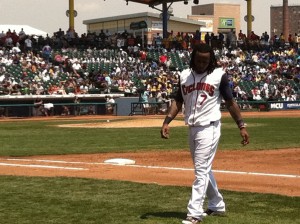 A Cyclone cameo. It was odd seeing Reyes in Cyclones togs, and odder to see him standing at shortstop with the decrepit Shore Hotel and the Wonder Wheel behind him. Odd, but great — his temporary teammates’ eyes were constantly jumping to him, to see what he would do. While he was going through his running drills in the outfield, several Lowell Spinners (their hitting coach is Rich Gedman, by the way) came over to pay their respects.
It would be easy to say the Spinners looked very much like the pop-eyed kids crowded up against the right-field fence where I was sitting in the second row. It would be evocative in a Norman Rockwell way, and you’d be able to see the scene perfectly well in your mind, and maybe drift into an idle bit of fancy about today’s kids growing up to be tomorrow’s hopeful young A-ballers.
Except that wasn’t true. The crowd I found myself an unwitting part of was more Hieronymous Bosch than Norman Rockwell, and it made me much more sympathetic toward pro athletes who are boorish or merely standoffish in public. The crowd at the fence did contain a very few kids who seemed genuinely in awe of Reyes and just wanted to be near him, but they were vastly outnumbered by nakedly mercenary fans of all ages bragging about what they’d manage to extract from Reyes and plotting how to get more — or decrying him for having the gall not to take time and enrich every member of the mob. The fact that Reyes was a Met, or an honest-to-goodness big leaguer, or the most exciting player in baseball, meant nothing — everything was about how to cadge a ball, or extract a signature, or bully the WPIX cameraman into making them feel important for 15 seconds. I’d tucked a ball in my pocket before the game, thinking that maybe I’d ask Jose to sign it as a nice surprise for Joshua, but I wound up feeling embarrassed that I’d brought it, and left it in my pocket.
But as is so often true (and thank goodness for that), the beauty of the game trumped the boorishness of the spectators. Watching Reyes out there on the field, I found myself wondering about the balance between individual preparation and the team game. Reyes couldn’t have known anything about his double-play partner Brandon Brown, or Cole Frenzel, the first baseman throwing him grounders between innings, yet he slotted in just fine with them, taking part in the age-old rituals. When Cyclones skipper Rich Donnelly came to the mound after his pitcher had yielded a long homer to a Spinner, Reyes joined the grim meeting, and I wondered what a moonlighting Met could possibly have to say in such a situation. (“You should probably forget that thing I said about our maybe being teammates one day?” “Are you related to Aaron Heilman?”)
Reyes went about his business for six innings, collecting one double off the wall (it’s hard to drive a ball out of MCU Park, too) and making one routine play in the field. The hamstring looked fine, as did the billion-watt smile and the Predator ‘do. Then he was gone, replaced by Ismael Tijerina, and once he was gone it was hard to ignore that the Cyclones were getting pounded, it was hellishly hot, and the hordes of day campers (Camp Avnet included) were putting their Thundersticks to use with terrible efficiency.
But though Reyes moved on and the Cyclones lost, it was still daytime baseball under a summer sky, which was to say it was pretty great. The Cyclones kept showing current Mets in their Brooklyn uniforms, which made me realize that these days there’s an impressive crop of matriculated Cyclones at Citi Field, or at least in the trainer’s room: Besides original Cyclone heartthrob Angel Pagan, there’s Ike Davis and Dillon Gee and Daniel Murphy and Bobby Parnell and Nick Evans and Lucas Duda, with Carlos Beltran and now Reyes on the list with asterisks.
I don’t know if the likes of Danny Muno and Richard Lucas will join them one day, but we can hope. And in the meantime, it was great fun to be there for a Jose Reyes Cyclone cameo — and even better to know that tomorrow he should be back in Citi Field, where he belongs.
by Greg Prince on 17 July 2011 7:48 pm “I’m more frustrated than anybody.”
—Jason Bay, July 17, 2011
I swear this is getting to be like George Fostermania: not George Foster, but an incredible simulation.
Except left fielder Jason Bay seems to try real hard. And left fielder George Foster was — in the traditional definition of productive as we understood it via home runs and RBI circa 1983 — actually fairly productive in his second Met season. He hit 28 home runs and drove in 90 runs that year. His Wins Above Replacement was nothing special, but I don’t recall it being mentioned on Kiner’s Korner back then, so I’m giving George a pass on that stat.
Saturday marked 162 Mets games played for Bay. He came through his virtual first full season at .250 BA/.337 OBP/.374 SLG. Bay’s WAR added up to 2.0, which as I understand it, is borderline between a bench player and a nondescript starter.
You can get Jason Bay numbers for a lot cheaper than you’re getting Jason Bay. Though to be fair, he has 19 steals in 20 attempts…and that’s not even counting all the megastar money he’s made off with since signing in December 2009.
Jason Bay played his 163rd Mets game Sunday. It didn’t enhance his value by any metric imaginable. He grounded out with two on in the first. He grounded out with a runner on in the third. He flied out with nobody on in the sixth. He walked in the eighth when everybody was else was walking (but he was the lead out on a double play that immediately followed). And he fouled out in the ninth with a runner on.
Oh, and he couldn’t catch a fly ball hit right at him, which led to a three-run inning that put the game pretty much out of reach.
 Jason Bay, reminding Mets fans of George Foster and basketball fans of the Charlotte Hornets logo. 
So it wasn’t a good “first” season or equivalent thereof for Jason Bay as a Met. And the “second” season isn’t off to a roaring start. And the Mets owe him compensation too daunting to contemplate on a Sunday night.
But he does hustle. He usually fields. Nobody’s more frustrated than he is. And you keep thinking he’s gotta start hitting and not stop.
He’s gotta, doesn’t he?
by Greg Prince on 16 July 2011 11:57 pm I feel so bad for baseballs that are launched on a trajectory toward the top of the so-called Great Wall of Flushing. In most other ballparks, they’d be destined for their ultimate reward: some grateful fan’s loving mitts and a digit of immortality — anywhere between a 1 and a 4 — on the scoreboard. At Citi Field, the baseballs headed in that general direction mostly fall short of optimization, and even when they break free of the surly bonds of stifling architecture, they look like their little tongues are hanging out from all the effort it takes to surpass that hundred-or-so-foot-high fence. I swear I can see the sweat beads forming on the horsehide as it tries its darnedest to metamorphose into a home run.
This, however, was not a problem for Scott Hairston’s mountain of a fly ball in the seventh inning Saturday. That baby, carrying the fates of two baserunners on it as it elevated, called to mind Crash Davis’s line about anything that travels that far having a damn stewardess on it…except in the case of Hairston’s homer, I’m assuming NASA assigned an entire crew to its journey.
Scott Hairston piloted this mission perfectly. His ball did not look exhausted when it arrived in the Left Field Landing — and I can report first-hand it really did land up there, hard as it is to believe that a) it’s not still going and b) a Met homer can clear that wall that decisively.
I saw it for myself, not with a telescope but from a section or two away in the very same Left Field Landing. Until Hairston decided to give a random representative of Rawlings a three-run tour of the deepest precincts of Citi Field, I don’t think I’d seen anything happily land in the Landing. Luis Castillo improbably landed a home run up there two Augusts ago, but I was asleep when he did it, so I maintain it was a dream. My handful of games up there never involved flying baseballs. Before Scott scoffed at the laws of gravity, the only thing I knew about Left Field Landing is that it’s harder to get to than Carnegie Hall.
You can practice, practice, practice, but eventually you find yourself hiking up or down some back staircase because the Left Field Landing — cut off from the rest of its tier by the fancy folks dining finely in the Acela Club — was quite possibly designed by R.E.M. You can’t, not easily anyway, get there from here.
“It’s like the Citi Field annex,” Stephanie decided after boldly leaving and attempting to return in four or five fell swoops.
Oh, there’s an escalator (literally one escalator) intended to ferry you Scottward, but when Stephanie and I confidently attempted to board it, we found it barricaded off. In the great tradition of escalators in this region of Queens, it wasn’t working. Surprisingly, somebody (literally one person) was attempting to repair it. In the meantime, we were cordially directed to several nearby flights of stairs. There’s also an elevator that will get you there — good information to have if you’ve just shared in a hearty bounty of World’s Fare for lunch — but somehow nobody cordially mentions that.
The best feature of the Left Field Landing, as attended this Saturday, is you could plainly make out the Mets’ kicking of the Phillies’ ass (and, given the recent proliferation of interlopers clad in red, that’s an entity in continual need of a few swift boots). Hairston’s home run occurred after the Mets had already constructed a sturdy six-run lead, thus making it, in the words of C.J. Cregg, the punch Ali never gave Foreman when he was going down. But we haven’t exactly been The Greatest lately and the Phillies aren’t the kind of team that takes the count easily.
So Hairston’s coup de grâce was by no means inelegant. And his two doubles, while not as high, far and handsome as that three-run homer, were by no means unappreciated (may Scott Hairston always be this healthy when Carlos Beltran is feeling not so hot). Daniel Murphy’s shot over another difficult fence to hurdle — aren’t they all? — gave us a powerful hint that today wouldn’t be close, and Nick Evans provided a sense that we might be hearing a little more Tom Petty in the days to come. Good ol’ Nick: his batting average before he tripled in the fifth was so low, I wouldn’t have blamed him had he blocked our access to it with a privacy setting.
What a good 11-2 day. Jon Niese earned his ninth win. Stephanie broke her personal five-game losing streak. Citi Field was graced by the presence of a true American hero, United States Army Staff Sergeant Leroy Petry, recipient of the Medal of Honor (plus he got to meet Jose Reyes!). And the reason the whole day felt even better than a nine-run margin would imply was because of the way it started, well before we climbed those golden stairs to the Left Field Landing.
Saturday was the day the friends and family of Dana Brand gathered on the site of Shea Stadium’s home plate marker to remember Dana together. That’s an important clarification, for nobody among us has stopped remembering him since his passing in late May. But to come together, especially on a slab of such sacred cement, was an inspired tribute dreamed up by GKR/Pitch In For A Good Cause’s Lynn Cohen. It was inspirational, too.
We spoke, we listened, we laughed, we downed a little ingeniously purchased RC Cola (official cola of your World Champion New York Mets twice) and when we were done — before ascending to the Left Field Landing, where we would eventually form our critical mass of Metsdom — we launched dozens and dozens and dozens of orange and blue balloons. It’s what the Mets used to do on Opening Day and sometimes on Closing Day at the stadium that’s now a parking lot.
Not only was it a perfect emotional sendoff for the man so many of us think of when we see the phrase Mets Fan, but I’m willing to bet one or two of those balloons lingered in Citi Field airspace just long enough to distract Ryan Howard from catching Murph’s popup in the first inning. It doesn’t show up in the box score, but I’m not betting against it having happened.
It’s unions like today’s that make me extra proud to be a Mets fan, to know so many Mets fans, to keep meeting more Mets fans, to write for Mets fans, to read what other Mets fans have to write, wherever they write it. I’m just as proud to have participated in a just-published book of remembrance called Mets Brand. It’s the brainchild of Ray Stilwell, author of the reflective and keenly clever blog Metphistopheles, and an extraordinarily empathetic soul. Despite never having met Dana, he felt a genuine connection to him through Dana’s work and wanted to do something special in his memory.
Thus, he set out to collect the many essays written throughout the Mets blogging community in the days following news of Dana’s death and, in what seemed like no time at all, he and a very generous graphic designer associate of his created a beautiful chronicle — fronted by a photo that truly captures the warmth of our subject. It is available in electronic and print formats and is filled with wonderful words from wonderful writers regarding an absolutely wonderful person who shared an interest so close to all of our hearts. I strongly recommend you make it part of your baseball library. Any proceeds generated by the sales of Mets Brand will be donated to GKR, which does great work in its own right.
Funny thing I noticed as I leafed through it on the train home Saturday evening: the preponderance of the phrase “despite the loss,” as in “what a great experience it was to go to the Mets game with Dana despite the loss.” On May 25, we all suffered a loss where Dana Brand was concerned, yet despite it, we all feel like we won something more important just by knowing him.
And at a Mets game we dedicated to his memory, the Mets won. I have to say it’s kind of nice to not have to qualify it as anything but a great experience.
by Jason Fry on 16 July 2011 2:43 am Not everything about Friday’s night trip to Citi Field was terrible. Let me make a list of things that did not, in fact, suck:
1. It was nice spending an inning on the Shea Bridge with two old friends: longtime Faith and Fear reader Charlie Hangley (who’s now a pretty fair blogger in his own right over at Mets 360) and his wife Sarah, making her first-ever visit to Citi Field.
2. The night was gorgeous — perfect temperature, next to no humidity. Then, in the late innings a full moon that was so beautiful it looked fake rose majestically behind the stadium for us to ooh and ahh over.
3. I got to enjoy three hours in the company of my lovely, wise, baseball-mad wife.
4. El Verano Taqueria is always a good thing. Plus we’ve hit upon a winning strategy: three orders of carnitas for two people. One order isn’t enough; two orders is too much. “Genius” is sometimes an underutilized term.
As for everything else, “terrible” would actually be an understatement — it was a total suckfest. The Mets couldn’t field, betraying R.A. Dickey on two double-play balls that led to five runs. The Mets couldn’t hit, particularly with runners on base. Ryota Igarashi couldn’t pitch, which isn’t news — when he went 2-0 on John Mayberry Jr. I groused to Emily that “here comes the meatball,” then was out of my seat and stalking off before Mayberry arrived at second base. (Figures Igarashi was the Japanese hurler who got an extra year for his Omarpalooza gift, while the actually useful Hisanori Takahashi decamped for Anahaim.) The end result? We’re one bad weekend from being more than 10 out in the wild-card hunt, which essentially means a Do Not Resuscitate order for our playoff hopes.
A loss wasn’t a great way to start the second half, but not all losses are created equal. This one alternated being boring and being annoying, with most of the offense a side effect of inept defense. Only Angel Pagan’s catch of Ryan Howard’s deep drive and Carlos Beltran’s uncatchable homer were plays you’d conceivably want to see again, let alone things that could lead you to wax rhapsodic about baseball’s majesty. For the first couple of innings I was happy because there was baseball again and I got to see it up close. For the next few innings I was bored. Then I was pissed. And then I went home.
Sigh. Did I mention the moon?
|
|