The blog for Mets fans
who like to read
ABOUT US

Faith and Fear in Flushing made its debut on Feb. 16, 2005, the brainchild of two longtime friends and lifelong Met fans.
Greg Prince discovered the Mets when he was 6, during the magical summer of 1969. He is a Long Island-based writer, editor and communications consultant. Contact him here.
Jason Fry is a Brooklyn writer whose first memories include his mom leaping up and down cheering for Rusty Staub. Check out his other writing here.
Got something to say? Leave a comment, or email us at faithandfear@gmail.com. (Sorry, but we have no interest in ads, sponsored content or guest posts.)
Need our RSS feed? It's here.
Visit our Facebook page, or drop by the personal pages for Greg and Jason.
Or follow us on Twitter: Here's Greg, and here's Jason.
|
by Jason Fry on 28 May 2010 11:34 pm Ryota Igarashi is a hell of a nice guy: It was his birthday, but he gave Corey Hart a gift — a splitter that hung in the middle of the plate, and which the equally generous Hart promptly regifted, delivering it to the Brewer relievers in the distant bullpen as a game-winner.
Ah well, 35 goose eggs ain’t bad. But 36 would have seemed a lot nicer — particularly if the Mets had managed a bit more on the other side of the ledger.
Yes, the duel between Johan Santana and Yovani Gallardo was pretty great: Both pitchers were able to thread needles, and had the hitters and Ron Darling guessing all night. As the Mets’ scoreless streak kept rolling along, 1969 was a recurring topic of conversation for Gary and Ron (probably best that Keith wasn’t present to comment on the high-kicking Brewer cheerleaders), and this game seemed borrowed from that long-ago year, with two starters zipping through the opposition and looking singularly disinclined to leave the moundwork to someone else.
In fact, 41 years ago tonight Clay Kirby put up nine scoreless innings for the Padres, only to see Jerry Koosman put up 10 in a 1-0 Mets win. Though given the final score, perhaps it’s more fitting to link to this heartbreaker from later in that Magic Summer, one that saw Gary Gentry edged by Ron Reed. I’ll grudgingly tip my cap to the fact that Gallardo got the kind of just reward stalwart starters often deserve and rarely receive: Typically the victory comes with the starter sitting in the dugout looking exhausted with an arm wrapped while some dingbat reliever stumbles into a W.
The wonderful duel at least dulled the pain of that third inning: Bases loaded, nobody out, and the resurrected Jose Reyes at the plate. Bang! One hop to second, Rod Barajas an easy out at home, then Alex Cora grounding into a double play. Or the pain of the ninth, which saw Angel Pagan justifiably furious at being called out on a pitch that crossed the plate at mid-shin. Or the pain of the eighth, with Santana nearly hitting one out (the man was everywhere) but being left on second by Reyes. Or the pain of going from figuring the Mets would find a way to win to feeling a tickle of dread that they wouldn’t. Or the pain of 58,000 more fricking Derek Jeter’s Got An EDGE! commercials. Or if you want literal pain, there was Jason Bay tracking George Kottaras’ drive to left against the backdrop of Kottaras’ own face, as if Bay were going to run into his mouth, and then smacking the plexiglass so hard that the LEDs blinked behind his back. Bay — who’s been nothing short of excellent in left field despite all our doubts — looked more than a little dazed, and who could blame him?
Then there’s the headache of fretting about the Mets’ vanishing act once they put on road grays. The old saw is if you play winning ball at home and .500 on the road you’ll go to the playoffs, but that bit of wisdom comes with a corollary that rarely needs uttering: If you somehow play .285 ball on the road, even a .679 winning percentage at home won’t get you far enough.
Chalk it up, for now, as one more mystery about a thoroughly mystifying baseball team.
by Jason Fry on 28 May 2010 4:19 pm Apparently our favorite sports-radio hyena ripped Matthew Cerrone today for something he wrote about Mike Pelfrey. Francesa lobbed some personal attacks Cerrone’s way and then asked, “Who reads blogs anyway?”
What amuses me more than Francesa’s after-the-asteroid roaring is that is I found out about it on Metsblog. Which might surprise him, but not me. It’s been years since I listened to WFAN outside of Mets hours. Why on earth would I? I get more-timely news from blogs. I get better analysis from blogs. I get better fan comments and reactions from blogs. In fact, except when Mike Francesa says something amazingly stupid and/or reactionary, these days I barely remember he exists.
Who listens to sports radio anyway?
by Greg Prince on 28 May 2010 2:55 am It was a canyon of zeroes along the top line of the Citi Field scoreboard these past three nights. Read ’em, per sweep:
000 000 000
000 000 000
000 000 000
That’s what your defending National League champion Phillies left behind, thank you very much. More to the point, that’s what your homestanding New York Mets gave them.
Twenty-seven goose eggs — the perfect gift for the team that has everything. Or maybe used to.
The Phillies have been an outsized nightmare almost every day of our existence since late August of 2007. Prior to this week, we had actually beaten them some seemingly important games, including 11 of 18 in 2008 when we worked all year to put the year before it behind us. Those wins no doubt served their temporary purpose, yet it was the losses to Philadelphia that defined our relationship to our newest blood rivals. Obviously the four defeats at Citizens Bank Park that presaged The Collapse of ’07 and the three at Shea Stadium that kicked it off in earnest stand out most glaringly, but the single Mets-Phillies encounter that I think probably hurt us most in terms of timing and tonesetting was the Friday night in September 2008 that ended, just as Thursday night at Citi Field did, with a score of 3-0.
That night was about as unspecial as it got. And it shouldn’t have been. That night should have crackled with tension. We held a three-game lead over the Phillies with 22 remaining. We had Mike Pelfrey going for us against Brett Myers. It was our first game at home after a 6-2 road trip that took us through Philly (1-1), Miami (2-1) and Milwaukee (3-0). Shea should have been crackling or roaring or something. Instead, it was flat, just like the Mets. The Phillies scratched out a first-inning run (single, steal, errant throw, groundout), allowing Myers to nurse a 1-0 lead through six. In the seventh, Pelfrey, who had stymied the Phillies after that first run, gave up a two-out, two-run fence-scraper to Greg Dobbs.
And that was the game, 3-0. The Mets stirred in the ninth — a Wright double, a Delgado single — but Brad Lidge retired Carlos Beltran and Ryan Church on fly balls that landed in gloves and the Phillies were winners. It was a tight game, and the Mets were still in first, but the ultimate outcome of that season felt predestined. Over the last 22 games of 2008, the Mets went 10-12, the Phillies 16-6.
Like I said, the Phillies were winners. In any one game and, for that matter, any one division (Wild Card considerations notwithstanding), there can only be one winner, which left the Mets to be something else that year…same as the year before…same as the year after.
Now it’s a different year. It would be a bit hasty, unconscionably premature and overwhelmingly presumptuous to declare in the giddy aftermath of what Gary Cohen instantly dubbed The Goose Egg Sweep that it is a different era altogether, that it is the Mets’ time to be winners and the Phillies’ time to be something else. We shall see what the balance of 2010 holds in store for us, for them and, within the realm of an N.L. East in which all teams are presently all right, for the rest of the division.
But I gotta tell ya: The Phillies didn’t look champs of anything in this series. By the ninth inning of its third game, their dugout was filled by haunted faces, as if each of them had just come back from the morgue to identify each other. They looked dead and they knew it. Even for a Mets-Phillies game that felt more like September than that Mets-Phillies September game from two years ago, we must remind ourselves it’s only May, and that a three-time divisional champ that holds a 1½-game lead with four-plus months to go isn’t exactly what you’d call down for the count.
Yet the Mets…they look pretty good. They may not have looked this good since another September 2008 affair, that bittersweet final win at Shea over the Marlins authored almost solely by Johan Santana. This wasn’t exactly that, but this was, for late May, incredibly special, maybe beautiful. It was also a dandy group effort.
Mike Pelfrey was obviously the instigator, a pitcher so matured that he seems to be a different person from even his alleged breakout year of 2008. On radio and TV, it was noted the change in the rule that dictates when, where and how a pitcher can go to his mouth — which sounds vaguely pornographic — might have something to do with his relaxation and the results that have followed. If that’s the case, then get Big Pelf a bucket of KFC, because he was finger-lickin’ good Thursday night. Not spotless (not with five walks), but totally poised. Like Myers two Septembers ago, Pelf was staked to a 1-0 lead in the first and wasn’t bolstered further until the seventh.
Didn’t matter to the Phillies’ starter on September 5, 2008, and it didn’t much matter to Pelfrey on May 27, 2010. He put a runner on in every inning from the second to the sixth, and it was almost of no consequence. Maybe it wasn’t predestined, but Pelf threw five ground balls to end those five innings, the middle three of them for double plays. That’s using your noggin and your fielders, something I never believed Mike Pelfrey could do on a consistent basis. That’s also the group effort at its dandiest.
5-4-3. 4-6-3. 1-6-3. Three innings. Six outs. Everybody where they were supposed to be, everybody playing a part. The pitches were made. The throws, like Henry Blanco’s to nail Raul Ibañez, were made. The catches, like Angel Pagan’s perfectly timed dive and grab off Carlos Ruiz, were made. The adjustments, like Pagan sliding feet-first at second to steal successfully two innings after his head-first slide led him to an out, were made. Little things that impressed the hell out of me happened: such as Jeff Francoeur playing Shane Victorino’s sinking liner perfectly so Wilson Valdez couldn’t score from second in the second; such as Francoeur questioning Andy Fletcher’s strike three call in the bottom of the eighth, but knowing when to quit questioning so he would be able to go out to right for the top of the ninth and be the right man in the right place to track down a deep line drive from Chase Utley; such as Fernando Tatis running every step of the way to first so that Placido Polanco’s bobble would not go for naught. One batter later, Jose Reyes was doubling him and Blanco home. Reyes himself had been doubled home in the first by Jason Bay and spent most of the evening along some segment of the basepaths.
Even the one thing that I thought was going to blow up this beautiful game, Jerry Manuel’s ritualistic removal of Pedro Feliciano in favor of the paycheck of Frankie Rodriguez in the ninth — even though the first two Phillies due up were who Feliciano lives for getting out — didn’t go against us. At the end of the evening, with Utley, then Howard, then Werth going down, it was comforting to be reminded that Frankie, his touch of Benitez notwithstanding, is actually a pretty effective closer.
It wouldn’t be fair to say the Phillies were no problem to the Mets for the last three nights. It would be more accurate to say they were a challenge the Mets accepted and handled with aplomb. The Mets were breathtaking in their efficiency, actually. The Mets just played 27 innings, scored 16 runs, allowed none and committed no errors. They didn’t exactly kick the Phillies’ ass; it’s more like they tidily swept it to the curb.
That works well, too.
After the Yankee series, I had a grand time referring to us as the Kings of New York. After the first win of this series, I was dying to declare us the Kings of the Northeast. Now that it’s five in a row over two defending league champs, I don’t think I’ll do that. That’s the stuff you do in May when you have nothing else to look forward to. I look forward to Milwaukee. I look forward to the Mets.
***
Somebody please get Gary Cohen a Met no-hitter to call. All that was at stake tonight, besides the bottom-line result, was a third consecutive shutout. Of course it’s significant and symbolic and, with the tidbit that the Mets hadn’t done it in the same series (against the Phillies, no less) since 1969, historic, but all that truly mattered was a win. Didn’t matter if it was 3-0 or 3-1 or 3-2. Yet Gary amped me up exponentially for that 27th zero, investing it with the kind of reverence Vin Scully lent Sandy Koufax’s 1965 perfect game — right up to including the time of night that the Goose Egg Sweep went final. At seven minutes to midnight, Gary tingled my spine every bit as much as K-Rod’s strikeout of Werth did.
SNY offered wonderful production all night (save for not being able to show us Jose’s two-RBI double landing fair), but geez, I wish they would stop doing things just because they can. The tosses to Chris Carlin are brutal. Chris Carlin is brutal. The only upside of a Met loss is the unlikelihood that I’ll stay riveted to the postgame show that he hosts and infects with his relentlessly sour disposition. But he’s not the worst part of the SNY ephemera. The worst is when they direct our attention away from the game and to Kevin Burkhardt at the wrong time of night. Kevin is a fine reporter and a generally welcome presence in these telecasts (his early-inning tour of the realigned bullpens represented value-added substance), but I wish they’d deploy him more judiciously. I as a viewer do not need to see and hear him interviewing the departed starting pitcher while the game is still in progress — not if the game is still very much up for grabs. I can wait until the postgame show to hear Mike Pelfrey’s aw-shucksiness. The more interviews they have during the postgame show, the less Chris Carlin there is. But with Feliciano pitching to Wilson Valdez and Ben Francisco in the eighth, I want Gary and his analyst buddies commenting on the action. I don’t need gee-whiz drop-ins. I don’t need SNY to prove it can get an interview with a player during a game. The novelty of that feature is long worn-off.
Why throw it to Kevin Burkhardt at that moment? I couldn’t say for sure, but I noticed his spot is sponsored as a “Business of Baseball” segment. Yes, I guess the business of baseball is to intrude on the live action with bells and whistles so long as somebody’s paying for it.
Dear SNY: Less business, more sports, particularly when the sports you’re telecasting are this exhilarating. No need for you to step on your own storylines. Thanks.
by Greg Prince on 27 May 2010 8:44 pm  Set your DVRs or just get yourself glued to SNY Friday night at 7:00 for the debut of Mets Yearbook: 1988, the latest installment of the best series on television and the latest one we’ll see in chronological terms. Get ready to revisit the powerhouse Mets who were going to reign for years to come: the 1986 stalwarts plus David Cone, Gregg Jefferies, Dave Magadan, Randy Myers and Kevin McReynolds all in full bloom. I watched this highlight film on VHS about twenty years ago (rented it from a Palmer Video) and by the early ’90s it was already making me nostalgic for the dynasty that never was. Set your DVRs or just get yourself glued to SNY Friday night at 7:00 for the debut of Mets Yearbook: 1988, the latest installment of the best series on television and the latest one we’ll see in chronological terms. Get ready to revisit the powerhouse Mets who were going to reign for years to come: the 1986 stalwarts plus David Cone, Gregg Jefferies, Dave Magadan, Randy Myers and Kevin McReynolds all in full bloom. I watched this highlight film on VHS about twenty years ago (rented it from a Palmer Video) and by the early ’90s it was already making me nostalgic for the dynasty that never was.
Recently, Bronx Banter ran an eerie series on how the Mets could have been a juggernaut for all time across the ’70s and then some. It was fanciful, but not totally, given that it was based on things the Mets could have done, like draft Reggie Jackson, and didn’t have to do, like not trade Amos Otis and Nolan Ryan. (Read it in three parts here, here and here.) The other night I was watching yet another airing of the 1988 division clincher, and I gotta tell ya, there was nothing fanciful about the concept of a Met dynasty. We were about to wrap up the East, the Dodgers would be easy pickings and then the foreseeable future would fall at our feet. How could it not? Strawberry, Gooden, Darling, McDowell, HoJo, Dykstra, Mookie plus all those aforementioned young fellows. Yes, it was going to be great.
Now that you’re all uplifted, make a note to watch Mets Yearbook: 1988 anyway. And don’t forget ALL TEN episodes, spanning 1963 through 1988, will run on SNY on Memorial Day, beginning at 4:30 PM. If you don’t have a DVR, buy one now.
Image courtesy of “Mario Mendoza…HOF lock” at Baseball-Fever.
by Greg Prince on 27 May 2010 2:46 pm 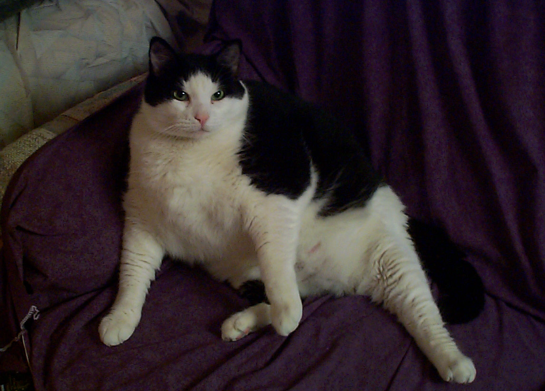
Today is five years since Bernie the Cat was last with us. Right about now, if he were still stationed on the couch, this would be the look from him. It would be easily translated as, “You got me up for this? For four consecutive wins? For Dickey and Takahashi? Wake me when we’re at least in the lead for the Wild Card. And put out some Fancy Feast for when I wake up for real. Never mind. I’ll have some now.”
Typical Bernie, never too high, never too low. But he was always as good as he looked when we were winning and looked better than anything when we weren’t. Bernie was good all over, regardless of the Mets’ performance in a given week or season. He was even good about all those naps of his I interrupted for Mike Piazza home runs, Rey Ordoñez catches and Al Leiter strikeouts. He came along when Doc Gooden was still the ace of the staff and hung in to the early days of Pedro Martinez. Bernie saw the Mets finish last and Bernie saw the Mets finish the World Series. Bernie saw plenty. He saw plenty, he ate plenty and he napped plenty.
Bernie, more than any soul I’ve ever known, had it goin’ on.
Today is five years since Bernie. This, my friends, is what a first-ballot Hall of Famer looks like.
by Jason Fry on 27 May 2010 9:59 am So perhaps I’ve been unfair, and the Mets had a Plan B for their starting pitching all along: “If, somehow, John Maine’s chronic injuries don’t disappear and Oliver Perez doesn’t stop pitching like Oliver Perez, we’ll just substitute a knuckleballer who’s a dead ringer for the Cowardly Lion and a 35-year-old who had a good but not great career in Japan. OK, we’re done here — wait, Beltran did WHAT?”
At least for 48 hours, Plan B has gone swimmingly.
I first really appreciated Hisanori Takahashi watching him battle Javier Vazquez to a standstill: He’s a done-with-mirrors location/finesse type, which doesn’t give you enormous hope for the future — every discussion of those guys begins with Greg Maddux with a local detour to Rick Reed, but ignores how few of those guys get Greg Maddux/Rick Reed results. Still, guys in that mode are enormous fun to watch when they’re on and showing you how pitching is supposed to be done — changing speeds here, putting the ball there, and either being one step ahead of the guy with the stick or having been so consistent about being one step ahead of the guy with the stick that he guesses what’s coming but still can’t hit it solidly. I wonder how long that double hesitation in Takahashi’s delivery — the tiny pause at the top of the windup and the freeze frame with one leg high — will keep scrambling hitters’ timing, but even when it becomes familiar he’ll know what he’s doing out there. I wonder if Oliver Perez has ever been able to say that.
Unintentional bringdown note from ESPN New York’s Adam Rubin: “Takahashi became the first Mets pitcher since Grover Powell in 1963 to allow no runs in either of his first two major league starts.” Who was Grover Powell? Not someone whose career path Takahashi would be advised to emulate. Powell was a Penn econ major who got thrown off the baseball team, agreed to sign with the Mets for $8,000, saw his bonus cut to $2,500 and signed anyway. (Wonder if they covered that at Wharton.) He was called up in 1963, beat the Phillies in his first start (wearing No. 41) and had logged four scoreless innings in his second when Donn Clendenon smashed a line drive off his cheek. He retired shy of 50 innings pitched and that first win was his last. In 1985 Powell drove to the hospital after his son was in a near-fatal crash, wound up seeing a doctor himself, was diagnosed with leukemia and died the same year. His tombstone bears an image of his baseball card — the only one he ever had.
But for now, let’s not worry about what might befall Hisanori Takahashi in 2032. In fact, let’s not worry at all. I’ve done plenty of that about the 2010 Mets, just as I’ve done a bit of pinching myself and thinking they’ll turn out just fine despite their various flaws. Either way, every time I find that I’m a lagging indicator: The Mets have either looked unbeatable or hapless, which is one way to be average but puts a lot more mileage on stressed-out fans than repeatedly winning one and losing one. Is the current run of good starting pitching a fluke, or guys who figured out how to pitch getting a chance to prove it? Are the statistical cylinders lining up favorably at the moment, or has Jason Bay relaxed and Jose Reyes returned and Angel Pagan matured — which might give David Wright the peace of mind to ease up on himself? Have the Mets caught the Phils and Yanks in a lull, or found a formula that should work for a while? Who knows. Tell me when to tune in and I’ll hope for the best.
And maybe I’ll even see some of it. Last night I put Joshua to bed with my eyelids already trying to stay above half-mast and trudged upstairs to the couch. I fell in and out of dozing, but sat bolt upright when I saw it was the sixth and the Phils had runners on first and third with one out and Ryan Howard at the plate. Takahashi sliced away at the strike zone and erased Howard on an evil low-and-away changeup. I sank back into the couch, but struggled up to one elbow as Jayson Werth and his ridiculous facial hair arrived. Werth promptly hit Takahashi’s first pitch to the moon, but he was too early, so more accurate to say his drive went harmlessly left of the moon. Takahashi, chastened, went back to work, got Werth to hit a harmless fly to Jeff Francoeur, and I let my eyes close. It was only 2-0, but something told me it would be OK, and it was.
by Greg Prince on 26 May 2010 1:14 am When the Mets score eight to win by eight and give me my personal-record eighth victory in a row, you know what that means?
I don’t know. But it sure feels good. I’ll take serene eights over the crazy kind any day.
When last we saw the Phillies in New York, they were no help whatsoever, ich bin eining us against each other en route to shoving us into yet another November of discontent. And the last time we saw them in our neck of the woods, we were subject to those saddest of possible words: Bruntlett to Bruntlett to Bruntlett.
Feh on 2009. Everything sucked then. Everything’s great now. Great may sound like an overstatement for a team that just reached .500 for the first time in ten games, but I’m going with the feel, and there’s a feel in the air that it’s fun to be a Mets fan until it isn’t. That moment could come any second, so let’s just let it be.
Hey, has it really been only ten games since we owned as many wins as losses? Is that all? Seems like we were buried about a hundred below and a thousand out as recently as the last road trip, but you inject an R.A. Dickey into your life, everything looks better. The whole year looks better. Goodness knows the rotation has a certain spin only an effective knuckleballer can put on it.
This is no average knuckleballer, this R.A. Dickey. This guy is fearless. We know he’s ligamentless. We know he doesn’t mind sacrificing a non-pitching elbow as necessary, per Ryan Howard’s hot liner that never saw the outfield. That may be the best sacrifice executed under the auspices of Jerry Manuel since Spring Training.
Do we have problems? No, not tonight, not after a rousing 8-0 win when the weather was perfect, the Blue Point Toasted Lager was sublime and my wife made another unlikely Tuesday appearance at Citi Field (we were there along with dozens of her colleagues…best workplace outing ever). There were Phillies fans in attendance, but the Fightin’ was sapped out of them early and nobody sitting anywhere near us in red could even work up a good vomit.
And how about that Raul Valdes? Not to jump around, but that guy is to relieving what R.A. Dickey is to starting, which is to say excellent. Wayne Hagin mentioned something about 16 starts between John Maine and Oliver Perez and one win registered by the two of them. Well, nine innings Tuesday night between R.A. Dickey and Raul Valdes and the Phillies still haven’t scored. And I still haven’t lost, as a spectator, since the grim late afternoon reaping of Willie Harris. That seems longer than 6½ weeks ago.
Eight in a row. I’ve never been in on eight wins in a row in my life, a life which now spans 461 games and two home ballparks. I’ve gotten comfy at Citi Field. Maybe it’s the Blue Point Toasted Lager, available only from the Catch of the Day stand (all Met dingers, not that we seem to generate them all that often, need henceforth be known as Blue Point Blasts). Maybe it’s that Stephanie, who likes a good walk the way Oliver Perez can create a bad one, has room to roam. “You want me to get you that Blue Point?” she asked as she and one of her social worker friends got up to amble a middle inning away.
Why yes, I would like that very much.
Sure enough, my wife came back with the beer (a phrase I’ve never written, said or thought in my generally temperate life), I flagged down a pretzel vendor and the rest was a Met run here, a Met run there, the Phillies and their unwelcome battalion of would-be vomiters left scoreless and silent. Let ’em choke on our eight runs, our thirteen hits, our delicious Long Island microbrew and our pitchers nobody was counting on when the season began. Let the Mets continue to peck away in Build-A-Run Workshop fashion at opposing pitchers whose careers began when Reagan was president, the first Cuomo was governor, Koch was mayor and our first baseman wasn’t quite yet an embryo. Let Darryl Strawberry, who always hustled and never dogged it (ahem), preach the Strawberry Way anytime, anywhere, to any current Met he likes. Let Frankie Rodriguez remind Randy Niemann which ’86 Met did the least and celebrated the most. Let John Maine deny his pitching arm is a problem except when he tries to pitch.
The Mets have just taken three straight from last year’s World Series. The Mets have just given me eight consecutive in-person wins. The Mets have Blue Point Toasted Lager. The Mets have R.A. Dickey. The Mets have Raul Valdes. The Mets have it goin’ on at least until the next torrent of sniping, aching and whatever usually goes wrong with them.
Let it be.
by Jason Fry on 25 May 2010 10:51 am NPR’s Mike Pesca brought me into the studio to discuss my post about my neighbor and his brother’s baseball cards, and did a nice job crafting it into a story for “All Things Considered.” Have a listen here, and feel free to make fun of my (subconscious) attempt at the NPR voice.
by Greg Prince on 24 May 2010 11:45 am I’d like to be not such a hardass toward my team. I’d like to not be so realistic about the tendencies of its individual components. I’d like to like the players I like without not being able to stand them when their performances unequivocally merit disdain.
I’d have liked to have been a more steadfast supporter of Jose Lima while he was a Met. I really liked Lima, right up to the minute he began pitching for us. I wanted him to succeed as a Met. He most surely didn’t in the conventional sense. I was relatively slow to — as was said far too often in the past decade — throw him under the bus, but eventually an ERA of almost 10 after four starts will have even the most sympathetic supporter calling the pitcher who posts it a cab out of town.
Jose Lima, No. 17 as a Met, was a Met for 17 days and pitched 17.1 innings. Yet it seems like he was around a lot longer and did a lot more. He left an impression. The impression is not instantly flattering, not with 9.87 earned runs allowed per 9 innings pitched.
Lima’s Met time was three turns through the rotation in the middle of May 2006 and one more try in early July. He wasn’t part of the plan. The ’06 Mets were, despite their yearlong pacesetting in the National League, often short of starters. Injuries impinged on their depth beginning in late April when Brian Bannister’s right hamstring gave out on the basepaths in San Francisco. Young John Maine was Bannister’s replacement, but his right middle finger (one he’s probably used a lot lately) gave him trouble after only one start, and he was disabled. Next came and went Victor Zambrano, who felt severe pain in his right elbow while pitching against the Braves. He grimaced, bore down, struck out Andruw Jones for the first out of the top of the second inning and then left the Shea mound never to return.
The Mets rose through the standings even as their starting pitchers dropped like flies. Lots of offense and lots of relief catapulted the team to a 21-9 record and a 5-game lead over the second-place Phillies in the N.L. East by the first weekend in May — this despite their rotation having become Pedro Martinez, T#m Gl@v!ne, Steve Trachsel and a pair of recurring TBAs.
Into this paradoxical breach stepped Jose Lima.
When Jose Lima appeared in Port St. Lucie that February, those who knew better rolled their eyes all over the Internet. The Mets were casting about for any and all arms available. They came up with one that threw very little that worked in 2005 when he was a Royal (Wins Above Replacement rating: -2.1). Now he was 33 and his sole appeal seemed to be that he had been around and had been successful not all that long ago. Scoffing could be heard all across cyberspace. What a retrograde signing! This is the kind of philosophy that ruins baseball! “Experience” is a crutch!
That’s what it sounded like to me, anyway. I wasn’t much counting on seeing Jose Lima as a Met, and if we did, I was confused as to why it would automatically be a bad thing. Wasn’t this guy a winner as recently as 2004? He was. He went 13-5 for the Dodgers. He threw a shutout in the NLDS against the Cardinals. It wasn’t that long ago, was it?
Unlike many shadowy longshot pitching candidates in a given Spring Training, I actually knew who Jose Lima was, or at least who Jose Lima had been. He was an unabashed cut-up in a sport generally shy of confirmed extroverts. Pedro Martinez was one of those types. Martinez was giddy when he learned Lima was coming to the Mets. “This is going to be one crazy clubhouse,” he said. Quite an endorsement.
It wasn’t the most hilarious thing in the world, nor was it intended to be, that he came to camp and casually mentioned he planned to wear No. 42, his number when he was winning 21 games for the Astros in 1999, the one Houston assigned him in 1997, just before it was otherwise removed from circulation to honor Jackie Robinson. Lima did not maintain 42 as he moved on to other teams, so he was no longer “grandfathered” in the way Mo Vaughn was when he came to the Mets in 2002. Thus, Jose Lima wasn’t going to come to the Mets and get Jackie Robinson’s number (in fact, they tried to give him 99). Lima didn’t make a huge deal of it when his request was denied, but I liked his obliviousness to the sacred. It might have seemed self-absorbed coming from another player, but it felt human from Jose Lima.
Jose the human went down to Norfolk after Spring Training, his veteran right arm hidden from harm’s way until Bannister and Maine and Zambrano all fell onto the DL. Then it was Lima Time, May 7, 2006, his first start as a Met, at Shea, against the Braves.
And he was really bad. Let’s not pretend he wasn’t. He was terrible. The Braves hit him hard. Five days later, the Brewers hit him hard. Six days after that, the Cardinals did the same thing. Designation for assignment followed shortly thereafter; nobody else signed him, so he returned to Norfolk. After another month or so in the minors, a series of unfortunate Met events — Alay Soler’s flameout, Heath Bell’s implosion, Pedro Martinez’s inflamed right hip — conspired to give him one more chance in Met colors and then as a Met starter.
The Marlins hit him hard. Dontrelle Willis reached him for a grand slam in the top of a six-run Florida fourth. Willie Randolph, probably still shocked that the opposing pitcher homered with the bases loaded, left Lima in to face one more batter, Alfredo Amezaga. Amezaga singled. Randolph then removed him. It was Jose Lima’s last batter faced as a major leaguer.
To recap, this is how Jose Lima’s 2006 with the Mets unfolded:
First Start — Pitched in 5 innings, surrendered at least 1 run in 4 of those innings.
Second Start — Pitched in 5 innings, surrendered at least 1 run in 2 of those innings.
Third Start — Pitched in 5 innings, surrendered at least 1 run in 3 of those innings.
Fourth Start — Pitched in 4 innings, surrendered at least 1 run in 2 of those innings.
Jose Lima participated in 19 innings and gave up runs in 11 of them. Everybody who said he wouldn’t be any good was right (Wins Above Replacement rating: -1.2). I who thought he was worth taking a flyer on was wrong. As if to compensate for my lack of cynicism in advance of his Met tenure, I raced to join the chorus of voices demanding his immediate dismissal from Shea Stadium, from Flushing, from Queens, from our midst forever.
This was me on July 5, 2006, before his fourth and final start as a Met:
I would have been content to have never been party to the return of Lima Time, but I’ll admit I’m rooting for the guy to have one solid outing and not just because a guy in a Met uniform having a solid outing benefits us all. Both in spring training and during his last stay, Lima was a unifying force in the clubhouse. Everybody seemed to like him in a big way. Yeah, they said the same thing about Gerald Williams, but ya know what? This seems like a good time for a unifying force. For a team with a double-digit lead, its players have betrayed a touch of crabbiness. And who can blame them, with their record having loitered at convenience store level (7-11) since The Road Trip ended? If Lima can keep ’em loose for a few days, maybe that’s a contribution. […] Maybe Lima — who is motivated enough to keep pitching at AAA after his Major League embarrassment in May, so he must have some pride in avenging his prior performance — hangs through Sunday and we see one of the other Tides roll in after the break. After being certain the deployment of Jose Valentin was complete folly, I’m not going to kneejerk any veteran player move Omar makes, certainly not one that isn’t likely to amount to a hill of beans in the long run.
This was me on July 8, 2006, after his fourth and final start as a Met:
Lima Culpa. He’s worthless. Get him out of here. I don’t just mean DFA’d, which he’s been. Jose Lima can be of no help whatsoever as a pitcher in this organization. That spicy meatball he threw Dontrelle Willis with the bases loaded? I can’t believe he hit the whole thing. Nice fella, Lima, but let him loosen another team’s dugout. Good night, funny man.
With Jose Lima having just died of a heart attack at the ridiculously young age of 37, I feel bad that’s the last substantive appraisal I ever wrote about what he contributed to the Mets. I was trying to be a hardass toward my team. I was maybe the last Lima believer in 2006, had been burned for my faith and now I was going to make up for it with a little vitriol. Not that Jose Lima was likely to read what one blogger among a hundred had written — and not that Lima Time wasn’t up as a practical matter — but I kind of hate that I succumbed to the prevailing thought process of the day. Guy pitches bad? Condemn him. Shove him out the door. Forget why you had taken a liking to him in the first place, why just three days ago you were rooting for him and now you couldn’t tolerate his presence.
Yet it was his presence that drew me tentatively into Jose Lima’s corner during his brief Met stay. He didn’t have much of a right arm by that May, but he had an undeniable presence. It energized a clubhouse that was already revved for great things in 2006. “Lima Time” was already legendary as a most uncommon strain of charisma around baseball. No self-consciousness, no restraint in letting joy seep from his every step. Now it would be our Time on our team. It’s no coincidence that twice — once in February and once in May — the Times used the phrase “no laughing matter” in headlines over stories about Jose Lima. Jose Lima was synonymous with laughter. It may not have been enough to get batters out anymore, but it was a precious commodity in a sport where too many modern players put on game faces and mouth inoffensive platitudes when asked anything interesting.
Two images of Jose Lima stay with me from 2006, and neither of them involves his trudging off the mound in despair.
The first was from his first start, against the Braves, in a series finale. The Mets had won two thrillers in the first two games — a 14-inning, 8-7 triumph that twisted and turned until turning out all right after nearly five hours; and the truncated Zambrano start, which required the services of six relievers to finish successfully the last 7.2 innings of a 6-5 decision. With Atlanta reeling 9 games behind us in third place, anything we got from Lima would be gravy, but when you’re in the process of obliterating your archrivals’ dynasty, gravy can be awfully tasty.
As mentioned, we didn’t get more than a spoonful of gravy from Jose Lima that Sunday afternoon. Mostly we got screwed by Angel Hernandez and then Lima was pounded by Atlanta bats. Still, even all that took a bit of a back seat to what I witnessed before the game started.
On his way in from the Met bullpen, a fan seated along the railing on the first base side reached out to Jose Lima. The fan was wearing a Dodger jersey, No. 27. Jose saw that and reached right back out to the fan and hugged him.
The starting pitcher hugged a fan? On the day he was going to pitch? Minutes before he was about to pitch? They can do that?
Seriously, I had taken it as gospel that the starting pitcher never speaks to anyone when it’s His Day. His Day is sacred. He doesn’t talk to you and you don’t talk to Him. But that’s not how Jose Lima played it. Jose Lima was happy to be a major league pitcher again that Sunday. Why hide it?
The second image I maintain of Lima was from TV, from, as it happens, the Subway Series. It was Friday night at Shea against the Yankees, the game in which yet another transient 2006 starter, the late Geremi Gonzalez, was roughed up for four runs in the first inning, and we were presumed done from there. Yet facing Randy Johnson in the bottom of the first, the Mets roared right back, with Reyes walking, Lo Duca singling and Beltran homering. That made a game of it, a Grade A Subway Series contest, the kind of game that makes you forget Interleague play is a marketing contrivance that baseball did fine without for a century or so.
That game goes back and forth and then locks in at a 6-6 tie after five. It stays there until the bottom of the ninth when Mariano Rivera is deployed by Joe Torre to keep things tied. It does quite work out that way. A Lo Duca double, an intentional walk to Delgado and then, at last, a very long fly ball hit by David Wright over Johnny Damon’s head.
Mets 7 Yankees 6!
Exultation!
Ebullience!
And…Lima Time?
Yes, Lima Time! Leading the charge out of the Met dugout to congratulate Mr. Wright, to celebrate the Met victory, to revel in his teammates’ success was Jose Lima. Lima didn’t pitch that night. Lima hadn’t been a Met two weeks earlier. The day before, he was knocked around in St. Louis. The day after, he would be cut from the roster because St. Louis wasn’t an isolated incident. Yet Jose Lima was as much a Met as anybody that night when they came back on the Yankees. He wasn’t a mercenary. He wasn’t lost in his own drama. He was the absolute definition of a ballplayer who was just happy to be here.
You couldn’t not be happy if you noticed him that night.
Jose Lima’s immediate Met legacy coming out of his four 2006 starts was to be invoked every time we thought Omar Minaya was signing someone unnecessary, particularly starting pitchers who couldn’t go more than five innings or give up fewer than five runs. “Another Jose Lima,” we’d grumble. He’d become a brand name to us, and not the leading national brand, either. Meanwhile, as Lima’s New York teammates were marching to a division title, Jose returned to Norfolk and kept pitching. After 2006, he would pitch in Mexico, in Korea, in a pair of independent leagues in the United States. Last winter, he pitched for a team in his native Dominican Republic. He planned to do it again this winter. He showed over and over that it would be difficult for anyone to again find another Jose Lima.
Jose Lima loved baseball and was never shy about sharing the romance with the rest of us. It may not obliterate a 9.87 ERA or save you a spot in anybody’s rotation, but surely any time spent appreciating a person like Jose Lima was time well spent.
Check out what Lima’s former teammates on the current Mets told Matt Gagne in the Daily News about their old friend. And, echoing Jason’s sentiments, please read Joe Posnanski’s remembrance of Lima Time. That, too, will be time well spent.
by Jason Fry on 24 May 2010 1:17 am One of the problems with being a baseball fan who’s reached a certain level of insanity is most every game is seen as part of your team’s ongoing drama, with the other guys walk-on antagonists who exist only to thwart us. When our team wins, if we can we attribute it to pluck or fortitude or togetherness or some other quality detectable only by emotional instruments. When our team loses, if we can we attribute it to incompetence, laziness, a lack of heart or some equally unquantifiable failing. Now and then our team faces an opponent that plays so well or so badly that we can’t turn the game into a morality play, but most of the time we find a way.
You could write a book on why this is so, but I’ll try to sum it up in two sentences: We’re natural storytellers, and few things are less satisfying than a story that turns on random events. Luck (or its lack) makes for a lousy narrative, particularly compared to virtue (or its lack). I’ve always thought this is what’s at the heart of the increasingly tired and ridiculous divide between traditionalists and stat guys. But it’s also a remarkably one-sided way of looking at a baseball game.
Which brings us to the Yankees.
There’s no shortage of things to despise about the New York Yankees and their fans. There’s the insane payroll. The thoroughly awful combination of a sense of entitlement and an animal delight in others’ misfortunes. The humorless fetishizing of history, Kultur and numbing scale. The insistence among Gotham media hacks that any baseball story is ultimately about them. Their paranoid Tokyo Rose approach to covering themselves. The enshrinement of vaguely fascist rules. The overt, not even faintly apologetic appeal to greedy, front-running wannabe overdogs. I could go on, until I was punch-drunk with hatred for them.
But the Yankees are also 25 guys who are, on average, pretty good at baseball.
Two pitchers took the mound for the Mets in the ninth — a clearly overamped Ryota Igarashi and a clearly underwhelming Francisco Rodriguez. They were facing a pretty good ballclub trying to fight out of a five-run hole. That was it — two pitchers not having good nights trying to get three outs before the other guys got five runs. Because they’re Mets, though, the story tried to become one of their heart and courage and ability to keep cool. And it tried to become our story — thousands upon thousands of fans no longer having good nights trying to have desperate hope win out over despair, doubt and disaster.
And because tonight’s antagonist was the Yankees, all of those unquantifiable, invisible things were magnified until they turned monstrous. Iggy and K-Rod were facing a subset of those 25 guys in Yankee uniforms — not a pack of big dollar signs, a bunch of World Series rings, Michael Kay, a lack of facial hair, or 15,000 baying hyenas. Those opponents were playing only in our own private potential hells.
But what hells they were. Nick Swisher walked and the prickles of dread began. How enthusiastically will John Sterling stutter through his loathsome victory call? Francisco Cervelli dropped in a single. God, WFAN will be unbearable. Kevin Russo hit what first looked like a double-play ball, only Igarashi turned wild-eyed to third and only got Cervelli at second. I swear I’ll wind up punching that guy [from payroll/on the subway/upstairs/beside me at Citi Field/who’s related to me] if they pull this out. Juan Miranda singled, plating Swisher and cutting the lead to four with the hammer-and-tongs part of the order in sight. Exit Iggy, enter the always-suspect K-Rod. The Yankees were pulling their usual act of getting contributions from the fill-in guys and setting it up for the varsity. Joe Girardi will say something to that effect in an hour and I’ll throw the radio through a window. K-Rod battled Derek Jeter through a long, tense at-bat that revealed Francisco was missing most of his arsenal, culminating in a double over Jason Bay that scored Russo and made it 6-3. Various media idiots will roast Jerry Manuel for having K-Rod get five outs the night before, talking about how the Yankees take things one game at a time. Not discussed: Those same media idiots would have roasted Manuel for not using K-Rod, yammering about how the Mets had to make a statement. Brett Gardner hit a little chopper to David Wright, who grabbed the in-between hop and hurled the ball to first, where Ike Davis was pulled off the bag — safe. NO! OUT! Gardner was indeed out by an eyelash, but now it was 6-4 with Mark Teixeira coming up as the tying run. A million Yankee fans will still be whining about the call tomorrow, and we’ll hate them not so much for that or for whatever happens, but because secretly we were astonished it didn’t go their way. Teixeira, showing no flair for drama, promptly hacked at K-Rod’s first pitch and hit a Baltimore chop that Alex Cora had no chance of turning into the final out. Now the tying run was on first, A-Rod was at the plate, and Citi Field’s invaders had put aside their pose of being above caring to whoop and bray for the outcome they think is their birthright.
A-Rod and K-Rod, a showdown between horribly boring nicknames, with Francisco having the advantage according to the numbers but clearly scuffling for velocity and location, and A-Rod having the advantage of all of the above phantoms. You probably saw one or two materialize in your living room, on Gameday, or in the aisle at Citi. Between pitches, Alex Cora threw the ball wide right, Luis Castillo scuttled under a drifting pop fly, Armando twitched as Paul O’Neill fouled off pitches, Jeter noticed Timo Perez clapping his hands instead of running, Roger Clemens fired something at Mike Piazza’s head and the Wilpons gave Citi Field’s pitching rubber to Mariano Rivera. On the couch, I was yelling and pleading and clapping my hands and trying to baby the Mets home like they were a rental car on E, I’d bought the fuel-service option and was only on the Grand Central in traffic.
But wait. K-Rod harnessed a curve, A-Rod swung over it, and we’d won. The ghosts and goblins evaporated. The Yankee fans leaving Citi Field tonight and haunting the office or breakfast table tomorrow would chide us that we hadn’t won the World Series, but that one never stings, because only in the shriveled souls of Yankee fans is winning the World Series the lone yardstick for success.
K-Rod had made his pitch. A-Rod had swung and missed. That was it. The rest had been in our heads, not those of the Mets’. And all was fine. Well, until next time.
* * *
Condolences to the family of former Met Jose Lima, dead at just 37. The peerless Joe Posnanski remembers.
|
|