The blog for Mets fans
who like to read
ABOUT US
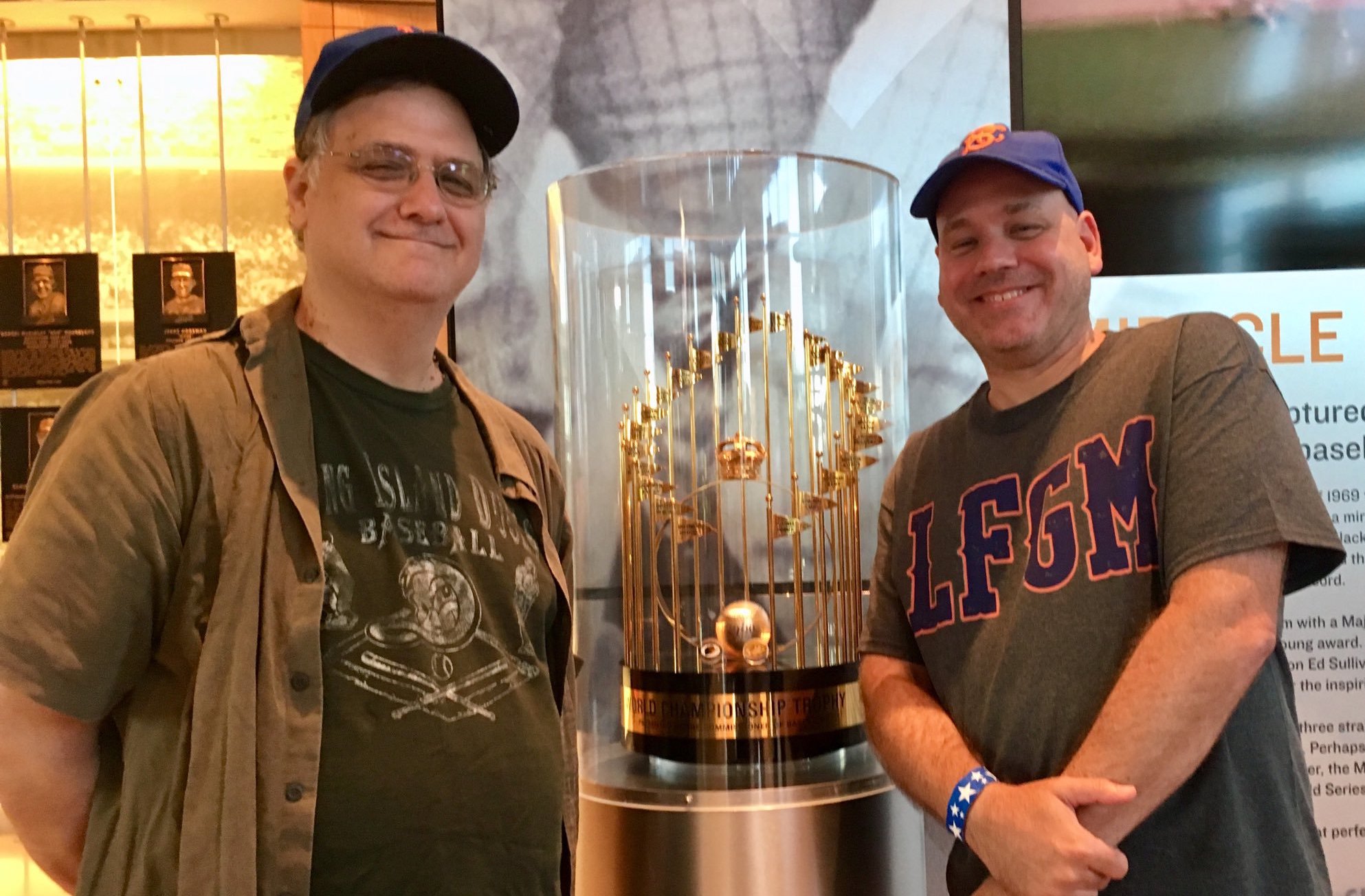
Faith and Fear in Flushing made its debut on Feb. 16, 2005, the brainchild of two longtime friends and lifelong Met fans.
Greg Prince discovered the Mets when he was 6, during the magical summer of 1969. He is a Long Island-based writer, editor and communications consultant. Contact him here.
Jason Fry is a Brooklyn writer whose first memories include his mom leaping up and down cheering for Rusty Staub. Check out his other writing here.
Got something to say? Leave a comment, or email us at faithandfear@gmail.com. (Sorry, but we have no interest in ads, sponsored content or guest posts.)
Need our RSS feed? It's here.
Visit our Facebook page, or drop by the personal pages for Greg and Jason.
Or follow us on Twitter: Here's Greg, and here's Jason.
|
by Jason Fry on 8 May 2010 12:15 am Well!
The endgame of tonight’s completely thrilling, slightly silly, altogether amazin’ Mets win was the perfect culmination of a sloppy, wacky, thoroughly entertaining affair, one that saw Mike Pelfrey fail just enough not to succeed and the Giants’ Jonathan Sanchez succeed just enough not to fail. The early frames brought that rather uncertain contest, as well as the latest chapters in the lavishly illustrated storybook TALL TALES OF IKE DAVIS, BASEBALL HERO. (Didja know Ike lives in an apartment in Yorkville with a blue and orange ox? It’s true — I heard Ike hangs his laundry on the beast’s horns. Big apartment.)
Every time I feel my affection for Ike threaten to topple over into the stuff of besotted fan bromance, it’s like Mike Vail and Daniel Murphy pop up on each shoulder, tut-tutting about small sample sizes. But goodness is there a lot to like. I’m all for tape-measure home runs, but what impresses me even more is how few rookie jitters Davis seems to have. He works the count like — well, like Daniel Murphy. (See? There it is happening again.) And at first base he’s not just smooth, but smart — witness the game a while back in which he unhurriedly arranged his long legs and considerable wingspan in foul territory to give the catcher a better angle on a dropped third strike. A reliable first baseman has a calming effect on a team, and the Mets have been without that sense of calm on the other end of throws from the infield since John Olerud.
That ninth inning was anything but calm, though — it was an overstuffed parade of weird, goofy, unfortunate and thrilling plays. Consider the following, all of which might have stood out as the lone thing to remember from your average run-of-the-mill May game:
* Against John Bowker with one out in the ninth, Francisco Rodriguez’s 1-2 curve is pretty obviously a strike. K-Rod is twirling somewhere between the mound and first when Hunter Wendelstedt gives a little shoulder fake but otherwise remains still, forcing Francisco to reel himself back onto the mound mid-pirouette. Instead of trudging back to the dugout as the home fans began to rise and cheer, Bowker is even in the count against an upset closer.
* Two foul balls later, either Gary or Keith or Ron (I don’t remember which one, because I was crabbing about K-Rod needing strike four) notes that Rod Barajas is calling for an inside fastball but has been shaken off by Frankie, who wants to throw the change-up. That’s not a good idea, I think to myself on the couch. WHAM! Bowker swings at a high change and the ball stitches a line across the sky, vanishes from Citi Field, and comes sizzling back to earth in the middle of the Iron Triangle, where it strikes an eminent-domain lawyer who is using a dented Honda Civic door to fend off three chop-shop owners armed with welding torches, after which it is devoured by a feral dog. OK, not quite, but Bowker does hit it a really long fucking way. Tie game. Pelfrey’s work wasted. Boooooo.
* With two out, Aaron Rowand on second and Mark DeRosa at the plate, DeRosa fouls a ball off with Rowand running to make the count 3-2. Except he doesn’t: Paul Schrieber has called a balk on K-Rod. One you don’t see every day in an inning with no lack of them.
* DeRosa then hits a little worm-killer up the middle, a Luis Sojo special that seems like a cinch to bring home Rowand and leave me writing a really angry post about Francisco Rodriguez. Except Luis Castillo flops onto the outfield grass, slightly on the shortstop side, and just corrals it with the tip of his glove, leaving Rowand skidding like a cartoon character on the downhill side of third base and scampering back to it. Still tied, but Pablo Sandoval tramping to the plate, and K-Rod doesn’t throw high fastballs. Uh-oh.
* So of course the Kung Fu Panda hits a pop-up that’s clearly ticketed for the first-base seats. No, make that the dugout roof. No, make that the dugout. No, make that Ike Davis’s mitt where it sits at the end of Ike’s just-long-enough arm, followed by Ike toppling over the dugout railing like a construction crane, his body pivoting around Good Samaritan Alex Cora, his feet winding up more or less firmly planted on the dugout floor, and holding up a mitt with white showing in it. “And he sticks the landing!” crows Gary Cohen. (Ike then picks his teeth with a sequoia. At least that’s how I heard it.)
As if that weren’t enough, we got a bottom of the ninth.
* Jeff Francoeur cues an ugly little excuse-me hit to the left side of the field, and is clearly safe, except Angel Hernandez — grinning evilly before stuffing a wad of dollar bills into his back pocket to keep his autographed Michael Tucker photo company – calls Francoeur out. Gary is apoplectic, and apparently about to begin reciting all the times Angel Hernandez has screwed the Mets. Except the replay shows that Francoeur was actually out. Even amid this inning’s wonders, Angel Hernandez getting an important call right when it involves the Mets might be the most amazing thing of all.
* Ike Davis takes one step north, creating Long Island Sound, and plucks a peak from the Adirondacks. He shapes it into a granite bat and smacks his third home run of the night. Oh wait, he just walks. Very calmly, though.
* Rod Barajas — who has a home run himself tonight, as well as a smashed finger that causes him to obviously grimace whenever he does anything — gets a 1-0 hanging slider from Sergio Romo. This afternoon Mark Simon — part of the very, very good crew covering the Mets for ESPN New York — noted that the Mets hadn’t had a walkoff home run since David Wright made the Padres very sad in August 2008, meaning they’d never had one at Citi Field. I thought of this as Barajas came to the plate. I really did.
Anyway, Barajas squares up Romo’s hanging slider and hits it into the air, as Barajas is wont to do. The ball seems like it will follow the longest parabola a ball hit to left field in Citi Field can follow without being a home run. DeRosa is going to press his entire body against the fence, lift his glove as high as he possibly can, wait for a moment, and have the ball whistle into the very top of his mitt. He will hurl the ball back to the infield and let his shoulders slump in amazed relief. Ike will calmly return to first and frown. Barajas will shake his head and be consoled in the dugout. Those of us in the stands or on couches will boo and/or roll around in dismay, while those of us near keyboards or smartphones will furiously begin pecking out typo-ridden diatribes about dismantling the Great Wall of Flushing. It’s going to be very disappointing.
But no, it’s just over the fence, sending fans leaping and yelling and waving their arms and Barajas floating around the bases for the receiving line and happy helmet pounding at home plate. Mets win, and all’s right in the world. Just another tall tale of Ike and Rod. Except it’s all true. So I heard.
by Greg Prince on 7 May 2010 1:37 pm Welcome to Flashback Friday: Take Me Out to 34 Ballparks, a celebration, critique and countdown of every major league ballpark one baseball fan has been fortunate enough to visit in a lifetime of going to ballgames.
BALLPARK: Network Associates Coliseum
BETTER KNOWN AS: Oakland Coliseum
VISITS: 1
VISITED: July 5, 2001
CHRONOLOGY: 23rd of 34
RANKING: 26th of 34
When you watch a baseball game on television, you have a sense of what the playing field looks like. You recognize the outfield walls, the scoreboard, the seats behind home and the dugout. Yet you rarely get any kind of definitive look at the exterior. If you’re not dealing with an already iconic ballpark, you have no idea what it’s like to approach the place.
In the case of what was then known as Network Associates Coliseum, just as well. I’ve never encountered less grandeur en route to a major league stadium. That hoary quote from Gertrude Stein was obviously written with the home of the Oakland A’s in mind.
There is no there there. It didn’t feel like there would be when Stephanie and I stepped off a BART train from San Francisco nine years ago and looked for something approximating a ballpark. Normally I’d just follow the crowd, but for a Thursday afternoon game in Oakland, there was no crowd. There was barely any “there”. There was, however, a bridge. There were some panhandlers. There was then a loading dock. Then there was an enormous pile of concrete.
That’s the Coliseum. Welcome to A’s baseball. It’s going on in there somewhere.
Perhaps it was because the outside was so uninspiring that once we were inside “the Net” (or as our local friends called it, “the Ass”), it actually surpassed our expectations. We expected a quarry, I suppose. We got a pretty decent setting for baseball, all things considered.
You had to take a few things into consideration as you settled in for a day of baseball in Oakland. You had to take football into consideration. That’s what the city had to do to lure the Raiders back from their extended Los Angeles stay in 1995. They built Al Davis a wall of luxury boxes that killed the view of the mountains over the center field fence. “Mount Davis,” they called this atrocity. It was the moral equivalent of Mr. Burns blocking out the sun and plunging Springfield into eternal darkness.
But it wasn’t the practical equivalent, because while you couldn’t see anything beyond Mount Davis, you got plenty of sun. The sun never stopped pounding us, which was too bad because having unnecessarily bought tickets well in advance, I got us some great seats behind home plate. They were so great, my fair lady of a wife — Scandinavian heritage, burns easily — wanted no part of them. Darn. We asked a friendly usher if it was OK if we moved back some (there’s a request I never made at Shea). No problem, he said, pointing us to some still very good and blessedly shady seats a little further back of home. Paid attendance that day was under 13,000; it wasn’t like we’d be sitting in somebody else’s seats.
Lots of concrete, lots of sun and lots of green. Green, green grass in particular. The one thing I’d learned watching A’s games on TV over the years was a surfeit of foul territory made for a verdant festival of popouts. Surely it frustrated batters, but at least it went well with the A’s caps. You can’t go wrong with green in baseball. And while you could go wrong with width in the foul territory department, I noticed and liked the extraordinarily wide concourses behind the stands. They were darker than Shea, but they were twice as wide. If you needed to escape the midday sun some more, there was refuge to be had.
While I didn’t know what it looked like outside until we got there, the Coliseum felt familiar enough as we waited for the game against the Angels to begin. The A’s were a featured actor on the October stage for half the ‘70s, so whenever I’d find an A’s card in my Topps pack, I probably lingered on it a little longer than I would have if a given Athletic had been a White Sock or a Twin. One feature that felt very familiar was the last row of the upper grandstand — it just cut off, like they ran out of money for it. Surely I’d seen it on a card in 1974 or thereabouts. The Coliseum in those portrayals always looked like Bobby Brady’s backyard to me in those days (sans the Astroturf lawn) and that memory rushed back in 2001.
Also back, not shockingly, was my awareness of the four-game cameo this building had in Mets history. The Mets have lost only one World Series on the road in their existence, and it was here. Up close, it didn’t bother me. In some twisted way, I was happy to forge that connection on a stray July day 3,000 miles from home. Sure, we lost, but we lost to a great team (or so I told myself until 2005). It didn’t bother me that this was where George Stone went unused and Willie Mays was blinded by the light and Augie Donatelli was simply blind to Ray Fosse not tagging Buddy Harrelson. The Mets kind of mattered in the scheme of things here. This was the only place besides Shea for which there was a banner hanging that said “1973”. This was the only place besides Shea on whose DiamondVision highlights from the 1973 postseason got a workout — though I booed World Series MVP Reggie Jackson when he was presented as A of the Day.
It had been 28 years. I think the rivalry had died down. My Mets cap was greeted with a smile from the guy who sold me my program. He was friendly. The usher who let us move about freely was friendly. The vendor who sold frozen dairy products may have been unnerved, however, when I felt compelled to resort to Default Flushing Etiquette to flag him down.
“MAAWWLLT!!!” I screamed at him. I was just trying to get his attention the way I might have at Shea. I mean, c’mon, that’s how we do it, right? The mellowness inherent in a Northern Californian afternoon was lost on me. He was a whole two rows away when I bellowed, and with few of the 12,719 on hand vying for his attention, he looked a little hurt that I yelled at him. Nothing personal, pal, we just want your MAAWWLLT…I mean malt.
He was nice about it. They were all nice about it. When you’re Oakland competing with San Francisco, the Coliseum competing with Pac Bell, the A’s (muddled under .500 at the time) competing with the Giants and record-pursuing Barry Bonds, you’d better be nice. Only baseball-oriented tourists like us, on an otherwise all-San Fran vacation, were going the extra few miles to be here. Whatever it was that kept fans out of the Coliseum, it wasn’t a bad attitude. Mount Davis notwithstanding, there was no Black Hole here. A’s Nation — including the fans who teamed on the occasional Let’s Go OAK-land chant and particularly the lady who for some reason thought I would know whether Johnny Damon was Korean — was comprised of nice people doing their best to create a nice atmosphere, even as the A’s went down lamely to the Angels. It left us in a good mood before we braved the pedestrian bridge and its panhandlers to return to the BART and the other side of the bay.
You could do worse on a Thursday afternoon in the middle of almost nowhere.
by Greg Prince on 6 May 2010 8:54 pm 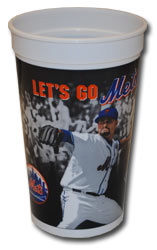 Hey, neat? Tomorrow night, according to the periodic table of elements better known as the Citi Field Seating & Pricing Chart, is a Bronze game on the Mets’ home schedule. Tickets are priced from $15 in Promenade Reserved to $460 in Delta Club Platinum (Delta Club Platinum is, of course, the finest faucet money can buy). The $445 range encompasses 41 different seating levels, some more Terrific than others. You can spend $112 to get high on Baseline Box Gold, roam to Caesars Club Silver for $96 or just go with something that actually sounds like a seating section in a ballpark, like Left Field Reserved, for $40. Your choice.
What will you get for between $15 and $460 Friday night? You’ll get the Mets playing the Giants, Mike Pelfrey (shoulder tightness willing) versus Jonathan Sanchez, a matchup of a team that’s been on a bit of a roll — a 7-2 spurt has elevated San Fran into first place — posing a challenge to our boys who have cooled down since their last historically hot homestand. Depending on how much you value baseball, it’s a perfectly attractive game and you are, by all means, encouraged to consider purchasing whichever ticket fits your desires and/or budget.
Also, if you buy a ticket and enter among the first 25,000 ticketholders, you will receive a cup. A plastic cup. A cup with a picture of Johan Santana, one of the Mets logos and the words LET’S GO METS. It is “presented” by the company that makes the sausages sold at Citi Field, so I suspect the company’s trademark will appear, too.
You may want a cup that features those characteristics. You might say, “Hey, neat!” Johan Santana is still, recent unnerving drop in velocity notwithstanding, a pretty popular guy with Mets fans, and the whole notion of LET’S GO METS presumably continues to maintain resonance with the same audience. I personally don’t give a damn about the company that makes the sausages, but you know the old saying: There’s two things in this world you never want to let people see how you make ’em — laws and the Mets’ promotional schedule.
You may want that cup when you come face to face with it. When you’ve paid between $15 and $460 for that ticket and then attempted to self-scan it five or six times before the scanner beeps and you are permitted to pass through the Kozy Shack turnstiles (after you and your belongings have been searched, patted down and wanded), you may be wordlessly handed that cup and indeed say, “Hey, neat!” Or you may say, “Oh.” Or you may say nothing. Again, your call.
What I’m guessing you won’t say is, “Oh boy, a plastic cup! This was that little extra bonus that attracted me to the stadium tonight.”
I don’t think you’re gonna say that at all. Even if it’s a most handsome cup, I don’t think a single ticket buyer will have been moved to dig deep because of a plastic cup. Even if it’s got Johan Santana’s picture. Even if it says LET’S GO METS. Even if you’re a fan of the sausage company.
You know what this particular promotion is billed as? Collector’s Cup Night. That implies there is an active effort underway among Mets fans to collect plastic cups. That there are vibrant, growing plastic cup collections all about Metsopotamia. That there is something to collecting plastic cups beyond not throwing them into the trash or leaving them under your seat.
I have, mere feet from where I type, probably a dozen different plastic cups featuring the Mets logo and a complementary design highlighting a given year’s star players or marketing slogan. They come from disparate and sometimes desperate Mets seasons. They came with a Diet Pepsi, most likely. Elsewhere in the Prince household, there are more Mets cups of that nature. Some predate Pepsi’s Mets sponsorship and came with a Diet Coke, maybe even a Diet Rite if we reach back far enough. I like to display them here and there. I don’t like to throw them away. When my wife decided to indulge her latent green thumb a few months ago, she asked if she could use one of them to pot a plant. Sure, I said, we have plenty of them. After a fashion, they are not really fit to drink from anyway, so you might as well fill one of them with dirt and seeds and hope for the best.
But I gotta tell ya, I don’t collect plastic Mets cups. Nobody collects plastic Mets cups. We collect stuff with Mets logos, sure. And we keep our cups because they have Mets logos, but it’s not a hobby or a passion or an obsession, not one I’ve encountered in my Met travels. Therefore, to host a six-game homestand and have as your only promotional date a night dedicated to giving out plastic cups…I can’t see that working.
This is the best the Mets could do? Collector’s Cup Night? It’s a false construct. Nobody seeks out these cups. They’re not collected. Collections of them just happen. At best, you go for a soda and you decide to spring for the difference between what the soda would cost in a paper cup and what it will cost in a plastic cup. When I told Stephanie that Friday was going to be Collector’s Cup Night, she asked, “Don’t you get that with the ten-dollar soda?” Yeah, I said, something like that.
You wind up with the cup because you bought the soda. Or you wind up with the cup because somebody else bought the soda and you’re not too proud to scoop it up when that person doesn’t care enough to take it home. It’s not why you went to the game. It’s just what you wound up with when you left. That, I am convinced, is the extent of plastic cup collecting.
You don’t buy a ticket priced anywhere from $15 to $460 so you can get the Collector’s Cup. You’ll take it if they’re dispensing it. You’ll be damned if you don’t get what’s coming to you for the price of your admission. You’d prefer not to be Fan No. 25,001 and not get your cup.
But no way — no way in hell — are you going to look at your pocket schedule or visit mets.com and say, “I think I’m going to go Friday, May 7, because it’s Collector’s Cup Night.” No, it’s not going to happen. And the organization that plans promotional nights has to have a hunch that it’s not going to happen. That organization, in concert with its sausage supplier, might want to sit down for as many as five minutes and discuss the matter. They might want to acknowledge to one another that a Collector’s Cup is neither a legitimate enticement to buy a ticket nor a suitable reward for having bought a ticket.
It’s a plastic cup. You get it with the ten-dollar soda.
***
• Though “Attend Collector’s Cup Night” just missed the cut, check out the newly released paperback version of Matt Silverman’s 100 Things Mets Fans Should Know & Do Before They Die. It has been updated with more thoughts, more facts and more things to know and do. I’m particularly partial to No. 81: “Read the Mets,” but all hundred are top-notch.
• Today is New York Met and New York Giant icon Willie Mays’s 79th birthday. If the Mets are marking the occasion during the visit of the Giants this weekend, they are keeping it a well-hidden secret. Nevertheless, you can celebrate the life of the Say Hey Kid by reading this great story about Willie and a member of the Mets’ broadcasting family by James H. (Jim) Burns.
• AMAZIN’ TUESDAY is returning May 18, 7:00 PM, to a NEW LOCATION: The Two Boots at Grand Central Terminal. We’ll have more details next week, but mark down the date, the time and the special guest speakers: Taryn “Coop” Cooper of My Summer Family and Josh Wilker of Cardboard Gods.
• Every day is a good day to read Metstradamus, who can now be found at a new URL: metstradamusblog.com. Belated fifth-anniversary wishes to the only blog that deserves a permanent place in the Angel Berroa Rotunda.
• Reminder for fans of Jane Jarvis’s music, Mets-related and otherwise: a jazz memorial in her honor is taking place at St. Peter’s Church in Manhattan this Monday evening. Details here.
• Reminder for those who love New York and want to know more about it: Peter Laskowich is kicking off his spring and summer history tours next weekend, May 15 and 16. Some are baseball-centered, others give it to you without horsehide. Every one I’ve been on has literally and figuratively been a trip. You can get in touch with Peter through New York Dynamic to learn more..
• Finally, heartiest of congratulations to Sharon Chapman on having reached her initial imposing fundraising goal of $3,600 for the Tug McGraw Foundation. Thanks to readers like you and a lot of other generous folks, Sharon has earned her entry into the New York Marathon this fall. Befitting someone who has undertaken a long run, Sharon’s not done trying to help out the fight against brain cancer and other insidious diseases. She is going to try to jack up her total to a Tuglike $4,500 and we will, as Official Wrist Sponsor, continue in the coming months to keep you apprised of her and the Foundation’s activities. We’ll also be sharing a few more Tug stories along the way. If you can, please donate here.
by Greg Prince on 5 May 2010 7:17 pm Baseball is a first pitch being thrown at 12:35 in the afternoon, and a schlubby fan attempting to follow it while working. A decision to listen on the radio because things are going well for his team while avoiding the TV. That’s baseball. And so is a kid from Defiance, Ohio, pitching for the first time in Cincinnati.
There’s a man in Connecticut who will confirm a forty-seven year-old pitcher from Philadelphia won a game for Chicago at New York twenty-four years ago. That’s baseball. So is the scout reporting that a seventeen-year-old pitcher in the Dominican is a coming Dwight Gooden. Baseball is a marathon and a sprint. A game of turning tides. It’s the pitcher who strikes out the side in his first go-round making you wonder why he doesn’t have a better lifetime record. It’s that same pitcher walking in a run three innings later, answering your earlier question.
Every skill is measured. Every heroic, every failing is seen and cheered, or booed. And then becomes a statistic. A veteran outfielder, a tired old man of thirty-five whose last name is amended with Junior, breaks a slump of zero for fifteen and scores his team’s first run. By day’s end, he will have begun a new slump. A reliever who is still new to these major leagues pitches to nine batters and retires them all. Another reliever, who has pitched in every other game his team has played for the past two years, throws only two pitches and is declared the loser.
In baseball democracy shines its clearest. The only race that matters is the race to the bag. A second baseman hustles to first in his first at-bat, jogs his next time up and trots the time after that when it becomes apparent he has no need to run. His double play partner, a shortstop who hasn’t hit as many as ten home runs in any of the past six seasons, emerges as the slugger who ends the game.
Baseball is a star third baseman removed to ensure that his seldom-used backup who has just pinch-hit remains in the game because he is the emergency catcher. It’s worrying that that move will backfire and having that worry rendered moot when the game ends two pitches later. It’s a stolen base attempt against a catcher who has thrown out every base runner who has dared to run on him. It’s questioning that attempt until a television replay shows the runner took too big a lead and got too good a jump to resist trying to steal. It’s the catcher negating the lead and the jump with an even more outstanding throw. That’s baseball.
Names are baseball, names that seem close, like Johnny and Jonathon and Jonny, and names that couldn’t seem closer, like Henry and Jenrry. It’s Laynce and Drew and Angel and Hisanori and a Francisco on each side. It’s searching for a nickname for the previous night’s hero who doesn’t get to start because today is a day game. It’s an exotic name like Catalanotto belonging to a man who hails from a place called Smithtown. It’s the man from Smithtown singling to lead off the ninth for his first hit in a week and his fourth hit of the year and ultimately scoring the tying run, the second run he has scored after a month of play. It’s an enormous run when it goes up on the board, but it’s forgotten when his team loses. That’s baseball, too.
Baseball is the quiet frustration of Jason Bay. The mile-wide grin of Jeff Francoeur. The second-guessing applied to Jerry Manuel. It’s the wind current that blows to right at Great American Ball Park, a breeze that draws everybody’s attention until the game-deciding home run clanks off the left field foul pole.
Baseball is just a game as simple as a ball and bat. Yet, as complex as we who blog wish to make it. A sport, a business and sometimes almost even a religion. It’s a pastime, an obsession, a subject of endless fascination. It’s what we regret when our team loses, it’s what we wait for to return in two days when we realize there’s no game tomorrow.
Why, the inspiring tale of Jose Reyes working his way back from a hamstring injury. And then being told he can’t move a muscle because he has a thyroid condition. That’s baseball. So are the voices that sing his name when he is cleared to return to the game he plays so beautifully.
Baseball is chewing your thumb, taking a deep breath, clicking refresh, balancing your logic with your superstitions, wondering how a text message can be more important than the next pitch and “Lazy Mary”.
Baseball is knowing people better than you would otherwise, feeling you know those you’ve never met and, at its best, baseball is a self-described tongue-tied kid from Georgia growing up to be an announcer and touching millions with his voice and his kindness, probably never grasping how much he will be missed when he is gone.
This is a game for America. Still a game for America, this baseball. And Ernie Harwell, we thank you for making as much of it as you did.
Do yourself a favor and read the real thing here, and a glorious take on the man behind it here.
by Greg Prince on 5 May 2010 9:49 am 10. R-Bar
Among the many things that make my skin crawl regarding Alex Rodriguez is how lazy he made us all in conjuring nicknames for baseball players. First initial of first name, first syllable of last name? That’s so much easier than thinking! A-Rod could also be known as Z-Zzz. Yet I’ve been guilty of it myself, imploring, among others these past few years, P-Lo, C-Bel, C-Del and J-Bay to come through in the C-Lutch. R-Bar doesn’t really work for Rod Barajas, even though he most definitely came through in the clutch Tuesday night with the ninth-inning homer that pre-empted more creeping Red Dread (or R-Dread). Besides, R-Bar puts me in mind of the old Roy Rogers Double R Bar Burger, which might be appropriate in light of the way Rod pulled the Trigger on Francisco Cordero’s two-out delivery before absolutely tasing it, but I’ve never been fully comfortable with the horse/hamburger connection.
9. Old ’Jas Rod Bar
Then again, Rod Barajas has been a horse behind the plate this year, and he’s no spring chicken. If this were the 19th century, we’d be issuing colorful nicknames along the lines of Old Hoss Radbourn, the pitcher who won 59 games for the 1884 Providence Grays (wonder what his pitch count was). By the end of this season, Rod Barajas will likely take part in 59 Met wins. He may even take 84 pitches by then.
8. The Wild ’Jas of the Osage
Gashouse Gang third baseman Pepper Martin was known as the Wild Horse of the Osage. Like it wasn’t enough to be known as Pepper (full name: Johnny Roosevelt Leonard Martin). The wildest thing about Rod Barajas is his idea of the strike zone when he’s batting. Rod’s got two walks in one-sixth of a season. Buddhists will tell you that he’s on pace to be reincarnated as Jeff Francouer.
7. Air Rod
Not that it’s gonna happen anyway, but you don’t want Rod Barajas hitting the ball on the ground. When he does, the earth doesn’t move. Certainly Rod doesn’t. He has one hit on a ground ball thus far this year. Then again, he’s only hit the ball on the ground 13 times. You will, however, find Air Rod has the most daily nonstop flights of any Met. Forty-seven of the 69 balls he’s put in play have, like Harry Chapin in “Taxi,” taken off to find the sky. Seven have found the other side of the fence.
6. Rodney Allen Rip ’Em
Back to burgers for a moment. Does anybody else remember that adorable kid who plugged Jack in the Box in the ’70s? His name was Rodney Allen Rippy. He’s still around. Like Roy Rogers, Jack in the Box doesn’t seem to be around as much, at least in New York. On the other hand, our catcher has ripped nine line drives this season, six of them for hits. Rod Barajas didn’t sign with the Mets until late February. Talk about a fun surprise springing out of a box!
5. Andy Roddick
This is a truly awful nickname, but it would carry on in the tradition of truly awful Mets nicknames. Perhaps you’ve heard Ron and Keith explain the lineage of Howard Johnson’s clubhouse nickname Sheik. Howard Johnson was HoJo to the rest of us. HoJo morphed into Haji, per the Giants placekicker of the day, Ali-Haji Sheikh. Follow that ballplayer logic? Well, Rod Barajas’s full name is Rodrigo Richard Barajas. So you’ve got the Rod, and then you take the formerly respectable shortening of Richard, and you bring an athlete from another sport into it…like I said, this is truly awful, but it would have fit on the 1986 Mets. In The Bad Guys Won, we learn Darryl Strawberry not so affectionately dubbed Timothy Shawn Teufel “Richard Head”. FYI, Darryl — or Straw — is now listed in the Mets Media Guide as a “club ambassador”.
4. ’Raja California
Rod Barajas was born in Ontario, California, well east of L.A. and a little more than a hundred miles north of Baja California. As it happens, his father is from Mexicali, part of the Mexican peninsula just south of San Diego. When Rod Barajas homers for the Mets, he brings great honor to all peoples (save for Francisco Cordero). He brought great honor to the Diamondbacks as a catcher on their eternally beloved 2001 world championship team, but it doesn’t sound like he’s looking to get back to Arizona any time soon.
3. B-Rod
Confession: I’ve been calling him this in front of the TV lately. B-Rod with the winning hit, K-Rod with the save, A-Rod at fault for this total lack of originality (with an assist to my own organic laziness).
2. B-Roll
In a newscast, B-Roll is the footage that runs while the anchor or reporter is nattering away. Thus, when Gary Apple is attempting to lamely tease our interest with “Guess which Met catcher is doing something no Met catcher since Mike Piazza has done!” you’ll probably see B-Roll of B-Rod from last night while you think, “What, lead the team in home runs? Does SNY think I’m an idiot?” If he has enough highlights like the one he filmed last night, Rod Barajas will be the embodiment of power-hitting B-Roll B-fore long.
1. Huggy Bar
On Starsky and Hutch (again with the ’70s references — contemporize man!), Huggy Bear was the streetwise contact who gave the lead detectives the information they needed to make it through another episode. Well, what is a veteran catcher if not a streetwise contact for pitchers in a tight spot? And didn’t you want to just hug the ever-lovin’ stuffin’ out of Rod Barajas when he hit that home run last night? For that matter, is he not, purely on demeanor, the most huggable Met we’ve had since Benny Agbayani? Then again, everybody’s huggable when you win in the ninth.
by Greg Prince on 4 May 2010 9:49 am I can’t get enough of Gary Cohen in the course of a game. Except for when I know he shouldn’t have just said what he just said.
Example one from Monday night: Oliver Perez is cruising along, as calm as the Ohio River. It’s the top of the fifth, game knotted at one. Ollie is being not just Good Ollie but, after some choppiness in the first couple of innings, Efficient Ollie. The only element that can disturb Ollie’s rhythm is explicitly acknowledging what an unusually low pitch count Ollie has registered thus far.
That’s exactly what Gary does as the fifth begins. So what happens? The baseball gods (who listen to Gary, too, because they know quality when they hear it) mess with Ollie and he goes to three-and-two before striking out Ramon Hernandez. OK, I think, it’s an out. A little more effort than I would have liked, but nobody’s on, and the pitcher, Mike Leake, is coming up.
Nine pitches later, the pitcher, Mike Leake, has walked. The fabulously economical pitch count that was languishing in the low 50s after four innings is now up on its feet and climbing. Where Ollie’s pitches climb, trouble is sure to follow. Granted, there wasn’t all that much immediate damage — just one pesky go-ahead run — but Ollie, after being lauded by Gary for not throwing too many pitches, had to labor through a 38-pitch fifth and was suddenly pushing 90 for the night.
I think we’d all agree that Oliver Perez doesn’t need much of a nudge to throw too many pitches. But he was nudged…which is why I cringed. “Don’t mention how well he’s doing! He’s going to stop doing well!”
And he did.
Fast-forward to the eleventh. Ollie, who left after six innings and (ahem) 108 pitches, gave way to excellent relief: Mejia to Nieve to Feliciano to keep matters tied at two. Sadly, the Reds’ pen has been just as ungenerous to Met hitters. That’s why we’re still playing. The new Met pitcher is Manny Acosta. One out in, Laynce Nix is up as a pinch-hitter. Not really the guy Dusty Baker would want up here, Gary asserts. Too bad, for Dusty, that he already used Jay Bruce in a similar situation and that he’s not still in the game.
Yes, too bad for Dusty. Except Dusty is jumping up and down not a minute later when Nix’s fly to right carries no more than two rows into the stands and the Mets have lost 3-2, seconds after I cried in anguish to the television, “NO, don’t say that about Laynce Nix!”
Let’s be clear: Gary Cohen is doing his job, a job he does better than anyone on the planet. But once or twice a game (some games, not all games) he identifies a situation or trend that appears, on the surface, legitimately positive for the Mets or negative for their opponents and I shudder because, on some intrinsic level, I know he has reversed it.
Gary Cohen has more power than even Laynce Nix when it comes to game-changing. I don’t think he’s aware of it. He’s reporting and analyzing. It’s what he’s supposed to do. It’s why there are cobwebs on my living room radio. Since Gary left WFAN for SNY in 2006, I stick to television on non-Fox, non-ESPN occasions as long as the remote is accessible. But once in a while, probably because the baseball gods are jealous that Gary’s better at what he does than they are at what they do, he is compelled to say something perfectly logical that will be proven inoperative in a matter of pitches. Ollie Perez will stop being efficient. Dusty Baker will not regret having already used Jay Bruce. The Mets will lose.
It’s not the announcer’s fault. It’s mine for noticing.
by Jason Fry on 2 May 2010 11:58 pm Once upon a time I liked this baseball game just fine. David Wright took Old Man Moyer convincingly deep in the very first inning for a 3-0 lead, and yesterday’s memories of dropped pop-ups and Doc Halladay and getting shellacked receded at the best possible speed. Yes, it got interesting in the bottom of the first, with solo shots by Placido Polanco and Ryan Howard off Johan Santana bringing the Phillies to within 3-2. But Santana seemed to settle down, and Rod Barajas continued his Citizens Bank domination, whacking a two-run homer to restore the Mets’ three-run lead. Jamie Moyer didn’t seem to be fooling anybody, and obviously Johan would settle down and throttle the Phils. The Mets would head for Cincinnati in first by 1 1/2, having Not Blinked and Made a Statement and Proved Something to Themselves, and all would be just fine.
Yep, that was pretty obviously what was going to happen.
This is what happened instead.
Let’s start in the fourth inning, with two outs and Utley standing on third.
- Johan’s fourth pitch after that point was a Raul Ibanez single that made it 5-3.
- Johan’s fifth pitch was a Juan Castro single.
- Johan’s ninth pitch sent Carlos Ruiz to first via a thoroughly intentional unintentional walk.
- Johan’s 16th pitch walked Jamie Moyer, forcing in a run and making it 5-4.
- Johan’s 18th pitch disappeared into the seats, a Shane Victorino grand slam that put the Phillies on top, 8-5.
- Johan’s 21st pitch was a Placido Polanco single
- Johan’s 23rd and mercifully final pitch was an Utley home run that made it 10-5.
Hisanori Takahashi came on, but the delights of this particular game were not over.
- Takahashi’s second pitch was a Ryan Howard single.
- Takahashi’s fifth pitch — the 28th since Ibanez came to the plate with two out — was a Jayson Werth double that it made it 11-5.
And then, at last, that elusive third out, made by Ibanez. Nine two-out runs. Sitting there like a gaffed fish in front of the radio, I mused that at least one Mets fan somewhere out there must have needed an extended bathroom trip, thought to himself, “eh, two outs and it’s Johan,” and emerged some time later to assume his TV had broken. It’s always faintly shocking when a starter unravels this quickly and thoroughly, but to see it happen to Santana was almost unimaginable — and deeply disturbing.
(Update: Rewrote the conclusion, because what I wrote originally was emotional and dumb.)
And then, after that 28-pitch disaster, the Mets had one baserunner for the rest of the night. One walk. No hits. Not one.
I don’t think that says anything about character or guts or anything else. Teams go through five-inning stretches without hits. It happens. If the Mets had had their hitless spell in the beginning of tonight’s game, and come back from 11-0 to get slightly less tar beaten out of them, we’d be tempted to talk about their Never Say Die attitude. But that would be silly. So, therefore, would be trying to measure their character by snarking that their response to Santana’s getting walloped all over creation was to mount a Gandhi-esque civil disobedience campaign, minus the high moral standing. Even though it’s tempting.
So let’s just leave it at this: It sure was horrible to watch.
by Greg Prince on 2 May 2010 8:02 am It was billed in some quarters as a battle of aces. Ours slipped out of the deck in the fourth inning. Theirs ran the table, collected the pot and was home in plenty of time for Cops.
So much for Pelfrey vs. Halladay. Just as well we still have Santana to deal as we await (and await and await and await…) the series finale at 8:05 tonight. And while no news is good news from a 10-0 drubbing in which the Mets were schlubbing, absorbed a clubbing and were in desperate need of subbing, there is one truth that remains.
It’s still early.
It was still early when we were descending to 2-6 and 4-8, though we acted as if the window was shutting on a season that had at least 150 games remaining. It was still early when we were 14-9 and riding roughshod on four different opponents whom we lapped at every turn. It continues to be early this Sunday morning, no matter the unpleasant thud! that resounded from the Citizens Bank Park grass as one ball escaped Jose Reyes’s grasp, another fell away from Alex Cora and an eight-game winning streak crashed to Earth.
Funny thing about the sport in which it legendarily gets late early: it does, yet it doesn’t. Sometimes you know a season is over before it’s over — in 1993, the Mets were done by the middle of May, probably sooner. Sometimes you know no such thing — in 1999, the Mets had to do the near impossible to survive after having played a presumably definitive 159 games, yet they did just that and kept playing, memorably so, for several weeks longer. Most of the time, however, 24 games is just 24 games, especially when they’re the first 24 games of a season. Unless you’re 20-4 (which only the 1986 Mets were) or 4-20 (which even the 1962 Mets weren’t), it’s still early.
There was a strain of Mets fan who didn’t want to hear it when “early” was a synonym for let’s show a little patience. Patience had worn as thin as Gary Matthews’ batting average in these parts, and eight games or twelve games was as much a sample size as we needed in order to know that the rest of our season would be played an under an intractable doom. Another segment of the fanbase chafed when “early” was bandied about in a different cautionary context, as in perhaps we’re not really on a pace to win our next 139 games. For these folks, this was a blasphemous, mean-spirited interpretation of a beautiful 14-9 record.
We’re in first place!
We’ve won ten of eleven!
We just pounded the Phillies!
In other words, tell your early to shut up.
In the spirit of Joni Mitchell, I’ve looked at early from both sides now. At neither 2-6 nor 4-8, I didn’t want to hear that these bums could be trusted to turn it around and, ten rabbits in eleven hats later, I didn’t want to hear lots of luck, lousy opponents and uncommon hotness were primarily at work. I wanted to believe, more than anything, that I knew what was going on. I wanted to be certain that my team sucked/ruled.
I didn’t. And I’m not.
It’s still early, no matter how you care to examine it. It’s too early, despite our recent run of exhilarating success, to say we’re home free. It’s too early, despite our reluctant referral to Dr. Halladay, to say we’re screwed. We’re all gonna be right sometimes about how bad this team and several of its players in particular really are. We’re all gonna be right sometimes about how good this team and several of its players really are. We’ll come together in about five months, underscore our favorite data points and prove how much we knew all along. That much — probably — is certain.
But it’s too early for that. We’re still finding out what 2010 has in store for us, which is fine. It’s a baseball season, the thing for which you wait an eternity to arrive. Why you’d want to know how it ends not even four weeks after it began is beyond me. Put your certainty aside. Read one page at a time. No skipping to the final chapter. It isn’t written yet.
It’s still early. Take that as you will.
by Greg Prince on 1 May 2010 12:25 pm 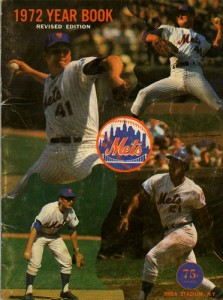
It’s Saturday night, 8 o’clock, the Mets game, unless it’s going 20 innings, is over. What’re ya gonna do now?
You’re gonna watch Mets Yearbook: 1972 on SNY, of course. Cool down from your Pelf-injected excitement (or cheer up from your Pelf-related depression…just covering the bases here) with a look at the season that started a tad late due to strike, began sadly because of the passing of Gil Hodges but then accelerated with the best 32-game start in team history: 25-7, a six-game lead over the second-place Pirates.
That ended soon enough (accursed injuries), but no doubt this edition of the Yearbook will provide many happy thoughts to chew over, including the Hall of Fame induction of new manager Yogi Berra, the acquisition of slugger Rusty Staub, the homecoming of favorite son Willie Mays, the All-Star selection of Tug McGraw, the stellar rookie campaigns of Jon Matlack (ROTY) and John Milner and a 21-win season from Tom Terrific. Less likely to be mentioned: No Met collected as many as 100 hits, but they weren’t called “highlight films” for nothin’.
Looking ahead, mark Memorial Day, May 31, on your DVRs. Starting at 4:30, SNY will air, in chronological order, all Mets Yearbooks produced to date, culminating in the premiere of Mets Yearbook: 1988 at 9:00 PM. Then stay tuned for the Mets at Padres. Or go to bed. I’m not going to get all up in your business.
Image courtesy of “Mario Mendoza…HOF lock” at Baseball-Fever.
by Jason Fry on 1 May 2010 12:56 am Not so long ago, an off-day for the Mets was secretly a little bit welcome. But that was before Ike Davis rolled away the stone from Citi Field and commanded that the Spirit of 2006 come forth — and be quick about it, dammit. (What’s that? Putting too much pressure on the rookie? Don’t know what you can possibly mean.) Thursday I was antsy because there was no game to play; today I was nervous and excited, trying to will 7:10 p.m. to hurry up and arrive. In my desperation I even wound up watching 15 minutes of WPIX News, an experience dangerously close to being lobotomized.
I think for a lot of us there was a sneaking suspicion that tonight would see an immediate and painful return to cold, hard terra firma. Yes, the Mets were on a roll, but the Cubs are mediocre at best, the Braves played like they’d never seen a baseball before, and the Dodgers have degenerated into a squalid soap opera. The Phillies have had injury problems, but they just stuck a shiv in the Giants to pull out a pretty amazing victory, they were returning home, and, well, they’re the Phillies. How many balls would they launch into that dinky left-field porch, seemingly built to the opposite specifications of the Great Wall of Flushing? How many Met drives would Shane Victorino snag in the gap? Would a Met reliever walk in the winning run? Perhaps an overenthusiastic Met runner would get called out for obstruction? Even without Jimmy Rollins woofing sweet nothings, there’d be Chase Utley to contend with, and the blandly surly Jayson Werth and the foaming-at-the-mouth Greg Dobbs and who knew who else. In recent years the Mets have had to claim, not entirely convincingly, that the Phillies aren’t in their heads; since late 2007 I’ve never tried to claim they aren’t in mine.
One game out of 18 means pitifully little, I know, but this one sure felt different: The Phillies got steamrolled in every aspect of baseball except mascot antics. A shaky second inning aside, Jon Niese was sublime: His strikeout of Placido Polanco was one of the most beautifully unhittable and downright unfair curveballs I’ve ever seen not end a season. There’s something appealingly lunch-bucket about Niese, from his squashed-looking nose and his ungainly grasshopper legs to the way he snaps his catcher’s throw out of the air and turns his head as if annoyed with himself, tramping back to the rubber to give it another try. Meanwhile, Jeff Francoeur was the night’s Indiana Jones, suffering injuries and indignities from chain-link fencing and hurled fastballs and abusive fans and afterwards declaring it all great fun. Francoeur plays baseball like a dog racing after a Frisbee, and even when he’s doing something spectacularly ill-advised you can’t help grinning at the idea that he just might pull it off. And there was David Wright golfing a homer into the shrubbery and Barajas slamming two of his own and Jason Bay somehow plucking Victorino’s two-run triple out of the flowers, among other wonderful things. (Does it surprise anyone else that flowers survive in Citizens Bank Park? I’m faintly amazed Phillies fans don’t incinerate them with lighters.)
April sure looked like the cruelest month in the early going, but it’s ended on a hopeful, downright gleeful note. The Mets are somehow in first place, and playing like they belong there. And to my happy surprise, I find myself eager for May.
|
|