The blog for Mets fans
who like to read
ABOUT US

Faith and Fear in Flushing made its debut on Feb. 16, 2005, the brainchild of two longtime friends and lifelong Met fans.
Greg Prince discovered the Mets when he was 6, during the magical summer of 1969. He is a Long Island-based writer, editor and communications consultant. Contact him here.
Jason Fry is a Brooklyn writer whose first memories include his mom leaping up and down cheering for Rusty Staub. Check out his other writing here.
Got something to say? Leave a comment, or email us at faithandfear@gmail.com. (Sorry, but we have no interest in ads, sponsored content or guest posts.)
Need our RSS feed? It's here.
Visit our Facebook page, or drop by the personal pages for Greg and Jason.
Or follow us on Twitter: Here's Greg, and here's Jason.
|
by Greg Prince on 10 February 2010 10:07 am 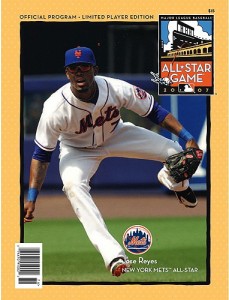 It’s September 2009. The last thing I want to do is give the Mets more of my money. But there I am, at Citi Field, in the team store browsing, when I see a sign advising me that player number t-shirts are on SALE. It’s September 2009. The last thing I want to do is give the Mets more of my money. But there I am, at Citi Field, in the team store browsing, when I see a sign advising me that player number t-shirts are on SALE.
See, this is why I’ll never be an effective participant in a boycott of all things Wilponian. The desire to support this ownership group’s product is Pavlovian. No, actually, it is Simpsonian. Homer Simpson couldn’t resist a half-price sale on chocolate even though he was already (in his imagination) in the Land of Chocolate, where everything was made of chocolate and he could take a bite out of everything without dropping a dime. I live in the Land of Met t-shirts. I don’t need any more, not at the tail end of 2009 when I’m far more fed up with the reality of the Mets than I am in love with the concept of the Mets. But there is a SALE — $28 marked down to $16 — so I could feel myself stepping up my browsing whether I wanted to or not.
Where do I go with this with this 40% or so discount? Who don’t I have? What’s available? The most plentiful inventory is for injured Mets.
Lots of PEREZ 46. I pass. It would send the wrong message that I’m in favor of his $36 million contract; should Omar see one fan in PEREZ 46, he’ll sign Ollie to an extension.
Lots of MAINE 33, too. I could have gone for one of these in 2007, but how do I know he’ll be back in 2010? I don’t feel nearly enough for Johnny to become a MAINE 33 martyr if he’s not on the team.
An ample supply of SHEFFIELD 10…I might have jumped in May when I was briefly enchanted by his presence, but it’s clear Sheff will not be cooking here much longer. And I’m no longer enchanted.
I look to see if maybe there’s SANTOS 9 available, but an investment in SANTOS 9 seems an invitation for fate to unconditionally release him five minutes and sixteen bucks later.
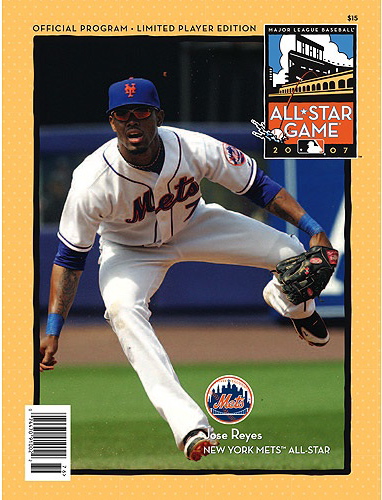
Then, in blue, with that neat-o alternate inaugural season logo (the one with the rendering of the Rotunda, not the unspeakable Domino’s ad), I see what I want: REYES 7. I don’t just want REYES 7. I need REYES 7.
By September 2009, I need REYES 7 more than I need a t-shirt that says that.
No shortage of JoseWear in my drawers at home, mind you. There’s a blue REYES 7 from 2003, his rookie year. There’s an orange REYES 7 from early in the ’07 season and a black National League All-Star REYES 7 from that same summer. Though I officially condemn the existence of the World Baseball Classic, I added a Dominicana REYES 7 last March. So I’m pretty well set. But staring at REYES 7 in concert with the faux patch that links him to 2009…yes, it will make a handsome addition to my apparel library (as would, given that I’d just theoretically “saved” $12, the REYES UNIVERSITY tee over on the next rack that I snap up as well).
How much better would have the Mets been in 2009 with Jose Reyes playing his customary 153 to 161 games instead of the 36 to which his right hamstring limited him? Would have they been better than 70-92? Would they have been markedly better than hopeless, which is what they were not long after Jose limped away from the scene of the grisly accident that last season was? An extra 120 games of Jose Reyes and concomitantly less Cora, Martinez, Valdez, Hernandez, whoever playing short…I don’t need to check Wins Above Replacement to know that a lot more Jose would have made some kind of difference.
All things being equal, there may be no worse position from which to lose your regular player than shortstop. I base this assertion on two very strong sets of recollections.
• Whenever Bud Harrelson missed copious amounts of time, the Mets seemed to tangibly suffer.
• Whenever Rey Ordoñez missed copious amounts of time, the Mets seemed to tangibly suffer.
No disrespect to the likes of Teddy Martinez, Mike Phillips, Luis Lopez or Melvin Mora, all of whom put in yeoman work as fill-ins in seasons when Harrelson and Ordoñez were shelved by injury for lengthy periods, but a top-flight shortstop never seems easily replaced. At their peak, Harrelson and Ordoñez vacuumed up everything in sight — and in Ordoñez’s case, everything in general. Neither of these guys was an offensive force in the Ernie Banks or Cal Ripken mold, but you didn’t care what they hit when they were in the field. A ground ball at or near Buddy or Rey-Rey was one less thing for the pitcher, the manager and the fans to worry about.
Same could be said for Jose, except Jose at his best extended his anxiety-clearing qualities to the plate and all over the basepaths. In any given game from 2005 through 2008, he had a pretty good shot at being the Mets’ best all-around player. As a classic catalyst, he was unmatched in Met annals. Tommie Agee was power plus speed for a couple of great years as a leadoff hitter. Mookie Wilson could be literally unstoppable on the basepaths (see Mets Walkoffs for just how unstoppable). But Jose Reyes…you know what he was when he was playing every day for four years.
Yeah, you know what I mean.
Subtract that Jose Reyes from any team, and it’s going to show. It was easy to forget as 2009 ground on, given that everybody was injured. It all became one big clump of missing players. Thus, it wasn’t until I stared at that t-shirt that the lack of Reyes in our midst really struck me. There had been so little intertwining of 2009 logos and Jose Reyes. He was the missing person, the kid who was absent when they took the class picture. I didn’t realize how much I missed him while Cora & Co. kept his position lukewarm.
I also glossed over it because of a nagging suspicion that Reyes had stopped being the Reyes I loved toward the end of 2007 and never really recovered his total Joseness thereafter. I know he put up numbers in ’08 that fit in nicely with what he’d been doing since emerging as a full-time player in ’05, but something was always just a little off once the rest of the world discovered how great he was. Not as off as the entirety of Wilson Valdez or Anderson Hernandez, mind you, but askew enough to diminish my innate Jose-loving ways, no matter how many REYES 7 t-shirts I kept wearing. He stopped hitting down the stretch in ’07. His stolen base total froze. He’d choose odd moments to not run to first or to throw tiny, unflattering tantrums. About the only thing I remember well about Jose actually playing in 2009 was the game-winning homer he thought he hit against Atlanta in the twelfth inning on May 13, the one that Citi Field’s daffily designed dimensions kept in play. Had Jose run out of the box, he’d have been on third easily. He broke into a trot and settled for second. The Mets lost by a run.
A week later he was day-to-day, which, per Met medical procedure, kept him out for the rest of the season. Somewhere between May and September, as the ’09 Mets numbed my nerves, Reyes was just another DL casualty in a lost campaign. Since September and that t-shirt, however, with every interview he’s given, every interview somebody else has given about him and every stride he’s taken toward — fingers crossed tight — full recovery, he’s become to me what he’d been since 2003:
My favorite player.
It dawns on me now one of the reasons I found 2009 so toxic, besides the losses and the severe and appalling lack of fundamental baseball skills applied by the Mets in compiling those losses (as their manager and coaches looked on with apparent disinterest), was I had no favorite player to get behind. I had Mets, sure, and I generally root for all Mets. I always find myself rooting a little extra hard for a while for somebody new (like Santos), somebody familiar but new to us (like Sheffield), somebody struggling gamely against adversity (like Maine) and sometimes somebody whom I couldn’t bring myself to completely turn against no matter how compelling the evidence that I should cut bait (like Perez). I was delighted to have Frankie Rodriguez on board. I deepened my admiration for Carlos Beltran before and after his absence. David Wright by now is part of the skyline logo. He’s a landmark. It’s easy to overlook the Woolworth Building, but you still have to root for it. And I do.
But none of them was Jose Reyes to me. None of them was my favorite player. I don’t care how long you’ve been at this rooting thing. You need a favorite player.
Tom Seaver carried that title for me as long as he was a Met or a Met in exile (and, of course, always will in the all-time sense). There was Tom Seaver and everybody else from ’69 until the middle of ’77. I made do with the Mazzillis and Hendersons during the interregnum, but Seaver was my favorite player even when he was a Red.
It took the second idiotic banishment of Tom Terrific and the rise of Doctor K to effectively replace him on a going basis. Dwight Gooden was my favorite player from ’84 until the middle of ’94. Then he was gone, and I was adrift, albeit for only about ten minutes.
Very quickly, I adopted Rico Brogna, who got me through the strike and had me revved up for when baseball returned in ’95. Rico was my favorite player until he was traded just before Thanksgiving 1996 (which gave Thanksgiving a bad name around here for the next decade).
Edgardo Alfonzo came out of the shadows under Bobby Valentine in early 1997 and immediately cemented his place as my favorite player until he was allowed to walk away in December 2002. Not unlike Seaver in Cincy, Fonzie in San Fran retained his ranking for a while thereafter.
I couldn’t handle a long-distance relationship, though. I needed a Met as a favorite player. Not that Fonzie wasn’t still a Met at heart, but I wasn’t about to leave my heart in San Francisco. June bloomed soon enough and, with it, Jose Reyes was brought up from Norfolk. Steve Phillips said it was going to be temporary. Steve Phillips says a lot of things I wouldn’t trust. Reyes was here permanently from June 10, 2003. By June 12, 2003, Steve Phillips was asked to remove himself from his place of employment.
I’d say both were the right call.
Reyes won me over right away, partly because I was dying to be won over, partly because he his good notices from the minors didn’t seem out of line with what he was presenting, partly because he just beamed from the outset. That’s a kid who loves to play baseball, I thought. Loves to play it and can play it well. A little raw, but he just turned twenty. Who wouldn’t be raw that young? It wasn’t a tough consumer decision when I wandered into the Mets Clubhouse Shop on 42nd Street and bought my first REYES 7 in July of ’03.
I was horrified when Jose ended his season in a heap of pain at second base in 2003. I was insulted when he was shuttled to the same base in the spring of 2004 in favor of Kaz Matsui, the Toyota of his time (a big-time Japanese brand whose operating problems should have kept it off the road well before its recall). I was horrified when I saw what the Met braintrust had done to Jose’s beautiful stride after he rehabbed from injury. I was protective of his ascent in 2005, irritated no end when so-called experts snorted that Jose Reyes didn’t walk enough. Not walk? Why walk when you can run like that?
When it all came together in the heart of the 2006 season, when the Mets were becoming Jose Reyes and the Mets…wow, that was gratifying. He was a celebrated prospect a few years earlier and now he and Wright and the rest of the Mets were celebrating a division clinching and a bright future. I loved that my favorite player was the favorite player of so many Mets fans. I loved the serenading. I loved that there were about as many home runs as triples, and there were plenty of triples. I loved the All-Star selections, particularly his moment with Willie Mays in 2007. I hate the WBC, but I loved that his shortstop-rich country thought enough of him to make him a part of its team. Even as I found myself occasionally disappointed at how Jose was playing and acting, I loved him. He was my favorite player. You gotta have a favorite player. Baseball’s not the same without one.
My favorite player is coming back. I look forward to wearing my heart on my sleeve along with his name and number on my back.
And speaking of welcome comebacks, Mike Steffanos is returning to the blogging beat after a winter’s hiatus. If I didn’t see all that snow outside my window, I’d swear spring is right around the corner.
Also, another Mike is reportedly returning. Congratulations to our longtime commenter Jacobs27 for maintaining the same screen name since Mike Jacobs’ departure. Talk about keeping the Faith.
by Greg Prince on 9 February 2010 2:13 am I have lost and I have won, losing isn’t any fun. Rain is fine, but when it’s done — sun is better.
—Edward Kleban, “Better,” A Class Act
The Saints were coming, I read Sunday morning. A couple of days later, the Saints are still going, while the Mets will be here soon enough. Excellent news on both counts.
Unlike Jason, I have no particular attachment to New Orleans or its world champion football team. I visited on three business trips in about a nine-month span not quite ten years ago and — a run of several splendid Hurricanes notwithstanding — nothing much happened to me there. A cab driver did engage me in baseball talk upon seeing my Mets jacket, but I can’t say it was a momentous occasion.
Still, I’m glowing the reflected glow I glow when a team that hasn’t won before or in a very long time has won. It’s the kind of result for which I instinctively pull when a team I call my own isn’t involved in a championship round. The ’01 Patriots, the ’02 Angels, the ’02 Buccaneers, the ’04 Red Sox, the ’05 White Sox and now the ’09 Saints all grabbed my temporary allegiance out of what I consider decent sports fan empathy (and, in the Saints’ case, reasonable human empathy for New Orleans). When each of them won, I felt very good…not frontrunner good, but rather “it’s about time the world proves it can be fair” good.
The Saints winning the Super Bowl was the first professional sports championship to be decided since the World Series ended ignominiously in early November. Football beat baseball in this matchup. What would you rather witness: a perpetually downtrodden franchise get off the schneid or somebody/anybody spill tears over a 27th ring? The only thing wrong with the Saints’ celebration Sunday night was a crowd shot from the French Quarter: thousands of happy, deserving fans and, blighting the bliss, one idiot in a Yankees batting practice jersey. Go home and count your rings, buddy. You’re not wanted anywhere people who have waited an eternity are finally being rewarded.
Naturally, the inclination here is to translate that temporary goodwill from the Saints (or Bucs or White Sox, et al) to where it really and indelibly counts by our reckoning, to the Mets. Hence, one is left once again to remember what it was like the last time the Mets won a championship and, more so, imagine what it will be like the next time the Mets win a championship.
That’s what it’s all about. When you’re between or before championships, it’s about everything else, and everything else offers plenty of valid rewards. But a night like the one Saints fans will be experiencing for the next month is the end zone for every football fan and home plate for every baseball fan. Don’t kid yourself. As great as a pretty good season can feel, and as enormously as a nearly great season might loom, World Champion New York Mets is the Holy Grail. It’s not shallow to want it above all else and it doesn’t expose our character as anything less than sturdy to admit it. For all the secular spirituality with which we approach our fandom, it’s impossible to ignore there are wins and there are losses. The wins are the desirable part. The championship is the most desirable.
The losses you can keep.
Sports fans, Mets fans included and maybe in particular, often act in a counterintuitive fashion when it comes to losing. Of course we hate it. Of course we don’t want to go through it. Of course when we’re stuck in its rut, we endlessly strategize methods to eliminate it. Yet god help anyone who would deny us claim to the losses that have been accumulated on our ledger. Those are our losses, damn it, and don’t you dare question our purity for having endured them.
At the risk of being overly judgmental of people whose heads I cannot possibly be inside (or, in one obvious case, have no desire to get anywhere near), it’s safe to say fans of the following professional sports teams have forfeited any claim on long-suffering status:
• The Saints
• The Yankees
• The Lakers
• The Penguins
Those are the defending champions in their respective realms. Their fans are fine until they’re not (except for the Yankees fans, who are sated for life, no matter how many World Series Don Mattingly didn’t win when they were kids). If you root for the runners-up to those champions — the Colts, the Phillies, the Magic, the Red Wings — I’d estimate that you’re exempt from long-suffering status for now as well. We’d like it if the 2009 World Series-losing Phillies fans were as long-suffering as they claimed to be prior to 2008, but given that they won it all two years ago, we’ll have to settle for knowing the Delaware Valley was deluged by snow over the weekend and Phillies fans were among the immensely inconvenienced. Colts fans see their team win 12 games every single year and enjoyed one championship a mere three years ago. A tinge of frustration might be setting in, but that’s not suffering in the wider fan vernacular.
If we consider championships Holy Grails and everything else killing time, we could probably extend this exercise clear back to the 1908 Cubs and eventually decide their fans take the suffering cake and deserve the biggest, most empathetic trophy of all — unless your impression of the Cubs as a bunch of preening bullies was formed as a six-year-old Mets fan in 1969. In that case, every time someone runs the Steve Bartman clip, your smirk demonstrates a mind of its own. This is why patterns and formulas will only get you so far in calculating who can kvetch and moan the most. Not a Mets fan who was watching Terry Pendleton take Roger McDowell deep on September 11, 1987 was thinking, “aw heck, that’s OK that we just missed our big chance to move within a half-game of the Cardinals — we won last year.” There’s no point in trying to look at sports in an unbiased fashion. Rooting is nothing if not an expression of permanent bias.
Every fan has to decide for himself or herself what’s really painful and what’s just not winning. Though I’ve just kind of told Colts fans to take a hike (and maybe not run the ball as the clock winds down), nobody can define your suffering for you. The Great Bill Simmons recently threw the kitchen sink at trying to decide what fans have been tortured more than any other. Per usual for the man who essentially invented sports blogging, his effort was very entertaining but irritatingly overreaching. Simmons’ rankings and system are neither here nor there — he goes with the Cubbie legions as No. 1 among the most put upon — but what’s really revealing is the responses he received from those he didn’t place in his Top/Bottom 15.
For example, Simmons ranked the Minnesota Vikings second and the Detroit Lions not at all. The Vikings, you might recall, almost made this year’s Super Bowl, losing the NFC championship on an overtime interception. They almost made the Super Bowl eleven years ago, losing on a missed field goal as time expired. I looked it up and discovered the Vikings have made the NFL playoffs 26 times in the past 43 seasons. They’re 0-for-26 in attempting to win a Super Bowl from there. Sounds reasonably tortured, right?
Screw them, wrote in a Lions fan, roaringly offended by Simmons’ blithe dismissal of his pain:
“What more do we have to endure? We haven’t won more than one playoff game in a season since the merger. Most Lions fans would KILL to lose four Super Bowls, or even make it back to the NFC Championship Game. We’re jealous of Vikings fans.”
While Simmons gave his benediction to fans of the Cubs, the Vikings, the Bills, the Browns, the Indians and ten others, loads of other fans from the four major sports were disappointed they didn’t get the call and wrote in to tell him so — fans of teams that have Viking-like luck when the clutch overcomes them as well as fans of Lionesque franchises that disappear down the competition hole for decades at a time. If we’re gonna have to lose, one can infer from the reaction, at least give us credit for having lost memorably and painfully.
This is frontrunning in reverse. This is backpedaling into a brick wall.
I don’t know that I necessarily want a piece of this type of action. I can, and I have, sat here this winter and attempted to quantify the downer quotient of being a Mets fan these days. For example, you know it’s been 24 years since a world championship has been celebrated by the deserving citizens of Metsopotamia. Esteemed blolleague Matt Artus of Always Amazin’ noticed quite recently that we are in the midst of the 14th longest World Series drought in captivity; 14 teams have gone longer than we have without a title and two that didn’t exist on October 27, 1986 have yet to win one. I can add to this cavalcade of despondency that:
• We are no longer in the upper half of the big leagues in terms of recent playoff qualifications, which in itself is no crime, but also indicates how long ago, all of a sudden, 2006 was. Fifteen teams have played a postseason game since the Mets last did, on October 19, 2006…which, in case you’ve forgotten, ended with three Mets on base and three strikes on Carlos Beltran.
• Should the Mets by some chance make the 2010 playoffs, and our first playoff game is played the Wednesday after the Sunday when the regular season ends, 1,447 days will have passed since 10/19/06 and that nasty curveball from Adam Wainwright.
FYI, a recent viewing of the bottom of the ninth inning of Game Seven on MLBN indicates Wainwright had that curve working hellaciously against Floyd and Reyes, which I swear I didn’t notice the night it happened or in January 2009, the first time I watched a replay of the game (when I think I was still reeling from the idea that I was watching this stupid game all over again). This third viewing and first really good look has changed my default “Beltran knew what he was doing taking” stance from 1,209 days ago to “how the hell could have he not been protecting the plate?”
Either way, it’s still too long since the Mets have played a postseason game. Just because the Royals have gone a lot longer and the Nationals have yet to play even one doesn’t make our wait seem any shorter.
• The Mets have been to four postseasons since 1986 and have not won a World Series in any of them. It’s hardly the stuff of Vikings…or the Phoenix Suns, 28-time NBA playoff qualifiers yet never champions…or the NHL St. Louis Blues, whose 35 trips to the Stanley Cup Playoffs have sent them home without a Cup every time. It’s also not quite Cubbish — 13 postseason appearances after 1908 with no winning it all — nor is it what happened in Atlanta after 1995: ten consecutive playoff appearances, no more world championships (shucks).
Even using life after 1986 as the baseline, we don’t have it as bad as others where October futility is concerned. Beginning with October 1987, the Indians (7), Giants (6), Astros (6) and Cubs (5) have all made more playoff appearances than the Mets and come away completely emptyhanded. Of course we don’t care that much about any team that isn’t the Mets, so four lousy playoff appearances over 22 seasons (not counting 1994 when there were no playoffs) and no stilted handshakes from Bud Selig…while it’s not the worst showing in sport, it’s more than a little disturbing when you’re immersed in the quest for that Holy Grail.
Baseball is still more selective than the other sports in inviting teams to its tournament, so there is a specialness to just being there, even without a big parade to cap it off, even with crash-landing endings like those that ultimately defined 2006 and 1988. The holy-ish grails can do a nice job of distracting you, particularly if there are 1999-style dramatics or a couple of rounds of victories as there were in 2000 before the shadow of defeat eclipsed every happy thing in our midst. Though we haven’t paraded up Lower Broadway in nearly 9,000 days, it’s not like we don’t drop a little drama on our way out of tournaments.
• Nearly 9,000 days, you ask? On the 8,702nd day of my life, the New York Mets defeated the Boston Red Sox 8-5 to capture the 1986 World Series. This July 24 will mark 8,702 days since that moment. On July 25, 2010, I will, therefore, have lived more than a half a lifetime since the Mets were last crowned world champions.
Yeah, I could do this sort of cheerful accounting all day, and sometimes I have to stop myself from doing just that. It’s easy enough to get caught up in fan hardship. It’s a perceived badge of honor to say we were around when the team was losing, so that when the team wins, we can show off the texture of our bona fides. There is no doubt that nights when you clinch something are a lot more meaningful for all the nights you compiled caring about a team that was clinching nothing.
Nevertheless, we didn’t become fans of a team to prove to ourselves and anyone who’ll listen that we have it worse than others whose teams haven’t won lately or ever. That stuff only sounds good once you’ve won and it’s all in your colorful past.
The Saints’ ascension and their accompanying mythology revived the legend of the paper bags. Paper bags, you were probably reminded along the Super way, became de rigueur in New Orleans in 1980 when the so-called Ain’ts lost 14 of their first 14 games en route to their 14th losing season in 14 tries. If anybody could make paper bags look sharp, it was the Saints fans. It’s not something anybody else would be advised to try on for size.
Seeing the inevitable montages of such Saintly images from New Orleans’ notorious football past eventually brought back to mind the dope I noticed lingering in Shea’s Upper Deck on Collapse Day, 9/30/07. The final game of the season several minutes over, he was wearing a paper bag on his head and shouting “I’m embarrassed to be a Mets fan!” I was embarrassed he was a Mets fan, too.
Listen, that day sucked. As stunning culmination of a 7-game lead blown in 17 games’ time, it sucked more than Beltran taking Called Strike Three, which at least followed a division title and a division series sweep. I was disgusted with every Met who lost 8-1 that Sunday, but I still couldn’t abide the paper bag guy as a symbol of our so-called suffering. Besides it being derivative of another team in another circumstance in another era in another sport, why would a Mets fan hide his head? It was bad enough the players and manager had hidden theirs up their collective rear end. What was this guy proving? That he was suffering? That the Mets did something so heinous to his identity that he now had to obscure it?
I don’t particularly expect us to stop being a non-juggernaut in 2010. Still, I don’t want to get caught up any more than I have to be in the Mets’ lack of successes. We’ll report them, analyze them, comment on them, rue them and, perhaps as a defense mechanism, mock them as applicable, but I’m not going to bask in them. I’m not going to go the Bitter Bill route and constantly moan about all the wrong the Mets are doing me. Bill Price, like Bill Simmons, can be quite amusing and fairly sincere in his shtick, but the Mets fan as tortured soul bit (which fits well into the Daily News Yankee-worshipping narrative, doesn’t it?) feels more forced than genuine.
Suffer? The Mets? Baseball? In the words of Gob Bluth (the Jeff Wilpon character in Arrested Development), come on! It’s the game we love, the affiliation we embrace, the camaraderie we adore. Why do you suppose so many of us mourned the loss of Jane Jarvis? Why were we insistent that the Mets open a Hall of Fame? Why do we treat the countdown to Pitchers & Catchers like a prisoner scratching days interred into his cell wall? The day-by-day of baseball in all its reassuring rhythms, its infrequent rewards, its small disappointments, its debilitating devastations and its 162-part comic drama is a prize unto itself. Maybe it’s not the Holy Grail, but it’s not a bad set of dishes, either.
No, this isn’t suffering. This is what we willingly live for. This is not the suffering portion of life. Sometimes (or a lot of the time) we are prevented from exulting to our maximum capability by front office negligence or an uncertain starting rotation or somebody else’s unhittable curve, but it’s still the good part of life.
The Mets can let us down, but only we can make ourselves suffer. Why, exactly, would we want to do that?
Please join Frank Messina and me on Tuesday, February 16, 6:00 PM, at the Cornelia Street Cafe in Greenwich Village for a night of Mets Poetry & Prose. Details here, directions here.
by Jason Fry on 7 February 2010 12:07 am In a few short hours the New Orleans Saints will play the Indianapolis Colts in the Super Bowl.
I bet you remembered that.
Four and a half years ago, Hurricane Katrina gave the city of New Orleans what can be described as a devastating near-miss. The city was spared the direct hit from a powerful hurricane that had long been feared in a place largely below sea level, but failed levees flooded it nonetheless, leading to a disaster marked by terrible human suffering, anger and anguish and searing visuals beamed to a shocked country.
I bet you remembered that too.
The once-lowly Saints’ march through the NFC South and the playoffs has been accompanied by something else: Katrina fatigue. On one level, this is completely natural. If we haven’t already given our hearts over to a team, we turn reflexively cynical when we hear the stentorian tones of sports announcers trying to channel epic seriousness to describe the outcome of a contest between a bunch of young men running around on an athletic field wearing motley. When Fox or CBS or ESPN gets its Ken Burns on and shows black and white pictures accompanied by mournful music, we dig in our heels, because we know soon enough there will be martial music and fireworks and CGI logos and the whole rest of the routine sports show.
I get all that. But I’m asking you, on the doorstep of this Super Bowl, not to be jaded. I understand what motivated all those people who responded to Garrett Hartley’s kick against the Vikings by groaning about the number of Katrina columns they’d now have to endure for two weeks. I know that the miseries of Katrina are not going to be magically remedied by flights of fancy from knights of the keyboard who watched a little CNN on YouTube. But those people who bemoaned the coming Katrina frenzy were letting the cliché get the better of them. They needed to look past all that, to look deeper.
You’ve probably guessed by now that I am a Saints fan. Though truth be told, I’m really a New Orleans fan. This was inevitable: New Orleans was the city where I drew my first real adult paycheck. It’s where I first lived by myself without the immediate safety net of parents or college administrators. It was the first place I was taught my craft, was treated as an adult, had to figure out grown-up stuff on my own, and succeeded tolerably enough at all of those things to give me hope that I might find my way through. (And, a summer later, it’s where I’d meet my wife.) Even if it weren’t one of the world’s greatest cities — which it most certainly is — that would be enough to grant New Orleans a lifelong place in my heart.
For me the Saints were and always have been secondary to New Orleans. I’m a half-assed Saints fan by any real measure. I can moan about Bobby Hebert and John Fourcade and Jim Everett, but this isn’t real knowledge or real suffering. I can’t name all the guys on this year’s team, or most of them, or even an acceptable percentage of them. If the Saints lose, I will be sad for a couple of hours and wake up on Monday morning thinking about spring training and complaining about Omar. I have nothing against the good people of Indianapolis. I think the Colts should be admired for the scientific way they approach rosters and strategy and the consistent excellence they achieve. I give Peyton Manning credit for having grown up with a preordained spot as an NFL quarterback and still managing to be mildly interesting. All things considered, my stake in this is pretty small.
But like I said, I am a New Orleans fan. And as one, I’m asking you to try and step back, to listen again to what you’re tired of hearing about, and to consider two things.
First of all, Hurricane Katrina did not happen in another century or in a world so technologically different as to seem apart from us. The most powerful, technologically advanced nation on this planet saw a storm drown one of its oldest and most-famous cities and proved astonishingly impotent at providing its own people the basic means of survival in a timely, organized fashion. More than 1,800 people died, most of them in the houses and neighborhoods they held dear, killed by an impersonal enemy no ideology or army will ever be able to conquer. More than four years later, whole swaths of the city remain unrecognizable, with decades of families and stories literally washed away. Bourbon Street may stagger happily along, but New Orleans will never be the same. Neither, I would argue, will the United States of America. Regardless of whom you voted for or what political creed you profess or how you assign blame, Katrina matters. What happened in New Orleans in 2005 pierces the uncomfortable heart of whatever we think about race, about class, about the proper role of government, about the possibilities of technology, about the demands of personal responsibility, about fairness, about bias, about faith, about luck. Those who live far from New Orleans will find it bound up in their arguments about these things for decades. Those who live in New Orleans will never escape it.
Which brings us to the Saints.
I know, it’s a cliché to talk of cities rallying around a team. But in New Orleans, the Saints cast a spell that it’s hard for us to grasp in our pick-an-allegiance, this-one-or-that-one metropolis of many sports and choices. The Saints command the affection and allegiance of New Orleans’ gentry and its destitute alike, as they have in good years and bad. And in the immediate aftermath of Katrina, it seemed all but certain that the team was gone for good. Katrina punched holes in the Superdome, where as many as 20,000 sought shelter from the storm in the heat and filth. While the tales of horror in the Superdome proved wildly exaggerated, six people did die there. Meanwhile, the Saints had decamped to San Antonio, where their owner had made his fortune selling cars. Negotiations were under way for the team to relocate permanently. What were the chances the team would return to a wrecked stadium in a ruined city whose population had largely dispersed? We’ve been through a lot as Mets fans, but for all our woes, we’ve never even endured or even imagined anything close to that.
But the Superdome was repaired, and the Saints returned. They have been led by players and a coach who have embraced the city and its people, and not just in the way a millionaire pitcher embraces, say, the idea of commuting from Greenwich and occasionally hitting a museum or an expensive restaurant. A few months after Katrina, former Chargers quarterback Drew Brees was picking a new professional home. His choices were New Orleans and the undestroyed precincts of Miami. Newly hired head coach Sean Payton drove him around the city, took a wrong turn and wound up giving a horrified Brees an extended tour of the ruins. Brees, amazingly, chose the ruins. He has given millions to the effort to get the city back on its feet, and he is far from alone. Many Saints players have done the same.
The Saints are close to religion in New Orleans. In that city’s darkest hour, it seemed certain that they too would be taken away. But they returned and endured, and now shine more brightly than they ever have. All the hoary old maxims about the love of a team making a city whole? They’re said in cities that don’t need to be rebuilt, and they’re no more true in New Orleans than they were in those places. If Brees and Payton lead the Saints to a Super Bowl victory, no houses will spring back to life in the Lower Ninth Ward and no levees will be made strong enough to resist the next storm. But the idea that the Saints have bound up the wounds of a city and its people and given them something to love and cheer for and believe in when there’s been very little else? That’s absolutely true, and it’s been desperately needed in ways most of us, thankfully, can only imagine.
The problem with a cliché isn’t that it’s inaccurate, or a poor turn of phrase, or fails to capture the reality of something. Rather, it’s that a cliché does those things too well, and therefore is employed so often that it becomes empty and shopworn. Every cliché hides in plain sight something that was new and valuable before we got used to it. So don’t get used to it. Don’t let media overkill make you numb to Katrina, or dismissive of the idea that the Saints really do mean something more to their fans than what we’re accustomed to.
New Orleans doesn’t need a miracle — the work to restore it is and will be much slower and harder than that. And win or lose, the Saints already are a miracle, in ways small and not so small. But within the narrow confines of sports stories, they and the city they play for deserve something that’s a lot smaller than that, but far from nothing. They deserve a happy ending.
by Greg Prince on 4 February 2010 6:51 pm Right before Pitchers & Catchers flock to Port St. Lucie, join Frank Messina and me for a little poetry & prose in Greenwich Village. Frank — better and rightfully known as the Mets Poet — and I will be preparing for Spring Training in our own way, reading on Tuesday, February 16, 6:00 to 7:30 PM, at the Cornelia Street Café, 29 Corneila Street (directions here). We’ll try not to pull any muscles in the process.
Frank is the author of a compelling book of Mets poetry entitled Full Count. It’s a must-have for any Mets fan with a soul. He’s a great spoken word artist, too, as I learned when I followed his tour de force last April at Varsity Letters. Get to know him a little better through Gelf Magazine’s March ’09 profile.
He’ll bring the Mets poetry. I’ll bring the Mets prose. Angst and euphoria will no doubt be in plentiful supply. Please join us there.
The paperback edition of Faith and Fear in Flushing: An Intense Personal History of the New York Mets, featuring an all-new epilogue covering the Mets’ move into Citi Field, will be released next month. You can pre-order it from Barnes & Noble and Amazon now. The book is also available in Kindle format.
by Jason Fry on 3 February 2010 3:27 pm Here’s another sign of spring for you: 2010 Topps Baseball is out.
I know, it’s February. That’s the way things go these days — the first series of cards arrives in the dead of winter, weeks before anyone even shows up in Florida or Arizona, with a couple of cup-of-coffee rookies adorning their first cards (Tobi Stoner has now made his Topps regular-series debut) and a couple of old veterans appearing on Mets cards when they’re no longer Mets. (Sorry, Mr. Delgado.) There will be a second series in the spring, followed by the traded set in the fall, and then the cycle will begin again.
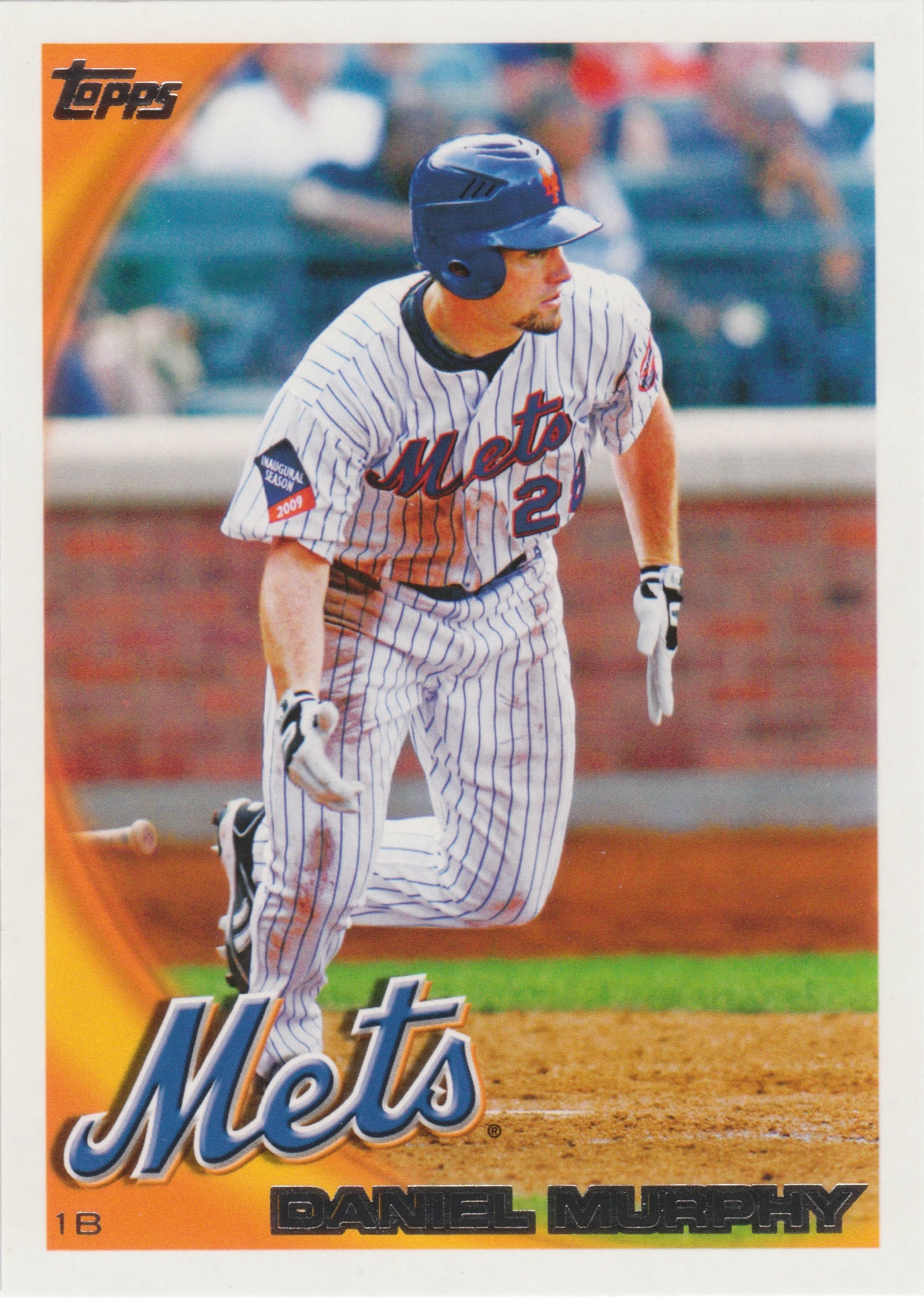
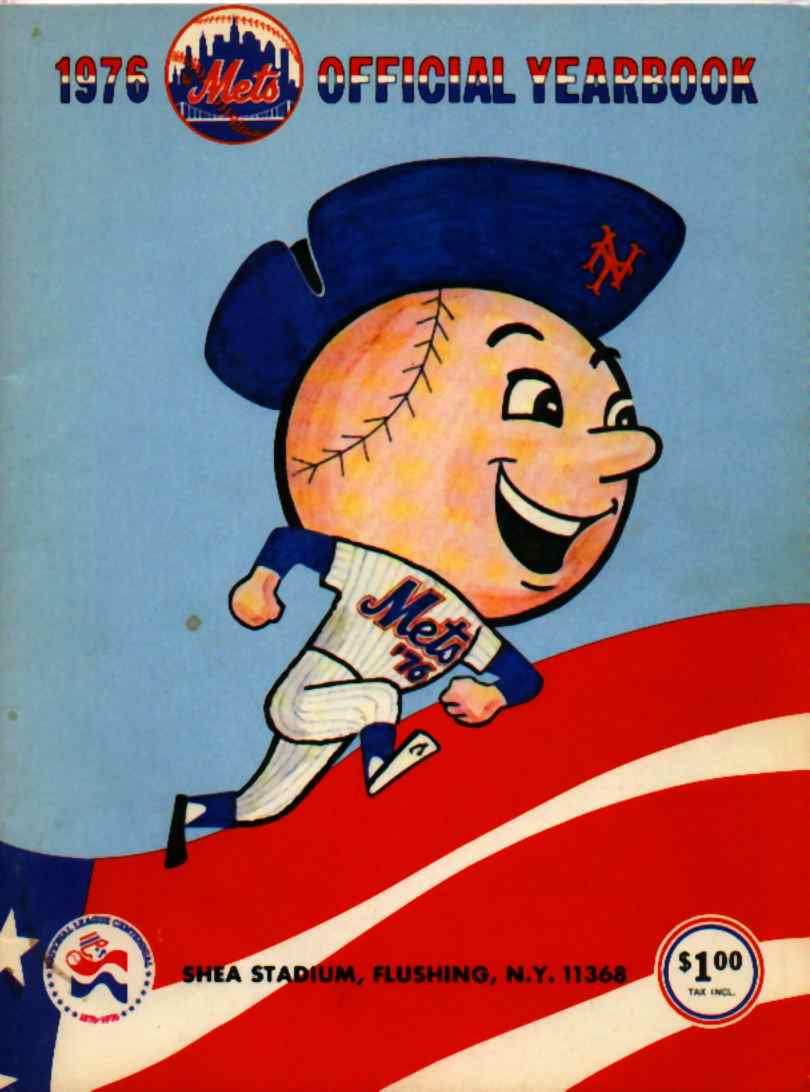
 This year’s cards are pretty nice, at least to my eyes: prominent Mets logos and cards in Met colors. (I still can’t get over that in 1976, the first year I collected, the Mets cards came in Michigan colors.) And even though there’s snow on the ground, it’s great to be able to momentarily glimpse the coming baseball summer through a little cardboard window. Flipping from Daniel Murphy’s 2009 stats back to his picture on the front, you realize spring isn’t so far away and you’ll probably make it, yet again, through the Super Bowl and the tail end of another cruel winter to the promised land of pitchers and catchers. This year’s cards are pretty nice, at least to my eyes: prominent Mets logos and cards in Met colors. (I still can’t get over that in 1976, the first year I collected, the Mets cards came in Michigan colors.) And even though there’s snow on the ground, it’s great to be able to momentarily glimpse the coming baseball summer through a little cardboard window. Flipping from Daniel Murphy’s 2009 stats back to his picture on the front, you realize spring isn’t so far away and you’ll probably make it, yet again, through the Super Bowl and the tail end of another cruel winter to the promised land of pitchers and catchers.
Still, there are odd things afoot this year. Major League Baseball has now reduced the number of card makers to one — Topps — echoing the monopoly of years past. Upper Deck is still in the game, but won’t be able to use team logos, which I suppose means it will issue cards that look like the pictures of players you used to find on wiffle-ball cartons, or the cards Topps would produce for guys who’d changed teams, with blank caps or no caps at all. (The term for the latter is BHNH — “big head no hat.” More on this in a bit.)
From the highly parochial perspective of The Holy Books this is bad news: In recent years Upper Deck did a public service by rounding up cards for the lesser lights of baseball rosters, and without competition I doubt Topps will worry overmuch about immortalizing fourth outfielders and middle relievers. From THB’s roster of 26 2009 Mets, Upper Deck was responsible for Casey Fossum, Andy Green, Pat Misch and Darren O’Day — not guys you’ve thought of much since Game 162, but Mets nonetheless.
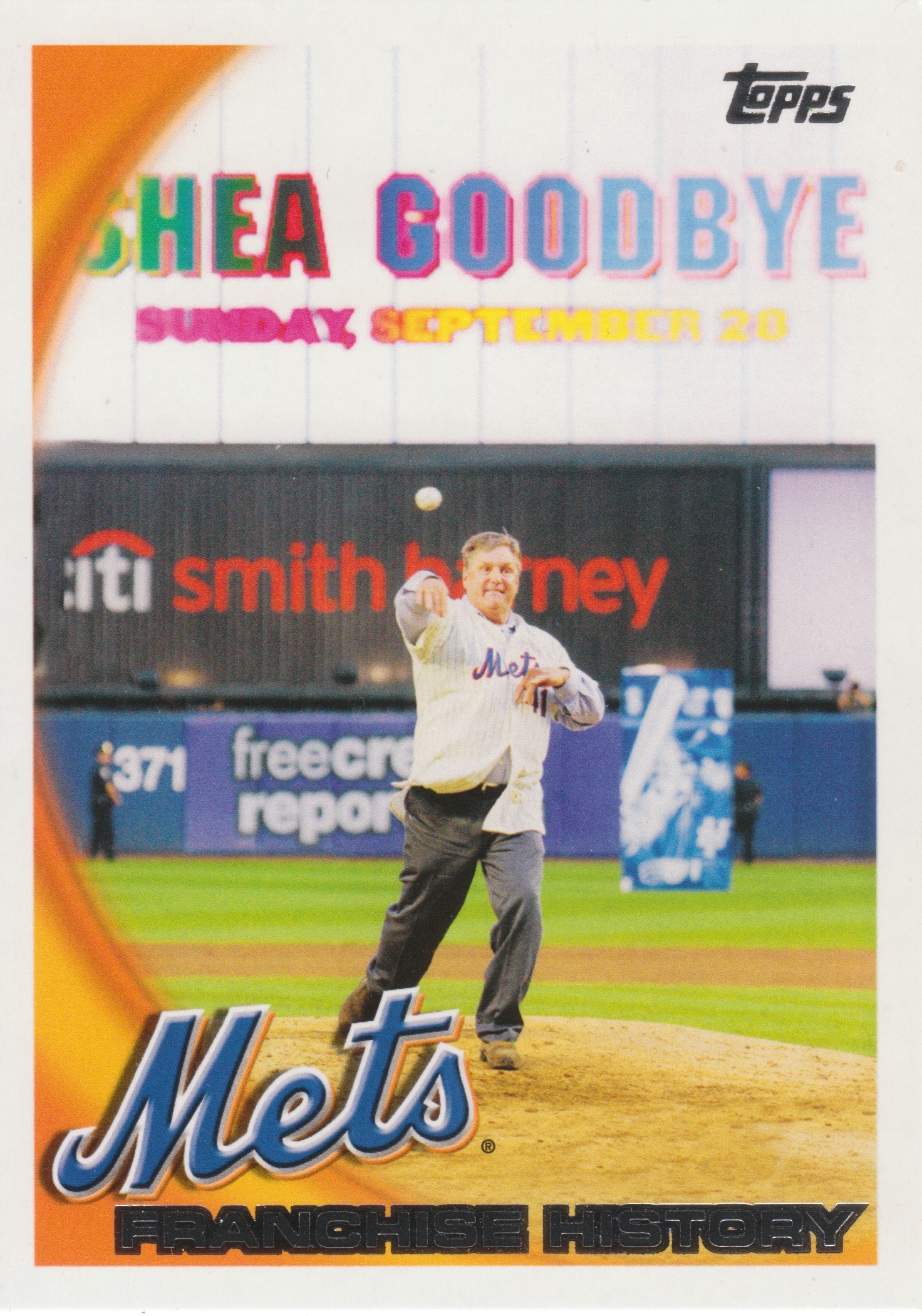
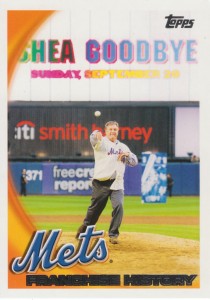 Speaking of which, 2010 Topps Series I brought new THB cards for Angel Pagan, Gary Sheffield, Fernando Martinez, Josh Thole and Stoner. Thole is an annoyance, though — he’s no longer an Eastern League All-Star, but now he’s stuck with a dreaded horizontal card. Still, at least that’s better than the franchise-history card Topps stuck the Mets with: It’s Tom Seaver tossing the closing pitch under the SHEA GOODBYE banner. Speaking of which, 2010 Topps Series I brought new THB cards for Angel Pagan, Gary Sheffield, Fernando Martinez, Josh Thole and Stoner. Thole is an annoyance, though — he’s no longer an Eastern League All-Star, but now he’s stuck with a dreaded horizontal card. Still, at least that’s better than the franchise-history card Topps stuck the Mets with: It’s Tom Seaver tossing the closing pitch under the SHEA GOODBYE banner.
No disrespect to the Franchise or the Mets’ old home, but really? That’s the image that sums up the franchise? An old player in a phony antique jersey bidding farewell to a concrete doughnut after a soul-killing loss that left fans near suicide? I suppose it’s a better fit than we’d like to admit, but can’t the positive be accentuated in a situation like this? Why not young Seaver’s knee scraping dirt? Jerry Koosman jumping into Jerry Grote’s arms? Tug McGraw slapping his glove against his knee? Ray Knight with his hands on his helmet in happy disbelief? Jesse Orosco putting his glove in orbit? Todd Pratt hoisting Robin Ventura aloft? I haven’t seen the rest of the set, but I won’t be surprised to discover that the Yankees’ franchise-history card documents Yogi Berra descending to the surface of the Moon or Derek Jeter capturing Osama bin Laden.
Speaking of franchise history, recently Mets Guy in Michigan and the Crane Pool Forum collaborated to uncover an interesting sidelight to an oddity of Mets baseball cards. There are no 1972 and 1973 Topps cards for Rusty Staub, apparently because of a contract dispute. But Staub is featured on one of the most horrifying-looking cards in Met history — a late 1970s Hostess card in which he bears an awkwardly repainted “Mets” batting helmet. (Follow either link to see it.)
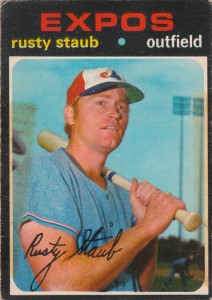 Ugly, but not exactly surprising: As MGIM chronicles nicely, lots of players from the 1960s and 1970s wound up with their new team allegiances achieved through added pinstripes, awkwardly changed colors and repainted caps. What vaults the Staub card into the ranks of the truly grotesque is that the Expos logo is still very visible on his uniform, and his added Mets pinstripes peter out in the vicinity of his right shoulder. Ugly, but not exactly surprising: As MGIM chronicles nicely, lots of players from the 1960s and 1970s wound up with their new team allegiances achieved through added pinstripes, awkwardly changed colors and repainted caps. What vaults the Staub card into the ranks of the truly grotesque is that the Expos logo is still very visible on his uniform, and his added Mets pinstripes peter out in the vicinity of his right shoulder.
The theory advanced on the Crane Pool Forum feels right: This is an unused Topps photo from the early 1970s, when Staub was an Expo, that was converted into a Met card but never used until it was handed over to Hostess. The visible Expos logo and missing pinstripes? You can see them (or not see them) because Hostess didn’t crop the photo tightly, as Topps would have done. Tighten the crop, add in a 1972 Mets overlay and RUSTY STAUB in ’72’s font, and you have what very probably would have been Staub’s 1972 card. It makes perfect sense, and it’s immensely satisfying to see.
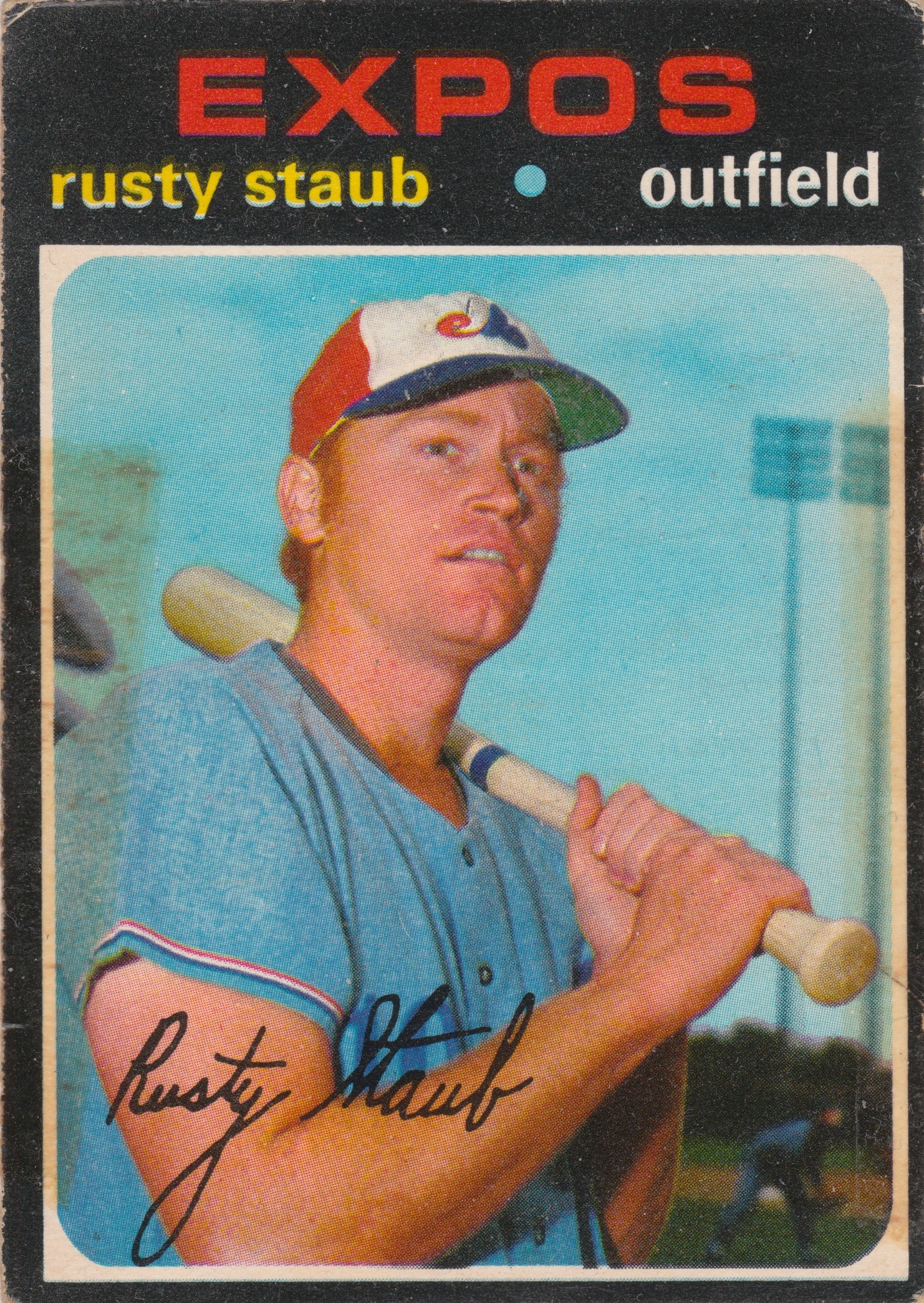
I don’t have that card, though I’m tempted to make one of my own. But I did recently get another oddball card: an alternate Rusty Staub card from 1971, before his falling-out with Topps. This one was put out in Canada by O-Pee-Chee, which used alternate shots of some Expos and added some other Montreal players to the checklist for the purposes of their domestic market. Like the reconstructed ’72 Staub, looking at my alternate ’71 Rusty gives me a little chill: A card that had escaped me exists, and for a moment I feel like a little kid pausing halfway through a wax pack to gaze at the latest treasure — a ’76 Tom Seaver, say, or even a ’77 Mike Phillips — he’ll be able to display in the neighborhood, and love until the corners are round.
And it’s not even a horizontal.
by Jason Fry on 1 February 2010 11:26 am Remember, in the wake of the Carlos Beltran fiasco, how the Mets wanted those mean people in the media and all us nasty bloggers to think about the rash of injuries that derailed the team on a case-by-case basis, instead of trying to look for patterns?
Well OK. Fair enough. Let’s evaluate these comments from J.J. Putz, in a conversation with Sox Drawer.
First Putz said that when the trade with the Mariners happened, “I never really had a physical with the Mets. I had the bone spur [in the right elbow]. It was discovered the previous year in Seattle, and it never got checked out by any other doctors until I got to spring training, and the spring training physical is kind of a formality.”
OK. That’s fairly astonishing, given Putz’s injury history, but let’s just keep on going for now.
Putz said that in April and May it was clear he was hurt, and the Mets told him not to talk about that with the media. “I knew that I wasn’t right,” he said. “I wasn’t healthy. The toughest part was having to face the media and tell them that you feel fine, even though you know there’s something wrong and they don’t want you telling them that you’re banged up.”
Putz’s conclusion: He’s learned a lesson. “That it’s my career, and when you know something doesn’t feel right, and they want to take these little sidesteps to do something, and just wait and wait and wait, you got to get it taken care of instead of trying to prolong the inevitable.”
My conclusion? I’ve got two of them.
1. Doesn’t this sound like Carlos Beltran would agree?
2. With more and more evidence out there, can anyone claim with a straight face that the Mets baseball-operations folks aren’t mindbogglingly incompetent?
Oh, I’m sorry, there I go looking for patterns again. Nasty blogger!
by Jason Fry on 31 January 2010 7:16 am Recently there’s been talk of WAR and CHONE and the first attempts to figure out what we might expect from the 2010 Mets. Amazingly, despite the three-years-early Mayan apocalypse of the 2009 season, I keep finding myself hopeful — or at least desperate for baseball to move off the winter back burner and return to its accustomed place in my brain and heart. But every time that hope begins to blossom, some horrid Metsian thing happens to tramp it back into the dirt.
No sooner was I getting used to Jason Bay and thinking about the Mets as an 83-win team that had six or seven additional wins within front-office reach than the whole Carlos Beltran disaster arrived, with the usual double whammy of terrible news and evidence of front-office incompetence.
Next came the mysterious Gary Matthews Jr. trade, for which the other shoe never dropped — but once I calmed down a bit and managed to look past the inert bulk of Luis Castillo and his continued presence on the roster, I realized it wasn’t an awful deal, not for that money. Ditto for re-signing Fernando Tatis. I still don’t understand why Tatis kept playing over Nick Evans in last year’s cruelly extended garbage time, but Jerry Manuel’s myopia isn’t his fault, and I wasn’t being fair to him. The contract is reasonable for a player who can play several positions and still hit.
But then, there was this from Ken Rosenthal: “[Joel] Pineiro identified the Mets as his No. 1 choice, but instead signed a two-year, $16 million contract with the Angels. He got tired of waiting for the Mets to sort through their other pursuits, tired of waiting for them to raise their initial offer, sources say. As negotiations intensified, the Mets were prepared to match and perhaps top the Angels’ offer for Pineiro. But by the time they turned aggressive, it was too late.”
Follow that with this, from David Waldstein in the New York Times: “John Smoltz, who turns 43 in May and would like to extend his Hall of Fame career, has received 2010 contract offers from several teams, his agent, Lonnie Cooper, said Wednesday. The Mets, however, are not among those clubs, Cooper added, even though they have expressed some interest in Smoltz … The lack of an offer does not necessarily mean the Mets have only passing interest in Smoltz. It does signal that the Mets are continuing their off-season negotiating posture, which, for the most part, has not been an aggressive one. Although they are widely viewed as a team in need of starting pitching, they have let other clubs outbid them for free agents like Ben Sheets, Jon Garland and Joel Piniero. In each instance, they did not appear to put up much of a fight, or any fight at all.”
Our team’s problem this off-season hasn’t necessarily been being outbid, though there are questions there, too. Rather, it sounds like it’s been basic communication and organization. Which is where Gary Matthews becomes an interesting bellwether.
No, not Junior, back for second tour of Met duty. I’m thinking about his dad, the Sarge — the ruthless outfielder who helped sink the 1984 Mets and liked slamming into Gary Carter at the plate and ripping him in national magazines.
Matthews has another infamous distinction in Mets history. He was one of the members of the inaugural free-agent class, post-McNally and Messersmith, and the player who seemed to interest the Mets the most. So in late 1976 Joe McDonald and M. Donald Grant made that interest plain — by sending Matthews a telegram asking him to contact the team. (He wound up signing with the Atlanta Braves.)
Another offseason, another front office that appears not to know what it’s doing, calls that don’t get made, players who move on. And the exact same name in the middle of it. Then it was the father, now it’s the son. I’m not much for superstition, but that doesn’t strike me as a good omen.
by Greg Prince on 30 January 2010 7:17 am If ever a cold January morning called for a round of the Mexican Hat Dance, this is it. It’s a good time to hear Jane Jarvis on the Thomas Organ welcoming us to Shea Stadium. It’s a good time to lean forward in anticipation of an afternoon in the sun with the Mets and a hot dog and whatever the next nine innings will bring.
It’s a good time to close our eyes and hear Jane Jarvis play something peppy.
Jane Jarvis died Monday at the age of 94, the New York Times reports. She outlived Shea. She outlived the organ as the prime source of pregame and between-innings entertainment. She lived a very long time and accomplished a great deal as a musician and music executive. She lives on for every Mets fan who ever clapped or tapped along to whatever she played. Jane Jarvis was as much the Mets as anybody or anything else between 1964 and 1979. For those of us enchanted by the Melody Queen of Shea Stadium, she’s always going to be synonymous with some of the best days of our lives.
This is where I tell my Jane Jarvis story. It’s not from Shea. It’s from long after she was on the active roster. It’s from just over six years ago, the fall of 2003, at the senior center my wife runs in midtown Manhattan. The church that houses the center hosts weekly jazz concerts. The star of one of those shows? None other than Ms. Jane Jarvis, then nearly 88 — one year for every key on the piano.
“Jane Jarvis is playing at the center Wednesday,” Stephanie told me. “Do you want to come?” It was like one of those cartoons in which the person on the other end of the conversation leaves his chair spinning and a cloud of dust behind before the question is completed.
There I was, and there she was, Jane Jarvis, playing with a small combo, playing with style and grace to a packed house, playing everything on the jazz menu that afternoon. The audience was loving it. They thought they were hearing it all. I was loving it, too, except I wanted to order off the menu. The jazz was tasty, but I wasn’t there to hear all that jazz. I wasn’t going to say that, of course, but my wife is pretty good at reading my Met mind and knowing what I wanted to hear.
The show was ending. Stephanie, as emcee of the event, informed the audience that in case you didn’t know it, Ms. Jarvis was the organist at Shea Stadium for many years and if we all encourage her, maybe she’ll give us a little of her signature tune. This wasn’t a crowd of baseball fans (I think her Shea credentials came as news to most of them) but they were up for it. Everybody applauded.
Jane had this look of “I’ve been a serious musician for 75 years and you want to hear what?” But, pro’s pro, she departed from her set list and dove right in to “Meet The Mets”. It was just a few bars, but it was dreamy.
Until she segued into the other song I associate with Jane Jarvis: “The Mexican Hat Dance”. And that was off the charts thrilling. Jane Jarvis’ “Mexican Hat Dance” is the ultimate pregame soundtrack in my mind. Always will be. And here it was, a command performance almost.
The audience in the church knew exactly when to clap. Just as I did that autumn afternoon. Just as I am right now, in appreciation for making our Mets life that much more joyful.
After her 2003 performance, I brought my Meet The Mets CD from up to the piano, thanked her for playing those two songs and asked her to autograph the liner notes. She did so, regally. Why not? She’s Jane Jarvis, Shea Stadium’s Queen of Melody. Her playing will always rule.
A musician’s perspective on the life of Jane Jarvis is offered here by Ann Ruckert.
by Greg Prince on 29 January 2010 6:22 am 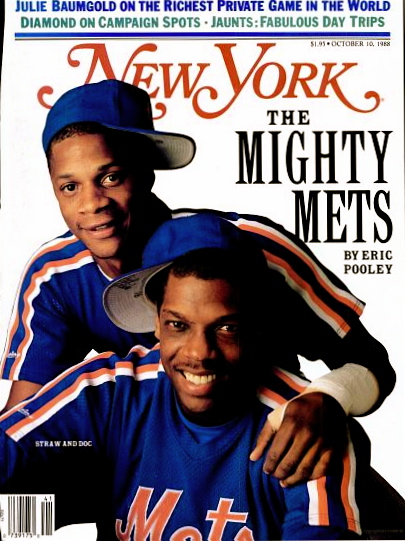
It’s nice to know who you are, even if you don’t always buy into it, even if who you are keeps on changing. For example, per a request made here several weeks ago, Andre Dawson will be going into the Hall of Fame as a Montreal Expo, making thousands of dispossessed ‘Spos fans (if not Dawson) very happy. For history’s sake — or Cooperstown’s sanctioned version of it — we know Andre Dawson as an Expo.
Then there’s a certain edifice in South Florida, close to the Dade-Broward border. It is now known as Sun Life Stadium. What’s Sun Life? My first guess was a tanning oil concern. My second guess was a marketer of vitamins that were once subject to government recall. Two strikes, so I looked it up: Sun Life is a Canadian insurance concern. Why is a Canadian insurance concern’s name on a stadium in South Florida just in time for the football game that will be played there February 7 when Andre Dawson is reluctantly wearing the cap of a Canadian team for whom he actually starred? I assume money is involved. Sun Life Stadium was, for about twenty minutes, Land Shark Stadium. Before (and after) that it was Dolphin Stadium. Prior to that? Working backwards, it was Pro Player Stadium, Pro Player Park (quite the distinction from Pro Player Stadium) and, when the Florida Marlins moved in there in 1993, Joe Robbie Stadium.
The Marlins are scheduled to move out in 2012, but I get the idea that the building is trying to tell them to get lost already. I’m sure their mail already has, several times over.
Honest to Gosger, who besides those who are paid to do so is going to call it Sun Life Stadium? We like to call it Soilmaster Stadium since there are sacks of the stuff visible in the Mets’ dugout every time the Mets play there. Funny how they found the time to change the name of the stadium every few weeks but they never could build a proper storage shed. But when we’re not mocking the home of the Fish, I still instinctively refer to it as Joe Robbie. Joe Robbie was a guy, not a company. Joe Robbie Stadium is a better identity, no matter what whoever makes these decisions nowadays thinks.
This brings us to the Mets, who will be playing in Mets caps (several variations, per usual) at Citi Field (name holding surprisingly steady after one fiscal year) in 2010. While the Mets can boast of bits of stability where those sorts of ancillary issues are concerned, it seems their identity is up for grabs. Let’s hope it is, because the one being built on their behalf at the moment is not one you’d seek.
As if you hadn’t noticed.
At the slightest provocation, a well-known baseball columnist or two will remind us that the Mets look bad in winter and are likely to get worse come spring. Response from there, whether it be online, on the air or deep within the souls of most every Mets fan paying attention, tends to echo or expand upon the broader points of these scathing critiques — albeit with a modest dose of “everybody stop being so negative!” backlash to the backlash put forth in the name of loyalty or, perhaps, self-preservation. With every wave of anxiety washing over Metsopotamia, we form an ever less impressive identity for our Mets. If they were in a police lineup, surely we’d finger the most hopeless, hapless, clueless group of suspects and declare, “THAT’S THEM! WE’D RECOGNIZE THAT DIM-WITTED EXPRESSION ANYWHERE!”
We wouldn’t necessarily be wrong. But we wouldn’t necessarily be right.
The penultimate episode of my favorite dramatic series ever (television series, I should clarify; my favorite dramatic series ever was the ’99 NLCS), Six Feet Under, was entitled “Static”. Why static? Take this exchange between Claire, the grieving youngest daughter of the Fisher family and Nate, her recently deceased brother over whom she is grieving and thus talking to only in her imagination:
Nate: Stop listening to the static.
Claire: What the fuck does that mean?
Nate: Nothing. It just means that everything in the world is like this transmission, making its way across the dark. But everything — death, life, everything — it’s all completely suffused with static. You know? But if you listen to the static too much, it fucks you up.
This is, for Mets fans, the season of static. There’s no baseball and there’s no movement toward perfecting a baseball team once there is. There’s only, you know, re-signing Fernando Tatis and generating buzz about Josh Fogg. It’s not substantive to us. Substance is a pool of Mets making us anticipate Opening Day. It’s a 25-man roster coalescing into a contender. It’s superstar center fielders healing rather than being subject to lawsuits and such.
Little wonder the Mets’ identity is frayed. No wonder the Metsosphere is continuously and maybe justifiably staticky, jittery and expressing discontent. We are, by nature, a gaggle of nervous crosstalkers when we don’t have an actual season to dissect. Right now it’s all nervous crosstalk for Mets fans. We, collectively, remind me of the middle-aged ladies who’d set up card tables in front of somebody’s cabana at the beach club to which my parents belonged when I was little. (That’s the Sun Life I remember.) Those ladies indulged in nervous crosstalk, too, just like us. All we’re missing is four floppy hats, a carton of Tareytons and a few hands of canasta.
Just walking by them made me jittery, and I was only six.
We don’t have any Mets games right now, so naturally we’ll look at anything Mets-related on the card table and tear into it like it’s the Slenderella platter the cabana boy might bring these ladies who lunched. We look at the Mets not signing a passel of seemingly suitable pitchers and we’re pretty sure that all we’re gonna be left with to start the season is a scoop of cottage cheese, a cling peach slice and a naked hamburger patty. We have pitchers who have regressed, pitchers who are rehabbing, pitchers who loom as ridiculous…and, as if to save time in rounding up all three, Oliver Perez. Even if we expect Johan Santana to be fully recovered and routinely wonderful, that makes the projected rotation no better than Exclamation Mark and the Mysterians…with the lot of us poised to cry 2010 tears.
No, as Matt Artus implies at Always Amazin’, the state of our union is far from robust. And yeah, I get why confidence in anyone responsible for organizing or comprising these Mets is not in abundance. I don’t care for the piling on by the Rosenthals and Klapisches (and idiots with undeserved platforms), but I’m also not ready to sell backlash to the backlash. I didn’t buy into the 2009 Mets going into last season when all components seemed to be functioning, and I didn’t take comfort in their briefly splendid record before everything went to health — not when fundamentals-free baseball was running rampant. I don’t have a lot of faith in the 2010 Mets at this juncture either, whatever their best-case potential may be; it’s been a while since I’ve seen a Met case acquit itself as a best case. There’s nothing wrong if your discernment leads you to a “negative” assessment of this team’s short- and long-term prospects if, in fact, you honestly assess the Metscape and detect that things are irredeemably awry.
However, they may not be.
This is where I’d love to provide insight and comfort as to why this will be a fine, fine season after all. Alas, I’m afraid I don’t have a silver bullet emblazoned with some secret statistical formula that will prove we are not doomed to mediocrity in 2010. What I have — besides no proof that we are inevitably doomed to mediocrity — are a couple of bits of encouraging precedent, neither of which amounts to Pollyannish positivity, each of which is likely irrelevant, but both of which are better than nothing.
We were supposed to suck in 1984. It was habit, even if I personally didn’t see it that way that winter, despite the spirit-dampening loss of Tom Seaver to the White Sox. The year before we had managed to accumulate at least half a lineup that didn’t suck: Hernandez at first, Brooks at third, Wilson in center, Strawberry in right. George Foster had recovered from his mighty plunge in 1982 to knock 90 runs home in ’83. Junior Ortiz, Brian Giles and Jose Oquendo all showed flashes. No, I thought, we won’t suck. But I didn’t see us jumping all the way from last to second with a pleasant summer’s stayover in first. I didn’t see Dwight Gooden’s medical degree. I didn’t know what a difference Davey Johnson was going to make or how Mike Fitzgerald, Wally Backman and Ron Gardenhire would be upgrades over Ortiz, Giles and Oquendo at catcher, second and short.
I chuckled a bit the other day as I read a post on the prolific and addictive Mets Police site wherein our busy blolleague Shannon Shark bemoaned the Mets’ lack of a brand, which is a cousin, I suppose, of identity. “In the mid ’80s,” the Police chief wrote, “there was a swagger. I think Keith Hernandez personifies it. If you throw another fastball I will punch you. There was a swagger. It was very New York.” I chuckled because, while I don’t think that’s an inaccurate portrayal of those times, winning is what gave the Mets their swagger, their punch, their brand, their whatever. It’s amazing what winning will do for you. When you win, you don’t need an identity. You’re a winner. Everything else is subtext. The mid-’80s Mets started out in 1984 as perennial doormats. They rose from there. Next thing you know: swagger.
The Mets were going to suck in 1984, according to conventional wisdom. Or, according to mine, they couldn’t help but be somewhat better but probably not all that great. We were all wrong. They were an unforeseen contender, the best kind.
We were supposed to suck in 1997. It was also habit. I saw it that way, too. We were the Mets who fell below .500 in 1991 and stayed there for six seasons. There were no big free agent signings after 1996. There was also no sense of competence percolating à la 1984. None of the pitchers on whom the Mets had counted in ’96, the instantly mythic Generation K trio of Izzy, Pulse and Paul, would be available by Opening Day (or, as it turned out, September). Three position players compiled awesome 1996es, yet even with Todd Hundley, Lance Johnson and Bernard Gilkey producing at their highest levels fathomable, we still lost 91 games. What new dismay awaited us next?
Little to none, it turned out. Bobby Valentine, who took over for Dallas Green at the tail end of the previous season, found guys he and he alone counted on. Or maybe GM Joe McIlvaine hadn’t found him anybody better and Bobby learned to cope. However it came to be, journeyman Rick Reed emerged as a superb second starter; overlooked ex-Rockie Armando Reynoso contributed win after win in the early going; the preternaturally obscure Brian Bohanon picked up significant slack after Reynoso succumbed to injury; guys who projected as Tides if anything at all — Matt Franco, Jason Hardtke, Luis Lopez — appeared from almost nowhere to fill in ably. If you were told that this collection of nowhere men would fashion a key to success, you would have scoffed as you’d been conditioned to since 1991.
But Valentine’s sweethearts were difference-makers. As were Edgardo Alfonzo, who was promoted from utility player and emerged as one of the best third basemen in the league once Bobby entrusted him with the job; and Butch Huskey, woefully miscast at third, but utterly useful in right; and a salvaged John Olerud, deteriorating in Toronto, resurgent in Queens; and heretofore unspectacular Bobby Jones, suddenly among the best pitchers in baseball for three months; and Carl Everett, who, for a time, harnessed his talent and plugged whatever hole developed in the outfield.
Funny how Valentine’s hunches, calculations and strategies worked out in light of what didn’t click. Hundley put up good if lesser power numbers compared to 1996. Gilkey slumped almost endlessly. Johnson was injured and eventually traded. The previous year’s great outfield hope, Alex Ochoa, took a nosedive. A herd of relievers — Toby Borland, Ricardo Jordan, Barry Manuel, Yorkis Perez — imported to improve upon the smoldering wreckage wrought by Jerry DiPoto, Doug Henry and other best-forgotten 1996 perpetrators actually proved worse in the clutch than their predecessors. Plenty of the things you would have figured had to go right for the ’97 Mets to be any better than the ’96 Mets didn’t occur…yet the ’97 Mets were way better than the ’96 Mets. They broke the franchise’s six-year losing streak, won 88 games and competed tenaciously for the Wild Card into September. As in ’84, a new and happier era of Mets baseball commenced.
Nobody saw it coming.
Neither of these heartwarming examples guarantees anything for the 2010 Mets. We don’t have a new or almost-new manager implementing a new and improved vision. There doesn’t appear to be a Doc Gooden, Ron Darling, Walt Terrell or Sid Fernandez warming up in the wings. There could be the kind of unnoticed or underappreciated gem glistening out of common view right now, the way the talents of Reed and Alfonzo revealed themselves to Valentine before the rest of us could get a good look, but that may require too much blind faith for even those who Gotta Believe to count on. Ultimately, searching for solace in 26- and 13-year-old aberrational examples isn’t the most encouraging way to usher in February, but those seasons did happen. Could they happen again real soon?
Probably not, but we don’t know, do we? I imagine we’ll be able to identify some semblance of success if we happen to stumble upon it.
by Greg Prince on 28 January 2010 8:32 am 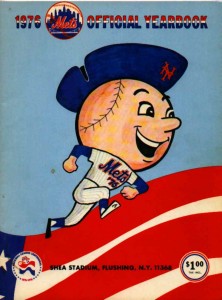 The program guide function on my TV indicates that tonight at 7:30, SNY resumes the best series in the history of the medium, Mets Yearbook, with the highlight-film spotlight shining on what would turn out to be the last good Met year for a very long time, 1976. Those Mets muddled through the first four months of their season, fell completely out of contention early, but then revved themselves up for a faaan-tastic finish. The program guide function on my TV indicates that tonight at 7:30, SNY resumes the best series in the history of the medium, Mets Yearbook, with the highlight-film spotlight shining on what would turn out to be the last good Met year for a very long time, 1976. Those Mets muddled through the first four months of their season, fell completely out of contention early, but then revved themselves up for a faaan-tastic finish.
Technically speaking, the finish was a rather tepid third, but there was an encouraging stretch of baseball in August and September (34-21) — not enough to give you hope for an N.L. East title run, but plenty to make you forget how quickly things in the post-Payson era were deteriorating. We’d figure that out come 1977, but never mind that right now. Tune in cheerfully and discover just how willingly we deceived ourselves back in the day when we had Jerry Koosman going for 20, Dave Kingman going for 56, John Milner going for grand slams, Lee Mazzilli going to the plate for the first time ever and Mickey Lolich going as quickly as he came. I’m guessing, if not necessarily hoping, that there will be a Pepe Mangual sighting as well.
Stay tuned afterwards for an encore presentation of Mets Yearbook: 1984, marking what would turn out to be the first Met good year in a very long time…first good Met year since 1976, actually.
Sigh.
Image courtesy of kcmets.com.
|
|

 It’s September 2009. The last thing I want to do is give the Mets more of my money. But there I am, at Citi Field, in the team store browsing, when I see a sign advising me that player number t-shirts are on SALE.