The blog for Mets fans
who like to read
ABOUT US

Faith and Fear in Flushing made its debut on Feb. 16, 2005, the brainchild of two longtime friends and lifelong Met fans.
Greg Prince discovered the Mets when he was 6, during the magical summer of 1969. He is a Long Island-based writer, editor and communications consultant. Contact him here.
Jason Fry is a Brooklyn writer whose first memories include his mom leaping up and down cheering for Rusty Staub. Check out his other writing here.
Got something to say? Leave a comment, or email us at faithandfear@gmail.com. (Sorry, but we have no interest in ads, sponsored content or guest posts.)
Need our RSS feed? It's here.
Visit our Facebook page, or drop by the personal pages for Greg and Jason.
Or follow us on Twitter: Here's Greg, and here's Jason.
|
by Greg Prince on 23 October 2009 7:28 am Welcome to Flashback Friday: I Saw The Decade End, a milestone-anniversary salute to the New York Mets of 1969, 1979, 1989 and 1999. Each week, we immerse ourselves in or at least touch upon something that transpired within the Metsian realm 40, 30, 20 or 10 years ago. Amazin’ or not, here it comes.
Let others, for now, stew over what would be the worst World Series outcome possible. A Phillie repeat? A Yankee return? One is a kick in the head. The other is a kick in the groin. The key word here is kick; the key result is pain. Don’t sweat it. Perspire, instead, over this baseball conundrum:
Which was the worst Mets season ever: 1979 or 1993?
Why ask? Besides, “Why not?” Well, as part of this year’s salute to the way Met decades have ended, I’ve intermittently alighted on 1979, inevitably pointing out its seemingly limitless depths of despair. The bottom line with ’79 is always that it represented the bottom of the barrel. Yet I know it shares that barrel bottom with another Mets season, 1993, a year whose chronic shame I’ve managed to recurringly harp on with and without the impetus of an obvious Flashback angle. I’ve been pissed off at both of them for ages. Hence, to me and to history, 1979 and 1993 go together in dreggy fashion the way that 1969 sits alongside 1986 at the top of the Met heap.
Yet I see no point in choosing between world championships to determine which one of those was better. They’re both great, they’re both awesome, they’re both unsurpassed — even by one another. When you only have two world championships, there’s no point in slighting one to honor the other. They’re like our kidneys. I don’t want to do anything to damage either.
Worst on the other hand…I know either ’79 or ’93 must take the dishonors, I’m just not sure which. That’s what we’re going to try to determine here today.
Those years are our only two choices, by the way. This is not an open-ended question like Jason’s September query regarding most disappointing Mets season. I’m not looking for nuance here. I don’t seek to delineate disappointing from devastating. I’m not looking to calibrate my definition of worst. When I say worst, I mean worst, as in so thuddingly bad you don’t have to think about it.
And there are only two candidates. There’s 1979. There’s 1993. That’s it. There can be no other.
Not grisly 2003.
Not mortifying 2002.
Not dismal 1996.
Not wretched 1992.
Not godforsaken 1982.
Not abominable 1977 (treacherous, but at least Seaver was around for some of it).
Not hideous 1967 (dispiriting, but at least Seaver was around for all of it).
Not the 40-120, 51-111, 53-109, 50-112 quadfecta of 1962-65.
No, not even 2009, a six-month Met nightmare whose misery only Mets fans could find a way to extend without the benefit of actual playoff participation.
2009 continues to be the essence of crummy. I hated it. You hated it. We all hated it. The wounds are too fresh not to still be ruing. Yet 2009 was the bleepin’ Catalina Wine Mixer when juxtaposed with our loathsome finalists. 2009? We were in first place in May. We were a game out in July. We entertained vaguely plausible Wild Card hopes as we entered August.
Don’t give me 2009. Don’t give me 2003. Don’t give me 1992. Don’t give me 1977. And I won’t accept anything from before 1969.
Y’know why? Because no Met years compare to 1979 and 1993 for utter badness, total despair, relentless hopelessness and a crystal-clear indication that the end time was nigh. You could compare and contrast 1979 and 1993 with other losing propositions, and maybe some other season would sneak ahead on points and make a case as worse than the Dyspeptic Duo…but that’s won’t be necessary, for I’ve done my own unique brand of intensive research to narrow down our choices to two.
Here is what was involved:
1) I lived through 1979 as a Mets fan.
2) I lived through 1993 as a Mets fan.
3) I survived.
I know about Worst Teams That Money Could Buy. I know about Tom Seaver and Dave Kingman being traded. I know Grant Roberts, Mark Corey and Tony Tarasco were allegedly high on everything but performance. But those are early-round losers from my perspective. They were bad, but they weren’t super bad. They weren’t 1979 bad or 1993 bad.
Only 1979 and 1993 answer to those fetid descriptions.
Saturday Night Live once did a game show sketch called ¿Quién es Mas Macho? in which the object was to determine which Latin leading man was the most manly. Por ejemplo, Ricardo Montalban or Fernando Lamas? It is in that spirit that we now present our own take on the concept: ¿Cuál es Mas Mal?
That is to ask, which is more bad: 1979 or 1993?
We wish both our entrants the worst possible luck.
RECORD
The most simple measurement is to look at wins and losses. The ’79 club went a horrendous 63-99, the worst Mets mark since 1967, when the Mets could still be reasonably excused for being at the tail-end of their expansion mode. The ’93 team went 59-103, worst Mets mark since the last of the original (if pardonable) dark days of 1965. As a bonus, the ’93 Mets sank from 8-7 to 21-52 at one point, never winning as many as two consecutive games — that’s two months of 13-45 baseball, a clip worse than Casey Stengel’s first Mets club registered for all of 1962. Records don’t say everything where awfulness is concerned. No record was worse than 1962’s and I’m told, all things considered, it wasn’t so bad. The records sure as hell say something here.
Mas Mal Record: 1993
OUTLOOK
The 1993 Mets were actually considered a contender in the National League East that spring. The conventional wisdom was they were hamstrung by injuries in ’92, and all their high-priced talent would surely bounce back from what had to be an aberrational annum (you might want to file that sort of appraisal away for when you start hearing it from men named Wilpon and Minaya this winter). There was nothing but doom predicted for the 1979 Mets. They were awful in ’78, they’d be at least just as bad. Hence, one team lived down to its perceived capabilities, one crashed versus expectations. Maybe it’s a personal preference, but I’d rather have a little false hope going into April. I can always get depressed later.
Mas Mal Outlook: 1979
SAGGING START
After an exhilarating 10-6 win on Opening Day, the Post‘s back page snorted that the Mets were in first. Ha-ha, big joke. The Mets would climb to 2-0 and stay tied for the top spot. After five games, they were 3-2, a game behind the front-running Expos. And that would be that for winning records in 1979. Before another victory could be chalked up, a six-game losing streak would ensue. The die was cast for another lousy season. Fourteen years later, the Mets had their way with the brand new Colorado Rockies to start 1993. Their 2-0 start was spoiled when they were swept at home by the Astros. Well, those things happen. The Mets went to Denver, took two in a row and appeared righted. They lost the finale, but couldn’t beat the Rockies like a drum forever. Two wins in Cincinnati was more like it. The Mets were 6-4…and would never be as many as two games over .500 again. It took 17 games to establish a losing record, 22 games (8-14) to signify something was really off about 1993. They had the same mark the ’79 Mets had at the same juncture.
Mas Mal Sagging Start: Push
SIGNAL EVENTS
You knew it was going to be dreadful in 1979 when Charles Shipman Payson, widower of Joan, declared he’d had enough and planned to sell the team out from under his daughter Lorinda. Why, you might wonder, was that dreadful? Good Mets fans everywhere prayed for new ownership. The dreadful part was that Charles, who was uninvolved in operation of the team, revealed he was a Red Sox fan. Good bleeping god, the guy who technically sort of owns the team doesn’t even root for the team. More tangibly, the Mets played games of fourteen, eleven and twelve innings versus Montreal in early April and lost each of them. Over in 1993, while Bobby Bonilla was etching his personal aesthetic onto the schedule by threatening to show Worst Team co-author Bob Klapisch one borough or another, Eddie Murray was grumbling early and often that umpires were out to get him. They were indeed ejecting him at home plate for arguing and not getting out of his line of sight at second base when he requested. Eddie Murray had come to the Mets the year before with a reputation as one of the revered players in the game. Now he couldn’t get a break from the men in blue. If a surefire Hall of Famer couldn’t be cut slack, what Met would be?
Mas Mal Signal Events: 1993
ROSTER PHILOSOPHY
The 1993 Mets were loaded with credentials coming out of St. Lucie, even if those credentials had been cheapened in 1992. Murray, Bonilla, Coleman, Saberhagen, Gooden, Johnson, Franco, good old Sid Fernandez, newly minted Met Tony Fernandez, even ancient Frank Tanana — All-Stars every one of ’em…some even recently. The 1979 Mets were built on the cheap. How cheap? So cheap Joe Torre wasn’t permitted to keep his own Tanana, Nelson Briles, who came with a price tag of $60,000 — which wasn’t a lot, not even then. Forget your extravagances, Joe: It’s rookies and perpetual prospects for the ’79ers. Even Dick Young mentioned in print and on TV how cheap the Mets had gotten. Dick Young!
Mas Mal Roster Philosophy: 1979
APOCALYPTIC EPISODE
The 1993 Mets fired their manager in May and their general manager in July. The 1979 Mets honored Pete Rose in April. Jeff Torborg and Al Harazin deserved what they got. Pete Rose did not.
Mas Mal Apocalyptic Episode: 1979
UNWANTED ATTENTION
The 1993 Mets became a local joke early and a national joke late. There was all the losing. There were all the hijinks, most notorious among them Vince Coleman’s firecracker. There was more losing. There was record-setting losing. At the point when they should have faded into obscurity, David Letterman debuted his CBS show and made the Mets his go-to punchline. Jay Leno, meanwhile, had Anthony Young on to commemorate the end of his losing streak. The 1979 Mets, on the other hand, disappeared quickly. Nobody expected a thing out of them and they delivered. Call me a masochist, but I prefer existing, even horribly, to completely evaporating. Nevertheless, there’s something to be said for keeping your losing to yourself.
Mas Mal Unwanted Attention: 1993
FREAK INJURIES
Lee Mazzilli was the only Met regularly exceeding expectations in 1979. Thus, we shuddered when Dan Norman ran smack into him and Lee required a stretcher. Nothing terrible came of it, fortunately (except for the realization that that was the hardest hitting Dan Norman would ever do as a Met). In 1993, Vince Coleman’s backswing of a golf club in the clubhouse (well, it is a clubhouse) nailed Doc Gooden in the ear. Tony Fernandez missed time with a kidney stone. He was traded for Darrin Jackson, a dependable outfielder in other stops. With the Mets, he contracted a thyroid condition called Graves Disease, an affliction made famous by Barbara Bush that same year. Those were the kinds of things that happened to 1993 Mets, who played like former First Ladies — though perhaps without as much guts.
Mas Mal Freak Injuries: 1993
DESOLATION
788,905. For as long as I live, I will know the 1979 Mets home attendance. I had time to count it. The 1993 attendance was respectable on paper (seven figures, anyway) because it was the first year the N.L. used the phony A.L. method counting tickets sold. Lots of tickets sold to Shea Stadium in 1993 went unused. Somebody told me her temple was having a charity auction. When four box seats to a Mets-Dodgers came up for bid, there was awkward silence then nervous laughter. The ’93 Mets weren’t even a good charity case. But somebody actually bought those tickets in the first place, even if nobody wanted them later. No religion would have blessed the 1979 Mets, not even the really compassionate ones.
Mas Mal Desolation: 1979
PEER PRESSURE
Variations on “Mets suck, you suck” were well in vogue before 1979. Like we didn’t realize that. It stung more in high school than it would in adulthood. It was said in more polite terms among adults, but the 1993 comprehension that the Mets sucked all over again and, that on some level, we would have to bear the brunt of their suckiness was not welcome. As a grown-up, I was more pitied than mocked. Plus the Yankee thing was just revving up in ’93. In ’79, they were coming off two world championships. Did I mention high school?
Mas Mal Peer Pressure: 1979
ICON OF AWFULNESS
Richie Hebner didn’t want to be a 1979 Met. He made it clear in advance he didn’t want to be a 1979 Met. So the Mets went out and traded for him. He never stopped not wanting to be a 1979 Met. His words and deeds affirmed it. Vince Coleman didn’t want to be a baseball player or a responsible citizen from the looks of how he behaved. He would have been a vile presence on any team. Throwing the firecracker at a girl in the Dodger Stadium parking lot was the last straw. He was whisked from active duty and eventually released. Richie Hebner gave Mets fans the two-armed salute when booed. He was maintained for the balance of the season before being traded to Detroit. Boy, this is a tough one. Both were incredible a-holes. I’d say nobody got literally burned by Hebner, but that doesn’t take into account psyches. Honestly, this is like choosing between the Phillies and the Yankees in the thus-far hypothetical 2009 World Series.
Mas Mal Icon Of Awfulness: Push
HORRIBLE PITCHER
Frank Tanana couldn’t break glass. Eric Hillman couldn’t crease Saran Wrap. Mike Maddux simply couldn’t get anybody out. But when you’re talking pitching on the 1993 Mets, you’re talking Anthony Young, 1-16. Yes, a hard-luck 1-16, but it couldn’t all be luck. Sometimes you make your own luck. AY manufactured 27 consecutive losses over two seasons. He had a hand in them, certainly. In 1979, Pete Falcone compiled a 6-14 record, as we learned he had concentration problems on the mound. I wonder what else he had to think about besides the batter and the three runners he put on base. Still, he won six games; Wayne Twitchell won five; Dale Murray, the master of disaster, won four. How could Anthony Young not win even one for almost two years?
Mas Mal Horrible Pitcher: 1993
EMBLEM OF EMBARRASSMENT
The 1979 Mets gave the world Mettle the Mule. He was paraded around the warning track before the games and was supposed to deliver clean baseballs to the umpires during games. As if those baseballs would have remained clean had this harebrained scheme actually been implemented. The de Roulet daughters, promotional geniuses behind Mettle, actually wanted to use batting practice balls in games. Would have saved money, never mind that it wasn’t up to code. The 1993 Mets did not bother any animals, except when Bret Saberhagen filled his toy rifle with Clorox and pumped it in the direction of a pack of beat writers. Hey, maybe Whitney and Bebe could have bleached the used balls white!
Mas Mal Emblem Of Embarrassment: 1979
ALL-STAR REPRESENTATION
Lee Mazzilli was the fleeting feelgood story of the ’79 Mets. His appearance in the All-Star Game was the year’s highlight: a game-tying home run off Ron Guidry, a game-winning walk off Jim Kern. And John Stearns was in attendance at the Kingdome to cheer him on. The ’93 Mets were represented at Camden Yards by Bobby Bonilla. None of us particularly cared if he ever came back.
Mas Mal All-Star Representation: 1993
DIMMING LUMINARY FROM A BETTER TIME
The ’93 Mets still had three ’86 Mets in the house: Doc, Sid, HoJo. Gooden, then 28, wasn’t what he was, but he was still pretty good considering his supporting cast: 12-15, 3.45 ERA. The only 1969 Met hanging in there in 1979, was Ed Kranepool. Eddie, 34, unwittingly played his last game on September 30, going out a .232 hitter and .162 pinch-hitter.
Mas Mal Dimming Luminary From A Better Time: 1979
YOUTH OF AMERICA
You couldn’t tell much from their first-year performances, but four 1979 rookie Mets would go on to make quite an impact, if not necessarily as Mets. Mike Scott would be a Met bane; Neil Allen would be Met bait that snagged Keith Hernandez; Jeff Reardon would become a first-class closer elsewhere; and young Jesse Orosco, pitching in relief Opening Day only because of how cheap the Mets were, would close out another season down the line and make one of the longest-lasting impressions in major league history. Some rookie 1993 Mets weren’t necessarily as futile as their veteran counterparts: future one-hitter twirler Bobby Jones, eventual contributor Butch Huskey and slugging outfielder Jeromy Burnitz (who, alas, slugged more consistently in other uniforms). The downside of the ’79 youth movement was shoving an underdone Kelvin Chapman into the starting lineup at second base. He’d return somewhat seasoned in ’84 and be of some value. 1993 not ready for prime timers Doug Saunders and Tito Navarro (91 plate appearances between them and exactly 1 RBI) never returned and nobody missed them.
Mas Mal Youth Of America: 1993
HIDDEN GEMS AMONG THE DROSS
Craig Swan never developed into the second coming of Tom Seaver, but he put up 14 wins and gave Joe Torre 251 innings in ’79, both career highs. After some early struggles, Jeff Kent began to emerge as one of the harder-hitting middle infielders in the National League in 1993, finishing with 21 homers and 80 RBI. Swannie, 28, we knew about, so it was hard to consider his quality season a diamond in the rough. Kent, 25 and already annoying his teammates, was indeed something of a revelation. Torre would also get better as a manager, but his improvement didn’t net us even as much as a washed-up Carlos Baerga for our troubles.
Mas Mal Hidden Gems Among The Dross: 1979
POINTLESS TRANSACTIONS
Early in the 1979 season, the Mets gave the Pirates their shortstop Tim Foli in exchange for Frank Taveras. Foli would win a ring — and was praised as the “glue” of the Pittsburgh infield ad nauseum throughout the postseason. I saw Taveras strike out five times on night in May. The big trading deadline move in 1979 was bringing in two veteran pitchers, Dock Ellis and Andy Hassler. They couldn’t have been of less use. Later, a deteriorating Willie Montañez was shipped to Texas for soft tosser Ed Lynch, a likable, articulate righty who nonetheless kept the Mets from winning their division in 1985 by duking it out with Mariano Duncan of the Dodgers in September and messing up his shoulder in the process. The ’93 Mets gave up on Tony Fernandez because Dallas Green thought he was jakin’ it. Tony Fernandez, like Tim Foli, was a World Series winner in the October that followed his trade from the Mets. It reflected badly on us, but it’s not like trading him was the reason we weren’t also in the World Series that October.
Mas Mal Pointless Transactions: 1979
SAVING GRACES
Anthony Young was in line for his 28th consecutive loss on July 28 when Ryan Thompson rescued him in the bottom of the ninth by driving in the game-tying run against the Marlins, and Eddie Murray ended his misery at 27 straight defeats by banging a walkoff double to score Thompson. Final: Mets 5 Marlins 4 Young WP (1-13). You’d have thought the 1993 Mets had just won…well, maybe not the World Series, but for a second, you could imagine everything didn’t suck so resoundingly. The 1979 Mets established a club record by scoring ten times in one inning against the Reds on June 12. That was astounding and terrific, naturally, yet it’s always bothered me slightly that Sergio Ferrer was robbed by third baseman Ray Knight to end the barrage. Little Sergio, as Steve Albert called him, went 0-for-7 on the season, the final seven at-bats of his career. At least Knight would make it up to us down the road.
Mas Mal Saving Graces: 1979
WEIRD-ASS GAMES
1993 gave us a no-hitter (against the Mets, in case you weren’t sure); a 17-inning 1-0 game won by Kenny Greer, who never pitched as a Met before or after that seventeenth inning; and a rain delay that was waited out in the bottom of the ninth of the 162nd game between the sixth-place Marlins and seventh-place Mets even though the score was 9-2 — even though there were 200 losses already on the field. But these bizarro occurrences had nothing on 1979, which saw 1) a game in April in which four strike-replacement umpires conferred for nearly half an hour before ruling that Jack Clark caught a line drive from Lee Mazzilli, reversing themselves twice in the process; 2) a game in May that was fogged out in the eleventh inning and ruled a tie after Bill Robinson literally couldn’t find a Joel Youngblood triple; and 3) a game in August in which Ed Kranepool left the field thinking it was over…but it wasn’t, because Frank Taveras had called time before what appeared to be the 27th out. The 1979 Mets went 2-0-1 in their weird-ass games. The 1993 Mets went 2-1.
Mas Mal Weird-Ass Games: 1993
PROMOTIONAL EVENTS
The 1969 Mets reunited for the first time at 1979’s Old Timers Day. Fireworks Night came to Shea for the first time the same year. With the 1993 Mets, you were just happy somebody didn’t fling an explosive directly at you.
Mas Mal Promotional Events: 1993
FANTASTIC FINISH
The 1979 Mets needed to win all six of their final games to avoid losing 100 games. They somehow did it. The 1993 Mets mostly needed the season to end, but they, too, won their final six. In doing so, they avoided setting quite possibly the dumbest record ever: most losses by an established franchise in an expansion year. By going 59-103, the ’93 Mets were only as bad — not worse than — the 1962 Cubs. Of course by going 59-103, the ’62 Cubs finished 18 games ahead of the 40-120 1962 Mets. The ’93 Mets finished five games behind the expansion Marlins and languished in seventh place the only time a National League Eastern Division team could do so. I was happy we didn’t lose 100 games in 1979. I sort of hoped we’d set that expansion year record. It would have been fitting.
Mas Mal Fantastic Finish: 1993
LONG-TERM IMPLICATIONS
Seven years after their respective debacles, the teams that had been the 1979 Mets and 1993 Mets were each in a World Series. Orosco became an ’86er; Franco and Jones made it to 2000. The Annus Horribilis of ’79 did get the team sold in 1980, to a group that rebuilt the franchise into a viable entity, contender and champion. The trauma of ’93 made ownership more image-conscious, if nothing else. Poor behavior was frowned upon and fan-friendliness — the institution of the DynaMets Dash and the return of Mr. Met — was in vogue. The team would improve on the field in ’94 and then alternately backslide and rise until ’97 when Bobby Valentine revved them up for a sustained late ’90s pennant run. Joe Torre’s succeeding Mets clubs fell well short of contention, as did George Bamberger’s and Frank Howard’s. It took five years and Davey Johnson to right the ship.
Mas Mal Long-Term Implications: Push
VIBE
Which felt worse? In a way, 1979, hands down. The Mets were in clear descent through ’77 and ’78, yet ’79 — despite a record similar to its ungodly predecessors — felt several steps lower. There was just a barrenness to it that no other Mets year has ever evinced. They were expected to do nothing and they did it comprehensively. Fans from that era can recite the roster staples by rote almost: Mazzilli, Henderson, Stearns, Taveras, Flynn, Youngblood, Swan, Zachry. We rooted for them despite our better judgment. We indulge them in retrospect because they gave us our stripes for when better times came around. We try to forget the Hebners, the Elliot Maddoxes, the Jose Cardenals, the journeymen who didn’t seem thrilled to play for us. Then again, the 1993 Mets were pockmarked by guys like that: Chico Walker, Ced Landrum, Jeff Kaiser, Paul Gibson and so on. Less wattage, to be sure. Sadly, the Murrays, Bonillas, Saberhagens and Colemans gave off the same kind of light. Everybody was a journeyman in 1993, no matter how accomplished. The two years before ’93 were bad, but they in no way prepared us for the plunge we would take. It was a whole new kind of bad. Perhaps because a World Series wouldn’t be won anytime soon thereafter, it doesn’t seem as roguishly charming as ’79. In a way, it’s 1993, hands down, as feeling worse.
Mas Mal Vibe: Push
Conclusion? These were the two worst years the Mets have ever had. To say one is worse than the other is to implicitly pardon the one you don’t choose. Neither deserves to be remembered as better than any other.
But at least the Angels are still alive.
At last, the Daily News learns how to spell the name of a 300-game winner correctly — read Jesse Spector’s Q&A with Jason and me here.
by Greg Prince on 23 October 2009 3:34 am 
Hold the Armageddon talk ’til Saturday night at least.
by Greg Prince on 22 October 2009 8:29 pm For a fan base that fancies itself the carriers of the You Gotta Believe legacy, we are making me sick.
Yankees? Phillies?
Yeech. Phooey.
You gotta believe in something better than the infinitesimal lesser of two enormous evils.
You gotta believe, if only for another night, in the Los Angeles Angels of Anaheim.
The Los Angeles Angels of Anaheim still have their wings. They play tonight. They need our support. I'd given up on them in defense against onrushing disappointment, but I now realize I was too early and that it is not too late.
Prepare yourself. You know it's a must. Gotta have a friend in Aybar, in Figgins, in Lackey. Gotta line up on the side of the Angels. For you, it's a matter of contingency. For me, it's a matter of faith.
In the summer of 2002, my cat Casey died. I was miserable. He became, for the next several months, my spirit in the sky…my angel, if you will. I communicated with him there as best I could. He may not have been in a position to listen, but I had faith he was up there somewhere. Come October, after we found the strength to give Casey's brother Bernie a new companion named Hozzie, Stephanie and I and our cats discovered together the Anaheim Angels. The Anaheim Avenging Angels. The Angels avenged four consecutive horrible Octobers by clipping the wings off the Yankees in only four American League Division Series games. We all felt good about them.
The Angels made the World Series. I watched as they lined up for Game One in Anaheim. Maybe they'd been doing this all year or maybe it was just something they picked up for the occasion, but their stadium public address system played, in a loop, the introduction to “Spirit In The Sky” by Norman Greenbaum, the song I had quietly dedicated to Casey after he ascended to wherever he ascended.
That's why the Angels are my favorite American League team. That's why I was thrilled all out of proportion when they won the 2002 World Series. That's why I will not give up on them just yet.
You gotta believe in something. Believe in the Angels. Believe in them tonight.
by Greg Prince on 22 October 2009 4:49 am 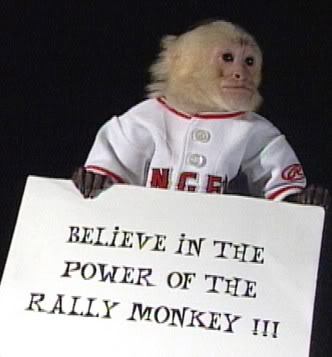
To paraphrase our own Lou Monte, lazy monkey, you better get up. You’re all that stands between us and…sigh.
by Jason Fry on 22 October 2009 3:48 am My fellow Mets fans,
Tonight we gather neither in triumph nor in joy. Rather, we have assembled out of necessity, driven by the need to oppose a deep-seated evil. Tonight we must make choices that will not sit well with any of us. Tonight we must make choices between unpalatable courses of action. Tonight we must do what many of us, in all honor, once swore we would not.
These are not easy times. We have been bested on the field of battle and outmaneuvered in the arena of ideas. Our fires have been banked, damped by misfortune and miscalculation. For now, our yesterdays are brighter than our tomorrows. We may mourn that we have come to this pass, yet we stand here nonetheless.
And here, stand we must. We have proven unfit to play a role in the combat about to unfold before us. Yet this grim judgment, however impartial its verdict, must not lead us to reject our larger calling, or to turn aside from our unhappy duty. We are bystanders, yet our voices must be heard. We are reluctant, yet we must commit.
We have profound differences with our league-mates to the south. It would be the stuff of childish fantasy not to acknowledge this. We abhor their Hawaiian braggadocio. We reject their penchant for domestic violence. We disdain the partisan yowling of their maroon rabble. To offer them fellowship runs counter to all we profess and everything we hold dear. We are neither friends nor allies. It is only wisdom to state this clearly, calmly and without apology.
Yet wisdom is nothing without a sense of proportion. We must not profess blindness citing the mote in our eye, while ignoring the beam that would blot out the light for all. Our neighborly disagreements are profound and the canyon between us is deep. Yet deeper still lies the chasm into which we now both stare.
My friends, there is another evil loose in our nation, one that makes the misdeeds of our league-mates in maroon look small. We have a greater enemy, and a higher calling. This greater enemy gilds all that it touches in gold, then scorns those who can afford only brass. This greater enemy gathers mercenaries and reprobates and evildoers to its banner, and declares them paragons. This greater enemy declares that pitchers shall not hit. This greater enemy conflates arrogance with tradition, and bequeathed wealth with hard-earned success. This greater enemy is attended by a howling mob that knows neither reason nor humility nor decency.
This greater enemy cares not for our disagreements and disputes, real though they are. Twenty-six times has this foe bred a vile plague, one that reduced our nation to lifelessness and blighted all that we hold dear. Though we are not allowed to fight, neither are we required to adjourn in silence. We must lift our voices against tyranny, though we would have chosen most any other champion. We must shout down injustice, though our voices cannot conjure fairness. We must oppose a great evil even if it means supporting a paltry good. We have been called, and however reluctantly, we must answer. It has fallen to us to do what must be done, and to heed a summons we would pretend not to hear.
My friends, this too will pass, and the banner of the blue and orange will fly once again in triumph. I eagerly await that day, and the restoration of all that is just and proper. As do all of you. But for now, we must serve a more difficult cause, and we must do so with all we can wring from our reluctant hearts. This is necessity. This is obligation. This is duty.
My friends, the conflict we wish had never come to pass is upon us now. Join with me. Say the words we would rather bite back. Say them firmly, and clearly, with loud voices, though none of us possesses a glad heart. Say them with me now, and we will face these difficult days together.
ICH BIN EIN PHILLIE.
by Greg Prince on 21 October 2009 6:27 am Welcome to a special Wednesday edition of Flashback Friday: I Saw The Decade End, a milestone-anniversary salute to the New York Mets of 1969, 1979, 1989 and 1999. Each week, we immerse ourselves in or at least touch upon something that transpired within the Metsian realm 40, 30, 20 or 10 years ago. Amazin’ or not, here it comes.
In the span of six summer days in 1989, the Mets traded Mookie Wilson and Berke Breathed stopped drawing Bloom County. Both entities had been a staple of my life over the previous nine years.
That’s it, I thought at the time, the ’80s are really ending.
I loved Opus the penguin. I loved Mookie the centerfielder. Many fine things happened to me in their time. Yet I was never crazy about the 1980s as a decade. I always believed I was loitering in them with a visitor’s pass. Josh Wilker of Cardboard Gods articulated my feelings on these artificially arranged ten-year periods almost exactly earlier this year when he wrote:
I am a citizen of the 1970s. I have resided in other decades, but I have always felt like a foreigner within them, or have mostly ignored them altogether, an expatriate with no interest in participating in the local customs.
Like Josh, I’m at home in the ’70s, a structure I entered at age 7 and exited by chronological necessity the day after I turned 17. No matter how much that decade objectively sucked, it will always be where I live, psychically (sort of like Shea Stadium). When I was forced to leave figurative home on January 1, 1980, I was at a loss. Never mind that it was during the 1980s that I graduated from high school, graduated from college, met my future wife and came of age in all those ways a person naturally embraces. I just disliked it being the ’80s. The values, the politics, the hair…I don’t know what it was, I was just deep-down uncomfortable with what surrounded me for ten years and was tangibly relieved when I crossed the finish line to January 1, 1990.
I’ve had nothing against the ’90s or the ’00s, per se. You get older, you don’t delineate decades as reflexively. I once asked my dad what the ’60s were like. He shrugged. To him, I suspect, they were just years during which he was over thirty. Hell, some days feel so random that if Christmas is mentioned, I can’t remember without thinking first whether we’re closer to the last one or the next one.
Maybe I resented that when the ’70s ended, nobody asked me to sign off on the ’80s. Thus, I mistrusted them — but it’s not like I didn’t enjoy a good bit of them. For instance, I enjoyed Bloom County on the comics pages. “Come On Eileen” was a great song. SCTV was a great show. And the Mets were never better as a long-term proposition.
When we think of the Mets of the ’80s, we tend to jump right to one particular year, 1986, and one particular month, October. Of course that was the height of the decade and, arguably, the franchise. From the standpoint of kicking ass, which is the idea in sports (and a pretty big societal priority in the ’80s), nothing in the annals of Mets baseball touches 1986. Members Only jackets, Trickle Down economics, the staggering popularity of The Cosby Show…lots made me cringe back then, but I had no complaints with the baseball back then.
When the Mets were at the top, it was unimaginable they wouldn’t stay there. Mookie Wilson himself, about as humble a “Bad Guy” as that team featured, stood before the City Hall ceremonies that capped their ticker-tape parade and exclaimed a hope we would all take as an implied guarantee:
1986: Year of the Mets!
1987: Year of the Mets!
1988: Year of the Mets!
Of course. Of course there’d be more than one year for these Mets. There’d be year after year. The Mets of the ’80s were built to last. That they didn’t make ’87 or ’88 their years in the same sense as ’86 didn’t lessen the sense that it was their time. The Mets ran a contest in 1989 encouraging fans to submit designs for a secondary logo, one that commemorated the previous half-decade. The Mets had baseball’s best record from 1984 through 1988. They were, according to their own marketing acumen, excellent again and again…so draw something!
Met hubris wasn’t easily detected by us Mets fans in the last year of the 1980s because it was a way of life. We were in the middle of it, so how could we see it for what it was? We could be asked to create logos celebrating our quasi-achievements and accept the challenge with a straight face. We could read profiles such as that which appeared in a high-flying business magazine called Manhattan Inc. informing us that the Mets were “the IBM of baseball” and be confident of receiving perennial returns on our investment. We could watch a Cy Young winner like Dwight Gooden go down with an injury at the beginning of July and calmly accept as his replacement another Cy Young winner like Frank Viola at the end of July.
We were the Mets. We were excellent. We would be, repeatedly. Everything and everybody said so.
Then we traded Mookie Wilson.
With him went our would-be magnum opus of a decade. Well, him and Wally Backman, traded the December before; him and Lenny Dykstra and Roger McDowell, sent to Philadelphia in June; him and Rick Aguilera, part of the payment for Viola; him and Lee Mazzilli, waived the same frenzied night that Frankie V was acquired and Mookie W was shipped to Toronto for Jeff Musselman.
The Mets traded Mookie Wilson for Jeff Musselman. Next time you watch a clip of Mookie hustling down the first base line during Game Six of the 1986 World Series, try to think of anything Jeff Musselman did in a Mets uniform or could have conceivably done that would make a trade of Mookie Wilson for Jeff Musselman sound remotely reasonable.
You’ll be thinking an awful long while.
The last year of the 1980s was truly a last gasp for the Mets of the 1980s the way we remember them. Gary Carter and Keith Hernandez, each 35 and hobbled, were still on hand but had faded badly in ’89. Mex hit .233, Kid .183. Neither played in even half of the team’s games. Both would bid adieu to Shea at season’s end twice: on the field to standing ovations in the team’s last home game on September 27 and at a press conference in the old Jets locker room on October 3.
Kid:
“I can still play this game, and I know there’ll be an opportunity out there. But these have been five great years. I heard the cheers and I heard the boos, and I like the cheers a lot more. Maybe I’ll hear more of them.”
Mex:
”It’s sad because these have been six-and-a-half great years, and I’ll always be a New Yorker and a New York Met. But then come the cold realities. You can’t retire at 65 in baseball.”
That left Doc and Darryl as the 1986 stalwarts who would lead the Mets into the new decade. Darling, Fernandez, Ojeda, HoJo, Teufel and Elster were the only other veterans of the World Series team to see 1990 in blue and orange. The ’90 Mets would contend to the final week of the season but fall short. They’d also be the last Mets team to finish over .500 until 1997. The IBM of baseball went bust.
Mookie Wilson wasn’t exactly igniting the 1989 Mets toward an encore as division champion when he was traded. Having ceded centerfield to the cleverly obtained Juan Samuel, Mookie was batting .205 as a reserve and the Mets were seven games out of first when he was cut loose. That said, you don’t trade Mookie Wilson from the Mets. You just don’t.
And if you do, you don’t trade him for Jeff Musselman.
The Mets, despite an encouraging August surge, fell flat in September. They finished in second place, six games behind the Cubs, at 87-75. It was a respectable record for mere peons, but these were the alleged paragons of Excellence Again and Again. All those moves were supposed to be the stuff of a forward-thinking IBM-type enterprise, one for which progress was paramount. Yet the 1989 Mets signaled a return to mediocrity. They were a huge disappointment in real time, the first Mets club to not win at least 90 games since 1983.
Even for someone who never fully embraced the decade in which they occurred, 1983 and 1989 make for fascinating ’80s Met bookends. If you checked out of Metsdom after their seventh consecutive losing season in ’83, you’d walk away thinking the ’80s were and always would be a terrible time to be a Mets fan. The team started the decade with the last four of those losing seasons, showing only intermittent promise that things would ever get better. By the middle of 1983, mired in last place with a record of 37-65 (their worst 102-game mark since 1965), there seemed no tangible progress on which to hang one’s Mets cap. The Mets’ marketing slogans in those dark days — The Magic Is Back; The Magic Is Real; Now The Fun Starts — could have been brought up as evidence in a false-advertising lawsuit. It was all talk and no action…except for the losing that wouldn’t stop.
Then it began to stop. Not enough to save the 1983 Mets from their fifth last-place finish in seven seasons, but enough to propel them to a final record of 68-94 — if one could be said to be propelled to a record that encompasses 94 losses. It was better than it sounds. The Mets won 31 of 60 in their final two months. Two months of winning baseball was an accomplishment for those Mets. Winning 68 games was an accomplishment for those Mets. It was the most they’d won since the 86 they posted in 1976. These were baby steps, but longer strides awaited in 1984, when 90 victories became the norm and success would become expected.
As viewers of this decade’s greatest television drama Six Feet Under will recall from the episode in which Nate Fisher began to fade badly, the ecotone is that space where two environments overlap. For the Mets of the ’80s, 1983 and 1989 were most ecotonic.
Look at your 1983 Mets. They started the season with Tom Seaver pitching, Ron Hodges catching and Dave Kingman in the infield. That’s how they ended the 1975 season. Everybody was happy to have Seaver back, but still — Hodges, Kingman, Craig Swan, Rusty Staub, Mike Jorgensen, John Stearns…does this sound like a team that was about to turn a corner? Or relics uncovered during Shea’s 1980 refurbishing?
Ah, but Mookie Wilson was there. So was Wally Backman, albeit in a limited role. Doug Sisk made the Opening Day roster (winning what Seaver started). Darryl Strawberry was called up in early May. Ron Darling was given his first start in September. Danny Heep pinch-hit most reliably. Neil Allen, a reliever whose welcome had clearly worn out, was famously traded in June for Keith Hernandez, not only solving first base and the third slot in the batting order, but clearing the closer role for a rapidly developing Jesse Orosco. By the end of 1983, fully one-third of the 1986 World Series roster was in place. The torch was being passed to a new generation of Mets.
Six years later, once Hernandez and Carter said goodbye, only eight World Series Mets survived. In the six months prior, as Dykstra, McDowell, Aguilera, Mazzilli and Wilson were cleaning out their lockers, the 1989 roster hosted Frank Viola and Juan Samuel; Don Aase and Wally Whitehurst; Phil Lombardi and Jeff McKnight; Tom O’Malley, Craig Shipley, Blaine Beatty, Lou Thornton and the immortal Manny Hernandez — no relation, talent or otherwise, to Keith.
The 1989 roster had its share of talent that came along after the formation of the ’86 champs and before their dissolution: Cone, Jefferies, Myers, Magadan, McReynolds to name a few good to very good players. Samuel had been a star not long before 1989 and Viola would win 20 games in 1990. But the times they were a-changin’ in Flushing and not for the better, not the way they were in 1983.
Thing is the 1989 Mets were a legitimate contender, if a continually frustrating and ultimately disappointing one. If you went to one of their games, it probably meant something in the standings. You at least thought it did. You could legitimately spend that entire spring and summer watching the scoreboard and worrying that glorious worry of the fan whose team has something to play for. This was what you had been told the 1980s Mets were all about.
But was it as much fun as the other bookend, 1983 once 1983 foreshadowed an era of potential greatness? The Mets weren’t rising from last no matter what they did that summer, but what a delight it was watching them not fall even further through the floor. There was Keith Hernandez being everything you hoped he’d be when you heard he was en route from St. Louis. There was Darryl Strawberry simultaneously getting used to major league pitching and earning Rookie of the Year honors. There was Jesse Orosco saving or winning nearly every game in which he pitched. There was Ron Darling giving you an idea of why they traded Mazzilli to get him. There were Walt Terrell and Hubie Brooks, too. They wouldn’t stick around to 1986, but they were showing enough to make you optimistic for 1984. Again, no contention with that ’83 team, no chance of it, but no boundary for what you could imagine they might do with a little growth and a little help.
The Mets of the ’80s, circa 1983, were Mookie Wilson racing out of the box no matter how futile the prevailing competitive circumstances. The Mets of the ’80s, circa 1989, were Mookie Wilson donning a Blue Jays uniform as part of an ad hoc reconfiguration aimed at remaining viable in the short term.
The 1983 Mets nurtured players whom we would come to know as 1986 Mets. The 1989 Mets shed them.
The 1989 Mets finished six out yet were more done than we realized. The 1983 Mets finished 22 out yet were just getting started. I’m not sure we realized that either, but it began to feel pretty good there toward the end. At any rate, nobody was calling valedictory press conferences and saying sad farewells.
It’s the section between these bookends we remember best about the 1980s Mets. It’s the story smack in the middle, 1986, that defines the decade. It was the Year of the Mets, just as Mookie said it was. It guaranteed we’d willingly accept nothing less in the years that would follow, even it meant rather cavalierly offing those who got us to 1986 in a lame effort to lunge for one more echo of that once-in-a-lifetime season.
It’s not like the Mets haven’t sent their key players away in other decades. But doing so to those players from that team…no wonder I’m still a little uncomfortable with the 1980s.
Todd Pratt’s 1999 NLDS-winning homer is underranked on Mets Walkoffs’ list of the Fifteen Most Metmorable Postseason Home Runs, but I can’t say any of those slotted ahead of his are unworthy either. Check it out here.
by Greg Prince on 21 October 2009 5:38 am 
Tim Heiman, sports director of WRPI radio at Rensselaer Polytechnic Institute in Troy, just returned home from a road trip the likes of which has been unseen by Mets fans since Benny Agbayani was rising and shining in Tokyo. Tim covered the Engineers’ away game (very away game) at Alaska-Fairbanks — a 1-1 tie — yet found the time to grace the 49th state with a little 37 14 41 42.
Yup, that’s the Faith and Fear shirt in Alaska, and that is indeed the Alaska Pipeline overhead. We’re really impressed by Tim’s display of the numbers so far north, but we are a little concerned that he’s outside in Alaska with no coat on. Tim says it was 20 degrees there this past weekend, making it slightly chillier than the Meadowlands on Sunday.
No word from Tim regarding any prospects on the Goldpanners like the one the Mets eventually scooped up in the 1960s. Then again, we guess that Fairbanks team is a little out of season right now.
Wherever you go in this world, do be sure to go there in FAFIF style.
by Jason Fry on 20 October 2009 4:41 am 
In a better world, many more of these would be Bisons cards. Oh well. Commentary here.
by Jason Fry on 20 October 2009 4:18 am People who think computers play baseball will say the Angels are down 2 games to 1. But computers don’t play baseball. And when you have a teammate like Derek Jeter, and you see the way he goes about his business and how calm he is after a game like that, it’s like you’ve won. So the computers may say the Angels are down just one game, but if you’re in the Yankee clubhouse you feel like you just won two games. That’s the kind of player Derek Jete —
I’m sorry, I came down here and Joe Morgan was futzing around with my computer. (Who even knew he could type?) Joe, you can see yourself out. We’re not here to talk about whatever the heck just happened involving an evil team in a league that doesn’t play real baseball. No, we’re here for the 5th annual admission of a new class of Mets into The Holy Books.
Brief review for newcomers and the similarly obsessive: I have a pair of binders, dubbed The Holy Books (THB) by Greg, that contain a baseball card for every Met on the all-time roster. They’re ordered by year, with a card for each player who made his Met debut that year: Tom Seaver is Class of ’67, Mike Piazza is Class of ’98, Jose Reyes is Class of ’03, etc. There are extra pages for the rosters of the two World Series winners, including managers, and for the 1961 Expansion Draft, with the latter including the infamous Lee Walls, the only THB resident who neither played for nor managed the Mets. (Previous annals here, here, here and here.)
When a player has a Topps card as a Met, I use that unless it’s truly horrible — Topps has been around a decade longer than the Mets, so they get to be the card of record. No Met Topps card? Then I look for a Bisons card, a non-Topps Met card, a Topps non-Met card, or anything I can get my hands on. Topps had a baseball-card monopoly until 1981, and minor-league cards only really began in the mid-1970s, so cup-of-coffee guys from before ’75 or so are a problem. Companies like TCMA and Renata Galasso made odd sets with players from the 1960s — the likes of Jim Bethke, Bob Moorhead and Dave Eilers are immortalized through their efforts. And a card dealer named Larry Fritsch put out sets of “One Year Winners” spotlighting blink-and-you-missed-them guys such as Ted Schreiber and Joe Moock.
Then there are the legendary Lost Nine — guys who never got a regulation-sized, acceptable card from anybody. Brian Ostrosser got a 1975 minor-league card that looks like a bad Xerox. Leon Brown has a terrible 1975 minor-league card and an oversized Omaha Royals card put out as a promotional set by the police department. Tommy Moore got a 1990 Senior League card as a 42-year-old with the Bradenton Explorers. Then there are Al Schmelz, Francisco Estrada, Lute Barnes, Bob Rauch, Greg Harts and Rich Puig, who have no cards whatsoever — the oddball 1991 Nobody Beats the Wiz set is too undersized to work. Best I can tell, Al Schmelz never even had a decent color photograph taken while wearing his Met uniform. (I’ve stopped writing to him in search of one for fear that he’ll call the authorities on me.) Anyway, the Lost Nine are represented in THB by fake cards I Photoshopped together.
A 10th Lost Met seems unlikely — today it’s rare to sign a pro contract and not wind up on a card somewhere. (Though next year Topps will be the only company allowed to use team logos on its cards, leaving Upper Deck to produce products that I fear will look something like the “cards” we used to cut off the back of Hostess boxes.) During the season I scrutinize new card sets in hopes of finding a) better cards of established Mets; b) cards to stockpile for prospects who might make the Show; and most importantly c) a card for each new big-league Met. At season’s end, the new guys get added to the binders, to be studied now and then until February. When it’s time to pull old Topps cards of the spring-training invitees and start the cycle again.
Anway, time to meet the Class of 2009: the many, the less than proud, the submarines. If we see more than a few of them next year something will have gone badly wrong. Again.
Here they are, in order of matriculation (group photo here):
Sean Green — Green arrived in New York via a trade that sent away the beloved Endy Chavez, and bearing the same name as Shawn Green, the briefly inspiring but mostly dreary rightfielder I nicknamed “One Hop” for his apparent inability to catch anything hit more than three feet in front of him. Neither of these associations was his fault. What was his fault was that he spent long stretches of the year pitching like Aaron Heilman, down to biting his lip with a glum expression that all but shouted, “I can’t believe this is happening to me again.” (And why take that number, Sean? Why?) That said, there’s no particular reason not to bring Green back: Middle relievers tend to yo-yo around a median of competence, and no Met pitcher should be judged without an acknowledgment that they played with stone-handed infielders and a stupid manager. But just thinking about Green uncorking a wild pitch and looking like a kicked dog makes me want to throw something.
J.J. Putz — Arrived with a history of elbow problems, departed with his season cut short due to elbow surgery. Shocking. The Mets will have 10 days after the World Series to either pay Putz $8.6 million for 2010 or to buy out his option for $1 million. This would seem like a no-brainer, but Putz will undoubtedly work super-hard in the offseason, want to prove something to his teammates, bring a veteran presence to the bullpen, and so on. Ow, this stove is hot! Ow, this stove is hot! Ow, this stove is hot! Ow….
Francisco Rodriguez — Lived up to the ignominous history of recent Mets closers by being quietly terrible. Remember when he walked freaking Mariano Rivera with the bases loaded? The first time he gave up a walk-off grand slam to a player who had no business hitting one? How about the second time he did that?
Jeremy Reed — About as close to anonymous as you can possibly be for a player who stayed on a big-league roster for an entire season.
Alex Cora — Cora is one of those guys whose attitude and work habits you wish you could bottle — a smart, wise, tough player who made everyone around him better. Unfortunately, since everyone around him was terrible, the best Cora could do was make them merely bad — an adjective that statistically one would have to apply to Cora himself, however reluctantly. The man played a good chunk of the year with busted ligaments in both thumbs, and that should be applauded. But he’s the kind of guy you desperately wish your team would bring back as a coach, while dreading that a two-year contract is in the offing instead.
Darren O’Day — Vanished around Tax Day after 3 2/3 innings for the Mets as a Rule 5 pick. Wound up in Texas, where he naturally put together a terrific season. Ladies and gentlemen, Omar Minaya!
Gary Sheffield — Sheffield was greeted by the New York press corps and plenty of fans as if he were an Al Qaeda member — clearly he was done as a player and could only bring woe, misfortune and rancor to the idyllic world of the Mets clubhouse. So what happened? He turned out to still have plenty of life in his bat, did a lot better than anyone could have anticipated playing the outfield (meaning he was somewhere below average), and quietly proved a very good teammate. (Jeff Francoeur credited Sheffield for a tip that helped his swing.) Sheffield did eventually blow up and cause a ruckus, but for once in his life he was right to do so: The dead-and-buried Mets put Sheffield on waivers, saw him get claimed by the Giants, and pulled him back instead of getting a prospect or two and rewarding Sheff with the chance to play the final weeks for a team with a heartbeat.
Livan Hernandez — If the old guard of baseball GMs had run prehistoric human society, no one would have ever discovered fire, the wheel or agriculture. Exhibit A is Livan Hernandez, a profoundly terrible pitcher who for years has reliably eaten up innings and vomited forth baserunners, runs and losses. Enter Omar Minaya with a bag of money; exit hope and dreams of a better world organized around something other than superstition and phrenology. Players like Livan Hernandez make me want to cry even when they’re not on my team.
Omir Santos — Omir was the first player to become a bone of contention between stat guys, who looked at his nonexistent minor-league track record, inability to walk and unlikely BABIP and held their noses, and look-and-feel fans who loved Omir for his flurry of big hits and apparent joy in what he was doing. I tend to side with the stat guys on this one, but with the caveat that Omir Santos is the kind of player whose unlikely success makes you want to jump up and down and throw an impromptu parade. His home run off the perennially childish Jonathan Papelbon was the last flicker of life in the 2009 season; if someone actually made a highlight film of this hideous year, I wouldn’t be surprised to find that the credits rolled right after that moment.
Casey Fossum — Made his Mets debut on April 21 against the Cardinals with two outs in the fifth, the bases loaded, and the Mets clinging to a 4-3 lead. Walked the first hitter he faced. On four pitches. Yes really.
Ken Takahashi — 40-year-old Japanese rookie lefty pitched competently enough, though he got killed by lefties while handling righties decently. Which made about as much sense as signing a 40-year-old Japanese rookie lefty in the first place.
Tim Redding — A big dude with a silly beard and a cheap-looking shamrock tattoo, Redding began his Mets career by getting his rear end handed to him by the University of Michigan, which most baseball fans will agree augurs poorly for success. He then got pounded for much of the early part of the season, after which the Mets cruelly let him twist in the baseball wind, telling everybody but Redding himself that his release was a done deal. Redding wasn’t released, as it turned out. To Mets fans’ slow-building astonishment, he pitched well again and again in late August and September and ended the year as the Mets’ most-reliable starter. This sounds like a bad joke but actually is meant as honest praise. Redding took a lot of abuse, hung in there, and changed some minds. Kudos to him.
Fernando Martinez — The latest wildly hyped Mets prospect arrived in late May, and turned out to indeed be the Second Coming. Unfortunately, he was the Second Coming of Don Hahn. F-Mart looked hopelessly overmatched at the plate, uncertain in the outfield, made boneheaded mental errors and then was lost for the season due to injury, furthering the suspicion that he’s made of porcelain and nitroglycerine. Martinez only just took his first legal drink, so he still has plenty of time to find himself, but his initial impression suggested he’s not close to doing that.
Wilson Valdez — Actually played pretty well as 2009 Mets replacement shortstops went. This isn’t the same thing as praise, but in 2009 it’s about as close as you can get.
Emil Brown — Had five at-bats in early June, collecting one hit. He would have had another, but he passed Luis Castillo on the basepaths and was called out. It was that kind of year.
Fernando Nieve — Plucked off the waiver wire from the Astros, Nieve proved a nice surprise, actually beating the Yankees and looking like he had some kind of future. So of course he went down as if shot in a July game against the Braves. Torn quadriceps, gone for the year. (Jon Niese, his replacement, had essentially the same progression in miniature: Looked promising, grotesque injury, gone until 2010.)
Jon Switzer — Debuted against the Yankees, got his brains beat in, heroically lowered his ERA to 8.10, vanished.
Elmer Dessens — A pudgy reliever with a goofy name, Dessens seemed like the latest punch line to an increasingly unfunny joke when he arrived in June, but pitched well and proved dependable.
Pat Misch — After pitching tolerably but mostly anonymously for the bulk of the summer, Misch absorbed one of the more-fearful beatings I can remember against the Braves in late September, giving up eight runs on seven hits in an inning and a third. In his next start, he stared down the Marlins to pitch a gutsy complete-game shutout, probably the best performance of the season by a Mets starting pitcher. Sometimes it’s nice to be wrong.
Jeff Francoeur — The poster boy for sabermetricians inveighing against baseball primitivism, Francoeur is almost comically aggressive at the plate, making you wonder if no one’s ever told him that four balls will gain him first base. After languishing in Atlanta, he came to the Mets and immediately became either lucky or good, lashing balls all over the park, playing with a billion-watt smile and carrying on despite a bad thumb. It’ll be fascinating to see how he fares in 2010, and how he’s received by the fans if the statistical gods are against him. Oh, and he hit into the 15th unassisted triple play in big-league history to end a game against the Phillies. It was that kind of year.
Angel Berroa — Records show he played for the Mets, and Topps gave him a baseball card for some reason. Apparently the morphine had kicked in by the time he arrived, because I either don’t remember him or have blotted his tenure out of my mind.
Cory Sullivan — A hard-nosed journeyman outfielder, he became something of a fan favorite (by the low, ironic standards of 2009) for seeming to retain a pulse in the pitiful days of $5 StubHub tickets and playing for draft picks the Mets will be too cheap to sign. Sullivan seems like he could prove useful as a bench player in a better season.
Andy Green — Oh, I’ll let Greg tell the story.
Lance Broadway — Failed White Sox prospect was thoroughly mediocre as a general dogsbody at garbage time. If it doesn’t work out, at least he can pursue a reasonably lucrative porn career without having to resort to a screen name.
Josh Thole — Interesting catching prospect showed a precocious eye for the strike zone and a nice, compact stroke at the plate, giving us some reason to hope as the season circled the drain. (Why did Jerry give Thole time to learn at the major-league level while seeming to forget Nick Evans existed? Don’t ask me.) Thole probably won’t return until summer, if not 2011, but unlike most of the Class of ’09, we’ll actually look forward to his return.
Tobi Stoner — Former Cyclone could really help the Mets sell more merchandise to snarky college kids. We’ll have to reserve judgment on what he might contribute in actual games.
My goodness, that was depressing. But take heart! Every second brings 2010 closer! And a plague year like this CAN’T POSSIBLY HAPPEN AGAIN! RIGHT? RIGHT?’
Just tell me I’m right.
by Greg Prince on 19 October 2009 9:03 pm In 1959, a New York Times editorial entitled “Requiem for the Meadows” was only saying what most people thought about this reviled land of burning garbage dumps, of polluted canals, of smokestacked factories, and impenetrable reeds. The Meadowlands was the nation’s eyesore, the blight separating New York and America. The Meadowlands cried out to be developed.
—Robert Sullivan, The Meadowlands: Wilderness Adventures at the Edge of a City
In August I mentioned casually at a Mets game that I’d never been inside Giants Stadium. Next thing I knew, my friend Sharon — a person who converts casual mentions into first downs — asked me if I wanted to break that lifelong ohfer before the ancient facility (opened in 1976) turned to dust. She and Kevin have Jets season tickets and there was an opening October 18 against the Bills. A chance to see a stadium before it meets its wrecking ball sounded right up my sentimental alley. New Jersey Transit even started operating a rail line to and from the stadium as if anticipating my needs. It shaped up, in gauzy anticipation, as a brilliant autumnal afternoon.
Despite my August observation, I never much cared if I saw the Giants or Jets play at Giants Stadium, though I’ve always felt a little bad that I never made any kind of move to see the Jets at Shea during their twenty-year stay. Never mind that they left Shea in 1983 and that I didn’t start rooting for the Jets in earnest until 1978 — or that by 1981 I was spending my autumn Sundays in Tampa. The whole thing never added up, but I’ve remained charmed that on September Sundays when the Mets were home, clear through to 2008, guys continued to show up at Shea in Jets jerseys, as if Curtis Martin was going to pinch-run for Matt Franco. Guys even showed up that way the last Sunday at Citi Field, where the Jets never played. That was adorable, I thought. Even if I’ve been following the Giants longer and a bit deeper, I generally maintain a soft spot for the Jets.
That soft spot is in my head. And now it’s frozen.
There was little brilliant and nothing autumnal about going to Sunday’s Jets game. It was so cold! I cannot believe how freaking cold it was! I knew it was coming, I was prepared for the nor’easter, I layered and I bundled…but geez, it was cold!
But it’s football, right? It’s supposed to be cold, albeit not so soon. At the peak of my fandom in January 1983, I was encouraged to read that when the Jets landed in Miami for the AFC championship game and saw the rain, they chanted “JET WEATHER! JET WEATHER!”
Then Richard Todd went out and threw a zillion interceptions. But the idea holds.
The Meadowlands is legendarily windy. Jerry Izenberg once wrote in a great book called No Medals For Trying that the gust is so notorious in the area that folks in Newark gave it a nickname: The Hawk. You want the Hawk at your back if given a choice by the referee.
Good advice. By the middle of the second quarter, Sharon and I had the Hawk at our backs — as we fled to the first NJ Transit train back to Secaucus Junction. It was a slow game, it was a cold game, it was not a baseball game. Sharon and I once stuck out fourteen innings of a Mets loss to the Cardinals, but that was the Mets. We’ll sit through almost anything for the Mets, even the 2009 season. But for the Jets?
C-O-L-D…leave, leave, leave!
And judging by the way the rest of the afternoon/evening unfolded, we didn’t miss anything we’d want any part of.
Don’t get me wrong, however. I’m glad I got my Giants Stadium cameo, particularly before all decent citizenry of the Garden State will be advised to evacuate lest they be stampeded by the obnoxiousness that will envelop New Jersey when the inevitable Phillie-Yankee World Series proves there is no God — at least not one that likes us.
It so happens I have enough green in my wardrobe to meet the approval of Jet management, which asked for a “green out” (and helpfully suggested a trip to the team store so we could all comply). I wear a green winter coat anyway and I own a green Jets hoodie. Alas, no Jets headgear in my collection. As the New Jersey Sports & Exposition Authority forbids umbrellas, I dipped into my pile of blue and orange caps to pick the biggest one I’ve got to shield me from potential rain. That’s fine in my book. I’ve seen so many Jets jerseys worn to Mets games, the least I could do was return the favor. While there wasn’t a ton of Mets gear in evidence, my cap was not the only one of its kind on the premises.
Yet why was it that as we walked through the parking lot before the game and passed a tailgate gathering, I had to hear this?
“Hey! You root for the right football team, but the wrong baseball team. LET’S GO YANK-EES! METS SUCK!”
I don’t remember what I blurted in response, but I’m pretty sure it wasn’t J-E-Et Al. What strikes me a day later is that there must be something about me that Yankees fans like, because I’m always being told I should be rooting for their team. It’s never occurred to me to extend the same invitation in their direction.
Then again, I’m not a sports fascist.
Yes, they’re everywhere, in every season. No place in the Metropolitan area is safe from their kind. Most of them were content to be smug and otherwise keep to themselves about it. A Jets game should be a DMZ for baseball. Later on, I switched to my orange Michigan Hunter’s Hat since it’s the warmest hat I’ve got. This elicited another wise guy, this one sitting in the row behind us:
“Yo! You can’t wear an orange hat to a Jets game!”
I turned around and gave the kid who said that a look that was more droll than dirty. He changed his tune instantly.
“Yo! Your hat is all right, it’s all right! Let’s Go Mets!”
Whatever. This was supposed to be about the Jets, an organization whose long-term proposition regularly mystifies me, and the stadium, a place that was I just meeting. Was it really time for it to go? I can still recall watching an NJSEA propaganda film in 1976, narrated by Pat Summerall, explaining that it was OK that the New York Giants had moved to New Jersey because, “The Greeks had a word for it: megalopolis.” The Meadowlands, you see, wasn’t East Rutherford. It was the whole region, so get past the “Hackensack Giants” jokes and come on out. The Giants filled it every Sunday and the Jets would do the same once they moved west, so I guess the argument was processed and purchased as intended. Still, it was kind of strange seeing the big green NY on the screen and thinking that technically, we’re somewhere else.
It’s not like you’re far from New York. You can see the skyline plainly from the right spot just as you often do on TV during one of the interminable breaks in the action. The train ride — Penn Station to Secaucus, Secaucus to the stadium — was a dream. As easy to get to via mass transit from Manhattan as Shea, almost. Still, you look around and you wonder what all this is doing here. It really is a swamp. It really was the middle of nowhere, like that spare room where you throw your clutter, your bric-a-brac, your extra sports franchises. Now it’s the middle of nowhere except with a stadium that for some reason needs to be replaced by another stadium.
Sharon mentioned the Vet as a point of architectural reference and I found that an accurate comparison (save for the lack of a jail). Giants Stadium is from that age when stadiums weren’t “state of the art,” let alone “world class”. After a summer of being hit over the head by how lucky I was to be at a ballpark that was tailored just so to my needs, it was chicken soup for the sports fan’s soul to attend a rather utilitarian facility to see a game. We did several pregame laps around the 300 level and the sameness was reassuring. There’s the food, there’s the souvenirs, there are the bathrooms that so relieved Leon Hess…what else do you need exactly? I had never been inside Giants Stadium before yet I felt very much at home along its ramps and concourses.
Entering the seating bowl was like visiting a set at Universal. The Giants and Jets had been a television production for me all these years. Now it was live. How strange.
The verdict? It’s a football stadium. They’re all a hundred yards. You can’t wedge a Mo’s Zone into the end zone. I guess you could do something cute (others have), but Giants Stadium retains the same clean look that Summerall touted in ’76. The Jets drape it in green and I know the sky-high press box is a relatively recent embellishment, otherwise it appears serviceable and, pending the presence of the Hawk, relatively comfortable.
Of course they have to tear it down.
Our seats were over one of the end zones. I would say the south end zone using the sudden appearance of the sun to our left as a gauge, but later I heard something on the radio about the east end zone, so who knows? It was a fairly spectacular panorama from wherever we were. Behind us were the idiots who didn’t care for my orange hat. They had turned their attention on a girl wearing extravagant foul-weather gear (“Miss Yellow Pants! Miss Yellow Pants!”…shut up already) and on any Bills fan who happened to make his or allegiance obvious. An undercover Buffalonian who wore his Bills stuff to a Jets game ten years ago and will “never make that mistake again” struck up a conversation with me, swearing that if he had to sit here eight times per season, he’d kill himself — or the guy behind us.
“The latter would be more efficient,” I recommended.
I go to a game and I think about the stadium and the history and the sociology. Others go to a game to drink, yell and curse, reminding me of my brother-in-law’s tenure as a Shea vendor in the ’70s: he hated working Mets games…but he really hated working Jets games. Sunday, whether measured by prevailing winds or temperament, didn’t provide much of a climate for ruminating on what makes the Jets the Jets and why it never really works for them. The only notable highlight we saw from our seats was Thomas Jones breaking a very long run. Of course there was much celebration in the stands and on the field. The Bills fan volunteered he’d prefer to see more consistent reactions, not getting so high from a brief victory, not getting so low when things don’t go well.
“Kind of a metaphor for this franchise,” I told my nominal enemy whom I rather liked. Not that the Bills have much to brag about over half a century (thanks, in part, to my other football team), but an air of desperation just hangs over the Jets. Lots of video clips of the players on Fan Appreciation Day — we got swell travel mugs as we left — telling us how important it was we make lots of noise. I suppose this is standard admonition at sporting events, but I flashed back to Joe Namath using a Super Bowl III reunion in 1994 to lobby the fans for a better home-field advantage. I flashed forward from there to Rex Ryan leaving his infamous voicemail for fans imploring them to whoop it up against the Patriots a few weeks ago. Is all this anxiety over fan enthusiasm really necessary? Are the Jets worried they won’t be mistaken for a mid-market team where all anybody worries about between Sundays is football?
A little unbecoming if you ask me. “Noise Meter” graphics notwithstanding, even the Mets display more dignity than that. And if “76,048” in attendance don’t rumble nonstop, I can’t blame them, not when there are so many torpid halts in the action. You don’t appreciate how much nothing happens in football when you’re watching it on TV. Football is awesome on TV. It’s impressive in person, but only for the eight seconds per hour when they’re actually playing. I exaggerate slightly, but I once read that if you add all the plays together from an NFL game, they amount to all of twelve or so minutes. Don’t tell me baseball is dull.
I had my taste and was satisfied. Sharon had made the second-strongest guarantee in Jets history when she said she’d be willing to leave our wind tunnel at any time, so I didn’t feel the least bit bad when, after Jay Feely kicked the field goal that put our side up 6-3, the only noise we produced was from our shoes making tracks to the train. I wished my new Bills pal luck (with the idiots behind us, I meant) and that, presumably, was the last I’ll ever see of Giants Stadium.
I’m still cold.
Mark Sanchez didn’t throw too many bombs Sunday, but at least ten Mets have operated some heavy artillery in their time. Check out Mets Walkoffs’ penultimate installment regarding the greatest regular-season home runs the Mets have ever hit.
|
|







