The blog for Mets fans
who like to read
ABOUT US

Faith and Fear in Flushing made its debut on Feb. 16, 2005, the brainchild of two longtime friends and lifelong Met fans.
Greg Prince discovered the Mets when he was 6, during the magical summer of 1969. He is a Long Island-based writer, editor and communications consultant. Contact him here.
Jason Fry is a Brooklyn writer whose first memories include his mom leaping up and down cheering for Rusty Staub. Check out his other writing here.
Got something to say? Leave a comment, or email us at faithandfear@gmail.com. (Sorry, but we have no interest in ads, sponsored content or guest posts.)
Need our RSS feed? It's here.
Visit our Facebook page, or drop by the personal pages for Greg and Jason.
Or follow us on Twitter: Here's Greg, and here's Jason.
|
by Greg Prince on 19 October 2009 9:02 pm 
No blue, but a Michighan Hunter’s Hat worth of orange at Giants Stadium Sunday. Thanks to Sharon Chapman for converting a casual mention that I’d never seen the place into a first down, or at least a first visit. Neither I nor an early Jets lead lasted long in the face of the bitter cold, but it was as much fun as one can have when Mets baseball is out of season.
by Greg Prince on 18 October 2009 1:59 pm Ever since the Yankees recorded a 9-8 walk-off win over the Mets in June on a dropped pop fly by Luis Castillo, they've become conditioned to believe that anything is possible — particularly in their new home in the Bronx.
—Jerry Crasnick, ESPN.com
Saturday night, I watched the Mets lose the 1973 World Series on MLB Network. Then I watched the 35th President of the United States struck down on the History Channel. Those were depressing results, but at least I knew for sure they were coming.
I tried not to watch too much of ALCS Game Two on Fox, for I knew I might be lulled into believing something not depressing might happen. The Angels took a 3-2 lead in the top of the eleventh. On MLBN, the Mets had gone up three games to two. On History, JFK arrived to cheers in Texas. I knew neither circumstance was going to last. But I watched out of irredeemable hope nonetheless.
I stayed away from the game in progress out of conviction that the Angels' 3-2 lead wouldn't likely last. Sure enough, during a commercial break from the Kennedy documentary, I flipped to Channel 5 and heard raucous cheers for those two seconds before the picture kicked in. “Wait…let me guess…” Yup, A-Rod. The only thing I didn't know until I caught a replay was how his game-tying home run would have been an outfield fly in a ballpark built to big league dimensions.
Didn't matter. The Yankees, earflaps and all, would have found a way to overtake the Angels. If it wasn't going to be Alex Rodriguez in the bottom of the eleventh, it would have been, I don't know, Jerry Hairston, Jr. in the bottom of the thirteenth.
Actually, it was. Of course it was. While the rest of baseball was delirious with speculation over where Roy Halladay was headed at the trading deadline, Brian Cashman scooped up Hairston for Chase Weems. I don't know what Chase Weems was watching last night, but Hairston was busy igniting a game-winning rally in the American League Championship Series. Alex Rodriguez tied it, Jerry Hairston, Jr. — with a little help from an Angelic version of Luis Castillo — won it.
Before they dissolved into grainy archival footage, you couldn't have known what would happen in Oakland 36 years ago or Dallas 46 years ago. You watch those events develop now, on film, and you're filled with rising levels of dread (different kinds of dread, obviously) because you now know the outcome and no matter how hard you wish, it never changes. You implore Yogi to start Stone in Game Six on MLBN, but he doesn't listen. You plead with President Kennedy to turn around, don't get in that motorcade, but the History Channel doesn't hear you. You don't have any control over the events on Fox either, but they are live, so maybe, you believe, they won't conclude the way you don't want them to.
But they do. And they will. Better to find more cheerful things to watch than pretend otherwise.
The thirteenth inning was unlucky last night, but The Eleventh Inning provides a pretty good book review right here.
by Greg Prince on 17 October 2009 2:04 pm Pedro Martinez mowed down his opponent. Then the Dodgers picked apart Chase Utley and the Phillies' bullpen. There was the added bonus of learning Kobe Bryant grew up a Mets fan and seeing that somewhere in this world it's still summer. Game Two of the NLCS unfolded beautifully for my purposes, save for the gnawing realization that had Pedro been available to this then-employers three Octobers ago, I'd be less bitter every time I watch a playoff game. The thought process usually goes like this:
This is the postseason. The Mets are not in it. They were last in it in 2006, which gets further and further from the present. How did we not win that World Series? How did we not make that World Series? We might have made and won the World Series had Pedro Martinez and Orlando Hernandez pitched, but they were not able. And we did not hit. Yet we had the bases loaded in the bottom of the ninth in Game Seven…
That's usually where I switch to VH1 Classic and let a Men at Work video distract me so I can temporarily forget all I remember.
I watched the Angels last night — Charlie's Angels, second season, disc five. Stephanie made it a Netflix pick because a longtime favorite soap actress had a bit part in one of the episodes. In an Archie comic strip circa 1977, Archie's mom told Archie's dad she could tell her little boy was growing up because he had replaced his California Angels poster with a poster featuring those other Angels.
Archie's dad then emitted sweat beads of shock.
I stopped watching Charlie's Angels after season one, after Farrah left. Cheryl Ladd could bring it, I suppose, but once you'd had Tom Seaver as your ace, who could take Pat Zachry seriously, y'know?
Franchises were getting away everywhere you looked in 1977. Archie, to my surprise, is still going strong, or at least still going (cue the sweat beads).
I didn't look in on the other Angels very much despite my affinity for them. I didn't care for the venue, the opposition, the score or the on-site audience. When Joe Buck is the least objectionable element of a baseball broadcast, then you're better off checking to see if Jaclyn Smith's acting lessons ever paid off.
They didn't.
It's now forty years and one day since the Mets won their first world championship. Several blolleagues joined us in commemorating the ruby anniversary with remembrances and reflections I was happy to read. You might enjoy them, too.
• Louie Maz gives this indelible slice of Mets history his customary fine “This Date In…” treatment.
• Lou Di Falco would never forget 10/16/69, or any of the year that preceded it.
• Steve Keane shouts out to Mrs. McGuire and P.S. 105's cutting-edge technology.
• Rob Kirkpatrick echoes Karl Ehrhardt, then manages to find some words anyway.
• Mark at Mets Walkoffs fills us in on all the minutiae we might have missed amid the revelry.
• Dave Murray visits a stadium where the Mets went 0-6 in '69 but he makes it an Amazin' trip per usual.
• Howie Rose, weighing in for mlb.com, still takes geometric inspiration from “the gift that keeps on giving”.
• Paul Vargas proves exceptional vis-à-vis my rule of thumb that one would have had to have been at least six years, nine months and sixteen days old at the moment a Mets world championship occurred to maintain a clear memory of it to this day. Paul's talking about 1986, but that was a good one, too.
Whether you were in first grade, in fifth grade, in college or not even close to in utero, if you're a Mets fan, you will want to secure your copy of The Miracle Has Landed, a gang-authored celebration of the 1969 Mets. This is, as one of the sponsors of that year's World Series highlight film put it, the real thing: bios of every player and significant Mets figure; chronicles of all the big moments; essays about everything connected to that year of years (including one by me regarding Shea Stadium); and from the secret archives of The Holy Books to you, images of every Topps 1969 Mets Baseball Card. If you're looking for the perfect Mets gift this holiday season (besides this baby here, I am compelled to mention), The Miracle Has Landed will, like the Mets rolling down Lower Broadway, receive a hero's welcome.
Finally, Happy Grand Slam Single Day. Is it ten years already? Seems like just four years ago that it was six.
by Greg Prince on 16 October 2009 11:47 am Welcome to Flashback Friday: I Saw The Decade End, a milestone-anniversary salute to the New York Mets of 1969, 1979, 1989 and 1999. Each week, we immerse ourselves in or at least touch upon something that transpired within the Metsian realm 40, 30, 20 or 10 years ago. Amazin’ or not, here it comes.
The 1969 baseball championship, won — not stolen — by the New York Mets, stands unquestioned as the greatest sporting achievement of the year. Yes, some will say “of the century”.
—Richard Dozer, Chicago Tribune, 1969
I’ll love Ron Swoboda ’til the day I die.
—John “Little Chief” Sullivan, Frequency, 2000
Forty years ago today was the last time Mets fans who could sleep woke up never having never experienced a world championship. Come afternoon, Gil Hodges would bring a shoe polish-smudged baseball to Lou DiMuro; Donn Clendenon and Al Weis would each homer; Ron Swoboda would double; Cleon Jones would score a couple of runs; and Jerry Koosman would throw a complete game five-hitter. The last pitch he fired was hit by Orioles second baseman Dave Johnson. It would be caught by Jones in front of the left field warning track and crown the New York Mets the World Champions of baseball.
That was it. For as long as there would be baseball, for as long as there would be Mets, for as long there would be Mets fans, we had one. We had a world championship. We had a trophy (the only one with a Seattle Pilots flag among its ornaments, it would turn out). We earned a parade. We could watch Ed Sullivan introduce Edwin Charles, Rodney Gaspar and G. Thomas Seaver so they and their teammates could sing of the benefits of having heart. But even without the tangible rewards of victory, we were fulfilled in the eyes of eternity. We were Mets fans and we were fans of a world champion. It was not mutually exclusive. Stunning to consider both for where the Mets had been not long before October 16, 1969 and, let’s face it, where they’ve been lately.
This winning a World Series isn’t easy. First you have to get to a World Series, and our Mets have done that only four times in 48 attempts. They’re two-for-four upon arrival. The second time they succeeded, in 1986, they were overwhelming favorites along every step of their journey and it was still hard as hell to nail down. The first edition to be ultimately successful went all the way more succinctly (five games versus seven) but not without its own share of stress and drama.
Your first world champions won two games by one run (one in extra innings) and another after falling behind by three runs. The one game they won by a large margin came via two magnificent Tommie Agee catches that, if not made, would have changed the course of immediate baseball history. It’s not severe overstatement to calculate the Mets in Five could have been, if not for just about everything going right, the Orioles in Four.
But just about everything went right. Maybe not Ron Swoboda’s leap at the Memorial Stadium wall in the first inning of the first game, but history would say Rocky made up for that all right. History would say the Orioles didn’t know what hit them, or, more precisely, what caught them (to say nothing of who pitched right by them). History has been kind and consistent to the Mets from the moment Cleon Jones put away Dave Johnson’s fly ball.
What amazes me when I read contemporary accounts of the 1969 world championship is that everybody got it right away and that the story hasn’t changed all that much over four decades. It was an achievement for the ages and a miracle like no other. It still answers to that brief description. Occasionally its enormity has been overlooked (like when MLB failed to include it among what couldn’t therefore be described as the sport’s thirty most memorable moments) and sometimes it’s been taken a bit for granted (like when shortsighted Mets fans voted it no higher than the third-greatest moment in Shea Stadium history), but it’s held up. The 1969 Mets didn’t fall down a memory hole. You don’t have to explain it all that much. It’s not a season for which you had to be around to understand. It probably helps to have experienced at least some of it first-hand to truly appreciate it, but you can probably say that about everything.
I’m forever grateful for the timing I unwittingly demonstrated in coming to baseball and the Mets in the late summer of 1969. By the time I understood what a world championship was, I had one. My earliest sports memory of any kind was watching the 1968 Summer Olympics with my parents. We laughed at whichever discus thrower grunted the loudest in Mexico City. The first specific sports event I can recall watching was the fourth game of the 1968-69 NBA Eastern Division Finals between the Knicks and Celtics from Boston Garden (Knicks lost a one-point heartbreaker and fell behind three to one in the best-of-seven). But really, it was the Mets who were the beginning of everything for me. They were the beginning of knowing what I was watching and why I was watching. The 1969 Mets were the first thing outside the limited sphere of my own insignificant six-year-old life that I ever cared about.
The Mets were my point of entry to the world at large. And suddenly they were the champions of it. Talk about your most hospitable of Welcome Wagons.
After plucking the Birds, Maury Allen suggested in the Post that ever higher times loomed for those Amazin’, Amazin’, Amazin’ Mets. “Ryan hasn’t yet been tapped and Ken Boswell will be better and Agee has confidence and Jones is only 27,” Allen wrote with glee. “Why, the Mets could win for the next 10 of 20 years.” Perhaps Maury Allen was doused with more clubhouse champagne than Mayor Lindsay. Perhaps the giddiness of the moment was contagious. Or perhaps the Mets seemed just that ready to roll.
It didn’t happen that way, of course. The 1969 Mets stand apart not just from their predecessors but all their immediate successors. Anybody who came along not much after me would have to wait until 1986 for the kind of fulfillment I felt instantly (though 1973 wasn’t a bad consolation prize). Anybody who came along after the fall of ’86 is still waiting. Using my own timeline as a gauge, I deduce that no one currently under the age of 29 likely has any tangible memory of the Mets approaching and winning a world championship.
Thus, I congratulate you the younger Mets fan on this fortieth anniversary. You’ve maintained your affinity despite receiving no ultimate reward on your watch. Congratulations on displaying admirable perseverance and loyalty. But congratulations, too, because today is the fortieth anniversary of the Mets winning their first world championship, and it belongs to you just as it belongs to me, just as it belongs to everyone who started at zero — literally zero and nine — with this franchise when it commenced losing in amounts so voluminous that when it began to win anything at all, it had to be considered a miracle. What happened forty years ago today belongs to all of us. I hope if you’re younger than 30 you see October 16, 1969 that way.
I wasn’t around in 1776, but I still celebrate the Fourth of July.
I’d like to think I would have been every bit the diehard I became had I discovered the Mets a little later, without the benefit of witnessing them become world champions the first time. I assume I would have, but I’m glad I’ve never had to find out. I’m glad I could grow up knowing that it happened at least once. It meant it could happen again. That fact was all that tided me over when things grew grim. Somewhere in my Met-loving soul, I’m pretty sure I still rely on it for reassurance. On October 16, 1969, the Mets beat the Orioles 5-3 and became champions of the world. I know it happened. I saw it happen. It can happen again.
It will.
by Jason Fry on 14 October 2009 2:14 am Not far from here, Citi Field sits empty, as we’ve known it would for months now. The team that calls it home had the kind of year that makes you want to sleep with the light on. The people who run the baseball operations had a worse one.
Given that, it’s a bit complicated answering what should be a simple question: How was Citi Field’s first year?
For example, we don’t really know what Citi Field feels like with a huge, revved-up crowd making noise inside it. The Mets’ early-season games were marked by the usual spring chill and a certain forgivable inattention as the faithful wandered around and figured out the new park. (I can’t go behind home plate on the, um, Excelsior level? What gives?) That was followed by a strangely cold June, and by the time full summer arrived it was obvious the 2009 club was going nowhere.
We can all remember nights when Shea’s decrepitude was transcended by the enormous, exultant noise of a big, baying crowd, but Citi Field never got one of those, so how can you compare them? Any discussion of the park runs into a similar problem: 2009 was a frustrating, infuriating and embittering year, and the sourness of that will cling to Citi until it's washed away by better days.
But l’ll try anyway — with a few admissions up-front. As longtime readers know, I was never a fan of Shea, which I generally described as a DMV with a baseball game in the middle of it. I have lots of great memories of baseball games I saw there and friends and loved ones I saw those games with. But those are memories of people and events, not of a building. I shed no tears for Shea’s passing and I have not missed it.
From the beginning, some of the things that bothered other people at Citi Field didn’t bother me. I quickly warmed to the Jackie Robinson rotunda (though it’s far more useful as an exit than an entrance), and I never begrudged the Wilpons making the front half of the ballpark into a handsome replica of Ebbets Field. Imagine the Mets had decamped for Sacramento when Shea was torn down, and generations later you found yourself owning the expansion team that replaced them, with a new stadium to build. You’d want to right a historical wrong, too. I don’t mind the green seats and the black walls — there’s no reason for a park’s colors to echo that of the team, and Shea’s variegated seats always struck me as borrowed from the palette of a 70s panel van anyway. Security guards wearing maroon? Not the greatest idea, but they can wear panda costumes for all I care.
For a while it was strange watching a game without people circulating in front of me, as they did in Shea’s aisles. But I soon found myself grateful to be able to watch the game without having to stand and peer irritably around lost tourists or bark “Down in front!” at some moron who’d gone into a coma after coming out of the tunnel. For every Cow-Bell Man or bearer of an amusing/inspiring banner, Shea stuck you with a gang of wandering mooks in sideways Yankee hats, accompanied by dimwitted girls leaking gum-flavored drool into their Sidekicks. I’m glad they’re now up in the concourse instead of down between me and the game.
While Shea was literally two-thirds of a concrete donut, Citi Field has architectural surprises, from the center-field bridge to the funny walkway that leads to the Pepsi Porch to the picnic area atop the rotunda, with its baseball set in the floor. I immediately liked the light towers, with their simultaneously industrial and vaguely organic feel, and the gates down the lines and at the bullpen, marked with iconic silhouettes.
And the park is friendlier to foot traffic, without having that traffic interfere with the sightlines. I’ve rarely been to Citi Field without running into people I know out by the bridge or in the left-field food court, and I love that. The crowd naturally flows through the field-level concourse as game time approaches, and it feels right to stop on the bridge or among the food tables, under the early-evening sky, and chat about the game before moving on to the business of 7:10 or 1:10 or 4:05. Shea’s dank tunnels were no place to stop, unless you liked being serenaded by towel-hawking MasterCard touts.
The food? There's no debate there. Alas, no skirt steak, elote and Sabrosa for me until April.
Finally, there are the seats themselves. There are shamefully bad seats at Citi, about which more in a moment. But when I was able to stay out of those, I was happy. After my first couple of games I told someone that the seats felt like moving down a level and forward by a third compared with their Shea equivalents, and I think that was fairly accurate. They’re angled properly for baseball, they're bigger, and they have cupholders and more legroom, all of which make me happy. It wasn’t until late May that I got out of the habit of sitting Shea style: feet tucked firmly under the chair, shoulders forward to avoid contact with knees or fumbled beers behind you. As for there being fewer seats, maybe I’m just getting old and undemocratic, but this never bothered me either. Shea generally had 15,000 or so empty seats on a given night.
I thought all of that was a great foundation, one the Mets could have built on rather nicely.
Unfortunately, they didn’t. Instead, they undermined their own efforts by making the kind of dopey, tone-deaf mistakes the Mets seem to always make. In doing so, they damaged relationships with a lot of loyal fans who missed Shea and were nervous about what would replace it.
First off, the seats. Yes, they were mostly better. Much better. But the ones that were worse were mind-bogglingly worse. For our first visit to Citi Field, Emily and Joshua and I sat in the Promenade, far down the left-field line. Emily and I settled into our seats for St. John’s and Georgetown and grinned at each other and reminded Joshua to eat his hot dog and compared notes, and we were so busy doing all that that it took me a while to notice something.
I couldn’t see the left fielder.
Nor could I see the center fielder.
What the hell?
Yes, there were seats down the lines at Shea where you lost a corner, and I called the back of the loge the U-boat seats because you lost the top half of the arc of fly balls and had to peer at the field through a slot. But this wasn’t Shea — this was a brand-new, extremely expensive, state-of-the-art baseball-only park that had been relentlessly marketed as everything Shea wasn’t. And I couldn’t see two of the outfielders.
On the FAN, Dave Howard split hairs about obstructed views vs. sightlines. He invoked park geometry, blustering that this was the price to pay for the greater intimacy of the modern parks. Really? In the last 13 months I’ve been to Coors Field and Petco Park and Nationals Stadium and walked around all of them. The only geometrically-challenged seats I found were in one Petco section behind the warehouse around which they built the park — and those were clearly marked when buying tickets. The Mets opened Citi Field with whole swathes of seats like mine. Moreover, balls down the line disappear from view even if you’re in the really expensive seats. Gary, Keith and Ron lose sight of balls in the corners, for God’s sake.
As always with the Mets, it’s impossible to figure out who screwed up. Did someone not vet Populous’s work? Overrule the architects? Ignore their counsel? We’ll probably never know. But someone definitely screwed up — that aspect of the design was negligent and incompetent. It got put right, sort of, with the mid-summer installation of a video board down the right-field line. But that was a kludge for a problem that never should have existed in the first place — the stadium-design equivalent of There I Fixed It. Those seats should be cheap in 2010, and purchasers should be told what they’re getting.
Then there was the other big problem.
In the final days of Shea, Greg and I had a polite but impassioned argument about the selling of everything in the park that wasn’t nailed down and most everything that was. He wanted to know why there was no place for the banners of Tank and Rusty and Franco at Citi Field; I wanted to know what the big deal was. OK, those particular banners wouldn’t be in the new place. But surely there would be other banners, right?
Wrong. Citi Field opened with the silhouettes on the gates, a new apple, a couple of welcome holdovers from Shea, a sepia collage of famous Mets down the left-field line and some sepia banners outside the building. But that wasn’t nearly enough. Contrast that with the soon-to-open Target Field, the new home of the Minnesota Twins, as toured by Ken Davidoff. Its entrance gates will bear the teams’ retired numbers. There are beautiful atriums named after Kirby Puckett and Rod Carew and bearing artwork of them. A 573 bar for Harmon Killebrew. Announcers’ famous calls engraved in stone. That's what the inside of Citi Field should have been like. Instead, its features were either anonymous or evoked Dodger history.
There’s nothing at all wrong with honoring Jackie Robinson or evoking Ebbets Field — I think both those things are great, in fact. (And they’d be even better if from there you were led to an exhibit dedicated to National League baseball in New York, one that acknowledged the Giants and put the Mets in their full context.) But honoring the Dodgers and Giants should have been prologue to celebrating the Mets. If that had happened, few fans would have griped or made jokes about Fred Wilpon’s favorite team. But it didn’t happen. Jeff Wilpon has called the anger about the lack of Mets stuff a fair criticism, and the Mets belatedly tried to put things right with more team imagery. Good. But as with the Promenade seats, it’s disturbing that the team got something so basic so wrong.
Moreover, it’s not clear to me that the Mets understand what’s broken. It’s not just the lack of Mets stuff but the way it’s presented. The Mets went too far in delivering the Anti-Shea, making everything blend in an overzealous effort to class the joint up. That’s fine when you’re talking brick and green seats and black walls (heck, I wish they’d rejected the horrible scoreboard ads on aesthetic grounds), but it’s not right for Mets iconography. Tug McGraw and Lenny Dykstra and Turk Wendell didn’t blend, and we loved them for it. Sepia works for the rotunda, and it works for Ken Burns, but banish it elsewhere. We want our Mets in Technicolor.
And we want a lot more of them. We want a Hall of Fame, of course, but don’t stop there. The interior of Citi Field should be full of Mets stuff. It should be a scavenger hunt of Mets stuff. Give us a wall of honor carved with the name of every player to wear the blue and orange. (I’ll make rubbings of Mike Phillips, Rusty Staub, Edgardo Alfonzo and David Wright. And Al Schmelz.) Tear down the sepia and put up full-color photos. (They can still have a Nikon symbol. Don't care about that.) Put up Shea-style banners in the weirdly barren stairwells. Line the concourse with yearbook covers, biographies of players great, good and merely beloved, and graphics about the Mets’ changing uniforms, past homes and origins. Name the park’s features to honor our heroes — calling the picnic area the Piazza, for instance, is funny and appropriate. (And what the hell's Excelsior, anyway?) Buy back Tom Seaver’s locker and encase it in Plexiglass as a devotional point where fans will gather before big games. Reward exploration and keen eyes. Surprise us.
Citi Field began with two pretty big mistakes that should have been avoided, and that was unfortunate. But they’re fixable, and the Mets have already made some progress. If they finish fixing them, I think Citi Field will be discussed for the many things that were done right, and before we know it the park will be three or four years old and the initial missteps will have faded. What we’ll have then, I believe, is a wonderful park — one where friends meet on the bridge or in line at Shake Shack, then head for their seats past a parade of reminders of the Mets and their rich (if star-crossed) history. Citi Field is the Mets’ home, and ours. With a little work, it can be a happy one for decades to come.
by Greg Prince on 13 October 2009 7:04 pm Century Boulevard? Victory Boulevard? Santa Monica Boulevard?
We love them! We love our Southern California baseball teams. Yes, we love L.A. We love Anaheim of L.A. We love the Dodgers. We love the Angels. Nine years after we began this decade with a Subway Series, we are keen to bookend the 2000s with a Freeway Series.
Despite the dexterity of Dexter Fowler the fabulous flying Colorado Rockie, we know exactly what looms out there. There are the Phillies, back in the NLCS for a second consecutive season after double-leaping over Huston Street the way Fowler somehow soared over Chase Utley. And there are the Yankees, who need no introduction. Even allowing for the oddballs among us (and I'm sure you have good reasons, you weirdos), Mets fandom will not benefit by either of these teams' participation in the Fall Classic. So naturally one assumes we're staring down the barrel of the Phillies playing the Yankees in two weeks.
Until then, let's hope for the not worst. Go Angels in the American League and (though I'm not crazy about them by any means) Go Dodgers in the National League. Go teams from Los Angeles. Keep baseball as geographically far from us as you can.
by Greg Prince on 12 October 2009 8:35 pm Watching three of this year's four League Division Series end in sweeps got me thinking that three-and-out is a tough way to leave the playoffs. It also got me checking. Turns out only one team in Major League Baseball history meets the following criteria:
• Has been to at least three postseasons
• Has never won fewer than three games in any postseason it's been in
And that team is your own personal favorite autumnal juggernaut, the New York Mets.
We don't get swept. We don't exit early. We don't go down without a fight. And we've made it enough to not be considered a Marlinesque fluke.
We are No. 1 at this sort of thing as long as this sort of thing is defined narrowly enough to make us feel as good as possible.
But it's true. We've won the following number of games in our seven respective postseason appearances:
1969: 7
1973: 6
1986: 8
1988: 3
1999: 5
2000: 8
2006: 6
No other team that made more than token postseason appearances has managed that much staying power every single time they show up for October baseball.
We've played 14 postseason series and won nine of them. We took three of those we lost to a seventh game. We took one of those we lost to the eleventh inning of a sixth game. We were eliminated from a best-of-seven in five games once, but none of our four losses in that series was by more than two runs.
The Mets give us our passion's worth in October. And they've given us seven Octobers. Not as many as we'd like, but this is no fly-by-night operation when the going gets tough (and the clichés start flying). When we get to this stage, we don't always win, but we never lie down. Roger Angell was right when he wrote, “The Mets go melodramatic in October, it's in their genes.” Those genes seem to fit our disposition quite nicely.
It's quiet for us this October, but at least somewhere in the back of our collective mind, the upper deck is rumbling and we can't sit still.
by Greg Prince on 11 October 2009 9:42 pm During this postseason, I've rooted against the Cardinals. Tonight I'm rooting against the Yankees. For as long as they survive and skip Pedro Martinez, I'll be rooting against the Phillies. But this afternoon I rooted for the Angels and, for the first time in a while where my positive baseball affinity is concerned, I've been rewarded.
The Angels have been my Second Team since 2002 (with my auxiliary appreciation since 1986). It's an admittedly light affiliation, but it's tangible enough for me to sincerely enjoy their bouts of success when I'm not otherwise immersed in my First Team. Thus, I was quite delighted when erstwhile nemesis Bobby Abreu and all-time favorite opponent Vladimir Guerrero pooled their combined talents to slay the annoying closer of Red Sox Nation (an inning after our erstwhile Sandman made like an Orange County alarm clock and helped awaken the sleeping Angel bats). Most pleasant game of the postseason thus far. No ballpark looks better on television that Fenway on a puffy, cumulus Sunday. I guess we won't have that pleasure anymore in 2009, but it's not like they were going to schedule a lot of day games in the next round.
Then there's the matter of the Angels having been the only consistent American League thorn in another team's side since 1996. That can't hurt our larger postseason cause, whenever our cause becomes official (presumably a few hours hence in Minnesota). The recent past doesn't make the Angels any kind of ALCS lock, but I'll take my chances with them. I'll take my chances with any version of Not the Yankees, mind you, but these chances may actually have some hope in them.
Whether you call 'em California or Los Angeles of Anaheim, I'm calling the Angels the only team I've got at the moment.
A lovely perspective on a team that didn't get quite far enough this month as well as an exciting tour of an otherwise deserted baseball fortress from the relentlessly positive Dave Murray.
by Greg Prince on 11 October 2009 4:34 pm I didn't think I had much of a rooting interest in the Dodgers-Cardinals NLDS until I noticed a fan at Busch Stadium in a MOLINA 4 All-Star jersey. I still didn't think I would glean a lot of satisfaction from this Division Series until Yadier Molina attempted to cross from second to third on a one-out ground ball clearly in front of him and was tagged out with ease.
“HA!” I said.
“HA!” I said yet again. That kills the Cardinals. That kills Yadier Molina.
You can't kill Yadier Molina enough for my tastes.
Figuratively speaking…I guess.
Of course the Cardinals lost in embarrassing/heartbreaking fashion Thursday night when Matt Holliday couldn't handle a simple fly ball, yet it didn't really register with me as Cardenfreude. Matt Holliday wasn't a Cardinal in 2006 and the game took place in Los Angeles. Most of the Cardinals of today weren't the Cardinals of three years ago. Their presence in red doesn't necessarily set off insecurity alarms in my head.
But Yadier Molina? The last postseason villain Shea Stadium ever knew? Him making a vital mistake and burying his team's faint chances all at once? And doing it front of the home folks so the Dodgers could celebrate — or modestly shake hands, in their case — on their turf?
Outstanding. Bleeping outstanding.
From April to the first weekend of October, I hadn't given much thought to the St. Louis Cardinals when we weren't playing them. The biggest villains in the Mets' 2009 season were the Mets themselves. The last time I truly hated a Cardinal was at the end of the 2007 season when the Redbirds, long decimated as defending champs, flew in to Shea on the wings of Joel Piñeiro for a makeup game. Piñeiro infamously shut the Mets down and facilitated the greatest c-word in baseball history. Yet Saturday night I couldn't get my animus on for eventual losing pitcher Piñeiro or Skip Schumaker or Ryan Ludwick or Brendan Ryan or Colby Rasmus — who sounds like he was made up by Mark Twain — or even legendary Brave tormentor John Smoltz in his special guest appearance (I actually caught myself admiring the old goat's brief spurt of effectiveness in the middle innings). Those are Cardinals come lately in my baseball perceptions.
But the 2006 Cardinals who persevere? Enough bad things can't happen. So glad Chris Carpenter was outpitched in Game One (even if he was technically beaten by Jeff Weaver, a 2006 Cardinals who did us more damage three years ago than Carpenter). So glad Adam Wainwright and is blankety-blank breaking pitches went for naught once defense took a Holliday. So glad Albert Pujols picked now for the first slump of his career. And bitterly, cravenly, spectacularly thrilled that Yadier Molina was not only on the losing team in the playoffs last night, but that his boneheaded baserunning helped seal his team's doom.
This was the Cardinals' first postseason appearance since 2006, therefore their first series loss since then. We know it did us no good. We know the loss that mattered happened three years ago and it didn't happen to the Cardinals. We know the Mets couldn't have less impact on the 2009 postseason if they were Chip Caray's broadcasting coaches.
We know, but we have so little else to enjoy right now. So what the hell? Yadier Molina isn't a playoff hero this time around. The Cardinals are October goats this time around. The red-clad masses were forced to endure the sight of a visiting team's victory lap in their midst.
In context, I couldn't be happier.
I don't like the Dodgers either, mind you, but we beat them in 2006, so they get a pass, at least until the Torre @ Skanks storyline takes off in earnest (and by then we'll love Joe Torre all over again for not wearing his old getup). I don't watch them much either since we only play them two series a year. I have to confess I instinctively blurred Loney, Kemp and Ethier all into one player prior to the '06 NLDS and I still kind of do. But they beat Yadier Molina in St. Louis, so good for them. What I don't get is what Dick Stockton of TBS kept pushing across Game Three. He said if the Dodgers win, it will be their sixth consecutive series clinching win on the road.
Huh?
Let's do the math: Last night was a Dodger road game — that's one. The last series they clinched was in October 2008 at home against the Cubs. So there goes that theory. And for that matter, the last series they clinched before last year was the 1988 World Series, in Oakland. But before that? As we remember too well, Game Seven, '88 NLCS, Orel Hershiser striking out Howard Johnson to complete a five-hit shutout over the Mets for the pennant…at Dodger Stadium. So if I'm doing the math correctly, the Dodgers have clinched two of their previous four series wins on the road, which is quite different from whatever TBS's befuddled research department threw up.
Does everything get dumber when Major League Baseball should be putting on its best face? Chip “Line Drive Base Hit” Caray is the single worst lead announcer ever employed by any network in any postseason situation. The only game Phil Cuzzi should be allowed to officiate is Prison Parchessi. Our old buddy Carlos Gomez brought his essential Metness to bear on the basepaths Friday night (as the Twinkies dutifully played their assigned role as American League tomato cans). And SNY's SportsNite, never a bastion of intellect, has plumbed new depths, even for them. Anchor Michelle Yu introduced her Twins-Yankees postgame report by noting A.J. Burnett “seeked” his first playoff win.
“Seeked?” As in past tense of seek? That would be sought, dear SportsNite, a program that is too dumb for the likes of Chip Caray, Phil Cuzzi or Carlos Gomez to watch. I watched more SportsNite than most discerning humans would in 2009 because it followed the Mets' postgame show throughout the season, and there was almost never a night when I didn't question why I felt the need to stay tuned. It was usually ostensibly because one of their unctuous hosts (Wu, Gary Apple, the particularly grating Kirk Gimenez) promised some small bit of unfinished business from the Mets game: “Coming up: Mike Pelfrey…and you're not gonna believe what he has to say about his latest outing.” Inevitably I would believe it, because it was usually “Yeah, I didn't pitch well tonight.”
I hate SportsNite. I hate its warmed-over SportsCenter clichés. I hate its dimwitted debate segments between two put-on know-nothings. I hate the recurring misspellings in its news crawl (it's “completely,” not “completley”). I hate that Mets scores that have gone final — thus SportsNite being broadcast at that very moment — are reported as in the eighth inning on the crawl. I hate that whole tacky “you're not gonna believe…” shtick when I know exactly the story they're teasing and that it was reported ten hours earlier everywhere else and that there was nothing unbelievable about it. I hate that standards in the media have fallen so low as to allow this crap on the air night after night. And I hate that I watch it. It's a New York sports show and I'm a New York sports fan who will fall for anything sometimes.
This doesn't have anything to do with Yadier Molina, but once one thinks of him, one tends to go into full froth and wishes to steamroll all else that is wrong with the world.
Some more well-placed hate here from the new and shiny Home Run Apple blog.
by Jason Fry on 11 October 2009 2:32 pm 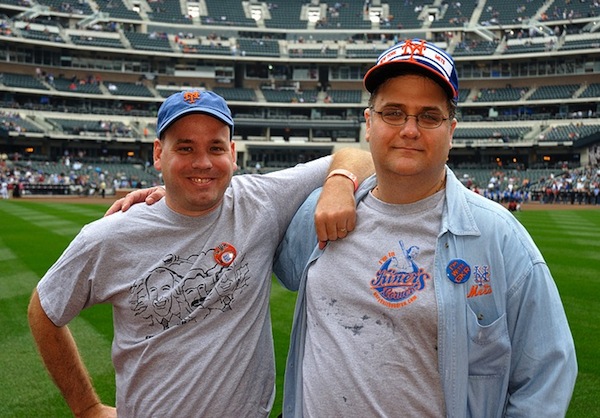
Jason and Greg on the warning track for GKR Day, our final meeting at Citi Field in 2009. Here’s to shaking hands there again with a happier place in the standings — and to keeping the Mets fires burning in these bloggy precincts this winter. Photo courtesy of the incomparable David Whitham.
|
|






