The blog for Mets fans
who like to read
ABOUT US

Faith and Fear in Flushing made its debut on Feb. 16, 2005, the brainchild of two longtime friends and lifelong Met fans.
Greg Prince discovered the Mets when he was 6, during the magical summer of 1969. He is a Long Island-based writer, editor and communications consultant. Contact him here.
Jason Fry is a Brooklyn writer whose first memories include his mom leaping up and down cheering for Rusty Staub. Check out his other writing here.
Got something to say? Leave a comment, or email us at faithandfear@gmail.com. (Sorry, but we have no interest in ads, sponsored content or guest posts.)
Need our RSS feed? It's here.
Visit our Facebook page, or drop by the personal pages for Greg and Jason.
Or follow us on Twitter: Here's Greg, and here's Jason.
|
by Greg Prince on 16 August 2009 6:18 am 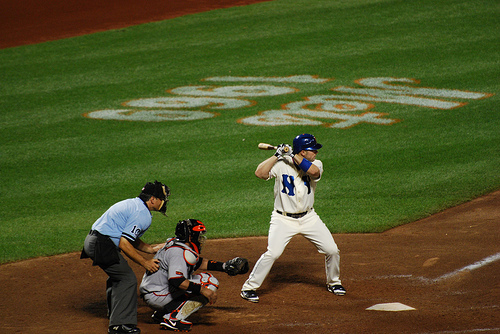
Sharon took this picture Friday night, capturing, at once, three glorious elements of New York baseball history: the early 1900s Giants, the 1969 Mets and our best third baseman ever. No sentiment ever seemed as obvious as this one, but get well immediately, David Wright.
by Jason Fry on 16 August 2009 3:27 am In retrospect, why were we surprised? Didn’t it stand to reason that David Wright would go down too? And didn’t it make sense that, having failed to injure himself sliding into third or stretching for a bag or descending the dugout steps or conducting other maneuvers that have waylaid unwary Mets, the cruel baseball gods would finally strike Wright down in frightening, decisive fashion, via a fastball from the hand of an enemy pitcher?
I don’t mean to make light of what happened in the fourth inning. Wright’s in the hospital, presumably for precautionary measures, but that’s no insignificant thing. Nor did it seem so at the time. Matt Cain’s fastball came up and in, too much of each, there was the sound of impact and then the helmet had gone one way and the player another, and then Wright was lying on his face in the dirt. And then, worse, Wright was lying on his face in the dirt and not moving.
The natural instinct is to say what you thought of when it happened, but in truth I didn’t think of anything when it happened, because I wasn’t capable of thinking anything except whatever goes through your mind when your mouth is a cartoon O. A minute later, with Wright still on his face, I thought of Tony Conigliaro, and exhaled in relief when Wright turned over and wasn’t bloody. And then I thought of Mike Cameron and Carlos Beltran and Mike Piazza. But at the time? I was thinking Oh no and Fuck, please get up and other formless, useless things.
It’s a basic rule of baseball that you never know what a game will wind up being known for. Before first pitch, I brassily predicted that Johan Santana was pitching a no-hitter, an idea that caught Joshua’s fancy and left him marching around the bedroom declaring the imminence of the first Mets no-no during the brief time in which it seemed possible. Pablo Sandoval, the amusingly nicknamed Kung Fu Panda, put an end to that fantasy, and soon Johan was spinning this way and that, dismayed by an unlikely barrage of hits. Then it became the game in which Cain beaned Wright. And then it would try and fail to become other things.
The game was also a chance to take the measure of the Giants, one of those likable, done-with-mirrors teams that misses the memo about how they’re supposed to suck. Their lineup is full of guys I never heard of, guys I lost track of and guys I thought had retired (if they were a band I’d expect them to be Aaron Rowand and the Giants), but there they are with very real postseason dreams, thanks to good defense and superlative pitching. (1969 Mets, anybody?) And the Giants were impressive — no more so than in the seventh-inning sequence in which Santana decided the best place for a fastball was the same space occupied by the Kung Fu Panda. The ball wound up behind Sandoval (though, happily, not in a lame-ass Shawn Estes way), Santana got warned, Santana threw another one inside, and then Sandoval hit the next one to Montauk. Which was one of those baseball sequences that left everybody nodding: Johan answered as his team would have liked and Sandoval sure as hell answered the way his team would have liked. Measure taken, respect given. (Johan then hitting Bengie Molina, on the other hand, was baseball as farce — particularly the sight of Bruce Bochy arguing he should have been thrown out instead of ushered out by his own manager.)
With the Mets behind, Emily and I left the house for our Saturday evening. The eighth inning’s scrappy comeback unfolded remotely at the Good Fork over Gameday, with its kabuki figures and blue, red and green pitch indicators and its cryptic, edge-of-your-seat alerts about run(s) and out(s). With my phone dying, I cut back to occasional peeks after the game went into Free Baseball territory. If it had been disappointing to miss the Mets’ rally, it was some mild relief to miss what came next: I caught up with the decisive blow a few minutes after the fact, but updates weren’t particularly necessary. We all could have guessed that a Molina brother hitting a home run would be fatal.
Brushback the indignities of 2009 with Faith and Fear in Flushing: An Intense Personal History of the New York Mets, available from Amazon, Barnes & Noble or a bookstore near you. Keep in touch and join the discussion on Facebook.
by Greg Prince on 15 August 2009 6:48 pm 
Congratulations to the New York Mets for making the playoffs seven times in their occasionally illustrious career. Very happy to see the banners pasted to the outfield wall again, particularly the one paying homage to 1999’s almost indescribable accomplishments. The first night they were back up was a very nice night, indeed.
Thanks to Porchmate Sharon Chapman for the photo.
by Greg Prince on 15 August 2009 6:50 am Here's a confession whose content should surprise you, the regular reader, as much you were stunned when you heard Pete Rose admit he gambled:
I didn't like Citi Field.
I didn't like Citi Field when it began to rise. I didn't like Citi Field when I first set foot in it for an exhibition game. I didn't like Citi Field when I attended my first game that counted. I didn't like Citi Field when I attended my first Mets win there. As the weeks and months went by, I continued to not like it, even though I had some wonderful times with some wonderful people, even as the Mets mysteriously won game after game with me watching.
I didn't absolutely hate it but I didn't really like it. I tried, I swear I did. I contorted my perspective to find individual elements I could praise, I reasoned that Rome (let alone Shea) wasn't built in a day, I tamped down my raging lack of enthusiasm so I wouldn't be a total wet blanket when blogging about our new ballpark.
But honest to god, I just didn't like it.
Yet I do now. I like Citi Field. I am home from a Friday night at Citi Field feeling none of the simmering antipathy I'd been carrying around for it as a concept dating back to 2006 and in tangible terms since early April. I am not angry at it, I do not resent it, I won't spend the rest of my evening wondering why I can't gather any affection whatsoever for it.
I don't love it, but I don't not like it. That is to say I do like it. I might very well be channeling that cheerleader at the end of Revenge of the Nerds who can't believe she's in love with a nerd. I'm not in love, and I may never be, but at long last, I'm in like with Citi Field.
What's not to like?
Oh, enough, still, I suppose, but for the first time in 2009, none of it got on my nerves. Instead, I was sated by the upgrades the Mets have begun to implement — better late than never and better to listen to your fan base even if you missed the obvious the first time around — and I was charmed by something that's been sitting there since day one.
The changes, simple stuff, really lifted my spirits, none more so than the seven playoff team banners that now adorn the tall wall in left center. I stood on the bridge and almost wanted to cry when I saw 1999, 2006 and 1988 (in order of my esteem) acknowledged for the world to see. Yeah, they've been down in the bullpen basement for a while — duplicates still are — but it wasn't the same. And I know there are flags lying limp over right field for the pennant-winners, but the banners are bolder. I missed them and I love the seven seasons they represent.
I didn't cry when I saw them, but I stood on that bridge and I applauded softly, briefly, yet heartfully. It's the first thing at Citi Field I ever felt proprietary of. Thank you for bringing them back.
Thank you, too, for the miniaturized versions of the '69 and '86 murals that adorned the sides of Shea. Those are gone, but a little reminder lives on. Darryl, Keith and Doc are in right, just off the Pepsi Porch. Gil, Tom and the Koosman-Grote tango can be found under the left field escalator. They're not big, maybe they're not quite prominent, but they're there. I've been told a bunch more adorn the staircase entrances in Promenade, but I haven't seen them yet. I'll say thanks for those, too, on good faith.
From a practical standpoint, I was delighted to see two new big-ass screens designed to show the action to the obstacle-impaired, one in right field, the other in the Promenade food court. These were lacking, they were easy fixes and, stunner of stunners, they provide a solution. From where I was sitting, per Citi Field's wacky dimensions, I couldn't see all of the outfield. No problem: I turned to my new video screen and I was good. It's like the Mets realized something didn't work and made it their business to correct the problem.
As for my seats, I am enchanted by the Pepsi Porch. I was enchanted by Tiger Stadium, too, but I groaned when I heard that this was supposed to evoke that. It all sounded a bit adorable for words. Not a lot of fly balls have come up to the Porch this season, so I don't know if it's really destined to play the same role the right field overhang did at the corner of Michigan and Trumbull, but never mind that. It's just a fantastic view and a lot of fun. It's separate from everything else but unlike the neighboring Excelsior/Caesars Club level, it doesn't leave you feeling isolated from the baseball game.
As I sat and watched our new No. 2 starter mow down the San Franciscans (maybe we should call this area the Parnell Porch), I looked around Citi Field and I finally got it. It looked just about every bit as special as they promised. You don't see it from Field Level, you don't see it from Promenade, you don't see it from the Big Apple seats, you don't see it even from the nauseatingly named Ebbets Club. But I saw it from the Pepsi Porch. I saw a cohesive structure, one that looked like it was constructed by somebody who cared — not by accident as has been my suspicion all year.
The Mets winning was a lovely touch, but I'd seen nineteen other wins and none really brightened my mood vis-à-vis Citi Field. As has been the case without exception this inaugural season, the experience of watching the Mets was immeasurably enhanced by keeping company with some great friends, but damn fine people like Sharon and Dave and Mark (my Friday quorum) have been on the scene since April and I was still not quite comfortable with my surroundings. So was it all about what was new and where I hadn't before planted myself? Maybe, plus a little this 'n' that.
• The grass was painted with a 1969 tribute in advance of the fortieth reunion next week. If that had been done in April, I assume they would have painted it over as they planned to do to Doc's signature.
• The quasi-throwbacks looked kind of all right (though they could have sprung for matching pants*) and I love the idea behind them — honoring the Mets' ancestral connection to the NY Giants, that is, not the presumed cash grab in the team store.
• Mad Men fan that I am, I was pleased we were party to a steady stream of promotional announcements for the best show on television, and I wasn't too sore that my section wasn't the one chosen to be favored by those snazzy fedoras with the blue and orange bands (the lucky stiffs who won 'em were one bunch to our left). I guess I was too relaxed to be a mad man.
• By showing up unusually early, I got to the Shake Shack before there was a line. To paraphrase Hank Hill, I tasted the meat, not the hype.
• There was a blue and orange fiberglass Amazin' Cow, lifesize, in the Promenade food court. Don't tell it about what I so enjoyed from Shake Shack.
• Nobody in a golf shirt told me I couldn't go somewhere, possibly because after 25 games I've kind of figured out where I'll be hassled and what's worth hassling over.
Did I mention I don't yet love Citi Field and may never? It wasn't a flawless presentation, you know. They could have turned down the unnecessary pregame music and I wish they'd pick a less depressing song than Louis Armstrong's “It's a Wonderful World” for when we win. I also wish the crowd would buzz a little more in a close game, but maybe we were all in shock by what's been improved and how quickly the Mets emerged victorious.
I know I was a little in shock. Maybe that's what this is. Maybe I'll go back to muttering to myself next time. But I don't think so. I feel good about Friday's visit to Citi Field. It was a nighttime version of Ice Cube's good day, non-usage of AK and all.
*Closer consideration of the shirts and pants indicate a matched set. I swear they looked otherwise Friday night, but perhaps it was the Porch perspective messing with my perception.
I think you might like Faith and Fear in Flushing: An Intense Personal History of the New York Mets, available from Amazon, Barnes & Noble or a bookstore near you. Keep in touch and join the discussion on Facebook.
by Greg Prince on 14 August 2009 2:34 pm Welcome to Flashback Friday: I Saw The Decade End, a milestone-anniversary salute to the New York Mets of 1969, 1979, 1989 and 1999. Each week, we immerse ourselves in or at least touch upon something that transpired within the Metsian realm 40, 30, 20 or 10 years ago. Amazin’ or not, here it comes.
If the Mets, with their reputation as beloved fools, could win a World Series in only their eighth season, why anything could happen — the Vietnam War could end; cancer could be cured; the races could learn to live together; poverty could be erased. Anything.
—George Vecsey, 1979
To calculate the joy of an event accurately, perhaps one must measure the inevitable letdown that follows. No event in baseball history, one can say with only a little bias, unleashed as much joy as the 1969 New York Mets winning the world championship wrought upon the land. Alas, it only figured there would be a precipitous dropoff from there.
And there was. In the decade that followed, the Mets wouldn’t match their on-field accomplishment of ’69, coming mighty close once and nowhere near it nine times. That’s show business. Teams have won a championship and experienced comparable dry spells or worse (just ask the 1908 Chicago Cubs). The ’67 Cardinals waited fifteen years for a suitable encore; the ’68 Tigers went without for sixteen years. The Mets’ aridity, September and October ’73 notwithstanding, seemed to indicate something more than the ball not bouncing their way.
The further we drifted from the autumn of ’69, the sadder we felt.
The 1969 Mets spoiled everybody for years to come. Unless you could prove a dynasty was up someone’s sleeve, it was bound to happen. And even if it was the beginning of great things, how could anything ever be greater than the first, universally unexpected time? As Leonard Shecter warned in the wake of October 16, 1969, “It is a glorious thing, and yet it is somehow sad.” He knew, and maybe everybody knew, that you only get to drink in so much joy from a single fount, that once you’ve shocked the world, the world is no longer so easily impressed by you.
The 1970 Mets didn’t repeat the feat of the 1969 Mets, finishing six games out in third after a spirited race with the eventual division champion Pirates and Cubs. The Mets were tied for first as late as September 14, but it wasn’t anything like the year before. How could it be? The year before was unprecedented. Now everything in the way of winning would be precedented for a generation.
“Explanations, excuses…” mused Roger Angell in the wake of 1970, “what remains invisible is the weight of success that these young, all-conquering Mets brought with them into this season. So little was expected of these players last year that they could plunge headlong into every key game and series, knowing that they would not be blamed if they fell on their faces. This year, the opposite was true.”
If you had told the loyal Mets fan in 1968 that within two years their team would be a first-division, 83-79 contender, there probably would have been enough champagne uncorked to fill Flushing Bay. But perspectives change with results. The 1970 Mets were ultimately an also-ran, more competitive than the pre-’69 bottom-feeders, but no more miraculous.
Thus, a certain sameness set in. The Mets compiled the exact same record in 1971 as they did in 1970, but weren’t part of an N.L. East race. They were, all in all, just a touch better than mediocre, and mediocrity — once a goal — had evolved into numbing disappointment.
“Everything considered,” Leonard Koppett wrote following the 1973 demi-miracle in a revised edition of his classic The New York Mets, “1971 was probably the least satisfying year the Mets had ever experienced. Not only were the mini-rewards of the pre-championship days no longer possible, but also the status of champion was officially gone.” As long as the Mets were alive in ’70, Koppett posited, there existed the chance that they still had a miracle in them and maybe a dynasty, a chance for “perpetual success”. Once that was gone, “the Mets moved into complete ordinariness.”
Having become just another ballclub with a decent shot at winning, the end of the Mets’ tenth year of existence proved to Koppett that “all their specialness was gone, for better or worse. They had entered the mainstream, and had completed the transition into being routine. No longer were they a challenge to any Establishment: they were the Establishment.” The Mets of 1971 were not represented primarily by “kooks carrying homemade banners” or what the author called “the disenfranchised”. Mets fans, Koppett concluded, “wanted only what sports fans everywhere seemed to want: victory, and no questions asked.”
Of course questions would be asked as victory became elusive, prime among them as 1969 faded further into the rearview mirror, where did everybody go? The 1970 Mets stopped being the 1969 Mets within two weeks of their championship when they released 36-year-old Ed Charles. The most famous picture of their celebration, Koosman leaping into Grote, with Charles seconds from making their battery a threesome, was cropped before John Lindsey completed his re-election campaign.
Charles was the first to go but he wouldn’t be the only one disinvited from active participation on Opening Day. The 1970 Mets would compete without the Glider, without Jack DiLauro (lost in the Rule 5 draft to Houston) and without J.C. Martin (traded to the enemy Cubs late in spring). Top prospect Amos Otis was given up on and traded for Joe Foy in December of ’69. Supersub Bobby Pfeil would be dealt mid-season ’70. Rod Gaspar, who scored the winning run in Game Four of the World Series, would get no more than a callup cameo in September and would go to the Padres as payment for Ron Herbel a year after he was one of 25 heroes. Don Cardwell became a Brave in July 1970, a month after Cal Koonce was sold to the Red Sox. Foreshadowing the unsuccessful title defense, Johnny Murphy, the GM who shepherded the Mets to their destiny, suffered a heart attack and never saw the championship flag raised.
Attrition approached epidemic stages in March 1971 when Ron Swoboda was swapped to the Expos for Don Hahn. Swoboda was the first of the frontline, born-and-bred Mets from 1969 to go. It was a sign that nothing miraculous could last forever. By 1973, Rocky was already nostalgic for 1969, telling Joseph Valerio in the updated edition of Jerry Mitchell’s The Amazing Mets, “It was a romantic type of atmosphere in 1969 that ended abruptly. I never got over it, not even yet. I think they had time to sit on that club, but they made businesslike motions. They milked so much emotion from that team and then they made cold, calculating moves. They raised the price of tickets the next year.”
If Ron Swoboda, maker of the most impossible catch a World Series ever saw, could be sent away, who couldn’t? We would know by the end of the calendar year that his right field platoon partner, Art Shamsky, wasn’t immune either. Sham became a Cardinal, as would Donn Clendenon, released two years after earning the Fall Classic MVP award and four months after his stiffest competition for the prize, Al Weis, was given his walking papers. Ron Taylor and his fireman’s gear were sent north to Montreal. 1971 closed out with the highly questionable trade of hot & cold fifth starter Nolan Ryan (and three others) to the California Angels for six-time All-Star shortstop Jim Fregosi. Fregosi would be asked to play third.
Then came 1972 and the death of Gil Hodges, and the dissolution of 1969 seemed to have taken on a whole new dimension. It wasn’t just sad. It was tragic.
Under Yogi Berra, the Mets made a concerted effort to turn the page to a new post-1969 chapter, acquiring the lefty power bat they’d forever lacked in Rusty Staub and grasping for whatever magic remained in the body of 41-year-old Willie Mays. It all seemed to work for a while. The 1972 Mets entered June with a five-game lead and shared first place as late as July 1, but injuries took their toll and the Mets fell from contention long before summer waned. Once 1972 ended, the ’69 housecleaning recommenced: Gary Gentry and Danny Frisella to the Braves for Felix Millan and George Stone in an unquestionably good deal; Tommie Agee for Rich Chiles and Buddy Harris in an absolutely pointless deal. As Agee himself would put it down the road, “When you’re traded for Rich Chiles, you’ve got to be bitter.”
The 1973 Mets, the team that almost matched the 1969 Mets miracle for miracle — albeit via a very different path — was composed of no more than 44% certifiably Miraculous content. To glance at their postseason roster and see Seaver, Koosman, McGraw, McAndrew, Grote, Dyer, Jones, Kranepool, Garrett, Boswell and Harrelson was to be reassured that 1969 didn’t take place all that long before. Berra was the manager now and a coach then. He was assisted by Rube Walker, Joe Pignatano and Eddie Yost, just as Hodges had been. And there was no arguing that Staub, Millan, Hahn, Mays, John Milner, Jon Matlack, Jim Beauchamp and the others who had joined the club since ’69 had achieved something substantial and remarkable.
It was after 1973’s effort came up one game short in Oakland and its 1974 encore collapsed with a thud (first Met losing record since ’68) that the distance from 1969 to the present really began to gape. It couldn’t help but be noticed by the world at large that the Mets had fallen far from their Miracle peak. Writing in the Cincinnati Enquirer in 1974, Mel Woody recounted the whereabouts of the missing for an article that would be reprinted in Baseball Digest under the headline “Whatever Happened To The Miracle Mets?”
• Jim McAndrew, 30, released by Iowa in the American Association less than six months after the Mets shipped him to San Diego.
• Don Cardwell, selling cars in Winston-Salem.
• Jack DiLauro, out of the game.
• Gary Gentry, recuperating from elbow surgery.
• Cal Koonce, college baseball coach in North Carolina.
• Donn Clendenon, running a “thriving” nightclub in Atlanta.
• Al Weis, working in Chicago.
• Ed Charles, scouting for the Mets in Kansas City.
• Art Shamsky, “younger than Pete Rose,” operating a bar in New York.
• Tommie Agee, same as Shamsky.
• Ron Swoboda, a “TV announcer” in the Big Apple.
• Ron Taylor, studying medicine in Toronto.
• Rod Gaspar, a Hawaii Islander in the Pacific Coast League.
• Nolan Ryan, “doing his strikeout thing for the California Angels after a disastrous Mets deal.”
Woody wondered how so many young up & comers had up and gone from the big leagues in just five years, especially with such a fantastic achievement on their respective résumés. He theorized that someone like the once-brilliant centerfielder Agee, making a then high-end salary like $80,000, was ripe for release if he “slips a bit”. Jerry Koosman didn’t disagree, adding if it meant hanging on longer, “I could see myself going to the front office and renegotiating my contract downward so they could afford to keep me on the club.” (This was a little more than a year before Peter Seitz struck down the reserve clause, making Kooz’s notion quite quaint in due order.)
Whatever happened to the Miracle Mets, it just kept happening, especially after the downcast ’74 season ended. Next out the door: Duffy Dyer (for Gene Clines); Ken Boswell (for Bob Gallagher); and, in the biggest shocker of the realm to date, Tug McGraw, in a six-player deal that brought in two very helpful players, centerfielder Del Unser and catcher John Stearns, yet underscored just how deeply the Mets had descended into the “complete ordinariness” Koppett divined as setting in a few years earlier. Tug McGraw was a Met of good standing in 1969, a top reliever in the early ’70s and, of course, the legend of 1973. You couldn’t believe he was no more than trade bait to the post-Miracle Mets. But he was. GM Joe McDonald admitted to Jack Lang, in The New York Mets: Twenty-Five Years of Baseball Magic, “that both he and McGraw cried over the telephone when the general manager called to advise the relief pitcher of the trade.”
The Mets were down to seven 1969 Mets in 1975. They’d be down to six come July when Cleon Jones, who had hit .340 for the world champs, was released after a dugout run-in with Yogi Berra — who would be dismissed shortly thereafter — over his insertion as a defensive replacement. As the ’75 Mets were coming up short in September (in the weeks just prior to the nearly simultaneous passings of Casey Stengel and Joan Payson), the comparison of what the Mets had been with what the Mets were now was a recurring theme, and not a happy one. In the October 1975 edition of Sport magazine, Dick Schaap and Steve Steiner described the twinned fates of the co-proprietors of the Outfielders Lounge on Astoria Boulevard, Cleon Jones and Tommie Agee, following their romp off the field after Jones caught the final out of the ’69 World Series:
Their futures seemed so bright. They were heroes, fresh from a parade down the middle of Manhattan, fresh from confetti and cheers and a championship.
From that image of 1969 to the reality of 1975: Jones chased from the Mets after a nightmare year (the mini-mutiny against Berra, the nagging injuries and the embarrassment of a team-mandated public apology for being found in a van with a woman not his wife during Spring Training); Agee not even in baseball the preceding two years, his last at-bat coming in 1973, as a Cardinal, at age 31.
“For several months” after his unconditional release by the Dodgers in the spring of ’74, Schaap and Steiner wrote, Agee “kept practicing his batting stance, his grip and his swing in front of mirrors. And then, by the time he turned 32, he knew the dream was dead, and he stopped practicing, and he let the paunch come on him without resistance.” The Sport article left them in their bar, physically near but spiritually disconnected from Shea Stadium. A Mets game aired in the background, but “neither man even glanced at the television for a moment. They just turned their backs on the game — the way the game, for some reason, had turned its back on them.”
The 1976 Mets reduced their 1969 head count from six to five with the trade of Wayne Garrett (and Unser) to Montreal in July. The Mets were going nowhere faster than usual, and Maury Allen in the Post shortly thereafter envisioned where we might find the final survivors of ’69 five years into the future, 1981. Jerry Koosman would be farming in Minnesota; Jerry Grote would be ranching in Texas; Bud Harrelson would be the baseball coach at the University of San Francisco; Ed Kranepool would be tearing up the American League as designated hitter for the Kansas City Royals; and Tom Seaver would be a full-time sportscaster. Allen’s larger point was the Mets needed to start rebuilding and he urged them to think about trading Tom Seaver sooner than later.
M. Donald Grant must have read that article.
Come June 1977, the 1969 Mets absorbed the crushing blow the Cubs, the Braves and the Orioles could never deal them. Tom Seaver was traded. It had been in the air, but it seemed impossible to fathom. There were more tears, shed by the traded as he packed up his locker and shed by his devotees as they attempted to comprehend the incomprehensible. “A man I know — not much of a Mets fan, or even much of a baseball fan, ” wrote Roger Angell, “told me that ever since the trade he had been waking up in the middle of the night thinking about Tom Seaver; one time, he said, he woke up crying.” There was anger, too. “This place is a madhouse,” Mets switchboard supervisor Emma Fuchs told Sport magazine’s Paul Good. “It’s insane. The people are calling up and screaming and cursing.”
That was about all the passion the ’77 Mets would inspire. They would delete Jerry Grote before September (handed to the Dodgers for their stretch run) and end the season in last place for the first time in ten years. Bud Harrelson would go to the Phillies in the spring of ’78 for the immortal Fred Andrews. Jerry Koosman would get his first and only Opening Day start. He’d win it and two more decisions, en route to a 3-15 record, his last as a Met. In December, he’d be sent packing to Minnesota, not to farm, but to pitch.
Ed Kranepool, the last of the 1962 Mets, was now the last of the 1969 Mets on the premises. Come July 14, he would hear his name called among his most accomplished teammates again as part of the team’s first reunion of its, to that point, only world champions.
Old Timers Day 1979 was clearly the highlight of that season’s schedule, with the double-theme of 1969’s tenth anniversary and coach Mays’ upcoming induction into the Hall of Fame. Mets fans looked forward to it, flocking to Shea in numbers mostly unseen that year (28,254, a paid gate exceeded only and barely by the inaugural Fireworks Night in June). The Mets organization, which couldn’t have done more things worse across a decade had it actually set out to fail, did the best it could to brighten this particular Saturday. The individual ’69 Mets may have turned bitter toward their former employer as they had been traded, released and ignored (none of them voluntarily stepped aside), but 15 of those who were no longer active turned out for this milestone occasion. Kranepool was included in the festivities as was fictional ’69 utilityman Chico Escuela, a.k.a. Garrett Morris, fresh off his All-Star season on Saturday Night Live. A handful of those who were otherwise engaged by baseball — Seaver the Red, Koosman the Twin, Harrelson and McGraw of Philadelphia — sent taped messages the fans cheered.
That esteemed quartet couldn’t be there, nor could Angel Ryan or Expo Dyer. Garrett was playing in Japan. Gaspar missed his plane. “Efforts to contact Koonce and Pfeil,” according to the 1980 Mets Yearbook, “were futile”. But everybody else who could be there showed up at Shea, which was transformed, for this fleeting moment in 1979, back into the happiest place on Earth.
The narrative of the Mets as a franchise that had stumbled itself into hard times was now familiar not to mention accurate. Perhaps the most telling episode from that Old Timers Day, as captured by George Vecsey in Inside Sports magazine:
The choice of uniform confirmed the rumors of the new tackiness of the Met ownership. Rather than provide a souvenir shirt with each player’s name on it, the Met management scrounged up spare uniforms with the right numbers but adhesive tape blocking out the name of the current Met. Thus, Rocky Swoboda returned to the scene of his dazzling World Series catch wearing his old No. 4, but with peeling white tape barely concealing the name of Bruce Boisclair.
So the Mets under Lorinda de Roulet were penurious and preposterous. So the Mets commemorated the tenth anniversary of 1969 by finishing in last place for the third consecutive season. So Jerry Koosman would win 20 games for somebody else, Tom Seaver and Nolan Ryan would lead other teams to the playoffs and Tug McGraw was merely one year away from sealing a division rival’s world championship — by which time the last of the ’69 Mets to not leave the Mets, Kranepool, had been kicked off the roster (never to DH for KC or anybody).
Yes, it was sad to watch the Mets transform from once-in-a-lifetime winners to stupefying losers, usually without grace or regard for what had made those winners so appealing. Yes, 1969 was all over too fast. Yes, it was a sad story.
Emphasis on was.
Now and, really, since 1979, the ’69 Mets have lived on as a unit happily ever after. It may have started that otherwise hopeless July day when SWOBODA peeled off into BOISCLAIR. At the time, the 1969 Mets were out of practice at coalescing. They hadn’t done it since that Thursday ten Octobers prior when Koosman jumped Grote, Charles jumped them both and all of New York followed. But the first Old Timers Day in which the ’69 Mets came together not as retired players but living legends set the stage for the rest of time. We now understand the ’69 Mets will always be the ’69 Mets, no matter how each of them stopped being a Met in the course of his career. We just accept it and are grateful for it.
With that kind of hindsight, it’s rather surprising to read in Vecsey’s characteristically wonderful 1979 article how it was all a little strained for the retired Mets to greet each other again, at least according to Dr. Ron Taylor:
“Almost no laughter, not many old stories, not much serious talk. I guess that’s because a lot of the key players — Seaver, Koosy, Bud Harrelson, Tug McGraw — are still playing. In ten years the party will be better.”
There would be more parties and nobody seems to have complained of their frequency or quality. Reuniting the 1969 Mets became a tradition at Shea Stadium. There would be an Old Timers Day in 1989 for the twentieth anniversary, another in 1994 for the twenty-fifth and a thirtieth birthday party in 1999. There will be one at Citi Field on August 22 for the fortieth anniversary, the first to feature Nolan Ryan. Any and all celebrations that weren’t dedicated solely to 1986 have represented an excuse to bring back 1969 Mets, including ten from the World Series roster — McAndrew, Charles, Shamsky, Garrett, Swoboda, Kranepool, Jones, Harrelson, Koosman and Seaver, along with first base coach Berra — when Shea shuttered its gates on the last day of 2008. There’d be fantasy camps and card shows and commercials and all manner of reunions as 1969 grew sepia-toned. Men like Agee and Swoboda managed to forget whatever misdeeds management dealt them and became regular visitors to where they made the miracle. Tom Seaver serves the Mets as a “club ambassador,” which is not something one would have projected for him in 1977.
While it was still fresh in the memory, ’69 couldn’t help but mock its ever less miraculous immediate successors. But as it’s become older, what stands out about 1969 is not how it unraveled but how it could never truly come apart.
“When the Mets roared down the stretch to win the National League pennant five years ago, and then went on to upset the Orioles in the World Series,” Mel Woody reflected in 1974, “they captured the fancy of the baseball public. In retrospect, it was a short-lived miracle.”
That, blessedly, would prove a short-lived conclusion.
The 1969 Mets could hook a person on baseball, as you’ll find out when you read Faith and Fear in Flushing: An Intense Personal History of the New York Mets, available from Amazon, Barnes & Noble or a bookstore near you. Keep in touch and join the discussion on Facebook.
by Greg Prince on 13 August 2009 10:26 pm 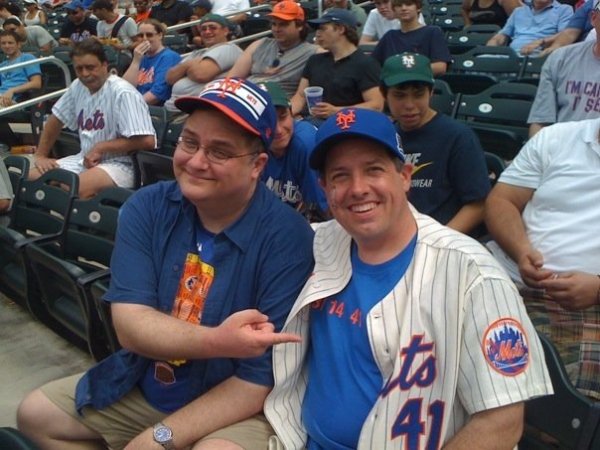
The Faith and Fear t-shirt has been seen this season at Fenway, at Rogers Centre, at what is now known as Pitco, even at the Roman Colosseum. But how about this: the first “official” FAFIF shirt sighting* at the New World Class Home of the New York Mets, Citi Field? And how about Dave Murray coming all the way from Michigan (and unbuttoning his flannel jersey on a heatlamp of a day) to show it off? Not a lot of Citi-identifying background here, I admit, except those disgusted expressions attached to Mets garb, so you definitely know where this was taken.
The Mets said they’d be adding installations of photographic imagery of historic moments to the ol’ new ballpark. We’re happy to help by offering this milestone occasion.
Get your shirt by going here. And get us a picture of it in action anywhere you like by sending it here. If you’d like to see everywhere the FAFIF shirt has been since its October 2006 introduction, you can take the tour here.
*We’ve seen others, actually, but it never occurred to us to get a picture until last week.
by Greg Prince on 13 August 2009 8:04 am That doctor from SNY's constantly airing New York State Smokers Quitline commercial — the one who comes into the examining room and tells that poor, haunted guy all the diseases he risks contracting from indulging his filthy habit (kind of like a one-man death panel) — might make a good medical liaison for the Mets. Imagine him opening the door, making his diagnosis and then reappearing to make another and another and another…
“You have tears in your left medial collateral ligament and flexor pronator.”
“You have a right hip impingement.”
“You have tendinitis behind your right calf.”
“You have a fractured left pinkie.”
“You have a bone spur on the back of your right elbow.”
“You have right shoulder weakness.”
“You have a bone bruise to your right knee.”
“You have a torn meniscus in your right knee.”
“You have a muscle tear in your right thigh.”
“You have a torn right upper hamstring tendon.”
Of course that's not one guy he's scaring spitless. Those are the injuries that sent ten men, all of them Mets, to occupy what is presumably baseball's busiest Disabled List. If there's a busier DL, I doubt it's on a ballclub. It's probably in a war zone.
While the Mets' DL has meant a break (figuratively speaking) for the likes of Cory Sullivan, who wouldn't otherwise be a Met right now and wouldn't have tripled twice in Phoenix Wednesday afternoon to key a rare Met victory, it has, of course, crippled the Mets' chances of contending in 2009 and strained their ability to compete — that and their composite lack of professionalism and unfamiliarity with the fundamentals of baseball. But the injuries have been the most glaring problem and will likely be both the legitimate excuse and sorry alibi the Mets lean on when this abortion of a debacle of a disaster of a season is over.
As fans, we ache for our players' pains. If one is sustained on the field, like if he falls and he can't get up, we hold our breath until the guy's on his feet or a cart and then we rise and applaud. We collectively wish him well (we may have even admired that he was playing with pain up until the moment he could play no more) and then get on with the business of rooting for his generally lesser replacement. As the 15-day mark approaches, we begin to ask when our guy will be coming back because we could really use him.
And that's when the trouble seems to start. Almost nobody is placed on the 60-day DL at first. It's almost always 15 days, just a couple of weeks. We are conditioned to believe that number. Then we are conditioned to believe the most hopeful number we hear when 15 days come and go. He was supposed to be out six to eight weeks, but if all goes well could resume baseball activities as soon as three weeks? And then he could go to extended spring training? And play a rehab game? Great!
Our expectations rise. Somebody reports something about somebody picking up a ball, swinging a bat, running a lap, hitting the stationary bike. Boy, if he's doing as well as they say, he could be back sooner than expected. Throw him into the mix and we improve a lot. Yeah, I'm sure glad he's coming back. It doesn't seem to help anybody's cause to tamp down our expectations. The Mets, like just about all commercial enterprises, are in the optimism business. Sure, he'll be back! He's bending without discomfort! He's tying his shoes again! He's eating solid food! St. Lucie beckons! Can Citi Field be far behind?
Then? Then nothing. Because the optimism is rarely founded in anything but wishful thinking. What good does it do the Mets to announce this player or that pitcher is indeed going to St. Lucie — “but don't get your hopes up”? Doesn't do the player/pitcher any good. He has to believe he's getting closer, too. I don't know how many tickets are sold on the basis of any individual player's active status, but who wants to discourage the fans by telling them, Whoa, slow down there, he's healing but he's not a walking miracle? The media need something new to report and hype up and hype whatever they've got. Someone continuing his stay on the Disabled List is not news. Someone making his way off it is.
I'm not a doctor, I don't play one on TV and I haven't watched a medical drama since Marcus Welby, but I'm pretty sure the human body is a tricky contraption, especially those human bodies that engage in unusual, maybe unnatural activities for a living. So when we hear that a person in one of those bodies is working toward recovery but encounters an obstacle…oh, we don't like that. It must be somebody's fault. Some doctor, some trainer, maybe the player himself. Somebody's too stupid or too lazy or too “soft” to get it together. The same guy we stood and clapped on weeks, maybe months ago is not someone we're happy with now.
When the hell is he coming back?
Billy Wagner may be coming back Sunday. Or he may not. I'll put this in the seen-when-believed file, but OK, he's been out for a year and nobody necessarily expected him to return at all after Tommy John surgery. That's one for some combination of science and hard work.
Anybody else?
This is where we get into trouble because how the hell would I know? How the hell would you know? How the hell would Omar Minaya or Ray Ramirez or Dr. David Altchek know? It sounds good to say “we expect them to start coming back by the All-Star Break” or “we should begin to see a couple of them around August 1,” but what does it mean? Nothing, apparently. It's the old “nobody knows anything” catch-all, except it's true — at least until someone does know something. Wednesday there was a palpable knowing sigh emanating through Metsopotamia when word went forth that Carlos Delgado, in the midst of rehabbing his hip, strained an oblique. Oh not again!
But not what again? That a man trying to fix one part of himself hurt another? That's frustrating from a fan standpoint, but I'll bet it's way more frustrating for Carlos Delgado. It can't make anybody in the organization for whom he works happy either, whatever their role in his recovery or prognosis, however supportive they are or however cynical they've become.
Somewhere along the way, Delgado was pegged as coming back by now. So was Reyes. So were Beltran and Maine and Putz. I could swear I heard or read about the encouraging progress each was making at some point or another. Guys who went down in May and June, you could say they would return in July or August and who was going to argue? It sounded good and not unreasonable. The Mets were however many games out that they were. Add Delgado and Reyes and Beltran and Maine and Putz to the equation, and that's not such a bad team. You wouldn't have to slash ticket prices to sell seats to see that team.
Like I said, this is frustrating. There is a tendency to remember the outsized examples and blame somebody for not living up to, or for perhaps for living down to precedent. How about the way Johan pitched even though he needed knee surgery? Remember the way they screwed with Reyes' running style? How many times did they say Pedro was ready before he suffered a 'setback'? Didn't they have to fire their hospital a few years ago? There is also a tendency to cringe when we hear of the most benign “ouch,” because we recall how benignly various hips, hamstrings and hamates might have been framed before the players attached to them disappeared into the Disabled mist.
It's just possible that the Mets stretch all wrong, or that their pitchers don't warm up properly. It's just possible that they hired a battalion of incompetent doctors, or that some conniving segment of the medical-industrial complex knows that lingering Met injuries represent a cash cow. It's just possible that every Met who's gotten hurt has a mental block about recovering, or the ones with long-term contracts don't see the benefit of rushing back to a team buried in fourth place.
It's also possible that there is some sort of shortfall in the Mets' training methods; that there are doctors who shouldn't have been so certain about certain prognoses; that each player is an individual; that their aggregation of injuries has been rather freakish; that management lacked foresight in terms of roster alternatives; and that the team's communications apparatus is as fractured as any given pinkie when you consider the gap that exists between promised return dates and the reality in which those dates go by without any evidence of tangible progress.
The above is my pet theory, but when it comes to Met injuries, nobody knows anything really, and that includes me.
***
If you think the overpopulation of the Mets' DL is part of some great, big plot, then the book for you is The 30 Greatest Sports Conspiracy Theories of All-Time, whose new improved edition has been co-authored by Mark Weinstein, blogger of Bluenatic and editor of another fine sports book of recent vintage. Conspire to get your copy today.
And if you think 2009 should go out on the happiest, healthiest note possible, you should attend the second annual Gary, Keith and Ron end-of-season bash in the Big Apple section at Citi Field, Saturday, October 3. This is your chance to make like Cory Sullivan and stand on the warning track of a big league ballpark. Details here — and here's an added bonus because you have the good taste to read Faith and Fear in Flushing: Through this Saturday, August 15, use the coupon code Blogger and get 15% off tickets and all GKR merchandise, courtesy of Lynn Cohen.
by Greg Prince on 12 August 2009 8:59 pm 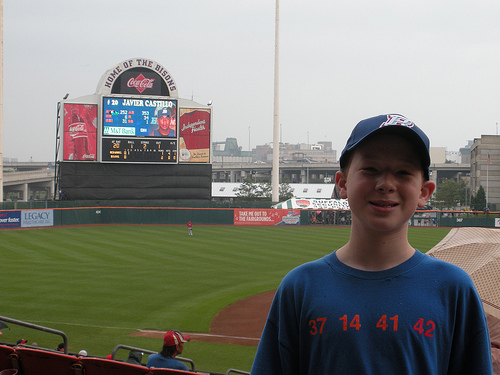
The best thing to come out of Buffalo since Fernando Nieve: Ross Chapman showing off the FAFIF numbers tee at Coca-Cola Field, home of the Bisons.
See, Tony Bernazard? Some guys can keep their shirts on at Mets minor league ballparks.
Show you’re in the pros with your own Faith and Fear t-shirt, available here.
by Greg Prince on 12 August 2009 8:29 pm Quick in-game break from our daily teeth-gritting to acknowledge that the New York Mets seem to have caught on after 4½ months and will be (hold on to your fedoras) honoring the heritage of the New York Mets in a well-rounded fashion. The organization with the Ebbets Field facade, the Pee Wee Reese jerseys displayed prominently in the main team store and the the Brooklyn Dodgers highlights running in a loop above the Jackie Robinson Rotunda — to say nothing of what their owned & operated farm club is doing to celebrate the existence of one of the Mets’ sworn enemies — is finally getting on the ball with a little Mets decor and even a three-day nod to that other New York National League franchise that helped pave their way.
From the horse’s mouth:
The New York Mets today announced they will honor their National League heritage by wearing throwback uniforms inspired by the turn of the century New York Giants uniforms when they play the San Francisco Giants August 14-16 at Citi Field.
The cream-colored jerseys feature an oversized blue “NY” on the front, blue and orange piping on the sleeves and a Mr. Met patch on the right sleeve.
Mets Amazin’ Memorabilia will auction off the jerseys to benefit the Mets Foundation on www.mets.com/gameused.
In addition, the Mets have begun installation of photographic imagery of famous players and historic moments in team history on the Field and Promenade Levels as well as the display of team championship banners on the left field wall.
The Mets were created after the Brooklyn Dodgers and New York Giants left for California following the 1957 season. Major League Baseball granted New York a National League franchise in 1960, and the Mets played their first two seasons in 1962 and 1963 at the Polo Grounds — the former home of the Giants.
One will have to inspect the installations and such, but may I say, as one of the most vociferous critics of the Mets’ one-eye-covered approach to their history, way to go team.
The throwback uni is here. The inspiration is here.
by Jason Fry on 12 August 2009 5:10 am The Mets are now 1-5 on a West Coast trip against crappy teams. Tonight they got beat by Max Scherzer, he of the David Bowie eyes, and Trent Oeltjen, a young Aussie who really ought to retire the moment the Mets leave town. (Trust me, Trent — baseball isn't this easy.) They got beat because they sent out a lineup composed of guys who couldn't make the Junior Varsity, because they were unlucky, and because at various points they played flat, indifferent and frankly lazy baseball for the second night in a row.
One more final game in the desert and it's back home for 11 against the Giants, Braves and Phillies, all considerably tougher competition than the Padres and Diamondbacks. Barring a jaw-droppingly unlikely series of events, that homestand will be the final Waterloo, the stretch after which even the true believers will have given up.
The hope here is that it doesn't mark the season going from unfortunate to ugly. Because it's looking like it sure could.
It's been clear for some time that 2009 was going to be a harvest eaten by locusts, a famine year that reminds you baseball is fickle. Which is taxing to live through, but part of being a fan. But a sour spring has turned into a nauseating summer, with mutterings about subpar medical care and willful front-office blindness, the drip-drip of revelations about Tony Bernazard's reign of terror and Omar's self-immolation at the podium. That wasn't enough to necessarily turn the fans against a wounded team, but now the effort on the field has to be called into question, too. It was bad enough that Livan Hernandez showed up Alex Cora and Luis Castillo half-assed a throw to Daniel Murphy; it was worse that these misdeeds came a night after Jerry Manuel's made his displeasure with Angel Pagan, Fernando Tatis, Mike Pelfrey, Anderson Hernandez and Murphy evident.
Omar Minaya, for all his many faults, was probably going to get a pass for 2009 because his team got hit by lightning. Then he had to pick an embarrassingly public feud with a reporter, and now his future seems very much in doubt. Jerry Manuel, for all his many faults, was probably going to get a pass for 2009 because his team got hit by lightning. But now his charges are playing like a team that's stopped listening to its manager — and much more of that could put his future in doubt.
I've been more than clear that I think Omar should go, and I think as a strategist Jerry is a pretty good player's manager. So what's wrong with a purge of the ranks? Nothing in the long term, I suppose. But purges are generally the culmination of ugly, bloody times. Citi Field has flaws that good conscience demands the Mets address before 2010, but so far it's been a relatively bright spot in an otherwise horrible year. That can change quickly, however, and it will if the Mets come home and play the kind of indifferent garbage-time baseball they've shown us on this road trip. The Wilpons are already staring at the likelihood of inaugurating their new park with 90 losses, which is bad enough; having the Mets slump across the wire pelted by well-earned boos would be a whole lot worse.
Say “boo” and you're three-quarters of the way to saying “book.” Take your mind off the carnage with Faith and Fear in Flushing: An Intense Personal History of the New York Mets, available from Amazon, Barnes & Noble or a bookstore near you. Keep in touch and join the discussion on Facebook.
|
|

 Comments closed | |






