Happy Memorial Day. Keep in mind those who gave their all in service to a great country. And enjoy a ballgame tonight and most every night (or day) for a few months.
 
Faith and Fear in Flushing made its debut on Feb. 16, 2005, the brainchild of two longtime friends and lifelong Met fans. Greg Prince discovered the Mets when he was 6, during the magical summer of 1969. He is a Long Island-based writer, editor and communications consultant. Contact him here. Jason Fry is a Brooklyn writer whose first memories include his mom leaping up and down cheering for Rusty Staub. Check out his other writing here. Got something to say? Leave a comment, or email us at faithandfear@gmail.com. (Sorry, but we have no interest in ads, sponsored content or guest posts.) Need our RSS feed? It's here. Visit our Facebook page, or drop by the personal pages for Greg and Jason. Or follow us on Twitter: Here's Greg, and here's Jason. |
Happy Memorial Day. Keep in mind those who gave their all in service to a great country. And enjoy a ballgame tonight and most every night (or day) for a few months. About a month ago (or so it seems), the Mets headed off for the West Coast, not knowing that what lay ahead was the baseball equivalent of the Donner Pass. Delgado. Reyes. Putz. K-Rod. Cora. Sheffield. Church. Beltran. All either went on the DL, missed games or had their contributions hindered by injuries. (And now Ramon Martinez — Plan C when it comes to finding someone to play shortstop — is hurt, too.) Given all that, returning to Citi Field 5-5 isn't a bad accomplishment. But what a way to go 5-5! The Mets started off by taking three in a row from the Giants with apparent ease, leaving us all slavering with comparisons to the epic 9-1 road trip that served as formal notice that the 2006 squad was going to win the division in a walk. They then got edged in the San Francisco finale and got swept in L.A., including a slapstick affair that has to rank as one of the most appalling, humiliating losses in franchise history. So then, of course, they came in and took the first two from the mighty Red Sox, with Johan Santana willing them to win the first game and Omar Santos playing hero for the kind of once-in-a-blue-moon win that ensures you'll watch blowouts to the bitter end for the next two years — because, in the word of Joaquin Andujar, youneverknow. A three-game sweep in Boston, with the lyric little bandbox hosting a substantial and vocal minority of Mets fans, was a lot to ask, and even with the Mets ahead in the middle innings, I kept waiting for the other shoe to drop: Tim Redding kept falling behind hitters and giving up loud fly balls, and you figured that the middle of the Red Sox order would see its luck even out before Redding could escape. The Bosox may have their problems, but that lineup is deadly, from the more-Eckstein-than-Eckstein Dustin Pedroia to the overcaffeinated Kevin Youkilis to the bland but deadly Jason Bay and J.D. Drew to the sad-eyed, wise Mike Lowell. All except David Ortiz — I felt for Big Papi, who looked absolutely helpless all series and was verbally scorched by fans who not so long ago would have sworn he had a lifetime pass for his past heroics. Ortiz hit exactly one ball hard, and it rocketed straight into Daniel Murphy's glove, leaving Papi to yowl and then offer a death's head grin at just how unfair the game can be. (If you'll allow me a parental interlude, can I address whatever person at WPIX let an afternoon game be sponsored by “Drag Me to Hell?” I have nothing against horror movies and am a Sam Raimi fan, but that ad is way too intense for young kids, and anyone with a modicum of decency or common sense would understand that parents shouldn't be put in the position of shooing their children away from a baseball game every 40 minutes on a Sunday afternoon.) The rest was enjoying the observations and memories and questions that any baseball game will yield if carefully attended to. Like wondering at how smooth Gary Sheffield looked in left field, and remembering how utterly discombobulated Lastings Milledge had been three years before. Or watching Murphy at first, still not entirely sure of himself but handling even the hard plays with a calm he's never exhibited in left on easy chances. Or (from the sublime to the ridiculous) wondering, in a particularly idle moment, where Murphy got his sunglasses. Ramon Castro was wearing the modern baseball standard Intergalactic Warrior iridescent shades, as was Sheffield, with Castillo opting for the classic flip-down glasses. But Murphy's sunglasses looked like he'd fetched them from a Dollar Store in Woburn. These are the things you wonder about when the game's out of hand and the only reason you keep watching is … well, because it's baseball, and how could you even ask that question? We lost, and it seems like everybody's hurt, and who knows what that will mean. But we're right here in it, and tomorrow we start again. That's the whole point, ain't it? The Mets will have to play the next two without me — I'm headed for Denver. (And yes, going to Coors Field. Like you had to ask.) Greg will keep you faithful or fearful, as the case may be. Speaking of which, Faith and Fear in Flushing: An Intense Personal History of the New York Mets, is available from Amazon, Barnes & Noble or a bookstore near you. Keep in touch and join the discussion on Facebook. Bob Murphy lives. His most enduring lesson certainly does. Baseball, the original Murph told us countless times, is a game of redeeming features. Saturday night proved him indubitably and eternally correct. Met upon Met redeemed himself at Fenway Park. They lined up like we incessant diet cola drinkers who live in a carbonated beverage container deposit state tend to do. They brought their psychological bottles and cans, all digned and dusty, to the reverse vending machine outside the proverbial Pathmark and they inserted one empty after another. Insert enough, you don't just redeem your deposits. You gain redemption. To quote a great philosopher, “bottles and cans and just clap your hands — just clap your hands.” Coming from behind in the ninth to beat the Red Sox 3-2 is definitely worth a hearty round of applause. It's where it's at. The Mets seem redeemed. The 0-4 Mets from Sunday to Wednesday are 2-0. The dropping-toward-.500 Mets of 2009 are suddenly stepping beyond it. The road-weary Mets have crossed the country and their winning ways have been refreshed in one of the sport's most inhospitable climes. The starter who couldn't stand up for falling down last weekend rose from the dead. The lineup and its at least five nine-hole hitters strung together enough live wood to bring home all the runs the unit as a whole would need. The defense that previously couldn't catch a break let alone a grounder caught everything in its path and some items that seemed destined to zoom on by. The closer who's ticked that he rarely gets to close got to close matters shut. The system installed to see to it that bad umpiring could be overruled by modern technology had a redemptive flavor to it as well. When Omir Santos unleashed that lethal short swing on Jonathan Papelbon in the ninth, I thought it was too much to ask for it to go out. Then I thought it was too much to ask for it to be ruled to have gone out even though it did. “We always get screwed on these calls,” I informed Stephanie who is quite aware of our track record in call-screwage. Ah, but home run replay. That's a relatively new twist on a formerly rancid cocktail of arbiter incompetence. Even Joe West can watch TV. Even Joe West and his merry men — including Paul Nauert, ball cop — could see Santos' shot landed above the magic barrier that separates homers from doubles before bouncing back to earth. It took a while, but fingers were twirled and runs were assigned. Omir Santos: short stroke, long trot. The bottom of the ninth never felt it would be easily resolved. First off, where in the world was Francisco Rodriguez? When we last saw him, after a simple ninth Friday, he was high-fiving the heavens and rubbing his tummy as if quite full from all the saves he's been ingesting. Did he have a bellyache or something? No, we'd learn and cringe: back spasms. Say, that doesn't sound like something you want your otherwise almost infallible closer to come down with, especially when you're missing (deep breath) Delgado, Cora, Reyes and Church. Good thing we keep a spare Putz around for moments like these, but let's be clear: J.J. Putz, whatever he was doing in Seattle all these years, is no Frankie Rodriguez. Frankie Rodriguez has been, for a quarter of a season, everything we could have fantasized about, assuming your fantasies involve uneventfully blissful ninths. Why do you think he almost never comes up in the greater Metropolitan conversation except as an OK afterthought? Because Frankie Rodriguez has done nothing wrong, and we only talk at length about those whose imperfections overwhelm us (Johan Santana not included, as Johan Santana overwhelms life its own self). Anyway, no K-Rod, just J.J., just a little old-time Braden Looperism to start the ninth, walking fucking Youkilis (so named since annoying Johan — anybody who annoys Johan is automatically cursed) and giving up that hot shot to Bay to put runners at second and third…WHAT'S THIS? Correction: Wright comes up with Bay's liner, thankfully keeping the ball in the infield, meaning the Red Sox have only runners on first and second with nobody…WHAT'S THIS? Wright throws to second? When it squirts into right field and puts runners on second and third…WHAT'S THIS? Luis Castillo retrieves Wright's off-balance fling and plants a foot on the bag and fucking Youkilis is OUT! OUT! HE'S OUT! That last bit of exultation was a little unwelcome on the couch because somewhere among the throw, the nab, the foot and my unbridled reaction to all of it, Avery the Cat let his nerves get the best of him. When he does — it happens either from my sneezing or my rooting — he will do a nasty leap across Stephanie's lap, which overrides my wife's approval for a nice play because it usually means she's getting scratched. But Avery's claws did no damage, thanks to a suitably rugged pair of sweatpants. Thus, the sweetest 5-4 putout you're ever going to see remained a joyous affair. OUT! HE'S OUT! But there was only one out. Then, after Drew lined hard but at Pagan, there were two out. Then Lowell found a hole, and I thought here we go again, first and second at least and why is Putz putting us through this — but the steady veteran hand of Ramon Martinez plugged the hole and wisely, calmly threw to first for the ballgame while callow youths Jose Coronado, Ruben Tejada and Jonathan Malo each gained valuable experience on the farm; all that folderol is there to drive Jason crazy, but it was a very nice play at the end of a very nice game in which there was lots of fine defense by the other team, too, and loads of good pitching by both pitchers, including — surprise, surprise — Mike Pelfrey. After he struggled through 34 pitches in the first inning, our starter somehow gave up only two runs then (thanks again, Luis) and nothing for six more. Big Pelf got some big professional help from some big mind in sports psychology and stopped making with the balks already yet. Didn't think I'd be saying — one start removed from his balking thrice — nice move, Mike. But calling the doctor really was. It was all very nice Saturday night at Fenway, save maybe for Frankie's back and the late word that he was hospital-bound from the back pain. May he find the kind of redemption the rest of us got to cash in from this game. Cloaking oneself in doom only to emerge triumphant…I'll redeem that deposit any day. (And if unspeakably cretinous amalgamations of evil have to have a good day, it's all right, I suppose, that it comes at the expense of other unspeakably cretinous amalgamations of evil.) No deposits, no returns, just plenty of Faith and Fear in Flushing: An Intense Personal History of the New York Mets, available from Amazon, Barnes & Noble or a bookstore near you. Keep in touch and join the discussion on Facebook. Seeing how that worked out, before tomorrow's game I will pen an anguished attack on the rest of the starting nine.
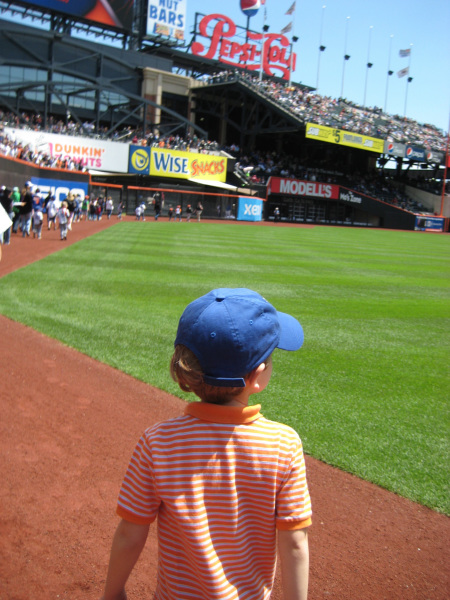
Snapped by his mom on Mother’s Day, while I watched from the Excelsior level very far away and cheered on my two beloved little dots. Careful, kid — linger out there in left field too long and you might find yourself at first base with a borrowed glove. I'm not the least bit ashamed to say my two-day vacation from the Mets was necessary and thoroughly pleasant. Tuesday night's debacle also marked the end of a long run of late nights spent working at the computer; on Wednesday morning I dragged myself out of bed and swore that five minutes after Joshua was in bed that night, I would be asleep myself. The overtired have been making such empty vows for years, but I knew this promise would be kept, and at 8:20 p.m. I was out cold. I woke up 11 hours later, padded groggily to the computer, saw the Mets had lost, wasn't particularly surprised, and got on with the day, pleased that there was 0% chance the Mets could lose Thursday's game, what with it not existing and all. Mets-Red Sox didn't seem like a particularly promising way to return from baseball exile, but we did have Johan Santana. And I had a chance to watch a ballgame with my old pal Chris, a.k.a. the Human Fight from our comments section. (And an absurdly passionate Sox fan.) And what happened while Chris and I inhaled approximately 83 tons of Jake's BBQ? Well, the Mets made three errors, with David Wright and Ramon Martinez each managing to boot double-play balls behind Johan, the defense's usual victim. (To reiterate the stat everybody will reiterate, the Mets have made 35 errors this year, 12 of them in Santana's nine starts. How is that even possible?) A byproduct of this horrendous self-sabotage has been the increasingly common sight of Johan stalking around the infield and staring at his infielders like a junior-high cafeteria aide trying to figure out who threw that pudding. Fortunately for the Mets, Kevin Youkilis (so high-strung that I wouldn't be surprised to discover he spends his time in the dugout eating glass) made the mistake of barking at Johan for daring to hit him in the elbow with a pitch that was actually over the plate, which gave Johan someone to be enraged at who wasn't wearing the same uniform. (The Human Fight's observation: “Youkilis is a little bitch.”) The other fortunate thing was Julio Lugo demonstrating he's about as qualified to play shortstop as Ramon Martinez — his lazy, flat-footed non-pivot let Jeremy Reed stay out of a double play, after which the Mets tacked on the two runs they'd need. So, Mets win. But forgive my utter lack of optimism, for reasons too numerous to be enumerated even on this wordy blog. Here are just a few: 1. Johan doesn't pitch tomorrow. Or on Sunday. Or Monday. Or Tuesday. 2. Gary Sheffield has been an admirable addition to the team so far, but sticking him in front of the Green Monster is cruel. 3. Jose Reyes remains in the limbo the Mets insist on using instead of the disabled list, perhaps because they think 22 or 23 players is better feng sui than 25. 4. Ryan Church, who even Jerry Manuel would admit is a very good outfielder, is now hurt. 5. Luis Castillo still has no range. 6. We all love David Wright, but when he fields a routine grounder and looks to first you can see him break into a sweat. 7. I don't know who the hell's going to play first, but I do know it's going to be a left fielder. And then there's Ramon Martinez. Early in the game, Gary Cohen said (with that slight tension in his voice that lets you know perfectly well what he thinks) that he'd talked to a Mets' assistant GM about what alternatives to Martinez the Mets had as Shortstop Plan C. Gary discussed the Tejadas and Coronados and Malos before explaining that the Mets settled on Martinez as the best man for the job. Left unspoken was the reason a baseball team would consider Ramon Martinez the best man for any conceivable assignment, but from hard experience with this front office I know the reason: It's that he's old. Oh, sorry — I wasn't speaking Metese. It's that he's a veteran. The Look, I don't know much about Ruben Tejada or Jose Coronado or Jonathan Malo, and I confess to reflexively overvaluing young players. But I will bet those three kids at least have the potential to do something more than hitting .240 and playing average defense. That's Ramon Martinez's ceiling, with a distinct possibility that we see even more of his by-now-familiar floor. I know, he had an RBI single tonight. Great! Sell high! Emily and I have a ritual in our house of saying “hit it to anybody” when there are two outs, a ritual sometimes amended for nervous/comedic effect when some Met is being conspicuously stone-gloved. Tonight I found myself saying, “hit to anybody — except Wright, or Martinez, or Castillo, or Murphy, or Sheffield, or Pagan.” Which left, I realized, Reed and Omir Santos and whoever was pitching. I kept looking for defense replacements and realizing they weren't coming — that if the all-aces Bobby Parnell or Frankie Rodriguez let the MPH dip below 95, some Red Sock might subject us to a ball that would have to be gloved by Ramon Martinez and then again by Daniel Murphy. That's a terrifying prospect, one we'll have to endure as long as the Met front office insists on playing with guys who should be on the DL on the bench and guys who should be on the golf course at shortstop. In which case we'll all need another vacation soon. Vacation or not, you should spend time with Faith and Fear in Flushing: An Intense Personal History of the New York Mets, available from Amazon, Barnes & Noble or a bookstore near you. Keep in touch and join the discussion on Facebook. One week delayed due to a fever that could have eviscerated Corona, welcome to Flashback Friday: I Saw The Decade End, a milestone-anniversary salute to the New York Mets of 1969, 1979, 1989 and 1999. Each week, we immerse ourselves in or at least touch upon something that transpired within the Metsian realm 40, 30, 20 or 10 years ago. Amazin’ or not, here it comes. One player was elected to the National Baseball Hall of Fame in 1979. And one team was there for him when he was first called on to talk about it. That was Willie Mays and those were the New York Mets. They went together naturally thirty years ago. That Mays would be a Hall of Famer wasn’t much of a surprise nor a topic for debate. The shock was that his percentage of the vote was only 94.7%. It may have been the highest such percentage since Cobb, Ruth and Wagner were elected with the first Cooperstown class, but 23 sportswriters didn’t bother to vote for him. As one of that year’s J.G. Taylor Spink Award-winning scribes put it, “If Jesus Christ were to show up with his old baseball glove, some guys wouldn’t vote for him. He dropped the cross three times, didn’t he?” The quip was delivered by Dick Young, which doesn’t make it any less appropriate. It wasn’t a surprise that Mays was, in a sense, going into the Hall as a Met. No, not on his cap, but in all practicality. Willie had come home to New York in May 1972. New York was home, baseball home. He did a tour of duty in San Francisco, but this was where he was born as a big leaguer (though he was probably sliding into third as soon as they cut the cord). Willie Mays said “hey” in Harlem in 1951 and he put the exclamation mark on his career twenty-two years later in Flushing when he said goodbye to America. After that, he wore the Mets uniform for six seasons as a coach without portfolio, which is why it was Met executives accompanying him to his congratulatory press conference in January 1979. He was in charge of being Willie Mays. Every organization should be lucky enough to have one of those. We did. It was relatively brief, but we did. More to the point, New York did. New York (N.L.) did. Who else could have been gone nearly fifteen years and gotten a veritable welcome home parade and, had it not been for Bowie Kuhn, probably a lifetime sinecure at Shea? Mays and Mickey Mantle, it will be recalled, were banned from baseball for associating with a casino (think about that next time you’re knocking back Scotches at the Caesars Club). Choose one or the other, ordered the commish. The legends chose the casino greeter jobs. Not long after, the Mets were sold to a group that didn’t involve the family of the late Joan Payson — great news for the long-term health of the franchise, a development that served to make Willie superfluous at Shea. In the following years, Willie would gravitate back to San Francisco, to the Giants. They retired his number (before a game against the Mets) in 1983. He eventually received a lifetime ambassador’s post by the Bay. They opened a ballpark on 24 Willie Mays Drive and put up an impressive statue in his honor. I think we can do a little something to remember him ourselves. Let’s christen the Willie Mays Bridge. You know what bridge I’m talking about: that bridge out above right center, probably the most recognizable feature of Citi Field’s internal vista. For all the carping and sniping I’m prone to doing as I settle in for the remainder of my lifetime in this facility, I have to compliment the Mets and their architects for coming up with that bridge. It’s allegedly Jeff Wilpon’s inspiration, thought up while his plane came in for a landing. He saw the Hell Gate Bridge and thought something that evoked it would be a nice touch in his new ballpark. The mets.com official propaganda puts it this way: A structural steel “bridge” motif throughout Citi Field reinforces the Mets’ connection to New York’s five boroughs while also symbolically linking the team’s storied tradition to its future. Intentionally or not (can you imagine the Mets doing anything successfully not by accident?), the idea echoes the official team logo wherein “the bridge in the foreground symbolizes that the Mets, in bringing back the national League to New York, represent all five boroughs.” Whyever its there, it works. It gives you a feeling of place both when you’re leaning back against it and when you’re staring out at it. It’s already a magnet for pedestrians. As I was approaching it from right one sunny Saturday, I heard a traffic copter report in my head. “Backup on the Tommie Agee Bridge…” That was my first impulse, name it for Agee. Nobody is more closely associated with center field among Mets as Mets than Agee, and that’s after Mazz, Mookie, Dykstra and Carlos have each laid their claim to imMetality. No Met centerfielder will ever have a game like Tommie Agee did in Game Three of the 1969 World Series: two indelible catches plus a leadoff home run. But I got to thinking about Agee and how he was the only player commemorated in fair territory at Shea Stadium for a single feat: that home run in the Upper Deck, struck April 10, 1969. Just because Shea isn’t there anymore doesn’t mean it didn’t happen. That’s why I’d suggest an alternate tribute to Agee. Look at the out-of-town scoreboard at Citi Field (if you’re seated where you can do so). There’s a big blank space to the left of the American League listings. What would look better there than a recreation of the Tommie Agee marker from Upper Deck 48? Just put the same info up there and let people who remember the marker (or the homer) say “oh yeah…” and let those who don’t ask somebody. That’s how you keep an oral tradition like baseball going. And when you do that, announce another initiative. Let it be known that when a Met hits a homer deep into the Promenade, it will be marked with an orange seat. It’s an idea stolen from Fenway, to be sure, and a variation was even used at the Vet for Willie Stargell and Greg Luzinski blasts, I believe. But it’s a good idea. Imagine one or two orange seats in that sea of green. “Hey, what’s that?” an out-of-town visitor might ask. “Well,” you can tell that person, “Wright was up and he got a pitch and just swung as hard as he could and…” The Agee marker and the orange seat don’t hit you over the head, they just very calmly tell you, “Mets,” which is something you’d like to hear more often in this ballpark. Back to the bridge, which the Mets themselves asked about last Friday in a survey of fans at the very moment I was writing this and succumbing to influenza. (Thanks to the ever-vigilant Mets Police for printing the questionnaire in full.) The Mets’ survey offered up some good and frankly bad ideas for naming the bridge: • Amazin’ Alley • Casey’s Crossing • Gil Hodges Bridge • Miracle Mile Bridge • Piazza Path • Seaver Bridge • You Gotta Believe Bridge • Other I’m an “other,” myself, but I considered a couple of these options even before I saw a survey was out. Naming something for Gil Hodges is generally a fine idea, but I’d demur on that one, as much as I want attention to be showered on Hodges. Hodges has a bridge in New York, a real one — the Marine Parkway Gil Hodges Memorial Bridge that connects the western end of the Rockaways to Brooklyn. It’s massive, like Hodges’ forearms, like Hodges’ impact on the Mets. He deserves something similarly substantial in the new ballpark. I propose the path from the Ebbets Club to the right field corner be christened Gil Hodges Hall and the man’s life story be on display all along the route. It is, after all, the first base side. Gil, a great first baseman, is the one who got the Mets to first literally and (if you take into account shoe polish) then some. Casey Stengel had a plaza at Shea, which wasn’t much more than a street sign. Let’s resurrect it out front of the Rotunda. It’s a beautifully landscaped entrance and who did more to sow the seeds of the Mets franchise than Casey Stengel? Casey also had a deli at Shea, in Loge, but we’ve got enough places to eat for now. Of course you’d have a Casey Stengel statue out there. Just as you’d have one for Gil, perhaps out where his Hall ends, around the World’s Fare Market. And yes, we need one for Tom Seaver, too, but I haven’t decided where it should go. (Foot traffic is a serious issue at Citi Field, so let the Mets plan it wisely.) No, the center field bridge should acknowledge a centerfielder…it should acknowledge the centerfielder. And it should do what it purports to represent: it should link. It should tell, in a brief and classy way, of the New York National League tradition Willie Mays came from and it should tie it to the one he came home to — the one that continues today. It doesn’t have to be a huge deal. A small plaque on each end, his likeness on one side in an NY cap circa 1951 and another image in an NY cap circa 1973. WILLIE MAYS BRIDGE
He spanned a generation. There. That’s all. You don’t need a multimedia extravaganza. We don’t need to see him in a non-Mets uniform. We just need to pass it on. The caps say it all: New York (N.L.). Every time the camera lingers on the Willie Mays Bridge, Gary, Keith, Ron or Kevin (to say nothing of Ralph) will tell the story of the Say Hey Kid, how he played stickball in the street after a long day’s work chasing fly balls blocks away. We’ll hear the occasional mention of the 50% of the Mets’ forebears who, to date, have been completely hidden from view at Citi Field. When Beltran or his successor makes a great running dive, we’ll see footage from the 1954 World Series and we’ll be reminded, too, of what Agee did in center and Swoboda in right and Chavez in left. It fits the Citi motif perfectly, too. Have you seen that outfield? Can you imagine a better challenge for a young Willie Mays? Remember the line, “Willie Mays and his glove: where triples go to die”? Can you imagine the greatest centerfielder taking on the terrain that seems designed to gestate triples? You will imagine it because you’ll be walking across the Willie Mays Bridge. I thought about the Polo Grounds Bridge, seeing as how Willie and a lot of other pre-Met New York National Leaguers played there — plus the Mets for two seasons — but that seems forced. Same for Coogan’s Bridge. Too much to explain there. As my friend Charlie Hangley pointed out to me while we took in a game, the structure beyond the bridge, the Mets’ administration building, gives off a bit of a Polo Grounds center field clubhouse vibe. Thus, it really feels like a subtle stroll from the past to the present and beyond when you name the span the Willie Mays Bridge. Best of all, he was a Met. It was for fewer than two seasons as a player, but for the next six as a coach, almost eight full seasons in and as part of the fabric of this franchise. He had come home and he appeared to be staying home. It was the best kind of connection: a New York National Leaguer in the ’70s because he was such an important figure as a New York National Leaguer in the ’50s. It was such a huge deal when he came back — emphasis on back. A light was left on in the window for New York’s favorite son, and through the good works of Mrs. Payson, the light went heeded. Then he remained when he was done playing, guiding the “kids,” as he called the young players he tutored formally and informally in pre-game maneuvers, as noted in Mary Kay Linge’s biography. Don’t believe Willie Mays was a significant contributor as a Met? Just ask those who played with him down the stretch of that legendary ’73 pennant drive (courtesy of SABR’s John Saccoman): Tug McGraw: “I guess I learned as much from Willie Mays as anybody.” Jerry Koosman: “He was still our best player. I begged him not to retire.” Tom Seaver: “Many of the New York writers made him out as a load we had to carry, but, quite the contrary, he helped us carry the load we had all the way down through the season, especially the last month and a half, when we got hot and put it all together.” Willie Mays, the best player in National League history by most reckoning, was a Met. It wasn’t a stopover. It was a homecoming. He touched home plate at Shea after a dramatic homer on May 14, 1972 and he touched home plate at Shea leading off a dramatic farewell on September 28, 2008. He did span a generation and a continent. He did transcend the game. He did it as a New York Giant and he did it as a New York Met. He did it in center field. He was the bridge. He should be the bridge. One of the all-time greats was a Met. Don’t quibble with how much of his legacy belongs to us. Glory in that he was here. Speak his name and further his legacy, that of National League baseball in New York. Reclaim it, burnish it, don’t hide from it. Willie Mays’ current employers come to Citi Field August 14-17. Might be a good weekend to dedicate a bridge and cement a legend. Say “hey!” to Faith and Fear in Flushing: An Intense Personal History of the New York Mets, available from Amazon, Barnes & Noble or a bookstore near you. Keep in touch and join the discussion on Facebook.  20 comments - (Comments closed) | | 20 comments - (Comments closed) | |  Print This Post | Print This Post |  1979 Mets, Citi Field, Flashback Friday, Hall of Fame, Willie Mays 1979 Mets, Citi Field, Flashback Friday, Hall of Fame, Willie Mays
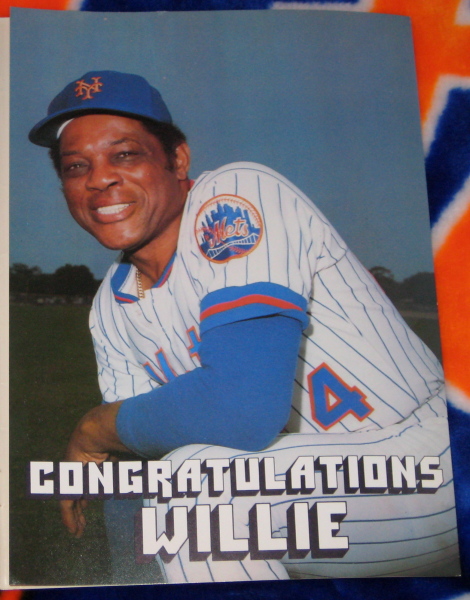
In the 1979 Mets yearbook, the organization wished one of their own the best as he ascended to Cooperstown. Willie Mays wore the uniform of New York’s National League entry for fourteen seasons, six playing in Harlem, two playing in Flushing and six more tutoring “the kids” of Queens. Somewhere in there was a hitch in Uncle Sam’s togs and, I guess, a stretch off Alcatraz. According to Adam Rubin, Jose Reyes is not DL'd yet and may not have to be. The Mets are calling it tendinitis behind the right calf, a situation that can't imperil the leg. So he'll be back right away. Or soon. Or eventually. He's (drumroll, please) day-to-day. It's the Mets and an injury. Believe what you will. The catcher was a spy, but with apologies to Moe Berg, it was the leftfielder who wore the most cunning of disguises for nearly forty games. Turns out Daniel Murphy was a first baseman. He's been found out — praise the lord and pass the ammunition. Now if we can solve the mystery of the incredible disappearing offense — featuring the shortstop who suddenly vanished midgame — the world may be safe for Metropolitans. But I wouldn't count on that happening for a while. Yes, Murphy's masquerade, as beguiling as any incognito guise perpetrated on gullible Mets fans since Robbie Alomar impersonated a future Hall of Fame second baseman, has reached a merciful ending with the hint of a happy beginning. The kid from hunger from left field played first base professionally Wednesday night in Los Angeles. He wasn't Keith Hernandez. He wasn't even David Segui. But he wasn't Dave Kingman, and that's promising. The Mets shouldn't be promising anything else right now, because they appear woefully incapable of delivering anything besides a mildly encouraging position switch. They can't deliver a big hit, they can't deliver a key run, they can't deliver a victory, certainly not over a quality team on the road. That wasn't a good formula for Dodger Stadium. It's not likely to work wonders in Fenway Park. OK, so they've lost four in a row. OK, so they were swept three by L.A. OK, so they wasted one of their best non-Johan starts of the year. Not OK at all, actually, but it's not the losing that's been the Mets' bad moon rising every late night this week (and doesn't it feel as if the Mets were the third New York team to move to California?). It's the spectacular lack of fight they've put up in these four losses, and I don't necessarily mean the lack of grit, edge, “gredge” or any of the yada-yada many of us, myself included, have bandied about. They just look incapable right now of playing a full, well-rounded game of baseball. I don't know if they've done it more than a few times this year, even during the 11-of-13 good times. Maybe it was my fever over the weekend, but I didn't think they looked that imposing while they were running wild on the Giants. They were getting on and they were delightfully aggressive and San Francisco was suitably rattled, but those weren't excellent all-around games. They were slugfests won by the Mets. They didn't look that good beating the Braves in that walkoff-walk win last week; it took a lucky call to push them over the top. They looked kind of disheveled against the Pirates, but the Pirates give you lots of wiggle room. It was wonderful beating the Phillies, but I didn't get the sense we were putting it to them. I got the sense the Phillies weren't so hot. Hey, I'll take 95 instances of the Mets being partially awesome if they can half-ass their way to a playoff spot, but this team is frightening in both its inability to rev on all cylinders and its ability to zitz out on too many of them at once. Until proven otherwise, its talent is concentrated into a small clutch of players, one of whom is available only every five days — note we scored generously for Johan one time and took it out by inflicting penuriousness on Pelfrey, Redding, Maine and now Hernandez — and one who is rarely used when not protecting a lead. There are almost no leads now because the only two healthy talented regulars are being helped by almost no one. Every trip around the order in the Dodger series was an exercise in breath-holding and finger-crossing. C'mon Carlos! C'mon David! They came on. Nobody joined them. Any team can have four fallow games. What's troubling is what lies ahead, and I don't mean just the Red Sox. Jose Reyes limping into the dugout in the third and then stomping frustratedly through it en route, probably, to the DL was a more harrowing sight than any five flies hit to erstwhile leftfielder Murphy. No team can lose its starting shortstop for any significant period of time and thrive, not unless you've got young Cal Ripken waiting to take over for Mark Belanger or something. The Mets don't seem to have that. They have Ramon Martinez. I've had a soft spot for Ramon based on his burst of big hits the last week of last September. That spot has now hardened and dried Martinez — his nickname here was going to be “Bring 'Em Home Ramon” if he had tied it in the ninth — didn't lose the game. Putz and his cortisone shot didn't lose the game. Murphy's Tatisian production with runners on didn't lose the game (though when Wright moved Castillo and Beltran to third and second with a long fly to right with nobody out in the eighth, I groaned because I just knew that was our scoring opportunity right there). They all lost the game. Not Liván and his RDA of seven one-run innings. Not Beltran and Wright, of course. But the fightless Mets, the pulseless Mets, the directionless Mets, the depthless Mets, the Mets sans Reyes, Delgado, Cora and whoever else they don't got…they lost and it was pretty apparent they were going to lose. While not as flat-out embarrassing as a passel of their earlier losses, it was just as definitive. A quarter of the season is now complete. The Mets are one game out of first with three-quarters of a season to go. That's the good news. Beltran, Wright, Rodriguez and Santana are the great news. Murphy playing one fine game at first is a swell development. Except for one bad pitch by John Maine to Casey Blake, the same could be said for Johan's backup singers of late. We all love Bobby Parnell and Brian Stokes, and Pedro Feliciano will have a job striking out Ryan Howard as long as he wants one. But based on what we've seen, when those we count as assets veer to a bad week, I don't know who or what is going to pick them up. We're seeing a lineup not sustain the loss of its cleanup hitter. Now it will likely be without its leadoff hitter. Should the bullpen show a little more give, should the starters go not quite as long, should, god forbid, Daniel Murphy not be Vic Power…boy are we in trouble. David and Carlos have done almost nothing wrong for a week. They're due to not get the big hit, the big walk or even the big fly ball. Is anybody going to pick them up? It's forty games in. Do you know where your Mets are? I do: Barely over .500. It didn't take long to suss them out there either. Rooting for a team that never seems to score enough? That's not new. That's Faith and Fear in Flushing: An Intense Personal History of the New York Mets, available from Amazon, Barnes & Noble or a bookstore near you. Keep in touch and join the discussion on Facebook. |

Piazza: Catcher, Slugger, Icon, Star by Greg Prince is available from Amazon, Barnes & Noble and other online booksellers. 
Amazin' Again: How the 2015 New York Mets Brought the Magic Back to Queens by Greg Prince is available from Amazon, Barnes & Noble and other online booksellers. 
Volume I of The Happiest Recap: 50+ Years of the New York Mets As Told in 500+ Amazin' Wins by Greg Prince is available in print and for Kindle on Amazon. 
Faith and Fear in Flushing: An Intense Personal History by Greg Prince (foreword by Jason Fry), is available from Amazon, Barnes & Noble and other online booksellers. |
|
Copyright © 2026 Faith and Fear in Flushing - All Rights Reserved |
||