The blog for Mets fans
who like to read
ABOUT US

Faith and Fear in Flushing made its debut on Feb. 16, 2005, the brainchild of two longtime friends and lifelong Met fans.
Greg Prince discovered the Mets when he was 6, during the magical summer of 1969. He is a Long Island-based writer, editor and communications consultant. Contact him here.
Jason Fry is a Brooklyn writer whose first memories include his mom leaping up and down cheering for Rusty Staub. Check out his other writing here.
Got something to say? Leave a comment, or email us at faithandfear@gmail.com. (Sorry, but we have no interest in ads, sponsored content or guest posts.)
Need our RSS feed? It's here.
Visit our Facebook page, or drop by the personal pages for Greg and Jason.
Or follow us on Twitter: Here's Greg, and here's Jason.
|
by Greg Prince on 5 June 2009 2:18 pm Welcome to Flashback Friday: I Saw The Decade End, a milestone-anniversary salute to the New York Mets of 1969, 1979, 1989 and 1999. Each week, we immerse ourselves in or at least touch upon something that transpired within the Metsian realm 40, 30, 20 or 10 years ago. Amazin’ or not, here it comes.
The Mets have lost three in a row. I’ll wager they’ll win a game eventually, and not just because a series with the 14-38 Washington Nationals looms; the Nationals, by the way, are chock full of fine Major League talent that is capable of coalescing to beat any team on any given day — don’t let it be said I’d ever risk tempting the wrath of the whatever from high atop the thing by acting as if the Mets are guaranteed a win against anybody. Even the godawful Nationals…who are really much better than they’ve shown.
Anyway, I know that teams hit hot streaks and cold streaks, just like players, just like people. You’ll win a few in a row, you’ll lose a few in a row, somewhere along the way the record will reflect reality. The greatest Mets team ever lost 54 games. The worst Mets team ever won 40 games. Nothing is so good or so bad that it prohibits something bad or something good from happening now and/or then.
But you couldn’t have convinced me of that ten years ago today. Ten years ago today, I was absolutely certain the New York Mets would never win another game.
At the time, the Mets were 27-28. By my calculations, they were on pace to finish 27-135, after which they would reel off consecutive seasons of 0-162 unless somebody stopped them from competing, which would be the only way to stop them from losing.
I had no proof to the contrary, not on June 5, 1999.
Occasionally mythmakers get it wrong. One myth I’ve heard is that Bobby Valentine never got his Mets off to good starts. That’s not true. Depending on how you define a start, he did fine when the bell rang as often as not. In 1998, the Mets were 9-4 by April 15. In 2000, after shaking off their Tokyo jet lag, they made it to April 25 at 14-7. Even lousy 2002 was, at one point, promising, with the Mets a robust 18-11 on May 3. So it was in 1999 that Bobby V guided the Mets to a splendid start, winning 17 of their first 26. The 17-9 stays with me because that was Jerry Koosman’s mark in 1969.
I had high hopes for those 1999 Mets. I had high hopes for the 1998 Mets, too. They fell a scooch short of fulfilling them by losing five straight at the end and missing the Wild Card — or at least a tie for it — by one game just a week after leading the league in the crucial category of best second-place standing. The Cubs and the Giants both blew by them and had their own mini-playoff on a Monday night as I sat and fumed over how the Mets lost two to the Expos and three to the Braves to disqualify themselves from participating in a potential round robin tournament. 1998 was going to be the Mets’ first trip to the playoffs in a decade, my first trip to the playoffs ever. I had a pair of tickets for Game Four of the NLDS. If the Mets could win one of three from the Astros, I’d be at Shea on Sunday October 4.
I was home Sunday October 4. The Mets didn’t play the Astros. The Mets didn’t play anybody after September 27, 1998. Their 9-4 start was an obscure memory by the time the 0-5 finish rolled around. It was the latter that ended, all at once, my interest in baseball. Or so I told myself. Sometime by the League Championship Series, I was watching baseball again, and as soon as the Mets started making moves — re-signing Piazza, signing Ventura and Henderson, trading for Benitez and Cedeño — it was as if the losing streak that ended ’98 hadn’t stung at all. We’d be back in ’99. I’d be back for sure.
There they were and there I was, per usual, as the next season got underway. Every game, as had been the case since Bobby V woke this franchise up in the spring of ’97, was the most significant event in my day, night and life. The Mets had shaken off their late 1998 doldrums and were playing baseball with enough joy and verve and poetry to satisfy the Annie Savoy in all of us. Piazza cracked the Trevor Hoffman code in the ninth inning one cold April night at Shea for a walkoff homer against the Padre closer; Rickey announced his presence with authority one night in Florida with four hits, four runs, two dingers and a walk; Matt Franco hustled from first to home on a mishandled windblown pop fly to short against the Giants, breaking an eighth-inning 0-0 tie. Lots of little victories mounted toward a great big confidence boost that rendered 1998 instantly ancient history. The fielding was superb, the hitting was timely, the baserunning was thrilling the relief was stellar, the starting pitching was more than adequate.
The Mets were 17-9. Then they were a little shaky, but suitably dramatic whenever they righted themselves. They’d sweep a doubleheader from the Brewers in which Robin Ventura blasted a grand slam in each game. They’d trail the unhittable Curt Schilling 4-0 entering the ninth but grit their teeth and score five off the very same pitcher in their last ups and win 5-4. There were losses in between the heroics, but they didn’t seem fatal. They went from 17-9 to 27-20 by May 26, trailing the perpetually first-place Braves by just 1½ games. What I had forecast for 1998 — an overthrow of eternal Atlanta — would happen in 1999. I knew this was our year.
It didn’t take me two weeks to change my tune completely.
The Mets came home from Pittsburgh on the Friday of Memorial Day weekend to play the second-year Diamondbacks who, despite their infancy, bore no resemblance to the 1963 Mets. Arizona stocked up on free agents and had about the same record as us and had already taken first place in the West. A tight pitchers’ duel — Rick Reed vs. Omar Daal — went their way. The ninth inning was particularly galling as we loaded the bases off Gregg Olson but Luis Lopez looked at strike three and it ended a 2-1 loss.
Very frustrating, but we’ll get ’em tomorrow, I said.
We didn’t. We sent Allen Watson to the hill, which was the first hint we wouldn’t be seeing another duel. Watson was gone by the fourth (and would never start for the Mets again; he’d be traded to Seattle in mid-June). Armando Reynoso, starter and loser in the first and fifth games of the decisive ’98 losing streak, came back to haunt us, if only partially. He pitched five mediocre innings, gave up five earned runs but left with an 8-5 lead as Pat Mahomes and Rigo Beltran proved no better than Watson on this Saturday afternoon. An Agbayani homer in the sixth (he was hitting lots of them since his recall) and a Henderson double in the eighth pulled us to within a run, but the ninth saw the big league debut of Byung-Hyun Kim. The scouting reports said watch out, this guy throws gas. The scouting reports were uncommonly accurate. Fonzie flied to center. Oly lined to left. Mike struck out swinging. We lost 8-7.
Very frustrating, but we’ll get ’em tomorrow, I said.
That was wishful thinking bordering on delusional. They were pitching their premier free agent, Randy Johnson. We countered with Masato Yoshii. Yowch. Yosh’ didn’t make it out of the third. Johnson struck out ten over eight innings. Melvin Mora made his MLB debut, starting at short (Rey Ordoñez deemed incapable of facing the Big Unit), but he went 0-for-3. The Mets all looked like raw rookies in a 10-1 loss. It was the first sweep we’d suffered since the three we lost to the Braves to end the previous season.
In came Cincinnati, a few games over .500, just like us suddenly. We jumped on Brett Tomko early — he was gone in the third — but they jumped right back on Al Leiter. A 3-1 Mets lead became a 5-3 Memorial Day loss. Then May became June and the four-game losing streak became five. Another ex-Met, Pete Harnisch, was successful at the expense of his old team (and the manager he’d despised). Harnisch, whom like Watson, I never particularly liked once I learned he grew up in the New York area but not as a Mets fan, threw seven shutout innings. Orel Hershiser was ineffective across five and we lost 4-0. That put us just two over .500 and, predictably, five behind the relentless Braves.
The Mets would trot out their sixth starting pitcher in six games Wednesday night June 2. This time it was fallen Generation K idol Jason Isringhausen. With Bobby Jones out with an injury and the Subway Series looming Friday, Valentine was saving Reed for the Yankees. Thus, Izzy. Thus, an unimpressive start of four runs surrendered over 5-1/3. The good news was Reds starter Steve Avery wasn’t much better and the reliever who followed him, Danny Graves, got shelled for four in the seventh. John Franco came on in the ninth to protect our 7-6 lead and halt our five-game losing streak.
He couldn’t do it. Just as he could never do it (which isn’t true, but it sure felt that way), John Franco blew the save. He got the first two Reds out, but then walked Greg Vaughn and allowed a single to Barry Larkin. They executed a double steal. Dmitri Young then walked. Mike Cameron came up and singled home Vaughn and Larkin to put the Reds up 8-7. In the bottom of the ninth, Rickey Henderson walked and stole second with two out, but Luis Lopez — how often can the same man be your last hope? — struck out.
The losing streak was six. The record was 27-26. The distance from first place was six games. The next opponent was the Yankees. The venue would be Yankee Stadium. And so all of that could sink in, there was an off day Thursday.
By Friday, I was a baseball wreck. I knew, just knew we were better than this. We were recently 17-9 and 27-20, weren’t we? We’d had all those exciting wins, hadn’t we? Weren’t we the team of superb fielding, timely hitting, thrilling baserunning, stellar relief and more than adequate starting pitching?
Not for a week we hadn’t been. The interceding homestand blotted out all the good the first seven-plus weeks had yielded, or so it seemed. Maybe it wouldn’t have felt that way had the Mets gone off to Montreal or Miami, but no. This was Subway Series weekend. This was when the hype for that contrivance was fresh and suffocating. This was when the Yankees could do no wrong in the media’s eyes and the Mets conveniently forgot to do anything right. Thus Thursday and Friday was one big special preview section, all of it reflecting badly on us. None of that should matter in the boxscore of games yet to be played, but gads it was depressing. One column sticks in my mind from that Friday: Wally Matthews, then with the Post, reached and reached until he could reach no more before coming up with a comparison between the Mets 25th man, Bobby Bonilla, and the Yankees’ 25th man, Joe Girardi. Girardi was a great team-first guy beloved by all; Bonilla was Bonilla. And they each wore No. 25. Conclusion: the Yankees are awesome, the Mets are loathsome.
Something like that.
Despite Bobby V saving Rick for the Yankees — and despite Stephanie and I being relieved that our cat Casey had made it through a procedure to remove a bump from his back with no report of it being cancerous (that would come a couple of years later) — it wasn’t a pleasant Friday night. Reeder pitched less than characteristically well, walking four and giving up four runs before exiting in the seventh. The Mets stayed maddeningly close only to have Mariano Rivera shut the door on them 4-3. It was our fourth one-run loss of the now seven-game losing streak. It was also the third loss at the hands of a team whose starting pitcher was an ex-Met. First Reynoso, then Harnisch, now David Cone. Injury to insult was the protective collar Casey had to wear so he wouldn’t attack his stitches.
Christ, I thought, even my cat is a conehead tonight.
Saturday June 5 was a big deal in New York by everybody’s reckoning. There was the Mets-Yankees game in the Bronx. There was the third game of the NBA Eastern Conference finals at the Garden between the Knicks and the Pacers. There was the Belmont Stakes, where Charismatic was attempting to become the first Triple Crown winner since Affirmed 21 years earlier. Huge stuff. It made the suddenly fading Mets seem only a small piece of the Big Apple puzzle. Fox carried the game and focused on Spike Lee who was plugging his movie Summer of Sam by dressing himself in Yankeewear (he was a Mets fan in 1986; funny how that worked). The script worked beautifully for everybody’s purposes but ours. A record crowd at Belmont, even if the main horse lost. The Knicks won in a thriller to take a series lead (which gave me no joy since Spike Lee was their superfan). And in baseball, it was more of the same: Yankees 6 Mets 3. This was the game in which El Duque threw his glove, with the ball tucked in it, to first to retire Rey Ordoñez. The Mets actually led 3-0 at one point, but how are you going to compete with those kinds of special effects?
Eight losses in a row. Under .500. Third place, behind the Phillies. That’s it, I thought. We’re doomed. We’re not just not making the playoffs this year. We’re not winning another game. I don’t mean against the Yankees. I mean ever.
I honestly sort of believed that. I’m sure I had a logic mechanism deep down that was supposed to tell me, no, don’t be silly, losing streaks end. But the mechanism failed to kick in. Logic was overwhelmed by the immense futility of the situation. Not only were the Mets 0-8 in the previous nine days, but everybody everywhere I turned confirmed they were hopeless. There were the Mets being the Mets. There were the Mets losing every day to National League opponents and, just to drive the point home, losing now to the exalted defending world champions. The Yankees were still great. The Knicks were now great. Some horse named Lemon Drop Kid was great. Everybody was great except us. We were doomed. Doomed! We would never win another game.
The wait to make it nine straight losses was interminable, Sunday’s game being an ESPN affair. There was nothing to do but stew all day, until the Mets were kind enough to put on a show to fill the void. They made it clear they agreed with the prevailing wisdom that they were no good, that the 0-8 streak trumped the 27-20 start, that 27-28 wasn’t more or less a break-even milepost but the undeniable start of something much worse unless something drastic was done.
This was June 6, the day they fired three coaches. The Mets replaced Bob Apodaca with Dave Wallace, Randy Niemann with Al Jackson and Tom Robson with Mickey Brantley. New pitching coach. New bullpen coach. New hitting coach.
Same manager. Same manager without the coaches he had chosen. Apodaca had been with Valentine when he came up from Norfolk in 1996. He was literally in the car when they drove to Shea from Pawtucket. Bob Apodaca had been in the Mets’ organization since 1971. Tom Robson was standing by Bobby Valentine since Opening Day 1997. Robson was the hitting coach that season when the Mets emerged into contenders. Niemann was ostensibly in charge of the bullpen, an area that until very recently was perhaps the team’s strongest suit.
Same manager. Barely. Steve Phillips (with ownership’s blessing, presumably) was sending a message. Charismatic’s head on Bobby Valentine’s pillow would have been more subtle. What made the whole episode particularly chilling was it was announced at Yankee Stadium. Phillips and Valentine spoke into a microphone branded with the vertical swastika. Somebody compared it to a hostage tape.
The Mets were never going to win another game and now they were being blindfolded and paraded through the streets of Tehran. The next game, the nationally cablecast game, would have us facing Roger Clemens who was 5-0 in ’99 and hadn’t lost a decision in more than a year. It couldn’t get any lower. Why even play the season?
Because it was 1999 and these were the 1999 Mets. We’d find out anew what that meant starting that Sunday night at Yankee Stadium when Al Leiter — a former member of the other team instead of the other way around — threw seven strong innings while Bobby Bonilla (!) and Benny Agbayani led the charge against Clemens. By the third, when Mike Piazza tagged him for a two-run homer, Roger was teetering. When Benny drove home Robin to make it 7-0, it was Roger and out. He’d leave and he’d lose. The Yankees would lose. More importantly, the Mets would win.
The Mets won. The endless eight-game losing streak was over. The Mets were back to .500 after 56 games. Bobby V had said if the second 55 games produced a record as unsatisfactory as the first 55, he deserved to be gone. But that wasn’t going to happen, he insisted. Valentine suggested the Mets could very easily win 40 of those next 55. As of June 6, they were 1-0 in pursuit of that goal.
And come August 6, a Friday night when Octavio Dotel beat Chan Ho Park by the same 2-1 score that began the troubles in late May, the Mets — now the 67-43 first-place Mets — had won exactly 40 of 55. They did it without being particularly streaky either. The most wins they reeled off in a row in that critical two-month span were six. Tellingly, however, that 40-15 stretch encompassed two runs of 15-3. Amazing how stuff like that can add up, just as it’s astounding that practically a quarter of the Mets’ 66 losses in 1999 (22.7%) were compiled as products of two nearly lethal losing streaks. There were the eight consecutive losses to the Diamondbacks, Reds and Yankees; and there were seven more yet to come, far off in the distance when 40-15 was achieved and everything was coming up roses.
I didn’t think that second losing streak would ever end either. My logic mechanism was clearly on the fritz in 1999.
It’s not whether you win or lose, it’s how soon you get your copy of Faith and Fear in Flushing: An Intense Personal History of the New York Mets, available from Amazon, Barnes & Noble or a bookstore near you. Keep in touch and join the discussion on Facebook.
by Greg Prince on 5 June 2009 12:33 am Andrew Vazzano at The 'Ropolitans passes along informed Tweets that Jose Reyes has been diagnosed with a tear in his right hamstring tendon. That means Reyes must rest and that he won't be playing for the Mets 'til at least after the All-Star break. In Metsdom, that could mean mid-July or it could mean a season to be named later. “Clearly,” Adam Rubin adds, “Reyes will not return very soon.”
That's not good. That's not good at all. In fact, I'd say we're kind of screwed for the foreseeable future.
by Greg Prince on 4 June 2009 10:36 pm “Do they lose every weekday game when I'm listening at work?” a reader asked late in this afternoon's affair. If I am to assume he has listened to every weekday game this year, yeah, just about. Opening Day was a weekday game and it was triumphant (thanks in great part to the awesome relief work provided by Sean Green and J.J. Putz — boy, Opening Day was suddenly a long time ago). There have been five midweek matinees since and each of them has ranged from dismal to abysmal and then some, culminating in the lousy Pirates sweeping us out of town. Just as the Allegheny meets the Monongahela to form the mighty Ohio, the Mets in Pittsburgh represented a confluence of their own: lousy pitching joined with ineffectual hitting to create three injury-riddled losses.
Mets are coming and going these days, few doing anything worthwhile in between. The David seemed reborn in terms of reappearing on the basepaths (he also saved Putz even more embarrassment on a heads-up play after J.J. muffed a catchable grounder in the seventh) and Carlos was no longer sick (what do they call that thing again when a Met hits a baseball over a wall?), but otherwise, not much offense of which to speak, at least not the timely variety. Of course the Mets were behind all day, with Big Pelf suffering a big letdown and the bullpen being only selectively helpful (Green is looking better, as he couldn't look any worse…but oh our aching Putz). Alex Cora has returned, which I can't believe has evolved into as big a deal as it has. The SNY guys were saying he's been a great influence on Fernando Martinez; he does seem to be running everything out, which is terribly thoughtful of the kid.
Is the problem the injuries? On any given evening we're without a genuine starting shortstop, an authentic first baseman and at least one able-bodied outfielder. Depending on how Wright and Beltran are holding up, that doesn't leave much slack. You don't want to hastily or harshly judge a roster that's being held together by the baseball equivalent of Rub 'n' Glue, but these are the Pirates. Even if they're athletic (whoosh! goes McCutchen; whoosh! goes Morgan), they're the Pirates. They trade Nate McLouth because it's a Wednesday.
Sure, there are a lot of Bisons on this roster, but it occurred to me as I watched Emil Brown make his long-unanticipated Met debut that we always hang in a Buffalo stance. That is to say the Mets are chronically shuttling in AAA players, wherever they keep them stored in any given season.
Emil Brown became the 863rd Met in team history when he grounded out to end the fifth. Just for fun, or my idea of it, I checked the lifetime roster I keep, the one that tracks every Met's first and last game ever. Met No. 764 was June '05 journeyman Brian Daubach, just under four years ago. I knew it felt like we go through new Mets like car companies go through government bailouts, but a hundred Mets in just under four years? Isn't that a lot?
Not for this organization for the past dozen or so years. Our previous hundred new Mets — Matt Lawton through Danny Graves — were compiled in slightly less time, from July 2001 to June 2005. And the hundred Mets who debuted directly before Lawton, the group that spanned Steve Bieser to Gary Bennett, bowed between April '97 and July '01; a slightly less manic pace, but indicative of a pretty disposable player supply nonetheless.
Before the Valentinian Epoch took hold, Mets didn't quite traffic players as quickly. D.J. Dozier to Barry Manuel (464 to 563 in your program) took not quite five years, though the player strike of '94-'95 may account for a bit of the slowing. The hundred before them — Kevin Mitchell through Rodney McCray — represented a veritable ice age of more than seven seasons.
Mets By The Hundreds is clearly a game that has picked up speed since the late '90s. Why is that? I don't know (four different GMs, four different field managers would indicate it's more systemic than personal…or maybe our guys just get hurt a lot), but it's become apparent that when you bring in player after player, not that many are going to be great players. You wind up with the Quadruple-A guys. You wind up with Emil Brown, Wilson Valdez, Casey Fossum, Ramon Martinez, Ricardo Rincon, Andy Phillips, Trot Nixon, Chris Aguila, Robinson Cancel…and that's just a sampling of who's been brought in during the last calendar year from a team that very nearly made the playoffs in the middle of all that and isn't desperately far from first place at the moment.
On the other hand, such roster shuffling, whether necessitated by contingency or philosophy, eventually takes its toll. The Mets have been lucky thus far to have pieced together a contender despite having to make enough moves to have played 37 different players in only 52 games. They've been lucky and they've been, more often than not, good. But sometimes your luck runs out and things go bad. Sometimes you trot Nixons and Browns out there so often that before you know it, you're getting swept by the Pirates.
The one book your literary roster needs to call up immediately is Faith and Fear in Flushing: An Intense Personal History of the New York Mets, available from Amazon, Barnes & Noble or a bookstore near you. Keep in touch and join the discussion on Facebook.
by Greg Prince on 3 June 2009 10:23 pm Mets rained out tonight. Makeup will be July 2, 12:35 PM. When we finish this series Thursday afternoon, it will be without Nate McLouth anywhere in sight. Adam Rubin reports he's been traded to Atlanta.
Emil Brown replaces Ramon Martinez in a roster move that is sure to set my partner's heart aflutter. Reyes set back at least a few days in extended spring training, which can't possibly be good news in Met medical lingo, but at least it's not the same as Mike Francesa's forecast of Jose missing the next hundred or so series (apologies for listening to Mike Francesa, even incidentally). And could anything be more depressing in baseball terms than “extended spring training”? We all agree actual Spring Training goes on far too long. Imagine it never ending.
Good luck to Randy Johnson in his quest for No. 300 tonight in Washington. Randy Johnson went 5-0 in the 1995 ALDS and 2001 World Series combined, delaying a dynasty on one end and dismissing it on the other. Plus we kicked his very tall ass whenever it really mattered, so we're square.
Not every winner of 299 or more games who is technically active has an appointment to pitch. Our old buddy whose name I don't feel like spewing has been released by the Braves. Nothing worth gloating over. I admire how pitchers never seem to give up. That's why the whole Clemens farewell tour was so bogus. Not a single pitcher of any stature has ever hung 'em up in advance the way he claimed he was going to in 2003. Even Mike Mussina, who walked away without fanfare, didn't announce it beforehand. He won his 20th for the first time, figured he was good, and he gracefully exited the stage. Every other pitcher who pitched a long time hung in and hung on as long as he could until a matter of health or ability did him in. Kudos for their kind, no matter how badly they may flail toward the end (remember Steve Carlton suddenly talking to reporters?). It's their life and livelihood. It must be difficult to put it away for good. Not that I'm particularly rooting for the former and eternal Brave lefty to make a big comeback. He's six wins shy of Tom Seaver and I'd like him to stay there.
Non-baseball recommendation as long as SNY is likely to ply us with Beer Money: Part II of NBC's behind-the-scenes look at the White House at 9:00. I slipped into Part I it as the Mets were going down to quiet defeat last night and it was way better than the game.
by Greg Prince on 3 June 2009 1:40 pm It was singles night in Pittsburgh. The Mets collected eight one-base hits and carefully avoided the other kinds, while there seemed to be fewer than ten healthy Mets let alone ten living Pirates fans at PNC Park. Double-digits are apparently reserved for places like San Diego where the Phillies won 10-5 on the strength of Raul Ibañez’s 18th and 19th home runs and moved 2½ games ahead of us now that we’ve hit the road and, for the moment, stopped playing the Nationals.
Zach Duke outpitched Johan Santana. His full name is Eff Zach Duke. I’ve had it in for Zach Duke since the night in 2005 he completely silenced the Mets at Shea Stadium and left Jim Haines and me grumbling about what a worthless game that was all the way back to the Nassau County border. Jim and I have attended nine night games together since then and the Mets have lost every one of them, all by Zach Duke-like margins, each leaving us more grumbly than the one before. (We were due to break our nocturnal streak last Friday but I threw my friend under the bus so I could accept an invitation to the Ebbets Club — if we had rustled up Promenade tickets as tentatively planned, Ramon Castro would still be a Met, because Omir Santos would not have driven in the winning run in the eleventh because the Marlins would have beaten the Mets handily just as they always do when Jim and I show up in tandem for night games.) Duke, meanwhile, did not grow up to be Johan Santana. He just became one of those young Pirate pitchers who got older and less successful. That Duke boy who went 8-2 in ’05 has followed it up with successive seasons of 10-15, 3-8 and 5-14. He seems to be back in Dukeness, damn it.
The Mets were also done in, for the second night in a row, by Matt Capps, which is an interesting name for a closer or perhaps a lovable rogue British comic strip character. Did you know Matt Capps’ middle name is Dicus? And did he ever, 1-2-3 in the ninth.
Only one Met hit Tuesday night, and that was Jeremy Reed. He, however, found a creative way to not score when he tumbled hopelessly into an out at home in the third from second, somewhat diminishing the halo from his 3-for-3 performance. The Mets’ only run was put up by Ramon Martinez whose thumb took it on the chin in the process and, without even catching the team flu, found himself sidelined immediately thereafter, joining the Mets’ burgeoning ranks of the lame, the halting and the reportedly nauseous. There is no surer path to seasickness than playing the Pirates.
And enjoying it all was a very small kaffeeklatsch of Bucco loyalists. You’d figure after sixteen consecutive losing seasons they’d attract no more than a hardy band of lost souls (aarrgghh!!), but then the Penguins skated into the Stanley Cup finals and reduced their ranks even further. I flipped over briefly to Versus to see what all the fuss was about. Not only was the hockey next door causing a frenzy inside the Igloo, but there was a bigger crowd outside their arena watching Game Three against the Red Wings on temporary TVs than there was inside PNC for Duke, Dicus and the rest of the local baseball crew performing in person. Brought me back to that Saturday afternoon in May of 1980 when Bobby Nystrom and the Islanders finally broke through to win their first Stanley Cup…and that night in June 1994 when the Rangers ended their infamous 54-year drought. On both occasions I wondered how anybody could care about any other sporting event when there was a Mets game in progress.
Baseball, gentlemen…baseball.
To be fair to the ‘Burgh, they haven’t seen a lot of the regionally pleasing kind since 1992, since Barry Bonds didn’t throw Sid Bream out at the plate in Atlanta and then packed for San Francisco. Every time the Mets alight at PNC, the SNY cameras linger lovingly on statues and signs saluting Willie Stargell and Roberto Clemente while Gary and Keith/Ron invoke Ralph Kiner. It’s great historical stuff (what do visiting teams’ broadcasts show from Citi Field — spaces where there are no pictures of Mets?) but it points up more and more what little good the Pirates have achieved lately, as in during the last two two-term presidencies. The Pittsburgh Pirates are essentially the Florida Marlins with backstory but sans any trace of recent achievement.
Yet I’ve identified them in my mind as my Doomsday team. That is to say I decided some time ago that if the Mets ever pulled a 1957 and skedaddled to another city, and that if I could still stand to look at baseball, I would break the emergency glass and become a Pittsburgh Pirates fan.
The rumors that swirled over the winter about the Islanders moving to Kansas City reminded me of all this (though having the Islanders as your favorite hockey team means never having the slightest distraction from baseball come June). What if it were the Mets who were loading Mayflower vans in the dead of night? What would I do?
An absurd proposition on the face of it, but I worked out the Doomsday Scenario in the mid-’90s when the talk of a new ballpark ramped up in earnest and progress toward it was nil. That was when most nights at Shea drew the kinds of crowds the Pirates attracted last night. The subtext, beyond lousy Mets baseball, was “we need a new stadium.” What if Wilpon & Doubleday didn’t get their wish? What if the Mets never substantially improved? What if nobody besides me kept going to Shea? How soon before a line like “well, we love New York, but we cannot continue to operate under these conditions” became a genuine threat?
Yes, absurd-sounding now — maybe even then. Once the Mets got Mike Piazza and the orange seats didn’t remain quite so orange for nine innings, it seemed all but prohibitively impossible. But I always had it way in the back of my mind that it could happen. The Giants left. The Dodgers left. Those were unthinkable exits. Why would the Mets be immune? The whole raison d’etre for the Mets was New York couldn’t live without National League baseball. Circa 1994-96, it was living fine while generally ignoring it. If that pattern continued, I couldn’t see the Senior Circuit argument taking hold a second time and securing us a replacement franchise á la what Bill Shea accomplished by October 17, 1960. If the stadium named for our savior continued to deteriorate and the Mets rotted from the inside out and ownership carped that it wasn’t getting what it wanted from the politicians…let’s just say I never completely put away these fears until Mike Pelfrey fired strike one past Jody Gerut on April 13. Whatever my reservations about Citi Field, I figured that if Wilpon got what he craved, he or his progeny — at least in my sentient lifetime — would never make even a veiled threat to move.
Exploring the Doomsday Scenario now is like coming across a Fallout Shelter sign left over from the Cold War. But I did have a contingency plan planted somewhere in a mental deposit box. I’ll spill the contents now.
Option A was to give up baseball forever, which may have been the most likely course. I’d have become one of those guys who told you he saw a triple play at Ebbets Field once but hasn’t watched a game since. Baseball isn’t hockey or any other take-it-or-leave-it activity to me. To not have the Mets would be to not have baseball…probably. But who knows?
Option B, theoretically, would have been to have grudgingly accepted the Mets in their new guise as (Jason came up with this name years ago) the Charlotte Demographic or whatever they’d be called. I know a whole clutch of old New York Giants fans who’ve gotten by for more than a half-century as San Francisco Giants fans. I can’t picture that being me, though. True, I nominally remain a Nets fan even though they left Long Island in 1977, but that’s basketball and New Jersey isn’t far away. But the New York Mets mean far more to me than the New York Nets ever did, even when Dr. J was slamming me home two ABA championships that I still cherish. I can’t see the Anytown USA Mets having any kind of imaginary pull on me.
Option C was find another team. I don’t know if I could have followed through, but it was intriguing to imagine.
• No remaining New York team, obviously.
• No American League team. Just couldn’t.
• No L.A. Dodgers. You can’t avenge a team that left New York with one that left Brooklyn.
• No Atlanta Braves. Yeech.
• No Houston Astros. How dare they be the surviving 1962 franchise?
• No Florida Marlins. I hate when New Yorkers move to Miami-Fort Lauderdale and become Dolphins fans.
• No St. Louis Cardinals. Too much bad blood.
• No Arizona Diamondbacks, since they didn’t exist when I started worrying about this.
• No Milwaukee Brewers, who were probably an American League team when I started worrying about this.
• No Cincinnati Reds. Warren Giles ran the National League from Cincinnati after 1957, acting as if New York didn’t matter. I resent the Reds immensely in the abstract just for that.
• No San Diego Padres because I’ve never cared in the least about them.
I was down to maybe six viable if remote possibilities in this mostly unthinkable realm.
I thought for a second about the Cubs, purely out of admiration for Wrigley Field. But then I’d be a Cubs fan and I really can’t stand Cubs fans or anything the Cubs stand for. They were out.
I thought for two seconds about the Colorado Rockies. New team, a little success early, gleaming home, fresh start, expansion brethren. But c’mon…the Colorado Rockies? A million miles from here? And no pitching? Nope.
I thought about the Montreal Expos, and this was before I developed the absence-inspiring fondness for the Expos I dwell on here from time to time. The Expos weren’t that far away geographically. They were founded in 1969, which was a good year for baseball, and they were unique. We played next to a World’s Fair and they were named for a World’s Fair. They had Rusty and Kid, we had Rusty and Kid. Lots of linkage in my mind. But I took Spanish in high school, not French. Plus I live in the United States, not Canada. It wouldn’t have worked as anything more than le fling. (And, as it turns out, they wouldn’t have been a good long-term emotional investment given that they actually did meet their doomsday on October 3, 2004.)
I thought about the San Francisco Giants. Yeah, it would send the wrong message in that it would legitimize just the sort of franchise movement that would have cost me my team, but if the Mets had left me, wouldn’t that sort of negate the historical crime committed by the Giants? I’d have full access to the lineage of Mathewson, Ott and Mays without having to exhort endlessly about their latter-day relevancy. They would be my team. But, no, they left New York. As much as I would come to look longingly at Pac Bell when it was built, I never could have gone all the way to the Pacific for my team. They stopped being my team before I was born.
I thought more than I’m comfortable admitting about the Philadelphia Phillies. This was from the perspective of the mid-’90s. The likable 1993 Phillies were still fresh in the mind’s eye. They had Lenny Dykstra. They’d had Tug McGraw. They were a convenient train ride away. I could hear Harry Kalas without too much static. But…they were the Phillies. As Jason told me when I suggested once that they could be my Doomsday team, he set me straight: “No, you don’t have nearly enough hate in your heart to be a Phillies fan.” Amen, brother.
I was left with the Pirates. The Pirates of Hans Wagner and Pie Traynor and Ralph Kiner. The Pirates of Bill Mazeroski and Roberto Clemente and Pops Stargell. The Pirates I rooted against as a kid because they competed vigorously with the Mets, but the Pirates I always vaguely admired despite that rivalry. Five years ago this month we moved, which forced me to semi-organize my shoeboxes full of baseball cards. They were still more or less as I’d had them since my adolescence, wrapped in brittle rubber bands and Hefty Bagged by divisional alignment. I went through my National League East cards on a Sunday night in June 2004. I bristled at the Phillies of the ’70s. I spat at those Cardinals. I rolled my eyes at those Expos. I fumed anew at the Cubs for even thinking of getting in our way in 1969. But when I came to the Pirates, I was like, “Hey, they were pretty good. Good players. Good guys.”
Doomsday dwelled in dormancy for quite a while until I visited PNC Park in 2002. I fell in love with that place. If I were a cat, I’d roll around on its outfield grass. Even if I weren’t a cat and thought I could get away with it, I might. It is clean, lean, green, serene…everything Shea wasn’t, everything Citi Field isn’t. Citi Field, by comparison, is garish verging on whorish, more brassy than classy. PNC Park is beautiful and mostly unoccupied. As I dusted off the Doomsday Scenario, I imagined frequent flier mileage on US Airways being applied generously to weekend trips to Pittsburgh or, what the hell, just moving out there. I never really wanted a piece of Western Pennsylvania, but with computers, you could live most anywhere and do most anything. I just wanted to spend time at PNC Park. If I had to accept the lousy Pirates in a chilling Metsless world to do it…well, there was always Stargell and Clemente and everybody else to admire.
I’m glad it never came to that. Whether it’s the sixteen consecutive losing seasons or their ability to shake off their chronic futility when the Mets come to town, I don’t particularly like the Pirates anymore, not even a little. I don’t want to take away from the gleam of PNC, but any ballpark in which the Mets play so badly so regularly can’t possibly be that great. And screw the Penguins while we’re at it.
Death to Doomsday. Long live the Mets, flu-bugged, injury-addled and impotent as they appear on any given Allegheny evening.
Documentation of what the Mets can do to you can be found in Faith and Fear in Flushing: An Intense Personal History of the New York Mets, available from Amazon, Barnes & Noble or a bookstore near you. Keep in touch and join the discussion on Facebook.
by Greg Prince on 2 June 2009 9:00 pm 
Robert Moses patterned Shea Stadium after the Roman Colosseum, yet only one of them isn’t a parking lot today. Mark “Bluenatic” Weinstein confirmed that not all ancient ruins have been paved over when he recently parked himself and his classic FAFIF t-shirt in Rome. I wonder if anybody over there mutters, “It’s a dump, but it’s our dump.” Probably not.
As for the shirt, it can be your shirt by clicking here.
by Jason Fry on 2 June 2009 3:50 am Forget the Florida Marlins on final days of the season. As Mets fans, what really ought to make us shiver is the thought of playing the Pittsburgh Pirates at PNC.
Before everything went straight to hell tonight, Emily and I were lying in bed admiring the vistas of PNC and all those unoccupied seats and we agreed that next year we would join the hordes of blue-and-orange fans to invade the Pirates' home. How soon we forget. The Pirates promptly rose up against J.J. Putz, battering him like a steelworker with doubts about unionization, and I remembered. Oh yeah, this is the last place any sane Mets fan would want to be.
The Mets are 12-14 at PNC since it opened; 6-8 in the less-remarked Faith and Fear era. But oh, the gag jobs we've seen. Take some Dramamine and buckle up — we're going down Bad Memory Lane.
July 8, 2005: After eight very good innings by Victor Zambrano, Aaron Heilman comes in and gets two outs, but also allows three runners to take bases. Handed a four-run lead and needing to get one lousy out, Braden Fucking Looper proves the wisdom of his middle name by allowing a two-run single to Tike Redman and a sinking Matt Lawton liner that gets past Cliff Floyd for a tie game. Looper, sent back out for the 10th because Willie Randolph doesn't hate us enough, is victimized by “defenders” Miguel Cairo and Jose Offerman, two ex-Mets I'd gladly kick in the head if I could get away with it, then allows the game-winner to Humberto Cota.
July 9, 2005: The not-yet-useful Heath Bell and the long-proven-useless Danny Graves conspire to allow seven Pirates run in the seventh, with the big blow a Jack Wilson grand slam. Mets lose, 11-4.
September 15, 2006: With the Mets on the verge of clinching the NL East title, Pedro Martinez returns from a month on the DL with a sore calf. But that's as good as the storyline gets — Pedro is not himself, or more accurately (though we don't know it at the time) is what he will be from this point forward. The Pirates lead 4-0 after three and don't look back. Insult to injury: The Mets spend the evening batting in front of a bizarre banner for something called Pup-Peroni.
Sept. 16, 2006: Keep that champagne on ice. This one's 2-2 with two outs in the bottom of the ninth when Ronny Paulino drives in Joe Randa with a long double off Heilman, who bites his lip and makes his I Just Ate a Big Lemon face. (At least I'm assuming. How long will it be before I can no longer instantly summon up what Aaron Fucking Heilman looks like just after losing a game? HOW LONG, GOD?)
Sept. 17, 2006: Oh, fuck. For the third day in a row, the Mets are beat by a Pirate left-hander and denied a chance to clinch their title. Afterwards, David Wright says all the right things. Greg Prince, on the other hand, has had it. The Mets will clinch the next night, but the memories of PNC and the reverse broom will endure.
Aug. 16, 2007: Mets up 5-0 after three. And then … oh, for fuck's sake. There's no link for your own protection. Greg and I could only manage total denial and curt surliness, respectively. If you remember, you don't need another poke with a sharp stick. If you've forgotten, leave it that way.
June 1, 2009: Mets up 5-0 after three. We should've known, shouldn't we?
***
Need to deal with the pain? Call our office in the morning, but for now, read two chapters of Faith and Fear in Flushing: An Intense Personal History of the New York Mets, available from Amazon, Barnes & Noble or a bookstore near you. Keep in touch and join the discussion on Facebook.
by Greg Prince on 1 June 2009 7:43 pm 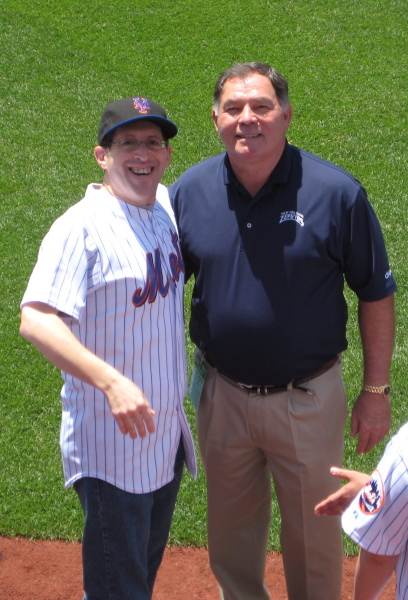
Straight from his sprawling silhouette above the Right Field gate, it’s 1969 World Series Game Four defender extraordinaire Ron Swoboda out in center Sunday. The man they called Rocky was re-meeting and greeting the Fantasy Campers he coached earlier this year, chief among them, for our purposes, No. 17, Keith Hernandez Jeff Hysen. Jeff — who shared his experiences with FAFIF in January and his extra ticket with me yesterday — is finishing his Amazin’ journey with a day of baseball at Citi Field tomorrow with the other campers. I’d say “have fun!” but I think those instructions would be superfluous.
by Greg Prince on 1 June 2009 4:18 am This is the people's history and it has flesh and breath that quicken to the force of this old safe game of ours.
***
This is how a ballpark becomes your ballpark: by having something happen there that really means something to you. Not that I don't care about any given Mets game, but there has to be something at stake besides the dwindling contents of your wallet and the National League East standings to really get you going about a place. For me, there was on Sunday.
There was a winning streak. My own personal winning streak. If the Mets could beat the Marlins, I would set a record for bearing witness to uninterrupted Mets winning: seven in a row. All seven would take place in this merry, merry month of May and all seven would be taking place at Citi Field.
Me and Citi Field making history together. I never would have believed it as recently as April.
Yes, the Mets won. And I won: my seventh consecutive win, a streak never accomplished in my first Log or at my first ballpark. Long live Shea Stadium, but six straight was all I ever notched there in the regular season, twice, ten and eight years ago, respectively. I've been sore at Kevin Appier since August 10, 2001 for blowing a 5-0 lead to the Cardinals in what was certain to be the seventh consecutive win (we lost in ten). So this was quite a while in the making. When you write down the result of every game you've ever attended, it's a bigger deal than you'd think to string together seven in a row.
And it happened at Citi Field. We now have that, me and it.
***
Bill says, “Let me tell you something, Cotter.” Then he pauses and grins. “You got quite a grip, you know. My arm needs attention in a big way. You really put the squeeze on me.”
“Lucky I didn't bite. I was thinking about it.”
***
During the eleven seasons in which the Pepsi Party Patrol did its thing at Shea, I never caught a t-shirt. I can't say it was up there on my list of priorities like “catch foul ball”; “see no-hitter”; or “win seven in a row,” but if such things are going to fly through the air, it struck me that it would be nice to grab one of them. The last thing that struck me where the shirt giveaway was concerned was some dude's elbow to my shoulder when a shirt was coming right at me. That was in 1998. The bruise healed. The scar apparently remained.
But that was a Koonce age ago, back when I didn't win seven in a row or catch t-shirts. Today, out in the Big Apple section (I would've loved a piece of the consulting action on naming everything here), the Launch crew appeared before us and a shirt was popped toward the sky. It began to fall. There was no one sitting to my left. The shirt was heading in that direction. I put out my hand. I felt cotton in my palm. Could it be?
Yes!
Yet maybe not!
Somehow the shirt that landed in my left hand was making its way into somebody else's hand. I'm pretty sure I had it first. And let me tell you something: I had it last. I've always been a little dismissive toward those Pepsi shirts given what I do for a living, which involves knowing people at beverage companies. “If I really want a Pepsi t-shirt, I could just make a call,” I liked to huff. But that isn't exactly true. I could call somebody, but if you really want something, you should have to grab at it like it means something.
It meant enough. I grabbed and I got it. I got the shirt.
I GOT THE SHIRT!
Then I got another. Really.
I'm sitting there, exulting in my soft hands, when a shirt appears from the right. It bounces out of a crowd. It bounces toward the airspace of the guy next to me. It bounces off his chest when he's not looking. And it bounces right into my hands.
There. Just like that. No shirts for eleven-plus years. Then two shirts in about sixty seconds. Go figure.
I happily gave the second shirt to the guy who just missed it because he was the reason I was out in center to begin with: Faith and Fear Fantasy Camp Correspondent Jeff Hysen. You might recall we turned the blog over to Jeff for a few days last January and he reported to us on what it was like to travel to Port St. Lucie and play ball like a pro under the tutelage of the pros. The addendum to that wondrous week is the campers are invited to Citi Field to a) line up on the warning track and have their names read over the public address system and b) play some ball in a big league stadium — this one — once the Mets leave town.
Jeff lives in the Washington area, which made this trip a bit complicated, particularly since the organizers aren't letting his group pitch, hit and catch until Tuesday. He was going to skip the Sunday game but became convinced that lining up where the Mets play and hearing his name over the loudspeaker was nothing to take lightly. Part of the deal was they gave him two tickets for Sunday. In the same manner I was perfectly positioned to catch two t-shirts, I was in the right spot to accompany him.
My role in his official activity was to take some pictures from over the centerfield wall. It wasn't easy because all the other campers had somebody trying to do the same for them and because I was looking for someone wearing No. 17.
Guess what the most popular number among fantasy campers is.
But I picked out HYSEN 17 and shot as best I could. I take t-shirts better than I take pictures, but I think I got a good one of Jeff with coach Ron Swoboda. (Ron smiled for my camera without bringing up that Thanksgiving 1977 awkwardness that still haunts me if not him or Lee Mazzilli.)
***
The crowd, the constant noise, the breath and hum, a basso rumble building now and then, the genderness of what they share in their experience of the game, how a man will scratch his wrist or shape a line of swearwords. And the lapping of applause that dies down quickly and is never enough. They are waiting to be carried on the sound of rally chant and rhythmic handclap, the set forms and repetitions. This is the power they keep in reserve for the right time. It is the thing that will make something happen, change the structure of the game and get them leaping to their feet, flying up together in a free thunder that shakes the place crazy.
***
Jeff helped kick off this seven-game surge of mine on May 9 when he made his first Citi Field trek and invited me to join him and his sons. It occurred to me then that he was the first person with whom I ever watched a game at the new place who never joined me at the old place (though we had taken in Mets road games in Philly and D.C.). Perhaps it's appropriate that he was the man on the scene for the record-breaker, not just because he helped jumpstart the damn thing three weeks ago but because a new stage seems to require new characters. The Mets required six flu-riddled innings from John Maine Sunday, to be sure, but somehow this month has been about Citi Field Mets more often than not. Playing key roles in victory Sunday were Gary Sheffield, Omir Santos, Fernando Martinez, Bobby Parnell and Frankie Rodriguez…Met names not cemented as such at Shea Stadium. Maine and Wright and Beltran and Santana aren't going anywhere soon, and they are no doubt fit to bridge the gap from ballpark to ballpark, but I'm reminded of what I've read of the Dodgers when they moved to Los Angeles. They still had several Boys of Summer on the roster, but who was the face of the transplants who won the pennant in 1959? Someone who never played back east.
“He helped establish the new identity that distinguished the team from its Brooklyn ancestors,” Neil Sullivan wrote in The Dodgers Move West. “Hodges and Snider were familiar stars of a club still associated with Ebbets Field, but Wally Moon, by way of the St. Louis Cardinals, was the first star of the Los Angeles Dodgers.”
Wally Moon had the jury-rigged L.A. Coliseum configuration working in his favor in '59. Omir Santos has the stars aligned for him at Citi Field a half-century later.
You never know what you'll find when you look to the sky.
***
The steps from the Dodger clubhouse are nearly clear of people. Thomson has gone back inside but there are fans still gathered in the area, waving and chanting. The two men begin to walk across the outfield and Al points to the place in the left-field stands where the ball went in.
“Mark the spot. Like where Lee surrendered to Grant or some such thing.”
Russ think this is another kind of history. He think they will carry something out of here that joins them all in a rare way, that binds them to a memory with protective power.
***
We needed some new history Sunday beyond what Log II was privileged to record, beyond my good times with Jeff, the shirts, Swoboda and our A.M. tailgating friends from Jersey and Connecticut. We needed to beat the Florida Marlins on a Sunday at home, wherever we call home. We didn't do it the last three times we had a chance, two of those, notably, being the final game of 2007 and the final game of 2008. Those are inscribed in my original Log and remain charred on my brain. No need to dwell on the significance of those particular results.
The last time the Mets defeated the Marlins on a Sunday at Shea was August 12, 2007. I was there for that, too. The day included a pregame ceremony for a Mets pitcher I never particularly wanted pitching on my behalf. But he had just won his 300th game and the Mets were honoring him. I snorted and sniffed through his ceremony until I'd thought I'd come to an understanding with him. By the end of the gripping and grinning and golf ball presentation, I was on my feet applauding T#m Gl@v!ne, New York Met.
As I approached Citi Field Sunday morning via mass transit, I thought back to that day, how I decided to go along and get along with the prevailing sentiment of Metsopotamia even though it remained anathema to me. By August 2007, as he was being toasted for his career accomplishments, I was one of the last anti-Gl@v!ne holdouts. Maybe, I decided, I was being unnecessarily stubborn about a pitcher who was in his fifth season as a Met and had pitched some fine games in our uniform. So I dropped the anti-Gl@v!ne thing for the next several weeks.
I can't swear there's a connection to the Mets never again beating the Marlins on future Sundays at Shea when it really, really mattered, but I was untrue to my instinct that day and, karmically, I paid for it. I paid for it on September 30, 2007 and I paid for it again on September 28, 2008.
Having decided while riding the 7 (of all numbers) that there might be a connection, Sunday May 31, 2009 became about not just extending the winning streak but breaking the curse of he whose name I cannot bring myself to spell without swearing. The curse, maybe, was broken. Or nothing had to do with anything. Still, it all floats toward the top of my mind because T#m Gl@v!ne was the last piece of Mets merchandise I mistrusted the way I've mistrusted Citi Field. Slowly I've been moving off the mistrust angle. It's a ballpark. It's a ballpark where my team plays. It's not perfect by my reckoning and I will always resent it at least a little for replacing the imperfect place I loved, but I don't want to be anti-Citi Field for the rest of my days — not in the way I absolutely can't stand the thought that Mr. Brave, Mr. Players Association Hardliner, Mr. Disappointed N. Devastated was one of us.
Thing is, thirteen games in to my life with it, it's not a stretch for me anymore. I don't love Citi Field, I may never love Citi Field, but I don't hate it. I don't reflexively snarl when I see it or think about it. I don't have to be talked into liking it. I do like it — kind of. I don't plan to be unduly influenced by what anybody who claims to love it says about it and I don't plan to be unduly influenced by what anybody who claims to hate it says about it. I respect all opinions, but I have to keep forming my own.
Right now, I know I like it OK. Maybe a little more than OK at this moment because I got a genuine piece of intense personal history out of it when Frankie struck out Ronnie Paulino to secure my seventh straight win.
But I am having a hard time with something from early in Sunday's game and I do instinctually blame Citi Field for it the way I will never stop blaming T#m Gl@v!ne for the culmination of September 2007. It was one of those pointless text polls Verizon sponsors. This one was a multiple-choice quiz that asked a pretty easy question:
Where did the Mets originally play their home games?
The results:
• Shea Stadium: 7%
• Ebbets Field: 52%
• Polo Grounds: 41%
A majority of those who responded got it wrong. When Alex Anthony read the tally and identified the correct answer, he sounded embarrassed. As for the sound I made, if you heard a distant yowl of pain coming from the general direction of centerfield on PIX11 this afternoon, it had nothing to do with Angel Pagan's groin.
How?
How does this happen?
Does it happen because someone owns a team and doesn't care about portraying its history in any meaningful fashion?
Does it happen because he cares mostly about the team that left town more than a half-century ago and therefore erects tributes to its former players and ballpark while practically ignoring the actual team that's on the premises?
Does it happen because his organization does not see fit to mention anywhere within the current home of that team that the identity of its first home was, in fact, the Polo Grounds?
You could just slough it off on Generation Text being young, uninformed and goofy enough to cluelessly respond to a poll like that, but I can't. It is a disgrace that Citi Field's slobbering evocation of Ebbets Field and the Brooklyn Dodgers have made a question about where the Mets first played baseball unanswerable to so many visiting it on a sunny Sunday afternoon.
So Citi Field and I…we have that, too, and that will be an issue until Mets management makes its own history — not just half of its heritage — a priority.
But I'm a Mets fan, so I'll hold out hope that it will actually happen. Being a Mets fan is all about hope. After all, I never gave up hope I'd someday see them win seven games in a row in person.
***
All the fragments of the afternoon collect around his airborne form. Shouts, bat-cracks, full bladders and stray yawns, the sand-grain manyness of things that can't be counted.
It is all falling indelibly into the past.
—Don DeLillo, Pafko At The Wall
***
If you somehow missed it or just want to relive it, you can follow Jeff Hysen's January journey through Fantasy Camp starting here.
Jason and I had a blast Sunday evening with EJ & JB on the Happy Recap radio show. Go here and click on the 5/31/09 show.
And for more intense personal history, try Faith and Fear in Flushing: An Intense Personal History of the New York Mets, available from Amazon, Barnes & Noble or a bookstore near you. Keep in touch and join the discussion on Facebook.
by Greg Prince on 31 May 2009 5:21 am Perhaps you remember Carlos Beltran's introductory press conference in which he declared that the heretofore bedraggled, woebegone organization he'd signed with was no more, that these fellows with whom he'd thrown in his lot for lots of money were instead the New Mets.
That was January 11, 2005. On May 30, 2009, Beltran didn't make any big public statements, but by his exit from Saturday's game, he could have been saying we were looking at the even Newer Mets.
Once Beltran left the game with a stomach virus as the top of the sixth commenced Saturday, there wasn't a single Met on the field who was a member of the 2005 renaissance men or the 2006 National League East champs. In fact, with 2007 acquisition Luis Castillo having pinch-hit in the fifth only to sit down thereafter, there would be, for the remainder of the day, no player in a Mets uniform on the field who had been a Met before 2008. Brian Schneider, technically the most recently activated Met on the roster, was the most heavily tenured Met of anyone who played from the sixth through ninth innings.
C Brian Schneider: March 31, 2008
CF Angel Pagan: March 31, 2008
3B Fernando Tatis: May 13, 2008
1B Daniel Murphy: August 2, 2008
P Brian Stokes: August 9, 2008
2B Ramon Martinez: September 7, 2008
LF Jeremy Reed: April 6, 2009
PH Omir Santos: April 21, 2009
P Ken Takahashi: May 2, 2009
RF Fernando Martinez: May 26, 2009
SS Wilson Valdez: May 27, 2009
Wow, that was quick.
Extenuating circumstances, of course, explain how our good old Mets became Club Nouveau. Beltran was feeling icky. Jose Reyes and Carlos Delgado are on the DL. Oliver Perez is experiencing yet another setback. Slumping David Wright was judged to require a rare blow (though he did make it as far as the on-deck circle in the ninth). There was no pressing lefty-lefty matchup with which to bother Pedro Feliciano. Mike Pelfrey pitched Friday. John Maine pitches Sunday. Ramon Castro catches for the Chicago White Sox.
I haven't checked with Elias or anybody like that, but there's no way we've had a lineup so lacking in core Mets of the recent past for even a fraction of a game since before the Age of David kicked in. There's always a Wright or a Beltran listed on the manager's card and, before this last road trip, there was usually a Reyes. Each of them plus Delgado played in no fewer than 159 games last year. (Reyes, Wright and Beltran all sat to start this memorable affair from May 17, 2007, but Delgado was in the whole way.) But just like that, for four not so solid innings, the team fielded eleven players who are, relatively speaking, Metsies come lately.
Not that there's anything wrong with that if they win. Not that there's necessarily anything wrong with that even if they lose, which is what they did behind starter and loser Tim Redding, an active Met for not quite two weeks. There is no magic inherent in having been a longtime Met per se. But it was strange to notice this kind of September lineup in late May, and by September, I mean the kind of Septembers the Mets endured before Carlos Beltran blessed us with his talent and signature in January '05.
For part of a day, life went on without all the Mets we've automatically identified as Mets for years. It just didn't go on very well.
Familiar names and faces dot Faith and Fear in Flushing: An Intense Personal History of the New York Mets, available from Amazon, Barnes & Noble or a bookstore near you. Keep in touch and join the discussion on Facebook. Read all about why you'll want to read FAFIF: AIPHOTNYM at Transplanted Mets Fan and join Jason and me on The Happy Recap radio show tonight around 6:10.
|
|






