The blog for Mets fans
who like to read
ABOUT US

Faith and Fear in Flushing made its debut on Feb. 16, 2005, the brainchild of two longtime friends and lifelong Met fans.
Greg Prince discovered the Mets when he was 6, during the magical summer of 1969. He is a Long Island-based writer, editor and communications consultant. Contact him here.
Jason Fry is a Brooklyn writer whose first memories include his mom leaping up and down cheering for Rusty Staub. Check out his other writing here.
Got something to say? Leave a comment, or email us at faithandfear@gmail.com. (Sorry, but we have no interest in ads, sponsored content or guest posts.)
Need our RSS feed? It's here.
Visit our Facebook page, or drop by the personal pages for Greg and Jason.
Or follow us on Twitter: Here's Greg, and here's Jason.
|
by Greg Prince on 23 March 2009 12:14 pm 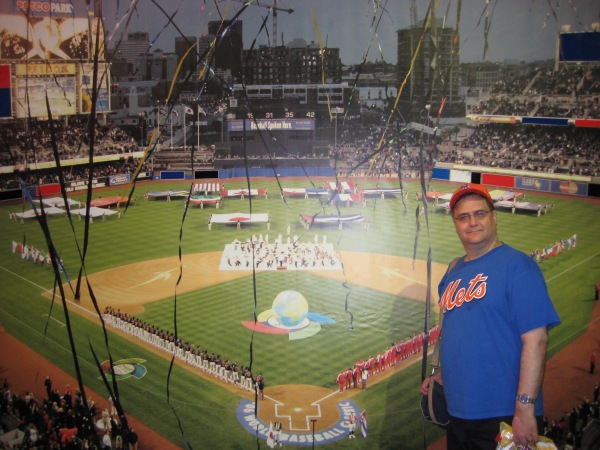
Let the celebration commence: the last of the at-large Mets are coming home from their baseman’s holiday, a.k.a. the World Baseball Classic. They can get back to being the team they’re paid to be, the one we’ll care about in two weeks when whatever happened in the WBC is tucked away in memory’s recesses for a few more years. Honestly, when I ran across the above pictorial salute to the “Classic” at the All-Star FanFest last summer, I had completely forgotten the first one had ever taken place in 2006.
But no need to be a total curmudgeon about this. While I had no use whatsoever for this tournament at this time of the preseason, and it still offends me that Mets weren’t in Mets camp, I have to applaud our David Wright for looking out for one Mets fan in particular, U.S. Army Sgt. Felix Perez, a kid from New Jersey who was injured in Iraq in ’04. It was noted in the press that Perez was greeted warmly in Miami by Team USA during the WBC semis last week. David made sure Felix continued to feel the warmth in Los Angeles over the weekend. As reported by Christian Red in the Daily News, Wright saw to it that Perez would be at Dodger Stadium for the game against Japan last night, all expenses paid by the Mets’ third baseman. There’s a huge difference between the uniform Perez wore in harm’s way for the United States and the one Wright put on for a few weeks, but David…he’s the kind of guy who makes me proud of my team and my country.
Felix, too.
by Greg Prince on 22 March 2009 9:50 pm “So,” Jason asked me Friday. “Have you been in the wilds yet?” His way of asking had I been to a book store so I could view my merchandise in its natural selling habitat.
Not yet, I said, but I'm headed there.
Good timing had me abandoning my hermit-ish existence and meeting some former colleagues Friday night in what we Long Islanders call the city. It allowed me three brief excursions before joining the party.
Penn Books in Penn Station. Cramped fixture of my commuting experience. Sometimes sports books meander to the front of the store. The Torre book and a new book about Walter O'Malley were in evidence immediately, but not Faith and Fear. Walked laterally (it's really cramped) to the back, to the sports shelves. No particular order, not even alphabetical, but blue and orange tends to stand out. Yup, there it was: my first sighting of my first book in a retail environment. It was next to a book about a team I can't stand by a writer I'd cross the street to avoid based on what I've read, but as with your relatives, you can't necessarily choose your contemporaries. I literally high-fived my book's binding. It's still saleable.
Borders at Penn Station. I've had lots of good luck finding gems in this Borders and other Borders. I had no luck finding Faith and Fear. Place was way crowded. Rush hour plus Knicks game must have equaled store traffic. Went to a DIY computer, typed in my title and it told me “Likely in store.” Thought about badgering a clerk to go get it. I had to do that once for a DVD that had just been released at this Borders, and someone I know had to the same at a Suffolk County Borders earlier in the week to get FAFIF. If it were less busy and I didn't have an engagement, I might have, but I wasn't buying a copy of my own book at that moment, so I let it go…not without angst that it's wasting away in a storage room. Next trip in, I will be on them like Olerud on base. Still, encouraging to see that in this economy, people flock to book stores.
Barnes & Noble in Union Square. When I worked eight blocks south and then nine blocks north, Union Square was my midway, midday oasis, no place more of a lunchtime refuge than the giant book store on E. 17th St. If I were to get up and count all the books in this room right here that were purchased at the Barnes & Noble in Union Square, I'd probably not finish, 'cause I'd pick one out and start reading.
So I enter the place I consider The Capital of Books. Maybe I'm with new non-fiction or new releases or New York…nah, let's not get greedy. Let's just head up to the second floor, to where they keep the baseball, to where I used to scour the shelves, absorb the breadth of titles, roll my eyes at how many frigging Yogi Berra books get published and wonder if someday I'd see my own unwritten, sketchily conceived book about being a Mets fan here.
Someday came Friday night. There I was…I mean there it was, Faith and Fear in Flushing, facing out from a top shelf (luck of the alphabet). A little high for immediate consumer eye contact, but who wants to be down near the floor? There's three copies of me/it, then some other stuff, then Tony La Russa's uninviting mug.
It was like Endy Chavez made a nice catch. Not a great catch, but a nice catch at an important moment. When he would do that, I might jump up (not as high as Endy) and shriek (not as high as Endy could jump), but I knew I'd seen something. I saw something. I saw my book at the book store where I bought other writers' baseball books for eight years. I jumped and, yeah, I shrieked.
After calling Stephanie to alert her to my discovery (noticing I was leaning on a table of baseball remainders…how foreboding), I went back to my shelf. I reached up there, pulled my three copies out a little further so they'd be more prominent than La Russa and was on my way to meet my friends. When I returned to Penn Station many hours later, I went back to Penn Books to check on FAFIF's status. A second copy had materialized in the course of the evening. Maybe it had been there all along. I hope it wasn't from an unsatisfied customer.
***
My sister and her husband wanted to take us out Saturday night to celebrate the release of the book: dinner, then a trip to see the damn thing in action. We wound up at a diner, which was fine with Stephanie and me and extraordinarily appropriate given the Long Island-bred nature of the author and his work. Just down Glen Cove Road from where we dined is my de facto hometown B&N. I don't live in Carle Place, but it's close enough. Another busy store that's gotten its fair share of my discretionary income over the years. My sister asked me where the sports books are kept, for she had never, ever had cause to seek them out previously.
A nice big table hosted all kinds of baseball books by the stack. One stack was a nice tall pile of Faith and Fear in Flushing. While I was marveling at its presence, Stephanie was over at the shelves. And, in alphabetical order just like the night before, there it was. But more, lots more. I began to wonder if I should be more concerned than happy that so many were here. Why weren't we moving more units? Then I remembered it came out like three days before. Patience, rookie. Patience.
Suzan whipped out a camera and handed it to Mark. I posed with the book and with various members of my family, sort of like Friday night when I brought a copy with me for my Facebook-driven reunion with old work friends. I've written and occasionally still write for magazines. I write various forms of corporate communications. I write a blog. Nobody asks to pose with those. A book, even now when digital reigns supreme, is different. Seeing the book you wrote in a book store is way different from seeing it anywhere else, except maybe in the hands of those who care enough to grab a copy.
We hung around longer than necessary. Stephanie and Mark each went to browse for other things. I gave Suzan a brief tour of the baseball inventory vis-à-vis the other authors I've gotten to know, the other books I've read and reviewed, the books wherein our blog and I have been acknowledged. We had to keep inching away from the Faith and Fear display, lest we block others from a clear view. As we were about to leave, I noticed a woman in a Mets jacket was in a nearby section. Stephanie — not a salesperson by nature — picked up a FAFIF and marched over to her. “This is my husband's book. If you're a Mets fan, you'll really like it.”
“We're not really going door to door,” I felt compelled to add. “But as long as you're here and wearing that jacket…”
She promised to take a look.
***
Friday, March 27, 12:30 PM, I'll join Mark Healey for Baseball Digest Live, airing from Foley's NY, on West 33rd Street in Manhattan, between Fifth Ave. and Sixth Ave., across from the Empire State Building. Stop by if you can or listen online.
Coming Wednesday, April 1, 7 PM, I join Mike Silva and Howard Megdal on NY Baseball Digest. And the next night — Thursday, April 2 at 8 PM — I'll be on the bill (introduced by the fabulous Mr. Fry) at Gelf Magazine's Varsity Letters sports reading series, at the Happy Ending Lounge on the Lower East Side, a venue with a name that meshes quite fortuitously with Chapter One of the book.
Hope you'll be listening/calling/attending to any and all of these events as applicable. More such stuff To Be Announced. Watch this space and this space.
Faith and Fear in Flushing: An Intense Personal History of the New York Mets: available from Amazon, Barnes & Noble or a book store near you.
by Greg Prince on 22 March 2009 2:05 pm 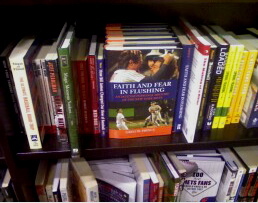
Not much of a picture, but a pretty pleasing sight to this first-time author. From the baseball section at the Carle Place Barnes & Noble on Old Country Road, Saturday night. There was also another nice stack on a display table.
Great to see them on the shelves. Will be even greater when they’re flying off.
Faith and Fear in Flushing: An Intense Personal History of the New York Mets is available at many fine bookstores near you…and easily obtained online via Amazon, Barnes & Noble and other booksellers.
by Greg Prince on 20 March 2009 8:36 pm Welcome to Flashback Friday: I Saw The Decade End, a milestone-anniversary salute to the New York Mets of 1969, 1979, 1989 and 1999. Each week, we immerse ourselves in or at least touch upon something that transpired within the Metsian realm 40, 30, 20 or 10 years ago. Amazin’ or not, here it comes.
They were young. They were guns. But the hopes of a franchise didn’t hang on their rifle arms. They were just the easiest, most inexpensive options available. So they were opted for. In retrospect, they were quite a bargain.
Seventeen years before Generation K went down in flames and infamy, there was Generation Pre-K, if you like. Not as celebrated in advance as Jason Isringhausen, Bill Pulsipher and Paul Wilson but a lot more durable in Met lore was this trio: Neil Allen, Jesse Orosco and Mike Scott. It was three decades ago this spring that each made the Mets.
If 2009 has anything in common with 1979 — and perhaps most springs — it’s that the Mets came to camp with holes in their pitching staff, particularly their starting rotation. You could count on 1978 National League ERA champ Craig Swan. You could hopefully count on 1978 National League All-Star Pat Zachry, a great first half to his credit, but also a fractured foot that kept him out of action in the second half after he gave up a record-tying single (longest modern N.L. hitting streak) to old teammate Pete Rose. Kevin Kobel had a shot in March, but his own foot sprain put him out of action until May. Lightly used outfielder Tom Grieve was swapped to St. Louis for Brooklyn’s own Pete Falcone, whose claim to fame, at least in my eyes, was the Mets always beat him; we were 9-0 against him since he came up in ’75, 0-4 in ’76 alone. His other claim to fame was his cousin was eternal bullpen coach Joe Pignatano
After those relatively sure things, 1979 was full of pitching question marks. As punctuation went, they surely outnumbered dollar signs. That became evident when that season’s prospective No. 4 starter, Nelson Briles, was disinvited from Spring Training for having some wear on him. You’d think the ’79 beggars wouldn’t be choosers (even if Briles, 35, hadn’t been particularly effective since 1976), but they chose not to pay him the $60,000 a veteran of his stature would have demanded. Joe Torre wanted his former St. Louis on the teammate, perhaps to keep him company, perhaps to remind of him of what it was like to play behind a rotation of Gibson, Carlton and a much younger Nellie Briles. But sixty-thou was big money to the Lorinda de Roulet Mets. As Jack Lang recounted in his essential The New York Mets: Twenty-Five Years Of Baseball Magic, “the austerity campaign was on and [GM Joe] McDonald would not or could not pay Briles the money a veteran commanded.”
So count Briles — whose lasting contribution to Mets history was his cameo in Bill Murray’s coverage of Chico Escuela’s courageous Spring Training comeback — out of St. Petersburg. And count Nino Espiñosa and his impressive afro out, sent to Philly with ten days to go for slugging (if not sunny) Richie Hebner. The Mets headed for Opening Day in Chicago with three experienced starters: Swan, Zachry and Falcone.
This is where the youth movement drifted in. This is where the Major League Baseball minimum of salary of $21,000 per year came in to play. This is how Neil Allen, Jesse Orosco and Mike Scott became, at the respective ages of 21, 21 and 23, 1979 New York Mets. Three rookies for just over the price of one Briles? A steal.
Their ascension onto the roster was not completely without merit. These weren’t California Penal League refugees, not even at that tender stage of their nascent careers. Jesse Orosco, the player to be named later in the Jerry Koosman deal (named after Greg Field), showed up in St. Pete as a non-roster invitee and chalked up six scoreless appearances. Allen had a 10-2 single-A season under his belt from just two seasons earlier. Scott threw nearly 200 innings two consecutive years in the minors. Time would bear out that each belonged in the bigs. But that time was a ways off.
There were moments. Orosco’s came first, in the Opener at Wrigley, a whale of a game the Mets led 10-3 (Richie Hebner, four hits, four RBI) behind eight solid frames out of Craig Swan. Dwight Bernard — of whose Met career absolutely nothing positive can be said — came in to mop up and quickly set the ivy ablaze. In a blink it was 10-6. Torre called on young Jesse Orosco to face Bill Buckner with a runner on second. Not a save situation, but close enough. Orosco flied Buckner to right and that was that. The Mets were 1-0 and Jesse was golden.
For about a minute. Orosco wasn’t ready. Allen served as de facto fourth starter when the first doubleheader rolled around and pitched the barest of quality starts (6 IP, 3 ER) before going down to a vengeful Espiñosa. He lost to Nino and the Phils again six days later, looking less impressive. Neil wasn’t ready. Scott’s first start went well, a romp over Vida Blue and the Giants. But Mike proved progressively less able and the Mets, even the 1979 Mets, were not willing to wait for him to be ready. He and Jesse were sent down in mid-June. Neil lost his spot in the rotation by May and was scheduled to join his fellow young guns as Tides after a Disabled List stint, but then closer Skip Lockwood had a shoulder problem (joints were killing the Mets; Zachry’s year was ruined by a bad elbow), so Allen stayed a Met. He began pitching effectively in relief and eventually succeeded Lockwood to save whatever Mets wins there were to save.
Cheapness was the reason they got their break, but their youth would be served, albeit once they matured. Allen was probably the brightest spot of the bleak second half. He was the closer of record clear to early 1983 and a darn good one, too, at least through ’82. Orosco would need time to hone his craft, but at about the time Neil was crumbling in New York (and becoming legendary trade bait), Jesse moved into the closer’s slot and earned All-Star honors twice. Scott never amounted to much as a Met, but you likely know he became quite the craftsman — particularly with sandpaper — in Houston.
By October 1986, the discount seeds of the spring of ’79 had blossomed all over the postseason: Scott scuffing and stifling the Mets, Orosco asphyxiating the Astros and Red Sox and the bounty Allen brought to Queens, Keith Hernandez, driving in the runs that turned around the final game of that Fall Classic. Neil Allen pitched until 1989, Mike Scott until 1991, Jesse Orosco, a.k.a. Methuselah, until 2003. I’m not sure that three pitchers with zero big league innings among them every came up to the Mets together at one season’s beginning and went on to have three individual tenures quite as long.
Sometimes you can’t judge at face value what you see in a given Spring Training. And sometimes you just have to reserve judgment.
Don’t be left off the final roster: get yourself a copy of Faith and Fear in Flushing: An Intense Personal History of the New York Mets before Opening Day! Available via Amazon, Barnes & Noble, other online booksellers and fine bookstores throughout the Greater Northeast. Discuss the Damn Thing, too, at Facebook with other FAFIF fans.
by Greg Prince on 19 March 2009 6:36 pm Gary Cohen just mentioned your favorite blog (or at least this one) in the bottom of the fourth inning. Keep an ear open when you eschew college basketball this evening for SNY's rebroadcast.
by Greg Prince on 19 March 2009 12:02 pm When Air Metropolitan departs from Palm Beach International in a couple of weeks (assuming this perpetual Spring Training ever ends), I think we all know who's going to be sitting in the fifth row of the starting pitchers' section and who will be deplaning to meet his connecting flight, ETA April 11 or 12 against the Marlins, maybe sooner given the way rotations have of never, ever spinning as planned.
Meet the new Met, same as the old Met in that Liván Hernandez is classic fifth starter Met-erial. Is anybody here really surprised this veteran's veteran whose shiningest moment in baseball came in the previous decade wound up a Met? Isn't everybody more surprised that he hasn't already been a Met? Doesn't he seem just that familiar?
Tim Redding was injured before he ever had a chance to pitch well. Freddy Garcia was injured long before we signed him. Jonathon Niese was born not 22½ years ago, which makes him kind of young to be keeping this kind of company just yet. That leaves Liván, and not just by process of elimination. The old man has pitched well (embellishing his credentials with five very solid innings Wednesday), though it certainly helps that Redding, Garcia and Niese have a combined ERA of way more than Hernandez's age…whatever number that might be today.
Niese should have a future, Garcia has shown nothing more discernible than a past, Redding has a bad shoulder and Liván Hernandez — named World Series MVP right around Kid Jonathon's eleventh birthday — is undeniably the fifth starter of the present. Liván Hernandez is officially 34. And I'm the King of Sweden. But whaddaya want from a fifth starter: an accurate birth certificate or lots of innings, many of them dependable? That's Liván's stock-in-trade. He's big, he's durable plus he hits. I saw him hit a home run at RFK, and that's no mean poke. Let the “bat Liván eighth and Castillo ninth” talk commence in earnest (hell, let the “play Liván at second the days he's not pitching” talk commence, too). I'm not convinced Liván will endure into May or June let alone September or (deep breath) October, but let's get to the first week of the season with five starters on board and take it from there.
Santana had to shut it down at one point this spring. Pelfrey was seen wearing a boot. Maine ain't all the way back even if he's out there firing. Perez mentioned something about being tired from Playing For His Country. Hopefully they'll all be tip-top when everything counts again. Until then, I'm not going to look askance at someone with Liván Hernandez's track record, long-term or extremely recent. The King of Sweden would never be so shortsighted.
As for the man ultimately on the other end of the rotation's deliberations, Brian Schneider — not my favorite catcher by any means but surely a guy we need given the present roster composition — is experiencing “pain and stiffness behind his right knee“. I would assume all catchers experience loads of pain and stiffness, but Schneider hasn't played since Sunday and he required an examination that revealed “inflammation of the capsule in the knee”. Omar Minaya said he was not particularly concerned. I'm pretty sure that means Schneider will be out six to eight weeks.
Also, an X-Ray showed David Wright's left big toe is all right after he fouled a ball off it in WBC play. Excuse me while I go hyperventilate into a paper bag For My Country.
Thanks to the Eddie Kranepool Society for a glowing appraisal of Faith and Fear in Flushing: An Intense Personal History of the New York Mets, available via Amazon, Barnes & Noble and other online booksellers — and at many fine bookstores near you, including Barnes & Noble and B. Dalton locations from Connecticut to Washington, D.C. All are welcome to join the FAFIF: AIPOTNYM discussion on Facebook here.
by Greg Prince on 17 March 2009 4:27 pm Thanks to Joe Dubin's New Breed-bred eagle eye for such things (though discounting the Odd Couple game we won only in fiction), it appears the Mets' winning ways date back further than originally thought, all the way to June 13, 1967, a full 44 games before the juncture initially calculated (when I was either too sleepy or too timid to wade through what loomed as a full and daunting pallet of L's on baseball-reference).
Commencing with that evening's doubleheader split against the Reds at Shea, specifically rookie Tom Seaver's eight-hit complete game 7-3 victory over Cincinnati in the nightcap (the fifth win of the young man's career), the Mets were 22-22 up to and including the aforementioned July 28 loss in Los Angeles…meaning that since the middle of play 6/13/67, the Mets are 3,308-3,307 (winning percentage: .50007559), marking the furthest you can go back in time and call the Mets cumulative winners. Before the second game of that June 13 twinighter, up to and including the 6-0 shellacking the Reds pasted on Bill Denehy in the opener, the Mets were 277-582 (winning percentage: .32246799).
The larger points stand as previously reported:
• The Mets were very bad well into their sixth season, covering a period of their first 859 games.
• They've been intermittently almost as bad since then but sometimes they've been pretty good and once in a while magnificent. Thus, for more than four decades, they've been the slightest shade over middling in a span that covers 6,615 games, right through last September 28's 4-2 defeat at the fins of the Marlins.
• They still need to win 82 games this season to have as many yearly winning records as losing records in their checkered 48-year history.
• They will still have an all-time losing record even if they go thirty games over .500 every year for the next ten years.
• Buy my book please.
by Greg Prince on 17 March 2009 2:22 pm To paraphrase Vin Scully, it was 10:26 PM in the City of Angels, Los Angeles, California. And a crowd of 31,101 was sitting in on history. Claude Osteen had just shut out the New York Mets, 2-0, on July 28, 1967, dropping the visitors' record for the season to 39-57 and their lifetime franchise record to a staggering 299-604. Since their founding, the Mets had lost slightly more than two games for every one they won.
That night marked the end of ancient history. The next night is when modern history began, as that Dodger Stadium crowd saw the beginning of something bigger and better, at least where Mets fans were concerned. True, it was just another loss in another losing Mets season, 2-1 to Bill Singer. But, with ample hindsight, we can say our winning ways date back to July 29, 1967.
Starting with that defeat on 7/29/67, the Mets' record for the balance of 1967 would be 22-44, a typically unimpressive 22 below .500. But — and it's a humongous but — beginning in 1968 and running straight through to the end of 2008, the Mets have compiled a record that stands 23 games above .500, a nifty 3,264-3,241. Start the clock with those final 66 games of '67 and you have, over a span of 6,571 regular-season Mets games, an all-time mark of 3,286 wins and 3,285 losses.
In 1967, the Impressions recorded a single called “We're A Winner”. In 1967, we had yet to make much of an impression beyond a certain Rookie of the Year pitcher, but progress was and is progress. The Mets are forever a work in progress. A winning percentage that measures out to .50007609 over a span of not quite 41½ seasons after Casey Stengel's and Wes Westrum's troops came limping out of the gate at .3311849 is…well, if it's not impressive, it is sort of progressive.
We're a winner! From July 29, 1967 to September 28, 2008 we are! Other franchises may define their success by championships or whatever, but that's too much forest and not enough trees, especially after your first several seasons were comprised of acorns falling on your head. The New York Mets, as you probably know, began their existence 0-9 and 40-120. They followed that up in 1963 with 0-8 and 51-111, and it was considered a great leap forward. Going 53-109 in 1964 was posited, straight-faced, as the best record in team history — which it was.
So don't tell me there's not something magical about an almost 41½-season winning record, even if it's a one-game-above winning record, even if it encompasses part or all of eighteen losing seasons, most of them horrendous to have endured. Every win, like every one of Warren Zevon's sandwiches, should be enjoyed, savored and treasured. What the 1962 Mets wouldn't have given for one extra winning sandwich every month.
This line of thought is relevant because the Mets can do something very special in 2009. Statistically speaking, by one particular measure, they can stop being losers for the first time in their not-so-brief history.
The Mets posted losing records every year from 1962 through 1968. Then winning records for seven of the next eight seasons through 1976. Then they went off on a losing binge for seven years. They followed that Biblical famine with seven years of plenty…and followed that with a six-year, sub-.500 stroll through the desert. Winning returned in 1997 and hung around through 2001. Losing made its uninvited reappearance for three seasons after that, but starting in 2005, it's been, a couple of final days notwithstanding, nothing but peaches and cream.
Let me add it up for you: 47 seasons, 23 winning records, 24 losing records. After 2008, the Mets stand one winning record away — 82 victories without cancellations — from having as many winning seasons as losing seasons. After 48 years, they can be 24-24 in this regard.
I'd regard it highly. To rise up from, at various junctures, 0-7, 7-15 and 14-21 to make it to 24-24…I don't know if it would be Amazin' cubed, but it would be nice. We've had similar chances before, reaching 7-8 in '76 and 14-15 in '90, but there was always that darn backsliding into a state of un-Met-igated disaster. When the Mets land on disaster, they rarely just check in and turn around. They usually embrace it.
This is their chance to escape. This is their chance to be a .500 franchise.
They'll never reach that milestone in terms of individual wins and losses. Never, ever, ever, ever, not with that yoke they started building on April 11, 1962 and carried on their backs clear to July 28, 1967. To have fallen 305 games below .500 in just over 900 games' time and then need well over 6,500 games to supercede that level by exactly one game — Mets' all-time record, 1962 through 2008: 3,585-3,889, or 304 games below .500 — is to produce as shovel-ready a project as any stimulus package is ever going to find. The Mets dug a hole so deep by the middle of their sixth season that they could go thirty over .500 every year for the next ten years and still be under .500 forever after 57 seasons of operation.
I'm not counting on them to go 96-66 every season from 2009 to 2018. I'd take it, but I'm not counting on it. I'm not necessarily counting on 82-80 this year, actually, because I've learned to never, ever, ever, ever count on the Mets to do anything. But if this team, generally considered a contender for some reason, can do the bare good-team minimum and put up a winning record, then we can say — if so inclined — that we've had as many winning records as losing records in our sometimes triumphant, sometimes calamitous, always fascinating history.
And if we can do that, we can literally be, at last and for all Mets time, what the naysayers say we are.
Mediocre.
***
Thanks to Will Leitch for citing something we had here regarding one of the less triumphant, more calamitous events the Mets have ever conjured and, in the process, introducing Faith and Fear in Flushing: An Intense Personal History of the New York Mets to the readers of New York Magazine. And thanks to so many of you for having expressed your enthusiasm — via e-mail, comments and Facebook — at receiving your copy of the book (and seeming to be happy with what you've read so far).
If you enjoy it, please don't be shy about letting other folks on Amazon, Barnes & Noble and other online booksellers know about it by posting a review. I'm told they really help spread the good word. And if you haven't ordered your copy of FAFIF: AIPOTNYM, you can do so via Amazon, Barnes & Noble, Borders, Powell's, Deep Discount, eCampus…what I'm saying is, there are lots of options, and all of them are presumably better than whoever's going to be our fifth starter.
by Greg Prince on 14 March 2009 9:10 pm I'm still a little dim on things like this, but I somehow managed to add a Facebook page for Faith and Fear in Flushing: An Intense Personal History of the New York Mets here. Become a fan, get updates, post your thoughts on the book and do some of that social networking I keep hearing about.
And if you haven't ordered it already, FAFIF: AIPHOTNYM is available through Amazon, Barnes & Noble and other fine retailers.
by Greg Prince on 13 March 2009 9:52 pm Welcome to Flashback Friday: I Saw The Decade End, a milestone-anniversary salute to the New York Mets of 1969, 1979, 1989 and 1999. Each week, we immerse ourselves in or at least touch upon something that transpired within the Metsian realm 40, 30, 20 or 10 years ago. Amazin’ or not, here it comes.
A couple of mornings every week when I’m driving Stephanie to the station, I have to navigate around a line of rumbling sanitation trucks peeling out to keep the streets of our fair village clean. In the dark and in the fog, it can be a little daunting. Sometimes, though, when I’m just punchy enough, the sight of them will inspire me to break out into song.
Was the dark of the moon
On the sixth of June
In a Kenworth pullin’ logs
Cabover Pete with a reefer on
And a Jimmy haulin’ hogs
Yessir, we got a mighty convoy, rockin’ through what’s left of the night.
In that way I have of embracing songs that some consider the aural equivalent of Shea Stadium, I love “Convoy” by C.W. McCall. I’ve always loved “Convoy” by C.W. McCall, from the moment I first heard it in December 1975. For a while there, it made me want to be a trucker or at least use a CB radio. My sister had a pair of Walkie-Talkies that used to pick up local cab calls. By 1976, it was all Citizens Band crosstalk. If I shouted real hard, somebody could hear me. (This was when ten-four was how you signed off, not the score of one of Tim Redding’s starts.)
“Convoy” ranks No. 16 among the Top 500 Songs of All-Time, a position that usually stops cold anybody who made it past “Ice Ice Baby” at No. 7. Tough to sell the remaining 484 in polite society when you’re leading with Vanilla Ice and anything that mentions someone named the Rubber Duck. So be it. C.W. McCall always made me want in on that figurative line of trucks that crashed the gate doin’ ninety-eight, even if most mornings I’m scared so witless by traffic that I can’t get it up to thirty.
The desire to be welcomed into a convoy probably stems from how much satisfaction I derive from having aligned myself with a real, live baseball team, the same one of which I’ve felt a part since I was six. I believe in “we” and “us” here, rather than “they” and “them” when it comes to the Mets. That’s my team — not “That’s the team I like from a distance.”
Which is why I’m willing to reconsider my opinion of anybody who is willing to join my team, anybody who wants to wear for a living what I wear out of passion, anybody who is going to put his skill sets to the good use of making me happy.
It’s why I could comfortably embrace Orel Hershiser as a part of our convoy.
Bringing Orel Hershiser to Mets camp in 1999 was theoretically as atonal to the ear as trading for Bill Hands in 1976 or signing T#m Gl@v!ne in advance of 2003. This was probably worse given that Hands and Gl@v!ne were merely enemies. Hershiser was a Nemesis of the first order. He didn’t practice his dark magic in a particularly offensive manner for a very prolonged stretch, but then again he didn’t have to. Nobody compressed his pure evil into a more efficient time frame to worse effect than Orel Hershiser.
Such a nice fellow, too. His persona made it impossible to negotiate my animus for him in 1988. I wanted to hate him. And I did hate him. But then everything you hear about him is he’s an absolute sweetheart — “patience, intelligence, humor and humility,” wrote Sports Illustrated‘s Steve Wulf in 1988’s Sportsman of the Year profile — total man o’ God, awesome competitor and for one season’s stretch run, completely untouchable. His final 59 innings were record-breaking scoreless in ’88. Then came the NLCS and the Mets got to him just enough — just enough to pull out Game One, just enough to outlast him in Game Three.
Then came Game Four. The Scioscia Game. Let’s skip past the catcher and ahead to the pitcher Tommy Lasorda called on in the twelfth inning, one day after that pitcher started Game Three and threw 108 so-so pitches. It was Orel Hershiser, Lasorda’s sixth reliever of the night, there to save the day: bases loaded, two out, one-run lead, Kevin McReynolds up.
He got K-Mac to pop out to center. It took a little hustle from John Shelby to catch up to it, but it was all Orel all the way on no days’ rest. Once Hershiser put the Mets away to tie the series, the momentum was clearly Los Angeles’s. When we next saw him in Game Seven, he wasn’t the least bit touchable, throwing a five-hit shutout. The last sight of the night was Howard Johnson swinging helplessly and Orel Hershiser thanking his maker before being piled under a sea of blue on the Dodger Stadium mound.
Oh, how I hated Orel Hershiser, pious prick, and I’m sure I wasn’t alone. I made a point of attending his next start at Shea, in August of ’89. It was Hershiser vs. Cone, with a crowd (46,143 — and it probably undercounted the total in the house) thirsty for revenge. We won 3-2. We were ecstatic. But we still hated Orel Hershiser.
Ten years pass. He’s up and down, battling injuries, relocating to Cleveland, then San Francisco. Has some good years, some fine postseasons. He’s no longer the immortal moral Orel who captivated a baseball-watching nation, or at least those precincts outside of Flushing and Oakland. In March of ’99 comes word that the Mets, needing someone to pick up their traditional springtime rotation slack, have signed Orel Hershiser.
It should be weirder. Yet it isn’t. He came here voluntarily, just as he volunteered to pitch in Game Four in ’88. Orel would apparently do anything. Eleven years after killing us, he was here to prop us up. Perhaps we were his missionary work. Perhaps at age 40 he just wanted to keep pitching.
And I welcomed him with reasonably open arms. He was far removed from his 1988 prime, but he ate up innings. That was big on a team like the 1999 Mets, for whom nobody amassed more than thirteen victories. The team co-leaders were Al Leiter and…Orel Hershiser. Orel and Al also tied for the team lead in games started with 32. He filed away some clinkers, he turned in some gems. He started the game the Mets couldn’t live without, October 3, 1999, the 162nd contest of that scintillating campaign: Hershiser vs. Benson, old guy vs. young gun. The old guy’s team came out ahead. By the middle of October, a month we wouldn’t have seen without him, Hershiser was our second Mahomes, an indispensable long reliever for a team that found itself in some of the longest playoff games imaginable.
Orel Hershiser was a Met as much as anybody for that one season. When I think of Orel Hershiser today, I reflexively go for the 1999 teammate as opposed to the 1988 nemesis. Orel wore a Mets jacket just like I did. His professional efforts were committed in our name. We were in this thing together. That’s what it means to me for somebody to be a Met. That’s what it means to me to feel like a part of a team.
***
Yet if Orel Hershiser, Al Leiter or any American-born 1999 Met donned a red, white and blue jersey in 2000 and pitched for the United States Olympics team, I don’t think I would have cared what that team did in Sydney any more than I actually did — which was nil. And today, no matter how much evidence I’m presented that the World Baseball Classic is the cure for March malaise, I can’t get excited or even interested.
I love the United States of America, but the United States of America is not a baseball team, no matter how much merchandise they sell to that effect. I know some baseball fans who don’t care about nationality, they just like good games and good stories. I can see the charm in the underdog nations rising up and biting the overcats, but that’s not part of my narrative either. My team is my team. The only time I watch non-postseason baseball intently without my team involved is to cheer on a given day’s enemy of my team’s enemy (physical or psychic). I watch the postseason because it’s the stated goal of my team to get there, so it’s legitimately within my purview. The WBC, the Olympics, the Caribbean World Series, the College World Series…they have nothing to do with my team.
But there’s something deeper that nags at me about the World Baseball Classic and the way it’s put together.
In third grade, a bunch of us were on the basketball court at recess looking for new and creative ways to align our pickup squads. One of the three African-American kids in our class said, “Let’s play coloreds versus the whites.” There was a stunned silence, even for eight- and nine-year-olds. It just sounded wrong and we opted for some other method of choosing up sides. That kid’s idea is what the WBC reminds me of. You’re taking Mets for whom I’ve come to have a genuine affinity and telling me that because of their background, they are no longer on my team.
This one’s from the Dominican Republic, not an American like me. This one’s from Puerto Rico, not an American like me. This one’s from Venezuela, not an American like me. It’s a weird message to be sending, even if it’s not the intent. It’s even weirder when somebody like Frank Catalanatto, of Smithtown, L.I., is playing for the Italy team because of his Italian heritage. It’s saying this one’s Italian-American, not an American like me or the guys on Team USA.
The whole thing instinctively brings me back to the third grade playground. I don’t see it as progress for humanity.
Endy Chavez feels differently. He’s entitled. After October 19, 2006, he’s entitled to whatever he wants. Still, I was a little disappointed when he said, after helping Venezuela qualify for the next round of the WBC, that representing his country in this tournament was a bigger deal to him than the catch…you know, The Catch. Yadier Molina said something similar after getting a game-winning hit for Puerto Rico, that it was more meaningful to him than the homer he hit two innings after Endy’s catch.
My first reaction was “So give back the homer, you bastard.” My next one was even Molina’s entitled to his opinion. As Chavez said, “When we’re in the majors, it’s our job. We are professionals.” True enough, he was reminded of that a few months ago when he was traded from the Mets to the Mariners, the sixth MLB organization to own his rights, which is also part of the narrative as I understand it. Guys become Mets for only a while, even if we hold them dear. Endy’s a Mariner in 2009 because it’s his job, whereas he’ll always be Venezuelan.
And I’ll always be a New York Mets fan.
If the above sentence applies to you, then get yourself a copy of Faith and Fear in Flushing: An Intense Personal History of the New York Mets, available NOW via Amazon, Barnes & Noble and other fine retailers.
|
|






