The blog for Mets fans
who like to read
ABOUT US
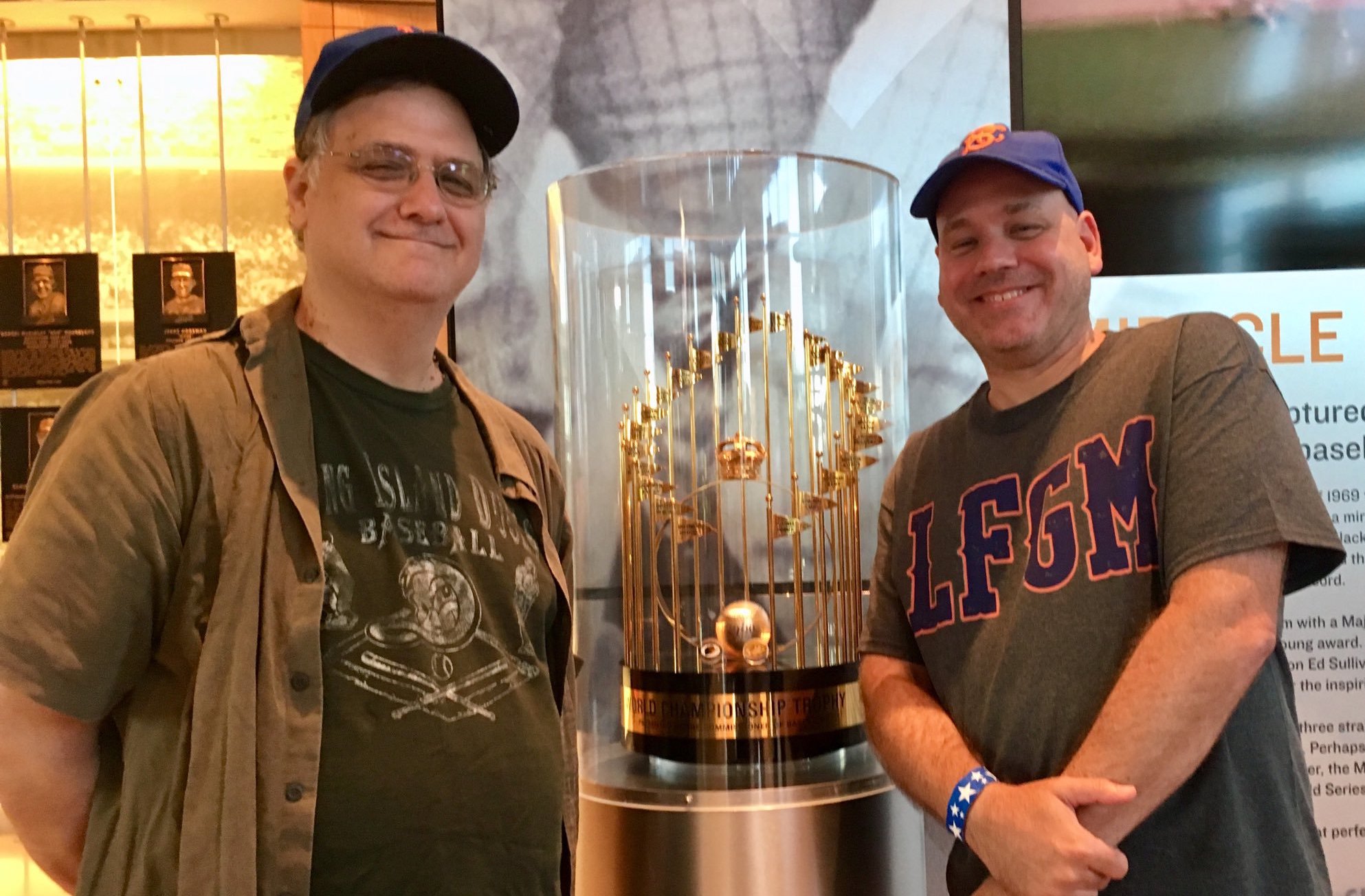
Faith and Fear in Flushing made its debut on Feb. 16, 2005, the brainchild of two longtime friends and lifelong Met fans.
Greg Prince discovered the Mets when he was 6, during the magical summer of 1969. He is a Long Island-based writer, editor and communications consultant. Contact him here.
Jason Fry is a Brooklyn writer whose first memories include his mom leaping up and down cheering for Rusty Staub. Check out his other writing here.
Got something to say? Leave a comment, or email us at faithandfear@gmail.com. (Sorry, but we have no interest in ads, sponsored content or guest posts.)
Need our RSS feed? It's here.
Visit our Facebook page, or drop by the personal pages for Greg and Jason.
Or follow us on Twitter: Here's Greg, and here's Jason.
|
by Greg Prince on 3 March 2009 12:31 pm “South Carolina,” declared John Rutledge, the fair colony’s delegate to the second Continental Congress on the occasion of that body’s 380th meeting, 7 June, 1776, “that is our country.” At least he said so in 1776, the restored director’s cut. As Rutledge was portrayed as a foe of American independence (and not big on the proposition that all men are created equal), I’m not in the habit of quoting him/his character to make my points for me. Yet on the occasion of this body’s deliberations as they concern the second World Baseball Classic, color me a little South Carolinian.
Elsewhere in the most important movie musical of all time, Judge John Wilson had to be continually reminded he couldn’t second Pennsylvania’s motion being that he was from Pennsylvania — but we don’t have that rule at Faith and Fear, so I will second the motion of my fellow delegate from FAFIF: phooey on the WBC. Ditto, ditto, I hate it.
Now please rise and repeat after me:
I pledge allegiance to the flag of the Metropolitans of New York, and to the baseball season for which they stand: one Team, under Jerry Manuel, noncollapsible, with Johan and K-Rod for all.
You may now take your seats. And the WBC can take a back seat to the M-E-T-S, because to paraphrase from Donald Hall’s biography of the late Dock Ellis, the Mets are a country all to themselves.
Nevertheless, I wouldn’t want to disappoint or deprive the honorable baseball fan from England who shared his eloquent defense of the WBC with us in response to Jason’s enumerated objections. And as long as I’m quoting John Rutledge and praising the British, let me go for the triple play of 1776 heresy and echo John Dickinson when he says that in his own way he regards America no less than does Mr. Adams. In my own way I regard world baseball no less than those who favor the WBC. But I’m not joining its army and I’m not fighting in its defense. It’s not so much that I believe that fight to be hopeless. I believe the WBC to be a waste of my and our time.
It may not be a waste of time to those who want to see baseball take hold on all seven continents (I hear there’s a southpaw in the Antarctica League who throws a pretty mean snowball). It may not be a waste of time to the players we’ve never heard of from places we rarely think of, the way we once rarely thought about Venezuela or Venezuelans like Johan Santana and Francisco Rodriguez. It may not be a waste of time to fans whose attention will be focused on this once-in-a-triennium opportunity to see some if not all of the best players in the game on one stage.
Yet at the risk of forfeiting my station among those cool, cool considerate men who are willing to see the upside in all this, I’m saying it’s a waste of time to me, the medium-sighted Mets fan whose interest lies in the 2009 Mets mutually pledging to each other — and us — their Lives, their Fortunes and their sacred Honor in the 2009 baseball season. I’m saying it’s a waste of time to the 2009 Mets and their pursuit of championship happiness during the 2009 baseball season. As long as it’s a waste of time to the other 29 Major League Baseball teams, I suppose it’s a wash. But I don’t worry about them. I worry about us. And I see no good in this.
Except for what Jerry Manuel chooses to see. In the first Snighcast of the spring last week, Gary Cohen explained Manuel, while not crazy about the WBC concept, hopes the idea his tournament-bound players have expressed about playing for a cause greater than themselves stays with them when they come marching home to Port St. Lucie. For when the WBC ends, Cohen said of Manuel’s thinking, the Mets are their country. Just like it’s our country.
Jerry elaborated in the Post on Monday:
“I hope it has an impact on them as individuals to enjoy that camaraderie and bring that same feeling back here. I think it’s going to be a great experience for them to play for what’s on the front of their jersey and not what’s on the back.”
I’d like to think this isn’t a new sensation to the individual Mets, that whether they’re wearing the uniform of the USA or Puerto Rico or Venezuela these next couple of weeks that they’ve always gotten the idea of the team coming first in what is, for all the individual stats and glory, a team game. They’ve had some pretty piss-poor coaching and guidance their entire lives if it takes the World Baseball Classic to frame that they should be playing each game for the betterment of their team. But maybe that’s just Jerry being Jerry, finding a useful spin to put on any potentially detrimental situation. One assumes the reason the Mets didn’t capture what was right in front of them these past two Septembers wasn’t misdirected individuality deployed at the expense of the unit. One assumes they just kind of sucked at the very worst possible juncture in the schedule.
On the other hand, the last time the Mets made the playoffs was in the last season whose Spring Training was interrupted by a World Baseball Classic. I viewed the WBC in 2006 as something akin to a second flood, a simple famine, plagues of locusts everywhere as much as I do now, but despite the unwelcome break afforded for the piddling, twiddling and resolution of the WBC, those Mets raced out to their best start ever. By the end of that year, we saw fireworks; we saw the pageant and pomp and almost a parade.
At Tradition Field, how quiet…how quiet the chamber is. But when they turn ’round and the battle begins, hey Mets — look sharp. Get whatever you get from this foul, fetid, fuming, foggy, filthy World Baseball Classic and take it to those obnoxious and disliked grenadiers of Philadelphia.
Let winning ring.
This Spring Training lull does present a great opportunity to pre-order Faith and Fear in Flushing: An Intense Personal History of the New York Mets from Amazon, Barnes & Noble or other fine retailers.
by Jason Fry on 2 March 2009 11:56 pm Send me to Baseball Gitmo — because I'm not rooting for the U.S. in the World Baseball Classic.
I'm not rooting for anybody else, either. I'm rooting for the whole thing to be snowed out or cancelled because of economic ruin.
Is there a worse idea than the World Baseball Classic? Let's count the ways in which it sucks.
1. It delays the arrival of real baseball.
2. It interferes with the development of team spirit and camaraderie and other things that I think are basically imaginary except when the alternative to them is the WBC.
3. It means spring-training telecasts are even more scrub-eriffic.
4. It offers random hitting and pitching coaches a chance to screw up Met swings and Met pitching motions in a flurry of shameful sports adultery. (Sure, you could claim that such a brief affair could help our players, but we're Met fans.)
5. It offers the chance for injuries, whether it's a pitcher trying to coax May stuff out of a March arm in a fit of patriotic fervor, bad luck or some Kafkaesque turn of fate — imagine (with crossed fingers) Nelson Figueroa beaning David Wright. Which would be particularly ridiculous since last time I checked Nelson Figueroa was from frigging Brooklyn.
(Sure, Mets could get injured playing the Astros or Italy or Hofstra, but don't you interrupt me when I'm ranting.)
Hell, according to Johan Santana his bout of elbow whatever (BECAUSE IT'S NOTHING SERIOUS RIGHTRIGHTRIGHTRIGHT?) is WBC-related: He was hurrying to get in shape to defend the national honor of Venezuela. Even when our players don't play in the WBC, they get screwed by it.
Enough. In the 1993 All-Star Game in Baltimore, John Kruk found himself digging in against Randy Johnson. Or, rather, not digging in — Kruk saw one laser beam above his head and saw the rest of his at-bat with his back foot somewhere in the vicinity of Washington, D.C. When chastised for not exactly offering the Unit the old college try, Kruk pointed out that he played for the Phillies, not the National League. So should it be here: Whether their passports are American, Venezuelan, Dominican, Canadian, or what have you, once the orange and blue are donned I want our guys to think of themselves as upstanding members of the Metropolitan armed forces. All other loyalties are checked at the door, lest distraction or disaster rear their ugly heads.
6. David Wright will be hanging out with Derek Jeter and Chipper Jones. I rest my case.
Loyalists of all stripes should do their patriotic duty and pre-order Greg's Faith and Fear in Flushing: An Intense Personal History of the New York Mets from Amazon, Barnes & Noble and other fine retailers.
by Greg Prince on 2 March 2009 1:16 am We have a saying around our house: We don't want to be on News 12.
In the first three years we lived here, our neighborhood was featured on Long Island's cable news outlet five times that I can remember for reasons that had nothing to do with a plethora of National Merit Scholars or our rousing Memorial Day parade. And we live in what I believe to be a pretty decent neighborhood.
• A car crashed through a bagel shop window.
• A high school teacher was apprehended for conducting funny business with one of his students.
• A would-be bank robber was pursued from yard to yard on foot.
• Natural gas leaked one morning, necessitating an evacuation of residents of an area co-op.
• And an apartment in the same co-op caught fire thanks to a halogen lamp meeting a fish tank.
The 2004 gas leak was in our parking lot and the 2007 fire took place in our building. I was wide awake for the fire, which was pretty scary to find out about while it was in progress. I learned of the gas leak evacuation on News 12, many hours after cluelessly sleeping through it.
We don't want our neighborhood to be on News 12. And we didn't want the back pages for our Mets this Sunday morning.
But we got 'em.
The back page of the News: SAY IT AIN'T SO, 'HAN!
The back page of the Post: SAY IT AIN'T JO
The back page of Newsday: OUCH!
No need to fill in the sub-headlines. You know what the fright was all about. You know that icy feeling you feel when the Mets are on the back page at the beginning of March for anything more topical than another round of team-to-beatery.
For what it's worth (hopefully a lot), news regarding Johan Santana generated since these papers were printed is sunnier. Johan has tested his left elbow, declared himself feeling loose and the Mets have decided against a flight to snowy New York to run an MRI on our ace's platinum triceps tendon.
Ain't that good news? Man, ain't that news?
It's March 1. Opening Day is five WBC-necessitated weeks away. Plenty of time to heal. Plenty of time for something to not heal, too. Bill Pulsipher was gonna be out maybe a couple of days. Pedro Martinez was just going to need to give it some rest.
Once the pitcher on whom you're counting makes the back pages for reasons that make you nervous, you just as soon sleep through it.
Unequivocally good news, I hope, is Faith and Fear in Flushing: An Intense Personal History of the New York Mets is available for pre-ordering now via Amazon, Barnes & Noble and other fine retailers.
by Greg Prince on 1 March 2009 2:25 am
by Greg Prince on 27 February 2009 10:53 am Welcome to Flashback Friday: I Saw The Decade End, a milestone-anniversary salute to the New York Mets of 1969, 1979, 1989 and 1999. Each week, we immerse ourselves in or at least touch upon something that transpired within the Metsian realm 40, 30, 20 or 10 years ago. Amazin’ or not, here it comes.
It was an iconic enough moment to have been included Wednesday in my partner’s recitation of Spring Training episodes that rise above the St. Lucie snooze to become genuine, generally unwanted news: “Right Fielder Punched the First Baseman on Photo Day.” I remember that episode. Everybody seems to remember that episode. I remember that episode for slightly more than Mets reasons.
The RF on March 2, 1989 was, of course, Darryl Strawberry. The 1B was Keith Hernandez. Until I re-read the details in Joe Durso’s piece in the next day’s Times I’d forgotten why, exactly, Strawberry took a swing at Hernandez and launched the hoary (but still hilarious) observation that it was the first time Darryl had ever successfully hit the cutoff man.
Straw was in a snit over his contract negotiations. Mex had been quoted in some stories that Darryl was getting bad advice. Strawberry didn’t need much to wind him up. Neither, by 1989, did Keith. As Bob Klapisch covered in The Worst Team Money Could Buy, the Keith Hernandez of ’89 was no longer the Keith Hernandez of ’84, no longer the rallying point for the young Mets. The Mets weren’t that young anymore. Darryl may have been slow to mature, but he was 26 in early March 1989.
Come to think of it, so was I.
Darryl stormed out of camp that Thursday because he didn’t like his job. I remember hearing about the tussle because I was attempting to storm into a job. The day they had their fight was the day my career would be defined for the next fifteen years, making their melee kind of momentous for me.
I tiptoed into freelance writing after college, a line of work I never really committed to. It represented an incredibly unambitious holding pattern that, like me, was getting old. After nearly four years as something of a timid dilettante, I knew it was time to find something permanent. Maybe not fifteen years permanent, but something steady.
My first interview for a full-time job was that Monday, February 27, in the city at a horrible trade magazine — horrible in the sense that I was bored just by the name. But a job is a job, I figured. The editor who interviewed me was kind of an Al Bundy type. Complained to me that people there didn’t like that he wore corduroy pants to work. I took that as a bad sign because he was wearing a tie when he said it and all I could think was, “Do I have to wear a tie in this place?” He gave me a proofreading test and then sent me to meet the publisher, a woman who acted very put out by my appearance in her office (although I was wearing a suit). The conversation seemed to hinge on the fact that I had been a freelancer and could I possibly transition into a staff job? That’s why I’m here, I said.
We left my future with their magazine unresolved. I eventually got a call offering me a trial: work here for a week and we’ll see if you can handle it. By then, I was en route to what I perceived as better things.
Thursday, Photo Day in St. Lucie, I drove to Great Neck and interviewed at a trade magazine whose bailiwick fascinated me: beverages. Always loved beverages, and not just with food that was too salty. I had a large collection of soda cans that I’d been stockpiling since the end of seventh grade. Brought soda to nursery school because I had a milk allergy. It was in my blood. I drank enough diet cola so it probably was my blood.
I had no idea a magazine devoted to beverages existed, let alone existed on Long Island, until I noticed a classified with the magic word in the title. Even then I didn’t pounce, just kind of filed it away until I figured I should call on spec. Got the editor on the phone and asked if there was any freelance work. Wanna be associate editor? he asked back.
It was just about that easy. Seems I called during a propitious interlude for hiring, just when the previous associate editor was packing up and moving to Chicago. I sent some clips and arranged to come in on March 2. I wore my suit again. I was the only one in the place who was that dressed up.
Nobody gave me a proofreading test in Great Neck. Nobody complained to me about their job or others’ impressions of their wardrobe. The editor who interviewed me likened the atmosphere to a big high school newspaper. I enjoyed my high school newspaper a great deal. About the only drawback I could divine was that when I instinctively peppered the conversation with references to Lenny Dykstra and Bobby Ojeda, the editor returned my Mets talk with a blank stare. He wasn’t a baseball fan. Oh well, you can’t have everything.
On the drive home, I heard on WFAN that Darryl came after Keith in the middle of the Mets shooting their team picture. I was horrified because I wanted (and still want) to believe that teammates all get along. Those Mets may have been “the bad guys” in other teams’ eyes, but did they really think that way of each other? Apparently at least a couple of them did. How discouraging.
Six days later, after Darryl and Keith shook hands, the editor called me and told me the job was mine. I went back up to shake hands on our deal Friday, March 10. The following Monday, March 13, 1989, I began what would become a nearly fourteen-year stay with that magazine. In late 2002, I left to helm a startup in more or less the same field. I didn’t stay at that post nearly as long, only into the second week of the 2004 season. Since that affiliation ended, I have remained involved in the beverage business, some days more than other days.
In honor of my impending twentieth anniversary in and around soft drinks and such, a six-pack (more or less) of salient points:
1) By the end of my first week on the job, I understood completely that teammates do not all get along. I had a particularly obnoxious co-worker to whom I was sorely tempted to give the Strawberry treatment — it took all my self-restraint to not hit the cutoff man. Whatever I’d been thinking of Darryl and Keith acting unprofessionally on March 2, I had to recant on March 16. Fellas, go after each other at will if either of you is really as bad as this guy at the next desk, but shake hands and play ball when it’s over. That’s what me and that twit from twenty years ago more or less did. Otherwise, save for my chronic inability to go to sleep at night and come in bright and early the next morning, I made the transition from freelancer to full-timer just fine, thank you very much.
2) The guy who packed up and moved to Chicago, with whom my relationship consisted of a benign handshake when I came in for my interview…you’d figure I’d never see him again, right? Except he worked in an industry that overlapped with beverages and dropped by to say hello to our staff when we were in the Windy City to cover a trade show en masse. Upon discovering my baseball fandom, he invited me — in that loose way people have of inviting you to do something if they don’t really know you — to go to a game at Wrigley one of these days. Thing is, I’m one of those people who remembers those invites; how many people invite you to Cubs home games? We kept in touch from a distance, became very good friends over e-mail and, yes, took in a Mets doubleheader sweep at Wrigley Field one fine afternoon in 1998.
2a) Of at least equal significance, this fellow became my audience for a series of reminiscences I began writing and mailing (actual snail mail) after leaving that second beverage magazine job in ’04. My “Greatest Baseball Experiences” I called them, borrowing the name from what he said he had — one of his greatest baseball experiences — in 2003 when he showed up at U.S. Cellular Field for the All-Star Game, found no luck with scalpers and then, for no foreseeable reason, somebody simply handed him a ticket, no money asked. I mention this because the Greatest Baseball Experiences were the seminal essays that would morph into Flashback Friday in 2005 and help form the foundation of Faith and Fear in Flushing: An Intense Personal History of the New York Mets in 2009. Hence, besides being fortunate enough to be friends with this very good guy, I can draw a line from our chance path-crossing in 1989 to this blog and that book.
3) Others with books coming out this spring: Keith Hernandez (ably aided by this accomplished author) and Darryl Strawberry. We each had an eventful first Thursday in March twenty years ago and now we’re all sort of in the same business.
4) Twenty years? Geez. It almost goes without saying that I can’t believe 1989 was twenty years ago. I can’t believe the other years in this series sit as far back from the present as they do, but 1989 in particular seems as much like yesterday as the cliché law will allow. Probably has something to do with me still doing, in some tenuous fashion, what I began doing then.
5) Thirteen years and nine months with that first beverage magazine wasn’t the plan. The plan was give me six good months, let me start making some money, let me find something more rewarding. But I stayed. Whether through laziness or loyalty, I tend to stay. I began grumbling to Stephanie that I really ought to leave in July 1990. Then again around June 1992. Then February 1994. Then pretty much every day for the next seven years starting in November 1995. I have no idea what path my career would have taken had I taken myself up on my threat, but I shudder to think about those I would have not gotten to know if I hadn’t stayed. In kind of a living, breathing Flashback Friday (except it was a Thursday), I threw myself a little tenth-anniversary bash at a bar near our office — by then in Manhattan — in March 1999. Somebody who probably sensed my frustration at never leaving said to me, “I’m glad you stayed.” At that moment, so was I. At this moment, too. It never quite lost that big high school newspaper feeling, while that sense of having found the exact right situation in March 1989 took almost forever to completely dissipate. A blessing and a curse, I suppose.
6) Beverages…there’s more to life and more to writing than beverages. When I was deep in my magazine tenure, I’d grown tired of being The Beverage Guy in social interactions with civilians. “Tell us about…” whatever beverage had penetrated the greater consciousness was a recurring request. Yet these days, when nobody particularly asks, I find myself volunteering bits of know-it-all minutiae about whatever’s being poured. I’m no longer The Beverage Guy, but what’s in your blood has a habit of sticking around.
Though I hear they have shots for that now.
I do my best to pour it on in Faith and Fear in Flushing: An Intense Personal History of the New York Mets, available for pre-ordering now via Amazon, Barnes & Noble and other fine retailers.
by Greg Prince on 26 February 2009 12:19 pm 
Hozzie the Cat can stop hiding now. The Mets return to something resembling action this afternoon at 1:00 on SNY, taking on…like it matters who they play. Jace is mostly right: Spring Training games are useless teases — except for the first one, which serves the same purpose as the adrenaline shot in Pulp Fiction. This is the injection that jumpstarts us back to life and gives us a reason to peek out from under our tarps, our shrouds and our Snuggies for another year.
Even the preternaturally reticent Hosmer is excited today.
by Jason Fry on 26 February 2009 12:00 am The Mets beat the Orioles somewhere down in Florida today, which means nothing except that it's no longer completely, utterly winter. Which isn't a bad bit of meaning to extract from a gray New York February day, but it's no longer transformative. At least not for me.
I'm even busier than usual this spring (three Star Wars books to push across the finish line), which isn't a great thing to combine with my usual disenchantment with spring training. I love baseball, but spring training just leaves me cold. Once upon a time, it took six weeks of calisthenics and wind sprints and exhibition games to get guys who'd spent the winter driving trucks or selling things into fighting shape. When I was a kid, baseball cards still occasionally mentioned what players did in the offseason; that's long gone unless Topps decides that “Joe spends the winter lifting weights, going to the batting cage and eating special diets in a nearly empty condo in Florida” would be a catchy thing to put on a cardback. Now, pitchers need spring training and everybody else tries not to die of boredom, including scribes stuck in St. Lucie and all of us back home. In theory, spring training is the renewal of hope and all that. In practice, the best you can say about it is it's nominally better than winter.
Besides, spring training's not supposed to be about news. “News,” in this case, does not mean “trying out a new pitch,” “in the best shape of his life” or “playing with a newfound maturity.” Those are cliches, baseball slots waiting to be filled by a different player each March. In spring training cliches are noise; news is signal. And in spring training real news almost always signals something bad: Hoped-For Third Starter Felt a Pop and Is Flying Back to New York, Right Fielder Punched the First Baseman on Photo Day, or (and I'm sorry for being even more cynical than usual) Marginal Roster Guy Is Hitting .783. Because the last is inevitably a statistical fluke that will lead to Marginal Roster Guy being taken north and regressing to the statistical mean in a cruelly public fashion.
Of course we could be the Yankees, in which case “news” would mean This Year's High-Profile Player Apologizes for Taking Perfromance-Enhancing Drugs. Which is amusing for us, except for the fact that our guy's turn in the stocks will inevitably come. And I'm not even going to mention Expected Phillie and Unexpected Met Engage in Something That Can Be Inflated Into War of Words, because I'm tired of that whole charade.
No, I think David Wright had it right last week: “This is the way it's supposed to be –- quiet.”
In the absence of news and resistance to cliche, I found my eyes drawn to these two Hardball Times pieces by Brandon Isleib. They're part of a series looking at how baseball's pennant races would have played out if the leagues had always been divided into divisions and played unbalanced schedules. As you might expect, the 1962-1968 Mets aren't a factor in this baseball alternate reality either. The '69 Mets still get a miracle. (Though the Cubs make the playoffs in the pretend NL Central anyway.)
And then it really gets interesting.
In real life the story of the early-1970s Mets is a frustrating one: Three third-place, 83-win seasons before a lovably flawed near-miracle. It's the triumph of great pitching lifting lousy hitting all the way to the middle of the pack. But in Isleib's world, the smaller divisions and unbalanced schedule gives the Mets division titles in 1970 and 1972 in addition to 1973, with the Braves edging them by a single game in 1971. That's one final-day bout of dismay (can't imagine how that feels) in the middle of four postseason appearances.
But wait — you want to know about the 1980s. Well, the 1984 Mets are a second miracle, coming from nowhere to win the NL East. And it's the first of seven in a row. Imagine that!
What does all this mean beyond a welcome diversion from February? To me, it's that reputations are carved in stone based on surprisingly small taps with the historical chisel.
The '69 Mets wind up looking less miraculous, and more like the blueprint for building a team around pitching and defense. This isn't as good a story, but one the players and front-office personnel on that team would appreciate, since “miracle” has some pretty demeaning implications. (And let's not lose sight of the fact that those post-season checks meant a heck of a lot more back then.)
As for the 1980s, David Wright wears a different number today — because 5 would be on the Citi Field wall and the Faith and Fear in Flushing shirt, and we'd all know it immediately and instantly as Davey's number. There's no way Davey Johnson gets fired in the spring of 1990, not with a perfect track record. And therefore there's probably no way Buddy Harrelson's reputation gets cruelly but not unjustly diminished, or the Mets try to rebuild around a lemon-pussed outfielder whose hobbies include throwing explosives near little girls, or we ever have to talk about Jeff Torborg with anything other than the joyously red-faced hilarity he deserves as a bad manager for other teams. I'm also quite sure, though I can't prove it beyond a shadow of a doubt, that the Mets' string of triumphs also leads to a just and lasting peace in the Middle East, warnings being heeded about Wall Street risk models not reflecting reality, a Shake Shack as centerpiece of a revitalized Brooklyn waterfront, and my nearing 40 with a lustrous skein of golden locks that would make a TV anchorman seethe with jealousy.
In Isleib's reimagined world the Bad Guys Win all the time. The Mets of the mid-1980s aren't a parable for wasted talent and the perils of late nights, but a celebration of apology-free behind-kicking. The late-1980s Mets no longer look like a thunderous but spastic team of mismatched parts, and Gregg Jefferies is no longer the scapegoat for everything from second-place finishes to global warming. No, they look like a continuation of a Met winning tradition that would have been a bit ho-hum by then, though presumably not to us.
If all this had come to pass, what would we see looking back? A mini-dynasty and an maxi- one in the blue-and-orange history books. What would that do to our little-brother reputation in this town, the one that leaves us by turns irritated and not-so-secretly relieved? And what would it do to our sense of self as Met fans? Would it be better, or worse?
You'll get less cynic and more into-it if you buy Greg's book — Faith and Fear in Flushing: An Intense Personal History of the New York Mets, available for pre-ordering now via Amazon, Barnes & Noble and other fine retailers.
by Greg Prince on 24 February 2009 5:04 pm Do we blame this on Hubie Brooks? If we give him the credit for starting a trend at one position, do we pin accountability on him for a far more insidious trend at another position?
It’s Mets 101 that third base was the perpetually hexed corner for a very long time, roughly from the dawn of time through Phil Mankowski in 1980. Consider that the third baseman who began to lift the curse of the hot corner was Hubie Brooks, whose competent play as the undisputed starter for four seasons from 1981 to 1984 set the stage, historically speaking, for Howard Johnson, Edgardo Alfonzo, Robin Ventura and, finally, David Wright to turn a longtime liability into an unquestioned asset. Consider as well that the player who took over in right for Darryl Strawberry, starting on Opening Day 1991 and for 97 games that season was…Hubie Brooks, in his second tour of Met duty.
Right field has never been the same since Buddy Harrelson sent Hubie out there. Hubie just kind of disappeared and he’s taken almost all of his successors with him.
Will Ryan Church be the Mets’ regular starting rightfielder in 2009? Jerry Manuel says yes. Recent and even distant history say absolutely not. He probably won’t even be here come 2010.
Why so fatalistic where Churchy is concerned? Because after carefully studying the relevant pages of baseball-reference, I have concluded there is no such thing as a regular starting rightfielder on the New York Mets.
At various stages of Met development, third base, center field, catcher and, in the modern era, second base have all taken turns as sore thumbs on the Met glove hand, sometimes a whole mitt’s worth. These have all been the unfillable positions for lengthy, uncomfortable stretches until a blue and orange knight emerges to stab grounders, track down flies or dig balls out of the dirt. Third is the most mythical of them all, but David Wright seems to have buried the third base hex for the foreseeable future. Center and catcher were particularly gaping voids in the franchise’s developmental years, but Tommie Agee and Jerry Grote put those spots on track and they’ve been fairly well taken care of most seasons. Second base, since Alfonzo was moved off it in deference to Roberto Alomar (boo), has been a throwback…or a woeback, the position that never finds stability. But second base did have Fonzie as recently as 1999-2001 and, at various junctures, it had Kent, Jefferies, Backman, Flynn, Millan and Boswell for at least three or more straight seasons.
Right has had nobody. Actually, right has had practically everybody, but nobody has claimed right field as his own since Darryl Strawberry. Darryl Strawberry left the Mets in 1990. Quite the arid dry spell has ensued without what you could call a regular starting rightfielder.
The Mets have swung from dreadful to delightful and back and forth in the nearly two post-Straw decades, but they’ve never settled on anything approaching a regular starting rightfielder. In the 18 individual seasons since Darryl skedaddled to L.A., the Mets have had 15 different players serve as their most oft-used starting rightfielder — most oft-used not being the same as regular. Right has become an Amazin’ly irregular outpost.
Let’s think about what it means to be a regular. You figure a guy is the everyday starter. Everyday doesn’t necessarily mean he literally starts every single day. You gotta give him a blow now and then, so he sits maybe once a week on average. But when crunch time comes, you send him out there. A reasonable rule of thumb would have him starting 140 games at his position, which works out to 86.4% of the 162-game season, slightly more often than six games in a seven-game week (85.7%).
You know who the last Met rightfielder to meet that 140-game threshold was? Darryl Strawberry. In 1990, Darryl started 146 games in right. He started 149 games apiece in 1987 and 1988. Those, incidentally, were Darryl’s three MVP-candidate years (finishing sixth, second and third, chronologically). In three other years — ’84, ’86, ’89 — when he battled nagging injuries and/or nettlesome lefties, he started 126, 127 and 128 games. 1985, when he tore ligaments in his thumb diving for a ball, was the only Met year when he was limited to fewer than 100 starts.
Darryl ended another noticeable right field drought — a.k.a. the Youngblood years — when he came up on May 6, 1983 and proceeded to start 114 games. Nobody had been around in right even that much (70.4% of the schedule) since Rusty Staub, who was Le Grand Ironman in right for three consecutive seasons, starting 150, 146 and 153 games, respectively, from 1973 to 1975. His first year in New York was ruined by a broken hand (65 starts in 156 games), but otherwise Yogi Berra and Roy McMillan couldn’t have enticed Staub out of the lineup even had they wielded a rack of New York’s most tender baby back ribs.
In 1986, SportsChannel conducted a fan survey to determine the Mets’ all-time 25th Anniversary team. It listed three players at each position. Strawberry and Staub had a very tight race in right, splitting almost the entire vote between them, with Darryl edging Rusty and Ron Swoboda finishing a very distant third. Pending what happens the next couple of seasons, you could run the very same poll for the Mets’ 50th anniversary by listing the same three rightfielders with no accuracy lost. Except for Staub, Strawberry and, to a certain degree, Swoboda, no Met has left a long-term mark in right.
Not one.
Keeping Jerry Manuel’s Team First mantra in mind, none of this matters of its own accord. If the team wins, you can start one rightfielder 70 times, another 61 times and still another 27 times and nobody’s going to get caught up in the math. That was the equation the platoon-savvy Gil Hodges executed in 1969: Swoboda with 43.2% of the starts, Art Shamsky with 37.6%, Rod Gaspar with most of what remained (though only once after August 4). Rocky led Mets rightfielders in starts four consecutive seasons, ’67 to ’70, but never with more than 117 turns. Some of it is attributable to Hodges discovering what worked, some of it was determining what would work. Some Swoboda, it turned, worked better than all Swoboda.
Stability is a desired trait at any position, but no manager is going to be tethered to one player if the player’s not producing. That’s a decision that helps explain why right field, with the exception of Strawberry and Staub, has been a black hole. There is a great tradition of — to put it in layman’s terms — guys not getting the job done full-time. Less organically, you might not have the same guy in right every day less because of performance and strategy and more because of unavoidable circumstances. Injuries happen. Military reserve duty used to happen. Trades happen. Your rightfielder on Tuesday might have to be your leftfielder or first baseman on Wednesday. None of this is particularly mysterious.
What’s mysterious is why it keeps happening to Mets rightfielders, why almost none of them has ever taken the proverbial bull by the proverbial horns and held said proverbials for any significant period of time. It’s always happened to Mets rightfielders not named Staub or Strawberry. It’s not an exaggeration.
• Exactly one Met rightfielder prior to Rusty in 1973 started as many as three-quarters of a given season’s games: Joe Christopher in 1964.
• No Mets rightfielder besides Swoboda, Staub and Strawberry has led Mets’ rightfielders in starts in more than two seasons.
• Only two rightfielders since Darryl have led the team in right field starts in two consecutive years, none in more than a decade.
• This decade we’re on our tenth year of has been an absolute rightfield whirlpool, with nine different rightfielders taking the most starts in each of the past nine seasons.
How transient and treacherous has right field become? Nobody since Jeromy Burnitz in 2002 has started more than two-thirds of the games out there; he wouldn’t be a Met by the end of 2003. The leader in games started in any one year in the 2000s is 2000 rightfielder Derek Bell, with 136 starts. Bell started the first game of the ’00 playoffs, slipped on the grass at Pac Bell and was, in terms of playing for the Mets, never heard from again.
Timo Perez stepped up when Bell fell down and sparked the Mets to series wins over San Francisco and St. Louis. Somehow it’s appropriate that he couldn’t keep his right field job clear to the end of the 2000 postseason. Game Five of the World Series was started by Bubba Trammell — his last game as a Met. Timo trotted out to right in more innings (427) than anybody else in 2001, but the most starts were covered by the fleeting presence of Matt Lawton (a scant 46). Nine different Mets started in right in ’01, with Tsuyoshi Shinjo (28) the most colorful, Alex Escobar (6) the most promising and Darren Bragg (9) fighting it out with Mark Johnson (4) as the most forgettable. No matter: None of these gents was a Met in 2002. Neither was Opening Day rightfielder Darryl Hamilton nor one-day cameo rightfielder Lenny Harris. Perez and Joe McEwing were the only survivors of 2001’s 162-game experiment.
Burnitz would be an essential part of the self-inflicted wound that the Mets brought on themselves in 2002. Jeromy loomed as the regular starting rightfielder in 1993 and 1994, though in each year had fewer starts, respectively, than Bobby Bonilla (shifted to third when HoJo got hurt, no doubt winning friends and influencing people in the process) and Joe Orsulak (48 times to the gate vs. 41 for Burnitz in a strike-truncated campaign), but he was gone after ’94. His homecoming in ’02 was going to be a feelgood story, like Roger Cedeño’s. Cedeño, incidentally, was the starting rightfielder of record in 1999 (89 starts) but was ousted before the century’s end via the Mike Hampton trade.
Neither Burnitz nor Cedeño made anybody feel good in 2002, and the pain continued in 2003, with Roger inheriting right once Jeromy was sent packing to L.A. Cedeño hit pretty well down the nonexistent stretch in ’03, making him just attractive enough to be traded to St. Louis the next spring. 2004 is notorious as the year the Mets skipped the opportunity to sign Vladimir Guerrero and opted for a Karim Garcia/Shane Spencer platoon, the kind of arrangement that was just too good to last. Neither fellow lasted past August, and midseason acquisition Richard Hidalgo led the Mets RF unit with 81 starts.
Natch, Hidalgo was outta here! by 2005, a more star-crossed year than usual in right. Mike Cameron was the Mets’ centerfielder in 2004, generally living up to his defensive notices. But he was no Carlos Beltran, which was a quantity the Mets lacked in ’04, but committed themselves to for ’05 and beyond. To put it just short of politely, that meant they were stuck with Cameron, so they stuck him in right pretty much against his will. Mike missed the first month with an injury and was wiped out in August by his horrendous Petco Park collision with Beltran, two centerfielders diving for the same ball, one of them miscast as a rightfielder. Cameron never played for the Mets again, temporarily giving way to Victor Diaz, who wound up with more starts (74 to 67) than his fallen comrade.
Ah, Victor Diaz. He would trickle ever so briefly into 2006 but march to the front of the brigade of lost rightfielders immediately, never playing the position for the Mets again after 2005. Diaz’s signature swing was the one on which he connected for a ninth-inning, two-out, game-tying homer off the Cubs’ LaTroy Hawkins on September 25, 2004. It was one of those teases in which Met right field prospects seem to specialize, dating back to Ron Swoboda’s bursting onto the scene with a first-half power surge in 1965. Swoboda was otherwise unready for the majors and, some indispensable baseball heroics notwithstanding, never formed fully as a player. Yet since Swoboda, we’re regularly suckered by some come-hither stud who — with the singular exception of Mr. Strawberry — leaves us in the morning feeling cold, alone and used.
• Ken Singleton gave us one year as a young, athletic regular starting rightfielder, 74 games in 1971, before being dispatched to Montreal for Staub. Can’t complain about receiving Staub in return, but the yen for young and athletic would go unsated in right, leaving us vulnerable to the next half-decent prospect who lit up an otherwise dreary September.
• Mike Vail was going to take over for Rusty in 1976 after his rookie 23-game hitting streak. It was going to be worth taking on Mickey Lolich even. But Mike played basketball in the offseason and dislocated his foot before he could relocate from left. Vail led Met rightfielders in starts with 67 in 1977, was waived before ’78.
• Carl Everett could do it all…sometimes. He did it as the starting rightfielder a plurality of 1995 — 67 out of 144 games, but couldn’t hold the job into ’96.
• Alex Ochoa introduced “five-tool player” to the Met lexicon (or revived it from the halcyon days of Ellis Valentine) when he came up in the middle of 1996 and hit for the cycle in Philadelphia. He solved the rightfield problem for 72 starts before recreating it anew when he couldn’t hit for his life in ’97. Alex Ochoa’s legacy was making sure we wouldn’t get too hung terribly hung up when we gave up early on Alex Escobar.
• Butch Huskey was long touted as the best power prospect in the Mets’ system. He was also touted as a third baseman in one of the less accurate toutings in memory. Huskey would settle in right for the duration of 1997 (68 starts) and a majority of 1998 (94 starts) before being exchanged for Lesli Brea, not a rightfielder, but also never a Met.
Huskey was the last man to nominally hold down right for two consecutive seasons, the first since Bobby Bonilla. Bonilla, literally a mammoth presence in right early upon his 1999 return (before inertia and common sense prevailed), was supposed to be an answer of some sort when he was signed prior to the 1992 season. It will be recalled that Bobby Bonilla’s major contribution as a rightfielder in ’92 was wearing earplugs to drown out the fans’ appraisal of his no-tool play. At one point that year, Bonilla said the fans still hadn’t gotten over the departure of Strawberry. The track record in right indicates they’ve had no reason to.
Anyway, Victor Diaz didn’t last and neither did Xavier Nady, whose crime as the regular starting rightfielder for 70 of the first 104 games in 2006 was playing well enough to be desirable to another team (Pittsburgh) who had what the Mets badly needed (relief pitching) when the Mets flukishly (cab accident) found themselves feeling desperate. Roberto Hernandez was not fair market value for Xavier Nady, though throw-in Oliver Perez made it a perfectly decent trade in the big picture. But if you focus just on right field, Nady’s disappearance down the right field hole simply continued a long-running trend of futility.
Into that hole stepped Shawn Green. Bereft of the hitting and fielding skills that made him a star in Toronto and an icon in Los Angeles, Green meandered from adequate stopgap to aging liability, good enough for the eventual N.L. East champs in ’06, not nearly the answer for the far more tenuous division leaders of ’07. Green, who would retire after 2007, started 107 games in right, the most any Met rightfielder started in five years; alas, they and he weren’t enough to help fend off a most infamous finish.
Lastings Milledge and Carlos Gomez were given shots in right in ’07, but, like Green, neither would be a Met by 2008. In fact, no Met who made the most starts in right in a given season during the decade spanning 1998 through 2007 — that would be Huskey, Cedeño, Bell, Lawton, Burnitz, Cedeño II, Hidalgo, Diaz, Nady and Green — would be in the Mets organization by the end of the succeeding season.
Which brings us to Ryan Church, right field starter for 81 of 162 games last year, more than anybody else on the Mets. Acquired from Washington for Milledge, Church had a great start, a dismal end and a dizzy middle, thanks to the second of two 2008 concussions that definitively derailed his first season as a Met. But he was still here when camp opened ten days ago and he was a presumed lock to start regularly in right in 2009. Then, over this past weekend, Manuel mentioned something about Daniel Murphy being the everyday leftfielder and allowed that maybe Church would platoon in right with Fernando Tatis, previously penciled in as sharing left with Murph.
Nah, not really, Jerry says now. The Murph part stands. He’s in left, but Churchy is supposedly secure in his position.
“You’re getting ready to be the rightfielder for the Mets,” Ryan Church’s manager told him Monday.
“I knew that,” the player responded.
Oh, Ryan. If you only really knew what you’re probably in for.
Admittedly, eerie precedent isn’t stone destiny. Ryan Church could possibly break the mold if he doesn’t break his head first. He could become the first rightfielder since Bell to start in more than two-thirds of the Mets’ games, the first rightfielder since Huskey to start the most games out there two consecutive years, the first since Bonilla in ’92-’93 to total 200 starts in a two-year span. Ryan Church is 30 years old and not without talent. He could blossom into if not another Strawberry then maybe a top banana on the Mets for years to come. Hexes, jinxes and whatever else that randomly doom one position on the field to an eternity of misfortune do come to an end.
Back to where we started, with Hubie Brooks, the Mets’ regular starting third baseman from late 1980 until late 1984, traded for Gary Carter directly thereafter, reacquired for Bobby Ojeda six years later. Straw, at the time of Hubie’s homecoming, was heading out west, universally acclaimed as the best everyday player the Mets had ever signed and developed. That acclimation remained universal and largely unchallenged until right about now, with David Wright’s tenure and stats clearly catching up to Straw’s. The Daveotronic 5000 may be an unstoppable machine in this regard.
The Mets’ first top-flight third baseman went to right field. Eighteen years of mishaps ensued in right. A third baseman stands on the verge of usurping a rightfielder’s crown as the Mets’ best-ever position player. I don’t know what it means, but one of these days, somebody’s not gonna get sucked into that vortex.
All the bases are covered and all fields are hit to in Faith and Fear in Flushing: An Intense Personal History of the New York Mets, available for pre-ordering now via Amazon, Barnes & Noble and other fine retailers.
by Greg Prince on 23 February 2009 11:12 am The Academy would like to pause for a moment to remember those Mets who have left us in the past year…
Gustavo Molina, 2008
I was surprised — and, oddly, a little disappointed — to find Gustavo isn’t, in fact, part of the seemingly inescapable Molina catching clan. Perhaps “molina” means “receiver” in some Spanish dialect, much the way someone named Cooper can bet he had an ancestor who made barrels. Or perhaps it will mean that one day.
—March 20, 2008
Willie Collazo, 2007
He’s 28, but he’s also a lefty who strikes people out. Might escape his Zephyr card yet. Might also never be heard from again.
—November 6, 2007
Ricardo Rincon, 2008
Ricardo Rincon has been nailed to a cross constructed of forMicah.
—September 26, 2008
Ambiorix Burgos, 2007
Ambiorix Burgos came into pitch the ninth and get the pretend save. I expected a nine-run disaster that would prompt an avalanche of calls to the FAN that we must trade this guy at once and bring back maybe Jorge Julio, but no, he pitched well.
—March 1, 2007
Jason Vargas, 2007
Dave Williams and Jason Vargas and Aaron Sele are the pitching equivalent of spaghetti hurled at a wall.
—January 31, 2007
Andy Phillips, 2008
Did I know, Ben asked, that the Mets have started 12 different leftfielders this season? I did not. Could I name them now that I knew there were an even dozen? Alas, I could come up with only 11/12ths of them…the one I didn’t get was one-game starter Andy Phillips.
—August 26, 2008
Abraham Nuñez, 2008
Chris Aguila is apparently up, Abraham Nuñez is undeniably down. The Mets are riding ’round in a hole in the ground.
—June 11, 2008
Chris Aguila, 2008
Topps has obviously hired some obsessive Met fan. How can I tell? Because Chris Aguila got a Met card.
—November 22, 2008
Brady Clark, 2002; 2008
Brady Clark was here. Now he’s gone. He left a hole on the bench to carry on…
—May 28, 2008
Trot Nixon, 2008
Moises Alou…Brady Clark…Matt Wise…Trot Nixon…they were all 2008 Mets when I could barely tolerate the 2008 Mets. They’re all getting paid somewhere in this organization to heal. I’ve lost track of Nixon.
—July 26, 2008
Matt Wise, 2008
A long winning streak could begin to unspool as soon as Wednesday night, and Tuesday afternoon would go into the books as an unpleasant stumbling block that had all the staying power of Matt Wise.
—April 8, 2008
Raul Casanova, 2008
There were no weekend express trains — and what locals there were sat like Raul Casanova and crawled like Brian Schneider.
—April 12, 2008
Claudio Vargas, 2008
Even with the bases empty, a tenuous 2-0 lead, built on Wright power and awaiting the benefit of opposing catcher’s interference, needed all the help it could get to keep Claudio Vargas’ goose from being prematurely cooked and to keep the newest era of Met good feeling from dying at the tender age of two days (as eventually we’d be positioned, per usual, to fall victim to the status Kuo).
—May 30, 2008
Ruben Gotay, 2007
Gotay’s loss is a little distressing, especially since he wound up claimed by the Braves (the only thing we’d like them to claim is last place), but I won’t pretend I was his biggest supporter. I liked half his bat — the right half — if little of his glove. But the kid was fast and had moxie, as evidenced by his contribution to the memorable five-run ninth the Mets pinned on the Cubs last May 17, and this team could always use more moxie, to say nothing of speed.
—March 30, 2008
Jorge Sosa, 2007-2008
After lying back and enjoying it, I still can’t get over Sosa, who looked so bad all last year and all spring. I had read his New Orleans pitching coach tinkered with his arm slot. Is that really what it was? An arm slot? These guys get to the Majors, struggle until their jobs are in jeopardy and then it’s something as simple as “hey you, move your arm this way, you’ll throw more strikes”? Wow. Who says pitching coaches don’t earn their paychecks?
—May 6, 2007
Luis Ayala, 2008
A fog rolled in to the depths of Shea Stadium. Everything grew hazier and hazier until I was taken to what was called the piece d’resistance: a ghostly image — a hologram, actually. It was Greg Norton launching a three-run bomb off Luis Ayala in the ninth inning on September 14, 2008. “Whoa!” I said again. “This is already here? This is here with everything else that has destroyed our spirits and represents all that has gone wrong at Shea Stadium over the past twenty-plus years? You’re already listing this in your catalogue of horrors?”
—September 15, 2008
Joe Smith, 2007-2008
I admired Joe Smith’s first-night guts if not his first-night results (he threw strikes, the rest will come).
—April 2, 2007
Scott Schoeneweis, 2007-2008
Has some brains, gives you hope by knowing enough not to get stoned in the woods or to sneak off and make out with the hot counselor from the camp across the lake. But inevitably slips in the wet grass and then scrabbles helplessly in a vain effort to get up as the escaped lunatic fires up the chainsaw. Oogh. That was gross.
—September 18, 2008
Orlando Hernandez, 2006-2007
El Duque was vintage El Duque (vintage in this case possibly referring to the 1940s, but that’s OK).
—June 24, 2007
Damion Easley, 2007-2008
I love when it’s Damion Easley lifting the team on his shoulders because it means Damion Easley will be interviewed by Kevin Burkhardt after the game and Damion always tells Kevin something interesting. Friday night, in response to a question about how the team is feeling, he answered that the team feels confident. Boilerplate, I suppose, but he added, it’s “the earned confidence,” earned through the hard work of a team that had been diddling around for too long, that woke up and got busy living. He didn’t say that part quite that way; he didn’t have to.
—July 12, 2008
Moises Alou, 2007-2008
Alou would show up in those taped messages telling you to not toss your crap on the field. They offered merchandise with his unfamiliar face on it at the concessions. He was listed in the program. You knew he was still technically affiliated with the Mets, but you couldn’t quite put your finger on what he did for them. Now you can. Today reminded us why on the verge of 41 he was signed for a year and why it made perfect sense. He hits the ball hard almost every time up.
—August 12, 2007
Aaron Heilman, 2003-2008
Dorian Gray had a portrait that aged so he didn’t have to. Maybe Aaron Heilman could try that trick. With every bad outing, the portrait would get a little more squinty, a little more hangdog, a little more slump-shouldered, a little more looking like it just built into an industrial-strength lemon or walked into class and got handed a pop quiz. The advantage, of course, is this would leave the real Aaron Heilman looking not at all that way. He’d remain broad-shouldered and impassive, even as batters strolled to first and balls found holes and boos rained down on him.
—May 14, 2008
Endy Chavez, 2006-2008
We knew instantly that people would still be referring to it for years and here we are, 20 years later, and I don’t even have to elaborate. I say “Endy Catch” and you can still see it (I mean in your mind as well as on those ads for the Chavez Defensive Instructional Download). Anyway, we thought we had some momentum. The Mets had a long history of sensational postseason moments and the Endy Catch was surely one of those. We usually won when those happened.
—October 20, 2006
Pedro Martinez, 2005-2008
Sunday reminded us Pedro Martinez is more than a Met. He is the Met on these Mets. Due respect to other names and other numbers that dot the backs of our tribe, it is MARTINEZ 45 that truly cloaks us. He is the flagship player of this franchise. He is our banner, our symbol, our coat of arms. And when he showed up to pitch from the Shea Stadium mound for the first time in 2007, I was reminded as well that there is truth in advertising. It took 142 games, but our season had come.
—September 10, 2007
Mets for all seasons are remembered fondly and otherwise in Faith and Fear in Flushing: An Intense Personal History of the New York Mets, available for pre-ordering now via Amazon, Barnes & Noble and other fine retailers.
by Greg Prince on 22 February 2009 2:17 pm Just saw David Wright on MLB Network declare the Mets need to let “our bats and gloves do the talking” when it comes to competing with the Phillies.
“Hey David,” said his bat, “don't be afraid to make contact with me if there's a runner on third and nobody out.”
“Yeah David,” added his glove, “and steady yourself before throwing to first. Just a little friendly advice.”
Over on SNY, the reairing of SportsNite led with a scare tease about “THE FIRST INJURY OF METS SPRING TRAINING…AND IT'S A PITCHER!” while images of Santana, Rodriguez and everybody else whose health you value at least as much as your own flashed across the screen.
Tim Redding's shoulder is a little strained was the news. Not that that's good news. Projection: he will try to come back too soon, overcompensate in some way, give up some huge homer in long relief and be booed out of The Field @ Shea Point before revealing, probably in late September, “I shouldn't have rushed back.” Not wishing any of that on Tim Redding at all. But if you have Tim Redding injury news, don't show me Johan Santana's picture unless it's to assure me not to worry, this has nothing to do with Johan Santana beyond the empathy he feels for a teammate (what a great guy).
At least five Mets are lookin' good, according to SNY: Putz (throwin' darts), Maine (feelin' loose), Church (dizzy not), Castillo (lighter than air) and Sanchez (at long last not rehabbing, just concentrating on pitching). Jerry Manuel said you don't practice baseball, you play baseball, which is probably the most substantive bulletin you can expect out of Spring Training on the last weekend before the Mets spend every weekend through late October playing baseball.
That is if their bats, their gloves and maybe their balls do the talking.
Amazin' angst and optimism alternate throughout the pages of Faith and Fear in Flushing: An Intense Personal History of the New York Mets, available for pre-ordering now via Amazon, Barnes & Noble and other fine retailers.
|
|