The blog for Mets fans
who like to read

ABOUT US

Greg Prince and Jason Fry
Faith and Fear in Flushing made its debut on Feb. 16, 2005, the brainchild of two longtime friends and lifelong Met fans.

Greg Prince discovered the Mets when he was 6, during the magical summer of 1969. He is a Long Island-based writer, editor and communications consultant. Contact him here.

Jason Fry is a Brooklyn writer whose first memories include his mom leaping up and down cheering for Rusty Staub. Check out his other writing here.

Got something to say? Leave a comment, or email us at faithandfear@gmail.com. (Sorry, but we have no interest in ads, sponsored content or guest posts.)

Need our RSS feed? It's here.

Visit our Facebook page, or drop by the personal pages for Greg and Jason.

Or follow us on Twitter: Here's Greg, and here's Jason.

This Will Be the Angle by Thursday

To be written by some combination of Wally Matthews, Anthony Rieber, John Harper, Joel Sherman, Mark Herrmann, Filip Bondy, Harvey Araton, Bill Madden and Bob Klapisch before too long, I'm sure.

The Mets have remained conspicuously silent during the Alex Rodriguez saga. One wonders what they are hiding.

Nothing has surfaced tying the Mets to A-Rod's misdeeds, but the team in Flushing is clearly complicit in any and all wrongdoing. It is their silence that presents the loudest evidence against them.

Let's turn the clock back some eight years to when Rodriguez, then a young, strapping buck with a world of promise and the most potent presence northwest of Derek Jeter, was a free agent. It was known throughout baseball as a done deal, a dead certain lock, that A-Rod would sign with his long-acclaimed favorite childhood team, the New York Mets.

But the Mets, as they did in the 2000 World Series, were overwhelmed by the moment and broke the heart of yet another of their fans. General manager Steve Phillips covered up his ownership's gun-shy “thriftiness” by labeling (and maybe libeling) A-Rod — 25 and exactly what the Mets needed to attain a shred of relevancy in the Yankee-owned New York market — a “24 + 1” player. The Mets missed out on their opportunity for Bronx Bomber bona fide legitimacy and let A-Rod slip away to Texas.

The Mets owe Alex Rodriguez an apology now.

A-Rod copped to Peter Gammons that he felt pressure living up to the contract Tom Hicks gave him for $252 million over 10 years. That is pressure Rodriguez, an undeniable precious natural resource before his exposure to the Cansecoesque element on the Rangers, would have never succumbed to had Fred Wilpon done his job as a large-market owner and signed A-Rod to a more reasonable but still lucrative long-term contract.

Imagine Alex Rodriguez at Shea Stadium from 2001 until now. While Shea might have remained an uninhabitable eyesore, there would have been beauty to behold four or five at-bats per game when A-Rod came to the plate — and more beauty when Alex Rodriguez fielded ground balls at his original position of shortstop. Beyond the wins and instant credibility a young Alex Rodriguez could have brought those Mets as he truly came into his own, baseball would not be suffering its current ills because there's little doubt A-Rod never would have taken the steroid road he wound up stumbling on.

Why? The answer, as ever where good things are concerned, lies in the nurturing persona of Derek Jeter.

Rodriguez as a Met would not have experienced the Texas-sized pressure he felt as a Ranger because Captain Jeter had long established himself as New York's premier pressure cooker. Pressure may gather like storm clouds around Jeter, but in the end it always falls on him like soft rain.

In the case of Rodriguez the hypothetical Met, Jeter would have been his old friend's sturdy umbrella. A-Rod would have been shielded from the tabloid elements simply by being a Met, which will never be as glamorous or alluring as being a Yankee. Rodriguez's current predicament dates not only to his admitted performance-enhancing drug use but to his stepping into the Bronx spotlight. That spotlight will never feel as harsh in Queens — and wouldn't have, even if Alex was hitting home runs out of Shea in a Mets uniform.

By being selfish and penurious, Fred Wilpon may have ruined baseball's last best power hope. The sport could have basked in the glory of Alex Rodriguez becoming its squeaky clean home run king (an honor Jeter could have nabbed for himself had he chosen that path but did not for the good of his team). A relaxed A-Rod surely would have surpassed 600 homers by now and been on a pace to pass Barry Bonds in a matter of seasons. It would have been the best thing for the game since the Yankee dynasty of 1996-2000.

Now that's gone.

Can the Mets make it up to baseball, to New York? Can the Mets erase the harm they have done the national pastime and the city's obsession?

It's not too late. The Wilpons can take their hands out of their pockets and sign Manny Ramirez.

Manny Ramirez is not Alex Rodriguez and never will be, just as Alex Rodriguez will never be Derek Jeter. But Manny is baseball's and New York's new last best hope. These are troubled times, times when a city and a nation turns its lonely eyes to a much-needed distraction.

Manny Ramirez in Citi Field is surely that much-needed distraction. Manny's dreadlocks, his bat and his joie de vivre are just what we all need these desperate days. Some are talking about a depression. Manny Ramirez is the direct opposite of a depression. He is a smile waiting to happen. And he's just what the Mets need to give them the kind of street cred their current cast of too-bland-to-care characters can give them.

True, Manny's unpredictable ways would never fit inside the professional clubhouse overseen by Captain Jeter, but these aren't the Yankees we're talking about. The Mets have proved an inability to win when it counts. If they can't win, they may as well be entertaining. Nobody is more entertaining than Washington Heights' own Manny Ramirez.

Too expensive? The Wilpons have not invested wisely, it is now well known, but they are the Wilpons. They are accepting taxpayer money — blood money, you could rightly call it — to name their new capitalist pleasure palace. They are torturing the honest businessmen of the Iron Triangle in ways that would make the guards of Abu Ghraib blush. And they are doing it broad daylight. It is implicit in the commissioner's “best interests of baseball” powers that Bud Selig should, no, must dip two fingers into the Wilpon wallet and hand over whatever it will take to make Manny Ramirez a Met.

The Mets ruined one future Hall of Famer's career. They ruined an entire era. It's only fair they give us a makegood. Derek Jeter has accomplished much in his storied time, but even the Captain can only be asked to give so much of his sterling self. The next move belongs to Sterling Equities.

Why Rickey Henderson Is Best in Small Doses

In my part of Brooklyn the news of A-Rod’s confession had to take a back seat to something far more important: the arrival of 2009 Topps Series 1.

They’re great, and not just because it’s early February and I’m gasping for baseball like a trout expiring in a bucket. Last year’s Topps cards were a disaster, not only blandly designed but horribly photographed. This year’s are different: The fronts have team colors and logos, the design is new but hearkens back to the classics, and the photos are well-shot and well-chosen. And plenty of the Met THB Class of ’08 can now shed their minor-league placeholder cards: Jon Niese, Bobby Parnell, Fernando Tatis and Daniel Murphy all have pretty nice cards. Even Luis Ayala got one — his first regular-issue Topps card, to boot.

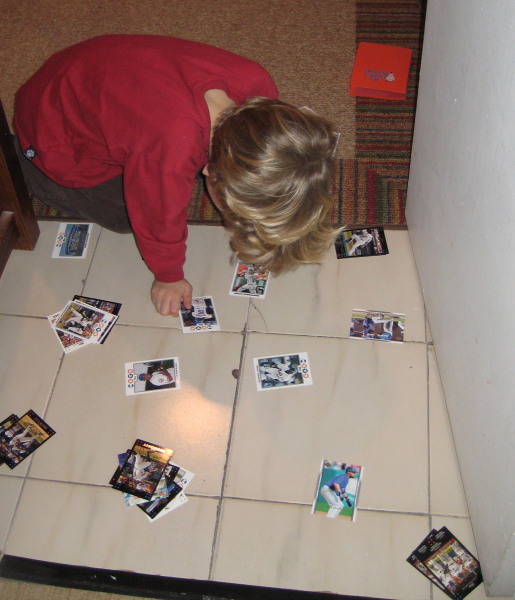
Joshua, as you can see from this picture, has caught at least a mild case of his father’s collecting illness, which isn’t a surprise given he has the same mania for order, categorizing and sorting that I do. Besides, if kids still collect baseball cards, it’s about his time to do so — he’s six, and I was seven in 1976, when one day I decided what I wanted to get at McCrory’s in the Smith Haven Mall was a couple of those three-plex packs of baseball cards. (About which you can read more here.)

I quit collecting baseball cards the first time when I was 12, like a more or less normal person. Which might lead you to ask how, in the year I’ll turn 40, I’m getting a box of 2009 Series 1 in the mail and am happy that Jon Niese has a decent-looking Topps card.

The short answer: It was an accident, and it’s all Rickey Henderson’s fault.

My last year collecting cards as an actual kid was 1981. (It would be convenient to say my hobby was killed by the baseball strike, but actually what shoved it aside was D&D.) The cards I had went into shoeboxes, six seasons’ worth of carefully collated singles and a lot of doubles and triples and quadruples and worse. (I think I got about 17 1976 Mike Anderson Traded cards, and even now seeing one still slightly annoys me.) My cards lurked in their boxes for the first half of the Reagan years, then went with us when we moved from Long Island to St. Petersburg, Fla., where they landed in the closet of a room I’d never live in. (I went off to boarding school about a week after we moved to Florida — as a side effect, I didn’t know my way around the town in which my parents lived until I was about 22.) And there my cards stayed until the summer of 1987, shortly after I’d outrun bad habits and managed to graduate from high school, with an not-inconsiderable assist from Mookie Wilson.

Our next-door neighbors in Florida had two boys, who were around seven and nine if memory serves. They collected baseball cards, and at some point they’d learned from my mom that I had a stash of by now pretty old cards up in my closet. But my mom wouldn’t let them even look at them until I got home, so my little neighbors basically spent the entire spring fidgeting until I got home from school and could hear their pleas.

When that happened, I discovered something strange had happened to baseball cards during my teen years: They’d turned into some kind of mutant investment. My next-door neighbors arrived with a shoebox of cards, but that wasn’t the most-important thing they had with them. The most-important thing, in their eyes, was their price guide, a glossy magazine that showed off the newest baseball cards like they were the latest flavor of credit-default swaps. And these kids weren’t really collectors, at least not in the way I’d thought of collecting. They weren’t interested in my old, well-loved ’76s, or in the handful of older cards I’d picked up somehow. They didn’t care who Thurman Munson was or what had happened to him. They had no 1987 tale equivalent to that of Mike Anderson, no card you couldn’t stop getting when you spent five bucks on packs in vain hopes of getting just one lousy Joe Shlabotnik.

No, all they cared about was what a card was worth, what it had been worth last month and what it might be worth next month. Over and over I’d find an interesting old card, explain to them why it was interesting, and watch them scan the Tuff Stuff agate, only to grumble that the card was worth maybe 50 cents.

It was a long afternoon — and then we got to Rickey Henderson.

Rickey Henderson was a superstar then, but when I’d stopped collecting he was just getting started. In 1980, the year before I’d quit buying packs, he’d been an anonymous rookie: Topps #482, Oakland A’s. 1980, as it turned out, was the year I’d collected most avidly. I had a couple of shoeboxes of 1980 doubles, all of which had gone straight from the pack to the box. Unlike a lot of my cards, they were in perfect shape. Heck, they were practically little Platonic cardboard rectangles. Rickey Henderson’s 1980 rookie card was worth north of $100 then, which struck me as an unbelievable sum for a not very old card. Could it be that I had a Rickey rookie somewhere in those doubles? The neighbor kids were saucer-eyed at the thought.

Anything’s possible, I said. Let’s look.

It turned out I had five of them.

This was a dream come true for the neighbor kids, but there was a problem. They were children. They didn’t have $100. Nor did they have anything of possible interest to me that was worth $10, let alone $100. They tried various unlikely stratagems until I was thoroughly tired of the discussion and their price guide and their baseball cards and them. I’d briefly perked up at finding I had $500 in a shoebox, but now my quintet of Rickey cards felt more like the digits of the monkey’s paw, a gift that you really wish would stop giving.

So just to get the neighbor kids to go away, I said, “I tell you what. I’m a Met fan. Go over to your house and bring me every Met card you have. Every single one, no exceptions. Bring me all those, and I’ll give you a Rickey Henderson rookie.”

Off they went at unsafe velocity, and about a half-hour later they returned with Met cards. Lots and lots of Met cards. Met cards from 1987 and Met cards from 1986 and even a scattering of Met cards from 1985 and 1984. I gave them their Rickey, looked at my new collection of newish Met cards, and started to wonder what the hell I’d done.

The rest is OCD collector history. I had enough Met cards that it didn’t seem like it would be that much work to fill in the blanks between the new cards I’d been given and the old cards I still had. That would give me full sets of 11 years’ worth of Topps cards. And 11 years’ worth of Topps Met cards would be closing in on half the Topps Met cards ever made.

You can see what happened.

I didn’t know that traded sets had returned, that the rookie cards of Dwight Gooden and Darryl Strawberry would cost a fortune (at the time), or that the rookie cards of Nolan Ryan and Tom Seaver would make those seem cheap. I didn’t know how expensive and hard to find high numbers from the 1960s were. I didn’t know there was about to be an explosion in card sets made by more and more manufacturers, or that I’d feel compelled to collect those too. I’d never imagined anything as insane as The Holy Books, or that I’d feel compelled to somehow get and then create cards for those brief-lived Mets who never got proper ones.

I had no idea about any of this. I just wanted two kids out of my house, and a Rickey Henderson rookie card seemed like a fair price if it accomplished that.

My family left Florida long ago. I suppose the neighbor kids grew up and did whatever they did. (My mom says one of them went to prison, which might be true and might be some sort of wish-fulfillment on her part. Oh, what the heck. Let’s say one of them went to prison.) The market for baseball cards swelled and crashed and gradually returned to some vague sanity. And the funny thing is that I don’t have the faintest idea what happened to the other four Rickey Henderson cards. I can’t recall whether I sold them or gave them away or lost them somewhere. I suppose it’s possible they’re in my parents’ latest attic in Charlottesville, Va.

You know what? They can stay there.

ABC, Easy as OCD

Joshua sorting Met cards. As you might imagine, it’s all my fault. Well, mine and Rickey Henderson’s. Click here for the story.

Here Comes 1969 Again

Back when the strongest substance in any major league clubhouse was brine (so as to toughen Nolan Ryan's finger against blisters), the New York Mets became champions of the baseball world. Presumably because it's the 40th anniversary of the 1969 triumph of triumphs, SNY is bringing back from Mets Classics mothballs World Series Games Two through Five every night this week at 7:30, starting tonight. They make for fairly fascinating viewing simply for television's sake. Throw in the Mets becoming champions of the baseball world, and ya think there's something better on?

Also this week, the Mets will win the 2006 National League East (Tuesday, 2 PM); beat the Giants on two balks and a blast (Wednesday, 1 PM); and ride two Robin Ventura grand slams to a doubleheader sweep over the Brewers (Thursday, 1:30 PM). Not that Mets Classics trend toward the predictable or anything.

It's Funny 'Cause It's Happening To Him

Serious business, this latest black eye to baseball's image, this latest bad example to the kids in America, this latest affront to the record books. We should all be simultaneously saddened and up in arms over it.

Maybe later. After we're done laughing that it's Alex Rodriguez.

It's not funny. There are legal issues that aren't funny. There are competitive issues that aren't funny. There are ethical issues that aren't funny.

Sorry, I can't keep a straight face. Of course it's funny. It's Alex Rodriguez, the highest paid player in the game, the most insecure player in the game, the least sympathetic player in the game. It's not just funny. it's hilarious.

It won't be funny the next time it comes up and bites a Met. It won't be funny the next time it comes up at all. But it is funny that it's A-Rod. It's funny that camera crews hit the street and ask Yankees fans to gauge how distraught they are that their hero has feet of anabolic clay.

It's funny because is Alex Rodriguez anyone's hero? He's a great baseball player who has put up great baseball numbers and, as best as can be gleaned from the public record, hasn't shot anybody, but what is heroic about this guy? Even in the realm of sports, putting aside the lessons we learned eight years ago about applying the label of heroic to athletes, what has this guy got going on, exactly, beyond major talent?

Alex Rodriguez isn't heroic. He's not even perversely admirably anti-heroic like Barry Bonds or, if you've made a heavy-duty pact with Satan, Roger Clemens. You booed Bonds and Clemens because they were booworthy. Is Alex Rodriguez really worth the boos he receives once you get past booing his uniform? There is nothing interesting at all about Alex Rodriguez except how much he wants to be thought of as intriguing, alluring or exotic. We're not even talking about boring as a choice like his teammate who plays short. Boring is that guy's thing, and he does it very well. He doesn't play short as well as Rodriguez, but Rodriguez decided five years ago it was in his best interest to not ask to play short, even if he was, as with everything else on a diamond, better at it than everybody around. He even interfered at first base with more flair than the average baserunner.

He's a “Lightning Rod” only because he's exceedingly rich and considered a nice looking fella. His swing is electric. His demeanor is not. To borrow from the outstanding writer Michael Lewis on the subject of Lamar Alexander running for president in 1996, his “words turn to steam as soon as they leave his lips”. Which is fine, but boy does Alex Rodriguez strive to be fascinating. Strive and fail. I've lost track of all the mini-scandals in the A-Rod era. None of them showed up in the boxscore the way his .071 batting average in the '06 ALDS did (now that was funny). The only true scandal around A-Rod is how much this guy gets paid to play baseball.

And that he apparently cheated at it despite playing it better than anyone else.

A little more than a year after declaring to Ms. Katie Couric that he never used steroids, it is reported pretty confidently that he used steroids. If it's not as funny as Rod Blagojevich trying to sell a United States Senate seat and then denying it with ever increasing ferocity, then it's close enough.

Hope we have better luck with our own Rod.

Right There, Right Then

Welcome to Flashback Friday: I Saw The Decade End, a milestone-anniversary salute to the New York Mets of 1969, 1979, 1989 and 1999. Each week, we immerse ourselves in or at least touch upon something that transpired within the Metsian realm 40, 30, 20 or 10 years ago. Amazin’ or not, here it comes.

Can you believe this decade is more than 90 percent over? I can’t.

Weren’t we just fussing over the coming of a new century/millennium? We were.

So what the fudge? I don’t know.

Baseball’s a funny game, Joe Garagiola once told us, and it’s funny to me — funny peculiar, not funny ha-ha — how baseball does and doesn’t fit well within the friendly confines of the traditional Gregorian calendar. Of the four major sports, counting hockey for some reason, baseball is the only one whose season falls completely within the parameters of what is known to the outside world as a year. But that’s the (more or less) April to October piece. The new year really begins when…it is unclear.

It could be Opening Day. It could be the first day of exhibition games. It could be when the pitchers and catchers make the like the swallows who return faithfully to San Juan Capistrano and wing their way to Port St. Lucie. It could be a tick after the phenomenon known as the Baseball Equinox, when you stand exactly between the end of the last game your team played and the planned first pitch of the next game your team plays. It might be that “next year” becomes “this year” the moment your Ryan Church, your Luis Castillo or your Carlos Beltran makes the final out of what suddenly becomes last year.

Whenever it is, it’s got almost nothing to do with a ball dropping (unless it falls in among Church, Castillo and Beltran). In that sense, the idea that the turning of a decade has much to do with anything on the baseball calendar or clock is probably a tough sell.

But I’d like to sell it anyway for the next bunch of months.

This year’s Flashback Friday theme is “I Saw The Decade End,” which some of you will recognize as a lyric from the 1991 Jesus Jones hit, “Right Here, Right Now“. The premise is this is the final year of the decade we’re in right here, right now…but, somehow, not for long. As I come to grips with time flying like those aforementioned swallows, I hope to use FBF this season to put into historical and personal perspective the seasons that are celebrating milestone anniversaries this season, though in at least one case “celebrating” is a mighty stretch.

2009 is the 40th anniversary of 1969. Not much explanation needed there for now.

2009 is the 30th anniversary of 1979. The antithesis of 1969, but if Flashback Friday isn’t going to pay it homage, who will?

2009 is the 20th anniversary of 1989. A more significant season than might be gleaned on first glance — or at least I’ll try to make it look that way.

2009 is the 10th anniversary of 1999. You might say I’ve been waiting ten years for this one.

One world championship, one Wild Card and one playoffless second-place finish notwithstanding, these are, statistically speaking, merely four of what will soon be 48 seasons of Mets baseball. It is the randomness of chronology that ties them together…that and my fascination with seeing a decade end. Baseball decades in particular don’t really mean anything, not in the begins with 0 and ends with 9 interpretation. That’s why I chuckle when “he had the most wins of any pitcher in the ’80s” or “he hit more home runs than anybody in the ’50s” comes up as an infallible endorsement of somebody’s career, as if Jack Morris or Duke Snider set out to top those lists. There’s nothing inherently more worthy about most wins between 1980 and 1989 than there is about most wins in some other ten-year string. But I suppose it is sexier.

Nerd-sexier, but sexier nonetheless.

It’s not so much that I can’t believe the ’00s are on their last legs. I can’t believe any of the decades I’ve lived through ended so fast. My older sister taught me the word “decade” on my seventh birthday, December 31, 1969. What’s that? It’s not just a new year, but a new “decade”? WOW! Couldn’t get enough of it. When school resumed after the holiday break, I proudly announced to my first-grade teacher, “This isn’t just a new year, it’s a NEW DECADE!”

She was like, tell me something I don’t already know, kid.

Nevertheless, I would get like that every ten years. I was in eleventh grade in December 1979 when I found a way to shoehorn in to my high school paper an inquiring reporter feature asking other kids their most tangible memory of the ’70s (and placed atop the responses that of the guy who said, “The Mets winning the 1973 pennant”). I was in the first year of my beverage magazine job when I demanded we make our December 1989 cover story “The Best of the ’80s,” which became my first cover story and foretold, perhaps, my Flashback Friday future. In December 1999, the millennium bit sort of pre-empted a good old decade-in-review, but I infused our bev-at-the-century’s end features with plenty from the previous ten years.

Now it’s here again, another final year of a decade. Everything for so long pointed to 2000, and now 2000 is nine going on ten years ago. Next year begins the 2010s. I clearly remember an assignment in a college journalism class, my final semester — spring of ’85 — in which we had to write about something was forecast to take place 25 years hence. We all used that verbiage: “In 25 years…” and our professor told us, no, call it 2010, there’s a movie out with that name, it’s sexy!

Nerd-sexy, but sexy nonetheless.

2010 is less than eleven months from arriving. The 2009 season begins two months from today. We are about to see the fifth decade in which there has been Mets baseball end. Right here, in a week, we’ll begin to look at how the others drew to their conclusions.

And, I suppose, at how this one might.

You Guys Are Wonders

Checking the Amazon sales charts will eventually be the death of me, so I’ll cut back, but I couldn’t help but notice that at 8 o’clock this morning Faith and Fear in Flushing: An Intense Personal History of the New York Mets had risen to No. 7 on the Baseball Essays & Writings list, which made me very happy because I could hear Tom Hanks as Mr. White, the manager of the Wonders from one of my all-time favorite movies, That Thing You Do!, practically whispering in my ear:

As of tomorrow morning, you Wonders… you’ve got the No. 7 record in the country.

Not that I’m striving to be a one-hit wonder, but when you’ve had no hits to date, it’s pretty heady.

(FYI, one of the books ahead of mine is a basketball book, but never mind that right now.)

Thanks to all of you who helped shoot FAFIF up the chart so quickly. I truly appreciate that thing you did.

Please continue to spread the word that pre-ordering is on via AmazonBarnes & Noble and other fine online retailers. (And if you haven’t it ordered for yourself yet, you know what thing to do.)

99.9 Sentences About My Book

1. The fortunes of our New York Mets have waxed and waned over the years and their popularity has commensurately ebbed and flowed.

2. But I never changed where they were concerned.

3. And neither did you.

4. We were Mets fans.

5. We are Mets fans.

6. It is as common a bond between you and me as it is an intensely personal act for each and every one of us.

7. It is for you and me — for us — that I am proud to formally announce the forthcoming release of a book I have written, called Faith and Fear in Flushing: An Intense Personal History of the New York Mets.

8. I've mentioned the planned publication of this book almost under my breath here a couple of times because, as someone who has seen superb Met pitching thwarted by the likes of Joe Wallis, Wade Boggs and Chris Burke, I don't believe in touting something as done until it is done.

9. It is done.

10. Faith and Fear in Flushing has gone to press.

11. As I understand it, it will be physically available before Opening Day — and it can be pre-ordered right now.

12. I thought I would take this opportunity to tell you about it and why, frankly, you should purchase it.

13. First off, it's your story.

14. Well, it's my story, but really, it's our story.

15. Though each of us experiences the Mets individually, there is a certain collective psyche we all share.

16. That's in this book, to be sure.

17. You will recognize yourself in this book.

18. You will read about what it's like being a Mets fan and you will relate.

19. You will say, “This could be my life you're talking about.”

20. Even if it is, technically, my life I'm talking about.

21. The subtitle of the book, “An Intense Personal History of the New York Mets,” attests to the nature of the perspective offered.

22. I don't know a true Mets fan who doesn't take this whole Mets thing extraordinarily personally.

23. There's something about our version of “our team” that seems to cut to the heart of the matter quicker than it does when other fans talk about their team.

24. When we say “we” for Mets, we mean it.

25. As for intensity, there's nothing casual about being a Mets fan.

26. This blog exemplifies that.

27. Your life, I'm guessing in a fairly informed manner, exemplifies that.

28. My life exemplifies that — which is why, in the book, I take the rather audacious step of standing in as “the” Mets fan in our story.

29. You'll recognize yourself, like I said, but you'll recognize me more.

30. You'll recognize some of what I've written from having been a longtime reader of this blog (if that, in fact, is what you've been), but Faith and Fear the book is by no means a best-of collection.

31. It is a carefully constructed narrative that follows the Mets' journey from the very beginning of the franchise right up to the end of last season…and my journey as intertwined with it.

32. It could be your journey; it happens to be mine.

33. I think you'd agree we mark the days of our lives by the seasons of our lives.

34. The Mets seasons, that is.

35. In Faith and Fear, you'll visit the championship seasons, the just-missed seasons, the surprisingly decent seasons, the shockingly awful seasons, the reassuringly mediocre seasons.

36. You'll see how those Mets seasons enhance, overshadow and dovetail with what some would call life.

37. As an intense personal history, the storytelling device is me as much as the Mets, but there will be plenty of Mets in there.

38. In fact, one of the impulses I had to fight was to pour on the Mets history, because I can do that, y'know.

39. My editor, an insightful fellow, gave me some good advice: when you have to make a choice, choose the information the reader doesn't know.

40. Thus, while this book can be enjoyed by any person or baseball fan, I wrote it primarily for those who won't require translation or cribbing.

41. I wrote it for you, the Mets fan.

42. I wrote it for you who knows without a lengthy explanation what I mean when I say, to use my editor's example, Terry Pendleton.

43. If I err on the side of inside baseball, I err on the side of the Mets fan.

44. Not nearly enough writers do.

45. I always will.

46. I've always wanted to.

47. Always, in my case, has its roots in the summer of '75, when I was twelve and hanging around the sports shelves of the Long Beach Public Library and taking out every Mets book I could find.

48. “Say,” I thought, “it would sure be great if I could write one of these way off in the distant future.”

49. Some move in mysterious ways.

50. I move like molasses.

51. There was a conversation with my mother (someone you'll get to know some in this book) in which she dismissed my notion to become what I, with youthful brio, called a “real writer”.

52. “What are you going to do — sit in a little room all day and write poems?” was her reasoned and encouraging response.

53. Or was it sit in a room all day and write little poems?

54. Either way, my mother did not believe in youthful brio and belittled my concept of what it meant to be a real writer.

55. Not to take the well-worn path of middle-aged men everywhere who blame all their problems on their late mothers, but that's the kind of thing that can resonate and rattle around in one's subconscious for what feels like an eternity.

56. It is probably as much that exchange as any episode that led me to pursue practicality and, ultimately, obscurity as a writer who wrote, for a living, things I had not necessarily much interest in.

57. It was definitely technology and the first good friend I made because of it that began to pull me out of that particular morass.

58. I like to reference the Bill Pulsipher story, how Jason and I went to our first game together in 1995 on the day the first of the Mets' three Generation K pitchers made his major league debut.

59. Nice day and nice story (both takes), but really it was the year-plus leading up to Pulse that had the longer-lasting impact.

60. Jason and I met online, via the AOL Grandstand sports forum, trading with each other and dozens of Mets fans thoughts and plans for the 1994 Mets.

61. I was shocked to learn such a venue existed and that there was a way of meeting other Mets fans without actually meeting them.

62. More pertinently, I was delighted to learn there was a place to express myself to an audience on Mets matters.

63. Except in the most limited way, I had never done that before.

64. Jason appreciated what I was doing, just as I appreciated what Jason was doing, which is why we wound up taking our segment of the conversation to e-mail once the strike dried up the at-large Mets chat.

65. As an aside, I assumed everybody would want to stick around and talk Mets baseball through the strike just because it's what true Mets fans should do.

66. They didn't; we did.

67. Anyway, as noted, Jason and I went to the Pulse game and other games from 1995 on, but most of all kept e-mailing each other.

68. Somewhere back there in the late '90s, probably about the time the Bobby Valentine Mets were giving us something to really write home about, Jason began encouraging me to write a memoir about being a Mets fan.

69. Others would, too, but he was the first.

70. And when Jason encourages you in your writing, you know you're doing something right, because this man is an incredible writer.

71. He still is, as you know, but when we first started corresponding…I know I'm telling you about a baseball book, but it reminds me of a basketball player of whom I was quite fond when I was growing up.

72. If you saw Julius Erving play for the Philadelphia 76ers, you'd hear others call him great, yet, if you saw him before he was a Sixer, you'd think, “Yeah, but I saw him in the ABA with the Nets, and he was really incredible then.”

73. And if you saw him a few times as a Virginia Squire, before he was a Net even, you knew you saw him when he was beyond incredible.

74. I read Jason writing about the Mets in his AOL days…it was Dr. J on the Squires all over again.

75. He was beyond incredible.

76. So when Dr. Jace tells you you should write a book, you'd do well to listen.

77. Even if you don't act on it immediately.

78. It's years later, and it makes me incredibly happy that the book I finally wrote has as its first piece of text a foreword by Jason Fry.

79. Right away you're getting your money's worth.

80. I should also point out that it was the publisher's idea to call the book Faith and Fear in Flushing, to which I protested a little because I saw that name as a joint production of Jason's and mine (never mind that he came up with the name on his own).

81. Last summer, when I was offered a book deal by Skyhorse Publishing, I told them I felt obligated to check with Jason about the name.

82. I asked and he never blinked, which I appreciate as much as the foreword itself.

83. I also appreciate the direct participation of two others in this project.

84. First is the other name you'll see on the cover, and that is Gary Cohen.

85. When my editor and I discussed having a “name” (besides mine and Jason's) involved, we both had the same one in mind: Gary Cohen.

86. When I contacted Gary about writing an introduction, he was thoughtful, gracious, as much a mensch in real life as he's been on the air since 1989…but he declined, saying he simply didn't like to write (which is an odd thing for a blogger to hear).

87. We never doggedly pursued anybody else, so I went back to Gary with a proposal: what about an interview?

88. It wasn't exactly my idea; I stole it from Dennis D'Agostino's essential This Date in New York Mets History, which includes a wonderful Q&A with Bob Murphy.

89. Gary agreed to that format and, as a result, Faith and Fear in Flushing includes a wonderful Q&A with Gary Cohen on the end of Shea Stadium.

90. Completing the lineup is the abundantly talented photographer David G. Whitham, an artist whose Mets portfolio it has been our honor to showcase here throughout the winter.

91. David lent the book some of his best baseball work and was kind enough to join me for a day of vital shooting late in Shea Stadium's life.

92. So there it is: what the book is about, how it came to be and who else made it what it is.

93. All that's left is for you to buy it.

94. I don't say that lightly.

95. I'm kind of shy about self-promoting, let alone asking you to pony up actual money, particularly in this economy.

96. But if you can spare the list price of $24.95 — less via some of your popular online booksellers — it is my honest belief that you will not be sorry.

97. It is my honest belief that you will recoup your investment in enjoyment, in emotion, in Mets.

98. Thank you for enduring what amounts to an extended commercial — and thank you, for that matter, for being a reader of this blog, which is what made the publication of this book possible…hell, necessary.

99. So don't wait — pre-order your copy of Faith and Fear in Flushing: An Intense Personal History of the New York Mets…now!

99.9. Please (and, by all means, tell your friends).

Also, mark your calendars for April 2 and Faith and Fear's return to Varsity Letters, a Thursday evening when hopefully it won't be as freezing as it was last time.

Judge This Book By Its Cover

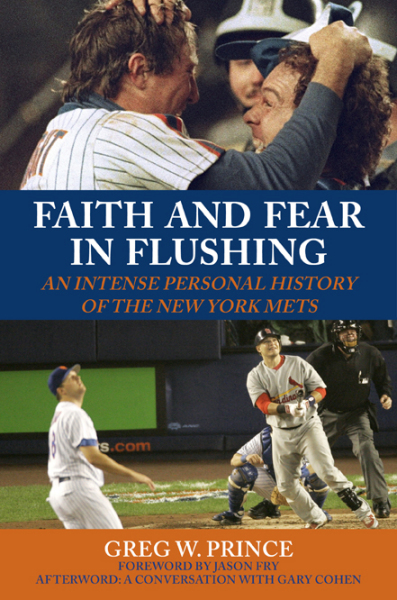
Faith and Fear in Flushing: An Intense Personal History of the New York Mets has gone to press and should be out before Opening Day. When you go to your popular online booksellers to pre-order it (right now, presumably), you might see slightly different text, but this here is what it looks like. My thanks to Skyhorse Publishing for capturing visually Faith and, because it’s an unavoidable part of the story, Fear.

'I'm Tellin' Ya, It Was Sourdough'jpg

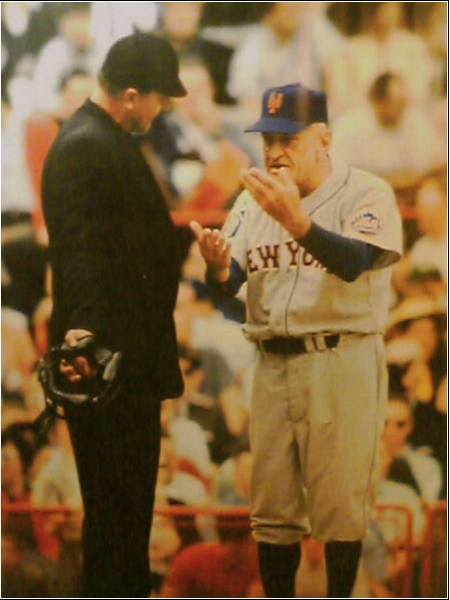
Longtime Faith and Fear reader Jason Gerrish is a big fan of the banner he remembers from the Gate A Field Level entrance inside the late, great Shea Stadium, that of Casey Stengel and a man in blue discussing, perhaps, the size of a really good loaf of bread. Or maybe they’re arguing about baseball. Whatever’s going on above, there’s no argument that Jason would like to track down a print of said picture (this one’s from his cell phone) and so far has come up empty. When the banner was put up for auction, it was listed in the ritzy neighborhood of $2,500, and Mr. Gerrish, like any Mets fan, was aghast at the price. Sure, maybe for a beer in 2009…

Anyway, I haven’t been successful tracking down any info on this picture, which I gauge as having been taken during the 1964 season, judging from the right-sleeve patch and lack of number on Casey’s shirt. If anybody knows anything, please pass it on. Thanks.