The blog for Mets fans
who like to read

ABOUT US

Greg Prince and Jason Fry
Faith and Fear in Flushing made its debut on Feb. 16, 2005, the brainchild of two longtime friends and lifelong Met fans.

Greg Prince discovered the Mets when he was 6, during the magical summer of 1969. He is a Long Island-based writer, editor and communications consultant. Contact him here.

Jason Fry is a Brooklyn writer whose first memories include his mom leaping up and down cheering for Rusty Staub. Check out his other writing here.

Got something to say? Leave a comment, or email us at faithandfear@gmail.com. (Sorry, but we have no interest in ads, sponsored content or guest posts.)

Need our RSS feed? It's here.

Visit our Facebook page, or drop by the personal pages for Greg and Jason.

Or follow us on Twitter: Here's Greg, and here's Jason.

It's Funny 'Cause It's Happening To Him

Serious business, this latest black eye to baseball's image, this latest bad example to the kids in America, this latest affront to the record books. We should all be simultaneously saddened and up in arms over it.

Maybe later. After we're done laughing that it's Alex Rodriguez.

It's not funny. There are legal issues that aren't funny. There are competitive issues that aren't funny. There are ethical issues that aren't funny.

Sorry, I can't keep a straight face. Of course it's funny. It's Alex Rodriguez, the highest paid player in the game, the most insecure player in the game, the least sympathetic player in the game. It's not just funny. it's hilarious.

It won't be funny the next time it comes up and bites a Met. It won't be funny the next time it comes up at all. But it is funny that it's A-Rod. It's funny that camera crews hit the street and ask Yankees fans to gauge how distraught they are that their hero has feet of anabolic clay.

It's funny because is Alex Rodriguez anyone's hero? He's a great baseball player who has put up great baseball numbers and, as best as can be gleaned from the public record, hasn't shot anybody, but what is heroic about this guy? Even in the realm of sports, putting aside the lessons we learned eight years ago about applying the label of heroic to athletes, what has this guy got going on, exactly, beyond major talent?

Alex Rodriguez isn't heroic. He's not even perversely admirably anti-heroic like Barry Bonds or, if you've made a heavy-duty pact with Satan, Roger Clemens. You booed Bonds and Clemens because they were booworthy. Is Alex Rodriguez really worth the boos he receives once you get past booing his uniform? There is nothing interesting at all about Alex Rodriguez except how much he wants to be thought of as intriguing, alluring or exotic. We're not even talking about boring as a choice like his teammate who plays short. Boring is that guy's thing, and he does it very well. He doesn't play short as well as Rodriguez, but Rodriguez decided five years ago it was in his best interest to not ask to play short, even if he was, as with everything else on a diamond, better at it than everybody around. He even interfered at first base with more flair than the average baserunner.

He's a “Lightning Rod” only because he's exceedingly rich and considered a nice looking fella. His swing is electric. His demeanor is not. To borrow from the outstanding writer Michael Lewis on the subject of Lamar Alexander running for president in 1996, his “words turn to steam as soon as they leave his lips”. Which is fine, but boy does Alex Rodriguez strive to be fascinating. Strive and fail. I've lost track of all the mini-scandals in the A-Rod era. None of them showed up in the boxscore the way his .071 batting average in the '06 ALDS did (now that was funny). The only true scandal around A-Rod is how much this guy gets paid to play baseball.

And that he apparently cheated at it despite playing it better than anyone else.

A little more than a year after declaring to Ms. Katie Couric that he never used steroids, it is reported pretty confidently that he used steroids. If it's not as funny as Rod Blagojevich trying to sell a United States Senate seat and then denying it with ever increasing ferocity, then it's close enough.

Hope we have better luck with our own Rod.

Right There, Right Then

Welcome to Flashback Friday: I Saw The Decade End, a milestone-anniversary salute to the New York Mets of 1969, 1979, 1989 and 1999. Each week, we immerse ourselves in or at least touch upon something that transpired within the Metsian realm 40, 30, 20 or 10 years ago. Amazin’ or not, here it comes.

Can you believe this decade is more than 90 percent over? I can’t.

Weren’t we just fussing over the coming of a new century/millennium? We were.

So what the fudge? I don’t know.

Baseball’s a funny game, Joe Garagiola once told us, and it’s funny to me — funny peculiar, not funny ha-ha — how baseball does and doesn’t fit well within the friendly confines of the traditional Gregorian calendar. Of the four major sports, counting hockey for some reason, baseball is the only one whose season falls completely within the parameters of what is known to the outside world as a year. But that’s the (more or less) April to October piece. The new year really begins when…it is unclear.

It could be Opening Day. It could be the first day of exhibition games. It could be when the pitchers and catchers make the like the swallows who return faithfully to San Juan Capistrano and wing their way to Port St. Lucie. It could be a tick after the phenomenon known as the Baseball Equinox, when you stand exactly between the end of the last game your team played and the planned first pitch of the next game your team plays. It might be that “next year” becomes “this year” the moment your Ryan Church, your Luis Castillo or your Carlos Beltran makes the final out of what suddenly becomes last year.

Whenever it is, it’s got almost nothing to do with a ball dropping (unless it falls in among Church, Castillo and Beltran). In that sense, the idea that the turning of a decade has much to do with anything on the baseball calendar or clock is probably a tough sell.

But I’d like to sell it anyway for the next bunch of months.

This year’s Flashback Friday theme is “I Saw The Decade End,” which some of you will recognize as a lyric from the 1991 Jesus Jones hit, “Right Here, Right Now“. The premise is this is the final year of the decade we’re in right here, right now…but, somehow, not for long. As I come to grips with time flying like those aforementioned swallows, I hope to use FBF this season to put into historical and personal perspective the seasons that are celebrating milestone anniversaries this season, though in at least one case “celebrating” is a mighty stretch.

2009 is the 40th anniversary of 1969. Not much explanation needed there for now.

2009 is the 30th anniversary of 1979. The antithesis of 1969, but if Flashback Friday isn’t going to pay it homage, who will?

2009 is the 20th anniversary of 1989. A more significant season than might be gleaned on first glance — or at least I’ll try to make it look that way.

2009 is the 10th anniversary of 1999. You might say I’ve been waiting ten years for this one.

One world championship, one Wild Card and one playoffless second-place finish notwithstanding, these are, statistically speaking, merely four of what will soon be 48 seasons of Mets baseball. It is the randomness of chronology that ties them together…that and my fascination with seeing a decade end. Baseball decades in particular don’t really mean anything, not in the begins with 0 and ends with 9 interpretation. That’s why I chuckle when “he had the most wins of any pitcher in the ’80s” or “he hit more home runs than anybody in the ’50s” comes up as an infallible endorsement of somebody’s career, as if Jack Morris or Duke Snider set out to top those lists. There’s nothing inherently more worthy about most wins between 1980 and 1989 than there is about most wins in some other ten-year string. But I suppose it is sexier.

Nerd-sexier, but sexier nonetheless.

It’s not so much that I can’t believe the ’00s are on their last legs. I can’t believe any of the decades I’ve lived through ended so fast. My older sister taught me the word “decade” on my seventh birthday, December 31, 1969. What’s that? It’s not just a new year, but a new “decade”? WOW! Couldn’t get enough of it. When school resumed after the holiday break, I proudly announced to my first-grade teacher, “This isn’t just a new year, it’s a NEW DECADE!”

She was like, tell me something I don’t already know, kid.

Nevertheless, I would get like that every ten years. I was in eleventh grade in December 1979 when I found a way to shoehorn in to my high school paper an inquiring reporter feature asking other kids their most tangible memory of the ’70s (and placed atop the responses that of the guy who said, “The Mets winning the 1973 pennant”). I was in the first year of my beverage magazine job when I demanded we make our December 1989 cover story “The Best of the ’80s,” which became my first cover story and foretold, perhaps, my Flashback Friday future. In December 1999, the millennium bit sort of pre-empted a good old decade-in-review, but I infused our bev-at-the-century’s end features with plenty from the previous ten years.

Now it’s here again, another final year of a decade. Everything for so long pointed to 2000, and now 2000 is nine going on ten years ago. Next year begins the 2010s. I clearly remember an assignment in a college journalism class, my final semester — spring of ’85 — in which we had to write about something was forecast to take place 25 years hence. We all used that verbiage: “In 25 years…” and our professor told us, no, call it 2010, there’s a movie out with that name, it’s sexy!

Nerd-sexy, but sexy nonetheless.

2010 is less than eleven months from arriving. The 2009 season begins two months from today. We are about to see the fifth decade in which there has been Mets baseball end. Right here, in a week, we’ll begin to look at how the others drew to their conclusions.

And, I suppose, at how this one might.

You Guys Are Wonders

Checking the Amazon sales charts will eventually be the death of me, so I’ll cut back, but I couldn’t help but notice that at 8 o’clock this morning Faith and Fear in Flushing: An Intense Personal History of the New York Mets had risen to No. 7 on the Baseball Essays & Writings list, which made me very happy because I could hear Tom Hanks as Mr. White, the manager of the Wonders from one of my all-time favorite movies, That Thing You Do!, practically whispering in my ear:

As of tomorrow morning, you Wonders… you’ve got the No. 7 record in the country.

Not that I’m striving to be a one-hit wonder, but when you’ve had no hits to date, it’s pretty heady.

(FYI, one of the books ahead of mine is a basketball book, but never mind that right now.)

Thanks to all of you who helped shoot FAFIF up the chart so quickly. I truly appreciate that thing you did.

Please continue to spread the word that pre-ordering is on via AmazonBarnes & Noble and other fine online retailers. (And if you haven’t it ordered for yourself yet, you know what thing to do.)

99.9 Sentences About My Book

1. The fortunes of our New York Mets have waxed and waned over the years and their popularity has commensurately ebbed and flowed.

2. But I never changed where they were concerned.

3. And neither did you.

4. We were Mets fans.

5. We are Mets fans.

6. It is as common a bond between you and me as it is an intensely personal act for each and every one of us.

7. It is for you and me — for us — that I am proud to formally announce the forthcoming release of a book I have written, called Faith and Fear in Flushing: An Intense Personal History of the New York Mets.

8. I've mentioned the planned publication of this book almost under my breath here a couple of times because, as someone who has seen superb Met pitching thwarted by the likes of Joe Wallis, Wade Boggs and Chris Burke, I don't believe in touting something as done until it is done.

9. It is done.

10. Faith and Fear in Flushing has gone to press.

11. As I understand it, it will be physically available before Opening Day — and it can be pre-ordered right now.

12. I thought I would take this opportunity to tell you about it and why, frankly, you should purchase it.

13. First off, it's your story.

14. Well, it's my story, but really, it's our story.

15. Though each of us experiences the Mets individually, there is a certain collective psyche we all share.

16. That's in this book, to be sure.

17. You will recognize yourself in this book.

18. You will read about what it's like being a Mets fan and you will relate.

19. You will say, “This could be my life you're talking about.”

20. Even if it is, technically, my life I'm talking about.

21. The subtitle of the book, “An Intense Personal History of the New York Mets,” attests to the nature of the perspective offered.

22. I don't know a true Mets fan who doesn't take this whole Mets thing extraordinarily personally.

23. There's something about our version of “our team” that seems to cut to the heart of the matter quicker than it does when other fans talk about their team.

24. When we say “we” for Mets, we mean it.

25. As for intensity, there's nothing casual about being a Mets fan.

26. This blog exemplifies that.

27. Your life, I'm guessing in a fairly informed manner, exemplifies that.

28. My life exemplifies that — which is why, in the book, I take the rather audacious step of standing in as “the” Mets fan in our story.

29. You'll recognize yourself, like I said, but you'll recognize me more.

30. You'll recognize some of what I've written from having been a longtime reader of this blog (if that, in fact, is what you've been), but Faith and Fear the book is by no means a best-of collection.

31. It is a carefully constructed narrative that follows the Mets' journey from the very beginning of the franchise right up to the end of last season…and my journey as intertwined with it.

32. It could be your journey; it happens to be mine.

33. I think you'd agree we mark the days of our lives by the seasons of our lives.

34. The Mets seasons, that is.

35. In Faith and Fear, you'll visit the championship seasons, the just-missed seasons, the surprisingly decent seasons, the shockingly awful seasons, the reassuringly mediocre seasons.

36. You'll see how those Mets seasons enhance, overshadow and dovetail with what some would call life.

37. As an intense personal history, the storytelling device is me as much as the Mets, but there will be plenty of Mets in there.

38. In fact, one of the impulses I had to fight was to pour on the Mets history, because I can do that, y'know.

39. My editor, an insightful fellow, gave me some good advice: when you have to make a choice, choose the information the reader doesn't know.

40. Thus, while this book can be enjoyed by any person or baseball fan, I wrote it primarily for those who won't require translation or cribbing.

41. I wrote it for you, the Mets fan.

42. I wrote it for you who knows without a lengthy explanation what I mean when I say, to use my editor's example, Terry Pendleton.

43. If I err on the side of inside baseball, I err on the side of the Mets fan.

44. Not nearly enough writers do.

45. I always will.

46. I've always wanted to.

47. Always, in my case, has its roots in the summer of '75, when I was twelve and hanging around the sports shelves of the Long Beach Public Library and taking out every Mets book I could find.

48. “Say,” I thought, “it would sure be great if I could write one of these way off in the distant future.”

49. Some move in mysterious ways.

50. I move like molasses.

51. There was a conversation with my mother (someone you'll get to know some in this book) in which she dismissed my notion to become what I, with youthful brio, called a “real writer”.

52. “What are you going to do — sit in a little room all day and write poems?” was her reasoned and encouraging response.

53. Or was it sit in a room all day and write little poems?

54. Either way, my mother did not believe in youthful brio and belittled my concept of what it meant to be a real writer.

55. Not to take the well-worn path of middle-aged men everywhere who blame all their problems on their late mothers, but that's the kind of thing that can resonate and rattle around in one's subconscious for what feels like an eternity.

56. It is probably as much that exchange as any episode that led me to pursue practicality and, ultimately, obscurity as a writer who wrote, for a living, things I had not necessarily much interest in.

57. It was definitely technology and the first good friend I made because of it that began to pull me out of that particular morass.

58. I like to reference the Bill Pulsipher story, how Jason and I went to our first game together in 1995 on the day the first of the Mets' three Generation K pitchers made his major league debut.

59. Nice day and nice story (both takes), but really it was the year-plus leading up to Pulse that had the longer-lasting impact.

60. Jason and I met online, via the AOL Grandstand sports forum, trading with each other and dozens of Mets fans thoughts and plans for the 1994 Mets.

61. I was shocked to learn such a venue existed and that there was a way of meeting other Mets fans without actually meeting them.

62. More pertinently, I was delighted to learn there was a place to express myself to an audience on Mets matters.

63. Except in the most limited way, I had never done that before.

64. Jason appreciated what I was doing, just as I appreciated what Jason was doing, which is why we wound up taking our segment of the conversation to e-mail once the strike dried up the at-large Mets chat.

65. As an aside, I assumed everybody would want to stick around and talk Mets baseball through the strike just because it's what true Mets fans should do.

66. They didn't; we did.

67. Anyway, as noted, Jason and I went to the Pulse game and other games from 1995 on, but most of all kept e-mailing each other.

68. Somewhere back there in the late '90s, probably about the time the Bobby Valentine Mets were giving us something to really write home about, Jason began encouraging me to write a memoir about being a Mets fan.

69. Others would, too, but he was the first.

70. And when Jason encourages you in your writing, you know you're doing something right, because this man is an incredible writer.

71. He still is, as you know, but when we first started corresponding…I know I'm telling you about a baseball book, but it reminds me of a basketball player of whom I was quite fond when I was growing up.

72. If you saw Julius Erving play for the Philadelphia 76ers, you'd hear others call him great, yet, if you saw him before he was a Sixer, you'd think, “Yeah, but I saw him in the ABA with the Nets, and he was really incredible then.”

73. And if you saw him a few times as a Virginia Squire, before he was a Net even, you knew you saw him when he was beyond incredible.

74. I read Jason writing about the Mets in his AOL days…it was Dr. J on the Squires all over again.

75. He was beyond incredible.

76. So when Dr. Jace tells you you should write a book, you'd do well to listen.

77. Even if you don't act on it immediately.

78. It's years later, and it makes me incredibly happy that the book I finally wrote has as its first piece of text a foreword by Jason Fry.

79. Right away you're getting your money's worth.

80. I should also point out that it was the publisher's idea to call the book Faith and Fear in Flushing, to which I protested a little because I saw that name as a joint production of Jason's and mine (never mind that he came up with the name on his own).

81. Last summer, when I was offered a book deal by Skyhorse Publishing, I told them I felt obligated to check with Jason about the name.

82. I asked and he never blinked, which I appreciate as much as the foreword itself.

83. I also appreciate the direct participation of two others in this project.

84. First is the other name you'll see on the cover, and that is Gary Cohen.

85. When my editor and I discussed having a “name” (besides mine and Jason's) involved, we both had the same one in mind: Gary Cohen.

86. When I contacted Gary about writing an introduction, he was thoughtful, gracious, as much a mensch in real life as he's been on the air since 1989…but he declined, saying he simply didn't like to write (which is an odd thing for a blogger to hear).

87. We never doggedly pursued anybody else, so I went back to Gary with a proposal: what about an interview?

88. It wasn't exactly my idea; I stole it from Dennis D'Agostino's essential This Date in New York Mets History, which includes a wonderful Q&A with Bob Murphy.

89. Gary agreed to that format and, as a result, Faith and Fear in Flushing includes a wonderful Q&A with Gary Cohen on the end of Shea Stadium.

90. Completing the lineup is the abundantly talented photographer David G. Whitham, an artist whose Mets portfolio it has been our honor to showcase here throughout the winter.

91. David lent the book some of his best baseball work and was kind enough to join me for a day of vital shooting late in Shea Stadium's life.

92. So there it is: what the book is about, how it came to be and who else made it what it is.

93. All that's left is for you to buy it.

94. I don't say that lightly.

95. I'm kind of shy about self-promoting, let alone asking you to pony up actual money, particularly in this economy.

96. But if you can spare the list price of $24.95 — less via some of your popular online booksellers — it is my honest belief that you will not be sorry.

97. It is my honest belief that you will recoup your investment in enjoyment, in emotion, in Mets.

98. Thank you for enduring what amounts to an extended commercial — and thank you, for that matter, for being a reader of this blog, which is what made the publication of this book possible…hell, necessary.

99. So don't wait — pre-order your copy of Faith and Fear in Flushing: An Intense Personal History of the New York Mets…now!

99.9. Please (and, by all means, tell your friends).

Also, mark your calendars for April 2 and Faith and Fear's return to Varsity Letters, a Thursday evening when hopefully it won't be as freezing as it was last time.


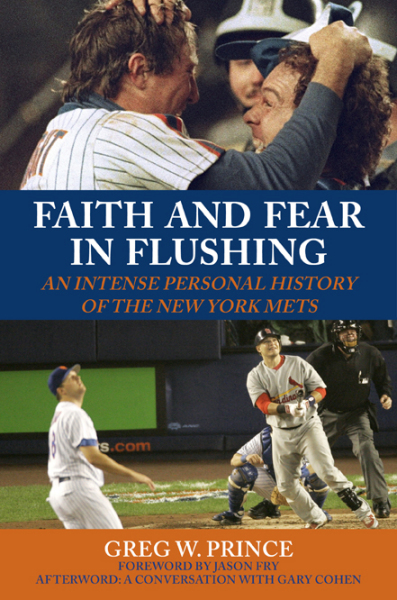
Judge This Book By Its Cover

Faith and Fear in Flushing: An Intense Personal History of the New York Mets has gone to press and should be out before Opening Day. When you go to your popular online booksellers to pre-order it (right now, presumably), you might see slightly different text, but this here is what it looks like. My thanks to Skyhorse Publishing for capturing visually Faith and, because it’s an unavoidable part of the story, Fear.

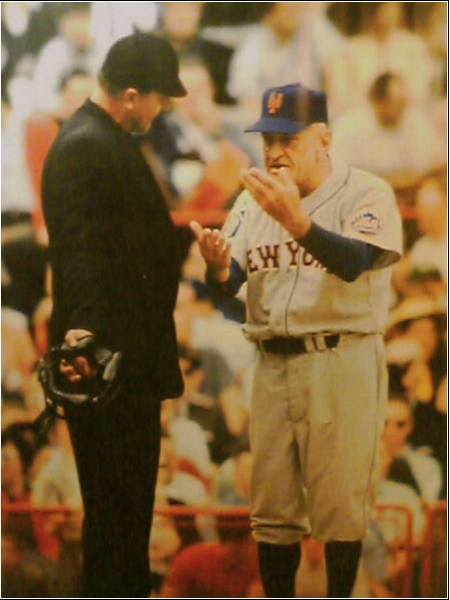
'I'm Tellin' Ya, It Was Sourdough'jpg

Longtime Faith and Fear reader Jason Gerrish is a big fan of the banner he remembers from the Gate A Field Level entrance inside the late, great Shea Stadium, that of Casey Stengel and a man in blue discussing, perhaps, the size of a really good loaf of bread. Or maybe they’re arguing about baseball. Whatever’s going on above, there’s no argument that Jason would like to track down a print of said picture (this one’s from his cell phone) and so far has come up empty. When the banner was put up for auction, it was listed in the ritzy neighborhood of $2,500, and Mr. Gerrish, like any Mets fan, was aghast at the price. Sure, maybe for a beer in 2009…

Anyway, I haven’t been successful tracking down any info on this picture, which I gauge as having been taken during the 1964 season, judging from the right-sleeve patch and lack of number on Casey’s shirt. If anybody knows anything, please pass it on. Thanks.

Vladdy to Manny to Citi

It was but five cold winters ago that the Mets didn't sign Vladimir Guerrero. They had a chance, it would have been a popular move, it seemed like it could get done, but it didn't happen. A fair swath of Metsopotamia was disgruntled yet probably not surprised.

Five cold winters later, the Mets don't seem to be signing Manny Ramirez. They have a chance, it would be a popular move, it seems like it could get done, it's not happening. A fair swath of Metsopotamia is disgruntled, yet probably a bit surprised.

My, how times have changed.

There was a Million Manny March on SNY's studios last week. Well, thirty or so guys, but word is they're gonna try it again. Hail to thee, marchers. You're not going to change the mind of Minaya or a single Wilpon, but it is the Metsopotamian way to express oneself in the face of overwhelming odds. As Stanley Cohen wrote in A Magic Summer, “Let's Go Mets” was chanted hardily at the Polo Grounds with the Mets down thirteen in the ninth during one game in 1963: “It was a simple and joyous act of defiance, the declaration of a will that would not surrender to the inevitable.” You can draw a straight line from the “'Go!' Shouters” Roger Angell immortalized in 1962 to the Manny marchers who are urging management to ante up for Ramirez.

The Mets weren't going anywhere in 1962. And, unless his price tag is severely reduced, they're not going anywhere near Manny Ramirez in 2009.

Funny thing, I think, is that a lot of us keep believing the Mets might sign him anyway. It's funny because of where the Mets were five years and one month ago — in a similar situation. That winter's hot free agent megastar was sitting out there in an ice-cold market and the Mets were the kid in gym class who's among the three left on the dodgeball court because everybody else has gotten himself knocked out through self-defeating aggression or a desire to sit in the bleachers and chill. Five years and one month ago, the Mets waited out all others' disinterest and found themselves with the ball.

A lowball. That's what Jim Duquette lobbed at Vladimir Guerrero. His people caught it, forcing the Mets out of the game. Then Vladdy became an Angel.

It felt like folly to think the Mets could have signed the great Guerrero, because the Mets of January 2004 didn't do stuff like that. It was possible, but highly improbable. Now, as Matchbox Twenty put it before every home game last year, let's see how far we've come.

We've come to the point where the Mets sign high-profile free agents you've heard of (a category that never included Kaz Matsui, inked in that Guerrero-free off season). We've come to the point where the Mets don't leave you with the impression they have considerable budgetary constraints. We've come to the point where we don't wish and hope the Mets would someday sign a player the caliber of Manny Ramirez. We've come to the point where many of us expect and demand the Mets right now sign a player the caliber of Manny Ramirez.

The Mets have acquired — since passing on Guerrero — Pedro Martinez, Carlos Beltran, Carlos Delgado, Billy Wagner, Johan Santana and Francisco Rodriguez. These are not the Shane Spencer/Karim Garcia Mets. It's a sea change in both reality and perception. Five years and one month ago, were you honestly shocked at who your right field platoon turned out to be?

Five years and one month later, aren't you a little shocked that some combination of Muprhy/Evans/Tatis (M/E/T for short) will probably be your leftfielder? When Manny Ramirez and all those RBI remain unclaimed? Isn't this what the Mets of this era do, get their man? Don't they make men like Manny their man?

Manny Ramirez is not an unalloyed page of good news in anybody's joy book. You remember how he lifted the Dodgers on his shoulders? Do you remember why he was suddenly so available, how he was suddenly making no effort no disguise his lack of seal for the proverbial dodgeball game in Boston? Do you remember seeing him play much left in any of his many seasons technically playing left? Do you care that nobody has ever accused T-E-A-M of being spelled with M-A-N-N-Y, regardless of the letters they have in common?

I'm not saying you should care or remember what is potentially unappealing — or extravagant — about signing Manny. Manny Ramirez is an extraordinary offensive player. The Mets could use some extraordinary offense. There are reasons to willfully cast aside the doubts and pick up a player like this who sits today without a team, just as there are reasons to willfully cast aside visions of run production and avoid him so as not to bring on Excedrin Headache No. 99.

What strikes me, whether they get him or not, is that it doesn't seem insane to think the Mets would sign Manny Ramirez, not as insane, sadly, as it seemed to think they might have signed Vladimir Guerrero.

***

But when you bring the latest chapter of the Citigroup saga into it, maybe it is.

I was in an early Tuesday morning fog when I noticed a blurb scrolling across the bottom of the Channel 4 news informing me that the Wall Street Journal was reporting America's favorite corporation was giving some thought to not plastering its name on the front and sides of the Mets' new ballpark. It was in such a fog from the same scroll that I learned Willie Randolph had been fired, so I rubbed my eyes and began paying attention.

It's just talk right now. Citigroup and the Mets have already knocked it down as untrue, which I take to mean as it is untrue…for now. Citigroup is a far less popular, far less sympathetic entity than it was two months ago when it was first getting bailed out. The private jet caper (if you want a good non-baseball laugh, by the way, read this spirited Mom & Apple Pie defense of private jets) didn't help, nor has the deepening economic mess made Taxpayers to Citi to Mets look nothing remotely like Tinkers to Evers to Chance. I still don't care for the simplistic political demagoguing — is there such a thing as complex political demagoguing? — but I like less, for our purposes, the damage this deal is doing to the Mets brand.

The Mets, I feel in my heart, would name their ballpark any wretched old thing short of Yankee Stadium if there were $20 million a year in it for them. As we've said time and again, who wouldn't? It's how business has been conducted in sports and America for years. What's more, there is a signed contract that declares the Mets shall play in a facility called Citi Field. Citigroup and the Mets are still using a very relevant term, “legally binding,” to describe their agreement. And sports franchises in big cities with large payrolls could sure use $20 million a year. Some of us march on SNY to emphasize it.

But this isn't good. This is no way good, and I don't mean philosophically anymore. There's lot of not good going around these days, but in the realm of Met, this pairing of our beloved team with this far less than beloved financial organization is just plain bad news now. Is it $20 million a year bad? I don't know how to measure that, but we're plainly seeing that all publicity is not necessarily good publicity. If the Mets get out to a 12-2 start and lead the East by 15 games at the break, maybe nobody will care. Maybe somebody will care, but we won't. We'll be too busy thrilling to what's going on inside Citi Field (whether each of us is there or not) to worry over brand-identity niceties.

Yeesh, though, and not philosophically. This isn't the 2006 discussion of whether it's right and proper to slap a company name on a ballpark. This is 2009 and there's a fierce recession in progress and there are companies that are taking our money after years of horrendous management and one of them is the company in bed with our team. It just doesn't work in the public eye — and the public eye is where it has to work, because the whole reason Citigroup should want to sponsor a baseball stadium for $20 million a year for 20 years is to market its brand to a public with less than firm confidence in its ability to run its affairs.

Big ol' Citi Field signs are not going to help in that regard in 2009. Whether it will be beneficial in 2028 is not relevant. The Citigroup image as it stands on the precipice of the next baseball season is a canker sore for both Citigroup and for the Mets right now and for however much of the future is foreseeable. Waving a ginormous Citi banner atop and around a decidedly upscale facility (which has been built on municipal land with New York City infrastructure investments and tax-free bonds, as the Journal points out) isn't going to make anybody look community-minded or particularly brilliant in the prevailing climate.

No way the Mets are blind to this. No way Citi is blind to this. No way we're going to a place called Citi Field for very long. Somebody might as well pay somebody off and figure a way out of this before the sore festers out of control. The Mets should and will get paid something substantial for their troubles. They are subject to that legally binding agreement, but they shouldn't have to cast a pox on their own house to cash in. From what I've seen, they've acted in good faith. They've done everything except insert the Citigroup Center tower into the skyline logo. At a time when the Citi mark looms as an overwhelming negative in the public's mind — even discounting chronically histrionic sorts and their hackish colleagues, is anybody applauding Citigroup these days? — it is ridiculous to ask somebody to nakedly embrace it. To do so, within the context of facility naming rights, is something approaching insanity.

The Mets don't have to bail on Citigroup altogether. They can still bank with them. They're welcome to advertise on the outfield wall. They can maintain a relationship. But the HEY LOOK! nature of Citi Field isn't going to do either partner any favor at a delicate juncture. There is legally binding and then there is the kind of face-spiting that costs you your nose. Surely there is a third way.

If the Mets don't get their 20 mil for 20 years, what will it mean to us? Oh, probably nothing good of a material nature. Books probably get cooked to the point of deep-frying in baseball, and there's no way a team that charges $15 for a simple parking space is going to be impoverished (especially with so many brand spanking new parking spaces coming to a former stadium near you), but the days of “just sign him” when a Manny Ramirez wanders by may have to be put on hold. Combine a potential alteration of the Citigroup deal with whatever the Wilpons have endured via the venal hand of Madoff (one assumes there can't help but be baseball fallout) and the Mets may have to think more than twice about how they build their team. What that means on the field is anyone's guess. The Tampa Bay Rays won a pennant last year with one of the lowest payrolls in the industry. Before that, they were one of the worst teams around. Money is both not everything and pretty good to have a lot of anyway.

The philosophical piece is, as noted, not top of mind, but you know what? Not one square of sod grows up dreaming of being planted in a ballpark named for a multinational conglomerate. You can fill in all the potentially pleasing replacements yourself; I'd vote for Shea Field, considering Bill Shea hasn't done an iota less to bring National League baseball to New York since September 28, 2008. If only that would be the silver lining. We're probably past that phase of innocence, however. Brace yourself for Petco East or worse.

Have a Seat — or Rather, Sit Your Ass Down

Quick take on re-inking Oliver Perez: He's the devil we know.

He's also shy of his 28th birthday and left-handed. It's far from unprecedented for guys matching that description to harness their gifts and their natural southpawness in their late twenties and become pitchers for whom you thank your lucky stars while fans of previous employers gnash their teeth. Granted, there are also plenty of flaky lefties who harness nothing and become old flaky lefties. But I'm happy to accept Oliver's not-so-bad floor and dream about his ceiling. Ben Sheets was fun to dream about too, but Sheets-related dreams tend to turn into DL-related nightmares, Randy Wolf was Randy Wolf, and Jake Peavy … well, I covered that already.

The real issue is, again, the year is shaping up to feature lots of sixth-inning appearances by Met relievers. Maine has battled physical problems and bouts of Leiteritis (defined by medical professionals as suddenly forgetting how to pitch for an inning), Pelfrey is coming off an unprecedented workload, Oliver has far too many games where he spontaneously combusts into a vaporous cloud of walks and hit batsmen, and the fifth starter is the fifth starter. Even JHN (that's the way his name is spelled by the devout) will be coming off knee surgery. The '09 bullpen looks much better, but it's going to be asked to do quite a lot.

But hey, at least we have a starting four plus one TBD to grapple with. And now Omar can get back to trying to exile Luis Castillo and/or ponder one of the mashers still available to play a corner outfield spot. Because he's still going to do that, right?

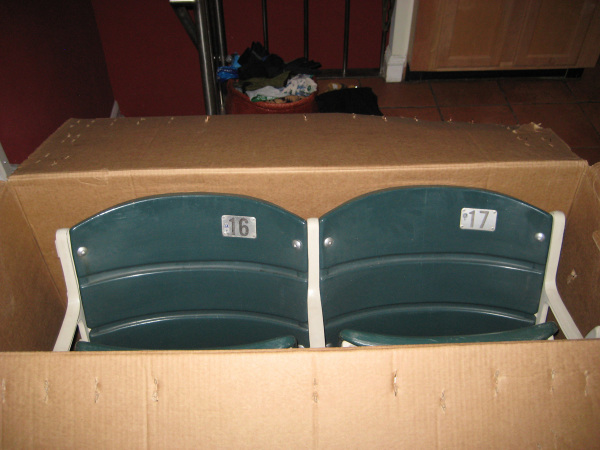
And now back to the seats. Yes, the seats ordered while I was unemployed and possibly mildly insane have arrived — actually, they showed up during President Obama's inauguration speech, along with Fresh Direct. (Why must everything of import happen at the exact same time?)

As you can see, they're mezzanine seats — that was where I usually sat at Shea, not to mention it's the only color of Shea seat generally found in nature. And I was pleased by the pairing of 16 and 17, which is pretty iconic as far as consecutive numbers go in Met lore. (OK, there's 17 and 18, but 18 tries to cheap-shot 17 when it's time to take their picture.)

Less pleasant was that the seats arrived dirty — not dirty as in warehouse dust settling in a box, but dirty as in “I ain't sitting on that until it's scrubbed.” Which was the first WTF moment to creep into the experience. I decided it was the accumulation of detritus from all the rags wielded by surly, extortionist ushers over the years, which actually made me laugh for a moment. Until unboxing the seats revealed the second WTF moment — a loose bolt, as well as long bolts sticking out from the backs of the seats instead of being sawn down, leaving passing elbows and hips at risk. The third WTF moment was that the bolts attaching the seats to their L brackets (needed so the seats can sit on the floor instead of being affixed to the concrete of the row behind them) were put on with the bolt heads to the rear of the seats. (To be fair, the L brackets are very good quality.) The fourth WTF moment? The letter included with the seats didn't say what section or row they were from. I wanted to know — just like I assume anyone who cared enough to buy two seats from a former stadium would have wanted to know.

By my count, for nearly $1,000 that's four WTF moments too many.

Anyway, they're clean now. They'll be installed in the backyard when it gets warmer and I can con my father into coming up so the job gets done competently. When we bolt them to the deck we'll saw down the bolts and reattach the L brackets. It'll be awesome. It'll be exactly what I'd hoped for. And the 16 and 17 will always make me happy.

But still.

You can go round and round over the reasons why the seats arrived dirty, not assembled the way you would have expected and missing items that would have made them a lot nicer, just as Greg and I used to go round and round over why a day at Shea was frequently so much less than it should have been. Was the problem the accumulated decrepitude of the park, the incompetence of the outside agency that was supposed to keep the place up, or disdain on the part of the Mets for their paying customers? You got me. All I know is I paid a lot of money for something that should have been very special, and instead that something wound up only mostly special because someone, somewhere did a half-assed job. But you know what? It fits. My final relic from Shea Stadium turns out to sum up the Shea experience perfectly.

Ollie Pitches and the Audience Applauds

Ollie Perez reportedly back in the fold, three years pending physical.

Santana, Maine, Perez, Pelfrey, Some Other Guy.

If it's not an upgrade, at least it's familiar.

16 and 17

Here they are, awaiting the coming of springtime and their new home in a Brooklyn backyard. Pretty sweet, huh? Well … eventually. More about that here.