The blog for Mets fans
who like to read
ABOUT US

Faith and Fear in Flushing made its debut on Feb. 16, 2005, the brainchild of two longtime friends and lifelong Met fans.
Greg Prince discovered the Mets when he was 6, during the magical summer of 1969. He is a Long Island-based writer, editor and communications consultant. Contact him here.
Jason Fry is a Brooklyn writer whose first memories include his mom leaping up and down cheering for Rusty Staub. Check out his other writing here.
Got something to say? Leave a comment, or email us at faithandfear@gmail.com. (Sorry, but we have no interest in ads, sponsored content or guest posts.)
Need our RSS feed? It's here.
Visit our Facebook page, or drop by the personal pages for Greg and Jason.
Or follow us on Twitter: Here's Greg, and here's Jason.
|
by Greg Prince on 17 August 2008 4:15 am Y'know when I was reminded how much I love Pedro Martinez? Not Saturday night when he calmly put away the Pittsburgh Pirates for seven innings. It was last Monday afternoon when his surefire win was pissed away by his bullpen, none of whose members will be joining Pedro in Cooperstown for more than a few minutes spent staring at his plaque.
I hated our bullpen. You hated our bullpen. But Pedro, he whose line sagged most at the hands of the Flushing Arson Squad, was magnanimous in team defeat.
“With me,” he was quoted after that calamity, “it's OK. Everybody out there was trying, was trying to reel in and win.” Pedro even gave the Pirates credit that day: “They never quit; you have to give them credit.”
It pained me to admit it but yes, the five relief pitchers who allowed the Pirates six runs in three game-killing innings weren't working for Bucs Inc. They were trying. I have a tough time remembering no Met sucks on purpose or with intent even though it often seems that way.
Johan Santana has practically broken his face trying not to act grumpy when one of his wins is ND'd or worse. It's obvious Santana is suffering bullpen foolishness ungladly. He can't speak in more than code about doing all he can because it would be poor sportsmanship and poor team protocol to do so. Santana could take a page from Pedro in that respect and just roll with the punches. Johan's got his contract. His W column is immaterial. If he does everything he can to win, the team's wins will take care of themselves and I sense he'd be saner in the long run.
Pedro's fine right now. More than fine. Pedro is a legitimate starting pitcher again. That's no small feat when you add up the physical duress his body and the emotional anguish his mind have endured in 2008. I saw a wire service photo of Pedro placing a baseball in his father's burial plot last month. It's tough enough to go through the death of a loved one. Then it's photographed and disseminated and everything he does is watched. Then he has to go get himself together and pitch and pitch well and pitch like he's completely healthy. He's paid and paid well to do it, but he's a person. So are each of his relievers.
Martinez and his support crew took care of the Pirates for nine full innings Saturday night. Pedro got seven of them done with minimal fuss. It's tempting to say, oh, it's the Pirates, but we know from the fallacy of oh, it's the Pirates. Eddie Kunz and Joe Smith aside, Pedro's relievers took care of him at the end, just as his hitters took care of him early (for fun, let's count Pedro — a hit and a run — as one of his very own offensive weapons).
It's not a bad rotation, occasional mogul on the slope aside. Maybe it will be an OK bullpen, Wagner or not. And this team surprises you often with its resiliency. Could there have been a more discouraging loss than the 7-5 choke job on Monday? Could there have been a better response than the five straight wins that have occurred since? Remember the ten-game winning streak that changed the tenor of this season came off a dreadful defeat in Philadelphia. We were 5½ back and in third after that. We're in first now, two games over the Phillies, 3½ ahead of the Marlins. We have Pedro, Johan, Pelf, Maine and Ollie in any order you like. We have every reason to be magnanimous on those nights when the wins don't come so simply.
FYI, I'll be joining Mike Silva of NY Baseball Digest to talk Mets (what else?) Sunday night at 7:00. Give us a listen and call in if you feel like it.
by Greg Prince on 16 August 2008 7:24 am No, no, no — that's not the Mets @ Pirates game I know. The Mets @ Pirates game I know ends with the Jolly Roger flying high and the Pirate Parrot squawking proud. It ends with missed Metropolitan opportunities galore and relievers whose heads are tucked somewhere south of the NEW YORK on their funereal black jerseys.
How did we not get that Friday night? How did the Mets hold on? How did the Mets win?
How did the Mets not lose?
That was one exceedingly losable Mets @ Pirates game. It had all the elements. It had the out-of-the-box scoring in the top of the first; it had the nagging sense we should have pushed more than two across the plate; it had the eerie calm of a no-name, no-stuff starter quietly mowing us down inning after inning; it had an atrocious call go against us on a stolen base attempt; it had a lead that began to look too lonely for too long; it had a pitcher pulled just in time in favor of a bullpen in whom trust is never to be placed.
It really did. It really proceeded as a Mets @ Pirates game in every sense of the word. The Mets' two bang-bang-bang runs at the start represented a suspiciously light total. Jason Davis didn't seem particularly overpowering — or powering — but gosh if he didn't shut the door from the first through the seventh after he allowed those two runs. Nary a rally flickered and Reyes really was robbed on an out call at second by an umpire who, it must be respectfully opined, is sightless, crooked or both. Pelfrey was at his non-Marlin best, good for seven scoreless. No way he should have been taken out, but Manuel said he wanted to keep his innings down because as a third-year pro in his first full big-league season Pelf's “in uncharted waters”.
How many of y'all assumed some Pirate would deposit some eighth-inning pitch in the uncharted waters of the Allegheny once it was delivered by a Met pitcher not named Mike Pelfrey? You can put your hands down now. Granted, Jack Wilson didn't quite splash down, but the punchless shortstop punched Duaner Sanchez's fourth pitch into the left field stands and our lead was cut in half and it was Mets @ Pirates per usual.
But then it wasn't. First, there was recovery as Sanchez retired the ageless (or perhaps just old) Chris Gomez. Then it was Feliciano time and Other Pedro got Nate McLouth, didn't get Freddy Sanchez but eventually got whichever LaRoche he says he is to make the third out.
The other distinguishing characteristic of this Mets @ Pirates affair was stupendous Mets defense. We saw it impressively in the sixth when Pelf handled a tricky Ryan Doumit tapper and ignited a 1-6-3 double play. We saw it startlingly in the seventh when Carlos Beltran gunned down, nailed and threw out one of the LaRoches at the plate (it was such textbook execution on Carlos' and Schneider's part that it deserves all the clichés it can carry).
But the bottom of the ninth…now that's the Mets @ Pirates inning that made Pittsburgh National Corp. famous. We've seen bottoms of ninths in PNC Park open up and swallow the Mets whole. We've seen them take the shape of sea monsters that rise up from each of the Three Rivers and shred the Mets alive. We've seen some bad stuff there.
How many of ya'll assumed we'd see more of that in Friday night's ninth? Shoot, I did. Hangdog Heilman takes the mound and I'm groaning and cringing, not just for the usual Aaron's pitching reasons. I'm groaning and cringing because it's Pittsburgh and the game's on the line and it doesn't have to be Heilman trying to protect a one-run lead but, of course, it is. You know something's coming, you just have no idea if it will show up in an ambulance or a hearse.
First there's a LaRoche. You know what they say about LaRoches: they're the only ones who will survive a nuclear holocaust. Sure enough, LaRoche grounds one to first that grazes Delgado's glove. Well, you think, that was gettable but it wasn't gotten and now Hangdog Heilman's burying this game in the backyard and…HEY! ARGENIS REYES SCOOPED IT UP IN THE HOLE…but LaRoche will be safe because Delgado's all out of position and…HEY! HEILMAN'S HUSTLING OVER THERE…but there's no way he's going to beat the runner and…HEY! HEILMAN BEAT LAROCHE TO THE BAG! HE'S OUT!
He was! He was! Like I said, stupendous Mets defense. It can really change the game you think you know.
After the highness of Argenis, the angst of Aaron subsided some if not altogether. Heilman struck out Brandon Moss but walked Jason Michaels because what would a bottom of the ninth with a one-run lead be without a Pirate baserunner? It wouldn't be PNC with the Mets in town. But my goodness, Jack Wilson, he of his first home run of 2008 in the eighth, didn't win the game for the Buccos. He didn't tie it and he didn't extend it. He popped to Jose and ended it. Ended it as a Mets win. Ended it so although ancient Jamie Moyer outpitched equally antique Greg Maddux on the other side of the continent, the Mets could wake up Saturday to a first-place lead and an icy cold Iron City.
That's not the Mets @ Pirates game I know, but I was sure glad to make its acquaintance.
by Greg Prince on 15 August 2008 4:00 pm Welcome to Flashback Friday: Tales From The Log, a final-season tribute to Shea Stadium as viewed primarily through the prism of what I have seen there for myself, namely 383 regular-season and 13 postseason games to date. The Log records the numbers. The Tales tell the stories.
9/6/98 Su Atlanta 5-8 Reed 9 70-70 L 4-0
It started with a picture, a picture of me on the floor of Madison Square Garden. I was friendly with the PR contact of a sponsor of the Liberty. She said she could get Stephanie and me tickets to see them on an upcoming Sunday. Not only that, but if we showed up early enough, we could be part of a youth clinic they were holding. We weren’t youthful and we weren’t looking to improve our jump shots, but it was a chance, she said, to set foot on the Garden floor.
We went, we stood, we took pictures. We tried not to get in the way of the kids who were learning basketball and whichever injured Liberty player got stuck conducting the clinic. All we wanted was to stand on the floor of MSG, the same floor where our girls of summer played, the same locale where the Knicks of my childhood won championships. I wasn’t really into basketball by the time I was 35, but it was the Garden.
I had the pictures. I brought them to work. I passed them around. I announced it was the first time I’d ever experienced anything quite like that. Never been on a professional court or field. I showed them to a friend, Jim in sales. He was a big Knicks fan and a resurgent Mets fan. He was impressed enough, but he got to thinking about me. Me on the floor of the Garden…that’s fine, but that, he later told me, was not where I needed to be.
He saw fit to fix that.
It’s weeks later. Jim knows someone who works in the Mets’ ticket department, Michelle. Hey, he says, Michelle can get us free tickets for Sunday, against the Braves — wanna go? Like I wouldn’t.
Jim told me to expect something special, but wouldn’t let on. I had no idea what he was planning. He let on when we met. He wanted very much, he said, to get me on the field for the postgame DynaMets Dash. He thought it absurd that I had been on the floor of the Garden but never on the field at Shea. How was it possible that had happened?
Gosh, I said, I don’t know. It just is.
Alas, Jim said, Michelle probably won’t be able to pull it off. Too much going on on her end. But we do have the tickets, so let’s go inside. We stopped by Michelle’s desk in the ticket office and I thanked both of them for even trying and, for that matter, the tickets to this relatively big game. Michelle said she’d come by with an update if anything changed.
Field Level seats, perfectly all right. Braves beating the Mets, perfectly dreadful. The Mets needed the game in their Wild Card chase with the Cubs. They weren’t getting it. There was nothing of value to recall from the actual contest.
‘Til the top of the ninth. That’s when Michelle reappeared in our midst and said we should come with her.
We were going Dashing after all.
Michelle led Jim and me through concourses and corridors and secret pathways — saw Fox Sports Net New York’s Matt Loughlin, Newsday‘s Marty Noble and Braves callup Marty Malloy en route — that you couldn’t get through if you were an ordinary person. But Michelle was extraordinary. She flashed her credentials and brought Jim and me to the area behind home plate.
I don’t mean the seats. I mean the area behind home plate where the grounds crew gathered. It’s not plainly visible any longer. In 1999 high-roller seats were installed there. But for years you saw the little windows from which Pete Flynn and his men stared out at the field, where the umpires were supplied with fresh baseballs. It never occurred to me that I’d be behind those windows, on the inside looking out.
Michelle, Jim and I watched the bottom of the ninth with Pete Flynn, head groundskeeper of Shea Stadium, a celebrity in his own right. Pete Flynn had been with the Mets since 1962. He was the wet blanket who grumbled in a brogue about the fans who tore up his precious grass in the aftermath of the ’86 division clincher, about how they didn’t deserve a winner. Security saw to it that there would never be another stampede like that no matter what the Mets might win.
But there was the DynaMets Dash, invented in ’94 to promote a little goodwill after the bad taste of ’93. “The best promotion in baseball,” Howie Rose called it. Its beauty was its simplicity: Parents lined up outside the centerfield fence around the seventh inning, as they might have themselves when they were kids with Banner Day entries. Except this time they walked their own children around the warning track to the infield. From there the kids (and maybe a few parents if the kids were toddlers) were permitted to stumble around the bases for precious moments.
Or, if you knew someone like Michelle, you could be labeled a V.I.P. in the loosest sense of the phrase and get to jump the line. You didn’t go to the centerfield gate. You waited with Pete Flynn. It was the ninth and it didn’t appear there would be a tenth, so Pete and his boys were ready to set up the field for the small invaders and a couple of big ones.
Michelle introduced Jim and me to Pete Flynn. Pete Flynn sized us up — literally.
“Aren’t you two a little big for this?” he asked.
“No,” I said. “We’re just taking that stuff McGwire had in his locker.”
Pete Flynn laughed.
I made Pete Flynn laugh.
John Smoltz struck out John Olerud to end the 4-0 loss, the most incidental 4-0 loss in the history of Shea Stadium, Wild Card race or not. Never mind the Wild Card race. I had a Dash to make. Michelle said “c’mon” and we walked out onto the field from behind home plate.
I WAS ON THE FIELD AT SHEA STADIUM! Thirty seasons of watching on TV or from the seats above us and this was the first time. It was a standing dream, one I never saw materializing. But here I was and here it was.
I WAS ON THE FIELD AT SHEA STADIUM! The lifelong focus of my attention was now, however temporarily, my playground. It was my pedestrian walkway. In a moment it would be my path from first base to home plate.
I WAS ON THE FIELD AT SHEA STADIUM! You look up at the stands when you stand there. You’re atop the world yet you’re below everything. You’re below street level, I imagine. What strikes you, or struck me anyway, is the orangeness of the field boxes. It’s dazzling. The fans were gone by the time we got to our starting blocks. Some team employees sat down to watch the proceedings. Maybe they had relatives who were going to take to the basepaths. Nobody was there to see Jim or me, but there we were.
On the field at Shea Stadium.
When you Dash, you are kept the hell off the grass. You start from first, not home. And the bases are not where the bases are. They are replaced by on-deck circle mats with Mets logos.
Who cared? It was Shea Stadium, on the field, on the diamond. Christ almighty.
Jim and I were like second and third in line. Boy that Michelle was good. Before I had a chance to think, somebody told me to GO! So I went. I took off from first like Brian McRae.
Or Hal McRae. Or perhaps Hal McRae’s maternal grandmother. Didn’t matter. I was running on the basepaths at Shea Stadium. And I was heading for second. It wasn’t second base. It was second mat. But it was good enough for the likes of me.
The Mets stationed grounds crew members at each stop to encourage the kids along and keep them from straying. For the likes of me, they were there to crack wise.
“Aren’t you a little big for this?” one asked.
“I’m big for my age,” I blurted.
I wasn’t thinking about that. I was thinking, I swear, cut the inside of the bag — don’t make a wide turn. I hadn’t been in any kind of competitive baseball/softball situation in nine years, I was an obvious ringer on a lark, I was overweight and overage, yet I was determined to do this right. Cut the inside of the bag at second.
So I did. And I headed to third. The grounds grew guys there asked, “Aren’t you a little big…?”
Yeah, yeah, I’ve heard it before. Save it for the next unconscionably lucky soul who knows someone who knows someone and they team up to make that guy’s dream come true. Mine, right now, is to round third and make it home.
And I did. I didn’t collapse. I didn’t breathe hard. I didn’t accidentally stampede any children — the children of V.I.P.’s. I was enveloped by the orange before me.
I was safe.
I think Jim went after I did because there is a picture of me running from first to second. I’m pretty sure he snapped it. Unless Michelle did. I can’t quite recall. But you see me about three-quarters of the way to second. There are couple of tots eating my dust. And, for no good reason except my general distrust of mankind, there is my schlep bag on my right shoulder. In the instant I was told to GO! I decided I better not leave my stuff unattended. Like something was going to happen to it on the field at Shea Stadium.
I did it. I ran around the bases, or at least what were used as bases for as much of the basepaths on which I was permitted to tread. Two-hundred seventy beautiful feet, first to home. I did something I never thought would be possible. I scored.
by Greg Prince on 15 August 2008 12:00 pm For those of you who missed the West Coast final:
Phillies 1
DODGERS 3
The Phillies got themselves swept out of Chavez Ravine, enabling the Mets, who for once treated a last-place team like dirt, to retake first place all by their splendid lonesomes.
Question then: Are the Phillies that lame? 'Cause I suspect we ain't quite that good.
Oh, we're all right, all right. We're capable. We pitch with confidence for seven or so innings most nights. But we're also coming off a three-game series against the Washington Nationals, a unit so bereft at this time they should be demoted to Regionals. Last time we played a non-National entity, we gave back a 5-1 lead — and we're playing that bunch all over again. Yes, the Pirates are technically underwhelming, but we know better, don't we? We know what happens when the Mets go to Pittsburgh. We play our worst baseball in the league's best setting.
In 2005, they left us hospitalized.
In 2006, they were party killers.
In 2007, they forced us to erase history.
I love PNC Park. I hate the Mets playing there.
Meanwhile, the talented Phillies of Ryan Howard, Chase Utley, Pat Burrell and Shane Victorino (among others, though few of the others are pitchers) drag their tails to San Diego. The Padres are about as dismal as the Nats, yet that didn't stop the Pads from brooming us in June, which is to say anything good or bad could happen to anybody in the N.L. from here on out. I would choose to get comfortable alone in first place but I wouldn't necessarily plan on it.
Since when does that work?
by Jason Fry on 15 August 2008 3:47 am 
Next time we’re up 12 in the 5th and the opponents have just one hit, we’ll consider smiling again.
by Jason Fry on 15 August 2008 3:42 am Wham! Biff! Pow! Sock!
The Mets were finally doing what they're supposed to do to teams like the Nats, the torrential rains that threatened to engulf New York had spared D.C., and Oliver Perez was looking unbeatable, benefiting from absurd movement on his pitches, overaggressive Nats hitters and a generous strike zone. I extracted some bitter amusement from Carlos Delgado hitting one over Willie Harris's head — earlier in the night SNY showed Harris in a Brave uniform robbing Delgado, a short-circuited comeback that Joshua and I witnessed at Shea last year, and that still struck me as deeply unfair. (How DARE you deny a four-year-old boy's belief in happy endings, you Brave fourth outfielder! The NERVE!) Only thing of note on the night's schedule was I had a 35th-birthday affair for a friend in lower Manhattan.
Ah what the hell, I thought when Emily returned from Pilates for the handoff of parental duties. It's 5-0 and Oliver looks great.
So I blithely headed out into the suddenly rain-free night, and what's more — this is the point where I'm pretty sure the baseball gods looked down from the diamonds of Olympus and frowned — I decided not to take the radio. Um, because I was already carrying an umbrella, or something, and there wasn't room for a radio in the giant pair of cargo shorts with all the extra pockets. As if Monday's freaking disaster — I was not only in attendance for but also kept score for the first time in years — was something that happened years ago.
So I walk into the Tribeca Tavern and it's 5-3. As in “no longer 5-0.” If baseball were a fishing trip, 5-0 would be reeling in flounder and the humidity's low and the bugs aren't an issue and perfect song after perfect song is coming in on the transistor radio. 5-3 is different. 5-3 is warm beer and the boat is leaking and the fish aren't biting and you have Deet in your eyes and you've got an uneasy feeling you screwed up the tide tables and so matters will soon be worse.
“Goddamnit — who blew it?” I demanded somewhat anticipatorally of a luckless guy in a Met hat who seemed to be looking at the TV. (Points to the Tribeca Tavern for consigning the Olympics to the little satellite TVs, BTW.)
“Oliver got tired,” he said.
“Not the bullpen?” I asked, genuinely shocked.
No, not the bullpen.
Chastened, I settled down to my proper station and the business of willing miscreant relievers across the finish line. (What the hell, Tim had about 8,750 hours to get used to being 35.) Joe Smith's slider wasn't going anywhere near where it should have been going. He was excused. Duaner escaped thanks to a nifty jai alai pickup by David Wright. And then the Nats commenced to play stupid, and that was that. But I wasn't so much pleased as I was relieved. The baseball gods had proven their point, we were safe, and no one — even if it would have just been me in the privacy of my superstitious little soul — could claim it was my fault.
by Greg Prince on 14 August 2008 12:12 pm There's a phrase I use almost as frequently as “oh boy, the Olympics!” and that would be “I love me some Los Angeles Dodgers!” But I do love me some Los Angeles Dodgers (!), for it is they who have won three consecutive games — including two in resounding late night walkoff fashion — over your Philadelphia Phillies. And with your Philadelphia Phillies stumbling around in the dark, your New York Mets have reconvened a first-place tie in the National League East.
Joe Torre…we love it!
Jeff Kent…we love it!
Brad Penny…we love it!
Sure, why not? Pennant races make strange bedfellows when it's after most decent East Coast people's bedtimes (I, of course, was wide awake when Nomar Garciaparra took Clay Condrey deeper than the night, stronger than the north wind blowing; I, of course, make no claim on decency). Should it all come back around to another Mets-Dodgers playoff series…well, talk about carts and horses all out of sequential whack. For now, we've got one more game in which we love us some Los Angeles Dodgers (and, for that matter, some St. Louis Cardinals in Miami). Brett Myers is pitching for the Phillies tonight. With Brett Myers on the hill, the repressive forces of communist China would look sympathetic.
Meanwhile, little-known American swimmer Michael Phelps strives desperately to garner the tiniest bit of attention within the vast shadow cast by the worldwide phenomenon that is Daniel Murphy. Phelps has won five gold medals, albeit in total obscurity, this Olympiad. Murphy, as the nonstop headlines and newscasts constantly remind us, is batting .467 in his first thirty Major League at-bats. NBC has left behind a skeleton crew in Beijing to record the remaining swimming events on the off chance anybody's still interested. Matt Lauer, Meredith Vieira and Al Roker are broadcasting live this morning from in front of Murph's hotel room in Washington. Can't they let the poor kid excel in peace?
by Jason Fry on 14 August 2008 2:59 am Faith and Fear does occasionally have some business to attend to, so periodically your bloggers get together to exchange blog-related news and ideas. (“Faith and Fear: The Interpretive Dance” will blow you away with both its kinetic nuance and its rococo wardrobe.) But tonight we were wary that the Olympics would squeeze the Mets off the TV in various bars and pubs, so we opted for a sit-down at my house. And thus it was that Greg and I held down either end of the couch and passed papers back and forth with the Mets as backdrop.
And what a backdrop! While we were chewing over our agenda for the night, Mets kept hitting and running around and getting walked and the score kept climbing. “You know,” Greg said finally, with cheerful disbelief, “I just realized that the Mets have been up since I got to your house.”
If only it were always so easy. I actually felt sorry for Jason Bergmann, left in to absorb a fearful beating for no apparent reason. Soon enough Keith was doing his usual blowout thing of all but ordering SNY's viewers to turn off the game and do something more interesting with their evening (they must love that in the truck), the two of us and Emily were comparing the horrible local ads that run in Kings County with the horrible local ads that run in Nassau County, and the only suspense was whether Brian Stokes would earn a rather ludicrous save. Well, unless you count whether any Nats fans would be left above the loge. If there were, I tip my cap to them. The Nats had four hits and are now 33 games under .500 — at the risk of getting all Mex on you, that's devotion, even on a nice summer night.
These games are the flipside of fiascos like Monday's implosion against the Pirates, which was the kind of game that's like letting the water gurgle out of the warm bath of the soul. Except we tend to go into cruise control during laughers, chatting and reading and attending to household business, while bullpen meltdowns and ill-timed offensive brownouts and other varieties of cruel defeat leave us stretched out on the rack, helplessly focused on the awful things that are happening to us. Or, to borrow from some writer preoccupied with something other than baseball, laughers are all alike, but every bitter defeat is bitter in its own way.
by Greg Prince on 13 August 2008 7:21 pm 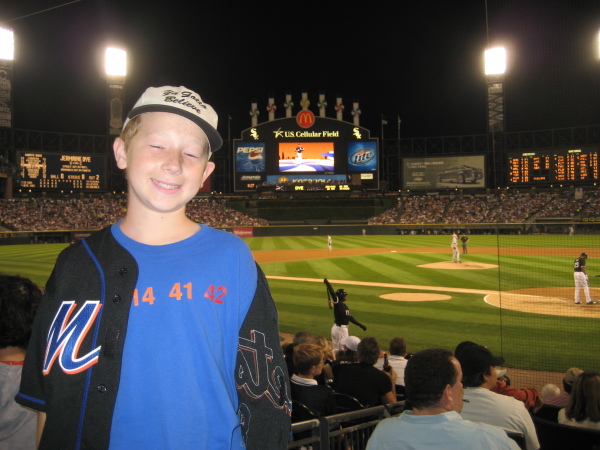
Because it wasn’t enough to surprise the kid by flying him to Chicago and taking him to Wrigley Field in the afternoon, mom Sharon and dad Kevin doubled up the “WE’RE WHAT?” factor by taking Ross to new Comiskey Park (a.k.a. U.S. Cellular Field) for the White Sox game the same night…fireworks night, at that. Both Chicago teams won at home that day, which only seems fitting.
Pretty good 12th birthday, don’t you think? And pretty sharp shirt he celebrated it in. Yours is pretty fitting and available by clicking here.
by Greg Prince on 13 August 2008 7:14 pm 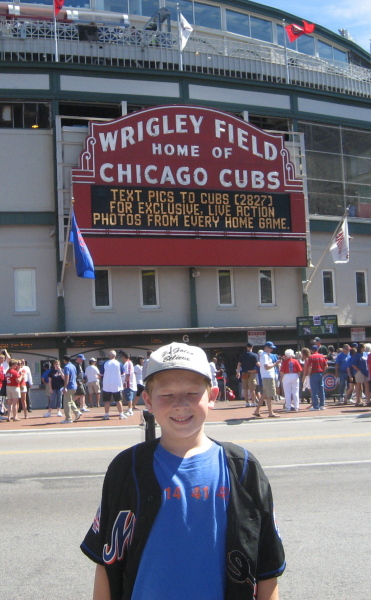
On the occasion of his 12th birthday last week, Ross was awakened and whisked away by the greatest parents the world has ever known last Friday. Other than “get in the car,” he wasn’t told they were going to the airport or flying to Chicago or headed to Wrigley Field for the afternoon.
Of course his mom Sharon packed the essential Faith and Fear in Flushing shirt that you can wear wherever you are whisked by clicking here.
|
|







