The blog for Mets fans
who like to read
ABOUT US
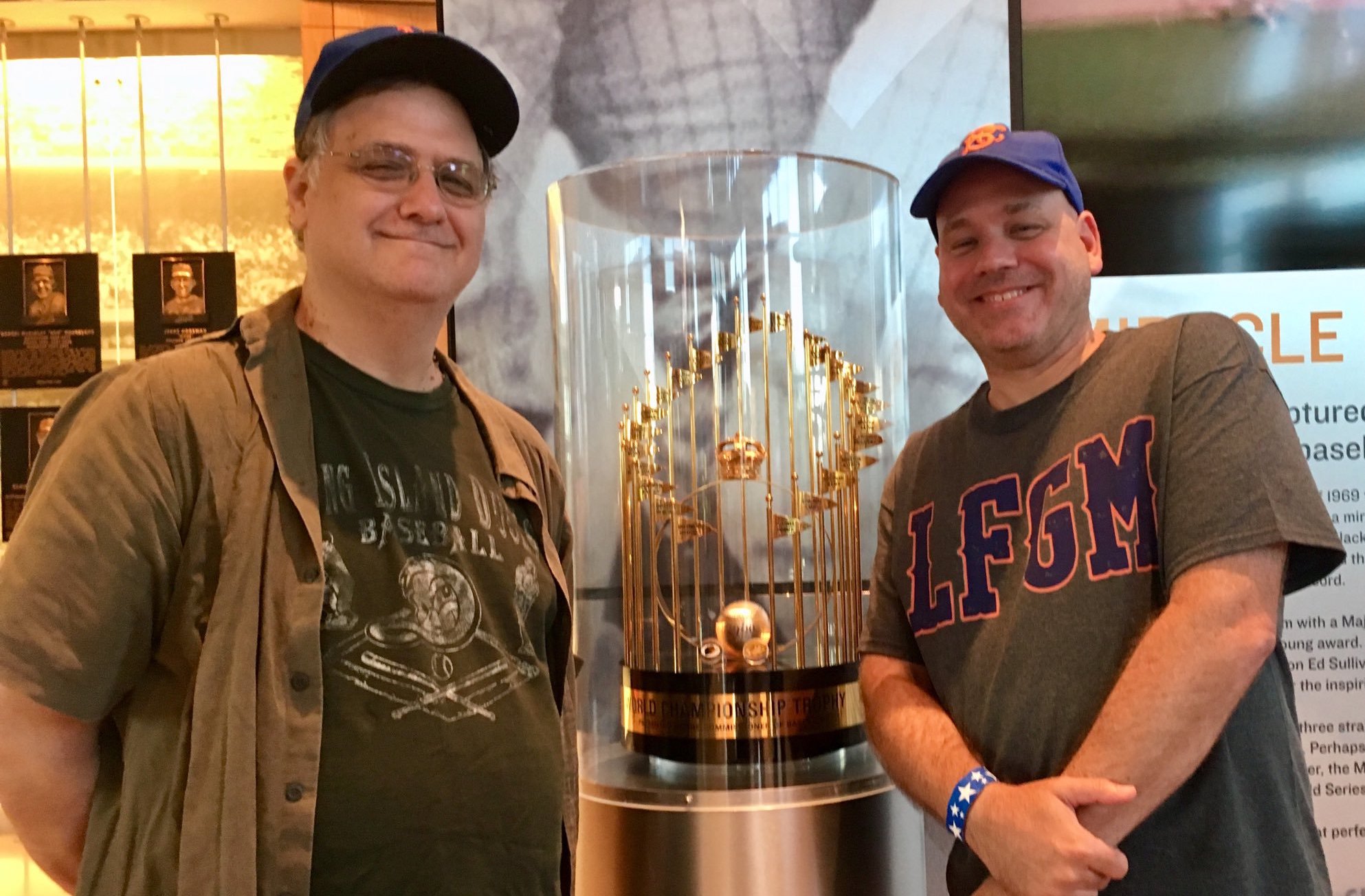
Faith and Fear in Flushing made its debut on Feb. 16, 2005, the brainchild of two longtime friends and lifelong Met fans.
Greg Prince discovered the Mets when he was 6, during the magical summer of 1969. He is a Long Island-based writer, editor and communications consultant. Contact him here.
Jason Fry is a Brooklyn writer whose first memories include his mom leaping up and down cheering for Rusty Staub. Check out his other writing here.
Got something to say? Leave a comment, or email us at faithandfear@gmail.com. (Sorry, but we have no interest in ads, sponsored content or guest posts.)
Need our RSS feed? It's here.
Visit our Facebook page, or drop by the personal pages for Greg and Jason.
Or follow us on Twitter: Here's Greg, and here's Jason.
|
by Greg Prince on 5 June 2008 12:10 pm I dressed all wrong for it, of course. The game that Stoneham and I had fixed upon was a midweek afternoon meeting between the Giants and the San Diego Padres in late June — a brilliant, sunshiny day at Candlestick Park, it turned out, and almost the perfect temperature for a curling match. I had flown out from New York that morning, and I reported to Stoneham’s office a few minutes before game time. He shook my hand and examined my airy East Coast midsummer getup and said, “Oh, no, this won’t do.” He went to a closet and produced a voluminous, ancient camel’s-hair polo coat and helped me into it… [When] we went back to Stoneham’s office, I took off the polo coat, and Stoneham hung it up in the closet again. I suddenly wondered how many Giants games it had seen.
—Roger Angell, “The Companions of the Game,” Five Seasons, 1975
What can be viewed as a certain sameness to every baseball season can also be looked upon as reassuring if momentarily distressing regularity. You know there’s going to be the indignity of Sunday Night Baseball; you know there’s going to be the late night West Coast opener that your system and your team aren’t quite geared to handle; you know you’ll be cursing your talented but erratic (or erratic but talented) lefty deep into the next morning when that opener, in fact, is not well handled; and you know you’ll be waiting far too long to avenge the bad taste of last night’s 10:15 start with another 10:15 start.
You also know, or at least you may have noticed, that there will be one tiny gem tucked into the schedule most every year. There will be a weekday afternoon game in San Francisco.
There was in 2006: a Wednesday afternoon win following a Tuesday night win following a Monday night loss. There was in 2007: a Wednesday afternoon win following a Tuesday night win following a Monday night loss. And there it was again in 2008, the very same pattern made famous first by Brian, Barry and Billy and then by buzzcuts. This time around, Wednesday afternoon in San Francisco was more mundane if ultimately no less satisfying: score early, pitch well, feel unease, hang on, what’s for dinner?…ooh, they’re showing it again!
You can’t necessarily count on the West Coast trip breaking just this way — although vigilant reader Ben pointed out to me after Ollie’s implosion Monday that the Mets were poised to follow a seemingly irrefutable pattern, going so far as to note we’d won the Tuesday night and Wednesday afternoon games by three and two runs, respectively, in ’06 and ’07…which is just what we did in ’08. You can’t necessarily count on anything in baseball, but you like the idea that you can, especially day baseball from San Fran.
I actually took off from work in 2000 to watch the Mets play an afternoon game on TV during their first trip ever to Pac Bell. My Baseball Tonight glimpses whetted my appetite that much. It was a terrible game and a terrible series, setting the stage for the Mets’ first several sojourns there. Pac Bell (and let’s just refer to it as such, for the constant jangling of its ever changing nom de phones just gives me a headache) behaved as Turner West at the dawn of the century. It took the Mets four seasons and thirteen tries to win a single regular-season* contest there, and that didn’t happen until Piazza, New York Catcher sacrificed his groin — so to speak — to avoid being hit by an inside pitch from Jason Schmidt. Mike was pronounced out indefinitely. Then the Mets finally won a regular-season game at Pac Bell. Talk about a tough way to change your luck.
(*Feel free to interject that the Mets won an enormous and thrilling postseason game in October of 2000 at the very same venue. That took the edge off any potential Pac Bell curse before it could start leaving threatening messages on our voicemail.)
The bad taste of any given loss drenched in San Francisco sunlight will eventually block out the good vibes I have coming in to every day game there, but those vibes are always good the next time around. Pac Bell remains the best-looking park in the National League for afternoon baseball, at least on television. It simply sparkles. It’s never cloudy…never — at least not on my watch. That green lawn beyond second base just expands out into forever. Not so good for Fernando Tatis, but a damn fine sight for the invention of color TV. The brickwork, the arches, the stationary cable car, the peekthrough walkway, the fanciful glove, the silly Coke bottle, the massive scoreboard that starts somewhere near Market Street and ends in Sausalito…plus where else you gonna get a whole bay to keep you company at a ballgame?
You can count on hearing the same things from the fellas when you tune in for day baseball from San Fran. You will hear that it’s a gorgeous day, that it’s 57 degrees (it’s always 57 degrees in San Francisco), that it was a little chilly last night but it’s 57 and gorgeous this afternoon, that this is so much more comfortable than it was at Candlestick, that Candlestick was, in more polite terms than is permissible to mention on SNY, the ass end of the earth. Pac Bell, according to Gary, Keith and Ron, is everything that Candlestick wasn’t. Too much wind at Candlestick. Too much foul territory at Candlestick. Too many roving biker gangs at Candlestick. Horace Stoneham had one nip too many one fine morning at Candlestick Point in the late ’50s and was convinced by crooked elements to stick a stadium out there on the edge of the Arctic. Horace took another nip and signed on the dotted line.
Here at Pac Bell, you’ve got the scenery and you’ve got the observations that come with it. There’s the Bay Bridge — it takes you to Oakland. There’s Willie’s statue — 24 Willie Mays Plaza, to be exact. There’s McCovey Cove — imagine how many Stretch would have hit here. There’s the kayak korps — whoops, they went the way of Barry Bonds. But what a nice place, huh? What a nice day for a game, huh?
The bundling-up of the San Francisco crowd is always duly noted. I bundled up on my one trip to date to Pac Bell — a Friday night in July — and I was overmatched by the elements. My friend Fred, not a huge sports fan but an observer-at-large second to none, chuckled when I told him how Stephanie and I required defrosting after seven innings: “Yeah, whenever they show highlights, I notice everyone at a Giants game is dressed like it’s winter in the middle of summer.” Given how frigid it gets at Pac Bell yet what a marked improvement it represents in climatological terms, I can only imagine that Candlestick must have been an ice cube tray in a deep freeze in Green Bay in a particularly harsh January.
One thing that jumped out at me yesterday afternoon was something I’m not used to seeing from San Francisco in this decade: swaths of empty seats. Paid attendance was 35,646. Similar crowds were announced Monday and Tuesday nights. Horace Stoneham would have killed (or maybe even sobered up) for such figures at Candlestick, but they’re a bit thin compared to what was the norm at Pac Bell for Mets games when the park was novel, when Bonds was productive, when the Giants were any good. Capacity in San Francisco doesn’t much exceed 42,000. For several years, the wind was against you if you wanted your choice of ticket. Now, no matter how pretty their park remains, it is a veritable breeze. Something for us to think about in parochial terms down the road…perhaps.
Something else: In 2006 and again in 2007, the Mets scored five runs in the first game they played after leaving Pac Bell. And they won. Should it happen tonight starting at 10:05, you read it here first.
by Greg Prince on 4 June 2008 8:50 am The accepted folkways of the big league clubhouse escape me. Even having grown up watching a team whose acknowledged leader — the player whose mere presence was and is universally acknowledged to have transformed the attitude of all those around him — was a pitcher, I’ve been hearing all my life that a pitcher can’t be a team’s leader. Even after watching a team derive its heart and soul from a relief pitcher as it followed his philosophy to nearly ultimate victory, I’ve been hearing all my life that a pitcher can’t be a team’s leader. Even after watching a team rally around another relief pitcher, one who was its seniormost member and clearly its dean, and agree it was right and proper to affix a “C” to his uniform, I’ve been hearing all my life that a pitcher, because he’s not an everyday player, can’t be a team’s leader. Captain, sure. Leader, no way.
All right, then. Tell me somebody besides Gil Hodges led Tom Seaver. Tell me somebody besides Tom Seaver led Tug McGraw. Tell me anybody could have led John Franco. And find me the Met whom Pedro Martinez could or should possibly fall in behind.
Pedro marches at the front of this parade as long as he’s around. To pretend that anybody else does is folly. For these New York Mets, it’s Pedro or it’s nobody. For too long it’s been nobody. For now, let’s say it’s Pedro.
Leading by example, it is universally agreed, is the way to go. Pedro’s examples get your attention. Pedro taking the ball Tuesday night, no matter how cold Phone Company Park was, no matter the wind that blew off the China Basin, got your attention. Pedro bearing down in the fifth got your attention. Pedro coming back for the sixth really got your attention. Pedro singling twice and driving in a run didn’t escape notice either. Pedro is a singular talent. Pedro is a singular presence. Pedro is more than that. Pedro is a magnet. He draws eyeballs, he draws teammates, he draws victories.
Somewhere in the middle of this cathartic and joyous Pedrofest, Ron Darling began to say how good it was for the Mets to have their leader back. But then, realizing of course that teams simply can not be led by a pitcher — I’m guessing Darling’s thought process was intimidated by his former first baseman and captain sitting next to him in the booth — he amended his statement to say the Mets’ pitchers had their leader back.
They sure did. So did the Mets’ catchers, the Mets’ infielders and the Mets’ outfielders. I suspect Mets management will gladly follow where Pedro Martinez leads. He’s got the fans’ support, that’s for sure. Pedro Martinez is pied piper with bulging portfolio. Pedro Martinez backs up his words with pitching and backs up his pitching with personality, with charisma, with a sense of right and wrong and responsibility and with honest-to-goodness leadership.
What the hell is leadership when it comes to baseball? I’m with Supreme Court Justice Potter Stewart when he groped to define obscenity: I know it when I see it. For the first third of 2008, leadership was obscenely lacking on the New York Mets. In San Francisco Tuesday night, I knew when I saw it. Now pitching and now leading the New York Mets, number 45, Pedro Martinez.
by Greg Prince on 3 June 2008 4:00 pm [H]ere, coming through the same tunnel as so many champions have walked before, the great man, Frank Sinatra, who has the phrasing, who has the control, who understands the composers, who knows what losing means as so many have, who made the great comeback, who stands still, enduringly, on top of the entertainment world.
—Howard Cosell, Madison Square Garden, October 13, 1974
Frank Sinatra retired from show business to great fanfare. He returned to it not long after and loomed larger than life, bigger than ever, for the rest of his career. His fans, naturally, were thrilled to have him onstage and in studios again, even if the name Sinatra became jokily synonymous in some circles with short-lived retirement.
When it comes to comebacks, Pedro Martinez puts Ol’ Blue Eyes to shame.
Pedro has never said anything about retiring. Well, maybe he has, but that was just talk. Pedro likes to talk. I like it when Pedro talks. I like it more when Pedro pitches.
The chairman of our board hasn’t thrown in front of an audience of discernible size since April Fool’s Day when the joke was on us that a rotation headed by the firm of Santana & Martinez could be counted on for regular starts of the every-fifth-day variety. Johan, rainouts notwithstanding, has kept up his part of the bargain. Pedro’s 2008, however, has been one outing and out: an uncomfortable three and one-third innings cut off at the legs…or at least one of their hamstrings.
I didn’t expect Pedro back any time soon once he left his April 1 start against the Marlins early and injured. I figured he’d tool up I-95 to St. Lucie, rehab in that nebulous way he does, emitting hope and frustration in every murky dispatch that wafted north. By now, Pedro Martinez must hold all the pitching records for extended spring training.
Tonight, two months and two days after he hobbled off the Joe Robbie Pro Player Dolphin Stadium mound and into the mists of the presumably zillion-day disabled list, he will reappear from out of the San Francisco fog. He will no longer be Pedro Martinez the question mark — Any word on Pedro? How is Pedro progressing? When might we see Pedro? — but Pedro Martinez the pitcher.
Pedro Martinez lights up a room as no pitcher does, as no pitcher can. Pedro Martinez’s sudden re-emergence in the Mets clubhouse is considered a balm even when he’s just passing through town for a checkup. That’s usually all he has time for. He has to get back to St. Lucie. He has to get back to the Dominican. He has to disappear for a while longer. But he’ll be back, they say. When? They’ll let us know.
Tonight’s the night. Just as it was in late July of ’06, just as it was that September, just as it was on Labor Day 2007. Pedro knows how to come back. Pedro knows how to pitch. Pedro Martinez is one of the indisputable greats. He looks so good out there when he’s out there. But he and us, we need to be more than strangers in the night exchanging glances.
by Jason Fry on 3 June 2008 5:09 am From: Jason Fry
To: Greg Prince
Date: Mon, Jun 2, 2008 at 10:44 PM
Subject: Re: Resting Easy With Randy Tate At Last *
you should tell retrosheet. seriously, they'd be thrilled.
meanwhile, tonight's game already really sucks.
From: Jason Fry
To: Greg Prince
Date: Mon, Jun 2, 2008 at 11:28 PM
Subject: Re: Resting Easy With Randy Tate At Last
we're gonna win this damn thing.
From: Jason Fry
To: Greg Prince
Date: Tue, Jun 3, 2008 at 12:09 AM
Subject: Re: Resting Easy With Randy Tate At Last
or maybe not
* I'm sure this will be explained by Greg at some point.
by Greg Prince on 2 June 2008 9:00 pm 5: Wednesday, September 24 vs. Cubs
If this week is about anything, ladies and gentlemen, it is about this: closure. We say goodbye to Shea Stadium and we aim to do it definitively. We wish to put a bow on a yearlong celebration and tie it tight. We don't want our home of 45 years to be cast off without the most complete and satisfying ending possible.
We hope we can say the same about Shea's final season. That we can't do anything about at this point. If we could, we'd do it every year…and we'd present for your consideration directly a far larger procession than we are about to.
Instead, we give you two men who will team to take down number 5 in the Countdown Like It Oughta Be. They are well suited to provide closure to Shea Stadium because these two men provided the greatest closure there is at Shea Stadium.
They caught the final outs of the two World Series won by the New York Mets.
Ironically, their stories are as much about beginnings as they are about closure. Each man became a Met and elicited a great deal of anticipation for what he might one day bring to the team. In both cases, their output was suspected to be pretty good. Nobody could have rightly dreamed that each would grasp a baseball that would clinch spots at the top of the baseball world in their respective dream seasons.
Start with our first man. He commenced his Met career in the veritable dark ages, 1963, in a far-away land known as the Polo Grounds. While his big league debut predated Shea Stadium, it was just a taste of things to come. He didn't arrive as a full-time, full-fledged Met until 1966. It would take a little while for it to become apparent that everything fans were hearing about “the Youth of America” wasn't hype. It was the real thing. Come 1968, there could be no doubt Mets fans were watching not just a good prospect, but a leftfielder who was the finest everyday player the Mets had signed and developed to date. He'd hold that distinction for years to come and remains, even now, one of the crown jewels ever polished by the Met system.
He'd hold something else as well. He'd hold a fly ball hit in the bottom of the ninth inning of the fifth game of the 1969 World Series. There were two outs when Baltimore Orioles second baseman Davey Johnson hit it toward him. When he caught it, there were three — and the Mets had reached their sport's pinnacle.
Ladies and gentlemen, the man who caught the ball that made the Mets world champions in 1969, Cleon Jones.
Our second man took a different route to Shea. His started on another club, in a different country. His reputation as one of the best at his position preceded him. It's what made him so attractive to the Mets and their fans. When he was acquired in exchange for a hefty bounty of young talent, it was agreed that he was truly worth it, that he could be the honest-to-goodness difference between the Mets being fine and the Mets being, as they were when Cleon Jones played left field, Amazin'.
This man, a catcher, indeed constituted that kind of difference. He played hard, he played hurt, he played brilliantly. He was a rock behind the plate, a fearsome threat when he stood at it. His mere presence transformed the Met lineup in 1985 and established it as the one that would dominate throughout 1986. And when he went into his final crouch of the 1986 postseason and caught a pitch that Jesse Orosco threw and Marty Barrett swung through, he, like Cleon Jones, found in his mitt not just a baseball, but a switch. When he grasped that ball, it was akin to pulling the switch that electrified an entire city.
Ladies and gentlemen, the man who caught the ball that made the Mets world champions in 1986, Gary Carter.
Cleon, Gary, you honor us by peeling No. 5 together, by reminding us for one more moment apiece what it was like at Shea Stadium when the Mets ascended to the top of the baseball world. To honor you back, the New York Mets and the New York City Department of Parks & Recreation are thrilled to announce the creation of two installations that will greet visitors to the Queens Museum, adjacent to the Unisphere in Flushing Meadows Corona Park.
One is of a leftfielder cradling a fly ball.
One is of a catcher snapping shut his mitt on strike three.
You'll find their faces and forms very familiar.
Cleon Jones' and Gary Carter's defining Met actions will then, for all time, be represented on the site of Shea Stadium's spiritual sibling, the 1964 World's Fair, symbolizing for generations to come the moments when they and their Met teammates made Flushing the undisputed capital of the baseball world.
Number 6 was revealed here.
Number 4 will be counted down next Monday, June 9.
by Greg Prince on 2 June 2008 3:00 pm Bill Parcells (or maybe it's John Madden) likes to glorify football players who so come to play that you can toss the coin in the parking lot and they'll line up at midnight and knock the other guy on his ass. Wherever, whenever…they're ready.
I can dig that. I can dig the Mets winning wherever, whenever. As one who has meticulously inscribed the result of every single Mets game he has ever attended and as one who cherishes every single Mets win for which he has had the pleasure of inking a big ol' W, I'll take 'em where I can find 'em, wherever they put 'em, whenever I have to come and get 'em.
That said, even with the 201st win of my Log career easily secured and safely ensconced between 8:07 PM and 11:02 PM last night, even having benefited from whatever charge Johan Santana got out of an additional six hours and fifty-seven minutes' rest, I hereby introduce a measure to abolish Sunday Night Baseball.
Get it out of our lives. We don't like it, we don't need it, we don't want it.
We don't want to be on Sunday Night Baseball. We don't want to sit and stew for seven perfectly good hours on a beautiful Sunday afternoon. We don't derive any bonus from the exposure on Sunday Night Baseball. My apologies to any Mets fans outside the immediate New York area who are grateful for a few dozen innings a year they wouldn't otherwise see, but it's not helping the greater good at all.
Find me the Mets fan who is relieved that Gary Cohen won't be doing play-by-play, who is enriched by Jon Miller. Find me the Mets fan who is so sick of Keith Hernandez and Ron Darling that he welcomes the insights of Joe Morgan. Find me the Mets fan who enjoys eschewing familiarity with his team for obnoxious relatives who barge in three or four times a year to get your story completely wrong, the kind of people who make you swear you will never, ever invite these people over for Thanksgiving again. Are you out there, mythical Mets fan who actually appreciates SNY getting Sunday off in favor of ESPN interpreting your team as some kind of poor relation? As some kind of auxiliary club activity for bored Gothamites?
I used to think being on national television was some kind of reward or recognition for a team, that it meant you'd made it, that you had earned extra attention, that everybody getting a look at you confirmed your progress or your status. Instead, it's punishment for us, the hardcore fans. We get nothing from it, not a damn thing. We're not privy to fantastic announcing we'd otherwise miss. We're not receiving a brilliant perspective from fresh eyes that will help us understand the big picture. We get Jon Miller's tired blowhard act and Joe Morgan's pompous nonsense.
And we get 8 o'clock starts. On a Sunday. On a Sunday! Who on earth wants to wait around until 8 o'clock to watch a baseball game that could easily be played at 1 o'clock? And who on earth wants to wait around until 8 o'clock to attend a baseball game that not only could easily be played at 1 o'clock, but was supposed to be played at 1 o'clock, that was scheduled to be played at 1 o'clock?
Some weeks ago, my friend Joe asked if I wanted to go to one of the Dodgers games. Sure, I said, how about Sunday? Fine, he said, I'll get tickets. And he did. And very quietly, the damn thing was rescheduled. It's not a particular hardship for me as I keep pretty malleable hours. But Joe, like most adults, has to get up very early Monday morning. Joe would rather shred his scorebook than leave a game before it's over. Rubbing his eyes red, we stayed.
We were not in the majority. It's unfortunate enough when the Mets go in the tank as they have so often this season and the seats empty well ahead of the ninth. But on a pleasant night with a lovely win in progress, thousands and thousands headed to the exits ahead of the conclusion, especially families. By the ninth, it was mostly drunken 17-year-olds holding sway in the mezzanine.
Why the abandonment of ship by so many? It's not because they don't like baseball, it's not because they don't like the Mets winning, it's not because they choose to flaunt their prosperity by not watching all the game they paid for. It's because it's frigging late for people. It's a school night, for goodness sake. If you live in Flushing or Corona, it's convenient. If you live anywhere else, it's not.
Now if the ticket said “8:05 PM,” then caveat emptor and so forth. But it didn't. ESPN makes this call. ESPN could have made this call months ago. ESPN could have figured out media market 1 was playing media market 2, that by the first of June neither team's marquee value or competitive prospects would be spent, that its phoney-baloney Joe Torre story line would be in effect and it could have issued an edict unto the Mets that Uncle ESPN Wants You. Instead, tens of thousands of seats were sold to an afternoon game — a Sunday afternoon game whose conclusion generally averts bedtimes of all ages — and thousands of seats no doubt went wasted because, hey, people have lives, even baseball fans. Many of those who didn't waste their tickets had to issue themselves a curfew.
Seven hours later than planned for. An hour later than a normal night game. Font for confusion among uninformed ticketholders. Fodder for Phil Mushnick. Three excruciating hours of Miller and Morgan. An excuse to cancel the Mr. Met Dash.
I'm not asking ESPN to get out of the baseball business. They do several things well. They produce wonderful research. They have that handheld camera that records homers going official when the batter steps on the plate. They have on their side many able minds, even if none of them belong to Steve Phillips. They can do a doubleheader some other night of the week. I'll complain far less if they can start on Sunday nights at 7:00, which is prime time for the rest of television. If they wanted to show only West Coast games on Sunday nights, when at least those would be 4:00 local games there, that would seem mildly fair to somebody. Instead, it's the same thing year in, year out. They take our Sunday afternoons and rob them from us. They stick our team on Sunday night and they shove their atrocious announcers down our throats. They keep us out past midnight or they chase us from our seats by ten. They get me griping after a 6-1 win, for gosh sakes.
I like the Mets winning. I like Johan finding his groove. I like Carlos Beltran blasting a “390-foot home run” to the base of the scoreboard (somebody get Shea a tape measure). I like Ryan Church standing and remaining in one piece and hitting, too. I like going to a Mets game wherever they put it, whenever they put it. But Sunday Night Baseball's unique charms are completely lost on me.
by Jason Fry on 2 June 2008 4:16 am Hey, Mets! You've just put up a 5-2 homestand, playing the kind of baseball that makes even veteran fans and conspicuous doubters like us double-check that, yes, this was the same homestand that began with everyone wondering if Willie Randolph would emerge from his long-awaited meeting with the Wilpons and Omar still employed. So what's your reward? You get to fly all night and play in San Francisco tomorrow, of course! Thanks ESPN!
Willie Randolph, typically, said next to nothing after keeping his job. His actions were different, though: He played the rusty bench guys, sat down Carlos Delgado, gave His Boredness a rich southpaw compliment in cheering him for getting his uniform dirty, and saw Beltran and Wright and Reyes stop creaking and start humming. Suddenly the Mets look like the team they were before last Memorial Day — and as it always is in baseball, we've gone (or are rapidly going) from wondering if we'll ever win another game to being mildly surprised when we lose one.
Emily, Joshua and I overnighted in Philadelphia Saturday, exiting the car just after Easley made the second out of the seventh, which is to say we skipped out before the turning point of the game. Last night we were talking with friends of ours (Phillies fans but, I assure you, good people) about Willie, about what had happened to the Mets for a year and about how good they really are or aren't. The conversation came around to how what we do as baseball watchers can often be reduced to telling stories that fit the already-established facts, and how we forget that it doesn't take much to turn one story into a very different one. If Ray Knight had ended Game 6 with a drive caught at the wall by Dave Henderson, nobody would talk about the indomitable swagger of the '86 Mets — they'd be a bunch of irresponsible substance abusers who squandered their potential. If the '07 Mets had gotten something respectable from Tom Glavine in the final regular-seasong game and made a respectable showing in the playoffs, we might well have waxed rhapsodic about how they'd held off the valiant Phillies and everything they'd learned pulling themselves out of free-fall.
But what's the alternative? I'm not a stat guy, which has nothing to do with any distaste for sabermetrics. To the contrary, in fact: I love that stuff, but I struggle to internalize valuable metrics such as VORP and RCAA and BABIP to the point that I can assess their values the way I can dissect the traditional measures, limited though they are. And then there's the larger problem for me, which is that I can't fit a stats-minded understanding of a baseball season's ebb and flow into the narratives we naturally want to impose on it. If the Mets rebound and go to the playoffs, the truest explanation of what happened could be that key players like Reyes, Beltran and Heilman regressed to the mean. But that's not a satisfying narrative. No, if that scenario comes to pass, we'll say something along the lines of how singling out Delgado was the wake-up call for an underachieving clubhouse, shaking the players out of their lethargy and restoring the team's focus. Will that be true? Quite possibly not. But it'll feel true.
Anyway. The story of a season may be shaped in retrospect, but the story of tonight's game seems fairly clear. One day we'll stop feeling mildly disappointed that Johan Santana didn't pitch a complete game, strike out 15 and heal the sick in the field boxes and the front half of the loge with his aura. One day, we'll watch him coolly dig his way out of an early hole and hold a team at bay the way he did tonight and be very happy with that. Did you see that called third strike on poor Blake Dewitt to end the seventh? Mercy. Oh, and kudos to Johan for doing something pitchers rarely do these days — exiting to a warm hand from the crowd, he actually tipped his cap.
Johan's supporting cast? Jose Reyes's electricity/stupidity ratio has been good enough to make me tempted to discard that unhappy measure, David Wright's bat could melt lead right now, Carlos Beltran looks awake and alive, Luis Castillo is moving well around second, and how about Ryan Church? Though somebody tell Brian Schneider to lay off the congratulatory helmet slap. It's a long way to San Francisco, even if you don't feel nauseous.
With a week of West Coast games on tap, you're going to be sitting around at 7:10 fidgeting. Fill up some of that empty time by ordering the famous Faith and Fear Numbers shirt, available right here.
by Greg Prince on 1 June 2008 2:33 pm The cork shot out of the right field mezzanine in the early evening Saturday, burst out of every section of Shea Stadium, exploded from the souls of Mets fans wherever they were watching or listening. Our bottle had been plugged up tight, but Fernando Tatis pushed from its upper neck the last vestiges of the stubborn stoppage that had kept our sanity, our happiness, our self-esteem from flowing freely for far too long.
All Tatis did was single home Nick Evans. All Tatis did was put the Mets up by a run in the bottom of the eighth. All Tatis did was finalize a three-run rally to overcome a two-run deficit. Tatis didn't win the game right then and there, the Mets didn't win the game right then and there, the Mets didn't clinch anything right then and there.
Yet we popped our corks as if he had. It was high fives all around. My bloggingly brilliant companion, who grew up almost down the block; who came, by his calculation, to 51 games in one season of his adolescence; acted as if he had never seen the Mets score a run before. High Five! The loopy woman behind me, with vocal cords obviously fused together with the Queens DNA of Edith Bunker and Estelle Costanza (WILLLLIIIE! USE CAAAASSSTRO!), spoke to me the language of palms. High Five! Man to my right, alternating hopeful exhortation and groaning acceptance all afternoon, had just hit the jackpot. It paid off for both of us in a High Five!
High Fives…I was giving as good as I got.
It had been a while, a very long while, since I had exchanged high fives of any length, of any force, in any multiples to everybody in sight at Shea Stadium. A fiver here, a fiver there, but no velocity, no urgency, no sense that every hand within lunging reach in my row, in the row in front, in the row in back had to get slapped. Fivery had grown cold at Shea in 2008 — until the eighth. First Beltran's hang glider of a homer warmed us up, now Tatis' single brought us to a sizzle.
High Fives all around. High Fives for the Carlos homer. High Fives for the Fernando single. High Fives for the closer firing 15 pitches, 11 for strikes, 3 for swinging strike threes. High Fives for the successful reopening of Sanchez Bridge, the span that guarantees safe passage from the seventh to the ninth. High Fives for the put-upon starter who sucked up breaking bad and hung in like a mad man. A funny thing happened on the way to New Orleans for Mike Pelfrey: his trip was cancelled.
A High Five, too, for Endy Chavez. Endy Chavez battled the hell out of Chad Billingsley to close the seventh inning. Endy Chavez brought Mookie and Dunston to the plate. Endy Chavez, with catchers at the corners (everyone but CAAAASSSTRO!), took a ball, a strike and another strike. One-and-two, two down, two on, two out…and would have you bet a third of those wouldn't follow in a sec? That the Mets would waste this opportunity as they had wasted all others Saturday and for that matter Friday? That Billingsley would put away Endy and the Mets? That a second loss in a row, a second dismal loss in a row, was a sure thing? That the same old same old was in full effect as if Fernandomania had never broken out as recently as Wednesday?
But Endy Chavez battled the hell out of Chad Billingsley. Billingsley was supposed to be striding triumphantly to the dugout seconds after he went one-and-two on Chavez. But Endy fouled off the fourth pitch of the at-bat. And the fifth. He took a ball. Then fouled another pitch. And another. And another. And still another. Then he took a ball to make it three-and-two.
Then he fouled off another.
Endy Chavez wasn't giving up. Endy Chavez is on the Mets. Pythagorean Theorem demands we infer that the Mets weren't giving up, therefore how could we the Mets fans give up? Endy Squared + Mets Squared = LET'S GO METS! Squared. First and third, three-and-two, Endy up, Billingsley's pitch count crashing through triple-digits, the Mets still in this thing…
OK, so Endy popped to short. So the Mets didn't score. So it was still two-nothing Dodgers as it had been for what seemed like hours, seemed like days. But the Mets were somehow less dead than they had been since Thursday, less dead than we had grown used to them being during 2008, certainly less dead than they'd been at any juncture of any of my four previous trips to Shea (Opponents 27 Mets 12).
We could believe. We could sing along to “I'm A Believer” in the middle of the eighth. We're supposed to sing along to “I'm A Believer” every middle of the eighth but I've noticed that when the tenor of the times go awry, such as when the Mets are trailing 13-1 or 10-4 or 9-5 after seven-and-a-half, nobody is expected to believe anything but the worst, thus the singalong is shelved. Sing about believing when the Mets trail depressingly and probably insurmountably? What's the use in tryin'? All you get is pain. When we needed sunshine, we got…
Wait a sec. It didn't rain Saturday, not during the game. The forecast insisted there was an 80% chance of rain, floods, locusts, darkness, rivers turning to blood, all your popular plagues. There was a tornado warning in five New Jersey counties. Thunder was rocking Long Island as I prepared to take up Metstradamus on his sudden and gracious invitation to Cap Day. I was going to need more than a cap Saturday. I was going to need an ark.
Or so I thought. I stepped out of the house and there was not a drop of rain falling from the sky. I was outfitted in my trench coat and hauling a golf umbrella, but both were extraneous as the Mets' bats the nights before. It was warm and it was dry. And now, as late Saturday afternoon turned to early Saturday evening, it was bright as all get-out at Shea Stadium. I adjusted my cap to keep the sun from blinding me. Endy adjusted my mood to keep precedent from drowning me.
The Monkees did their thing. Duaner did his. David doubled. Carlos homered. The other one singled, too, setting off a chain of events that climaxed in the firelight, Fernando. There was something in the air this night, all right. Billy shut the Dodger door. Slammed it, actually. The fourth-place Mets had gotten back to .500 at the end of May. But nobody was combing for details after Wagner's final furious fastball. By then the cork was out, all hands were red and our crowd could not stifle itself. If ever tens of thousands of kindred spirits needed lifting, Saturday evening was then.
by Greg Prince on 1 June 2008 12:39 am 
Thanks to Mike Pelfrey’s gutty seven innings, Duaner Sanchez’s perfect eighth, Carlos Beltran’s unleashed power, Fernando Tatis’ clutch timing and Billy Wagner’s one-two-three ninth, I was able to record in The Log its 200th regular-season home win. After four consecutive losses, I was beginning to think it would never happen. But I always think that. I probably thought that prior to July 29, 2000, date of The Log’s 100th win.
Eerie if happy coincidences:
The Log’s first hundred wins came after 184 games.
The Log’s second hundred wins came after an additional 186 games.
The Log’s 100th win required an eighth-inning rally.
The Log’s 200th win required an eighth-inning rally.
The Log’s 100th win came on a Saturday afternoon.
The Log’s 200th win came on a Saturday afternoon.
I noticed Todd Zeile signing autographs almost to first pitch prior to The Log’s 100th win.
I sat next to a guy wearing a Todd Zeile jersey during The Log’s 200th win.
I would go to the Sunday game that followed The Log’s 100th win…with the guy with whom I co-author this blog.
I am going to the Sunday game that follows The Log’s 200th win…with the guy with whom I went to The Log’s 100th win — but I’m mentioning it in this blog.
Lincoln Logs were once popular.
Kennedy Airport less so.
by Greg Prince on 31 May 2008 1:38 pm The Mets hadn't risen so high this week that they were in danger of contracting vertigo, but I was feeling a little less than steady Friday among the upper boxes.
Never mind Row V (or my forthcoming Seven-Pack stay in Row Q). At least up there there's a railing to grab hold of as you make your way down the stairway from the stars, if not an oxygen tank as you make your way up its thousand steps. I was reminded last night that the most treacherous spot in Shea Stadium — besides behind Aaron Heilman — is the steep slope you have to negotiate if your ticket tells you you're in a UR Box B or A. Maybe you're nimble and you're fine, but I'm not and I wasn't.
In the best spirit of the Met offense, nothing really happened, but I didn't like the short trip to my seat. I really didn't like the guys in seats 3 and 4 rising every five minutes for another overpriced beer (or to rid their systems of the previous one). Nice guys, bad habits. I had the aisle, which I greatly appreciate for legroom, but all the getting up unsteadied me. With nothing to hold onto as I stepped onto the steps to let their thirsty asses out, I made myself a near-nuisance to those around me as I looked to grasp and clutch anything and anybody so I would feel more secure.
Sort of like looking to Nick Evans and Fernando Tatis for salvation.
When not being rousted, I was engaged in my usual nine-inning yapathon with Jim Haines, who invited me at about the last minute he could have for me to make it. I hadn't been to Shea on a Friday night all season (I've now seen them lose every day of the week but Sunday) and I hadn't been to Shea with Jim since the third date of the Collapse Tour, so it was worth the rush.
It's always worth the rush to join Jim. Actually, we've been joined at the proverbial hip since 2001 when we met and discovered we're basically the same person, at least in terms of topline interests and drill-down instincts. If you'd like to listen in on a four-inning critique of when and why M*A*S*H went downhill, two innings on what's irredeemable about six different radio formats and a three-inning version of Kiner's Korner in which Ralph unloads on everyone who ever did him wrong (Jim's arsenal of voices includes a spectacularly grumpy Walter Matthau, I discovered to my delight last night) — laced with intermittent takes on how certain publishers ruined certain magazines — then sit next to us. But don't keep getting up to buy a Bud and use the John. I hate that.
Only problem going to a Mets game with Jim, at least this game, is Jim doesn't yet approach the Zen state I actively seek where the 2008 Mets are concerned. I know they kind of suck and am learning to accept it. Jim knows they kind of suck yet it still bothers him. It leaves him questioning why he likes baseball, why he watches baseball, why he allows the Mets to disturb his biorhythms, why do they HAVE TO SUCK SO MUCH?
I cannot answer those questions for Jim. He must discover his own inner path and I hope the steps he takes are not perilously steep. But I do know with great certainty that M*A*S*H never recovered from the horribly indulgent two-part episode that sent Radar home in 1979.
|
|