The blog for Mets fans
who like to read
ABOUT US

Faith and Fear in Flushing made its debut on Feb. 16, 2005, the brainchild of two longtime friends and lifelong Met fans.
Greg Prince discovered the Mets when he was 6, during the magical summer of 1969. He is a Long Island-based writer, editor and communications consultant. Contact him here.
Jason Fry is a Brooklyn writer whose first memories include his mom leaping up and down cheering for Rusty Staub. Check out his other writing here.
Got something to say? Leave a comment, or email us at faithandfear@gmail.com. (Sorry, but we have no interest in ads, sponsored content or guest posts.)
Need our RSS feed? It's here.
Visit our Facebook page, or drop by the personal pages for Greg and Jason.
Or follow us on Twitter: Here's Greg, and here's Jason.
|
by Greg Prince on 23 April 2008 4:00 pm 13: Sunday, September 7 vs Phillies
It is not exactly a family secret, ladies and gentlemen, that the Mets who took up residence in Shea Stadium 44 years ago weren't worldbeaters. Their records in the Polo Grounds? 40 and 120, 51-111. The trend continued for the first two seasons at Shea: 53 and 109, 50 and 112. Saying the Mets finished tenth four straight years was a nice way of saying they couldn't finish twentieth. That is why as much as the fans were in love with their team, they also came out to admire some of the great stars the National League had to offer in those days.
Today we have one of the greatest with us. Simply put, he personifies pitching — inconceivably excellent pitching — for a generation of baseball fans and remains the standard by which every flamethrowing lefthander who comes along is evaluated. A native of Brooklyn and a good friend of the Mets organization every spring, please welcome back to Shea Stadium, Sandy Koufax.
Now, as happy as we are to have Sandy visit us today, we have to admit he is not here solely for his own accomplishments, as plentiful as they are. You see, Sandy inadvertently became a yardstick for measuring what, in retrospect, may have been the first significant leap of progress in Mets history. You might even call it the first Mets miracle.
Not that Sandy Koufax didn't pitch well against all comers, but he enjoyed an incredible hold over Mets hitters from 1962 on, racking up a 13-0 mark over his hometown team by the latter portion of their fourth season, a résumé that included his first no-hitter. The idea that a ragtag bunch like the Mets could ever defeat Koufax…well, that seemed impossible to Mets fans who could only dream of competing on anything approaching his level.
But the impossible turned actual on August 26, 1965 when Sandy Koufax was outlasted — it seems blasphemy to say outpitched — by another lefty, this one just shy of his 21st birthday. The southpaw the Mets sent to the Shea mound that Thursday had all of one major league victory to his credit, but his performance earned him another. The great Sandy Koufax and the eventual world champion Dodgers were beaten 5-2, the first loss ever taken against the heretofore hapless New York Mets by the indomitable immortal.
The winning pitcher? An up-and-comer named Frank Edwin “Tug” McGraw.
As you know, ladies and gentlemen, it wasn't the last time Tug McGraw would have something to do with miraculous events at Shea Stadium. Tug would eventually convert from starter to reliever, become one of the best in the National League at closing games and then, in the summer of 1973, begin spouting a phrase that helped inspire the Mets on an Amazin' journey from the bottom of their division to the top of the flagpole.
Nobody pitched like Tug McGraw did down the final weeks of 1973 and nobody ever believed the way he did…or made Mets fans believe so wholeheartedly that anything is possible.
No individual in the history of this franchise or this ballpark represents the spirit of the New York Mets like Tug McGraw. Nobody ever showed a love of life or baseball more in or out of a Mets uniform. To honor his memory today in our Countdown Like It Oughta Be, we ask his onetime opponent, Hall of Famer Sandy Koufax, and his son, one of the most beloved recording stars in the music world, Tim McGraw, to take down number 13 for someone who brought this team better luck, greater hope and deeper faith than any Mets fan could have ever aspired to before he came along.
Number 14 was revealed here.
by Greg Prince on 23 April 2008 3:09 am Afternoon games at Wrigley…idyllic, no?
No?
Not this one. And that was the only one we get for 2008, which is OK from here. The Cubs are good and the Mets are relentlessly so-so, making it difficult to enjoy the ivy for the trees. The charm of America's most charming ballpark dissipates when you're losing 8-1 the day after the night you lost 7-1.
You can analyze the poor fielding by Delgado and the poor hitting by Delgado and the poor relieving by Delgado (what fun is blaming Jorge Sosa?), but I won't. The Mets defy useful analysis at the moment. The slippery slope of trying to unravel their ennui runs from “what's wrong now?” to “what's wrong tomorrow?” to “will it ever be righted?” and in about 15 seconds you're hosting one of those enlightening shows on SNY wherein second-tier WFAN talent shouts each other down for half an hour.
Let's go back to Wrigley instead. It looks so good on television. It looks so good in real life. It looks great in daylight. Get Ronny Cedeño the bleep out of there and you can't do any better for a few hours' commune with nature and baseball.
It boggles the mind to realize that not only was the darn thing built in 1914, it was built to play home to a Federal League team. A Federal League team, for cryin' out loud. Shea was sort of planned for a Continental League team, but it's not quite the same. Nothing's the same as Wrigley, no matter how many bricks are used by those who would be inspired by it. Compared to Wrigley Field, all those places are brick teases.
'Twas pointed out by Gary and Ron how Wrigley's the “template” for so many of the retro parks of the modern age — though not for limestone-based Nationals Park, the Mets' next stop and mine, too. We won't be seeing any more of Wrigley Field this season though a Mets prism, but we may as well get used to what they've got in D.C. as we play them down there nine times this year and nine or ten times every year for years to come. (Rumor has it we play nineteen different clubs in 2008, but mostly we seem to play the Washington Nationals.)
I look forward to telling you what it's like on the inside. If the Mets play the Nats like they did last week, it will be a far nicer place than Wrigley Field was this week.
by Greg Prince on 22 April 2008 3:00 pm 14: Saturday, September 6 vs Phillies
Ladies and gentlemen, this afternoon for our Countdown Like It Oughta Be salute, we honor one of the most memorable seasons in Mets history. In many ways, “season” is an overstatement because this Mets team did all its important business in the span of about six weeks. No team ever accomplished so much in so little time. You could even call them the patron saint of lost baseball causes, because after the world saw what the 1973 Mets could do after being in last place at the end of August, no team could ever lose faith in its chances again.
The essentials of this particular Met miracle have been handed down over 35 years now, but the telling never gets old. On August 30, the New York Mets were a last-place team. On October 10, the New York Mets were National League champions. You've heard it a thousand times if you've heard it once that it wasn't over 'til it was over and that you had to — absolutely had to — believe, but there is a well-kept secret about those 1973 Mets.
They had some pretty good players. If injuries hadn't gotten in their way, maybe the flag they earned would have come about in a more conventional manner. But then we wouldn't have the story to tell and retell, and we sort of enjoying doing that.
Let's meet nine of your 1973 New York Mets right now. They were all, to say the least, pretty good players.
We'll start on the mound, where manager Yogi Berra could depend on depth that was the envy of the other skippers in the N.L. East. For example, few teams had the luxury of a proven lefthanded veteran — a 20-game winner no less — filling in as a swingman, starting or relieving as needed and providing great leadership every step of the way. This man delivered all that and more to the Mets across five wonderful seasons in New York. Welcome back the southpaw Ray Sadecki.
Another pitcher who could take the ball in whichever inning was necessary enjoyed his first full season in the majors in '73 and boy did he make the most of it. An 8-4 record with 5 saves to boot, he was a rock for pitching coach Rube Walker. Give a warm hand to Harry Parker.
Also coming up to stay in 1973 was a righty with a world of promise, talent that would show itself most noticeably a year later when he led the National League in earned run average. He defended the honor of the Mets against Pedro Borbon and the Reds in the NLCS, proving his versatility as a fighter as well a pitcher. Let's have a big round of Shea Stadium applause for Buzz Capra.
Of course when you mention versatility in the context of the 1973 Mets, you have to mention the man who filled in so ably while so many regulars were on the shelf. He played short, third, second, left and center, and he handled them all like the pro he was. Say hi to old friend Teddy Martinez.
Our next two guests from the summer of '73 have to come out together, but they're going to be careful. They gave the Shea crowd quite a scare on July 7 when they collided at the left field wall in pursuit of a Ralph Garr fly ball. It wasn't pretty, but both players were typically giving it their all. Safe and sound, let's welcome home Don Hahn and the Stork, George Theodore.
If the pennant achieved by the '73 Mets is viewed as a surprise, then this fourth starter's accomplishments probably shocked a few people. He was a capable pitcher for his former team, but when he came to the Mets, he simply excelled, posting a 12-3 mark and making a case for the ages that he sure would have looked good taking the ball in Oakland during the World Series. We remember him fondly today as we greet him in Queens, ladies and gentlemen, George Stone.
George had some company in coming to the Mets from the Braves. His companion was one of the best second basemen in the National League, a title he maintained when he arrived in New York. Not only was he a surehanded fielder and the steadiest of hitters, he was an instant fan favorite. One of the most popular Mets of his or any day, let's hear it for someone who inspired a million area kids to choke up on their bats as high as they could, Felix Millan.
And to lead our group of 1973 National League champions to the right field wall to remove number 14 is a Met who burned hotter than just about any of his teammates down the stretch drive. Six homers, 17 ribbies, a .323 average, an Amazin' glove at third. He was so hot, it was probably more than genetics that caused his hair to glow a bright red. Ladies and gentlemen, one of the true Met stalwarts of 1973, Wayne Garrett.
Number 15 was revealed here.
by Greg Prince on 22 April 2008 4:48 am CHICAGO (FAFIF) — The Mets lost 7-1 at Wrigley Field Tuesday night, which came as something of a surprise to this reporter who nodded off on the couch with the Mets behind 2-1 in the eighth.
“How the fuck did it get to be 7-1?” this reporter wondered upon waking and observing the final score.
The Cubs scored five runs while this reporter napped, leading him to believe some combination of Aaron Heilman and Willie Randolph must have been doing the same thing.
“Shit,” he said. “Five runs! How the fuck did that happen? Fucking Heilman? Fucking Willie? Fuck!”
In the portion of the game for which this reporter managed to stay awake, the Mets offense sputtered while John Maine was outpitched by Carlos Zambrano.
“Fucking Maine,” this reporter noted. “And fucking Zambrano, while we're at it. Fuck!”
The Cubs took a 2-0 lead while this reporter had switched away to watch Countdown With Keith Olbermann on MSNBC. Usually this reporter switches back and forth between Countdown and the game frequently during the 8 o'clock hour, but Keith was interviewing Hillary Clinton, which “seemed newsworthy enough seeing as how it's obvious Keith can't fucking stand her,” this reporter surmised. Upon turning back to SNY after a 20-minute absence, this reporter learned Aramis Ramirez had homered off Maine.
“Fucking Ramirez,” this reporter said. “Hillary's a fucking Cubs fan, too.”
The Mets got a run back when Endy Chavez doubled and eventually scored on a Jose Reyes double play.
“How the fuck does Jose Reyes hit into a double play?” this reporter asked himself. “They're always saying how rare it is, yet it seems to happen twice a week.
“Fuck!”
Even before things began to go against the Mets, this reporter admitted he wasn't really paying very close attention to the game.
“I thought it was going to start at 8 o'clock like they usually do in Chicago,” he said. “Then I turned on the FAN around 6:30 and they were doing the pregame show. 'Fuck,' I thought, 'ESPN's doing the game, it starts at 7.'”
The mildly surprising starting time caused a brief controversy as this reporter was expecting he and his wife would do their usual Monday night grocery shopping between 7 and 8.
“She didn't feel like it any more than I did,” this reporter explained. “Good, I get to watch the game from the start. But it was weird. I wasn't really into it. Go figure.”
Game notes
This reporter agreed to pick up “some crap we're probably running out of,” including milk, at the store Tuesday. … Delgado fucking sucks. … Moises Alou is expected to come off the 15-day disabled list later this week. … Moises Alou is expected to go on the 15-minute abled list soon after. … Castillo kind of sucks, too.
by Greg Prince on 21 April 2008 9:06 am 15: Friday, September 5 vs Phillies
Ladies and gentlemen, tonight we pay tribute to one of the seven Mets teams whose identity is inscribed above the right field wall where we are revealing the numbers that indicate how many games remain in the life of Shea Stadium. This one, however, is not easily summarized by the titles to its credit.
True enough the 1999 New York Mets won a Wild Card and true enough they won a division series. But as we approach a decade's worth of retrospection on that one-of-a-kind Mets season and postseason, we begin to appreciate what a unique club that was. It clawed, it scratched, it never gave up and more times than maybe any other edition of this beloved franchise, it recovered its bearings and lived to fight one more day when no sane observer would have given it the chance to remain on its feet.
The 1999 Mets won a Wild Card and won a division series. It also won a place in the hearts of Mets fans who lived through that season and won't ever forget it.
To commemorate the achievements and the amazement engendered by the '99 Mets, we have brought eleven of them back tonight to remove number 15 as part of our Countdown Like It Oughta Be.
First up, he was often the last man standing in manager Bobby Valentine's bullpen, putting the length in long relief. You couldn't play extra innings without him, please welcome Pat Mahomes.
He was the starting pitcher for the first Mets postseason game in eleven years and the starter at the beginning of the Mets' longest October night. A real stalwart for Bobby V in the late '90s, how about a nice hand, all the way from Japan, for Masato Yoshii.
Even the long games moved fast when this outfielder was in the lineup because he brought as much speed to the top of the order as any Met in team history, setting a standard for stolen bases that endured for eight seasons. Give a big hand to the sparkplug of those 1999 Mets, Roger Cedeño.
Speaking of the top of the order, no baseball player in the history of the game has led off the way this Hall of Famer to be did across a career that spanned 25 seasons. Only one-and-change was spent in a Met uniform, but he made the most of it, hitting .315 in 1999 and continually building on his all-time Major League stolen base mark. We're thrilled to see him at Shea one more time, the immortal Rickey Henderson.
Like Rickey, this next '99 alumnus is more famous for what he did in the garb of another organization, but we're not here to talk about that part of his past. Instead, we are delighted to recall the yeoman work he put in throughout the regular season as a dependable starter and how he threw himself into the role of reliever when called on in the playoffs. Ladies and gentlemen, the Bulldog, Orel Hershiser.
Orel and every pitcher who pitched in front of him would tell you there was nothing more comforting than knowing that if you threw a ground ball, this next Met was there to track it down. He made all the plays, including not a few unbelievable ones, in setting a Major League record for consecutive errorless games as a shortstop in 1999. The winner of three Gold Gloves and someone who lit up Shea Stadium with his defense, let's remember the good times and say hello to Rey Ordoñez.
He was a Met ever so briefly in 1999, but boy did he make an impact. As the hour grew late and the circumstances grew dire, this battle-tested veteran fouled off pitch after pitch until he found one to his liking and singled. In doing so, he set up one of the most mind-boggling rallies in the history of this ballpark. He was gone by 2000, but he's back now and we couldn't be happier to greet Brooklyn's own Shawon Dunston.
Every successful team needs someone to emerge from nowhere and this utilityman was just that mystery guest in 1999. His clutch hitting and heads-up baserunning on the final scheduled date of the regular season pushed the Mets toward the playoffs, and once they arrived, he was literally all over the place, showing off an arm that registered crucial assists from all three outfield positions. He even waited for the NLCS to launch his very first big league homer. We thank the Baltimore Orioles for giving him the night off to join us back where it all started for him. Give a great big Shea Stadium welcome home to Melvin Mora.
Think ice cream. Think cotton candy. Think the sweetest treat you've ever tasted. Now think of the sweetest swing you ever laid eyes on and you have some idea of what our next guest was like to watch in the batter's box. The architect of some of the biggest moments of the late 1990s, this three-year Met made the most of his time at Shea, ringing up the highest single-season batting average in team history in 1998 and driving in key run after key run in the 1999 postseason. He left New York to be closer to his family across the continent but he returns to us tonight, still loving the city that never stopped missing him. Ladies and gentlemen, the first baseman, John Olerud.
In a town where every Broadway understudy dreams of that one big break, our next 1999 alumnus lived the dream. Called on to substitute for a matinee idol, this so-called backup catcher hit the only home run to ever win a postseason series at Shea Stadium. His power display may have been a surprise, but the fact that he'd “roll” to the occasion shouldn't have been because, after all, isn't rolling what a Tank does? The one and only…Todd Pratt.
Todd, as fate would have it, would have to share the 1999 postseason spotlight where Amazin' dramatics were concerned with a teammate who also hit a ball over the Shea wall. Funny, though, it wasn't a home run, thanks mainly to Tank himself who maybe couldn't bear the thought that anyone else would be credited with as dazzling a four-bagger as his. Or maybe it was just that trademark Met exuberance that was such a big part of the '99 campaign. At any rate, our final 1999 Met, the man who will take down 15 — as in 15 innings — was the Gold Glove cornerstone of the infield recognized by many as the best in the history of the game; the heart of perhaps the best batting order the Mets have ever sent to the plate day in and day out; the clubhouse leader who made the Mojo rise; and, of course, the batter who came up with the bases loaded and walloped the longest single anyone has ever seen. Leading his teammates to the right field wall — and accompanied by Red Foley, the official scorer from Game Five of that unforgettable 1999 National League Championship Series…he was just doing his job — ladies and gentlemen, Robin Ventura.
Numbers 19-16 were revealed here.
by Greg Prince on 21 April 2008 6:22 am 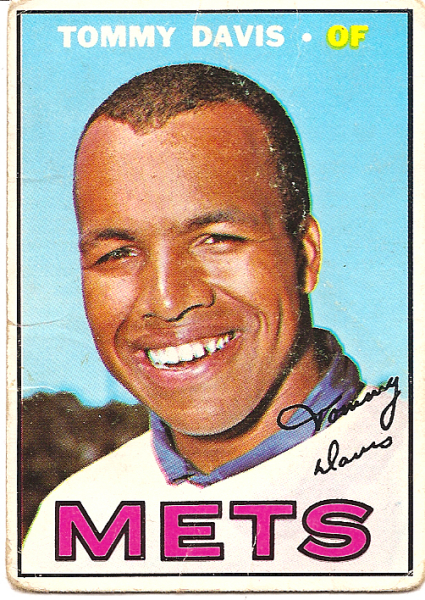
| One of the first Mets cards I ever had my hands on was this one, of Tommy Davis, newly acquired outfielder for 1967. By the time my familiarity with baseball and my baseball team caught up to my earliest collecting, Tommy Davis was somewhere else. He always was. In eighteen Major League seasons, he landed on ten different clubs. The Mets were the second of them.
Tommy was a stud with the Dodgers, particularly in 1962 when he drove in 153 runs and batted .346, leading L.A. to a tie with the Giants at the end of the regular season (the flag went to San Francisco in a three-game playoff, à la 1951). Injury and age made him eventually available to the Mets, who traded Ron Hunt and Jim Hickman for Davis following the 1966 campaign.
I bring this up because Tommy was a guest on Ed Randall’s Talkin’ Baseball on WFAN Sunday morning, recalling fondly his one season as a Met, even though that season was 1967 (61-101), because it represented a homecoming for the Brooklyn native. It wasn’t a bad year at all for Davis who batted .302 for the cellar-dwellers, topping the power-starved Mets in homers with 16 and RBI with 73. For his efforts, he received a single eighth-place vote in the National League Most Valuable Player balloting, good for three points, the strongest MVP endorsement any Mets position player collected in the franchise’s first six seasons.
Given the emphasis on batting average in those days, he probably wouldn’t have drawn even that much support had he not topped .300, a benchmark he cleared by .002 — and it was closer than it appeared, according to what Tommy told Randall. He was playing in the 161st game of the season and batting right around .300 when he stepped out of the box and had a word with Dodger catcher and former teammate John Roseboro. Roseboro wanted to know if something was wrong. Yeah, Davis said, look at the scoreboard, alluding to his average, which was an even .300 and teetering on the edge of ignominy considering the opposing pitcher was Don Drysdale.
“Why didn’t you say so?” Roseboro asked. “What do you want?”
Davis wanted a fastball, of course. As the Dodgers were going nowhere, Roseboro obliged and called for the heat. Davis doubled. His average rose. An inning later, he came out of the game and for the year, his .300+ preserved for posterity.
(The boxscore indicates Roseboro entered the game as a pinch-hitter after Davis left and that Jeff Torborg was catching when Tommy came up, but let’s not ruin a great story with silly accuracy.)
As reward for batting .302, Tommy Davis was traded after the season, to the White Sox as part of the bounty that brought the Mets Tommie Agee, Al Weis and a miracle to be named not too much later. Confronted by the turn of events that occurred in New York after he was sent away, Davis suggested to Randall he’s due at least half a 1969 World Series ring for his in-kind contribution to the Amazin’ cause. The laughter in his voice just about matched the smile on his face as pictured here from forty-plus years ago. |
|
|
by Greg Prince on 21 April 2008 4:25 am I'd throw something, except I'm afraid Chase Utley would launch it toward Independence Hall.
The prospective 146-game winning streak has been snapped at five, which was inevitable, one supposes. But what a way to go.
Maybe Pelfrey was due to be less than a PELF (Pitcher Everybody'd Like to Find), especially without his de facto personal catcher behind the plate guiding him in for a safe landing. Brian Schneider has been a tonic for Pelfrey and the beeg boy hadn't shaken (or “shaked,” as Wayne Hagin put it) him off all year.
But our PELF (hopefully not reverting to Pitcher Everybody'd Like to Fix) kept us in it enough for matters to get tied on his watch. Once it became 4-4, the game fell apart.
From the moment the playing field had been leveled by Ryan Church's run-scoring single…
• Endy failed (but he never gets to play; besides, he's Endy).
• Marlon failed (though we assume he will eventually stop doing that).
• Delgado continued to do nothing (which is exactly what I'd assume about his near-term contributions).
• Feliciano didn't retire the righty Feliz (but did keep Utley in the Cit, so score one for lefty-lefty thinking).
• Castillo did not bunt successfully (surprised?).
• Wright was robbed (by the wind and Howard).
• Beltran was robbed (by Bruntlett and, to a lesser extent, Howard, who isn't quite as bad a first baseman as we'd like to believe).
Just enough went wrong to send the Mets out of their place for a smoke, hopefully not much longer. We saw two evenly matched teams this weekend. If everybody's at full strength later this season, they'll still be evenly matched. We took two of three there and here, so this Mets-Phillies thing by no means shapes up as a total loss, or even a loss — except for the most recent battle of hits…which kind of takes the edge off the fairly recent successes.
I still feel like throwing something.
Pennants, however, aren't won in April. They also aren't won in September. They're won and lost over 162 games. There's no real point to spouting that morsel of wisdom except perhaps to turn the page toward Chicago.
Where Chase Utley won't be tonight or Tuesday.
by Greg Prince on 20 April 2008 6:11 pm Five games into the second year of the long-dormant Mets-Phillies rivalry, I think we can identify what one of these babies feels like.
Torture. Total torture. Put away the waterboarding. Bring on Jayson Werth. That'll make 'em scream.
Here's a Mets-Phillies game in digest form:
The Mets get a lead. The Mets fans get confident. The Phillies lurk. The Phillies creep. The Phillies make it close. The Phillies get a call. The Phillies stir memories of bad endings. The Phillies fans make too much noise.
Sometimes the Mets and the Mets fans get the last laugh. But there's always another game. And there's almost always more torture.
The Mets and Phillies have only been playing for universally acknowledged high stakes since the middle of 2007, though it seems to me the games have always been like yesterday's. They were like this in '06, we just won more often was all. They were like this in '05, there just wasn't as much on the table. There have always been Phillies batters who kept far too many at-bats going past their expiration date, always been Mets relievers wearing a path from bullpen mound to actual mound, always the sense of potential doom lingering over the entire exercise.
This isn't the Mets-Braves rivalry, which works generally as punishment in one park, a touch of lunacy in the other. This is different. This is failing to properly grip the remote because of the sweat that has formed on your channel-changing palm. Not that you want to change the channel from the sixth inning on — sometimes it's just a self-defense mechanism.
Somebody there's slumping. Somebody there's injured. Yet nobody here's ever off the hook. There's always some Phillie that experience wouldn't necessarily dictate your worrying about, unless your experience is that of a Mets fan: Werth, Dobbs, Coste, Taguchi, Victorino. Fans elsewhere would think “good thing those guys aren't Rollins or Utley or Howard.” I don't think we think quite that way…not that we take those more famous guys lightly either.
To say nothing of Pat Burrell.
It's not that we don't or can't beat the Phillies. We've won the last four from them. It took historic hoodoo to finish second to their first. But doesn't it take everything we've got to subdue them every time? And doesn't that take a toll on us eventually? Consider the past three wins over the Phillies:
April 10: Maine goes 6, gives up 1; followed by 6 relievers; Mets win 4-3 in 12
April 18: Santana goes 7+, gives up 3 (K's 10); followed by 3 relievers, Mets win 6-4
April 19: Perez goes 5-2/3, gives up 0; followed by 6 relievers; Mets win 4-2
These were all good, sometimes dominant outings by the Mets starters, yet there was nothing easy about them, nothing certain, nothing that would allow you to breathe long enough to leave in Smith when you can bring in Feliciano, leave in Feliciano when you can bring in Heilman, leave in Heilman…no, it's pretty much down to Aaron at this juncture, let's hope he doesn't have to throw the ball to first. It took almost emptying the bullpen twice in the last three wins against the Phillies, and even when we had our ace going and our ace had his great stuff, it still took three relievers to accumulate six Philadelphia outs.
It was like this last year, too, except for the winning when the going got tough. It's like this as a rule when we face them. Beating them is by no means impossible, but it's rarely easy. Granted, you can't not expect close games against anybody in this league — and managers are prone to overusing their bullpens from one end of baseball to the other — but against nobody else does it feel we're one sagging beam from the roof falling in.
Only solace is playing the Mets seems as daunting a task for the Phillies as playing the Phillies is for the Mets.
by Jason Fry on 20 April 2008 7:13 am Now that I've had a chance to settle into the new season, I've reached the point where I can stop watching baseball so anxiously, investing every out and every pitch with more intensity than it or I can bear for very long. Which is a relief: Until October comes, you can't watch baseball that way. The season is a marathon, not a sprint, and it demands that you pace yourself.
A Saturday or Sunday day game in the spring is the perfect way to remember what you've forgotten. On a day like that, a baseball game can be like an old faithful dog, there in its accustomed spot, content for all of your attention or a passing display of affection, depending on what you can give at that moment. After raucously cheering the Mets pouncing on the Ageless Jamie Moyer in uncharacteristic fashion, I spent much of the rest of the game pottering around the house doing various things that needed doing, following the game from room to room, TV to radio and back, and stopping when key moments were unfolding. (Remember the ad a few years back featuring the soccer fan who had TVs in every room, down to each dresser drawer? That guy's not crazy — it's the rest of the world that's crazy.)
During my wanderings, I was pleased to realize my mental clock had reset itself to baseball units of time. For example, I know from years of experience that the wait between pitches at a tense juncture is exactly enough time to walk from our bedroom to the hall, transfer one armload of wash from the washing machine to the dryer, walk back to the exact spot near the TV where I've been standing for the last couple of batters because nothing has gone too terribly wrong while I'm in that spot, and intone (in this case) “Come on, Heilman! Hit it to anybody!”
For the historical record, that last command was aimed at Jayson Werth in the bottom of the eighth with two out, the bases loaded and the game in the balance. Werth, as it turned out, hit it to nobody, but that was just fine — the ninth pitch he saw wound up in Schneider's glove for a strikeout. A nice bounceback for Heilman, though I didn't much believe his postgame insistence that he'd been thinking only of the pitch he had to make, and not, say, Greg Dobbs's home run the night before or the outfield fence that had to seem about 15 feet beyond the infield or why Angel Pagan had frozen on Carlos Ruiz's little pop two batters before. Heilman's a smart, reflective guy, and that's not always a bonus for baseball players, who tend to do their best when they can follow Ray Knight's dictum that “concentration is the ability to think about absolutely nothing when it is absolutely necessary.” This isn't to claim the ideal baseball player is dumb as a stick — rather, it's to note that a curious mind is more easily distracted from what it needs to be doing, or undone by its own devices.
Werth's at-bat was just one of the mini-dramas of a long, tense game that wound up in our column. There was the eight-minute, 15-pitch at-bat by Eric Bruntlett that forced Oliver Perez out of the game after a very typical O.P. performance — impressive yet inefficient, and so done a bit too soon. The Bruntlett drama was immediately followed by Duaner Sanchez entering to try and check Jimmy Rollins, whose cameo just called attention to how conspicuous he is in his absence. A lot is made of Rollins' fairly ordinary stats, but if the MVP is the player who determines more than any other whether a good team sinks or swims, then the five games against the Phils definitely show why Rollins deserved the award. As for Duaner, his fist pump after stomping on the first-base bag was even more satisfying than his return to action after nearly two years gone — he's now showing up with ballgames on the line, instead of just showing up, which is only a victory once.
And so on to tomorrow night and the chance for a sweep while Joe Morgan praises Odalis Perez's fine performance today. (Sigh.) The over-under on fights between indignant Phillie fans and overamped Met fans who smuggled in brooms? Approximately 200. The value of an early-season statement in the testing of hypotheses of team quality as expressed by Drs. Rollins and Beltran? Unquantifiable, but definitely more than zero. The numbers of hours to go until we find out what'll happen? I don't know when you'll read this, but in all cases the answer is Too Many.
by Greg Prince on 19 April 2008 5:34 am “Can you do something about the fish smell? It's not very appetizing.”
“Oh, I don't think it's that bad. They were only here for about ten days.”
“Ten days was ten days too many. And what's up with the AC? There's hot air coming out.”
“That? That's just some fumes. It's from a couple of weeks ago. Washington…you know, lots of hot air.”
“Uh-huh. Boy, I missed this place.”
“How long has it been?”
“Too long.”
“Records say September 26 of last year.”
“Yeah, whatever. It's good to be back, though.”
“Actually, says here you shared it on the 27th and again on the 29th.”
“I don't count those. You share it, it's not yours.”
“If you say so. Well, it's yours for now.”
“About time. You gonna do something about all this green fur? It's clinging to the carpet, to the chairs. Ick.”
“That's not our responsibility.”
“Since when?”
“You have been out of here a while, haven't you? 'It is the occupant's responsibility to maintain sole residency. Failure to do so…'”
“'Failure to do so will result in sudden eviction.' Don't think I don't remember.”
“Well, you should remember then that the green fur is your problem.”
“Yeech. It's stuck to everything. What did they use? Krazy Glue?”
“I think it was the Champagne. It settled in and formed adhesive properties over the winter.”
“Amazing to think they got to keep this place all winter. They didn't move in until the end of September.”
“You know the rules. Whoever has it at the end of the season gets to keep it…”
“Yeah, I remember the rules.”
“It's not like you didn't spend all of last summer here.”
“No need to remind me.”
“Just wanted to be clear. Staying here is temporary, you know. It's not something you're entitled to.”
“I said I know!”
“No need to snap.”
“Sorry about that. It's just rough looking around and thinking back on everything I missed about this place.”
“Why don't you go ahead and unpack your stuff — that is if you're serious about staying.”
“Oh, I am. I got some great new pieces since you last saw me. Get a load of these…”
“Whoa, those are beauties! How many you got there?”
“Ten. Got 'em all in just seven innings.”
“Impressive.”
“There's more where they came from. They're expensive, but they're gonna be worth it.”
“Those look familiar.”
“These four? I got 'em from that same place I've been going the last few years. Just picked 'em up Friday night.”
“Is that one of each? If it is, we have special parking for cycles.”
“Looks like it, doesn't it? Nah, not quite. That would have been sweet. These four are just fine. They're probably the biggest reason I got back here when I did.”
“You do have some nice pieces. Say, that save looks untouched.”
“The guy who makes them is impeccable. I have to admit I'm surprised about the work he's doing.”
“I'll let you finish unpacking. Boy, it would be a shame if you couldn't set all this stuff up. You seemed so at home here last summer. And the whole year before that.”
“Uh-huh.”
“Well, good luck sticking around. The old joint wasn't the same without you.”
“Tell me about it.”
|
|






