The blog for Mets fans
who like to read
ABOUT US

Faith and Fear in Flushing made its debut on Feb. 16, 2005, the brainchild of two longtime friends and lifelong Met fans.
Greg Prince discovered the Mets when he was 6, during the magical summer of 1969. He is a Long Island-based writer, editor and communications consultant. Contact him here.
Jason Fry is a Brooklyn writer whose first memories include his mom leaping up and down cheering for Rusty Staub. Check out his other writing here.
Got something to say? Leave a comment, or email us at faithandfear@gmail.com. (Sorry, but we have no interest in ads, sponsored content or guest posts.)
Need our RSS feed? It's here.
Visit our Facebook page, or drop by the personal pages for Greg and Jason.
Or follow us on Twitter: Here's Greg, and here's Jason.
|
by Greg Prince on 25 April 2008 5:44 pm Welcome to Flashback Friday: Tales From The Log, a final-season tribute to Shea Stadium as viewed primarily through the prism of what I have seen there for myself, namely 361 regular-season and 13 postseason games to date. The Log records the numbers. The Tales tell the stories.
8/11/84 Sa Pittsburgh 1-5 Gooden 1 11-22 W 3-1
Dwight Gooden’s eleventh Shea Stadium start was the first of his I ever saw in person. No disrespect to the other 87 Mets I’ve seen start at home, but I never looked forward to seeing a pitcher the way I did Doc.
How could you not? He was the sensation of the National League in 1984 — he and the shockingly surging Mets. While I was at school in Tampa during the spring and early summer, I would read descriptions of the scene at Shea and dream about what it would be like to be there for something like this, as related by Jim Kaplan in Sports Illustrated that June.
Dwight Gooden, the Mets’ 19-year-old rookie righthander, was scheduled to pitch against Montreal last Friday night, and the excitement mounted all day in New York. Offices buzzed with talk of his strikeouts. Radio stations led their sports reports with his name. People stampeded the Shea Stadium ticket windows, swelling the crowd to 39,586. Then, as Gooden built up two-strike leads against Montreal batters, the fans went bananas, clapping, screaming, whistling and waving “K” signs.
On that particular night, the Mets didn’t win. They fell to the Expos 2-1, but it was almost beside the point. Gooden struck out eleven Expos, with the fans who had waited seemingly forever for someone like him growing more and more frenzied with every pitch. As Kaplan put it, “the decibel level [was] increasing with each K … It was an occasion, an event, a spectacle … He’s a happening in New York, just as Mark Fidrych and Fernando Valenzuela were in their rookie years in Detroit and L.A.”
Mark Fidrych never came to Shea, but I was there when Fernandomania touched down. That was indeed a happening, even if it was the guy in the wrong uniform causing it. Mike Scott pitched, to that stage of his career, the game of his life, but nobody cared. It was Fernando Valenzuela, the 1-0 winner on May 8, 1981, for whom nearly 40,000 crowded normally moribund Shea. Sombreros were worn. The Mets gave out tortilla chips. It was exciting, if bittersweet, given that it was the visiting starting pitcher at the center of the fuss.
Not the case in ’84. It was all Doc and he was all ours. I would get my first look that counted (after seeing him in St. Pete that March) on a Saturday night against the Pirates in August. It was something to see, something to be a part of.
First up for Pittsburgh, former Met farmhand Marvel Wynne. Doc gets a strike on him. Then another. I’m up and applauding — CLAP CLAP CLAP. Just like I read about. Just like I saw on TV. Guy behind me taps me on the shoulder and asks me to sit down, it’s only the first.
Sorry, I say. It’s just that I’ve waited so long for this.
Wouldn’t take very long to get what I came for. Wynne struck out. I was back on my feet again, applauding wildly and unrhythmically. Doc had one K in the books, one instantly affixed to the facade of the upper deck in left. It was a ritual that would be repeated nine more times. Doc would blaze a fastball by an overmatched Buc. Doc’s curve would drop in for black & gold doom. The DiamondVision would display a shark swallowing a batter. The PA would blare the theme from Jaws. An alphabet of nothing but K’s would be extended.
Everybody was beside himself with joy. Everybody was standing in front of the guy behind him.
Hubie Brooks doubled home two runs. George Foster drove one over the fence. Jesse Orosco registered a save. The Mets won 3-1, but it was almost beside the point. Doc was the point. Doc’s 10 K’s. Doc breaking Jerry Koosman’s team rookie record for strikeouts. Doc being 19 and virtually untouchable.
What could be better than that?
***
It’s easy enough to remember Dwight Gooden’s role in the Dwight Gooden phenomenon. It was his, after all. But you can’t overlook the fans in accounting for what a big, big deal he and his strikeouts were. You can’t think of Dr. K without the literal hanging of K’s in his honor. That was my thinking when, in imagining the Countdown Like It Oughta Be, we had the Mets pay homage to not just Gooden but to those who came up with the K Korner koncept.
I faced one problem, however, in writing up that entry. Who was responsible? I could remember the K’s, I could remember the buzz around them, but I couldn’t remember the names of those who gave life to them. It was a couple of guys, I thought. Or maybe more. Or maybe one. After running some searches, I came up ‘Net-empty. The only clue I had came from Jack Lang’s eternally Amazin’ The New York Mets: Twenty-Five Years of Baseball Magic: a picture whose caption identified three fans hoisting K’s. One was Dennis Scalzitti who was said to have “originated the idea” and the other two were “his cohorts” Bob Belle and Neil Kenny. With at least that much information on hand, I credited them, as a unit, for having “founded the K Korner” and gave them the virtual honor of removing, in conjunction with Gooden himself, number 31 from our fanciful right field wall.
Funny how the Web works. I couldn’t find any concrete background on the K Korner before I mentioned it, but now I’ve been sent some by a person who read that entry. He’s seems a reasonably reliable source:
For the record, The K Korner was created in 1984 by two 22-year old guys from northern New Jersey named Dennis Scalzitti and Leo Avolio, and was present in the left field upper deck (Section 42) at every game Dwight Gooden pitched at Shea Stadium.
Kenny, our source says, was a “rabid” enough Mets fan, but just happened to be in the right place at the right time when the photo that wound up in the book was snapped. In ’84, it was Scalzitti and Avolio, from Doc’s early starts (when only diehards were in attendance) to his explosion onto the national stage, who were tracking strikeouts. Soon, with ESPN taking note, the K Korner was as famous as the Doctor himself.
Scalzitti’s distinctive handpainted red K’s on white posterboard hanging from the left field upper deck railing became a familiar and recognizable icon that summer, and fans were quick to jump on the bandwagon and get caught up in all the excitement of “swaying for a K” after Dwight got two strikes on a hitter.
1984 ended with Doc winning Rookie of the Year honors, but only half of the K tandem willing to see their phenomenon through to ’85.
Leo indicated he didn’t want to make the commitment to make the trek to Shea Stadium from Jersey anymore. Dennis begged to differ, and believed their efforts would lead to bigger and better things down the road. Regardless, Leo dropped out. In 1985 Scalzitti recruited his high school buddy Bob Belle as a replacement, and that was the year Gooden electrified the baseball world with one of the single greatest seasons any pitcher has ever had.
Indeed, Doc went 24-4 with a mind-blowing 1.53 ERA and 268 more strikeouts to go with the 276 from the season before. Doctor K was clearly established in his practice and those who hung out his shingle were steadfast in their support.
Dennis and Bob were besieged with newspaper and television interviews, as well as four appearances on The Joe Franklin Show. Their names, along with the trademarked name of “The K Korner,” were now a part of New York baseball history. Dennis and Bob marketed their K cards, t-shirts and bandanas via a mail-order company and received orders from all over the country as Mets fans everywhere got caught up in strikeout fever.
The next year was stupendous for the Mets if only pretty darn good for Dwight Gooden (17-6, 2.84 ERA, a mere 200 strikeouts). Yet it wasn’t at all bad for the K Korner duo.
Dennis and Bob signed a shoe contract with Nike. To date they are the only two fans to sign a contract of this sort. Nike reached out to Scalzitti and Belle and provided them with 27 laminated blue & orange K’s with a flaming baseball in the center. This logo would appear on a full line of “Dr. K” shoes and merchandise later in the year, and the executives at Nike felt they would achieve maximum exposure if the logo was promoted in The K Korner. At that time, Mike Lupica of the New York Daily News applauded this business deal and called Scalzitti an entrepreneur. The “K-men” were invited to some celebrity events that season, and were seen rubbing shoulders with everyone from Bob Murphy and Ralph Kiner to Nelson Doubleday, Frank Cashen, Mayor Ed Koch and Carly Simon. Security guards were provided (at Scalzitti’s request) to protect them from some of the more “enthusiastic” fans, and they posed for photos and autographed everything from baseballs and scorecards to a girl’s chest.
With the 1986 World Series won, the K Korner crested. One K went to Kooperstown, driven there personally by Dennis. One more trip to Joe Franklin’s show came, too, though it was a sad one. Dennis and Bob went on to announce they were giving up their perch. This was in the spring of ’87. The innocence surrounding Dwight Gooden had been sapped. But the memories would remain and are as indelible as those K’s.
Two games will forever stand out in my mind: Dwight had 16 K’s against the Pirates in late September 1984 and another 16 against the Giants in 1985. The entire stadium was just going completely NUTS!!! It was beyond description.
Anybody who watched Doc pitch then would agree, but I put particular stock in these recollections of what was “truly a magical time” at Shea Stadium. Why, you may be wondering, should we take this source’s word for it?
Because I lived it…I was there. My name is Dennis Scalzitti.
Yes, the Dennis Scalzitti, then the guy who started playing up the K’s, today the North Jersey-based owner of Coconut Joe’s Music-To-Go, a full-time DJ service. Apparently he still likes making people happy. His K partner Bob Belle, meanwhile, seems to have taken his inspiration from the likes of Gary Carter and has gone into a segment of the cleanup business. In writing to us here, Dennis had just one request:
Please make sure to let the fans know how much we appreciated their incredible enthusiasm and support from 1984 to 1986. Not even ONE time did we ever get harassed or given a hard time by the people sitting around us when we were standing up or running up and down the aisles whipping everyone into a frenzy. The fans were just so cool, and it’s very important they know how we fed off their energy and truly enjoyed being there to provide some entertainment for them.
This Friday’s Flashback turned out to be as much Dennis’s as mine, but that’s all right. I wouldn’t remember Doc’s eleventh Shea start so fondly if it weren’t for what Dennis began doing at the outset of ’84, for the passion he unleashed in the rest of us. That’s why you can’t tell the story of a stadium via only its ballplayers. That’s why sometimes, at the risk of being rude, you just can’t sit down, no matter what the guy behind you says.
Another tale of another fan of another team from another ballpark in another time, very much worth reading here.
by Greg Prince on 25 April 2008 2:47 pm They've got all kinds of banners and signs posted in Nationals Park. They might want to add this one around first after last night:
Under this glove pass the loveliest double play balls in the world.
To paraphrase from Jackie Mason's description of Ronald Reagan's presidency, Carlos Delgado is a wonderful baseball player, a terrific baseball player, a marvelous baseball player…it's just that baseball isn't his field.
Cripes. I know Oliver Perez decided to start the second game of a doubleheader in the middle of the one that was going just fine…and Aaron Heilman joined Jorge Sosa in popularizing the new Mets bullpen slam dance craze…and that Angel Hernandez remains, as my partner pointed out to me, an unindicted war criminal…but it was Delgado's inability or unwillingness to bend sufficiently down that I recall most miserably this groggy Friday morning. Carlos can be pissed off at the Worst Umpire in the World for smirking and muttering his calls, but he should be more pissed off at himself. Twenty-two, twenty-three guys who dress similarly can feel the same way.
So much for the knock on the Mets that they only win against lousy teams since they didn't do even that much Thursday — though to be fair, they did kind of defeat themselves.
Your 2008 Mets: They could be better, they could be worse, they don't look, after an eighth of a season, like they'll have much to do with the playoffs. And I could make pretty much the same assessment of Nationals Park…which I'll get around to doing in the very near future.
by Jason Fry on 24 April 2008 4:27 am Less than an eighth of the season is gone, which isn't anywhere near enough time to draw conclusions about a player, team or pennant race. But we're fans — what are we supposed to do, turn off the set and take the long view? Nah, we draw conclusions every night, shifting our stances until eventually all is said and done and what happened looks inevitable. (And more often than not we say we knew it all along.)
The conclusion about the 2008 New York Mets, fresh from Game 20? It's that they're stupendously average.
Yeah, they beat up on bad teams — particularly teams as punchless and inept as the Nationals, who right now are trying Manny Acta's much-revered patience with their complete inability to do anything. Yet they then, in turn, get beaten up by better teams — witness the recent manhandling by the Cubs, and the earlier unpleasantness inflicted by the Brewers. That's a classic sign of an average team. So too is the complete inability to have any kind of momentum — the Mets went from playing tight, taut ball against the Phillies (albeit the Jimmy Rollins-less Phillies, who are a very different club) to looking mopey and confused against the Cubs. That too fairly screams “average.” And — again, like average teams since time immemorial — they make it all but impossible to think that all will be fine once Problem X is solved, because Problem X keeps mutating. One night it's the crappy middle relief. The next night it's the thin bench. The night after that it's all those aging regulars in extended spring training. Give it another night and it's all the nagging injuries. And more and more nights, it's thinking that moving Castillo and Delgado around in the batting order just obscures the real possibility that the best spot for them both is in someone else's batting order. (Except Delgado is untradeable and Castillo is untradeable and will still be untradeable in fucking 2011, when he'll likely be playing second base by dragging himself around on his hands in a box, like Eddie Murphy in “Trading Places.”)
Yet every fifth day things are different. Every fifth day we know there's a good chance Johan Santana will remind us how above-average baseball players can be.
Tonight while I was hustling Joshua through some part of his bedtime routine, I heard Emily yelp, “I love Johan Santana!” Why? I couldn't guess — because there were too many answers to that question. Was he cutting through Nationals like a combine? He did that. Was he making a superb fielding play? He did that too. Was he helping his own cause by cracking a double? Hell, he did that twice.
Watching Santana, you feel like Met fans of a different generation must have felt watching Tom Seaver in '67 or '68 — a great player willing a less-great team to keep up with him, daring and all but demanding they be great as well. Which is fine, except we aren't supposed to be watching the '67 or '68 Mets. The '08 Mets supposedly have greatness within them. They're supposedly the class of the National League. Maybe in the Lake Wobegon League, but not here, not so far.
This isn't to say the new season is without its pleasures. There's baseball on a warm spring night, which is one of the grander parts of life whether you're 11-9 or 9-11 or 3-17. (OK, maybe if you're 6-14. Let's not overdo it.) There's the sharp, smart play of Brian Schneider and Ryan Church, which hasn't erased wondering why Lastings Milledge was exiled, but has lessened the sting. There are the feel-good stories of Angel Pagan and Nelson Figueroa and Duaner Sanchez, though one hesitates before proclaiming the rest of the chapters will be so uplifting. There's Billy Wagner, literally unhittable so far. (Though you know one of the next three guys he faces will get a hit. He's a Met, ain't he?) There's watching David Wright become an even better baseball player than he was last year, and wondering just where his ceiling lies.
All of that is nice. But it's not the same here-we-go oomph of watching Johan — and there's the problem. Every fifth day may be something to look forward to, but the other four were supposed to be must-see stuff too.
(Too gloomy? Quite possibly. Greg will be along by morning with a first-person report from D.C., which might be more cheerful. Though I doubt he'll be able to shed any light on that weird home-plate camera angle we kept seeing tonight. Kind of like watching baseball from a low-flying plane or a Tom Clancyesque spy satellite, wasn't it?)
by Greg Prince on 23 April 2008 4:00 pm 13: Sunday, September 7 vs Phillies
It is not exactly a family secret, ladies and gentlemen, that the Mets who took up residence in Shea Stadium 44 years ago weren't worldbeaters. Their records in the Polo Grounds? 40 and 120, 51-111. The trend continued for the first two seasons at Shea: 53 and 109, 50 and 112. Saying the Mets finished tenth four straight years was a nice way of saying they couldn't finish twentieth. That is why as much as the fans were in love with their team, they also came out to admire some of the great stars the National League had to offer in those days.
Today we have one of the greatest with us. Simply put, he personifies pitching — inconceivably excellent pitching — for a generation of baseball fans and remains the standard by which every flamethrowing lefthander who comes along is evaluated. A native of Brooklyn and a good friend of the Mets organization every spring, please welcome back to Shea Stadium, Sandy Koufax.
Now, as happy as we are to have Sandy visit us today, we have to admit he is not here solely for his own accomplishments, as plentiful as they are. You see, Sandy inadvertently became a yardstick for measuring what, in retrospect, may have been the first significant leap of progress in Mets history. You might even call it the first Mets miracle.
Not that Sandy Koufax didn't pitch well against all comers, but he enjoyed an incredible hold over Mets hitters from 1962 on, racking up a 13-0 mark over his hometown team by the latter portion of their fourth season, a résumé that included his first no-hitter. The idea that a ragtag bunch like the Mets could ever defeat Koufax…well, that seemed impossible to Mets fans who could only dream of competing on anything approaching his level.
But the impossible turned actual on August 26, 1965 when Sandy Koufax was outlasted — it seems blasphemy to say outpitched — by another lefty, this one just shy of his 21st birthday. The southpaw the Mets sent to the Shea mound that Thursday had all of one major league victory to his credit, but his performance earned him another. The great Sandy Koufax and the eventual world champion Dodgers were beaten 5-2, the first loss ever taken against the heretofore hapless New York Mets by the indomitable immortal.
The winning pitcher? An up-and-comer named Frank Edwin “Tug” McGraw.
As you know, ladies and gentlemen, it wasn't the last time Tug McGraw would have something to do with miraculous events at Shea Stadium. Tug would eventually convert from starter to reliever, become one of the best in the National League at closing games and then, in the summer of 1973, begin spouting a phrase that helped inspire the Mets on an Amazin' journey from the bottom of their division to the top of the flagpole.
Nobody pitched like Tug McGraw did down the final weeks of 1973 and nobody ever believed the way he did…or made Mets fans believe so wholeheartedly that anything is possible.
No individual in the history of this franchise or this ballpark represents the spirit of the New York Mets like Tug McGraw. Nobody ever showed a love of life or baseball more in or out of a Mets uniform. To honor his memory today in our Countdown Like It Oughta Be, we ask his onetime opponent, Hall of Famer Sandy Koufax, and his son, one of the most beloved recording stars in the music world, Tim McGraw, to take down number 13 for someone who brought this team better luck, greater hope and deeper faith than any Mets fan could have ever aspired to before he came along.
Number 14 was revealed here.
by Greg Prince on 23 April 2008 3:09 am Afternoon games at Wrigley…idyllic, no?
No?
Not this one. And that was the only one we get for 2008, which is OK from here. The Cubs are good and the Mets are relentlessly so-so, making it difficult to enjoy the ivy for the trees. The charm of America's most charming ballpark dissipates when you're losing 8-1 the day after the night you lost 7-1.
You can analyze the poor fielding by Delgado and the poor hitting by Delgado and the poor relieving by Delgado (what fun is blaming Jorge Sosa?), but I won't. The Mets defy useful analysis at the moment. The slippery slope of trying to unravel their ennui runs from “what's wrong now?” to “what's wrong tomorrow?” to “will it ever be righted?” and in about 15 seconds you're hosting one of those enlightening shows on SNY wherein second-tier WFAN talent shouts each other down for half an hour.
Let's go back to Wrigley instead. It looks so good on television. It looks so good in real life. It looks great in daylight. Get Ronny Cedeño the bleep out of there and you can't do any better for a few hours' commune with nature and baseball.
It boggles the mind to realize that not only was the darn thing built in 1914, it was built to play home to a Federal League team. A Federal League team, for cryin' out loud. Shea was sort of planned for a Continental League team, but it's not quite the same. Nothing's the same as Wrigley, no matter how many bricks are used by those who would be inspired by it. Compared to Wrigley Field, all those places are brick teases.
'Twas pointed out by Gary and Ron how Wrigley's the “template” for so many of the retro parks of the modern age — though not for limestone-based Nationals Park, the Mets' next stop and mine, too. We won't be seeing any more of Wrigley Field this season though a Mets prism, but we may as well get used to what they've got in D.C. as we play them down there nine times this year and nine or ten times every year for years to come. (Rumor has it we play nineteen different clubs in 2008, but mostly we seem to play the Washington Nationals.)
I look forward to telling you what it's like on the inside. If the Mets play the Nats like they did last week, it will be a far nicer place than Wrigley Field was this week.
by Greg Prince on 22 April 2008 3:00 pm 14: Saturday, September 6 vs Phillies
Ladies and gentlemen, this afternoon for our Countdown Like It Oughta Be salute, we honor one of the most memorable seasons in Mets history. In many ways, “season” is an overstatement because this Mets team did all its important business in the span of about six weeks. No team ever accomplished so much in so little time. You could even call them the patron saint of lost baseball causes, because after the world saw what the 1973 Mets could do after being in last place at the end of August, no team could ever lose faith in its chances again.
The essentials of this particular Met miracle have been handed down over 35 years now, but the telling never gets old. On August 30, the New York Mets were a last-place team. On October 10, the New York Mets were National League champions. You've heard it a thousand times if you've heard it once that it wasn't over 'til it was over and that you had to — absolutely had to — believe, but there is a well-kept secret about those 1973 Mets.
They had some pretty good players. If injuries hadn't gotten in their way, maybe the flag they earned would have come about in a more conventional manner. But then we wouldn't have the story to tell and retell, and we sort of enjoying doing that.
Let's meet nine of your 1973 New York Mets right now. They were all, to say the least, pretty good players.
We'll start on the mound, where manager Yogi Berra could depend on depth that was the envy of the other skippers in the N.L. East. For example, few teams had the luxury of a proven lefthanded veteran — a 20-game winner no less — filling in as a swingman, starting or relieving as needed and providing great leadership every step of the way. This man delivered all that and more to the Mets across five wonderful seasons in New York. Welcome back the southpaw Ray Sadecki.
Another pitcher who could take the ball in whichever inning was necessary enjoyed his first full season in the majors in '73 and boy did he make the most of it. An 8-4 record with 5 saves to boot, he was a rock for pitching coach Rube Walker. Give a warm hand to Harry Parker.
Also coming up to stay in 1973 was a righty with a world of promise, talent that would show itself most noticeably a year later when he led the National League in earned run average. He defended the honor of the Mets against Pedro Borbon and the Reds in the NLCS, proving his versatility as a fighter as well a pitcher. Let's have a big round of Shea Stadium applause for Buzz Capra.
Of course when you mention versatility in the context of the 1973 Mets, you have to mention the man who filled in so ably while so many regulars were on the shelf. He played short, third, second, left and center, and he handled them all like the pro he was. Say hi to old friend Teddy Martinez.
Our next two guests from the summer of '73 have to come out together, but they're going to be careful. They gave the Shea crowd quite a scare on July 7 when they collided at the left field wall in pursuit of a Ralph Garr fly ball. It wasn't pretty, but both players were typically giving it their all. Safe and sound, let's welcome home Don Hahn and the Stork, George Theodore.
If the pennant achieved by the '73 Mets is viewed as a surprise, then this fourth starter's accomplishments probably shocked a few people. He was a capable pitcher for his former team, but when he came to the Mets, he simply excelled, posting a 12-3 mark and making a case for the ages that he sure would have looked good taking the ball in Oakland during the World Series. We remember him fondly today as we greet him in Queens, ladies and gentlemen, George Stone.
George had some company in coming to the Mets from the Braves. His companion was one of the best second basemen in the National League, a title he maintained when he arrived in New York. Not only was he a surehanded fielder and the steadiest of hitters, he was an instant fan favorite. One of the most popular Mets of his or any day, let's hear it for someone who inspired a million area kids to choke up on their bats as high as they could, Felix Millan.
And to lead our group of 1973 National League champions to the right field wall to remove number 14 is a Met who burned hotter than just about any of his teammates down the stretch drive. Six homers, 17 ribbies, a .323 average, an Amazin' glove at third. He was so hot, it was probably more than genetics that caused his hair to glow a bright red. Ladies and gentlemen, one of the true Met stalwarts of 1973, Wayne Garrett.
Number 15 was revealed here.
by Greg Prince on 22 April 2008 4:48 am CHICAGO (FAFIF) — The Mets lost 7-1 at Wrigley Field Tuesday night, which came as something of a surprise to this reporter who nodded off on the couch with the Mets behind 2-1 in the eighth.
“How the fuck did it get to be 7-1?” this reporter wondered upon waking and observing the final score.
The Cubs scored five runs while this reporter napped, leading him to believe some combination of Aaron Heilman and Willie Randolph must have been doing the same thing.
“Shit,” he said. “Five runs! How the fuck did that happen? Fucking Heilman? Fucking Willie? Fuck!”
In the portion of the game for which this reporter managed to stay awake, the Mets offense sputtered while John Maine was outpitched by Carlos Zambrano.
“Fucking Maine,” this reporter noted. “And fucking Zambrano, while we're at it. Fuck!”
The Cubs took a 2-0 lead while this reporter had switched away to watch Countdown With Keith Olbermann on MSNBC. Usually this reporter switches back and forth between Countdown and the game frequently during the 8 o'clock hour, but Keith was interviewing Hillary Clinton, which “seemed newsworthy enough seeing as how it's obvious Keith can't fucking stand her,” this reporter surmised. Upon turning back to SNY after a 20-minute absence, this reporter learned Aramis Ramirez had homered off Maine.
“Fucking Ramirez,” this reporter said. “Hillary's a fucking Cubs fan, too.”
The Mets got a run back when Endy Chavez doubled and eventually scored on a Jose Reyes double play.
“How the fuck does Jose Reyes hit into a double play?” this reporter asked himself. “They're always saying how rare it is, yet it seems to happen twice a week.
“Fuck!”
Even before things began to go against the Mets, this reporter admitted he wasn't really paying very close attention to the game.
“I thought it was going to start at 8 o'clock like they usually do in Chicago,” he said. “Then I turned on the FAN around 6:30 and they were doing the pregame show. 'Fuck,' I thought, 'ESPN's doing the game, it starts at 7.'”
The mildly surprising starting time caused a brief controversy as this reporter was expecting he and his wife would do their usual Monday night grocery shopping between 7 and 8.
“She didn't feel like it any more than I did,” this reporter explained. “Good, I get to watch the game from the start. But it was weird. I wasn't really into it. Go figure.”
Game notes
This reporter agreed to pick up “some crap we're probably running out of,” including milk, at the store Tuesday. … Delgado fucking sucks. … Moises Alou is expected to come off the 15-day disabled list later this week. … Moises Alou is expected to go on the 15-minute abled list soon after. … Castillo kind of sucks, too.
by Greg Prince on 21 April 2008 9:06 am 15: Friday, September 5 vs Phillies
Ladies and gentlemen, tonight we pay tribute to one of the seven Mets teams whose identity is inscribed above the right field wall where we are revealing the numbers that indicate how many games remain in the life of Shea Stadium. This one, however, is not easily summarized by the titles to its credit.
True enough the 1999 New York Mets won a Wild Card and true enough they won a division series. But as we approach a decade's worth of retrospection on that one-of-a-kind Mets season and postseason, we begin to appreciate what a unique club that was. It clawed, it scratched, it never gave up and more times than maybe any other edition of this beloved franchise, it recovered its bearings and lived to fight one more day when no sane observer would have given it the chance to remain on its feet.
The 1999 Mets won a Wild Card and won a division series. It also won a place in the hearts of Mets fans who lived through that season and won't ever forget it.
To commemorate the achievements and the amazement engendered by the '99 Mets, we have brought eleven of them back tonight to remove number 15 as part of our Countdown Like It Oughta Be.
First up, he was often the last man standing in manager Bobby Valentine's bullpen, putting the length in long relief. You couldn't play extra innings without him, please welcome Pat Mahomes.
He was the starting pitcher for the first Mets postseason game in eleven years and the starter at the beginning of the Mets' longest October night. A real stalwart for Bobby V in the late '90s, how about a nice hand, all the way from Japan, for Masato Yoshii.
Even the long games moved fast when this outfielder was in the lineup because he brought as much speed to the top of the order as any Met in team history, setting a standard for stolen bases that endured for eight seasons. Give a big hand to the sparkplug of those 1999 Mets, Roger Cedeño.
Speaking of the top of the order, no baseball player in the history of the game has led off the way this Hall of Famer to be did across a career that spanned 25 seasons. Only one-and-change was spent in a Met uniform, but he made the most of it, hitting .315 in 1999 and continually building on his all-time Major League stolen base mark. We're thrilled to see him at Shea one more time, the immortal Rickey Henderson.
Like Rickey, this next '99 alumnus is more famous for what he did in the garb of another organization, but we're not here to talk about that part of his past. Instead, we are delighted to recall the yeoman work he put in throughout the regular season as a dependable starter and how he threw himself into the role of reliever when called on in the playoffs. Ladies and gentlemen, the Bulldog, Orel Hershiser.
Orel and every pitcher who pitched in front of him would tell you there was nothing more comforting than knowing that if you threw a ground ball, this next Met was there to track it down. He made all the plays, including not a few unbelievable ones, in setting a Major League record for consecutive errorless games as a shortstop in 1999. The winner of three Gold Gloves and someone who lit up Shea Stadium with his defense, let's remember the good times and say hello to Rey Ordoñez.
He was a Met ever so briefly in 1999, but boy did he make an impact. As the hour grew late and the circumstances grew dire, this battle-tested veteran fouled off pitch after pitch until he found one to his liking and singled. In doing so, he set up one of the most mind-boggling rallies in the history of this ballpark. He was gone by 2000, but he's back now and we couldn't be happier to greet Brooklyn's own Shawon Dunston.
Every successful team needs someone to emerge from nowhere and this utilityman was just that mystery guest in 1999. His clutch hitting and heads-up baserunning on the final scheduled date of the regular season pushed the Mets toward the playoffs, and once they arrived, he was literally all over the place, showing off an arm that registered crucial assists from all three outfield positions. He even waited for the NLCS to launch his very first big league homer. We thank the Baltimore Orioles for giving him the night off to join us back where it all started for him. Give a great big Shea Stadium welcome home to Melvin Mora.
Think ice cream. Think cotton candy. Think the sweetest treat you've ever tasted. Now think of the sweetest swing you ever laid eyes on and you have some idea of what our next guest was like to watch in the batter's box. The architect of some of the biggest moments of the late 1990s, this three-year Met made the most of his time at Shea, ringing up the highest single-season batting average in team history in 1998 and driving in key run after key run in the 1999 postseason. He left New York to be closer to his family across the continent but he returns to us tonight, still loving the city that never stopped missing him. Ladies and gentlemen, the first baseman, John Olerud.
In a town where every Broadway understudy dreams of that one big break, our next 1999 alumnus lived the dream. Called on to substitute for a matinee idol, this so-called backup catcher hit the only home run to ever win a postseason series at Shea Stadium. His power display may have been a surprise, but the fact that he'd “roll” to the occasion shouldn't have been because, after all, isn't rolling what a Tank does? The one and only…Todd Pratt.
Todd, as fate would have it, would have to share the 1999 postseason spotlight where Amazin' dramatics were concerned with a teammate who also hit a ball over the Shea wall. Funny, though, it wasn't a home run, thanks mainly to Tank himself who maybe couldn't bear the thought that anyone else would be credited with as dazzling a four-bagger as his. Or maybe it was just that trademark Met exuberance that was such a big part of the '99 campaign. At any rate, our final 1999 Met, the man who will take down 15 — as in 15 innings — was the Gold Glove cornerstone of the infield recognized by many as the best in the history of the game; the heart of perhaps the best batting order the Mets have ever sent to the plate day in and day out; the clubhouse leader who made the Mojo rise; and, of course, the batter who came up with the bases loaded and walloped the longest single anyone has ever seen. Leading his teammates to the right field wall — and accompanied by Red Foley, the official scorer from Game Five of that unforgettable 1999 National League Championship Series…he was just doing his job — ladies and gentlemen, Robin Ventura.
Numbers 19-16 were revealed here.
by Greg Prince on 21 April 2008 6:22 am 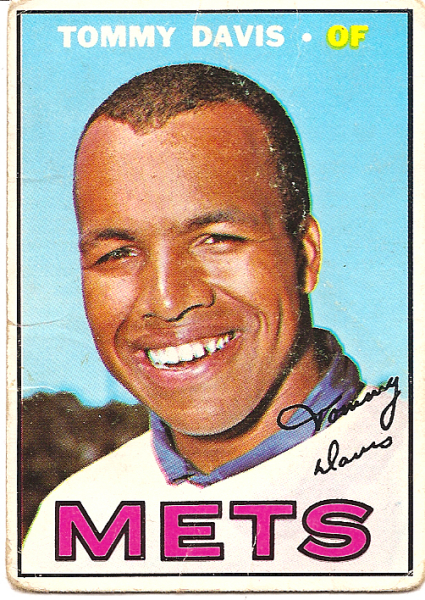
| One of the first Mets cards I ever had my hands on was this one, of Tommy Davis, newly acquired outfielder for 1967. By the time my familiarity with baseball and my baseball team caught up to my earliest collecting, Tommy Davis was somewhere else. He always was. In eighteen Major League seasons, he landed on ten different clubs. The Mets were the second of them.
Tommy was a stud with the Dodgers, particularly in 1962 when he drove in 153 runs and batted .346, leading L.A. to a tie with the Giants at the end of the regular season (the flag went to San Francisco in a three-game playoff, à la 1951). Injury and age made him eventually available to the Mets, who traded Ron Hunt and Jim Hickman for Davis following the 1966 campaign.
I bring this up because Tommy was a guest on Ed Randall’s Talkin’ Baseball on WFAN Sunday morning, recalling fondly his one season as a Met, even though that season was 1967 (61-101), because it represented a homecoming for the Brooklyn native. It wasn’t a bad year at all for Davis who batted .302 for the cellar-dwellers, topping the power-starved Mets in homers with 16 and RBI with 73. For his efforts, he received a single eighth-place vote in the National League Most Valuable Player balloting, good for three points, the strongest MVP endorsement any Mets position player collected in the franchise’s first six seasons.
Given the emphasis on batting average in those days, he probably wouldn’t have drawn even that much support had he not topped .300, a benchmark he cleared by .002 — and it was closer than it appeared, according to what Tommy told Randall. He was playing in the 161st game of the season and batting right around .300 when he stepped out of the box and had a word with Dodger catcher and former teammate John Roseboro. Roseboro wanted to know if something was wrong. Yeah, Davis said, look at the scoreboard, alluding to his average, which was an even .300 and teetering on the edge of ignominy considering the opposing pitcher was Don Drysdale.
“Why didn’t you say so?” Roseboro asked. “What do you want?”
Davis wanted a fastball, of course. As the Dodgers were going nowhere, Roseboro obliged and called for the heat. Davis doubled. His average rose. An inning later, he came out of the game and for the year, his .300+ preserved for posterity.
(The boxscore indicates Roseboro entered the game as a pinch-hitter after Davis left and that Jeff Torborg was catching when Tommy came up, but let’s not ruin a great story with silly accuracy.)
As reward for batting .302, Tommy Davis was traded after the season, to the White Sox as part of the bounty that brought the Mets Tommie Agee, Al Weis and a miracle to be named not too much later. Confronted by the turn of events that occurred in New York after he was sent away, Davis suggested to Randall he’s due at least half a 1969 World Series ring for his in-kind contribution to the Amazin’ cause. The laughter in his voice just about matched the smile on his face as pictured here from forty-plus years ago. |
|
|
by Greg Prince on 21 April 2008 4:25 am I'd throw something, except I'm afraid Chase Utley would launch it toward Independence Hall.
The prospective 146-game winning streak has been snapped at five, which was inevitable, one supposes. But what a way to go.
Maybe Pelfrey was due to be less than a PELF (Pitcher Everybody'd Like to Find), especially without his de facto personal catcher behind the plate guiding him in for a safe landing. Brian Schneider has been a tonic for Pelfrey and the beeg boy hadn't shaken (or “shaked,” as Wayne Hagin put it) him off all year.
But our PELF (hopefully not reverting to Pitcher Everybody'd Like to Fix) kept us in it enough for matters to get tied on his watch. Once it became 4-4, the game fell apart.
From the moment the playing field had been leveled by Ryan Church's run-scoring single…
• Endy failed (but he never gets to play; besides, he's Endy).
• Marlon failed (though we assume he will eventually stop doing that).
• Delgado continued to do nothing (which is exactly what I'd assume about his near-term contributions).
• Feliciano didn't retire the righty Feliz (but did keep Utley in the Cit, so score one for lefty-lefty thinking).
• Castillo did not bunt successfully (surprised?).
• Wright was robbed (by the wind and Howard).
• Beltran was robbed (by Bruntlett and, to a lesser extent, Howard, who isn't quite as bad a first baseman as we'd like to believe).
Just enough went wrong to send the Mets out of their place for a smoke, hopefully not much longer. We saw two evenly matched teams this weekend. If everybody's at full strength later this season, they'll still be evenly matched. We took two of three there and here, so this Mets-Phillies thing by no means shapes up as a total loss, or even a loss — except for the most recent battle of hits…which kind of takes the edge off the fairly recent successes.
I still feel like throwing something.
Pennants, however, aren't won in April. They also aren't won in September. They're won and lost over 162 games. There's no real point to spouting that morsel of wisdom except perhaps to turn the page toward Chicago.
Where Chase Utley won't be tonight or Tuesday.
|
|






