The blog for Mets fans
who like to read
ABOUT US

Faith and Fear in Flushing made its debut on Feb. 16, 2005, the brainchild of two longtime friends and lifelong Met fans.
Greg Prince discovered the Mets when he was 6, during the magical summer of 1969. He is a Long Island-based writer, editor and communications consultant. Contact him here.
Jason Fry is a Brooklyn writer whose first memories include his mom leaping up and down cheering for Rusty Staub. Check out his other writing here.
Got something to say? Leave a comment, or email us at faithandfear@gmail.com. (Sorry, but we have no interest in ads, sponsored content or guest posts.)
Need our RSS feed? It's here.
Visit our Facebook page, or drop by the personal pages for Greg and Jason.
Or follow us on Twitter: Here's Greg, and here's Jason.
|
by Jason Fry on 10 April 2008 3:33 am What we wanted was Met domination — Pelfrey to somehow rise from the prospect-turned-suspect dead and show no rust after being a spectator for an entire road trip, Delgado to bang more homers off the scoreboard and fewer throws off Chase Utley, Jose Reyes to work counts and lace liners and race around second, Beltran and Wright to be Beltran and Wright, and Angel Pagan to keep being someone who bears no particular resemblance to the historical Angel Pagan. We wanted the Mets we loved in 2006 and the first two months of 2007, as opposed to the listless impostors who showed up for the last four months of 2007 and then reacquainted themselves with us at Shea yesterday by stumbling over their own feet. And we wanted it so badly that we were squeezing programs to pulp and beer bottles to metal shards and levitating our caps on little puffs of steam. The Phillies may or may not be in the Mets' heads, to revisit this morning's tedious newspaper theme, but there can be no doubt that they're in ours. After 45-odd years of scarcely noticing we shared a division with them, we now see them in every shadow. They're under our beds, in our closets, and the cops just called to say they've been phoning us from somewhere inside the house, asking if we've checked on the children.
AUUGGHHH!!! BEHIND YOU! PHILLIES!
What we wanted was for the Mets we used to know to show up, turn on the lights and demonstrate that there are no maroon-and-gray monsters in the closet. But dominance isn't like turning on a switch, and so not surprisingly we didn't get what we wanted.
But what we did get was probably what we needed: a laugher that was kind of on both of us.
What we got was a stupefying, goofy, doofy mess of a game — proof that the baseball gods are fickle and cruel but also downright weird. The way they tormented Pelfrey by asking him to get a key ground ball again. The way they tormented Kyle Kendrick by making an 0-2 count child's play and then shrinking the plate to the size of a postage stamp. The way they lit out after Eric Bruntlett like Furies for the crime of not being Jimmy Rollins. The Phillies played a horrible game, the kind of game that makes you grind your teeth and mutter that instead of kicking the other guy's teeth in and making a statement, your guys showed up in clown paint and fell down for a while and then crawled offstage. But we didn't exactly paint a masterpiece ourselves, not with Reyes heaving a ball over Easley's shoulder or the bases being left loaded repeatedly or Pelfrey following up admirable early innings with so-so middle innings that brought the bullpen in too early once again.
It was goofy and doofy and messy, but it was a win. So there! The Phillies' coach is so mad at them that he wouldn't take them to the Tastee-Freez, and our bus just zoomed by the Tastee-Freez without stopping, but at least we're getting to bounce on the seats and sing “99 Bottles of Beer on the Wall” without getting yelled at. And tomorrow? Tomorrow we might win and not make lots of mistakes. And then I'm totally getting fudge and butterscotch and that weird pineapple stuff nobody gets. You just see if I won't.
by Greg Prince on 9 April 2008 8:10 pm 28: Tuesday, August 5 vs Padres
Ladies and gentlemen, often this season as part of our Countdown Like It Oughta Be, we have saluted some very, very long nights in the history of Shea Stadium. It didn't get any longer or later, however, than it did on the night of September 11 — and the morning of September 12, 1974. Let's just say if you were here from first pitch to last pitch, you developed a new understanding of the phrase “in for the duration”.
Twenty-five innings played. Fifty players used. Seven hours and four minutes of action. Ten major league records set, including longest night game ever played. Approximately 1,500 fans in attendance when Sonny Siebert struck out John Milner to seal the 4-3 win for the Cardinals. Behind the plate for every ball and strike: umpire Ed Sudol, who officiated the Mets' 23-inning game here in 1964 and the 24-inning game they played in Houston in 1968.
And on Channel 9 after the game? Kiner's Korner, of course.
To remember the night Shea nearly greeted the sun, we've brought back a few old friends to remove number 28.
While Ed Sudol manned the plate, this longtime National League ump monitored the goings-on around third. Please welcome Frank Pulli.
A young man who collected a couple of hits that night…in eleven at-bats, more than anybody else. Say hi to Dave Schneck.
He made his Major League debut as a pinch-runner in this game and must have wondered, “Is it like this every night?” A real Shea fan favorite, Bruce Boisclair.
The Mets' pitcher of record, though I think we'd all agree it was wrong that anyone had to take a loss that night, welcome back Hank Webb.
The Cardinal who singled to lead off the 25th and scored on a pickoff throw that got away. He had a wonderful season and a wonderful career, Bake McBride.
And finally, the Mets reliever who came away with a no-decision but deserved something more for his eight innings of shutout relief, give your Shea Stadium best to Jerry Cram.
27: Wednesday, August 6 vs Padres
Tonight, ladies and gentlemen, to remove number 27 from the right field wall, we have an all-star team of sorts. The catch is they all play the same position.
By the time Shea Stadium opened in 1964, the legend of third base as the hottest of hot corners for the New York Mets had already taken root. It was a position that saw many occupants, but no owner. It would take a long time before there was genuine stability at third. Before then, there was many a Met to ply his trade and try his best. We have nine of them with us tonight.
He played 53 games at third base as a Met, including 28 in the opening year of Shea Stadium, say hi to Bobby Klaus.
Twelve games in 1967 added our next guest to the list, but no list of Mets third basemen would be complete without the name of Joe Moock.
From Westrum to Parker to Hodges, this infielder gave the Mets 54 games at third between 1967 and '68, how about a warm round of applause for Jerry Buchek?
He wasn't only from Brooklyn, he was the final Brooklyn Dodger to remain active in the big leagues, doing so as third baseman 97 times for the 1971 New York Mets. A big Shea Stadium welcome to Bob Aspromonte.
This next Met from the '70s played all over the infield and a little bit in the outfield. He made two tours of duty with the organization, manning third for 38 games in 1970 and '71, and eventually wound up with a well-earned World Series ring from the Pittsburgh Pirates. Say hello to Crazy Horse, Tim Foli.
One of the bright prospects from Tidewater in the mid-'70s, he was the Mets' third baseman on 142 separate occasions in 1975, 1976 and 1977. It's good to see Roy Staiger once more.
A utilityman of the most useful order, he gave manager Joe Torre 14 turns at third in '78 and '79. Every Mets fan from that era remembers Sergio Ferrer.
It was a brief but memorable tenure that this ex-Tiger established as a Met third baseman in 1980 and 1982. He played the hot corner 16 times as a Met, he's here tonight, he's Phil Mankowski.
And finally, the man who may have seemed just another in the long line of Met third basemen at the beginning, but he would grow into the first Mets third baseman to claim the position as his own for an extended period of time, paving the way for later, less roiled circumstances at third. He came up in late 1980, won Rookie of the Year votes in 1981 and was a key member of the Met renaissance of 1984. He left in a swap that benefited both teams but returned in the early '90s as an outfielder. Always loved at Shea Stadium, the third baseman in 516 games as a New York Met, welcome home Hubie Brooks.
26: Thursday, August 7 vs Padres
Imagine, ladies and gentlemen, you are inserted into a major league lineup. You're probably pretty happy about that. Except it's a day game in April and the shadows are a little unkind. Plus you're facing the hardest-throwing and best pitcher in all of baseball that afternoon. He's at the top of his game. It's a tall order.
It's one our guests today accepted. They didn't do so with the intention of being on the wrong side of history, but they undeniably became part of the record books at Shea Stadium on April 22, 1970. They faced the future Hall of Famer Tom Seaver. It was the first Earth Day. It was also Seaver's day. He tied a National League mark by compiling 19 strikeouts in nine innings and he set a major league record by striking out the last ten batters in order.
We have with us the eight surviving San Diego Padres who struck out in the sixth, seventh, eighth and ninth innings against Tom Terrific. For being such great sports and returning to the scene of that 2-1 Mets win from 38 years ago, Tom has graciously sent each man a case of fine wine from his California vineyard.
Raise a glass of your own, then, to these 1970 Padres who became a part of Shea Stadium lore:
• the great slugger who would go on to drive in 13 runs in a 1972 doubleheader, Nate Colbert
• a longtime ESPN baseball analyst, one of the best, Dave Campbell
• drafted by the Padres from the Mets in 1968 and the Mets' rightfielder a dozen years later, Jerry Morales
• the catcher Bob Barton
• pinch-hitter Ray Webster
• third baseman Van Kelly
• two-time world champion manager for the 1992 and '93 Toronto Blue Jays, Cito Gaston
And to take down number 26, the Brooklyn-born outfielder who may have struck out first and last among Tom' ten victims, but homered that afternoon, too. A real solid player for eight big league seasons, please welcome Al Ferrara.
Numbers 31-29 were revealed here.
by Greg Prince on 9 April 2008 3:29 am Maybe it was my seat location, only the slightest of strolls from Upper Deck Box 746B. I could see it from Upper Reserved, Section 12, Row C. And I could see all over again what I saw when I sat in 746B on September 30 last.
I saw the end of 2007 — the end that won’t conclude. It’s not Groundhog Day with these Mets. Groundhog Day was funny. This is a team that plays a week late and many dollars short. This is a team that makes me sad.
Remind me all you want that it’s only six games. I can count. I own several calendars and earned an A in logic when I was a college freshman. It’s not logic that draws me magnetically back to Shea Stadium season after season, April after September, ticket price hike after breathtakingly epic decline. It’s not the chance that the Mets might make up a net deficit of one game in the standings and then go on to achieve what they haven’t achieved for more than 21 years. After the first decade without, you stop setting your expectations by world championship possibilities.
Six games deep, a fine, fine season is still possible for 2008. A long winning streak could begin to unspool as soon as Wednesday night, and Tuesday afternoon would go into the books as an unpleasant stumbling block that had all the staying power of Matt Wise. Three or four consecutive Mets batters could each collect a hit; a series of Mets relief pitchers could record scoreless innings in rapid succession; simple ground balls could be transported without incident from the first baseman to whoever’s covering second. A festival of competence and even enthusiasm could break out among the players. The manager’s imagination might possibly stir.
It’s baseball. Anything could happen. Doesn’t mean it will. After the first Home Opener in ten attended that had me returning on my shield instead of with it, I’m not in a mode to see where anything outstanding will happen except for Johan Santana starting every five or six days.
Sorry. Can’t shake September 2007. Can’t watch the 2008 Mets play listless, ineffectual ball and not see much the same cast I saw from a couple of sections over six-some months ago. They were limp then. They’ve failed to stiffen since.
What a downer. What a downer after hours of uppers. It was such a good day there for a while, from the efficiency of the new and surprisingly improved transportation hub to my first-ever experience feeding off somebody else’s meticulously executed tailgate bash to sittings with and sightings of old and great Mets friends to five innings of warmth before the sun ducked toward Corona to the shockingly classy tribute to Bill Shea, the Shea family and everything Shea. They honored the bejeesus out of the man, the clan and the stadium, that sweet Final Season logo plastered on everything from the popcorn boxes to the copiously consumed Bud and Bud Light bottles (there was even a countdown component — life imitates blog?). I wasn’t fazed by the fights, the boos, the annual stilled escalator or the I dunnos from those who couldn’t tell you a blessed thing about the potential replenishment of their merchandise supply. I didn’t even mind the looming presence of that glassy space invader over the outfield fence whose mission it is to plow under for parking everything I’ve held dear across 36 springs, summers and falls. For now, I think of wind-curdling Citi Field as Shea Stadium’s generally benign answer to the B&O Warehouse. As they eerily coexist, I can even imagine the understudied two-ballpark plan regaining traction because, really, if you put aside what’s wrong with Shea, there’s absolutely nothing wrong with Shea.
But the hollow Mets brought me and anybody who didn’t wear a red cap down right quick on what’s supposed to be and usually is one of the happiest days of the year. Losing would figure to do that, but there’s losing and then there’s playing, acting and being utterly defeated. It wasn’t a brand new season full of hope we saw take shape on Tuesday. It was September 31, 2007. And it was damn depressing to watch.
by Greg Prince on 8 April 2008 7:27 am Pallets of brown corrugated boxes sit somewhere in Queens. They are filled with magnetic schedules. Could be the reason I suddenly feel something.
I already kind of don’t remember the first week of the 2008 season. I was there, it was there, but there wasn’t much there there. Admittedly, I haven’t managed to sit down and focus like a laser on nine contiguous innings, but that’s just an excuse to go with all the others. Whether it’s the hangover of ’07 (if you can have a hangover after drinking no Champagne) or the clammy New York spring or the inability to mix and match new Mets with previous Mets and call the collection a team or, to be blunt, the saggy 2-3 start, I’m just not feeling this particular campaign yet.
But where I’m headed in a matter of hours…I’m feeling that. I’m feeling the pull of Opening Day at Shea Stadium. It’s absolutely magnetic.
Somebody’s down in storage unloading those pallets right now. Case upon case of those brown boxes. Somebody’s cutting through the bands, somebody’s rendering the adhesive obsolete. I can hear the boxes tearing open. I can feel it. Somebody with a clipboard is directing a fleet of forklifts. These go to Gate E, these to Gate D and so on. Break ’em out, have ’em ready. Company’s coming.
It’s the Home Opener at Shea Stadium. They always hand out magnetic schedules, since 1997 at least. It’s the first sponsorship, the first promotion of the year: Kahn’s…Delta…whoever pays the freight. They used to give one to everybody. Now it’s the first 25,000 through the gates. You’d figure they could afford another pallet’s worth, given the Amazin’ advertising the thing provides. These magnets go up on 10,000 fridges and 10,000 filing cabinets in the Metropolitan area almost immediately. Who knows how many millions of times this summer somebody in New York or New Jersey or Connecticut will say “hang on a sec…let me check…” and crane a neck toward the schedule he or she was handed April 8 and positioned purposefully onto a cooperative surface April 9? Who knows how many Mets fans have waited patiently since September 30 to replace the previous magnetic schedule with a better one?
The new magnetic schedule’s gotta be better than its predecessor. It’s just gotta.
Or so we hope, which is fine — which is required, actually. Hope’s in fashion this morning and afternoon, no matter how few sparks the season to date has thrown off, no matter that the cast of 2008 doesn’t feel whole, as if we’re in the Archie Bunker’s Place phase of All In The Family.
Ah, stifle yourself. Enough moping that these Mets haven’t clinched a darn thing after one week on the job. Those were road games. They counted only in fact, not at heart. The season starts when Shea unshutters, when indifferently trained personnel dip into those brown boxes and peel off a magnetic schedule to you…and to you…and to you…and sorry, we’re all out, you shoulda got here sooner. The season starts upon first sighting of the big blue shell with the white trim, its amazing Technicolor dreamcoat of seats and its green, green grass of home.
The season starts at Shea. One more time it does. The contents of a pallet of corrugated boxes sitting somewhere in Queens says so.
by Greg Prince on 8 April 2008 7:18 am 
In the middle of last season, Dave from The Gil Meche Experience was thoughtful enough to send us some shots of what you can see from the upper deck of Shea Stadium when you ascend to Row V and turn around.
by Greg Prince on 8 April 2008 7:16 am 
“The other day me and my friend were at a game sitting in the upper deck,” Dave related. “He suggested we go way up to the top and check out the view, as Gary Cohen had recommended it at some point this season. So we did, and were amazed at the view.”
by Greg Prince on 8 April 2008 7:14 am 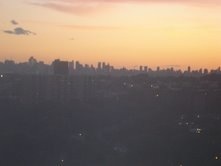
We don’t know precisely what we will see when we turn around at Citi Field. But we do know, on this final Opening Day at Shea Stadium, what Row V in reverse can get you. Like everything else about Shea, it’s something that will be succeeded, likely improved upon, but it will never quite be replaced.
by Greg Prince on 7 April 2008 4:47 pm 31: Friday, July 26 vs Cardinals
Ladies and gentlemen, welcome to 1986 Weekend at Shea Stadium. We are saluting the most recent world championship in Mets history between now and Sunday and we're asking some folks associated with that season to remember to remove the Shea Final Games Countdown numbers from the right field wall. It's appropriate that we bring some '86ers in here because this seasonlong tribute, after all, is the countdown like it oughta be.
If you needed to pinpoint when the buildup to 1986 began to take hold, you would have to look to 1984, the year the Mets shook off the dust of several consecutive second-division finishes and began to contend in earnest for the N.L. East crown. That was when Shea Stadium began to shake, too, with the fierce belief by Mets fans that this team was going somewhere.
Nobody represented the crossroads of hope in the stands and the inspiration for it on the field like three young men who decided to express their belief one letter at a time. That letter was a K and their place was the left field corner from which they waved their Ks — much as National League batters waved at the pitches that resulted in K after K in 1984.
The guys who founded the K Korner are here tonight: Dennis Scalzitti, Bob Belle and Neil Kenny. And joining them to remove number 31…who else but the pitcher who kept them so busy by hanging his shingle out at Shea that summer and for a decade after that, Doctor K himself? Welcome back to Shea Stadium the 1984 National League Rookie of the Year, the 1985 National League Cy Young Award winner and the ace of those 1986 World Champion New York Mets, Dwight Gooden.
30: Saturday, July 27 vs Cardinals
Ladies and gentlemen, many were the hands that contributed to building a world champion at Shea Stadium in 1986, but no two pair of them were steadier than those that built the team and those that guided it.
To remove number 30, we welcome home two gentlemen who came from Baltimore, saw what Shea Stadium could be like when a World Series was won here in 1969 and decided to try it for themselves 17 years later. The general manager of the 1986 World Champion New York Mets, Frank Cashen and the manager of the 1986 World Champion New York Mets, Davey Johnson.
29: Sunday, July 26 vs Cardinals
We are excited, ladies and gentlemen, to be joined by a group of Mets who contributed to one of the two greatest achievements in club history. They were and will forever be champions…1986 World Champion New York Mets. A few of their teammates have come home to Shea this season and removed ceremonial numbers from the right field wall, and we have a hunch that a few more will make it back here before 2008 is out.
Tonight, we have ten men who proudly wear the rings they earned 22 Octobers ago.
The clutch-hitting backup catcher on the '86 Mets, say hello to old friend Ed Hearn.
A ten-game winner during the regular season, he is the pitcher of record on the winning side in the most famous game in Mets history, Game Six of the 1986 World Series, Rick Aguilera.
His walkoff, extra-inning grand slam home run electrified Shea Stadium on June 10. He would go on to homer in the World Series, too: Tim Teufel.
As sound defensively as they came at short, a fixture in the infield on those great Mets teams of the '80s, please welcome back Rafael Santana.
A rookie in 1986, he played with the steely nerve of a veteran when it counted most. Raise your cup and show your support for the man they called World, Kevin Mitchell.
No lefty was a tougher assignment for National League hitters in 1986 or, as he proved in October, that postseason. An 18-game winner for the world champs, ladies and gentlemen, Bobby Ojeda.
You know his voice now. You knew his right arm then, and was it ever right, to the tune of 15-regular season wins and two terrific outings in the World Series. Direct from the SNY booth, say hi to Ron Darling.
He was an All-Star starting pitcher in 1986, but it was in a World Series relief role that he truly earned his Met stripes for all time. His middle-innings appearance changed the tide of the seventh game and set the stage for the second world championship in Mets history. All the way from Hawaii, please welcome Sid Fernandez.
Nobody was grittier, nobody was guttier and, for that matter, nobody among the regulars had a higher batting average in 1986 than the second baseman from your World Champion Mets. Give it up for him as he always did for you…Wally Backman.
And finally, to remove number 29, he was the third baseman on those 1986 New York Mets, he was the comeback player of the year in the National League and he demonstrated some of the greatest never-say-die determination baseball has ever seen. The Most Valuable Player of the 1986 World Series, returning to Shea Stadium as a Met for the first time since the night of October 27, 1986, please give your warmest home-team welcome to Ray Knight.
Numbers 34-32 were revealed here.
by Greg Prince on 6 April 2008 11:37 pm At week's beginning, I questioned the efficacy of the Mets “watch parties” promoted by bars here and there. Well, I just came home from one and have to say they can be plenty of fun.
They give you something to do while the Mets aren't scoring.
The occasion was the launch of everybody's favorite book — surely it will be yours if you purchase a copy — Mets By The Numbers. Authors Jon Springer and Matt Silverman were there along with several members of the MBTN community who double as friends of FAFIF. A good time was had by all who weren't paying close attention to what was transpiring in Atlanta.
Which was absolutely nothing, save for the valiant, unsupported pitching of Johan Santana who must not have heard this is how we treat our aces.
Because I was deep into chicken wings and conversation, I didn't get a good look at John Smoltz, though after two decades, I think I've seen all I ever need to see of that mangy old goat. Baseball-Reference says Smoltz is a few games over .500 versus the Mets. I'm sure he's 500 games over and maybe we've won a few. It always looks worse when you're 2-3 in your bounceback season, but man did the Mets do anything today other than inspire us to order another round of Black & Tans?
The Braves aren't The Braves anymore, but they're still the Braves. I hope I've made myself clear. If I haven't, this is sort of what I mean: When the Mets go out and make a move, even a really good move, the Braves go out and match or trump it.
• In the winter of '02, as we're high-fiving over the imminent contributions of Robbie Alomar and Mo Vaughn, they get Gary Sheffield.
• Three years later, as we are ascending the ranks thanks to Pedro Martinez and Carlos Beltran, they manage to come up with Tim Hudson.
• Last summer, moderately jubilant that we have secured the pennant drive aid of Luis Castillo, they go out and grab Mark Teixeira, who was re-signed in January for exactly one year (whereas, as my partner so accurately put it, we filled a firehose with money and blasted Luis green in the face).
This offseason, the offseason of Santana, the Braves didn't match Johan. You don't match Johan. It was all they could do to replace Andruw Jones with Mark Kotsay. But they keep reviving bleeping John Smoltz. John Smoltz won't age. John Smoltz won't fall to pieces. Every series you turn around, John Smoltz is waiting to face the Mets. This was his 69th appearance lifetime against us, his 41st start. Both are career highs. His first start was at Shea Stadium in 1988, back when Rick Astley was riding high and the Soviet Union was at least riding. He won then, he wins now. He will, nuts to the knots behind his shoulder, keep winning against the Mets at Turner Field, at Citi Field, at whatever succeeds Citi Field. The John Smoltz Memorial Classic they'll call it. Buy a brick before they're all gone.
When it comes to pitching, John Smoltz knows his onions.
On our side of the fence, the Mets clearly aren't clicking, save for Santana and Church. Let's hope they can resist the pull of their new teammates and their old karma. It's already begun to suck Schneider and Pagan into that stale and dismal vortex that seems unchanged from last September, the one that makes you forget we're only five games into 2008. Funny, I thought that's what the Black & Tans were for.
by Greg Prince on 6 April 2008 10:05 am 34: Tuesday, July 22 vs. Phillies
Ladies and gentlemen, the unofficial motto of Shea Stadium for much of its life has been You Gotta Believe. How appropriate then that a man who inspired belief worldwide stepped into this ballpark on an autumn day in 1979 and brought with him, as he put it, “a message of faith and love.”
That man was Poland's Karol Wojtyla, known far and wide from 1978 until his death in 2005 as Pope John Paul II. He came to Shea Stadium in the second year of his papacy, acknowledging “the special character of this metropolis” and urging a predominantly youthful audience that “a city needs a soul if it is to become a true home for human beings.” Whatever your faith, it's a message for all New Yorkers to live by.
As we begin the second half of our final season in this ballpark, we remember the historic visit of the Holy Father to Shea Stadium on October 3, 1979. To commemorate it, we are honored to be joined by New York's Edward Cardinal Egan, who will remove number 34 from the right field wall.
33: Wednesday, July 23 vs Phillies
Ladies and gentlemen, from now until there is no more Shea Stadium, baseball will be the only order of business on this site. But as many of you know, last week Shea demonstrated more of its multipurpose versatility. Put more specifically, it showed one final time that this house knows how to rock.
The Who. The Police. Simon & Garfunkel. Bruce Springsteen & The E Street Band. Elton John. Eric Clapton. Janis Joplin. Jethro Tull. Grand Funk Railroad. The Rolling Stones. And finally, Billy Joel. These were the headliners who made musical history at Shea Stadium these past four decades.
But before them, there was one act. And everybody who has ever played Shea Stadium bows to them and their impact on music.
There's nothing you can do that can't be done, nothing you can sing that can't be sung and nothing you can say except…the Beatles.
To take down number 33, ladies and gentlemen, Shea Stadium is proud to present, as it did in 1965 and 1966, Ringo Starr and Paul McCartney.
32: Thursday, July 24 vs Phillies
As a pitcher's park, ladies and gentlemen, Shea Stadium will never be mistaken for a seat of power, but it has had a longstanding relationship with those who have resided in America's most famous seat of power. This afternoon we wish to recall those White House denizens who graced Shea with their presence.
During the 1969 World Series, the Mets were proud to welcome two New Yorkers in particular, the former first lady of the United States and her eight-year-old son. To represent the memory of Jacqueline Kennedy Onassis and John F. Kennedy, Jr., we welcome the daughter of the 35th president of the United States, Caroline Kennedy Schlossberg.
In the late 1980s, after settling in the New York metropolitan area, this former president was a regular visitor to Shea Stadium. Sports had always been one of his passions and he held a particular fondness for baseball. To represent the memory of Richard M. Nixon, we welcome the son-in-law of the 37th president of the United States, Edward Cox.
Joining our special guests in removing number 32 from the right field wall, we have the man who threw out the first ball of the season in 1971 when he was the United States' ambassador to the United Nations — at the time, his uncle G. Herbert Walker was on the Mets' board of directors — and again in 1985 when he served as vice president of the United States. He would go on to the presidency and still knows some people in the White House. Ladies and gentlemen, the 41st president of the United States, George Herbert Walker Bush.
And to make it a truly federal fab four, we welcome the only sitting president who ever visited Shea Stadium. He was with us the night Jackie Robinson's 42 was retired throughout baseball and he has been back from time to time since taking up residency in Chappaqua. Ladies and gentlemen, the 42nd president of the United States, Bill Clinton.
Numbers 40-35 were revealed here.
|
|






