The blog for Mets fans
who like to read
ABOUT US
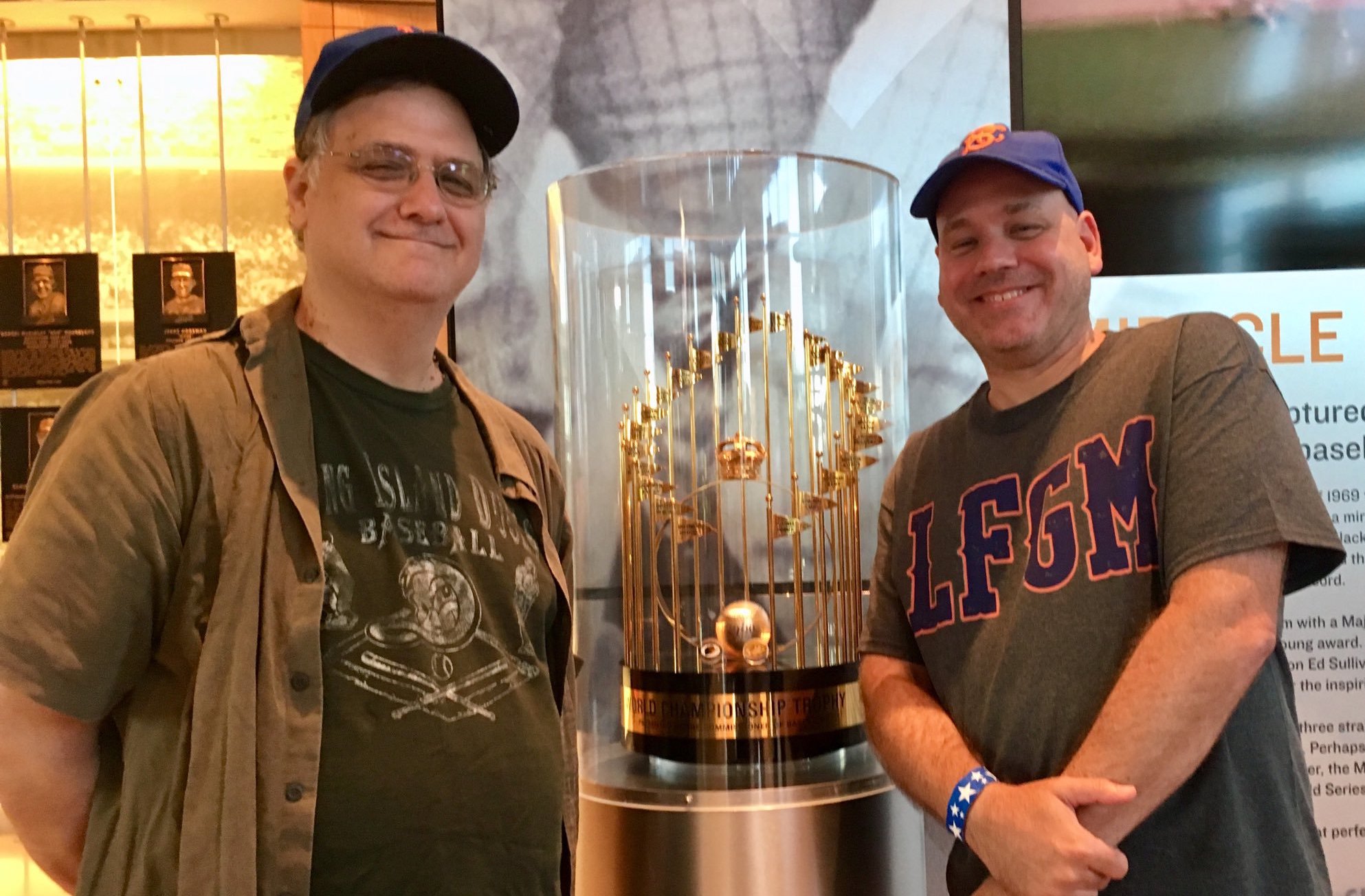
Faith and Fear in Flushing made its debut on Feb. 16, 2005, the brainchild of two longtime friends and lifelong Met fans.
Greg Prince discovered the Mets when he was 6, during the magical summer of 1969. He is a Long Island-based writer, editor and communications consultant. Contact him here.
Jason Fry is a Brooklyn writer whose first memories include his mom leaping up and down cheering for Rusty Staub. Check out his other writing here.
Got something to say? Leave a comment, or email us at faithandfear@gmail.com. (Sorry, but we have no interest in ads, sponsored content or guest posts.)
Need our RSS feed? It's here.
Visit our Facebook page, or drop by the personal pages for Greg and Jason.
Or follow us on Twitter: Here's Greg, and here's Jason.
|
by Greg Prince on 29 March 2008 12:11 am 59: Monday, May 26 vs Marlins
Welcome back, ladies and gentlemen, to our Shea Stadium Final Season countdown. If, by chance, this is your first game at Shea this season, a quick reminder: At every home game this year, we are pausing in the fifth inning for a brief ceremony in which we introduce one or more individuals with a deep and abiding connection to Shea, tell you a bit about that person or those persons and have him, her or they take a number down from the right field wall to signify how many games remain in the life of this wonderful ballpark.
To continue the countdown tonight, we have someone who spent a great deal of time on Shea Stadium's pitcher's mound during a single game. It was October 2, 1965. The season was about to end but it wouldn't end all that soon thanks to what you would have to call the yeoman efforts of Rob Gardner. Rob took to the hill that Saturday evening in the nightcap of a twinight doubleheader and pitched…and pitched…and pitched some more. By the time manager Wes Westrum took him out, Rob had pitched 15 scoreless innings. His opponent that night, the Phillies' starter, the late Chris Short, matched him frame for frame, zero for zero…and struck out 18 Mets while doing so.
It was a pitching performance for the ages even if eventually it was put in the books as a tie. The Mets and Phils played 18 innings that night, neither team scoring a run. They had to play a doubleheader the next day, the last day of the season.
Tonight, we want to give Rob the opportunity to get some kind of number next to his name for authoring perhaps the greatest forgotten Met pitching performance in the history of Shea Stadium. We can't give you any runs, Rob, but we can offer you the honor of peeling number 59. And to join you, we've asked the two relievers who backed you up to take the walk with you. Ladies and gentlemen, please welcome home to Shea Stadium, from your 1965 New York Mets, Darrell Sutherland, Dennis Ribant and Rob Gardner.
58: Tuesday, May 27 vs Marlins
Ladies and gentlemen, throughout the years at Shea Stadium, management has strived to offer you, within reason, a fine selection of food and beverages to make your baseball-watching experience relatively pleasant. Rest assured, when Citi Field opens in 2009, the culinary effort will be kicked up a notch.
Until then, we ask you to remember as fondly as possibly some of what you've eaten and drunk here and if you do and if you are old enough, one particular Shea Stadium sponsor's product will stand out in memory above all others.
From the opening of Shea Stadium in 1964 through the thrilling pennant run of 1973, Rheingold was the beer of choice here in Flushing and a big part of New Yorkers' lives. Brewed in Brooklyn beginning in 1883, Rheingold gave us the Miss Rheingold contest, the Ten-Minute Head and of course a jingle that echoes down the corridors of time. It has been relaunched under different ownerships since and has even returned to Shea on occasion. True, other beers have taken its tap space, to say nothing of its spot on the scoreboard, but at heart, Shea Stadium will always belong on the Rheingold beat.
To commemorate Rheingold's place in Shea Stadium history, we have asked Terry Liebman, one of those who worked to bring Rheingold back to New York in the late 1990s and a member of Rheingold's founding Liebmann family to join us, take down number 58 and toast the memory of a great Mets sponsor. Feel free to join in with a chorus of “My beer is Rheingold the dry beer…”
57: Wednesday, May 28 vs Marlins
Have you ever wondered why, ladies and gentlemen, the Mets are here? That's not an existential question but rather a query pertaining to the Mets having set down their roots in Flushing Meadow. The answer can be traced back to one man.
For the balance of the 20th century, that individual held sway over New York City in ways that are unimaginable today. His name was Robert Moses. He held various job descriptions across more than four decades of government service, but he is probably best known by the title of the masterful biography that explained him to succeeding generations: The Power Broker.
Moses believed the future of the New York metropolitan area lay ever eastward. Demographic trends validated his vision as more people left the five boroughs and began to call Long Island, right next door to Queens, home. He saw a future driven by the automobile and set out to build a network of highways second to none to accommodate it. And he recognized the potential of parkland in the geographic center of New York City, Flushing Meadow. He worked tirelessly to develop it and included within his blueprints for growth a modern baseball stadium the likes of which New Yorkers had never seen. The result was Shea Stadium, a structure Moses consciously modeled on the Roman Colosseum.
Robert Moses lived from 1888 to 1981, a time when the world changed and changed again. His legacy remains up for debate in matters large and small, but it is clear that he helped shaped New York as we know it, particularly Flushing Meadow. If you're wondering why the Mets are right here, you can be certain Mr. Moses had something to do with it.
To recall the impact of Robert Moses, we asked his Pulitzer Prize-winning biographer, by no means an unalloyed admirer of the man, to join us and remove number 57 from the right field wall tonight. One of America's greatest writers and kind enough to take time out from his rigorous research on the life of Lyndon Johnson — president of the United States, incidentally, when Shea Stadium opened — please welcome the author of The Power Broker, native New Yorker Robert Caro.
56: Thursday, May 29 vs Dodgers
This evening, ladies and gentlemen, it gives the Mets great pleasure to welcome back an old friend to Shea Stadium. He played his first game here as a member of the Milwaukee Braves on May 12, 1964, catching a complete game shutout. He would visit often over the course of eleven seasons until 1975 when he became a Met. Midway through his third season as a player for the home team, he became the Mets' manager, a post he'd hold for five years.
We speak, of course, of Brooklyn's own Joe Torre. While Joe hasn't exactly been a stranger around these parts, we are happy to have him back as a National Leaguer again. Joe will be removing number 56 from the right field wall tonight and joining him are two of the most popular players from the Joe Torre era at Shea.
He was an All-Star four times, three under Joe's tutelage. He was also one of the hardest-charging Mets of any period in team history, someone who gave no ground on the basepaths, at the plate or anywhere the field of play extended. Please give a warm welcome to the Dude, John Stearns.
Another Brooklynite, he spent his rookie season at the elbow of manager Joe Torre, learning the game and mastering his trade. By 1979, he was a Mets All-Star and a stellar one at that, homering and later walking with the bases loaded to ensure a win for the National League. He enjoyed two tenures in New York, the second of them commencing just in time for the 1986 World Series when he played a key role in securing victories in Games Six and Seven. Ladies and gentlemen, Lee Mazzilli.
55: Friday, May 30 vs Dodgers
Ladies and gentlemen, the next time a Met homers — provided all functions as it should — an apple will rise from a top hat and all will be right with the world. As has been the case since 1981, the Home Run Apple remains Shea Stadium's most recognizable and beloved landmark.
How did this apple come to take rise at Shea? We can thank one of advertising's most legendary minds for the inspiration. In 1980, when the team's new ownership was looking to garner attention, it hired Jerry Della Femina to produce an ad campaign. He came up with one of the most memorable lines in baseball advertising history: The Magic Is Back. A year later, the hat you see today was installed, sporting the phrase Mets Magic. It would take a little while for the club itself to pull out of the proverbial hat enough wins to contend, but by 1986, a world championship was conjured right here in the Big Apple.
Jerry joins us tonight to remove number 55 from the right field wall and, accompanying him, are two of the original Magic Mets of 1980, a pair of players who stirred the sleeping giant that was the New York National League fan base and gave it reason to hope that lasting success would someday soon be more than an illusion.
Craig Swan pitched for the Mets for over a decade, earning the N.L. ERA title in 1978 and always throwing his heart out from the Shea Stadium mound. His right arm bridged the gap from Seaver to Gooden like the Triborough connects Queens to points north, including Swannie's home in Connecticut.
Doug Flynn joined the Mets in 1977 and manned second base as no other Met had previously. Little got past Doug and his defensive brilliance was recognized in 1980 with the Gold Glove award. Bob Murphy liked to say Doug would look ground balls into his glove and we're happy to get another look at Dougie tonight.
Please give a big hand to Jerry Della Femina, Craig Swan and Doug Flynn.
54: Saturday, May 31 vs Dodgers
Ladies and gentlemen, we hope you're enjoying your Saturday in the park. Saturday has been a great day for Mets baseball over the years, particularly when the sun starts going down. Though it will probably still be light out when we're done today, we wanted to pay homage this late afternoon to some of the most memorable Saturday night fireworks in Shea Stadium history.
Our first sparkplug joins us from the active roster of the New York Mets. On June 11, 2005, he did one of the most difficult things there is to do in baseball. He came off the bench as a pinch-hitter and delivered a big blow off an ace reliever. What made this feat all the more amazin' was that not only was it a game-tying blast in the ninth off the superb Francisco Rodriguez of the Los Angeles Angels of Anaheim but it was an inside-the-park job. He was already one of the best pinch-hitters the Mets had ever seen but this hit — and his mad dash around the bases while blowing his bubble gum — made him an instant legend with the Shea fans. We're thrilled he's a Met again, please greet Marlon Anderson.
As evening began to fall over Flushing on September 13, 1997, it appeared the Mets were going down to a rather dreary defeat at the hands of the Montreal Expos. The score was 6-0 for the visitors and the end was at hand…until an unbelievable rally unfolded that scored two runs, loaded the bases and brought up this man to face Ugueth Urbina. There were two outs and two strikes, but this valuable fourth outfielder had a game-tying, grand slam home run left in his bat. He sent the Shea crowd into ninth-inning euphoria and, as would be the case in the Marlon Anderson game, the Mets would go on to win in extra innings. Please welcome back the slugger Carl Everett.
What Marlon did and what Carl did no doubt spurred memories all over Shea Stadium of what one more Met did on a Saturday night when things looked desperate. On June 14, 1980, Joe Torre's Mets fell behind the San Francisco Giants 6-0. But typical of how they operated that spring and summer, the Mets battled back and closed the gap on the Giants to 6-4 in the ninth. Then, with two on and two out, our next guest, who will peel off number 54, swung and belted an Allen Ripley pitch into the Mets' bullpen. Just like that, the Mets had won, 7-6. So thrilled was the Shea crowd that it demanded a curtain call — a response almost unheard of here or anywhere in those days. Those who saw it will never forget it nor the man who came back on the field to wave to the fans. Ladies and gentlemen, Steve Henderson.
53: Sunday, June 1 vs Dodgers
As you know, ladies and gentlemen, Shea Stadium has been the home of the Mets since 1964. Sometimes, however, the Mets share their digs with others. Never were they as generous with their real estate as they were in 1975. During that calendar year, thanks to various construction and renovation products taking place around the metropolitan area, Shea Stadium played host to not one, not two, but four big league professional teams. In 1975, if you were at Shea Stadium, you were at the home of the Mets…and the Jets…and the Yankees…and the football Giants. Together, they kept the ushers and the grounds crew very busy.
To remember that unusual year, we have invited back a representative of each of those teams, starting with one of the best punters in NFL history. Dave Jennings gave the Giants great field position for 11 autumns, one of them right here in Queens. He finished his career kicking for the Jets and has been an excellent broadcaster of New York football ever since. Please welcome Dave to Shea again.
On Sundays when the Giants weren't playing at Shea, a more familiar football team set up shop. In 1975, the Jets depended on a talented Kansan to rush the ball for them and did he ever. He racked up 1,005 yards, the first Jet to run for four figures in one season. He would later rush to even greater glory in Washington but it was at Shea where he established himself as one of the great ground game threats in the NFL. Loosen up and say hi to John Riggins.
During the 1975 baseball season, for the second year in a row, when the Mets were on the road, they laid out the welcome mat for the New York Yankees. Someone already at home here after a stint with the Mets in 1967 was a stalwart for the temporarily Flushing Flashers at second base. He played 151 games for the '75 Yankees and the next year would take under his wing an up & comer named Willie Randolph. From the third base coaching box right here at Shea, give a warm hand to Sandy Alomar, Sr..
And leading our troop of 1975 Sheamen down the right field line to remove number 53 is someone who was most familiar with the terrain here. He came up in 1972 and earned Rookie of the Year honors for the Mets and would go on to contribute mightily to the National League championship run of a year later. In 1975, he pitched well enough for a second trip to the All-Star Game, emerging as its winning pitcher and co-MVP. One of the best southpaws to ever pitch in a Mets uniform, give a great big hand to Jon Matlack.
Numbers 66-60 were revealed here.
by Greg Prince on 28 March 2008 5:56 am Welcome to Flashback Friday: Tales From The Log, a final-season tribute to Shea Stadium as viewed primarily through the prism of what I have seen there for myself, namely 358 regular-season and 13 postseason games to date. The Log records the numbers. The Tales tell the stories.
3/31/98 Tu Philadelphia 9-6 Jones 10 59-61 W 1-0 (14)
March? Whose deranged idea was it to start the baseball season in March?
That was my first thought when I saw the 1998 season would open in the month before it had always opened. Who starts a baseball season in March?
My second thought was where do I sign up? If baseball was going to be thoughtful enough to run back and meet me a month — OK, a day — early, how could I hold myself back?
So maybe the schedulemakers knew what they were doing. And for once, I had to hand it to the Mets marketing department. I handed them my MasterCard number, actually, and bought a six-pack ticket plan for the 1998 season. I loved the gimmick: It was called the Debut Pack. In it were pairs of tickets for six games, the first games against opponents who had never played the Mets at Shea during the regular season: the expansion Diamondbacks and Devil Rays, the newly National Leagued Brewers and the Interleagueing Orioles and, sigh, Yankees (who, between you and me, were probably the impetus for this new bundling scheme). That’s five. The sixth was Opening Day, the überdebut of 1998 itself, versus Philly.
I was psyched, even though the Mets would be opening in March for the first time ever. All winter long, I predicted wind chills and icy rains which was what we got for the opener in 1996 on April 1 of that year. If April 1 was frigid, March 31 would be frozen.
Except it wasn’t. It had been one of those Greenhouse Effect winters. We got little snow and the last week of March bust out like June. New York was having an honest-to-god heat wave, just in time for Opening Day. The Mets, who surprised the world with their legitimate 88-74 run at the Wild Card in 1997, were apparently going to be blessed with great weather to go along with their great chances.
What better way to prepare for our good fortune than with the ancient nectar of Metsopotamia? I speak of course of the one, the only, the Extra Dry treat, Rheingold. As if record-breaking temperatures and the onset of baseball weren’t enough, I was sent an invite to a press luncheon launching the return of Rheingold, doubtless the most beloved consumer product associated with the Mets. The event, the day before the opener, was set for Gallagher’s, an old-time steakhouse on West 52nd Street. How great was this place? I had been there once before for an Anheuser-Busch thing and discovered a seat from the Polo Grounds right inside the front door. I discovered it and I sat in it and I didn’t even break it.
Warm weather…Opening Day…Rheingold…Polo Grounds seat…what else could I possibly want?
How about some ballplayers? The first one I saw, heading up the stairs to the private dining room booked for the occasion, was Ralph Branca. Ralph Branca! Ralph Branca who gave up the homer to Bobby Thomson but made a nice living off it later in life. Ralph Branca whose daughter Mary married Bobby Valentine who led the Mets to dizzying third-place heights the year before. We were asked to sign in, name and affiliation. Ralph Branca wrote down that he was representing “Baseball”.
The rest of us should have given up and gone home after that. But I’m glad we didn’t, because the new owner of Rheingold, which had been the Mets’ beer from their inception until the mid-’70s when the brewery in Brooklyn went out of business, sought to add some stardust to his relaunch. He brought in Ed Kranepool and Tommie Agee to speak.
In case you’re keeping score: Warm weather…Opening Day…Rheingold…Polo Grounds seat…Ralph Branca of “Baseball”…Eddie Kranepool…Tommie Agee. And the season was still 24 hours away!
It wasn’t even April!
I got a nice column out of the event, but I’m still kicking myself that I wasn’t more self-indulgent and didn’t include the quotes from Eddie and Tommie. It would have been extremely self-indulgent, but look what I was covering. Eddie recalled coming up to the Mets as a 17-year-old under the watchful eye of Casey Stengel. Said he really loved drinking Rheingold in the clubhouse even though he was too young to legally do so. Tommie invoked another manager from Rheingold’s halcyon days, reminiscing about Gil Hodges and wishing the sainted skipper were still here to enjoy a couple of beers with us. All the speakers mentioned this was a fortuitous time to rebrew because the Mets were going to have such a good year. They could have served us baked shoe for lunch, and it would have been delicious.
Each guest got a Rheingold goody bag to go. It included a t-shirt, a cassette of the old jingle (“think of Rheingold whenever you buy beer”) and a can of the golden lager itself, red label on a field of soothing white. I’m not much of a beer drinker, but this can was special. I took it home and stashed in the fridge. I told Stephanie I wouldn’t open it until the end of the season, after the Mets clinched the playoff spot that surely awaited them.
The road to postseason glory began the next day, March 31, and it was still sizzling. The temperature ran to 88 degrees (same as our victory total in ’97…omen, omen, omen!) as gametime approached. Anticipation for the new season bubbled like Rheingold. Or Pepsi. Pepsi won the Shea contract from Coke early in spring training. As a trained BevHead, I couldn’t help but notice the signage all over the ballpark. The Pepsi Picnic Area, formerly the bleachers, looked like it had just been painted that morning. Mountain Dew was suddenly an official soft drink of the Mets, just like Lipton Brisk. Not that I would have ever pulled any strings for access to Shea Stadium (cough, cough), but Pepsi was based in Westchester and I kind of knew some people.
But that was work. That’s not what 88 degrees on the last day of March was for.
I met my buddy Jason outside the park. Jace invited me to the raw Opening Day two years earlier and now I was returning the favor. We found our seats — my seats for the balance of the six-pack — in the mezzanine, Section 17. Short right field. Not bad. Not bad at all. I brought our camera from home and snapped off a roll’s worth of pictures. Mostly of the Pepsi signs. As a BevHead, I was always looking for photo opportunities.
The buzz was unmistakable throughout the ballpark (and it wasn’t from the Rheingold — they wouldn’t get a pouring deal until later in ’98). The Mets were wearing their new black caps with the blue bill as were, to my surprise, a lot of fans. Hadn’t played one game in ’em and the faithful had already invested. I was in traditional blue, a feeling the hitters on both sides would come to know quickly.
Curt Schilling, starting for the Phillies, was awesome. Our lineup was depleted from the get-go as Todd Hundley, he of the 71 homers over the past two seasons, was recovering from elbow surgery. Catching in his stead was Tim Spehr, who lit up Port St. Lucie just enough to win the pro tem job over Alberto “Bambi” Castillo and Todd “Tank” Pratt. Tank didn’t even make the big club. Spehr, defending in an alienesque black-and-orange chest protector (Jace thought it looked more Oriole than Met) and carrying no discernible nickname, collected two hits, or one more than any of his teammates had.
Schilling was otherwise awesome, striking out nine in eight innings. The heroes of ’97 — Fonzie, Oly, Gilkey, Huskey, Baerga, Ordoñez — were a combined 2-for-28. Bobby Jones, making his third Opening Day start, was less impressive than his opposite number — 1 K in 6 IP — but reasonably effective. The important thing is no Phillie scored. The visitors threatened every now and then, especially against Franco in the 10th, but nothing happened. The Mets paraded five relievers to the mound and all of them, even Mel Rojas, emerged unscathed. The Philadelphia relievers were no less unyielding. It was 0-0 through the top of the 14th. Far worse for wear was a guy in our section who didn’t wait for Rheingold. He went for Bud or whatever it was they were selling in the stands. By the end of regulation, he was passed out, several plastic cups stacked on his chest by his companions. Midseason form, indeed.
By the 14th, it was a tad chilly, just a touch. Nothing Marchlike, but cool enough to make me glad I brought an overshirt. The 49,000 in attendance had shed maybe 20,000 by now — it was after 6 o’clock. Funny that you’d wait all winter for baseball and then decide you had somewhere else more important to be. Ralph Branca wouldn’t do that to “Baseball”. Jason and I certainly weren’t going anywhere. True, I did get up and take a walk, but that was only to the row behind us, which had been vacated. I paced back and forth until the Mets, with two outs against them, managed to load the bases in the bottom of the 14th against Ricky Bottalico.
Up stepped the Mets’ last available position player, Alberto Castillo. Bambi. I’m pretty sure it was a derogatory tag, because if Alberto Castillo reminded you of any hitter living or dead, it may have been Albie Pearson or Freddie Patek or Sergio Ferrer, but it wasn’t the Bambino. In any event, he was all we had left.
He was enough. Alberto Castillo poked a grounder between first and second. It got to right field. Brian McRae jogged home. The Mets won, 1-0, in 14 innings. Jason and I delivered our first high-fives of the year.
The black and blue Mets, like the weather and the circumstances of the last two days, were perfect. March 1998 record: 1-0. March all-time record: 1-0. We were tied for first with the Braves and the defending champion Marlins, the two teams who finished ahead of us last year. But that was last year — the Marlins were decimated by Wayne Huizenga and this Braves thing was going to end sooner or later. Sooner was my hunch. Based on early returns, things were looking and feeling very, very good.
In the fridge, my Rheingold awaited a September debut.
Required reading for Shealovers: Gary Myers, Daily News football writer, turns his thoughts back to “my all-time favorite stadium that will forever hold a place in my heart”. It’s a beautiful and heartfelt tribute. Thanks to Loge 13 for the link…and for reminding us to watch The Amazin’ Shea Saturday night, 7:30, on Channel 4.
by Greg Prince on 27 March 2008 8:36 am 66: Friday, May 9 vs Reds
Ladies and gentlemen, to remove number 66 from the right field wall, we call on a player intimately associated with tonight's opponent, someone who ordinarily would not be setting foot inside Shea Stadium without buying a ticket, but someone so intertwined with the history of this ballpark that it would be impossible to say goodbye to Shea without saying hello to him one more time.
For a quarter-century, as a player, a player-manager and a manager, he was a regular visitor to Queens. Nobody in baseball was more recognizable, more controversial and, as it pertained to the Mets, more notorious than our special guest tonight.
He played his first game here on May 6, 1964 and in his second Shea Stadium at-bat doubled. Fourteen years and many individual and team accomplishments later, he tied and broke the modern National League hitting streak record right here to the cheers of the home crowd. As a Philadelphia Phillie, he would be the first batter Tom Seaver would face in his Flushing homecoming in 1983 and back with the Reds in 1986, he'd collect the last of his 189 regular-season Shea Stadium base hits off Dwight Gooden.
But it would be a postseason appearance that would inextricably tie Pete Rose to Shea Stadium, specifically a hard — some would say too hard — slide into Buddy Harrelson at shortstop in the third game of the 1973 National League Championship Series that brought Pete the kind of lasting infamy only true passion and a level of regard elicits.
Tonight, however, with only 66 games left in the life of this stadium, we believe it is time to greet Pete Rose if not forgive him or forget his role in the most memorable brawl Shea Stadium ever saw. That is why we secured permission from Commissioner Bud Selig for Pete's return to Shea, his first time in a New York ballpark since being banned from baseball for gambling in 1989. That is also why we asked the Glass Distillery Packaging Association to sponsor Salute to Pete Rose Night.
GDPA was gracious enough to provide the commemorative Pete Rose bottles of whiskey from which every fan has been enjoying since entering the park and the Mets remind you that when you're finished with your liquor, there are better ways than recycling to make use of your empty bottles.
65: Saturday, May 10 vs Reds
That sound, ladies and gentlemen, can mean only one thing. The sound is that of a cow bell and it belongs to a Mets fan everybody will recognize instantly, Eddie Boison. You might know him better by the name on the back of his jersey, Cow-Bell Man.
Eddie has been coming to Shea since it opened in 1964 but has truly become a fixture in the 21st century, strolling every section, making a joyful noise and stirring up his fellow fans from the field level to the upper deck.
We had planned to ask Eddie to reveal number 65 in partnership with another true Shea Stadium original, a fan who, like Eddie, became synonymous with enthusiastic and unique support of the Mets. Alas, Karl Ehrhardt left us this past winter, but in light of the tributes he received upon his passing, we are confident the placards held aloft by Shea Stadium's own Sign Man will live in the mind's eye as long as there are Mets fans. To represent Karl, we have asked his children, Richard Ehrhardt and Bonnie Troester, to join Eddie in making the walk to right field. Please give them a warm welcome.
64: Sunday, May 11 vs Reds
As you know, ladies and gentlemen, at every game throughout the 2008 season, we are taking a moment and pausing our game long enough so that individuals connected to the long and rich history of Shea Stadium can enjoy a moment in the sun. On this Sunday, however, we turn our attention to the Mets' only other home to date, the Polo Grounds.
It is true that the modern and attractive ballpark under construction right before our very eyes pays homage primarily to Brooklyn's Ebbets Field, but it is just as true that the Mets never played in Ebbets Field — it was gone two years before the Mets were born. It was left to the Polo Grounds in upper Manhattan to serve as launching pad for this franchise we all hold so dear. When Citi Field opens in 2009, no matter what the exterior would indicate, proper tribute will be paid to the Polo Grounds' role in the development of the New York Mets and New York baseball.
Until then, there is today, which Mayor Michael Bloomberg has officially proclaimed Polo Grounds Appreciation Day in the city of New York. In Manhattan, the portion of the Harlem River Drive that runs past the site of the Polo Grounds has been renamed the Ottway in recognition of legendary New York Giants slugger and all-time New York City home run king Mel Ott. And here at Shea, to commemorate this admittedly overdue occasion, in addition to presenting every fan who entered Shea this afternoon with a handsome, glossy 96-page program filled with pictures and essays devoted to the Polo Grounds, we have invited a quartet of Mets whose presence speaks to roots of the club.
• Frank Thomas hit 34 home runs in 1962, 18 of them at the Polo Grounds, establishing a team record that would stand another thirteen seasons. He was the Opening Day leftfielder the day Shea Stadium opened and would remain a Met into the 1964 season.
• Roger Craig was the ace of the Mets in 1962 and 1963, pitching in hard luck but always giving it his best. His appearances at Shea would come in other uniforms, yet he would always be remembered warmly here for his work at the Polo Grounds.
• Choo Choo Coleman gained a measure of immortality as a catcher on the 1962 and 1963 Mets. He may have been quiet, but the stories shared by those who played with him and interviewed him spoke volumes. Choo Choo returned to the Mets in 1966 for a brief stint before retiring as an active player.
• And leading these three original Mets out to right field to remove number 64 is a teammate of theirs whose story becomes complete today. Ted Schreiber played one season in the big leagues, 1963, when the Mets still called the Polo Grounds home. In fact, Ted turned out the lights, in a manner of speaking, on the historic bathtub-shaped ballpark at Eighth Avenue and 155th Street. He came to bat as a pinch-hitter in the bottom of the ninth on September 18, 1963 and grounded into a double play, one involving two future Met coaches, Cookie Rojas and Bobby Wine, as the Mets lost to the Phillies, 5-1.
It was the last play in the baseball history of the Polo Grounds. Ted left the Mets after 1963 and never made it to Shea. It only seems right to invite him here now and give him the honor of taking down the next number in the park that he just missed playing in. Ted's presence also reminds us that no matter where we are at a given moment, whether it's this year or next, there is usually something that came before that deserves to be remembered.
63: Monday, May 12 vs Nationals
Ladies and gentlemen, if you can't hear me or I have to stop speaking for a moment so you can hear me, it is not a technical difficulty on the part of Shea Stadium's often erratic public address system. It is almost certainly for the same reason conversations have been interrupted, batters have been stepping out of the box and pitchers have been leaving the rubber for 45 seasons.
It is the airplanes.
We have a very famous neighbor just slightly to our north, LaGuardia Airport. While it is in many respects a fine airport, one once voted the greatest in the world by those who made their living in aviation, its presence may not make for ideal company during a ballgame. While passengers on the planes overhead no doubt thrill to a glimpse of Shea Stadium, the players on the field and the fans in the stands have mostly tolerated and learned to live with some pretty powerful jet noise.
But the airplanes are a part of the Shea Stadium scene, just as we sense they will be around when Citi Field opens, so we may as well acknowledge the unusual role they have played at Shea. To do so, we have asked Anthony Coscia, chairman of the Port Authority, the government agency that runs LaGuardia, to remove number 63 from the right field wall. Anthony's being such a good sport about representing noise and distraction, we have asked to join him the one Met more likely than any other to disrupt air traffic from below.
He hit 73 Shea home runs in two tours as a New York Met, and seemingly each and every one of them was a cause for concern among pilots flying into and out of LaGuardia. It's no wonder that he once did television commercials for United, one of the airlines that flies regularly from the airport next door. Please welcome back to Shea the slugger more likely than any other on any given day to reach the clouds and part the jets, Dave Kingman.
62: Tuesday, May 13 vs Nationals
Ladies and gentlemen, there are many factors that have made Shea Stadium one of the most distinct ballparks in America, none of them as juicy and tasty, however, as what we can rightly call its native crop.
How many stadiums do you know where tomatoes were grown as a matter of course? We refer, naturally, to the agriculture in the home team bullpen, the tomato plants that for decades were an integral part of the Shea scene.
One man was more responsible for those tomatoes than any other. He was the planter, the farmer and the inspiration, to say nothing of a pretty fair tutor of relief pitchers across 14 seasons. Please give a warm hand to coach Joe Pignatano as he trots out to right field to remove number 62 and then, presumably, continues into the Mets bullpen to check on the soil.
61: Wednesday, May 14 vs Nationals
As Mets fans, ladies and gentlemen, it is your inclination to root, root, root for the home team. It has never been common to cheer an opponent at Shea Stadium. It is almost unheard of today unless it is for a certifiable superstar.
The man whom we have asked to take down number 61 would be the first to tell you he was no superstar, just a guy doing his best. Sometimes, because he is human, his best wasn't good enough. Unfortunately for our special guest, the fates were not with him on the biggest stage baseball has to offer, the World Series. In one game, Game Two, he made three errors and his team lost in extra innings. The club owner for whom he worked was not pleased and attempted to circumvent the rules regarding postseason rosters and attempted to have him replaced by another player. A firestorm of protest erupted and this player's place was preserved.
The World Series in question was 1973, which means the action began in Oakland and shifted to Shea Stadium, which is why we honor A's infielder Mike Andrews here tonight. Mets fans recognized the raw deal Mike was receiving from Charlie Finley, so when he came to bat as a pinch-hitter in the fourth game of that Fall Classic, Mets fans rose as one and supported him with a long and loud ovation. They gave him a second round of applause as he made his way back to the Oakland dugout after he grounded out.
Mike never forgot the reception he got at Shea, normally a tough place for visitors to play, that much more intense with a world championship on the line. Mike would say of Mets fans, “The ovations gave me chills, it surprised me. I don't think I've ever had a standing ovation in my life. To me that meant everything.”
Mike retired after that World Series, the only career appearance at Shea Stadium for this lifelong American Leaguer. We thought it would be appropriate to have him back here once more. Ladies and gentlemen, please remind Mike Andrews what good fans Mets fans are.
60: Thursday, May 15 vs Nationals
Ladies and gentlemen, if you own a 2008 media guide, available at Shea concessions, or have visited rich and informative Web sites like Ultimate Mets Database or Mets By The Numbers — now available in book form — you know where to find a list of every player who has ever played as a Met. Yet one of the most lovable Mets of his era won't show up in any of these reputable reference sources.
Nevertheless, Mets fans will always remember the contributions infielder Chico Escuela stitched into the fabric of the 1969 and 1973 Mets even if the boxscores from those seasons don't reflect his presence. He is probably better recalled for his comeback attempt, tracked ably by Weekend Update anchor Bill Murray, during the spring of 1979 when he had to overcome the doubts and grudges that arose from his classic tell-all volume, Bad Stuff 'Bout The Mets. Anyone who remembers 1979 would have to admit there was plenty of Bad Stuff to write 'Bout The Mets in those days, but Chico's presence in blue and orange surely was one of the better things the franchise had going then. You might even say he was “berry, berry good” for the Mets. He certainly brought laughter to a fan base mired in an understandably dark mood.
Chico Escuela lit up Shea on Old Timers Day in '79, appearing alongside “other” members of the '69 Mets at their first on-field reunion, and baseball was better off for it. Unfortunately, Chico had a speaking engagement this afternoon and couldn't make it when we called and asked him to take down number 60 from the right field all as homage to his many fine years as a Met. But Chico being Chico, he was thoughtful enough to send in his place a great performer in his own right, a cast member on Saturday Night Live at the exact same time Chico was making his Met comeback. Please give a berry, berry big welcome to Garrett Morris.
Numbers 72-67 were revealed here.
by Jason Fry on 26 March 2008 3:16 am Art Howe was a fine man with the misfortune to be rather seriously miscast as manager of the New York Mets. But his finest act might have come on Oct. 3, 2004, in his final inning at the helm. (Which also happened to be the final inning in the history of the Montreal Expos, and the endpoint for various other histories. I'll get to all that.)
Joe Hietpas had been called up from Binghamton in mid-September as an emergency catcher, though 2004 was so horrible that most any position could have been considered manned on an emergency basis. He was 25, and known as a defensive whiz, but an indifferent hitter if you were in a kind mood. (Seriously. Look at his minor-league stats and see if you can call the offensive glass one-eighth full.) Here he was nonetheless, waiting for the backup catcher to get injured, waiting for his shot in the Show. Waiting. And waiting some more.
I got used to seeing Hietpas on TV and from the stands as the season sputtered to an end — he'd be right there in front, leading on the dugout railing, staring at the field. It went from vaguely comic to decidedly tragic: Couldn't Art find a place for Young Joe, the Forgotten Catcher? Some absurd blowout, some extra-inning tilt, some something? Nope. The second half of September went crawling by, and still that dugout rail separated Joe Hietpas from where he wanted to be.
On the last day of the season, I was there in field-level seats with Greg and Laurie, saying farewell to a hideous Mets season, farewell to never-again Mets Todd Zeile and John Franco, farewell to a well-intentioned but unfortunate choice as Met manager, and farewell to a franchise treated like a stepchild by the sport that should have done right by it. But what I really wanted was to say hello to Joe Hietpas.
Hietpas had warmed up pitchers between innings before — a routine duty for backup catchers, but one made particularly cruel by his situation. But this time, in the top of the ninth, he was staying. At the last possible moment, Joe Hietpas was getting his shot. He'd catch Bartholome Fortunato, raising his own curtain as the Mets lowered the curtain on the season. It was 8-1. Fortunato got in a bit of trouble, and I briefly entertained ridiculous imaginings: The Expos would spit in Bud Selig's eye by scoring seven runs, staving off their own extinction, Greg and Laurie and I wouldn't have to say farewell to baseball quite yet. And sometime in extra innings Hietpas would bat — and crack one over the fence to send us all home.
Why the heck not?
Nah. With two men on Fortunato gathered himself, struck out someone named Josh Labandeira and struck out Maicer Izturis and then got future friend Endy Chavez to ground out, Keppinger to Piazza. John Franco's Met career and Todd Zeile's career and Art Howe's Met tenure and the Expos were history. As, in all likelihood, was Joe Hietpas.
Hietpas got a baseball card the next spring, a rather optimistic declaration from Upper Deck SPX that he was an SPXciting Rookie, and went back to the bus leagues. Where he offered a mathematician's degree of proof that he couldn't hit: .216, ,194, .130 and .185 in tours of duty over two years with Binghamton and Norfolk. With Paul Lo Duca and Ramon Castro hitting up a storm for the big club, it was obvious his fate was to be the Mets' Moonlight Graham.
So Hietpas tried what more than a few guys who get called into the office and told the grim facts try: He said something along the lines of “Hey skip, I can pitch.”
Only he actually kind of could: It didn't go so well for one inning with the Tides in '06, but down at St. Lucie last year, Hietpas put up a 2.47 ERA in 43.2 innings. He didn't strike many guys out, and he gave up a lot of hits, but hey, he didn't walk a lot of guys, either. And then there he was today, cleaning up after a parade of Met minor-league pitchers. In a Met uniform again. Pitching.
At this point, it's time to ignore some inconvenient facts. Like the fact that he was wearing 92. Or is in A ball with his 29th birthday soon to arrive. Or that his stuff was consistently up in the strike zone, and hit all over the place by Braves borrowed from minor-league camp, with only the unlikely glovework of Fernando Tatis and boneheaded Atlanta baserunning saving him from ugly results.
Never mind all that. It's March, whatever the Red Sox and A's are doing on the other side of the world in the nighttime. March is the time for ignoring inconvenient facts, and letting yourself imagine: Late summer '09, Hietpas trots in from the Citi Field bullpen as the latest middle reliever to get a shot as the Mets try to defend the title they won in saying goodbye to Shea. (I know, we're imagining a lot. Stick with me.) He throws an OK inning, and as he's sitting on the bench Reyes and Wright and Beltran and Teixeira and teammates start hitting rockets everywhere. A close one has turned into a rout, and Willie's decided not to burn up the bullpen for this farce. Hietpas goes to the bat rack. Borrows somebody's lumber. Finds a helmet. Steps into the on-deck circle. Then walks up to the plate.
“You know Keith,” Gary says with the first hint of arch in his voice, “he was drafted as a catcher.”
by Greg Prince on 25 March 2008 5:23 pm 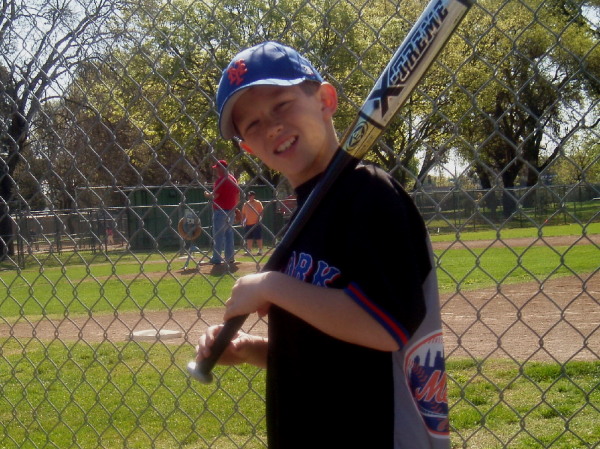
It’s still Spring in St. Lucie, it’s still cold in New York, but out in Northern California kids are playing ball in shirtsleeves. Batter up! Max Lugo is obviously ready for the real Mets season to start…and if it won’t, he’ll start his own.
by Greg Prince on 25 March 2008 9:03 am To be estranged from your favorite Met is strange. I know. I've been sort of on the outs with mine since last September.
I still wear my three REYES 7 t-shirts; my overpriced Jose Reyes button is still affixed to my plush home run apple; no Met has been elevated above him in my esteem, official or otherwise. Yet Jose Reyes and I haven't communicated much since things unraveled. I haven't lit up at the thought of him, haven't embraced the sight of him, haven't Jose-Jose-Jose'd hardly at all. And Jose hasn't really reached out to me.
Is there hope for us yet?
The annual day of renewal is at hand, so the benefit of the doubt must be issued. On Opening Day, Jose Reyes will bat first in Miami and I will put my hands together and he will take it from there. There's no point going to bed angry at your favorite Met and emerging from hibernation in the same old snit. I've been down on Jose since September, down in a way I didn't think was possible, down for reasons I can fathom but don't like doing.
The Mets as an institution did not do themselves proud when last they played for money and honor. You can count on one hand the individuals who bathed themselves in glory and have enough fingers left over to tell Jimmy Rollins what he can do with his portfolio of predictions and pronouncements. We were laid waste by a teamwide epidemic, but with the exception of a certain undevastatable lefthanded pitcher who doesn't live here anymore, nobody was more of a poster child for determined underachievement than Jose Reyes.
My favorite Met sparked everything good about the Mets in 2006, just as he had since coming to the big leagues in 2003. If, in between, he wasn't as polished as some would have liked, it was just a matter of time, I swore it was. He was a work in progress, like young Jed Bartlet in the “Two Cathedrals” episode of The West Wing when Mrs. Landingham told him that he missed a spot.
I didn't miss it. I just haven't gotten to it yet.
Jose got to it by '06 and in the first half of '07 he was on it but good. Then he got off it. The National League Player of the Month for April was nowhere to be found come September. It wasn't that he sucked (which he did), it's that he was almost on a mission to suck. He swung mindlessly, he ran recklessly if at all and he…he just wasn't Jose Reyes anymore. He was some time-marking pod person counting down to when he could ditch this stupid game and this stupid team and go hunting and fishing and maybe gravedigging. He comported himself like a latter-day Richie Hebner, for crissake.
I look at certain Met holdovers and I cringe a little for this year given how last year became last year and whatever troubling dispatch has wafted north from St. Lucie. Has Delgado completely fallen apart? What to make of Wagner's back? Beltran's limbs? Is the perpetual cold shoulder vis-à-vis being the one guy with the potential to fill the fifth-starter role yet never again given a chance going to catch up to Heilman? Is Ollie's arm OK? His head? Will Wright, as blameless as a Met could be as everything around him withered, have the strength to start it up and carry that weight again? Or will he be reduced to churning out quotes about how we're all out there giving it our best, Willie knows what he's doing, my circuits are fine, this does not compute? Contrary to how it looks sometimes, even David Wright is human.
Jose Reyes is way too human, it turns out. Jose Reyes has months, maybe even halves of seasons when he's not superhuman, when he's not the whirling dervish of home-to-third legend, when he's not beating out ground balls because he appears interested only in beating it out of town. He's having a nice March — every time I see a highlight, he's diving into something — but he had a fantastic early 2007 and in the end it amounted to a hill of nothing. No, it was worse than nothing. It was alarming the way he phoned it in on offense and wasn't nearly enough of an Ordoñez to make it up on defense. I was alarmed. I wonder if he was.
Does all that just go away now? I've seen him interviewed. He's smiling the Jose smile. He says everything is fine, everything is dandy. He looks a good bit like the Jose Reyes with whom I fell truly, deeply, madly in baseball love five summers ago. But I stare hard and I see the Jose Reyes from a September to dismember and I struggle to see the leadoff hitter of my dreams and the man who's gonna get on first base enough to get us back to first place enough.
Come back Monday, Jose. Come back for real. All will be forgotten and forgiven if you do.
by Greg Prince on 24 March 2008 1:43 pm 
Jason’s revelations regarding the uncalled for printing of a Mets card for Johnny Estrada included a callback to the Mystery Mets of yore, baseball players given baseball cards in which they were identified as Amazin’, Amazin’, Amazin’ Mets but somehow escaped the actual burden/honor of performing in orange and blue. The last such identity-theft perpetrator (or victim), according to my Topps-tracking partner, was Jerry Robertson in 1971. Four years after this black-bordered nightmare of a set was issued, a mercenary classmate was showing me some old Mets cards to which he was no longer particularly attached. Among the gold was dross that drew me in like platinum:
Jerry Robertson • Pitcher
(I can’t bring myself to resort to lower-case for proper names, no matter how groovy it might have struck Topps amid the graphics Zeitgeist of ’71.)
Jerry Robertson? Who the hell…? It may be almost a quarter-century before Ultimate Mets Database is founded, I thought to myself, but I know damn well the Mets never had a guy named Jerry Robertson in 1971 or at any point since. Jerry Koosman, Jerry Grote, even Jerry May for a minute, but there had been no Jerry Robertson.
I gotta have this!
I told my friend how much I wanted his Jerry Robertson. Well, it’s gonna cost ya, my friend (though not for much longer) said. I’m pretty sure we skipped the niceties of my offering current Steve Garveys and Joe Morgans and the like and got right down to cash negotiating, far more to this kid’s liking. It took a dime, maybe a quarter…big money for sixth grade (at my and perhaps the world’s very first baseball card show that very same spring, a mint Sandy Koufax cost me a dollar). But, as you can see, it was worth it because I have New York Met Jerry Robertson, even as that remains a physical and perhaps philosophical impossibility for everybody else, including Jerry himself.
by Greg Prince on 24 March 2008 1:16 pm 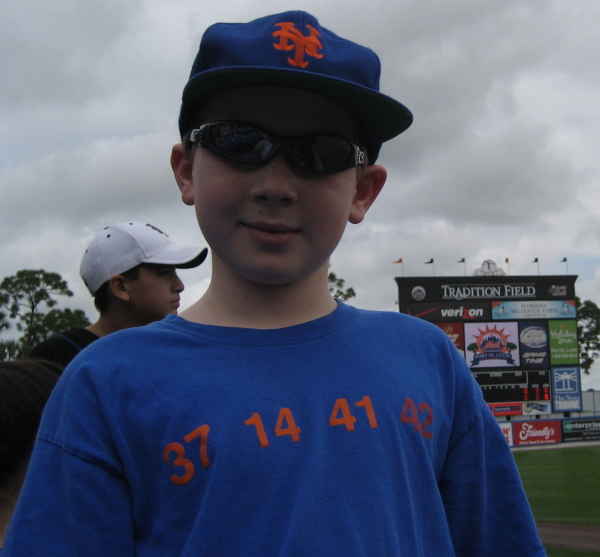
At this stage of Spring Training, every team faces a numbers game in terms of finalizing its roster. As our favorite world traveler Ross Chapman can tell you, the numbers that worked best in St. Lucie this past weekend were the ones on his Faith and Fear t-shirt. They certainly did better than El Duque or Mike Pelfrey.
Want to be the Ross in your crowd? You’re on your own with the shades, but here’s how you can get a FAFIF t-shirt of your own.
by Greg Prince on 23 March 2008 6:42 am 72: Friday, April 25 vs Braves
Ladies and gentlemen, it took six seasons for Shea Stadium and the Mets to host their first postseason game. When they did, it was a doozy: Game Three, the 1969 National League Championship Series, an exciting, come-from-behind 7-4 win over the Atlanta Braves to clinch the N.L. pennant.
The happy ending should not obscure the efforts of a very special player on the visiting team who put his own mark on what would be the final postseason appearance of his brilliant career. He drove in the very first runs in Shea Stadium postseason history with a two-run homer in the top of the first inning. In fact, he hit a home run in each game of the 1969 NLCS, which should not surprise anybody since he would eventually retire with 755 home runs, for 33 years the standard in Major League Baseball and still recognized as an achievement that towers over the landscape of the sport.
Please welcome back to Shea Stadium, to remove number 72 from the right field wall, one of the greatest opponents this or any ballpark outside Atlanta or Milwaukee has ever known, Hammerin' Hank, Henry Aaron.
71: Saturday, April 26 vs Braves
Today, ladies and gentlemen, the New York Mets are honored to play host to Jack Lang Day, paying tribute to one of the most beloved sportswriters in baseball history. The late Jack Lang covered the Mets on a daily basis for the first-quarter century of their existence and continued to write about them for most of the next twenty years of his life. Proceeds from select ticket sales today are going to benefit the Epilepsy Foundation of Long Island, a cause close to the Lang family's heart. They thank you for your support.
In the spirit of the job men and women like Jack Lang have done throughout the history of the Mets, disseminating the goings-on of a baseball club to a fan base that always wants to know more, we thought it appropriate to invite three of his colleagues to remove number 71 from the right field wall. Each man we call on today has written about and been around the Mets since their beginnings. It is through the efforts of journalists like these that a team becomes more than a logo, that players emerge as more than figures on a stat sheet. Though the relationship is occasionally adversarial, the Mets appreciate the job that writers like these do and wish to salute it.
So please welcome from the Shea Stadium press box to the right field line, a trio of Jack Lang's most distinguished peers: George Vecsey, Vic Ziegel and Roger Angell, and, accompanying them, the Mets longtime vice president of media relations — one of Shea's most famous faces in his own right — Jay Horwitz.
70: Sunday, April 27 vs Braves
Ladies and gentlemen, it was 28 years ago that the New York Mets took their first tentative steps toward the rebirth that would lead them to an eventual world championship. It was then, in 1980, that the Mets tradition was granted new life under a vigorous new ownership group, one committed to growing a winner in Queens.
Though neither of them ever sought the spotlight, it would be impossible to tell the story of the New York Mets since 1980 without acknowledging their individual and collective contributions. That is why we asked them to take part in our Shea Stadium final season countdown together and that is why each of them graciously agreed to take the field this one time.
Please welcome, then, the chairman of the New York Mets until 2002, Nelson Doubleday, and his partner of more than two decades, current chairman and chief executive officer, Fred Wilpon, as they proceed to remove number 70 from the right field wall.
69: Monday, April 28 vs Pirates
No baseball season, ladies and gentlemen, is a static one. Player transactions happen regularly, sometimes frequently. For fans of a given team, it is a boon when a move is made and the payoff, in terms of a postseason appearance, is almost immediate.
There are several episodes in Mets history wherein a player came in and made that kind of impact. Unfortunately, there is a flip side. Somebody ultimately has to move on when someone else is added. And in the years when success lies just down the road for the team, it's a tough break for an individual who contributed to the rising to miss out.
With that equation in mind, we have decided to balance the books just a bit tonight by inviting back to Shea Stadium a quartet of Mets who played on four of our most successful teams but for one reason or another did not make it to October. Think of this, fellas, as our making it up to you.
From the 1969 Mets, traded on June 15 for eventual World Series MVP Donn Clendenon, please welcome a Met who made his debut with the club in 1965, Kevin Collins.
From the 1986 Mets, a victim of roster roulette, a pitcher who gave the Mets several gritty seasons and always his best, say hello again to Ed Lynch.
From the 1999 Mets, the centerfielder traded at the deadline in a deal intended to shore up various other needs, someone popular with his teammates and always a pro, Brian McRae.
And leading our group of would-be October heroes to remove number 69 from the right field wall, this outfielder played a major role on the 2006 National League Eastern Division champions. Circumstances dictated the Mets make a trade two Julys ago and the price was a stiff one. We were sorry to see him go, but we're happy to have him back, if just for three games in a Pirate uniform. Please give a warm hand to, from the 2006 Mets, Xavier Nady.
68: Tuesday, April 29 vs Pirates
We are playing ball, ladies and gentlemen, and we expect to finish playing ball sometime tonight. But there have been evenings in Shea Stadium's colorful history when that wasn't always the case.
One of those nights was May 25, 1979, better known as The Fog Game. It was these same two opponents, the Mets and the eventual world champion Pirates who played to a 3-3 tie. Why a tie? Because in the eleventh inning, the fog rolled in off Flushing Bay and it simply became too tough to see.
Here to relive that soupy night are:
• The Pirates' starter who went seven innings and surrendered only three hits, Jim Rooker.
• The Pirate pinch-hitter who belted a two-run homer in the eighth and was a perennial thorn in the Mets' side, the Hit Man, Mike Easler.
• He pitched a perfect top of the eleventh, striking out Dave Parker and Hall of Famer Willie Stargell to preserve the tie score, one of the Mets' most reliable relievers ever, Skip Lockwood.
• And leading us through the fog to number 68, the man who hit a ball to left that could not be tracked down in the pea soup of that May night and went for a triple. The conditions dictated the game be called right then and there and go into the books as a tie. He hit lots of balls in all kinds of weather that fell in unaided by the elements, however, and he had an arm that could rifle a ball through whatever the atmosphere had to offer. Please welcome back Mets All-Star outfielder, Joel Youngblood.
67: Wednesday, April 30 vs Pirates
This afternoon, ladies and gentlemen, we are please to recall a Pirate legend whose playing career had a funny way of bouncing through the annals of New York baseball.
He came to the big leagues in 1956. A season later, he was the starting second baseman for Pittsburgh in the final game at Ebbets Field and what appeared to be the final game at the Polo Grounds. Of course a few years later, the Polo Grounds would reopen for business with the Mets as the tenant, by which time this master of infield defense had become famous for hitting the first home run to end a World Series, defeating the Yankees and making their manager, Casey Stengel, available soon thereafter to tutor the new kids in town.
It shouldn't surprise you to know that Bill Mazeroski was in the starting lineup on April 17, 1964 for these Pirates when Shea Stadium opened or, given his credentials, that he was Ron Hunt's backup at second base when the All-Star Game took place here took three months later. Yet none of his accomplishments, not even his 2001 induction into the Hall of Fame, is why we asked the man known as Maz to remove number 67 from the right field wall today.
No, we invited Bill Mazeroski to Shea Stadium because he hit into a triple play…but not just any triple play and definitely not one that would show up in any box score. On June 27, 1967, prior to a day game right here at Shea, the director of a movie called The Odd Couple staged a triple play for fictional sportswriter Oscar Madison, portrayed by the great Walter Matthau, to cover…or not cover, as the plot dictated. The player captured forever on film making three outs with one swing? None other than Bill Mazeroski.
Maz, who never hit into a triple play in “real life,” was a good sport then and he's a good sport now. And since The Odd Couple is also something of an icon in Shea Stadium history, joining Bill for his trip up the right field line is the actor who would play Oscar Madison in the television series version of The Odd Couple. He is quite possibly the actor seen more than any other in a Mets cap on screen. Please welcome to Shea Stadium, the incomparable Jack Klugman.
Numbers 78-73 were revealed here.
by Greg Prince on 22 March 2008 1:02 am Welcome to Flashback Friday: Tales From The Log, a final-season tribute to Shea Stadium as viewed primarily through the prism of what I have seen there for myself, namely 358 regular-season and 13 postseason games to date. The Log records the numbers. The Tales tell the stories.
7/27/03 Su Cincinnati 9-6 Trachsel 12 148-117 L 8-5
9/25/03 Th Pittsburgh 11-10 Gl@v!ne 1 150-118 L 3-1
8/10/04 Tu Houston 9-9 Trachsel 14 153-123 W 7-3
Talk about a strange dream.
I was at Shea. It was a Sunday afternoon and I was there with my bobblehead-collecting friend Joe. The Mets were playing the Reds. We were handed bobblehead dolls. The dolls had two figures: Ralph Kiner holding a cigar and Bob Murphy holding a microphone. That was weird.
The pitcher for the Reds was Paul Wilson, which was weird, too, because he was the No. 1 draft choice for the Mets long before and Wilson hadn’t pitched at Shea in seven years.
Weirder still was I kept taking out my tiny radio to listen not to the Mets game but the other all-sports station in town, ESPN, because I wanted to hear the Hall of Fame ceremonies. I was sitting at Shea and watching a game and listening to Bob Uecker accept the broadcasters’ award. Weird, huh?
Even weirder is I got up after five innings and said goodbye to Joe. I took my Kiner-Murphy bobblehead and walked over to the Long Island Rail Road station. I called my wife from there. I left early because she had bought tickets on my say-so for a Cyclones game because I had forgotten that I was already going to the Mets game because Joe had gotten the tickets months earlier because of the bobblehead. So weird…I never forget stuff like that.
Except as I was standing on the deserted LIRR platform, my wife was telling me by phone that she had taken the car to the East Rockaway station and it had stalled and she was calling Triple-A. Plus her westbound train to the city was cancelled. Now instead of meeting her at Penn Station to take a subway to Coney Island for the Cyclones game, I told her to forget about Brooklyn and I would take a train from Penn to East Rockaway and we’d skip the Cyclones game which was the reason I had left Shea after five innings. And with all that on my mind, I was still listening to ESPN and they were broadcasting Gary Carter’s induction speech at last.
And it gets weirder still, because when I turn around inside Penn Station for the train home and tune in the end of the Mets game that I had walked out on, Gary Cohen and Ed Coleman are on the post-game show talking about what a nostalgic day this was, with Paul Wilson beating his old team and Gary Carter going into the Hall and mostly because of Bob Murphy announcing his retirement on the same day they handed out those bobbleheads and getting that sustained standing ovation when they posted his decision on the scoreboard in the middle of the sixth, a half-inning after I took off.
I’d call it surreal except that it actually happened. This is how I found out that the Mets figure I held dearer than any other was calling it quits. As the train rumbled east toward Nassau County, I was numb. Bob Murphy was retiring. Can he do that? Is that allowed? If the Mets fall in the forest and Bob Murphy isn’t there to broadcast it, did they really lose?
And me. What’s my problem? Did I really leave the only Mets game in the history of the franchise during which Bob Murphy, who had been the voice of the Mets since there had been Mets, stood up in the press box and waved and everybody there who had a ticket — except one idiot who had a ticket and left — waved back? What a faux pas. Cyclones games, jump starts, Cooperstown…there’d always be time for those mundane episodes. Bob Murphy, 78 and not able to withstand the travel and the staircases and the strain of being even an occasional baseball announcer, was saying goodbye to us.
What the hell was wrong with this picture?
***
We all knew it was coming. It had to be. 2002 morphed into 2003, an extended mix of Met embarrassment, on the field and off of it. And still there was Murph. Not as much of him as there once was — there used to be a full slate of 162 — but enough to make you happy he was hanging on, maybe just a few too many when you heard him flub a name, such as the Sunday he somehow turned Al Leiter into Larry Dierker. But he was still Murph. Still upbeat, still on the game as much he could be. Still winking at us once in a while. During a week when steroids flared in the news, while Gary expressed concern, Murph mused, “maybe the Mets’ hitters should be taking them.”
“That’s not funny,” Cohen scolded. Murph apologized. He shouldn’t have. Shame on you, Gary — nobody puts Bob Murphy in a corner.
After the details of the Mets’ loss to the Reds were covered, Gary and Eddie stayed on and talked about Murph. Listeners called in in shock. And I, sitting on the train alone with my headphones, was growing more and more numb. This is not an announcer. This is my uncle you’re talking about. The calls grew more intense as the train pulled into East Rockaway and I walked home. When I came through the door, I started to tell Stephanie the news. But I couldn’t get the words out. I excused myself to the bedroom and composed myself. Then I called Chuck in Florida to tell him. Chuck all but eschewed television when he lived in New York, so he spent his spare summer nights with Murph. He and I kidded relentlessly about Murph’s growing inability to follow the flight of the ball, all those catches at the wall that were actually home runs, all that “they win the damn thing” stuff. But he understood. Stephanie understood. Everybody understood. Bob Murphy was retiring.
I couldn’t understand, not really.
***
Bob Murphy gave the Mets 42 seasons of Ford C. Frick Award announcing. The Mets gave Bob Murphy a night. A Thursday night.
Years before, five years, Jason expressed disappointment he wasn’t at Shea the night Bill Pulsipher returned from his endless odyssey of rehabilitation and recovery. He added that he was determined to be on hand when Jay Payton made his long-awaited debut. Funny, I thought, I have two days I am going to bust down the doors to be at Shea Stadium for if I have to — but for lasts, not firsts: Whenever they have the final game at Shea and whenever they say goodbye to Bob Murphy.
Not that I could picture either of those events ever transpiring. But one of them was, September 25, 2003, the final home game of that season, a season so useless that I had no plans to be on hand for its finale, until it became Dodge Bob Murphy Night. A Thursday night didn’t seem appropriate, but it was fortunate. Had they done it the previous weekend, I was going to be out of town, on business. I can’t say for sure I wouldn’t have skipped the trip, my own career be damned, for Murph. It — and he — meant that much to me.
They gave Bob Murphy a Friday night, too, the Friday night before the Thursday night. Fox Sports Net decided to pair Murph and Ralph in the television booth one more time. I wasn’t going to miss that either. It was just two or three innings. Matt Loughlin and Fran Healy were standing by for when they faltered, and there was no doubt they would falter. Murph and Ralph had talked more baseball in their lives than most of us would ever see. Hard to believe they had much more to talk about, except how much they had loved doing all that talking together.
Fox Sports Net placed a camera behind home plate, the way Channel 9 used to do it. They imitated the graphics of WOR-TV circa 1973 as best they could. It was a nice touch, though not nearly as nice as hearing those two voices together again, even if those voices had grown slower and less certain than those that accompanied our growing up. Like I said, it was just two or three innings, but it did the trick. It could have been 1973 or any of the years when Mets fans came of age with those guys and their partner Lindsey Nelson. Maybe they were faltering, but in our eyes, to our ears, they would never fail.
***
Friday night passed, I left town Saturday afternoon, I flew back on a Tuesday evening. I sat on the plane and I thought about Murph, about how Murph had been the Mets to me, about how in a couple of nights Murph wouldn’t be the Mets anymore. And I cried not a little.
To be fair with regard to gauging the source of my tears, I was on the verge of probably the worst illness of my adult life. It would eventually be diagnosed as acute bronchitis. It felt like walking pneumonia. It felt like impending death. I would straggle into work on Wednesday, feeling only remotely human. Come Thursday morning, I knew I was going down. So I stayed home from work to save myself for Shea.
I wasn’t missing this.
I’d love to tell you it was a beautiful night in Flushing, that it was a packed house, that it was an adoring crowd. Well, the weather was all right, I guess, and what crowd there was adored Murph. But there wasn’t much of a house. I’d heard later that construction leading to the Whitestone was something awful, that it kept the announced attendance of 25,081 (hellaciously high by ’03 standards) down for the pregame ceremonies. Imagine having a ticket for the last night of the 2003 season, a ticket for the last night of Bob Murphy’s broadcasting career, and getting held up in traffic and arriving too late to see it.
My throat was sore, my head was pounding, my appetite was in abeyance, I was popping every over-the-counter remedy I could find. But I wasn’t missing this. I took an early train and had no intention of leaving before the final out
I met Jason at Gate E as ever and we received a videotape of a SportsChannel interview Fran Healy had done with Bob sometime in the mid-’90s (kind of a retrospective of other Murph retrospectives; I thought it odd that the Mets had not heard about DVDs; Jace said we should consider ourselves fortunate they didn’t hand it out in Beta). My friend had secured us $5 seats via Verizon. Just about every seat that September was $5. The Mets’ slogan could have been “baseball that’s worth what you’re paying for it.” The Mets we were ostensibly ponying up to see included Raul Gonzalez in left, Jorge Velandia at short and the immortal Mike Glavine at first. Mike Glavine’s presence was a sop to his brother, who was pitching.
These were not Mets I was almost literally dying to see on a Thursday night in late September, but it wasn’t about them. It was about Murph. Murph transcended the men who passed through Shea just long enough to try on a uniform. Murph was more Met at the end of an otherwise empty September than anybody else. He was the first hint of spring and he was the hottest days of summer. Murph was the summer when I was 7 and 17 and 27 and 37. By speaking so highly, so accurately, so constantly of everyone from a Sadecki named Ray to a Seo named Jae, Murph was the first Met who came to mind in winter when you needed a taste of summer. Murph was the fastening of my seatbelt and the security of my shoulder restraint. But he was no airbag.
That’s why I was there on September 25, 2003. That’s why exploding acute bronchitis couldn’t keep me away.
That’s why it was so damn sad. I could have felt tip-top and the fire marshal could have guarded every gate to prevent overcrowding and it would have been sad. Everything about the festivities was well-meaning, but a heavy heart hung over it. Gary Cohen emceed and seemed in mourning. A night to honor your flagship broadcaster should have been happy, as happy as every winning recap Murph ever delivered.
But forget it. This was too much of an ending. They rounded up Seaver and Harrelson and Hernandez and Pignatano. They invited Mrs. Hodges and Mrs. de Roulet and Bob’s friend, the singer Julius La Rosa. They saved seats for Al Leiter and John Franco, two Mets fans before they were Mets. The DiamondVision showed us smiles, but you didn’t have to look too hard to see they were really stiff upper lips.
Gifts were presented. A Mets uniform, MURPHY 42, commemorating his seasons in the booth, was framed and autographed. Nice, very nice words were spoken. Cohen, allegedly not always on the best of nightly terms with his senior partner, spoke the moon of Bob. “Other broadcasters will come and go,” he said, “but Bob Murphy will always be the voice of summer.” Ralph called Murph his brother. The best words of all, however, were found square on the banners that were hung from the railings and the placards that were held among us.
Murphy:
Excellent
Treasured
Splendid
Thanks for the memories Murph
Bob, Thanks for the word pictures
Thanks Murph, for 42 Happy years
To Recap: “The Voice of Summer” will never be silenced but will live on
Come Back Often
Banner Day had been discontinued after 1996. It lived again for a night in 2003.
When Murph spoke, he paid homage to everybody but himself. Mets fans — us, of all people — were “unbelievably good, loyal, friendly”. In those first years, ’62, ’63, ’64, “baseball was such fun.” He liked the days when “the announcers got to know the fans a lot better.” The Mets would win one game a week and everybody would be happy. Casey would keep him and Ralph and Lindsey up to the wee hours and then tell them he’d meet them for breakfast.
Casey was wonderful, as were Tom Seaver and Gil Hodges and Yogi Berra (“pure as the driven snow”) and 1969 and 1973, and those years’ “dynasty teams,” the Orioles and Reds, the Mets beat to win what they had won. Ownership, starting with Mrs. Payson right up to Fred Wilpon, was great, too, having always “stood up” for the fans…and “I love the fans, they’re terrific.” He was going to have to answer a lot of mail this winter because he’d gotten lots of it wishing him well since he announced he’d be retiring.
Murph wasn’t about Murph. Murph didn’t talk about his announcing, only whom he had been around and what he’d reported — and the Mets and the Mets’ fans, entities who “provided me with a way of life that I’ve enjoyed so much, you just can’t possibly believe how much I love it.”
At the end, just before and after praising Cohen as the best baseball broadcaster in the country (“he can really get it done”), Bob Murphy got as personal as he was ever likely to.
I hate to say goodbye so much. I know I have no choice. It was a lot easier saying hello the first day we came to New York 42 years ago than it saying goodbye here tonight.
There’s no point in keeping you waiting any longer. Let me tell you how much I love you, let me tell you how great you have been. I’m gonna miss you, believe me I will. I’ll start missing you the minute I walk off this field. It has been such a marvelous, marvelous time.
On behalf of my wife, Joye, we both say thanks to you for being so good to us, for allowing us to be a part of your life and for enjoying baseball with us.
Thank you very much. Good night and God bless.
With that, Bob hugged Joye and we resumed our applause which had been intermittent but hardy for half-an-hour. The PA played “Yesterday Once More” by the Carpenters, its first lyrics more than appropriate to the occasion: When I was young, I’d listen to the radio.
I sure did. When I was 7, and as part of me stayed 7, clear up to that moment when I was technically 40. I didn’t draw up a banner or anything, but I had my own tribute prepared for Dodge Bob Murphy Night.
When I was young, I would listen to the radio, specifically this RCA transistor I inherited from my sister. That’s the radio I carried around with me for day games and night games when it was only with great protest that I agreed to be torn away from the Mets. That’s the radio I pressed to my ear on a Wednesday afternoon one particular October, in a Lamstons drug store in Manhattan (Sukkot got me out of school), so I could hear Tug McGraw tease a grounder to first out of Dan Driessen and know that after having been in last place on August 30, the New York Mets were champions of the National League.
That radio had to come with me to the upper deck thirty years later. One 9-volt battery and it was good to go. Thus, with the bottom of the ninth at hand, I dug it out of my bag and turned up the volume so I, so Jason, so everyone around us could hear Bob Murphy call the final three outs of his career. Timo Perez, Mike Piazza (who had become the Met first baseman for the first time in the top of the ninth) and the 2003est Met of them all, Ty Wigginton, went down quickly. With the Mets’ home season done, there went Bob Murphy’s broadcasting career. No Happy Recap, just a tidy summation of one game in thousands in a career that touched everybody who had ever carried a transistor radio to hear what he had to tell them.
I’ll say goodbye now to everybody. Stay well out there wherever you might be. I’ve enjoyed the relationship with you.
New York Mets baseball is a production of Sportsradio 66 WFAN in conjunction with the New York Mets. The coordinating producer is…
***
One of the banners thanking Bob Murphy ended with METS IN 2004 as its coda. That was appropriate as anything the Carpenters might have sung. Murph gave us that kind of optimism, never not on display at Shea Stadium. Even at the end of 66-95 seasons, he prevented pessimism. Murph never broadcast games the Mets were losing, only ones that they were a few base hits from getting right back into. Seasons, too. It worked in 1973, so we never believed it might not happen again.
Amid the goodbyes was the promise that Murph, retiring like so many New Yorkers to South Florida, would stop by Port St. Lucie for an inning or two now and then, and that if the spirit moved him, he would Come Back Often to Shea Stadium. The radio booth was named for him, so he was eternally welcome. He did pick up the mic once more in the spring of ’04, and it was quite reassuring to hear. Then he left and that was that. In the middle of the season, word spread that lung cancer — the manifestation, apparently, of all that damn coughing you’d hear between pitches — was getting the best of Murph. You wanted to hear he was doing better. You weren’t hearing that.
On the first Tuesday in August of ’04, Stephanie and I went to the movies, The Manchurian Candidate. We came back with sandwiches from our nearby Subway. After setting them down, I turned on the radio in our new home. Bob Murphy, somebody said, had died at 79. He didn’t make it one year into retirement.
If the 2003 Mets had had any decency, they would have been in a 1973-style pennant race the September before. The crowd for Murph should have overflowed. The following summer, however, it did. From the second Bob’s passing was reported, everybody was on the air somewhere talking about him with loving unanimity. The Yankees were home that night and Bob Sheppard read a tribute that Yankees fans stood and applauded long and hard. The Mets were in Milwaukee and Brewers fans stood and applauded for him, too. That entire night’s radiocast, Gary Cohen and Howie Rose presented essentially one long recollection of Murph. Somewhere in the middle of it, the Mets engineered a rout at Miller Park.
I suppose that by sitting alone, typing up whatever spilled out of me and staying glued to Murph’s old frequency, I said goodbye for good that night, August 3, 2004. But there were two more farewells that I had to make.
A week after his death, I was at Shea with Laurie. We figured they’d say or do something for Murph before they played the Astros, and they did. It was a DiamondVision tribute full of pictures and clips, some of which we hadn’t seen, like Murph in his Marine uniform. We applauded as long and as hard as we could. There was nothing intermittent about it.
The day after that, we went to a public memorial at St. Patrick’s. I put on a suit for it. Hundreds of Mets fans showed up in their Piazza jerseys. I’m still glad I wore my suit — and I’m never glad to have worn a suit. Gary Thorne, by no means my favorite broadcaster, gave a rousing eulogy, one that declared there was no better seat in this world than one at a bar, after a game, between Bob Murphy and Ralph Kiner. Cardinal Egan led the congregation in one final, almost endless ovation for the departed.
On the way home, it rained torrentially.
|
|