The blog for Mets fans
who like to read
ABOUT US

Faith and Fear in Flushing made its debut on Feb. 16, 2005, the brainchild of two longtime friends and lifelong Met fans.
Greg Prince discovered the Mets when he was 6, during the magical summer of 1969. He is a Long Island-based writer, editor and communications consultant. Contact him here.
Jason Fry is a Brooklyn writer whose first memories include his mom leaping up and down cheering for Rusty Staub. Check out his other writing here.
Got something to say? Leave a comment, or email us at faithandfear@gmail.com. (Sorry, but we have no interest in ads, sponsored content or guest posts.)
Need our RSS feed? It's here.
Visit our Facebook page, or drop by the personal pages for Greg and Jason.
Or follow us on Twitter: Here's Greg, and here's Jason.
|
by Greg Prince on 22 January 2008 9:33 pm The recent passings of Jim Beauchamp and Don Cardwell demonstrate the power of association by distillation. They both had long and distinguished careers in the Majors but it is the instinct of the fan to boil it all down remember them for the one or two things they did on your team.
Beauchamp? He good-naturedly gave up No. 24 in May 1972 when the Mets acquired a centerfielder who may have been more readily identified with it. Pretty good righthanded pinch-hitter, too.
Cardwell? He drove in the only run of a 1-0 shutout in the second game of a doubleheader after Jerry Koosman performed the same unlikely hitting feat in the first game. Also, I hear he wasn't crazy about love beads.
Granted, Don Cardwell was about five minutes before my time and I wasn't terribly conscious of Jim Beauchamp until he was traded here with a flock of Cardinal bit players in exchange for Art Shamsky, whose 24 he donned for about a month before switching to 5 in deference to Willie Mays. I know Cardwell pitched a no-hitter as a Cub and, in the aftermath of his passing, have learned more about several of his 1969 contributions beyond that RBI single and those eight shutout innings in Pittsburgh. I recall Beauchamp as a Braves coach when they got good again in '91 and persevering there before he retired and they became intolerable at the end of the '90s.
But Cardwell drove in the only run of a shutout in the doubleheader in which Koosman did the same. And Beauchamp gave up his number for Mays. That's what I remember. That's what came to mind in the instant after I learned of their respective deaths, just as it was what came up every time their names were mentioned since they stopped playing. It may not make for a complete or representative portrayal, but it is what has stuck with me. It's probably what's stuck with most Mets fans.
What do you suppose we'll remember about Endy Chavez when his name comes up after he's not playing anymore?
That drag bunt single to win a game against Colorado, the homer off Pettitte, a big hit against the Pirates on the July 4 before last…plenty of good, strong contributions. If you want to recall him generically as architect of perhaps the most significant fourth-outfielder season in Mets history — 133 games as a stellar fill-in in 2006 — go right ahead. If he makes you yearn for low-fat dairy, raise three glasses of skim milk to him.
All that acknowledged, who're we kidding? You think Endy, you think catch. What else is there to think about? We'll remember the catch. We'll remember other stuff, too — he is surely no one-catch pony — but we're tethered to the catch. The next generation will know of the catch and the generation after that one, too.
The Mets have secured Mr. Chavez's services for another two seasons, agreeing on a two-year $3.85 million contract. This comes a couple of weeks after he aggravated a hamstring in winter ball. That wasn't the one he strained and missed a load of time over in regular ball last June. He played the last month or so of 2007, but it wasn't quite the same Endy from 2006. And now he's recovering from injury again.
If this were Player X, I'd be a mite reflexively grumbly that management just overcommitted, as it is prone to do, to someone 30, brittle, part-time and theoretically replaceable. But he's not Player X. He's Endy Chavez.
Endy Chavez made that catch. How much do you suppose that would be worth in arbitration if any one of us were the arbitrator? How much would have you given in the course of the evening of October 19, 2006 to have had Scott Rolen's surefire two-run homer retrieved and converted into a double play? For how long would you feel privileged to compensate Endy Chavez in appreciation of his dash, his leap, his grab and his throw?
Two years? Make it two eternities. One for now, one for later. It was that good.
Technically, the catch took place 15 months ago. Seems more like 15 years, doesn't it? A little? Doesn't that moment when the world froze for a handful of unyielding seconds seem from another era already? Endy was in left. Who were in center and right — Tommie Agee and Ron Swoboda? Is it possible that that same Endy Chavez who made in 2006, with all due respect to glorious Met outfielders past, the greatest postseason catch ever played on the 2007 Mets of badly constructed legend? What would a Mets team with Endy Chavez be doing coughing up a large divisional lead? No, impossible. Endy is associated with only goodness; he drinks his milk, he eats his yogurt and everyone wins!
Of the theories that have abounded and will always be bandied about where The Greatest Collapse In Baseball History is concerned, you don't hear much about the extended absence of Endy Chavez, how 133 games in 2006 were reduced by almost half in '07, how Chavez came to the rescue in Cliff Floyd's absence one year but was unavailable to do the same for much of Moises Alou's predictable recovery period, how a team rises to the occasion when it has an Endy Chavez and how it falls flat when nobody plays that role for months at a time.
To be fair, the Mets were muddling along in first place when Endy went down on June 6 (against the Phillies, appropriately enough) and were still masquerading as front-runners on August 28 (once more versus Philly) when he returned. A check of Baseball-Reference's gamelogs reveals he had slumped from .337 to .292 in the week-plus before his left hamstring gave out…reflecting eerily the southbound turn the Mets as a whole had begun to take. When he came back, he wasn't quite the same Endy, not the one from 2006. That's perfectly understandable as it's tough to miss 73 games and reconjure your magic all at once.
He also wasn't used that much down the stretch. With Alou healthy and hot, Chavez wasn't going to left. Among lefty Green and righties Gomez and Milledge, he got lost in the other corner shuffle. He started all of three times in September, all in right, not once after September 18 (when he went 3-for-3 and drove in two runs). I sat at one of the final games of the year, the Friday night loss to the Marlins, and wondered, amid the parade of pinch-hitters Willie Randolph was dispatching to the plate and welcoming back to the bench hit-free, where in the world was Endy Chavez?
Venezuela, I learned. His sister died. He went home for the funeral and would miss the final series.
2007 was almost never the same as 2006. There were dozens of factors that went right previously that simply underwhelmed later. In one year, a journeyman utility outfielder first steps up and then jumps up and makes a breathtaking catch for the ages and an incalculable difference to our fortunes. In the next year, he's the same man, yet he can only do so much. He can't do anything when he's hurting. He can be a bobblehead promotion and he can be the one universally beloved component of the “Sweet Caroline” video, but he can't play if he can't play or they won't play him. Subtract such a glaring disparity between '07 and '06 and you wind up deleting the extra from extraordinary.
None of which makes me think of anything but that catch when I think of Endy Chavez. Whatever he does in 2008 and whatever he does for however long he plays for the Mets, he makes that catch. That thought sticks with me.
by Greg Prince on 22 January 2008 9:30 pm 
| I’m a little fuzzy on why more baseball cards don’t portray players executing their signature moments. I was extraordinarily delighted when Jason sent me Upper Deck No. 381 from its 2007 set last spring. If you’re gonna get an Endy Chavez, you might as well get the Endy Chavez. We have him, incidentally, for two more years. We will have what he did on October 19, 2006 for much, much longer. |
|
|
by Greg Prince on 22 January 2008 9:25 pm 
| Jim Beauchamp, wearing the number he was issued when 24suddenly needed to be ripped off his shirt, indeed did some fancy pinch-hitting as a 1973 National League Champion Met, landing on base at a .325 clip when called off the bench and into action by Yogi Berra. Ken Boswell lost his second base job to Felix Millan that same season but he, too, did his part to inspire the ’74 yearbook’s caption writer, belting a pair of pinch-homers in a reserve role. You’d think that two guys who combined to start all of 21 games in 1973 wouldn’t be smiling all that much. But if you look closely, you might recognize the setting for this photo as the Oakland Coliseum. Beauchamp and Boswell were pinch-hitters on a World Series team. Jim Beauchamp’s final appearance in the big leagues, for that matter, was in that Fall Classic, the only one in which he played.Knowing that, I ask you, why wouldn’t you smile? |
|
|
by Greg Prince on 22 January 2008 9:13 pm 
In the 1968 yearbook, Don Cardwell doesn’t quite look like he’s thrilled to be here, but inside of two seasons, he had every reason in the world to be satisfied with what must have seemed like exile to baseball purgatory. Traded to the perennially lousy Mets before 1967, he earned the Opening Day start (kid named Seaver took the ball for the next game) and produced sparkling ERAs of 2.96 a year later when the Mets improved immensely and 3.01 the year after that, when they won it all. With a Major League career that began ahead of any of his 1969 teammates, he was the personification of “elder statesman” on the world champs’ pitching staff, even if he was seven weeks shy of his 34th birthday as the ticker tape rained over Lower Broadway.
As for those love beads Ron Swoboda wore on a team flight — the ones that raised Cardwell’s ire — Don told Stanley Cohen, in the essential 1988 book A Magic Summer, he had long transitioned into forgive & forget mode: “He thought I was a southern redneck, and I thought…I thought he was just a Rocky.” Confirmed Swoboda in the wake of the news of his teammate’s passing, “Just old school, man. He was old school back then.”
by Greg Prince on 21 January 2008 4:51 am Kudos to my friend Mark for putting the NFC championship into Met perspective for me:
I root for the Jets, but I’d have to imagine for a Giants fan, that was kind of like winning Game 7 of the 2006 NLCS.
Yeah, I thought, kind of. There was a definite twinge of life after death that followed the kicker missing the winning field goal at the end of regulation and being given another attempt in OT. It was as if Beltran had gotten just a tiny little bit of that 0-2 curve from Wainwright and was granted another swing.
And connected.
Now, thanks to Lawrence Tynes, the Giants are going to the World Series of football, the Super Bowl. It’s only sinking in how amazin’, amazin’, amazin’ this is. These are the Giants of Eli Manning, which as recently as a month ago was code for don’t be silly, there’s no way they’re going anywhere even if they are in the playoffs for a third consecutive year. These are the Giants of ornery Tom Coughlin for whom I’ve been willing to endure a 5-11 season just to get him fired on principle. I look at Tom Coughlin and I see Art Howe’s nasty brother.
Yet there they are, Manning and Coughlin and the rest of them I barely know or moderately tolerate in the same laundry and logo I’ve always gravitated to and they are half of the last two teams standing. When I was a kid in the ’70s, I couldn’t imagine the Giants in the playoffs, let alone the Super Bowl. Then, finally, there was that golden age of Parcells and Simms and Taylor with a dash of Hostetler and Ottis Anderson and several other true Giants, and the result was two absolutely thrilling world championships. I really gave a damn back then. As overtime began at Lambeau, it was noted the Giants were 0-2 in playoff sudden death, including the infamous loss to the Colts in ’58. What was the other one, I wondered. Oh yeah — the Flipper Anderson game that knocked them off on January 7, 1990. I was so inconsolable after that one, the date sticks with me eighteen years later.
Somewhere along the way, the Giants’ shortcomings became a matter for which consolation was not required in copious amounts. I never expected a single Super Bowl. I got two mighty wins. Everything thereafter was bound to be letdown (especially Ray Handley). In the handful of dramatic mediocrity-interrupting Giants losses since they last lived up to their enormous name, I’d be miserable for a day, then an evening, then an hour, then maybe the seconds it took me to resume the countdown to pitchers and catchers.
The Mets long ago overwhelmed all my ancillary sports loyalties. Annoyance with Coughlin’s “you’re late if you show up five minutes early” brand of motivation (which probably makes sense to football players) notwithstanding, I’ve never actively rooted for Giant failure. I just became less and less concerned with what they did. A quarter to half of their season interferes with baseball. I resent that. By the time I look up in November (once I’ve had the opportunity, as Chuck puts it, to decompress from whatever catastrophic event I’ve experienced in September and perhaps October), there are suddenly large, tattooed men wearing numbers that used to belong to Gary Reasons and Lee Rouson and spare ’80s Giants I have no business remembering but do because those Giants teams were so memorable and football today is just something that gets in the way of baseball.
A few weeks ago, there was an inane public debate over whether the Giants, a playoff spot inexplicably in their pocket, should play hard against the Patriots, who were going for a perfect record. I watched that game more intently (mostly rooting against the ’72 Dolphins) than I’d watched any Giants game in a few years. I watched them beat the Bucs two Sundays ago and it was quietly gratifying. I watched them beat the Cowboys last Sunday and it was surprisingly exciting. I watched them play the Packers with muted emotions earlier. It was good to see they were still playing hard. But honestly, they were playing at literally below zero, against Brett Favre, the guy with the misplaced “v” and all those comebacks. What was the point?
The point was Tynes the kicker got another shot at a winning field goal and, after that asinine coach barked at him when he missed in the fourth quarter, took the bat off his shoulder and nailed it, and the football team I’ve rooted for as long — if nowhere near as deeply — as I’ve rooted for my baseball team was going to the Super Bowl for the fourth time…which makes it four more times than I ever thought I’d see. I have almost no doubt they’ll lose 43-6 when they face the Patriots again, but I think I’ve been pretty clear that football isn’t the sport where I excel at understanding. I rarely if ever show up five minutes early for anything.
by Greg Prince on 20 January 2008 10:33 am 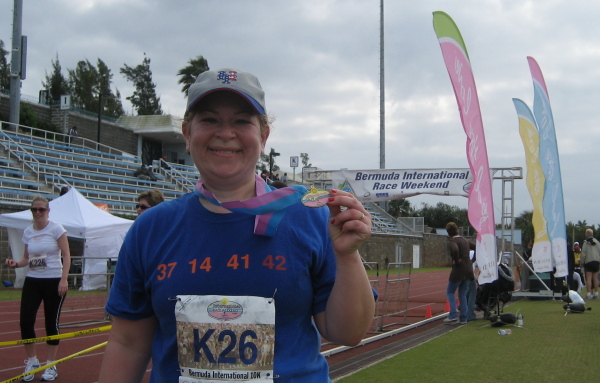
The most versatile t-shirt on earth just got a pretty good workout in Bermuda, the fourth nation in which The Numbers have been photographed (fifth, if we count Texas separately). The occasion was, as the sign in the background suggests, Bermuda International Race Weekend, and our wearer of the hour, Sharon “Inside Pitcher” Chapman, went the extra mile in completing the 10K course and spreading the gospel. “Several people watching the race asked about the numbers,” Sharon reports, “and were supportive when I told them that they were the Mets’ retired numbers.”
One assumes K26 has something to do with the race and is not part of an organized campaign to have a marker commemorate one or all of Dave Kingman’s 672 Met strikeouts.
If you want to show us what you’re doing in your Faith and Fear shirt, by all means, send us a picture and we’ll do our best to post it. And if you want your very own Faith and Fear shirt, just take a jog over here and order one up. Medal not included.
by Greg Prince on 18 January 2008 11:09 am Welcome to Flashback Friday: Tales From The Log, a final-season tribute to Shea Stadium as viewed primarily through the prism of what I have seen there for myself, namely 358 regular-season and 13 postseason games to date. The Log records the numbers. The Tales tell the stories.
8/29/93 Su Colorado 2-1 Tanana 4 36-43 L 6-1
Not to go all Top 500 on you for a second consecutive year, but I have to direct your attention to the tune at No. 372, for it is critical to understanding the point this week’s Flashback intends to make.
The song is “I’m Coming Home” as performed by Johnny Mathis. It didn’t mean anything to me upon its release in the fall of 1973 (though anything from the fall of 1973 generally evokes a pleasant baseball memory) but I heard it on a Wednesday night in the fourth week of June 1987 and it meant everything to me, particularly the refrain:
I’m goin’ home
Goin’ home
Tell someone to meet me
I’m comin’ home
It is not incidental that I heard it when I heard it. I was ten days removed from having last seen my brand new girlfriend whom I had met on her Summer in New York term of college. She had taken a train back to Florida. I had taken a trip up to Montreal to delay what I expected to be a long bout of loneliness. It kicked in that Wednesday night, but not in a bad way. Although Stephanie was more than a thousand miles away, I knew once and for all and without a doubt that with her I was home. I felt a state of belonging unlike any other I’ve ever known. More than 20 years later, I still feel it.
And yes, I feel it with the Mets. That’s a given. I feel it here on this blog and I feel it when I listen to Howie Rose and when I read Screwball for the umpteenth time and when I stare at the high-number 1972 Jerry Koosman card a very considerate friend sent me for my most recent birthday so my 1972 Tom Seaver card would have someone to warm up alongside. It’s a given, I would think, that the Mets, like my wife, are my home. With both, I am where I belong.
Having acclimated to the Mets through TV, radio and newspapers, I suppose I technically didn’t need my very own stadium to feel all that, but I am lucky enough to have had one. Of course Shea is a part of this dynamic of comfort, familiarity and belonging. That’s what these Fridays are all about in 2008, that’s the subtext of this upcoming season, that Shea is home.
It’s easy enough for me to have identified Shea Stadium as home for 35 years, dating back to my first game there in 1973. It went like this: I’m a Mets fan; the Mets play at Shea; Shea is home. But if I’m honest with myself, I know the first two decades or so of my relationship to the ballpark had a bit of a wannabe quality to them.
Shea was the home of the Mets, absolutely, but it was just a place I got to visit a few times a season, first because nobody was volunteering to take me, then because I didn’t make it my business to go very often. From ’73 through ’92, I never went to more than seven games in a single season. It’s hard to believe I wasted my teens and twenties doing anything else, but apparently I did. I loved going to Shea then, but it was a place that on some level of my soul I felt I was just passing through.
Then came my thirties and I came home.
The people responsible for directing me where I belonged were the people who wanted as little to do with it as possible when I was younger. My family, agnostic at best to our national pastime, decided it would be a fine thing to round up 15 pairs of tickets and present them to me as a 30th birthday present on New Year’s Eve 1992. Their sense of mathematics was poetic (15 X 2 = 30). Their sense of timing would, however, seem unfortunate (1993 = 59-103).
I’ve been kind of chortling for 15 years now that that was some kind of present, a semi-access pass for the worst Met season since 1965, that I should feel fortunate that my father, my sister and my brother-in-law liked me because if they didn’t, I imagine the present would have been 30 pairs of tickets. But I think I’m ready to step off that easy-laugh bandwagon. I think I’m glad I was at Shea as much as I was in 1993, even if it involved watching the 1993 Mets as much as I did.
1993 was the year I came home to Shea. 1993 was the year I stopped feeling like a visitor, like a guest, like a tourist. 1993 was, through repetition and because there was so much elbow room, when I started feeling truly at home at Shea. I could stretch out, put my feet up and not have to ask where the bathroom was or if anyone minded if I used it. The lay of the land would become so familiar as to become second-nature across five months of dismal baseball. Whatever residual self-consciousness I carry with me in public places that tend to intimidate me wore away. I’d always called Shea home. 1993 was when I began to mean it.
I’d say it took the entire season, at least my portion of it, to gain the experience necessary to clinch my sense of 100% belonging. I wound up going to 16 games in 1993 (my record of 6-10 an eerily accurate reduction-facsimile of the overall 59-103 mark, so it wasn’t like they were singling me out for punishment), the last of them at the end of August. That was the day I would pinpoint as my finally being all moved in. I would have to deem it a banner day.
Or, better yet, Banner Day.
No bedsheets were harmed in the course of this milestone in self-discovery. Banner Day was one of those dates that had intoxicated me from afar, the way oodles of fans would materialize from behind the centerfield fence between games of a doubleheader, how wave after wave would march upon the sacred track, how the faith never waned, how when I was 16 and the Mets were crap, there was a banner that insisted “AIN’T NO STOPPIN’ US NOW” even though, clearly, our forward progress had long been kicked into reverse. But Banner Day was no time for a reality check. I had to see one of those Days one of these days.
My Banner Day, thanks to my foresightful brother-in-law (he selected the 15 pairs and took great care to find me all the best promotions) was August 29. For the third time in 1993, I secured the company of my wife for a Mets game. I’m pretty sure I had promised back on New Year’s Eve that she would not be my default companion every time out, especially on the chilly nights, but this occasion required no persuasion. It was Banner Day. Banner Day had been featured in “An Amazin’ Era,” set to the tune of Petula Clark’s “Sign Of The Times”. Stephanie liked Petula Clark. Stephanie liked nonviolent tribal rites. Stephanie liked art. Stephanie even liked the Mets if I didn’t assault her with too much strategy or trivia. How could she not like Banner Day?
The scheduled doubleheader was dead as the dodo by ’93 (just as well for my purposes, as I’m trying to imagine a world in which my wife consents to attend two events of any kind in a single day), so the parade would precede the 3:10 start. So we wouldn’t miss a single word of laundry-markered encouragement, we arrived nice and early and made our way to our Row A seats in loge, roughly parallel to first base.
Alas, they were ruined. It had rained some the night before and those blue seats had turned to white. The mezzanine found a way to leak heavily on them and, though it was now bright and sunny, continued to do so. Our seats were unsittable.
You know how useless your Shea ushers are? Not when they sniff opportunity, they’re not. Standing in front of our seats, we were approached. Look, I said to the man in orange trim. These are not banner seats. What can be done?
Usherdom kicked into action. The man ushered us to another man in uniform and, for a convenience fee of a dollar, we were handed off. Our new man was a higher-up armed with a walkie-talkie, and he ushered us to undamaged seating: Loge Section 1, Row G, Seats 7 and 8. Another cash consideration was consummated to complete the transaction.
These were the best seats I’d ever had at Shea. Not the closest I ever was, but for scope and breadth of the field, they were quite unMetlike in that they couldn’t be beat. Plus, my literally fair lady heartily endorsed the shade we’d be in. Far back enough to avoid the foul balls she forever feared, close enough so that Ryan Thompson wouldn’t be a rumor (as opposed to his talent, which was never proven).
Down went our butts. Out came the banners. Sanguinity was in abundance. There were hundreds of placards passing before us. I expected maybe a dozen in these, the dog days of a dog season, but no. You tell Mets fans they can walk the Shea track, they will at the very least feign optimism. Maybe they’ll even mean it. Me, my banner would have probably proclaimed…
1993: I KENT TAKE THIS ANYMORE!
…but like I said, I didn’t participate. I was just happy to be there.
That was the key to the day: I was happy — immersed in a pool of happiness deeper than a 1993 Mets fan could possibly anticipate. I had the great seats and of course the greatest of seatmates. We watched the banners flutter by and then we watched Frank Tanana’s pitches do the same. Of course the Mets lost, 6-1 to the expansion yet somehow superior Rockies. Of course they bowed without a fight, taking barely more than two hours to sink 40 games under .500. Of course I didn’t care. I was numb to the losing by the end of August. I had gotten used to it in that sad whaddayagonnado? fashion any sane fan adopts when a 1993 rolls around.
Yet the game wasn’t the point of this sunny afternoon in loge. Even the bucket list accomplishment of taking in one Banner Day before management unceremoniously abandoned this proudest of Mets traditions wasn’t. It was that feeling that I was where I was supposed to be, joined for the afternoon with whom I was supposed to be joined, doing what I was supposed to be doing. I was watching the Mets with Stephanie at Shea Stadium like it was no big deal.
Believe me, though. It was.
And not incidentally, Happy Birthday come Sunday to the woman who has brought me a passel of banner days since May 11, 1987.
by Jason Fry on 16 January 2008 5:15 am Don Cardwell, one of the Miracle Mets’ elder statesmen, died Monday at 72.
It’s been that kind of offseason: Most of the headlines the Mets make are because there are fewer of them, and not because three or four are headed to Minnesota for Johan Santana. Jim Beauchamp died shortly before New Year’s; now Cardwell. What news do we have otherwise? Well, Angel Pagan has come back to the fold in what Bill Veeck used to call a dog-and-cat trade — I’ll trade my utility guy for your utility guy so the papers will have something to write about and the fans will have something to chew on in the barbershops for a few days.
(Actually I was pathetically excited to hear Pagan was returning — he was the phenom on the inaugural edition of the Brooklyn Cyclones, the one the girls would yell loudest for, with that goofy-in-English name that sounded like something a bunch of suburban punk kids would call their crappy band. I’d been warned, as a newcomer to this short-season A-ball thing, that at most two or three guys might make the big leagues in any capacity. Pagan had some pop and some speed and a certain way of gliding around the bases that made me imagine it would be him. Now, I suppose, it shall be.)
I never saw the ’69 Mets play (OK, I did but I was five months old when they won), so as a geeky Met fan on Long Island I did the only thing I could: I learned them by rote, assembling them from little snippets of biography I read in quickie books borrowed from the library or found in used bookstores. I was a kid, so the portraits I assembled were odd bordering on random: They mixed obvious baseball descriptions with personal stories, and often prominently featured words and concepts I was just learning. For example: Tom Seaver was the phenom, who’d bulked up in Fresno moving boxes (some of which contained big spiders) and in the Marines, played in Alaska, wound up in a lottery, and married Nancy, who was beautiful and blonde and wore something called a tam o’shanter in the stands, where she was not afraid of Orioles fans.
See what I mean? And Tom Seaver was easy, because he was Tom Seaver — still around while I was falling in love with the Mets and devouring every bit of their history that I’d missed. Most of the others were gone, and thus not so simple to fix in memory. Grote was hard-nosed, muttered at umpires and thought the writer who said the Mets had as much chance of winning as men did of landing on the moon had insulted the team. Swoboda had once got a batting helmet stuck on his feet but despite that was smart, had beaten Steve Carlton with two home runs, had a Chinese grandfather and you pronounced his name “Suh-boda” even though that was wrong. Nolan Ryan soaked his fingers in pickle brine and was now very good. Ed Charles wrote poetry and was nicknamed the Glider. Tug McGraw was a flake, which was a baseball term, gave his teammates haircuts, and his brother Hank had been a Met minor-leaguer. Tommie Agee and Cleon Jones were from Mobile. Rod Gaspar’s name had eventually been twisted into “Ron Stupid” by Frank Robinson and the rest of the Orioles, which might have been one reason they got what they deserved. Jack DiLauro was the guy you’d forget the first time around.
Don Cardwell, hmm. He was older, had been a Phillie and a Cub and a Pirate. Swingman. Helpful to the younger pitchers. Bigger than Cal Koonce, with whom I otherwise got him confused. Not a lengthy or terribly flashy biography, but then that’s the life of a swingman as put together after the fact by a child.
And yet, unfairly, Cardwell also became the name I connected with an important and thoroughly unwelcome loss of baseball innocence: These guys wearing the same uniform didn’t always get along.
The root of that is a tiny incident, one the principals invariably laughed off in the retelling: On an airplane in the summer of ’69 (when Bryan Adams was freaking nine, by the way, that Canadian faker), Swoboda — my favorite Met whom I never saw play — and Cardwell got into a dispute over Swoboda’s general Swobodaness and his wearing love beads. (I didn’t know what love beads were when I first read that; truth be told, I’m not sure I do now.) Cardwell objected to the love beads or tore them off, and eventually wound up taking a swing at his teammate.
No harm was done, but for a baseball-obsessed kid it was an eye-opener. How was this possible? Baseball players wore the same uniform, they had road roomies, they went to battle together, they slapped hands and hugged after home runs and once in a very great while they got to cover each other and anyone else in range with champagne, which looked like it would be incredibly fun to do. And now you’re telling me there are guys who do this and don’t get along, who even once in a while try to punch each other over love beads, whatever those are? I was shocked.
To reiterate: Cardwell, by all accounts, was an awfully nice guy. (And he got traded to the Cubs and threw a no-hitter in his first start, which is insanely cool.) It’s ridiculous to have the kind of little disagreement that probably happens all the time on planes and buses during a long season surgically attached to him. But it got wired that way when I was a kid, and I’m powerless to change it: Ever since I read that ages ago in some forgotten book, Don Cardwell has been the face of intramural dust-ups. Whether it’s Rey Ordonez and Rey Sanchez fighting on the bus or Darryl hitting the cutoff man on Picture Day or everybody abusing Gregg Jefferies, when I hear about stuff like that, the first thing that pops into my head, always, is “love beads.”
by Greg Prince on 14 January 2008 8:57 pm Last week when I was very sick, my friend Joe Dubin, a charter member of the New Breed, cheered me up as he is wont to do by sending me a copy of an old Mets radio broadcast of a game I recently wrote about but missed the first time around. I returned the favor by transmitting my cold to him via e-mail. To make it up to him, I'd like to share with you something he shared with me last year, a lovely stream of recollections regarding the new ballpark in Queens…the first time such an edifice was constructed.
Feel better, Joe D. — and thanks for your memories.
Drove by Shea yesterday and was able to get a quick glimpse of Citi Field's construction site while heading to and from the Grand Central Parkway. There it was, the old making way for the new. It made me think of the first time I saw Shea 43 years ago.
Remember your reaction the first time you saw it? I'm not thinking as much when entering the park but rather that experience when first approaching it close up, either from the expressway or pulling into the Willets Point station.
My experience might be a little bit different than yours since I first saw Shea when it was the newest ballpark in America and light years away from the old Polo Grounds and Yankee Stadium and anything east of Dodger Stadium (except maybe D.C. Stadium).
Games started at 8:05 P.M. so it must have been around 7:15 P.M. when I got my first glimpse sitting in the car as Dad drove onto the Whitestone Expressway. It was overcast and the sky was dark, allowing the stadium lighting to be seen in its full brilliance. The upper deck lights were much brighter when looking straight at them than they are today. Most of the exterior was open (unlike now, when it's partially covered by blue painted masonry with bulbs arranged to look like ballplayers), so the entire perimeter was a silhouette of neon lights coming from both the outside and the ramps and pedestrian walkways peaking through from within.
I'm glad my first trek to Shea was at night because the effect would not have been as dramatic or beautiful without that gorgeous lighting. My first two words were “holy s–t”. I couldn't believe the ultra-modern stadium I was seeing! It was like being in Disney's Tomorrowland.
We parked, purchased our general admission tickets, took the escalators to the upper deck and sat behind third. All I had ever seen on TV was a Shea drenched in shades of black and white. This park had tiers of yellow, orange, blue and green seats with a rainbow of lights protruding onto the white shell covering the scoreboard. We saw color slides of each player from the square screen on the top.
About the game? Well, it was a Wednesday evening in late July against the L.A. Dodgers, the middle of a three-day on-field celebration of Casey Stengel's 74th birthday. The Mets scored three in the bottom of the first off Joe Moeller but the flood gates opened in the top of the second and my first experience was a washout!
Dad was unprepared for inclement weather and purchased from the concession stands a clear, gray-tinted plastic poncho (with no Met logo or hood) stored in a small travel case to protect him from the rain. Harry M. Stevens came well prepared back then; at that time there was no such thing as a Met Shop behind home plate selling all types of apparel.
Probably because the event was so impressionable I remember so many of the details, including the game being stopped by rain in the top of the second. Or, maybe it's because the Mets scored three runs in the bottom of the first and actually were ahead of the Dodgers 3-0 when the rains came (how often did the Mets lead L.A. by that margin back then?).
Well, the game was a washout but not the memory of my first visit to Shea. That's how I'll always remember Shea — no DiamondVision, no Budweiser advertisement filling two-thirds of the old scoreboard, Jane Jarvis, the green outfield wall.
When it opens, Citi Field will be gorgeous to see but somehow I doubt I will experience anything like the awe I had when I first saw Shea, for I'm obviously much older. I will see the construction as it progresses and despite all the new conveniences, the park itself won't be as unique compared to its contemporaries as Shea was in 1964.
I'm sorry you were too young to have experienced Shea when it first opened and the exciting, unbelievable first glance as seen through the eyes of a 13-year-old at a time when most ballparks were ancient and the world was not surrounded by the Internet, cable, computer video and other forms of communication that today take away the thrills experienced by the 13-year-old in each of us.
by Greg Prince on 14 January 2008 2:36 am John Strubel of MetsNet, a terrific and comprehensive site devoted to all things orange and blue, was kind enough to invite me on MetsNet Radio Saturday for a little chat regarding various aspects of Mets nostalgia and a touch of potential trade talk. The most interesting thing about the session to me is that I don't sound nearly as bad after a week of marathon sneezing, coughing and noseblowing as I thought I would. Pull me out of a sickbed in the middle of winter to discuss the 1973 yearbook cover, and I apparently get well in a hurry.
You can listen to the show here. I come on at about the 42:00 mark and go for about 15 minutes (good guests precede me as well).
|
|






