Faith and Fear in Flushing made its debut on Feb. 16, 2005, the brainchild of two longtime friends and lifelong Met fans.
Greg Prince discovered the Mets when he was 6, during the magical summer of 1969. He is a Long Island-based writer, editor and communications consultant. Contact him here.
Jason Fry is a Brooklyn writer whose first memories include his mom leaping up and down cheering for Rusty Staub. Check out his other writing here.
Got something to say? Leave a comment, or email us at faithandfear@gmail.com. (Sorry, but we have no interest in ads, sponsored content or guest posts.)
It’s three straight Memorial Day weekends that the Mets have visited the Marlins and that would be nothing more than a scheduling quirk barely worth noting except the Mets at the Marlins at this particular juncture of the calendar means one thing to me beyond any wonderful things John Maine, Carlos Delgado and their teammates are doing during their stay at Dolphin Stadium.
Bernie The Cat chose the hours leading up to the Friday night game of this holiday weekend two years ago — May 27, 2005 — to leave the building, so to speak. I would say we lost Bernie, but that doesn’t sound right. Number one, you couldn’t lose Bernie if you tried. There was just too much cat there to misplace. Number two, I would never let it happen.
We found Bernie at the North Shore Animal League on Halloween 1992 and he found himself at home in our hearts before All Saints Day dawned. He is the reason I’m a cat person. He’s the reason we adopted him a brother, Casey, six months later and the reason we share our home with another smashing set of siblings, Hozzie and Avery, today. It’s impossible for me to lose the feel of what Bernie meant and means to me.
Having served as Bernie’s publicist, pro bono, for nearly thirteen years, I can report with total objectivity that Bernie The Cat was a star. A megastar. We should have furnished him with a red carpet and a velvet rope, that’s the kind of star he was. You couldn’t not see it and swoon. But you also couldn’t not see what he was like inside.
See, Bernie would attempt to be aloof but could never quite pull it off. He’d sidle up to me as if it were just a coincidence that I was sitting a few inches to the right or left of where he decided to plant himself at a given moment. No, I didn’t come over to see you, I just happen to like hanging out in the same square footage that you occupy…believe me, you shouldn’t be flattered. My purring in your presence is not to be taken as tacit acknowledgement that I care for you. But as long as I just happen to be lying in the vicinity of you and whatever you were reading before I plopped myself on top of it, how about you make yourself useful and stroke me about 50 or 60 times? Also, there’s a can of Fancy Feast in the kitchen that could use some opening when we’re done here in the living room.
The act, repeated regularly, never lasted for long. We’d lock eyes and we’d become one, a man and his cat, a cat and his man. When the rest of the world slept, Bernie was the best friend I ever had. We did pretty well when everybody else was awake, too.
The Mets took three of four from the Marlins in Miami two years ago at this time. The Mets took two of three from the Marlins in Miami last year at this time. The Mets have taken the first two from the Marlins in Miami this weekend. In honor of Bernie’s aspirations of aloofness, I’ll continue to pretend the National League schedule is just one big, fluffy coincidence.
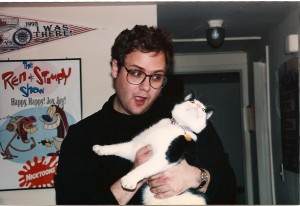
Now that’s a star. Bernie The Cat, on a winter’s evening in 1994, is as ready for his closeup as he’s gonna get.Note a) the Sprockets look I sported for this photo shoot; b) our devotion to yet another cat (and his overwrought asthma-hound Chihuahua companion) from the early ’90s; and c) my enduring pride at having attended the first Mets-Rockies series ever. That pennant hung in our living room well after 1993 was revealed to have been 1993.
They all looked wonderful Friday night. Orlando rehabilitates with so little notice that I tend to forget he's on call. You get a Duque outing like that (and with one exception, that's exactly what he's given us all year) and you've got a great chance, no matter how dimly and densely his teammates execute on his behalf. Thank goodness the Marlins did Sergio Mitre a similar lack of favor.
Mr. Martinez won't be going tonight or tomorrow or the next day (of course not the next day — why would every baseball team be scheduled to play baseball on a major national holiday in the middle of baseball season?), but just seeing that face…that face…that marvelous face…attached to that arm…that arm…that marvelous arm. He'll be back. He has to be. Pedro Martinez smiling in a Mets uniform from the bench is too big a tease to not augur Pedro Martinez pitching in a Mets uniform from a mound relatively soon.
In other injury news, Green and his .314 batting average sustained a broken bone in their right foot from a foul tip, an owwie sufficient enough to keep both of them out of action at least a couple of days. Those desperately craving another serving of Carlos Gomez energy drink might get a whole case if Shawn and the nearly recovered Moises pass in the DL night. Who knows?
That question would also apply to the final result, a W from a New York bunch that played like L'ers most of the evening. As implied above, the Mets stunk, almost every one of them not named Hernandez, Lo Duca or Smith. They didn't run correctly, they didn't throw correctly, they didn't play what you'd call sound baseball. But they nibbled determinedly at the heels of the Marlins bullpen until that esteemed body collapsed under the weight of its own inadequacy.
We'll take it. Better to be ugly winners than beautiful losers.
If it’s the final Friday of the month, then it’s the fifth installment of the special Top 10 Songs of All-Time edition of Flashback Friday at Faith and Fear in Flushing.
I couldn’t have been blamed had I not heard any music in the very late spring of 1977, so loud were the wails coming from me and every Mets fan in the known universe over the systematic dismantling of our once proud franchise.
Seaver…gone.
Kingman…gone.
Hope…after a 15-30 start, it was already gone, but now it had officially expired. We weren’t expecting a new shipment until about 1984.
You might think any song that dredges up memories of that particular moment in time might give me the prickly heat or something similarly unappealing. But actually, music from down periods in my life sometimes resonates happily. It’s the sweet escape from whatever’s bothering me. It’s comforting in its way. When, as Carole King put it, you’re down and troubled — and make no mistake about it, the Mets were in pieces even before the Wednesday Night Massacre made it a completely done deal — you need a helping hand. A song can pat you on the back, lift you by the shoulders, make you get on your feet, even if that song has no obvious connection to your troubles.
In June 1977, “Ariel” by Dean Friedman was…
…not necessarily that song.
Oh, I liked it. It was kind of catchy and the imagery of a guy in a band meeting a girl by chance and going out with her was rather enchanting and I got a kick out of it the relative handful of times I heard it. But to be honest, other than one very tangible memory of hearing it waft out of an open window from one of the bungalow-like houses where I delivered Newsday on Roosevelt Blvd., I don’t remember hearing it all that much. Sometimes it doesn’t take more than one or two listens to embed a song as one of my favorites forever, but that wasn’t the case with “Ariel”. It would take Dean Friedman’s mystery date another 13 years to be elevated into the upper echelons of my esteem.
Therefore, I have to exit June 1977 now, leave behind the vile machinations of Dick Young and M. Donald Grant, put aside the first Regents exam I ever took (Algebra, eighth grade, an 88), not think so much about my three-and-a-half months as a paper boy. “Ariel,” unlike her gal pals “Rosanna” and “Come On Eileen,” did not earn her way into the Top 10 on contact. She needed time to get ready for her ultimate date — that with destiny as the No. 6 Song of All-Time.
First stop: Winter 1986. A Sunday night in February. I’m listening to WBLI, 106.1 FM. It doesn’t come in very clearly because it’s from Suffolk and I’m in Nassau, but I go out of my way on Sunday nights to listen because ‘BLI airs the only known ’70s show in the universe, at least the only one I know about.
In early 1986 we are just over six years removed from the 1970s yet they have been buried. The ’80s were in progress, so they were fine with those who decided those things. The ’60s were glorified again and again, dating back at least to the 1983 release of the fatuous The Big Chill and its accompanying Motown-driven soundtrack. Something had to give and it was the decade in between.
My decade. My songs, my pop songs, my soul songs, most everything from between 1970 and 1979 that wasn’t a Zeppelin track on an AOR station, had disappeared from the radio by 1986. It took me a while to notice and then a little longer to be insulted by it. No offense to Martha & The Vandellas or Duran Duran, because I liked them fine, but where the hell went the stuff I came of age with? To a Sunday night show on WBLI, apparently.
I didn’t know in 1986 the way nostalgia worked, that in less than a half-decade’s time there would be a full-fledged 1970s revival underway, that everything I loved along with everything I didn’t care for would be re-released, that half of it would be used in commercials, that loads of movies would come out celebrating exactly what I was missing, that eventually there would be satellite radio and digital cable channels devoted to all of it. I couldn’t have guessed that except for some snobbish grudges (or grudgy snobs), a day would come when nobody would have anything particularly bad to say about the 1970s musically, that it would all get folded in with everything else that, like me, was getting old and that there would be enough of us who were around back then to maintain a permanent critical mass to keep my musical memories in perpetually current rotation. I couldn’t have imagined that reverie for the relatively recent past would run so wide and so deep that America’s Finest News Source would by 1997 warn of “an imminent ‘national retro crisis’.”
Didn’t know any of that in 1986. I just knew about the Sunday Night ’70s show. So I turned it on and grooved alone to “The Night The Lights Went Out In Georgia” and “Midnight Train To Georgia” and maybe “Rainy Night In Georgia” and perhaps some songs that had nothing to do with Georgia. Whatever 106.1 was playing for two hours, I accepted in good cheer. A little DeFranco Family went a long way.
One thing stood out about that show on WBLI. It was the weekly playing of a “lost hit”. That’s funny, I thought. All of this stuff has been conveniently forgotten and now you’re casting your rod even further down the memory hole? Something’s more lost than “Drift Away” by Dobie Gray? The host explained the lost hit was something you really haven’t heard in a long time, not something that got a lot of attention even when it was new.
“Like ‘Ariel’ by Dean Friedman,” he said.
“Ariel” by Dean Friedman…yeah, I had lost sight of that. The DJ didn’t actually play “Ariel”. He just mentioned it as his example. But that was all I needed.
Now it was no longer the winter of 1986. It was again the cusp of summer 1977, when I was 14, when I was dutifully leaving Newsday in mailboxes or under mats or between doors in my territory of E. Beech St. between Neptune and Roosevelt and Roosevelt from Walnut to Penn. It was like a “T”. Perpendicular? I’m not sure — I got an 88 in algebra but barely passed geometry.
Anyway, I’m delivering my papers and I hear “Ariel” and I’m humming along with it as I make my rounds. What references I don’t get — is there something significant about “the munchies”? — don’t get in my way. What references I do get are quite amusing —”Channel 2 was signing off the air” and “we made love to bombs bursting in Arrr…rrriel!”…hey, he’s talking about the national anthem! — or even aspirational — I wonder when I’ll get to be “fooling around with the vertical hold”. In 1986, I’m remembering that in 1977 that “Ariel” was a very fun, very clever song.
In my mid-twenties, “Ariel” plants itself in my head, less musically (I still haven’t heard it since I was 14) than anecdotally. In 1987, I meet my future wife and learn almost immediately that we share the same passion for the hits of the ’70s, even the near-hits of the ’70s, like one that rose only as high as No. 26 on Billboard. Hey, I ask the second time she comes over to the house, remember “Ariel” by Dean Friedman? She does. We maintain a mutual vertical hold on the same decade-oriented obsession.
Fast-forward to the spring of 1990. Stephanie and I are engaged and living together. The topic of music from the ’70s is never far from the table. Rhino Records has assisted us in not thinking we’re crazy by releasing the first few titles in its Super Hits of the 70’s: Have A Nice Day series. We’re getting ambitious about recreating a medley we both recall from the end of ’79. It was from a syndicated radio show and it included a snippet from every No. 1 song of our beloved decade. The seventies are constantly in our thoughts. It’s no wonder that once again I mention “Ariel” and once again she remembers it. We do our best to reconstruct it from memory.
Way on the other side of the Hudson Deep in the bosom of suburbia
The first line places the story in the greater New York metropolitan area. No wonder I liked this song in the first place.
I met a young girl She sang mighty fine Tears On My Pillow And Ave Maria
Or did “Ave Maria” come before “Tears On My Pillow”? Wasn’t “Ave Maria” a religious song of some sort? Shouldn’t it have come first? Or was Dean Friedman being ironic? Or slyly acknowledging the standing of rock ‘n’ roll (well, doo-wop) over that which is merely ecclesiastical? Or did “Maria” just rhyme better with “suburbia”?
We put the song together as well as we could from thirteen-year-old memory, but it was tough. I kept turning “the waterfall in Paramus Park” into “the fountain at Paramus Mall” and while I admired that the young girl had taken up with “the Friends of ‘BAI” and all the progressive causes that implied, I couldn’t help but think her best friend was that DJ on ‘BLI, the one who rescued her from oblivion.
We sat and we talked into the night, continually toying with the lyrics to “Ariel,” never quite sure if we were getting them quite right, but having a mighty fine time trying. We didn’t have a copy of the song handy and debated whether it might be worth whatever that weird guy at Memory Lane Records would charge us for the 45 if he had it in stock…eight bucks…ten bucks…something absurd. Maybe we’d just keep working on it on our own.
Then my mother died.
Sorry to jerk this recollection in an unexpected direction, but that’s where “Ariel” truly kicks in for me. Because when my mother dies on a Sunday evening after her long and horrible battle with cancer, there is a funeral scheduled for Tuesday, leaving only Monday to finalize plans. On Monday, my father expresses the wish that two songs my mother apparently loved (first I’m hearing of it) be played at the service. One is “La Vie En Rose” by Edith Piaf and the other is “Someone To Watch Over Me” by Ella Fitzgerald. Edith, who sounds like Olive Oyl to me, is easily found at Record World in Oceanside. Ella is not. With little time to scour Sam Goody and the like, I figure this is a job for the weird guy at Memory Lane Records.
Memory Lane Records was the Android’s Dungeon of music stores. I don’t know when it disappeared from the Grand Avenue scene in North Baldwin, but it no longer exists. I think there’s a check-cashing place there now. Pity. It was my go-to galaxy when I had to find the unfindable star. I first tapped its massive resources in December 1989 when I was trying to complete a six-sided ’80s medley (I do love me some medleys) and had to have this, that and the other thing to make it whole. I felt compelled on that occasion to tell the proprietor why I was paying top dollar for a Gloria Loring & Carl Anderson 45. He didn’t care. He didn’t care about anything, just that if you picked a record out of his stacks and didn’t buy it that you left it on top, that you didn’t put it back where you found it or thought you found it. That he cared about a lot. Otherwise, this grim and paunchy man (no ponytail, but otherwise a template for Comic Book Guy) betrayed no joy that his store provided a portal to the passions of his customers. Your human emotions did not concern him.
On Monday, June 18, 1990, Stephanie and I paid Mr. Memory Lane a visit for Ella Fitzgerald on behalf of Sandra Prince. He led us through his inventory-laden store way into the back, deep in the bosom of records you couldn’t imagine had ever been laid to vinyl. There was, for example, an LP by Pele. You know…the soccer legend. I was tempted to snatch it up sheerly from curiosity but decided that would be disrespectful to the task at hand. In one of Memory Lane’s musty, dusty storage rooms, we found Ella’s “Someone”. As we paid for it, I explained to the waxmaster that we needed this for my mother’s funeral tomorrow.
“Yeah?” he responded, the first time I had ever seen him express a scintilla of curiosity in anything that didn’t involve you not putting the records back. “I guess I could do a lot of business on funerals.”
That good thought left at the counter, we took the album home, dubbed its key track along with Piaf’s to a cassette, brought it the next day to Gutterman’s Funeral Home in Rockville Centre where a rabbi who had never met us or my mother made note of my father’s instructions to have it played. My father asked him if it was unusual to make this request and the officiant mimicked the Memory Lane guy by not acknowledging the question. Scratching out an on-the-spot eulogy, the rabbi would tell the assembled mourners that one of the things we should know about the deceased was “she loved music.” She did? How did “please play these songs” become “she loved music”?
We had the funeral and the procession and an entombment out at Pinelawn. The whole party, as it were, followed back to my sister’s house for sitting shiva, which didn’t feel particularly solemn. After a decent interval, Stephanie and I called it a wake and went home.
Restless, I headed out again. I had an errand to run, I told my fiancée. I drove to the nearest Citibank branch, withdrew a wad of cash and turned back toward Memory Lane. On a very steamy Tuesday afternoon, still in my very dark funeral suit, I pawed through the store’s 45s once more. I picked out, I think, eight different records, spanning the ’70s and early ’80s, all of them songs Stephanie and I had reminisced on in the previous two months.
That I’d been in the day before in advance of a funeral and I was here the day after having just attended a funeral — my mother’s funeral — didn’t penetrate the Memory Lane guy’s consciousness. He just wanted to make sure I hadn’t attempted to replace any of the records I hadn’t bought. I didn’t. I think I bought everything I looked at that day.
“Who Do You Think You Are?” by Bo Donaldson And The Heywoods. “Boogie Nights” by Heatwave. “Heaven On The 7th Floor” by Paul Nicholas. A few others that if I delved into my 45 cases I could tell you, but the one that headed my list of must-haves on the day we brought my mother to her final resting place was “Ariel” by Dean Friedman.
There was no connection per se between Ariel with no known last name and Sandy Prince. My mother was not from Paramus Park or anywhere in Jersey. She had nothing to do with my Newsday route. Except that both she and Dean Friedman were documented as having made spaghetti, there was zero relationship between her life and this song on the Lifesong label.
But no song and no thing could have boosted my spirits more on the occasion of her death. Friedman’s was the 45, at a brisk 3:22, we played repeatedly, maybe a dozen times that hot afternoon. Stephanie microwaved popcorn and I poured Barq’s Diet French Vanilla Creme and we spun “Ariel” over and over and over again on June 19, 1990. Those were the first times I had heard it since 1977. If I close my eyes I can smell the popcorn and taste the soda and feel the grief dissipating just a little. About a week later, I’d adopt “Hold On” by Wilson Phillips, as my on-the-nose, get-through-this anthem of the summer of ’90, but really the emotional perseverance really began to take hold way on the other side of the Hudson. If I listen to “Ariel,” there’s no way I won’t hold on for one more day.
As I smell that popcorn and taste that soda seventeen years later, I hear every word of “Ariel” very clearly. I don’t screw up the lyrics anymore since buying the 45. I’ve got it straight that Ariel was collecting quarters in a paper cup, thus looking for change just like Friedman (brilliant!). He took a shower then put on his best blue jeans then picked her up in his new VW van. It was only after seeing her in her peasant blouse that he said “hi” and she answered, “yeah, I guess I am” (as in high, as in the munchies…NOW I get it!). The narrator was so much cooler than the guys who asked my sister out in the mid-’70s.
Growing from 14 to 27 helped me appreciate “Ariel” right to the last bomb bursting in Arrrrrriel. As my nostalgia for my youth picked up speed, I noticed that “Ariel” itself sounded, musically if not lyrically (when else would have a peasant blouse been worn outside of the Russian countryside?), like the 1950s, or at least the faux ’50s we commemorated every Tuesday night at eight. Amid the Happy Days retro kick, the ’70s weren’t shy about ripping off the ’50s. Another group with obvious New York-area inclinations, Gunhill Road, did the very same in 1973 with “Back When My Hair Was Short” (No. 337 on the Top 500). The sax was a dead giveaway on “Ariel”. If the solo evoked anything for me, it was Richie Cunningham blowing his heart out in that band of theirs that could never come up with a name.
The melody is a funhouse, but it’s the lyrics that made me fall in love with “Ariel” and made us choose it as the third song played at our wedding — the first number we danced to not for ceremonial purposes, just for joy. How did Dean Friedman not have more hits? (He’s still going strong in England.) How was this not a bigger hit? Competing for airtime with “Undercover Angel” and “Angel In Your Arms,” you’d figure a title that was alphabetically close to angel would score, but it didn’t. I should have been inundated well into my adolescence with more of his work, but to this day, other than the flip side of “Ariel” (“Funny Papers”), I’ve never heard another Dean Friedman composition.
Wait…I take that back. As the ’70s nostalgia boom exploded, Rhino kept issuing more and more “Have A Nice Day” CDs. Overcoming my distaste for redundancy — why would I need 12 songs on a CD if I already owned any one of them on record or cassette? — I eventually relented and collected them all (despite the liner notes that recommended that anyone who purchased the entire 25-disc catalogue was in need of “a good therapist”). I added Vol. 20, whose eleventh track was “Ariel,” in 1994.
And you know what I heard? A different “Ariel”! Not completely different, but with lines that came as a total surprise to me. She was still singing “Ave Maria,” but now I learned “she was a Jewish girl,” which gave her one thing in common with my mother. I also found out that Dean and Ariel went to Dairy Queen where “she had some onion rings/she had a pickle/she forgot to tell me that she didn’t eat meat.” And before they went home to watch Annette Funicello and some guy going steady, Ariel watched Dean in his band play the American Legion Hall — a dance for the Volunteer Ambulance Corps.
What in the name of Paramus Park was going on here?
Rhino was complimentary, comparing Friedman favorably to The 4 Seasons and Billy Joel’s later “Uptown Girl” homage to them, but their notes didn’t explain why I was just now hearing about onion rings. It would take until 2000 when I ordered The Lost 45s of the ’70s & ’80s: Volume Two from Barry Scott (noted author, disc jockey and story-song flamekeeper) that I got the version of the single I remembered on CD and the whole deal behind it:
Dean Friedman says that it “was written as a composite of all the girlfriends I dated in my life.” The record is presented here in its edited single version — which Dean is “ashamed of having ever done.” The record label execs at Lifesong thought the line on the original album track, “she was a Jewish girl,” would make airplay harder to achieve and wanted it out of the song entirely. They reached a compromise with Dean, who left the lyric on the album version, but deleted the whole verse for the single.
I could have guessed, sadly, the reason was something like that. I’m sorry Friedman had to give in, but I have to admit I like better the edited version Dean regrets, the version I now know like Ariel’s number on the back of my hand. It is, after all, the one that I played over and over again to cheer me up one of my saddest days.
Y’know, I don’t think you can ever truly lose a 45.
The No. 7 Song of All-Time was heard at the end of April. The No. 5 record will be played at the end of June.
Next Friday: When you get the sense that this might be your year.
I kept thinking of Smoltz's 200th win as the mirror image of Oliver Perez's 36th — he looked dominant for long stretches, acutely vulnerable at other times before wiggling out of trouble, and while he was clearly the star of the game, the outcome remained in doubt until the very end.
Yes, David Wright got fucked on that appeal with the bases loaded. No way was that a swing. But he also got erased later in the game on straight-as-a-string fastballs and a hanging slider from Rafael Soriano, a pitcher who looked in danger of falling asleep.
And oh, that ninth inning. Emily and I amused ourself to no end by making fun of Bob Wickman while hoping we would pound him into submission.
Her: Is his cheek full of chocolate?
Me: I think he's got a Cornish game hen in there.
Oh yes, we were laughing it up. And it looked like we might be laughing last: First Delgado's little poke, then karma finally swinging against Atlanta after eight innings of great infield defense. Can't argue for Gotay bunting the tying run into scoring position. Could argue with Julio Franco, whose considerable contributions to this team can't preclude noting that such contributions are increasingly intangible. Gary noted that Julio's got a lot of experience in this spot; I rather sourly noted that I could walk down to the VFW Hall and find guys with experience storming beaches, but that wouldn't make a repeat a good idea.
And then Jose Jose Jose Jose, our slumping superstar. Not a knock on our heart and soul, just a reflection that everybody slumps at some point in a long season, and it's his turn. With two strikes I noticed that the tying run was on third, Kelly Johnson was far enough out at second to chat with Jeff Francoeur, and Wickman's best chance at fielding a push bunt would be to have his own gravity drag the ball toward him. Could Jose make like Endy? A little push bunt to tie, a steal of second, a bloop by Endy….
Oliver Perez could have saved us a great deal of trouble had he been born maybe 10 years earlier and signed by the Joe McIlvaine regime in time to blossom for the opening of Turner Field in 1997. 'Cause, man, he would have been handy to have had around for most of the last decade.
A Braves killer. An honest-to-goodness Braves killer. We have one. That's one against many. Finally, a fair fight. Imagine Oliver Perez, this Oliver Perez, firing strike three past one of the Joneses during the September '99 meltdown…or marching in from the bullpen a month later and effortlessly hanging up a scoreless eleventh…or outdueling the irksome castoff likes of John Burkett and Andy Ashby…or tagging out Michael Tucker so clearly that the name Angel Hernandez wouldn't elicit as much as a shrug from any of us.
Let us forget all that for now. Instead, let us remember that the curse of Turner Field blew away with the wind last season. Dead, dead, dead, I tell you. Let us also not forget, however, that the mark of any horrible sequel is depending on the audience's willingness to conveniently dismiss what it saw in the last 15 minutes of the original. Never mind that the Mets swept the Braves in Atlanta in July 2006 or that we dethroned the hell out of them from April to September. God forbid facts get in the way of Revenge of Those Bastards 2.
I turned on Wednesday night's game and I thought there was something wrong with my TV, like it was stuck in the past. Gary Cohen was going on about the terrible things that happen on 755 Hank Aaron Drive, how they reared their ugly head in the person of Kyle Davies the night before, how when the Braves score first in this ballpark the Mets are 3-108 or something like that.
Gary! Stop it!
Yes, we lost the opener of this series. And yes, we lost two annoying games there in April. And…that's all. Everything before 2006, from Braden Looper's patchworthy unraveling in September 2005 clear back to Bobby Jones' gripping problems in September 1997, is immaterial to the current state of the union. I'm willing to concede that the Mets '06 ATL-kicking isn't all that relevant save for that it wiped the historical slate clean. There's nothing black-magical about Turner Field anymore, just a good team in residence. So everybody, especially esteemed flagship broadcasters, please stop quivering in fear that Brian Jordan circa 2001 is lurking in the on-deck circle just because we lose one pathetic game. Somehow we came back and won an exhilarating game one night later.
The intramural season tally to date is Braves 5 Perez 3. To that you might say, oh dear, no Met except Perez has beaten the Braves. To that I say good thing we've got Perez.
Having won the first round of the basically meaningless Battle for New York, it was time to resume pursuit of the real prize — the National League East — and the foe that seems to have returned after a one-year sabbatical. So how'd it go against the Atlanta Braves?
Not so good. It was obvious pretty early that this would be one of those thorough ass-kickings, the kind of game that you keep watching because seeing your team play lousy, dispiriting baseball is a sliver better than not watching your team play baseball. What picture would you like to remember from this one? Jorge Sosa looking too amped up against the team that put him on waivers, overthrowing sliders so they flatten out and demonstrating no command of the strike zone? Carlos Delgado looking utterly lost at the plate? Beltran and Reyes slumping, the few line drives flying into gloves, opposing pitchers hitting balls over the center-field fence? Our one rally was short-circuited by Mark Carlson's ruling that Kelly Johnson had dropped a ball on the transfer instead of before a force out was recorded. Honestly, I thought it was the right call; even if it wasn't, well, when you're going horseshit they fuck you. I think Confucius said that. Or maybe it was Buddha. Regardless, it was somebody wise.
There are few things more aggravating than watching your baseball team play flat while the other guys are enjoying a laugher — while smothering in that kind of misery it's hard to believe you'll ever see a big inning again, let alone win a game. It's not true, of course — a team that looks dead and buried one night can blast the ball all over the park the next night. Or so I seem to remember. Let's hope so, at least.
A discussion within a discussion within the enjoyably endless thread that accompanies the post that precedes this one (got that?) hit on the idea of former Blue Jays not working out as Mets, vis-à-vis Carlos Delgado's slump.
Brings to mind one of my favorite mental exercises, name the Met you think of when you think of a Met who was also a member of another specific team.
Rules: No player can be mentioned twice and if you can, go on instinct.
GO!
Met and…
NL East
Brave: Greg McMichael
Phillie: Tug McGraw
Marlin: Al Leiter
National: Marlon Anderson
Expo: Gary Carter
NL Central
Astro: Nolan Ryan
Red: Tom Seaver
Cub: Cliff Floyd
Cardinal: Keith Hernandez
Brewer: Jeromy Burnitz
Pirate: Bobby Bonilla
NL West
Giant: Willie Mays
Dodger: Jeff Kent
Padre: Mike Piazza
Rockie: Kaz Matsui
Diamondback: Shawn Green
AL East
Yankee: David Cone
Red Sock: Bobby Ojeda
Oriole: Joe Orsulak
Blue Jay: John Olerud
Devil Ray: Ty Wigginton
AL Central
Indian: Robbie Alomar
Tiger: Tom Veryzer
Royal: Ed Hearn
Twin: Matt Lawton
White Sock: Cleon Jones
AL West
Mariner: Lee Guetterman
Angel: Jim Fregosi
Ranger: Victor Diaz
A: Jay Payton
Those were the ones that leapt to mind for all 30 opponents (counting the Nationals and Expos as different species and acknowledging that Tom Veryzer is a strange choice). If you are so inclined, can you, without looking any up, contribute 30 other Mets who also played for the 30 franchises in question?
Pitcher of last month Johnny Maine isn't necessarily Johnny May. Jose Reyes doesn't hit 14-year-olds particularly well. And 'em all we can't win.
Still, what a homestand. Two of three from the once-hot Brewers, three of four from the once-trendy Cubs and two of three from the once-relevant Yankees, all while the Braves were losing six of ten. David Wright found himself, Jorge Sosa remained resurrected and all five games that were close went our way. Even Scott Schoeneweis managed a scoreless inning Sunday night.
Life isn't perfect, but it's pretty darn good. Atlanta awaits…
Piazza: Catcher, Slugger, Icon, Star by Greg Prince is available from Amazon, Barnes & Noble and other online booksellers.
Amazin' Again: How the 2015 New York Mets Brought the Magic Back to Queens by Greg Prince is available from Amazon, Barnes & Noble and other online booksellers.
Volume I of The Happiest Recap: 50+ Years of the New York Mets As Told in 500+ Amazin' Wins by Greg Prince is available in print and for Kindle on Amazon.
Faith and Fear in Flushing: An Intense Personal History by Greg Prince (foreword by Jason Fry), is available from Amazon, Barnes & Noble and other online booksellers.