I don't care how much they're paying us or how much icier the easily imagined alternatives are. Citi Field will be born from original sin. Spell it with a space, pronounce it with a pause, cite all the precedent you can and rationalize all the benefits you like. The fact is we'll be playing in a ballpark bearing the mark of corporate sellout. It's a sin to the sensibilities of every true blue and orange baseball fan.
To every Metsopotamian who says, “I don't care what it's called, just give me a winner,” you've got to be kidding. You will care. That's your new home. To every Metsopotamian who says, “I'll just keep calling it Shea,” you've got to be kidding. There's only one Shea Stadium. To pretend you can transfer identities between two very different buildings the way you transfer a payment from your money market to your Visa is delusional. Shea is Shea. Citi will be Citi. Let's not confuse them.
As these are done deals all around, our next task is not to throw ourselves in front of the bulldozers or preach against the sin of corporate namesmanship, but rather to offer the unborn park near-immediate absolution.
No Sheadenfreude here, old-guarders. We need this Citi thing to work for us.
Right now, as planned, Citi Field is essentially a nice pile of bricks. It's got to have more than bricks. It's got to have a soul. Twenty million bucks does not buy you a soul. But there is, I believe, a soul-ution.
Homecoming Weekend 2009.
You can't have a future without a past…your own past. So let's link what's come before with what will come later. Citi Field does not get a clean slate or a blank check. It has to reflect where the Mets came from, spiritually and geographically. That's why we have Homecoming Weekend in 2009.
This is a high school and college conceit, one I picked off from my new favorite prime time drama, Friday Night Lights. It is when your alumni come home and your heroes reappear and your tradition springs to life. It's more than an Old Timers Day. It's a vital nod to who you've been and who you are and who you hope to be.
Citi Field requires an injection of soul right off the bat. Any new park would, but one whose only clear references are to somebody else's favorite childhood team and a financial conglomerate really needs the help.
Wider concourses, increased leg room, pretzels baked the same day they're sold…that's all great, but going to a Mets game is more than that. It's looking around and knowing somethin' Amazin' happened right over there. It's saying I was here when that happened. It's passing it on and paying it forward.
Performance is, as ever, an unknown variable (though a no-hitter on Opening Day would be nice). Hence, it will be a long time before there's much beyond the novelty of the new to associate with Citi Field. Until there is, we've got to imbue it with as much Mets, the Mets we've known, as we can. And it's up to the Mets to make the first, second and third moves. Management must thread the present of 2009 and whatever future it holds to the glorious, yes I said glorious, past from next door. I don't mean flooding the bathrooms and creating wind tunnels. I mean you make damn sure that when you pack up all the history in 2008 that you don't just leave it in crates and forget about it.
The Mets do that too much already.
Some of us who haven't kissed the Citi stone with gusto (reportedly some have) owe our reticence not to Citi sponsorship or Shea nostalgia or retro recycling. Many Mets fans simply find themselves overDodgered by what they've seen to date. You won't find a single human being of any value who doesn't revere Jackie Robinson. I doubt too many people have a problem with him getting the rotunda. I sure don't. And if you're going to crib a classic design, you could do worse than Ebbets. But by the time this baby is delivered, the New York Mets will have put up a pretty impressive history of their own. 2009 will be the 48th season of Metropolitan operation. The Brooklyn Dodgers' 48th season was 1937. Do you think those Dodgers felt the need to genuflect daily and broadly before their 19th-century American Association ancestors by then?
While a nod to the Dodgers (and Giants…hello?) is not out of line, Citi Field needs to be Met territory. It needs to be Met territory as soon as it can be. That's where Homecoming Weekend 2009 — a three-day series of celebrations commemorating a trio of conveniently occurring Met milestones — sets things right. Some of what needs to be done will be due. Some of it is already overdue. All of it will be utterly Amazin', which is not a bad thing to be if you're planning on being home to the Amazin', Amazin', Amazin' Mets.
Homecoming Weekend 2009.
Clear eyes.
Full hearts.
Can't lose.
Friday Night Lights. In his rookie season, Dwight Gooden lit up Shea Stadium like nobody before or since. If there was one night that was truly his, it was Friday: Five home starts, five earned runs in 41 innings with 51 strikeouts. Dr. K operated at his best at the end of the week, so it's appropriate to kick off Homecoming Weekend with the return home of Dwight Gooden, three years clean and sober, on the 25th anniversary of his debut year to induct the franchise's second-greatest pitcher ever into the William A. Shea New York Mets Hall of Fame and National League Museum — known as Shea for short — an institution that will celebrate the rich heritage of the Mets, the Giants, the Dodgers, the Cubans, the Bushwicks, the Bridegrooms and almost every team that made a mark on Big Apple baseball (almost). “Shea” enjoys its grand opening tonight. It will be open year-round and be easy to find since the mayor has signed a bill that redubs 126th Street between Roosevelt Avenue and Northern Boulevard Bill Shea Way. Doc, after acknowledging the tough road back and thanking the fans for sticking by him after all this time, cuts the ceremonial ribbon with a scalpel. A strikeout tally board is installed in left field and officially dubbed the Doctor K Korner. Joining Doc in the Mets' first induction class since Tommie Agee in 2002 will be his first manager, Davey Johnson, marking his own quarter-century anniversary. He thanks Doc for making his first big managerial decision in 1984 — whether to add “the best pitcher I ever saw” to his rotation despite his tender age — an easy one. Following 1997 inductee Keith Hernandez's presentation of plaques to Doc and Davey, Omar Minaya assures all that the Shea Hall of Fame Induction will be an annual Citi Field tradition. “The Mets have a great history,” he says, “and we're going to make sure we show it off even as we continue to make new history.”
Saturday In The Park. Was there ever a more exciting moment that didn't involve playing than when a certain No. 31 emerged from the home dugout at Shea Stadium on a Saturday afternoon in May 1998? Mike Piazza's debut was so exciting that Mets fans voted it the eighth-greatest moment in team history. It will be an exciting Saturday when Mike Piazza emerges from the home dugout at Citi Field to see No. 31 become the first number since Jackie Robinson's 42 in 1997 — and the first Met number since Tom Seaver's 41 in 1988 — officially retired by the club. The occasion meshes nicely with the 10th anniversary of the most exciting season of Piazza's tenure, 1999, so it's also a good chance to reunite that particular Wild Card edition of Mike's Mets. By now, just about everybody from '99 is also retired, so just about everybody can make it back. And they do. Rickey Henderson takes his time emerging. Al Leiter waves a little longer than everybody else. Bobby V flies in from Japan and dons the mustache and glasses. The greatest defensive infield ever trots out to their positions together, though Todd Pratt tackles Robin Ventura before he can get anywhere near third. Mike himself thanks John Franco for “loaning” him 31 and “borrowing” 45 and returns the favor by calling the crowd's attention to the newly dubbed McGraw-Franco Mets Bullpen in right. It's not far from the spot on the right field wall where five numbers are posted now and forever. (Dozens of fans scattered throughout Citi sport updated Faith and Fear t-shirts while dozens of others opt for their worn 2006 models.)
Beautiful Sunday. The Met everybody flocked to Shea to see on any day he pitched will now be the Met everybody sees when they flock to Citi every day of the week. As part of the 40th anniversary celebration of the 1969 world championship, the CitiVision board takes us live to Stengel-Hodges Plaza, directly outside the Jackie Robinson Rotunda, where a parade of celebrants — Koosman, Grote, Kranepool, Jones — pulls the tarp from the first statue ever commissioned by the Mets to honor a Met. It's a larger-than-life likeness of none other than The Franchise himself, Tom Seaver. When we go to games, we can meet by The Knee…the lovingly sculpted joint with the trademark splotch of dirt that Seaver absorbed every time he went into that perfect motion. As his teammates file back into Citi Field, Fred Wilpon presents Seaver with a scaled-down model of the sculpture that will greet every Met fan before every game. Seaver, rarely at a loss for words, is genuinely humbled as he speaks from the mound: “I never pitched here, obviously, but to know I'll be a part of this great new ballpark means a great deal to me.” He only wishes, he says, his teammates Tommie and Tug and Donn and his pitching coach and his manager could see “that awesome statue and this marvelous place,” but as long as he's out there, forever pitching in bronze, “all of us from '69 will be a part of this.”
Tom concludes his remarks and joins every living 1969 champ to ride in a stream of vintage Plymouths around the warning track. An impromptu ticker-tape parade breaks out. The cars depart through the centerfield gate, the grounds crew comes out to clean up the shredded paper and a black cat roams in front of the third base dugout. Way up in the Darryl Deck, somebody pulls out a handkerchief and cries “Goodbye Leo!”
Not everybody gets it, but those who do have a good laugh and share what it means. That's what you do at Citi Field.
 
Faith and Fear in Flushing made its debut on Feb. 16, 2005, the brainchild of two longtime friends and lifelong Met fans. Greg Prince discovered the Mets when he was 6, during the magical summer of 1969. He is a Long Island-based writer, editor and communications consultant. Contact him here. Jason Fry is a Brooklyn writer whose first memories include his mom leaping up and down cheering for Rusty Staub. Check out his other writing here. Got something to say? Leave a comment, or email us at faithandfear@gmail.com. (Sorry, but we have no interest in ads, sponsored content or guest posts.) Need our RSS feed? It's here. Visit our Facebook page, or drop by the personal pages for Greg and Jason. Or follow us on Twitter: Here's Greg, and here's Jason. |
I don’t care how much they’re paying us or how much ickier the easily imagined alternatives are. Citi Field will be born from original sin. Spell it with a space, pronounce it with a pause, cite all the precedent you can and rationalize all the benefits you like. The fact is we’ll be playing in a ballpark bearing the mark of corporate sellout. It’s a sin to the sensibilities of every true blue and orange baseball fan. To every Metsopotamian who says, “I don’t care what it’s called, just give me a winner,” you’ve got to be kidding. You will care. That’s your new home. To every Metsopotamian who says, “I’ll just keep calling it Shea,” you’ve got to be kidding. There’s only one Shea Stadium. To pretend you can transfer identities between two very different buildings the way you transfer a payment from your money market to your Visa is delusional. Shea is Shea. Citi will be Citi. Let’s not confuse them. As these are done deals all around, our next task is not to throw ourselves in front of the bulldozers or preach against the sin of corporate namesmanship, but rather to offer the unborn park near-immediate absolution. No Sheadenfreude here, old-guarders. We need this Citi thing to work for us. Right now, as planned, Citi Field is essentially a nice pile of bricks. It’s got to have more than bricks. It’s got to have a soul. Twenty million bucks does not buy you a soul. But there is, I believe, a soul-ution. Homecoming Weekend 2009. You can’t have a future without a past…your own past. So let’s link what’s come before with what will come later. Citi Field does not get a clean slate or a blank check. It has to reflect where the Mets came from, spiritually and geographically. That’s why we have Homecoming Weekend in 2009. This is a high school and college conceit, one I picked off from my new favorite prime time drama, Friday Night Lights. It is when your alumni come home and your heroes reappear and your tradition springs to life. It’s more than an Old Timers Day. It’s a vital nod to who you’ve been and who you are and who you hope to be. Citi Field requires an injection of soul right off the bat. Any new park would, but one whose only clear references are to somebody else’s favorite childhood team and a financial conglomerate really needs the help. Wider concourses, increased leg room, pretzels baked the same day they’re sold…that’s all great, but going to a Mets game is more than that. It’s looking around and knowing somethin’ Amazin’ happened right over there. It’s saying I was here when that happened. It’s passing it on and paying it forward. Performance is, as ever, an unknown variable (though a no-hitter on Opening Day would be nice). Hence, it will be a long time before there’s much beyond the novelty of the new to associate with Citi Field. Until there is, we’ve got to imbue it with as much Mets, the Mets we’ve known, as we can. And it’s up to the Mets to make the first, second and third moves. Management must thread the present of 2009 and whatever future it holds to the glorious, yes I said glorious, past from next door. I don’t mean flooding the bathrooms and creating wind tunnels. I mean you make damn sure that when you pack up all the history in 2008 that you don’t just leave it in crates and forget about it. The Mets do that too much already. Some of us who haven’t kissed the Citi stone with gusto (reportedly some have) owe our reticence not to Citi sponsorship or Shea nostalgia or retro recycling. Many Mets fans simply find themselves overDodgered by what they’ve seen to date. You won’t find a single human being of any value who doesn’t revere Jackie Robinson. I doubt too many people have a problem with him getting the rotunda. I sure don’t. And if you’re going to crib a classic design, you could do worse than Ebbets. But by the time this baby is delivered, the New York Mets will have put up a pretty impressive history of their own. 2009 will be the 48th season of Metropolitan operation. The Brooklyn Dodgers’ 48th season was 1937. Do you think those Dodgers felt the need to genuflect daily and broadly before their 19th-century American Association ancestors by then? While a nod to the Dodgers (and Giants…hello?) is not out of line, Citi Field needs to be Met territory. It needs to be Met territory as soon as it can be. That’s where Homecoming Weekend 2009 — a three-day series of celebrations commemorating a trio of conveniently occurring Met milestones — sets things right. Some of what needs to be done will be due. Some of it is already overdue. All of it will be utterly Amazin’, which is not a bad thing to be if you’re planning on being home to the Amazin’, Amazin’, Amazin’ Mets. Homecoming Weekend 2009. Clear eyes. Full hearts. Can’t lose. Friday Night Lights. In his rookie season, Dwight Gooden lit up Shea Stadium like nobody before or since. If there was one night that was truly his, it was Friday: Five home starts, five earned runs in 41 innings with 51 strikeouts. Dr. K operated at his best at the end of the week, so it’s appropriate to kick off Homecoming Weekend with the return home of Dwight Gooden, three years clean and sober, on the 25th anniversary of his debut year to induct the franchise’s second-greatest pitcher ever into the William A. Shea New York Mets Hall of Fame and National League Museum — known as Shea for short — an institution that will celebrate the rich heritage of the Mets, the Giants, the Dodgers, the Cubans, the Bushwicks, the Bridegrooms and almost every team that made a mark on Big Apple baseball (almost). “Shea” enjoys its grand opening tonight. It will be open year-round and be easy to find since the mayor has signed a bill that redubs 126th Street between Roosevelt Avenue and Northern Boulevard Bill Shea Way. Doc, after acknowledging the tough road back and thanking the fans for sticking by him after all this time, cuts the ceremonial ribbon with a scalpel. A strikeout tally board is installed in left field and officially dubbed the Doctor K Korner. Joining Doc in the Mets’ first induction class since Tommie Agee in 2002 will be his first manager, Davey Johnson, marking his own quarter-century anniversary. He thanks Doc for making his first big managerial decision in 1984 — whether to add “the best pitcher I ever saw” to his rotation despite his tender age — an easy one. Following 1997 inductee Keith Hernandez’s presentation of plaques to Doc and Davey, Omar Minaya assures all that the Shea Hall of Fame Induction will be an annual Citi Field tradition. “The Mets have a great history,” he says, “and we’re going to make sure we show it off even as we continue to make new history.” Saturday In The Park. Was there ever a more exciting moment that didn’t involve playing than when a certain No. 31 emerged from the home dugout at Shea Stadium on a Saturday afternoon in May 1998? Mike Piazza’s debut was so exciting that Mets fans voted it the eighth-greatest moment in team history. It will be an exciting Saturday when Mike Piazza emerges from the home dugout at Citi Field to see No. 31 become the first number since Jackie Robinson’s 42 in 1997 — and the first Met number since Tom Seaver’s 41 in 1988 — officially retired by the club. The occasion meshes nicely with the 10th anniversary of the most exciting season of Piazza’s tenure, 1999, so it’s also a good chance to reunite that particular Wild Card edition of Mike’s Mets. By now, just about everybody from ’99 is also retired, so just about everybody can make it back. And they do. Rickey Henderson takes his time emerging. Al Leiter waves a little longer than everybody else. Bobby V flies in from Japan and dons the mustache and glasses. The greatest defensive infield ever trots out to their positions together, though Todd Pratt tackles Robin Ventura before he can get anywhere near third. Mike himself thanks John Franco for “loaning” him 31 and “borrowing” 45 and returns the favor by calling the crowd’s attention to the newly dubbed McGraw-Franco Mets Bullpen in right. It’s not far from the spot on the right field wall where five numbers are posted now and forever. (Dozens of fans scattered throughout Citi sport updated Faith and Fear t-shirts while dozens of others opt for their worn 2006 models.) Beautiful Sunday. The Met everybody flocked to Shea to see on any day he pitched will now be the Met everybody sees when they flock to Citi every day of the week. As part of the 40th anniversary celebration of the 1969 world championship, the CitiVision board takes us live to Stengel-Hodges Plaza, directly outside the Jackie Robinson Rotunda, where a parade of celebrants — Koosman, Grote, Kranepool, Jones — pulls the tarp from the first statue ever commissioned by the Mets to honor a Met. It’s a larger-than-life likeness of none other than The Franchise himself, Tom Seaver. When we go to games, we can meet by The Knee…the lovingly sculpted joint with the trademark splotch of dirt that Seaver absorbed every time he went into that perfect motion. As his teammates file back into Citi Field, Fred Wilpon presents Seaver with a scaled-down model of the sculpture that will greet every Met fan before every game. Seaver, rarely at a loss for words, is genuinely humbled as he speaks from the mound: “I never pitched here, obviously, but to know I’ll be a part of this great new ballpark means a great deal to me.” He only wishes, he says, his teammates Tommie and Tug and Donn and his pitching coach and his manager could see “that awesome statue and this marvelous place,” but as long as he’s out there, forever pitching in bronze, “all of us from ’69 will be a part of this.” Tom concludes his remarks and joins every living 1969 champ to ride in a stream of vintage Plymouths around the warning track. An impromptu ticker-tape parade breaks out. The cars depart through the centerfield gate, the grounds crew comes out to clean up the shredded paper and a black cat roams in front of the third base dugout. Way up in the Darryl Deck, somebody pulls out a handkerchief and cries “Goodbye Leo!” Not everybody gets it, but those who do have a good laugh and share what it means. That’s what you do at Citi Field.
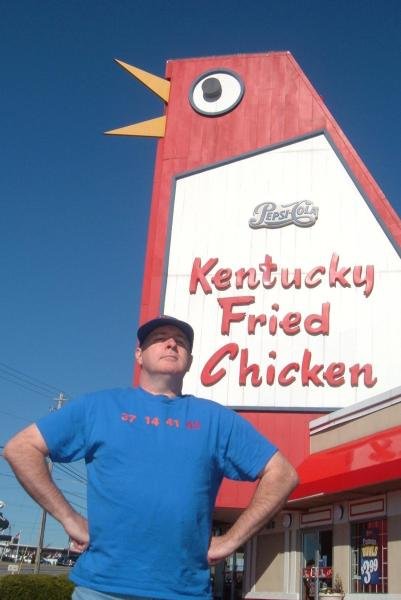
We’ve always suspected Atlanta is the municipal equivalent of an intentional walk, and here’s your proof: BALK! BALK! BALK! BALK!
Yeah, that’s the Big Chicken, the unofficial mascot of Braves baseball circa 2006, and that’s our own NostraDennis, Dennis McCarthy, passing through Marietta, Ga., with his chest puffed out proudly to display his Faith and Fear digits for all Braves fans to see (also pictured: all Braves fans). It was fitting Dennis wore 37, 14, 41 and 42 since those were the paid attendance figures for the last four Braves home playoff games. Which were a while ago now. Not pictured: Dennis showing off one more special Met digit on a side trip to Turner Field. If you’re wearing, you should be sharing. Send us a photo of yourself in your Faith and Fear t-shirt and we’ll likely post it here. Wear it on enemy turf and we’ll totally post it. News of Pat Dobson's death Wednesday night reminds us that there was a team 35 years ago that featured four starters who each won 20 games, only the second time such a conglomeration occurred. The 1971 Orioles could call on Dave McNally (21-5), Mike Cuellar (20-9), Jim Palmer (20-9) and Dobson (20-8) and be almost equally pleased every time they did. The way each man won his 20th was like something out of another Baltimore pastime, duckpin bowling. McNally knocked down No. 20 on September 21, Cuellar and Dobson picked up their spares in respective ends of a September 24 doubleheader and Palmer rolled his 20th on the 26th. News of Pat Dobson's death Wednesday night reminds us that there was a team 35 years ago that featured four starters who each won 20 games, only the second time such a conglomeration occurred. The 1971 Orioles could call on Dave McNally (21-5), Mike Cuellar (20-9), Jim Palmer (20-9) and Dobson (20-8) and be almost equally pleased every time they did. The way each man won his 20th was like something out of another Baltimore pastime, duckpin bowling. McNally knocked down No. 20 on September 21, Cuellar and Dobson picked up their spares in respective ends of a September 24 doubleheader and Palmer rolled his 20th on the 26th. The '71 Orioles were the third straight spectacular regular-season Orioles club to dominate the American League: 109 wins in '69, 108 wins in '70, a measly 101 wins thereafter. Each division title was a breeze, each ALCS was a sweep (World Series were something else, heh-heh). Dobson, previously a journeyman with the Tigers and Padres, benefited from the coaching wisdom of Bamberger and the hitting and fielding prowess of Brooks, Boog, Buford, Blair, Belanger and assorted killer Birds. July in particular was quite a month for him. He started eight games, he won eight games, he completed eight games. Who starts eight games in a month anymore? Who wins eight games in two months anymore? For goodness sake, who completes eight games in two years anymore? The CGs alone bring a “you and what army?” aspect to the mound. In 2006, only two Major League STAFFS (Cleveland and Cincinnati) exceeded for the year what Dobson accomplished in that one magical month vis-à-vis finishing what one starts. By 1971, Palmer was en route to the Hall of Fame, Cuellar had a Cy Young in the bank and McNally was an established stud. It was Pat Dobson who turned the Orioles into historymakers, matching the 1920 White Sox (Cicotte, Williams, Faber, Kerr) in the category of outstanding quartets. It is why, quite frankly, I remembered him yesterday when I read he had passed. At the risk of being crass, do we need to write an obituary for the 20-win season as well? Or would we be too late in paying it tribute? You may have noticed 2006 came and went with no pitcher gaining 20 wins. Johan Santana and Chien-Ming Wang led the American League with 19. Nobody led the National League at all…not really. The most wins here in Pitching & Defense Land was 16, a milestone so pale it seems insulting to the concept of leading the league to specify which six pitchers reached it. Now and then, 20-game winners are at a premium. In fact the N.L. hasn't had more than four in any one year since 1977. That speaks to the elite nature of winning 20. Is it possible that nobody's even close to elite anymore? Now and then, one league or another misses 20, but the National League is usually good for a 19- or 18-game winner. This year, if you had a pitcher and 17, you lost. In the Age of Dobson, 20-game winners were everywhere. The four Orioles were joined by six other American Leaguers…TEN 20-game winners in one league TWO years before the DH eliminated the need to take starters out of close contests for offense. Come 1973, a full dozen American League pitchers racked up 20 wins and only a couple of them were Jim Palmer or Catfish Hunter. If you're not a nut about knowing them, I wouldn't be surprised if you told me you've never heard of Joe Coleman or Paul Splittorff or Jim Colborn (or, honestly, Pat Dobson). They were all A.L. 20-game winners back in the day. On this day, nobody's a 20-game winner. In the three seasons previous to 2006, only four National Leaguers won 20, including Roy Oswalt twice. He's the only N.L. starter in his prime to have multiple 20s on his ledger. Geez. What happened? Well, it's not like there's not good pitching somewhere. Santana, for example, is pretty decent. He got to his 19th win on the final Tuesday of the season, putting him in line for a chance at a 20th win on the last Sunday. Ah, but there was a playoff for which to prepare. Why waste a lot of energy getting to 20 when there was something more important at stake? For that matter, is 20 wins important? As a round number, absolutely. We love that stuff. Always have: Jerry Koosman merited the cover of the 1977 yearbook (first edition) for winning 20. Always will: I considered it marvelous that Willie Randolph sat Jose Reyes to protect his .300 average at the very end in Washington. Yet when the Mets won 97 games, were you picking apart the Ws and bemoaning Glavine's and (if you'll excuse the expression) Trachsel's failure to top 15 victories? Would you rather marvel at the anomaly of Steve Carlton in 1972 (27 wins on the 59-win Phillies) or watch Wright and Reyes exchange funny handshakes 97 times? You shouldn't have to choose. The '69 Mets won 100 and Seaver won 25, good news all around. In 1971, the same season that Dobson was contributing to an epic accomplishment, Tom Terrific chalked up 20 wins himself, nailing down his final W on the season's final night and putting a bow on his greatest season: 1.76 ERA, 289 K's, a run-starved 20-10. Would have Seaver not had his greatest season had the Mets not bothered to score for him his last start 35 years ago? No, but from here, that 20 looks so much better than a 19. The '90 Mets won 91, led by Frank Viola's 20, the last time of eight we enjoyed so many victories from one pitcher. That was 16 going on 17 years ago. The Mets haven't had a 19- or 18-game winner since then. Al Leiter won 17 in 1998, the most in the post-20 period. Nobody else has accumulated more than 16. Why? You probably know why. • Five-man rotations, foresightfully deployed by Gil Hodges and Rube Walker, became the norm, cutting down on starts per pitcher, cutting back on the opportunity to win 20. Hell, six-man rotations sneak in now and then. • Pitch counts are part of the boxscore never mind the gameplan. Throw a lot of pitches early, you're not going the requisite five to be in position to win. Throw a lot of pitches early and you're probably not going to be in a position to win regardless, but 35 years ago, who was counting? • Pitching staffs are routinely 12 men (if not 12 men strong). Relief is not a punishment, it's a specialty, one that is handsomely rewarded at this time of year. If you're paying a setup man exponentially more than you ever paid Mike Cuellar, you're using him, decisions be damned. • Dude, everybody's handsomely rewarded at this time of year. Except for old goats with their eyes on a transcendent prize, few are seriously counting individual wins. Nobody's going to kill himself to get to 20, playoffs or no playoffs. Anybody who manages 19 wins these days is going to be compensated like a 30-game winner used to be anyhow. Statlovers that we are, we also realize wins are as much luck as skill, the stuff of right place meeting right time. Maybe W's need to be issued those t-shirts that read PROPERTY OF NEW YORK METS. Tom Glavine driving to 300 helps (helped?) the greater good, but when he's undermined by circumstance and “his” win winds up as Pedro Felicano's, does it matter for more than a minute to us? Now that he's at 290, it would be sweet to see him get there in a Met uniform, but it's sweet to see any Met win anytime. It means our team won. Quick, what pitcher was the difference between the Mets advancing to the World Series and the Mets going home a tad too soon? No not Trachsel; it was Jeff Suppan. Jeff Suppan beat the Mets in Game Seven but good. Except Jeff Suppan technically did not beat the Mets. Oh, he was the man, no bleeping question about it, but he exited in the eighth for Randy Flores who was the pitcher of record when Yadier Molina…you know. That said, 16-going-on-17 seasons is a long-ass time. It's not the worst National League stretch going by any means — only eight N.L. teams have had as many as one 20-game winner since 1990. The Dodgers, the hallowed House of Koufax, Drysdale, Valenzuela and Hershiser if you can believe it, have gone just as dry. Hence, there's no real shame in any of this. Still when Reyes triples more often than any single pitcher wins two years in a row, I have a hunch we've got a legitimate drought on our hands. So what gets here ahead of the other: the first Met no-hitter or the next Met 20-game winner? If current trends prevail, bet on neither.  5 comments - (Comments closed) | | 5 comments - (Comments closed) | |  Print This Post | Print This Post |  20-Game Winners, Moment of Silence, Orioles, Pat Dobson 20-Game Winners, Moment of Silence, Orioles, Pat Dobson If you haven't already, by all means get yourself a copy of the Nov. 27 New Yorker, and read the Roger Angell season recap. If you haven’t already, by all means get yourself a copy of the Nov. 27 New Yorker, and read the Roger Angell season recap. I’ve loved Roger Angell as long as I’ve loved baseball — I remember reading The Summer Game as fast as a young boy could read a pretty thick book and realizing to my happy amazement that there were other collections, too. I devoured accounts of seasons that had come and gone years before I was born, learning the names I’d soon know by heart (Mays, Robinson, Koufax, Yaz) and soaking in the ceaseless, easy beauty of baseball expertly chronicled, interrupted by sudden spikes of joy and troughs of depression. He made it real, made me wish I’d been there, made me grateful that he had been there to tell me what happened. But reading Angell on the subway today, I realized something new: just how much we owe him. Not just as writers or as baseball fans — I knew that already — but as bloggers. Yes, Angell talks to players and managers and umpires and officials; he goes into the locker room and the press box. But he also watches from the stands or in front of the TV. He’s a professional and a partisan. And it’s this double vision — being simultaneously a smart, reasonably neutral observer of the on-field and front-office goings-on and a hopelessly lovelorn fan — that each and every baseball blogger tries to emulate. Bill Simmons gets and deserves a lot of the credit for teaching a generation of sports bloggers to cheer at not being in the pressbox, but it was Angell who paved the road the Sports Guy walked down. And more simply, a lot of his piece concerns the 2006 Mets. And when the last pargraph ended, to my amazement and embarrassment I started to cry. Not a-bit-dusty-in-here eye-rubbing, not a momentary sniffle, but a shocked dissolve, like a little kid. Read it. It’ll happen to you too. To sum up Thanksgiving for me, here’s a shot* of me and my lovely wife, on our way to hook up with Greg and Stephanie in the upper, upper, upper, uppermost deck for the Mets’ 4-1 win over the Dodgers on Oct. 5. About two weeks before I’d mourned that Emily and her Dad didn’t get a Met win in one of Emily’s rare 2006 trips to Shea, and hoped the Mets would make it up to her in the postseason. Happily, they did. And I got to see it beside her. Smaller but still heartfelt thanks to Carl Bialik, my Daily Fix co-writer and Gelf impresario, for snapping the picture. Funny, we don’t even look nervous. *Image currently missing following migration of blog to WordPress. Blessed be the player who keeps you rooting for your team when your team gives you little on which to root. Not that you're going to switch to another team or perceptibly scale back your allegiance if you're any kind of a good fan or a good person, but if you can't reasonably expect wins, it's nice to expect something. Blessed be the player who keeps you rooting for your team when your team gives you little on which to root. Not that you’re going to switch to another team or perceptibly scale back your allegiance if you’re any kind of a good fan or a good person, but if you can’t reasonably expect wins, it’s nice to expect something. From 1994 to 1996, Rico Brogna was something. Maybe not something else, but he was definitely a Met among Mets, certainly by my not altogether stringent standards. Anybody can fall in love with Tom Seaver when it’s 1969 or Doc Gooden when it’s 1984. I did both. They were the key men on clubs that were getting great. Easy choices. But when your team is on an extended downswing, why do you choose whom you choose? What made Rico Brogna one of my all-time favorite Mets almost immediately? Gosh, what didn’t? When I recall the Met tenure of Rico Brogna, a gentle breeze brushes my right cheek. It’s so…clean. Refreshing. Rico Brogna was the right man at the exact right moment, a scouting party of one sent ahead from a not-too-distant future to those of us wallowing in a despairing present. He arrived to tell me everything was going to be all right again, eventually. Don’t worry, he said, the Mets aren’t going to be the way they’ve been for too long forever — soon enough you will take pride in all those jackets and caps and t-shirts you bought, soon enough you will tell people “I am a Met fan” and not wait for the inevitable cringe. Rico Brogna was a prophet without honor in his own time. He didn’t last long enough to more than nibble on the fruits of progress. His three Met seasons each ended with losing Met records. Prosperity was just around the corner, but Rico never made it down the block. I hate when that happens. Rico Brogna came to the Mets in a transaction so quiet that it could have been consummated at Joe Robbie Stadium. At the end of Spring Training 1994, the Mets gave up on a former first-round draft pick, Alan Zinter, sending him to the Tigers for Brogna, a minor leaguer. I had forgotten Zinter was even in the system. I completely missed the trade. So when Rico was called up on June 20, replacing the groin-strained David Segui, I thought, “Who?” His first game was two days later at Fulton County Stadium. He went 0-for-3 against Greg Maddux. His first Met hit, a single off the Pirates’ Paul Wagner, was recorded June 26 at Shea. Two days after that, Dwight Gooden was suspended for violating his aftercare program. Doc tested positive again. Doc was back on cocaine. Doc was through as a Met. The last link to 1986 — the one that had survived firecrackers and bleach and earplugs and rampant surliness and 27-decision losing streaks and rookie hazing rituals gone awry and media boycotts and paranoid managers and miscast general managers and 103 losses and more than one allegation of sexual misconduct — had been severed. Through the misery of the early ’90s, as the Mets got worse as baseball players and human beings, at least there was Doc, my favorite player for a decade. Now there wasn’t. On the night Dwight Gooden was suspended, Rico Brogna went 2-for-4 against the Cardinals. He was batting .333. He had nothing to do with any of what had come before him. He was utterly detached from the disasters of 1992 and 1993. He was clean. And it looked like he could hit. I had a new favorite player. It was a small sample, but the remainder of 1994, which only lasted until August 11, cemented my bond with Rico Brogna. If he wasn’t a classic drop-whatever-you’re-doing slugger, I still tried not to miss any of his at-bats. I loved the line drives. I loved the nifty glovework at first. I loved that he was a nice and polite young man. There was something about him that wasn’t bitter or anonymous, that didn’t point fingers. The best players the ’94 Mets had to offer before him were guys who emitted personal flaws out their tailpipes. John Franco rarely hid his displeasure when plays weren’t made behind him. Jeff Kent wanted to be anywhere but New York. Jose Vizcaino, a decent enough shortstop, had the personality of a turnip. We were finally getting that big season from Bret Saberhagen, but Bret Saberhagen was one snide comment away from another Clorox attack. Bobby Bonilla was still the life of the party. Everybody else was Doug Linton. Rico wasn’t any of this. He was Rico, or RI-CO! RI-CO! RI-CO! He was the first thing worth chanting at Shea in years. Even an impending strike couldn’t dim the sense of possibility around Rico Brogna. On a Monday night in late July, the Mets played in St. Louis. The game was televised by that monstrosity known as The Baseball Network. Rico went 5-for-5. Swaths of the Midwest, if not the world, were now finding out who this Brogna kid was. He ended the night hitting .377, the shortened season hitting .351. The strike would be hell, but I would not shunt baseball aside as so many others swore they would irrevocably, no way, no how. I had Rico Brogna to look forward to. Baseball came back. So did Rico. The next May, I got his autograph and shook his hand at a meet ‘n greet in the Mets clubhouse store in Manhattan. He struck me as young, small, fit and, most importantly, so nice and polite. I knew I made the right choice stopping by. Rico’s average didn’t soar in ’95, but there was power: 22 homers, 76 ribbies. I knew I made the right choice picking him as my favorite. The Mets were stronger, too, particularly in the second half when they reeled off 34 wins in 52 games to end the season. Rico was the best player on a team that was about to come of age. He was getting help. Isringhausen and Pulsipher were up. So was Alfonzo. And Everett. Hundley was beginning to show what the fuss was about. There was a future, just like Rico said. He was at its forefront. It was only going to get better in ’96. Actually, it didn’t. The Mets stumbled. Rico hurt. They both regressed. Mets finished 71-91. Rico finished on June 19. He’d been plagued by a chronically bad back and now he was diagnosed with a torn labrum in his right shoulder. Managed only seven homers, though one of them was of the walkoff variety, winning a game against the Cubs that included the last brawl the Mets ever fought. When our dignity was at stake, I knew he wouldn’t let us down. I bring Rico Brogna and my fanly affection for him to your attention today, Thanksgiving Day 2006, for a particular reason. It was ten years ago, just before Thanksgiving Day 1996, that the Mets traded my favorite Met to the Phillies for two no-account relief pitchers. I was puzzled, I was livid, I was saddened. The Mets were terrible in 1996, absolutely horrifyingly depressing. Their plan to improve? Trade my main man for Toby Borland and Ricardo Jordan. Oh the humanity. Rico would recover from injury and forge a representative career for himself as a Phillie. He drove in 104 runs in 1998 and 102 in 1999. Except when he was in a position to beat us (which he did, 1-0, on a solo homer off Mlicki late in the ’97 season), I always rooted for him. Even as a Phillie, as distasteful as that was. Even as a Brave, as dismaying as that was. When Rico went deep off Kevin Appier in our Home Opener in 2001, I stood and cheered. He wasn’t in a position to beat us, but even if he had been, I probably would have put a hand or two together on his behalf. I would recover, too. The Mets made a good trade a few weeks after that horrendous one, acquiring John Olerud from Toronto for Robert Person. Olerud was one of those who made the Mets in 1997 what I’d been waiting since 1990 for them to become again: good. I never let how much I loved Rico Brogna get in the way of how much I would love John Olerud. He was one of the most special Mets ever. Which doesn’t excuse the trade of Rico Brogna. Franchises shouldn’t be allowed to trade your favorite player, but they do. No need to go down the litany of Mets who should have stayed Mets but didn’t. When the litany starts with Tom Seaver, you really don’t need any more examples. No matter how mature you get, they hurt every time. The Rico Brogna for Toby Borland and Ricardo Jordan trade hurt immediately. I wasn’t thinking about his 36 Met homers, his 126 Met runs batted in or his .291 Met average. I was thinking about what it was like to fall into the player who keeps you rooting for your team when your team gives you little on which to root. Some people would never get that. Right after Rico Brogna was traded, I had to deal with one of them. I hadn’t had 24 hours to digest the Brogna bulletin when I found myself a reluctant pilgrim, in a car heading north to Westchester for Thanksgiving. Stephanie and I were in the backseat. My father was driving, his girlfriend of then almost five years was next to him. It was her family — daughters, sons-in-law, grandchildren, cousins — with whom we’d be sharing the day. I liked her. I liked her fine. I was glad my dad found somebody when he did, not long after my mother died. It was a good thing all around. But that didn’t mean I had all that much to say to her. Groping for news of any kind, I mentioned that I was kind of bumming because the Mets had just traded my favorite player, Rico Brogna. She could have said, “I’m sorry to hear that” or “that’s too bad” or even “that’s life”. I wasn’t expecting a dissection of who would be setting up Franco in ’97 or how much time Huskey could anticipate at first. I was just trying to fill the uncomfortable silences. I sure as hell wasn’t expecting this: “Well, I don’t want to be mean, but if they’re not very good, maybe they were right to trade him, you know?” No, I didn’t know. And neither do you, I wanted to say. Rico Brogna has a tricky back but he’s not the reason the Mets went 71-91 this year. He didn’t even play after June. He was hurt. Maybe the Mets would have been better had he been healthy. Maybe a team in a constant state of rebuilding shouldn’t be casting off one of its pillars so recklessly. AND FUTHERMORE, what the fuck do you know about my team other than it’s my team? That should be all you need to know. I get enough reminders at work, one month after the fucking Yankees won the fucking World Series, that my team isn’t very good. I know I’m practically all alone as a Mets fan in New York and now my favorite Met has been traded to fucking Philadelphia and all you can say is it wasn’t such a bad idea? That’s what I wanted to say. I didn’t say much. Not in response to Rico, not through the car ride to Westchester, not at the drafty house with the onslaught of people to whom I wasn’t really related. Dissing Rico Brogna was merely the first straw. It was just one thing on top of another (the group Macarena may have been the last straw) that made Thanksgiving 1996, hands down, the most pain-in-the-ass Thanksgiving I ever endured. And that’s sayin’ somethin’ if you’re last name is Prince. Not to be overdramatic, but Stephanie and I found ourselves in essentially a two-against-dozens situation all day and night, with our only natural ally, my father, making like Switzerland and sitting it out. We may as well have spent Thanksgiving in an isolation booth. OK, that is overdramatic, but not by much. Let’s just say we didn’t fit in and wanted no more part of this particular blended family. Nobody was mean. They just weren’t who we wanted to be with and nobody seemed particularly interested in whether we were there or not. They were courteous enough to have us for my fathers’ sake, but once it became impossible for me to spark a conversation with my dad, what was the point? So we decided not to be a part of it all any longer. Thanksgiving ten years ago was the last of those mythic Thanksgivings that we took part in. My sister and her husband had already begun fleeing annually for the West Coast every mid-November. My father has remained enmeshed with his other family. Stephanie and I are on our own. From the first time a teacher told me to trace my hand and pretend it was a turkey, I tried to buy into family-laden Thanksgiving as a great event. Everybody always said so many nice things about it. Yet time and again, these occasions were embarrassing or abrasive or tongue-bitingly non-confrontational and always endless. Amid company in which I am not at ease (which is most people) I am a clench. It is my nature to tighten up when I am not relaxed, no matter how Yogiesque that sounds. I’m self-aware enough of my antisocial tendencies to try and compensate with bursts of warmth and outgoingness, but I am to warmth and outgoingness what Rey Ordoñez was to batting cleanup. I value nice and polite. If that’s what you want, Rico Brogna or I am your man. You want warm and outgoing? Call Domino’s. 1996 was the culmination of a lifetime of bad Thanksgivings. In the years that followed what we’ll call for our purposes here the Rico Brogna debacle, we mostly hid from Thanksgiving. It is only recently that we have dared to embrace it on our own terms at our own table with our own Oven Stuffer. We have succeeded. So this, you see, is not an unhappy Thanksgiving story. We simply ignored the turkey-family industrial complex and made Thanksgiving our own. Just us and the cats. The result is a holiday I used to dread and curse — to the point of cackling demonically when high winds interfered with the Macy’s floats — is now one I genuinely look forward to every fourth Thursday in November because it’s cozy and it’s comfy and I can go on about Rico Brogna all I like if the mood strikes. (Just for variety’s sake, my wife and I occasionally do chat about other things, though she does love her some Mets.) On any given Thursday, we like everybody in our family fine. On this given Thursday…oy. There are 364 other days in the year, 365 sometimes, to commune with our loved ones. I didn’t need this particular Thursday shoved down my throat like a third serving of Stove Top Stuffing just because it’s supposed to be. Thanksgiving togetherness is very touching when we pop in the DVD of Pieces of April or the King of the Hill where everybody gets stuck in the airport. It’s overrated in real life. At least ours. Hence, nowadays we see my sister and her husband and my father and his girlfriend not because we have to but because we want to. And we do want to…just not on Thanksgiving. It’s not like we held a family meeting to do away with the tradition to which we were all unwillingly tethered. We just stopped conferring on the particulars and there were no evident hard feelings. Funny how that works. Meanwhile, that ornery Thanksgiving of a decade ago may have also led, in its way, to an unquestionably positive year-round development. It may have made this blog possible. You see, I think that dreadful Thursday was when I decided I’m going to live to do what I want to do at least when nobody’s paying me to do something I don’t want to do. I used to grit my teeth for family get-togethers. That Thanksgiving helped me realize nobody was benefiting from this behavior, not me, not the family. Where does the blog come in? I guess I also made a semiconscious decision that in general I would seek out those who were passionate for what I was passionate about. I was passionate about the Mets. I began to semiconsciously cultivate the idea of the Mets logo as my coat of arms. Mind you I’m not so delusional to believe that a starting first baseman (not even the beatific Brogna or angelic Olerud) will rush to my aid if harm befalls me. My father or my sister would — as I would for them. I understand family is family. But catastrophes aside, with whom do I want to spend my time, invest my faith, confess my fear? Mets fans. Not exclusively, but mostly. Good Mets fans…good people who are good Mets fans if I could find them. By Thanksgiving ten years ago, I knew a few well and had, thanks to technology, come to know a few more a little. As the late ’90s proceeded and the Mets at last rode an upswing through the National League (no thanks to Ricardo Jordan or Toby Borland), they became more important to me than they ever were, even when I was a kid. I didn’t plan it that way. It just kinda happened. Concurrently, I came to rely for good company on the good Mets fans and the good people with whom I shared this surpassing interest. One of them writes this blog with me. Another of them, I’d like to think, is you, whether we know each other beyond these pages or not. So I guess I’m thankful for that. |

Piazza: Catcher, Slugger, Icon, Star by Greg Prince is available from Amazon, Barnes & Noble and other online booksellers. 
Amazin' Again: How the 2015 New York Mets Brought the Magic Back to Queens by Greg Prince is available from Amazon, Barnes & Noble and other online booksellers. 
Volume I of The Happiest Recap: 50+ Years of the New York Mets As Told in 500+ Amazin' Wins by Greg Prince is available in print and for Kindle on Amazon. 
Faith and Fear in Flushing: An Intense Personal History by Greg Prince (foreword by Jason Fry), is available from Amazon, Barnes & Noble and other online booksellers. |
|
Copyright © 2026 Faith and Fear in Flushing - All Rights Reserved |
||