

One of the benefits of paying very close attention to one specific entity for a very long time is you pick up on trends that might be apparent to you and only you. One of the benefits of having a platform like this is the opportunity to remark upon those trends.
Here’s my picked-up-on trend of the moment: The Mets are almost unbeatable at Great American Ball Park in September. Having sensed that trend as play began Friday night and having examined the annual annals to confirm my sense allowed me to pretty much relax, even when Friday night’s Mets-Reds game turned utterly unrelaxing.
Great American Ball Park opened in 2003. The Mets made their first September visit there in 2007, then returned in 2013, 2014, 2015, 2016, and 2019. Their composite won-lost mark on the banks of the Ohio in the final month of those specific seasons? A cool 15-4, including a division-clincher in 2015 and Pete Alonso’s 50th home run as a rookie in 2019. Six series versus the Reds inside this month within the walls of this venue, six series wins.
If you could pick your spot for a three-game set, you’d pick this spot in Cincinnati at this time of year. I believe the American Broadcasting Company laid it all out in the late summer of 1971 as it urged viewers to tune into its network when fall arrived for swell new shows (most of them soon to be cancelled) along with familiar fun fare like Friday night staples The Brady Bunch, The Partridge Family, and, ever close to this blog’s heart, The Odd Couple.
Come this September
This is the place to be
Hey there, remember
This is the place to be
ABC then, GABP now. Friday nights then, Friday nights now. C’mon get happy, indeed.
The Reds come with the locale where the Mets are almost unbeatable this time of year, so you’d have to pick them as your opponent. But why wouldn’t you? The Reds are the team to whom the Mets have dealt all that September beating since 2007. Plus, until this week, this series loomed as an opportunity to shake off once and for all our nearest nemesis for the third and last Wild Card. The Reds, by dint of their erratic play, seemed to have shaken themselves off, falling behind the Giants as the contender we have to worry about at least a little. The trend I’ve picked up on where the Giants are concerned is their historical penchant for sneaking into or back into pennant races they seemed all but eliminated from with weeks to go.
1951: 6 out on September 13; the Giants win the pennant on October 3
1962: 4 out on September 20; the Giants win another pennant on October 3
1982: 9 out on September 3; 1 out on September 30 (they fall short of the NL West title but manage to knock off their archrivals the Dodgers, the same team they chased down and passed in ’51 and ’62, on…October 3)
1998: 4 out of the Wild Card on September 20; qualified on September 27 for a Wild Card play-in game versus the Cubs (not pictured: the New York Mets, who led both the Cubs and the Giants with a week to go)
2010: 6½ behind the Padres for the division title on August 25; the Giants not only zoomed past San Diego and kept their other Southern California foes from the postseason by beating them on the schedule’s final day (October 3, naturally), but they went on to win the franchise’s first World Series as the San Francisco Giants
Giant spurts spanning nearly sixty years probably have nothing to do with the standings fifteen years past the last example, but it’s September, and if we’re thinking about playing in October, we are advised to take every possible relevant data point into consideration.
Like David Peterson being due for a good outing, which he gave us for a while on Friday night. His first couple of innings were ground ball heaven. In the meantime, the Mets were getting on base and hitting behind runners and advancing on the basepaths and doing everything so well that in the first, when Brandon Nimmo was robbed of a three-run homer at the center field wall, they still got a run out of it on a sac fly and put up three runs in all.
It was a great night at Great American Ball Park. Everybody else could look at the scoreboard and figure that out once Mark Vientos whacked a homer nobody was robbing to make it 4-0 in the top of the third. I knew it was a great night because it was September in Cincinnati and the Mets were visiting.
Then Peterson reverted to his recent sample size in the third and the fourth, and by the time he was lifted in the sixth, the Mets lead was down to 5-4. The bullpen parade was underway, commencing with grand marshal Ryne Stanek. Low-Leverage Barbie is asked to get out of a two-on, one-out jam. That’s a lot of leverage for those flowing golden locks. Ryne strikes out his first batter, walks his second, and, son of a gun, strikes out his third with the bases loaded, inning over. Low-Leverage Barbie’s Dream House — Pleasant Surprises Sold Separately.
The Mets stopped hitting in any meaningful fashion after Vientos’s aforementioned dinger, but the lineup Carlos Mendoza could lean on was that of his relievers. Brooks Raley in the seventh: three Reds up, three Reds down. Tyler Rogers: four Reds up, none of them scoring. Ryan Helsley: resting up, thank goodness. This got us to the bottom of the ninth, the Mets still ahead, 5-4, and their closer on to cleanly settle matters once and for all.
Edwin Diaz hadn’t been notified of the Mets’ lording it over the realm of the Reds. Edwin Diaz gave up a single, a walk, and another walk before getting an out. Edwin Diaz also gave up a shoe at some point. If it were Helsley, the shoe would have come off the way Charlie Brown’s pants and shirt went flying as line drives whizzed past the mound. In Edwin’s case, it was a faulty bit of sporting goods, a cleat coming off a spike (or a spike coming off a cleat). Either way, in the midst of facing Elly De La Cruz, he was delivered a new pair. We would never accuse Edwin of not already having a pair.
Properly laced up, and unpenalized by pitch clock codes that presumably don’t delineate shoe-changing protocol, Diaz struck out De La Cruz in two shoes different from those he wore when he struck out Noelvi Marte. Both of those K’s were etched with the bases loaded. The bases were still loaded. It was still 5-4. It was still Edwin Diaz. It was still Great American Ball Park. So many constants to take comfort in. So many situations that could tip into a hellish finish at any second. Diaz is the best. Diaz is the worst. Edwin’s brother, the former All-Star Red reliever Alexis, is suddenly available now that the Dodgers have DFA’d him, and it’s been suggested the Mets take a look at him. My reaction was no thanks, we already have two Diazes — the one who creates messes and the one who pulls out of them.
On Friday night, with two men out and three men on, nowhere to look but inside, the preferable Edwin Diaz proved he can be The Man, responding to self-imposed pressure by grounding Gavin Lux to an area between first and second patrolled by Luisangel Acuña. Definitely the right guy to hit it to, as it took some dashing to corral the ball and sling it to first. Covering first on such a play should be the pitcher. We’ve seen Edwin be that pitcher on that play and proceed to enjoy his view of first base when he’s supposed to be rushing toward it. This time, he was where he needed to be, just like the Mets were where they needed to be. Diaz made the putout and sealed the win. The Mets won again in Cincinnati in September.
 Ever see anything like it? In the Great American Ball Park sense, yes. The Mets are 16-4 in September there. But getting out of this last jam as they did? That actually did happen once, in the past decade. On July 19, 2016, Jeurys Familia, who could be a couple of different closers at once himself, loaded the bases with a one-run lead at Wrigley Field in the bottom of the ninth before recording an out. Somehow, Jeurys wriggled altogether free of harm and the Mets prevailed by the same 2-1 score they clutched when he entered (as we clutched our chests). Once Familia successfully Houdinied, Elias Sports Bureau noted it was the first time the Mets held on to win a game after leading by one run in the bottom of the ninth or later after the opponent loaded the bases with nobody out.
Now it’s happened twice, but this time with a changing of shoes on the mound.
Dust settled and footwear difficulties resolved, the Mets extended their lead over the reeling Reds to six games, which is fine, but the Giants continue to sneak along and are four back of us and the Padres. The Padres? How did they get into this part of the postseason scenario? By losing a lot lately, apparently. The NL Wild Card situation stays fluid, as do the Mets’ starting pitching plans. Kodai Senga is in the minors, instructed to get his forking stuff in order before coming back. On Sunday, Brandon Sproat will be up to attempt to triplicate the charms that were Nolan McLean’s and Jonah Tong’s respective debuts. First time was a charm. Second time was a charm. Are we pushing our luck with a third time? Senga has imploded. Manaea’s barely any better. Peterson won but struggled. And Clay Holmes has limitations. Bring up the new kid and see if he can throw strikes like the other two.
McLean. Sproat. Tong. Generation MST3K could have us in orbit. Or in Cincinnati, which in September, as we’ve established, is the place to be.
Now, sadly, we’re out of Davey Johnsons. Davey died Friday in Florida at 82. There was only one of him.
Davey Johnson managed his share of strange games with the Mets from 1984 to 1990, wherever their itinerary took them. He managed the most wins and the biggest share of winning games any manager ever racked up for the Mets. He managed the winningest season the Mets have ever mounted, only the second that ever ended with the Mets winning the final game of the World Series.
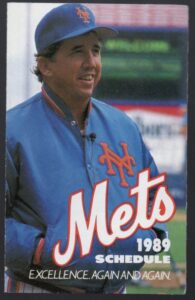 He was Davey Johnson, manager of your New York Mets. Knowing he was running things in the dugout equaled one less thing to worry about as a Mets fan. Not once, not even when Frank Cashen sent him home from Cincy in the wake of a sluggish start to his seventh season at the helm, did I think Davey wasn’t the right guy for the job he held. When Davey was our manager, we were in good hands, confident hands, informed hands. There were the Mets before Davey Johnson. They hadn’t gotten anywhere near a legitimate pennant race in ages. There were the Mets during Davey Johnson. They were in a pennant race every single year he held the job. The Mets after Davey Johnson sagged in due order. The man was a difference-maker of the highest order. Believed in himself. Believed in his players. We believed along with him.
Davey was introduced to the media as the new Met manager not in New York but in Philadelphia. It was an off day during the 1983 World Series. Philadelphia was close enough to New York. The Mets weren’t close to the World Series. Not even close to thinking about the World Series or any of those barriers they’d have to clear to get there. It makes sense, however, that Johnson would field reporters’ questions at the World Series. He was gonna get us there quicker than we would have guessed.
Three years later, after a shocking 90-win season, an exhilarating 98-win season, and the dream season that encompassed 108 wins (always loads of wins in the Johnson era), the Mets were in the World Series. They were almost out of it on the night of Game Six. Davey’s Mets, despite a questionable call or two on the skipper’s part, snatched victory and revealed what a glass jaw defeat really had. When Ray Knight crossed home plate, everybody stormed from the Met dugout to congratulate him. Davey was right in the middle of that scrum. I somehow had the presence of mind to notice the manager among his players in one of those situations where you inevitably see the manager hang back with his coaches. Not this time. This was too big, and Davey was too smart to not recognize this was something to react to viscerally. This was two out and nobody on and the Mets down two and the World Series threatening to slip to Boston and even DiamondVision giving up, congratulating those Red Sox on coming to Queens and ending their legendary 68-year drought.
But, nope. Carter singles. Mitchell singles. Knight singles. Stanley throws a wild pitch. Mookie makes contact. Buckner doesn’t. You know what happened by heart, but until then, nothing like it had happened, not even to the Mets. Davey had a new champion among strange games he was involved in. Two nights later, he had a world champion, and the Red Sox’ drought would grow 18 years more legendary.
Having led us to a parade and a ring and all that spectacular stuff we’d been parched for since 1969, Davey ascended to the pinnacle of Mets Managing. He had done what only Gil Hodges had done. If it was easy to do again, we could mention a third name, but we can’t, because it’s not. Had gambling interests advertised during ballgames in 1987 and 1988, I would have bet Johnson’s Mets would have done once or twice more what they’d done in 1986. Davey’s Mets stayed close and came close. The only cigar was lit in ’86. It still glows in memory. Davey’s pledge to dominate from Spring Training through the Fall Classic was made good on. Of course you’re gonna pass out cigars. So what if a dynasty wasn’t born? For one year, the Mets were never better. For one year, there was no manager like Davey Johnson. For the best parts of seven years, there was no Met manager like Davey Johnson.
For other clubs — including good ol’ Cincinnati — Davey did some serious winning as a manager, just as he did for Baltimore as a player (or have you forgotten who was up in the ninth against Koosman in Game Five?). If he hadn’t won a World Series for us, he’d be somebody you’d remember if you were a baseball fan. Hit 43 home runs alongside Henry Aaron in Atlanta in 1973. Hit 26 home runs alongside Sadaharu Oh in Tokyo in 1976. Got the last base hit Sandy Koufax ever gave up, a single in the sixth inning of the second game of the 1966 World Series, where Davey earned his first title. Did his first skippering with the Miami Amigos in a long-forgotten circuit called the Inter-American League (he had them ten games in front when the league folded after three months of operation) before reuniting with his old Baltimore GM Cashen in the Met organization. Worked his way up our minor leagues as a manager. Crossed paths with an instructor named Cleon Jones, who caught a ball of Johnson’s that didn’t go for a hit in a World Series. Led Jackson to a Texas League championship. Led Tidewater to the International League and overall Triple-A championship. Grew well-acquainted with the abilities of some rising stars as they soared with him. Landed in New York, let it be known he knew mathematics and used a computer. In 1984, he might as well have been from the future. The future was now at Shea Stadium and first would soon be the place to be.
Davey Johnson’s immediate predecessor as Met manager was Frank Howard. The managers who followed him in rapid succession were Bud Harrelson, Mike Cubbage, and Jeff Torborg. They, like Davey, all played baseball in the 1970s, when I was a kid. They’ve all passed away in the past two years, when I’m less and less surprised that players from my childhood and managers from the earlier parts of my adulthood depart the scene. I knew Davey had been battling health issues for a few years, so this news wasn’t particularly shocking, which didn’t keep it from being sort of stunning, because he’s Davey Johnson. He managed Rusty Staub, who started playing in the majors in 1963. He managed Bryce Harper, whose contract says he’ll be playing in the majors in 2031. He was in and out of the game for decades once the Mets decided they didn’t need him any longer, not exactly a baseball lifer, but, oh, what a baseball life.
His, I mean — but ours, too, thanks in large part to him.






Rest in peace Davey Johnson. Jay Horwitz’s post on Johnson’s passing suggests he’d been sick for a while. I didn’t know. I became a Mets fan in 1986, so Johnson set the standard for Mets manager for me.
Tong day today. Nolan McLean’s 4 good starts to start his big-leaguer career are setting a high standard for Jonah Tong and Brandon Sproat. But the Yankees’ Cam Schlittler and Red Sox’s Payton Tolle’s recent rough outings are a reminder that it’s normal for top pitching prospects to be hit with learning experiences. On the other hand, Robert Gsellman and Seth Lugo kept delivering all the way to the top wildcard in 2016 as rookies, so why not these rookies.
I have a feeling Tong will be hit hard with a learning experience today, and I hope I’m wrong. The Mets need the trio to soak up all the learning experience they can get over the remaining 21 games because it’s looking more and more certain that none of the veteran starters can be relied on to deliver a 1, 2, or 3 level starter’s performance in terms of innings and runs allowed. It’s looking like the rookies will need to carry the load into the post-season.
Drew Gilbert is doing for the hot, Mets-chasing, ex-Met-laden Giants what we looked forward to him doing someday for the Mets from the day of the Verlander trade. Jett Williams and Carson Benge better be the goods. The Mets have had an opening for an outfielder for most of the season, and Mullins has disappointed. Given that the Giants promoted him immediately, I wonder why Gilbert didn’t get a look on the big-league level before the Mets traded him.
Just had to mention some other great Friday night shows on ABC, including The Newlywed Game, Nanny and the Professor, Room 222, and Love American Style!
Nice extended Billy Joel reference there, Greg. That game was best watched after you’d been informed the Mets won.
Too bad the GABP’s small dimensions acted as a Tong depressor yesterday. Scintillating ninth-month Cincinnati record notwithstanding, the Mets lost a game there in late September 2019, one close enough like yesterday’s to be winnable, which all but squelched their Wild Card hopes. It was also a Saturday, the second of three games. Different year, though, and much better position these Mets are in, so hopes remain high for a playoff berth.
Agree: Tong will be hit hard with a learning experience today, and I hope I’m wrong.