

I woke up this past Friday with what we’ll politely call a stomach bug. That evening, in the wake of fitful rest, glacial recovery, zero appetite, and sporadic glimpses at my phone, I informed my wife, “Alonso and Diaz had their introductory press conferences with their new teams today.”
“So,” she diagnosed, “that’s why you’ve been throwing up.”
Durocher may have been as obsessed by style when he left the ballpark — wearing “suits with the pockets sewn tight so he wouldn’t be tempted to put something in them to ruin the line,” per his 1990s biographer Gerald Eskenazi — but he didn’t much care whether he was identified as a sweetheart while he was working as a player, coach, manager, or broadcaster, or simply being the all-around baseball man America came to know. Couching opinions at least as sharp as his wardrobe in euphemisms wasn’t his wont. Hell, nobody ever came out more explicitly against niceness. In the chapter of 1975’s Nice Guys Finish Last dissecting the signature swap that created Durocher’s kind of team, the one that netted the Giants shortstop Alvin Dark and second baseman Eddie Stanky from the Boston Braves in December of 1949, Leo didn’t mind letting the reader know that…
• “There are two things that make it difficult to work for Stoneham when he’s drinking. 1) Sometimes you can’t find him. 2) Sometimes you can.”
• Red Webb, a Giants righty the Braves demanded be thrown in along with Sid Gordon, Buddy Kerr, and Willard Marshall, was “a mediocre pitcher” to whom Stoneham was nonetheless attached. “Horace, please,” Leo begged, “I’ll jump in my car and drive out to the woods and get you a dozen Red Webbs.”
• As for the one Kerr in the deal, the fella whose errorless streak at short reached 68 games, a multiseason mark that would remain the big league standard until Kevin Elster topped it more than forty years later, Leo attempted to persuade Horace, “‘I know shortstops, and I think mediocrity is the word for him.’ He didn’t make errors, but he didn’t make plays, either.”
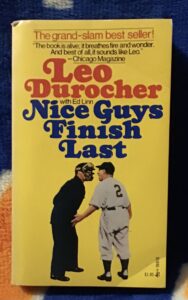
Shy guys don’t write this kind of memoir.
Stoneham, Webb, and Kerr (eventually a Mets special assignment scout) all had one thing in common when Durocher’s book was published. They were all still alive. A nice guy might have found a less edgy manner in which to detail a decades-old trade in the interest of not making anybody look or feel unnecessarily bad, but the title was the title, and Durocher was very much Durocher. “Branch Rickey once said of me,” Leo recalled in the memoir he co-authored with Ed Linn, “that I was a man with an infinite capacity for immediately making a bad thing worse. Carve it on my gravestone, Branch. I have to admit it’s sometimes true.”
Later upon a time in the annals of New York National League baseball, a gentleman named David Stearns came along and never once issued a quote remotely as colorful as anything Leo Durocher likely uttered in the course of ordering dinner. Stearns, who favors quarter-zip sweaters over custom-stitched suits, is a modern master of speaking affably while sharing little, which isn’t the least bit surprising in the industry that is baseball in 2025. Perhaps if Durocher had each of his personnel assessments relayed and critiqued instantaneously on myriad platforms as today’s managers and executives do, he might have also communicated in more anodyne English. It ain’t 1948, anymore. Then again, one struggles to imagine David Stearns letting loose to reporters over tumblers of Scotch at Toots Shor’s.
Yet for all the contrasts between Durocher’s rough-and-tumble persona and Stearns’s buttoned-up/quarter-zipped approach, some things in town don’t seem to have changed all that much. Consider Leo’s closing argument to his club owner as to why they should trade away loyal Giants Stoneham counted as personal favorites, stalwarts whose track records convinced the owner, “We can win the championship with this team next year”:
“‘This is a business you’re involved in, and you’re talking like a fan. It makes my pitching look worse than it is because the defense is bad. It’s bad, Horace. All you have to do is look at the figures. We don’t make the double play.’”
Translate it into contemporary corporatespeak, and you can detect the seeds of Stearns’s paeans to run prevention, roster flexibility, and whatever other priorities the Mets’ president of baseball operations will point to as paramount while he attempts — in his third offseason shaping this generation’s New York National League hopeful — to create his kind of team. And maybe ours. We’ll see about that. We can’t see it now. Maybe, in these suddenly Bearless and Sugar-free times, we’re not in the mood to look.
It’s hard not to talk like a fan when we are fans. We try to be dispassionate and analytical and think as a GM might think, but none of that is really our job. Our job is to stay in love with the team we fell for when we were kids, and fall head over heels again and again for players who’ve starred for our team year after year until we can’t fathom them starring for anybody else…or declining from stardom for us.
As a fan, I detest that Edwin Diaz and Pete Alonso are no longer Mets, the same as I remain less than keen on Brandon Nimmo no longer being a Met. At the beginning of the Winter Meetings, I was listening to Stearns go on as he does, answering whatever question he was asked in his trademark substance-redacted manner, when the phrase “when we traded Brandon” jumped out from his word cloud. My thought at that moment became, “That’s right. The Mets traded Brandon Nimmo. What the fuck did they do that for?” Had I been alive 76 years earlier, I probably would have asked myself the same thing regarding Sid Gordon.
This was before Edwin Diaz signed with the Dodgers and Pete Alonso signed with the Orioles, which is different from trading Brandon Nimmo to the Rangers for Marcus Semien, but as a fan, what the fuck do I care? As a fan, my instinct is I rooted like hell for Nimmo and Diaz and Alonso year after year, and, despite all my rooting and all Mets fans’ rooting, none will be a Met next year.
What the fuck, indeed.
Listening to Stearns explain the Mets’ offseason — granted, not in depth following the departures of Diaz and Alonso given the “reported” nature of their new affiliations before their new teams could drape them in their respective atonal jerseys — I swear I can hear local philosopher king Billy Joel welcome us back to the age of jive. Our POBO said enough after Nimmo was sent packing so that you don’t need to tap AI on the shoulder to guess his reasoning for why not much (or enough) was done to secure the ongoing services of perhaps the best closer in baseball and definitely the most prolific slugger the Mets have ever had. You knew nice things would be said about the currently former Mets. You knew nicer things would be added about not committing too many resources to players at certain junctures of their careers. And then there’d be something about athleticism.
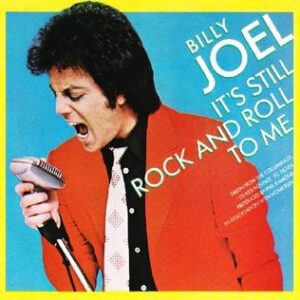
What’s the matter with the clothes Diaz and Alonso are wearing? Everything.
I’m not certain what constitutes Stearns’s kind of team, but I get the sense he prefers to find out by starting his search with a blank slate. In what feels like a very Stearns sort of move (I’ve seen it referred to as “creative”), veteran American Leaguer Jorge Polanco will attempt to cover a span of our void for the next two years. He’s almost never played first base before, but is apparently going to give it a try for us. How considerate of him.
Whoever’s the next Opening Day starting first baseman, that mystery guest will be the Mets’ first Opening Day starting first baseman not named Pete Alonso since Adrian Gonzalez. Early in his career, Gonzalez played on teams that included Kenny Rogers, who came up in 1989; David Wells, who came up in 1987; and Greg Maddux, who came up in 1986. They were all long retired before Gonzalez finished up as a Met in 2018, but I think the juxtaposition offers an intuitively instructive sense of Alonso’s longevity to know he succeeded somebody who played with somebody (Maddux) who once pitched against somebody (Steve Carlton) who broke in on the same day (April 14, 1965) that Warren Spahn made his Met debut. Spahn, at the time, was 44 and had been a major leaguer since 1942, though he did miss three years in order to serve in World War II.
And it’s not like 2018 is terribly recent.
Beyond Six Degrees longevity, one of the reasons Alonso holds the Mets all-time home run record is because he made himself available to demonstrate his power day in and day out for seven years. You’re not just replacing what Alonso did last year. You’re replacing a veritable Met epoch, 2019 to last week. Even if you agree with Stearns’s implicit judgment that the Polar Age couldn’t be counted on to flourish into the 2030s, the Bear remains a force. However many of his throws to pitchers go awry, his home runs don’t loom as easily replicated.
Nor, despite the insertion of Devin Williams into the ninth-inning lead-protecting role, do a whole lot of saves. Edwin Diaz racked up the third-most in Mets history, behind only John Franco and Armando Benitez, offering a not altogether dissimilar proportion of angst and exultation, but boy, when he was on (which was usually), he was on, and when he was on, he was a thrill on the mound tantamount to Alonso at the plate. I saw a quote from Terry Collins, who somehow predates the both of them, in which our erstwhile skipper spitballed during his TV gig, “This core has not won. So maybe it’s time to go with a different core.” I would counter “has not won” is relative. If “won” means the World Series, shucks, only six different franchises have earned the right to call themselves world champions in the past nine years. I’d prefer the Mets had been one of them. The fans of all teams that weren’t among the sated six would surely say the same thing.
This core won enough to make two postseasons, make a spirited run toward one the first year it began to come together, and fall a frustrating game shy in what turned out to be their final year as a core. The Mets, if nothing else, have been interesting in the years since Steve Cohen came along. Well, they’re always interesting to us, but within the world beyond the borders of Metsopotamia they’ve attracted more attention than they used to, frequently for solid competitive reasons. Because Alonso went deep. Because Diaz inspired trumpets. Because personality and performance meshed, latter portions of 2025 notwithstanding. My darkest fear is less about David Stearns guiding our ballclub toward losing records and more that he will unconsciously shepherd it toward well-deserved obscurity.
Perennial consistency may have eluded the group that featured Alonso, Diaz, and Nimmo, along with, to various extents, McNeil, Lindor, Marte, and Soto, but these are the Mets. They’ve been known, in this century, to go more than a half-decade without a playoff appearance and nearly a decade between playoff appearances. A core can be dismantled in service to a bigger picture, a greater vision, a fresher start. It can also be supplemented by solidifying its strengths and addressing its existing shortfalls. It’s certainly a choice to give up on a productive left fielder, closer, and first baseman from a position of coming fairly close several times over several years, including three of the past four. It may even turn out to be valid. But it is not the altogether obvious choice to make.
Nor does it represent a clean emotional break. December 9 and 10, 2025, socked the solar plexus with enough oomph to serve as the moral equivalent of June 15, 1977, without so much as a Dan Norman or Paul Siebert to show for it. Still, the one-two punch of losing Diaz and Alonso on consecutive days can’t be viewed as unilateral Metropolitan malfeasance. Players have agency they didn’t have in Durocher’s day; they had only begun to have it when Grant traded Seaver and Kingman. Had Edwin Diaz wanted to be a Met more than anything in his life, it could have been arranged. Had Pete Alonso prized everything about Flushing more than the opportunity go get as much as he could on the open market (the latter option hardly a sin), something could have been worked out. Though he doesn’t operate as ultimate baseball shotcaller the way Horace Stoneham did way back when, Steve Cohen presumably had a say in how Stearns did or didn’t make an effort to keep both men Mets. These defections, which is probably not how these moves would be viewed in L.A. or Baltimore, didn’t simply happen. People had to want to go as much as people had to want them to stay. It would be disingenuous to suggest we have an M. David Stearns on our hands.
Lack of proprietary interest in players who are not “yours” is another matter. Diaz was acquired by the Mets I don’t know how many general managers ago and was re-signed by, I think, the last one. Alonso was drafted and nurtured in ancient Aldersonian times. Neither of these legitimate star players emerged as a Met icon on Stearns’s watch. If either was ever somebody Stearns absolutely had to fill in on his slate, it wasn’t going to be for as much as money or as many years as these now ex-Mets got. Flexibility doesn’t need to be written with visible ink. Blank slates give a guy a chance to create his kind of team.
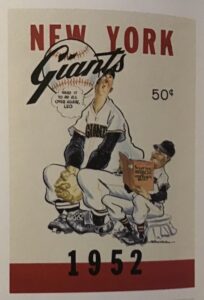
All’s well that ends well, until somebody moves the franchise.
Fueled by Stanky and Dark, the 1950 Giants rose from 73-81 and fifth place to 86-68 and third. The next year, more improvement arrived, which is to say Willie Mays was promoted from Triple-A. “It does your reputation no great harm to have Willie Mays on your side,” Durocher and Linn wrote. In the three years spanning Leo’s intricately detailed organizational report to Stoneham at the end of his first partial season in Upper Manhattan — “back up the truck” — to Bobby Thomson’s Shot Heard ’Round the World, the Giants became Durocher’s kind of team and, more importantly, Giants fans’ kind of team: a pennant-winning team. Three years later, with some further adjustments, it would become a world championship team. Diehards carried forth fond memories of those players who constituted the inventory that was backed up onto the truck so Leo could have his kind of players, and they got to reap the rewards his desired changes wrought. Overlook the move to San Francisco that awaited three years after the 1954 World Series, and you could say everything worked out for those who loved the New York Giants.
Regardless of the cynicism encroaching upon my Metsian worldview as a result of having to say goodbye to Edwin Diaz and Pete Alonso weeks after bidding adieu to Brandon Nimmo, I sincerely believe that whatever it is David Stearns will try to do will be in the perceived best interest of the New York Mets, which is to say as perceived by David Stearns. It may not yield the best outcome in the world. It probably won’t yield the worst outcome in the world. Where it lands between the two poles will tell the tale with a modicum of accuracy. Right now, we’re likely projecting onto Stearns whatever dismay and dissatisfaction we have garnered since OMG dissolved into WTF. There was a time we hailed the POBO as the executive wise enough to see something special in Jose Iglesias. Like Candelita, we’re kind of waiting for a followup sleeper hit.
We tend to like players most when they are good and help our team win (welcome to Fandom 101). Soon enough, if they’re any good at all and help our team more than they hurt it, we decide to like like players. We cheer as they excel in clothes adorned by the same logos our clothes are adorned in, and we beam when they beam, and we hang on their acronyms when they’re interviewed after delivering the big hit, and we choose our favorite instrument based on how effectively it heralded their most clutch strikeout. We identify with them. We follow their social media. We may name a pet after one of them. Naturally, we miss them when they go.
Front office heads, on the other hand, we’re transactional toward, which is appropriate, given that all we really care about from a general manager or like-titled executive are the transactions made at their behest. David Stearns grew up a Mets fan, but he’s all grown up now. Clearly, he put the childish things we continue to cherish away when baseball became his business. How much a Mets fan loves Pete Alonso and Edwin Diaz is incidental to him, at most a data point amid a sea of them in a voluminous PowerPoint deck. If Stearns finds another data point that can be quantified as predictive of marginal success, that he’ll love.
How can you not be romantic about baseball?
It sits within the realm of possibility that we’ll warm ourselves next offseason rhapsodizing over the contributions of Semien, Williams, Polanco, or somebody else Stearns subs in for the Mets he’s sent away or let walk. We don’t know how his blank slate will be filled in. However queasy it made a fan feel after Alonso pledged allegiance to the Orioles and Diaz grinned over being a Dodger, all hope isn’t lost. We can always hope more hope will be found, and we don’t have to feel like suckers for hoping. We do have prospects. We do have in-house options. We do have the implied wherewithal to bring in players who could offer the overall operation a net upgrade. (We know Stearns has a taste for ex-Brewers, but there are only so many of them at large.)
We had a winning team that didn’t win as much we wished. We aren’t coming off a world championship or even a playoff exit. There is room for improvement. Actually, there is a ton of such expanse, considering Stearns passively expunged from our immediate future any further contributions from Alonso and Diaz. I doubt we’ll get anything better than their 2025 numbers out of their respective successors in 2026, but it’s not about individual statistics. It’s about a winning kind of team.
Good luck building one, David. Truly successful GM types have to finish first at some point.






Put Stearns aside, and Polar Bear and Diaz and Nimmo: It sez here that they will never go far with Mendoza as manager. Players know this even if NY media may not. So few of any stature willing to 1) stay here 2) come here. Hence: a Polanco, to play 1B, where he has played one game, despite Stearns’ claim to focus on defense. Clown show. And hey, how has Milwaukee done without Stearns?
I’ve been wondering for the past 4-5 years what kind of management the Mets really have. I now know – sadly.
I don’t know, Greg. I loved those guys – Pete and Diaz particularly. (Nimmo, less so, but I did love his hustle and his smile….) And yet — I could never shake the feeling with Pete that we probably weren’t going to go all the way with him as the Big Bat in the lineup (only part of the reason I was so thrilled we got Soto) – I always worried he was a little too much Ted Kluszewski. And I well remember the uproar when Theo Epstein unloaded Nomar “the face of the franchise” Garciaparra in 2004 – and that ended well, for Red Sox fans anyway. I do think there is method to this madness, and that we really might all be singing a different tune come October 2026. That’s the faith part, anyway – the rest is fear, of course – not to mention flushing….
Stearns made it pretty obvious last year he wasn’t gonna pay Pete what He was looking for. Personally I’d have overpaid for him but I’m not the GM. Diaz is another story. He wanted to be elseplace. Specifically with the team with the best chance to win a WS.
Lot of offseason to go and a bunch of moves to be be made but so far we’re a weaker team than when we ended the season, at least on paper. But the way the last 3 months went, maybe that doesn’t matter much. Waiting to see how Stearns is gonna bring in some starting pitching. Just hoping we can hang onto McLean, Tong and Benge.
I worry that younger Mets fans -and by younger, I mean those who cannot remember 1986 – will lose faith in this ownership and management. These particular players (Alonso especially, but to a certain extent Diaz and Nimmo as well) related very well to those fans, creating hope and memorable moments that must now feel like ancient history to them. I wish I could reassure them that every generation of Mets fans goes through this test of fire when their favorite Mets are shown the door and it is slammed behind them but that Mets fandom continues, as bittersweet as it may be. I sense that when we rattle on about Seaver and McGraw and Gooden and Strawberry and Mazzilli and Reyes and Harvey and deGrom and Flores, not only are such fans bored and angered by this, but also disbelieving, because it has been such a long, long time between championships that dozens of favorites have come and gone and it must seem to them like a futile undertaking to be a Mets fan.
And yet here we are again. Fans who were children when Nimmo came up in 2016 are young adults now, graduating high school or college or starting a career or a family. Toddlers who came to CitiField with their parents or grandparents and wore polar bear hats and carried toy trumpets and who just KNEW, because ya gotta believe, that ball was going over the fence in Milwaukee, have had their first taste of shock and to a certain extent sorrow, because when next spring rolls around, those hats and trumpets will be put away.
I love the Mets simply because they are always there, bringing me back to my childhood, before I lost my father and before they broke my heart in 1977 ( and how can that be almost 50 years ago?). I was hoping this newest crop of Mets fans would be spared that fate, but I hope they will be convinced to come around to the beginning again. Trust me, they will always detest David Stearns, but if they do come back, it won’t be very long before they remember how much they loved-and still love-Brandon and Sugar and that big old Polar Bear, and allow themselves to get attached to other, younger players and let Mets baseball be part of their lives again.
It’s probably a good thing you waited a few days to post this. I don’t think my initial response would have been printable (postable?).
I hate to break this to David Stearns. I get that he’s the expert and I’m just a dumb fan who doesn’t really understand how the sausage is made. Fair point. But at the end of the day, he still works for us, and not the other way around. And Stearns just traded away two of the most beloved players on this team. And they were deservedly beloved. Pete was only the most prolific/consistent home run hitter in Mets history, and Sugar battled through a rough start to become the absolutely most feared reliever in baseball. As I stated a few weeks ago, this kind of talent doesn’t grow on trees, and I think that some Met fans will not realize what jewels they had until they are gone, and doing what they used to do for us for other teams
(OMG, Edwin, did it have to be the Dodgers? Why not just sign with the Yankees and totally rip my guts out? Sorry, I’ll stop now.)
It may be that David Stearns was right, and you are right, and this is the first hard step towards an ultimate World Championship. But I’m just not feeling it now. And as a dumb fan, I’m allowed to feel that way.
On the other hand, I remember how I felt at the end of the season, and wanting Stearns to gut the gutless team that absolutely quit midseason. So I guess I got what I wanted. Yay?
I don’t buy the “best chance to win a championship” argument. It’s pretty hard to three-peat. It’s possible of course, but I’m thinking the Dodgers are less likely to win 3 in a row. And Pete, come on — the Baltimore Orioles? Was that really the best you could do?
Here is my vent session: As a long-time season-ticket holder, I feel like a sucker. They lied to us about wanting to bring Pete and Diaz back, and they easily could have had both of them. I would prefer those guys to a Casino, which as we all know certainly brings the best element to communities short-sighted enough to bring one in. I have no use for one-armed bandits manned by old ladies with Depends on, and would prefer actual parking spaces in the parking lot. Pete has represented the Mets with class and dignity and how you don’t bring a guy like that (at only 30 years old!) back says more about Mr. Stearns and Mr. Cohen than it does about Pete. This is “Revenge of the Nerds”/strat-o-matic baseball with no regard for the human element. What free agent would really want to come here if he is being viewed as an automaton rather than a human being? How you don’t bring back the face of the team is beyond me and is almost as tone deaf as losing Tom Terrific twice. I guarantee that guys are calling their agents begging “get me out of here!” Stearns no longer has any benefit of the doubt, and we are approaching “Same Old Mets” derisive narratives that we haven’t had to suffer since the Wilpon days. I for one am tired of it. Nice guys may finish last, but character guys like Pete get you through the tough spots without falling apart and contribute to winning. It was all about the lack of pitching in ’25, and this is just a misdirection play by Stearns who has the people skills of a HAL 9000 computer.
I have to agree with Joey G. I’ve been a fan of this team for 60 years, and Lord knows I’ve had my heart ripped out on countless occasions. But this latest debacle is up there with M. Donald running The Franchise out of town in 1977 in terms of fan trauma. Mr. Run Prevention has torn the heart, soul, and identity out of this team. (Not even making an offer to Pete is unconscionable.) Pete, Nimmo, and Sugar weren’t the culprits in ’25 — it was the godawful pitching staff The Boy Genius assembled. So now, who’s going to want to play here? Jorge Polanco, the new first baseman who doesn’t play first base (so much for run prevention), ain’t gonna sell tickets. I appreciate your view, Greg, but these moves don’t elicit much hope. I’ve seen all this way too often. But of course I hope I’m wrong: If we win a playoff spot in ’26, I’ll gladly stand by the Seaver statue and eat my collection of Mets caps.