The blog for Mets fans
who like to read
ABOUT US

Faith and Fear in Flushing made its debut on Feb. 16, 2005, the brainchild of two longtime friends and lifelong Met fans.
Greg Prince discovered the Mets when he was 6, during the magical summer of 1969. He is a Long Island-based writer, editor and communications consultant. Contact him here.
Jason Fry is a Brooklyn writer whose first memories include his mom leaping up and down cheering for Rusty Staub. Check out his other writing here.
Got something to say? Leave a comment, or email us at faithandfear@gmail.com. (Sorry, but we have no interest in ads, sponsored content or guest posts.)
Need our RSS feed? It's here.
Visit our Facebook page, or drop by the personal pages for Greg and Jason.
Or follow us on Twitter: Here's Greg, and here's Jason.
|
by Greg Prince on 4 August 2018 11:56 am Following my attendance for his 22nd start of the season Friday night, Jacob deGrom and I can each count 12 decisions on our 2018 ledger. Twelve times this year I’ve decided to be at Citi Field for a Mets game. Some would question the judgment of anybody who chooses to watch these particular Mets in person a dozen different times — none of the Mets populating their Friday night lineup ended the evening with a batting average as high as .250 — yet I stand by my decisions despite the Mets absorbing defeats on seven of those occasions. The 2018 Mets, having relentlessly ridden a 44-63 wave clear into the basement of their division, lose roughly seven of every twelve games they play, anyway, so it’s not like I’m bringing them down.
Them bringing me down is another story, but I can’t say I haven’t been cautioned regarding their effect on my mood. The National League East standings are tantamount to a Surgeon General’s mental health warning.
DeGrom, on the other hand, didn’t decide to be 5-7 in his 12 decisions this season, but there he is, with a won-lost record that reflects a 22-start slate marked mostly by cruelty. Call it ace abuse. I don’t know how Jake’s arm feels the morning after a night when he has pitched his heart out for a team that withholds its offensive support from him, but I can only imagine the number it’s doing on his psyche. Actually, I don’t know that the imagination needs to run wild, given the postgame quotes that grow incrementally tetchier. And why shouldn’t they? How often can a pitcher serve as official spokesperson for befuddling disappointment?
“I don’t like losing baseball games,” Jacob told reporters after he threw eight innings, gave up two runs, drove in one run, struck out nine Braves and lost a baseball game. “It’s not something I ever want to get used to. Nobody in here likes losing. Go around and ask anyone in here if they had fun losing tonight. I don’t think anybody would say yes.”
Intentionally or not, deGrom channeled Brad Pitt as Billy Beane in Moneyball when he unleashed his fury on the cinematic version of the 2002 A’s after finding a clubhouse apparently unconcerned by its most recent defeat. “Is losing fun?” the GM demanded. “Is losing fun? What are you having fun for?” Beane underlined his message by taking a bat to the team boombox and instantly silencing all traces of music.
If a Met tried that, the boombox would still be blasting.
Based on his 1.85 ERA and any other peripherals you care to cite, you can be pretty certain you will witness excellence when you take in a Jacob deGrom start. Based on all other prevailing evidence, you can also be fairly sure you’ll see at least one of the following outcomes:
• Jake doesn’t win.
• The Mets lose.
• Jake loses.
Friday night, all three slots came up lemons. Two runs allowed over eight innings will usually put your team in position to win. But the Mets are deGrom’s team. We know how that goes. The 2-1 loss to this week’s magically mystifying deGropposition (Anibal Sanchez guest-starring as yet another sudden Cy Young candidate) was more or less the same as deGrom and the Mets losing to the Pirates last weekend; deGrom and the Mets losing to the Padres the Monday before; the seven instances in which deGrom has been saddled with an L despite being deGrom; and the fourteen when the Mets — while deploying the best pitcher on the planet — wrangled a collective defeat with him on the mound. The novelty of Friday’s loss to the Braves was deGrom not only Wheelerishly delivering the Mets’ lone run, via a third-inning single that plated Amed Rosario from second, but literally half of the Mets’ offense. The two hits that built that one run were unaccompanied by any others.
None of us would blame Jake if he later directed his bat in anger at some innocent inanimate object as Pitt/Beane did in the movies, but that’s not deGrom’s style. Testifying that he detests losing will have to do until his teammates present him with a viable alternative.
And me, the other guy carrying a 5-7 record? I had as much fun as a Mets fan could have amid the ongoing disaster that is the 2018 Mets season. Go to a game with my friend Kevin in any Mets season and you will have fun. We are quite practiced in forging quintessential bad game/good time experiences. Also having fun were the co-ed clusters of teens sharing my train en route to the game. Who says the Mets have lost another generation’s allegiance while endlessly losing ballgames? At least on the LIRR on a given Friday night the Long Island chapter of the Youth of America is visible in full force, giddy to be decked out in orange and blue (save for the one JETER 2 in every crowd) and cheerfully commuting to commune with the team nobody made them pick as their own. Were they all won by over by the fleeting success of 2015? Are they just in it for the illicit thrill of consuming beverage alcohol on public transportation? Do the standings mean nothing to them?
I suppose I could ask, but they all look they’re having too good a time to be brought down by the crusty likes of me. I do wonder where they disperse to once they arrive at Citi Field, though. In a year like this, the crowds on a gorgeous Friday night are far thinner than when pennants are in the offing. On the train between Jamaica and Woodside, there was barely room to turn around. At the park, plenty of room. Maybe after all those delightful Steve Gelbs reports from that ostentatiously branded bourbon bar, Jim Beam has surpassed Jacob deGrom as Citi’s top draw.
(Which would present an inconvenience to those hoping to use the third base-side men’s room in the Promenade food court as they left. Kevin and I were among the patrons to discover it was locked. That’s one way to send your customers scurrying down the stairs.)
As the eighth inning wore on, Kevin and I were compelled to stand in front of our Section 417 Row 1 seats to let a mother and her young daughter squeeze by with their nachos and chicken tenders. That would not be worth noting except nobody had come or gone all night from our midst, and neither of us had seen these two ladies previously. And that probably would not have stayed with me except they stood politely yet firmly by the otherwise unoccupied seat next to mine where I had planted my bag prior to first pitch. Our row featured a plethora of empty pairs of seats by the eighth inning (and during all the innings before it), but this was where their tickets guided them and they planned to sit where that paper told them to sit. I wasn’t gonna argue, but after I removed my bag, I asked with a touch of churlishness, “Just getting here?”
“Yes,” the mother said.
Having less than a month ago arrived fashionably late for extra innings of the first game of a doubleheader, I can appreciate wanting to get in every last pitch even if you missed the bulk of the pitches that preceded them, but, y’know, there was a second game lined up on the runway behind that one. Showing up as this single game was nearing its conclusion — and insisting on those two seats (perfectly lovely seats, but surely not the only ones available) — struck Kevin and me as weird, even by Mets game standards. Nevertheless, I grudgingly applaud the principle involved. Let us not turn away anybody who wants to see even a smidgen of the current season. Maybe someday the little girl will grow into one of those teens on the train gathering her friends for fun on a Friday night in Flushing. Maybe someday she’ll age into a crusty blogger who wonders what still attracts a decent amount of people to come see this stupid team.
Maybe someday the Mets will be worth being in your seat for across an entire game, except when jumping to your feet is appropriate.
by Jason Fry on 2 August 2018 11:36 pm The Braves beat the Mets, 4-2. Wilmer Flores short-circuited an inning by ill-advisedly trying to take second on a little bobble in center by Ronald Acuna Jr. He was safe, giving the Mets runners on second and third with one out, until the umps huddled and ruled he was in fact out, leaving the Mets with a bad feeling about things. (This ticky-tack stuff isn’t what replay was made for, but that’s a complaint for a more meaningful time.)
The Mets staged a little uprising in the ninth: Todd Frazier almost stroked a double down the line, but it landed a few inches foul and then he struck out. Jeff McNeil almost bounced a ball off the warning track, but this isn’t Vegas and Ender Inciarte was lurking in the vicinity, and it was an out. Kevin Plawecki almost worked a two-ball count, but the ump decided the strike zone could use a little widening, and that was that.
If I’d told you the above when the Mets were 11-1, you might have groaned and stamped a foot, because that sounds like a bad loss, doesn’t it? Of course a lot has happened since then, with recent installments of A Lot Happening including the Mets giving up 25 runs, which was embarrassing, and then losing to fucking Tommy Milone, which I’d argue was worse.
The Braves are somehow really good, far earlier than we would have expected, let alone liked, and battling for first-place with the Phillies — the Phillies! The Mets, meanwhile, are viewing the proceedings from deep inside a crater of their own making. They’re a tire fire and a tired farce, which means losing by two in a humdrum game on a sweltering night barely moves the needle these days.
The Mets have been garbage for months, and now the calendar has caught up with them. Whatever’s hanging on your wall or adorning your lock screen may say August, but if you’re a baseball fan you know better than that. It’s Garbage Time, where all blue and orange actors are in supporting roles, no game means much of anything, and no statistics are to be trusted.
* * *
Your blogger is off for an eight-day midwestern swing that will take him through six states and five ballparks, four of them new: I’m adding Minnesota, Milwaukee, the White Sox and Cincinnati to my roster of parks visited, with Emily’s first trip to Wrigley Field tossed in for obvious reasons. Field reports to come; in the meantime, be nice to Greg, who’s being admirably cheerful about being left in the wreckage.
by Greg Prince on 2 August 2018 1:53 am His name was Dr. Lago. He left Cuba years before and wound up teaching Spanish in my junior high. He was what you’d kindly call irascible. The translation of irascible en Español is also irascible, which is good information to retain in case he calls on me. Not much chance of that more than forty years — or cuarenta años — after I somehow passed his class, but some teachers haunt you into making certain you stay prepared.
Suburban legend had it that Dr. Lago once gave a student an F-minus on a test. F-minus didn’t exist within the school’s grading system, but it’s hard to imagine that would stop Dr. Lago. The student in question protested that an F-minus seemed rather harsh. Dr. Lago was usually rigid in his decisionmaking and didn’t tolerate a lot of pleading for mercy, but he was intermittently capable of surprising. In this case, he considered the student’s point for a moment, took back the paper from him and, miracle of miracles, returned it with the grade raised.
“All right,” Dr. Lago conceded grudgingly, “I give you F…” Then, to make certain the student understood in any language just how magnanimous a gesture this was, he added an addendum:
“…but you are not F student.”
I’d never heard of a teacher seriously giving an F-minus before I heard this story, but then again, I’d never heard of a 25-4 loss until I watched the Mets fail remedial baseball on Tuesday night. When you lose a ballgame by 21 runs, maybe you need to schedule an appointment with your guidance counselor.
The F-minus boys from Tuesday showed themselves to be quick learners for the Wednesday matinee in Washington, proving themselves capable of failing in something approximating normal fashion. Such progress is truly impressive in the context of 25-4. At this rate, the Mets stand an excellent chance of graduating to 2019.
God help us all if we have to repeat 2018.
Instead of falling behind by seven runs in the first inning as they did on Tuesday, Wednesday’s Mets trailed only 1-0 almost immediately. And at the stage where the Tuesday Mets were down by thirteen and on their third pitcher, their successors stuck with Noah Syndergaard, who was determined to keep the Nationals’ line score totals from resembling the ZIP Code for Millstone, W. Va. The Mets were behind, 3-0, by then and would stay down all afternoon (hey, how ya gonna hit the great Tommy Milone?), but at least they didn’t retreat to an underground bunker. This was indeed a step in an encouraging direction. From all available evidence, Noah didn’t contract any further childhood diseases as he continued pitching for seven innings, the last several of them quite solid. As far as we know, he avoided a relapse of his infamous bout of hand, foot and mouth disease and managed to not pick up whatever forearm-tightening malady laid Steven Matz low (and catapulted Matz’s earned run average high).
Of course the Mets lost, anyway. Not being an F-minus team didn’t suddenly transform them into a band of baseball scholars. They lost by the mundane score of 5-3, the kind of final that can be quietly filed away in the cabinet where the bulk of the Mets’ myriad relatively unremarkable 2018 defeats are kept. Other than Syndergaard’s conditionally encouraging comeback and Jose Reyes homering from each side of the plate (do not adjust your screen), Wednesday’s contest indeed resulted in just another loss.
The 25-4 Game, on the other hand, other foot and other mouth, can’t be contained to a single drawer or a single file cabinet. The 25-4 Game already has an annex devoted to it. Losing 25-4 goes on your permanent record.
Make no mistake about it — losing 25-4 is a millstone. Yet I have to confess that once 7-0 became 10-0, and 10-0 became 13-0, I was rooting for history. Or HI27ORY. If you’re absolutely, positively gonna lose, lose big. Lose like nobody’s watching. Lose so that you can’t take your eyes off it. When 13-0 is ballooning to 16-0, embarrassment is hardly at stake. We thought the Mets’ participation in the frenzied trade deadline had come and gone with nothing but Jack Reinheimer to show for it? Listen, Jack, we may have been beyond 4 PM on Tuesday, but we weren’t beyond shopping our last shred of dignity.
So yeah, I hoped every record for Met futility would be bested. Or worsted. You’re gonna get blown out, don’t suddenly turn off the reverse-vacuum. Keep that contraption blowing. My specific goal was obliterating 26-7. Mint silver medals for Von Hayes and all those Phillies from June 11, 1985, and snatch their gold. Give up at least 27 runs this time around. Lose by at least 20 runs in the process. Make this one a night to remember.
A Night to Remember, incidentally, is the name of a movie about the Titanic sinking. Not that the Mets are particularly titanic these days, but they’re not constructed soundly, either.
At 19-0 barely halfway through Tuesday, I thought we had a shot, but then Jerry Blevins had to nearly spoil it all by doing something stupid like getting Nationals out in the fifth and sixth. Drew Smith did the same in the seventh. The deck chairs seemed sufficiently rearranged. As bad…as F’in bad…as the Mets were, I no longer thought they were bad enough to take down the ghosts of Veterans Stadium. Matz, Rhame, Peterson and Bashlor were genuinely atrocious in assuming their mantles as the four horsemen of the nineteen-run apocalypse, but it appeared they’d be no match for the collective efforts of Tom Gorman (0.1 IP, 6 R), Calvin Schiraldi (1.1 IP, 10 R) and Joe Sambito (3 IP, 10 R). It’s one thing to helplessly give up 26 runs in one game. It’s another thing to expect 26 runs to easily give up its perversely exalted place in Mets history.
Alas, 26 runs still stands in all its ingloriousness, but it surely teetered on the brink of extinction, and that’s pretty perversely impressive in its own right. When it was 19-1, Mickey Callaway demonstrated as much imagination as he has all season and threw Jose Reyes at those 26 stubborn runs from 1985. The ploy almost worked, as Jose’s career ERA of 54.00 clearly attests, though I didn’t believe this was the honorable way to pursue putrid immortality. While I had been steadfastly rooting for 27 (or, more accurately, for 26 to be erased), using a position player to get there seemed somehow unsporting. Call me old-fashioned, but if you’re going to challenge the standard for most runs surrendered, you shouldn’t surrender them with position players who’ve never pitched. You should surrender them with authentic relievers who’ve rarely pitched well. Otherwise, there’s no earthly reason to maintain a roster spot for Paul Sewald.
Pitch Jose Reyes? Why not just issue oodles of abra-ca-dabra intentional walks until home plate is covered in National cleatmarks? Hell, we could still be losing that very same game by hundreds of runs.
In the end, past and present were served. Twenty-six remains the record for most runs allowed by the Mets in one game, and twenty-one is the new record for largest margin the Mets have lost a game by. We can still invoke Hayes and his pair of first-inning home runs when necessary, yet we now also can frame for eternity the image of Reyes nicking Ryan Zimmerman in the leg and Zimmerman barely controlling his giggles. Joke’s on Zimmerman. All Jose needed to get his bat going was loosening up his pitching arm. Two home runs given up one night and two home runs launched deep the next day. National League East beware: The Reyesnaissance is on at last.
I kind of hoped Syndergaard would start Wednesday by transmitting the same kind of message to Nats leadoff hitter Adam Eaton that he once upon a time stuck in the ear of Alcides Escobar. Let Thor announce his presence with authority. Let him tell our ostensible archrivals, “Enough of this crap.” Alas, the ethos we associate with the 2015 World Series at its best resides three years later more than sixty feet, six inches away. Besides, Noah had other priorities in Washington. Like shaking off the aftereffects of Coxackievirus. Like not spreading it to Kevin Plawecki. Like not planting his ass in anybody’s jackpot in the bottom of the first and inadvertently getting the Mets bullpen involved early and often again. One blowout of 19 to 21 runs every 33 years is a novelty.
Any more often than that, and you are not F student.
by Jason Fry on 1 August 2018 12:02 am 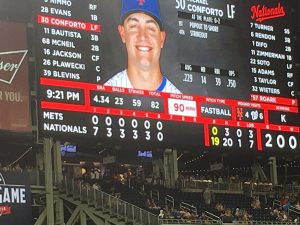 That’s enough baseball for tonight, thanks. Honestly, it was kind of funny.
Your recapper was three seats behind the left-field fence for the worst loss — mathematically speaking — in franchise history, and can report that it really wasn’t that bad.
Losing 3-2 in 11 lingers unpleasantly in the memory. Getting jumped for a five-spot in a disastrous eighth will leave a mark. Falling behind 1-0 in the first and never making up the difference will get you muttering. But giving up seven in the first and then having things get truly out of hand? All you can do is try to laugh.
Getting your butts kicked all over the place is part of baseball, and thank goodness for it. Every team, from sad sacks to juggernauts, is going to have a day or two in the course 0f a season when they get shelled, shellacked, tattooed or what have you. You try to grin and bear it, to be a good sport, and to accept your licking with a stubborn insistence that baseball karma works in slow and mysterious ways.
There were a ton of fellow Mets fans in attendance at Nationals Park on Tuesday night, and we became one big support group as the Nationals kept putting crooked numbers on the scoreboard. “We got a third hit!” one member of the orange-and-blue faithful mock-exulted as I returned to my seat to find us down 16-0. Emily and I complimented the father of a pair of stoic-looking young Mets fans for raising his kids right, and assured the doubtful-looking kids that this kind of thing builds character. If nothing else, there were mutual raised eyebrows and head shakes as we passed each other in the concourse, trying to ignore that the crowd noise was gleefully swelling again. Everywhere, there was a sense that we were in this together, even though all of us would have found anything else to do with our night if we’d known it would be this breathtakingly bad.
The Nationals fans were invariably good sports too. While I waited in line for a half-smoke at Ben’s Chili Bowl (tasty!), a Mets fan and a Nats fan behind me got to talking. Surveying That Which Didn’t Need to Be Named, the Mets fan offered that “it’s OK, we know we suck.” To which the Nats fan replied, “We’re under .500 ourselves,” after which they both started discussing chili. It’s true: the Mets’ season has been a train wreck, but so has the Nats’ year, and you can make the case that it feels worse to go from March shoo-in to July mediocrity than it does to go from spring-training enigma to regular-season disaster.
As I said, we were all in this together. What was happening in front of our eyes — a 7-spot, followed by a quartet of 3-run innings and matters were far from settled — was pathetic and hilarious and above all else bizarre. Everyone seemed to understand that it was unseemly to gloat and undignified to mourn. The only thing to do was to marvel.
When it was 10-0 Emily and I decided there wasn’t the slightest bit of disloyalty in setting out on her first-ever stroll around Nationals Park. When it was not only 19-0 but also 19-0 and raining, we decided we had had the greatest sufficiency of baseball for the evening, thank you very much.
And so we departed, missing Jeff McNeil‘s first career home run, Jose Reyes‘s debut as a pitcher, and the Mets winding up losing by three touchdowns. I mildly regret not having had eyes on McNeil’s homer, though it seems I have a talent for this: at Yankee Stadium last year I was absent for Dominic Smith‘s first big-league round-tripper. That was worse, as the game was relatively close and I missed Dom’s milestone to get a revoltingly terrible hot dog.
The remaining unseen portion of Tuesday’s debacle? I regret nothing. The night had been amazing enough as it was. And should I go the rest of my life without seeing a Mets game quite so amazing in a similar way, that would be all right too.
by Jason Fry on 30 July 2018 1:23 pm When they’re tired of a player, fans have been known to opine that they’ll drive him to the airport themselves. I’ve certainly said it a few times. Heck, I’ll give Jose Reyes a piggyback ride to LaGuardia if that will end the current farce. But what we don’t hear often enough is the opposite sentiment — a promise, say, to lie down on the runway if the Mets try to get rid of someone rumored to be on the move.
Someone like Zack Wheeler.
Wheeler has attracted plenty of scouts and rumors ahead of the trading deadline, and on Sunday he showed why he’s a hot commodity, scattering five hits and a walk over six innings. Which doesn’t capture how dominant he was: he was throwing strikes and working quickly and aggressively all day. Know how many times a Pirate saw a 2-0, 2-1, 3-0 or 3-1 count from Wheeler on Sunday?
Zero. That’s good.
The Mets being the Mets, they went out and backed Wheeler up with another zero: no offense, for which some credit should go to hulking hurler Joe Musgrove, who was pretty awesome himself as Wheeler’s opposite number. So Wheeler took care of things himself, burying a fifth-inning fastball that got too much plate in the right-field corner to chase Luis Guillorme home from first.
Wheeler departed after six on the right side of a skinny 1-0 lead, but Seth Lugo rebounded from Friday’s lousy outing to hold the fort, helped out by a good throw by Kevin Plawecki, whom I’d just taken to Twitter to declare myself officially sick of, and perhaps even willing to drive to the airport myself. (No piggyback rides, though — not for backup catchers.) With one out in the eighth, Starling Marte tried to steal first and was cut down by Plawecki, an erasure that held up under replay scrutiny and seemed to take the sap out of Gregory Polanco, who’d tormented us all series. Polanco, deprived of a runner in scoring position, swung at a ball out of the strike zone and was done.
That left the ninth in the hands of Anthony Swarzak and his train wreck of a season. But of late Swarzak’s been more like the pitcher the Mets thought enough of to give a two-year contract. He buzzed through the Pirates 1-2-3, and Wheeler’s 1-0 victory was secured.
If you’re scoring at home and have been for the last 49 years, you knew immediately that was the sixth time a Met pitcher had driven in the lone run in their own 1-0 win: the others to have done it are Jerry Koosman, Don Cardwell, Buzz Capra, Ray Sadecki and Nino Espinosa, with Koosman and Cardwell inflicting said indignity on these same Pirates (or, OK, on utterly different Pirates) in their respective portions of a Sept. 12, 1969 doubleheader. I remember that Koosman/Cardwell factoid from all the Miracle Mets insta-paperbacks I devoured as a kid; you know some veteran fan somewhere in Pittsburgh remembered it too on Sunday and went off, muttering, to clean out an already immaculate garage.
Anyway, Wheeler’s been good for some time, winning his last three starts to go to 5-6 — the sign of ace stuff in this Mets rotation. After losing two years to injury and one to accumulated rust, he looks like he’s figured out who he is, what he can do, and how he can do it consistently. Maybe it’s just my stubborn optimism at work again, but that strikes me as the kind of thing to build around rather than trade away.
* * *
Addendum: I’ll be at Tuesday night’s Mets-Nats game in D.C., and then seeing five more big-league games live over the next 10 days, part of a ballpark trip that will take me to Minneapolis, Milwaukee, both Chicago stadiums and Cincinnati. Will it be awesome, or the baseball equivalent of an ice-cream headache? Stay tuned!
by Greg Prince on 29 July 2018 12:46 pm The new Metropolitan standard of excellence by way of archaic statistics is Five Wins and Six Losses. That’s right, 5-6. Never mind the likes of 25-7, 19-10, 22-9, 24-4 or 20-6. Move over, Messrs. Seaver (those first three), Gooden and Dickey. You were Amazin’ in your respective Cy Young seasons, but there’s never been anything like what Jacob deGrom is doing.
Jacob deGrom is crafting a Cy Young-caliber season with increasingly Anthony Young-style results.
We all understand that AY pitched better than the 0-27 stretch that came to define his major league career. We also understand that 5-6 is laughable when attached to the year deGrom is producing, though none of us is producing the slightest chuckle that the best pitcher in professional baseball is saddled with what is commonly referred to as a losing record. The losing is primarily on the team for which deGrom labors. Jake is a winning pitcher. The Mets are allergic to his excellence.
In Pittsburgh on Saturday night, deGrom threw a shutout for five innings, which was, naturally, good enough to engage him in a tie with Trevor Williams. Trevor Williams might have been throwing an excellent game as well, but who can tell? Funny how the deGropposition is inevitably Jake’s equal. The Mets’ most imposing threat came in the fourth when they loaded the bases on two singles and a walk. With one out, Devin Mesoraco stepped up and grounded the first pitch he saw into a double play to end the imposition let alone the threat. Remember when we were congratulating one another on swiping Mesoraco from the Reds for that washed-up Matt Harvey?
DeGrom was so thrown off by his batterymate short-circuiting the closest thing the Mets had to a sure-thing rally that he threw a scoreless bottom of the fourth and then doubled in the fifth. He was still doing what he does in the sixth, striking out the first two Pirates on his docket to continue pushing his constant companion boulder uphill. That made it eight consecutive Buccos retired. But then — there’s always a “but then” — Jake allowed the softest of singles to Gregory Polanco. Polanco then stole second off erstwhile steal Mesoraco. Moments later, Colin Moran placed a ground ball out of the reach of Wilmer Flores and, bam, deGrom is down, 1-0.
Jake stayed in to hit in the seventh, because it was both the right thing to do for Jake or the right thing to do for the Mets. Why would you take Jake out of a game that he’s trailing, 1-0? Being Jake, he singled. Being the Mets, nothing came of it. Thus, it was back to the hill for the man forever trudging up one, and that’s where those Anthony Young vibes began to filter in. Not that deGrom didn’t deserve to keep pitching (who would you rather see?), but the experienced Mets fan knew the chance to reverse a nagging narrative trend had been definitively bypassed for the evening. In 1993, it meant we rooted for Young in the full if unspoken knowledge that something was eventually going to go wrong enough to place him beyond the reach of common winning decency. And in the seventh on Saturday night, deGrom cracked a little, allowing three more hits and two more runs. With two innings to go, the game was over, and by “game,” I mean the chance to keep deGrom’s record from dipping below .500. The eventual outcome, in which the Mets would lose, was already in the foregone conclusion category.
So Jacob deGrom, possessor of a 1.82 earned run average, is, to prevail ourselves of outmoded nomenclature, a 5-6 pitcher. It’s unlikely that if any of us had seen him walking across the Roberto Clemente Bridge after the game Saturday night, we would’ve said, in the spirit of the splendid Ted Williams documentary currently streaming at PBS.org, “There goes a 5-6 pitcher,” even “There goes the greatest 5-6 pitcher who ever lived.” We don’t think in those terms anymore, right? We all get the flaws related to the assignment of wins and losses to individual pitchers. We got it in theory a long time ago and, boy, do we get it in practice in 2018. We get it, yet we simultaneously find it hard to cope with such a pedestrian won-lost record linked to such a lofty four-month performance. We want the 1.82 pitcher to be something more — way more — than a 5-6 pitcher.
Yet if Jacob deGrom is a 5-6 pitcher, there must be something to be recommended from being a 5-6 pitcher. Actually, we didn’t need Jake to let us in on that statistical secret. Mets history is dotted with stars, legends and immortals who now share one undeniable commonality with deGrom: they, too, were 5-6 pitchers.
Eight different Mets have finished a season 5-6. Fingers crossed, deGrom’s season isn’t done (though you never can tell in these parts). But since we seem to be at the stage of his campaign where the best we can hope for out of the Mets is to furnish him a dozen no-decisions in his final twelve starts, let’s say our prospective MLB ERA champ winds up the year where he is in terms of wins and losses. Let’s say Jacob deGrom really is a 5-6 pitcher.
He would be in pretty good company. Granted, the members of the company weren’t necessarily at their best when they were 5-6, but they were still who they were despite compiling a record that lingered uncomfortably south of mediocrity.
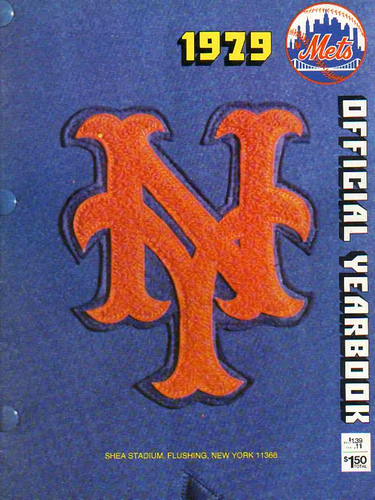
Kevin Kobel went 5-6 for the 1978 Mets. At face, this is probably the least impressive example of a 5-6 Mets pitcher, but let’s not let that detract from the loyalty the scruffy Kobel elicited during his three-season tenure in Flushing. Inside the 1979 Mets Official Yearbook, the one whose discreet cover was the orange NY logo set against a blue warmup jacket, a page was devoted to letters from children (or adults with largely undeveloped handwriting). The first one printed came from wee Michael Settanni, and boy did he let us know who his guy was:
My favorite player is Kevin Kobel and he is a great player. I hope they are in first place. He is a great pitcher. He is a great batter to[o]. I am a met fan.
When you’ve got a kid like that in your corner, what do you need with run support? Kobel was something of a proto-deGrom forty seasons ago, compiling a 2.91 ERA in 108 innings pitched. The former Brewer lefty appeared in 32 games, starting eleven and completing one (one more than Jacob to date). In his starts, according to Baseball-Reference, the Mets scored 3.6 runs per 27 outs while Kobel was in the game, or the same as they did for Craig Swan, whose 2.43 ERA led the National League despite what was considered a rather wan won-lost record of 9-6. Nine-and-six would look pretty good on Jake a dozen starts from now, huh?
The Mets are scoring 2.9 runs per 27 outs while deGrom is in the game as a starter. All of them presumably came that one start in Colorado.
Charlie Williams went 5-6 for the 1971 Mets, pitching 31 times, nine of them starts. There was nothing inherent in his lone Met season to suggest greatness awaited on the righty’s horizon, except the following May he was traded to the Giants for Willie Mays. Nobody’s greater than Willie Mays. That oughta count as extra win on Charlie’s ledger.
Ron Darling went 5-6 for the 1991 Mets in 17 starts. His Met season indeed ended in July when he was traded to the Expos for Tim Burke, a previously effective closer whose skills were apparently confiscated by customs en route to Shea. Darling requires no introduction here, though the 1991 version is unrecognizable versus the younger, sharper righty who helped pitch the Mets to the postseason twice and generally excelled throughout the 1980s. This was the beginning of the period of 1990s Mets baseball Ronnie regularly claims no memory of during SNY telecasts despite taking the ball from Buddy Harrelson those 17 times. He would later rediscover his abilities for a division-winning club in Oakland. Burke, not so incidentally, was a Cy Young-level human being. Pitching isn’t the only thing by which we should recall pitchers.
Pedro Martinez went 5-6 for the 2008 Mets. Seven summers later he was inducted into the Hall of Fame. Pedro was ticketed for Cooperstown well before he signed a four-year contract with the Mets in December 2004. The fourth year was considered extravagant, but worth it to have him in 2005. In 2005, when Pedro was still regularly flashing Hall of Fame form, who was worried about 2008? In 2008, 33-year-old Pedro struggled amid injuries and the ravages of age, though now and again reminded you he was Pedro Martinez. His final start as a Met was a lesson in grit and determination. He kept the Mets on life support as they pursued one final postseason appointment for Shea, leaving the game of September 25 in the seventh, two Cubs on base, nobody out, scored tied at three. After Jerry Manuel removed him, we had the presence of mind on this raw, rainy night to stand and applaud for all he did in his four seasons as a Met and he had the presence of mind to acknowledge our appreciation of him, pointing at every slice of the stands as he returned to the dugout. It was such a beautiful moment.
Then Ricardo Rincon came on and gave up a three-run homer to Micah Hoffpaiur, sticking Pedro with two extra earned runs and reminding us how hard it is to get to the end of a season, a contract and a ballpark. Fortunately, the Mets rallied and forged their last Shea walkoff in the ninth. Unfortunately, there was no postseason. Had there been a one-game playoff for the Wild Card, Pedro was probably going to pitch it. In light of the 5.61 ERA he posted in 20 starts (and the Rinconian relievers who were forever warming up behind him), I don’t know how that would have gone. But I’d have taken my chances with a diminished Pedro Martinez over most anybody else.
Carlos Torres went 5-6 for the 2015 Mets, pitching 59 games exclusively out of the bullpen. Torres’s three seasons as a Met, encompassing a couple of handfuls of spot starts, were the essence of a 5-6 pitcher, if not the one we’re presently pulling for. Torres tended to pitch well when you weren’t paying attention and blow games when you were. That was what made me think of him as Carlos Tsuris. Sadly, an injury kept him from being part of the pen of which he’d been such a staple from 2013 forward when the Mets finally visited October for real, but Carlos did enjoy one signature moment while the Mets pushed toward their pennant. On August 27, working in the tenth at Citizens Bank Park, Torres’s foot fielded a shot off Jeff Francoeur’s bat that bounded into the vicinity of first baseman Daniel Murphy. Murph being Murph — and this being 2015 — it resulted in one of the most scintillating outs of the season. Murph grabbed for it, flung it to first sans glance on the slight chance that somebody would be there to retrieve it on the fly…which Torres was. Francoeur went down and, three innings later, so did the Phillies.
The winning run that wild Thursday night was scored by Torres, too, Carlos having led off the thirteenth with a single. It was great batting that a now older Michael Settanni would have appreciated.
David Cone went 5-6 for the 1987 Mets, but there was no mistaking that, unlike Devin Mesoraco, he represented a long-term steal for the Mets. The Mets used to pull heists on unsuspecting GMs all the time, and prior to their most recent championship-defending season, this one was a doozy. The Royals needed a catcher. They wanted Ed Hearn, able backup to Gary Carter in 1986. They were willing to give up this promising righthander with the unusual delivery (Laredo, we’d learn it as) in exchange. We wouldn’t express such a sentiment come November of 2015, but thanks Royals! Cone was not yet a skilled batsman or at least bunter in his first Met season. We lost him for two-and-a-half months when he broke a finger while attempting to bunt in late May. But young David returned and contributed to the Mets’ ultimately doomed quest to repeat. Five-and-Six didn’t describe how good Coney was about to become. Twenty-and-Three in 1988 did the job much better.
Sid Fernandez went 5-6 for the 1993 Mets, a team that rarely went 5-6 in any isolated eleven-game span. Sid missed three months while the 1993 Mets were leaving their mark on the darkest recesses of our souls, but when he returned from injury in late July, he was essentially the same El Sid who was a featured fifth of all those great contending Met rotations of yore. The contending was only a memory for the Mets of 1993, but Sid was still bringing it in that often unhittable, intermittently frustrating fashion of his. After tossing seven innings of two-hit ball at Joe Robbie Stadium in the next-to-last game of that sullen season, Fernandez lowered his ERA to 2.93…and raised his record to 5-6. Next time Sid put his left arm to good use, it was as a Baltimore Oriole.
Tug McGraw went 5-6 for the 1973 Mets. I don’t know that we can say Jacob deGrom has given us the greatest 5-6 season in Mets history as long as we know Tug McGraw went 5-6 for the 1973 Mets. Tug McGraw was the embodiment of the 1973 Mets, and little in life is better than recalling the 1973 Mets. Tug, of course, was mostly a reliever, though he did take two starts in ’73, mostly out of desperation on Yogi Berra’s part because Tug was having such a dismal season relieving. As of August 20, Tug was an 0-6 pitcher no matter when he entered a game. Not that relievers’ won-lost records amount to much in the way of a metric, but McGraw was consistently awful and the Mets were stuck in last place.
But you know what the screwballer said — You Gotta Believe. Tug did and we did and, in a veritable blink, Tug won five in a row, saved a dozen (without blowing a single game) and the 82-79 1973 Mets, following the lead of their 5-6 fireman, Believed their way to the National League flag. Nineteen-and-Ten Seaver was rightly voted that year’s Cy Young, but Tug won a place in our hearts that transcends the glitziest of awards not to the mention the drabbest of statistics.
Jake has already secured a spot of that nature with us. Sure would be nice to see the Mets bump him up beyond .500 before this season is over, though.
Yup, sure would.
by Jason Fry on 28 July 2018 12:39 pm On Friday, in rapid succession, the Mets lost an interesting player and an interesting ballgame.
The player, of course, was Asdrubal Cabrera, now a member of the Philadelphia Phillies. More on him in a bit.
The ballgame, hmm. It wasn’t exactly a showcase for baseball, as at times neither team looked like it had any idea what it was doing out there. But it was kind of fun nonetheless, with Mets fans offered plenty of chances to size up new players and Pirates fans given plenty of chances to figure out if their team is great, terrible or somewhere in between.
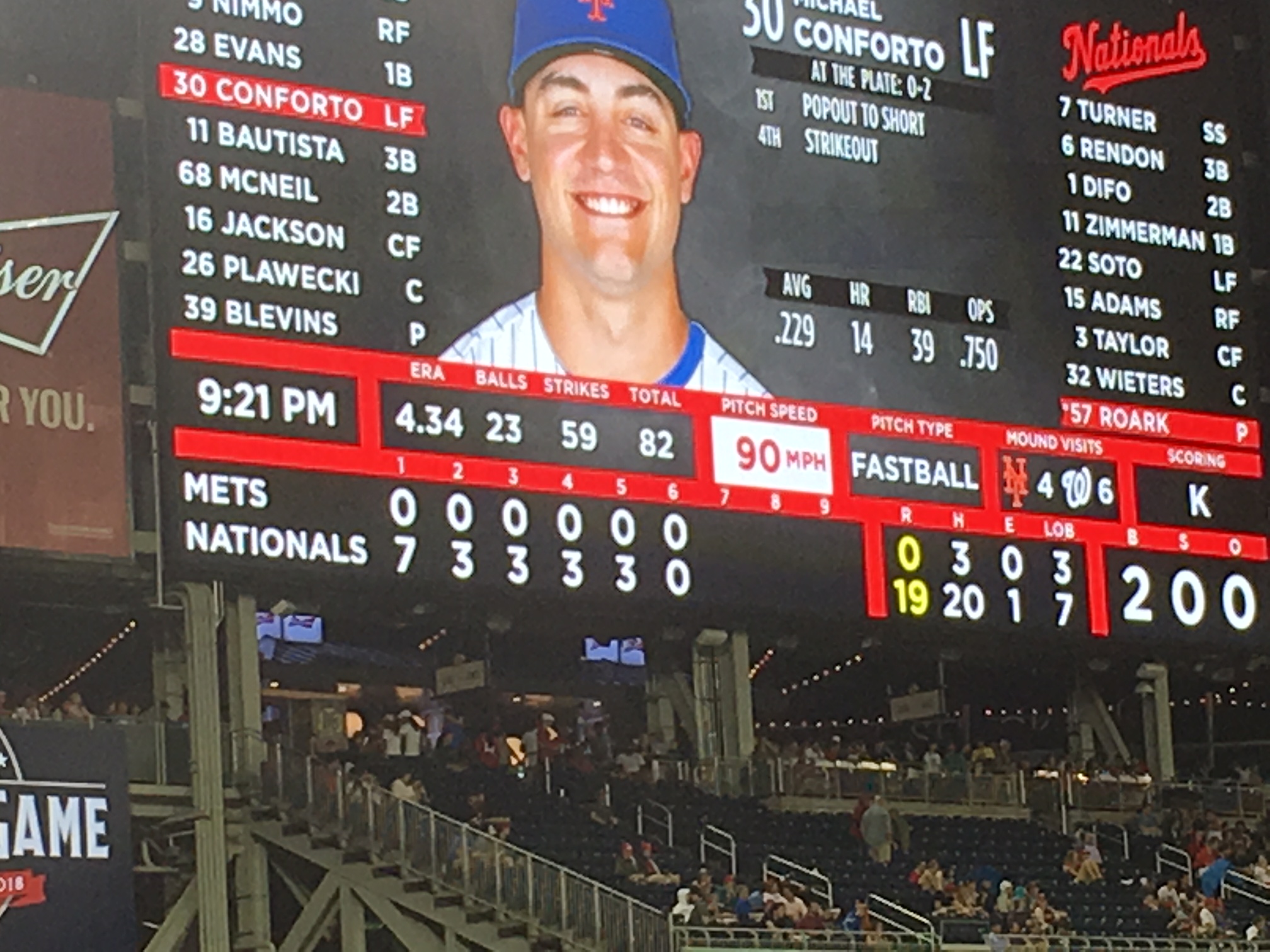
Honestly, this was a game the Mets should have been out of early. Jason Vargas‘s line looks OK but was anything but: he was horrible, as he’s frankly been all year. He gave up a home run to David Freese in the second to bring the Pirates within a run, then loaded the bases with two outs in the fourth and hung a curve to Jordy Mercer. It was a meatball, all but arriving with a polite note to be turned into a souvenir, but Mercer missed it, lining out to Michael Conforto in left. Vargas — who at least is self-aware — knew it, too; SNY cameras caught him rolling his eyes as he walked off the mound, simultaneously appalled at what he’d done and amused that the baseball gods had given him a reprieve.
The stay of execution was temporary. Mickey Callaway let Vargas lead off the fifth with 73 pitches thrown, few of them sharp. In the bottom of the fifth, Vargas got Ivan Nova, but lost Jordan Luplow on an eight-pitch walk and departed for Seth Lugo, who arrived bearing a curveball he couldn’t command, a flat slider and probably a feeling of foreboding. Lugo didn’t get the call on close pitches to Elias Diaz with two outs, started Freese out 0-2, but then couldn’t get him to fish. Lugo went to the fastball, left it in the middle of the plate, and the Pirates led 4-3.
The Mets responded by loading the bases with nobody out, prompting me to sardonically ask Emily how many runs she thought they’d get: zero or one? The answer was one, and it was a near-thing, as Conforto scampered home on a horrific throw from Luplow that was so bad it almost turned into a Pachinko-style out at the plate. Then it was Reliever Roulette, which the Mets lost, though they did at least start using the young hurlers they’d called up and then decided to let gather dust and cobwebs in the bullpen. Last I checked, that wasn’t the optimal way to keep pitchers sharp, but what do I know.
Even the failure was interesting, though: in the fatal bottom of the ninth, Tim Peterson somehow managed to allow four baserunners on six pitches, which you have to admit is efficiency of a sort. One of those baserunners was an intentional walk, which would have made that combination of pitches and outcomes impossible not so long ago; in the era of the abracadabra walk it was still fairly unlikely. The last pitch, inevitably, was to Freese, who drove it over the head of an already-clubhouse-bound Jose Bautista, and that was that.
The Mets played a man short because Cabrera was dispatched to Philadelphia late in the afternoon in exchange for a huge, raw Double-A starter named Franklyn Kilome. Immediate reactions to the deal were far kinder than the response to the Jeurys Familia trade, in which the general consensus was that the Mets had traded a faded but still useful closer for roster fillers, slot money and (cough cough) cash back in the Wilpons’ pockets. Kilome has a beastly fastball he sometimes leaves up to get whacked, a plus curveball and control problems, which is a long-winded way of saying he’s a young pitcher in Double-A. Still, not a bad return on two months of a free agent to be.
As for that free agent to be, Asdrubal Cabrera will now play alongside Odubel Herrera, a combination that’s always entertained me and should have Phillies’ A/V guys preparing their parodies of “Let’s Call the Whole Thing Off.” We are left to miss him except for our nine games remaining with Philadelphia, ample time for Cabrera to beat our heads in.
Which I have no doubt he’ll do. Cabrera had superb baseball instincts and a frankly ridiculous amount of grit, playing through far more injuries and nagging hurts than we ever knew about and still handling both second and third capably. He kicked up a fuss about being moved off short, it’s true, but if any of us had the misfortune to be Mets employees I have a feeling we’d all be kicking up far more fusses than he did.
If a Mets game was coming down to a key at-bat, Cabrera was the guy I hoped to see at the plate. When he faltered or failed in those situations, he turned into the position-player equivalent of Al Leiter: any rancor you wanted to direct at him quickly disappeared because Cabrera was already angrier with himself than you could possibly be. Sometimes this made me laugh; sometimes this made me laugh while being mildly worried about him. Seriously, cartoon characters with steam whistling out of their ears and noses were slightly less over the top about their rage than Cabrera with a good boil on.
But enough about failures. I wanted Cabrera at the plate because there was a good chance he’d succeed — as he did in crafting one of the Mets’ indelible Citi Field moments, the September walk-off homer against his future employers that keyed the team’s unlikely march to a 2016 play-in game.
Greg had the recap of that night, which you can read here. I wound up watching it over beers (so many beers) at Foley’s, with an old friend in town and a guy at the next table who was making his first trip to Citi Field the next night and had a million questions about the park, the fans, the atmosphere, and everything else.
The Mets blew a 4-3 lead in the eighth, with Addison Reed surrendering a three-run homer to Maikel Franco, but tied it in the ninth on a two-run shot by Jose Reyes. They then gave up two more runs in the 11th, but kept grinding along, putting two men on against Edubray Ramos. With one out, Cabrera connected. He knew it was gone before anyone else on the planet did, flinging his bat away and thrusting both arms skyward. Cut to Foley’s, and one overserved blogger flinging his own arms skyward in happy disbelief. Future Citi Field attendees were hugged, impromptu dances were exhibited, exclamations of amazement were made, beer may possibly have been spilled, and who knows what else.
Cabrera’s reaction and Gary Cohen’s double OUTTA HERE! will be replayed forever in Met Land, and justifiably so, but my favorite part of that highlight comes a moment later. It’s the sight of all the other Mets scurrying from the dugout to home plate, hurrying to get there and form the welcoming committee — but Cabrera, at least for the moment, is going the other way, his pace a moderate trot. A long night’s labors are behind him and a celebration awaits. But these next few seconds are Cabrera’s alone, and he’s going to use them to quietly savor a job well done.
by Greg Prince on 27 July 2018 4:40 am Such a messy game for such a tidy milestone, but given that the biggest mess of runs landed decisively on the Mets’ side of the box score, of course we’ll accept it without complaint. We do so little without complaint these days. What Mets fan could possibly complain about a 12-6 Mets romp over the Pirates?
The Wilpons still own the team, so that might get you airing your grievances, which is your prerogative, but I didn’t become a Mets fan to root for or against the owners. I rooted for the Mets to win as soon as I got to know them in 1969 and I still do in 2018. Thursday night in Pittsburgh, I rooted for…
• Steven Matz to shake off some early difficulties…which he did, going six innings that got better as they got later, culminating in a surprisingly reassuring four-run outing garnished by nine strikeouts, including six of the called variety;
• Asdrubal Cabrera to deliver a powerful potential swan song as the trade deadline nears…which he did, via two runs, three hits, four ribbies and a homer that climbed higher than the 21-foot wall that graces right field at PNC Park;
• Amed Rosario to continue to sizzle…which he did with two more hits, bringing his recent offensive output to 8-for-22 and, at last, revealing what it was that had us panting for his promotion a year ago at this moment;
• And Jeff McNeil to continue to get acclimated to big league surroundings…which will doubtlessly take a little more doing (witness Rosario’s stubbornly incremental progress to date). McNeil started at third for the first time in a Mets career that commenced Tuesday. The first ball hit toward him eluded him completely. The first time he was on second, he raced to third despite Jose Bautista having very recently slid into it and not showing any intention of leaving it. Rookies, even the 26-year-old late bloomers who were tearing up every level of the minors, will be rookies. Jeff didn’t have jitters with the bat, though. The relatively young man singled once, walked once, was intentionally passed once and Nimmo’d once (a.k.a. was pinged by a pitch). He’s not a flop. He’s not a star. He’s Jeff McNeil, New York Met, and he just got here. May he have plenty of opportunity to let us discover what he’s all about.
So, basically, I got everything I was pulling for, and I would guess you did, too. OK, maybe not everything. Twelve runs, fourteen hits and a three-game winning streak, no matter how satisfying all of it is, doesn’t seem primed to suddenly spur the current owners to clear a path for successors. Or does it? Maybe a 43-57 juggernaut on a long-awaited upswing is more attractive to some mysterious deep-pocketed big shot than a 42-58 sad sack would have been. Perhaps now that Jeff McNeil is finally getting a long look, billionaire sportsmen types will be lining up to bid any minute now.
If you can bear to leave that fantasy to fester, I would direct your attention to the Mets’ record as stated in the preceding paragraph. Do the math and you’ll note we just passed the hundred-game mark. Tidy, huh? The number is round and the arithmetic is easy. At no other juncture between now and Closing Day will calculating your team’s winning percentage, unless the number of wins equals the number of losses, be such a breeze. One-hundred games means you take the wins, you bracket them with a decimal point and a zero and you have your answer. For example, the 2018 Mets have 43 wins after 100 games and are thus a .430 baseball club.
Aren’t you glad you could figure that out so quickly?
One-hundred games also provides a pause to gain one’s bearings if the bearings don’t already speak for themselves. Sadly, 2018’s bearings have said most of what they need to say to such an extent that “tell your statistics to shut up” is a perfectly polite response when they begin to clear their throat. You don’t need to be a math maven to know a .430 winning percentage doesn’t scream much in the way off imminent possibilities like they oughta be. We wouldn’t be talking dealing Cabrera if there was anything utterly unknown about the fate of this season. We probably wouldn’t be greeting McNeil, at least under these circumstances. An enlightened organization amid a playoff push might have recognized the thunder lurking in his knobless bat and put him to good use already, but we’ll never know. If our sad bearings hadn’t made themselves plenty apparent, Metsopotamia’s evergreen topic of What Will Make the Wilpons Sell? wouldn’t have returned to the fore as the current season’s odometer was reaching triple-digits.
The best and worst 100-game records in Mets history will not surprise you. The best was 1986’s — by a lot. In the year of teamwork that made the dream work, the Mets were, at this stage of their season, 68-32. That’s eight games better than any other Met team (1988) has been after 100 games. The worst was 1962’s — by enough. In the year when it wasn’t obvious anybody here could play this game, the Mets were, at this stage of their season, 26-74. That’s four games worse than any other Met team (1964) has been after 100 games.
Despite the surge that has presumably lifted our spirits these past three days, the 2018 Mets are closer to overhearing the conversation for worst 100-game marks than best. We are at present one game ahead of the pace set by the 42-58 2003 Mets…or one game behind our predecessors from 15 years ago if you frame what remains of our season as an epic struggle to determine the worst Met team of the 21st century. Also, 43-57 ties us with our 1978 and 1979 forebears. In case you’re seeking a silver lining, after 1978 and 1979, we got new owners.
What interested me most when I dug into The Mets After A Hundred Games was gleaning the point hope tends to disappear. Understanding that you’d need to know where the Mets stood in the standings in a given year to form a truly telling snapshot, most times a hundred-game record will communicate the essence of what a fan feels. When the Mets were 59-41 on five separate occasions (1984, 1985, 1990, 1999, 2006), you felt alive. This thing is there for taking, let’s get after it! When the Mets were 53-47 on four other occasions (1975, 1989, 2008, 2016), you felt anxious. We’re in this thing, but we can’t lose ground — oh, for cryin’ out loud, don’t tell me the Pirates/Cubs/Phillies/field won again. When the Mets are 43-57…well, you know exactly how that feels.
A little above .500 after 100 is where you have to start to rely on faith. Twice the Mets have been 52-48: 2002 and 2015. One of those seasons descended into a nightmare. The other ended in the World Series. Faith can be fickle that way. The 51-49 crews of 1976, 2005 and 2010 were coming at it from three distinct angles. The ’76 Mets were light years in back of Philadelphia (it was the Bicentennial, we had to let ’em have that one), so our record was mostly bookkeeping. The 2010 Mets were in full retreat from their surprisingly good first half, so winning more than losing seemed a temporary condition. The 2005 Mets, though, legitimately orbited the Wild Card race and, perhaps more vitally, were re-establishing their credibility as a franchise (something we seem to have to do every few seasons). 51-49 felt pretty, pretty good thirteen years ago.
There’s been only one literal 50-50 proposition in Mets history: the 2011 Mets. Their even-Steven 100-game mark coincided with the briefest of leaps of faith that maybe, just maybe, if everything clicked and enough other teams in front of them fell apart…nah, that wasn’t gonna happen, and it didn’t. Respectability was fleeting. Selling was on the agenda. Next thing you knew, there we were trading Beltran for Wheeler and waving .500 goodbye.
Twenty-nine Mets teams have sat below .500 after 100 games (not counting split-season 1981, which just loves getting the special “not counting” treatment in these retrospectives). Barring a miracle that would consign 1969 (56-44 at 100, incidentally) to asterisk status, 2018 will be among the twenty-eight certain to wrap up its business no later than early October. Only one sub-.500 Mets club at the hundred-game mark went to the playoffs. You gotta believe it was the 1973 edition, easily dismissed at 44-56 — one lousy game better than we are now — and in last place. I’d say “buried in last place,” but the nine-and-a-half-game margin between them and first-place St. Louis paled in comparison to how far MLB’s other cellar-dwellers dwelled from the tops of their respective divisions. The Rangers were 17½ in back of the Royals in the AL West; the Indians were 20 behind the Yankees in the AL East; and the Padres languished 30½ games from the Dodgers in the NL West.
None of the first-place teams at this interval of the 1973 schedule won its division, but only the Cardinals let the losers in last relish the last laugh. (Ha!)
Nineteen Seventy-Three’s run to the National League pennant is the reason we seek every possible entrée into dreaming dreams that barely qualify as remotely statistically plausible. All those other sub-.500 records after 100 games are the evidence that such crazy dreams rarely come true. The odds are 28:1 against.
Yet we dream. We dream with tangible degrees of conviction in the face of better judgment at 49-51 (1980, 1992, 2009). We dream infinitesimally despite mostly grasping reality at 48-52 (1994, 2004, 2012). We dream ever, ever so slightly and delusionally at 47-53 (1968, 1996, 2014, 2017). We probably nod off unimpeded by bizarre dreams of contention once we dip to 46-54, as we did in 2013, but you know, in 1973 we were 44-56…
In 2018, we’re not even that. Sixty-two games to go.
by Jason Fry on 26 July 2018 11:50 am In a lost season, you appreciate the little things. Sometimes because they might grow into big things, and sometimes just for themselves.
You appreciate two-out singles by Phillip Evans (yet another victim of the Great Jose Reyes Fiasco) and Amed Rosario to tie the game and then give the Mets a two-run lead.
You appreciate that the timing of those hits delivered a first big-league win for Corey Oswalt, who’d been removed either because his hand was sore or because that’s what Mickey Callaway‘s Big Book o’ Managing told him must to be done. (Any and all explanations by the skipper are automatically regarded with suspicion.) That win came after a string of outings in which Oswalt deserved such a reward but one wasn’t forthcoming, because the Mets.
You appreciate a game marked by fine defense on both sides. There was Jose Bautista making a nifty running grab (his second fine play in as many days) in right to save one run (and maybe two) in the fourth. There was Bautista, again, alertly short-circuiting the San Diego fifth by nabbing pitcher Clayton Richard at second on a dunker in front of him. There was Freddy Galvis (temporarily) rescuing Richard in the fifth on an errant throw to second which he converted to a nifty spin and tag of Kevin Plawecki.
And hey, there was Brandon Nimmo making a marvelous leaping catch to take away a home run from Austin Hedges, only to have the replay meanies correctly note that Nimmo had trapped it off the back wall. Nimmo sold it, too — a little instinctive leftover from the days in which calls were made by umpires and reviews belonged to the historical record and what-if fiction.
All of that was good fun as the Mets won a matinee and — gasp! — a series, their first series win since May 20, when they were 23-19 and we were still trying to convince ourselves that a headlong plummet was a mere stumble.
But as that last sentence indicates, the problem with appreciating the little things is that the bigger things keep rudely shoving themselves into the picture.
Like Yoenis Cespedes being out until … well, it’s the Mets, so let’s not even speculate, but there are two heel surgeries involved and the talk right now is May. Perhaps we’d be better off asking, “Which May?” And this inevitable pass has been arrived at via the usual Metsian Stupid Watergate way: waiting too long to put a player on the DL, grousing about his inability to come off of it, anonymously insinuating said player is soft, navigating second and third opinions amid palpable mistrust between player and organization, sending flunkies out to prevaricate, and finally arriving at the dreary conclusion. This has been happening through multiple general managers and training staffs, so you don’t need Sherlock Holmes to figure out where the real problem lies.
Or like the Mets being likely to look different when they return from their current road trip after the trading deadline. Normally that would be a little thing to be glad about — the rot of a dead team is best turned into fertilizer as early as possible. But the Mets’ shamefully paltry return on Jeurys Familia makes this potential good little thing more likely to be another bad big thing. The Wilpons are playing their usual game of seeking salary relief rather than prospects, and meddling with an already ill-advised front-office arrangement. Which is a recipe for minimizing the return on useful pieces, and the reverse of the process that a competently run organization would follow.
Should the Mets think bigger and trade some combination of Zack Wheeler, Steven Matz, and Jacob deGrom? In theory, absolutely — 15 games under .500 is excellent evidence that some other plan should be pursued. But that theory presumes the Mets would get something decent back in such a deal or deals. The 2017 deadline crop and the Familia trade strongly suggest they’d instead maneuver themselves into securing a pittance — the inevitable money back in the Wilpons’ pockets and a bunch of raw lottery-ticket bullpen arms that not even a connoisseur of agate-type transactions could get excited about. If you’re going to trade key pieces of a young, cost-controlled rotation, you better get a lot more than middle-relief maybes. Because if you don’t, you’ve all but assured there won’t be big things to appreciate any time soon.
by Jason Fry on 25 July 2018 10:45 am It was, admittedly, one of those Everything Has to Go Perfectly ideas: Emily and I were landing at JFK a little after 4, taking the subway home to drop our luggage, then turning around and getting back on the subway to meet her father and our niece at Citi Field to see the Mets take on the Padres.
Everything Has to Go Perfectly plans do occasionally work, even in New York City, and when they do you feel like you’re at the head of your own triumphant parade. But not this time. The plane was late leaving Logan, sat on the tarmac at JFK while a gate was cleared, the A train was slow to come, the A train was slow to advance, the 7 train was a local, the 7 train inched into Mets-Willets Point at the end of its journey, and then — inexplicable and maddening — the 7 train sat at our destination, doors stubbornly closed, for a good three minutes or so.
By which point it was 7:40 or so and the only gate taking mobile tickets was the rotunda, a Mets customer-service change I’d forgotten. We got in through McFadden’s using the tickets I’d printed as backups (that’s a genuine customer-service improvement, at least), but it took a while and by the time I joined a long line for tacos and realized the kitchen was both understaffed and moving with the urgency of a sweet summer stroll, I was thoroughly annoyed.
What made it worse was I’d glimpsed the score during our trudge around the stadium and seen a 3. The Mets were already down 3-0. Fantastic.
And then, in the taco line, everything changed.
I saw Wil Myers single and Manuel Margot slide into Devin Mesoraco at home, his foot pushed off home by Mesoraco’s knee. Out, singled the ump. Mesoraco, aware of replay-era baseball’s uncertainties, fired down to third to nab Carlos Asuaje as he sauntered into the base like he was auditioning for Citi Field food prep. The first replay showed me and the surrounding Mets fans that Margot had pretty clearly been safe. But what to do with Asuaje? Declare him out with a lecture about assumptions, or replant him on an unoccupied base given that he might have considered the inning over?
While the umps huddled, my fellow taco seekers and I did the same. After a brief exchange of views, our conclusion was unanimous: fairness dictated Margot be called safe and Asuaje out, ending the inning. Which, miraculously, was what happened.
The tacos were still being prepared by too few people moving too slowly. But my impromptu seminar with fellow Mets fans had chased away my being annoyed by travel bobbles and Wilponian customer service. The world is a better place when the people around you care about a weird play in the early innings of a meaningless game between also-ran teams and the importance of Getting It Right.
Oh, and I’d noticed something else: that crooked number I’d spotted wasn’t against the Mets, but for them. Rather than being 5-0 Padres, it was 3-2 Mets. That made me feel better too.
As my life’s Waiting for Tacos period finally reached its conclusion, the crowd roared. Michael Conforto had driven a two-run homer over the fence below where my party was waiting in the second row of the Coca-Cola Corner. 5-2 Mets. I arrived and found the night had turned breezy and coolish if not exactly cool — the front that had threatened to rain on the game had instead knocked down some of the humidity.
Things had turned, and the rest of the game was calm and soothing. The Mets added another run on a Amed Rosario triple and an Asdrubal Cabrera single, a combination likely to soon become impossible and so best enjoyed while still available. Zack Wheeler, having emerged from his bumpy inning intact, pushed through seven innings of fine work. Before the top of each inning, Jose Bautista tossed the ball he’d used to warm up into our sections, serving as his own one-man Pepsi Party Patrol or whatever its new name is.
I realized that my having been absent from the premises since last April (!!!) meant I was getting my first in-person look at the likes of Rosario, Brandon Nimmo and other Met stalwarts. And Jeff McNeil appeared, to my surprise — he’d been recalled while I was piloting rental cars and being piloted on airplanes. McNeil, as if making up for lost Reyesian time, liked the look of the first pitch he saw as a big-leaguer, served it into center field, and tried and failed to look cool about things while he stood on first and the ball was removed from play. If I watch baseball until I’m 99, I will never get tired of that little ritual.
Oh, and the game was concluded in a crisp 2 1/2 hours or so, allowing us to wind our way back along the 7 and fall into bed in Brooklyn by a reasonable hour.
Maybe this isn’t the greatest season in Mets history, but it was a pretty fun night. Maybe I ought to do this more often.
|
|