The blog for Mets fans
who like to read
ABOUT US

Faith and Fear in Flushing made its debut on Feb. 16, 2005, the brainchild of two longtime friends and lifelong Met fans.
Greg Prince discovered the Mets when he was 6, during the magical summer of 1969. He is a Long Island-based writer, editor and communications consultant. Contact him here.
Jason Fry is a Brooklyn writer whose first memories include his mom leaping up and down cheering for Rusty Staub. Check out his other writing here.
Got something to say? Leave a comment, or email us at faithandfear@gmail.com. (Sorry, but we have no interest in ads, sponsored content or guest posts.)
Need our RSS feed? It's here.
Visit our Facebook page, or drop by the personal pages for Greg and Jason.
Or follow us on Twitter: Here's Greg, and here's Jason.
|
by Greg Prince on 8 June 2018 3:56 pm It was a rally or as close to a rally as the 2018 Mets could have conjured in the first week of June 2018. Wednesday afternoon against the Orioles, Todd Frazier singled to lead off the bottom of the ninth. Recently returned from a hamstring injury and representing the tying run, a pinch-runner was in order. One sprinted from the home dugout. Todd, with his back to his manager’s machinations, didn’t realize he as being replaced until his substitute put both of his hands on Frazier’s helmet. It was more direct than a tap on the shoulder. I’ve seen baserunners look disturbed to be informed they’re leaving the game. Not Todd. The man who brought salt and pepper to Queens got the flavor of the moment immediately. He and his successor high-fived and switched places. Frazier headed for the dugout. Jose Reyes took over at first base.
Jose Reyes, my favorite player. I was thrilled to see him in action and, from where I sat in right, applauded vigorously.
Jose Reyes, my favorite player. I was horrified that he’d get picked off and, in a voice not loud enough for him to hear, told him not to.
Brad Brach, the Orioles’ closer, threw to first immediately. Jose was safe. After a ball to Jay Bruce and then a foul, Brach threw again to Chris Davis, who did not tag out Reyes. Jose tried another lead, Brach tried another pickoff to no avail. Refocusing his concentration on Bruce, Brach threw two more pitches out of the strike zone. At three-and-one, Jay connected for a long fly to deep left field. If it traveled as far as it looked like it could, I’d have the best of all worlds: a Mets walkoff win with my favorite player not only scoring the tying run but not doing anything to keep the Mets from winning.
As Roger Angell wrote, he “has so far resisted the clear evidence that he should retire. He plays sporadically, whenever he is well and rested, and gives his best, but his batting reflexes are gone, and so is his arm.” Except Angell wasn’t writing about Jose Reyes in June of 2018. He was writing about Willie Mays in June of 1973, specifically a night when Mays chased down a double and, realizing he wasn’t up to making a sufficiently strong throw to the infield, flipped the ball to left fielder George Theodore, who was not expecting to be called upon in that situation. Who would? Who would think Willie Mays would need a cutoff man to hit the cutoff man? “The horrible truth of the matter,” Angell continued, “was that Mays was simply incapable of making the play.”
That was in the top of the fourth at Shea, against Willie’s old team, the Giants. In the bottom of the fourth, he grounded out to short, pulling his average below .100 for the year. “He has subsequently done a little better,” Angell reflected weeks later, “but his failings are now so cruel to watch that I am relieved when he is not in the lineup.”
This is what a Jose Reyes sighting is like for me these days.
The player whose promotion so delighted me this week fifteen years ago; whose reign as the Mets’ best-ever all-around shortstop elevated my spirits for nine seasons; whose absence from the Mets gnawed at me for the four seasons after that; and whose reacquisition in 2016 I embraced reluctantly but eventually…I’m thrilled to see him in action…and I’m horrified that he’ll get picked off. Or strike out. Or pop up. Or ground into a DP. Or be thrown out stealing. Or otherwise run us out of an inning. Or let a ball skitter under his glove. Or bobble a ball. Or drop one as it descends from the sky.
Yet I am instinctively thrilled to see him. When I saw him emerge from the dugout to run for Frazier, I definitely put my hands together, a little out of amazement that Mickey Callaway knew enough to take out a guy who’s not a burner even on sturdy hamstrings, mostly because the guy he put in is my favorite player. He was my favorite player almost immediately in 2003 and stayed my favorite player through 2011 and served as my favorite player in absentia until 2016. I never fully restored him to his most exalted place of pre-eminence after the circumstance that deposited him on our doorstep a second time, but I also never found another Met to fully supplant him. Nobody’s ever pinch-run for Reyes in my heart. He’s still my favorite player in the active sense, for as long as he remains active.
Which is no longer an open-ended proposition. I caught a flurry of tweets en route to the game Wednesday that reported an exit strategy was being concocted. “Mets officials,” according to the Post’s Mike Puma, had “discussed releasing Jose Reyes, but are conflicted given Reyes’ roots in the organization. Mets want Reyes receiving a proper sendoff.”
In the realm of Twitter, a medium into which patience was never programmed, the news was greeted by fast-fingered Mets fans with disbelief. Not disbelief that the Mets would be offing Reyes — Jose was routinely being typed out onto 126th Street when the club was 11-1 — but incredulity that the Mets were, for once, concerning themselves with making a player’s swan song as graceful as possible. This player’s swan song. This player who has been overmatched at bat, underskilled in the field and not much of an asset on the basepaths. Faster than Todd Frazier is basically the portfolio Jose brings to the table in June of 2018.
Had Bruce’s ball kept carrying, it would all be moot. Reyes would be running and, unless he allowed Jay to pass him, he’d be scoring. The Mets would be winning for a change. Nobody would have anything to complain about with Jose for a change. People have every right to complain, but encountering their complaints has bothered me all season. I’m not saying the complaints — that he shouldn’t still have a spot on the roster; that he shouldn’t have had a spot on the roster to begin with in ’18; that he shouldn’t have been invited back in ’16 considering the event that made him available — are without validity. I’m just saying they bothered me. Jose Reyes has been my favorite player for fifteen years. Once he’s done, I realized recently, that’ll be it. I will never again have a favorite player in the active sense.
I’ll like players. I like lots of them now. I like most everybody on the Mets. Several of them I wear t-shirts for. But none of the other current Mets has ever generated the kind of personal passion required for me to call him my favorite. Few Mets ever have. Tom Seaver did. Doc Gooden did. Rico Brogna and Edgardo Alfonzo did. Then Jose Reyes. Five players spanning fifty seasons, the first starting when I was six, the last lasting until I’m fifty-five. At forty, which is what I was when Jose was nineteen about to turn twenty, it was probably a stretch to select a favorite player. But the chemistry was just right and I went with it. I don’t see myself getting revved up for another in the latter half of my fifties or beyond.
Having a favorite player doesn’t mean blanket dispensation for what I might not like at a given interval. No. 41 will always be my No. 1 to me, but I cringe every time somebody tells me of a chance meeting in which the Franchise bristled at them. Doc is a case study in not putting too much faith in an idol. Brogna never did anything wrong other than wear the uniforms of teams I didn’t like, but the bad back that ostensibly motivated the Mets to trade him did indeed end his career prematurely and I acknowledge that (though swapping him for Ricardo Jordan and Toby Borland was hardly a solution). I’ve never forgiven the Mets for letting Fonzie walk as a free agent in December 2002, but I’ll grudgingly admit he was probably done being a superstar at that point.
I’ve had my issues with my last favorite player. Two months after I tingled that Jose of all All-Stars was the All-Star chosen to catch a ceremonial first pitch from Willie Mays in San Francisco, I thought he ran recklessly and stupidly in September 2007 and accelerated the worst collapse ever. I thought a couple of times at his peak that his maturity was maddeningly slow to develop. I didn’t mind him ferrying his batting crown to the bench ASAP on the last day of 2011, but I thought he didn’t have to take the right turn to the dugout so suddenly. What happened after that day — signing with an unpleasant division rival — I considered business. I’d have preferred the Mets had made him an offer. Maybe they weren’t crazy not to, seeing as how the Jose of Miami and Toronto was never quite the Jose of Flushing.
There was nothing to defend or rationalize when it was reported Jose threw his wife into a glass door in Hawaii, which led to his suspension from the Rockies and his reunion with the Mets. Talk about damaged goods. In retrospect, as long as his name keeps filtering through my consciousness, it reminds me of my first year collecting baseball cards, 1970. I really wanted to open a pack and find a Willie Mays. I never did. Five or six years later at a card show, I came across a 1970 Mays. Except it was a cut card. The top was lopped off and the bottom was the top of some mere mortal’s portrait. It wasn’t the Willie Mays I’d wanted when I was younger.
But it was there, it was affordable and I grabbed it. It was still Willie Mays.
And the free agent the Mets signed for the major league minimum in the middle of 2016 was still Jose Reyes. Jose Reyes with a domestic violence rap soldered to his reputation, but Jose Reyes. I still had him listed as my favorite player, same as I had Gooden when he tested positive for cocaine. Second chances. Compartmentalization. Deeply embedded sports fan loyalty. Wright was out for the year. We needed a third baseman. I had deleted some but not all of my REYES 7 shirts from rotation. And, business being business notwithstanding, he looked so happy to be home.
I got a kick out of Syndergaard. I grew fond of Cabrera. I admired deGrom. I loved that Cespedes decided to stay. But none of them was really my favorite Met by the summer of 2016. Reyes filled the role. Maybe not as he had from 2003 to 2011, but close enough. Though he wasn’t really a third baseman, he played the position as asked. He wasn’t the speedster he once was, but he ran as needed. The 2016 Mets sputtered and frustrated but, with REYES 7 again atop their batting order, they took off in late August, roared through September and, as they did with Willie Mays on their team in 1973, made the playoffs.
It’s not generally mentioned when people glibly refer to Willie Mays falling down in center field during the 1973 World Series and reflexively use him as their example of a player who resisted retirement to his own detriment that Willie was as good a player as the 1972 Mets had after he came home to New York in May. The team was riddled with injuries and falling apart, but Mays was rejuvenated. Nobody got on base more than Willie. Had he gone out as a 1972 Met, the New York coda to his career would have been sweet, hold the bitter.
But then we wouldn’t have had the night Willie said goodbye to America, despite hitting .211, despite Angell wishing he wasn’t still pushing himself onto the field a shadow of his formerly brilliant self. I was ten years old in 1973. I could decipher batting averages. But it never occurred to me to not want to see Willie Mays.
Jose Reyes, once the dust settled, helped the Mets win something in 2016. He batted more than any Met did in 2017. The results weren’t spectacular, but they steadily improved as the year went on. There were some stray good Jose moments in an otherwise dismal Met year. On the night of their final home game, some of us chanted the Jose chant as if a decade hadn’t passed. Had he gone out as a 2017 Met, the New York coda to his career would have been completed quietly and with minimal hard feelings. Those who didn’t want him back wouldn’t have been happy that he’d been here again at all, but those who were happy that he’d been here again could have finished their active relationship with him on a modestly upbeat note.
Instead, the Mets asked him back again, Jose said sure, and I’m channeling Roger Angell in that I’m relieved when my favorite player isn’t in the lineup. Never mind what impact he has on a given game. I just don’t want to see him fail and feed more fodder to those who never cease pointing out his myriad shortcomings. I love my Jose Reyes from when he was nineteen about to turn twenty. I love my Jose Reyes who set every speed-based record in Mets history. I love my Jose Reyes from when he caught a first pitch from Willie Mays. I love my Jose Reyes who batted .337. I love my Jose Reyes who homered to tie the Phillies late in an epic contest in 2006 and did the same in 2016. The Jose Reyes of today, the one whose age is about to be five times his uniform number, the one whose OPS is basically what you get for attaching your signature to the SAT, doesn’t perform remotely like that. But I saw how he greeted Frazier when he replaced him on Wednesday. I’ve seen how he high-fives teammates after they score when he’s in the on-deck circle. I’ve seen how once in a great while, when he has reason to smile on a baseball field, he brings it like few others have.
He doesn’t bring it much with his bat or arm or legs anymore. I held out hope in April, but in April he had only five hits. I looked for signs in May, but in May he had only five hits. He’s had none in June. Few at-bats, either, and little reason to be given them. Jose Reyes is more done than I’ve cared to admit. I will admit that he’s done, no matter that I haven’t cared to admit it whatsoever.
The last favorite player I’ll ever have didn’t get to cross the plate on Jay Bruce’s home run off Brad Brach, because Jay Bruce’s fly ball didn’t land over the fence. It was caught in left field for the first out of the ninth. Jose was back to being a baserunner at first, trying not to get picked off. For his sake. For the Mets’ sake. Though he’s never met me, for my sake.
Don’t get picked off, Jose.
He didn’t. He drew two more throws — once while Kevin Plawecki batted, once while Adrian Gonzalez was up. They made the second and third outs, not Jose. The Mets lost, 1-0. While pinch-running for his baseball life on June 6, 2018, Reyes didn’t further facilitate his own demise.
It’s coming. It’s racing around third like Jose used to. I know that. Maybe it doesn’t matter how it’s arranged. Maybe the concept of a “proper sendoff” is tonally out of sync with these harsh what has he done for us lately? 27-32 times. If I had my way, the player with the second-most hits any Met has ever recorded, Reyes, would leave the field one final time alongside the player with the most hits any Met has ever recorded, Wright. They played next to each other for a lot of years, you might recall. I do.
It was a while ago.
by Greg Prince on 7 June 2018 3:39 pm As we will be reminded this evening and then again on Monday, the only thing worse than the Mets not winning is the Mets not playing. That’s the problem with a baseball season, even one like this: it includes off nights.
But we’re gonna try to make one of them better.
On Thursday, June 28, the Mets will be idle, but a few of us got together and recognized that Mets fans like us never are. Thus, we’ve found a way to help each other get through the off night. We’re calling it…
OFF NIGHT FOR METS FANS:
READIN’, WRITIN’ & RUSTY
…and we’re having it at Two Boots Midtown East, 7:00 PM to 8:30 PM, 337 Lexington Ave., between 39th and 40th Streets in Manhattan, convenient to Grand Central Terminal.
OFF NIGHT FOR METS FANS will be part spotlight for some prime baseball writing, part tribute to one of our idols and, if things continue as they have since the middle of April, part group therapy session.
On hand to discuss their recent books will be three writers whose devotion to the orange and blue colors so much of what they do.
• Dave Jordan, who founded Instream Sports, co-authored Fastball John with former MLB pitcher John D’Acquisto and contributes to The Sporting News.
• Jon Springer, who injected the Mets into the Internet’s bloodstream in the 1990s when he created the Mets By The Numbers site and just released his exploration of an 1880s phenomenon, Once Upon a Team: The Epic Rise and Historic Fall of Baseball’s Wilmington Quicksteps.
• And me, who you know from here and perhaps stuff like Piazza and Amazin’ Again.
Books will be available for purchase and signing. No obligation or admission, but you’ll probably want to grab an armload.
Besides delving into Met and Met-adjacent Lit, we look forward to sharing our memories of one of the greatest and most beloved Mets ever, Rusty Staub, and of course invite you to do the same. Two Boots proprietor Phil Hartman — a Mets fan and restaurateur so Amazin’ he sells his slices at Citi Field’s Promenade food court — plans a pizza most Grand for the occasion.
It’s been a while since we convened a night of this nature, but these Two Boots events have always been fun. Phil makes great food, baseball makes great conversation and, what the hell, there’s no game that night.
Hope to see you there.
by Greg Prince on 7 June 2018 6:51 am Little is more ideal than a midweek afternoon game, a pitchers’ duel unfolding in the sun and the whole affair playing out quickly enough to not bog anybody down in the worst of a rush hour commute. Of course baseball’s ideals take a pounding when left in the hands of the New York Mets, formerly considered a contending baseball team, then a competitive baseball team, then just a baseball team. The first two descriptions are currently inoperative. The last one is up for debate.
The Mets did host a ballgame on a lovely midweek afternoon Wednesday, one I was fortunate enough to attend at the invitation of my friend Sharon. It wasn’t particularly sunny overhead, but considering the Mets, that’s appropriate; shades of gray suit the orange and blue mood best of late. It was also a little shy of warm for the first week in June. Given how cold the Mets have been, that, too, felt right. Might as well mix it up a bit for Weather Education Day, that dubious curriculum addendum dreamed up to annually populate Citi Field’s Promenade with kids who I can’t imagine complain about taking part in what amounts to state-sponsored hooky.
Weather Education Day? Kids, if it’s not raining, they play ball. Taking part in any ruse that offers a valid excuse to get you out of school and into a ballpark surely encompasses a lesson worth learning.
I don’t know if an inquisitive child raised a hand to ask why an American League team was visiting a National League team more than four months ahead of the World Series. Twenty-two seasons into Interleague play, I don’t have a good or at least moral answer. Wednesday’s starting pitchers, Zack Wheeler and Dylan Bundy, did however carry on in the best tradition of Jerry Koosman and Dave McNally, the starters from the second game the first time the Mets and Orioles faced off in a series that counted. In that Game Two, a scant forty-nine years ago, the Mets prevailed, 2-1. Kooz went eight-and-two-thirds, giving up two hits. Ron Taylor finished up for Jerry, retiring Brooks Robinson on a grounder to Ed Charles. The victory erased the allegedly indomitable Birds’ advantage from the opener and set the stage for three midweek afternoon games in Flushing that I assume are covered thoroughly in Regents-level history classes to this day.
Except for the uniforms, there isn’t much to evoke a World Series matchup when the Mets and Orioles meet in the present. Yet despite their respective franchises’ current fortunes and the decided lack of drama surrounding their performances, Wheeler and Bundy pitched to dueling standards. It didn’t feel like a pitchers’ duel because these Mets are these Mets, and these Orioles are technically not even that, but the statistics fit the parameters. Wheeler gave up three hits and no runs over seven innings. Bundy did exactly the same. It no doubt helped to be facing the lineup each of them was facing.
Eventually, the Orioles eked out a run off Jeurys Familia and the Mets eked out nothing off either of two Baltimore relievers. A questionably conceived bunt devolved into a double play in the eighth. A deep fly ball died at the track in the ninth. Then so did the Mets. Our beloved Amazins totaled one run in the two-game set. Sadly for Zack, the run came the night before he pitched, when it wasn’t enough to support the similarly admirable efforts of Jason Vargas, Seth Lugo and erstwhile optical illusion Anthony Swarzak (spotted for an instant in March and then practically never again). Thus, a 1-0 loss, a series sweep out of step with the example set in 1969 and a six-game losing streak to serve as prelude to another wholly unnecessary Interleague engagement this weekend.
If you’re scoring at home, the Mets desperately want to know how you do it. In their last six games/losses at Citi Field, the Mets have crossed the plate seven times. In their last four games, they’ve done it twice. Their starting pitchers have been outstanding — Wheeler has never looked sharper than he did on Wednesday — but little notice gets paid to the branches of the tree that don’t fall on your head.
One ideal that has emerged unscathed in this latest iteration of Met offensive ineptitude is how quickly they’re completing their daily defeats. Wednesday afternoon’s required a mere 2:27, only seven minutes longer than it took Koosman and Taylor to outduel McNally in the age when men were men who didn’t fiddle with batting gloves and stepped into the box without Jay-Z blaring an intention to reintroduce himself on their behalf. Tuesday night they needed 2:33, on Sunday only 2:30. Recent results may be hard to take, but the postgame commutes are suddenly a breeze.
by Jason Fry on 6 June 2018 12:20 am … we present Sunday afternoon’s.
Or Saturday night’s.
Or Friday’s.
Or Thursday’s.
Honestly, they’re all pretty much the same. Decent starting pitching + no offense, pulse, or clue = no chance. The good news, for the second night in a row, was that the Mets managed a squeak of protest in the middle innings and didn’t get no-hit.
So when’s this going to change? Beats the fuck out of me. When Jarred Kelenic becomes a star? When Jarred Kelenic Jr. becomes a star? When Jeff Wilpon sells the team? Never?
I just know I’m pretty freaking tired of it.
by Greg Prince on 5 June 2018 4:12 pm How historic is the ongoing fall from grace the Mets will seek to halt this evening versus the Orioles (at 17-41, as ideal an opponent for that sort of task as one could request at this moment)? Consider that the 2018 Mets were ten games above .500 fourteen games into their season, wielding a menacing 12-2 record and lording it over the National League East. Now consider they are 27-30 and are not only ensconced in fourth place in their division but saddled with the fourth-worst mark in the National League.
It’s not out of the question that somewhere in Maryland, an Orioles blogger is delighted that the Birds have a chance to get well or at least a little better in New York tonight. The Mets haven’t been making anybody — besides the then-faltering Diamondbacks a couple of weeks ago — look bad by comparison to themselves since the middle of April. We know they’ve steadily explored the tubes via downward trajectory for a while, but just how far have they plunged?
Far enough to evoke some unflattering precedents. Only twice before in their history have the Mets soared to at least ten games over .500 only to dip to at least three games under .500 later that same season.
In 1991, a ten-game winning streak propelled Buddy Harrelson’s Mets toward the kind of dizzying heights to which we’d become accustomed: a place in the pennant race, a victory total whose baseline was the high eighties, general adoration…then the bottom fell out. The Mets went from a peak of 53-38 on July 21, to their last glimpse of Ten Over at 55-45 on July 31, to Three Under — 57-60 — on August 18. That’s the franchise air speed record for a freefall of the nature our current Mets are going through. Losing 15 of 17 to travel 13 games south will get you there in no time at all.
A longer journey downward occurred nineteen years later. In 2010, the Mets were as many as eleven games over .500 at one point (43-32 on June 27) and still Ten Over as of July 6, when they were 47-37. It was hard to imagine while they were confounding expectations that Jerry Manuel’s band of merry Mets would plummet so decisively in the not too distant future. But plummet they did, though it took a good longer than it taken in ’91. Come September 3, the 2010 Mets were a 66-69 outfit, the result of going 19-32 in their previous 51 games.
The stretch we are in at present, during which we’ve ridden the absolutely wrong escalator, has run somewhere between the warp speed of 1991 and the stately descent of 2010. Our 2018 Mets are 15-28 in their past 43 contests. More 2010 than 1991, but mostly not good no matter how you count it.
Neither of the Ten Over/Three Under 2018 predecessors, incidentally, continued to fall through the earth’s surface at quite so an alarming rate. The 1991 Mets finished their year at a sad 77-84, which is to say that once they reached Three Under for the first time, they didn’t stray altogether far from respectability the rest of the way, going 20-24 in their final 44. The 2010 Mets were even better at not being even worse. In their last 27 games, they went 13-14, settling in the books at 79-83.
And then everything was fine…right? Well, no. 1991 begat 1992 and 1993 and, eventually, six consecutive losing seasons clear through 1996. 2010 paved the route for 2011-2014, four more years when .500 was aspirational and ultimately out of reach. Not that the future is told in our worst moments, but let’s just say you don’t want to fall from Ten Over to Three Under in the space of one season if you can help it.
I guess if the Mets could help it, they wouldn’t do it.
There’ve been a couple of other similar if not exact in-season plops from well over to uncomfortably under. The 1971 Mets were a powerhouse for a while: on June 30, they crested at 45-29, a bulging sixteen games over .500. Then summer really kicked in and kicked our asses. By August 15, we were 58-60; 13-31, under Gil Hodges, no less. Not Three Under, but perilously close enough. The ’71 Mets rallied to end their year 83-79 and return to the brand of mediocrity that defined most of their post-1969 existence.
Five years later, the 1976 Mets raced out to an 18-9 start — one shy of Ten Over on May 8. Joe Frazier was Mickey Callaway without the initial rush of New Age savoir faire about him. Then he was simply Joe Frazier (which Mickey Callaway has been himself a little too much recently). In a blink, the Mets of ’76 were Three Under, hitting 24-27 on June 3 after losing 18 of 24 following their impressive if illusory start. There’d be a long, futile .500 slog that would land them at 52-55 on August 2, then an insane surge that lifted them to 86-71 on September 28, before an 0-5 coda warned us to not get carried away by their final mark of 86-76. It was their best won-lost total since ’69, yet seven horrific seasons awaited on deck.
The fate of the 2018 Mets, let alone the Mets of 2019, 2020 and so on, will be determined by many factors. Logically, none of them figures to involve how previous iterations of Mets handled falls from Ten Over to Three Under. The Mets just activated Todd Frazier and Anthony Swarzak from the disabled list and just selected Jarred Kelenic and Simeon Woods-Richardson in the first rounds of the amateur draft. None of them or anybody else taking the field tonight or in the decade to come had anything to do with 1971 or 1976 or 1991 or 2010. (Well, Jose Reyes from 2010 remains extant on the 2018 roster, and David Wright from 2010 is signed through 2020, but never mind that for now). Still, statistically similar precedent wouldn’t lurk so close to top of mind if the Mets didn’t seem to be in the process of bottoming out.
Actually, it would be great if that’s what the 2018 Mets were doing at Three Under. Sinking any further below is really asking for trouble.
by Jason Fry on 4 June 2018 11:45 am Steven Matz pitched well on Sunday afternoon, showing no signs of any woes from an injured finger.
This concludes the good-news portion of the recap.
Everything else was trash, and familiar trash at that: bad defense, zero offense, a certain fatal sleepiness. The Cubs beat the Mets, 2-0, completing a four-game sweep in which they never seemed seriously threatened.
The game turned on two plays at home plate, a locale the Mets never glimpsed during their cameos as baserunners.
The first came in the seventh. Javier Baez singled but looked gimpy at first, to put it mildly. Baez looked like he’d need a limb amputated, and was just remaining in the game out of doggedness. This was eyewash: Baez managed to reach third on a single by Willson Contreras, then took an enormous lead off third as Matz — apparently wearing blinders — tried to keep Contreras close. As Matz turned towards first, Baez jetted home. Adrian Gonzalez took the pickoff and threw home, but it was far too late. 1-0 Cubs.
That lone run was enough to beat Matz, but the Cubs weren’t done. With one out and runners again on the corners, Ben Zobrist spun a little pop fly behind second, drifting towards right. As Luis Guillorme twisted and backpedaled, Jay Bruce passed up a far easier path to the ball, regarding it as if he was a signatory to a nonaggression pact. Guillorme made the play — he makes most plays — but was in no position to throw to anyone except the ballboy, last seen doing more for the 2018 Mets than Jose Reyes. Contreras trotted home and the Cubs had an unnecessary insurance run.
That was it. A Cubs team doing everything right, a Mets team doing enough wrong, a loss, a sweep, a once-promising season grinding deeper into the dust. Something has to change, but there’s precious little indication that it will.
by Greg Prince on 3 June 2018 11:42 am As any black cat could tell you, many of the seminal legends in Met lore involve the Cubs, including the go-to tale of the person who called a local newspaper sports department one fine day in 1964 to inquire how many runs the Mets scored in their game that afternoon at Wrigley Field. The newspaper employee dutifully reported the total was nineteen. The caller had a followup question:
“Did they win?”
You’ve heard that one before. It usually gets trotted out when the Mets, particularly in a down period, somehow light up the scoreboard for a change. We all have a good laugh because a) the Mets in their down periods preternaturally lend themselves to laughability; and b) yes, they did win. They won that day in 1964, 19-1. They’ve won every time somebody references “did they win?”. Even the Mets tend to win when they pile up a ton of runs. You’d figure the same concept would apply to any occasion when they pile up a ton of anything that could be construed as positive. They do that, they win.
Don’t they?
Welcome to early June 2018, the heart of apparently another down period in the history of the New York Mets, when their ace starter can be characteristically unhittable; their shaky bullpen can be aberrantly able; and they can strike out more batters as a pitching staff in one game than any Mets pitching staff had struck out batters in any game before…yet you still have to ask the followup question:
“Did they win?”
No, they did not win. The Mets — primarily Jacob deGrom, but also Robert Gsellman, Jeurys Familia, Jerry Blevins, Hansel Robles and Tim Peterson — struck out 24 Chicago Cubs across the first 13 innings at Citi Field on Saturday night, and they lost, 7-1, in 14 innings.
I guess it’s laughable, sort of like promoting a Todd Frazier Batting Practice Pullover giveaway and then not giving away the Todd Frazier Batting Practice Pullovers as promised (never mind not having Todd Frazier around lately). But it might take a few decades and an intervening championship to find the funny in the defeat that followed the imploded promotion. Four hours and fifty-three minutes of inducing swings and misses to no avail was enough to make Brandon Nimmo mopey, and he grins at everything. Little is for smiles let alone chuckles when Mets batters can’t connect any more effectively against Cubs pitchers than Cubs batters could against Mets pitchers. The Mets struck out 15 times in 14 innings, which came off less as epic than typical. There was no majesty to our futility. The Mets not hitting Mike Montgomery, Cory Mazzoni or Justin Wilson didn’t seem out of the ordinary (we’ll get to Luke Farrell later). DeGrom not giving ground to an opponent, even one as good as the Cubs, probably wasn’t noteworthy, either, but, oh, the way he didn’t give ground…
That was magnificent.
Of course it was. It was deGrom. He’s always magnificent and it usually amounts to nothing. But we didn’t know that for sure in the first inning when he was nicked for three soft singles, including the first hit he’d given up with a runner in scoring position since the George Stone Age, yet allowed no runs. The one-out RISP hit only moved one Cub from second to third and another from first to second. That was Chicago’s mistake. Loading the bases versus deGrom is one thing. Sending anybody from those bases home is a whole different matter. Jake struck out Willson Contreras looking and Kyle Schwarber swinging to escape the first unscored upon.
The tone was set. DeGrom, who got all three of his outs in the first on K’s, commenced to cornering Cubs where they could not make contact. A fourth strikeout in the second; a fifth and sixth in the third; the seventh and eighth in the fourth; nine through five. The Cubs didn’t get to one of the greats when they had him on the ropes early, the same way their ancestors learned that not knocking out Seaver or Gooden when they were in trouble was a recipe for eventual regret. In the sixth, two more soft singles did lead to a Chicago run, but another deGrominant gut check derailed another bases-loaded threat. Jake struck out Albert Almora for No. 10 and Addison Russell for No. 11 and no further damage ensued.
DeGrom trailed, 1-0, just long enough to resign ourselves to his and our usual fate. But two outs and no runners into the bottom of the sixth, a Met batter did something besides relentlessly disappoint: Michael Conforto belted a Montgomery delivery onto the party deck. Celebration ensued. The Mets weren’t winning, but deGrom wasn’t losing. At this point in 2018, that’s a victory for us.
Jake was permitted to start the seventh inning of a 1-1 game. In another era, that would not be reason to call a local newspaper sports department. These days, you set your Google Alerts for when it happens. DeGrom was around 100 pitches. Do you know how many pitches Seaver would throw when striking out and shutting down the opposition in his prime? Neither do I. Nobody counted. They started counting when Gooden came along, mostly to marvel at how many of his pitches were strikes. (This message has been brought to you by Wistful Nostalgia for The Way Certain Things Used to Be.) Jake indeed made it through seven innings, adding two more strikeouts and giving up no more runs.
This is where we brace for the bullpen to do its worst to whatever deGrom has left them, but the first wave of Met relievers picked up the gauntlet crisply. Gsellman walked Anthony Rizzo to start the eighth, then struck out everybody else. Familia, who nailed down a pennant against the Cubs less than three years ago, struck out Russell and Ian Happ to start the ninth and grounded out Kris Bryant with two on to end it. In the tenth — where we floated once Conforto’s blast revealed itself a blip on the Mets’ otherwise blank offensive radar — Blevins went into bend mode, but resisted breakage. Jerry made it 20 K’s overall.
The only other time a Mets staff totaled 20 strikeouts was against the Cubs. Sometimes it seems most Met things worth recalling happen against the Cubs. This one occurred on August 1, 1999, at Wrigley. Al Leiter fanned 15 in seven innings and Pat Mahomes fanned Jeff Reed in the thirteenth for No. 20, but what lives on longest from that sweltering Chicago Sunday is Billy Taylor, obtained from Oakland the day before, came on in relief of Armando Benitez in the tenth. Taylor was so fresh to the Mets that he’d had no time for a pregame meeting with his catcher, Todd Pratt. Thus, Tank initiated one on the mound.
“What’s up, dude? What do you have?”
“Sinker, slider, changeup.”
“OK, let’s go.”
In brevity, there was salvation. Taylor retired Sammy Sosa in the tenth. Mahomes singled home Roger Cedeño in the thirteenth. Did they win? Of course they won. Up period, down period, it shouldn’t matter. As with scoring 19, you’re supposed to win when you strike out 20.
I mean, I suppose you are. The alternative to scoring is not scoring, but outs are outs, no matter how they are wrangled. Runs can technically be scored around strikeouts and often are. Ask Steve Carlton how that works (and when he remains tight-lipped, ask Ron Swoboda). Figuratively speaking, almost everybody strikes out constantly in contemporary baseball, yet somebody from one side or the other has to win the games amid the K’s. Literally speaking, almost every Cub struck out constantly in Saturday’s game. Robles struck out the night’s 21st Cub in the eleventh (and amazingly surrendered no home runs) to establish a new franchise record, yet the Mets hadn’t won. By the middle of the thirteenth, low-profile Peterson’s second inning of work, the franchise record was 24…and the Mets still hadn’t won.
They’d take a definitive step toward not winning in the bottom of the thirteenth. Only the trained eye could see it coming. With two out, Jose Bautista doubled to deep left-center. Conforto, the lone Met who’d done something constructive with a bat during the previous twelve innings, was intentionally walked. Mickey Callaway sent up his last bench player, Jose Lobaton, to pinch-hit for Peterson. I would have gone with Zack Wheeler in that spot, but Callaway’s of an American League mindset and doesn’t realize some National League pitchers are better hitters than some Quadruple-A catchers. But all credit to Lobaton for coaxing a full-count walk out of Luke Farrell, the Cubs’ de facto long man, at this point in his fifth inning of yeoman relief. Farrell had never pitched this long in his thus far eighteen-game big league career. Joe Maddon, however, was determined to preserve the business end of his bullpen or show another facet of his genius or whatever. Farrell was 75 pitches deep into this most uncommon appearance. He had just lost a .152 hitter on ball four. Their Luke was on the cusp of becoming the late-night version of our Jake, the pitcher you can’t believe wouldn’t be rewarded for throwing so many impressive innings.
We were on the verge of shoeing that other foot. We couldn’t get deGrom a win (again), but we could make hay from those 24 strikeouts. All we had to do was push Bautista home from third against a rookie reliever who had been pushed to the brink of exhaustion.
Yeah, that’s all.
Kevin Plawecki was up. The erstwhile half of Travin d’Arwecki had been stationed at first base to begin the game to provide righthanded punch versus the lefty Montgomery. There was nothing in Plawecki’s past to suggest any punch was forthcoming, but he was righthanded, and considering how little the left-leaning Mets hit southpaws, every infinitesimal bit was judged helpful. Somewhere along the way, first baseman Kevin became catcher Kevin via double-switch. His only position of importance in the bottom of the thirteenth with the bases loaded and two out was that of batter. His only immediate task as Farrell prepared to throw his 76th pitch was to take. Take a pitch. Walk’s as good as a hit here. Moreover, the pitcher who just walked Lobaton needs to be given the chance to dig himself the deepest hole possible.
So what does Plawecki do? He swings at the very first pitch he sees, grounding it sharply to Russell at shortstop to facilitate the simplest of putouts at second and ensure a fourteenth inning.
As Rose Marie advised, wait for your laugh. It’s coming. It will take a while if you’re a Mets fan. Perhaps the tale of the team whose first six pitchers struck out 24 batters in thirteen innings before its final two gave up six runs in the fourteenth will come off as amusing in a future context. Not hilarious at this juncture, however. Buddy Baumann didn’t strike out any Cubs. Nor did Gerson Bautista. Outs of any sort were elusive for that duo until the barn door was detached from its hinges.
Trailing 7-1 in the bottom of the fourteenth, with the clock having passed midnight, the Mets attempted to foment a rally off Cub closer Brandon Morrow, the fellow Maddon was so desperate to withhold from action. With one out, Amed Rosario beat out an infield single. It was the Mets’ seventh hit of the evening/morning and maybe a sign that something crazy could happen. Crazy things have happened in Mets-Cubs games forever, dating back from before Familia caught Dexter Fowler looking in 2015; before the hurried Taylor-Pratt Summit of 1999; before the black cat crossed in front of the visitors’ on-deck circle at Shea Stadium in 1969; even before the 19-1 victory that required media confirmation in 1964. Marv Throneberry not touching first — or second — in 1962? That was against the Cubs. The first fourteen-inning game between these teams? That wasn’t in 2018 — it was in 1963, one the Mets won on Tim Harkness’s grand slam at the Polo Grounds, struck only after Billy Williams whacked a two-run inside-the-park homer off Galen Cisco in the top of the fourteenth. And let us not forget the night the Mets had to amend their offer of Todd Frazier Batting Practice Pullovers to the first 15,000 fans through the turnstiles because of a “quality control issue”. That, too, came against the Cubs…on the same night the Mets struck out 24 batters but trailed by six runs in the fourteenth inning.
To be fair, the Mets gave out vouchers for Frazier pullovers and rustled up leftover Conforto jerseys from the night before. Also to be fair, it’s not like the Mets aren’t striving to rise above their present down period. On Friday night, after giving away free shirts and a sloppy loss, Callaway held a team meeting to remind his players to play the game “the right way”. A little more than twenty-four hours later, there was Rosario getting that hit off Morrow in the fourteenth.
And a little more than twenty-four seconds after that, there was Rosario getting doubled off first on Adrian Gonzalez’s line drive to short to end the game in the fourteenth.
Team meetings probably work better when you have a better team attending the meeting.
by Jason Fry on 2 June 2018 11:09 am It’s been a busy couple of days.
On Wednesday I drove up to Massachusetts in a rented Nissan Pathfinder. (Nice vehicle, BTW.) On Thursday I helped my kid clean out his dorm room, a task that would have been more efficiently accomplished with a fire hose and/or flamethrower, and transported the to-be-salvaged/reused stuff to summer storage at his grandmother’s in Connecticut. Friday morning we were up early with the remainder and battling traffic into New York, where I’d no sooner shed the rented Nissan than I got myself fopped up in seersucker and a bow tie to talk at a Book Expo America author’s tea about audiobooks. (As one does, right?)
So the Mets game came as a treat at the end of a busy stretch, and in the beginning it was indeed a nice reward. There was Zack Wheeler, looking sharp and effective in taming the Cubs. There was Brandon Nimmo, socking a two-run homer to give the Mets the lead. There was also Jose Lobaton, inexplicably back from the minors, but you can’t have everything.
Perhaps I let my guard down. Perhaps I was just tired. Whatever the case, my couch posture went from upright to supine and Emily asked if I was going to sleep.
What? No. Of course not. Why, the idea bordered on the offensive.
Narrator: Five seconds later, he was asleep.
When I jerked myself back to full awareness nothing seemed that different. My wife and child were in the same places they’d been. Paul Sewald was now on the mound, but it had looked like Wheeler was just about done, so that was no particular surprise.
Except the Cubs no longer had zero runs. They had three.
I had missed the bad part. The discouraging part. The inevitable part. The part where the Mets’ horror show of a bullpen does what it normally does.
That was really it. Sewald gave up a home run that seemed to make the rest of the game academic. There was a mild Mets uprising that amounted to nothing. Jose Reyes continued to play third and take up a roster spot he has no business having. At one point the Mets had Jose Bautista in left, Michael Conforto in center and Nimmo in right, showing an impressive determination to have all three outfielders in the wrong place simultaneously.
Oh, and the Mets lost, sinking under .500 for the first time all year.
It didn’t hurt as much as it might have, because I missed the part where hope curdled into dismay. I recommend this strategy. But good luck figuring out when to employ it.
* * *
In happier news, yesterday was the anniversary of Johan Santana‘s no-hitter. If you’d like to go down memory lane with us:
- Greg had a hunch about Carlos Beltran as a Cardinal. (Fortunately, he was wrong, though Adrian Johnson’s mistake kept Beltran from Ruining Everything.)
- First reaction from Mr. Prince as your recapper. (Context: There was a beer ad at the time with this as a tagline.)
- The full recap, with historical perspective.
- My What Johan Did art piece disguised as blog post. I’d thought of this idea years before and never thought I’d get to do it.
- My account of listening to and then finally watching a Mets no-hitter unfold from the unlikely vantage point of Orlando, Fla.
- And Greg’s back to put a historical bow on things.
Have fun! Don’t let the 2018 Mets get you down!
by Greg Prince on 1 June 2018 2:52 pm Seth Lugo going four innings and giving up no runs as a starter after two months doing nothing but relieving was inspirational. Brandon Nimmo homering fair directly after homering foul was inspirational. Scott Copeland — with Tim Peterson one half of the Who? Brothers Show Band and Revue — acquitted himself nicely from out of nowhere and that can surely be interpreted as inspirational. Devin Mesoraco hanging in there behind the plate despite absorbing another backswing was an inspiration. So was Michael Conforto finding a fly ball after a moment of apparent panic beneath the misty, murky skies of Citi Field.
You know what wasn’t inspiring? The Mets overall Thursday night, as they lost to the Cubs at home, 5-1. While one can take morsels of inspiration from certain aspects of individual achievement, the team as a whole produced a performance worthy of the fog that enshrouded the playing field. You were better off not seeing the whole thing.
When it was over, the Mets were again a .500 ballclub, finishing May and the first third of their season at 27-27. That’s an inspiring record to file away if it could have been worse or has very recently been worse. We know in 2017 the Mets fell away from .500 early and never remotely neared it by the time the final third of the season dragged itself onto the calendar. We know the Mets of 2018 have often played like a team incapable of winning as many as it loses, yet, thanks to Sandy Alderson’s somewhat defensive pronouncement Thursday afternoon, we recognize the Mets as having lately practiced a modestly inspiring brand of equilibrium. In suggesting the media (and fans) quit harping on the Mets’ pace slowing from the now ancient torrid tear that commenced 2018, Sandy said, “I’ll bet you nobody remembers that we’re 8-8 in the last sixteen games, which, given everything that’s happened, is almost as incredible as the 11-1 start, considering what we’ve lost, how we’ve lost, and the players we don’t have.”
Actually, the Mets were 9-9 in their previous 18 entering Thursday, and if the general manager wants to split a cookie more than 25 ways among all the players responsible for keeping the club barely seaworthy when it looked like they’d sink off the shores of Flushing Bay, he is welcome to distribute the crumbs accordingly. I’m not sure winning nine of eighteen (now nineteen) was a goal for the organization, but sometimes you should celebrate what you can. I remember being thrilled by 23-24 and 26-27 clubs when I was my matriculating my high school grades, hopeful that they weren’t bound to conclude those respective years of 1978 and 1980 at 66-96 and 67-95…which they were. The Mets have spent recent weeks losing a starting outfielder, a starting infielder, two starting pitchers and too many games on the backs of terrible relievers, yet they’re not as dead as widely portrayed.
Huzzah! They’re .500!
It doesn’t feel like a celebratory occasion, based both on the elephantine 11-1 start in the room and just how resoundingly crummy they’ve been when losing one for every one they’re winning. It doesn’t even feel like some great achievement after 2017, which was supposed to be an aberration in the aftermath of two playoff campaigns. The perpetual injury wave (another perception bugaboo of Alderson’s) has presented an impediment to progress. You don’t rationally expect injuries to keep happening, even if we are conditioned to expect exactly that. Maybe somewhere else this guy, that guy and a couple of other guys missing some time here and there wouldn’t amount to a trend. For the Mets, it’s a recurring way of life.
Yet here we are, not only at .500 but not certifiably comatose within the National League East. We started May in first place. We end it in fourth, but only five games out. Five out one-third of the way through extrapolates to fifteen out when it’s all over, but that’s not the way to look at it. The way to look at it is 108 games remain to make up a surmountable patch of ground. To make that theory operative, the Mets have to play somewhat better for four months and the three rivals ahead of them have to play somewhat worse (factor in Wild Card possibilities as you choose). It’s not a great inspiration, but it’s something.
Here’s something else. The Mets have been here before. They’ve been exactly .500 exactly 54 games into the season four times: 1999, 2004, 2008 and 2010. In 1999, they were in freefall, having been 27-20 a little over a week earlier. The losing streak that would devour three of Bobby Valentine’s coaches and leave room for the manager was about to crest. The Mets bottomed out at 27-28; Valentine declared he should be dead meat if he didn’t lead his team to 40 victories in their next 55 engagements; and, lo and behold, the Mets went off and posted a 40-15 record, putting their flirtation with .500 in a distant rearview mirror. We remember 97-66 1999 as fondly as any year that didn’t result in a trophy festooned with a couple of dozen or so flags.
The other .500 one-thirds ended less happily. The Mets were messily but determinedly putting their 2004 together at this juncture fourteen years ago. After a 9-15 start under the decidedly uninspiring Art Howe, they had accomplished a great deal in not losing more than they’d won. 2002 and 2003 were horror shows. 2004 was at least getting watchable. They’d continue their one step up/one step back march along Mediocrity Way well into July, hewing so close to legitimate contention that they’d make the kinds of trades they thought a contender might make. Scott Kazmir went in one of those trades. Jose Bautista was trafficked in the other. The 2004 Mets soon disintegrated. The 2018 Mets have Jose Bautista and he made a nice, perhaps inspiring catch against the Cubs last night.
The 2008 Mets were supposed to rise high above .500. Fifty-four games in they were stuck in mud left over from the 5-12 finish that made 2007’s 88-74 total look no better than 2004’s 71-91. Howe’s successor Willie Randolph was given fifteen more games to push the Mets upward…then a one-way ticket on an eastbound 747 when he didn’t. Jerry Manuel eventually guided the Mets triumphantly past .500 in 2008, to 89-73. Alas, it was a little shy of the preferred destination, which is to say another year one painful game shy of the playoffs, but Manuel proved his mettle.
Two years later, a .500 record one-third of the way through didn’t seem so bad, which tells you how bad 2009 (precursor of 2017) was. Those 2010 Mets surprised and delighted us for about half a season, then consigned us to the nearly bottomless pit of despair we kind of expected all along. That team’s — and Manuel’s — final record was 79-83. Looks better than it was.
Four different .500 clubs at this stage of the season, four different results. One was great. One wasn’t quite good enough. Two came off as disasters. We don’t know where we’re going from this 27-27 rest stop, but we do know we could be worse.
Huzzah once more for .500! Now maybe climb above it and stay above it.
by Jason Fry on 31 May 2018 9:25 am Teams in freefall have a certain stink to them — a weird funk of despair and anger, disbelief and anxiety. The relievers will self-destruct, the bats will fail, the defense will falter, the umps and/or fate will intervene. Players and fans alike carry themselves as if they know it and are just waiting for the inevitable to arrive. It’s a malady that grows worse and worse, until the afflicted team takes the field looking like each player is carrying a pallet of bricks on his shoulders. Leading feels like cruelty; being tied feels like a death sentence.
That’s been the Mets of the last week or so — an outfit braced for impact.
What a team in the throes of such things desperately needs is a normal game, one that wouldn’t demand particular comment in other circumstances. And — thankfully, miraculously, wonderfully — that’s what the Mets got on Wednesday night. They won — holy shit they actually won — by an undramatic 4-1 score, concluding a 3-5 road trip that only felt like an 0-800 debacle.
And you know what? It was a pretty darn good game, too.
The signs weren’t exactly auspicious at the beginning. First, Jason Vargas was pitching, which has generally not gone well this year. (Let’s add that he was taking the place of Noah Syndergaard, who will supposedly only miss a start, i.e. is most likely dead.)
Vargas, however, looked OK. In fact, he looked great, keeping the Braves off-balance for five innings. So of course he was pulled leading 1-0. (In fairness, he was pitching on three days’ rest.)
Enter … Tim Peterson?
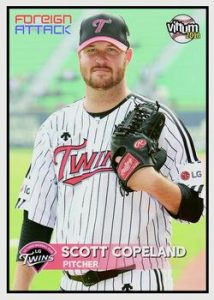 No, I didn’t make that up. If you knew who Tim Peterson was before Wednesday, well, my cap is tipped. I had no idea. Neither had I heard of Scott Copeland, called up alongside Peterson and the briefly glimpsed Buddy Baumann as part of a dizzy carousel of player moves. Copeland’s most recent baseball card, BTW, is a Korean League offering from a set called — and I’m not making this up — Foreign Attack.
Peterson put up a scoreless inning and nearly hit a line single in his first big-league AB, but then gave up a run to Johan Camargo, now enshrined as the 145,982nd Brave to torment the Mets in Atlanta.
The Braves had a run, but the Mets had put up another one for Peterson — and in heartening fashion. Amed Rosario (whose plate discipline is rapidly improving) tripled, and Brandon Nimmo (whose everything is rapidly improving) singled him in. Those two would be back at it again in the ninth, authoring a double-double that gave closer du jour Robert Gsellman a 4-1 lead to defend.
In between, Rosario saved the Mets by making the kind of play neither he nor they have been able to make of late. In the eighth, Jeurys Familia gave up one-out singles to Ozzie Albies and Freddie Freeman to bring Nick Markakis to the plate with the tying runs on.
That was the disaster right there, the inevitable cave-in that would seem foreordained later. We all knew it. Markakis slapped a hard grounder past Familia, up the middle, and oh boy.
Except Rosario dove and corraled it, the ball almost tumbling out of his glove but remaining safely ensconced, and flipped it into the bare hand of Asdrubal Cabera, who pivoted neatly and fired to Adrian Gonzalez. Just like that, the Mets were out of the inning and, as it turned out, out of danger.
Rosario and Nimmo. If you squint a bit, you can imagine those names being paired in a decade’s worth of happy recaps like this one. That’s getting ahead of ourselves, of course; for now, they’re young players figuring out the things young players have to figure out. But at least for a night, they gave the Mets two related things that they desperately needed: a win, and a normal, no-fuss game.
|
|