The blog for Mets fans
who like to read
ABOUT US

Faith and Fear in Flushing made its debut on Feb. 16, 2005, the brainchild of two longtime friends and lifelong Met fans.
Greg Prince discovered the Mets when he was 6, during the magical summer of 1969. He is a Long Island-based writer, editor and communications consultant. Contact him here.
Jason Fry is a Brooklyn writer whose first memories include his mom leaping up and down cheering for Rusty Staub. Check out his other writing here.
Got something to say? Leave a comment, or email us at faithandfear@gmail.com. (Sorry, but we have no interest in ads, sponsored content or guest posts.)
Need our RSS feed? It's here.
Visit our Facebook page, or drop by the personal pages for Greg and Jason.
Or follow us on Twitter: Here's Greg, and here's Jason.
|
by Jason Fry on 25 September 2016 2:14 am The standings do not recognize moral victories. A 2-0 perfect game counts the same as some hideous crapfest against a second-division opponent that you win 9-6 despite walking the ballpark. The same goes for losses — the manager turning over the buffet after sending the backup catcher to the mound doesn’t mean the defeat was hideous enough to cost you an extra half-game.
But Saturday night’s depressing, aggravating, ludicrous, exciting, fun, absurd and ultimately tragic loss was about as close as you can get to a moral victory. It won’t help in the standings — the Mets start Sunday tied with the Giants and a half-game in front of the Cardinals — but it does earn an asterisk, at least on this blog.
It also strikes me as a miniature version of the 2016 season. Which we’ll come back to in a bit.
The game defied description, but I’ll try: Sean Gilmartin was bad and so was Rafael Montero, with their combined efforts putting the Mets in a 10-0 hole. Shame on the shitty Mets fans who booed Gilmartin, pressed into service after a month in which he didn’t throw 20 pitches in any appearance — there’s another New York team that’s a better fit for their likes. I hope those fans left, because once Terry Collins wisely sat down the varsity to save them for Sunday, weird things started happening.
A division of Met relievers sent into battle held the Phillies at bay, and the Las Vegas 51s started making some noise. It was 10-4, which is still lipstick-on-a-pig territory, but then it was 10-6, which is when you catch yourself thinking the pig has some good qualities, and then … well, let’s not pursue that metaphor any further. Once the Mets were within four it was fun — the Phillies looked like they were trying to wake up from a nightmare, while the Mets looked like they were determined to keep dreaming.
Baseball tugs you in different directions — towards the cool logic of statistics and then towards the hot rush of fan enthusiasm. The latter is often a funhouse mirror for assessing the former — it’s what we’re looking into when we think we spy hot hands, players being due, clutch, grit, karma, destiny and all the other intangibles we like to argue about. With that in mind, our pals at Amazin’ Avenue end each game recap with a graph of both teams’ Win Probability (it’s courtesy of FanGraphs) and the chart for this game is instructive.
It shows that the Mets’ chances of winning Saturday night bottomed out at 0.2 percent after Asdrubal Cabrera grounded into a fourth-inning double play and barely budged from there until the uprising began. In the ninth, with Michael Conforto on first and Eric Campbell on second and the Mets trailing 10-8, the chance of a Mets victory had risen dramatically, ascending all the way to … 17.5 percent.
Those aren’t wise betting odds, but it sure didn’t feel that way to me, not with Lucas Duda looming at the plate with one out and the tying run on first. Hell, I could practically see it — Michael Mariot would get into a count where he’d need to throw a fastball, and he’d try to put one on Duda’s knee, except the ball would drift just slightly towards the center, ending up exactly where Duda likes it. Duda would golf the ball on an arc, his eyes coming up and his mouth opening as he tracked it into the night. The ball would wind up in Utleyville, maybe clattering off the pole that Lucas just missed the other night, or crashing into the facing above it. In play, run(s), as At Bat likes to say, which would mean 11-10 Mets, and we’d know that my God, anything is possible.
When that didn’t happen, my confidence was only moderately shaken. Because hadn’t Travis d’Arnaud found his way to the right place through an 11-pitch at-bat? If d’Arnaud connected the ball would head for left-center and wind up in the Party Deck, maybe hitting off the railing above the head of Roman Quinn, and we’d just hope that Travis wouldn’t shatter a tibia jumping on home plate or go on the DL with sunflower seeds in his ear canal or suffer some other Extremely Travis d’Arnaud Calamity.
And if those two stalwarts couldn’t quite manage that level of heroics, why, Gavin Cecchini was behind d’Arnaud! Cecchini and I were tied in the career hits column when he entered the game in the fifth, but since then he’d doubled twice, ascending the ladder of our affections from Oh Yeah That Guy to Comforting and Reliable Presence. (Yeah, it was that kind of game.)
Alas, this is where the dream ended. We all awoke, Duda popped up and TdA hit a little bouncer to Mariot. Pumpkins again.
But still, wasn’t it fun?
And hasn’t this year wound up being fun?
The Mets were essentially down 10-zip in August: below .500 with an All-Star team worth of DL residents. They then went insane, vaulting to a tie atop the wild-card ranks despite having player after player snatched away — no Neil Walker, no Jacob deGrom, no Steven Matz, no Wilmer Flores. Now there are seven games to go over eight days, and somehow this band of stepbrothers has something to play for and nothing whatsoever to lose.
If they fall short next week, I’ll be disappointed but look back on 2016 as a year whose finishing kick was a rollicking good time, a county fair every night. And if they do make it to a 163rd game, I’ll enjoy whatever that means, whether it’s one extra day of baseball with a disappointing ending or a championship that will launch a million columns bitching about wild cards.
Think of these last seven games as the ninth. There are 51s coming up and guys who haven’t panned out and guys who just got back and guys we’ve quit on and then embraced, and of course Bartolo Colon. And maybe, just maybe, they have a rally in them — because haven’t they come this far?
Here’s to cheering them on.
by Greg Prince on 24 September 2016 11:31 am Met pinstripes are magical. Put any player in them and they perform wondrous feats. Players you’d all but forgotten about. Players you’d barely heard of before. Players on whose backs it would not occur to you to pursue a postseason berth. They’re all here, whoever they are, and they’re wearing Mets uniforms in the service of winning Mets games when every Mets game might as well be a Mets season in miniature. Eight one-game seasons remain.
These New York Mets of Matt Harvey and David Wright…no, that’s not it.
These New York Mets of Jacob deGrom and Neil Walker…no, not them, either.
These New York Mets of Jon Niese and Justin Ruggiano…uh-uh.
Can we at least say “these New York Mets of Noah Syndergaard, a.k.a. the formidable Thor, the lone stud who has remained stalwartly studly from April to September, with his mighty thunderbolt of a right arm…?”
Don’t be silly. Of course we can’t. Syndergaard’s got the strep. He’s been scratched for tonight. Rest up, Norse horse. We will need to ride you at some point. I’m not so enchanted by magical Met threads that I believe we can put them on anybody who wasn’t leading the league in RBIs for Cincinnati and succeed as if nobody valuable has dropped like a fly (or a fly ball off the glove of Luis Cas…nah, too soon).
The folk trio you’ve seen during all those PBS pledge drives, Sean, Gil and Martin, will pitch in Thor’s place tonight. Correction: It’s Sean Gilmartin. You may remember him from such 2015 highlight film outtakes as Rule 5 Rules! and If You Send Me Down, You’ll Never See Me Again. In a normal year, whatever a normal year is in Flushing, Sean would be that last pitcher you can’t quite remember is filling out the obscure end of the bullpen. In this abnormal month, Sean is a veritable celebrity, considering the Q (or “Who?”) ratings of his reliever colleagues.
Gilmartin’s making a start tonight, but ultimately he will probably not throw alone. Gabriel Ynoa made a start last night. If Gilmartin was projected as No. 18 on the Mets starting pitcher depth chart when they broke camp, Ynoa was 18A. Nowadays, the starting pitcher depth chart is good for cleaning Dan Warthen’s glasses. Ynoa didn’t so much start against the Phillies on Friday as throw two so-so innings of relief in the first and second. He gave up two runs and five hits, but the important thing is he gave the Mets length — reliever length — and got them to the third.
From there, the pitching got a little sitcommy, one ancillary character after another entering the main set only to exit moments later. Edit in smash cuts, lay down a music bed and sweeten with canned laughter, and it would make for a solid evening of prime time entertainment to have on in the background while you’re doing something else.
Except this is late-September pennant race baseball and you’re trotting out Ynoa, Logan Verrett, Josh Smoker, Erik Goeddel and Josh Edgin instead of one fully formed Steven Matz (Friday night’s projected starter, if you can remember as far back as Thursday afternoon). Some of these chronic fill-ins were more effective than others. None was in danger of being spun off into his own series. It was more Full House than TGIF.
But because Met pinstripes are so flattering and turn almost every bit player into a star, it didn’t matter all that much. When the Phillies pitched, the Mets hit. Travis d’Arnaud, who is occasionally confused for his brother Travis, who used to be a rising-star catcher for the Mets, came out of offensive retirement to lash a run-scoring double in the second. Terry Collins was so stunned that he immediately pinch-hit for Ynoa even though there were at least seven innings to go.
To be fair, removing an ineffective emergency starter early when there was a chance to put runs on the board would have been stunning behavior for this manager a week or two ago. That was mid-September. This is almost late September. Anything goes. Anything but Jay Bruce’s name on the lineup card, that is.
The Mets and their secret ally Jeremy Hellickson shifted into whichever gear makes you go moderately faster in the fifth. The game was slogging along and would take 3:40 to play, but clocks, like roster limits, are immaterial this time of year. There were singles and walks and runs and a Met lead and, after Hellickson could help us no longer and he was replaced by some other dude on the Phillies, a three-run homer from…
Michael Conforto? We still have him? Yeah, I guess we do. Conforto lives and hits and is only whatever young age he is and he’s probably still toting his talent around and if it’s bursting out of him like it did at this juncture last year, well, watch out world…and get the eff out of the way, Jay.
The Mets were up by four until they were up by two until they were up by five, which is where it ended. The bullpen parade was halted when Hansel Robles took control of the final two-and-two-thirds innings like the calm, wily veteran he is. Juan Lagares, last seen supplanting Collin Cowgill and elbowing Rick Ankiel, laid down a pretty bunt and ran down a sinking line drive. Lucas Duda got a hit. Ty Kelly and Matt Reynolds were in there somewhere. Asdrubal Cabrera, our indefatigable Weeble of a shortstop, wobbled but didn’t fall down (keep Thor and his strep the fudge away from him). Even Eric Campbell drove in a run. Also, Eric Campbell requests we stop prefacing our compliments of his accomplishments with “even”.
From a mosh pit of Mets arose a messy 10-5 victory one night after a 9-8 triumph for the ages. For nine games prior to Thursday, the Mets wrung 24 runs outs of their barely damp washcloth. Now they’re raining runs until they’re not. It seems to go in cycles. Meanwhile, the state of the, if you’ll excuse the quaint expression, rotation — the one so abundant in talent that we were planning on telling Bartolo Colon to grab some pine, big fella, healthy and robust Zack Wheeler is here to take your place — seems to have been foreseen in General George Washington’s final dispatch from 1776: “I begin to notice that many of us are lads under fifteen and old men, none of whom can truly be called starting pitchers.”
I’d say Thor will presumably recover from his strep throat, but I don’t want to seem presumptuous. On Thursday, when Matz was ruled unavailable, I was going to write something to the effect of “remember when learning you’d lost a starting pitcher seemed like a big deal?” But I thought better of tempting the baseball gods into doing something to Syndergaard. I apologize for even thinking it.
Nevertheless, we got by on Friday and we’ll attempt to get by on Saturday and for the seven mini-seasons beyond that remain. Because the roster is nearly if not quite a surfeit, we have the multitude of limbs and other body parts to make up for personnel shortfalls. Every game really is a season unto itself. Emerge a champion from each of these microcampaigns, gain a chance to legitimately contend for the one enormous title off in the distance. Based on what we’re seeing, this is how it’s gonna have to play out — subject to change, since we’re always seeing something we haven’t seen before.
It’s all very ad hoc, very improvised. Hell, it’s practically improvisation.
“How about you, sir? Give me a pitcher, a hitter and a situation.”
“Um, Gabriel Ynoa, Michael Conforto, and the Mets are trying to win the Wild Card.”
“OK, that’s a good one. Let’s see… ‘I’m Gabriel Ynoa, and I’m making my second start in the bigs…and I’m Michael Conforto and I’ve basically disappeared from view since April…we’re gonna help the Mets gain ground on September 23!’ And…scene.”
“Oh, very good. Ha, yeah. It’s like you were really in a pennant race or something. Hmmm…”
Is this any way to get to October? The Mets are a game up on San Francisco, a game-and-a-half ahead of St. Louis, so the answer is a definitive maybe.
by Greg Prince on 23 September 2016 10:58 am 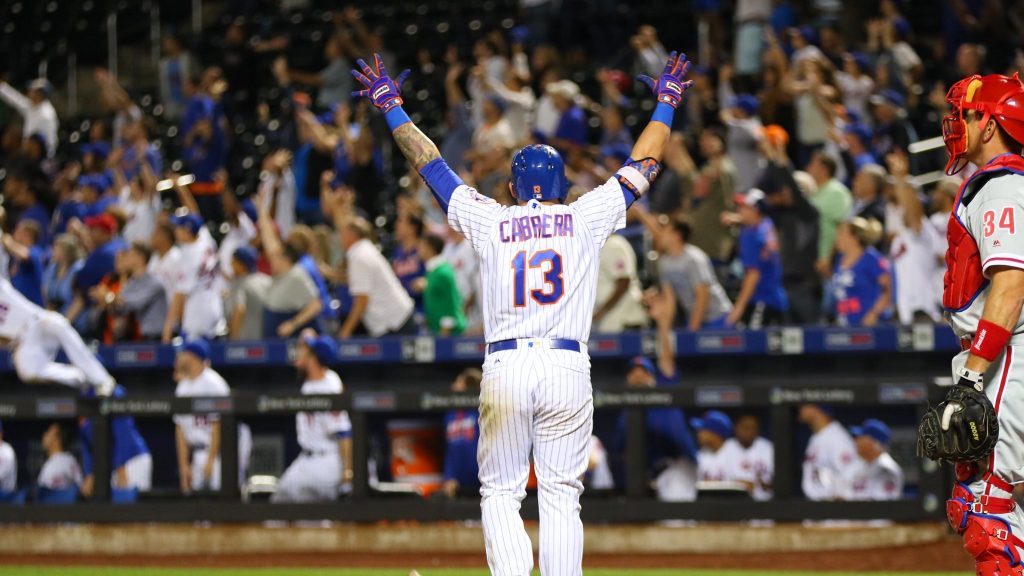 Asdrubal knew it was OUTTA HERE! OUTTA HERE! as soon as he hit it. Eleven innings played. Twenty-seven home players used. Two-hundred fourteen home pitches thrown. Two-hundred sixty-three minutes consumed. Two arms raised skyward. One-hundred eighty emotional degrees traversed. And, in the final scene, the Three Amigos riding off into the sunrise, having rescued their team’s season yet again.
Their reward as midnight approached was that justice had been done.
Jose Reyes. Asdrubal Cabrera. Yoenis Cespedes. Their night. Their month. Their year. Our Amazin’ good fortune. Thursday they were aided and abetted here and there by a handful of their 24 accomplices, but when you got right down to it, it was they who lassoed a loss and giddy-upped it over and over until it galloped across home plate a glorious win.
The Mets reached base via hit, walk or error seventeen times. Bundled at the top of the order — a veritable penthouse suite crowning an otherwise ordinary off-ramp motel — they accounted for eleven of those appearances. They scored four and drove in seven of the nine Met runs, making almost all the difference in what became a 9-8 victory that obscured the frustration and heartbreak that defined the two previous evenings at Citi Field and made a person overlook everything that seemed to be going irredeemably wrong in those innings that they could not personally repair.
The Mets used 27 players? Who uses 27 players? No basket of deployables is that deep, yet Terry Collins kept dipping in until he became the first manager in the 55-year history of the franchise to deploy one Met for every out required in a normal nine-inning affair. Natch, this wasn’t a normal night, nor could it be confined to nine innings.
The opposing Philadelphia Phillies, another component of the schedule allegedly brought to you by Hostess Cupcakes, took a cue from the recently departed Atlanta Braves and refused to live down to their record or reputation. Their placement toward the rear of the National League East has apparently cultivated their ability to be a severe pain in the ass, demonstrated by their refusal to go quietly into this Met night. At various junctures, by various means, the Phillies took leads of 3-2, 6-4 and 8-6. If that’s what your division’s fourth-place team is capable of, then the club in second place must be something else.
They are. They’re the 2016 New York Mets, a Chumbawamba tribute band that gets knocked down but they get up again, you’re never gonna keep them down (as long as your name isn’t Ender Inciarte). These Mets led 2-0 on honorary amigo Curtis Granderson’s two-run homer in the second; tied it at three when Cespedes smartly singled the other way in the fifth; and took a 4-3 lead in the seventh when Yoenis cracked a double down the left field line. As long as Cespedes avoids hitting the ball merely an inch or two above the center field wall, he’ll be fine.
But Yoenis, contrary to stubborn rumor, can’t always lift the Mets all by himself. A one-run edge into the eighth is usually entrusted to Addison Reed for safe passage into the ninth. Reed’s been throwing a lot lately and has lifted the Mets plenty. On Thursday, however, he threw a pitch that became a three-run homer off the bat of Maikel Franco. It was stunning. Yet it was not decisive.
No, the decisive move of regulation Thursday night came in June when a decision was made to enlist the services of Jose Reyes. It wasn’t met with universal acclaim (really, it was closer to general disdain), but if more than lip service is to be paid to the concept of second chances, action had to pick up where words left off. Jose always could generate some action. He already had in this game, walking as prelude to scoring the go-ahead run on Cespedes’s double in the seventh. The ninth proved he was just getting started.
Brandon Nimmo opened the inning with a pinch-single off Phillie closer Jeanmar Gomez, the second night in a row Brandon entered late and delivered ASAP. Jay Bruce was called on to do something similar. Bruce, with three hits in his previous 39 at-bats, did not resoundingly answer the call in AB No. 40. In the category of surprises, his inability to come through in the clutch or even in the vicinity of the clutch ranked a close second to learning before the game that Steven Matz’s projected Friday night start was, in fact, a fantasy woven by Met magical thinking. We will not see Matz on Friday or probably at all the rest of this season. We didn’t really expect him to pitch, did we? Just as we didn’t really expect Bruce to do anything but strike out against Gomez, we just assumed we’d keep getting by with whoever else we have besides Matz.
We have 39 players on the active roster. Jacob deGrom is still one of them, but I assume that’s because we have 42 players on the disabled list. DeGrom, you’ll vaguely recall, was the projected starter on Sunday until the magical thinking made on his behalf dissolved into surgery required to repair an ulnar nerve. The Mets keep publicly stating pitchers who haven’t seen the mound since it was a molehill are suddenly feeling fine and ready to throw 50 or 75 competitive pitches in a pennant race. I applaud their optimism, but I seriously wish they’d keep it to themselves.
Willing bodies and reasonably able arms are in abundance in September. That’s how we come to have Gabriel Ynoa subbing for deGrom one start and Matz the next, how we came to have Seth Lugo attempting to withstand a Phillie barrage on Thursday. Seth was touched up on consecutive pitches to start the fifth, first by Unfrozen Caveman First Baseman Ryan Howard (his 128th or so homer versus the Mets in a career that dates back to The Clan of the Cave Bear), then by Cameron Rupp, who may or may not be the same person as Darin Ruf (I am being told he is not). Lugo only went five, which is fine as long as you have ample replacements.
Not a problem in September, particularly this September, when Collins is hosting an open house every night. After so many injuries and so much turnover, who can tell who belongs where anymore? The Thursday night lineup that was charged with maintaining a playoff position included T.J. Rivera batting cleanup, first baseman Eric Campbell hitting sixth, René Rivera catching, Alejandro De Aza in center and Lugo pitching. At this point, almost none of that looks remotely ridiculous. If you’d seen it in St. Lucie in March, you’d nod and ask if the Phillies are bringing any of their starters from Clearwater.
These guys and all the other guys are a part of this push, and pretty much all the other guys get to play, especially the pitchers. Lugo was succeeded by basically everybody who is described as a reliever. Some brought more relief than others. Reed couldn’t provide any for an uncomfortable change, but that will happen in a long season, just as if you play enough games and enough innings and enough guys, players you’d forgotten were there will get a big hit, as Nimmo did to start the ninth, and maybe players you’d prefer to forget, like Bruce, will eventually get one.
From this mass of humanity, it’s reassuring to have a proven commodity to lean on if you choose to indulge some magical thinking of your own. Reyes, who appeared on this roster from out of the blue and orange, has done a lot of spectacular things in his two terms as a Met, but only once to my recollection had he hit the big homer that we really needed to turn around the potentially bitter conclusion of a game. As it happened, it was a year ending in a 6 and it was against the Phillies: May 23, 2006, the eighth inning, the Mets trailing, 8-6, with a runner on. Then Jose drove a ball deep into the Flushing night off Ryan Franklin to knot the score at eight apiece. The Mets went on to top Philadelphia, 9-8, in extras.
Foreshadowing? Coincidence? Whatever. Jose the Elder reached back to that night of youthful exuberance and did to Gomez at Citi what he did to Franklin at Shea, lining a pitch out of the park and landing the Mets in a 6-6 tie. Wonders may pause for a decade, but they don’t necessarily cease. Meanwhile, this game that appeared lost was suddenly found.
Jeurys Familia, who in an ideal game is the last Met to pitch, became the eighth, in the tenth. He threw a scoreless inning that was matched by Severino Gonzalez, though an old amigo nearly scripted a wonderfully cheesy ending. Lucas Duda, buried deeper in the Met subconscious than Soup Cambpell by this point in the season, emerged as a pinch-hitter with two out. Terry started him on Sunday. He didn’t last the entire game and hadn’t been deployed since. But Thursday was the night of the bottomless basket. The manager reached for the Met slugger of record from 2014 and 2015, and wouldn’t you know it, Lucas almost turned back time. He hit a ball that hugged fair air for probably 329 feet and nine inches. As we learned from Mr. Inciarte on Wednesday, however, those last few inches can make all the difference. Duda’s attempt at a game-ending homer went barely foul.
Lucas had been sidelined by a bad back since May. I hesitate to imagine what his well-meaning work proximity associates might have done to it and him had he circled the bases. Not an issue. Lucas wound up striking out and Jeurys returned to the mound for the eleventh. Uncharacteristically he left before the inning was over, having yielded a go-ahead run on a ringing double, a productive grounder, an intentional walk and a dunker of a single. The Phillies led, 7-6, in a way that made you say “damn!” Then Jerry Blevins hit a guy and (after unconscionable strike-zone squeezing) Jim Henderson walked a guy to make it 8-6.
Nice hole you record-tying 26 Mets have dug for yourself there. It would be a shame if something didn’t happen to it.
After Nimmo whacked a pitch hard up the middle but to no avail, Michael Conforto became Met No. 27 in the box score and, more importantly, a baserunner via base on balls versus Edubray Ramos. Ramos was the Phillies’ ninth pitcher; it’s September for them, too. Reyes followed Conforto by singling safely above the glove of Jimmy Rollins clone Freddy Galvis (he of the frigging ringing double). The Mets had two on with one out and Asdrubal Cabrera prepared to bat.
This was the best possible scenario magical thinking could have conjured. Cabrera has been a hybrid of Bud Harrelson and Howard Johnson all year long, combining indispensable infield glue with uncommon shortstop power. Just the night before, Asdrubal had broken Jose’s single-season shortstop home run record of nineteen. When Reyes hit that many in 2006, it was a revelation (and cause for hundreds of groans to come that Jose was prone to homer-happiness). When Cabrera put his twentieth as a shortstop and twenty-first overall in the books on Wednesday, it was simply another example of what the man does. Of those Three Amigos who are linked at the top of the order and, by all reports, inside the clubhouse, Cabrera appears the most businesslike of the trio. The bottle-blondest, perhaps, but definitely the veteran who doesn’t attract attention for anything but his reliability. Reyes blazes around the bases. Cespedes drops jaws. Cabrera simply gets the job done.
The job at hand in the bottom of the eleventh with two on and one out was monumental. If Asdrubal could avoid grounding into a double play, it would rate as a net-positive. If he could as much as walk, it would be welcome, since it would set up Cespedes as the potential game-winning hitter for a third consecutive night, and you know what they say about third times and charms. If indispensable Asdrubal could manage to stay in one piece amid the myriad possible outcomes given the precarious condition of his continually balky knee, well, that would be keen, too.
Asdrubal transcended all ancillary aspects of the job when he connected authoritatively with the final pitch Ramos threw, the last of 409 delivered by nineteen pitchers in all. As soon as Cabrera swung, he knew it was gone. His bat was flipped, his arms were raised, his trot was jubilant. The camera stayed on him an instant before it cut to the ball Gary Cohen was describing in flight, so we could tell it was going to land easily beyond harm’s way a tick ahead of the rarely uttered double-OUTTA HERE! the home run so richly deserved. Ender Inciarte was in another city and no Phillie could climb, leap or pray high enough to do a darn thing about this one.
It was indeed outta here, outta here. The Mets were 9-8 winners. The Three Amigos were baseball heroes, even if their cinematic image is two-thirds suited to the era of silent films. Cespedes from Cuba speaks primarily with his bat and through an interpreter. Cabrera of Venezuela doesn’t usually find himself in front of a microphone. Reyes the prodigal/wayward Dominican son possesses the voice that’s most familiar to us. We understand his Metropolitan accent fluently. Postgame, when WOR’s Wayne Randazzo asked Jose about the bond he’s forged with these friends he’s made this improbable year, he didn’t withhold his affection one vocal bit. “They’re my brothers,” Jose declared. “One blood. They’re my brothers, I love them, we’re in this together.”
So are we all for the next nine games, hopefully more.
by Jason Fry on 22 September 2016 2:56 am I need to find a hobby that’s better for my health than watching the New York Mets.
I’m thinking maybe Russian roulette.
A long time ago, when I was still innocent and believed there was good in the world, it was a beautiful night for a ballgame. I was sitting in the stands with my wife, enjoying a crystal-clear evening as Bartolo Colon rolled through the Braves and Asdrubal Cabrera and Rene Rivera hit home runs to give the Mets a 3-0 lead. In the middle innings, we looked at the clock in disbelief and wondered if we might be out of Citi Field at the end of a two-hour Mets win.
Yeah right. Those early innings were a feint, shadowboxing meant to distract us from one of the meanest right hooks I’ve experienced at a baseball stadium.
If there’s baseball in Hell, rest assured that the eighth and ninth innings of Wednesday night’s game will be in heavy rotation for Mets fans. Pretty much everything you can torture a baseball fan with was on display: overmanaging, ill-timed misplays, lazy and/or inept execution, and finally luck that was both terrible and fatal. It was torture by frustration, culminating with having your heart ripped out and showed to you.
Whoa it’s still beating but it’s no longer in my chest, so how am I — GAAKKK!!!
(Trigger warning: bad shit dead ahead. If you’ve had enough, by all means hit the back button. No one will blame you.)
So yeah, let’s go through that eighth and ninth. Seems like fun.
Actually we’re going to back a bit. Addison Reed faced the Braves in the eighth — the same Reed who’d been summoned with two outs in the seventh and the Mets’ lead cut to a single run thanks to a homer from old pal Anthony Recker. Reed struck out Blake Lalli to prevent further harm, causing me to think a) that Terry Collins was showing some welcome flexibility in departing from his usual rigidly scripted use of Reed and Jeurys Familia; and b) that a Faith and Fear post overloaded with adverbs would be a fun goof on Lalli’s name.
I was probably still distractedly humming Schoolhouse Rock as Reed returned to duty and an error by James Loney put Ender Inciarte on first with nobody out. (You’ll be hearing more of Mr. Inciarte’s work, alas.) Reed got 2016 Mets nemesis Adonis Garcia to fly to right, but with eternal Mets nemesis Freddie Freeman up, Terry opted for Josh Smoker.
Smoker throws hard and has guts; I’m glad he’s a Met. But he’s not Reed. Freeman singled and Terry summoned Familia for a five-out save, double-switching Jose Reyes out of a one-run game in the process. Inciarte and Freeman pulled off a double steal and then Familia went to work on Matt Kemp.
Kemp hit a ball to left, where Yoenis Cespedes was perfectly positioned — behind the ball, eyes on home plate. At third base, Atlanta coach Bo Porter saw that and put up the stop sign. Inciarte ran through it. Cespedes heaved the ball wildly and the game was tied.
In the bottom of the eighth, with one out, Cespedes connected off Brandon Cunniff.
It was an odd night at Citi when it came to baseball parabolas — yes, Rivera, Cabrera and Recker had hit balls out, but most balls weren’t traveling as far as you expected off the bat. That downtick in temperature and humidity robbed them of a bit of distance, as both Cabrera and Loney found out at discouraging points during the proceedings.
But Cespedes’s drive … it sure looked gone. Heck, off the bat it looked like it would be 20 rows beyond the Great Wall of Flushing. But as we all got to our feet I wasn’t quite sure. The ball was high — at first majestically so, then worrisomely so. Kemp went back to the wall, but he wasn’t getting as close as he could to spare his pitcher’s feelings. He looked like he had a play. The ball clanked off his glove and we turned to see Cespedes arriving at second instead of third — he’d been admiring his handiwork instead of running.
The Braves walked Curtis Granderson, and he and Cespedes pulled off a double steal of their own — take that, Braves! But Chaz Roe fanned T.J. Rivera before giving way to Aaron Krol.
Which is when Terry really started overmanaging.
Frankly, I thought Tuesday’s calling on Eric Campbell and Kevin Plawecki was a terrible idea that happened to work, which isn’t the same as a good idea. This time, Terry outdid even himself, burning Kelly Johnson in favor of Campbell. Campbell, you may recall, collected his first hit since May on Tuesday; apparently Terry decided Tuesday was the first day of the rest of Soup’s baseball life. When the Braves walked Campbell, Terry countered by hitting Plawecki for Loney. Newcomer Ian Krol was wild and went to 2-0 on Plawecki, who promptly expanded the strike zone, fanning in a remarkably feeble at bat.
(Let’s stop and recall that Terry didn’t have Wilmer Flores because Wilmer got hurt in a collision at home plate in Atlanta, a collision that wouldn’t have happened if Terry hadn’t forgotten to pinch-run for him.)
Onto the ninth in a tie game, with Familia returning to duty after sitting in the dugout during the whole excruciating mess. The Braves took the lead on a couple of soft singles and a perfectly placed RBI groundout from Inciarte. Enter Jim Johnson to protect the Atlanta lead, fresh off fanning Cespedes with a remarkable, Wainwrightian curve that ended Tuesday night’s game.
We were all hoping and praying the lineup would get to Cabrera and Cespedes, while wondering what parade of pinch-hitters Terry had in mind now. Brandon Nimmo hit for Rene Rivera and singled; Jay Bruce hit for single-thumbed Juan Lagares and arrived to an odd sound, a mix of determined cheers and anticipatory boos and possibly ironic BRUUUUCEs. He struck out, and I suppose it’s a small kindness that no one will remember that given what was in store for us.
Travis d’Arnaud, another Met who marked Bark in the Park night by finding himself on a short leash with the fans, did what Plawecki couldn’t and coaxed a walk. Cabrera hit a deep but playable fly ball. Two outs, and it was time for the Cespedes-Johnson rematch.
On Tuesday, Johnson attacked Cespedes with fastballs to set up that killer curve; this time he showed Cespedes the curve first, getting strike one with it. He then went to the fastball and threw one that didn’t sink. It arrowed right down the middle of the plate and Cespedes mashed it on a line to right-center.
It sounded good. Hell, it sounded great. It sounded like a walkoff, and we started to yell. But I remembered the ball that had looked gone and wound up just eluding Kemp’s glove, and so I felt a queasy dread as I watched Inciarte run to the fence and leap, his glove flicking above the wall. He came down on the warning track and held his glove up, radiating such joy that he looked like he was on springs, and the game was over.
I stood there in silence, trying to process everything that had happened and get it to add up to something different. The Mets put the replay up immediately, and if you watch the Braves’ highlight (not that I recommend this), you can hear the moment we all got a real look at what had just happened — an OHHHHHH rolls through the crowd as Inciarte is still making merry with his teammates.
Walking out of Citi Field, I let myself imagine how much fun it would have been if Cespedes had hit the ball just three inches higher, to paraphrase Charlie Brown. But on the 7 train the mood was … well, better than I’d expected. And I found myself oddly philosophical.
That Mets’ defeat had a lot of ingredients: frantic overmanaging, bad at-bats, errors, lazy baserunning, lousy luck. But the game came down to a line drive sizzling through the air and one guy who had a small chance at interrupting its journey.
There are lots of ways to lose a baseball game. Most of them aren’t terribly interesting, and the sting goes away once you see a game that isn’t lost. But this wasn’t one of those baseball games.
Years from now the name “Ender Inciarte” will come up and you’ll remember, and your jaw will clench. This was as cruel as the game gets — which means, inevitably, that it was also about as astonishing and thrilling as it gets. I wish I could erase the ending we got and write a new one, but I don’t have that power. It was going to happen anyway, and since it did, I don’t regret being there to see it and hear it and feel it and have to take it away with me.
When the talk turns to Pratt hitting it over the fence or the 10-run inning or the Grand Slam Single or Piazza’s 9/21 homer I smile broadly and say that yes, I was there. I cherish these things as a fan — the memories, and every chance I get to relive them.
And when talk turns to other games — to Willie Harris robbing Carlos Delgado, or Murph coming up too quick on a ground ball in the World Series — I smile wistfully and say that yes, I was there. So shall it be with the Ender Inciarte game. I don’t cherish those memories, exactly — they’re unwelcome companions when the clock says 4 am and sleep is nowhere in sight — but they’re as much a part of being a fan as those other, happier ones.
by Greg Prince on 21 September 2016 2:55 am Thirty-thousand of us were dying to be hypocrites Tuesday night. We wanted to pull one of those dazzling Asdrubal Cabrera spinoramas in our souls, execute a spectacular turn of sentiment and roar for the stranger at whom we’d been directing our derision loudly or slyly every time we saw him. Some of us preached and practiced patience, but patience, like the battery in your phone, can run low. It needs a charge. So did any of the pitches Julio Teheran delivered to Jay Bruce in the bottom of the sixth. Put a charge into one, Jay. You’ll see what a renewable resource our faith in you can be. You’ll feel it. You’ll never forget it.
It was 2-1, Braves. There were two out. Bruce was battling his erstwhile Red ass off. Ball one. Foul. Ball two. Another foul. Then another. Then ball three. A couple more fouls. I don’t remember which one clanked off the right field upper deck, but I do remember thinking that if he’d hit that in Cincinnati for Cincinnati, it would have been fair.
Nothing’s been fair for Bruce since he became a Met. He was a country mouse contentedly piling up slices of pasteurized RBIs in relative private. He was leading the National League in a traditional prestige category. It wasn’t helping the Reds and it wasn’t impressing the statsnoscenti, but it looked good on the back of a baseball card.
Then he was asked to craft some semblance of what he did for Cincy in New York, transferred midseason from a team wallowing at the bottom of its division to one clinging to a strand of Wild Card hope. It was getting late for the Mets. Jay Bruce could help them make up time and make up ground.
Bruce has indeed been on the Mets as the Mets have forged forward in their race. Bruce’s presence has been mostly coincidental. It’s become impossible to hide his lack of productivity. He was already 0-for-2 on the night and he didn’t contribute on defense when a ball fell between him and Curtis Granderson in right-center. The center fielder is a right fielder. The right fielder is still new to the terrain. Nobody called it. One run that was going to score anyway had the ball been caught scored, but no outs were made, which led to an additional baserunner and a second run. The Mets trailed, 2-1, in great part because Curtis and Jay didn’t want to step on each other’s toes.
It was Granderson’s responsibility. It was Bruce’s catch. Or it would have been had he caught it.
You could forgive Curtis. Curtis has a track record here. Curtis has won games for us. Jay has earned demerits. We could erase a whole bunch of them if this epic at-bat against the terroristic Teheran went where we wanted it to go. We could embrace Bruce if he could work through all those fouls and lean into a pitch and put it on the scoreboard. It’s usually folly to request a home run as opposed to “just get good wood on it,” but this is Jay Bruce, New York Met, we were trying to get behind. We needed airtight motivation.
We got a grounder to first on the ninth pitch. Third out of the inning, umpteenth out in the Met career of a lost soul who’s nice-guyness is neither in dispute nor of surpassing relevance. Nice guys often finish first or at least with one of the two best non-first place records in the National League. We’re rooting for a passel of nice guys who return our affection by now and then coming through for us.
We’re still waiting on Jay Bruce to be a part of that. We’re just not doing it very patiently anymore.
Next time Jay Bruce was due up, he was disappeared from the on-deck circle. We saw Eric Campbell instead. Eric Campbell used to be Jay Bruce to us, except without the bulging portfolio. We usually cringed at the sight of Eric Campbell. C’mon Terry, we begged during difficult swaths of 2015 and 2016, don’t you have somebody better than Soup? At this juncture of ’16, when so much is on the line and we’ve barely noticed the continued proximity of Eric Campbell to the rest of the Mets, we have bigger fish to fillet. How can we deride the use of Eric Campbell against a lefty when the guy he’s replacing in the critical eighth inning of the crucial 151st game of the year is Jay Bruce?
It may have been the gutsiest move Terry Collins has made in six seasons of managing the Mets. Or it may have been as logical as any of hundreds we don’t give second thought to. Collins has seen Campbell succeed against lefty pitching. He hasn’t seen much of that from Bruce.
The sixth should have been Jay’s redemption inning. Nine pitches. Good swing after good swing until a completely ineffectual swing. The eighth was no longer about Jay Bruce breaking loose. We had been down, 5-1, and about as dead in the game as we were in the season a month ago. But the pulse stirred. A one-out walk to Cabrera, whose face should be on currency because he’s so money. Yoenis Cespedes was grazed by a pitch. Granderson, who again proved he is more than a fleeting defensive communications miscue, doubled, scoring Asdrubal and sending Yo to third. Folk hero T.J. Rivera’s sac fly sent Cespedes home. The Mets, out of it, are in it. It’s 5-3.
In 506 — where we had moved in an effort to escape the divebombing gnats of 505; instead we encountered additional gnats plus a kid who just discovered Thunderstix — the scenario for which Rob Emproto and I had braced when we considered the lineup was at hand. “This is gonna come down to Bruce,” we told each other. Our projection had come to pass. Yikes.
No, not yikes. Soup. Soup instead of Bruce. All I could think was, boy, do we miss Wilmer Flores. Yet I held out hope for Campbell because a) he just became a papa, and that’s usually worth one feelgood hit; b) some number exists proving he smacks the bejeesus out of the ball even if he rarely gets on base as a result; and c) if you’re going to be grateful to be spared any more Jay Bruce, you’d better get behind his replacement.
Campbell had himself a seven-pitch at-bat versus Ian Krol. It didn’t run as long as Bruce’s in the sixth against Teheran, but it ended better: a sharp single into left, scoring Granderson. Now it was 5-4 and anything was possible…even Kevin Plawecki batting for James Loney.
Boy, do we really miss Wilmer Flores. Some games Terry seems to have any number of viable options ready to deploy. Some games his basket of deployables is disconcertingly shallow.
Pinch-hitting fever had taken hold and was spreading like a tarpulin. Plawecki got good wood on the ball. Such good wood that it was hit too hard for Adonis Garcia to handle at third. After Garcia had yet again been a three-run pain in our rear, he owed us something. The ball caromed into left field. Soup poured it on and raced to third. We had two on, two out and Travis d’Arnaud due up.
Travis d’Arnaud is the Jay Bruce of catchers. His agent can use that in contract negotiations, but it’s not a compliment. I would have welcomed another substitution right then and there. Krol was still on the mound. I would have taken my chances with Matt Reynolds. We were no longer standing still for hitters who couldn’t hit (Bruce at all, Loney against lefties), so why stop? Granted, as fans we reflexively model what Lily Tomlin said about children’s stated aspirations, which is that if we all became what we wanted to be when we grew up and managers did what we incessantly demand, we’d live in a world filled with nothing but firemen, cowboys, nurses, ballerinas and pinch-hitters.
Nobody subbed for d’Arnaud. Travis got lousy wood on the ball and grounded out to short.
Eventually, despite everything that went wrong, the Mets got the game to exactly the spot we wanted it once there were two out in the bottom of the ninth: a runner on, Cespedes up as the winning run. He struck out. Nobody booed, and only one crank in the men’s room line was heard to dismiss his entire 2016 with “he’s had a shit year.” Cespedes can be forgiven. He, like Granderson, has a track record here.
Afterwards, as the Mets positioned themselves to drop into a three-way tie with San Francisco and St. Louis for the two National League Wild Card berths, Terry did his best Laurence Olivier rending fabric from his garment in the remake of The Jazz Singer as he explained how saddened he was by having to prevent his ostensible marquee right fielder from batting for himself in the most pressing game situation the Mets encountered all night. “It’s one of the worst things you can do as a manager, to pinch-hit for a star,” Collins emoted, “especially one of the elite power hitters in the game.” The manager then praised his elite star power hitter for stepping aside like a pro.
It was, to date, the highlight of Jay Bruce’s Met career.
by Jason Fry on 20 September 2016 12:42 am Sometimes your ace, while perfectly worthy of New Yorker covers, is missing that little wrinkle from his fastball and can’t locate it anyway and he gets whacked around.
Sometimes an opponent who’s spent the year being an absolute tomato can manages to bewilder.
Sometimes your hitters connect with ball after ball after ball in ways that seem promising at first but wind up profoundly frustrating.
Sometimes Matt Kemp catches EVERYTHING THAT COMES WITHIN 50 FEET OF HIM.
Sometimes Freddie Freeman shows up and does Freddie Freeman things.
Don’t let it get you down. It’s just baseball, which can be beautiful and can be cruel and can also be baffling and exasperating. We weren’t going to win every game. In all likelihood we don’t need to win every game. Win series. Win series and we’ll take our chances.
It all starts tomorrow. It’s always all starting tomorrow.
by Greg Prince on 19 September 2016 12:05 pm Remember that weekend the Mets were vying for a Wild Card and the Minnesota Twins came into Citi Field with the worst record in baseball and you thought, “oh great, another one of those traps when the Mets inevitably play down to their competition,” and, sure enough, the Mets couldn’t score more than three runs in any of the three games, and they kept leaving runners on, and the Twins lived up to their Pesky Nats heritage, and the Mets had to keep reaching deep into their bullpen, and they were using as a starter in the middle of a playoff race somebody who’d never started in the major leagues before and he was out of the finale in the fifth, and there was more devastating injury news, and…
The Mets won all three games. Remember that.
You’re not used to it, but good things happen to the Mets. More precisely, the Mets make good things happen to themselves.
They took the schedule they were issued, they added to it dried cut grass and they made hay. They swept the allegedly dreadful Minnesota Twins three straight at home. I’m sure the former Washington Senators (original edition) have earned their worst record in baseball, but they looked perfectly professional to me. The Mets scored three, three and three runs against them in the three games and won, won and won again.
Somebody wearing a home uniform must have been doing something right. Lots of somebodies, as it turned out.
Admission to the postseason isn’t gained on the strength of one hot batter or one unbeatable pitcher. It takes a roster. In the Mets’ case, it takes an expanded roster. An organization that doesn’t celebrate Old Timers Day nonetheless dipped into its storied past and invited Lucas Duda and Juan Lagares to take bows before the crowd on Sunday. Back from incapacitating injuries, Lucas (starting first baseman until pinch-hit for in the sixth) and Juan (a defensive replacement in center in the ninth) made appearances not for ceremonial purposes, but to help the team for whom they technically still play win a game, sweep a series and near a playoff. Neither contributed anything tangible to the cause, but it was good to see them. Their active involvement was indicative of how everybody is doing his part.
Sunday afternoon, Gabriel Ynoa was the first Met you haven’t much thought about to step in and step up. I hadn’t thought about Ynoa since the previous Monday, when I couldn’t stand to think about Rafael Montero one inning longer. Twenty-four hours before Ynoa threw his first Sunday pitch, neither one of them was on my mental radar. I had Jacob deGrom to look forward to: a hat with a convincing replica of his hair on Saturday, his arm and whatever it could deliver on Sunday.
Scratch one of those. I’d gladly give up the giveaway cap to get back the shutdown arm I vaguely recall intersecting with the glory days of Duda and Lagares. That deal is not on the table. As I stood on my Long Island Railroad station’s westbound platform on Saturday and skimmed Twitter, I saw a reputable news source reporting deGrom was out for the season and headed for surgery. For about a half-a-second, I tried to comprehend what the gag was here. Then I remembered, oh yeah, deGrom — hadn’t pitched for a couple of weeks, hadn’t looked good for a couple of weeks before that, who was kidding who when they said he was going to pitch on Sunday?
Thus, Ynoa, and — don’tch’Ynoa — he was Twins-ready. Gabriel struck out eight of them in four-and-two-thirds innings, giving up only one run in the process and standing in line as the winning pitcher of record (if one can be presumptuous enough to contemplate such ephemera in a fifth inning) until he allowed a two-out single to Brian Dozier. A mere single to Dozier, he of the 41 homers, may be the moral equivalent of a third out, but not technically the same thing. Next up was lefty-swinging Logan Schafer, perhaps not the one Twin to have up when you’re having no more than a two-run lead, which is exactly what Ynoa was nursing on the mound. There was no reason to think the rookie righthander wouldn’t retire Schafer, but if you were Terry Collins, and you’d just gotten to two out in the fifth with Gabriel Ynoa filling in for Jacob deGrom, why push it?
Exit from Schafer City Mr. Ynoa, enter Josh Edgin, a lefty-versus-lefty reflex. Edgin had pitched the night before. Yours truly groaned at his appearance in the twelfth inning. Collins had run through six ostensibly better options before tapping Edgin. Edgin threw a scoreless twelfth and wound up the winning pitcher after Curtis Granderson made victors of us all. It was a good lesson: don’t doubt any Met in this September when the Mets’ September is very much and very rewardingly the sum of their parts.
Edgin entered Schafer City and could not in all good conscience recommend it on TripAdvisor. “Not a good scene for singles,” he was probably moved to comment after Logan dropped one into the outfield. With the left-leaning portion of our immediate concerns completed, we bid goodbye to Mr. Edgin and greeted Erik Goeddel. On Saturday, when my buddy Dan pointed out Goeddel was warming up, I groaned louder than I had at the sight of Edgin. Goeddel is to me what the Great Gazoo was on The Flintstones. Gazoo couldn’t be seen by most of Bedrock. Goeddel’s uselessness seemed until very recently to have escaped the notice of every Mets observer but myself. Every game he enters, our esteemed announcers are telling me what an absolutely outstanding job he’s done out of the bullpen. All I remember is five runs in a third of an inning. I don’t know which third of an inning or who scored the five runs. To invoke Bill Maher for the second consecutive month, I don’t know it for a fact, I just know it’s true.
As someone who values an actual fact, I’ll go with this one: Goeddel got out of the fifth. Not immediately — he threw a wild pitch, then walked Jorge Polanco (I’m typing names I’ve never typed before and won’t type again until who knows when; ain’t Interleague awesome?), but with Kennys Vargas up in a situation that could redefine this September with one bad pitch, Erik killed Kennys. Struck him out, at any rate. Inning and threat over.
It was a big enough moment in the course of the season to entrust to a reliever who doesn’t make me hallucinate little cartoon spacemen, but I’m not sure the manager had spectacular choices at his disposal. I wish there were an Addison Reedbot you could wind up and send out in every inning of every game to shut down opposing batters, but the Mets’ more dependable arms have been depended upon to excess of late. Twelve innings on Saturday night meant everybody could claim a Sunday afternoon hangover. The fifth was the inning to get out of in the fifth, but what of the sixth, the seventh and so on? Of those not used on Saturday, you had available Sean Gilmartin, Logan Verrett, Jim Henderson and Montero. “Oh boy,” as Buddy Holly once enthused. Of those deployed Saturday, Reed (two straight days already), Familia (ditto) and Robles (2 IP, 1 HR) were, if good sense ruled, off limits.
I could groan at Goeddel, but it didn’t mean he wasn’t the guy to go to in the fifth and to hang around in the sixth when he pitched another scoreless inning. Once he did his part, there were still three more innings and a minimum of nine more Twins to surgically separate from scoring. If the Mets had increased their lead by a few, you could go to your one of your rather-nots, but the Mets, as noted above, scored three runs in each game of the series. On Sunday, their three runs were registered by the third inning. That left the staff in an all-hands-on-deck state when a fair percentage of arms needed their rest.
More runs in the bottoms of innings seemed doable let alone desirable, but some days — and weekends — you deal with what you’re dealt. On Friday, the Mets went 1-for-8 with runners in scoring position. They won. On Saturday, the RISP total was 1-for-7. They won. Sunday, they were 1-for-the-first-1, when Michael Conforto singled home Alejandro De Aza from third and T.J. Rivera from second in the first inning, 1-for-8 the rest of the game. Rivera was responsible for the Mets’ third run with a solo homer in the third. He’s also emerged as Ynoa to the Lugo power when it comes to position players, if that formula translates. With less fuss than deGrom but just as many implications, Wilmer Flores didn’t play in this series. Wilmer hasn’t been medically written off for the rest of the season, but you gotta wonder. He still can’t swing, and an expanded roster that doesn’t include Flores taking on all lefty comers is by definition a depleted roster.
So when you’re asking yourself where the Mets would be without Seth Lugo and Robert Gsellman and now Gabriel Ynoa, be sure to toss in a rhetorical query on behalf of T.J. Rivera, and do it in a pleasing Noo Yawk accent, or as we who grew up in these parts process it, no accent at all. When Rivera talks (or tawks), he sounds a lot like his Bronx forebear Ed Kranepool. When Rivera swings, he looks a lot like his jack-of-most-trades Edgardo Alfonzo.
The Mets are doing it with Rivera and Conforto (who was a big part of the Mets’ plans in that distant epoch when Duda and Lagares nonchalantly roamed the earth); Ynoa and Goeddel; a perfect Josh Smoker in the seventh; and, because the best bet for closing isn’t always a closer, Jerry Blevins in the ninth. Blevins came on to bail out gopher-susceptible Fernando Salas in the eighth. Role-assignation be damned, Blevins stuck around for the ninth to protect what had dwindled to a one-run lead. Jerry the bleach-bottle blonde made certain we’d have more fun when he struck out John Jacob Jingleheimer Ryan Murphy, grounded out Joe Mauer (Rivera to Duda replacement James Loney for the not-so-simple 4-3) and K’d Dozier, who left New York toting the same gargantuan quantity of home runs with which he arrived.
The Mets you don’t think of fashioned a 3-2 victory after the more usual suspects notched the first two anti-Twin wins.
• Granderson, the hero of the middle match (his second homer landed a few rows in front of me and my hairy hat, capping one of the most spiritually fulfilling experiences I’ve had in eight years of attending services at Citi Field) was rested.
• Jose Reyes (whose ancient HoZay!HoZay! entreaty arose organically on Saturday, though with the bases loaded in the eleventh, it came off more like davining than singing) was rested.
• Asdrubal Cabrera pinch-hit for Duda, then returned to resting.
• Yoenis Cespedes left the game in the seventh in deference to “nausea and dizziness,” symptoms familiar to any Mets fan this time of year in this type of race.
• Jay Bruce, who I swear hit the ball encouragingly hard three out of five at-bats on Saturday even if it was to absolutely no avail (“he’s due,” Dan and I kept reassuring each other not too many feet from Jay’s left shoulder), was kept from spreading whatever ails him to the box score.
The Mets on Sunday didn’t get a full game from any of the five guys who ostensibly top their lineup and they won. They held a lead of less than three runs entering the final two innings and they set up the eighth without their setup man and closed out the ninth without their closer. They had one of their aces extracted from their immediate not to mention going plans, replaced him with whichever body seemed warmest and they continued to survive and advance. Maybe it was the level of competition that facilitated this flexibility, but let’s not lay it on the 55-95 Twins. The visitors weren’t overwhelming, but nor were they noticeably inept. The Mets have built a self-replenishing contraption. They get by without Flores because of Rivera. They don’t perish without deGrom because of Ynoa. You hear Matz threw an encouraging bullpen but you don’t hold your breath and you don’t suffocate from anxiety because somehow somebody keeps stepping in and stepping up.
You don’t or didn’t think of so many Mets who’ve become so intrinsic to their rising fortunes, yet you find yourself in September thinking constantly about the Mets — the First Wild Card-holding Mets, that is, after Minnesota was swept three while the Cards and Jints did nothing but butt zero-sum heads at one another for four days. These Mets, 20-7 since they were dead and buried, grip your attention. They occasionally stir your tummy acids while making your head spin, but wouldn’t you rather feel the baseball version what Yo was feeling Sunday as opposed to total apathy?
The Mets won their eightieth game of 2016. From 2009 through 2014, the Mets never won more than 79. Eighty was never a goal, just a steppingstone to bigger and better objectives. We saw how that played out last year and we’re seeing something develop this year. These Mets keep on keeping on as we keep being reminded how nimble they can be when it comes to negotiating every step along the way.
by Jason Fry on 18 September 2016 3:06 am I’ll accept the title of Fan Who Had Nothing to Do With the Outcome But Can Be Forgiven for Thinking He Did: a couple of seconds before the turning point of Saturday night’s marathon against the Twins, I looked up at the scoreboard and told my friend that “if this keeps up we’ll somehow be the last game on the MLB schedule.”
CRACK!
Nope, time to go home — and go home happy.
It was a late-developing thriller, though: for most of the night this was one of those close games that feels more sleepy than taut. Ervin Santana was dealing, changing speeds and leaving the Mets helpless at the plate; Seth Lugo was wild but managed to escape the jams he created, his night marred only by a curveball to Eddie Rosario that didn’t break and became a souvenir.
Nobody much minded — it was an absolutely perfect night for baseball, clear and comfortable. The 15,000 who arrived early enough to get their Jacob deGrom hair hats wore them proudly, even amid news that the man who’d inspired the giveaway would be pitching in front of the first zero fans for the rest of the 2016 season, felled by ulnar-nerve compression. (Oh, the maladies you learn about as a Mets fan.)
I was there in the company of kind friends gathered for a birthday outing, at the front of a section that contained a substantial minority of Twins rooters. Enemy fans are a fact of life in the online age, and a few fanbases — the Giants spring to mind — have become reliably irritating presences at Citi Field in recent years. The Twins fans, though, were excellent guests: heard from when something good happened for their side and otherwise conspicuous only by their gear. Chalk it up to a combination of Minnesota Nice and, well, rooting for a team destined to lose 100 games.
On our side, there was anxiety but also a steely-eyed sense that there was still a lot of baseball to be played. (We didn’t grasp just how much.) The crowd stirred when the Mets did, and really came to life when Yoenis Cespedes or Jay Bruce arrived at the plate. Our faith in Cespedes was rewarded, as he hit a soft liner over the infield to tie the game in the eighth; on the other hand, I’m worried about Bruce not just as a player but as a person, as he’s worn out his welcome to the point of getting a rough ride even on routine plays. He did hit a couple of balls on the nose, with buzzard’s luck; for his sake as well as ours I hope things turn for him posthaste.
The game ground on, with Jeurys Familia besting Joe Mauer in a nifty 11-pitch duel in the ninth before giving way to Hansel Robles, which can be an iffy proposition. Robles looked fine for one inning, but then surrendered a truly mammoth blast to Byron Buxton, one that hit the facing of the third deck above the Acela club. And while the Mets were now into the Parade of Unreliable Relievers, the Twins still had their closer.
Uh-oh, except Brandon Kintzler arrived in the 11th and discovered it was one of those dreadful nights for a pitcher when he’s brought a cocked thumb and pointed finger to an actual gunfight. Curtis Granderson lashed Kintzler’s second pitch into the left-field party deck; Bruce just missed ending the game with a drive to center; T.J. Rivera and Brandon Nimmo singled; Kevin Plawecki nearly won the game with a liner that hit Kintzler and became a stupendously unlucky out; Kintzler hit Matt Reynolds; and finally after all that up stepped Jose Reyes.
The Reyes AB was the flipside of Familia vs. Mauer: a nine-pitch marathon, but one that ended with Kintzler slipping a fastball onto the inside corner. Somehow he’d survived, on we went to the 12th, and I started telling my friends that yes, there was a 14th inning stretch.
Josh Edgin came in and did nothing wrong; Michael Tonkin came in and got Asdrubal Cabrera on a loud but inconsequential flyball, then coaxed a pop-up from Cespedes, then departed in favor of Ryan O’Rourke. I confess I looked past Granderson and started fretting about the 13th, not because I doubted Granderson but because an extra-inning homer to win the game seemed like an awful lot to ask of a man who’d just hit an extra-inning homer to tie it.
It wasn’t. Granderson worked the count full (getting the benefit of a couple of calls, if we’re being honest) and then hooked an offspeed pitch down the right-field line. It wasn’t a bolt like the one he’d hit an inning before, but a looping drive headed for the shortest porch in the park. Max Kepler tracked it to the wall and then watched it plop into Utleyville for the win.
For those keeping track at home, Granderson now has 28 home runs and just 51 RBIs; a future generation of fans will scan his 2016 numbers and assume they’ve found a typo. But then the 2016 Mets are baffling as a group, too: they’re second in the NL in homers but just 13th in runs. More interesting stats here if you’re so inclined.
To keep track of happier things, the Mets are now tied with the Giants for the first wild card, and that’s not really a tie because we have the tiebreaker for home field in the play-in game.
Yes, I said happier things. DeGrom is the latest young gun to be snatched away, leaving the Mets rotation as Syndergaard and Colon and Hold the Phone and the lineup as a grab bag of Plan Bs and Cs. We all know this, just like we know that if the Mets survive to the play-in game and make it to the NLDS they’ll be given approximately zero chance of getting any further.
But so what? This is a patchwork team that keeps sewing up holes and rips, and now somehow controls its own destiny with two weeks left to go. No 163rd game is ensured, but in mid-August who even thought we’d be having this conversation? Get to that 163rd game and you’re into the Land of Random Outcomes, where strange things happen so routinely that we ought to stop thinking of them as strange.
We’re playing with house money when we thought we’d be out on the street with empty pockets. May as well double down, right?
by Jason Fry on 17 September 2016 12:00 pm My preparations for watching Friday night’s game included slippers and finding the fake fur throw that my wife was horrified when I bought — TV-watching components that made their last appearance one chilly day in May. It’s the baseball circle of life — a young season that needed spring thawing before we discovered what it would be has grown up and become a stooped old season trying to make it into the autumn.
And we’re still not sure what kind of season it is. That’s subject to ongoing negotiations between us and the baseball gods.
The Mets held up their end, shutting out the Twins behind Bartolo Colon, Addison Reed and Jeurys Familia. Colon was … well, what can you say at this point except that he was Colon? His so-simple-no-one-else-can-do-it strategy of variants on a fastball muffled Minnesota in happily familiar fashion, though the old master looked like he had a little extra pep in his step, whether it was bearing down to erase Jorge Polanco and a Twins’ threat in the third or combining with an also sprier-than-normal James Loney for a nifty out on Eduardo Escobar in the seventh. Colon was an afterthought at the beginning of the year, a seat-filler for Zack Wheeler; now Wheeler’s at the doctor with too many of the other whippersnappers, and Bartolo has a shot at winning 15 games. Amazin’, one might say.
Still, the game had a queasy Objects in Mirror May Be Closer Than They Appear feeling — it was only 2-0 at the 7th-inning stretch, with the Mets ahead courtesy of back-to-back bolts by Jose Reyes and Asdrubal Cabrera. Yoenis Cespedes chipped in an insurance run and Reed was briskly efficient at going about his 8th inning duties, but 3-0’s not the stuff of invincibility, even with Familia on the mound.
And, indeed, Familia’s location was off. Happily, he righted himself, the plays went the Mets’ way instead of against them, and the game was won. But I still had the feeling we’d escaped. And I still refused to be lulled by strength of schedule. The Twins are having a lost season, but beware such teams. Earlier this week, I was in the back of an Uber in San Francisco when Ryan Schimpf of the lowly Padres’ wrecked a Giants victory. The car was at a light next to a bar with a big front window, and I got to look from Gameday on my phone to the pantomime playing out in the window: the little figures on the TV, the fans’ hands going to their heads in agony, the heads going down in despair.
Look elsewhere and you’ll see the Royals just got beheaded by the going-nowhere A’s, all but finishing Kansas City’s dreams of repeating as champs. The Cubs are safe this year, but whisper “Victor Diaz and Craig Brazell” into one of their fans’ ears — and then run. And how many of our pennant chases ended with ambushes by seemingly quiescent Marlins? Note that those Marlins’ descendants remain on our schedule, standing between us and October glory.
Or at least a shot at October glory — like all sports fans, we’re dishonest bargainers at this time of year, negotiating shamelessly with the baseball gods.
Just let my team salvage this wreck of a season and have something to play for down the stretch. OK, done.
Just give us that second wild card and we’ll see what our pitching can do. It’s currently yours by two games and fivethirtyeight.com (now one-stop shopping for stressing out about both baseball and the real world) likes your chances.
Um, it sure would be great to be the home team for the play-in game. Oh, I see. Greedy much? You’re a game out, so far from impossible.
You know, a 163rd game is a treat, but we really want a series. Just to see what might happen. Now you’re getting ahead of yourself, no?
And a trip back to the NLCS! Wouldn’t that be fun, to see if we can do it again? The baseball gods are sure it would be.
And repeating as league champs, well, it would validate everything. Last year wouldn’t be a fluke! [drums fingers on desk patiently]
And if we could just win the pennant, well, maybe this time there wouldn’t be quick-pitching and errors at second and wild heaves home and getting talked into an inning too many and then we’d be WORLD CHAMPS! Oh boy. Are you finished?
Yes, of course. Sorry! It’s just that … well, that would be so amazing. We’d never ask for anything again. And advisedly so.
Though, of course, back-to-back titles has to be about the best feeling a fan can have… All right, that’s it — get out. What will be will be.
by Greg Prince on 15 September 2016 11:33 am What to do with a 1-0 loss? Throw stuff? Suck it up? Shrug? There are no wrong answers. It is the baseball epitome of close but no cigar.
I’m not sure of the appeal of cigars, but one run sure sounded good on Wednesday. One Met run, that is. There was one National run, and it sounded, if you’ll excuse the expression, devastating. Wilson Ramos hit a solo home run off Fernando Salas in the seventh inning in Washington and it felt like we had just gotten our ash kicked beyond the point of surgical repair. All that was required of the Mets in their subsequent two innings of batting was a single run to change the tenor of the late afternoon, but some days a molehill is a mountain.
One-nothing doesn’t imply insurmountability in the long term. In 1986, the Mets lost each of their postseason Game Ones by that score and it didn’t stop them from taking both best-of-sevens. For that matter, their last regular-season setback was of the 1-0 variety, Ron Darling not quite beating Montreal’s Bob Sebra. (It dropped the Mets’ mark to 103-54; if you couldn’t shrug that one off, baseball might not have been the game for you.) On the final day of the 1973 schedule, the Sunday when it was conceivable five teams could finish tied for first, the Mets dropped the opener of their doubleheader at Wrigley Field, 1-0. Jon Matlack pitched great, nicked for one lousy run in the eighth inning while otherwise striking out nine and going the distance. Alas, the Mets couldn’t push one lousy run across against Rick Reuschel and Bob Locker, and there went as crucial a late-September game as you could imagine.
In the nightcap, the Mets won, 9-2, and the next day, Makeup Monday, if you will, they eliminated everybody who was still standing to clinch the division title. The only impact from the previous day’s 1-0 defeat was that it survived in allegory form to be retold reassuringly during a somewhat similar September more than four decades into the future.
Thanks to Baseball Reference’s Play Index tool, we know the Mets have lost 118 regular-season games by a score of 1-0. Comparatively, they’ve won 131 games in the same fashion, the most recent of them June 25 in Atlanta. For a team better known historically for its pitching than hitting, it makes sense we’d be more successful than not in this particular subgenre of results. You’d like to think if you give a Seaver, a Gooden, a Gsellman one run that they could make it stand up.
OK, maybe not Robert Gsellman, but then again, the rookie held the Mets aloft for five-and-two-thirds innings, aided by a pair of strike-’em-out/throw-’em-out double plays (René Rivera with the gun twice) plus one conventional 4-6-3 twin-killing. The Mets gave Robert nothing. Or Tanner Roark, Blake Treinen and Mark Melancon gave the Mets nothing. You can look at it from both sides, though you rarely do when you can’t believe your team couldn’t score one freaking run in nine innings. To some degree, however, you enter cap-tipping territory when you partake of the wrong end of a 1-0 game.
Or helmet-throwing. Again, there are no wrong answers.
For a franchise that has existed in its current guise only twelve seasons, the Nationals have demonstrated an unhappy talent for winning 1-0 games from the Mets. Wednesday’s was their fifth, as many as their Expo forebears notched across 36 campaigns. The one-nothing whitewashing that stands out as most aggravating is the first, which was tossed at Shea Stadium on May 15, 2008, while Gary, Keith and Ron broadcast from the Upper Deck and I stifled my screams on Field Level. Mike Pelfrey, who hadn’t pitched too many games of his life to that point, was pitching the game of his life. Big Pelf went seven-and-two-thirds, blemished not at all until Wilson Ramos prototype Jesus Flores doubled, Willie Harris (aaauuuggghhh!!!) bunted and Felipe Lopez sank a sac fly from one-run range in the eighth. The Mets made Jason Bergmann and his extraneous ‘n’ look like Jon Matlack for seven innings, striking out nine times, and then did so little against Luis Ayala in the eighth that they apparently jotted a note to themselves to “Go get Luis Ayala for the stretch drive should we be in one this year and find ourselves incredibly desperate for relief pitching.”
Come the ninth, the Mets were coming on as if they planned to assert themselves once and for all in what had been the wheels-spinning aftermath of the 2007 devastation. Carlos Beltran singled. Ryan Church didn’t, so Beltran stole second while Carlos Delgado batted and took third on Flores’s errant throw. Now this was more like it: one Carlos on third with one out, the other at the plate prepared to cut overgrown tattoo parlor pole Jon Rauch down to size.
Delgado lined to first. One out. Beltran was caught off third. Nationals first baseman Aaron Boone (aaauuuggghhh!!!) threw to Ryan Zimmerman. Two out. Added to what Church didn’t do a batter earlier, three out.
Now that was a one-nothing loss to throw things at because the ending was so, well, aaauuuggghhh!!! (Four months later, Pelfrey and the Mets would lose 1-0 to the Nats again, in Washington. Score a couple of runs in each of those games, and there are playoffs at Shea before it is torn down, I just now realized…aaauuu…ah, whaddaya gonna do?) The game in which Mr. Roark was no Mets fan’s fantasy took a different trajectory. Its missed opportunity arose as early as possible, in the top of the first. Jose Reyes singled. Asdrubal Cabrera singled. Yoenis Cespedes popped out, but Ramos whiffed on a passed ball and Curtis Granderson recovered from a one-and-two count to walk and load the bases.
Jay Bruce was up for the next three pitches and back on the bench seconds after the third pitch. Two out. The offensive hero of Tuesday night, T.J. Rivera, fouled out to Bryce Harper on a ball Harper had to dive, slide and not slam into the right field sidewall in order to hold onto. Three out.
Everything about that inning told me we were probably screwed, starting with the setup of Reyes and Cabrera getting on base. Seriously. It was one of those “this should be great, but it won’t be” sensations I’m sometimes overcome by. A younger version of myself would have salivated over having exactly the guy up who I want up in that situation. Of course I want Cespedes up with two on and nobody out.
I AM GOING TO HAVE AN INTERLUDE NOW.
On August 14, 1985, the Mets trailed the Phillies, 2-0, going to the bottom of the ninth at Shea. They had been as hot as they’d been at any time since 1969, winning 30 of 37, including their previous nine. I was 22 and almost always believed the Mets would, never mind could, come back. It was that kind of season and I was that kind of fan.
Howard Johnson led off and drew a walk from Kevin Gross, who was going for the shutout (good lord, I miss starters pitching in the ninth). Davey Johnson enlisted Rusty Staub to pinch-hit for Rafael Santana (good lord, I also miss having a pinch-hitter deluxe batting in the ninth). Rusty walked. Rick Aguilera pinch-ran for Rusty because the only thing you’d ask Staub to do in the last year of his star-spangled career, if you could help it, was pinch-hit. Clint Hurdle was going to pinch-hit for Roger McDowell, who had replaced Darling in the eighth and given up the second Phillie run in the ninth to Gross (see — some pitchers could pitch and hit late in games). Righty Gross was pulled in favor of lefty Don Carman. Lefty Hurdle was pulled in favor of righty Ron Gardenhire. So much chess!
Gardenhire, who was a fine manager but mostly let me down as a player, bunted. Carman, whose name is the one I hear when I listen in my mind to Harry Kalas doing Phillies games, threw the ball past first baseman Mike Schmidt (not a misprint; Schmitty played some first). The error placed Gardy on second, Aggie on third and HoJo across the plate. These Mets who we knew on a nickname basis were within one. Veteran Tom Paciorek, obtained to be sort of a righthanded Rusty, pinch-hit for rookie Lenny Dykstra. More righty-lefty stuff. Paciorek was intentionally passed to load the bases. There was nobody out. The Mets, according to 22-year-old me, could not lose.
Wally Backman, who maybe deserved more respect as a manager but was definitely deservedly revered as a player, faced a tough assignment in Carman. The Mets had recently given up on Kelvin Chapman, who had been getting the starts at second against lefties, the ones in which Wally clearly didn’t excel (a situation that led to the acquisition of Tim Teufel in the ensuing offseason). Wally was a switch-hitter, but not to great effect. For 1985, he is listed as having batted .324 as a lefty, .122 as a righty. With no better option at hand, southpaw Carman got righty-swinging Wally to ground to third baseman Rick Schu, who threw home to Ozzie Virgil, who, instead of calling his aunt, forced Aguilera.
That was OK, though. Keith Hernandez was up next. Keith Hernandez, for all you kids out there, was everything in the summer of 1985. During the 30-7 stretch alluded to above, Keith had slashed .382/.449/.583 and had grilled forty of those “ribeye steaks” he so favors. Bases still loaded, only one out, the Mets trailing by Twiggyesque run. Of course I salivated over having exactly the guy up who I wanted up in that situation. Of course I wanted Hernandez up.
The Mets could not lose, yet they did. After “seven pitches and four minutes,” as the Times put it, Keith grounded to second baseman Juan Samuel. Samuel flipped to shortstop Tom Foley for one out, and Foley relayed to Schmidt for the second out. The game was over. The Mets lost by one run. It was frustrating, but not devastating, since it was the middle of August and the Mets remained in first place. “You’ve carried us for a month, Mex, can’t do it every night,” is how Hernandez remembered his teammates patting him on the back afterwards in his 1985 diary If At First…
That 2-1 loss didn’t sting nearly as badly in the moment as, say, the 1-0 loss at Shea to Washington in 2008 (or, to be honest, that 1-0 loss in Montreal after everything was clinched in 1986, which somehow still annoys me), yet it’s stayed with me for 31 years because it taught me that even though you have up exactly the guy who you can’t imagine not carrying you, sometimes the guy can only lift so much. If Keith Hernandez at the peak of his clutchness couldn’t deliver on demand, how could I expect anybody else to do so every single time?
I AM DONE WITH MY INTERLUDE NOW.
Cespedes didn’t come through against Roark. Neither did the formerly Red white elephant in the room, Bruce, who needs a pat on his back, a rub on his shoulders, a kick in his decidedly unsmoldering ash, something. I prescribe a little faith and a ton of encouragement. I’m predicting my prescription will be ignored. Somehow I don’t think giving up and heaping abuse is the answer where a struggling human being we wish to succeed is concerned. The ol’ “he can’t be this bad” song from the Bay days is playing in my head. That was an extended mix went on for three years. We need a change of tune for two weeks. Jay’s due. Let’s hope. Or let’s see De Aza. Or Conforto. Or Nimmo. Or Tom Paciorek, who wasn’t much of an answer in 1985, but did more down the stretch than Bruce has thus far in 2016.
The one guy who’s worrying me more than Jay Bruce is Wilmer Flores, because he’s not playing at all (an option that sounds pretty good where Bruce has been concerned). Wilmer’s not having been pinch-run for in Atlanta not only potentially cost the Mets a critical run, it has definitely cost them a Wilmer. We were told his neck was bothering him after his collision with A.J. Obnoxious. It turns out his wrist is a bigger deal. He wasn’t available to swing a bat in the Nationals series. That’s an absence you begin to notice, no matter how many times SNY replays T.J. Rivera’s homer. Injuries are what have us in a three-way tug-of-pacificity at present. If we were a little healthier, yesterday’s 1-0 loss would have damaged our charge at first place, not a Wild Card. But we’ve got who we’ve got and we’ve got to go from there.
To bring this thing semi-circle, I’m brought back once more to 2008, to the part where we survived the 1-0 losses to Washington and were hanging in there in the last week of the season. The top of our order was sublime: Reyes, Beltran, Wright, Delgado twice, with Beltran fifth otherwise and an innocent rookie who’d never hurt us named Daniel Murphy batting second. Then the bottom dropped out. Those were the days and nights marked by Ramon Martinez at second, Robinson Cancel catching, whoever wherever else. Sometimes it worked. Often enough it didn’t. Despite a midseason surge (40-19) that elevated crazy ’08 above the wreckage of despicable ’07, the division and the Wild Card both got away. Even with extra bodies in September, we always seemed short of players.
Currently, the top half of the Met order is imposing: Revived Reyes, Capable Cabrera, Scary Cespedes, Evergreen Granderson. It goes a long way toward explaining the 17-7 record in effect since August 20. After them, though, I feel the earth disappear under my feet. It’s a mosh pit of moving parts five through eight. The bench strength is stretched to fill the starting lineup. The second wave of projected starters need to be plugged into a wall outlet. Losing Flores for any length of time much past the four games he’s already missed isn’t a torpedo, but all these voids become contiguous, latching onto one another and forming a season-swallowing sinkhole. In the second half of 2008, Tatis, Easley, Maine, Wagner…before you knew it, yeesh.
We don’t know “yeesh” yet and we don’t have to. Because we are by necessity at least a little bit a Cardinal and Giant blog these days, it is my pleasure to repeat what you already know, that each Met competitor lost Wednesday, so it’s still SFG and NYM in the playoffs that don’t start today, with the STL Redbirds flying a touch below radar. Half-games are wild in the Wild Card race. A St. Louis win tonight at San Francisco ties all three teams with a 77-69 record and sixteen left to play. If you’re a chaos theory fan, the kind who reserved your salivation in 1973 for everybody finishing 80-82, that’s your preferred temporary outcome. If you’re a Mets fan, I’m not sure. A pox on both their houses is instinctively appealing, but I think I just want somebody to get swept and go away. Three to make two hasn’t worked in the NBA since 1981, and it won’t work on October 5.
That’s a ways off. Let’s concentrate on scoring more runs than the last-place Twins this weekend. The Twins used to be the Washington Senators. The Washington Nationals used to be the Expos. Anybody can beat anybody. Take no games for granted.
Why am I telling you this? Somebody tell the Mets.
|
|






