The blog for Mets fans
who like to read
ABOUT US

Faith and Fear in Flushing made its debut on Feb. 16, 2005, the brainchild of two longtime friends and lifelong Met fans.
Greg Prince discovered the Mets when he was 6, during the magical summer of 1969. He is a Long Island-based writer, editor and communications consultant. Contact him here.
Jason Fry is a Brooklyn writer whose first memories include his mom leaping up and down cheering for Rusty Staub. Check out his other writing here.
Got something to say? Leave a comment, or email us at faithandfear@gmail.com. (Sorry, but we have no interest in ads, sponsored content or guest posts.)
Need our RSS feed? It's here.
Visit our Facebook page, or drop by the personal pages for Greg and Jason.
Or follow us on Twitter: Here's Greg, and here's Jason.
|
by Greg Prince on 31 July 2016 10:55 am You can identify my black Mike Piazza t-shirt by sight if you see me wearing it; it says Mets 31 on the front, PIAZZA 31 on the back. I can identify it by feel. It was always longer than all the player-number shirts I acquired in the late 1990s, thicker without being confining. I’m a t-shirt connoisseur, I suppose, or at least a connoisseur of my t-shirts.
I know my PIAZZA 31 well enough so that when I make the purposely infrequent decision to wear it, I know no other shirt could be covering my torso. It, like he to whom it pays tribute, is one of a kind.
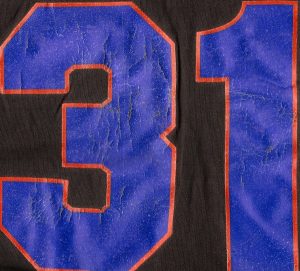 Absorbs perspiration, provides inspiration. PIAZZA 31 came out of retirement for the third time in a decade just as Piazza’s 31 was going into retirement for keeps. The last time my black shirt with the particularly dark blue and definitely cracked numbers was in rotation was October 2, 2005, Mike’s last game as a New York Met. It moved from drawer to shelf after the next laundry, re-emerging on August 8, 2006, Mike’s first visit back to Shea Stadium as a San Diego Padre. Seven years later, on September 29, 2013, while others wore the PIAZZA 31 they were handed upon entering Citi Field (I’m always impressed that people don giveaway shirts as soon as they get them), I opted for Old Glory to come out of the closet. The occasion was the induction of Mike Piazza into the Mets Hall of Fame.
One more time, I said at the end of that day. They will retire his number and I will unretire this shirt one final time when they do.
They did. And so did I. PIAZZA 31 didn’t just fit fine. It felt right. How many summer nights from 1999 to 2005 did I sweat in this shirt? How much Flushing humidity has it absorbed? (What haunting climate change story could it tell?) By the middle of Saturday night, July 30, 2016, the upper half of my body was dead certain of what it was wearing. There could be no other shirt for me on this date, just as there could be no other Met at the center of the ceremonies that demanded I dress appropriately.
A confession: I both love and hate talking about retired numbers. I love it because it’s such a carefully woven topic, consisting of so many fascinating threads. I hate it because it unravels so quickly. There is no right answer. There is no wrong answer. Usually, there are no answers, just more opinions, no two ever quite meshing. You probably could have injected the subject into the pair of political conventions just completed and had each party snipe at the other for its totally unreasonable stance.
Changing minds is a tough go in any realm these days. A person’s criteria for retiring a number seems to stay as stuck as any summer evening’s moisture to my PIAZZA 31. We should retire ‘A’ because…but wait, what about ‘B’?…never mind ‘B’…‘C’ is totally overlooked…what, you want to be like the Y’s and retire every number in sight?…besides ‘A’ wasn’t here as long as ‘B’…you guys are completely dismissing the historical significance of ‘D’…yes, but ‘E’ was already retired and ‘C’ actually had better stats…‘B’ wasn’t that great for us, not really…‘A’ had issues off the field that I can’t forgive…did ‘C’ ever actually win anything?…look at this list of numbers retired by some team we never give any thought to and how it’s ridiculously expansive…but not as expansive as the Y’s…y’know, the Y’s had a lot of really great players…‘F’ them, what about ‘D’?
I find it simultaneously the most stimulating and irritating topic in all of fandom, never mind blogdom. I value consensus and clarity almost as much I prize a t-shirt that’s as familiar as it is reliable. Arguments that circle round and round are anathema to me.
Perhaps that’s why 31’s official placement in an orange circle backed by blue pinstripes was so striking. At the moment it was unveiled, it was perfectly clear what it was doing keeping company with its handsomely relocated numerical brethren high above the left field corner at Citi Field. Exposure to Mike Piazza in all those at-bats way back when — and as he swung away at his makeshift podium Saturday — provided clarity that no number could have been more worthy of the honor the Mets were wisely bestowing on him after withholding it from everybody else for 28 years. As for consensus, if there was anybody in the house who wasn’t touched, moved and/or chilled by 31’s reveal, I couldn’t detect a nay vote.
This weekend and last remind us that Mike Piazza ruled. He was an era unto himself, and it was as invigorating an era as any that Mets baseball has offered. In a way, every Mets era fits me like my PIAZZA 31. Give me 31 seconds to think about a given season, and I’m mentally back in that season. Drop me off anywhere between 1998 and 2001 and I’m at home in the heart of Piazza Country. Nothing matters like Mike and the Mets, and nothing ever will. That’s when he and his teams pre-empted all regularly scheduled programming in our consciousness. When Piazza himself did something special — which was often — the Met Emergency Alert System went into effect. He might as well have been batting on every channel.
As with Cooperstown a week ago and the Mets’ underexposed Hall of Fame three years ago, the retirement of 31 was always, on some level, a technicality. Why would you have halls of fame and other accoutrement of what we refer to as immortality if you’re not going to ensure Mike Piazza is embroidered into their fabric? Within a franchise where importing elite talent has produced a decidedly mixed bag (may contain up to 95% letdown), Piazza was routinely great most of the time from the start. He grounded into a few more double plays than preferred his first couple of months. After that, he excelled on the regular and came through in extraordinary fashion at moments so iconic that they still bear his name. There was never any serious doubt he’d attain every honor available to a baseball player done playing.
Yet when the kudos he had coming have come along, his acceptance of them has been exhilarating. Mike has made these DVD extras to his career true bonus features. With the sudden addition of Justin Ruggiano, there have been 1,019 New York Mets. I’m willing to say that nobody among them has ever “gotten it” or “gets it” more than Mike Piazza, the “it” being this thing of ours.
Mike Piazza worked to make himself a longshot major leaguer, then a dazzling superstar. He had both of those down cold long before he arrived dazed at LaGuardia on May 23, 1998. Once he found his bearings, he worked to make himself a Met. I don’t know that anybody else ever has. He took time between cuts in the cage to notice who we were, what we wanted, how badly we wanted it. I can’t swear that our desires are tangibly different from those who adore the Dodgers or the Marlins or the Padres or the A’s, but Mike discerned during his sixteen seasons and after that it was different playing for the Mets than it was any of his other teams. It wasn’t a PR effort on his part. He understood our familial instinct, our yearning to make him one of ours, and he embraced it. He got it.
Not having come up as a Met only enhances Piazza’s legacy. After four months, he could have walked away. He could have been lavishly compensated anywhere he chose to go in the fall of 1998, places where 6-4-3 DPs and throws that sailed into center would presumably be tolerated a little longer or ignored altogether. Instead, he was determined to make it here, which studies have shown indicates you can make it anywhere. But why bother with anywhere else when you can be the rare imported superstar who doesn’t disappoint Mets fans? I really think Mike loves the Mets in that large-hearted mythic way an immigrant loves America.
That he loves the Mets like we do and loves Mets fans like we love him is not in question after the way he spoke when 31 was retired. It was right in line with what he said when the Mets installed him in their own Hall of Fame and Cooperstown’s voters finally generated a clue and did the same. He roots with us. He prays with us. He wants our current players, when they’re in need of a boost (and they sure as hell are lately), to look up at his number and derive all the inspiration they can from “Ol’ Mikey”.
We applauded everything he said and everything that was said on his behalf. We are in this together with him for as much eternity as a lifetime will allow. We will always look to 31 and appreciate how much better we were thanks to him having become one of us.
***
If you didn’t see the ceremony, by all means watch it here.
***
My deep appreciation to my wonderful sister of a non-biological nature Jodie who came up from Florida for the ceremony and made sure I got the opportunity to wear an old t-shirt for a new reason. We took in the game from the Honda Clubhouse, which is the Avenue of the Americas identity of what you probably more immediately recognize as the Mo’s Zone. It used to be fair territory. Now it’s an interesting perspective. If you position yourself properly, you’re within unique heckling distance of Carlos Gonzalez. It’s hard to resist the temptation. It’s also hard to leave at the end of nine innings, because they don’t let you out to dash to your train until the occupants of the Mets bullpen pass in front of you en route to their clubhouse.
The Ruggiano-enhanced Mets didn’t look any better versus the Rockies from ground level than they did any other angle. They’re pulseless, lifeless and teetering on the edge of 2016-hopeless. They’re also going to be sans pending Cleveland Indians catcher Jonathan Lucroy, which negates whatever was decided in recurring trade deadline conversations throughout Citi Field Saturday night (or not). I participated in one of those for a couple of innings as I slipped out of the Honda cocoon midgame and met up with two other long-distance travelers who determined they absolutely had to be on-site to witness 31’s overdue consecration. A tip of my damp black Mets cap with the 2000 World Series patch (when I go for a theme, I go all in) to my friends Mark from England and Dave from California for coming so far — not just their respective non-Honda sections — and standing with me in the drizzle between Papa Rosso and Beers of the World just so we could mull over a deal that was probably never going to happen.
I could think of worse things to get wet doing.
You can stay dry inside Little City Books in Hoboken and relive with me that golden year of 2015 on Monday night, August 8, 7 PM. It was a year ago today that the Mets made a trade and became Amazin’ Again. The contents of that book will probably come up at Little City, but feel free to talk about any year — or number — when you see me there.
by Jason Fry on 29 July 2016 11:32 pm No wait — I kind of mean it.
The Mets were down 3-1 to the Rockies in the top of the ninth, following a bottom of the eighth that was depressing even by recent Mets standards. Colorado had two men on with Carlos Gonzalez at the plate, and Antonio Bastardo, AKA the Human Curfew, was standing out there on the mound and occasionally throwing a baseball.
In the SNY booth, Gary Cohen and Ron Darling had had enough, and were idly discussing what one could accomplish between Bastardo pitches. Their candidates included booking an airline ticket and writing a country song. (I am not kidding.) In the park, the Mets fans who hadn’t already shuffled out in dejection were looking for anything blue and orange to boo. It was getting dangerously close to the Mets equivalent of the soccer riot in “The Simpsons.”
Then Bastardo roused himself to brush away the cobwebs and dust that had accumulated on his body since his last pitch and heaved a slider homeward. It only felt like Gonzalez had stood there long enough to attain free agency and be replaced by a lesser player; he was still present, eyed a slider that was doing no such thing, and hit it approximately to Portugal.
And with that, the Band-Aid was ripped off. Tragedy became farce, and this awful game stopped hurting.
So yeah, thanks Antonio.
Before that … well, must we? Steven Matz pitched inefficiently but pretty well despite that, Houdini-ing his way out of several tight spots, but wasn’t perfect and so lost. The Mets were awful again with teammates in scoring position: 0 for 7 on the night, which drops their season average to .202. If you’re wondering, yes, in fact that is the worst such mark in the history of the franchise, out-hopelessing even the ’68 club.
Still, even Don Bosch and Jerry Buchek might have found tonight’s eighth inning amazin’. With Jake McGee on the mound, Alejandro De Aza singled and Curtis Granderson moved him to second with a bloop hit. With Mets fans murmuring in tentative, fretful hope, Scott Oberg came in and threw … three pitches. Travis d’Arnaud broke his bat on the first one, with the lumber actually conking De Aza in the helmet. Yoenis Cespedes fouled out on the second pitch. And James Loney — your hitting star of the night with a solo homer — grounded out on the third.
Does hitting a teammate in the head with part of a bat count as a hit with a runner in scoring position? Because that was as close as the Mets would get.
You can’t make this stuff up. And if you could, why would you?
Honestly, there’s nothing new to be said at this point. Go read yesterday’s post, or the one from the day before that, or too many others of recent vintage. The team can’t hit, they continue to ask players to play on one leg or to sit on the bench for a while before finally moving them to the DL, the pitchers have to be perfect and pay the price when they aren’t.
The Mets are too much of a mess to responsibly be buyers and don’t have much of anything to peddle as sellers. So they continue to muddle along telling themselves and us that things are different than they are: when the losing stopped tonight, Terry Collins ordered that the clubhouse music be turned up. It was Bon Jovi, Adam Rubin informed us.
These days if you hear Jon Bon Jovi he’s touting the merits of being able to rewind live TV, and asking you to embrace the power to turn back time. Which would be nice, goodness knows — hell, I’d jam that button down until I had a chance to order Jeurys Familia not to quick-pitch Alex Gordon.
But that button’s broken for the ’16 Mets. Grampy Tim’s not coming back, the gym membership’s expired, hairlines are retreating faster than glaciers, the salsa’s perpetually mild, and not a single one of these ill-considered second children can get a hit when you need one.
by Jason Fry on 29 July 2016 9:59 am It really is true: the 2016 Mets are your 2015 Mets redux.
They pitch great, except for brief but fatal bouts of pitching lousy, and they hit something very south of great. Their not-hitting isn’t the usual baseball fan’s not-hitting where one grumbles about a player or two who can’t seem to come through. The Mets feature the kind of not-hitting where, say, a team goes 3 for 23 with runners in scoring position over a two-day stretch, with one of the three successes getting an asterisk because it didn’t score a run.
The problem for this year’s Mets, beyond that? It’s that last year’s Mets August-October offensive reboot, which turned a frustrating also-run club into league champions, was powered by crazy eruptions from two guys. One of those guys, Yoenis Cespedes, isn’t a trade candidate because he’s already here, or at least three limbs of his are. The other, Daniel Murphy, isn’t a trade candidate because he’s a Washington National and something tells me they aren’t giving him back.
I started with the offense because it’s been the real killer the last couple of days. Yes, Jeurys Familia has gagged two straight save opportunities — on Thursday the top of the ninth was a slow-motion car crash that took 26 excruciating minutes, as timed in disbelief by my pal Steve.
Up until then it had been a nice day in the park. I lucked into marvelous seats with old friends Steve and Brian, thanks to the kindness of a friend of a friend, Chris. We commiserated about previous Met woes, argued good-naturedly about shifts and replay and arm injuries, then found our seats just on the right side of the line between shadow and a whole lot of sun. A row ahead of us, Citi Field was a cauldron; where we sat, it was sticky and hot but just fine if you didn’t move around too energetically. The Mets took a skinny 1-0 lead against the Rockies and seemed poised to hold it. At least until the car skidded and we all braced for impact.
There was some bad luck involved for Familia — a Daniel Descalso bunt spun to a stop in fair territory as Rene Rivera glowered over it and a bat-breaking cue shot by Cristhian Adames was misplayed by James Loney — but there were also an alarming number of high non-sinkers, a wild pitch and the sight of a normally automatic closer wandering through the deep dark woods.
But still. If the Mets do something — anything! — with a few more of those 20 RISP failures over the last two days, Familia either comes in with a cushion or doesn’t need to be called on at all. The Mets have a great pitching staff, but day after day the bats force the pitchers to be perfect, not merely great.
I said at the beginning that the 2016 Mets sure look like the 2015 Mets, but it feels like there aren’t enough tears in Wilmer Flores‘s eyes to salvage this season. So, having said that, let me try and convince myself that I’m being way too pessimistic.
Well, here’s some evidence from Jesse Spector. The Mets are hitting a horrid .204 with RISP, far below their not particularly robust .238 batting average overall. That’s outlier enough to seem like a misprint: overall, MLB teams are hitting .255 and .257 with runners in scoring position.
So what’s wrong with the Mets’ hitters?
LACK OF GUTS, bellow the WFAN callers, but let’s not be those guys. (Ever.)
An alternate explanation is buzzard’s luck: the Mets are hitting .279 on balls in play, last in the majors. (The norm’s around .300.) Get that worm to turn, and the Mets could look a whole lot better without an infusion of new personnel that likely isn’t coming anyway. From that foundation, you can let yourself dream a little: Lucas Duda comes back, Travis d’Arnaud doesn’t go away, Michael Conforto relaxes and hits like he can. The division’s probably out of reach — Washington’s BABIP is just a tick higher than the Mets’ — but grab a wild-card slot and the Mets are immediately the team no one wants to play.
Well, maybe. But it also could be that 2015 was the outlier — the team in offensive rags that became a slugging Cinderella, only to have midnight arrive with a couple of dances left. The story of 2016 isn’t finished yet, but maybe this team never gets to the ball in the first place.
by Greg Prince on 28 July 2016 10:28 am This win-one/lose-one pattern the Mets have settled into is, if nothing else, steadying. You can set your watch by it, assuming you still wear a watch. Even adjusting for rainouts, you know what’s coming. If it’s the second game on a Tuesday — and the first game on a Tuesday was a loss — then it must be a win. If it’s a Wednesday following that second Tuesday game, it must be a loss.
Wednesday was, in fact, a loss. Funny, we thought Jeurys Familia was just as predictable after 52 consecutive regular-season saves. Something had to give. Yadier Molina (natch), Kolten Wong and the twelve Mets batters who didn’t drive in their teammates who stood waiting in scoring position ensured the ninth would give the game to the Cardinals.
Familia took the loss, but don’t be too hard on the fella. He hadn’t blown one of these babies in almost exactly a year. He was due. Only two relievers had ever successfully played 52 Pickup before. Even allowing for parentheticals (Jeurys gave up a four-run lead to Los Angeles earlier this year and there were those three World Series saves that didn’t get converted), it was a helluva streak. Familia has done his job.
Not everybody has, 100 on-again, off-again games in. The Mets are consistently inconsistent. The last dozen contests in which they’ve won one, lost one, won one, lost one and so on and so forth make for a pretty telling microcosm. This is a 53-47 team that is markedly better than it looks when it looks bad and likely less imposing than we’d like to believe when it looks good…which it does every other game.
But not that good. Except when Yoenis Cespedes gets ahold of one, as he did versus Adam Wainwright in the culmination of an epic seventh-inning at-bat. Yo put us ahead, 4-3, after the Mets didn’t hit nearly enough, but Logan Verrett pitched just well enough. Verrett had one tough inning, a three-run third, but otherwise didn’t look bad.
Met looks can be alternately deceiving and confirming, so who knows? The standings say the Mets are in contention, if not in command. The calendar says the Mets are on the clock (which they can set via their stubborn .500 tendencies). The trade deadline lurks Monday. Last year, as if you didn’t know, it brought Cespedes. If the Mets could go out and get him again, that would be fantastic, but it’s also fantasy. As Terry Collins has suggested, it would be swell if the players already here could play like the players they are.
Maybe that’s exactly what they’re doing.
I hope you’ll join me at Hoboken’s Little City Books, Monday night, August 8, for some Mets discussion, featuring my book Amazin’ Again. Full details here.
by Jason Fry on 27 July 2016 12:05 pm Maybe I was just in a good mood.
Emily and I were supposed to be back Monday night — Portland, Me., is an easy 45 minutes or so away by plane. But Monday night’s rainout also scratched our plane, shifting us to a 5:30 am departure Tuesday. Ugh … and then they cancelled that one too, telling us we wouldn’t be able to return until 5:30 am the next day.
Screw it, we told the airline, give us our money back and we’ll drive. Because that had been enough air-travel shenanigans, and because we had tickets for Tuesday night. And, as noted by a Cardinals-rooting friend of mine who was in town, those tickets were good for Game 1 as well.
So back we came in our little rented Hyundai Accent (suggested marketing pitch: “Undeniably a car!”), arriving just in time for me to hurry off to Citi Field on the subway while Emily caught up with work. The ballpark was nearly empty for the start of Game 1, so I found my friend Will and we settled in for Noah Syndergaard and Carlos Martinez.
Syndergaard and Martinez made for a pretty interesting contest: a matchup of young flamethrowers (23 and 24 years old, respectively) trying to get a 10th win.
Both were ambushed by two-run homers: Jedd Gyorko got Syndergaard in the third, while Rene Rivera launched one off Martinez in the fourth. So the game, as many of the good ones do, came down to a smaller difference … a failure of execution, a loss of composure, a modest mistake.
It sure looked like the fatal shortfall would be Martinez’s — he was clearly rattled by Rivera’s homer, and spent a good chunk of the fourth stalking around the mound like a spooked horse, attended to stoically by Yadier Molina. Molina will always be a Mets villain, of course, but that doesn’t mean one can’t appreciate him — every time I thought someone needed to give Martinez a talking-to I’d see that Molina already heading for the mound, summoning the infielders for a chat. Martinez walked Syndergaard and then walked Curtis Granderson, but managed to gather himself — or perhaps was snapped back into focus by Molina — and retire Yoenis Cespedes to escape harm.
Meanwhile, the Mets had already made what turned out to be the decisive mistake. But was it Syndergaard’s, or Tim Teufel‘s?
In the second, Syndergaard was tripped up by infield singles from Jeremy Hazelbaker and Tommy Pham, the second one spanked off his calf. With the bases loaded and one out, Martinez then tapped a ball to the left of the mound, which Syndergaard picked up with his bare hand while scuttling toward the third-base line. The play looked awkward and I had just enough time to think uh-oh before Noah alligator-armed the ball home, short-hopping Rivera and letting Molina score.
As for Teufel, Jose Reyes was on first with two outs when Cespedes cracked a ball off the wall in right-center. Reyes turned third and Teufel held him … to the dismay of the ballpark. Asked about the red light after the game, Terry Collins revealed his opinion by muttering that he wasn’t going to comment on coaching stuff.
But the matinee had one final play of import. In the ninth, with Granderson on first and nobody out, Cespedes connected to dead center off Cards closer Seung Hwan Oh — whose nickname in Korean ball, by the way, was the rather awesome “Final Boss.” The ball Cespedes swung at made a good sound off the bat, one that brought Will and me to our feet. He was filled with horror; I was ready to leap skyward with glee.
But.
But but but.
 Purty! The wind was blowing in, and center field had not been friendly to the Mets: earlier in the game, Michael Conforto and Wilmer Flores had connected solidly but for naught. Out there in center, Pham wasn’t turned around or feeling for the wall. He was looking up. The ball came down in his glove and he fired it to second, where Granderson was trying to sneak into scoring position.
Out! They were both out! Now Will was elated and I was slump-shouldered in disbelief. Eight seconds had changed the entire game; a moment later, James Loney was retired and the Mets had lost.
Still, it had been fun — an interesting little game starring two gifted pitchers, with a couple of fine defensive plays and a coach’s decision to chew over. And now the heat was fading out of what promised to be a beautiful night, and we still had another one to play.
I moved over to find Emily and her dad and the three of us watched Bartolo Colon go to work. Where Syndergaard had labored in the heat despite his ferocious arsenal of pitches, Colon did what Colon does, throwing almost exclusively sinkers and four-seamers and almost exclusively for strikes. The slowest ones were 85, the hardest ones were 89, but Bartolo hit corners and added or subtracted a touch of sink or spin, sending Cardinal after Cardinal away empty-handed.
Bartolo at his best is like a really subtle magic trick: two variations on one pitch, all strikes. It shouldn’t work but it does. He limited the Cardinals to a solo shot (freaking Gyorko again) and departed early so he could pitch again on Saturday. Meanwhile, the Mets were plodding along in a dull but productive fashion, tying the game with a third-inning double for Asdrubal Cabrera (his first hit with a runner in scoring position since the LBJ administration, if I’m recalling it correctly), then taking the lead on a run-scoring double play, then adding insurance on a Cabrera sac fly.
That was more than enough for Addison Reed — the done-with-mirrors relief version of Colon — and Jeurys Familia. The Mets had a split for their day’s work, and between Colon’s quiet mastery and the beautiful night that felt like victory.
by Greg Prince on 25 July 2016 11:01 pm 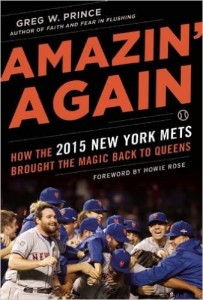 2015: The best kind of history. Though our nation turned its Piazza eyes to mythic Cooperstown on Sunday afternoon, it is Hoboken that makes a convincing claim as the true labor/delivery room of the National Pastime. The first baseball game for which there is a record took place on June 19, 1846, at Elysian Fields, way on the other side of the Hudson (albeit not so deep in the bosom of suburbia). The final score was New York Nine 23 Knickerbockers 1.
I sincerely hope we can make the next great date in Hoboken baseball history Monday, August 8, 2016, when you join me at Little City Books at 7 PM for an evening of Mets book talk. The book is Amazin’ Again: How the 2015 New York Mets Brought the Magic Back to Queens. The talk will strive to be stimulating enough to carry an off night on the Mets’ schedule. We may not do anything anybody will look up 170 years from now, but I’m willing to bet we can entertain one another more effectively than the Knickerbocker pitching staff held the Nine in check.
If you’re in New Jersey, I’m excited to come see you. If you’re anywhere else in the area, it’s only a PATH train ride from Manhattan. Let’s make a little baseball history together. Let’s have the most fun Mets fans can have on a night the Mets aren’t playing.
by Greg Prince on 25 July 2016 1:55 am One of the umpires working the Mets-Marlins game in Miami on Sunday should have taken a moment from making an eventually overturned call and blown a whistle to order a stoppage in play after a couple of innings. Baseball doesn’t operate like that, but how could any Mets fan worth his parmesan dedicate all of his or her bandwidth to just another game — no matter its relative import in the standings — when an almost unprecedented Metsian occasion was unfolding far north of where Michael Conforto was diving, Jose Reyes was tripling and Steven Matz was pitching?
Mike Piazza drew our attention from what every other Met was up to. When he played, it was by coming to bat. This time, it was by coming to speak.
Mike was inducted into the Hall of Fame on Sunday. I’m not sure at what point he was officially inducted. He was elected in January, but what’s the point of demarcation that separates election from induction? No Chief Justice of the Baseball Court appears in Cooperstown with a request to raise your right hand and repeat an oath, so it’s hard to pin down. Is it when the newbie is called to the stage by emcee Gary Thorne? Is it when Commissioner Rob Manfred finishes reading the description on the plaque? Or is it when a Piazza or Ken Griffey, Jr. starts to talk?
I thought Mike Piazza was a Hall of Famer ages ago, so I shouldn’t worry about such niceties, but I’m glad the BBWAA inscribed his Fame for good, because we got to hear him speak at length. It was worth missing a couple of innings of Mets-Marlins. It was worth waiting four elections as well, but don’t tell those who unjustifiably delayed the inevitable.
You thought Piazza could hit. The man can accept induction just as powerfully.
Piazza is not under the impression he ascended to baseball immortality by himself. Through sniffles that seemed to have nothing to do with allergies or a summer cold, Mike emotionally namechecked most everybody who gave him a boost along the way. There were parents and coaches and Dodgers by the bushel. Since he was going in as a Met, of course he mentioned Mets. He praised John Franco’s generosity for handing him No. 31. He paid homage to his batterymate Al Leiter. He credited Edgardo Alfonzo’s excellence for facilitating his own. All of that was much appreciated, but I have to confess I listened most closely to hear what he said about us:
“How can I put into words my thanks, love and appreciation for New York Mets fans? You have given me the greatest gift and have graciously taken me into your family. Looking out today at all the incredible sea of blue and orange brings back the greatest time of my life. You guys are serious. We didn’t get off on the best foot, but we both stayed with it. At first, I was pressing to make you cheer and wasn’t doing the job. You didn’t take it easy on me and I am better because of it. Sometimes a jockey whips a horse. It isn’t always pleasant to watch, but it gets results. The eight years we spent together went by way too fast. The thing I miss most is making you cheer. No fans rock the house like Mets fans. You are passionate, loyal, intelligent, and love this great game. To be only the second Met to enter the Hall of Fame, after Tom Seaver, brings me great pride and joy. And I truly enjoyed Gary Carter’s company. He was a wonderful man, a great player, and I miss him.”
After that — and a heartfelt tribute to those who gave their lives in the hope that others could live on September 11, 2001, ten days before Mike hit what is generally considered the most meaningful of his 427 big league home runs — it was hard to remember the Mets were still playing the Marlins. And when you remembered, it was hard to imagine they could lose, which they didn’t dare.
by Greg Prince on 24 July 2016 3:21 am Viewed from the proper perspective, the Mets played a Hall of Fame-caliber game Saturday night. When Giancarlo Stanton becomes eligible for consideration, some future producer will incorporate the clip of Stanton’s third-inning Neptune shot off Jacob deGrom into a persuasive highlight montage to illustrate why the Marlins slugger merits election. They can use a bit of Jose Fernandez keeping the Mets mostly at bay for seven innings as well when he reaches the ballot.
That’s a long way away. The Marlins pulled a long way away from the Mets in the game in question, winning by five after trailing by two and extending the difference between them and the Mets in the Wild Card standings to one-and-a-half games. That’s not an insurmountable distance. Stanton’s home run, however…good luck scaling that mountain.
Saturday night from Miami was a bummer but Sunday from Cooperstown should be special. Hall of Fame consideration for Mike Piazza, underway on some level for probably two decades at least, finally pays off this afternoon. Mike Piazza is going into the Hall of Fame.
Going into the Hall of Fame as a New York Met.
We’ve known this since January 6, felt it in our gut since no later than 2005, mulled it over since 1998. When he signed the multiyear megacontract that kept him a Met after sampling Shea Stadium for part of a season, he told us a Mets cap was his preference. At the time, Mike didn’t have enough years to qualify five years later; it takes ten years of MLB play to begin the process. Yet it wasn’t presumptuous to wonder, even then, what cap Mike Piazza, eventual Hall of Famer would wear..
Piazza’s first major league experience came in 1992. By 1993, he was being spoken of in elevated terms. When he hit the trade market (twice) in ’98, it was no mere salary dump. Mike Piazza was already in line to go down as the greatest-hitting catcher ever. Of course the Hall of Fame was in sight.
Opening Night in Atlanta in 2001 gave him a toe in a tenth big league season. He could have retired thereafter and he’d be eligible to be on the ballot for induction in 2007. Maybe that would have worked better for him. Those who vote wouldn’t have had time to think about Mike in the context of the era he played and decide that maybe something about his enormous totals wasn’t kosher. In 2001, it was ridiculous to think he wouldn’t go in ASAP. By 2002, it was preposterous to think of him on a plaque in a cap that didn’t spell out NY, given what he’d given New Yorkers the September before.
He left us in the active-roster sense in 2005, amicably. We figured that when the dust settled on what was left of his career, we’d see him in Cooperstown and that we’d recognize him by those initials. Nothing occurred in the intervening decade-plus to disabuse us of that notion, save for a little self-fortifying Mets fan paranoia. All we needed was for Mike to get in in order for him to go in. That took four ballots. He had to stand accused for three years. He withstood the judgment. No hard evidence emerged. By his fourth contest, there was no stopping him.
Today is the end result. Today is Mike Piazza on the Hall of Fame podium nodding in our direction. The NY will be on his plaque. The Mets will be in his heart. He is already in ours.
by Greg Prince on 23 July 2016 12:14 pm On July 23, 2005, Jose Reyes busted out at Shea. The kid we’d been told was gonna do great things did the greatest things he’d done to date: 4-for-5, including a triple; two RBIs; two steals; three runs scored. The Mets beat the Dodgers, 7-5. Mets starting pitcher Pedro Martinez — almost exactly a decade ahead of his induction into Cooperstown — announced in advance one of the plans he had for retirement. It involved Jose Reyes.
“When I’m finished,” Pedro said, “I’ll get the best seat to see him play. I’ll pay whatever price to see him play.”
Mr. Martinez is busy this weekend, reacquainting himself with his fellow Hall of Famers, but had he made good on his pledge of eleven years ago today last night in Miami, he would have gotten his money’s worth.
The veteran we’d been told might do good things busted out:
• A leadoff double, steal and run on a sacrifice fly in the first.
• Taking first on a strike three that got away in the third, then dashing to third on a one-out single (where two subsequent Met batters stranded him).
• An RBI single with a…how you say?…runner in scoring position in the fourth.
• A leadoff base hit, a first-to-third sprint on a single and another run in the seventh.
Jose, a natural shortstop shoehorning himself into a serviceable-plus third baseman, was charged with a throwing error in the bottom of the fourth, but made up for it pronto by starting a 5-4-3 double play on the very next batter.
The Mets wouldn’t have won on July 23, 2005, without young Jose Reyes, and they wouldn’t have won as they did — 5-3 — on July 22, 2016, without older Jose Reyes. As if to bookend the eleven-year trail of Reyes runs, we even got another nifty quote from his starting pitcher, this time Logan Verrett, who said, “He’s like a can of Red Bull balled up into a human being, and that’s something we were lacking.”
Jose is indeed energetic, but also a human being, and we know, through the circumstances under which he was available to re-emerge as a Met earlier this month, that human beings are capable of doing lousy things to their fellow human beings. Upon his return, it was hard to look at Jose, not see the domestic violence charge and instinctively not want to look at him at all. It was nearly impossible to look at Jose and see the Jose-Jose-Jose wunderkind to whom we took such a melodic shine a long time ago.
The vision is changing. I suppose it’s transactional. Now that he’s hitting and running and resembling the Reyes of yore, I’m less inclined to dwell on the legitimately negative (human beings will do that in exchange for a couple of runs sometimes). I’m seeing the Met again, the above-average baseball player. I’m hearing the kid we once embraced in pre- and postgame interviews and he sounds like Jose, except older and perhaps wiser. He is full of pep and positivity and, where the rest of his life is concerned, hopefully nothing else.
I’m rooting for my longtime favorite player again. I don’t know that he’s my favorite player anymore, but he’s here, he’s getting on base and I’m getting used to him.
by Greg Prince on 22 July 2016 10:26 am The Cubs and my father are enmeshed in my oft-told Mets fan origin story. It was my dad who’d bring home the Post — when it was an afternoon paper — that featured the recurring cartoon that I credit for sucking me into the ongoing storyline of the 1969 season: the Mets duck doing battle with the Cubs bear. I’m gonna go out on a limb and say I would’ve found my way to the Mets by some other means had John Pierotti not drawn and personified those wonderfully representative creatures, but I can’t deny that the cartoon didn’t offer me a way in when I was six. The illustrations provided enough impetus for me to read the headlines and flip the paper back a few pages to start making sense of standings and box scores.
The Mets were pursuing, catching and passing the Cubs. The duck was triumphing over the bear. The first championship I would vicariously celebrate, that of the National League Eastern Division, was arriving.
Yay Mets. Boo Cubs. Thanks Dad.
Charles Prince’s role in making me a Mets fan was understated. As I always feel obligated to point out, lest anybody lean on an inaccurate script, he was not a baseball fan. He did not pass down to me some great fondness for the game let alone a particular allegiance. Truth be told, he couldn’t stand baseball most of the time, periodic exceptions notwithstanding.
But let’s retrace my steps. Dad supplied the Post, so he has to receive some of the credit. He let me pull it out of the outer pocket of his briefcase before he was necessarily done reading it. He let me spend time with the sports section and anything else that caught my fancy (this was the Post of Dorothy Schiff, before Rupert Murdoch, so it was written for adults, yet suitable for children). One of his habits was to read to us during dinner. Not in some formalized children, gather round, your father is educating you way, but to share something he read on the train. “I read a really fascinating/funny story today,” he’d start telling my mother, and before I knew it, he’d grab the Times or the Journal or commandeer back from me the Post.
My dad valued reading. I valued reading.
He had already instilled in me that as New Yorkers we rooted for New York teams. My first exposure to any kind of team sport came earlier in 1969, when we rooted (without success) for the Knicks to topple the Celtics in the NBA playoffs. There was no weird predilection to side with Boston in that series, so I was certainly never going to choose Chicago when my eyes opened to baseball. Dad’s example was clear: we root for the home team. Our home was New York.
Oh, he also provided the home in which we watched TV and read the paper. That’s pretty important, too. He gave me a slight allowance, much of it going to local merchants of Topps baseball cards. When I got a somewhat more substantial amount, magazines featuring stories about baseball players were my investment. It paid off mostly in dust (I kept a messy room) and personal intellectual capital. Except maybe once or twice when perhaps something else was frustrating him did he suggest it wasn’t the best use of my funds.
Dad didn’t cultivate my Mets fandom as much as he passively indulged it. He certainly never threw up any obstacles. He bought the tickets to what was going to be my first Mets game. OK, so my pediatrician put the kibosh on it, and I’m bitter to this day we didn’t go, but the thought was present and the thought continues to count. The whole family tried again a few years later. It was a great game to me. It was a burden to him, my mother and my sister. Still, we went. A couple of years after that, once I’d suggested it strongly enough for it to be taken seriously, we took a trip to Cooperstown. It was a long schlep, but he actually seemed to enjoy it.
Growing up in New York in the 1930s and 1940s, it’s not like Charles Prince never encountered baseball. It was ingrained as the National Pastime, unquestionably the city game. He liked the Dodgers. His father liked the Yankees. My dad was keenly aware of all three teams, even if he told me he didn’t know too many Giants fans. The tipping point that left him lacking a passion for the game that would draw me in and never let me go was a Memorial Day doubleheader at Yankee Stadium in 1945. Too many innings. Too many people. Too much shvitzing. Too much sarsaparilla (he never much cared for root beer, either). Maybe my grandfather and great uncle who took him enjoyed themselves as much as they could, considering the Bombers only split with the Tigers, but my father had had enough baseball to last him a lifetime.
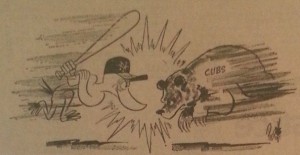 Scene from a divisional duckfight. Then came 1969, when I took the Post out of his briefcase and was charmed by Pierotti’s duck and lost myself in the agate type and never stopped loving baseball or the Mets. To the extent that he thought of it all, I’m guessing he viewed both of them — baseball and the Mets — as my friends who came over after school and stayed for dinner. He was mostly polite toward them. Now and then he’d dip into an old story, throw an old name into conversation, recall that when he and my mother were living in Brooklyn in 1955, it was quite exciting watching everybody celebrate the Dodgers’ first and only world championship. If I began to reminisce (and I commenced reminiscing at a tender age) about 1969, he’d recall coming out of Penn Station just after the Mets won the World Series and how all of Midtown was one big party, sort of like Brooklyn in 1955.
That brings up two points:
1) My father was a bit of a frontrunner when it came to baseball. The ’55 Dodgers. The ’69 Mets. Circa 1978 he gave me the impression he liked the Yankees, partly to bedevil me, partly because sometimes bandwagons grab a person’s attention. By the mid-1980s, he was every bit the Mets fan most New Yorkers were. I accepted his rather rapid conversion to the cause as something I assumed resided deep within him the whole time.
2) My father was coming out of Penn Station just after the Mets won the World Series. Why was a man who commuted dutifully early every morning from Long Island emerging onto Seventh Avenue as the Post was entering its prime PM sales window? On October 16, 1969 — and this is the capper to my origin story — he took the morning off from work to take me to the eye doctor in Brooklyn. We lived in Long Beach. Our doctors were all in Brooklyn. It occurs to me now that whenever I’ve moved, I’ve been slow to transfer loyalties to new establishments and have unnecessarily traveled an extra few miles to get my hair cut or my tires checked. It finally dawns on me where I get this from.
Anyway, he took me to the eye doctor because I poorly expressed some vision situation to my mother and she interpreted it as something being terribly awry, Chuckie, you gotta take him to the eye doctor. The date of the appointment coincided with Game Five of the World Series. In Those Days, to invoke a phrase men spiritually rooted in another era enjoy employing, the World Series was played in daylight. The deal couldn’t have been sweeter. I got out of school legitimately. All I had to do was put up with the eye doctor, get back in the car and plant myself in front of the television.
Doctor, my eyes have seen the Mets. Now let me see if they can win it all. Except I did not enjoy the sensation of drops in my eyes. I still don’t, but at the age of six, I hadn’t yet learned to remotely tolerate that which I could not stand. I yelped and I moaned and I shuddered. I did not want those goddamn drops in my goddamn eyes.
If I wanted to use my eyes to see the World Series later that afternoon, my father warmly but sternly informed me, I’d sit still and take the drops.
I took the drops. My eyes were fine. I watched the Mets win the World Series.
Yay Mets. Thanks again, Dad.
So, as my oft-told origin story always concludes, I was hooked, and here I am [FILL IN NUMBER OF YEARS DEPENDING ON WHAT YEAR THIS IS THAT I AM TELLING THIS STORY] later, still hooked. In 1970, with the hook well in me, the Post was still publishing in the afternoon, my dad was still bringing it home and the Cubs were still lingering on the periphery of my vision. They were in another divisional duckfight with the Mets, so much so that when the two 1969 rivals gathered at Wrigley Field for a five-game series in late June, and I was available to watch an entire doubleheader on Channel 9, I clearly remember being extra delighted to greet my father when he came home from work that night.
I assaulted him with the bulletin he hadn’t been waiting to hear: the Mets had swept the Cubs that day, won four straight, were in first place, and if they won tomorrow, they will have won all five…which they did the next day (the only five-game road series the Mets have swept, by the way). My father feigned enthusiasm, permitting me to have at the Post so I could examine the line score from the first game of the twinbill. That was one of the beauties of the afternoon paper. If a day game ended early enough, you’d see the score. Never mind that I already knew the score. Validation was on the back page. The Post printed not only final line scores of early games (and late West Coast games from the night before the morning’s News probably missed), they printed partial line scores. If there was, for example, a businessman’s special in St. Louis or Cincinnati, you might see the first couple of zeroes that had put on the board before the Post had to go to press. Or you might see the probable pitchers listed for a 4:05 game just getting underway in San Francisco as you were just getting ready to board your train. No score at all, but the sense that something was happening while you were riding the LIRR.
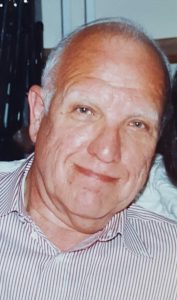 Charles Prince, in his extensive prime. Today you’d just click refresh. Or you’d set your app so you didn’t have to do anything but stare. In 1969 and 1970, you’d light up another Newport and maybe plan to call your bookie from a pay phone once you got off the train. Damned if I know the value of a blank line score, but I loved staring at it.
The Cubs couldn’t help but be central to partial line scores on the back page of an afternoon paper. They played nothing but day games at home. They no doubt logged more column inches in New York than they deserved based solely on a refusal to install lights at Wrigley Field. Throw in the duck, the bear and those two years when their games against the Mets made all the difference between first and second place (permanently in 1969, fleetingly in 1970), and it’s no wonder I think of the Cubs when I think of my dad bringing home the Post and me plucking it from his briefcase for Metsian purposes.
You couldn’t miss the Cubs on the Mets’ schedule In Those Days, which were days that extended well into the 1990s. We played five N.L. East teams eighteen times a year. Along with the French-Canadian novelty of the Expos, it was the Cubs who stuck out as a distinct Met opponent no matter what was going on in the standings. The Pirates and Phillies each played in the same stadium, more or less. The Cardinals were a vague presence in our lives until 1985. The Cubs were Wrigley Field nine afternoon games every season through 1987. Then came lights. Then came realignment. Then went the Cubs off to all-other land.
It took me ages to get over the derelevantization of the Cubs, particularly the lack of regularly slated weekday Mets games from Chicago. We get one now and again, but mostly, at least when we play them, they’re a night kind of town. Wrigley remains apart from everywhere else, yet many of their games start when more or less everybody else’s do. They have lately retrofitted in not just lights, but the modern accoutrement every ballpark has. Pac Bell, PNC and so many others were inspired by Wrigley, yet Wrigley concerned itself with jamming a Jumbotron onto its premises. In the spirit of In Those Days, I will add It’s Just Not The Same Anymore.
But you roll with the flow. The Mets weren’t in fierce competition with the Cubs? We lathered up for other opponents. The Mets didn’t receive an afternoon oasis in their routine? We tuned in later. The Mets were going for a pennant against the Cubs?
The Mets were going for a pennant against the Cubs? This was, on some level, my dream come true. I’d claimed to have hated…sports-hated, mind you…the Cubs long past the Mets-Cubs rivalry’s expiration date. A little piece of me was always watching in 1969 and 1970, the duck feuding with the bear on the back page of the Post and all that. The parameters worked if I wanted them to. We clinched a division at Wrigley on the day after the final day of 1973 (eliminating the remnants of the formerly fearsome Cubs the day before) We were at each other’s throats, or perhaps ankles, in the late ’70s and early ’80s, as the Mets and Cubs seemed to be trading off fifth and sixth places annually. Then came a genuine divisional race in 1984 that didn’t turn out as desired; then another semi-showdown in 1989 with another displeasing result. The Cubs padded off to the Central, yet we viewed each other with disdain from afar amid the 1998 Wild Card stakes (which also wound up sucking). Chicago rarely made its New York presence felt thereafter, though there were a couple of moments worth preserving in Flushing: the Victor Diaz/Craig Brazell spoiling of 2004, the five-run ninth of 2007, the final Shea walkoff win of 2008.
What we got in 2015 was something that would have been impossible to have experienced in 1969. We got a Mets-Cubs NLCS. They had to layer in extra playoffs to make it happen, but it came to pass. If the Post was still on its natural publication schedule, it would have called for extra editions.
Funny thing about last October was after all the years I salivated for a Mets-Cubs playoff, I could gin up no additional venom for the opponent of the hour. I wanted the Mets to prevail. I wanted whoever they were playing to succumb. That was all I wanted. I took no particular fervor from Chicago, home of the cartoon bear, trying to block the path of New York, home of the cartoon duck.
Nor, I imagine, did my father. I’ll also go so far as to imagine that if a Mets-Cubs NLCS had come to pass in any previous season in which three-division play made it theoretically possible, between 1995 and 2014, my father wouldn’t have cared whatsoever. He was on a long baseball hiatus. His deep-down Mets fandom that emerged in the mid-1980s evaporated in the early 1990s. He got caught up in the Teamwork Dreamwork Mets, just like my mother did. My mother died in 1990. His interest in baseball passed fairly soon after. It took me a spell to catch on. I still tried to talk baseball with him, tried to watch baseball with him, tried to express to him how much baseball meant to me and I thought it sort of, kind of meant to him.
It never took. At most, I got a “that’s nice” from him. The Mets went to a World Series in 2000. Dad shrugged. I started writing about the Mets in earnest in 2005. Dad didn’t get it. I told Dad I was writing a book about being a Mets fan in 2008. He told me there were probably better things I could be writing about.
I didn’t talk to him for two-and-a-half months after that.
We made up. Of course we did. We were father and son. I didn’t care that he didn’t love baseball. I was a little put off that he had no use for what I was doing, but he came around when the book came out in 2009. He told me he read it and liked it…though he confided to my sister that he didn’t necessarily agree with every aspect of my portrayal of certain family events — “Rashomon,” he reasoned, invoking the movie in which everybody tells the same story but with his own set of details.
My relationship with my father as my father grew older was mostly small talk. We honed it to a fine art, I believe. We talked about sports, global and national headlines, weather, maybe a human interest or pet story and a TV or movie review. We were essentially a weekly version of News 12 Long Island. His life had meandered in one direction, mine in another. We weren’t extraordinarily close to begin with. I loved him. More importantly, I liked him; I liked him like Sally Field reveled in being liked. That’s why I wished we had been closer. My attempts to forge a tighter bond — with baseball, without baseball — never went anywhere. Eventually, I shrugged. Good small talk was better than no talk at all.
You know he took ill in 2015 and I’ve described at length how we latched onto baseball together as the Mets tore through the National League last August and September. I’ve mentioned how much it meant to him and me to watch the World Series together. I’ve told you he died last week. So I’m not going to revisit all of that again. If anything, I want to get past his illness and remember him more like I knew him in his remarkably extensive prime — with baseball, without baseball. Mostly without, to be honest.
But I do have one strand of the Mets part of our story I don’t think I’ve ever delved into. It’s from last October. He was in the nursing home where he was administered palliative care, so his condition had already crossed over. His memory, so rich in detail, was growing spottier (particularly disconcerting for a son who is alleged to remember everything). His ability to conduct a conversation sputtered, which frustrated him when he was aware of it. I was missing our small talk. When one of us would call the other for twenty years, I took large delight in staying on the phone a little longer than usual. Maybe something was really good on TV that week. Maybe I hit on a nostalgic button that got him going. Any chat that wasn’t dominated by lingering pauses was a personal victory.
When we spoke on the phone in the fall of 2015, it was because he was insisting the nurse hadn’t come around when he rang for one. These calls came late at night. He didn’t know it was late at night. Sometimes his first question was “is it night or morning?” He’d call at 1 AM and want to know why lunch hadn’t come. The only thing he seemed to have no problem remembering was my phone number.
That was the Dad I was dealing with in the fall of 2015 when he wasn’t getting stirred up over the Mets. The Mets were playing for the pennant. That stuck with him. If the Mets were playing big games, he knew I’d come over and watch. I came over and watched other things with him; it wasn’t the same. We had truncated chats about other things; they didn’t click. He conflated the Mets and me. I suppose he always had. For the first time, it meant something to him.
We watched the Mets clinch the NLDS against the Dodgers together. He was pleased, but I don’t think he quite got the magnitude of it. It was just another playoff series. Basketball had playoffs. Football had playoffs. Not every victory is outsize. But a pennant is something else. If you’re from the 1930s and 1940s like he was, you got the significance of a league championship. There’s a reason Russ Hodges screamed like a lunatic on behalf of the Giants in 1951. Pennants were something else In Those Days.
We watched the Mets win Game Three of the NLCS against the Cubs together, a night game at Wrigley Field. He was pleased again. It meant the Mets were one win from the World Series. The World Series was what I promised him in August, when the Mets were more than one game away. Somehow we landed on its lip. I don’t know how I arranged it, but it happened.
Game Four we didn’t watch together. It was a conscious decision on my part. Game Four was my turn to recap here. If the Mets won the pennant for the first time in the history of Faith and Fear in Flushing, I wanted to be at my computer not too many minutes after the final out to capture the moment. If I was gonna do that, I couldn’t be with my father. So I wasn’t.
And y’know what? I’m glad I wasn’t. Because a few minutes after Jeurys Familia struck out Dexter Fowler and the Mets became National League champions for the first time in fifteen years, my phone rang. It was my father.
He wasn’t asking where the nurse was. He wasn’t asking where lunch was. He wasn’t wondering if it was day or night. He knew exactly what time it was.
It was time to call me and tell me, “Congratulations. They won the pennant. That’s really something.” My dad was as coherent as I’d heard him since he returned to being a full-time patient in August. I didn’t think I was talking to a man who had only so many months left. I was talking to a man who’d seen plenty and understood what he was looking at on television and realized it was a big enough moment in the life of a baseball team that he had to share it with the biggest baseball fan he knew.
Frontrunning has its privileges.
If we’d watched the Mets clinch the pennant together, I have a pretty good idea of how it would have gone. By watching separately, I received perhaps the greatest unexpected phone call of my life, from my father to me, via Wrigley Field. There would never be another phone call quite like that in the nine months he had left. Given that our relationship had been mostly phone calls for so long, it felt perfect, just like that pennant won against the Cubs in Wrigley Field under the lights.
I assured Dad I’d be up to see him in the following days, and I was. It wasn’t as good as the phone call, maybe because there was no Mets game on. Then came the World Series, which was better in theory than in actuality, at least our two games together, One and Five. We tried. The Mets tried. No dice. I know it meant something to him, though. He brought it up on and off during our subsequent visits — how he still had it in for the Royals, how he looked forward to our watching the Mets in the World Series together next year (he said it with such certainty that I began to believe he, I and they couldn’t possibly not make it that far again). He kept referencing it until he was incapable of referencing much of anything. My favorite moment in this regard came when we had the Chiefs-Texans AFC playoff game on in January. He repeatedly asked who was playing, who was winning. When it finally sunk in who one of the combatants was, he perked up:
“Boo hiss! I HATE Kansas City!”
Yes, Dad, I said. So do I.
***
We formally said goodbye to Charles Prince on Wednesday afternoon, July 20, 2016, in a rather simple service at the National Cemetery, part of the vast cemetery complex at Pinelawn. Dad was a veteran (defending the shores of San Francisco during the Korean conflict), so we availed ourselves of the outdoor military ceremony the VA said he’d earned. His only request was to be cremated; he didn’t care to know what would happen next.
A two-man honor guard participated. One of the servicemen blew “Taps”. Then the pair rigorously unfolded and folded an American flag, presenting it to my sister and me jointly, acknowledging Dad’s service to our country. When they completed discharging their duties quite honorably, Suzan read aloud a brief biography she penned, explaining who Dad was, where he was born and how he came to the life he lived. After leading us in the 23rd psalm, she turned the program over to me and I read a remembrance that I am sharing with you below, so you get an idea of what it was like, Mets aside, for me to have grown up the son of this man. There followed some heartfelt remarks from Florence, his “significant other” of nearly 25 years, and then a few more from her lovely granddaughters, Charles’s de facto granddaughters. When the speaking was done, Suzan and I were led to the wall in which the urns of loved ones are stored for what we on earth laughably refer to as eternity.
Suzan and I placed my father’s remains in his little locker together. That part was scripted. The next part was my own touch. I reached into my suit jacket pocket and removed the orange rally towel that I had hung, with Dad’s permission, on his nursing home bulletin board when I came over to watch Game Five of the Dodger series. It was from Game Three at Citi Field. It said, of course, Let’s Go Mets. It stayed up through the rest of the postseason, then the offseason, then into this, the next season. It probably explained why Dad managed to keep the Mets top of mind all those months. “Let’s Go Mets” stared at him every day. The Mets reminded him of me. A picture of me and the rest of the family was at the side of his bed, but after a while, he couldn’t turn his head. When the nursing home swept up his possessions and packed them into several Hefty bags in the hours after his passing, I asked Suzan, who was picking up his belongings, to make sure to return the towel to me. She presumably thought I wanted to re-add it to my amorphous blob of Metsiana.
Peering into the abyss of the eternal cubby (seriously, that’s what those urn compartments look like without their ornate doors), I took out the orange towel, which was folded as carefully and diligently as any flag, and placed it atop the urn. When my mother was prepared for burial 26 years before, I requested a button commemorating the 1986 World Champions, one I had given her after that World Series, be attached to her dress.
I have one move, I suppose. As my father would say when he didn’t want to dig any deeper for an explanation of his motives, what can I tell ya? Or was it, what can I say? Suzan and I remember it differently…à la Rashomon.
I didn’t want to make a fuss about what I had done — you don’t always want to be seen as the walking embodiment of the logo of your favorite professional sports team — but when we returned to our makeshift congregation under the canopy the cemetery provided, Suzan announced softy to all, “I just want you to know he went with a Mets rally towel.” After my brother-in-law Mark led us in the Mourner’s Kaddish and pressed play on his phone so the theme to “The Milkman’s Matinee” could send Charles off to the music he enjoyed, I had at least one attendee come up to me to compare notes. “When my father died,” he said, “I put a Mets cap in there with him.”
Mark had found something online about an Israeli folk tale and jelly doughnuts and maybe funerals. I didn’t quite process the note-for-note significance (he admitted it had no basis in scripture), but the idea that all the mourners who weren’t averse to sugar consumption should partake of something sweet was a nice one, so Munchkins were handed out, giving everybody an excuse to stand around a little longer and chat amiably under the canopy about the departed. After a fashion, we all got going. Stephanie and I walked into our living room at exactly 2:20 PM, first-pitch time for the Mets and Cubs from Wrigley Field. They were playing a day game at that venue on this day of all days, almost as if assembling a second honor guard, an LGM for PFC Charles Henry Prince. Given the gift of such beautiful if coincidental scheduling, I doubt I can ever pretend to hate the Cubs again (until the next time we see them, at least).
As if that weren’t enough, it was a throwback uniform game. The Mets dressed like it was 1986, the Cubs 1988. My dad and I watched them play each other in both of those seasons, years when the Mets went to the playoffs, years when we watched the Mets together quite a bit. We watched them play the first night game that counted at Wrigley in 1988. At the time, I considered it an affront to nature — a National League game in Chicago under anything but natural light was simply wrong.
In light of our telephone conversation from late in the evening of Wednesday, October 21, 2015, when the Mets won the pennant on the road from the Cubs and my dad sounded better than he ever would again, I stand corrected.
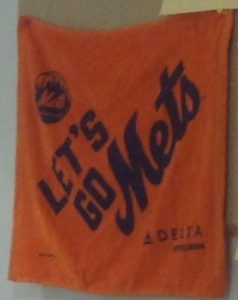 Long may it wave. ***
The following is what I wrote for and read at my dad’s service.
Today is Wednesday, and there was a time in this country that, if you watched enough television, you were reminded constantly that Wednesday was Prince Spaghetti Day. The commercial that established it as fact was very big when I was a kid. Don’t think my contemporaries on the school bus didn’t latch onto it.
When you have a name like Prince, people are going to make what they are certain are original, amusing remarks to you. They want to know how the spaghetti was last night. They want to know how much you made off your album, “Purple Rain”. In the days when you had to drop your film off somewhere to be developed, I can recall a several-minute dialogue regarding “prints for Prince”. It comes with the territory. It’s all intended in good fun, I’m sure, but after a while, you’ve heard it enough.
Mostly, the allusions are in the royal family. “Oh, you must be a real Prince!” or something like that. I’ve heard it a few thousand times, and I have a fairly innocuous first name.
Now imagine you’re Charles Prince, or as it usually winds up on a last-name-first form, “Prince, Charles.” It’s too good for people to pass up. “Oh, you’re Prince Charles!” he was told repeatedly. He always took it in good humor, as if he was hearing it for the very first time…which he wasn’t.
I don’t know what the famous Prince Charles with whom my father shared an accidental moniker is like around the castle, but whatever qualities are ideally attributed to a lower-case “prince,” my father, Charles Prince, had them in spades.
He was never less than cordial. He was ceaselessly gracious. He treated every single person he encountered with genuine respect. He acted as if nobody was beneath him.
Would you expect anything less from a prince?
I can tell you first-hand that the phrase “prince of a guy” absolutely fit this man. Which is not to say his regal bearing didn’t have a few wrinkles to it.
I knew the Prince of Absurdity, the guy who said of a vanity license plate that identified its bearer as HARRY, “Look, Greg, they turned Uncle Harry into a car.” Mind you, Uncle Harry had passed away a few weeks before, and my dad loved his Uncle Harry, and he immediately berated himself for such impertinence, but I could tell he thought it was pretty funny. And so did I.
I knew the Prince of A Lost World, the guy from a time before my own who loved to tell stories of his grandmother making him soup; of FDR talking to him and the rest of the nation on the radio; of the gentlemen who worked in the back at Prince Valet Dry Cleaning on 82nd Street in Jackson Heights and how they were so nice to him; of the wonders of the 1939 World’s Fair; of a semi-pro baseball team he referred to as the “old Bushwicks,” who played at Dexter Park; of the easily riled track coach at Newtown High who didn’t like what was written about him in the school paper; and of his buddy who wrote the critical article hiding in the closet so the coach wouldn’t find him. Dad made all these long gone personalities and places come alive for me over and over again.
I knew the Prince of Saturday Afternoons, the guy who would take me along on necessary errands. The guy who would take me to “take a haircut,” not “get a haircut” like everybody else said. The guy who put up with me screaming at the sight of the buzzer the barber used to clean up my sideburns. “No machine and no pinch on cheek,” he liked to tell me I told my first barber when I was two…he liked to tell me that a lot. The guy who explained, after I asked, why cabs where we lived didn’t cruise around like they did in the city (it was because it wasn’t economical, he said). The guy who told me to get in the front seat with him because he wasn’t a cab driver. This was mundane stuff, but I loved doing it with him. I learned a little more about the world every Saturday through his eyes when I was at my most impressionable.
I knew the Prince who watched TV in his boxer shorts and undershirt. The Prince who stacked newspapers practically to the ceiling because he planned to read them all eventually. The Prince who could be buttoned-up as any executive could possibly be as he spoke in hushed tones on the telephone with a candidate for a position he was attempting to fill. The Prince who would laugh uproariously if so provoked by friends or relatives or Archie Bunker or Mary Richards or even me. The Prince who prized the conceptual over the anecdotal. The Prince who used words like “conceptual” and “anecdotal” at the dinner table. The Prince who was rarely judgmental but informed me quite seriously that only an idiot would wear white socks with black shoes, go upstairs and change them. The Prince who insisted there was a wartime baseball player named Frenchy Bordagaray, which I somehow didn’t believe, but it turned out to be true. Imagine that — a kid finding out something useful from his dad.
I also came to know, in his final fourteen months, the Prince who fought a valiant fight against an insidious disease until he could fight no longer. I felt I got to know my father all over again, starting with the Wednesday, May 20, 2015, that he entered the hospital for the first time for what was diagnosed as a brain tumor; and I got to know him even more when — after he had worked so hard to regain his strength all summer — he was back in the hospital on Wednesday, August 19, 2015, with the pneumonia that sent him on his ultimate downward spiral.
The old nursery rhyme declares Wednesday’s child is full of woe. My dad was born on a Wednesday. We know he died last week on a Wednesday. We are standing here on a Wednesday saying goodbye to him. It’s not much of an advertisement for Prince Spaghetti Day, I suppose.
But my father lived 4,565 Wednesdays in total, 31,949 days in all across his approximately 87½ years. I wouldn’t call the totality of his life woeful whatsoever. He made countless lives better just for having touched them. None was better for his having been among us than mine, and I want to thank him for that.
He was truly a Prince of a Guy, and very much a helluva dad.
|
|