The blog for Mets fans
who like to read
ABOUT US

Faith and Fear in Flushing made its debut on Feb. 16, 2005, the brainchild of two longtime friends and lifelong Met fans.
Greg Prince discovered the Mets when he was 6, during the magical summer of 1969. He is a Long Island-based writer, editor and communications consultant. Contact him here.
Jason Fry is a Brooklyn writer whose first memories include his mom leaping up and down cheering for Rusty Staub. Check out his other writing here.
Got something to say? Leave a comment, or email us at faithandfear@gmail.com. (Sorry, but we have no interest in ads, sponsored content or guest posts.)
Need our RSS feed? It's here.
Visit our Facebook page, or drop by the personal pages for Greg and Jason.
Or follow us on Twitter: Here's Greg, and here's Jason.
|
by Jason Fry on 21 July 2016 10:59 am One of the great frustrations of being a fan is how different a team can look on successive days. In one game absolutely nothing works; less than 24 hours later everything does. Or vice versa, of course. Players know this far better than we do and respond to it with a studied stoicism that we sometimes misread as bland acceptance; 90% of dumb calls to sports-radio shows (which is to say about 81% of all such calls) start with the fact that fans externalize what players have learned to internalize.
A tolerably good response to this essential unfairness is to turn things around and look at them from the other guy’s perspective. (Actually this is a tolerably good response to everything, particularly in our to-the-barricades age of hot takes.) On Tuesday absolutely nothing went right for the Cubs, culminating in an excruciatingly hapless ninth-inning crash landing; on Wednesday the Cubs stuck their bats out and waited for good things to happen. Meanwhile, for the Mets … well, you get it by now. If Tuesday’s was a game that stubbornly refused to send the Mets away,Wednesday’s was a game that never came into view.
I was on my couch, happy to be back from nine days overseas and even happier that there was a matinee awaiting me. Being five hours in the future had limited me to a handful of early innings: witnessing the All-Star introductions but luckily missing Terry Collins failing to even secure his own team a participation medal; seeing Neil Walker blast a key home run; and catching a batter or two when the Wi-Fi was friendly. Now I was back, and ready for … well, for not much.
Bartolo Colon‘s location was not what it needed to be, which happens to him sometimes and makes him into the easy target he otherwise just appears to be. Colon looked odd in second-term Reagan gray polyester and grumpily resigned on the mound, knowing it was unlikely that the baseball was going to go where he needed it to. Twice that baseball lingered in the couple of inches of airspace where Anthony Rizzo most wanted to find it, resulting in fly balls so instantly and obviously gone that the normally polite Curtis Granderson barely moved his feet.
The Mets mounted a couple of fitful rallies against a very Colonesque Kyle Hendricks, most notably in the fourth when James Loney, Travis d’Arnaud and Kelly Johnson awakened with two outs to rap consecutive sharp singles. Unfortunately, Johnson’s hit had to deliver Loney from second base, a task for which express delivery is not an option. As Loney drifted continentally in the direction of home plate, Jason Heyward scooped the ball up in center and hurled it home. The play was neatly symmetrical: one hop between the grass and Heyward’s glove, one hop between the grass and Miguel Montero‘s mitt, and pretty much a textbook illustration of how to throw a runner out at home.
That’s another way to keep baseball from being maddening: appreciate whatever it gives you on the day, even if it’s a highlight for the other guy.
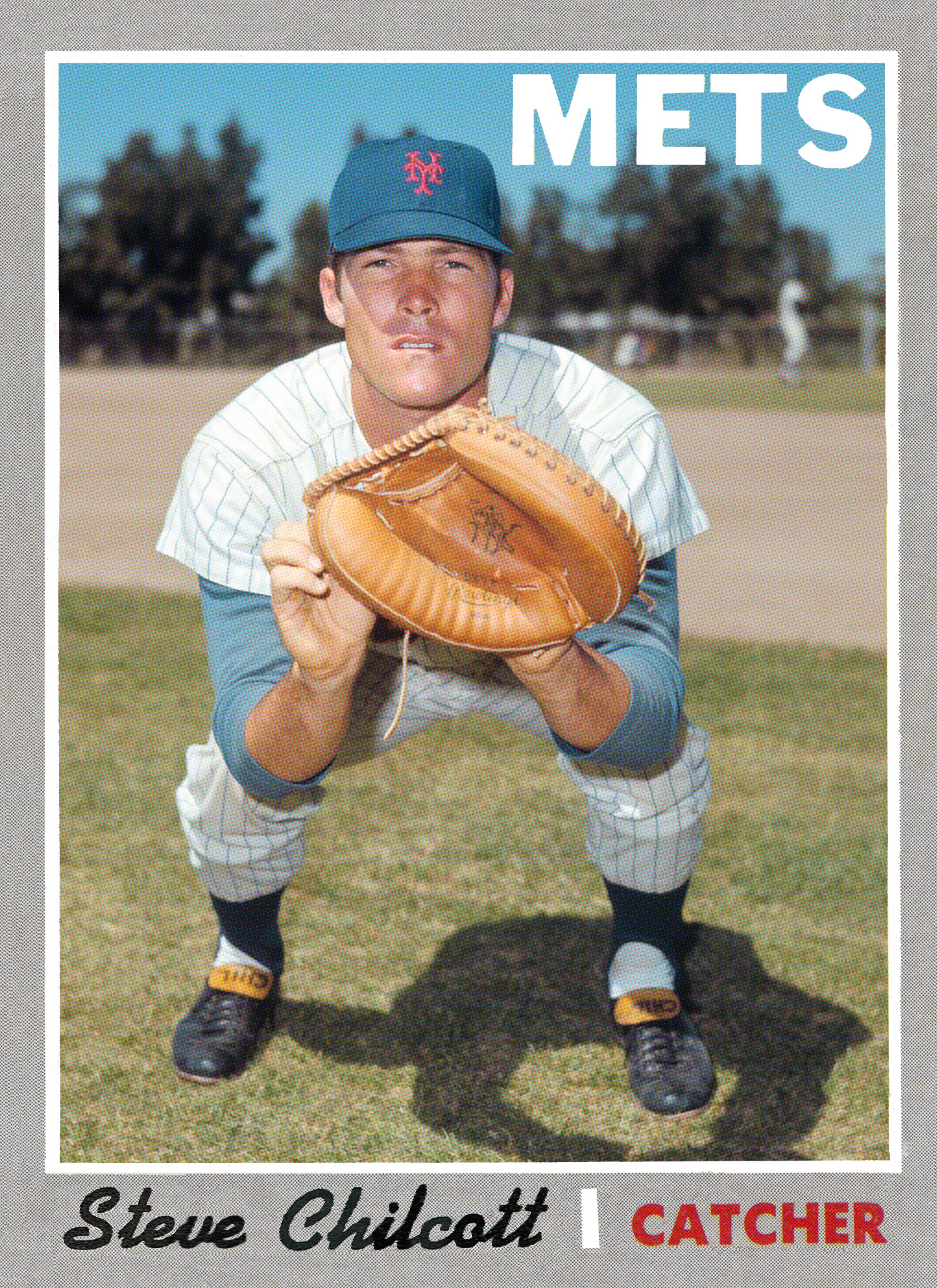
One other thing keeps bugging me, too much to leave for the full post it deserves to receive one day. During a discussion of draft picks, Steve Chilcott’s name came up and I winced, as I always do.
The Mets, you may recall, drafted Chilcott as the first pick in 1966, one place ahead of Reggie Jackson. Reggie became Reggie; Chilcott became a punch line.
What kind of punch line depends on the context. Sometimes it’s that the Mets are and have always been the Mets, ready to screw up their next two-car funeral. Other times it’s that the mid-60s Mets were run by racists who disliked rabble-rousers and other free-thinkers.
 What might have been. Either narrative ignores the fact that Chilcott was a pretty good player: he hit .500 his senior year at Antelope Valley High, with 11 home runs in a 25-game season. Whitey Herzog, a key architect of the Mets and the man who should have succeeded Gil Hodges as manager, recalled that he polled the other teams after the ’66 draft and the vote for Jackson over Chilcott was a skinny 11-9.
Chilcott didn’t do much in two stops in ’66, but was having a fine year at Winter Haven in 1967 when his career took a disastrous turn: he dove awkwardly back into second on a pickoff attempt, dislocating his shoulder. The injury never healed properly, leaving Chilcott saddled with constant pain and unable to throw effectively. He tried surgery in 1969 but was out of baseball by his 24th birthday.
That’s half of the story; the other half concerns what the Mets might or might not have thought of Reggie Jackson.
Rumors that race had something to do with the Mets picking Chilcott over Jackson go back to 1969: Reggie told one interviewer that “there are other reasons they didn’t pick me, and it isn’t what they put in the papers. Other people in baseball have told me why I wasn’t drafted by them.”
Mets GM Johnny Murphy rejected that: “We needed a catcher more than we did an outfielder when that draft came up and our reports indicated that Chilcott was a better player, certainly a better prospect. Every time I read about Jackson hitting another home run I appreciate how wrong you can be in your judgment.”
Checking racial boxes is a dubious strategy regardless of one’s intentions, but perhaps it’s worth noting that the Mets at the time were trying to develop an outfield featuring Cleon Jones, Tommie Agee and Amos Otis (three Mets from Mobile), saw Ed Charles as their spiritual on-field leader and had just traded for Donn Clendenon.
Still, Murphy hadn’t run the Mets when they selected Chilcott — that was still George Weiss’s department. Weiss’s Yankee tenure wasn’t one of the more glorious periods of baseball integration, to say the least, and a number of black players of that era heard rumblings that they’d been traded or passed over because they dared to date across interracial lines. This piece about Jackson and the Mets discusses their experiences, including those of Vic Power, who was buried in the Yankees’ farm system under Weiss.
In later interviews and autobiographies, Jackson said the Mets’ issue was that he’d dated white women and had a Hispanic girlfriend at the time of the draft. Jackson said Bobby Winkles, his Arizona State manager, warned him that he wouldn’t get picked first because of that. (Winkles has denied that.)
Reggie Jackson, of course, says a lot. My suspicion is that it still eats at him that he wasn’t the top overall pick. Combine that with having had to deal with a lot of toxic shit as a young black star (and as a not so young one) and you get a narrative that’s convenient for a lot of people, starting with Jackson himself.
As for the Mets, who knows? They did have a number of promising outfielders in ’66, and a glaring hole at catcher. Yet it’s also not a stretch to think that Weiss may have looked at two amateur players rated relatively evenly and opted against the one who would attract attention — for his temper and his mouth, certainly, and perhaps also for his dating habits.
We’ll never know — it’s far too late to ask Weiss. But what bugs me is once again we’ve lost sight of the man who’s been reduced to the punch line.
Steve Chilcott didn’t turn out to be Reggie Jackson, but he was a good enough player to hit .290 as an 18-year-old in the Florida State League. He got hurt, as innumerable baseball players have before him and will after him. That’s not his fault, or the Mets’ fault. If there’s any lesson in it, it ought to be the one baseball drums into players and fans alike — that this is an unfair game, one that will drive you crazy if you let it.
by Greg Prince on 20 July 2016 10:11 am Sometimes you look at the screen and you know you’re doomed. Then you look at the tiny score bug in the corner of the screen and realize you’re not. You’re losing in all facets of the game, especially on the scoreboard, but it hits you after a while that the game is neither over nor out of reach. The flagship example of this phenomenon in Mets history is probably Game Six of the 1986 National League Championship Series, wherein the Mets fell behind in a hurry, 3-0 in the first, yet the Astros never increased their lead versus Bobby Ojeda and Rick Aguilera. Bob Knepper had them stifled through eight, but Lenny Dykstra pinch-hit to lead off the top of the ninth, tripled, and suddenly it was all so clear: we’re not dead. Three runs would soon score and the legend of that Game Six was only beginning.
More recently, the final game of last year’s National League Division Series followed a similar path. Jacob deGrom was nicked early, the Dodgers threatened repeatedly, the Mets were doing little against Zack Greinke, the postseason seemed to be slipping down some terrible black hole…yet, it was only 2-1 heading into the fourth, 2-2 going to the sixth, 3-2 Mets thereafter. L.A. still loomed as trouble, but the worst never materialized. Somehow we hung on.
These Felix Unger Presents Oscar Madison’s Greatest Moments In Sports are invoked here because they were evoked Tuesday night in Chicago. The Mets played one of those games that you were sure they were destined to lose. Even when they hung tough, you figured it was for naught. Even when they tied things up, you assumed it was temporary. Even when they nosed out in front by no more than the length of Murray Greshler’s proboscis, you believed it represented no more than the prelude to a lethal fall.
No way the Mets were beating the Cubs last night. Yet they did, in this dimension anyway. In most other iterations of our universe, the Mets lost badly or weirdly or both. Since the game we witnessed is the only one that counts in the only standings we see, we’ll call it a win and not ask too many questions.
Besides, “How the hell did the Mets win that game?” and “How the hell did the Mets not lose that game?”
You weren’t sure what you’d get from Noah Syndergaard and the bone spurs he briefly claimed didn’t exist (public denials of the obvious being all the rage these days), and early on, it appeared the Cubs might hammer Thor. Yet balls hit hard and deep with runners on base wound up in the gloves of Mets outfielders who played wherever their manager told them to play. Through two innings, Chicago left five men on and sent no men across.
The logistics shifted in the third. Noah struck out his first two batters (not looking fatigued or damaged in any discernible way) before surrendering a two-out double to Wilson Contreras. Syndergaard retired the next batter, Jason Heyward, on a flyout to left, but in between, he threw a wild pitch, and a scrambling, overambitious Rene Rivera followed with a dart down the left field line. Contreras enjoyed an all-expenses-paid trip from second to home, while Heyward never had to dig into his deep pockets. The Cubs were up, 1-0.
Thor’s fellow All-Star, Jake Arrieta, needed no post-break adjustment period. He dominated the Mets from the first through the fourth, facing only one batter over the minimum. The “1” the Cubs had appeared as daunting as the Sears Tower (which is actually now officially the Willis Tower, but I had to look that up, and if I said as “daunting as the Willis Tower,” I’m guessing most of you would have thought, “what you talkin’ ’bout — Willis?”). This was the Arrieta who regularly handled the Mets prior to last October and these were the Mets who didn’t hit the night before and hit only intermittently to begin with.
Jake was so awesome that he doubled to center in the bottom of the fourth with two out and, when Tommy La Stella singled to right, he was off and running to increase his own lead. Helping his own cause was the placement in right of Michael Conforto, never before a major league right fielder and known less for his arm than the Sears Tower is known outside of Chicago as the Willis Tower. Son of a gun, though, Conforto unleashed a beauty of a throw to Rivera, who reminded one and all, despite that lousy peg past third, of his defensive prowess. With a grab and a swipe and a tag, he took out the heretofore invincible Arrieta, whose Cy Young form does not include baserunning. True, it took a replay review to reverse a horrific call at the plate by old nemesis Eric Cooper, but that’s why they make video monitors. The Mets were still down only 1-0.
But c’mon, they weren’t doing anything with Arrieta. There was a tiny uprising in the fifth, including an unlikely base hit from Rivera, but all that did was bring up Syndergaard with two out. Noah, hitting résumé notwithstanding, fanned. Jake was JaKKKKKKe in the scorebook and clean on the scoreboard.
Syndergaard was getting better. In the bottom of the fifth, he filed his first 1-2-3 frame of the night. Arrieta would start the sixth by taking on Jose Reyes, prototypical leadoff hitter of a day gone by, a day that didn’t seem to include Tuesday night. Le Grand Reyes — so dubbed because he’s sure looked rusty — turned back the clock to 2006, running counterclockwise from home to third after lashing a ball down the right field line. it was Jose’s first triple of 2016, the hundredth he has hit in a Mets uniform. Curtis Granderson followed with an immediate sac fly.
The Mets, you were sure, were still losing, except they had exactly as many runs as the Cubs did. Strange game, this baseball.
Thor and his right elbow had thrown plenty through five. Terry Collins decided they could go another inning. It seemed a strange bet, given the Syndergaardian condition and his importance to the overall Metropolitan enterprise. He walked that darn Contreras to start the sixth. The Cub left fielder stole second, but then Noah went full Norse on the next two batters, striking out Heyward and Addison Russell. His pitch count was in triple-digits, the next Cub was up was a lefty and Terry decided he’d pushed the limits of his luck. Out went Syndergaard — seven hits and two walks not so great; eight strikeouts and one run pretty fantastic — and in came Jerry Blevins to thwart Miguel Montero.
Arrieta’s awesomeness was receding in the seventh. Neil Walker singled to lead off. Two outs later, Rivera collected his second single. The pitcher’s spot was nigh. A pinch-hitter was needed. Alejandro De Aza was called upon.
Less than mighty Alejandro (.179) struck out. It was Jake’s eighth and final K of the night, dealt to his final batter of the evening. He permitted five hits and one walk. He was far more in command of his side of the ledger than Syndergaard seemed to have been of his, but “seem” is unseemly in a sport that keeps count of one indisputable fact: the score. It was still Cubs 1 Mets 1. Even it continued to feel like we were behind, we weren’t. Feel, like seem, is all very subjective.
Hansel Robles was efficient in the bottom of the seventh. Pedro Strop was more so in the top of the eighth. Robles stuck around for the bottom of the eighth and gave the Cubs nothing. Hector Rondon came on for the top of the ninth. The Mets would be sending up a stream of their solid, admirable veterans few of us ever gave a second thought to until they arrived among us.
James Loney, long of the Dodgers, singled the other way, in his case to left. Walker, hometown Pirate, grounded into a double play, immediately firing up an escape pod for Rondon and the Cubs, who would presumably alight in the bottom of the ninth positioned to ruin the Mets’ adorable efforts to keep pace with Joe Maddon’s children of destiny, hey, hey, holy mackerel and all that. Except it wasn’t a double play. The relay to first to nail Walker accomplished no such thing. It was just another horrible umpiring miscue, fortunately corrected by the blessing that is MLB replay review.
Replay rocks…when it works on our behalf.
With Walker on first, Cabrera from Cleveland singled to right, sending Neil to second. Rivera, defensive specialist/eighth-place hitter who kept his past well hidden from me until we acquired him (he’s a Tampa Bay refugee, I eventually learned), did what Loney did. He went the other way off Rondon. Rene’s third base hit of the night was served to right. Walker ran from second to home successfully.
The Mets had taken a lead in a game they, I swear, were never in. They led, 2-1, in the ninth (on a hit delivered with a runner in scoring position, praise be), and continued to have under contract the best closer in creation. On some level, this could be comprehended as an advantage for the team in the lead.
But this seemed and felt fishy. Jeurys Familia’s streak of not blowing saves had gone on forever. The only thing that dated back further is Wrigley Field, and how can the Mets play a night game in Chicago and not have something about it backfire dramatically? It’s the cost of doing business most seasons. A dramatic home run would screw them effectively, though some sort of passed ball would be plenty cruel, too.
Familia’s on in the ninth. He walks Russell. He walks Montero. Four or five walks in a row would be so unfathomably over the top enough that it could be nominated by a major political party, but it’s not like it couldn’t happen and potentially destroy our way of life. Ah, two walks was plenty. Two walks constituted the seeds of pending destruction. First and second, nobody out. The last time Jeurys was on the Wrigley mound, Gary Cohen noted, it was to celebrate a pennant. Of course he was due for penance.
Javier Baez came up to bunt the runners over. He chopped one toward third. Reyes, a third baseman for a good coupla weeks now, charged, grabbed, threw and…
Wasn’t that gonna go foul? Probably.
Did Jose get Baez at first? No.
Damn.
OK, now the bases are loaded, nobody’s out, the game is tied, the game won’t be tied for long, because there’s no frigging way this isn’t going to mushroom in spectacular fashion.
Matt Szczur bats for Rondon. He grounds sharply to Loney. Loney throws sharply to Rivera. Russell is out. Everybody else is safe. Albert Amora, Montero’s pinch-runner, is on third with the tying tally. Baez stands on second with the heartbreaking winning one. There is nowhere to put anybody.
Except out, like Fred Flintstone would do with the cat in the end credits to a show I watched every day after school without ever actually enjoying it.
Someday, maybe Fred will win the fight.
Then that cat will stay out for the night.
Fred rarely won any battle on The Flintstones. But when the whistle blew, he knew it was time to slide down the dinosaur and head for home. In this more modern age, our ninth-inning protagonist Jeurys knew if he wanted to punch out with a clear conscience, he had to keep Amora and Baez from heading for home. But how?
How about a Kris Bryant grounder to the ever aggressive Reyes, who, instead of firing to Rivera for one excruciation-extending forceout at the plate, went around the horn, throwing a little low to Walker, who stretched for the putout that offed Baez? Walker, in turn, pivoted and sent a slightly wayward bullet to Loney. Loney had to be a bit gymnastic to receive the delivery on a short hop, but he did.
Such a sequence of events is spelled, in baseball shorthand, 5-4-3, as in game-ending double play. The Cubs, with the bases loaded and nobody out, lost, 2-1. The Mets, on the other end of that exact equation, won, 2-1.
How the hell did that happen? Exactly as detailed above, but seriously. How the hell did that happen?
by Greg Prince on 19 July 2016 10:24 am Let’s see what we’ve got in the outfield:
Cespedes in left. Lagares in center. Granderson in right.
No, Conforto in left. Cespedes in center. Granderson in right.
Wait, Cespedes doesn’t want to play center. As dinged up as he’s been, and given how important it is to keep him in the lineup, it’s probably best to accede to his wishes.
Though he’s supposed to be in center tonight. But not much more after tonight.
Cespedes has such a great arm. He showed it off Monday night. It’s a perfect right fielder’s arm. But he wants to play left, where he’s really good…though he made a bonehead play there in the same game that he made the great throw.
He tends to make those bonehead plays in center.
So Cespedes is in left. Which is where Conforto played before being sent down. He wasn’t great at it, but it was the position he knew how to play best.
Like with Cespedes, we’re mostly concerned that Conforto hits. He hit in Vegas. He hit to the opposite field in the Mets’ last-chance, mostly useless ninth-inning rally just before the Mets lost Monday night’s mostly useless game to the Cubs. That was useful to see. Along with Cespedes’s early throw to nail a runner at home, and Flores’s homer, Conforto showing he had honed his approach while at Triple-A represented the highlight of the game.
We shouldn’t overlook Lugo’s solid relief, either, though when you identify “Lugo’s solid relief” as a highlight, it’s probably a bad sign for the night overall. No offense to Seth Lugo, but I actually forgot he was on the active roster.
Anyway, can Conforto play center? Can he play right? He played a little right in Vegas, didn’t he?
What about Granderson? Granderson used to be a center fielder. As is, he’s a really good right fielder, except for throwing. He throws like a barely adequate left fielder, which is the opposite of Cespedes, who’s primarily a left fielder, who throws like a really terrific right fielder. He throws well from center, too, but he’d rather not play center.
Conforto’s not a center fielder, but he might be.
Which leaves Lagares where again? Lagares was the best defensive center fielder the Mets ever had for a couple of years, then not much of anything offensively or defensively last year when he was hurt, lately better at both, even though he’s been battling his own injuries.
Lagares should be in center most of the time. Unless you can convince Cespedes to go back there. Or get Conforto used to it. Or get Granderson over there from time to time. Or make room for Nimmo.
Oh wait, Nimmo is back in Vegas. Lugo is here, Nimmo isn’t. Nimmo will be back soon, I imagine, though where he’ll play doesn’t seem obvious.
Same could be said for Flores, who hits when he starts, which isn’t often. Wasn’t there some talk at some point of trying Flores in the outfield? That ended quickly.
Come to think of it, didn’t they say something similar about Reyes, that he was going to play some third, some short, some second, some center, even though all he had ever played was short and a bit of misguided second a long time ago? Reyes somehow became the everyday third baseman at the same instant Flores became red hot.
Reyes has played a pretty good third base, but the leadoff catalyst element of his game has been a work in progress. Then again, neither Granderson nor Lagares nor Nimmo, albeit in a small sample size, was setting the top of the order on fire.
So Reyes isn’t playing the outfield, which is OK, since he’s not an outfielder and we have plenty of outfielders, but it seems to cramp Flores’s playing time. Flores isn’t an outfielder. He was a shortstop most of last year who was moved to third this year when Wright got hurt, and he occasionally plays first, but not much, because we have Loney. Plus Walker and Cabrera, who play Flores’s other positions, never sit. Walker, I heard, could play some third, but he hasn’t yet. Also, Johnson can play everywhere but never plays anywhere anymore.
That’s Kelly Johnson, in case you’d lost track of him. I have to admit I did. I saw “Johnson” was pinch-hitting last night, and for a moment I wondered who Johnson was.
Johnson didn’t get a hit. The Mets got only six hits. One of them was Flores’s home run, which came with nobody on. The Mets lost, 5-1. They have lots of potential outfielders. They could use more actual hitters.
by Greg Prince on 18 July 2016 12:01 pm I traveled to the Meadowlands a couple of Septembers ago for a Giants game. In the first series executed by the home team, a run for four yards on 3rd and 1 produced a first down. My host for the afternoon, as True Blue a fan as there is, could not have been happier to have seen the ball move from his team’s 29 to his team’s 33.
“That,” he exulted to me, “is Giants football!”
Some franchises are eternally identified with a certain style or trademark, regardless of how they’re playing in a given era. Giants football has indeed always meant effective rushing and stifling defense. The Lakers will always be Showtime in the mind’s eye. The Celtics must have a killer Sixth Man lurking somewhere on their bench. The Raiders are supposed to be marauders. You say “New Jersey Devils,” I still think “neutral zone trap”. The St. Louis Cardinals and Baltimore Orioles are assumed fundamentally sound, thanks to their respective Ways.
The Mets? The Mets are a convincing complete game shutout from an outstanding starting pitcher on a sunny weekend afternoon. That is Mets baseball, certainly to me.
Sunday from Philadelphia, I watched quintessential Mets baseball. I watched 2014 Rookie of the Year, 2015 National League All-Star and Wilson Defensive Pitcher of the Year Jacob deGrom throw nine innings and give up no runs. I watched the Mets score enough runs (five) to not require a pinch-hitter to prepare to bat for deGrom. I watched deGrom maintain a low enough pitch count (105) so that the bullpen did no more than perfunctorily stir in the ninth.
DeGrom’s line was so simple as to be beautiful: nine innings, seven strikeouts, one hit, one walk, no runs, no trouble. Add in the dazzling handling of a Cody Asche would-be bunt base hit; a two-out single deGrom’s second time up; and Jake coming around to score the Mets’ second run from first on Jose Reyes’s subsequent double into the gap, and some kind of day it had been. It was not a perfect game, but it was perfect. I love Mets baseball when it’s definitively Mets baseball. The Mets, at their best, are defined by a Jacob deGrom-type pitcher having a Jacob deGrom-type day.
You may have noticed I slipped that “one hit” allowed in there without fanfare. A one-hitter can be crushingly disappointing if a no-hitter is in play, but deGrom gave up his lone hit with two out in the third, to opposing pitcher Zach Eflin. Not that I wasn’t already contemplating how good deGrom looked and how possible it was that the Phillies might not touch him at all, but it was too early to be edgy about it, and besides — June 1, 2012. We’re good. We were also good the Santana start before his no-hitter, on a sunny Saturday at Citi, when Johan threw the kind of throwback complete game shutout deGrom did Sunday.
Tom Seaver threw a one-hitter in Philadelphia in 1970 in which the only opposing hit was generated in the third inning. The batter then was Mike Compton, a name that does not really live on in the pantheon we associate with dreamwrecker deluxe Jimmy Qualls. It could by all rights, considering catcher Compton totaled only 18 hits in his brief big league career, or 13 fewer than Qualls. But Compton’s hit of note happened six innings earlier than Qualls’s had ten months before, so some one-hitters get themselves accepted at face value.
We can take Jake’s as such, even if Eflin’s straight outta Compton single was only the third hit of his rookie year. It seems ungracious to rue the one at-bat that didn’t go deGrom’s way when all the others did. Jacob was in command from start to finish, accent on finish. Nobody else had to pitch for the Mets. Thanks to three runs off Eflin and two off Andrew Bailey, nobody who was in the lineup in the first wasn’t in the lineup in the ninth. The Mets were comfortably ahead by the fifth, prohibitively so by the eighth. Substitutions could be left to Pete Mackanin and, for that matter, Red Auerbach. It was a smooth afternoon, the kind Seaver and Gooden regularly gave us sans ceremony back in the day. I understand we live in a different day. I understand why it’s rare in the present. A little taste of what made the past so appealing when the past was the present, however, can be quite welcome any day. Especially on a sunny Sunday, though that’s a matter of personal preference.
A Mets win (in which no Met aggravates a quad or other body part) is a good Mets win, period, but a Mets win in the tradition of Mets wins as you picture them when you picture Mets wins…well, gosh, that’s baseball like it oughta be.
by Greg Prince on 17 July 2016 12:48 am I can’t prove it, but Met losses to the Phillies are the most annoying losses there are. The Phillies have become the new Marlins.
Move over, Miami. You’re no longer quite that team.
All losses are the worst, and I don’t doubt that if you catch me after a defeat at the hands of the Dodgers, the Padres, whoever, that I will testify that the experience was particularly awful. But losing to the Phillies has lately left me more annoyed than I can remember being toward anybody since the heyday of the useless Marlins (not to be confused with the contending Marlins, who are a whole other kettle of undesirable fish).
This has nothing to do with the dormant Mets-Phillies rivalry, a feud without fuse for a few years now, what with us relatively up and them undeniably down. I don’t like seeing Ryan Howard and Carlos Ruiz thawed out, but even the presence of unfrozen caveman first baseman and catcher doesn’t automatically stoke the old competitive fires. It has nothing to do with the feisty fans down the Turnpike. I don’t even have it in for any given Phillie.
That’s probably the thing. There isn’t an Utley or a Rollins in the bunch, not yet. They may possess pockets of talent, but they’re not hateful. Yet they do something against the Mets more consistently than any other opponent.
They win almost only close games against us. Check out the scores of every game the Mets have lost to the Phillies over the past three seasons.
3-2.
5-4.
6-5.
6-0.
7-6.
7-2.
3-1.
14-8.
4-3.
7-5.
3-0.
1-0.
5-2.
5-4.
And, on Saturday night, 4-2.
That’s fifteen losses since 2014 (not a terrible ratio for a team we play nineteen times annually). Twelve of them were in save opportunity range, no more than three runs. Six were by one run. I can’t the say Phillies 14 Mets 8 was aspirational, exactly, but if you have to lose, you don’t mind once in a while sucking it up early and moving on.
You can’t do that in these Phillie losses. You know the games could’ve been won and it irks the hell out of you they weren’t. All it would have taken was one hit with runners in scoring position; one more suitably deep fly ball with a man on third and less than two out; one fewer ball thrown away; one luckier bounce; one less sign of vitality from the otherwise cryogenically preserved remnants of the Phillies we used to hate on merit.
The Mets did several things well Saturday night. There was a large enough sum of parts to win, but not enough of a whole not to lose. The game didn’t break their way. Some games won’t. Sometimes you’re comfortable with a shrug. Against Philadelphia, it’s too close to rhetorically ask, whaddayagonna do?
You’re gonna get another hit, make a better throw, keep a runner from taking an extra base. You’re gonna not wonder how you lost to these guys when the game was so winnable.
You should, anyway.
by Greg Prince on 16 July 2016 12:31 pm When the Mets’ lineup was first posted in the late afternoon, I stared at it blankly. It might as well have been nine total strangers. I knew they were they players on my team, I knew I had waited for my team to begin playing again, I just didn’t feel any connection to their identities.
When the Mets game got underway, I turned it on and continued to stare blankly. Had it really been so long a time? I felt traces of what I experienced after baseball attempted to emerge from six days of national mourning on September 17, 2001, or when it shook off nearly two months of labor relations rust on August 10, 1981. Who were these guys? What were they doing here? Why would I possibly be interested?
I don’t think it was the five days between the first half and the second half that sapped my sense of fandom. My All-Star break became a little unorthodox, you might say, and though I won’t pretend to have not thought about baseball since Wednesday morning (I certainly threw myself into the 30 For 30 that profiled Dwight Gooden and Darryl Strawberry, because no way that would take a horribly depressing turn), the actual baseball season in front of us, the one in which the Mets were in a playoff race, wasn’t registering with me.
The Mets are tied with who?
They’re how many games behind or ahead of what?
Jose Reyes is on the team again?
Juan Lagares is on the team still?
Neil Walker is No. 20?
Keith Hernandez said the first game after the All-Star break was always a little disorienting for him as a player. As a fan who had his head in other matters, I could identify with that sensation. It took me a few innings to feel my way back into the 2016 season. At first, Bartolo Colon was either helping or helping a little too much by plowing through the Phillies as if they were six inches of powdery snow. It was effective for the Mets, but it wasn’t letting me get my bearings. The game was a third over in about 45 minutes. It was almost as if wasn’t actually happening.
Then it became a Mets-Phillies game, which is to say it got bogged down here and there in long at-bats and pitching changes and threats not so quickly quelled. Nevertheless, the Mets never trailed, thanks to Colon (5.2 IP), Lagares (a long solo shot in the third), Walker (a huge if not long three-run job in the sixth), Reyes (surprisingly surehanded at third) and, most of all, that Amazin’ Met bullpen.
Given the mercurial natures of bullpens, I don’t know how often I’ll get to say something like that, so we’d better luxuriate in their excellence while we can.
Due respect to Hansel Robles (who rescued Colon), Jerry Blevins (who LOOGY’d for a batter) and Addison Reed (who cleaned up the seventh and inoculated the eighth), here’s to Jeurys Familia and the way he locked down the ninth inning…let’s make that the way he locks down the ninth inning, as in he does it all the time.
I wanted Familia to pitch in the All-Star Game because I wanted all of America (or the tiny sliver that tunes in to what used to be a galvanizing event) to witness Jeurys doing his thing at his peak. I wanted Joe Buck and John Smoltz to read his statistics, lavish him with praise, explain the Mets wouldn’t have gotten where they did without him in 2015 and wouldn’t have a chance to the same in 2016 without him. I wanted to hear a few notes of Don Omar’s “Danza Kuduro,” a.k.a. the song Jeurys trots in from the bullpen to before it segues into “Are You Gonna Go My Way” by Lenny Kravitz.
I didn’t get to do that on Tuesday night. That was a shame in the moment, but the moment moved on to Citizens Bank Park and a game that counted and a reliever we count on for good reason: he comes through on the regular. So it was again in this Friday night 5-3 affair, where the Mets were ahead, but not out of range. Familia could have had a bad outing. It has happened, if not lately. Goodness knows closers don’t always slam doors, and the price to pay for the slightest state of ajaredness is overwhelming doubt. We doubt he can be trusted and maybe he doubts he can be trusted. Before you know it, it’s all the closer’s fault for daring to throw Ball One once in a while.
It’s all to Jeurys Familia’s credit that the ninth was never in doubt. He struck out Cody Asche. He grounded out Freddy Galvis. He struck out Cesar Hernandez. He had his trademark sinker fully functioning and he never looked anything but in total command of the situation. Fourteen pitches, ten strikes, good night, Philadelphia. Maybe America can see him do this again in a few months. Until then, we’ll keep watching.
***
Thank you to everyone who passed along such kind thoughts in the wake of my father’s passing. Your words of empathy and encouragement meant and continue to mean a great deal to me and my family.
by Greg Prince on 13 July 2016 1:10 pm Do you remember R.A. Dickey shutting down the Mets last June in Toronto and then letting it be known he was pitching a couple of days after his father’s death? Taking the ball was something his manager, John Gibbons, said he felt he had to do. That stayed with me in light of my father at the time attempting to recover from his recent brain surgery. I wondered whether if placed in the same situation soon — not inconceivable, given the long odds my dad faced — I’d want to write about a baseball game like I usually do.
It turns out I do.
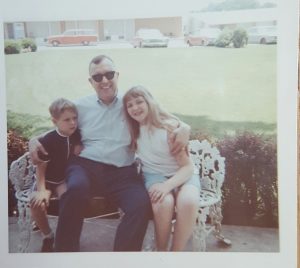 Dad, flanked by admirers, the year before I began thinking about baseball. My father, Charles Prince, died in the early hours today. He was 87. Those of you who’ve faithfully read this blog over the past fourteen months are probably aware of the ordeal he endured, one which I am frankly thankful is over. If you’ve read my occasional dispatches tracking his journey from diagnosis to rehabilitation to relapse to inevitable decline, you are probably also aware that baseball often provided the two of us with an oasis from the onslaught of discouraging medical news. We watched a pennant race together. We watched a postseason together. We watched a World Series together. We even got one final Spring Training game in together.
Clearly there are things in life more important than a baseball game, especially a baseball game with no impact on the standings. But after this past year-plus, I wouldn’t call any baseball game meaningless, not if being distracted by it for a spell puts you in a better place.
Today, my mind is necessarily elsewhere, yet it keeps drifting back to last night, hours before I got the phone call to tell me my father died. It drifts back to the last baseball game I watched while my father was still alive, when I worried about him, but couldn’t technically say I missed him. I did miss him from when he was truly himself, of course, but he wasn’t in the past tense on Tuesday night. Now he is. It’s strange.
It’s also strange that despite nothing being more important in my thoughts right now than recalling the man I knew and loved, I’m still irked at how last night’s All-Star Game went down. Not so much that the National League lost, but where, from an admittedly parochial perspective, the National League’s manager went wrong.
In conversations today, I’ve discussed two subjects: my father dying and the All-Star Game. Perhaps it’s an outlet. Perhaps it’s compartmentalization. Perhaps I just have skewed priorities. I do know that thinking about an allegedly meaningless exhibition game somehow feels better than dwelling on the reality that is never going to leave me.
I don’t need a tissue, thank you. I need to write like I usually do.
Specifically, I need to blog about Terry Collins mishandling his most simple task as All-Star Game manager: get one of the Mets on the mound for a minute at least.
To be surprisingly human about it, Terry looked awfully tired in his postgame press conference, and I really do hope he’s OK. He’s 67, he’s a month removed from an unforeseen hospital visit in Milwaukee and he was working without the usual built-in break most baseball people are granted in July. No doubt everybody wanted a minute of the National League manager’s time. Throw in the additional transcontinental travel, and I’m sure the experience wore on him. When he was shown listlessly answering questions Tuesday night about his leading the N.L. to its annual midsummer defeat, he looked like he wanted nothing more than a decent nap on the flight home.
So I hope Terry’s all right. I also acknowledge All-Star Games have a Brigadoon quality to them. By Friday, few will much remember the 2016 affair. Terry’s gaffe — and I do believe it was a gaffe — will dwell primarily in our collective subconscious as we get back to games that count (I mean really count). It won’t spring back to a full-blown existence until “that time the manager didn’t use any of his own players” becomes an overcited anecdote in July of 2017, then July of 2018, then probably forever more.
Despite my concern for the well-being of the manager and the grip I have on the scheme of baseball things, I do think Terry mishandled his assignment. If you’re the All-Star manager, you have two public relations responsibilities: get somebody from the host team in the game if he’s in your league; and take advantage of the rare opportunity to show favoritism to the players from your club. Terry took care of the Padres. He didn’t take care of the Mets.
His stated strategy of holding out Jeurys Familia for the ninth with a lead and Bartolo Colon for extras in case of a tie crackles with logic on paper, but by two out in the bottom of the eighth, as the American League batted (they were the designated home team because MLB is silly that way), the National League was down by two, with only one of fifteen participating senior circuit clubs not having had one of its players enter the fray.
You know which one.
Terry and his college of coaches — did you ever dream you’d see so much of Dick Scott on national television? — didn’t pause to improvise a contingency plan. With the N.L. behind and not guaranteed of roaring back, it was an ideal moment to call Familia in from the bullpen. Jeurys has been the best closer in the league this year. He is the unsung hero of many Mets wins. He’s as good a reason as anybody that Terry was granted the honor of wearing a ridiculous batting practice jersey to begin with.
But let me not be too altruistic about this. I really like Jeurys Familia being our closer. I think he may be the best we’ve ever had, certainly from the right side of the menu. Yet my dismay that we didn’t see him face one batter isn’t generated only for him. This one was for us. This is the only high-profile game in the course of a year that is conducted with minimal competitive implications, almost solely for the enjoyment of the fans. The enrichment of corporate sponsors, too, but mostly the fans. World Series home field or not, you can mess around a little.
They mess around a ton. If they didn’t, they wouldn’t make substitutions all night. Terry had one final substitution to make, and it was simple: substitute a Met into the game. He didn’t have Yoenis Cespedes. He didn’t have Noah Syndergaard. He definitely needed a long man kept available, so, fine, he didn’t have Colon in the single-digit innings (and even I would have resisted the temptation to pinch-hit at Petco in a two-run game). But he had Familia. He had a Met. He is the Met manager. If you’ve somehow landed the All-Star gig, you make your fans happy. You don’t even have to think about it.
Terry clearly didn’t. Jeurys didn’t pitch. The N.L. neither tied nor led in the ninth. On a broadcast in which it was proclaimed Collins judged it vital to make sure every team’s uniform was represented on the field of play, one style of clothing was conspicuously absent…unless you count Terry trudging to the mound to exchange Fernando Rodney for Kenley Jansen. In that case, yeah, we saw a Met on the field.
Yippee.
Three years ago, Terry’s professed professional role model, Jim Leyland, was managing the American League at Citi Field. It was going to be Mariano Rivera Night, whether we wanted it to be or not. Rivera was an icon because of how he pitched ninth innings. Leyland understood there might not be a ninth for an A.L. reliever to pitch. Thus, he determined ahead of time that Rivera would pitch the eighth. Mariano mission (such as it was) accomplished.
Something like that was all Terry needed to do. The script was simple to follow:
“Jeurys, Kenley, take a knee, fellas, let me tell ya what I got in mind for you two…if we’re behind, Kenley, I’m using my guy, since one of your teammates will already have been in. And Jeurys, Kenley’s gonna finish the eighth if we’re ahead, so be ready in the ninth.”
Not that hard.
Now for a commercial message:
Please don’t tell me that the non-use of Familia or, for that matter, Colon, is some kind of stealth victory for the forces of good because neither got hurt, and you can’t get hurt if you don’t play, so what a genius that Terry is for unrolling the virtual bubble wrap. If that’s how we’re gonna handle the All-Star Game, mail everybody selected a certificate and don’t bother me with three hours of Joe Buck. Players from 29 other teams (give or take Oakland) risked life and limb so not only they’d enjoy a moment in the proverbial sun, but so their fans at home could say “yay!” before getting back to staring out the window and waiting for the second half. Besides, Familia hadn’t pitched since last Thursday and won’t pitch any earlier than this Friday. If he’s not concealing one of those ever popular bone spurs, he can throw to a batter.
Now for a caveat:
Come season’s end, if Jeurys is pouring champagne over Bartolo’s head and they revel in having been kept fresh in San Diego while all those other chump players exerted themselves during the meaningless All-Star Game, then Terry’s a freaking genius. I’ll accept that conclusion if it comes to pass and offer a full Met-a culpa.
I watched the 2003 All-Star Game in which the lone Met representative, pity pick Armando Benitez, didn’t appear. That’s the way it goes, I reasoned. Same thing in 1994, when Bret Saberhagen was the extent of our delegation. Same thing in 1978, the year of Pat Zachry. Managers are more conscious of “everybody plays” these days, but you can only do so much. Sometimes somebody’s gonna sit.
The difference in 2016: Terry Collins manages the Mets. The Mets manager almost never manages the All-Stars. Only in four other instances did a Terry predecessor get the chance. You know what Gil Hodges, Yogi Berra, Davey Johnson and Bobby Valentine had in common? They all got at least one Met in the All-Star Game they managed. It didn’t seem too much to ask.
by Greg Prince on 11 July 2016 4:10 pm The 2016 baseball season began approximately ten minutes ago and is now more than half over. It has tied the major league record for how quickly time flies, set in every other baseball season. Even the ones that drag zip by before you know it.
Embroidered in the fabric of the baseball season to remind us how much we value every second of it and how we can’t have a second more of it than it is willing to give us is the All-Star break. It is here and we can’t do anything about it.
The All-Star break is cruel. Four days, no Mets games. Boo.
The All-Star break is kind. Four days, no Mets games. Still boo, but maybe just a little all right, let’s regroup.
The team we watched Sunday needs a break. It scored two runs on solo home runs (both off the bat of the guy it’s still weird to see here) and nothing else. The team it faced won primarily because it has the guy it’s still weird to see there — plus they were facing a Mets team in need of a spa visit if not a full-blown vacation.
Three consecutive losses to the Nationals closed out the first “half,” or 53.7%, of 2016, diminishing the shine from the seven wins in eight games that preceded the present mercifully interrupted comedown. 2016 has been a lot like that. There’ve been some wonderful stretches encompassing games that prove how great these Mets can be. Then they end and are replaced by spans in which you can’t imagine the Mets getting from home to first without a medevac copter, except one isn’t available because it’s being used to transport somebody’s bone spur to the nearest MRI machine. When they’re playing like that, even the wins — layered with runners abandoned on base and the .158 batters who left them to wither — seem somehow at odds with the concept of winning.
When the Mets look good, we are reminded why the overriding question entering 2016 was “World Series or bust?” Ah, April hubris. There is so much space in between World Series and bust. The Mets are occupying the upper echelon of the squishy middle. They’d be in some sort of playoff if the season ended today (it doesn’t; it only feels like it has). They wouldn’t automatically be in the playoff we’d want, the one where they naturally go on to capture the little bit of reward they missed out on in 2015. Reward doesn’t come so easily for our Mets, though to be fair, twenty-nine other teams’ fans would swear the same circumstance befalls the objects of their affection.
Perhaps the Mets’ dead-arm/strained-quad period will cease when play resumes Friday night, setting up the second “half,” or 46.7%, as an invigorating sprint to the finish. Or perhaps things will lurch forward with bursts of joy punctuated by potholes of angst and it won’t seem long at all before I’m writing pieces in, say, 2022 swearing that 2016 wasn’t all bad — seriously, Cespedes had a monster first half and Colon homered and Familia had that streak and Thor was amazing, and that was just before the All-Star break.
I’m lousy at pretending to know what comes next, let alone knowing what comes next or insisting what should come next (agendas make me allergic). Steve Winwood would categorize me as a roll-with-it type of fan. When the Mets win, I’m going to express excitement. When the Mets lose, my irkedness won’t be particularly well-concealed. Perspective I can always sprinkle in on the other side of the semi-colons. I suppose I could use a break, too, but what I’ll want by 7:10 tonight is another Mets game I can react to accordingly. Like you, gentle reader, I shall just have to wait a few days.
***
• I was a guest on WFAN’s Talking Baseball With Ed Randall Sunday morning. The hook was my book, Amazin’ Again. We spoke primarily about the 2015 Mets, with jaunts into the present club’s situation. I even took listener calls, including one from a bright fellow referring to himself as “Jeff from Maryland”. The spot developed quickly, so I didn’t have a chance to let you know about it in advance, and unfortunately the station didn’t post audio from the program on its site. But, quite frankly, there’s no chance that, as a no-time caller/long-time listener, I’m going to let the opportunity to say “I was a guest on WFAN” slip by without making note of it here. My thanks to Ed for having me on and my thanks to those who did hear it for telling me they liked it.
• We’re a week past the annual commemoration of the July 4-5, 1985, game in Atlanta, but after 31 years, what’s a week? I recall a couple of moments from the marathon that ended at 3:55 in the morning for Vice Sports here.
• If it’s All-Star break time, it’s midseason roundup time for the guys at On The Sportslines. I join them at the 6:00 mark here and sound relatively optimistic about our Mets, so you know this program was taped before the Nationals series really kicked in and kicked us.
• New Jerseyans! Mark Monday night, August 8, 7 PM, on your calendar for my rescheduled first appearance in the Garden State. I’m coming to Little City Books in Hoboken to discuss Amazin’ Again and related Met matters. The original date had to be postponed because — no kidding — an adjacent establishment plans to challenge the record for most guitars played at once. It’s hard enough for one voice to be heard above the din most nights as is. Anyway, if you’re in the neighborhood (or care to be), I hope to see you there. And, yes, it is an off night on the schedule.
• As long as I’ve brought it up, thank you to everybody who has bought and/or read my book on how the 2015 New York Mets brought the magic back to Queens. If you haven’t, well, of course I urge you to buy/read it, but I wanted to get in a plug for those who have already done the Wright thing. Your actions are most appreciated.
***
Whether you’re seeking a copy of Amazin’ Again or, if you’ve got that one covered, you’re looking for something else to enhance your life, I’d recommend supporting the folks that have supported my efforts. If it’s convenient for you, please consider directing your business toward one of the following fine establishments:
• Bergino Baseball Clubhouse in Manhattan. (An entire National Pastime experience.)
• Foley’s in Manhattan. (For your baseball-immersed drinking and dining pleasure.)
• Turn of the Corkscrew in Rockville Centre. (Books and wine.)
• WORD in Greenpoint.
• Little City in Hoboken.
• My sister’s and brother-in-law’s eBay shop (specializing in signed copies of my book).
by Greg Prince on 10 July 2016 4:21 am I’ve got one word for Daniel Murphy, and it’s not because he’s the brother of either of my parents, because he’s not. The word is “Uncle.”
I’ll say it again: Uncle, as in stop it, stop it, stop it. I give.
You’re the man. You never should have been allowed to escape to Washington. You should’ve been paid by your longtime employer. We should have accepted your infield foibles and baserunning miscalculations and whatever else it was we didn’t find net-positive about you and instead handed you a bat and asked you to live up to your offensive potential for us.
Is this hindsight? Hell yes, it’s hindsight. As humans, we are imbued with the ability to sort through recent evidence and come to revised conclusions. Only idiot radio hosts with names like Mad Dog would bark that people can’t change their minds when compelled.
After Saturday night’s game, in which Murph went his usual 9-for-9 with fifty runs batted in against whoever the Mets threw at him, I am compelled to admit thinking that, ah, we’re better off with Neil Walker was December wisdom that doesn’t quite click in July.
Neil Walker’s a good, solid second baseman who is a perfectly serviceable hitter, sometimes a very productive one. But we can stop kidding ourselves that he is an overall upgrade over the Daniel Murphy who exists right now, essentially the same Daniel Murphy who swallowed two postseason series whole last October. At this stage of 2016, taking Walker over Murphy is like choosing the respectable court-appointed lawyer who looked good in a suit over Joe Pesci in My Cousin Vinny. Murphy’s methods as a Met may have been as unorthodox as Vincent Gambini’s in defending Ralph Macchio and friend in Alabama, but who drove off with the pennant and Marisa Tomei as the closing credits rolled?
To be clear, I prefer Walker in the categories of glove and savvy, and I have no complaints about him in a vacuum. I also, potential seriousness of quad injury notwithstanding, fully understand that the opportunity to re-sign the indispensable Yoenis Cespedes developed because whatever it would have cost to have retained Murphy was off the books. And I do look forward not that far down the road to the Dilson Herrera era eventually taking hold at second base. Even in the midst of a playoff chase ably aided by Cabrera to Walker to Loney, the thought of Rosario to Herrera to Smith is tantalizing.
But, c’mon. Look at what Murph is doing to everybody, never mind to us. Actually, look at what he’s doing to us, never mind what he’s doing to everybody. He’s in the worst possible National League East uniform from a competitive standpoint, one he is contracted to wear nineteen times annually against the Mets. He has seven more dates in 2016, including today, to do damage to us on behalf of the National pitching staff. Max Scherzer didn’t need that much support on Saturday. Murph provided a surfeit anyway, as he does for every one of his hurlers when the Mets are the opponent.
I dunno. Maybe if Murphy didn’t have the Mets to wreak vengeance or whatever is fueling him upon, he’d be merely outstanding, not otherworldly. Maybe Murph as a hypothetical Met this year wouldn’t be all that different from what Murph as a Met was most years. Then again, Murph was a helluva Met against the Dodgers and Cubs when we really needed him. Less so against the Royals, of course, but as long as we’re surveying small sample sizes, it’s hard not to weight his nine mammoth performances a little heavier than his five less glittering ones. Cespedes was a detriment in the World Series, too, and we surely embraced his return.
Water under the Triborough. Murph is a National. It’s a National disaster every time he bats against us. Even if it made every bit of sense to include him out of Met plans as they evolved in the offseason, it doesn’t seem so sound in the reality of the season that followed. I can almost hear one of Bob Newhart’s classic one-sided telephone conversations trying to explain how the whole thing has unfolded.
“What’s that? You let the guy hitting .349 and slugging .593 go? And he’s leading what? Oh, the league. How much of his hitting is at your expense? I see…most of it. Well, you must have had a very qualified replacement in mind…uh-huh…he’s hitting .259 and slugging more than a hundred-fifty points less. No, I guess that isn’t as good. What about his defense? His defense is fine…but, no, I suppose there is no defending balls that fly way over the fence.”
***
By the by, I was at Saturday night’s Murphfest, in which the Mets fell to the Nats, 6-1. Scherzer was unhittable, Murphy was unstoppable, yet — except for a two-out, bottom of the ninth downpour — I had a wonderful time. Two-thirds of last fall may have been covered by Daniel Murphy’s NLDS and NLCS pounding, but all of 2015 at Citi Field was defined in my scorebook by the presence of one man, and that gent, like Murph, is also back in full Flushing force this weekend.
Skid has returned! You know, Skid Rowe, the Mets fan from California who maintained a life’s dream of moving to New York for 81 home games and then actually did it. He wound up at Citi Field for 88 home games as it turned out, because Skid discovered seven prizes of the unforeseen autumnal variety at the bottom of his enormous case of Cracker Jack. I hadn’t seen him since the World Series. Nobody in New York had. Every baseball season necessarily ends, and when ’15 ended, Skid headed west.
You can only keep a determined Mets fan on the wrong side of the country for so long. Skid attended fantasy camp this past January, and this is the weekend when they hold their reunion in Queens. The campers line up on the field before Sunday’s game, play each other on Monday when nobody else is around. Skid being Skid, he decided to put together his own reunion ahead of the sanctioned version. On Saturday, he reserved a block of seats in the Hyundai (formerly Champions, formerly Ebbets) Club for the friends and friends of friends he made through his adventure last year. Stephanie and I were privileged to be in Skid’s thoughts and then in his gang for this occasion. Joining him and some other excellent folks for nine innings, regardless of a little rain and an overload of Murphy and Scherzer, represented a singular highlight for me within the current season. He’s one of those people who lights up a ballpark on a dreary night, which is no easily estimable talent. I thank Skid again for making 2015 extra memorable and 2016 that much better.
by Jason Fry on 9 July 2016 1:40 am You probably didn’t need this reminder, but here it is anyway: baseball will make you look dumb.
Like maybe in the afterglow of Thursday night’s thrilling comeback against the Nats (deliciously complete with hirsute heel Jayson Werth shooting his own team in the collective foot) you found yourself thinking that it was really too bad the Mets were hurtling towards the All-Star break. Why, hadn’t they just trounced the Cubs and taken a series from the Marlins and weren’t they obviously now on their way to shocking the Nats? Sure, it was only one game, but with the Mets hitting in bushels and frustrated Nats jefe Mike Rizzo screaming at umps anything seemed possible. Why, if Noah Syndergaard‘s Norse hammer of an arm could just get the forces of good past Stephen Strasburg….
SCREEECH!
Maybe the needle came off the record when Clint Robinson roped a Syndergaard pitch into the stands for a two-run homer. But unwelcome though that development was, it was only 2-0.
Maybe that cringeworthy sound came when Daniel Murphy did his nightly damage to our cause to make it 3-0. Or perhaps you got through that because after Thursday night what’s three runs between division rivals?
Except then you saw Yoenis Cespedes turn into Juan Lagares, followed in unhappily short order by the sight of everyone standing around Syndergaard. Fine, Noah repeated about half a dozen times, while Terry Collins peered up at him and conducted an agitated interrogation. Fine, Noah kept saying, though the look on his face had gone from annoyance to grudging acceptance. He was done, and the patter of applause that accompanied his exit sounded tentative and beseeching.
The Mets actually hung around, with Seth Lugo and Jerry Blevins doing heroic bullpen work and Asdrubal Cabrera simultaneously sparing us the indignity of a no-hitter and getting us on the board with a home run. Brandon Nimmo and Rene Rivera ground out long at-bats in the seventh, ensuring Strasburg’s exit, and Wilmer Flores greeted Shawn Kelley with a double in the eighth, followed by a Jose Reyes infield single that Murph surrounded and rolled over but couldn’t convert.
It was first and third with nobody out and Citi Field becoming a cauldron of sound. Except Curtis Granderson got sawed off by Oliver Perez and lifted a little pop to the infield, and behind him in the order was Lagares instead of Cespedes, with Blake Treinen brought into the game.
I can’t fault Reyes for not running with Lagares at the plate. He knew it was critically important to take second, and I’ll give him the benefit of the doubt that there was a reason he didn’t try it. Perhaps it was the wet track, or bits of rust still on the wheels — having wondered just a couple of days ago if Reyes was really ready for big-league duty, I’m not now going to turn around and accuse him of being derelict in that duty.
Whatever the case, Reyes didn’t run and Lagares slapped a perfect double-play ball that effectively snuffed out the Mets’ hopes.
And on to the butcher’s bill of postgame diagnoses. Cespedes was felled by his balky quad, an injury he said would take four to five days to heal. Syndergaard’s malady was harder to diagnose. It wasn’t the elbow, as we’re always going to fear until the day it is, but something the Mets called “arm fatigue.” That sounded worrisomely vague, but after the game Syndergaard basically shrugged: he explained that he’d lost the life on his pitches, something he chalked up to an empty tank at the midpoint of his first full season.
And, of course, all this came after the news that Matt Harvey‘s season is over, a victim of impending surgery for thoracic outlet syndrome that will demand four months’ recovery time. Four months’ recovery time and the removal of a rib, which is something I can’t really get past. We’ve become blase about Tommy John surgery, which is a mistake, but from what I’ve read this is a riskier undertaking, with a much lower success rate.
So if you’re keeping track at home, over twelve hours or so the Mets lost a) last year’s ace; b) their best hitter; c) a chance to see two All-Stars in blue and orange; d) whatever fragile confidence you’d built up in Syndergaard’s health; and oh yeah e) a game in the standings.
With two more yet to play against the Nats.
You know what? We’ve changed our minds. Everybody’s tired, so perhaps the All-Star break could come two days early.
Speaking of breaks, I’m off to England for 10 days. Be nice to Mr. Prince and get some wins, willya?
|
|