The blog for Mets fans
who like to read
ABOUT US

Faith and Fear in Flushing made its debut on Feb. 16, 2005, the brainchild of two longtime friends and lifelong Met fans.
Greg Prince discovered the Mets when he was 6, during the magical summer of 1969. He is a Long Island-based writer, editor and communications consultant. Contact him here.
Jason Fry is a Brooklyn writer whose first memories include his mom leaping up and down cheering for Rusty Staub. Check out his other writing here.
Got something to say? Leave a comment, or email us at faithandfear@gmail.com. (Sorry, but we have no interest in ads, sponsored content or guest posts.)
Need our RSS feed? It's here.
Visit our Facebook page, or drop by the personal pages for Greg and Jason.
Or follow us on Twitter: Here's Greg, and here's Jason.
|
by Greg Prince on 25 December 2015 4:07 am “It is a vital part of American sports that the present is tethered to the past,” Tim Layden recently wrote in Sports Illustrated. As a line of thinking, it’s completely understandable and not necessarily undesirable. If we’re any kind of long-term fans, we root for whom we root because we’ve rooted for whom we’ve rooted. We connect what are seeing to what we’ve seen. It provides us with a common shorthand. We know what we’re talking about if we can speak with some certainty on what has preceded the moment in which we currently exist. Precedent provides us with a comfortable cushion.
But there are times when its utility is limited. Adjust it all you want, it won’t give you all the back support you seek. Sometimes, you just have to lean forward. Sometimes, as Benjamin Franklin explained the idea of American independence to a doubting Continental Congress colleague in 1776, “It’s a new idea, you clot! We’ll be making our own precedent!”
In 2015, as our team was declaring its independence from the shortcomings of the immediate past, we saw Dr. Franklin’s notion in action. What the Mets did was something somewhat similar to what we had seen, but when you got right down to it, it was as new and novel as it was wondrous and wonderful. Thus, in recognition of the freshest of Metropolitan accomplishments, we designate Precedent — Or The Lack Thereof as our Nikon Camera Player of the Year, the award bestowed upon the entity or concept that best symbolizes, illustrates or transcends the year in Metsdom.
Precedent is a useful tool, yet it has its limitations. In 2015, it went only so far in helping us understand the season it seemed we were always trying to make sense of. We reflexively reached back and constructed cases for how this or that situation was just like that or this episode from our past.
Except it almost never was.
This is not to say there weren’t elements of 2015 that legitimately brought to mind certain touchstones. Unless you had just wandered into Mets fandom, of course you were going to view the goings-on at least partly through the prism of what you knew. An entity with 53 years of history behind it is sprinkled with examples applicable to any given moment unfolding in its 54th. But after a while, there was no stringing them together. 2015 wasn’t “just like” any Met year that preceded it. It was, when all was said and won, its own thing.
And it wasn’t so many other things.
2015 wasn’t 1962, when everything about the Mets was literally new. Nobody was seriously comparing the first and latest iterations of Mets baseball, but I’ll cop to drawing a parallel in a fit of frustration in May. The Mets had just lost in Pittsburgh, 9-1, which looked pretty bad, especially considering that the very first triumph the very first Mets managed was a 9-1 win in Pittsburgh. When you have a “1962 Mets” in your portfolio, you’re inevitably going to pull them out to make a point once in a while. The 2015 Mets outwon their Originators by 50 victories, so — 9-1 symmetry notwithstanding — Met-a culpa from me.
2015 wasn’t 1984, which was the popular preseason wishful thought for what 2015 might be. Despite the plethora of young pitchers, the invigorating turnaround and the 90-win total, 2015 exceeded second-place 1984 in the standings. 1984 peaked in late July. 2015 was just getting going.
2015 wasn’t 1972, even with the successful early-season launch and the string of debilitating injuries. The two teams shared eleven-game winning streaks before Memorial Day and a crowded disabled list well into summer, but whereas the 1972 Mets flailed without their regulars, the 2015 Mets persevered while healing.
2015 wasn’t 1970, when extremely capable Met pitching was undermined by hitters using (in the words of SI’s Alfred Wright) bats “made of Styrofoam and rolled up copies of the Daily News.” It felt that way in May and June, but offensive help was on its way.
2015 wasn’t 1996, when outstanding Met pitching disintegrated before it could truly materialize. Generation K became the default cautionary tale for every time we got our hopes up in arms because the Big Three of its day — Bill Pulsipher, Jason Isringhausen and Paul Wilson — never got the chance to function as a trio. Pulse missed the 1996 season. Izzy and Paul struggled and then disappeared onto the DL. There’d be no critical mass of homegrown pitching for more than a decade and a lingering sense that you couldn’t count on young pitching to carry you because, well, look what happened last time we tried that. In 2015, we didn’t have Zack Wheeler, but we had everybody else. However good we imagined Generation K would become, it wasn’t as good as what Matt Harvey, Jacob deGrom and Noah Syndergaard became (with Steven Matz not too far off the pace).
2015 wasn’t 2014, which should have been evident after the 13-3 spurt that started April, but once things got a little dicey, it was very tempting to slip into another rendition of “same old Mets”. Except they weren’t.
2015 wasn’t 2010, a mostly forgotten club that briefly rose to eleven games above .500 and clung barnacle-style to the side of the National League Wild Card race until late July. They headed across the continent and — following a 2-9 swing through San Francisco, Phoenix and Los Angeles — sank from contention’s view. It was the most extreme example available of how the Mets “always” crumble on the West Coast. In 2015, the Mets teetered on the edge of potential extinction entering July, traveled to California, won four of six from the Dodgers and Giants and came home to sweep the Diamondbacks.
2015 wasn’t 2004, the year Fred Wilpon targeted for playing (and you know this one by heart) “meaningful games in September”. There is meaning in every baseball game, but the team finishing 71-91 has substantially less significance attached to the final sixth of its schedule than the team en route to raising a divisional flag.
2015 wasn’t 2007, no matter how much instinctual fretting we succumbed to as August became September. The 2007 Mets held a formidable lead and mishandled it. The 2015 Mets held a formidable lead and expanded it.
2015 wasn’t 2008, the most recent winning season before this one. The 2008 Mets sagged in spring (42-44) and surged in summer (40-19), only to sputter in fall (7-10). The 2015 Mets worked their trajectory — 15-5; 21-32; 16-13; 38-22 — a little more effectively. It also didn’t hurt that the ’15ers swept three of three from their primary rivals, the Nationals, in early September, whereas the ’08ers lost two of three to the then-dreaded Phillies at approximately the same time of year.
2015 wasn’t 1981, not even in the sense that it felt like the Mets were playing a split season this year: the first marked by pre-Cespedes sluggishness, the second saved by post-Cespedes slugging. In 1981, everybody played two mini-seasons because of the strike that knocked 50+ games from everybody’s midsummer docket. The 1981 Mets were dreadful in their first half-season (17-34-1), competitive enough to dream in their second. They even dramatically swept the first-place Cardinals that September the way the 2015 Mets dramatically swept the second-place Nationals this September. But those Mets of 34 years prior couldn’t maintain their brief momentum and their spirited run (24-28-1) was all but lost to history. If only Frank Cashen could have traded for Yoenis Cespedes, who, it should be stressed, wasn’t born until 1985.
2015 wasn’t 1998, when the Mets were highly active before and at the trading deadline. The Kelly Johnsons and Juan Uribes of seventeen seasons before were Lenny Harris and Tony Phillips. The role of Mr. Cespedes was played by Mike Piazza. There were Willie Blair and Jorge Fabergas added along the margins à la Eric O’Flaherty. The ’98 Mets got busy swapping sooner than their successors, but it didn’t do them quite as much good, as they pulled up one game shy of a Wild Card (though that Piazza feller stuck around a spell).
2015 wasn’t any of the aforementioned years, not to mention any year in which the Mets missed the postseason. Once the Mets clinched their sixth division title and eighth playoff berth, the comparison to any campaign that didn’t extend meaningfully into October was rendered moot.
At least on the surface, then, 2015 had something in common with 1969, 1973, 1986, 1988, 1999, 2000 and 2006. But was it “just like” any of those years? Was there definitive precedent for what we just experienced embedded somewhere between nine and forty-five years earlier?
In the regular season, 1969 reared its beautiful head a few times. It was the last utterly unanticipated playoff year; who was going to pick a team that was coming off seven consecutive losing records? The eleven-game winning streak evoked ’69’s first coming of age milestone. Cespedes was Donn Clendenon (but more so). The Nationals were Durocher’s Cubs (but less so). Harvey, deGrom and Syndergaard pitched something like Seaver, Koosman and Gentry. Chris Heston and Max Scherzer stymied these Mets like Bob Moose blankety-blanked those Mets. Veteran third basemen wearing No. 5 provided their own kind of spiritual leadership then and now. 1969 had a black cat. 2015 had a rally parakeet. Both pennants were won in a sweep. Second baseman Al Weis against Baltimore (.455/.563/.727) provided a postseason template for second baseman Daniel Murphy against Chicago (.529/.556/1.294).
The Mets won the World Series in 1969. They didn’t in 2015. Even if they had, would have “2015 Mets” become an aspirational avatar for underdogs everywhere for generations to come? Magical baseball and miraculous feats have intermittently occurred from 1970 forward, but there was only one full dose of Mets Magic and only one Miracle Mets. 1969 is a lot to ask any successor to live up to.
We had to Believe in 1973. We had to jump-start an injury-riddled enterprise. We had to get hot at just the right moment and stay hot just long enough. We did and we were rewarded almost totally for it. That sounds a good bit like 2015. What doesn’t? 1973’s team got lost along the way but didn’t come out of nowhere. That was a blend of experienced 1969 hands and solid additions who’d come on board between pennants. Had the ’73 Mets stayed healthy throughout their campaign, they might have won the N.L. East fairly handily…in which case, they wouldn’t be the ’73 Mets whose legend we fire up when it suits our purposes.
In more mundane terms, the 2015 Mets were never as buried as the 1973 Mets were, even if it felt like it. The Mets of last summer were never as many as five games out of first place and they never dipped below second. The 1973 Mets were in last on the last morning of August and wallowed 12½ out in July. Their path to a divisional and league championship was tortuous. That they succeeded in traversing it is why we invoke them continuously. There was a taste of what they did in 2015, to be sure, but not necessarily a heaping helping.
The 1986 and 2015 Mets shared the same dizzying record after sixteen games, each based on winning eleven in a row. The ’86ers barely paused thereafter. They were 20-4 on May 10; 44-16 on June 16; 60-25 on July 17; 108-54 on October 5. You could be extremely confident that 1986 was going to be the Mets’ year coming off of 1985 and have no doubt whatsoever well in advance of the All-Star break. The 2015 Mets fell to earth for most of three months before resuming their April powerhouse ways in August. It worked for them just fine. But they were not in 1986’s stratosphere (nor were they populated by as many fascinating individuals). Also, there’s the little matter of the World Series and how only one team lost Game One by one run and Game Two by six runs and won Game Three by six runs as prelude to taking the whole enchilada.
Mike Scioscia obscured everything good about 1988, of which there was plenty. They had a resounding start and a spectacular finishing kick that separated themselves from their worrisome competition. They had aces going practically every night and they were bolstered by a born hitter plucked from the minor leagues in the second half. They even had a homegrown closer who, for a change, didn’t unleash butterflies in the Metsopotamian stomach. The 2015 Mets — featuring Michael Conforto and Jeurys Familia — won ten fewer games than the 1988 Mets of Gregg Jefferies and Randy Myers (among many talented others), but the 2015 Mets didn’t run into a Scioscia on the way to late October.
In 1999, peril lurked as an eight-game losing streak shoved the Mets’ won-lost mark a game below .500. In 2015, discomfort reigned when seven straight losses left the Mets a game below .500. The 1999 Mets dramatically altered the course of their season by firing coaches and winning 40 of their next 55. The 2015 Mets stayed the brain trust course and muddled along for a while before igniting their fuse. Both Met editions were extremely entertaining at their peak, but the 2015 club produced a relatively staid narrative compared to the twists and turns of 1999. Nothing wrong with being extremely entertaining, however.
The 2000 Mets lost the World Series in five games after winning a tight NLDS and a less stressful NLCS. Sound familiar? It should, though until October, there wasn’t all that much that bound 2000 to 2015. 2000’s Mets were a Wild Card, thanks to their inability to dethrone Atlanta. 2015’s Mets overthrew the defending divisional champs in one fell swoop. The 2000 team had pretty good starting pitching. The 2015 rotation announced its presence with authority. The 2000 Mets already had their Piazza. The 2015 Mets had to get theirs at the deadline. The 2000 Mets were coming off a season when they came achingly close. The 2015 Mets emerged from a void. The 2000 Mets transmitted the sense they had unfinished business. The 2015 Mets played with house money. That they both wound up with the same hand at the end seemed more coincidental than inevitable.
David Wright played for the 2006 and 2015 Mets, so there’s definitely that. Both teams enjoyed fast starts. The 2006 team never looked back. The 2015 crew gave up their first-place lead twice. Both teams could put together a sturdy lineup, but the ’06 Mets hit all year long. It took until September for the 2015 Mets to deploy their best eight-man unit — encompassing a healthy Wright, Duda, Murphy and d’Arnaud alongside Cespedes and Conforto plus Granderson and Flores — all at once. The 2006 Mets didn’t ever depend on an Eric Campbell or a John Mayberry to anchor the middle of their order. The ’06 Mets swept a playoff series, just like the ’15 Mets did, but, because of what came next, it didn’t resonate. The 2015 Mets got to the stage the 2006 were supposed to get. David probably had a better post-NLCS experience this time around.
Let’s take this exercise back to 1969 for a moment, via the night of September 9, 2015, the third and final game of the Mets’ series at Nationals Park. Stephen Strasburg was outdueling Jacob deGrom, as the Mets trailed Washington, 2-1. With Strasburg having struck out twelve through seven innings, Howie Rose suggested what the Mets needed to lead off the eighth was a Ron Swoboda, immediately explaining to those who didn’t get the reference that Steve Carlton was in the midst of striking out nineteen Mets one September night in 1969, but Swoboda hit two homers and the Mets improbably pulled that long-ago game out. As if on cue, pinch-hitter Kelly Johnson launched his own missile right at the heart of the opposing pitcher’s gem. He sent a ball over the fence that tied the game at two and essentially rendered Strasburg’s effort moot.
“Who needs Swoboda?” Rose asked excitedly in an instant of — for him, especially — near-blasphemy. “The Mets have Johnson!”
Lesson, perhaps: Precedent can only get you so far. Present is what you need in the here and now. The Mets of 2015 stocked theirs with moments that brought them farther than anyone could have expected, moments that will last in the Metsian consciousness for as long as anybody chooses to care about this franchise.
If the mind jumped during 2015 to some other Met year, that was a reasonable reflex. It’s great to nurture that thread. It’s also great to extend the thread. Someday, Mets fans will witness a player come over from the other league, put the team on his shoulders and say we’ve got another Cespedes (before Cespedes was allowed to leave as a free agent). Someday, Mets fans will watch a pretty decent hitter raise his game exponentially for a week in October and say we’ve got another Murphy (before Murphy went and signed with our archrivals). Someday, Mets fans will be awed by incandescent young pitching and say we’ve got another Thor and Jake and Dark Knight (who were something else when they were together for however long they stayed together). Someday, a Mets team will do glorious things and win more than was previously dreamed and Mets fans will say, gosh, this is like 2015 — maybe not “just like” 2015, but it sure feels similar. It won’t be exactly the same; it never is. It doesn’t have to be, which I think we learned all over again in the year just past.
We made our own precedent in 2015. It was a helluva thing.
FAITH AND FEAR’S PREVIOUS NIKON CAMERA PLAYERS OF THE YEAR
2005: The WFAN broadcast team of Gary Cohen and Howie Rose
2006: Shea Stadium
2007: Uncertainty
2008: The 162-Game Schedule
2009: Two Hands
2010: Realization
2011: Commitment
2012: No-Hitter Nomenclature
2013: Harvey Days
2014: The Dudafly Effect
by Greg Prince on 20 December 2015 9:30 pm Happy days in the hazy summer
Happy days being with each other
We’re gonna take a break by the rolling sea
The perfect summer, just you and me
—Chris Difford & Glen Tilbrook, “Happy Days,” 2015
Several players pushed the New York Mets to the brink of a breakthrough in 2015, but one more than any other was the reason they broke on through to the other side. For definitively opening the doors that allowed the Mets to gallop in the direction of the World Series, Faith and Fear in Flushing chooses Yoenis Cespedes as its Most Valuable Met of 2015.
I suppose this could be considered a controversial choice if one were to assume an award I made up on the spur of the moment ten years ago could inspire controversy. The arguable element would be the relatively brief tenure Cespedes had as a 2015 Met, never mind as a Met in general (probably). We’re bestowing the honor based on what he meant over 57 regular-season and 14 postseason games, admittedly a slight body of work.
But, oh, what a beautiful body.
There’d have been no contender to transform into a champion had it not been for the work of those who preceded Cespedes to the Metropolitan forefront. They deserve acknowledgement in any discussion of Mets who were most valuable.
• Curtis Granderson grew increasingly reliable as 2015 progressed and was the team’s best player as it vied for a world title.
• When all the Mets had was their pitching, no pitcher meant more to their ability to stick close to the Nationals than Jacob deGrom.
• Jeurys Familia greatly diminished the anxieties we associated with ninth-inning leads for an eternity.
• Matt Harvey returned from a prolonged absence, almost seamlessly resumed his place among baseball’s elite starters (innings-limit kerfuffle notwithstanding) and elevated the Mets’ rotation from promising to formidable to practically unmatched.
• Daniel Murphy owned a stretch of October in a fashion no batter before him had.
• Wilmer Flores signed his name across the heart of a glorious season when he hit its signature home run.
Each one of them, a Met from Opening Day to Closing Night, made an indelible let alone valuable contribution to perhaps the best Met year in almost three decades.
Yet quality overwhelmed quantity in selecting Cespedes as our MVM. Rarely can a Met be said to have changed everything for the better in an instant. Yoenis did. On the last morning Cespedes woke up as a Detroit Tiger, the Mets were two games over .500 and three games out of first place. Within four weeks, the Mets were fifteen above the break-even mark and six-and-a-half ahead of second-place Washington.
It was no coincidence. Cespedes’s presence and performance reconfigured a team that had been struggling to score runs for months to a team that scored eight or more runs eight separate times in those first four weeks. He made everybody around him better, starting with his first night in the lineup, August 1, when Nationals manager Matt Williams intentionally walked Cespedes to get to Lucas Duda in a critical situation. Duda had already homered twice that Saturday night, but the notion of facing Cespedes worried Williams more. There’s no telling what Yoenis would have done against Matt Thornton with Curtis Granderson on second and one out, but we know that Duda lashed a double, gave the Mets a 3-2 lead that turned into the second win in that showdown series. The Mets swept the Nats the next night and the N.L. East was never the same.
You hadn’t seen that kind of protection pay off since My Bodyguard.
Donn Clendenon was, for 45 years, the blue and orange standard for in-season impact acquisitions. Clendenon came to the Mets from Montreal on June 15, 1969. On October 16, 1969, he was accepting the World Series MVP award. It’s impossible to imagine the Mets coming of age in four months without the contribution of Clendenon. He was the righty bat Gil Hodges needed to platoon with Ed Kranepool at first. He was a veteran voice on a youthful team. He was an essential element of a budding world champion. His production in 72 regular-season games as a 1969 Met — 12 HR, 37 RBI — was contextually solid if not statistically spectacular. Clendenon deserves the reverence in which he is held these many decades later.
Yet all told, Yoenis Cespedes was the approximate equivalent of four, maybe five Donn Clendenons. We have a new example to throw at future GMs when trading deadlines roll around in seasons to come. “What we really need,” we will insist to one another, “is another Cespedes.”
The 2015 Mets had nobody like Cespedes before Sandy Alderson poached him from the Tigers on July 31. The Mets in 54 years of existence never had anybody like the Cespedes who went on the tear of tears almost immediately. In 41 games, Yoenis belted 17 home runs, drove in 42 runs and batted .309. His OPS required four digits: 1.048. By no coincidence, the Mets won almost three of every four games they played and put the division away. In the single most important September series they played in this century — September 7-9 in Washington — Peerless Yo from near Manzanillo was beyond scalding: three doubles, two homers, seven ribbies and game-altering swings in the second (three-run double that drew the Mets from 7-3 to 7-6 in the seventh) and third (two-run homer that sent the Mets ahead, 5-3 in the eighth) games.
Plus there was the style, which only sometimes made an impression in the box score but always got your attention. The neon compression sleeve that dazzled clear up to Promenade. The parakeet that seemed born to be his wingman. The custom tune (“Cespedes!”) to which he strolled to the plate at Citi Field. The cannon of an arm, which yielded a memorable 8-5 assist, when he threw Sean Rodriguez of the Pirates the hell out at third. The follow-through down to one knee that evoked images of Willie Mays in the batter’s box. The steal of third on the night he launched three home runs in Denver because you can never have too many runs at Coors Field. The sense of inevitability his bat brought to bear when the Mets absolutely, positively had to win nearly every night. Cespedes started twelve games between September 1 and September 14; he homered in nine of them.
By then, the Mets’ lead over the Nationals had risen to 9½ and their Magic Number to clinch the East had dwindled to 10. Yoenis Cespedes was acquired to make a difference in the franchise’s first pennant race in seven years, and he made all the difference.
Good thing he was so effective so soon, because beginning September 15, his mojo started wearing off. The man had been all mojo all the time for more than six weeks. Then he was hit on the hip by a Tom Koehler pitch and he wasn’t quite the same in form or result. He absorbed another blow late in the year, this one off his fingers from Justin De Fratus. By then, the mojo was a memory. The division that fell so easily to the Mets was already clinched and the concern was whether Cespedes was going to be all right for the playoffs…the playoffs that probably wouldn’t have materialized without him.
Physically, he was fine in the postseason. Occasionally, he made you remember how he injected the summer with an adrenaline shot straight outta Pulp Fiction. There was a home run he catapulted into the Left Field Landing against the Dodgers. There was a key run he swiped against the Cubs. But the Yoenis of autumn was a more mortal creature. The regular-season shortcomings that were almost charming in that at least they proved he was human — blips in which he didn’t field crisply or resist pitches patiently or run to first urgently — came to define his game. The World Series was a nightmare for Cespedes: dismal defense that put the Mets behind immediately in Game One; horrid basepath judgment that snuffed out the Mets’ hopes in Game Four; a debilitating foul ball off his leg in Game Five, which is one of those things that could happen to anybody, but it was accompanied by a foolish insistence on staying in to (futilely) finish his at-bat when he could barely walk. A Kirk Gibson moment it wasn’t. Cespedes had to leave, and without him, the Mets went down to their final defeat of the year.
Yoenis couldn’t have been less valuable in the World Series. And the Mets wouldn’t have landed anywhere near it without him.
Intermittently, our summer guest made polite noises about wanting to remain a Met for the long term. It was an alluring idea when everything was going great, but when Yoenis’s flaws started to obscure his talents, it was easy to envision recurring statements circa 2018 along the lines of “once Cespedes’s contract is off the books, maybe the Mets can fill some of their gaping holes.” That was if you dared to envision the Mets digging deep (or Yoenis offering an adopted-hometown discount) to extend his stay. The club showed no inclination to pay a player of Cespedes’s caliber before they picked up the final months of his old deal and they’ve given no indication they are of a mindset or in a position to commence doing so now.
The remainder of the offseason will confirm what seemed likely from the end of July to the dawn of November, that Yoenis Cespedes was a loaner vehicle. It was kind of a shame when we realized we almost certainly couldn’t keep him, but in retrospect, it was shocking we were handed the keys at all. What a sweet ride he gave us.
FAITH AND FEAR’S PREVIOUS MOST VALUABLE METS
2005: Pedro Martinez
2006: Carlos Beltran
2007: David Wright
2008: Johan Santana
2009: Pedro Feliciano
2010: R.A. Dickey
2011: Jose Reyes
2012: R.A. Dickey
2013: Daniel Murphy, Dillon Gee and LaTroy Hawkins
2014: Jacob deGrom
Still to come: The Nikon Camera Player of the Year for 2015.
by Greg Prince on 16 December 2015 5:57 am A word of thanks is in order to all those who attended Monday night’s Varsity Letters salute to the 2015 National League Champion New York Mets, a program in which I was honored to participate. It was great to meet or get reacquainted with a passel of Faith and Fear readers and wonderful to be on the same bill as David Roth of Vice Sports and Jared Diamond of the Wall Street Journal, two writers whose voices I’ve admired for years.
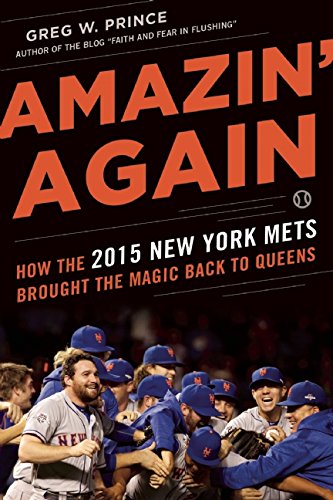
 Available for pre-order, now with cover! I talked about and read excerpts of my forthcoming book, Amazin’ Again, which now seems to have a cover (you can pre-order the whole package here), and after we each had our say at the podium, we were invited to form a panel and answer all manner of Met questions, one of which led me to recall a plan I had in the event the Mets won the World Series.
Which they didn’t, but you already knew that.
The question, which came from a pretty gifted writer in his own right, Brian P. Mangan, concerned how each of us dealt with particular factors that might influence what we write. For a beat reporter like Jared, Brian wanted to know about keeping the confidences of the players he covers. For David and me, the issue veered toward objectivity regarding the team of which we’re obviously lifelong fans.
I’m not quite sure how I found myself talking about it, but Brian’s inquiry got me onto my trying to keep in mind something I’ve learned over nearly eleven years of blogging: people eventually read what you write about them or their family members. Somewhere somebody (probably somebody long out of the public eye) is Googling his or her name or the name of a loved one. It’s been my experience to hear from former players who were delighted to read something nice I had written about them…and once in a while get a good-natured tweak from somebody I might have written something less than nice about.
In essence, I said just because somebody made an error that caused me aggravation when I was in my teens, there’s no reason to go overboard in my smoldering criticism of him decades after the fact. Yeah, we’re fans; and yeah, they were players; but y’know, be respectful.
Unless, I added, it’s somebody like Richie Hebner, a convenient target in the moment since David had invoked his name fleetingly earlier in the evening. For those of you not aware, I said, Hebner was a “miserable” sort who played one year for the Mets long ago and made no secret of his displeasure with being stuck here. Surely we could all agree that taking a shot at Richie Hebner is never out of bounds.
Without malice, Jared mentioned that he covered Richie Hebner when he was a reporter in Norfolk and Hebner was the Tides’ hitting coach (after they’d unaffiliated themselves from the Mets) and, actually, Richie was a really nice guy.
Oh well, so much for my ironclad exception to the rule. Even Richie Hebner, reliable sources were indicating, was a human being.
“It was nothing personal” that Richie held against Mets fans in 1979, Jared assured me after the panel was over. “He just didn’t want to be in New York at that stage of his career.” As a mature person in the present, sure, I could understand that. Hebner had played for nothing but contenders throughout the 1970s, and the Mets of ’79 were anything but. Hell, I kind of understood his objections then, though that was the first time I remember reading a player express his absolute disgust with the Mets upon learning he was going to be a Met (usually they waited a few innings). Hebner snarled during his stay at Shea, played with minimal vigor and didn’t leave behind a sparkling legacy.
Ten years ago, Jason and I took it upon ourselves to populate what we called Met Hell, a repository for those Mets who brought to bear “something that still makes the blood boil, something that made Met fans dread the smirking approach of the Yankee fans in their offices or on their blocks during that player’s tenure. Mental or physical incompetence that stemmed from not being prepared. Being a quitter, a lousy teammate, spectacularly obnoxious to fans or the media, a bad citizen, a traitor.”
Richie Hebner earned the Sixth Circle of Met Hell all for himself. It took me a Part I and a Part II to adequately express my disdain.
That was 2005, and I was still stewing over 1979. In 2014, I found myself in a song parody contest elsewhere on the Internet. You had to come up with something about a Met and set it to a Beatles number. My entry was titled “Richie Hebner Wants Off This Club Bad/Hebner Wasn’t Here To Make Friends”. The tune was “Sgt. Pepper’s Lonely Hearts Club Band/With A Little Help From My Friends”.
Sample lyric from the first part:
Richie Hebner wants off this club bad
He can’t believe the deal was made
Richie Hebner wants off this club bad
He’s dying to demand a trade
Richie Hebner’s mumblin’
Richie Hebner’s grumblin’
Richie Hebner wants off this club bad
And from the second:
If you were sent from a team near the top
To a club that was down on the floor —
Would you do your best to help them improve
Or just whine as you raced for the door?
Yo, Richie Hebner wasn’t here to make friends
No…not even with Steve Henderson
Oh, don’t worry, he didn’t make friends
In late 2015, I took a moment from my league championship intoxication to continue publicly harboring a grudge against this vouched-for really nice guy — and I was doing so in practically the same breath that I was insisting I had matured into the kind of fan who would think twice before flagrantly denigrating long-retired players who were just going about their business in the here and now. Truly it is a challenge tough to put aside well-honed animus.
But I would have had the Mets won the World Series. See, I was going to do something very classy (you can tell it would have been classy because I just termed it so). I was going to institute Met Amnesty. Or maybe just a Met Pardon. I’m not clear on the difference, but when President Carter pardoned Vietnam-era draft evaders, he carefully avoided the word amnesty, so one or the other. The point is that in our hypothetical era of extraordinary feeling, I was going to commit to thirty days of writing only positive assessments of every Met whom we’d never otherwise forgive for having kept us from winning a World Series since October 27, 1986.
I was going to laud Bobby Bonilla’s slugging.
I was going to applaud Vince Coleman’s speed.
I was going to find something pleasant to say about Roberto Alomar’s veteran demeanor.
I was even going to spell T#m Gl@v!ne the way it generally appeared prior to September 30, 2007.
Ambiorix Concepcion? Intense competitor. Guillermo Mota? Always looking for an edge. Gene Walter? The mere existence of his ERA indicates he likely got a batter out at least once. The 2008 bullpen? A unit that made every game exciting. Jason Bay? A .165 hitter only on paper. Armando Benitez? Forget the blowns, cherish the saves. Kurt Abbott? Surely not the most useless shortstop in the history of civilization. Kenny Rogers? Had a real sense of theater.
If we’d won the whole thing, there’d be no reason to be down on any Met who brought us down, at least not until the euphoria wore off. My real hope was to emphasize the contributions each Met made in his journey and to make us think an extra beat before defaulting to our usual venom toward these less than treasured members of our extended baseball family. Eventually we’d get back to cursing out their names, because it’s what we do (and perhaps what we must do), but as world champions, we’d be magnanimous.
Richie Hebner wouldn’t have been eligible for Met Amnesty under my chronological paramaters. He’d have been pardoned in the wake of winning it all in ’86, alongside Joe Foy, Jim Fregosi, Dale Murray and anybody else who symbolized post-1969 frustration and futility. But in the spirit of the gesture we never got to make, I do hereby grant a full, complete and unconditional albeit temporary pardon to Richie Hebner for all offenses against the New York Mets which he may have committed or taken part in during the period from April 5, 1979, to September 30, 1979. The pardon is in effect for the remainder of the calendar year 2015.
He wasn’t much of a Met, but somebody I trust told me the other night that he was a really nice guy. That should be enough to buy him two weeks of grace in the wake of a pennant.
by Greg Prince on 14 December 2015 2:40 pm Gelf Magazine refers to Faith and Fear as the unofficial recapper of “the soap opera that is the Metropolitans”. I’m more restless than young (and some days barely more active than the very recently retired Michael Cuddyer), but I’ll take that and point you back to Gelf for this Q&A they were kind enough to do with me in advance of my speaking at tonight’s edition of Varsity Letters.
You should come to that if you can. David Roth of Vice Sports and Jared Diamond of the Wall Street Journal will also be talking about the bold and beautiful 2015 Mets. And if you can’t, well, keep tuning in here.
by Greg Prince on 11 December 2015 1:49 pm Because December needs it badly, the Varsity Letters sports discussion and reading series will devote itself to baseball this Monday night — and not just any baseball, but National League Champion Mets baseball. I will have the honor of speaking there and hope you will be there to listen and speak back.
I’ll be previewing my forthcoming book, Amazin’ Again: How the 2015 New York Mets Brought the Magic Back to Queens (available for pre-order right this very minute), and generally basking in the afterglow of our very recent pennant-winning campaign. David Roth of Vice Sports and Jared Diamond of the Wall Street Journal are also on the announced roster of speakers, ensuring a fine and necessary night of Mets talk.
Varsity Letters happens at Le Poisson Rouge, 158 Bleecker St. (between Thompson and Sullivan streets in the Village), easily accessible by subway. Admission is free. Doors open at 7, the program begins and 7:30, plenty of time will remain later to watch the Giants take a lead deep into the fourth quarter of their game in Miami…but that’s another sport. As Casey Stengel once told a Senate subcommittee, “I am not going to speak of any other sport. I am not here to argue about other sports, I am in the baseball business.”
Or as the Mets’ new shortstop might add, get your Asdrubal down to Varsity Letters on Monday night. You’ll be glad you did.
by Greg Prince on 9 December 2015 8:11 pm Second base, like the beverage-branded seating section that overlooks it at Citi Field, has a new occupant. Neil Walker, unlike Ben Zobrist, turns out to be the real thing.
The former Pirate did not get a tour of our leafy suburbs. The Mets don’t care where he lives as long as he shows up for work somewhere between short and first. Walker’s a sound second baseman, a solid hitter and not owed more than one year’s arbitration-eligible salary. Zobrist can enjoy his proximity to Joe Maddon and Nashville all he wants from now through 2019. We have indeed moved on, not just from the free agent we didn’t get, but from the pitcher we had forever.
Jon Niese was the price that had to be paid to Pittsburgh to obtain Walker. Niese was signed to a team-friendly contract in 2012. The team it’s friendly to now is the Pirates.
It’s a little strange to consider Niese without the Mets and the Mets without Niese. For so long they went together like C&C Cola and Bachman Cheese Jax — not the most glamorous of brands, but presumably they’d get the job done if that’s what your mom stuck in your sixth-grade lunch bag (when I was 12, I had a friend who brought those items to school every single day and he made it to 13 just fine).
Of course the Mets very recently earned eye-level shelf placement and Niese was a part of that. He had to take on a new role to make himself extraordinarily useful, and he did. Niese was a reliable lefty specialist in the postseason and a valuable contributor to the first pennant-winner here since the turn of the century. I would have loved to have kept tapping that newfound equity, considering the one out you get in the seventh or eighth is often the tipping point of a given ballgame, but his contract wasn’t friendly enough to justify ongoing specialization.
Before Niese’s brief rebirth out of the bullpen, he made 177 starts for the Mets between 2008 and 2015. Several of them were stellar, many of them were adequate, enough of them grew frustrating enough in the middle so that you could resist growing attached to the most accomplished homegrown lefty starter the Mets had produced since Jon Matlack. The Mets didn’t produce many homegrown lefty starters of tenure after Matlack, so Niese is sort of a default victor of that title.
Jon plugged away, as best as we could tell. He wasn’t the most fascinating postgame deconstructor of his outings and his in-dugout tantrums seemed to speak volumes. A fan could be forgiven for losing patience with Niese. Niese could be forgiven for not blossoming in an uninterrupted fashion. He did throw a lot of innings for a lot of clubs that weren’t going a lot of places. By the time they were stepping up, it was primarily via pitching younger and stronger. Niese, who quietly turned the same age as the Mets’ most recent world championship during the last World Series, became that browser the URL you sought no longer supported.
Niese was promoted to the Mets amid the last pennant race of their Shea lives. He and current free agents Daniel Murphy and Bobby Parnell — all of whom played at the stadium that no longer exists — stuck it out longer than anybody who wasn’t David Wright. Now Jon’s gone, Murph’s clearly not coming back and, unless there’s a minor league Spring Training deal issued, Parnell is going to be a former Met, too. Behind Wright in the longevity pecking order now are Jenrry Mejia (tendered a contract but still PED-suspended) and Ruben Tejada, each of whom debuted as Mets on April 7, 2010. They were each 20 years old. They’ll enter 2016 at 26 apiece. They are veterans.
Time marches on, but it leaves a plethora of images in our rearview mirror. The one of Niese I’ll keep won’t be from the field or those moments when he couldn’t entertainingly explain what went wrong (or right) to reporters. I’ll think of him in Long Beach, my hometown, doing his best to help the victims of Superstorm Sandy. I realize Niese was there because the Mets were dedicating their community relations to the towns, villages and cities hit hard in the fall of 2012 and it was probably just Niese’s turn to be the player in the middle of it. But Niese seemed to make the most of it, handing out badly needed supplies, cordially greeting those who recognized him, lending unyielding support to those who didn’t. He wasn’t Jon Niese of the Mets that day. He was Jon Niese, human being. What he did for a living didn’t matter.
When he went back to his craft the following spring, he was good sometimes, he was less good other times and people like us judged him accordingly. In a realm without uniforms, I’d like to think I saw him at the top of his game.
by Greg Prince on 9 December 2015 1:24 am There’s been a breach of security. A Chicago Cub has seen our northern suburbs. Talk about intelligence falling into the wrong hands.
Ben Zobrist was made intimately acquainted with the leafy cul-de-sacs of Westchester and Fairfield counties by the management and ownership of the New York Mets. This is as bad as the Russian ambassador seeing the Big Board in Dr. Strangelove. They just let this…this…erstwhile Royal…look out the window from the back seat of a luxury SUV and form images in his head of Greenwich; of Rye; of Larchmont.
Of Larchmont, for crissake. God help us all.
And what is Zobrist, the new second baseman on the National League Championship Series runners-up going to do with this precious information? That’s the disturbing part. He’s going to share his impressions of Westchester and nearby Connecticut with Joe Maddon, and Joe Maddon will immediately proceed to work wonders.
He always does, except when playing the Mets in October.
Maddon will find out about the lush lawns of Mammaroneck and ride a mower into the Cubs’ next team meeting, loosening up his squad and sparking a nine-game winning streak. He’ll learn of the Rockefellers of Tarrytown and hand out canvas sacks marked “$” on them, but being Maddon he’ll fill them with gourmet candy. The Cubs, propelled by a high-end sugar rush, will storm out of their clubhouse and reel off ten wins in a row.
Zobrist’s bag will have actual $ in them — 56 million over the next four years. That plus a reunion with his once and future skipper plus the appeal of the bucolic ivy on the Wrigley Field walls (where Wilmer Flores’s Game Three triple went to lose 33.33% of its value) apparently add up to why Ben’ll be the Cubs’ second baseman and not the Mets’ next year.
I can’t believe the T#m Gl@v!ne memorial upscale “New York’s not really New York” tour didn’t win him over.
Phooey on Zobrist for spurning us and turning down whatever else the Mets were going to give him and only him. I found the Mets’ entire “BEN! PLEASE COMPLETE US!” approach rather unbecoming, quite frankly. Behave like league champions. Show him the money and show somebody else the money. You had enough money to take him to a fancy neighborhood. Maybe you have enough to go after somebody/anybody else? “No obvious Plan B” is the word from Nashville. Next year, let’s try to imagine the apple of our free agent eye won’t be impressed by expansive backyards and in-ground swimming pools.
Would I be singing a different tune if Zobrist decided it was his childhood dream to get paid by the Mets? You bet my hypocritical ass I would. Honestly, I had no strong baseball opinion about obtaining his services. I know he’s been a unique WAR producer and I know he’s a little too shall we say experienced to merit a four-year deal. I could have seen his arrival helping in the short term and morphing into “once Zobrist’s contract is off the books, the Mets can fill other desperately pressing needs” before long. Nothing personal against this guy, but all eight-figure contracts seem to become that after a couple of years. Cuddyer’s contract is that and it’s only a two-year deal.
I’ll also cop to a slight ick factor in that I didn’t want to start rooting for a guy I just spent the last five games of my life rooting against. I suppose that would have dissipated after a nice introductory press conference and a couple of Metcake photos in his new garb, but I really dislike anything to do with the Royals in this hot stove winter of 2015-16. I’d like to ride that bitterness a little longer.
My only genuine disappointment in this — besides discovering it never occurred to the Mets to target another player just in case Benny the Z said nix to them — is that we were pretty much guaranteed he was going to be a Met. Whether I really wanted him or not is immaterial. I bought into the proposition, going so far as to mentally dress him in our colors. Instead, we are left with a new second baseman on the all-time Never Met team (take a hike, Grudzielanek).
So let Zobrist be a Cub; let Starlin Castro, who was also forever rumored on his way here, merge into the wrong lane on the Triborough and find his own palatial estate wherever American Leaguers in these parts reside; let Don Zimmer maintain his spot at the end of the franchise’s alphabetical roster, where he’s been bookending, in chronological order, Craig Anderson (1962-1964), George Altman (1964-1967), Sandy Alomar (1967-1968), Tommie Agee (1968-1989), Don Aase (1989-2013) and David Aardsma (2013-present). The front of the line keeps changing, but Zimmer’s been bring up “z” rear from the very beginning.
We don’t necessarily need a new Met to play second base. We’ve got Dilson Herrera, about to enter his third season as the Next Big Thing. We’ve got Wilmer Flores, albeit in a walking boot at the moment. We’ve got Daniel Murphy…no, we don’t, but nobody else does yet, so rule nothing out.
We ruled Ben Zobrist in prematurely and see where that got us.
I was part of a rousing roundtable discussion on the Rising Apple Report the other night, which I hope you’ll listen to while ignoring the part where we all heartily agree Zobrist is going to be a Met any minute now.
by Greg Prince on 30 November 2015 9:22 am If this is the day you shop online for the holidays — and if you define “the holidays” as the approach of the next baseball season — then do I have a deal for you.
Go to Amazon or Barnes & Noble and pre-order Amazin’ Again: How the 2015 New York Mets Brought the Magic Back to Queens. It’s a book so fresh it’s still being written.
By me. Some of you asked for it and, son of a gun, it’s on its way.
I’ll tell you more about it as it becomes closer to real, but it is about to exist and it will capture the events and emotions surrounding the season we just lived through, the one where our team won the pennant and made us all proud.
Helluva story, huh? Man, I can’t wait to read it as soon as I finish writing it.
I’d love to tell you you can place it by the tree or adjacent to the menorah or wherever you like immediately, but it won’t be published until March. But that’s OK. Spring Training is our version of the Advent calendar. Come March, you’ll be anticipating 2016 and hoping it will exceed 2015 and you’ll be thinking about 2015 and there’ll be a book in your hands to bring it all back to you.
So pre-order now if such a proposition entices you. And please excuse me while I get back to writing the final portion of it.
And if you need a lovely baseball book as the non-baseball holidays near, you can’t go wrong with this one or this one.
by Greg Prince on 23 November 2015 1:19 am The Mets were the champions of the National League in 2015 without anybody being officially judged particularly valuable. The Baseball Writers Association of America has an award that declares who’s Most Valuable, and no Met got anywhere near it. Twenty National Leaguers were named on BBWAA ballots and only two of those names belonged to Mets; neither of them reached the Top 10. Yoenis Cespedes finished 13th, Curtis Granderson 18th.
Starting pitching was the 2015 Mets’ most obvious strength. MVP voting rarely favors starting pitchers, though three of them finished in the Top 10 in the N.L. voting. None of them was a Met. No Met pitcher showed up anywhere in the Most Valuable voting, but that’s OK. There’s a special award for pitchers. It’s called the Cy Young.
All that strong Met starting pitching translated to one Met, Jacob deGrom, drawing votes. He came in seventh of nine pitchers named. Nobody else in the rotation, nor the closer, was given as much as a single fifth-place vote for 2015.
One of the factors that catapulted the Mets from 79-83 also-rans to 90-72 and the postseason was the infusion of young blood. There’s an award designed to recognize players in their first year. It’s called the Rookie of the Year. One Met was considered for this award in 2015: Noah Syndergaard. The man we like to call Thor finished Thorth…uh, fourth in this voting. No other Met was mentioned.
A team with no more than the 13th-most valuable player, the seventh-best pitcher and the fourth-best rookie must have something going for it, like really outstanding managing. Terry Collins, the Mets manager, attracted support in the BBWAA National League Manager of the Year voting…just not a ton of it. Collins finished third, the best showing of anybody in a Met uniform in the “big four” award balloting.
No Met won a Silver Slugger. Cespedes won a Gold Glove, but it was for his four months of defensive work in the American League. Matt Harvey took Comeback Player of the Year honors in two realms: MLB.com’s (as voted by each team’s dot-com beat writer) and The Sporting News (as selected by a cross-section of nearly 200 players in the National League). TSN also singled out Collins as its Manager of the Year, which is decided by peer vote. And the Wilson Defensive Player of the Year awards, determined statistically, called deGrom the best-fielding pitcher in the majors.
So there’s that. Plus the pennant, which pretty much beats everything that isn’t a World Series title. In 2014, deGrom was Rookie of the Year and Juan Lagares won the Gold Glove. Any interest in trading this season for that season? Or do you prefer a year like 2012, when R.A. Dickey won the Cy Young and the Mets finished like Anthony Young?
Not that individual awards and team success have to be mutually exclusive, but I suppose this is just the way these things land. No Met has ever won the MVP, even if in all other years when the Mets made the postseason, they had at least one player wind up in the Top 10 in Valuable voting. And you can’t really argue too strenuously with Bryce Harper winning the 2015 MVP or all those Cubs — Jake Arietta, Kris Bryant, Joe Maddon — taking all those other BBWAA awards.
They can have them, it is tempting to scoff.
Still, the Mets got pretty far with nobody grabbing and holding the establishment’s attention during award consideration season, which occurred before the playoffs but after it was known the Mets would be part of them. Perhaps the tone was set in July, when they were allotted only one All-Star, same as the last-place Phillies, who you might recall were represented by the comprehensively stellar Jonathan Papelbon. The Mets’ closer, Jeurys Familia, saved 43 games on their behalf, yet the Trevor Hoffman N.L. Reliever of the Year Award, which you may or may not know exists, was voted by a panel of distinguished former closers to Mark Melancon of Pittsburgh. The peer-chosen Sporting News Executive of the Year award did not go to Sandy Alderson, who obtained Cespedes and several other transformational contributors at the trade deadline, but Alex Anthopoulos, the since-departed Blue Jays general manager.
Maybe Melancon (51 saves) was the best reliever in the league in 2015. Maybe Anthopoulos (Troy Tulowitzki, David Price) was the MLB GM handiest with a phone and a ticking clock. Maybe everybody was indisputably better at something, except coming back from an injury, than any given Met.
Pretty cool we got as far as we did, huh?
***
As if two Mets, Willie Mays and Yogi Berra, being named recipients of the Presidential Medal of Freedom wasn’t enough, we’ll be along with Faith and Fear’s annual offseason Most Valuable Met and Nikon Camera Player of the Year awards soon and finally reveal the long-promised Most Inconsequential Met Ever. Until then, you should know about what these people are up to:
• Sam Kulik has created The Broadcast, his own play-by-play of the May 31 Mets-Marlins game, with each half-inning set to its own original music. To make it even more interactive, Sam has created a special set of baseball cards that unlock the audio. It’s both impressive and fun. You can learn more here and listen to a sample here.
• Because you can’t watch 2015 Mets highlights enough, help yourself to Drew Palazzo’s stirring tribute montage, titled A Journey to Remember. It seems to cut off before the World Series, which I would say is an editing highlight unto itself. Watch Drew’s emotional wizardry here.
• It’s not too late to bid on a deluxe Met package as part of WhyHunger’s 2015 Hungerthon. Through Tuesday night at 6:30, you can try to win four Metropolitan Box Seats to a select game at Citi Field in April, with a David Wright-signed baseball and parking pass thrown in. It’s certainly a great cause and you can’t argue with the prize. If you’re interested, go for it here.
by Greg Prince on 14 November 2015 12:35 am This is a job for Daniel Murphy. Daniel Murphy took on all kinds of jobs in a New York Mets uniform: left fielder, first baseman, second baseman, third baseman, playoff hero, World Series less than hero (to put it kindly)…but the one that fascinated me most was credit deflector. Any time — any time — a reporter asked him to analyze something he did well to help the Mets win a game, Murph deflected the credit.
Daniel was hitting the ball because David was in front of him and Ces was behind him and who wouldn’t see good pitches with that kind of protection? Daniel was transformed into a slugger thanks to the countless hours in the cage Kev put in with him. Daniel’s home run contributed to a win because the pitching made the win possible, from Matty or Jake or Noah starting to Addy and Clip in middle relief to Jeurys, who was absolutely lights out. Daniel made that occasional great play in the field because Teuf had worked with him on positioning and Lucas can scoop the ball like nobody else and the only reason the play mattered was because of that tag Travvy made the inning before, and how about that throw from Grandy two innings before that?
Daniel Murphy painted himself an innocent bystander in his own success. He was present and accounted for by his reckoning when something went wrong, but if you wanted acknowledgement that Daniel Murphy was at all a factor in bringing a pennant to Flushing, you’d have to ask somebody else.
Ideally, you’d convince Daniel Murphy that Daniel Murphy was a teammate of himself and then maybe he’d file a proper review.
Like Daniel Murphy lifted if not a carried a team through two rounds of a jubilant postseason.
Like Daniel Murphy put team first always, consenting without any visible objection to playing wherever need dictated.
Like Daniel Murphy might not have been graceful or ultimately effective as a defender, but dang he tried.
Like Daniel Murphy could hit like Daniel Murphy could praise others.
The imperfect ballplayer with the unbeatable attitude gave us seven seasons in a Met uniform (plus one that got sidetracked in the minors). There were nights you wanted nobody else in there for you. There were nights you wished somebody else was in there for him. They were occasionally the same night. But never did he leave you thinking he left anything on the field, save for ego.
Friday, though, he left a qualifying offer of $15.8 million for 2016 on the table, opting to pursue free agency, as ballplayers tend to do when the option arises. This means Murph and the Mets have all but completely parted ways. Historically, that figures. The last NLCS MVP the Mets had, Mike Hampton, didn’t stick around for the flag-raising the following April. Same for the last Met World Series MVP, Ray Knight. The first drafts of internal histories are inevitably edited by forward progress. That guy who was as responsible as anybody for getting us as far we did? Go easy on his highlights, maybe crop him out of the special section in the yearbook. We’re not in the business of marketing him anymore.
We who are not responsible for selling the personalities that constitute the next version of the New York Mets will tell our own story. We’ll long tell of how Murph led our Mets above and beyond where we could have reasonably pictured them, how he slew one Cy Young winner after another in the one month when great pitching is purported to stop good hitting. No Daniel ever excelled in any lion’s den as Murphy did.
And then, when Daniel Murphy lifted the 2015 Mets as high as he could, he let their chances slip through his grasp. Baseball’s den is a capricious place and none of us who’d been with Daniel since 2008 could have been surprised that he’d miss a crucial ball in a crucial inning in the most crucial of World Series contests. It was why, when he went from Murphy to muffy and allowed the Royals to tie Game Four and facilitate the disappointing end of an otherwise uproarious adventure, I had to laugh at the reaction of the woman sitting directly in front of me in Promenade. There’s Eric Hosmer’s grounder, there’s Daniel Murphy not picking it cleanly, there’s the shock of the moment setting in and then there’s the woman — who had been as supportive of our team as possible since first pitch — wailing what each and every one of us had to be thinking:
“FUCKING MURPH!!!”
This reaction transcended mere fickleness or frustration. It was a family reaction. We all intrinsically understood that this was Murph as much as the Sports Illustrated cover boy/toast of October was Murph. The horrible error didn’t negate what he did in the two series prior. It was all part of the package we signed for from the time he delivered as a rookie in a race. We witnessed him spraying line drives or shifting positions or oozing determination just as we watched him running the wrong way or throwing to the wrong base or hesitating at the wrong instant or just being Murph.
Thing is, through all the missteps — of all the Daniel Murphys, he was the Daniel Murphyest — we never didn’t want to embrace him. He was family. He was ours. He was gonna help us win sometimes, he was gonna help the other team win sometimes. He was human that way. He was a Met that way.
Whatever his next uniform, he’ll always be a Met that way.
|
|