The blog for Mets fans
who like to read
ABOUT US

Faith and Fear in Flushing made its debut on Feb. 16, 2005, the brainchild of two longtime friends and lifelong Met fans.
Greg Prince discovered the Mets when he was 6, during the magical summer of 1969. He is a Long Island-based writer, editor and communications consultant. Contact him here.
Jason Fry is a Brooklyn writer whose first memories include his mom leaping up and down cheering for Rusty Staub. Check out his other writing here.
Got something to say? Leave a comment, or email us at faithandfear@gmail.com. (Sorry, but we have no interest in ads, sponsored content or guest posts.)
Need our RSS feed? It's here.
Visit our Facebook page, or drop by the personal pages for Greg and Jason.
Or follow us on Twitter: Here's Greg, and here's Jason.
|
by Greg Prince on 5 October 2015 3:34 am Maybe all the Mets needed was a little sunshine. The sun makes living things grow. The Mets appeared to be the opposite of a living thing since departing Cincinnati with a division title stuffed in their luggage. Perhaps they were under the impression they had entered the afterlife.
Not quite. They had only qualified for it. There was a little business left to be taken care of back on earth, a little pulse to be shown. They proceeded to play five games under cover of either darkness or clouds. The results reflected the gloom.
Sunday the sun came out. And so did the Mets, who did just enough to make the rest of us shine. Heaven no longer waits. It arrives unencumbered, at a time to be announced, this Friday at Dodger Stadium.
Funny thing about depositing yourself at a sun-kissed ballpark for the last few hours it was supposed to be open for the year. You forget your problems. You forget your team’s problems. You forget the total lack of scoring from the several games before. You forget the total lack of hits from the game directly before. You remember that even though the game you’re at was slated to mark the end of yet another season, this year it serves as a gateway to something potentially divine.
Under the Sunday sun at Citi Field, in Game 162, the Mets beat the Nationals, 1-0. One run more than their opponent — any opponent at this point — was all we needed to burnish our brightness. We got it. We got it against the Nationals, which was a nice and I’d say necessary boost for our collective self-esteem. The Nationals lost and went home. That’s where they were headed anyway, but it was better to send them away emptyhanded. Their disappearance from October before October really gets going provided a healthy reminder that it is the Mets who are sticking around to take a bite out of the meat of the month.
The Mets are going on to play more baseball. They start the new fall season Friday. They were the breakout hit of the summer. We’ll see how their act plays in prime time. Right now just knowing that they’ll be there to tune in to is pretty special. It was special knowing that on Sunday.
Ah, Sunday. Closing Day. It’s my thing every year at the end of the baseball year. I’ve come to cherish it more than Opening Day. It’s when I reflect a lot and mourn a little and appreciate a ton. But what about the rare year like this one when the Day in question is less about Closing and more about keeping the gate ajar?
What one sacrifices in sense of closure is more than made up for by the sensation of anticipation. My gosh, knowing the Mets and Citi Field will remain open for a while longer, maybe a significant while longer, doesn’t detract from Closing Day at all. It adds a whole savory dimension to the experience.
Thus, I wasn’t my usual melancholy self on the train ride in Sunday. I wasn’t kissing, hugging or heartily handshaking the season and its inhabitants goodbye. I wasn’t slumped into my seat at the end as I tend to be when the last out is recorded. I was light on my toes in my head all Closing Day long.
There was still the pageantry I arrange for myself on the occasion of the final regularly scheduled home game, a date I have now kept with the Mets for 21 consecutive seasons, 23 in all. There was the Chapman tailgate extraordinaire, this year with a Seaver Vineyards-supplied toast to a division title just won and a division series just ahead. There was a dime (or more) dropped on a t-shirt, a pennant and a pin that confirms the Mets really are champions of something. Usually Stephanie and I search the team store for clearance items. This year the shelves were stocked with new merchandise. It was no bargain, but I can’t question the value.
We walked the field level one more time. We said hi to people we see mostly at Citi Field. People who see us mostly at Citi Field said hi to us. We stopped in our tracks when the PA gave me what I’d been wanting to hear since April: Bobby Darin welcoming us to “Sunday In New York,” a song that had been a Sunday staple in Flushing dating back to early in the century. I thought they stopped playing it, the way they stopped playing “Takin’ Care Of Business” after Mets wins. I was willing to move on from BTO to Ace Frehley in the name of changing our luck, but I’d been missing Bobby Darin something awful.
“If you’ve got troubles/Just take them out for a walk/They’ll burst like bubbles/In the fun of a Sunday in New York.” I’ve got troubles. We’ve all got troubles. The Mets aren’t one of them. Sometimes we act as if they are. Even when we’ve had an appointment with the Dodgers guaranteed for more than a week we could, amid the clouds and the darkness, convince ourselves the sky was if not falling, then drifting dangerously downward.
On Closing Day, with the sun prominent and friends along the trail and postseason logos in evidence, there was no trouble at Citi Field. There were no hits for the Nationals for most of seven innings, albeit without the drama Max Scherzer provided Saturday night. Terry Collins was changing pitchers like a neurotic foot changes socks, yet no arm — not deGrom’s, not Colon’s, not Verrett’s and, until it finally did so a little flukily, not Niese’s — gave up a Washington base knock. Then the regular bullpen guys Reed and Clippard resumed keeping the Nats hit out of luck.
The Mets who hadn’t scored since Cincinnati (or so it seemed) didn’t score until the eighth, when Curtis Granderson hit a ball over a fence. But they did score and they had an entire run more than the Nats. See? No trouble. It was 1-0, Jeurys Familia coming on for the save that would tie Armando Benitez’s single-season mark of 43. Two outs were quickly recorded.
Finally, it was Familia versus Bryce Harper to end it. Or not end it. Harper stroked the first pristine hit of the day, a double to left. Or was it a single and he was out on Michael Conforto’s bullet of a throw to second? Harper was called safe. Collins challenged. Good move, aesthetics notwithstanding. Let Terry get tactical. It’s not like those challenges can be saved for another day.
A replay was watched from a thousand angles. Harper was ruled safe again. Harper is a superb player. I hope someday the relationship between his excellence and our distaste for it has some edge taken off of it. I didn’t like that after he was hit by a pitch Saturday afternoon and briefly writhed in pain that he was hooted on his way to first. Karma doesn’t care for that reaction. Karma was disgusted when Mets fans cheered Kirk Gibson pulling up lame at second base in the 1988 NLCS. See where that got us. Saturday Harper, writhing shaken off, hit the home run that won the day game. I wasn’t surprised. Boo Bryce, but hold the malice. Trust me. It will work better for us in the long run.
Anyway, Bryce was on second and I guess he’s technically if not physically still there. Jeurys left him on base when he flied Jayson Werth to center to end the regular season. A Met had notched a 43rd save for the first time since 2001, which was when “Sunday in New York” entered my consciousness. The Mets, sporting a spiffy 90-72 record, won a 1-0 game for the first time in 2015, a veritable unicorn-style event for a season that featured back-to-back 14-9 affairs at the offense-fueled height of August. Better late than never to make with the pitching, defense and one-run homer.
The last time the Mets won, 1-0, on Closing Day was 1995, the year I began my current last scheduled home game attendance streak. They beat the Braves that Sunday in New York. Bobby Cox started John Smoltz and pulled him after five the way Collins removed Jacob deGrom after four. It was just a tuneup for the N.L. East champs. Their ticket to the postseason indelibly stamped, they were swept by the Mets that weekend. Those same Braves were so burdened by those three straight losses that they went out and won the World Series four weekends later.
You never know how these things will unfold, but I’ll happily take the 1-0 win in 2015 just as I happily took the 1-0 win in 1995. Strange habit I’ve developed. When I go to see the Mets play, I leave happier if I’ve seen the Mets win.
Connoisseurs of Closing Day know the day isn’t done just because the game is over. You stand and you applaud and you wait to see what will happen next. It used to be the best you could hope for was a montage of video clips from the season we’d just persevered through and maybe a cluster of Mets gathering outside their dugout and tossing a few wristbands and well wishes to the fans nearby.
This time we got something more. We got something I’d never previously seen a Mets team do.
The Mets, every wonderful one of ’em, transformed themselves into a human highlight film. They came out en masse and they waved, but they didn’t stop there. They jogged the circumference of the field. They greeted every segment of the stadium. It would have been easy enough to make a beeline to the 7 Line Army out in center and then a beeline right back into their clubhouse. The 7 Liners are the most visible cluster of fans at any game they hold down seats and they can’t help but attract the most attention.
These Mets, though, symbolically recognized everybody who came out to recognize them. It was such a simple gesture, yet it ran so deep. The manager circled the field. The captain circled the field (and later grabbed a microphone in order to share a few gratitude-laced sentiments with us before encouraging all of us, “Let’s go beat L.A.”). Everybody from Yoenis Cespedes to everybody who isn’t Yoenis Cespedes circled the field. The effect was electric. It was like they, the players, knew who we were and how much we care; like they knew we show up to see them across 81 home games plus however many times some of us hit the road to lend them support. All we ask for in the course of the season is that the hitters pile up runs and the pitchers allow almost none. We wouldn’t have thought of asking for this.
Yet they thought to give it to us. It was a splendid moment, maybe never to be repeated again in my lifetime. Or it will be repeated following another few clinchings and become Met tradition, like the video montage used to be, like “Sunday In New York” used to be. Who knows? I know I won’t forget it.
That’s my leitmotif every Closing Day, not forgetting because there’s so much to remember, so much to tie up and take into winter. This Closing Day, however, winter was nowhere in sight, ballpark chill notwithstanding. This Closing Day we bundled and stacked only so many memories. We are privileged to be able to add to them beginning this Friday in Los Angeles. It’s a shame Games One and Two and potentially Five won’t take place at Citi Field. It’s a blessing that our number of games remaining isn’t down to zero.
Here’s to the 2015 that’s happened. Here’s to the 2015 still to come.
by Jason Fry on 4 October 2015 2:56 am Back in June, Emily and I decided that a lovely summer night would be made even better by our attending a ballgame. So we did … and watched the Mets get no-hit by Chris Heston and the San Francisco Giants.
I grumbled and groaned for competitive and aesthetic reasons. The competitive reasons for not wanting my team to be no-hit and lose are, I’ll assume, obvious. The aesthetic reasons? From our perch in the Promenade we couldn’t see how well Heston was mixing or locating his pitches. All we saw was Met after Met after Met arriving at the plate, doing nothing of offensive note and departing — until the Giants were whooping it up.
Last night, Emily and I decided that though it was not a lovely night — in fact, it was windy, cold and thoroughly vile — the best way for us to spend our evening was by attending a ballgame. So we did … and watched the Mets get no-hit by Max Scherzer and the Washington Nationals.
Yes really. I don’t go that often — I think I attended around eight games this year. The Mets don’t get no-hit that often — I know that was the eighth time it’s happened to them. And yet there my wife and I were, stranded once again at the intersection of You’ve Got to Be Kidding Me and What the Hell?
If this is luck, someone else can have it.
At least there were some differences between the two nights. Our vantage point for Scherzer’s outing wasn’t that much better than it was for Heston’s — they were perfectly nice seats but unless you’re in the padded Shake Shack area you can’t really speak with authority about movement on pitches or working hitters or any of the stuff you can geek out about if you’re in front of an HDTV. (This is probably one reason I don’t go to Citi Field as often as I should.) But even from where we were, we could see the life on Scherzer’s pitches, and the Met hitters trying to steel themselves in the batter’s box, and we could tell that no one in orange and blue could catch up to what he was bringing. You needed a close-up view to appreciate how Heston was succeeding, but Scherzer’s performance was amazing to witness from any seat in the house.
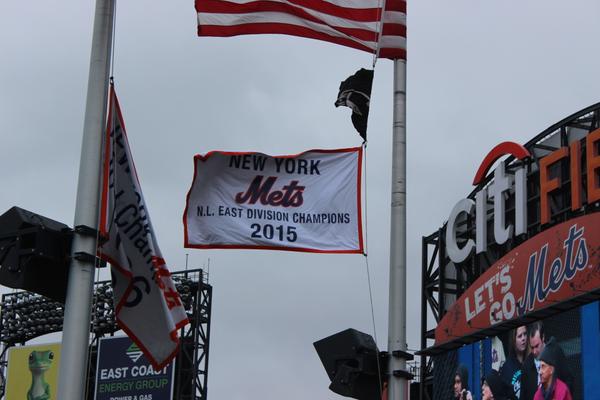
Competitively it came with a silver lining too. Believe it or not, being no-hit does not mean you immediately surrender 10 games in the standings. The Mets are still National League East champs, as their new flag accurately states — a fact that will come as news to the hysterical wing of Mets Twitter, and that was lost on the dopey, dyspeptic fans surrounding me and my wife last night.
Our section suggested the Mets got the promos wrong and Saturday was actually Wet Blanket Night. The guy in front of us was outraged at watching the Mets’ JV get throttled by one of the best pitchers in baseball on one of the most dominant nights of his life. The guy behind us was merely irritated, but perhaps that’s because he was busily mansplaining the game of baseball to his female companions, whose air of weary patience suggested this wasn’t a new experience. (Most of what he told them was wrong, which I think would surprise only him.) As for the guy at the end of our row screeching in outrage whenever Harvey threw a ball off the plate on an 0-2 count, I can’t even. I alternated wanting to throttle the lot of them with wanting to scream DUDES WE ARE GOING TO THE POSTSEASON, WE BEAT MAX SCHERZER WHEN IT MATTERED, SO CALM THE FUCK DOWN ALREADY.
The Mets are playing flat? I’ve noticed. Heck, it’s been impossible to miss. I’m not that concerned — one hallmark of the 2015 team has been routinely defying whatever it is we think we know about them. The Mets looked befuddled and tired against the Marlins ahead of their showdown with the Nats — and then effectively ended Washington’s season. They followed a grumble-inducing 3-6 homestand with annihilating the Reds. After Sunday’s game they’ll have four days off. It’s plenty of time to reset. And think of it this way: If the Met bats were hot, fans would be starting cars in garages while scribbling notes explaining that the layoff will obviously cause those bats to go cold.
(By the way, another team suffered the indignity of being no-hit twice this year. That’s right, it was the Dodgers.)
When the NLDS begins on Friday, the Dodgers will have home-field advantage. Eh, so what? If you want me to worry, bring up Juan Uribe‘s sternum and Steven Matz‘s back and Jon Niese‘s learning curve as a reliever. Clayton Kershaw and Zack Greinke are no picnic whether the shadows are between the hitter and the mound or on the other side of the planet. But our starters aren’t exactly a day at the beach either — give me today’s pitching performances from Harvey and Noah Syndergaard and I’ll take my chances with the Dodgers.
And let’s not forget the bigger picture. I wrote this a couple of days back, but it can’t be emphasized enough: The postseason is a crapshoot, a trio of exhibition series. Billy Beane famously remarked that “my shit doesn’t work in the playoffs. My job is to get us to the playoffs.”
Well, job done — and oh what a joyous mission accomplished. On Sunday that ends and we’ll wait for baseball’s autumn exhibition games to begin. I don’t know if we’ll get an ecstatic month that brings sweet memories for a lifetime or a few days of extra baseball followed by disappointment and winter. Either’s possible. If you’re tempted to make any prediction more specific than that, stop and remember the less-famous second half of Beane’s quote about getting to the playoffs: “What happens after that is fucking luck.”
by Greg Prince on 3 October 2015 4:59 pm “2015 is over as far contending for a postseason spot goes, and we should just admit it.”
—A post on a blog about a team, June 24
The Mets lost their fourth consecutive game Saturday afternoon. They’re still invited to the playoffs. That doesn’t get revoked on account of style points. But the style they are finishing the regular season in should have gone out of style in June.
June was the last time they lost as many as four in a row. June was when we had to remind ourselves, once the losing streak reached seven, that the Mets would someday win a game again. It seemed worth mentioning because it didn’t seem like a sure thing.
The Mets then went out and commenced to win a whole lot. From a nadir of 36-37, they roared to 89-67. If the “89” looks familiar, that’s the number of wins they’ve been stuck at since last Sunday, which was the day after they clinched that invitation to the playoffs. Again, it’s still valid. Hard to believe, based on the activities of the past six days. These games count, but they count differently from the games that preceded last Sunday. They’re in the standings and they help determine where future games will be played, but their outcome won’t prevent those future games from being played.
 The invitation is still valid. We’re clear on that, right? The Mets are still playing as of October 9. The Mets are still 0-0 as of October 9, regardless that they’re 0-4 since September 29. The Mets hoisted a divisional championship flag Saturday afternoon prior to their fourth consecutive loss. Long may it wave…and soon may it be embellished to reflect further accomplishment.
OK. That said, this is mostly lifeless baseball the Mets are playing and they should stop it. Just stop it. We can be only so sophisticated about it for only so long. We’d like to stop being sophisticated about it tonight. Use the second half of this day-night doubleheader to humor us with a 90th win. That would look better than 89. Keeping pace with the Dodgers for home field would look better, too, whether it actually matters or not. Let’s pretend it does. Warm your patrons with something more than a fleece blanket.
Make double plays. Hit with runners on base. Confound the winds. Everybody be as much of a credit to your uniform as Noah Syndergaard (7 IP, 2 H, 1 BB, 1 R, 10 SO) was to his during the day portion. Embarrass the Nationals, if just for recent old time’s sake. Go on Mets, play like champions. That’s what you are.
Fill your between-games void by listening to me join Mike Silva on Weekend Watchdogs. About an hour-twenty in, Mike asks me about the Mets going to the postseason and I tell him…hell, hear it for yourself.
by Jason Fry on 1 October 2015 11:56 pm Several times this winter, I’ll sigh and tell my wife how I’d do anything to watch any baseball game — even say, a June snoozer pitting the Brewers against the D-Backs. I’ll mean it, of course — nothing comforts me while staring out the window and waiting for spring. Not winter ball, not Mets Classics, not hot-stove talk, not tending to The Holy Books.
Still, if I had a choice between watching today’s Mets-Phillies game and sulking at the window, I actually think I’d sulk by the window.
The game clocked in at a tidy 2:23 but seemed to take three times that long. Sean Gilmartin was fine but Jerad Eickhoff was better, Darin Ruf hit a massive homer, no Met other than Kirk Nieuwenhuis hit much of anything. Plus it was freezing and I think the uniformed personnel may have outnumbered the spectators.
The amazing thing? I almost went to this game. I hit a big book deadline on Wednesday and have a couple of days before I have to move on to the next project. On Wednesday night, with a little too much prosecco imbibed, it seemed like a grand idea to take the morning train down to Philadelphia for a Mets matinee. This morning, thank God, it seemed like an excess of fuss.
Proof that not every opportunity passed up is one you’ll regret. (Or, as someone put it on Twitter, this was my Carlos Gomez trade.)
So here are the Mets, freshly swept by the Phillies but not booted out of their division title by way of punishment, trying to get all hands healthy and unsuspended and used to bullpen work. They’re tied with the Dodgers for home-field advantage in the NLDS, though recall that a tie goes to the guys in orange and blue. The next three days will settle that, weather permitting. (And if we think a Monday or Tuesday extra game would be inconvenient bordering on cruel, just think how the Nats and their fans would feel about it.)
It would be good to finish even with or ahead of the Dodgers, seeing how they’re much better at Dodger Stadium. But it would be better, I think, to be as healed as possible. We don’t like to admit it, but three games out of five is a crapshoot — just as we don’t like to admit that the entire postseason is a crapshoot.
If the Dodgers get home-field advantage, Mets fandom will of course have a collective stroke. But then that’s going to happen anyway over Yoenis Cespedes‘s fingers and Steven Matz‘s back and Wilmer Flores‘s back and Juan Uribe‘s sternum and Matt Harvey‘s innings and whether it’s Gilmartin or Erik Goeddel or Jon Niese or Bartolo Colon and Juan Lagares or Nieuwenhuis or Eric Young Jr. And Twitter will be the frantic heart monitor paging nurses and doctors with electrified paddles.
Until next Friday and first pitch at a park to be determined, it’s silly season. Which, don’t get me wrong, is a whole heckuva lot better than stale season, when you’re trying to convince yourself that the last dregs of a losing season are to be savored even though you’re secretly ready for a break from baseball. But it’s still silly. We’ll play life-and-death games in a week, but that week of waiting is going to feel even longer than this lost series in Philadelphia did.
So hang in there, rest up, and be kind to each other. And, of course, Let’s Go Mets.
by Greg Prince on 1 October 2015 9:24 am Pour yourself two fingers of your favorite morning beverage (or perhaps something stronger; no judgments) and drink to the digital flexibility of Yoenis Cespedes…and to the postseason not being over before it begins.
Cespedes is nursing a bruise that covers his left ring and middle fingers after his hand got in the way of a Justin De Fratus pitch in the third inning of Wednesday night’s Citizens Bank slog. As he knelt in obvious pain, the 2015 NLDS flashed before our eyes and it was over in a blink. When word emerged three innings later that the X-ray review ruled it a contusion — and that contusion is a fancy word for bruise — it appeared the republic would survive to fight another day.
Let’s hope Yoenis followed Keith Hernandez’s sage advice and iced the fudge out of those fingers overnight. And let’s hope Cespedes responds to this HBP the way characters on your Gilligan’s Island-type sitcoms would respond when conked on the noggin a second time. Our slugger/savior, it will be recalled, was merrily bopping along, having blasted 17 home runs in just over a month’s time (enough to lead nine previous Met squads in homers over the course of their full seasons), when he took a pitch to the hip on September 15. He hasn’t homered since.
“If hitting him with a pitch turned off his power,” the Professor might have theorized to the Skipper, “Hitting him again might turn it back on. I know it’s unorthodox, but it may be our only hope.” At which point the Skipper apologizes to his Little Buddy before whapping him on the coconut with a coconut. And somehow the radio works again, even if you probably can’t get WOR very well in the middle of the Pacific (or many other places) and even if nobody is rescued until somebody thinks to make a TV movie more than a decade later.
The crew of the S.S. Minnow set out on a three-hour cruise, or for one hour fewer than Wednesday night’s ball of contusion lasted. Otherwise, the whole affair seemed to be an uncanny remake of The Flushing Globetrotters on Gilligan’s Island. A tropical storm loomed; every Mets baserunner from the second inning onward wound up a castaway; the “I’m telling you, Steven Matz is going to be seaworthy when the time comes” plot point sprang another leak; and Hansel Robles portrayed a pretty unconvincing headhunter.
Hard to believe the episode started frothily enough, with the Mets plastering five runs on the scoreboard in the top of the first, as Daniel Murphy and Michael Conforto each took Alec Asher on a tour of the many lovely areas beyond the Citizens Bank Park outfield fence. At 5-0, it shaped up as the most laughable of laughers. The audience simply assumed that against the bottom-dwelling Phillies we’d soon have a 90th win (not quite); an additional leg up for home field advantage (nope, though the Dodgers lost, so we still lead that mini-race by one length); and a relaxing evening to enjoy that rare state of grace between clinching a title and battling for a bigger one (alas, Wednesday’s 7-5 loss dropped the Mets’ lifetime record to 34-17 in regular-season contests they’ve played as a playoff qualifier — why, yes, there is a stat for everything).
When the shining highlight of your baseball game is your best player being hit in the hand but not so badly that anything was broken, it can be definitively stated that nothing good happened. Except that the game eventually ended. That was pretty good. And a week from today, should Cespedes find himself gripping a bat free of pain in playoff competition, that will be a victory.
by Jason Fry on 30 September 2015 2:18 am I’ll admit this: I never thought Fred Wilpon’s line about meaningful games in September was so embarrassing. Granted, I would have revised the line to “meaningful games in the last week of September.” If you’re playing those, your team’s kept you scoreboard watching, hoping and dreaming almost until the end, which I’ll always sign up for. But even without my suggested tweak, I thought Wilpon’s formulation was the product of baseball wisdom more fans should internalize: winning is more about luck than we like to imagine, a season can be great even without a World Series trophy at the end, and a sense of entitlement makes you a toxic shithead. If you disagree with all that, there’s a team in the Bronx tailor-made for you.
But this week is a reminder of something else: Meaningless September games can be just fine. Not the meaningless kind where you try to convince yourself that a second-tier prospect’s garbage-time quality start will mean great things in a couple of years, but the meaningless kind we’re playing now. In Philadelphia tonight, the Mets lost. Bartolo Colon and Jon Niese weren’t great, Carlos Torres returned and looked OK, Lucas Duda hit a pair of home runs, and brothers Travis d’Arnaud and Chase d’Arnaud seemed to have a pleasant time gabbing at home plate. That’s about it.
If you weren’t paying attention, you get a mulligan. The Mets are auditioning starters for bullpen roles, trying to figure out how to fill the last couple of roster spots, and looking to strike a balance between rust and rest. The only thing left to play for is home-field advantage over the Dodgers, which would be nice but isn’t worth an all-out sprint; the team also has to face the possibility that they may not get to play baseball for a ridiculously long time, what with multiple fronts and a hurricane converging on the East Coast.
In all likelihood nothing that happens this week will be remembered come October 9, which is fine. Baseball’s one of humanity’s greatest artistic achievements, but there’s nothing wrong with a bit of a break from it. This is a fine week to take your spouse out to dinner, take your kids to the movies, or pursue whatever evening plan normally gets neglected between April and October. Next month you’re going to be frantic and delirious and terrified and delighted and mostly tired, for at least a long weekend and hopefully the whole month. So rest up, y’hear?
This concludes the Mets-related portion of today’s blog post. Now I’m going to tell you about my adventures watching baseball in Missouri.
A few weeks ago I noticed that I had a $200 Delta credit that was about to expire. After various ideas proved unworkable, I hit upon one I should have thought of earlier: I’d go to one of the 11 big-league ballparks I’d never visited before.
I eliminated Pittsburgh because Emily wants to go. I tossed out Detroit, Cleveland and Cincinnati because I’ve always imagined combining them with Pittsburgh in a baseball great circle route some summer. I dropped Milwaukee and New Comiskey because Emily wants to go to Wrigley (I went last year), and it and the other two could be combined in a single trip.
That left Minnesota, Texas, Miami, Kansas City and St. Louis. I started checking Delta airfares and schedules and StubHub, and then realized that if I was willing to drive for a few hours, I could knock off Kansas City and St. Louis in one trip, with enough room to pursue a little genealogical exploration as well.
Done — and for surprisingly little money. The credit took care of most of the airfare, even with me flying into K.C. and out of St. Louis. The one-way car rental was reasonable. I used points for hotel rooms. And I found pretty great seats that weren’t crazily expensive, a surprise given both teams were headed for the postseason.
My biggest worry was that the Mets would falter and I’d be stuck halfway across the country freaking out and blowing my data plan watching At Bat. But that didn’t happen either — I returned to a magic number of one.
So, the parks.
Kauffman Stadium dates back to 1973, though it got an extensive renovation a few years ago. It’s not bad for what it is — a pretty nice park from an era of lousy park design, given a thoughtful coat of paint.
Which isn’t enormous praise, granted. The biggest problem is one that can’t be solved: Kauffman isn’t in Kansas City proper, but plopped down east of the city next to Arrowhead Stadium and surrounded by highways. Behind those iconic fountains (about which more in a bit) are some statues of Royals greats, a few nondescript eateries (none of which feature local barbeque, for some absurd reason), and then this view:
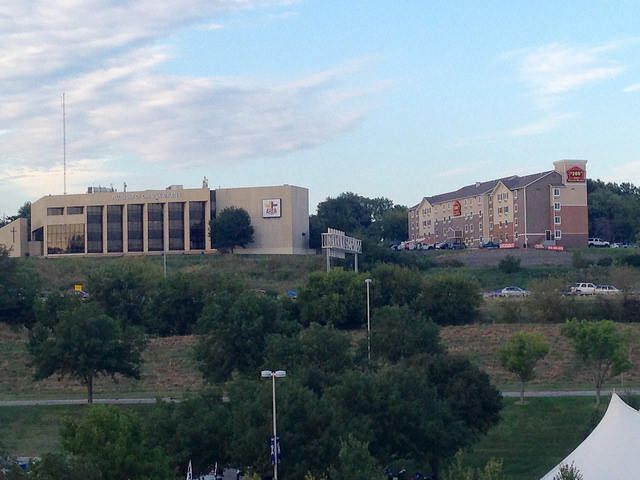
Yeah, that’s not inspiring. People tailgate like fiends before Royals games because there is absolutely nowhere else to go.
But the park itself isn’t bad. The fountains are a bit doofy — after hearing about them for years, I was as underwhelmed as Greg to see them in action, which is probably a reflection of my enthusiasm for fountains rather than any failure of the park’s. (I don’t know what the world’s greatest fountain is, but I bet it’s a bunch of pipes that make water go up.)
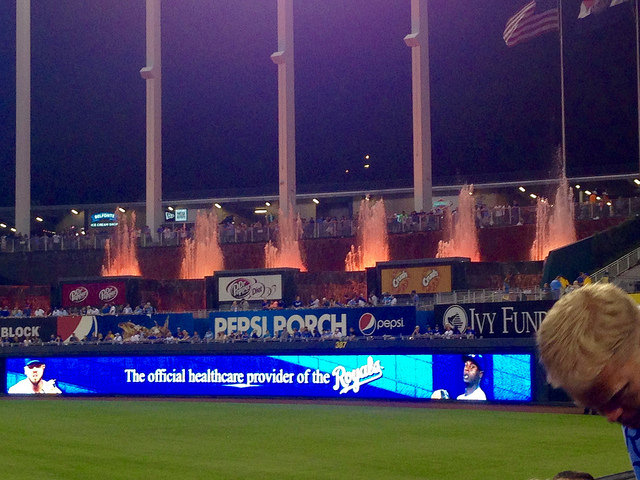
But I liked the big gold crown atop the massive video board, and the Royals flags snapping in the wind, and even the arches on the concourse.
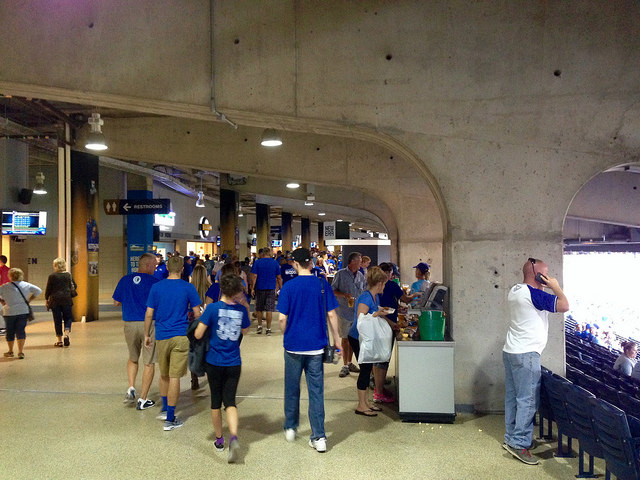
No, that isn’t old-timey brickwork or black iron. It’s just a bunch of concrete. But for 1973 it isn’t bad — Kauffman could have been some brutalist doughnut horror, but it has some nice sweeping angles and good bones that elevate it above such parks.
One thing that might have colored my perceptions is the fans are great. My pal Sterling and I were sitting in good seats behind first base, and we happened to be there on the night the Royals clinched the American League Central, which you might argue is the kind of thing that leads to grade inflation. And perhaps you’re right. But the folks around us in the good seats were into it from the first pitch, in a way the folks in a lot of good seats aren’t. It was rare to see anyone not clad in royal blue, and I was surrounded by baseball conversations all night.
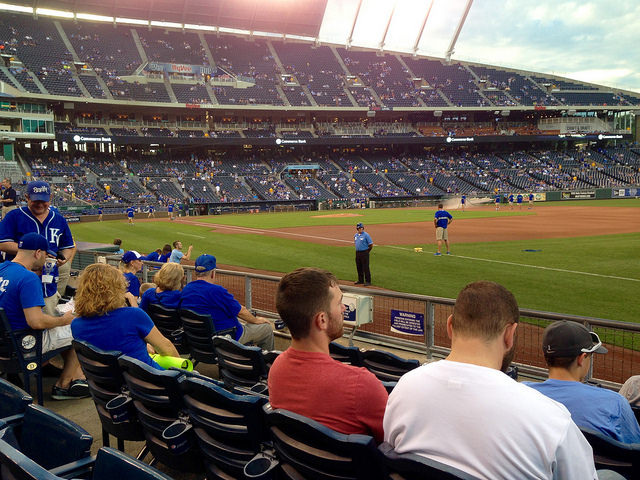
Kauffman’s stadium-operations folks set the right tone as well, seemingly determined to get every cute kid a few seconds on the video screen and to find every banner exhorting the Royals to a division title, looking for romantic attention from Eric Hosmer, or both. The Royals won and mobbed each other on the field, the fans cheered and high-fived and took inept cellphone videos from the stands (I looked at mine and deleted it), and then everybody wandered out into the vast parking lot and waited in their cars to get somewhere else. But they seemed pretty happy doing it, and I found I felt the same way.
The next night brought me to Busch Stadium, a visit that will need a few asterisks upfront:
- The Cardinals are far from my favorite team.
- St. Louis is far from my favorite town. (Well, except for the bourbon shake at Baileys’ Range, which is awesome.)
- I was there last year but the Cardinals weren’t, which I resented even though it’s nobody’s fault.
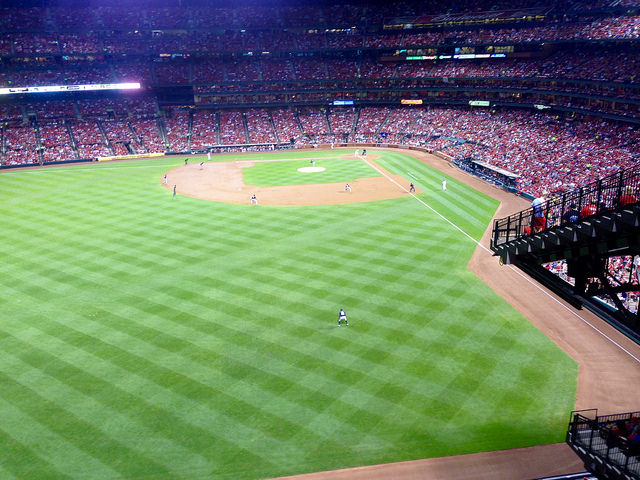
Busch Stadium opened in 2006, the third park to bear the name (here’s Greg on Busch II), and if you’ve been to more than a couple of HOK parks you’ll instantly recognize this one — brick and arches, ironwork, a level that’s suites-only, fancy seats with waiter service behind home plate, quirky seating areas in the outfield, a gathering place for families and big parties on the top deck behind home plate. None of this is a bad thing — heck, I just described Citi Field. But Citi’s a lot more distinctive than Busch, somehow. Busch feels like it was assembled by a committee flipping through a Retro Stadium pattern book.
It does have some nice touches. I liked the Scoreboard Patio seating area in center field, and the statues of Cardinal stars outside (including Jack Buck), and the place is properly festooned with Cardinalia no matter where you are. Walking up the stairs you find images of team logos, and the signs for sections are topped with cardinals in various poses. Even this Mets fan found those pretty adorable.
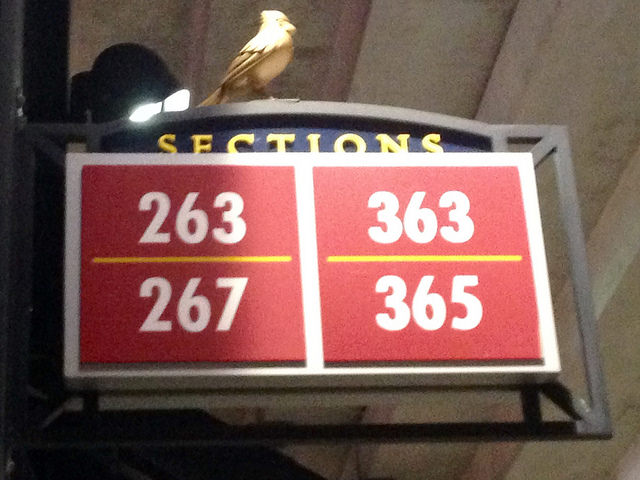
The customer service at Busch is also top-notch. There are people everywhere to help you, and they’ve been trained to actually do that, rather than assume you’re the enemy. There are about a billion places to get something to eat, meaning lines are pretty short even with a packed house. No matter where you are there’s a TV showing the game or you can hear the radio feed, which is the kind of simple thing a lot of parks can’t manage. And the out-of-town scoreboard is great, packing a lot of information into an easy-to-read space.
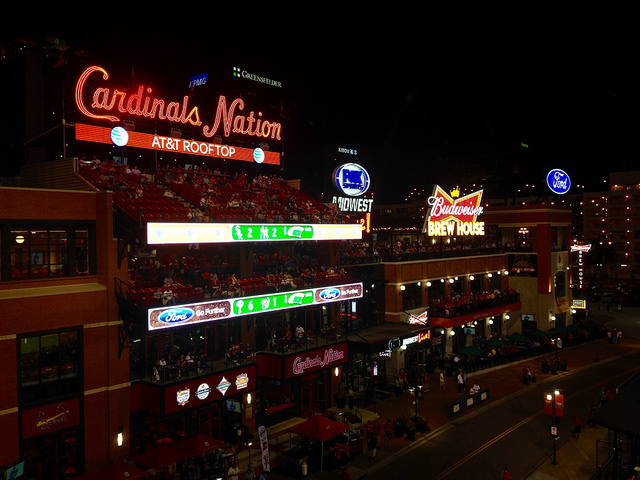
But there’s also a certain too muchness going on. For example, that thing above is Ballpark Village, an appendage of Busch that’s basically a TGI Friday’s on steroids that only serves Anheuser-Busch products. (If that sounds great to you, we probably shouldn’t hang out.) Besides the invocation of fandom as a nation, which works a lot better as ironic shorthand than as a massive expanse of neon, that AT&T Rooftop contraption is a blatant ripoff of Wrigley Field’s neighbors, which you’d think the Cardinals would have shied from copying. And I can count three Ford logos and three Budweiser ones in that picture, which is approximately 0.00000000000000001% of the number of each you’ll find at Busch. St. Louis feels like a company town, the Cardinals feel like a company team, and Busch Stadium feels like a company headquarters.
I don’t mean to be too hard on Busch. It’s a perfectly nice park. I enjoyed myself and the fireworks show after the Cardinals lost, then took myself across the street to the Hilton at the Ballpark, which has pictures of Cardinals in every room. I had a perfectly good time — as I will most anywhere you give me a beer, something to eat and let me watch baseball. But I was relieved when the next day was Cardinal-free, and I don’t think that was just the Mets fan in me.
by Greg Prince on 28 September 2015 8:49 pm 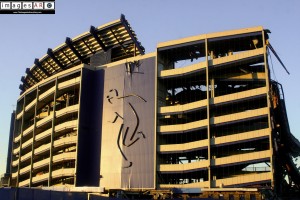 At last, I get the picture. (Photo by Andrew Richter) Welcome to FAFIF Turns Ten, the long dormant milestone-anniversary series in which we consider anew some of the topics that defined Mets baseball during our first decade of blogging. In this, the tenth of ten installments, we make one last trip to our spiritual home.
Last week, I was taking the LIRR to the Mets game, which for me ultimately involves a change at Woodside, which sometimes involves a change at Jamaica. I’m generally on top of the changes that are involved, but sometimes a conductor looks at my ten-trip ticket — which identifies my destination as Penn Station — and asks if I’m staying on all the way to the end.
“I’m going to Shea,” I say. I always say that if a Mets game is involved. It’s been my own little act of defiance for seven seasons when there is no Shea to go to. It usually sounds good coming out of my mouth and going in my ear. Shea, I like to say, is a state of mind that transcends a demolished physical plant. Mets-Willets Point is bureaucratic and cumbersome. Citi Field is free advertising. Shea is Shea.
I change at Jamaica. I change at Woodside. But I don’t change so easily otherwise.
Yet when I said, “I’m going to Shea,” on Monday night, September 21, 2015, it didn’t sound right at all. It sounded out like I got on the wrong train in the wrong year. It momentarily confused the conductor. It may have permanently broken me of my habit.
So here, on this particular ride, for what I’m pretty sure will be the last time, I’m going to Shea. I’m certain it will come up in conversation again, but never again will I head there so purposefully.
***
You remember Shea, don’t you?
“…[A] picturesque, elaborate and once widely celebrated establishment. I expect some of you will know it. It was offseason, and by that time decidedly out of fashion, and it had already begun its descent into shabbiness and eventual demolition.”
Wes Anderson did not write the above paragraph to describe Shea Stadium, circa 2008, but he could have. Our Grand Budapest Hotel of a ballpark was doomed. We still visited, but we wouldn’t for much longer. But I kept going long after 2008, at least in my mind and on these pages. It was my default setting for where to find Mets baseball, past and stubbornly present.
Lately I don’t go there so much. It’s not too crowded.
Directors love referring to their settings as “another character” in their movies. Sometimes the locale for their story is as important as any actual character, but I guess they have to stop short of saying that so as not to offend their human actors.
I don’t have such concerns, thus I can say that the primary non-autobiographical character in the first decade-plus in the life of this blog to date, certainly from my perspective, was Shea Stadium. Even though it’s a place. Even though it ceased to serve as an actual setting for Mets baseball seven years ago tonight. Even though its last physical traces were swept from the landscape more than six years ago.
Shea defined the stories I sought to tell for the first four years of Faith and Fear. It informed the subtext of much of what I wrote in the six years that followed. It lingered prominently in my Met consciousness until fairly recently, when I came to accept once and for all that it’s not coming back.
Which, at last, I’m fine with. Hence, to Shea I say a belated good night. Figuratively, emotionally, whatever.
It was hard to miss Shea’s literal lights-out on September 28, 2008, and the christening of its successor facility come April 13, 2009, wasn’t exactly conducted secretly, so, y’know, I got the memo. Still, there was something about the latter days of Shea that wouldn’t let go of me.
Factors that contributed to Shea Stadium’s continued hold on my psyche well into 2015:
1) Citi Field’s incognito phase, during which your guess was as good as anybody’s as to who played home games there.
2) Citi Field’s inability to sustain excitement.
3) The Mets’ inability to generate sustainable excitement inside Citi Field.
4) The relative recency of 2008 even as 2009 became 2010, and 2010 became 2011, and chronologically so on. (When a person passes a certain age, the use of “a few years ago” can mean anything from a few to a whole lot.)
5) Video footage from 2008 appearing a damn sight clearer and crisper than the film clips of 1963. If Shea Stadium at the end wasn’t all grainy and splotchy like the Polo Grounds apparently was, how is it possible that it was not still standing?
6) MSG repeatedly showing The Last Play At Shea and Live At Shea Stadium, wherein Billy Joel performs, crowds cheer and surely Paul McCartney is returning for one more encore. Like game action from 2008, but more so, it looked, sounded and felt far too contemporary to have taken place in a building long gone.
7) Wishful thinking. As predicted here, Shea Stadium grew in stature after its demise. Those who didn’t care for it had nothing to complain about. Those who figured they’d miss it didn’t stop missing it, and since there’s no antidote to absence, they…we were more than happy to invest it with supreme qualities it probably wouldn’t contain if it were still around.
8) Symbolism. Shea Stadium was where we had fun. Ergo, it was always fun and nothing but fun. It was where Joan Payson and Nelson Doubleday bought us whatever we needed and Tom Seaver pitched two-hit shutouts every other day while Darryl Strawberry went deep daily and K’s fluttered from above as Doc Gooden struck out side after side and Mike Piazza never, ever grounded into a double play and the Sign Man offered wry commentary and Jane Jarvis led us in the Mexican Hat Dance and Rheingold was on the house and each and every one of us was a guest on Kiner’s Korner, where we quipped with Bud Harrelson about our winning Banner Day entry that praised Ron Swoboda to high heavens. Oh, and it was always packed. We are more than happy to invest Shea Stadium with supreme qualities it displayed sometimes, maybe ofttimes, but, let’s be honest, not all the time.
Our happiest recaps remain the ones we’ve constructed in our mind. Those are the ones that refuse to be dismantled by demolition machinery. That’s OK. We are the sentimental ones.
***
“I’ve crossed that fine line from theoretical home stretch to the beginning of the end of the line. This is no longer a drill. This is no longer me thinking about what it will be like at the end of Shea Stadium. This one’s for real, I already bought the dream. I can stop having little fits of emotion late at night and during the day and on the train listening to the wrong song on my iPod. I can quit wondering whether I am going to miss Shea as much as I say I will or if I’m just saying that because I think I should miss Shea that much.”
With a little help from Donald Fagen and Walter Becker, I wrote those words on September 26, 2008, two days before the final game. I was a wreck as the end encroached. So, on some level, were the Mets. They were in the midst of playing a final week of home games to determine if there would be any more to immediately follow. As someone said into a movie camera a couple of nights before, “We are hoping that this year will be different. Maybe one more day, one more night, you’ll be in Shea Stadium, and thinking, y’know, maybe this is the year we win a World Series.”
Actually, that was me, too, for ten seconds in The Last Play At Shea, which came out in 2010, two years after Shea did not give us one more day, one more night, let alone another World Series. During a drought-conscious period in the early 1980s, you’d see a sign by the picnic area that said, “Well Water Used,” assuring anybody interested that Shea was kept green via environmentally responsible methods. By the end, though, Shea’s well of magic ran dry a game short of extending its stay on the active roster. On September 27, Johan Santana worked wizardry. On September 28, everybody returned to mortal. A final pitch from Matt Lindstrom was lofted by Ryan Church into the glove of Cameron Maybin, and there went 45 seasons. One all too brief procession of Met immortals later, that was that. Shea was done.
Now what?
***
In the middle of June 2015, it occurred to me I had just reached the 40th anniversary of my sixth-grade graduation. It was probably the first rite of passage I went through conscious that I was experiencing it. All I had known for six scholastic seasons was elementary school. Junior high awaited on the other side of summer.
I remember my reaction after leaving the ceremonies with my family. “I am finally done with this!” I shouted on the way to the car, not really pausing to think, “Now what?” All I had known would no longer be accessible to me. When I arrived in seventh grade in September, roaming the same hallways with supersized eighth- and ninth-graders, it was a whole other world and not an easily inhabitable one. I was one of the big kids in sixth grade. I had tenure. I was somebody. Groping to get a grip on seventh grade in the fall of ’75, I had never felt quite so small.
Maybe that transition informed my reluctance to exult that I’m Finally Done with certain phases of my life. Maybe that’s why when All I Had Known Stadium was being taken away from me, I hesitated to embrace the unknown. Besides, it wasn’t my idea to take my educational business to Long Beach Junior High School; somebody said I had to go.
That’s how it felt with Citi Field.
Home is where the Mets are, I tried to tell myself, but Citi Field took forever to feel that familiar.
***
Seventh grade was harrowing for the first couple of months, but eventually I got used to junior high (though I was perfectly happy to skedaddle to high school when tenth grade rolled around). 2009 was an awful season, even if it wasn’t exactly Citi Field’s fault the Mets lost 92 games. But Citi Field wasn’t helping, either. It was built, I suppose, as a counterpoint to Shea. If Shea was symmetrical, Citi Field had kooky angles. If Shea could hold 56,000 people, Citi Field would limit its seating by a quarter as much. If Shea was referred to, lovingly and otherwise, as a dump, Citi Field would be presented as “world-class,” with exclusive club upon exclusive club wherein the favored could accumulate points in their Infrequent Rewards program.
It was like Shea and night.
In my bones, I hated that first year at Citi Field, a facility that wasn’t my idea, which only served to make Shea a paradise lost in retrospect. A paradise of puddles, perhaps, but in the heart, you don’t notice the standing pools of water.
I wasn’t the only one who felt that way, apparently. You could hear the longing in people’s voices and eventually you could see it on people’s chests. The creators of the I’M CALLING IT SHEA t-shirt were nice enough to send me a couple of their signature items in ’09, which I was happy to wear, even if it never occurred to me call Citi Field Shea. I appreciated the sentiment. Those items were a fairly common renegade sight in those pre-7 Line days. I don’t see them worn out and about much anymore, but I occasionally slip mine on, mostly because it’s blue, orange and fits. To this day, whether I’m modeling it at Citi Field or anywhere else, I’M CALLING IT SHEA elicits more comments than any other t-shirt I own. The reaction is universally approving, usually with an addendum:
“I miss that place.”
I don’t know how it worked in other places, if Vet diehards couldn’t cotton to Citizens Bank Park, if the Three Rivers loyalists found fault with PNC, if there was a prevailing sense that Turner Field could never truly replace Atlanta-Fulton County Stadium. I do know that Shea kept getting better in the popular imagination the more it wasn’t there. I do know that Facebook groups sprang up to celebrate its every waking moment from 1964 to 2008. I do know that Shea became synonymous with Mets in a good way during the post-2008 years that Mets became synonymous with all kinds of unflattering adjectives.
Citi Field had no shot of winning if the Mets had no shot of winning. Shea couldn’t lose if there was no game today.
***
There’s a worm-turned moment coming in all of this; you just know there is. And you probably suspect it has something to do with the Mets being very, very good in 2015. It’s the logical conclusion. The Mets stopped being bad, and the author steps back and says, say, this joint ain’t so bad after all. Cue roar of the crowd, then a time jump to April 2016 where an eighth postseason banner (contents TBD) is affixed to the left field facing of the Excelsior level. Lesson learned: home is indeed where the Mets are.
OK, you can use that if you need to get going, but it wasn’t quite as simple as Wilmer Flores sockin’ that ball and making everything all right when it landed over the wall. Besides, this isn’t about Citi Field. This is still about Shea, Shea for the last time.
But we do have to go through Citi Field to get to Shea, and we have to do so when Citi Field is at arguably its worst. When it’s not world-class. When no gourmet burger can fix what’s wrong. It’s far more vexing a problem than any Upper Deck puddle ever was.
On the first night of July in 2015, I encounter standing pools of apathy. It’s the Mets and the Cubs and a stunning lack of offense. Nobody scores for ten innings. Ruben Tejada reaches third in the eighth but gets himself thrown out on a screwy squeeze gone awry. In the eleventh, the Cubs begin to successfully peck away. A walk, an out, three singles…a run.
Then chants.
“Let’s Go Cubs!”
“Let’s Go Cubs!”
“Let’s Go Cubs!”
And there is only faint retaliation. Little booing, little Let’s Go Mets-ing. This wasn’t one of those ballpark takeovers, mind you. The Cubs fans were not all over the place as the Giants fans have come to be on San Francisco’s annual trip in. There were enough— a.k.a. too many — of them, but not an infestation. It wasn’t the Victor Diaz game from 2004 when you understood the parameters — Cubs in a race, Mets nowhere near one — and could deal with the disproportionate cheers from the visiting fans (and truly relish Victor Diaz and Craig Brazell making it their game by the end). This was a light crowd to begin with, made lighter by the late hour, and now it was, as measured by volume, more a Cubs crowd than a Mets crowd.
Maybe it’s because I was at the game with my friend Mark Mehler, a Mets fan from when the Mets were aiming to overtake the Cubs in another July, that this really got to me. It didn’t help that these Mets, for all their inability to score, were still technically in a race on July 1, 2015. They were 3½ behind the Nationals entering the night’s action. At the same juncture of the 1969 schedule, through 78 games, the Mets were 7½ behind Chicago. Here we were, in contention, but nobody of a Met nature seemed to care or take it seriously enough to jeer the joyous Cubs fans into quietude.
Was there a single Cubs fan at Shea Stadium in July of 1969?
What’s happened to us? I wondered. How did it get this bad? This never would have happened at Shea. Of course it did happen at Shea. Just two paragraphs ago I mentioned the Victor Diaz game. That day Shea was two-thirds Cubs fans, but like I said, there was nothing on the line for the Mets that day. Here we were midway through 2015, making great strides, thanks to our pitching, yet in our home ballpark, it might as well have been some play-out-the-string September. The Mets would lose, 2-0, in eleven, but not lose ground because Washington didn’t win. The Nationals would have been doing us a mighty favor, I thought, if they’d just get on their inevitable winning streak and put us definitively away.
I was back at Citi Field about twelve hours later, at the gracious invitation of another friend, Brian Sokoloff, who had also asked Andrew Richter along. Andy is a gifted photographer who expressed his gratitude by bringing Brian a print of one of the photos he took from a series he’s particularly proud of. He documented the demolition of Shea Stadium. The pictures are haunting (I have a set of my own, thanks to the artist). It was a difficult subject matter for Andy to approach, but he said he felt it needed to be done.
“[T]his building was the first place I was allowed to be myself, and it was OK,” Andy has written on his Web site. “It is in this building where I became a man. Facing its death was depressing. Documenting its death was cathartic.”
The Mets didn’t score much during my game with Brian and Andy, either. The fact that they scratched out one run was cause for mock celebration. The Cubs would win this one, too, 6-1, Jake Arrieta excelling and Jacob deGrom fizzling. On the 7 to Woodside afterwards, I listened to giddy Cubs fans chatting it up as if the next stops were Belmont, Fullerton and North/Clybourn, and wondered if any other Mets fans were as innately offended as I was. The Cubs — our ancient rivals — waltz into Flushing and sweep three from the Mets and nobody does anything about it. Nobody beats them on the field, nobody menaces them on the train. Seven years into Citi Field’s existence, we are practically invisible in the shadow of our own ballpark.
I wanted to feel heartbroken that we’d been swept a terribly frustrating series in the midst of what the standings insisted was a pennant race, but I was incapable of feeling anything that deep about the Mets anymore.
If Citi Field didn’t care, why should I?
The line “Worst 24 Hours in Mets History” would be used toward the end of July to describe the time period encompassing the embarrassing spectacle surrounding the non-trade of Wilmer Flores and Zack Wheeler for Carlos Gomez and the twice rain-delayed ninth inning in which Jeurys Familia blew a save to the San Diego Padres, but for me, the night of July 1 and the afternoon of July 2 took the rancid cake. Those represented my worst 24 hours in Mets history…since 2008, at any rate.
***
Pictures and their capacity to say a thousand words put a crimp in my stock-in-trade. The picture Andy brought to Citi Field of Shea in its state of dismantlement spoke volumes to me. It stayed with me after July 2. Brian had posted it on Facebook and I kept looking at it there. I went back and looked at my own copy. When Andy had shown his work to me before, as early as April of 2012 at Hofstra and as recently as March of 2015 at Foley’s, it was too painful, too fresh for me to fully appreciate. I had to look away. If Andy had shown it to me inside Citi Field before July 2, I might have called security. It was the wrong place and the wrong time for such an egregious exhibition.
Now that I was firmly convinced Citi Field would never care like Shea did, somehow Shea meeting its end looked right. Yes, Shea was gone. I had known it as a reality for seven years, but still sort of expected and wished for it to magically arise from the Citi Field parking lot every game I went to.
Dude, I said to myself somewhere in early July, that’s just not gonna happen.
With no particular fanfare, just the slow dawning of realization, I laid Shea Stadium to rest. The video clips suddenly didn’t look like they were shot yesterday. The pictures on Facebook appeared historical in nature. The I’M CALLING IT shirt stays in the drawer because it fits (physically as well as spiritually), but it no longer feels like a subversive rallying cry. It’s just a sweet curio from another time. SNY recently debuted a series of highlight shows called Amazin’ Finishes, the first three episodes of which featured great Mets games from 2006, 2007 and 2008. Anywhere between 2009 and 2015, something like that would have taunted me. I’d be diving into the television so I could sit in those orange or blue or green or red seats again, in a place where baseball mattered, in a place where the Mets were real.
Instead, it was just to fun to watch because it was the Mets and stuff. It was from a long time ago.
Sometime during the summer, we moved some furniture around our living room. A couple of slightly dog-eared pocket schedules appeared, one from ’07, one from ’08, previously prime fodder for fiercely protected nostalgia, the kind of trigger that would get me angry all over again that somebody switched stadia on me. Now? The schedules could have been from any old years. More fun Mets stuff to peruse and briefly dwell on — whatever became of Popcorn Night? — but not something worth taking to another level of separation pains.
The boldest sign of the times? It can be found in my Log, the steno notebook in which I record the results of every game I go to. From almost the beginning, the competitive contents of The Log II — the Citi Field edition — were outpacing the original, the one from the Shea days. For all my missing of Shea and lukewarmth toward its successor, the Mets had been doing much better for me at Citi Field on a game-by-game basis. For example, after a hundred games at Shea, my record was 46-54; at Citi Field, it was 66-34. I prefer the Mets to win the games I go to anywhere, but I found it atonal to have sustained better luck at the place whose existence I persisted in resenting.
The gap has been closing for a while now. It closed so much, it reversed. After 207 lifetime regular-season games at Citi Field, I’m 117-90. After 207 lifetime regular-season games at Shea? 118-89. Shea has retaken the lead on Citi…and I take no pleasure in it.
I really have moved on.
***
The 2015 Mets season is on the verge of being remembered widely and fondly for many wonderful things. For me, it will be at least in part about the summer a hazy Shea of winter finally dissipated. There will now and then be flareups of private nostalgia. There will inevitably be a pang to take refuge in the Mezzanine, as if you can always go back to the green. In a matter of days, it will strike many of us as useful to have maintained a seating capacity that includes 14,000 more chairs, and 14,000 or more of us will wish that additional seating had indeed been preserved for an October like the one suddenly on tap.
Yet Shea Stadium has finally stopped being present in my mind because it’s no longer present in the present. I still love Shea for what it was. I can’t love Shea for what it is. It’s not there anymore. A season like this and the postseason ahead, whether or not you change at Woodside, belong to Citi Field. The torch has been passed to a new configuration.
Citi Field is still a ballpark that kind of dares you to embrace it as your own, but it is there. It is where the Mets are. It is where the Mets are winning. It is home. You can’t fight Citi Field. Nor do I care to any longer.
The summer of 2015 was also when the New Horizons space probe, which launched in 2006, finally reached the general vicinity of Pluto. It happened during the All-Star break, which may be why I noticed. That journey took nine years, or as long as it’s been since the Mets last orbited October. My journey from leaving Shea to saying goodbye to Shea took only seven.
When you rely on the Long Island Rail Road, it’s difficult to travel at the speed of Dwight.
by Greg Prince on 28 September 2015 3:22 pm What can I tell you that you don’t already know?
You know the Mets are the champions of the National League Eastern Division. They won that title Saturday and they maintained that title Sunday and as regards 2015, it is theirs forever. Even the NCAA can’t take it away. Every time I start to think about something else, the Mets having won the division is all I can think of.
You know the Mets won Sunday in their first outing as the reigning champions of the National League East. They swept the Reds by deploying a classic Day After lineup. Although the Mets still have some home-field advantage business to tend to, you have to go with the Day After lineup. It’s one of baseball’s finest traditions. You rest everybody who did the most to get you the crown and send their understudies to play in their place. The understudies for a division champion can’t be too bad. They’re champions, too.
You know (if you pay attention to these things) the Mets held rookie hazing day after finishing off the Reds. This time they dressed the kids in adult-sized Underoos and paraded them through the streets of Cincinnati. Last year it was skimpy superhero outfits. The year before they constituted a blushing bridal party. Once again, everybody smiled, everybody laughed. Everybody smiles and laughs even when there’s no division title in the bouquet, so this time it must have really been giddy. Hazing of the new guys strikes me as one of baseball’s least fine traditions, but if everybody’s having a sincerely good time (and the too-often present homophobia and misogyny inherent in this ritual is as toned down as possible), then, you know, boys will be boys…I guess.
You know the boys in Washington are screwed, especially the fella they brought in to close games who instead symbolically shoveled dirt on their season. In an episode worthy of the 1993 Mets, Jonathan Papelbon choked Bryce Harper in the Nationals dugout Sunday. All one can say to that sentence, let alone image, is “Wow.” Vince Coleman would have thought Papelbon’s behavior was unprofessional. Harper’s misdeed was not running full-bore after popping up. He should have run harder. Everybody should run harder on popups. Phil Mushnick could tell you that. But there are ways to communicate that without hands lunging for the neck of your teammate/prospective league MVP. Papelbon — who defending N.L. Manager of the Year Matt Williams sent back out to pitch after he assaulted his franchise player — makes no one around him better and everyone around him bitter. Washington’s acquisition of him may have been the Met move of the trading deadline.
I didn’t get into blogging to tell you what you already know (though I don’t mind repeating the part about the Mets as champs and Papelbon as chump). So here’s something I’m gonna bet the vast, vast majority of you don’t know. I didn’t know it until yesterday, and — at the risk of sounding immodest — if I didn’t know it, chances are it’s not widely known.
But Seth Wittner knows it and tells it.
Seth is a Faith and Fear reader who wrote to us in the aftermath of Saturday night’s clinching with an agenda. He wants to promote “Loo-Doo” as Lucas Duda’s nickname. So do Seth a favor and spread that around if you like it.
But never mind Loo-Doo, because Seth embedded another couple of autobiographical notes into his e-mail:
1) He’s been a Mets fan since 1962, when he was 12.
2) He lived in Elmont, near where American Pharoah would someday become a champion, and schlepped via trains to the Polo Grounds to cheer on a nag of a ballclub that was years away from sniffing the floral side of a finish line. “Lots of tears back then,” he says of that Mets outfit that finished 60½ lengths out of first that first year. Lots of loyalty, too, given that Seth’s still with our Mets all these years later.
3) He and a friend entered the very first Banner Night contest at the Polo Grounds in 1963 and earned second place, the prize for which was “four box seats to the first game ever at the Big Shea”.
Whoa, I said. Due respect to Loo-Doo, you gotta tell me what your banner said. It must’ve been a Loo-Doozy if it could win you such a phenomenal bounty.
Seth wrote back and filled me in on the banner and then some.
“Our banner had a silver trumpet on a solid black background. It said, ‘Ta-ta-ta-Da-da-da!’ as in ‘Charge!’ Beneath the words, we had the music for that snippet of melody a trumpet would play.
“My friends and I used to make lots of banners and take them to the PG. A few times, photos of our banners made it into Newsday.
“Here’s a story you’ll enjoy. Leon Janney was a semi-retired Broadway actor who played a bartender for TV commercials between innings. He would interview players or their wives. Everyone was bringing banners cheering on guys like Mays or Frank Thomas or whoever. Mike and I made one that said ‘Let’s Go Leon Janney!’ It had a picture of a sudsy, overflowing mug of beer.
“We were sitting in the right field upper deck. I felt someone tap me on the shoulder. It was Leon! He walked all the way from his season box behind the plate to where we were and talked baseball with us for a few innings. He mailed us autographed headshots and invited us (while he sat with us) to come watch a Rheingold Inn taping…but he never told us where or when.”
I know from Rheingold. We all know from Rheingold, the dry beer, the beer synonymous with the early years of New York Mets baseball. But the Rheingold Inn? Leon Janney? A bartender for TV commercials between innings who would interview players or their wives?
Did the Mets have a Steve Gelbs in 1962? A one-man Branden and Alexa?
I did not know. So I looked Janney up to see if I could find out anything else. The following I learned from a book called Cue the Elephants, written in 2005 by Dean Alexander, a memoir of 50 years spent working in television.
There was a “permanent, full-sized, functioning tavern” constructed in a studio at Videotape Center in Manhattan. It was dubbed the Rheingold Rest (Rest…Inn…close enough). Alexander worked there and saw “hundreds of Rheingold beer commercials” shot there. He likened the set, with its mahogany and brass and Cheers-like feel, to a “forerunner of the modern sports bar”.
In the middle of the action was Janney — a former child star, whose credits included a turn in one of the Our Gang comedies — as a barkeep, “who casually chatted with stage, screen, sports and political personalities who just ‘happened’ to drop by.” Alexander namechecks Tony Randall, Phil Silvers and Jim Backus among the visitors, adding, “virtually every living athlete who had ever played in New York made a pilgrimage to ‘Rheingold Rest’.”
According to Bill Shannon’s Biographical Dictionary of New York Sports, the Rheingold Rest aired after Mets games on Channel 9 those first two seasons at the Polo Grounds. Whereas Choo Choo Coleman became famous in part due to Ralph Kiner’s tale of Choo Choo coming on his postgame show and being legendarily taciturn…
“Choo Choo, what’s your wife’s name and what’s she like?”
“Her name’s Mrs. Coleman, bub, and she likes me.”
…Mike Tennenbaum, a contributor to the Ultimate Mets Database’s Memories section, recalled hearing Mrs. Coleman herself on Rheingold Rest. Leon, apparently, got more out of Mrs. C than Mr. K got out of her husband. “She met Clarence at the public tennis courts in Orlando, Fla.,” Mike wrote. “She recalled this soft-spoken master of the understatement as a wonderful tennis player.”
A self-described “beer reviewer, historian and raconteur” named Dan Hodge reported Janney’s skills went beyond interviewing. On the Rheingold Rest, Leon could be seen “illustrating tricky plays with the imaginative use of bottle caps as bases and baserunners”. Surely that made the sponsor happy (even if the tricky plays probably related to the sponsor’s team running into outs or throwing balls away).
Maybe not everybody was a fan. In 2010, someone on a Brooklyn Dodgers message board brought up the Rheingold Rest only to judge it “more like the Rheingold Snooze”. Nevertheless, the harsh critic of the program had fairly nice things to say about the host: “I met Leon on the subway once after a Mets game in the Polo Grounds, and he was a very nice guy, but he didn’t seem to know too much about baseball.”
Neither did the Mets, based on their records in ’62 and ’63, but we loved them then and we love them now and it’s characters like Leon Janney, whether they stood the test of time or only cross your consciousness because somebody brings them up in the service of disseminating a nickname for the guy who just blasted a grand slam in the current season’s division-clincher, are all part of the Amazin’ tableau.
So thank you, Seth Wittner, first runner-up in the 1963 Banner Night procession, for telling me something I didn’t know about the Mets. Thank you, Leon Janney (1917–1980), for taking note of the banner in your honor and schlepping up from your nice box seat to say hi to Seth and his friend Mike, not to mention your kind conversations with the man who would play Felix Unger, the lady who had married Choo Choo Coleman and the guy on the subway who wasn’t easily impressed.
And thank you, Sandy Alderson, for not trading for Jonathan Papelbon.
by Greg Prince on 27 September 2015 11:00 am  There have been 17 champagne celebrations for team accomplishments in New York Mets history. This is a scene from the 17th. Indulge me, Mets fans who weren’t viewers of Mad Men, as I channel Don Draper delivering — à la Matt Harvey on Saturday in Cincinnati — the most impressive pitching we had ever seen from him. The product, in this case, is a glorious new iteration of what our baseball team is capable of producing.
It’s not called the Collapse. It’s called a Division Title. It lets us travel the way a champion travels. Onward and upward, and higher again…to a place where we know we have clinched.
For those of you unfamiliar with what is being played off of above, Don, the master ad man, was branding, on the fly, the Carousel, Eastman Kodak’s contraption designed to show off your boring family pictures (long before Facebook usurped that function). The company executives who were Sterling Cooper’s clients had tentatively labeled their invention the Wheel. Don, however, saw something different in what they were selling.
And now you, the consumer of all things Mets, are seeing something different in the team with which you so closely identify. You’ve been used to a situation where you weren’t so much certain something was going to go wrong as you were sure nothing would ever go right again.
You’ve just learned the Mets have other, better applications.
My allegiance to the New York Mets dates back to late in the Mad Men era, to 1969, when everything went right, and 1970, when markedly fewer things worked out. After those two personally seminal seasons, I got that the Mets didn’t always win it all, but understood just as well that wondrous achievements weren’t beyond their grasp. In case I thought the first glimpse I got in ’69 was a fluke, 1973 came along soon enough to reinforce how wonderful the Mets could be.
Later…much later, there was 1986 and 1988 and 1999 and 2000 and 2006, each of them spawning commemorative t-shirts and selling tickets to games not originally scheduled. They made sense to me. They were of a piece with knowing what I knew was possible. All those other years, when the Mets weren’t winning, those were the outliers in my estimation. I got used to not winning for long (long) stretches, but I didn’t take that as the way it was supposed to be, just the way it was.
I don’t play the generational card much, certainly not to hold what I have experienced over the heads of those who’ve lived through less. To me, you choose the Mets whenever you choose them and you’re one of us. You’re eligible for every Real Fan perk I have to offer. But coming down the stretch in 2015, I felt genuinely bad for Mets fans who hadn’t been immersed in all or most or even one of those seven playoff years. I felt genuinely bad for anybody who made — whether by choice or instinct — 2007 the organizing principle of his rooting life. I felt genuinely bad for anybody who couldn’t help himself from shouting “COLLAPSE!” in a crowded ballpark (or comments section).
That’s not who the Mets have to be. That’s not what the Mets have to be about.
And now you’ve seen it for yourself.
You have the 2015 Mets. You have one of the 17 celebrations in Mets history. Seventeen times the Mets have opened bottles of champagne and poured them over one another. Seventeen times the Mets have won something transcendent as a team. Eight times it’s been entry to the playoffs. Six times it’s been a division title.
This time was one of each of those times. When Jay Bruce took his place in the procession behind Joe Torre, Glenn Beckert, Chico Walker, Lance Parrish, Dmitri Young, Keith Lockhart and Josh Willingham and made the final out of a Mets clincher against Jeurys Familia (following in the footsteps of Gary Gentry, Tug McGraw, Dwight Gooden, Ron Darling, Al Leiter, Armando Benitez and Billy Wagner), this was no longer a team that lets us down. This became a team that lifts us up.
Actually, it’s been a team lifting us up most of the past six months, dating back to those initial unbeatable April days, through the pitching-powered grittiness of June and July and then making like a dynamo once August hit with the full force of a revamped roster. Nevertheless, it had to be official to feel official. You had to know that the Mets could not just take a lead and build a lead but that they could keep a lead.
You know it now, baby. You know these are your National League East champions, the sole denizens of first place from August 3 to eternity where 2015 is concerned. You saw it on TV, you heard it on the radio, you followed it on the Internet and you can buy it at Modell’s.
You needed proof. I understand. We all need proof. Though it’s been obscured by the mists of time, there was a time I couldn’t believe a seemingly qualified Mets team could make it from September to October unscathed. In 1998, the Mets lost their last five games to ooze away from a winnable Wild Card. That was tough. In 1999, the significantly improved Mets lost seven in a row with two weeks to go and sent their fans and their fate into turmoil. That was tougher. As the Mets kept losing, I grew absolutely convinced the worst was inevitable. Neither the backstories of ’69 and ’73 nor the last-ditch rallies from ’86’s two Game Sixes could penetrate my consciousness. They choked last year, they’re gonna choke this year. That was my jam.
As you may know, the 1999 Mets got their act together on the final weekend of the regular season and, like the 2015 Mets, punched their ticket to the playoffs in Cincinnati. Before they could win that all-or-nothing showdown versus the Reds sixteen years ago, they had to beat the Pirates on the last day at Shea, which of course they did. That was the Melvin Mora Game, the one the Mets took when Mora scored the decisive run on a ninth-inning wild pitch. It was and remains my most cherished memory as a fan. The Mets had to do what they had to do and they did it. It wasn’t always going to be 1998. On the best of days, it could be 1999.
I watched that game in Loge alongside my friend Richie, who was kind of the baseball big brother I never had. We’re still in occasional touch via e-mail, but 1999 was really our year. Some years are like that, where you’re closer than ever to a particular person with whom you share a common interest. For Richie and me, it was the Mets and 1999. When Brad Clontz’s bases-loaded pitch thoroughly eluded Joe Oliver’s mitt and Mora raced home to give the Mets a season-lengthening 2-1 triumph and all 50,000 of us on hand went nuts, Richie had the presence of mind to grab me and stage-whisper over the din into my ear, “They didn’t choke.” It was exactly what I needed to hear.
To you who didn’t necessarily believe, I do for you what Richie did for me, albeit in the vernacular that overtook our consciousness following the unfortunate proceedings of September 2007.
They didn’t collapse.
I hope you heard that over the roar of the crowd. They didn’t collapse. They didn’t come close to collapsing. I didn’t think it was even an issue, considering they never led by fewer than four games from August 20 forward. I didn’t think anything needed to be said beyond “way to go,” considering the run the Mets went on between July 31 and September 14, playing 42 games and winning 31 times. Those were 1986-, 1988-type numbers. Those were being posted in the heat of what we called a pennant race, what I knew in my heart by late August was closer to a prohibitive runaway than a potential collapse.
A collapse wasn’t going to happen. And it didn’t. And it’s great. It’s great because we’re all Mets fans and it’s great because we’re all Mets fans who’ve experienced something like this now. I don’t have to dig deep and hark back. All I have to do is point to the standings and that lower-case “y” most outlets use to denote divisional champ. Links to video footage of the 17th champagne celebration in New York Mets history are fresh and plentiful as well.
You may still be tasting the literal and figurative bubbly from Saturday night. You may need to splash some cold water on your face. But if I could advise anything beyond, “they didn’t collapse,” it would be take how you felt in the moment after Familia fanned Bruce and put it somewhere where it will stay pristine. I don’t mean so you can take it out in the dead of winter or in some season down the road that doesn’t necessarily encompass a clinching. I mean, yeah sure, that too, but more immediately, I mean in case the rest of 2015 doesn’t match our fondest dreams.
I’m not suggesting this year won’t be the year. Heavens no, not while we are busy being N.L. East champions for the first time in nine years (or a million, in Met years). Alas, though, it’s worth noting that elsewhere on this continent, there are Cubs fans and Blue Jays fans and Royals fans and Pirates fans and some other fans who are convinced that this year is gonna be the year, based on the simple fact that their year has already been extended into the next month, just like ours has.
It’s a natural reaction. Just as bad results beget bad vibes, good results imply even better ones lie directly ahead. Last year at this time, there were 10 teams whose fans were feeling pretty, pretty good about their impending October appointments. In a matter of weeks, two; then six; then eight; and ultimately nine flocks felt significantly less good about the circumstances that had befallen the objects of their affection.
We are one of ten lucky batches of sumbitches. We have, at base, a 10% probability of winning the World Series. We can parlay that into 100%. Or we might crap out when pitted against another of the 10-percenters. Sadly, we can’t all be destiny’s children clear into November. If we don’t taste champagne again (let alone again and again and again) this year, I ask that you make a point of circling back to September 26 and remembering the night we did as your signature moment of 2015. Remember fiercely the 17th celebration in the event that the 18th, 19th and 20th don’t transpire exceedingly soon.
Remember 2006? What do you remember? If you say “Beltran looking at strike three” or words to that effect, I say reconsider. Remember beating the Dodgers in the NLDS. Remember beating the Marlins to clinch the East. Those touched off Celebrations Nos. 15 and 16. You see how long it took us to get to 17. As Monty Python might have put it, every celebration is sacred.
Don’t be that fan who, when presented a memory of anything that isn’t airtight success, says, “Don’t remind me.” You’re reading the wrong blog if that’s how you take your Mets. I make it my business to remind you of what our team has done, sometimes to make a larger point, sometimes just for the hell of it. But I don’t do it to make you feel bad or worse. When I invoke 1988, it’s not about Scioscia; it’s about 100 wins and a division crown. When I invoke 2000, it’s not about losing the World Series; it’s about winning a Wild Card, a Division Series and a pennant. When I invoke 2006, it’s not about one pitch that wasn’t swung at; it was about the most fun year I ever had blogging…until this one, which is just about as much fun to date.
Someday I will bring up 2015, the division title, the Saturday Duda and Granderson and Wright went deep and Harvey stayed in longer than anticipated and Familia finished up to clinch it. Regardless of what comes next, that — and everything that led to that — happened. It was beautiful. It will always be beautiful. Don’t let the course of Metsian events as yet unknown squeeze the context out of what you’re enjoying now and deserve to enjoy forever.
I’ll tell you one thing that has made 2015 unique among Met years that have included at least one champagne celebration, at least for me. You won’t find it in the standings, it doesn’t show up in a box score and I defy anyone who thinks it can be solved by deploying advanced metrics. The answer is all over whatever device you’re reading this on.
I got to enjoy this run toward glory with you. With you who visit this blog; with you who drop us a line via e-mail; with you who Like us like crazy on Facebook; and with you who I have the pleasure of tweeting back and forth with between every other pitch on what is sometimes derisively dismissed as #MetsTwitter. I don’t get the derision and dismissiveness, by the way.
• You know who composes #MetsTwitter? Mets fans who use Twitter to communicate their Mets thoughts to other Mets fans.
• You know who puts down #MetsTwitter? Mets fans who use Twitter to communicate their Mets thoughts to other Mets fans.
• You know who uses Twitter to communicate their Mets thoughts to other Mets fans? #MetsTwitter.
To paraphrase one of my favorite lines from the movie The Commitments, “Isn’t everybody on #MetsTwitter an arsehole? Except for management, that is.”
Anyway, when you’re a Mets fan online, you’re never by yourself. Nor would you choose to be. Taking in these Mets and what they’ve done alongside you — whether you always believed; you never believed; you didn’t believe until you had to believe; or you are unwittingly the embodiment of a human weathervane — has placed me comfortably inside a packed and jubilant stadium for every game. When we get a night that uncorks the best of our emotions, the celebrations we watch from the field and the clubhouse are more than matched by the joie de Uribe we engage in among each other. I swear the sensation is more real than virtual, whether or not you opted to pour champagne on your own home turf.
Which we Princes did, once the Jeurys-rigged ninth inning was completed and Stephanie and I emerged from our traditional post-clinch clench. We didn’t exactly don goggles and spritz Moet & Chandon around our living room and onto our cats. We laid in only enough to toast and sip, and that we took care of in a state of serene satisfaction. Unfortunately, I had a pre-existing headache that the surfeit of tweeting and the modicum of imbibing probably exacerbated a bit. I realized we hadn’t had anything substantive for dinner, which couldn’t have been helping, so I placed an order with a nearby pizzeria that operates under an agreeable enough family name and told them I’d come pick my order soon.
When the time came, I grabbed my Superstripe-model Mets cap (it’s my favorite), proudly affixed it to my slightly aching head and stepped out into the cool September night. It was the kind of move I made just as easily, pizza or otherwise, in the early autumn of 2006 and 2000 and 1999 and 1988 and 1986 and 1973 and 1969. It was 2015, which by now had something permanently in common with all of those aforementioned banner years.
It was a year when being a Mets fan once more felt exactly the way it’s supposed to feel.
And after I picked up the pizza? I spent the rest of the night talking Mets — present and past — with the good folks of the Rising Apple Report, which you can and should listen to here.
by Jason Fry on 27 September 2015 12:46 am
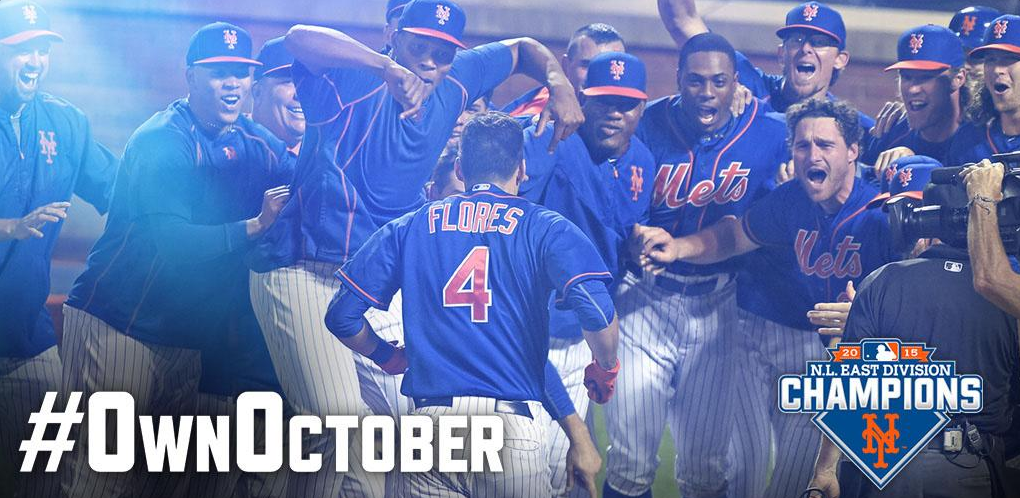 It’s not a new story any more. In fact it’s a well-worn tale on its way to becoming a cliche. It’s not a new story any more. In fact it’s a well-worn tale on its way to becoming a cliche.
But that’s the fate of stories that resonate with people, that mean something. And this one does. It’s the one I keep coming back to. And it’s worth hearing again.
It’s the story of Wilmer Flores, sent away to Milwaukee with Zack Wheeler for Carlos Gomez. In theory, it was a trade designed to make everybody happy. Gomez would come back to his first team, a rambunctious colt grown into a high-wattage hitter and charismatic clubhouse figure. Wheeler would return next summer knowing that his new team had valued him enough to acquire him long months before he could again be useful. And Flores would escape a situation that had become frankly dysfunctional.
He wouldn’t have to keep learning to play a position he’d once been told to stop playing, with his every hesitation and mistake exposed in public and excoriated at top volume. He wouldn’t be asked, while already doing something extremely difficult, to also add muscle to a sick, sputtering offense. Instead of being expected to speed up a transformation into something he’d never been, he’d be accepted for just being Wilmer Flores.
Plenty of athletes would have jumped at the chance. But Wilmer Flores didn’t want to go. Despite everything that had happened, he wanted to stay with the professional family he’d been a part of since he was literally a child. Distraught and dismayed, he spent his final moments as a New York Met in tears — an ordeal that was public, just like the previous ones.
And then came a twist that would have made even a soap-opera fan incredulous. The done deal was undone. Forty-eight hours later, the Mets faced off against the Nationals, the kings of the N.L. East, with Flores at shortstop. In the 12th inning, with the game knotted at 1-1, he drove a ball into the Party City deck. With a horde of teammates awaiting him at home plate, Flores tossed his helmet away and then grabbed at his uniform, at the script word on his chest, the one that turned out to have meant as much to him as it has to us: METS.
That all happened the same crazy week of the season that saw the great-pitch, zero-hit 2015 Mets 1.0 rebooted as Mets 2.0. There was the arrival of Michael Conforto from Double-A, viewed with reflexive suspicion as a low-cost PR gesture. There was the import of Juan Uribe and Kelly Johnson and Tyler Clippard, battle-scarred veterans and baseball professionals. And there was the shocking acquisition of Yoenis Cespedes, Plan C after deals for Gomez and Jay Bruce failed to materialize.
All of those events fueled the Mets’ astonishing rocket ride past the Nationals, a trajectory that has now reached escape velocity. But it was Flores’s resurrection that was the heart of it — the story we’ll remember, and tell in an effort to make sense of two months in which the impossible became routine.
For a long time we’ve labored under the burden of bad stories. There were the twin collapses that taught us to fear things that go bump in the September night, and then the financial reversals that taught us to assume we were being lied to on December mornings. The Mets, still shell-shocked from back-to-back disasters at Shea, moved into a modern park just in time for a savage economic downturn and the revelation that the coffers were bare. Both they and we took up residence at Citi Field like squatters in an stripped and abandoned palace, sniping about obstructed views and Dodger shrines, watching terrible baseball and listening to worse excuses.
We were a dumpster fire, a pitiable farce, a national joke. The athletes paid to be Mets failed and were discarded or succeeded and were subtracted anyway, sometimes exiting with an anonymous knife in the back. They left if they could, most of them; we stayed because we had no choice, we were born to this and it was too late to choose otherwise. And so for six years we subsisted on the little we had. There was nostalgia, correctly diagnosed by Don DeLillo as a product of dissatisfaction and rage. There was the ragamuffin insistence that glasses were 1/10th full. And there was hope — wild and desperate hope, idiotic and indomitable hope. Hope, a bucket constantly filling with water even as it runs out the massive hole blown in the bottom.
But those bad stories have lost their power over us. They dissipated into phantoms a little after 7 tonight, exorcised by Matt Harvey and Lucas Duda and David Wright and Jeurys Familia. We’ve rediscovered that September can be wonderful, and repopulated our dreams with memories that will make us laugh and clap and shed a happy tear come winter.
Like Matt Harvey explaining why this time he wasn’t going to let go of the ball, his face hard but his voice cracking.
Like Daniel Murphy and Jon Niese, two of just four remaining Mets who wore orange and blue at Shea, beaming at their children, who looked amazed at finding themselves scooped up in their fathers’ sodden, sticky arms.
Like the conga line of Mets slapping hands with fans who’d made the trek to Cincinnati and camped out behind the visitor’s dugout, waiting with their banners to salute and be saluted.
Like Cespedes in his custom goggles (as if he’d wear any other kind), standing with a cigar in his mouth next to Bartolo Colon, as imperturbable and Zen with a champagne bottle in his hand as he is with a ball out on the mound.
Like Wright, older and wiser than the last time he saw a magic number hit zero — and so appreciating the moment even more.
Like the joy on the face of Terry Collins, who spent four and a half years stoically explaining why a perpetually undermanned team wasn’t winning, then awoke one day to find he’d been handed a real one — a team he’ll now take to his first-ever postseason.
Like you, wherever you were, whether it was Cincinnati or your favorite bar or your lucky spot on the couch. In the top of the ninth I realized we had no champagne in the fridge and so hustled two blocks to the store. I got back for the bottom of the inning, and when Familia fanned Jay Bruce I sank onto my back on the carpet — a collapse born of joy instead of pain.
These are all good stories we get to tell ourselves now. And next time things threaten to go awry, next time we doubt or despair, we’ll remember that disaster isn’t the only thing that can take you by surprise.
Because sometimes the dutiful, decent captain whose career seems in jeopardy actually returns from the disabled list — and launches a massive home run on the first pitch he sees.
Because sometimes that kid called up from Double-A as a glimpse of the future turns out to be the present, and you realize he’s here to stay.
Because sometimes the big bat you want gets away, and the next big bat you want gets away, but the third time really is the charm, and you find yourself wondering if you too would be better at everything if you wore a parakeet-colored compression sleeve.
Because sometimes the late-season showdown with your biggest rivals, the one you’d been dreading, yields three straight come-from-behind victories, including one in which a 7-1 deficit in the top of the seventh turns out to be no big deal.
And because sometimes the accidental shortstop you get saddled with turns out to be the heart of the team — the one whose reaction to cruelties and misfortunes is to want to stay and help write a better story. And then sometimes, given an unlikely second chance, he does just that.
October is an undiscovered country. The Mets may win 11 more games after their normal course of 162 or they may win none; their season may continue into November or be a memory before the kids have picked out their costumes.
But whatever happens in the postseason, they’ve already won. And so have we. All of those games are bonuses, extras, lagniappe — a stolen season snatched back from winter. They’re our reward for nearly a decade of crazy perseverance, for getting up when it seemed a lot smarter to stay down, for insisting — in the face of considerable evidence to the contrary — that ya gotta believe.
The magic number is zero. The ball’s over the fence. Doubt and despair are walking off the field with their heads down. Come on around to where we’re waiting to greet you with open arms.
Welcome home.
|
|