The blog for Mets fans
who like to read
ABOUT US
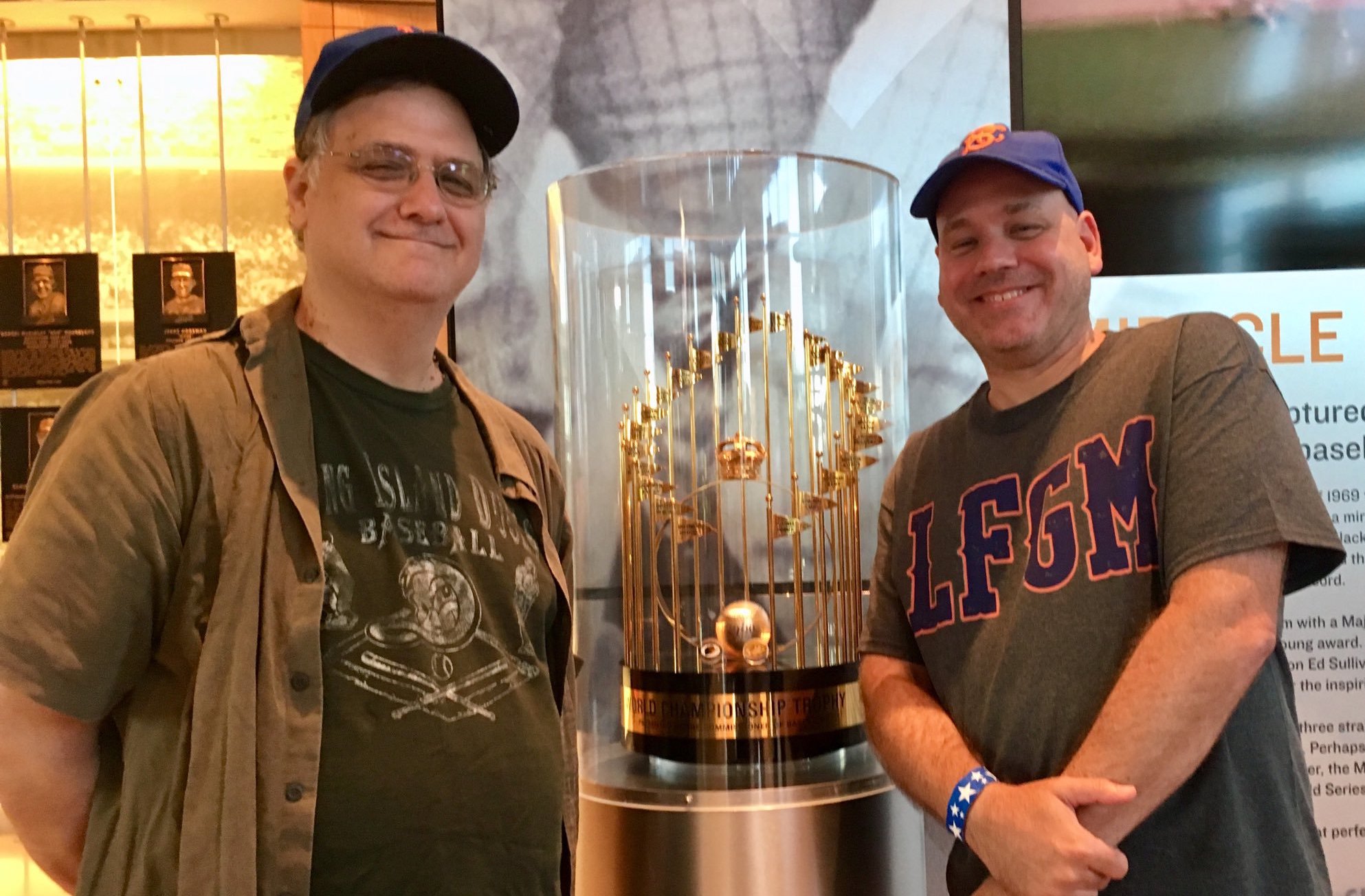
Faith and Fear in Flushing made its debut on Feb. 16, 2005, the brainchild of two longtime friends and lifelong Met fans.
Greg Prince discovered the Mets when he was 6, during the magical summer of 1969. He is a Long Island-based writer, editor and communications consultant. Contact him here.
Jason Fry is a Brooklyn writer whose first memories include his mom leaping up and down cheering for Rusty Staub. Check out his other writing here.
Got something to say? Leave a comment, or email us at faithandfear@gmail.com. (Sorry, but we have no interest in ads, sponsored content or guest posts.)
Need our RSS feed? It's here.
Visit our Facebook page, or drop by the personal pages for Greg and Jason.
Or follow us on Twitter: Here's Greg, and here's Jason.
|
by Greg Prince on 27 July 2015 4:36 pm I had Pedro Martinez on my back Sunday as I visited the same summer place on Flushing Bay I’ve been frequenting since 2009. MARTINEZ 45 normally sits on my t-shirt retirement shelf, but it felt appropriate to unfold it and ceremonially reactivate it in honor of Pedro Martinez entering the Hall of Fame with a plaque that devoted one half of one line to his time pitching for NEW YORK, N.L. 2005-08. Those seasons coincided with the final years I spent at my previous summer place on Flushing Bay, the one I’d been visiting since 1973. Pedro was kind enough to drop by the current place my first summer there, though I’m compelled to note he was dressed all wrong for the occasion.
True to 2005-early 2006 form, Martinez as immortality inductee didn’t let us down. When it came time for him to mention the period when he sold mountains of merchandise to the likes of us, he embraced us from afar. “The Mets fans,” he said to the Cooperstown crowd, “well, if you look at me and you see me going wild, that’s a Mets fan.” He offered a happy little dance, evocative of the night he was accidentally spritzed by the Shea Stadium sprinklers so we’d know what he meant by “wild,” then concluded his brief explanation.
“That’s how we are. So Queens, I love you too!”
Sweet of Pedro to find a way to identify with his legion of mid-2000s acolytes. If that’s how he chooses to vaguely recall us — as soulmates under the 45s — that’s beautiful. It might not be wholly accurate, but I’ll take it.
By the top of the ninth Sunday, while Pedro, Craig Biggio, John Smoltz and Randy Johnson were soaking in their well-deserved adulation, I was decidedly going less than wild for what was becoming of a 2-0 Mets lead. It had been, to that moment, a beautiful day, the kind of day you tell people about down the road, that day Jacob deGrom not only outpitched his fellow All-Star Zack Greinke but personally drove in the run that halted Greinke’s consecutive scoreless innings streak. Usually “scoreless” and the Mets go hand-in-hand, but not like that.
If you wanted a fastball that could cut glass…“y’know, razor sharp,” as Mark Wahlberg as Eddie Adams turning into Dirk Diggler would’ve put it…Jacob deGrom was your man. He was so bright and so sharp and so powerful for seven-and-two-thirds innings. Greinke was mostly Greinke, but that didn’t mean so much when we had deGrom, even if deGrom wasn’t permitted to display quite the extraordinary length that made Dirk Diggler famous in Boogie Nights.
Jacob came out after his 113th pitch, following a performance that encompassed eight strikeouts, no runs, two hits and two walks. The only sign of trouble was the second walk came in the eighth inning, to Jimmy Rollins (who you’d rather see walk than do that thing he did over the right field fence in the previous three games). DeGrom retired Alberto Callaspo directly thereafter, but Joc Pederson was due up and you have Jeurys Familia and it was 113 pitches and pretty warm, so OK, you do what managers do in this era. It’s not like they weren’t doing in the latter stages of the days of Martinez, Johnson and Smoltz.
Familia gets out of the eighth and it’s fine. The Mets don’t increase their 2-0 lead in their half, and it’s all right, you guess. I mean, yeah, more runs is better than fewer runs — witness the joy of excess from Saturday night — but try not to be so prickly, you tell yourself. The Mets are up by two and they have their de facto All-Star closer on. He wasn’t named to the squad, but you know he should have been. Jeurys has got this.
You tell yourself that, but you’re not quite believing it.
What is making me uneasy? Is it the inability to cope with the Mets’ version of prosperity, which as of the top of the ninth Sunday is a one-game winning streak? Is it reflexive worry that accompanies the participation of every Met closer from Skip Lockwood forward? Is it Familia’s recent unsharpness, during which he seems to be cutting glass less automatically than he was in the first half?
Actually, it’s something happening in the stands, where Pedro Martinez would be moved to reappraise his assessment of Mets fans.
On this Family Sunday, as the marketing department insists on labeling it, there appears to a brood of relations sitting around me. It’s hard to say who exactly is doing the sitting, as I’m in one of those spots (Section 107) where people seem to be shifting their seats all day. At one point, a lady with two kids shows up and asks if the chairs to my right are taken. I have to confess to her that I really can’t tell. She plops down anyway.
By the ninth, a father and two kids perhaps attached to this woman (perhaps not) are in front of me, and in front of that guy is an older man. We’ll call him the grandfather. I can’t say this bunch was paying attention to the game all day. I’d been paying attention to the game all day, so they could’ve been distilling moonshine for all I knew. What suddenly matters is they’re not paying attention to the game at its most critical juncture.
With one out in the ninth and me trying to focus on Familia, my trance was interrupted by the grandfather figure. He wanted his son and grandsons to pose for a photo. His back was to the part of the stadium where the featured match was still very much in progress; dad and the boys were facing forward, but not looking in on the action. Adrian Gonzalez and his .900 OPS were up.
“WHAT ARE YOU DOING?” I screamed in my head at the amateur shutterbug was who was turned the wrong way at a potential turning point of this ballgame we were all ostensibly here to see. “TAKE THE PICTURE LATER! TAKE IT WHEN THE GAME IS OVER! WAIT A FEW MINUTES AND SET IT AGAINST THE FIELD! IT’LL MAKE A BETTER PICTURE ANYWAY!”
I didn’t say any of that out loud. I didn’t have to. Adrian Gonzalez’s big stick did all the speaking. He doubled off the wall, bringing up slugging sensation Justin Turner, formerly a lightly regarded Met utilityman, you might have heard. Natch, Turner doubles and Gonzalez scores and if a picture is taken of the dad and his sons in the row in front of me, I’d hate to see the face I was making in the background.
It is a matter of public record that Yasmani Grandal shot the game-tying single down the third base line past Juan Uribe, which is just cruel, and it was now 2-2. What was being said in my head once the score was knotted isn’t fit for the Off Day Monday after Family Sunday.
Familia then gathers the two outs that had to wait just long enough to trash deGrom’s decision. The Mets can win it in the bottom of the ninth, but they’re not going to. I know it. Everybody knows it. Nobody is going wild. That’s what got me later about Pedro’s portrait of us. Perhaps we should have been willing our team toward the tiebreaker, letting them know it was just one of those half-innings, they happen, and now we’re gonna go get ’em, LET’S GO METS!!!!!!!
That would have been wild. Instead we went mild. Michael Conforto — Mr. 1,000 — walked to start the bottom of the ninth, but then Kirk Nieuwehnhuis was ordered to attempt a silly bunt, which wound up in J.P. Howell’s glove before it could ever touch the ground. Kirk has worked his ’Heis off to get his average to Mendoza levels and this is what you do with one of your hot hitters? So he becomes an out and Citi Field grows eerily quiet. You’d never have guessed the potential winning run was on base. You’d never have guessed a team that recently scored fifteen runs in a single game was batting.
I exhorted nobody, not even in my head. Everything had been so pleasant. Now it was just miserable. These were the Mets being the Mets of too many ninth innings past. I was attending my 600th regular-season home game, both Queens summer places combined, and this felt so familiar. It was that game against the Braves in 2001. It was that game against the Brewers in 2011. There was an Expos game from 1998 mixed in there, too, I’m pretty sure.
The game against the Dodgers from 2015 was joining the ugly crowd. And, as if to accent the awfulness of the affair as the bottom of the ninth was expiring without success, it was starting to rain.
This was not only my second consecutive game, it was my wife’s. Stephanie isn’t quite as committed to the completion of every contest as I am, but if she can be comfortable and have a sense that it will eventually end, she’s good to stay. But make it rain, close off the escalators that take a ticketholder to air-conditioned refuge on Excelsior and estimate the time of departure as “whenever,” then it’s not so good.
Not that she said anything, other than “where to now?” as it rained just hard enough to chase us into the Field Level concourse. We camped out somewhere a bit beyond first base, peering and (personally, seething) among others who sought dryness. Jenrry Mejia let Rollins roam as far as third base, but no further. The Mets could win this in the bottom of the tenth. Or the bottom of the tenth could merely preface more innings that would — as the previous Sunday’s encounter with the Cardinals did — expand beyond the orange and blue horizon.
I wasn’t going to do that to Stephanie. I wasn’t going to do that to myself. I wasn’t going to put up with it from the Mets. I can’t hit for them, I can’t pitch for them, I can only cheer so much for them. But I can now and then vote with my feet. I said, “If they don’t score in the tenth, we can go.”
That’s as close to a nuclear option as I carry to the ballpark (I hope security doesn’t read that literally). I don’t believe I’ve walked out of Citi Field before a non-suspended conclusion all year. Why would I? In my previous fifteen games at Citi Field, the Mets were 11-4. Losing is rarely an impediment to endurance. Rain, within reason, isn’t a dealbreaker. And I’m only so chivalrous toward my wife. This was essentially a protest. You’re going to blow an almost-sure win just as I was beginning to take you seriously? Then you’re going to have to do it without me watching.
Heckuva protest, huh? But it’s all I had. Exit velocity would be my version of turning my back to the field.
The bottom of the tenth did turn out to be our final half-inning, but for the surprisingly right reason: Granderson slashing and zipping until he was at second; Granderson not getting doubled off (though not advancing) on another inane bunt attempt; Daniel Murphy walking via the intentions of Don Mattingly; and Juan Uribe — who I’d already decided might wind up being more Tony Phillips than Donn Clendenon in the pantheon of midrace acquisitions — shooing away the last of the passing shower’s raindrops with a double that rang off the wall and into the books…the history books!
Well, my history books, in that I don’t remember ever before traveling from gloom and doom to boom and zoom while courting so much emotional whiplash. There was an extended episode of jumping up and down in the concourse and enough yelling to maybe require a stash of Sucrets be kept on hand for future euphoric outbursts. I thought we were good going into the ninth; I assumed we were crushed going into the tenth; I discovered a heretofore untapped vertical leap once it was confirmed there was no need to storm out prior to the eleventh. There was no eleventh inning. There was a 3-2 win in ten, a two-game winning streak, Greinke conquered, nearby Dodgers fans not so smug and a 4:57 at Woodside in case flying without wings was technically impossible.
If you go to a Broadway show, I suggested to Stephanie on the way home, you probably know not long after the curtain goes up whether or not you like it, whereas this baseball game was for the longest stretch terrific, then briefly horrific, yet ultimately life-affirming. After three disparate acts on top of a ceaselessly rousing production the night before, she who got her 19 innings’ worth over the previous 24 hours was compelled to agree.
Before Pedro Martinez spoke on Sunday afternoon, Craig Biggio delivered a decidedly lower-key Hall of Fame induction speech (no dancing whatsoever). “Tomorrow,” the eternal Astro from out east said, “is not guaranteed.” Biggio was talking about always playing hard, but his words also provide a useful lesson for general managers who have waited several years to be one hyperactive trading deadline from lunging for an eminently lungeable playoff spot. But what Craig might have missed is that for the fans, there is pretty much always tomorrow. We hang on to tomorrow as long as the schedule says we have a tomorrow. When Pedro was first a Met, I distinctly remember us giving up on him and his teammates right around this time of year…and circling directly back into their corner when their pulse beat just fast enough to get us going again.
I was ready to give up on the Mets in the tenth inning Sunday. I was ready to get the hell away from them. I was also ready to pull my old-fashioned transistor-type radio out of my schlep bag and tune it to 710 AM because I vote more with heart than my feet, no matter how much ire is racing through my brain.
That, too, is a Mets fan. That, too, is how we are.
by Jason Fry on 27 July 2015 8:30 am Three days ago, a thrilling game against the Dodgers would have ended a bit differently. Rather than Juan Uribe staring out at Kenley Jansen, it would have been Eric Campbell or Darrell Ceciliani or Johnny Monell or John Mayberry Jr. or someone else we’ve written about more often in sorrow than in celebration.
That isn’t fair. Perhaps Ceciliani would have hit a long drive into the seats, or Campbell would have … oh, screw it. We know better, don’t we?
It was Uribe who got an 0-2 pitch that arrived at a greater elevation than Jansen had planned, and Uribe who sent it arcing off the top of the wall — short of a home run by a disappointingly slim margin, tall enough of a double to send disappointment packing and Curtis Granderson scampering home.
I was listening on At Bat up at my folks’ summer place in Maine, and Uribe’s bat hitting ball made The Sound — a crack that causes heads to pop up from whatever’s occupied them and people in the next room come to see what the fuss is.
I’ve been coming to this house on the Sheepscot River since 1980, first with my folks and now when multiple family schedules allow. There’s no TV up here, so games are followed by radio. For years that meant WFAN, with a signal that would yaw and pitch and wail while the sun was up and then strengthen once darkness had fallen, which in late July means the sixth inning or so.
New technologies began elbowing over-the-air radio aside nearly two decades ago — my parents still remind me of the night I listened to a Valentine-era Mets’ radio feed via AOL dial-up, none of us knowing that I’d accidentally picked a long-distance number and so was paying north of a dollar a minute to hear a leisurely run-of-the-mill summer game. Now I don’t even know WOR’s call letters — At Bat simply fetches the bits from whereever they reside in Digital Land and brings them to me. (The concept of a long-distance call no longer exists, but I am doing damage to my data plan.)
I’ve listened to enough over-the-air radio under questionable conditions to glean information from the smallest snippets of context: a sudden acceleration in the rhythm of the announcers’ voices, or chatter where the flow of the game would normally have yielded silence.
Digital connections, though, don’t erode. They vanish — you’re either listening to the game or fiddling with a setting. Though this can lead to oddities of its own: Driving up on Friday, Emily and I were listening to At Bat through our rental car’s sound system, and when we hit a cell dead zone the car would helpfully cue up the first song stored on the iPhone, at impressive volume.
That first song turned out to be, I kid you not, “A-Tisket, A-Tasket,” by Ella Fitzgerald.
That’s a fine song — I’d be happy to hear it instead of “Piano Man,” though I’d also say that about the Mets playing three minutes of a car alarm — but it will now be forever linked in my mind with wanting to hear the Mets but not being able to.
Anyway, Sunday afternoon was spent sitting in the dining room watching the rain in the trees and listening to Jacob deGrom and Zack Greinke strike people out. You could hear the buzz of the Citi Field crowd handing out huzzahs to deGrom and heralding Michael Conforto for standing still at the best possible time … until things went awry for Jeurys Familia, whose misadventures stopped the party and left Josh Lewin and Wayne Randazzo narrating over a disconsolate hush.
I sighed and accepted what had happened — Familia won’t always be effective and Uribe won’t always smother what comes his way, though going forward he will now expect his closer’s occasional quick-pitch.
Familia faltered, but Jenrry Mejia held the line against Joc Pederson an inning later, chasing and capturing a key strikeout to keep the game tied. And then, in the bottom of the 10th, we were reminded that the Mets have finally rearmed, first with Conforto’s summoning to the field of battle and then with the import of Uribe and Kelly Johnson, neither of whom will be the Least Consequential Met when revealed later today.
Should he choose to write one (which he won’t), Sandy Alderson would produce a great tell-all book about his time as GM of the Mets. What was he told about the Wilpons’ finances at various points, and how did he respond? Why, after having to make nonsensical pronouncements about payroll, did he choose another tour of duty? Why did the team play with 24 guys so many times? Was the Mets’ long undermanned slog through the summer of 2015 a product of a slow-to-develop trade market, the owners’ pockets being sewn shut, or Sandy’s own … for now let’s call it “patience?” Did that patience turn into stubbornness in the face of repeated bad luck and fan/media yowling for action?
Whatever the case, the narrative in Panic City had become a new breed of toxic in recent weeks, with fans bemoaning that a division was there for the taking but the Mets seemed willfully determined not to put in a claim on it.
That corrosive storyline went away with the arrival of Conforto, Johnson and Uribe. Which won’t deliver the division to the Mets — another bat would be a big help, and an unhappy part of me still expects the Nats to finally find their focus and accelerate away from the rest of the NL East.
But.
As in, but the Mets will soon have Travis d’Arnaud back again, hopefully this time not to be hit by a pitch or a runner or the 10:30 from Woodhaven. As in, but David Wright is beginning baseball activities, that most hopeful of nebulous pronouncements. As in, but some of David’s more underwhelming teammates have ceased baseball activities, at least while wearing blue and orange at the major-league level. As in, but the Mets have survived a 10-game stretch against top teams and now begin an extended period of playing divisional also-rans.
None of this guarantees anything, but there’s an opportunity here — and the Mets are finally acknowledging that it exists, and taking steps to do something about it. After a summer of apparent inaction, that’s more than welcome.
Ya gotta conceive! It may not be a great rallying cry. But it’s a start.
by Greg Prince on 26 July 2015 4:40 am Consider this not a wet blanket, but at most a moist towelette: I attended the game in which Mike Bordick made his Met debut. In his first at-bat, he led off the bottom of the third and hit the first pitch he saw over the wall at Shea Stadium. At that moment, Mike Bordick — the surehanded shortstop who came to us from Baltimore in exchange for lovable but momentarily miscast Melvin Mora, as Gold Gloved Rey Ordoñez languished on the DL — was one of the best midseason acquisitions a contending Mets team had ever made.
Fifteen years later, on another Saturday in late July, the name Mike Bordick came up in idle conversation before that night’s Mets game. It wasn’t in a complimentary vein. A few hours after that, without any irony whatsoever, I leapt to my feet to applaud the first Met home run hit by Kelly Johnson in his first game as a Met. He was traded for on Friday. On Saturday, he and his fellow erstwhile Atlantan Juan Uribe went about transforming the Mets from frauds into legitimate contenders. At least that’s how I decided to see it from Section 329, where you could barely see anything that didn’t look like a pennant drive for the ages taking shape.
Welcome back, my friends, to the tease that never ends. These Mets, whose secondary logo is a .170 batting average, came to life on Saturday night in a way they’ve never lived and breathed at Citi Field. They set a stadium record for most runs (15), most hits (21) and most hope (tons). They pounded every Dodger pitcher not named Kershaw, Greinke or Ian Thomas. Almost incidentally, they had Matt Harvey pitching like Matt Harvey. It was easy to miss while reveling in everybody — Harvey included — hitting like hitting is something the Mets do every single day.
Oh good gosh, that was something to behold, wasn’t it? Was it all on account of the addition of Johnson (2-for-6, including that home run) or Uribe (1-for-2 and a fine diving play at third when inserted as a laugher replacement)? Maybe in some cosmic, karmic, veteran leadership sense those two altered the chemistry of the clubhouse and/or put everybody on notice that if you want to play, you have to produce. But when the box score is bulging with big, juicy, succulent numbers up and down the agate, it’s surely about more than a pair of rented strangers.
• Michael Conforto, the Met who preceded Johnson and Uribe by an entire day, was on base five times, four via hit, two via double, all via Binghamton (as if jumping up from Double-A was going to be an obstacle to so natural a talent).
• Kirk Nieuwenhuis, who once hit three home runs in a single game, you know, also registered four hits and drove in four runs — two of them carried by Conforto, who scored another two times besides.
• Lucas Duda gave up sheep-herding or whatever vocation he’d been pursuing in recent months and took up professional baseball again with a vengeance, launching two home runs and passing David Wright on the all-time Citi Field home run list, which it might surprise you to know exists (Duda 48; Wright 46…and unavailable to compete).
• Daniel Murphy hit a home run and drove in three runs, which sounds like something he used to do in other seasons.
• Ruben Tejada collected three hits and didn’t step on Conforto’s head or any part of the rookie sensation when he almost played modern-day Hahn to Michael’s Theodore.
• Harvey — remember him? — drove in runs in two separate at-bats, with a double and a single. He gave up a pair of solo home runs as well, which in the distant past of pre-July 25 would have saddled him with a 2-0 loss. But these are the Mets of Johnson and Uribe and Conforto, and they are freaking unstoppable.
Well, they were on July 25, and if that’s all this personnel overhaul adds up to, I’ll take it. I never before saw the Mets score 15 runs in person. Few Mets fans have. There was a Saturday at Shea in July 2006 (Mike Pelfrey’s debut) when they scored 17 runs. There were consecutive Shea Saturdays in July 1985 when they scored 16 runs apiece. And that’s the sum total of home games in which the Mets have scored more than 15 runs. They’d only scored 15 three other times at home prior to this Saturday night in July, none since 2000, a few months prior to their trade for Bordick, who was going to help them get to a World Series at last.
Actually, he kind of did. Or they got there in spite of him. Either way, in 2000, it didn’t hurt to have traded Mora for Bordick just as they were bringing in Bubba Trammell from Tampa Bay. From 2001 to eternity, it’s a different story, but sometimes you have to live in the moment. At this moment, the Mets have those two ex-Braves they got for two guys nobody ever mentioned as the next Harvey, deGrom or Matz. Johnson and Uribe could someday drift into oy, Mike Bordick territory. The could do it in a matter of weeks. Doesn’t matter. They gave us one hell of a boost and something tells me the boost isn’t over yet.
In the moment of July 25, everything was good and everybody was happy. As if we knew we were in for the offensive ride of this ballpark’s lifetime, we rollicked early. We saw Cole Hamels, not normally a popular figure on these premises, was angling for history in Chicago, and we oohed, aahed and cheered when he completed his no-hitter. The Phillies have contributed eight wins to our fifty; we can tune in to their fleeting moment of triumph and be magnanimous.
There were too many Dodgers fans among us — they effortlessly radiate smugness — but their quiet spoke delicious volumes. At last they presented us with a pitcher who a) we’d never heard of and b) pitched to his reputation.
Who’s Zach Lee? ’Zackly.
Lee was followed to the mound and into the feeding frenzy by Chin-Hui Tsao, and I can’t imagine it went uncommented upon on SNY that Chin-Hui Tsao cost Steve Trachsel the first no-hitter in Mets history a dozen years ago. I remember it like it took place in 2003, but I’m still annoyed that it was a pitcher who left the only speck of cork in Trachsel’s otherwise sparkling wine glass that afternoon. Why, yes, I can hold a grudge. Six earned runs on seven hits in two-thirds of an inning off any opposition reliever would have made me giddy. That it was off Tsao made me ravenous.
Which was a good thing since the next Dodger victim was Josh Ravin. He entered at 11-2. He exited at 15-2. I sure hope Tommy Lasorda was watching. To quote Chevy Chase as Fletch when he observes an adversary’s framed photograph, “Hey you and Tommy Lasorda.”
“Yeah.”
“I hate Tommy Lasorda!”
At which point Fletch smashes the picture. Or Ravin walks in the 15th Mets run. I forget which.
When you lead 15-2, you see a dreaded wave develop and you shrug. When you lead 15-2, you hear the forced frivolity of the “Piano Man” singalong and you join in full-force (not tough for me as a staunch Billy Joel advocate, but even I think this particular exercise should be given a rest). When you lead 15-2, the barley & hops-fueled idiots behind you who keep repeating, “This is the best game I’ve ever been to!” get on no more than your first nerve because it probably is the best game they’ve ever been to. It’s definitely one of the better ones in my portfolio, I tell you what.
The Mets had more hits than Heart played postgame, and Heart played a whole bunch of their greatest hits (as Wilsons wearing Mets jerseys go, Ann and Nancy were positively Mookie-esque). Do the Mets have the heart to keep it going and not make this merely a one-night stand? Do they have the hitters to keep the hits coming? Is Conforto really here? Is Duda really back? Is d’Arnaud really returning? Is there another trade in the pipeline? Are Johnson and Uribe difference-makers of the first order, whether or not they turn into Bordick/Bubba pumpkins when all of 2015 is said and done?
Try, try, try to understand. Or don’t bother and just enjoy whatever goes right on the off chance this spell doesn’t last forever.
Coming Monday: That least consequential Met ever. And, no, it’s not who you’re thinking of.
by Greg Prince on 25 July 2015 3:20 am “Daddy,” Tatum Niese might one day ask his father, “can you tell me about the night I was born?”
“No,” would be the appropriate reply from the pitcher who had no answers for the Dodger lineup Friday but at least he had an excuse — the birth of the actual kid in this hypothetical conversation.
Far be it from us to cut Jon Niese slack, but if you’re not going to look the other way from a six-run outing thrown by a man whose wife is giving birth during his shortest mound stint of the year, well, maybe you need to calibrate your priorities the tiniest bit. Tough to blame Niese for being distracted (I clearly remember the Mets benefiting from similar circumstances eighteen years ago when the new dad in question was Curt Schilling). Not so tough to blame the Mets for not having a tighter contingency plan in place than “you sure you wanna pitch tonight?” but blaming seems out of place on one of the better Met days to ever include a 7-2 loss.
Mazel tov to the Nieses, but we had our own blessed events to contemplate as the Dodgers were forcefully slapping Tatum’s daddy on the rear Friday night. For one, we had Met No. 1,000 inscribing himself in the book of life. Michael Conforto showed up, faced live pitching, hit the ball hard a couple of times, drove in a run with a well-placed grounder and created a major league batting average for himself. Granted, it’s an average of .000, but he looked like he knew what he was doing at the plate (something most Mets haven’t) and he’s got a promising career in front of him and us. Conforto is 22, yet I see that facial hair and I can’t help but think he grew it so he wouldn’t be hassled trying to buy beer.
And while we finally got the Met we’d been briefly but sincerely lobbying for, Sandy Alderson quietly went out and snagged us a couple more. In an order yet to be determined, we have tentative Mets Nos. 1,001 and 1,002 on deck. All the way from Atlanta, prepare to meet the even newer parts of the solution, Juan Uribe and Kelly Johnson, acquired in exchange for minor league pitchers Rob Whalen and John Gant. Hopefully you’ll have gotten over the sadness of bidding adieu Danny Muno (demoted) and John Mayberry (DFA’d) and be happy to step right up and greet a couple of veteran ballplayers whose most attractive quality is they haven’t been in the Mets lineup already this year.
This is all we’ve been asking for: the guy on the farm who might be preternaturally capable of contributing and a couple of guys to solidify that which has been made of cottage cheese. Unlike Leah Niese, the Mets front office has been overdue to deliver. Since that dreamlike eleven-game winning streak in April that presumably took place in an alternate universe, the Mets have played the equivalent of a half-season of baseball that counts. In 81 games, they’ve won 36 and they’ve lost 45. If you double that, you get a full-season record of 72-90, not championship caliber in any league.
Good thing the 13-3 part of the season counted and good thing the Washington Nationals still have Mets-flavored gum on their shoes. They should be off in the stratosphere — or Strasosphere — by now, but they’re not. They’ve had injuries. They’ve had letdowns. They’ve had a schedule that doesn’t include nothing but the Mets. That’s their problem. The Mets have, despite pitching their hearts out, done almost everything wrong since late April, yet it’s still a race: a race played out between narcoleptic tortoises, but a race nonetheless. Who’s to say, when you have our pitching and a lineup that’s finally vamped, never mind revamped, that a three-game deficit can’t be made up?
It won’t happen if starters last three innings and the likes of Justin Turner lurks round every non-tendered corner as the default response to “Who’s Your Daddy?” but soon the schedule will be kinder, Uribe will be ensconced, Johnson will be versatile, Conforto will be comfortable and Niese will be less distracted, if less well-rested. It should be too late, but it’s not.
You probably know what was going on the night Jon Niese was born. It would be nice if we could arrange an occasion like that before Tatum Niese is eligible for the amateur draft.
While I prepare to reveal unto you The All-Time Met of Least Consequence, this seems an opportune juncture to introduce you to a swell new blog called MetsDaddy.com. It’s not specifically about the paternity issues faced by Niese and Zack Greinke this weekend, but the timing is eerily fortuitous enough to make us particularly excited to welcome this bouncing, baby blog to the literary precincts of Metsopotamia.
by Greg Prince on 24 July 2015 2:53 pm Are you ready for some history? Not real history, but a numerical marker of passing historical interest? Are you ready for the slight chance of a run or two being scored by the home team tonight?
Then you’re ready for Michael Conforto, suddenly (after weeks of wailing and wondering) recalled by your offensively bereft New York Mets in time for tonight’s game against the Los Angeles Dodgers, as one-knee wonder Michael Cuddyer at last yields his seat on the 25-man roster, despite it apparently being bequeathed him into perpetuity by Joan Payson herself. Assuming Conforto makes Terry Collins’s hard-to-crack starting lineup, and assuming rains or plagues don’t wash away five official innings, then young Mr. Conforto will go into the books as the One Thousandth Met of All Time.
There, that only took 53½ years.
What started with Richie Ashburn, leadoff batter in Game No. 1 on April 11, 1962, projects to continue tonight. Once Casey Stengel’s lineup got through its first go-round, everything was pretty random from there. Consider our Franchise Four: Tom Seaver was No. 130; Keith Hernandez, No. 348; Mike Piazza, No. 594; and David Wright, No. 736. The last Numerical Milestone Met was Scott Hairston, at No. 900. Hairston, despite likely being the best hitter on the pre-Conforto 2015 Mets, wasn’t Mount Metsmore material. The numbers just fell where the numbers fell.
Hopefully, the base hits will fall for Met No. 1,000 in short order and the runs will pile up or at least trickle in, which is something they’ve done with alarming irregularity to date this year. Good luck, kid. You’re gonna need it, and we’re gonna need you.
When we officially have our One Thousandth Met, we will reveal our choice for the No. 1,000 Met of All Time…not chronologically, but consequentially. Who is the Least Significant Met Ever? Tune in later and find out here.
In the meantime, tune in here to hear me call for Conforto’s promotion and go on about some other Mets stuff with the folks from the Rising Apple Report the other night.
by Jason Fry on 24 July 2015 12:09 am It’s odd being away from your baseball team for nine games. Not to mention that being six hours ahead of behind the U.S. pretty much takes you out of seeing anything. While I was in Italy night games began at 1 a.m. I caught a couple of innings of the Mets and the Cardinals trudging through extra innings, but that was it — I’d get the final score in the morning. Sometimes I’d gape at the disaster that had occurred; sometimes I’d tell Emily with mild surprise that hey, the Mets won.
Tonight was the first game I got to see in its entirety since the finale of the West Coast trip, and I was excited … or at least I was until the storm clouds began to gather.
Let’s see….
1) While I was gone, the Mets effectively disarmed mean-spirited satirists by insisting on playing with 24 men. Michael Cuddyer, who hurt his knee on JUNE FREAKING 28TH, still occupies neither a spot on the DL nor a semi-regular spot in the lineup. Before Friday’s game Terry Collins said Cuddyer’s anti-inflammatory medication was making him dizzy, not generally a sign of readiness to play. Honestly, if a Met was shredded by a combine the team would spend the next week and a half collecting pieces of him in a bucket and trying to sew things back together before deciding that a DL trip might be needed … but not quite yet. Why on earth does this baseball team continue to behave this way? Cheapness? Incompetence? Both?
2) Before the game, Sandy Alderson said the insurance money on David Wright‘s contract made no particular difference in the Mets making a trade or not. Regarding the prospects of a deal, Alderson insisted he could add a player with a significant contract, then added that none of the reporters would believe that. He’s correct — no Mets fan who’s been paying attention since Citi Field opened believes him. Which is itself a pretty serious indictment of this organization’s chronic, self-inflicting dysfunction.
3) Why would an addition to the lineup possibly be a good idea? Well, after Sandy’s press conference, the Mets went out and faced Clayton Kershaw with .170 hitter John Mayberry Jr. batting cleanup, protected in the order by .179 hitter Eric Campbell. Look a couple of more spots down and you found Anthony Recker, hitting .137. That’s not a credible lineup for a split squad in March, let alone a team that’s somehow still in a pennant race at the end of July.
4) Facing this brawny lineup, Kershaw fell asleep in the bullpen and had to be persuaded that beating the Mets would actually count. OK, that’s not true, but he was perfect for six innings, and it was honestly a surprise that the Mets didn’t go 27 up and 27 down against him. They mustered three entire hits — one on a low slider Curtis Granderson golfed over the infield, the second on a Wilmer Flores dunker misplayed by Yasiel Puig, and the third a single Lucas Duda pushed through the shift. Hooray for the offense!
5) Bartolo Colon pitched quite well in defeat, throwing one bad pitch all night — which, unfortunately, Jimmy Rollins whacked over the fence for a 1-0 Dodger lead. That was enough to beat Bart, with poor relief by Sean Gilmartin and Carlos Torres giving L.A. two thoroughly unnecessary insurance runs. What were Gilmartin and either Torres doing in a 1-0 game? I have no idea either.
6) The Mets’ best chance at scoring came in the eighth, when Duda led off with a single. He then somehow managed to get picked off, perhaps because he’s barely been on first since the end of May.
7) The Nationals furthered their status as the worst first-place team in recent memory by losing to the Pirates, therefore cruelly extending the illusion that the Mets could win something if they magically stopped being run like a third-rate Romanian orphanage. Honestly, I wish the Nats would just rip off an 11-game winning streak. It would put an end to this farce and the attendant emotional assault and battery.
8) Good postgame news, everybody! Cuddyer is getting new meds. They’re TOTALLY going to work. He’ll be able to play tomorrow. In fact, his knees will now be invulnerable to harm, turning any baseball that dares approach within a yard to a few fluttering shreds of yarn and carbonized curls of horsehide.
9) Well, unless it turns out the Mets don’t actually have access to magical meds that don’t leave players dizzy, in which case Cuddyer might get DL’d nearly a month after getting hurt, to be replaced on the roster by Michael Conforto.
10) Michael Conforto, ha ha ha. We all know they’ll bring back Johnny Monell.
by Greg Prince on 22 July 2015 7:40 pm For the first time in seven years, I’m finding myself more than moderately bothered by the result of a Mets game lost on this late a date on the calendar…an indicator of progress for the franchise, if not for myself.
We must be stepping up in class. Get to July 22 of previous seasons — or the 95th game — and there was little on the Met line except for whatever we chose to read into it. Here, in the present, we were presented a legitimate showdown series, pitting our team in second place against Washington’s in first place. Only a sweep at the hands of the Nationals would have been semi-fatal (nothing’s necessarily a killer when there are 67 games to go). A sweep by the Mets would have been cause for euphoria. Splitting the first two games is what we got. It made the final game this Wednesday relatively enormous. A win would have left us a single game from the top of the division.
The loss that materialized leaves us three out. It feels like more, but it’s not. A team capable of being this close this late should be able to edge in a little closer a little later, maybe even when Washington comes to Flushing for a three-game series the night of July 31, by which time we’ll know just how serious the Mets take themselves.
That’s when the trading deadline will be over, but that will be another story, told by next week. For tonight, three games out when it could have been one is the story. It gnaws and nags at the fan who very much wants to believe (let alone Believe) proximity to first place isn’t a temporary condition.
Noah Syndergaard toughed out five innings of not being great yet yielding only one run. Jordan Zimmermann was better longer, but gave up more runs, three. Yes, the Mets led the mighty yet mightily vulnerable Nats and one of their impressive arms by two entire tallies. The Mets put runners on base in the fourth and scored them. The fourth has been their lucky inning since April. With Kirk Nieuwenhuis driving in two and Kevin Plawecki driving in Kirk, it appeared charmed today.
When the Mets lead the Nationals, 3-1, and continue to lead the Nationals, 3-1, it seems so real. It seems like whatever we’ve got is all we need. Why call up prospective phenoms? Why list as disabled the halting and the lame? Why make or take phone calls from other teams looking to upset our perfectly formed apple cart? The Mets won one night and they’re winning the next afternoon. Don’t disturb this group and don’t disturb this groove!
Still, I kept hoping a little more offense would unfold. The longer this game was being won, the more it absolutely had to be won. That was my thought, anyway. I hadn’t thought this much about the absolute need to win a game since 2008. It was a nice thing to think about.
Zimmermann surrendered nothing else and Syndergaard relayed the lead to Hansel Robles, who took it through the sixth. Robles passed it along to Jenrry Mejia, who cleared the seventh. In the eighth, Bobby Parnell came out of the blocks.
And boy did he stumble.
Mejia to Parnell to Jeurys Familia reminds me of Richard Nixon (Dan Aykroyd) plotting his political rehabilitation in cahoots with his secret advisor (Walter Matthau) in 1979 on SNL. The conceit was former president Gerald Ford — who had been Nixon’s veep — was going to run for the Republican nomination in 1980 and would thus block Nixon’s return. Matthau as the mastermind came up with a brainstorm: we’ll just get Jerry to serve under Dick again. The slogan: “The President and the President for President and Vice President”.
This is to say we have the closer from 2014 and the closer from 2013 and the closer from 2015 working not three ninth innings, but operating as bridge, setup man and closer. It’s all semantics if it works. It’s a disaster if it doesn’t. Wednesday it was a disaster, as Parnell had less of his best stuff than Syndergaard had had of his, along with four fewer innings to straighten out his act. In March, you might recall, veteran Bobby was part of the two-man enforcement crew that tried to teach rookie Noah a lesson about Spring Training comportment. Noah was in the clubhouse during an intrasquad game grabbing a quick bite. David Wright — the captain of the Mets, in case you’ve forgotten — and Parnell teamed to take away his lunch.
Today, Bobby did it again. He swatted the win straight off of Noah’s tray. It was as if he was saying, you don’t pitch your heart out and expect to be rewarded for it on this team, rook, ya just don’t.
I’m sure it wasn’t intentional, but Bobby gave away the lead. I’m sure Terry Collins didn’t mean to allow Bobby’s miserable three-run eighth to get that far out of hand, but he did. Would have Familia been a better bet? Anybody would have been, but Terry managed an important midseason game like Matt Williams managed a crucial October game: according to robotic formula, not in response to what was going on in front of him. The difference in 2014 was Williams — who I think I like even less than Fredi Gonzalez, as N.L. East gym teachers go — at least had his team in October.
That’s not going to happen for Terry unless almost everything that can go well does go well. It didn’t go well on July 22. Later, once Parnell got done delivering his worst outing since returning from Tommy John and Nieuwenhuis took borderline strike three and Plawecki failed to check a swing on ball four, the manager took (in contrast to David Frye’s version of Nixon) both the responsibility and the blame for all that went awry. It was his call to ride Parnell into the ground, so yeah, sure, fall on that sword, toss yourself on that that grenade, own that unfortunate decision, but I honestly felt bad for Terry at that moment.
This man, 66 years old; never winning anything anywhere in a big league managerial career that dates back more than two tumultuous decades; pushing and pushing and pushing this boulder of a team uphill for five years; gets them within six outs of one of game from first place; ready to take two of three from their de facto blood rival….and here comes the boulder rolling briskly downhill, flattening him, flattening his team, flattening the bejeesus out of whatever hopes, dreams and good mood we’d gathered together on the heels of making up crucial ground on July 21.
Parnell threw. Nieuwenhuis took. Plawecki swung. The Mets lost. But Collins had to make like it was all his fault.
The afternoon was edging toward something special, one of those day games you get to caress through the evening, go to sleep with smiling and wake up thinking about giddy that another game will follow tonight. There’s no big win quite like a big matinee win against the team you need to beat. It’s straight out of 1969, for Gil’s sake. Personally, I was dying to trot out the Durocherisms. Hey, Matt, were those the real Nationals we saw out there today? Williams would have given us his big, blank stare and tell us he approached today like every day, every day is equally important, we can’t get too up or too down, now choose sides for dodgeball. Collins, had the Mets won, might have shown a few teeth and emitted a little less melancholy.
Of course we’ll all get over it if we so choose. Baseball is made of far too much resilience to leave us flat. Thursday Terry will don a baseball cap, which is the only thing he looks right in. He’ll seem tortured but speak in platitudes tomorrow afternoon before skedaddling spiritedly to the home dugout to watch his players stretch. They’re stretching all right. Their feet are hammered into the ground yet the stars twinkle almost within their grasp. Almost. Somebody in the counting house needs to spring for a stepladder. We’ll see if somebody does. We, the fans, will repeatedly bounce back, unless we’re determined to show how immune we are to the charms of a decided underdog that is slated to throw itself to lions named Kershaw and Greinke.
We’re as more-than-moderately bothered as can be. But we lead with our heart, our chin and as little of our brain as we can spare. No, we don’t seek devastation, but to be in a position to be disappointed is far better than where we usually are on the eve of July 23, wholly unbothered because the Mets have already mostly gone away for the rest of the summer. I’m pretty sure the Mets, somewhere between 2009 and 2014 pioneered the concept of well-heeled New Yorkers basically taking August off.
But this year they’re still here, damn it. And so are we.
by Greg Prince on 22 July 2015 9:53 am I wish the Mets weren’t already out of the pennant race.
They’re not. They’re two games out.
I wish the Mets weren’t always getting their brains beaten in by the Washington Nationals.
They haven’t. They’ve split eight games this season thus far, winning the one last night.
I wish the Mets weren’t always falling apart after the All-Star break.
They aren’t. They’re two and three and have a chance for a .500 trip.
I wish the Mets didn’t have to rely on total deadwood coming off their bench.
They didn’t, at least last night. Eric Campbell, who, granted, isn’t much of a player, got a huge pinch-hit to key Tuesday’s 7-2 win.
I wish for once that when the Mets take a tenuous lead that they could maybe add on to it.
They did. They tacked on four in the ninth to put last night’s game out of reach.
I wish the bullpen wasn’t always blowing it.
It isn’t. After Jacob deGrom threw his usual sparkling start, Jenrry Mejia and Bobby Parnell provided a solid bridge to Jeurys Familia. Both of them have been mostly terrific since returning.
I wish Terry wasn’t using Alex Torres every frigging night.
He isn’t. Alex Torres didn’t pitch last night.
I wish the Mets wouldn’t lose every close game they’re in.
They don’t. Not only did they pull away at the end last night but they pulled out an eighteen-inning nailbiter on Sunday. It was by no means aesthetically beautiful, but they did wind up with more runs than the Cardinals, which has to count for something. It does actually. It counts for a win.
I wish the Mets could play a meaningful game in late July.
They are. The game today is as big as any as they’ve played in seven years. Win it and they’re just one game out.
I wish the Mets wouldn’t be doomed if they lose the rubber game against the Nats.
They won’t be. Even a loss would put them only three back with more than two months to go. By not being swept, at the very minimum they stay afloat. They have a chance to do much more.
I wish the Mets would go out and get somebody.
Me too. They still might. I’m not holding my breath, but the trading deadline is nine days away and supposedly they’re talking to people. It’s not like anybody else has already made a deal since the break.
I wish the Mets would give me nothing to complain about.
No you don’t.
by Greg Prince on 21 July 2015 9:47 am Perhaps you remember when you could cure what momentarily ailed a television set by whacking it on the side. It did the trick maybe once in twenty tries, but the memory of it working that one time stayed with you. So if your reception was erratic, your rabbit ears weren’t hearing your pleas and neither the vertical nor horizontal hold allowed you to get a good grip, you’d just give it a good zetz, and…
Hey! Grab the phone book and look up TV repairmen!
Matt Harvey already famously went into the shop and came back as close to as good as new as we could reasonably ask for, but still, sometimes the big picture comes in a little snowy, a little jumpy, not exactly crisp. I find myself wanting to give him the kind of purposeful, light zetz formerly reserved for the old RCA to help him tune in properly. I know he’s not a television, but I yearn deeply for him to be the best thing on mine.
Monday night in Washington, as the Mets braced for the challenge of the first relatively enormous series they’ve played during the Obama administration (which itself is in its seventh season on the air), the Nationals zetzed Matt Harvey early. It also didn’t help that the connections between a few of the batted balls he allowed and the Met defense around him desperately needed tightening. The signal was clear enough to see that this wasn’t going to be a Dark Knight kind of night.
With the Mets down by five and the pitcher’s spot coming around in the top of the fourth there were two programming options: pinch-hit for Harvey and insert Alex Torres — the one pitcher you wanted nowhere near Sunday’s long day’s schlep into night — or stick with Harvey, because since when do the Mets have a pinch-hitter? Besides, the memory of those few times in many tries that Matt helped his own cause stayed with you. Terry let Harvey hit, and Harvey drove in two runs.
The Mets were sort of back in the game and Harvey was back in the driver’s seat, pitching in brilliant, living color from the fourth to the seventh. If only the game had been joined already in progress, it would have won its time slot. Instead, the Mets never scored again, Torres left his usual blotchy mark on the proceedings and the Mets wound up losing by five en route to falling behind by three.
But we did get Harvey to come in perfectly for a while. I hope we can have that again next time he’s on.
by Greg Prince on 20 July 2015 12:02 pm Perhaps you’ve heard the story of John Daly, host of CBS’s What’s My Line?, introducing his broadcast of Sunday night, May 31, 1964, with the honest admission that he’d been backstage watching the most “marvelous” — or in one retelling “fantastic” — baseball game between the New York Mets and San Francisco Giants just before coming on the air that evening. Why, it had been going on for hours and was still going on well past regulation, here at 10:30 PM on the East Coast. Panelist Dorothy Kilgallen fretted that John must stop expressing his fascination at once, for if he extolled its virtues any further, he would risk chasing Metropolitan Area viewers from their show on Channel 2 to that very game on Channel 9!
Which there was plenty of time to do, given that the game in question — the second half of a doubleheader that commenced a little after one o’clock that afternoon — would march on toward 11:30 and total 23 innings before it was all over. Legend has it that countless dials clicked seven notches up the VHF spectrum to see what exactly at Shea Stadium had Daly so riled up, and there went the rating for that night’s What’s My Line?
In our splintered media universe of more than a half-century later, one wonders if anybody anywhere who wasn’t already watching our Metsies go similarly long last night opted to set aside whatever popular culture he or she was consuming in order to sample a taste of extra, extra innings 2015 Mets-style. If so enticed, did they find it marvelous? Was it fantastic?
If you were new to baseball and tuned in to decipher the fuss inherent in an endless 1-1 game, I can’t imagine it necessarily sold you on the virtues of the National Pastime. And if you are a hardened fan of several decades, chances are you were tempted to weep — or maybe just sigh a lot — for the farce your beloved game had become. Still, no matter why you found yourself watching the Mets and Cardinals from Busch Stadium on Sunday afternoon deep into Sunday evening, I can’t imagine you could pull yourself away.
That is the appeal of the marathon game, no matter how poorly it is executed (and no matter how much you believe its participants should be executed, or at least designated for assignment). It keeps going. Even if you maintain a severe rooting interest, you are torn between wanting the definitive run scored by your team and desiring no such thing because then it will be over. You may have things to do, places to go, people to see, but never mind all of those concerns. You are ensconced in what is becoming one of the longest baseball games you will ever experience.
Deep down, you don’t want it to end.
The Mets and Cards were cooperating with your wishes. They weren’t going anywhere for the bulk of six hours and neither were you. Certainly Mets batters weren’t going any further than third base, for that was the signature of this particular marathon dance between ancient rivals. This one wasn’t about spectacular fielding or dazzling strategy or mano-a-mano slugging. It was only sort of about clutch pitching; the pitching was effective as far as it went, but it was difficult to ascertain whether the pitching was smothering the hitting or the hitting was absolutely useless.
There were plenty of hits, actually: sixteen from the Mets, thirteen from the Cardinals. We learned Saturday night that hits don’t necessarily lead to runs. The Mets accumulated a dozen hits in the game before this one but scored only twice. The Mets are expert practitioners in the art of making copious amounts of noise without creating a discernible sound. Except for the sound of silence. If you attached a microphone to home plate in hopes of hearing the bottom of a spike cross it, you wouldn’t hear a peep.
We know how the Mets can be. What was the Cardinals’ excuse? Aren’t the Cardinals the best team in baseball, with the best fans in baseball, with the best opposition research in baseball? Shouldn’t have they hacked into the Mets’ mainframe for at least one run during the first dozen innings when the Mets were depositing and abandoning everybody from Wilmer Flores (stranded after a one-out double in the second) to Kirk Nieuwehnhuis (stranded after a one-out double in the twelfth)?
Credit Jon Niese, he who regularly pitches without support or particular joie de vivre, for the first seven-and-two-thirds of scoreless ball. It was a grim task, but there is no one more suited for sucking the action out of a baseball game played under unyielding clouds. Niese was grimly great for as long as Terry Collins would allow him to be. It wasn’t until the eighth, when he hit Randall Grichuk (and who among us hasn’t wanted to do that to the latest word in Met-killing?) that he was removed to make way for his fellow veteran, Bobby Parnell. Like Niese, Parnell has been a stoic Met since Shea Stadium stood. Unlike Niese, Parnell hasn’t shaved since Citi Field was built.
No situation was too hairy for Parnell. He struck out the dangerous Jhonny Peralta — all Cardinals are dangerous — and it was off to the torpid races from there. The Mets had a chance to go ahead in the ninth, if you interpret a baserunner as synonymous with a chance. Eric Campbell walked with one out. He was still on first with two out when he decided stealing was the better part of valor. Kevin Siegrist picked him off and was in the dugout enjoying a cool beverage before Soup was tagged out at second.
And on they went. The Met relief corps — Parnell in the ninth; Jenrry Mejia for the next two, Hansel Robles during the inning after that — kept the Cardinals at bay. The Cardinals seemed determined to disavow their Runnin’ Redbirds reputation and jogged as slowly as possible on most of their own batted balls. Everybody had an excuse. Yadier Molina was tired from squatting. Matt Holliday was recovering from injury. Carlos Villanueva was a pitcher. Even the Best Fans In Baseball booed impatiently when Villanueva didn’t take advantage of a potential infield flub in the twelfth…and much of the crowd that remained by then was sticking around for the sharing of postgame Christian Day testimony.
Thou shalt not pass on scoring opportunities was the key commandment of a game schlepping into the thirteenth. The Mets, at last, heard The Word, because they jumped on the energy-conserving Villanueva pronto. Curtis Granderson, an interloper into the festivities (having been initially sat in deference to Cy Young…check that Tim Cooney starting for the Cardinals), lashed a leadoff single that Curtis deemed worth stretching into something more. He sped up and was safe at second. While Keith Hernandez was in the booth audibly moaning for “a whiskey — please,” Granderson helped himself and made his own double.
Kevin Plawecki was up next and found the first significant hole of the day, not counting the 24 holes in all those doughnuts on the scoreboard. Kevin’s grounder darted between Kolten Wong at second and Mark Reynolds at first. Granderson, who had earlier attempted to inject life into listlessness with an unlikely stolen base, kept running as the rest of St. Louis sleepwalked. He scored an actual run. The Mets had an actual lead.
The Mets liked the sensation so much, they tried to extend it. Ruben Tejada singled Plawecki to third. A sacrifice fly would make it 2-0, so on the off chance that the next Met pitcher gave up a leadoff home run, the Mets would still be out in front. Campbell tried his best to make a worthwhile out, but his fly ball to right was too short to send Kevin home. Juan Lagares, in one of his ten at-bats, made one of his eight outs, also not long enough to aid the greater cause. Daniel Murphy was intentionally walked, bringing up Robles’s spot. Collins looked down his bench, shrugged and called for Johnny Monell.
Monell popped up. The Mets didn’t tack on an insurance run. Disappointing, but not unexpected. Prior to Plawecki’s hit, the Mets were 0-for-Ever with runners in scoring position or, really, any position. Still, a 1-0 lead was better than a perpetual 0-0 tie, and besides, Jeurys Familia, the All-Star in everything but being named one, was coming into pitch. Familia had saved the last four wins the Mets had compiled. He couldn’t have been any better rested, not having worked in a week. All he had to do was…
Oh, you know what he did. He gave up a leadoff home run to Wong in the bottom of the thirteenth. He had to. A thirteen-inning, 1-0 win would have been relatively simple. On the other hand, a thirteen-inning, 2-1 loss would have been brutally painful. Familia played his role perfectly. He put two more runners on before striking out Tommy Pham to guarantee a fourteenth inning.
There are exceptions to every rule, but extra-inning games don’t start running toward marathon status until they reach fourteen. Keith could sigh and moan and ache for the sanctity of the game he held dear every eight seconds, but until we knew we had a fourteenth inning — by which the time the LOB had been declared the official state bird of Flushing — we couldn’t be sure we were experiencing something we’d be referencing way down the road. Like the 23-inning game from 1964. Or the 25-inning game from 1974. Or the 19-inning game from 1985 that ended with fireworks at four in the morning. Or the 20-inning game at this very ballpark in 2010, one that also nibbled the edges of sanity with its offensive ineptitude, except Fox did that one, so we couldn’t sit inside Keith Hernandez’s head and watch it ooze out of his ears.
SNY was blessedly on the air Sunday and Keith’s disdain was running wild in the streets of downtown St. Louis. Thank heaven for small favors.
Now that Collins and Mike Matheny were legitimately low on personnel, a technically dull game was promising to get incredibly interesting. Matheny would eventually turn to starter Carlos Martinez. Terry went with perpetual mystery guest Sean Gilmartin, a pitcher whose identity would surely stump Dorothy Kilgallen, Arlene Francis and Bennett Cerf. Gilmartin, in case you’ve forgotten, is the pitcher who keeps pitching for the Mets because he was obtained in the Rule 5 draft. Rule 5 specifies that you must keep Sean Gilmartin on your roster all year long. Rule 6 delineates that you keep forgetting who Sean Gilmartin is.
Gilmartin pitches very well for someone who barely exists. He took care of the Cards with ease in the fourteenth and fifteenth and worked out of a bit of a jam in the sixteenth. Martinez, who came on in the fifteenth, had the easier job. He had to face the Mets, the pennant contenders who’d left eighteen runners on base thus far on top of the eleven from the night before, all while scoring a grand total of three runs in 23 innings.
That’s a lot of zeroes to get to a 1-1 tie, but it takes a lot of nothing to go a long way when you’re running a Metsian marathon. Martinez was no less successful than his seven pitching predecessors. A double play erased a hint of an uprising in the fifteenth; a single to Gilmartin (!) and a walk to Lucas Duda (a.k.a. Lucas Nada or Lucas Do Nothing; I haven’t decided) led to three meek outs in the sixteenth; the theatrical loading of the bases in the seventeenth, featuring an intentional walk to Murphy to set up an unintentional walk to pinch-hitter Jacob deGrom (!!) merely served to adorn Lucas’s two-out strikeout.
Carlos Torres, whom I tend to refer to as Carlos Tsuris so as to distinguish him from his non-biological brother Alex Tsuris, shook off his distinguishing family trait and didn’t bring the Mets trouble when he replaced Gilmartin in the seventeenth. C. Tsuris struck out his first two batters, surrendered a base hit, but then benefited from Plawecki’s gunning down of Peralta in an attempted steal of second. Molina may be the bee’s knees of catchers over the last decade, but Yadier was outshone in this particular marathon by young Kevin. Perhaps had Aaron Heilman pitched, it would have been a different story.
At last, a different chapter unfolded from all those that had preceded it. The eighteenth inning brought a sustained Met offensive onslaught. Flores singled. Granderson singled. Plawecki bunted and confounded Martinez. The bases were loaded again, with absolutely nobody out. The sport would be legally compelled to fold operations if the Mets couldn’t push one lousy run across.
Two were forthcoming, one via Tejada sacrifice fly, one via Campbell suicide squeeze. The latter couldn’t stand as an isolated moment of triumph, however, as good ol’ Soup got himself thrown out at first upon further review mostly because he slowed down en route to glance over his shoulder at the play at the plate. Terrible baseball instincts, but perfectly understandable from a human standpoint. If you cling to a spot on the sub-.200 Met bench of 2015, maybe you should eschew the best advice of Satchel Paige and look back; something ought to be gaining on you.
With a third run in and a franchise record-tying 25th runner left on base (yes, the Mets had done this before), all that could go wrong instead went uneventfully right. Carlos Torres — in for Carlos Tsuris — set down what was left of the Cardinals in order and the Mets had themselves a 3-1 win that took eighteen innings, ran five hours and fifty-five minutes and, with the notable exception of Keith Hernandez’s will to live, rendered no casualties. The Christian Day pilgrims, like the nocturnal fireworks enthusiasts of Atlanta, indeed stayed inside the park to hear special guest testifier Kurt Warner share his “incredible story,” which certainly had a new coda to it after that long an afternoon and early evening.
The entire package was billed in advance by the Cardinals sales office as “a wonderful day of faith and baseball”. Considering Sunday’s particulars and how it all worked out from our perspective — frustration, followed by aggravation, followed by deliverance, followed by a flight to take on an alleged powerhouse first-place club still only two games ahead of ours in the standings — we can’t say there wasn’t truth in that advertising.
|
|