The blog for Mets fans
who like to read
ABOUT US

Faith and Fear in Flushing made its debut on Feb. 16, 2005, the brainchild of two longtime friends and lifelong Met fans.
Greg Prince discovered the Mets when he was 6, during the magical summer of 1969. He is a Long Island-based writer, editor and communications consultant. Contact him here.
Jason Fry is a Brooklyn writer whose first memories include his mom leaping up and down cheering for Rusty Staub. Check out his other writing here.
Got something to say? Leave a comment, or email us at faithandfear@gmail.com. (Sorry, but we have no interest in ads, sponsored content or guest posts.)
Need our RSS feed? It's here.
Visit our Facebook page, or drop by the personal pages for Greg and Jason.
Or follow us on Twitter: Here's Greg, and here's Jason.
|
by Greg Prince on 19 April 2015 10:21 am When I fell asleep last night, the first-place Mets had won their seventh in a row and held the best record in the National League. When I woke up this morning, the still first-place Mets had still won their seventh in a row and still held the best record in the National League.
So this isn’t a dream. Good to know.
Inevitably we drift from the territory known as Pinch Me into the harsh light of day where we are spurred by habit and necessity to actually worry about what happens in a given baseball game. All this may feel different, but Saturday night’s ninth inning was a reminder that the eerily familiar lurks around every bullpen corner. Saturday night’s result was a better reminder, though, that better than previously experienced outcomes can become familiar without turning eerie.
Jacob deGrom didn’t have his best command against the Marlins. Jacob deGrom hasn’t had his best command in three starts, actually, yet except for a home run in his very first inning of his season’s work, Jacob deGrom hasn’t been touched in a meaningful way by any opposing hitter. When I think of the term unflappable, I think of a pitcher whose bearing down is etched onto his face as a non-verbal warning of “OK, you’re not gonna get me, ’cause I’m gonna get you.”
I don’t get that when I look at Jacob deGrom. I look at Jacob deGrom and I see one of the guys from down the hall grabbing his Frisbee on the way to the quad. Did he finish that paper? Doesn’t he have studying to do like the rest of us? Isn’t he stressing over his grades?
What stress? Jacob’s just one of those guys who’s got the situation under control. C’mon, he says as he tosses you the Frisbee, we’re gonna mess around for a while and then a bunch of us are going in on a Busch suitcase and after that, I dunno, it’ll be fun. And he’s right. It always is when he’s throwing.
The Marlins had their moments, all of them frustrating. Three replay challenges — one ours, two theirs — went Miami’s way and none of them particularly helped the Fish cause. Giancarlo Stanton, whose continued menacing presence in the middle of the Marlin order is made possible by a grant from the Wilver Stargell Foundation (and viewers like you), tried to fire up his teammates, but for eight innings they seemed as immune to his charms as deGrom and Buddy Carlyle were untouched by his bat. Three strikeouts and a fly ball to right that for a change didn’t fly clear to College Point Blvd. were all Giancarlo could inspire.
The Mets, on the other hand, were led by everybody. While deGrom was being totally cool for seven innings, Travis d’Arnaud and Wilmer Flores were depositing baseballs over the left field fence, Eric Campbell was filling in for David Wright so seamlessly that he could’ve been voted acting captain and Daniel Murphy lunged to cover second at the precise moment a runner on first wasn’t stealing, thus creating a hole to put two on when a double play ball was rolling rolled to where Daniel had just been standing. No, that wasn’t an actual asset, but the point is a Met made a mistake and the rest of the Mets overcame it.
Winning teams do that.
The lone visitor at raucous, sold-out Citi Field to be a real pain in our ascent was Dee Gordon, who fits the profile of irritating Marlin perfectly, in that he wears a Marlin uniform. As if inhabited by the spirit of Juan Pierre, Hanley Ramirez and old Joe Robbie himself, Gordon came up five times and recorded a hit five times. For most of the game, he was no worse than a thorn in our side, the kind of prickly sticker deGrom might notice on his sock while catching the Frisbee and pluck from the fabric with no fuss.
It was Gordon who was in the middle of the Met challenge that failed in the first. Gordon was ruled safe but then thrown out almost immediately at second by d’Arnaud.
It was Gordon who was in the middle of the Marlin challenge that succeeded in the third, but only to a point. Gordon was ruled safe at first but the confusion during the marathon review session constrained Adeiny Hechavarria, who had taken off from second, from scoring although he had crossed home plate during the third out that ultimately wasn’t the third out (and then he was stranded there when deGrom struck out Christian Yelich for the actual third out).
It was Gordon who was the Marlin on first when Murph acted out his phantom stolen base prevention strategy in the sixth, allowing him to take second despite Daniel’s best/worst instincts, yet he was left there as deGrom proceeded to set down his Frisbee, Stanton and Martin Prado in that precise order.
Dee Gordon was Wile E. Coyote for three at-bats, never getting the upper hand he sought or thought. In the eighth, he saw Sean Gilmartin pitching and responded with his fourth hit, a double that drove Jeff Baker home with the first Miami run. It seemed no more than a harmless footnote, given that the Mets had already scored five times and Carlyle came on to extricate New York from the tiniest spot of jam Gilmartin left behind. Even when the Mets had a sixth run disallowed when the third extended replay challenge of the evening tilted toward the Marlins — Campbell not safe at first in the eighth — it was all going the Road Runner’s way. The Mets were safely ahead, Billy Joel had confirmed it was a pretty good crowd for a Saturday, the manager had no reason to not give us a smile…all that remained was for the dynamic duo of Jerry Blevins and Jeurys Familia to nail down the win per usual and for Citi Field’s Bang Cap fireworks squadron to do their faintest imitation of your favorite Grucci Brother.
What’s that? The Mets’ most dependable relievers to date weren’t available? Terry Collins noticed that if you drive an arm into the ground it might not be terribly resilient when you need to dig it up later? Oh.
Well, that’s all right. We have Carlos Torres. Carlos Torres is always available. Carlos Torres almost always comes through for the Mets.
Almost.
Saturday’s ninth was not Carlos’s time. Michael Morse took him out of this park and three others to make it 5-2. Marcel Ozuna singled. Though Ichiro Suzuki struck out (amid the sound of 40,000 diaphragms exhaling), Hechavarria singled, and then there was a wild pitch to put runners on second and third, and why, era of good feelings notwithstanding, is Carlos Torres still pitching? Why was Buddy Carlyle removed when he got two clutch outs in the eighth? How does a frigging Hall of Fame pitcher give up seven runs in the first inning to a bunch of ragtag bottom-feeders with the entire season on the line?
An existential crisis is always getting loose in the on-deck circle when the Marlins come to play the Mets. Yet Torres rallied to strike out J.T. Realmuto, leaving only one Marlin to be reeled in.
That Marlin was Dee Gordon, who was as despicable to the Met cause Saturday night as his namesake G. Gordon Liddy was a couple of generations before to the cause of participatory democracy. G. Gordon was convicted for his role in the Watergate scandal. Dee Gordon was allowed to face Torres with two runners in scoring position after collecting four hits and, tactically, it was a scandal. Carlos predictably gave up Gordon’s fifth hit of the night, a two-run single to cut the Mets lead to 5-4. Yelich, who’s good, was up next. Stanton, who’s Stanton, was up after him.
Good night, Carlos Torres. Good evening, Alex Torres. Wearing a protective cap unlike any other ever worn by a Met pitcher before, this Torres hadn’t been dependable at all, but if Terry was going to avoid overworking Familia and Blevins, then it was going to have to be Alex Torres (or Erik Goeddel, who at the very least should have been fresh, not having pitched at all since the Mets clinched our provisional affections).
You know what happened next. The Marlins weren’t the Marlins. Instead, the Mets were the Mets. Alex Torres, odd hat and all, struck out Yelich. It was like he did so in slow motion. The bat slipped from Christian’s hands on his swinging third strike, leading to an instant where the entirety of Metsopotamia stared in horror before recovering to confirm, “he’s out, though, right?” Yes, he was out. The signal was made; the pyrotechnics, such as they are, could be loaded; and the Mets couldn’t be stopped. It wasn’t as easy as we might have suspected, but Dee Gordon wound up sleeping with the rest of the Fishes.
As bedtime Torres go, Alex gave us a pretty nice one.
by Greg Prince on 18 April 2015 1:53 am Are you supposed to know when you’ve been born again? Because I’m pretty sure I have been, fanwise.
Somewhere between Thursday night, when I expected everything to go wrong but it didn’t, and Friday night, when it never occurred to me anything would go wrong and it didn’t, I underwent some kind of transformation.
Perhaps Bartolo Colon dunked me three times in a vat of Rheingold and performed a baseball baptism on me when I wasn’t paying attention. It’s totally plausible that he did. He does everything else.
Call it a spiritual rebirth, a renewal of faith, a state of enlightenment. Call it 8-3, six in a row, another day dawning with the Mets in first place. I’m calling it different from whatever directly preceded the way I’m feeling now. I’m calling it different from anything I’ve ever felt before in a lifetime’s devotion to the cause of the New York Mets.
Seriously. I’ve experienced better records, longer winning streaks, extended stays at the top of the division. But I’ve never quite experienced this sense of joyous calm about it. I’m excited and enthusiastic, yes, yet I’m not anxious about it. It simply feels right.
The Mets are winning game after game. I love it. I love them. I love us. I feel no ire as I usually do. In recent years I couldn’t even enjoy the intermittent bouts with victory because they felt almost pointless. I knew we’d go back to losing sooner rather than later and that the losing would never truly end.
I know no such thing right now. I don’t know what’s going to happen during the rest of 2015. I’m not worried about it. I do know nothing about the Mets bothers me at this moment.
For example, on Friday afternoon, I learned they assigned Danny Muno No. 16. Most days I believe No. 16 should receive reverential treatment; if they’re not going to retire it for Dwight Gooden, then hold it in reserve for a player of veteran distinction or particular promise. I still believe that. I don’t believe a random rookie utility infielder should be handed Dr. K’s number. But I can’t get riled up about it.
The Mets don’t rile me up in the present. All the peripheral issues that generally gnaw at me are on hiatus. The ballpark? It’s a gem. The manager? He’s a genius. The owners? I forget their names.
The team is good. How good? In the long run, I have no idea. In the near term, they are a pleasure to watch. I see them fall behind in the top of the first when Colon gives up a home run to Giancarlo Stanton and I’m unperturbed. Sure Stanton’s killed us with regularity. Sure he’ll have several more opportunities to continuing killing us tonight.
But so what? I’ve been born again. You’ll have to do better than Giancarlo Stanton and his lethal bat if you want to take me down.
The Mets were being no-hit through four? Also so what? Is David Phelps really going to throw a no-hitter tonight? There were Friday nights when I would have strongly considered the possibility. It never crossed my mind on this one.
Sure enough, the Mets started hitting in the fifth and they tied the score at one. Colon not only hadn’t give up anything else to Stanton or any Marlin, but he drove in that tying run with a well-struck sacrifice fly. I told you he does it all.
He and Gold Glover Juan Lagares, that is. Lagares accepted his 2014 award before the game and earned his 2015 award during the game via three catches that were progressively Juan, Juaner and Juanest. You know the old saying: Two-thirds of the earth is covered by Bartolo Colon — and Juan Lagares is a sensational center fielder.
The fifth was fun. The sixth was more fun. Two more Met runs crossed the plate. Colon pitched seven. Jerry Blevins replaced him and was perfect in the eighth. Then Daniel Murphy, one of the few Mets who hadn’t contributed much to the winning ways of 2015, got on board and drove in a fourth run. Then Jeurys Familia did the rest.
I enjoyed the 4-1 win fully and embraced the result without hesitation. I didn’t worry that it’s no more than a prelude to a regression toward the mean and I didn’t attempt to link it to any obvious April precedent. I couldn’t, because this is like nothing I’ve felt before. Forty-seven seasons into my Mets fandom, I’m learning I can feel them in unprecedented ways.
That, to me, is more amazing than an 8-3 start.
You can draw parallels and comparisons with previous seasons and their encouraging beginnings. You can project out from the best of the past anything you want. Yet I’m not tempted to. I’ve spent most of my existence keeping close tabs on this franchise and I’m telling you: this feels different.
I feel equally untethered to the unrelenting sour times of the recent past and the occasionally glorious times of the distant past, and I don’t mind. I take comfort in knowing it’s all back there and that it all informs what we expect and how we react. Trust me, I know where to find it should I need it. This 2015 journey, though, is its own thing: kinda young, kinda now…kinda free, kinda wow.
That last part is from an old perfume commercial, but this spiritual or emotional or whatever it is rebirth that stems from the Mets winning the way they are is pretty sweet, so what the hell…y’know?
by Greg Prince on 17 April 2015 9:50 am In most parallel universes, the Mets lost Thursday night. They had to.
They were playing the Marlins.
Giancarlo Stanton went traditionally deep.
They were playing the Marlins.
Martin Prado added his own four cents.
They were playing the Marlins.
Dillon Gee pitched gamefully but not quite well enough to fully extricate himself from his last tangle of trouble.
They were playing the Marlins.
Rafael Montero’s control deserted him at a most inopportune juncture.
They were playing the Marlins.
Twice deficits were overcome only to have go-ahead or tying runs registered in immediate response.
They were playing the Marlins.
Ichiro Suzuki was disinterred from the great beyond to a) triple and b) score in time-lapse fashion.
Did I mention they were playing the Marlins?
This was so a Mets game waiting to be lost — and it was.
It was lost by the Marlins — because they were playing the Mets.
Welcome to the only universe that counts, the universe in which it’s 2015 and the Mets win games like Thursday night’s, 7-5, to take sole possession of first place.
You say it’s early? I say the Mets are in first place. I also say we’re both right. I will add that if you take out your pocket schedule and carefully apply an X-Acto knife to each and every box printed, you will wind up with a pile of 162 boxes representing 162 games and they will each weigh the same: the boxes from the first weeks of the season; the boxes from the last weeks of the season; the boxes from everywhere in between.
Now line them up sequentially. Onto the box marked April 16, scrawl a W. It will look perfectly in place alongside the W’s you can also legitimately enter onto the preceding four boxes, just as the Mets look perfectly in place in first, thanks to winning games that are as important to win now as they’ll be important to win later.
Five wins in a row. Seven wins out of ten overall. A half-game lead over idle Atlanta. A three game lead over consensus favorite Washington. One-hundred fifty-two games to go, to anticipate, to wonder what wonders they’ll bring.
Or, y’know, just one game that didn’t get away the way you’ve come to expect games like Thursday’s against the Marlins to get away because Stanton and Prado and Suzuki did the kind of stuff that usually dooms the Mets in these matchups.
What you might not have expected prior to extremely recent developments also happened, though.
You might not have expected Gee to recover from his gopher lapses and strike out seven in five and two-thirds.
You might not have expected Lucas Duda’s emergence (.395/.439/.632) as a five-tool badass.
You might not have expected Wilmer Flores (three-run homer) to have remembered he’s in there for his bat.
You might not have expected Eric Campbell to replace David Wright so seamlessly that the promotions people are calling the printers to find out if they can airbrush him into Sunday’s giveaway posters.
You might not have expected the truncated right field dimensions to hold J.T. Realmuto’s obvious sixth-inning grand slam off Montero or Curtis Granderson to Lagareshly track it down and turn it into a crucial third out.
You might not have expected a sequence of daggers — Ichiro’s matter-of-fact pinch-triple, Daniel Murphy’s amazingly awful throw home on Dee Gordon’s grounder, the agonizingly slow replay review process that reversed the Ancient Mariner’s out at the plate into Miami’s tying tally — to not completely maim the Mets’ momentum.
You might not have expected Jerry Blevins to exemplify grace under pressure, throw a double play ball and decisively stanch Marlin momentum.
You might not have expected John Mayberry to rather routinely steal a crucial base to set up the ultimate go-ahead run.
You might not have expected Michael Cuddyer to be earning his “this guy is totally clutch” bonuses so soon.
You might not have expected Jeurys Familia to take without trauma to the ninth inning, but take it he did. In conjunction with his teammates, Familia took down the Marlins, the Mets took over first and Ace Frehley took care of business in the New York Groove.
The Mets are 7-3 against National League opponents this year and overwhelming against expectations to date.
On a personal level, I was delighted to exceed expectations when I got to meet FAFIF reader and commenter Left Coast Jerry last night. As the name implies, Jerry lives across the continent but happens to be visiting this side of the map this week. He had contacted me with the idea we go to a game while he’s in his own New York groove and that sounded so splendid, we actually did it. I expected it would be a good time. It was that and then some. I thank Jerry for his company, his rental car’s passenger seat, his instructive stories of scholastic umpiring somewhere east of L.A., his fond memories of his very much with us in spirit late brother Louis, his eyewitness account of the unparalleled Met debut of Dick Rusteck and his perfect perspective when an edgy squabble broke out in our section between one of New York’s three Marlins fans and a presumed Mets loyalist who, judging by his LUNDQUIST 30 garb and demeanor, took a wrong turn on his way to ineffectively taunting Sidney Crosby at Madison Square Garden.
The Marlins guy was annoyingly giddy over the tide briefly turning in his team’s favor. The Mets/Lundquist guy tried to bring him down by informing him there were more people at Citi Field this evening than he’d see at Marlins Park all year…and there was basically nobody at Citi Field. The Marlins guy responded with his version of it’s all about the rings (baby), which is pretty sad, considering the Marlins have two and the Mets have two and none of them has been awarded for more than a decade.
I suggested to Jerry that somewhere Cardinals and Giants fans must be laughing their heads off at this exchange. Yes, Jerry said, but fans of the Cubs — a team whose last World Series was won so long ago that rings weren’t yet awarded to champions — would probably be jealous of all of us.
Hostilities simmered down as quickly as they’d been inflamed. Neither of our ammunition-deprived combatants stuck it out to the end. But we did. And the Mets did. And they gave us the idea they might continue to do so.
Better reattach those boxes to those pocket schedules. We might actually need all 162 of them this year.
by Jason Fry on 15 April 2015 10:41 pm The Mets playing a relatively ho-hum game wasn’t the worst thing in the world, after the emotion and intensity and wall-to-wall zaniness of whatever that was last night. Of course, a ho-hum game is a satisfying thing provided you win. Which the Mets did rather handily.
Some quick takes and then we’ll get on to the thing that’s been on my mind since last night:
- The Phillies are not just a tire fire, but a tire fire visible from space. They can’t really do anything well and have years yet to go of elephantine contracts sitting on their collective chest. Chase Utley remains a consummate pro, silly bunt attempt aside, and the same goes for Carlos Ruiz. But the rest of the roster … man oh man. Well, OK, Odubel Herrera looks like a keeper — the guy can hit and has some jump in his step that’s sorely lacking elsewhere in the lineup. He’s a Rule 5 draftee playing center after being a second baseman in the Rangers’ system, which is very Phillies, but it just might work out. Certainly the Phillies have nothing to lose — if there’s a team that afford to carry an out-of-position Rule 5 guy all year, it’s this one.
- Put a big “it’s the Phillies” asterisk on this one, but my favorite Met Jon Niese managed to contain his Nieseness despite various teammates trolling him. The sixth was particularly cruel: Niese gave up a leadoff single but then coaxed a double-play ball from Cameron Rupp … which Ruben Tejada promptly muffed. So Niese got another ground ball from Ben Revere, which Lucas Duda turned into a perfectly acceptable fielder’s choice, leaving runners on the corners. Niese then got a comebacker from Andres Blanco (I don’t know who the hell these guys are either), so he whirled and threw it to … a horrifying Human Centipede made up, somehow, of both middle infielders. Tejada was there and pointed in the right direction, but Daniel Murphy decided to involve himself, snapping the ball practically out of Tejada’s mitt and reorienting himself away from third to complete the double play. Call it your routine 1-
6-4-3 double play, and be kind the next time a Met pitcher seems wary of throwing to second.
- Lucas Duda is going to have a monster year. Duda just looks confident this year in a way he really never has before, whether it’s picking pitches to drive or fielding his position. He was the player I most wanted in my fantasy league this year, but missed out on because I somehow forgot when Draft Day was. (Um.) My loss is someone else’s gain; I don’t know what’s going to happen this year but I’m pretty sure watching Lucas will be fun.
- Poor Rupp. The Phils’ catcher lost a ball in the dirt at home plate, which rolled between the feet of home-plate ump Dan Bellino, who lingered at home and perfectly blocked Rupp’s view while Eric Campbell eventually strolled down to second. I imagine catchers have actual nightmares about this exact scenario — it’s the backstop version of realizing you forgot to drop a class and the final is today, except it actually happened to Rupp. Jeepers.
On to the Met Who Wasn’t There. Call it early-season Pollyannadom, but perhaps we’ll look back on the moment David Wright removed himself from the game as critically important to this season. Wright will always be known as the guy who played forever with a broken back, so you probably had the same reaction I did when he came off the field: Oh God, he must be really hurt. (Followed immediately by Who the hell is gonna play third?) It was odd that Wright then seemed fairly mobile, but that’s the good part. Two years ago Wright treated a pulled hamstring like he generally treats every injury that isn’t a severed limb, which is to say he ignored it. He quickly did more damage and was out seven weeks. An absence stretching that long would almost certainly be a death blow to our fragile hopes, but losing Wright for three weeks seems survivable. Like a lot of guys who aren’t as young as they used to be, David may be realizing that sometimes playing smart is better than playing hard, not just for him but for everybody else too.
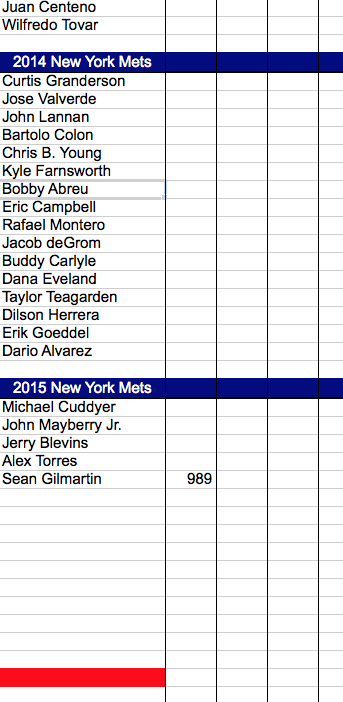
Here’s something to think about as we navigate 2015: With the Mets’ Opening Day roster all having entered service, there have now been 989 men to play for the franchise. (Not counting nine ghosts, one inaugural Met draftee sent elsewhere before Opening Day ’62, spring-training flyers, etc.) No. 989 was reliever Sean Gilmartin; who will be No. 1,000?
And will anybody but us notice? Clip-n-save this and play along!
by Greg Prince on 15 April 2015 4:53 am Before the manager had to deliver the news that something “major” had happened to his indispensable player’s hamstring…before a backup catcher presumably said a prayer that nothing be hit to him in his unforeseen debut as a third baseman…before baseballs brushed back batters hither and yon…before replays weren’t reviewed even though it sure as hell seemed like they were…before one piece of lumber in particular wasn’t interfered with even though the one person who mattered sure as hell seemed to think it was…before old nemeses, old friends and new dimensions launched five horsehide spheres bearing the new commissioner’s signature over pulled-in fences…before the man for whom the Night was named and a Dark Knight is namesaked could be alternately heroic, breathtaking and just plain plucky…before the Mets could make certain their six runs would withstand the five compiled by the Phillies…
Before all that, there was the noise. The noise of Citi Field. It’s the ballpark’s newest feature of all.
The Mets win in imperfect fashion. They likely lose David Wright for an undetermined period of time because the Captain slid awkwardly in stealing a base that he probably wishes he had left unpilfered. They find Matt Harvey’s comeback trail from Tommy John surgery might not be an uninterrupted march to Lower Broadway. They discover the Phillies may be dead, but there’s still no known cure for Chase Utley. They make nailbiters out of prospective romps. They burn through a short bench and reveal a startling lack of depth. They get by without their bantam rooster of a fearless leader who is never more popular than when he is being banished into the shadows by a numbskull umpire. They send you to your car or your train or whatever mode of transportation you chose wondering what the hell just happened.
But the uncertainty they tend to bring to bear couldn’t quiet the noise, at least not in my mind.
I want to say I went to Citi Field and Shea Stadium broke out, but that wouldn’t be wholly accurate. I’m not sure I ever heard Shea Stadium so determined to make polite conversation impossible. Oh, it was louder at Shea Stadium when the occasion warranted it. There were lots of occasions that warranted it. At Citi Field, there’s been mostly nothing to rev up the volume over. It’s been too quiet for six seasons.
At the outset of the second game of its seventh season, its inhabitants decided to change that. Why? Ostensibly because Matt Harvey was continuing his cinematic return — he cooperated with the preferred narrative, if not as neatly as he had the week before in Washington — but mostly, I suspect, because they could. Mets fans going to a Mets game decided they’d kept mum for too goddamn long.
So out came the sound that had been missing since Shea. We’re here, we cheer, get used to it.
I was happily perched behind home plate in the first row of Excelsior for my 2015 onsite debut, delighted to join my dear friends in the Spector family, and I heard things I had heard hardly at all through the Citi Field years. I heard “HARVEY! HARVEY!” I heard “LET’S GO HARVEY!” I heard “LET’S GO METS!” with no cue whatsoever from the 62%-larger scoreboard. I heard a general, recurring loudness that urged on nothing more than the idea of loudness for loudness’s potent sake. These were Mets fans — legitimately more than 35,000 of them, if not quite the almost 40,000 listed as the paid attendance — being Mets fans, tired of being something less. These were Mets fans buying into not only Harveysteria’s reboot and their team’s very recent winning ways but buying into themselves. If they’re gonna take back New York, they seemed to have figured out as one that they first need to take back Citi Field.
Not from the Phillies, but from inertia. The joint refused to jump for six years. It barely budged. Compared to its predecessor (and judging by the unsolicited opinion some dude offered me on the inbound 7, the comparisons won’t go away until there’s a September that supercedes the sadly established norm of the first half of the 2010s), Citi Field suffers from rigor mortis.
Or it did until Harvey took the mound and struck out his first, second and fourth hitters and the Mets, on Lucas Duda’s stinging three-run double, eventually took a lead that was continually challenged yet never overcome. The Phillies threw everything they had at Harvey, which is to say Utley and some dim officiating. Harvey lasted six innings. His eight strikeouts and zero walks were the stuff of a second win on the season. His determination to let one slip just enough to let Chase know he wasn’t dealing with a soft touch, though, became his UPS Delivery of the Game (I’m assuming some corporate entity sponsors something like that).
Benches were warned? So was the National League.
Phillies starter David Buchanan, who entered with an ERA as high as Pennsylvania native James Buchanan’s ranking as a president is low, had plunked, accidentally or otherwise, Wilmer Flores and Michael Cuddyer. Cuddyer had to leave the game. Citi Field didn’t care for that. It already didn’t care for Utley, who — besides reminding us he was Adam LaRoche before shuddering at the sight of Adam LaRoche was cool — dared to ruin Harvey’s perfect game with two out in the first.
Yeah, we were getting ahead of ourselves, but what’s the fun of having a Matt Harvey if you’re not convinced that he’s going to retire every Phillie from here to Granny Hamner? And if the Dark Knight is compelled to put an opponent on base, why waste four intentional balls when one pitched purposefully at a certifiable demon can do the trick so much more efficiently?
That’s what Harvey did in the fifth when Buchanan, who had the nerve to double, was on third; there were two out; and Ryan Howard (one of the few troubled American financial institutions the government didn’t bother deeming too big to fail) was on deck. Whoops! Pitch musta got away…just like Buchanan’s did when he’d hit Flores and Cuddyer. Hitting Utley removed the threat of Utley hitting and it told Utley’s pitchers, you hit two of ours, we’ll hit essentially the only one you got.
Citi Field liked that and made plenty of noise.
Citi Field was less appreciative of the BS catcher’s interference call that followed as Howard got in the way of Travis d’Arnaud’s attempt to throw Utley out on a stolen base attempt. Collins came out to argue with Alfonso Marquez, having gained no satisfaction earlier when he requested a replay review after Harvey was ruled to have hit Freddy Galvis despite pretty clearly not hitting Freddy Galvis. It took five minutes for the umpires to review the situation and tell Terry, no, you can’t have a review.
First that, now this. Howard was on first. Collins was ejected and then, as the saying goes, got his money’s worth, which was pretty cool to witness since replay review has kind of killed that tradition. Citi Field was very supportive of the manager and his actions at that moment. I suspect more than half of the 35,000-plus would gladly usher Collins to a waiting cab out of general restlessness, but we do love when our skippers stand up for our interests. Add “TERRY! TERRY!” to the chants of the evening.
Meanwhile, Harvey waited to resume pitching. As he involuntarily cooled his heels, I wondered how many heads off of how many live animals he would’ve bitten off if given the option, but the man has composure along with several out pitches. With the bases now loaded and Bob Geren his temporary manager, Matt popped Carlos Ruiz — the last remaining Phillie position player anybody outside the Delaware Valley could guess is currently a Phillie — to third, where Wright caught it to end the threat.
How comforting to have Wright out there. Little could Citi Field imagine it would see David voluntarily leave the game during a prospective eighth-inning rally because he felt something. As Collins implied later, that’s a guy who only comes out if an appendix bursts…and then the Captain would probably tell Ray Ramirez to spray some Bactine on it. By then, the 4-3 lead he’d helped protect had grown to 5-3 when Duda proved the niftiest of baserunners, sliding home safely on a d’Arnaud single and then lunging to touch the plate a second time when Marquez was initially too busy updating his Facebook status (“At the Mets-Phillies game, y’all! Umpiring is hard! LOL!”) to make a call. It blossomed to 6-3 when Daniel Murphy became the fourth Met to homer in 2015’s first eight games. But then it shrunk to 6-4 as Utley wreaked more of his home run havoc on Sean Gilmartin, a reliever whose performance would have pleased neither Gil Hodges nor Billy Martin.
After David left the game and Recker became his pinch-running and defensive substitute — the Mets’ teeny-tiny four-man bench had plumb run out of players — the extant spirit of weird-ass Met-Phillie games past, Jeff Francoeur, came up and homered to make it 6-5 in the ninth. Frenchy’s a Phillie now if you hadn’t been keeping up on his whereabouts. The fellow who in Citi Field’s first campaign lined into that year’s Mets-in-a-microcosm offensive escapade, Eric Bruntlett’s notorious Unassisted Triple Play. It was to 2009 Met rallies what Luis Castillo’s one hand clapping was to 2009 Met lockdown ninth innings.
Good times.
What was supposed to be Harvey Night and nothing but Harvey Night had subtly shifted to hang on for who knows what’s going to happen next, with Anthony Recker as your third baseman, Chase Utley in the on-deck circle and Jeurys Familia morphing from trusted setup man to Not Another Mets Closer. But then Familia struck out Galvis and the Mets of this year edged the Phillies of some other year but definitely not this one.
At which juncture Citi Field made more beautiful noise. It’s apparently what we do there now.
by Jason Fry on 14 April 2015 2:01 am In the first couple of weeks of April, emotions are subject to the perils of small sample size just like everything else. Win and you feel like your team is a lock to win 125 games, with various newcomers locks to hit .400, slug 50 homers, retire every tough lefty and turn every double play. Lose, and someone needs to call up the surviving ’62 Mets and tell them to start monitoring box scores, because the errors and strikeouts and injuries are going to snowball into an avalanche that wipes out everything in its path.
There’s nothing wrong with this — we’re talking spectator sports and not, say, nuclear negotiations. All that pent-up emotion from a cruelly baseball-less winter has to go somewhere. But we should remember that it’s silly. And for once, this is where we can learn something from baseball’s Proven Veterans™. They know in their bones the cliches we forget every April — that all the games are the same, that it’s a long season, that you gotta take ’em one day at a time.
Someone today asked Michael Cuddyer something along the lines of whether it was time for the bats to get it going, which is one of those daily baseball questions so Platonically inane that it should be counted as heating and redistributing air and not as actual speech. Cuddyer coolly replied that he didn’t think various Mets hitting .150 at the moment would keep doing so, which dispensed not only with the question but also with the foolish franticness behind it. The man’s been playing baseball for a long time, and he knows that a week is no basis to use for assessing anything. We should all keep that in mind, whether it’s April or August. Hot streaks will come and go, luck will ebb and flow, and we’ll make up stories to explain it all that will be triumphant or despairing, while Cuddyer and David Wright and Curtis Granderson and the grizzled vets measure out their marathon pace and remember — another useful cliche inbound — neither to get too high or too low.
But that said, few things are more fun than a home opener. Neither Greg nor I were there, but it was glorious watching the crowd bathed in sunshine, and seeing the happily dopey pomp and circumstance, complete with giant flags and Howie Rose barking out names and Mets waving, tipping their caps or practicing stoicism. (The faithful booed Bill de Blasio, which is what happens to elected officials of any ideological stripe; Ray Ramirez, which was childish but funny; and Ruben Tejada, which was just childish.) Bartolo Colon was cheered like a conquering hero, which was as it should be, while Matt Harvey received what was probably the loudest ovation ever accorded a pitcher with 13 career wins, a point I make in jest but I’m sure some talk-radio troll got half an hour out of. (I wouldn’t know, because the things I have to do with my time that would be better uses of it than listening to WFAN et al include stapling myself in the crotch and gargling with strychnine.)
And then, when all that was done, the Mets played a taut, interesting little game against the Phillies, one they came away from as winners.
It was an interesting game for a lot of reasons.
First of all, the ball wasn’t carrying at all, leaving Gary, Keith and Ron to ponder the mysteries of winds in that part of Flushing, an investigation now entering its sixth decade. If this game had been played in summertime, I suspect it would have been 5-3 early and relievers would have been a-scurry everywhere. Instead, it was one of those days where you got the feeling the game would come down to a compact little rally, a mistake, or both. And, indeed, that’s what happened: The Mets converted their first run when Aaron Harang caught his spikes trying to field a little squibber by Juan Lagares, and their second run after Chase Utley — who was the biggest tire on the Phillies’ fire today — let a double-play ball go right through his legs. Jacob deGrom benefited from not just the good luck but also the conditions — our favorite hirsute sophomore was admittedly not terrific, but hung in there with what he had and walked off with a win and a deceptively sparkling pitching line. Baseball, to quote the noted philosopher R. E. Kanehl, is an unfair game.
Ben Revere‘s fifth-inning snag of Curtis Granderson’s sure double goes in the file labeled Things You Didn’t Enjoy But Should Admire Anyway. Revere played a superb OF all day in tough conditions, though his popgun arm wasn’t enough to prevent Cuddyer — who’d somehow tripled — from coming home on a Travis d’Arnaud sac fly in the eighth. Small sample size alert: Don’t pencil Cuddyer in for 22 triples.
One New York fan added something neither enjoyable nor admirable to Daniel Murphy‘s fourth-inning double, waiting to douse Grady Sizemore with beer through the fencing of the Mo Zone. Here’s hoping he was not only ejected but banned from Citi Field. What’s hard to understand about this? Booing the enemy is your prerogative. Trash-talking (within the bounds of decency) is perfectly acceptable and can even be good sport. Interfering with a player in the field of play? Completely unacceptable. Plus from a replay it looks like he missed. Whoever you are, dude, you even suck at being a dick.
Spare a good word for Jerry Blevins, who has an unenviable assignment: For each series, he can identify the fearsome lefty hitter or two that he’ll be called upon to confront with the game on the line. Today Blevins was perfect, erasing Odubel Herrera (who’s awfully young but looks pretty good), Utley and the still-animate corpse of Ryan Howard in a flawless eighth. Blevins has retired all eight batters he’s faced so far this year, which we’ll forget when he hits a week in which bearding lions in their dens proves more difficult.
Oh, and how about the ninth inning? If your recipe for escaping a no-out, tying-run-at-the-plate jam was for a double play put together by Lucas Duda, Wilmer Flores and Jeurys Familia, you’re a braver fan than I am. It’s nice when things work out, isn’t it?
by Greg Prince on 12 April 2015 9:50 pm In case you don’t remember, baseball is back. A week ago at this time, you could barely sit still in anticipation of its annual arrival. Now it’s part of the woodwork.
I like the woodwork this way. I like baseball this way. I like when it keeps us company this way, embedded so smoothly into the everyday life. Opening Day and its Home Opener cousin are dandy, but anything that MLB Inc. crafts a logo for and hits you over the head with loses its innocence after a few decades.
This first road trip, the inherent ebbs and flows of 3-3 notwithstanding, made for an enormously satisfying week. I didn’t hang on every pitch. I couldn’t. Nobody can. But the pitches were there to return to and take as seriously as I wanted. Miss an inning?
Don’t worry. They’ll make more.
This is baseball in April, hold the pomp, circumstances to be determined. When the Mets win as they did Sunday afternoon in Atlanta, all is right with the world again, no explanations necessary. When the Mets lose in April, as they had Friday and Saturday nights, all could be better, but a Mets loss in April beats a Mets nothing in winter.
Before Michael Cuddyer introduced himself to the ranks of Met power hitters (he and John Mayberry are currently tied for last on the list of most home runs hit for the franchise alongside 72 one-dinger wonders who span Gus Bell, Hobie Landrith and John DeMerit from 1962 to Bobby Abreu and Taylor Teagarden in 2014); before the Mets made the most they could possibly make from a walk, a steal, a walk, a sacrifice bunt, an intentional walk and a sacrifice fly (Terryball in action!); and before two-tool player Bartolo Colon (three-tool, counting the vault of savvy he no doubt stores upstairs) put his bat in the way of a ball and accidentally authored his first RBI in ten years, the Mets were having a below-average weekend.
Niese Night was a comedown from Harvey Day and the Gee interregnum guaranteed the first losing streak of 2015. The closer had tested positive for some banned substance that had somehow infiltrated his system (he “honestly” has no idea how it got there). The captain felt compelled to tongue-lash his teammate in the third-person to the media. The shortstop was inspiring several nicknames, none of them flattering.
• Wilmer Porous
• Non-drelton Simmons
• Wilmer T. Flores (as in “WTF — he’s at short?”)
Yeah, bad Met times in a bad news ballpark. And it was still better than blank Met times in winter. I’ve realized this week, during the three Met losses I’ve seen most if not all of, that I rather don’t mind being annoyed by the Mets losing when I haven’t been annoyed by them for real for six months. I’d prefer being spiritually enriched by their endless excellence and their six straight wins to start the season, but deprived of that option…WTF, y’know?
It’s not about “panicking”. The silliest thing that can be said to a fan who is unhappy with an early-season slump is “it’s too early to panic” unless you’re talking NFL. Personally, I wasn’t panicking when the Mets were 2-3, and not because the 1986 Mets started 2-3 and rallied to win 106 of their next 157. I was simply fleetingly miffed — and damn glad to be so. Guy on third doesn’t get driven in? That doesn’t call for a state of Zen. It calls for geez, get the runner home, OK? Likewise the flat fastball that’s spanked into center when the other team has the bases loaded or whatever else doesn’t constitute the teamwork to make the dream work.
It isn’t fatal, it’s just not ideal. And it’s perfectly within the bounds of civil behavior to point it out, if just to oneself. Give yourself and your fellow fan credit for perspective. The next day, it can be all good. The next day after the two-game losing streak, Sunday, it all was. More good days than bad days will keep the annoyance in check. But when the bad days come around again, as they inevitably will, there’s no sense denying how much you don’t care for them.
If I have to be dealt a loss, allow me to enjoy despising it. It helps remind me how much I enjoy the wins.
by Jason Fry on 11 April 2015 10:45 pm For the first few games of the season happiness at having baseball back outweighs what actually happens on a given night. But then there’s a game that leaves you disgusted and sputtering profanities. Baseball, you think, is being very, very bad to you.
For me, tonight was that night. It was Dillon Gee handing out doubles like party favors in a fifth inning that blew up on him, and the Mets’ rally getting short-circuited by balls that were hit hard but right at people, and the offensive output consisting of two Lucas Duda hits and a Baltimore chop. Enough went right against Washington to put a certain spring in our collective step, but plenty’s gone wrong against Atlanta, the reports of whose demise seem to have been somewhat exaggerated. (And whose stadium can’t be knocked down soon enough, even if it means being party to another shameful bilking of taxpayers.)
So yeah, tonight’s game was no fun and — unlike last night’s — had nothing particularly admirable about it.
Speaking of neither fun nor admirable, say a half-season’s farewell to Jenrry Mejia, who will get 75 more games to rest his balky elbow now that he’s been suspended for stanozolol, which you may know better as Winstrol. It’s an old-school steroid — the stuff Brian McNamee said he injected in Roger Clemens‘s booty, to quote a famous line that I fear will be the last thing rattling around in my brain as I’m expiring in a nursing home one day.
Mejia, oddly, is the fourth pitcher in two weeks to test positive for this retro-steroid, which makes you wonder if someone changed the formula in some dubiously legal supplement or if people have come down with a case of the stupids.
I ran out of things to say about performance-enhancing drugs a long time ago — I’ll just let the last thing I remember writing stand. Well, all right, here’s a bit more: I’m disappointed and irked that Mejia did something dumb, but except for practical reasons I’m not more disappointed and irked about it because he’s a Met. I wish we could stop talking and worrying about this stuff, but at least the penalties have become pretty steep: Mejia’s out half a season and $1.1 million, which has got to hurt even if you’re a young millionaire, and is the kind of thing that you’d assume would make you think twice.
Well, until four players disappear from rosters in two weeks.
A suggestion for the Mets, besides volunteering to take sledgehammers to Turner Field to make it disappear even sooner: Next year, don’t name a closer for Opening Day. Just shrug and make vague harrumphing noises and tell people to come to the ballpark. Bad things happen to Met closers, and those bad things happen quickly.
Oh, and here’s a weird way to assess whether you’re optimist or a pessimist: Mejia’s mistake means he’s ineligible for the postseason.
by Jason Fry on 11 April 2015 12:52 am Baseball’s a mental game. Perhaps you’ve heard.
For a maddening, frustrating game this one was actually kind of fun. Wait, hear me out on that.
The Mets lost because multiple members of the team made physical errors, followed by multiple members of the team making mental errors. Those weren’t the fun parts.
But these parts were pretty neat:
- back-to-back home runs from David Wright and John Mayberry Jr.;
- an collision at home between Andrelton Simmons and Travis d’Arnaud that was adjudicated by pre-Sabean norms, with both players admiring each other’s effort instead of sniping about unwritten rules;
- Simmons adding to his very long career highlight reel with a jaw-dropping robbery of d’Arnaud from the outfield grass on the wrong side of his third baseman;
- great confrontations between Rafael Montero and Cameron Maybin and Phil Gosselin; and
- a duel between Jason Grilli and Lucas Duda that ended with one of the more evil sliders you’ll see.
Not all of those moments went the way we wished. But if you need a steady diet of MINE MINE MINE, baseball’s not for you. The season you’ll cherish your entire life is still going to have 50-odd nights that end with you grumbling about a loss. That’s a lot of futility to sign up for, so you learn to appreciate the game even when it doesn’t go your way.
But let’s get back to those physical and mental errors. Jon Niese‘s performance did nothing to dislodge him from his hard-won status as my least favorite Met since Michael Tucker, but consistently throwing a ball to the corner of home plate is a lot harder than it looks from the couch, so I’ll give him a pass for one night.
Are Wilmer Flores‘s errors physical or mental? The responsible answer would be How the Hell Do I Know?, but I can’t be the only armchair psychiatrist who noticed that Wilmer looked wide-eyed and dry-mouthed and uncertain of hand whenever the ball arrived for a visit, like it had just transformed into a shot put that he somehow had to transport to first base. We’re still in that part of the season where you can remember every important moment of every game, which means we’re trying to make patterns from what might just be blips. But early blips can turn into yips, self-fulfilling prophecies that can wreck a player’s confidence.
The game crumbled, though, because of mental errors committed by guys you’d expect would know better. First was Juan Lagares, who dove for a leadoff 8th-inning single by Chris Johnson that not even he could catch, turning it into a double. Lagares is a wonderful center fielder but not actually capable of flight.
Jace Peterson ran for Johnson, and Montero rebounded nicely, fanning Christian Bethancourt and getting a ground ball to third from Simmons. Except Wright — inexplicably and shockingly — tried to reverse field and tag Peterson instead of throwing to first for the second out. Insult to injury: With the other Mets arrayed to back up the expected play, everyone was left staring in horror at the unguarded second base, which Simmons promptly took possession of.
Montero intentionally walked Alberto Callaspo and prevailed in a nifty duel with Cameron Maybin, fanning him for what should have been the third out. Instead, he had to face Phil Gosselin. The seventh pitch was a fastball, low but with too much of the plate, and Gosselin rifled it into center. Too many fastballs with not enough wrinkle on them? Perhaps, but I thought Montero showed poise when he could have indulged in Niesean sulking and unraveling, and I’m not going to kill him for a pitch he never should have had to make. Hand a team an extra out and two free bases in an inning and bad things will generally follow.
There were some more moments to be admired before all was said and done, but that gory eighth inning was the ballgame. And it was no fun at all.
by Greg Prince on 10 April 2015 3:31 pm Welcome to FAFIF Turns Ten, a milestone-anniversary series in which we consider anew some of the topics that defined Mets baseball during our first decade of blogging. In this eighth of ten installments, we swing by a year that we hope the current season evokes comparisons to real soon.
They edged Washington to start their season. They lost in irritating fashion the next night. They finished off their opening series by sticking it but good to those pesky Nats.
Welcome to 2015, which has kicked off exactly as 2006 did, if you take your parameters narrow (and if it helps, know that the Mets finish this year against the Nationals, which they also did in 2006). More to the point of this particular stroll down Has It Really Been Ten Years? Avenue, though, is that the above paragraph also describes the first three games of 2006, the best season to date of the Faith and Fear Era.
I polled 30 Mets fans and bloggers — all of them me — and asked them to vote on which season was the most fun to root during and the most fun to write during. It was almost unanimous. 2006 received 29 of 30 first-place votes. The only dissenting ballot listed 2005 on top.
As you can imagine, a talk radio and social media uproar ensued that there was even a single outlier. “He should have his vote taken away!” “What kind of joke is that?” “Doesn’t he know how to count?” “He probably thinks RBIs are important, too!” I contacted the me who voted for 2005 and he explained his reasoning:
“I understand and appreciate that 2006 was a more successful Mets season, but taking into account the sense of discovery inherent in diving into near-daily blogging as well as the emergence of certain personalities and storylines that fueled the Mets’ rise into the ranks of Wild Card contenders…well, there’s something about 2005 that will always be near and dear to me. Plus I knew 2006 would win in a walkover, so I didn’t mind throwing a little sentimental support to a year that gets overlooked as a matter of course.”
The GPWAA has been asked to begin proceedings that would strip that version of me of my vote. But I wouldn’t expect any punitive action. We’re all entitled to our opinions — even 1/30th of me.
What shouldn’t be obscured by all the noise of that manufactured controversy is how far 2006 stands above all other seasons in the FAFIF Era and how it is the only season we covered in our first decade that comes up in conversations that center on the best Met seasons ever.
That’s because it was among the best Mets seasons ever. The 97-65 record of 2006 is the fifth-strongest in team history, topped only by 1986, 1969, 1988 and 1985. Given that 1985 brought no playoffs (despite much joy) to Flushing and 1988 didn’t contain a playoff series victory, you can argue that of all Mets teams that didn’t win a pennant, 2006’s was the best. Emotionally a majority of me would be inclined to vote for 1999, but 1999 — one-half game behind 2006 in the regular season — didn’t include a division title and it didn’t get quite as close to the World Series.
If one were to vet between the lines, one would detect a tap dance around the elephant in the room…the elephant that was last seen standing very still as an 0-2 curveball broke across home plate. For the purposes of this exercise, we’re going to treat the elephant as something of an illusion, like it’s pink and we had one too many, even if the Mets won one too few. Much of the foundation of my post-October 19, 2006 blogging has been built on revisiting how that night ended. I’ve grappled with it and I’ve analyzed it and I’ve surely bemoaned it.
Not today. I prefer to celebrate what preceded it.
There’s a reason 2006 was voted No. 1 by 29 of 30 of me. There are lots of reasons. The record and the division title and the League Division Series make most of the case, but unlike the cases presented by most of our seasons, there is serious delight to be mined from the details of this one.
So let’s mine away…
• The Mets blazed to their best 12-game start ever, going 10-2 and creating a ball of dust behind them. Left in it were the eternally defending National League East champion Atlanta Braves, five games back in second place with 150 to play. No team in the divisional era had buried its division so thoroughly so soon, not even the ’86 Mets.
• The Mets won April series in San Francisco, where they were rarely successful, and Atlanta, where they were legendarily cursed. They set a tone and they kept it in tune.
• The Mets kept coming up with contributors nobody had much considered before the year began, some more transient than others, but all of them part of what forges a formidable team. Anderson Hernandez’s brief reign at second yielded a web gem for the ages. Brian Bannister rose to the rotation and the occasion until (like Hernandez) an injury got the best of him. Jose Valentin evolved from failed pinch-hitter to power-packing infielder. Xavier Nady was one of those professional hitters you hear so much about. Julio Franco wasn’t just old, he was hot. Endy Chavez proved the world’s greatest fourth outfielder across seven breathtaking months. Orlando “El Duque” Hernandez parachuted in from Arizona to stabilize the starting pitching. Dave Williams threw a few good games. Alay Soler threw a shutout.
• The Mets made winning exciting. They established themselves as walkoff specialists in May. They demonstrated a knack for scoring early and often in June. They won behind players who were already stars and players who were becoming stars.
• The Mets essentially wrapped up the East in June on a road trip that remains quite possibly the best any Mets team ever played: two of three in Los Angeles, four of four in Arizona, three of three in Philadelphia. That last set, at Citizens Bank Park when it was still reliably Shea Stadium South, was the divisional dagger. With the Brave mini-empire was already in rubble, the Phillies’ aspirations were snuffed out accordingly. On June 15, following the Mets’ sweep, 9½ games separated the Jersey Turnpike neighbors. We were to the north and we were going to stay there.
• The Mets were laden with All-Stars: six, more than any Mets team before or since. David Wright, Jose Reyes, Carlos Beltran and Paul Lo Duca were voted in as starters. They shared the cover of Sports Illustrated with Carlos Delgado who could have easily made the midsummer trip to Pittsburgh, too. Pedro Martinez and T#m Gl@v!ne got ASG nods as well. No team in the big leagues was a bigger deal.
• The Mets scored eleven runs in one inning. It was the Sunday after the All-Star break, an early-evening start at Wrigley Field for the benefit of ESPN. The Cubs led, 5-2, through five. Then the Mets decided to tear their playhouse down. With one out, second baseman Todd Walker erred on Beltran’s ground ball. He shouldn’t have done that. Delgado and Wright singled and Cliff Floyd homered them all in. The Mets pulled ahead, 6-5. After a walk to Nady, a pitching change and an error that placed Ramon Castro on first and Nady on third, Chavez pinch-singled in the fifth run of the inning, with the not particularly speedy Castro taking third. Endy stole second. Valentin beat out an infield hit. The bases were reloaded. Chris Woodward — playing for a precautionarily sitting Reyes — accounted for his second out of the inning (he’d flied out to start the sixth) by grounding to third and allowing Castro to be cut down at home. The bases were then unloaded when Beltran hit one out. That made it two grand slams in the inning and nine runs overall, one short of the Met record that had been notched in 1979 and renotched dramatically in 2000. A Delgado double and a Wright homer broke the record. Eleven runs, for goodness sake. It was our scoringest inning ever, certainly my personal favorite offensive inning of the last ten years. Because it didn’t air on SNY, it doesn’t get any Mets Classic play, but nothing could have been more quintessentially 2006 than the Mets pounding an opponent into the gloaming.
• The Mets were usually on a network to call their own. The SNY announcers became rock stars. A weekly program profiled the players and the fans. A monthly program was designed especially to indoctrinate the kids. Mr. Met got tons of play. Games were reaired. Never enough of them and never often enough (except for some old ones that would soon be run into the ground), but this was, at least in theory, Mets TV. It was a good year to launch that sort of programming.
• The Mets had two songs produced in their honor before the season was two months old. Each of them could be termed charitably as energetic. First came “Our Team. Our Time.” Sample lyric: “Billy Wagner comin’ through/he’s throwin’ heat, no doubt.” It had the blessing of higher-ups in the marketing department who hoped “that fans catch on to ‘Our Team. Our Time’ as a rallying cry for the start of a thrilling season at Shea.” It wasn’t very good and they didn’t. Shortly thereafter, Lucas Prata retrofitted his dance hit, “And She Said…” into “And We Say…(Let’s Go Mets!)”. Sample lyric: “Billy Wagner closes/throwing heat at you.” It wasn’t much more inspiring than the other song, but the Mets took their cue and indeed kept going atop the N.L. East. Most encouraging about the existence of each of these recordings? Only clubs on a roll get serenaded energetically let alone in multiplicity.
• The Mets pitched well in relief. They pitched very well. While injuries forced them patch their rotation over and over, the later innings were held down by long man Darren Oliver, submariner Chad Bradford, lefty deluxe Pedro Feliciano, seventh-inning stud Aaron Heilman, eighth-inning rock Duaner Sanchez and aforementioned heat-throwing closer Wagner. Ultimately there’d be some shaking up of this classic corps when somebody ill-advisedly got into a cab in Miami, but we’re casting a warm glow on 2006 here, not a harsh glare. The Mets wouldn’t have such stellar relief pitching again until the final months of 2014 (and most of those guys are injured as we speak).
• The Mets had intriguing up-and-comers. Lastings Milledge, Phil Humber and Mike Pelfrey, the club’s three previous first-round draft picks, all made their debuts. The most delectable impression was made by Milledge, who demonstrated a lightning bolt for a throwing arm and a bat intermittently inhabited by thunder. Lastings also high-fived the fans in right field right after he homered for the first time, drawing the ire of Floyd and skipper Willie Randolph — plus he didn’t meet the veteran “know your place, rook” standards of Wagner — but he sure was fun to project dreams onto. Also making their first Met appearances were two talented righties, John Maine and Oliver Perez, soon to be bulwarks of the Met postseason.
• The Mets were in the postseason. They timed one of their rare losing streaks perfectly so they could clinch their first division title in eighteen years at Shea, and clinch they did, on September 18, against the overmatched Marlins. Cigars were lit, champagne flowed, fans embraced fans. Thirteen games remained, to be followed by playoffs during which the Mets — owners of the best record in the National League — would hold home-field advantage.
• The Mets began the playoffs with a flourish, taking both of their home games from the Dodgers, the first on an all-time defensive play (two runners tagged out literally one after the other when Shawn Green relayed to Valentin who relayed to Lo Duca), the second on sound veteran pitching from Gl@v!ne. The Mets went west and swept the LDS in L.A., with Steve Trachsel holding up under duress and Greg Maddux beaten down by Met bats.
• The Mets yielded some spectacular numbers. Beltran tied Todd Hundley’s single-season home run mark of 41 and knocked in 116 ribbies. Delgado drove in 114 runs and blasted 38 homers. Wright was a 25-116 man himself. Reyes owned the leadoff slot, with 17 homers, 19 triples and 64 steals. Lo Duca, asked to succeed the legend of Mike Piazza, hit .318. Sports Illustrated chose its cover boys well.
• The Mets hosted Piazza as a Padre, and Mike got hits and homers and standing ovations and the Mets won, so it was all good. That wasn’t long before the 1986 team came home and was lavished in love and provided a backdrop for the Mets to take three straight from the Rockies. That was just before Delgado hit the 400th homer of his career as part of a hopeless come-from-behind effort against the Cardinals, except it wasn’t hopeless because Beltran hit one off Jason Isringhausen and the two Carloses trumped everything Albert Pujols had been doing to us and the Mets won, 8-7, after trailing, 7-1. Not too many weeks later, Jose went around the bases for an inside-the-park job that he could file alongside his cycle and his three-homer night. And how about that time…
Yes, how about that time? It was the best of our times. Until we have better times.
|
|






