The blog for Mets fans
who like to read
ABOUT US

Faith and Fear in Flushing made its debut on Feb. 16, 2005, the brainchild of two longtime friends and lifelong Met fans.
Greg Prince discovered the Mets when he was 6, during the magical summer of 1969. He is a Long Island-based writer, editor and communications consultant. Contact him here.
Jason Fry is a Brooklyn writer whose first memories include his mom leaping up and down cheering for Rusty Staub. Check out his other writing here.
Got something to say? Leave a comment, or email us at faithandfear@gmail.com. (Sorry, but we have no interest in ads, sponsored content or guest posts.)
Need our RSS feed? It's here.
Visit our Facebook page, or drop by the personal pages for Greg and Jason.
Or follow us on Twitter: Here's Greg, and here's Jason.
|
by Greg Prince on 28 December 2014 4:42 am “It’s pretty hard to say goodbye to anything.”
—Terry Collins, September 26
On September 28, we were prepared to say goodbye to the 2014 baseball season and one of its featured players. If the Mets were listed like a movie cast, Bobby Abreu would have been presented last, with a generous “AND” preceding his credit. He was a Special Guest Star in our midst, a big name dropped in to provide wow factor. Abreu wasn’t in a position to dazzle us much with his play any longer, but he did come to us with a sparkling Baseball Reference résumé. Five years from now, when he’s being overlooked for Hall of Fame consideration, everybody who wasn’t following the Mets at the end of his career will likely offer a similar take on how his career ended:
“Bobby Abreu was a Met?”
Some Mets fans (most, probably) will eventually paddle the same boat, but on the last weekend of his last season, there was no doubt with whom Abreu was reaching the end of the line. Bobby gave a teary “adios” address to the press on Friday night the 26th. His manager, Terry Collins, the one who’d known him from his first month in the majors eighteen years earlier, let it be known that Abreu would be on the field before it was all over and that he’d “walk off with his head held high”.
So he did. Collins started Abreu in right field in Game 162, batting him second. Come the fifth inning, Bobby did what we in attendance wanted him to do. He connected for a base hit, reached first, tipped his cap and indeed walked off with his head held high. He had been a Met by mutual convenience. Abreu needed a place to conduct his unfinished business and the Mets weren’t beyond relying a little much on a 41-year-old who hadn’t played in the majors since he was 39. If all had truly worked out, Abreu would have proven himself a lefthanded pinch-hitter deluxe on the order of Kranepool and Staub and Lenny Harris. He might have produced a legendary bases-loaded line drive like Matt Franco or shocked the house as Marlon Anderson did via inside-the-park home run. Instead, other than serving as a venerable bookend to Bartolo Colon, he didn’t accomplish a load. It took one more favor from the front office to bring him back for September from Las Vegas after he proved ineffective off the bench by midsummer. On Closing Day, though, we decided he was our guy and we sent him off as such.
“Special,” Bobby called his final swing for a single off Houston righty Nick Tropeano. It was “the way that I wanted to end it — on the field.”
Abreu said farewell to the game he loved with Eisenhowerian élan and we, in turn, bid a heartfelt adieu to a player we took to heart at the very last minute of his tenure with us. Yet we never thought to as much as wave across the diamond to Eric Young, Jr. A year earlier on the same basic occasion in the same ballpark EY had reason to take a Closing Day bow. The son of a major leaguer — who grew up in New Jersey rooting for the Mets, for goodness sake — swiped two bases and brought a stolen base crown to Flushing, the only Met besides Jose Reyes to reign with his feet. The first eight bags were accumulated in Colorado garb, but it was as a Met that he broke out. For a while there in 2013, Eric’s alacrity was the catalyst that made the Mets go. Every cliché you remembered from the ’70s and ’80s seemed to come true. Our fastest man led off, got on, ran and we won. Speed didn’t slump.
Then it did. Young’s 2014 didn’t glitter. First the Mets would win with him in the lineup even if his numbers weren’t stacking up. Then they wouldn’t win. Then he didn’t play. By September 28, he was the pinch-runner for Abreu, the ex-Phillie and ex-Yankee who received the parting ovation; he scored in his stead, too, when Lucas Duda doubled him home. Five innings later, the final out of the Mets’ season landed in EY’s glove.
He was non-tendered on December 2, out of our lives as quickly as he’d go from first to third. We never did say goodbye.
No goodbye to or from Eric Young, Jr., save for social media. No goodbye to Daisuke Matsuzaka, whose last appearance as a Met came September 25. Dice-K, who morphed over time (but not as much time as we tended to attribute to him) from the worst of torpid Steve Trachsel to the best of handy Ray Sadecki, converted his free agency into a deal with the Softbank Hawks in Japan. No goodbye, either, to Gonzalez Germen, whose final throw for the Mets was fired in the same Nationals Park nightcap where Matsuzaka let loose his last Met pitch. The middle reliever with the two slightly confusing names, who was pretty good in 2013 and not quite so good in 2014, was sold to the Yankees just the week before Christmas. No goodbyes to Andrew Brown, who homered on Opening Day, or Juan Centeno, who threw out Billy Hamilton, or Buddy Carlyle, who soaked up innings. The sendoff Abreu got was the aberration, not the norm.
One of the strangest aspects of being a diehard fan of a given team is that we invest ourselves in the fortunes of total strangers and then, when they are removed from our laundry, we usually move on without as much as a goodbye. Abreu flashed us the sign that he was going and we executed the clap and run. Young, Matsuzaka, Germen and anybody else we didn’t realize we’d never see again as Mets weren’t able to extend any such hints.
It was just business. We’re cool with that, generally speaking. We get it. In our minds, we tinker with the roster without anybody asking our opinion. We’ll pull for any 25 Mets you put in front of us, but we’ll love the ones who win on a regular basis. The ones who don’t have to have left us with a pretty good reason to care that they’re gone. Attrition and deletion and transactions happen. They have to. It’s how nature renews itself. It’s how 79 wins might become more than 81.
It’s still strange that there’s no formalized separation process, no severance package that encompasses a standard amount of applause and atta-boys. You might luck into being a ticketholder on the day it is clear Bobby Abreu is done being a Met, but otherwise, it’s all very sudden and matter-of-course. Life is a series of hellos and goodbyes, as the Billy Joel lyric that accompanied scores of awkward head shots in the Long Island high school yearbooks of my adolescence went, I’m afraid it’s time for goodbye again. Except the opportunity to say goodbye to the so many faces in and out of our lives is surprisingly rare.
In 2014, I said goodbye to Bobby Abreu, baseball fan to baseball player. I said a few other scattered goodbyes as well. Those on the other end of my sentiments had no idea that’s what I was doing, but that’s OK. These were for me as much as it was for them.
A POSTHUMOUS SALUTE
Richie the Cop (1964-2013)
A sizable plurality of the inscriptions I collected in my high school yearbook made reference to one of two distinguishing characteristics of my life in the spring of 1981: I had been editor of our school paper and I was the most obvious Mets fan going. If my yearbook was within easy reach (rather than buried in a box underneath a pile of other boxes), I could quote accurately and warmly my favorite bon voyage. As is, I remember the gist pretty well.
“I hope you get to write about the Mets for a big paper company like the Daily News.”
“A big paper company,” but not like Georgia-Pacific. I always liked that. I liked the guy who wrote it, too. He was a Mets fan, which I suppose was why I asked him to sign. We’d been to a game together in 1980, the year the Magic was said to be Back, a week or so after it became clear it had all gone “poof”. The Mets lost to the Giants that night. Mark Bomback pitched all right, but Lee Mazzilli got himself thrown out at home.
Anyway, the guy’s name was Richie the Cop. I could tell you his last name, but it seems superfluous. We all called him Richie the Cop, kind of as a joke, but not exactly. I’m 99% certain he signed my yearbook as Richie the Cop.
Richie the Cop might have wished me luck in a prospective career that meshed with what I’d been doing in high school, but Richie, a year behind me (so I didn’t get to return the favor, yearbookwise), never left any room for doubt as to what his future held. It was all there in his name.
He was going to be a cop. Hell, he might have already been a cop, and he was only sixteen. Seriously, he already had ins with the local police and fire departments; he was organizing a chapter of the Guardian Angels when they were hot stuff; I think he was captain of the Civil Air Patrol. Anytime I had to write a story that touched on school safety or security, I had two go-to sources: our principal and Richie the Cop.
Our shared fondness for the Mets and the time I watched Halloween at his house on WHT (that’s Wometco Home Theater for you young streamers out there) notwithstanding, most of my relationship with Richie was of a friends-in-law nature. He was a friend of a friend, so I can’t say I ever really got to know why he was determined to be a cop. Simply, he was Richie the Cop when I met him, he was Richie the Cop when he signed my yearbook, he was Richie the Cop a couple of times when his name came up in conversation post-graduation, which wasn’t very often.
Last weekend, as news broke about the awful shootings of two New York City police officers, my mind (probably instinctively wishing to avoid the sadly predictable grandstanding that followed) wandered to Richie the Cop. I wondered whatever happened to him. It didn’t take a ton of Googling to discover a) he became a cop — an NYPD detective — and remained a volunteer fireman; b) he threw himself full-bore into the rescue and recovery operations at the World Trade Center; c) he served 20 years on the force before retiring to Florida; d) he contracted lung cancer from prolonged exposure to the air at Ground Zero; and e) he died from it at 48 in 2013.
I read the truly heartfelt remembrances of him; found he was at the center of a petty homeowners association controversy regarding the flag he chose to fly in front of his house; and listened to him describe to high school students in 2011 what it was like to be smack in the middle of the events of September 11, 2001, and how for him and his fellow first responders it was a date that lasted unfathomably far beyond the day in question. Richie the Cop from high school wound up being Richie the Cop in every sense of the word.
Thirty-three years have passed since he wished me well writing about the Mets for a big paper company like the Daily News. Come to think of it, that may have been our final encounter. Still, when I learned of his passing, I felt like I lost more than a friend of a friend from a very long time ago. As a decent human being, I generated sympathy for his family and sorrow for his suffering, yet as someone who had come into contact with him on a recurring basis as he came of age, I registered little sense of surprise. This man, when he was a kid, was ready to serve when the rest of us hadn’t a clue as to what we were going to do with our lives. He knew what he’d do with his, and, ultimately, he’d give it in service to others.
To have died as a result of what he always wanted to do was a tragedy. To have lived doing what he always wanted to do…let’s just say there was no chance Richie the Cop was going to turn out to be merely a high school nickname.
FAREWELL WITH FAIR WARNING & a side of kasha
Adiós Edison (1980-2014)
Too often you don’t know you’re saying goodbye to the institutions you counted on to always be there. Got a place you like to eat? Maybe not a place you go every week or month but you knew it would be around forever because it had always been around forever? Then one day you hear it won’t be?
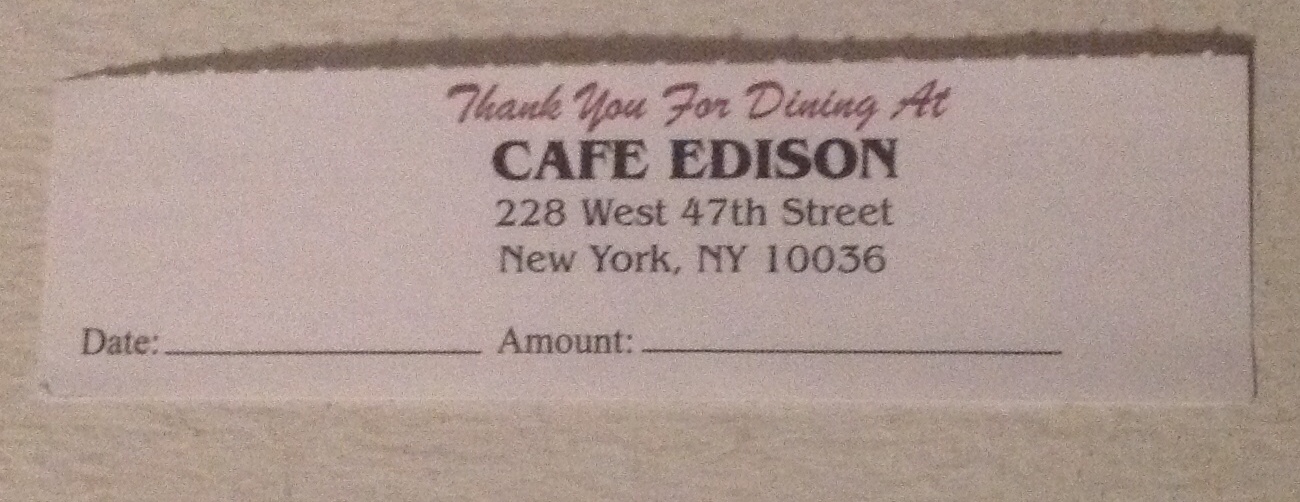
Maybe you heard about the Edison. It was tough to miss the coverage, if you were so inclined. Word came down in early November that the Edison — Cafe Edison at the Edison Hotel on 47th Street — was closing. It was the same story anybody who likes any place in Manhattan that isn’t overpriced runs into. Big Nick’s on the Upper West Side, where Stephanie and I continued our first date from Shea Stadium, went out because of high rents in 2013. Smith’s, in the West 40s, where now there’ll never be a plaque on the wall commemorating it as the spot I was offered my first book deal, went out because of high rents in 2014. Inevitably it was the Edison’s turn.
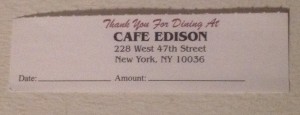 No, thank you, Cafe Edison. Miles of homages were written to the Edison between the time it was known the doors would close and the time they closed on December 21. All hit essentially the same notes: anachronistically reasonable prices for Times Square; they’d let you sit and talk; locals didn’t feel outnumbered by tourists; Broadway types would casually come and go (we once saw Peter Gallagher chatting up the cashier while Tony Roberts kept to himself at the counter); great matzoh ball soup.
Yes to all that. Yes to a coffee shop that had been in action since 1980 but I would have guessed 1945. No sentimentality needed. When you sat down at the Edison, there were whiffs of disinfectant to be caught. The service was fast but not remarkably friendly. You were better off sticking to essentials than roaming the menu free-range. With all that taken into account, though, there was no need to dismiss it from the hotel to make room for another upscale eatery. But that’s what was going to happen by late December.
Stephanie and I, who’d been dining intermittently at the Edison since 1997 — before Chicago, after Mamma Mia, on the heels of the King Tut exhibit around the corner (geez, who’s a tourist now?) — were determined to make one last pilgrimage. We never thought we’d have to. Who’d get rid of the Edison?
Then again, who’d get rid of the Variety Store? The Variety Store was a staple of my childhood. It was on Park Street a few doors down from the Associated run by Murray the Goniff, as my parents called him. No goniffs at the Variety Store. Need school supplies? You’d go to the Variety Store. Want Colorforms? The Variety Store would hook you up. Overcome with the desire for a little paddleball with the string attached? The Variety Store would take care of you. Gotta blow bubbles? The Variety Store had all the fixings sealed in one handy little container for under a buck. There were adult things, kid things, most things. Maybe they sold carburetors in the back. The mostly infallible Great American Baseball Card Flipping, Trading and Bubble Gum Book gave an unnecessarily hard time to “variety stores completely lacking in variety”. Ours, on Park Street, had variety.
What they had less and less of, I noticed as fourth grade became fifth, was customers. When I made my way inside, which wasn’t as often as I had in first and second grades, I noticed I never had to wait in line. I hadn’t seen a line there in years. Maybe that was why the Variety Store didn’t last to sixth grade. They held a going-out-of-business sale. It was dandy. Oodles of people. Scores of sales being rung up. The store that seemed so sad unshopped brightened up at the end. The mom ‘n’ pop who ran the store never stopped smiling as long they had a bustling clientele.
It was only temporary. Just like the Edison when we visited the first week of December. But I picked up the same Variety Store vibe. Everybody was friendly to the point of being festive. We didn’t tell our waitress anything like “It’s such a shame you’re closing.” She knew it. We knew it. All that was worth saying, really, was a cup of matzoh ball soup, please, a matzoh brei and, oh what the hell, a side of kasha varnishkes, even though at the Edison, a side of kasha varnishkes is the metric equivalent of a side of beef.
It’s not that hard to find a good bowl of matzoh ball soup in New York. It’s damn near impossible to track down a matzoh brei. The kasha varnishkes, I’ll freely admit, was pouring it on. Still, as I rationalized to Stephanie, what’s the point of coming for one last meal at the Edison if it’s not going to be your last meal at the Edison? Perhaps if I’d finished every last bite of brei and varnishkes it would have been my last meal, but modest restraint in consumption, like our legs en route to our evening’s entertainment, was exercised.
I left one of my larger tips — if you’re not going to be a sport here now, then when? — and we ambled uptown for a play called “The Oldest Boy,” which was, in its way, also about saying goodbye. Reincarnation was at the heart of the plot. In a related development, the keepers of Cafe Edison suggest maybe they’ll reopen for blintzness elsewhere.
COLI-SEE-YA DOWN THE ROAD
Vaya con Dios Islanders (1972-2015)
For ten years, I’ve lived four miles from a venue where one of North America’s four major professional sports is played. For more than 30 years before that, I’ve never lived all that much farther away. Yet in the 42 National Hockey League seasons that unfolded at Nassau Veterans Memorial Coliseum between 1972 and 2014, I attended exactly one New York Islanders game, on February 24, 1990, primarily at the behest of a friend who grew up in Rockland, moved away and had recently moved back to New York. He’d never seen the Islanders he’d listened to as a kid, the ones broadcast on radio by John Sterling on a station you could actually pick up throughout the Metropolitan Area. Neither had I. What the hell, I figured on that Saturday afternoon not quite a quarter-century ago. We drove over, parked, walked up to the box office and purchased two tickets. The Islanders and the Red Wings tied at three. I was glad to have done it once but, honestly, it didn’t strike me as all that exciting.
I wasn’t fully moved to return until I knew the 43rd season of Islander hockey at the Coliseum would be the last. I’d been thinking about going for a while, though. Caught up in the excitement of the Islanders’ conquest of the Capitals and Penguins in the 1993 Stanley Cup playoffs, I suggested to Stephanie, “We should go to an Islanders game next year!” I believe the response was tepid.
This exchange was repeated every few winters until last month when between periods one night — “you sure are watching the Islanders a lot lately,” she noted with the accuracy of Mike Bossy in his prime — I finally got her. Well, Bobby Nystrom’s mini-locker got her. It was part of an ongoing promotion. You buy a special ticket to a given game, you get a mini-locker bearing the tiny sweater of a Hall of Fame Islander. They were showing an extended highlight of Nystrom’s game-winning goal from 1980 versus the Flyers, the one that brought Long Island its first of four Cups, which probably wouldn’t have attracted Stephanie’s attention, except a) I was treating the footage with Buckneresque reverence and b) they showed a picture of the mini-locker.
My lady apparently can’t resist a mini-locker. And I could no longer resist the pull of a place I hadn’t visited since Billy Joel rang in 1994. Funny, I resisted it for two decades just fine. We went to Billy’s New Year’s Eve concert in ’93. It was my 31st-birthday present to myself. The tickets had to be bought through a broker who advertised in Newsday. I want to say they cost me 80 bucks apiece, an absurd amount for a concert at the Nassau Coliseum, I thought, except it was my birthday and this was Billy Joel and he and I were both Long Islanders.
The concert was splendid. The Coliseum was frightening. Mostly the getting out. A jammed arena, narrow concourses, preternaturally impatient natives, a parking lot that didn’t easily give up its automobiles. I’d seen the lights go out on Hempstead Turnpike and it wasn’t pretty.
I didn’t need to go back there…except for one more Islanders game. Even though it was claustrophobic over there. Even though I was always hearing how the building was falling apart. Even though I had grown to fear and loathe driving and there was no rational public transit route from where I lived. Even though the sight of me watching hockey for more than five seconds at a clip was surprising enough to someone who’s lived with me for more than 24 years that she was moved to comment on the novelty of it. Some nights we have hockey on in the background so much that you could film a Kids In The Hall sketch in our living room.
The Islanders were finally good again, though I’d like to think bandwagoning was only a little of a motivator. It was mostly the goodbye. It seemed not quite right to ignore what was happening four miles away. Here was the descendant of one of the great sporting dynasties of my lifetime, my team (to the extent I’ve maintained one in my fourth-favorite sport), my home turf. Next year, the Islanders break away to Brooklyn to join the Nets. Brooklyn is Long Island like 2000 was part of the last millennium: technically, it’s true; really, it’s not.
No, not quite right. The mini-lockers with Nystrom’s name, the promised appearance of Mr. Islander himself, the resurgence in the standings, the electricity palpable when I watched on MSG+ and listened to Howie Rose and Butch Goring, the accommodating scheduling of a Saturday afternoon game on December 6 because, even though it’s only a four-mile trek, for me four miles of driving can be like 400 for you, the now-or-almost-never aspect, the wife’s curiosity piqued just enough to get a nod of “sure” when I said tickets were available.
So I bought ’em and we went. It rained that Saturday, which automatically makes me extra nervous behind the wheel, but my back roads of choice were familiar enough to nullify the inherent discomfort, and before we knew it — because four miles is 396 fewer than 400 — the Coliseum was in view. I crossed Hempstead Turnpike, made the right I had to make on Earle Ovington Boulevard, gave a fellow in a booth $8, asked if this is where I exit from when the game is over (it was), and found a space with no problem.
I hadn’t driven to a sporting event since 2005. How strange to do something you almost never do, something you might never do again unless you get over your anxieties (or the Mets move to the Town of Hempstead). My driving yips kicked in approximately two decades ago and never departed. Maybe if they hadn’t materialized I’d have driven to another Islanders game sooner. Maybe my lightly used car wouldn’t predate the last good Islanders playoff run, the one from 1993.
From the outside, the Coliseum looked no different from the one I put in my rearview mirror in the early hours of January 1, 1994. It looks no different from the one I saw when I got off the Long Beach Recreation Center bus on November 29, 1974, for my first and only ABA game (Nets 107 Colonels 98). That’s the disconnect I have with the idea that the Coliseum is old and outdated. Hockey types, usually with a mix of affection and resignation, have taken to calling the Coliseum “the old barn”. Barn is a compliment. But old? How could it be old? It looks like it did when it opened in 1972, and when it opened in 1972, it was state-of-the-art. That’s what I always see when I see the Coliseum from the outside. It’s also what I see when I see my 1992 Corolla that I drive as little as possible, thus it has far less mileage than the building next to where it was parked a few rainy Saturday afternoons ago. First impressions are hard for me to shake.
I expected Will Call to be a hassle. It wasn’t. Our tickets were waiting for us there, along with our mini-locker vouchers. I expected the fetching of mini-lockers to be a hassle. It wasn’t. I handed over our vouchers, I was cheerfully given our lockers. I expected to lean against a wall and chew on a pretzel for an hour before game time, but there are actually a couple of sit-down restaurants in the Coliseum basement (establishments that summon the shoehorned spirit of the Casey’s 37 deli in Loge, except with seats). The accommodations helped win Stephanie over since she hates when I bring her to sporting events where we wind up leaning against a wall and chewing on a pretzel for an hour before game time. I usually compound the unattractiveness of those situations by trying to convince her what fun she’s having.
Unlike the Alamo, the Coliseum has a basement. It’s ice level, I gathered, because it’s where everybody who has business on the ice who isn’t a player or a ref seems to loiter. Various youth groups would be ushered on and off the ice through the course of the day to sing patriotic anthems. I saw the first batch ahead of their moment in the spotlight, down in the basement before the game. I like that you can’t hide at the Nassau Coliseum. We’re all in this together.
We had our “bistro” lunch, which was appropriately overpriced but quality, and re-entered the real Coliseum, where there were no cutesy cafes, just concourses that, with a sellout crowd, are presumably designed to squeeze the ever-lovin’ life out of you. It could’ve been Billy Joel New Year’s Eve flashback time, but I think that experience worked to our advantage. We knew how it could get. Plus, Stephanie and I are both longtime Long Islanders now. The missus can throw an elbow or check a hip with the best of them.
Saving grace to the milling masses: many Mets caps dotted the concourse. Orange and blue go very well with blue and orange.
I learned later that one of Stephanie’s hesitations vis-à-vis live hockey was she assumed violence wasn’t confined to the ice or getting through the ladies room line. Maybe at a Flyers-Rangers game in the ’70s, but nah, not here. Didn’t even occur to me. If anything, the Coliseum atmosphere, as taken in once we climbed to our seats in section 309, was as warm as any I’d encountered at a sporting venue. Saturday afternoon in Uniondale. Lots of families, lots of kids, bushels of enthusiasm. Standing O for Bobby Nystrom when he dropped the ceremonial puck. “Jaro! Jaro!” for the hot goalie Halak I won’t pretend to have heard of until this season. The “Let’s Go I-lan-ders!” chant I always appreciated from afar in the dynasty days. Even a polite ripple of applause, us included, for Martin Brodeur when he alighted in a Blues uniform (boos, too, ’cause, c’mon). The only expression of approval I couldn’t get behind was the “YES! YES! YES!” thing that’s caught on after Islander goals because some idiot Phillies fan ruined that for me back in May.
Islander goals were plentiful in the first period, which was outstanding because not only did it appear the home team was going to make us all happy, but it put the whole thing in a sweet light. See, the action said to Stephanie, this is ice hockey at its best. We’re all cheering and chanting and the weirdo in the Blues sweater in front of us can’t say anything and this is the Coliseum being the Coliseum as I’ve always understood it, the way Shea was Shea as I choose to remember it.
The game fell apart in the second period. The Blues matched the Islanders’ three goals in a blink. All the scoring, until John Tavares (no relation to Frank Taveras) grabbed the lead back late in the second, had occurred in our direction, making me think the Coliseum was unfairly titled the way a knock hockey table I recall from Camp Avnet was. But, no, the third period showed the Islanders couldn’t kill a penalty anywhere on this Saturday and St. Louis skated away with a 6-4 win, much to the sickening satisfaction of the weirdo Blues fan in front of me.
I properly despaired of the result because the Isles had been doing so well and I’d been paying attention and now it was all in front of me and maybe I was a jinx. But, y’know, it was just a game, and we had a disproportionate amount of fun compared to how much we know from hockey. I was surprised at how well I followed the action considering I’ve never been more than a dabbler in the sport. A loyal dabbler, to be sure. I’ve cared for the Islanders’ fate since they got off to a swell start in 1974-75 and held my limited allegiance forever after. But, as a friend put it to me when I admitted I could only commit to so much of anything that isn’t baseball, “You have enough on your plate with the Mets.”
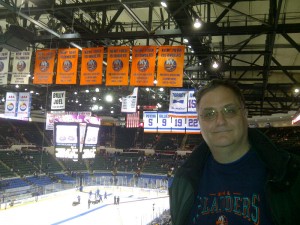 A loyal Islanders dabbler makes one last pilgrimage. True. Over the years, I’ve become reluctant to identify myself as “an Islanders fan” or “a Nets fan” or “a Giants fan,” no matter that those are my favorite franchises in their given endeavors, because I call myself a Mets fan and I know what goes into that. Let’s just say I’m a Mets fan who likes those teams, too, mostly on television. 2014 was the first year I was fortunate enough to see all of them in their respective buildings. When cheering for the Nets at Barclays Center, the Giants at MetLife Stadium and the Islanders at Nassau Coliseum, I was legitimately part of the “we,” but still felt like a bit of a guest. These are other people’s habitats and I consciously respected their folkways. At Citi Field, despite its insistence on not being Shea Stadium, I’m in my habitat. I have my own ways.
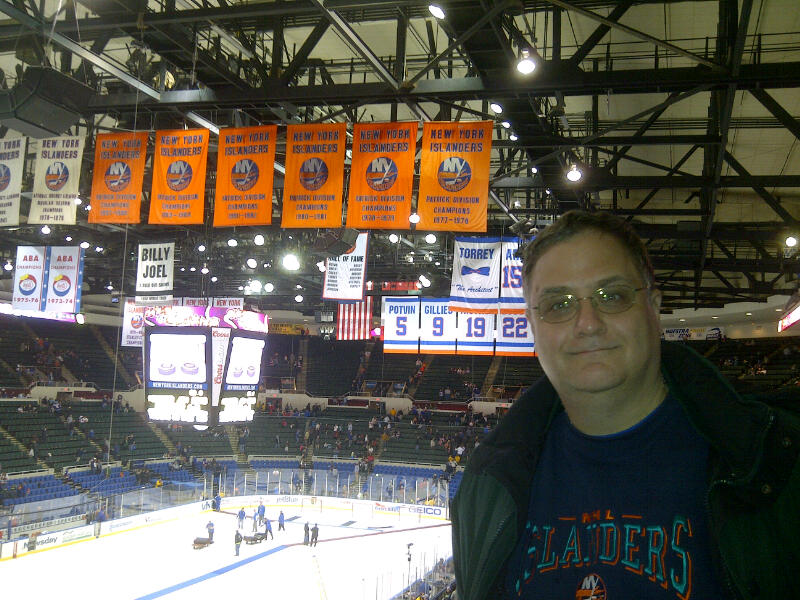
When my second and Stephanie’s first Islanders game was over, we took our time departing 309. We snapped a few pictures, soaked in all the championship banners, then regained our bearings and visited the team store. We were intentionally pokey partly to let the arena and the lot clear out and partly because I wasn’t in the mood to abruptly sever my relationship with either the cheerful afternoon or the allegedly old barn. Though I briefly envisioned constructing a winter in which I garnered the confidence to make the four-mile trek on a few non-rainy weeknights — because, y’know, I’m so into the Islanders — I knew I wouldn’t. I knew this would be it. A year from now, the team will be situated two counties west in a facility that I find promising for basketball but was by no means designed for hockey (though I can’t complain about its accessibility by train). The building we were in, the only one the team and its community have ever known, will attempt to schedule other attractions once the skates and sticks are loaded up and shipped to Brooklyn. Maybe we’ll come back for Ice Capades. Probably not.
The diehards who filled the amenity-deprived joint on this Saturday afternoon and have filed into it in fluctuating numbers but with bedrock passion since 1972 will be left to wonder what the hell was wrong with the way it had been. Fans of the New York Islanders — even those of us on the veritable fourth line of engagement — had just done what fans at a game are supposed to do. We were into it. Unlike my 2014 experience with the Giants and the Nets and the Mets, there wasn’t a lot of getting up and walking around and fiddling with phones. There was nowhere to walk around to. When you’re voluntarily in the middle of nowhere, you don’t really miss what isn’t there. The pedestrian traffic defies regulation and the bathroom capacities are counterintuitive considering the presence of a beverage-consuming public, yet not once in sixty minutes plus two intermissions did I think it would sure be great to be distracted by something else while I’m here. There was hockey. That’s what you paid for. That, and maybe a Bobby Nystrom mini-locker if you paid a little extra, is what you got.
It was a good deal.
A DO-OVER ADIEU
Hello Again, Goodbye Again, 653 (1962-1991)
I went home again in August. Screw you, Thomas Wolfe.
This was a one-shot, a one-off, a make-good, you might say. This was home in both the spiritual and physical sense, but it’s not where I live. Not now.
This was 653 — not to be confused with .653, which was Chris Young’s OPS at one point in late May. This 653 was the number on the door of the house I grew up in. I’ve had no legal entry to 653 since 1991, when my father sold it. I didn’t live there anymore and he didn’t want to live there anymore. It wasn’t in the family anymore.
So why would I be inside it?
I still spent a lot of time there in my dreams. I don’t mean I wistfully wished to while away my days at 653 on the East End of good old Long Beach. I mean whenever I had a dream that involved “home,” it almost invariably played out there. I assume that’s a common phenomenon. Your subconscious doesn’t necessarily receive change-of-address cards. Home doesn’t stop being home. Or so I’ve dreamed.
In my waking hours, 653 was consigned comfortably to the past from 1991 until 2012 when I consciously decided I kinda wanted back in one more time. 2012 was the summer I decided to get all sentimental journeyish about turning 50 and I went back to my hometown and my home street. I walked by once or twice or thrice on a sunny Sunday afternoon while listening to the Mets and Astros play their final National League game. I was like my friend from high school who used to drive by the house of this girl he liked. He wasn’t a stalker, but he acted like one. Like him, I don’t know what I would’ve done had the light been on and somebody stepped outside to issue an invitation in. In his case, the girl was a girl. In my case, the girl was a house.
I acted like a stalker toward 653 in the summer of 2012. I acted like a concerned stalker a few months later, after Sandy. I had to see if she…it was all right. It looked OK. I drove by it on a weekday afternoon. I don’t think anybody was home.
This past August, I found myself in Long Beach for what’s become something of an annual tradition. In 2012, I strolled the boardwalk and stalked the house. In 2013, I inspected the section of the boardwalk that had been rebuilt post-superstorm and stalked the house, though only fleetingly. In 2014, this time with that very same aforementioned friend from high school (who I’m pretty sure has stopped looking for that girl), I casually continued my quest.
Casually, as in we decided it would be nice to get together for brunch and catch up one Saturday morning that became a Saturday afternoon (because neither of us is a morning person) and it was plenty nice. He picked me up and we drove to the Laurel Luncheonette, one of the true culinary icons of Long Beach. I don’t know the last time we ate at the Laurel before that Saturday. It looked sort of different, it smelled exactly the same, it tasted great. We tasted enough so that we needed a full-on boardwalk stroll afterwards.
This year’s boardwalk was the completed version of the in-progress model from 2013. Sandy tore it apart. Our federal tax dollars (mostly) put it back together. In August of 2014, I considered it a fine investment. Like the Laurel, it’s not quite what it was but it’s essentially as good.
We strolled and we caught up and we reached the end of the boardwalk, a long nine blocks east. Our next stop was going to be my friend’s house, where his mother still lived, but since we were in the neighborhood — 653 isn’t far from the boardwalk’s eastern terminus — I said how about we make a little detour to “my house”?
I was stalking again. And this time a figurative light was on. That is to say that for the first time since 1991, I saw somebody sitting on the porch at 653. It wasn’t anybody related to me, but it wasn’t an apparition, either. It was a woman who by all indications lived where I used to live.
Now was my turn to be a Becker…and wouldn’t you like to be a Becker, too? The Beckers, you see, were the family who preceded us at 653. For years we received their junk mail. One time we received a couple of Beckers, maybe just passing through Long Beach, maybe on their own sentimental journey. I don’t remember the details. I just remember people showed up at our door explaining they used to live here, can we come in and have a look around? We were a suspicious bunch, but we said sure. We even did the same for the people who preceded the Beckers, people we wouldn’t have known from a hole in the head. Ever since 1991 and the abbreviated, dissatisfying goodbye I said to 653 — my father was selling because my mother had died the year before and nobody was in the mood to linger one sentimental second longer — I intermittently imagined a Becker moment for myself. It wasn’t really a thing for me until 2012. Not having it happen meant I kept thinking about it and kept dreaming about the house…the house that now had a person on the porch.
Here it was. My innate shyness didn’t stand a chance. This was no time for reticence or fear of rejection. This was 653 and a woman who could let me in so I could have the moment with it I didn’t get 23 years earlier.
“Excuse me,” I said after climbing the stairs. “I know this is going to sound strange, but I grew up in this house and…”
“You’re Prince?” she asked sans surprise, as if she’d been expecting me.
So it wasn’t strange. It wasn’t strange at all. Once a 653er, maybe always a 653er. Not only had Prince returned home, but I learned that somewhere between 1991 and 2014, an actual Becker had made one more sojourn. Home wheedles its way into everybody’s subconscious, I guess. Or maybe it was something in the pipes that affected the water we all drank. It didn’t matter. I didn’t have to produce any ID or scoot to my current digs to dig out an old report card. She took my word that I was a full-fledged member of Club 653.
“Do you want to come inside?”
And there I was. Me and my friend, who’d been in the house plenty when we were young but getting inexorably older. He made small talk with the woman. I searched for clues.
Was this really the house that wouldn’t leave my dreams? That I didn’t leave for good until I was 27? That left me when I was 28? The house where I witnessed two World Series being won and who knows how many mundane games being lost? Was this still home or is that sort of thinking nonsense? Would 653 recognize me?
The outside, which I had observed on my periodic walk ‘n’ stalks, had been spiffed up but there was no mistaking it was 653. The inside…that was a different story. This family, the very same one to whom my father sold, had been there a long time. They made their own choices. Lots of choices. Much was different.
It had to be. My mother, the self-styled interior decorator, had her own tastes. They weren’t for everybody. I doubt they were for anybody. I could tell they hadn’t been for these people. I could tell because the woman who let us in more or less said so. She laughed at the memory of the pink cabinets in the kitchen. That was my mother’s call, to match the pink fridge when she went on a painting binge. Little pink cabinets for you and me, apparently, but not for 653’s occupants after 1991.
The kitchen’s tones were more muted and its appliances more modern. Walls had been taken down. Space had been opened up. The living room and dining room were no longer separate entities. The room in the back we occasionally labeled “the den” but was just where all the junk got piled now operated as an actual den.
My friend and I were steered away from the upstairs, site of my room, which seemed appropriate. When the pre-Beckers visited us in the vicinity of 1977, we gave them the full tour. They remembered everything. When they got to my room, they drew a total blank. And now I couldn’t see it. Maybe it never existed except for me. Maybe my childhood, adolescence and deliberately developing adulthood were all figments of my imagination.
We were, however, offered the run of the basement, an area that never fully reached its potential in my day. The woman’s husband was down there, using the space that connected the garage to everything else as an office. I guess they solved the exhaust fumes problem. My friend asked about damage from Sandy (it’s the Long Beach equivalent of “what did you do in the war, Daddy?”). While they compared notes on what was bad and what could’ve been worse, I excused myself to use the basement bathroom. I didn’t need directions. I liked that I knew where things were even if they looked a lot better and therefore not as good in my eyes.
Only the seasoned visitor would feel out what were the constants. A door frame here, a stained glass window there, the cherry blossom tree that had been planted in the backyard when I was a kid and now seemed to expand upward and outward like the Astrodome. The most shocking constant was a rotary phone on the basement wall. It sat down there for 29 years unused in our day. It could have been mistaken for a prop from the Universal Studios tour. These clever people not only kept it but activated it. Go ahead, the woman said, pick up the receiver. There was a dial tone.
Our house was a big house by most standards, but even with three stories and a passel of rooms, it felt small in 2014. I suppose the house you grew up in is supposed to feel smaller when you’re in your fifties, but the more I stood there, the more I felt that if I took one more step, I might crush half a dollhouse. Perhaps 653’s mystique was receding. It still pops into my dreams now and then but not as frequently and usually in a less haunting manner.
When I said my 1991 goodbye to 653, the place was empty in advance of the closing. Dad was already moved out. Those pink cabinets had lost their shine. For the 2014 reunion, the house was simmering. People lived there. People were doing things. The current owners said something about maybe selling in a couple of years and moving down south before another superstorm hits — they had to replace the basement floors and don’t want to go through it again. For the time being, though, they were reassuringly entrenched. I don’t know if 653 recognized me, but it didn’t give me the cold shoulder it inadvertently showed me in 1991.
After saying thank you to these gracious folks and walking away, I was sated by a sense of closure or coda or simple yet overwhelming peace. Only Shea Stadium can challenge 653 for Most Mythic Structure in my backstory. It took me several years to realize I was, at least on a functional basis, over Shea’s demise. I still miss it, but I’ve accepted (grudgingly) that it will never again materialize as the Flushing-bound 7 express hums past 111th Street. Plus I had a genuine opportunity to kiss Shea goodbye in 2008. 653, on the other hand, was the place I didn’t realize how much I missed, not for living, but for leaving. I needed to leave — to say goodbye — on something approaching my own terms.
Delayed but definitive accord in this realm has been reached. My subconscious and I stalk no longer.
by Greg Prince on 26 December 2014 8:11 am If you didn’t get baseball for Christmas or Chanukah or any other occasion of late, don’t fret. It’s coming. And if you don’t mind extending your countdown a bit past 11:59:59 on New Year’s Eve, it’s coming that much sooner.
On the afternoon of January 1, at precisely (more or less) 3:59 PM EST, we will have arrived at the Baseball Equinox. That is the moment when we stand smack between the final out of the last Mets season and the first scheduled pitch of the next Mets season. Once we get to 4 in the afternoon this coming Thursday, we will officially be closer to playing ball in 2015 than we are to having had played ball in 2014. The coordinates are subject to change if television, precipitation or ceremonial hoo-ha gets in the way, but you can use 3:59 on New Year’s Day afternoon as your spiritual guide.
Pending a shootout, the Chicago Blackhawks and Washington Capitals should be done with their NHL Winter Classic (which, like Opening Day, will transpire at Nationals Park) and the Buffalo Wild Wings Citrus Bowl pitting the Missouri Tigers against the Golden Gophers of the University of Minnesota will be winding down. Should you be watching either of those contests or engrossed in SyFy’s Twilight Zone marathon or, y’know, just hangin’ out, maybe think to look at your watch or your phone or the shadow on the floor. As the clock strikes four, you’ll know you have made it more than halfway through what we as baseball fans know annually as the longest winter eever.
Kind of gives you a reason to live, eh?
And what better way to get through the second half of winter than a trip to the Queens Baseball Convention on Saturday, January 10, at Citi Field McFadden’s? Details here.
by Greg Prince on 20 December 2014 2:31 pm If you’re the type of Mets fan to read a blog about the Mets in a month when the Mets aren’t playing, then you’re the type of Mets fan who should be attending an enormous Mets event in the next month the Mets aren’t playing.
The Queens Baseball Convention is coming to McFadden’s Citi Field on Saturday, January 10. QBC 15 promises to build on the joy and fun that made QBC 14 such a fantastic baseball oasis in the midst of winter.
Mookie Wilson will be there. Wally Backman will be there. Jason Fry will be there. I’ll be there. So many others will be there. You can check out the whole schedule here.
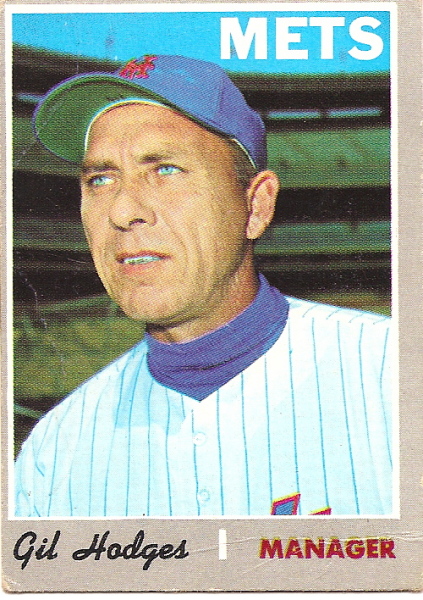
I’m particularly proud that for this second QBC we will again be presenting the Gil Hodges Unforgettable Fire Award, a gesture conceived as a way to a) keep Gil’s name and memory blazing for all Mets fans to see and b) honor a Met who, when we think of him, warms our hearts, brightens our spirits and lights our way — just like the thought of Gil Hodges still does.
Last year, upon dedicating the award, we presented it to Gil’s family as our way of saying we, as Mets fans, are forever proud of what he means to our team. This year, we are thrilled to be able to present it to one of the players Gil managed to a world championship, someone who personifies the parameters of the prize.
Graciously joining us at QBC to accept the Gil Hodges Unforgettable Fire Award will be Ed Charles. You may know him as the Glider or the Poet Laureate of Baseball or the Elder Statesman of the 1969 Mets. We know him as someone who crafted a baseball life like no other, dating from his childhood in segregated Florida when he was inspired by the sight of Jackie Robinson in Spring Training (a story portrayed in the movie 42) and winding through an unfairly long minor league apprenticeship. It took a decade for Ed Charles to reach the majors, but once he made it, as a Kansas City Athletic — debuting the very same day the Mets franchise did — it was clear he belonged.
A trade to the Mets in 1967 made him a New Yorker. His presence as a savvy veteran on a team comprised mostly of youngsters proved enormous in developing the team that would become forever known as the Miracle Mets. It is telling, perhaps, that in the famous photo snapped after the final out of the 1969 World Series we see rushing onto the scene to join pitcher Jerry Koosman and catcher Jerry Grote in full embrace is the third baseman.
Ed Charles wasn’t gliding that day.
Winning a world championship marked both the high point and the end point of Ed’s active career. He pursued other vocations over the next several decades — most notably working with New York City youth who could benefit from his help — but he never fully departed baseball. Ed scouted for the Mets, coached fantasy campers (who uniformly express delight remembering their interaction with him), became a welcome guest every time he showed up at Shea Stadium and Citi Field and lent his poetry to numerous commemorative and celebratory occasions.
In short, Ed Charles has been a tremendous gift to baseball and to Mets fans. We are humbled to have the chance to recognize him with the Gil Hodges Unforgettable Fire Award.
I hope you’ll be there with us at the Queens Baseball Convention to give him the greeting he deserves. Plus the joy and fun you’ll have on January 10. Find out more about attending here.
by Greg Prince on 19 December 2014 1:37 pm On this date in 1982, there was approximately zero-percent chance that the Mets would soon call Keith Hernandez their first baseman. On this same date in 1997, it was maybe less likely (if that’s statistically possible) that Mike Piazza was five months and change from becoming the Mets’ catcher.
But both deals happened and twice this franchise of ours was transformed.
As currently floated by an in-the-know baseball writer or two, the chances of the Mets acquiring Troy Tulowitzki lies somewhere between five and ten percent. So if you believe the laying of odds based on what somebody’s source says to some reporter who may or may not know something’s up, well, meet me at the top of the National League East standings sometime this summer.
It’s probably saner to stay situated in the “nobody knows anything” camp, but what fun is that? At the very least, it’s plausible that the Mets and Rockies have discussed a deal that would bring Tulo, the best all-around shortstop in baseball when healthy, to Citi Field in the right kind of uniform. The Rockies have a contract they’d like to move and the Mets have a hole they’d like to fill. If they’re not talking to one another, there’s massive negligence going on in two time zones.
Is any of this serious? Even if you generously interpret every report you’ve lapped up this morning, you can find, at most, a glint of light that indicates that maybe, if everything and more happens, this has a shadow of a shot in hell of transpiring.
Sounds good to me. If it does happen, then hallelujah, we have — best-case scenario — an amazing upgrade at short, a lineup that can produce steady streams of runs and enough pitching no matter what needs to be sent to Colorado in exchange. If it doesn’t, then except for a few dashed hot stove hopes, we’re back where we started, with Wilmer Flores, who has yet to prove he’s a terrible alternative. Also we keep however many promising young arms we didn’t hypothetically trade, we don’t take on the dollar commitment that might not be onerous to another team’s payroll but apparently is to our team’s, and we don’t have to worry about Tulowitzki staking out a cozy spot on the several-year disabled list.
All this chatter is win-win in a December when the most scintillating development in Metsopotamia to date has been Jeurys Familia donning an elf costume (and that includes the acquisition of John Mayberry). It’s a classic baseball dilemma in theory: Great player joins team that seems ready to rise versus injury risk, financial commitment and unproven talent that may haunt you later. Thing is it’s only theory. It’s five percent, maybe ten, maybe nothing at all.
Would I do it? Maybe. Maybe not. I don’t get to do it, so what’s the difference?
But I sure was happy when we got Hernandez and Piazza within six months of never imagining we might.
by Greg Prince on 18 December 2014 8:47 pm Children’s voices blended into an angelic choir. Or as angelic as it gets in Queens. Oh, how they caroled. “It’s the most wonderful time of the year,” they sang as one. They did so inside a ballpark, inside December.
Heresy! Sacrilege! What are they teaching these kids at PS 19, PS 57, PS 89, PS 140, PS 143 and PS 330?!
If it can’t be baseball season, then, yeah, sure, whatever, the second-most wonderful time of the year can be nine days before Christmas. Or nine days after Christmas. Like it matters if there’s no game on. But let us be clear, New York Mets who on Tuesday graciously hosted all those youngsters from all those elementary schools: the most wonderful time of the year commences April 6 and concludes October 4. Or preferably a few weeks later.
Don’t muck up your own script by encouraging confusion as to when the most wonderful time of the year is. You were giving out Christmas presents, but you should always be selling baseball.
 “No, little girl, there’s no shortstop in there. Now quit asking.” The most wonderful time of the year is still a ways off, so if you have to do something with the space between, doing it at Citi Field — while two Mets dress as something other than Mets and bring non-denominational joy to the local chapter of the Youth of America — is as good a way of doing it as there is. I was doing it this past Tuesday, as I have at the Mets’ invitation every December for five Decembers suddenly. Technically, I was covering it. Mostly, I was taking it in.
You couldn’t ignore “The Most Wonderful Time of the Year,” the holiday classic made famous by Andy Williams and belted out by one group of PSers or another. They were loud enough to drown out all conversation. Conversely, Sandy Alderson, conversing with reporters, spoke softly about the Mets’ disinterest in pursuing another big stick. The logistics and acoustics were a bit of a hurdle for your correspondent, who was leaning in from the edge of a media scrum better suited to gather within the most austere of monasteries. “Parties for hosting/marshmallows for toasting,” are all well and good, but does it have to be so loud?
In less festive terms, pipe down, joyous tykes — I’m on the other side of the curtain from where you are, I’m wearing a media credential for a short spell and I’m really trying to hear what Sandy’s saying.
That makes me different from many Mets fans who are probably not trying to hear what the GM is telling them about having pretty much wrapped up his wintertime shopping. He was letting it be known that no other shortstops — American, Korean, Coloradoan — remain on the Metropolitan must-have list, that the job belongs to Wilmer Flores unless some Grinch steals it away from him. And based on current inventory, the Grinch would named Ruben Tejada.
Word of this unsurprising pronouncement zipped around the world so quickly that even the seasoned beat reporters covering every cadence of Sandy’s chat had moved on. Their interview subject was talking low-budget lefties for the to-be-determined portion of the bullpen and they were scrolling through their phones. Maybe another general manager somewhere else was telling another cluster of microphones and cameras something more earth-shattering. GMs from San Diego, Tampa Bay and Washington were likely communicating among each other at that hour, though they’d wait a little while to let the rest of us in on their doings.
After a fashion, the kids out in the Acela Club quit caroling, the media huddle dispersed and I found myself standing next to Alderson just long enough to ask a big-picture question that maybe he hadn’t been asked lately. (Some years the blogging corps gets its own audience, some years you grab what you can get.) What, I wondered aloud, has changed about your job in the four years since you took office?
The “approach” is different, he told me. With the Mets “close” to contending, putting the finishing touches on the big league club is more of a priority than securing prospects and building the minor league system, which is where his efforts were concentrated during the first few seasons. “Not to say it wasn’t before,” he added, but nowadays there’s “more of a short-term perspective” at play. I followed up with a question regarding what, if any, has changed about his own assumptions or perceptions since becoming GM. He thinks the front office, as a group, “works better together now” than it did when he returned to day-to-day baseball operations.
One of my fellow bloggers asked if anything in particular impressed him about the goings-on at the Winter Meetings. Alderson was surprised at how active the White Sox had been and was taken by the number of deals the Dodgers made. I also wrote down that he said “pitching dominates in a short series,” which could be interpreted as an acknowledgement of Madison Bumgarner’s postseason or an implication that the Mets are well-equipped to handle a month of high-pressure short series, assuming they get there…which he and everybody else with the Mets seem to believe they might. The operative word I’ve heard over and over since September is “close”.
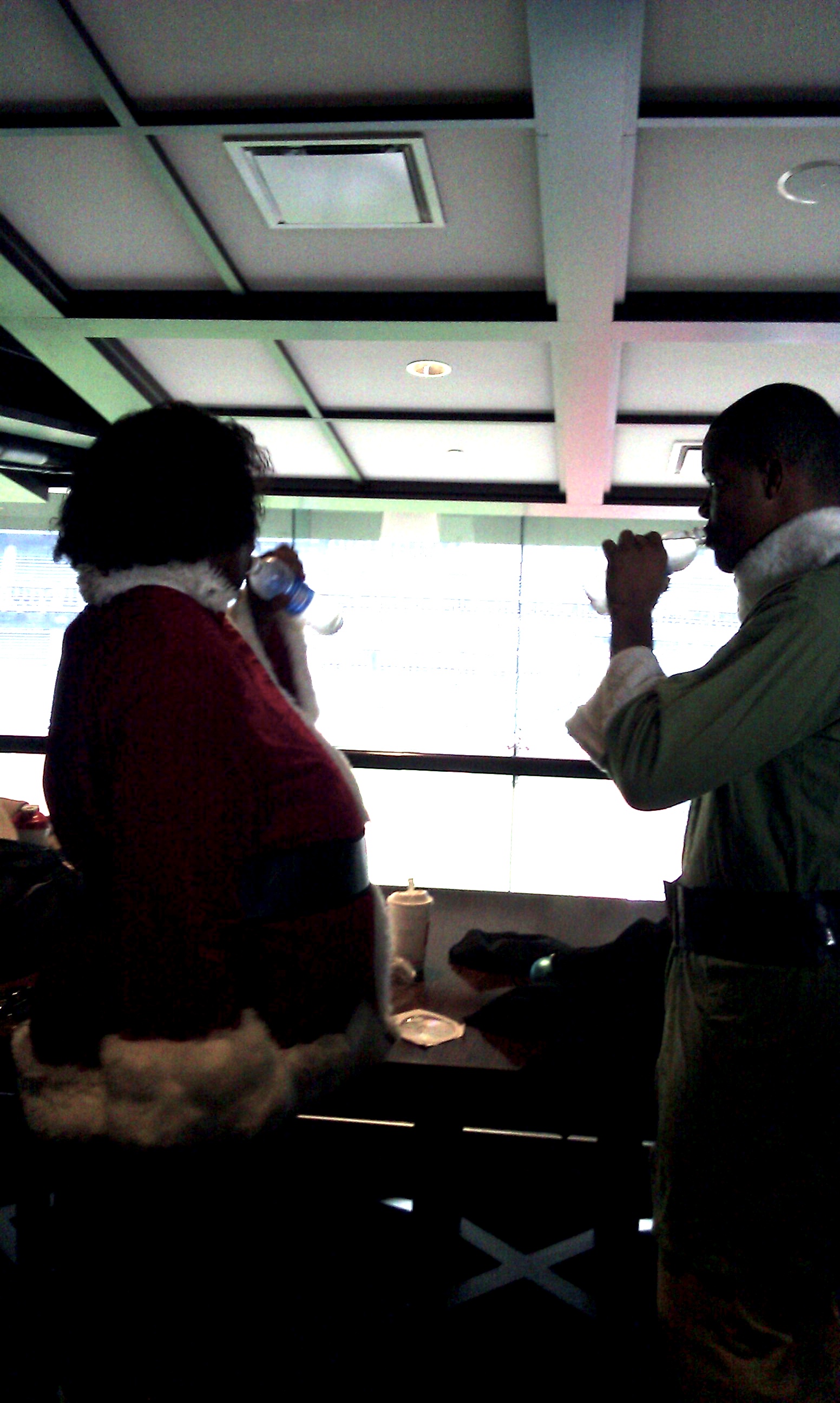
Except the season isn’t close, so after Alderson excused himself and while the kids giddily accepted gifts from Jenrry Mejia as Santa Claus and Jeurys Familia as Buddy the Elf, I occupied myself by staring out an Acela window and taking in the sight of the newly moved-in fence in right-center. That, like the Mets’ image of themselves, is close. If Curtis Granderson can’t hit 30 homers over that, something’s terribly wrong with geometry. Talk about a gift. Make sure visiting National sluggers know it’s not for them.
I hope the children all became Mets fans because of Mejia and Familia and the toys and games and lunch and singing and, of course, Mr. Met. I hope the children were already Mets fans when they arrived at Citi Field and weren’t faking it when they obliged the MC who drove them into a “LET’S GO METS!” chanting frenzy, but I saw only one kid who thought to wear a Mets cap to the party. It had the 50th anniversary logo patch on the back, implying that kid’s been a fan for at least three seasons of his young life. I hope he got the biggest kick of all out of anybody there, though I also hope he shared my skepticism about what passes, out of season, for the most wonderful time of the year.
Me and that kid, we know better.
My esteem for Familia, reasonably high based on his 2014 output, shot up exponentially because of the holiday gala. Or elfponentially. Usually “Santa’s helpers” at these things are players who wear their jerseys and a Santa hat. That’s how Carlos Beltran did it. Can you imagine Beltran going the Full Elf? Who would imagine such things anyway? But Jeurys did it.
Jenrry as Santa, on the other hand, was a little disconcerting. Not from the suit (splendid) or the demeanor (appropriate), but from the bulk he had to temporarily add to pull the whole look off. One Bartolo Colon on staff is enough. If you didn’t know it was an overstuffed ensemble, you’d be making Mejia an appointment with that new strength and conditioning coach the Mets hired. Especially for the conditioning part.
When the setup man and the closer who combined to give away fewer leads than the number (tons) to which we were accustomed presented the last of their presents, they came back behind the curtain to take questions, still dressed as Santa Claus and Buddy the Elf. I’m sorry they didn’t stay in character.
“How’s your slider coming along?”
“Why, you mean my sleigh, right little boy? Ho ho ho, here’s a Wiffle Ball!”
Nah, they didn’t do that. It was another crush of cameras and mics and mundane inquiries about how well they were recovering from their hernia surgeries, except they were being asked of men dressed in crushed red velvet and key lime green. I found myself on the fringe of this crowd, too, but I did clearly hear Jenrry say something about his two-seamer and his four-seamer. That’s better music for the Mets fan’s ear in December than anything Andy Williams ever recorded. I also caught an all-purpose “whatever job they give me, I have to be prepared” out of Santa. I guess “if Parnell tries to take my role away, he’s the one getting his skinny ass shoved down a chimney” wouldn’t have been in keeping with the spirit of the season.
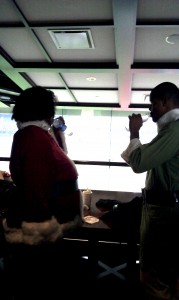 It’s as good to give as it is to relieve, but either way, Mejia and Familia could use some hydration. Harvey would have said something of that nature, but he wasn’t at the party. I assume he was down in the bowels of the stadium striking out three Bryce Harper mannequins.
Eventually, the English-language press gave way to the Spanish-language press. Mejia speaks faster in Spanish (who doesn’t?). The recorded Christmas music ceased. The students of the PSes were on their buses, headed back to class, all of them having had the best morning of the current semester. The beat writers, many of them appearing not much older than the students favored with goodies by Mejia and Familia, were on their laptops, transmitting the depth and breadth of what had happened here today, which, honestly, wasn’t much, but it was the semblance of baseball in winter, and who wouldn’t want to fill a stocking with that?
Given the roles the pitchers in costume played when there was a game every day or night, it didn’t seem right that we weren’t up to the eighth or ninth inning of the offseason already. We’ve not even arrived at the Baseball Equinox yet. But it’s coming. I know it is. Just not soon enough.
When I exited through the Stengel entrance, the security guard on duty gave me a broad smile and a cheery holiday greeting. I returned the same, with an addendum that the next time we’d see each other, it would be April. Our smiles broadened even more.
Yes. April. The most wonderful time of the year.
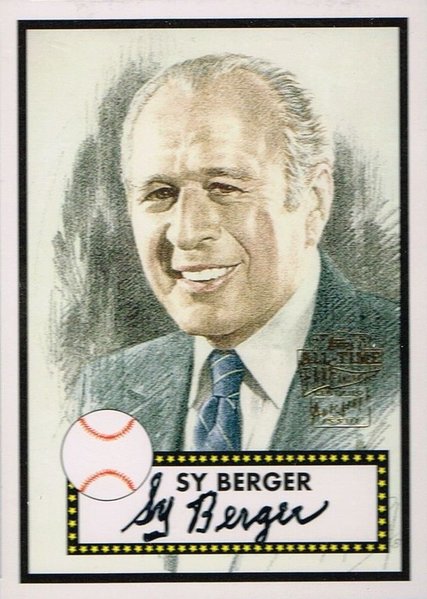
by Jason Fry on 14 December 2014 6:07 pm Sad news out of Long Island: Sy Berger, the father of modern baseball cards, died today at 91.
Berger didn’t invent baseball cards — they date back to 19th-century “trade cards” and were first popularized by cigarette companies. But Berger made them the empire they became. In 1947 he started working as a marketer at Brooklyn-based Topps, which had been co-founded by the father of one of his fraternity brothers. Berger’s first assignment was marketing pop-culture cards for the likes of Davy Crockett, but in 1951 he looked to steal an infant market from rival Bowman with a series of baseball cards.
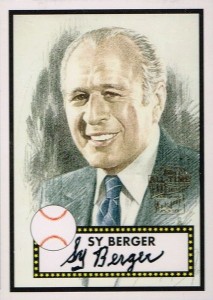 The ’51 cards were a dress rehearsal for what would follow — they were designed to be used playing a mock baseball game, making them more like a forerunner of Magic The Gathering than what we think of as baseball cards, and they came with taffy, which proved excellent at picking up the flavor of the varnish on the cards. (And you thought those square pieces of bubble gum were bad.) But the next year Topps introduced bigger, much better cards — full-color cards with stats on the back, including the now-iconic ’52 Mantle. Nothing would ever be the same — for generations, Topps cards were as much a part of boyhood as toy soldiers and bikes and other kid pastimes. (Berger was a sharp businessman, too — a showdown over photo fees for players was one of the union’s first attempts at finding its footing. The union’s insistence on better terms was a dry run for its ultimately successful attempt to force economic change on a sport that was still run like a medieval barony.) The ’51 cards were a dress rehearsal for what would follow — they were designed to be used playing a mock baseball game, making them more like a forerunner of Magic The Gathering than what we think of as baseball cards, and they came with taffy, which proved excellent at picking up the flavor of the varnish on the cards. (And you thought those square pieces of bubble gum were bad.) But the next year Topps introduced bigger, much better cards — full-color cards with stats on the back, including the now-iconic ’52 Mantle. Nothing would ever be the same — for generations, Topps cards were as much a part of boyhood as toy soldiers and bikes and other kid pastimes. (Berger was a sharp businessman, too — a showdown over photo fees for players was one of the union’s first attempts at finding its footing. The union’s insistence on better terms was a dry run for its ultimately successful attempt to force economic change on a sport that was still run like a medieval barony.)
I discovered the world Berger created in 1976, when I was seven. I’d grown up in a Mets household, but it wasn’t my mother leaping up and down and cheering for Rusty Staub that made me a fan forevermore. (Though that was a good start.) It was really Topps baseball cards, which in the summer of 1976 suddenly and irrevocably replaced dinosaurs as my principal boyhood obsession. For me, each of those Topps cards was a little window into baseball history — you could trace careers through the stats and the bulleted highlights on the back, and piece together an education about the sport from the little cartoon facts chosen by Topps writers.
Here’s what I learned from Topps’ twenty-six 1976 Met cards (plus one team card, a four-panel rookie and a record-breaker) — cards that came, oddly, on yellow and blue cards that would have been more suited for a collector of all things related to the University of Michigan:
- Connie Mack managed the Philadelphia A’s for half a century
- The Boston Braves played their home games in the 1914 World Series at Fenway Park
- Wayne Garrett, despite being a member of the Miracle Mets, apparently hadn’t been very good in 1969
- Jerry Grote had 20 put-outs in a game, specifically on April 22, 1970
- Bud Harrelson was from Niles, Calif., which I pictured as a wildly exotic place
- Jerry Koosman was undefeated in postseason play — 3-0 in the playoffs and 3-0 in the World Series
- Ed Kranepool had somehow hit 16 homers in 1966
- Christy Mathewson threw three shutouts in the 1905 World Series
- Jon Matlack was extremely handsome
- Felix Millan held his bat in a very strange fashion … but had set the Mets’ mark for hits in 1975
- Ken Sanders had been the AL Fireman of the Year in 1971, leading me to expect great things from him
- Rusty Staub had started his career with the Colt .45’s, who no longer seemed to exist
- Wes Westrum caught six foul pop-ups in one game on Aug. 24, 1949
- Craig Swan seemed to do well when he pitched for TIDEWATER, but not so well pitching for METS
- Joe Torre was odd-looking and seemed to like hanging out in the shadows near accumulated helmets
- Del Unser was the son of Al Unser, who’d been a catcher for the Tigers and Reds
- Mike Vail had led the mysterious IL in batting in 1975 and hit safely in 23 straight games for the Mets
- Joe Sewell of Cleveland had fanned just four times in 608 at-bats back in 1925
And that was just one team’s cards. I spent hours with my ’76 cards, piecing together the beginnings of a baseball education and the foundation of a lifelong love of the sport. How long did I spend? Well, a couple of weeks ago, on an insomniac whim, I Google-searched for photos of ’76 team sets and was able to identify at a glance which cards I’d never found during that summer 38 years ago.
From there, I submerged myself in the Baseball Encyclopedia, reading accounts of baseball history and scouring lists of league leaders and just browsing through the statistics of players, stopping to review careers that seemed particularly long or tragically short or otherwise noteworthy. (And how amazing was it that Hank Aaron somehow came first?) I haunted the library, checking out and devouring every baseball book I could find. (Like Greg, one of my favorites was Tug McGraw’s mildly deranged autobiography Screwball.) But my education began with Topps baseball cards, with seeing that Jesus Alou had played for a long time, and wondering what it was like to play for Marion or Visalia or the mysterious Pomp. Bch, and noting that players were drafted.
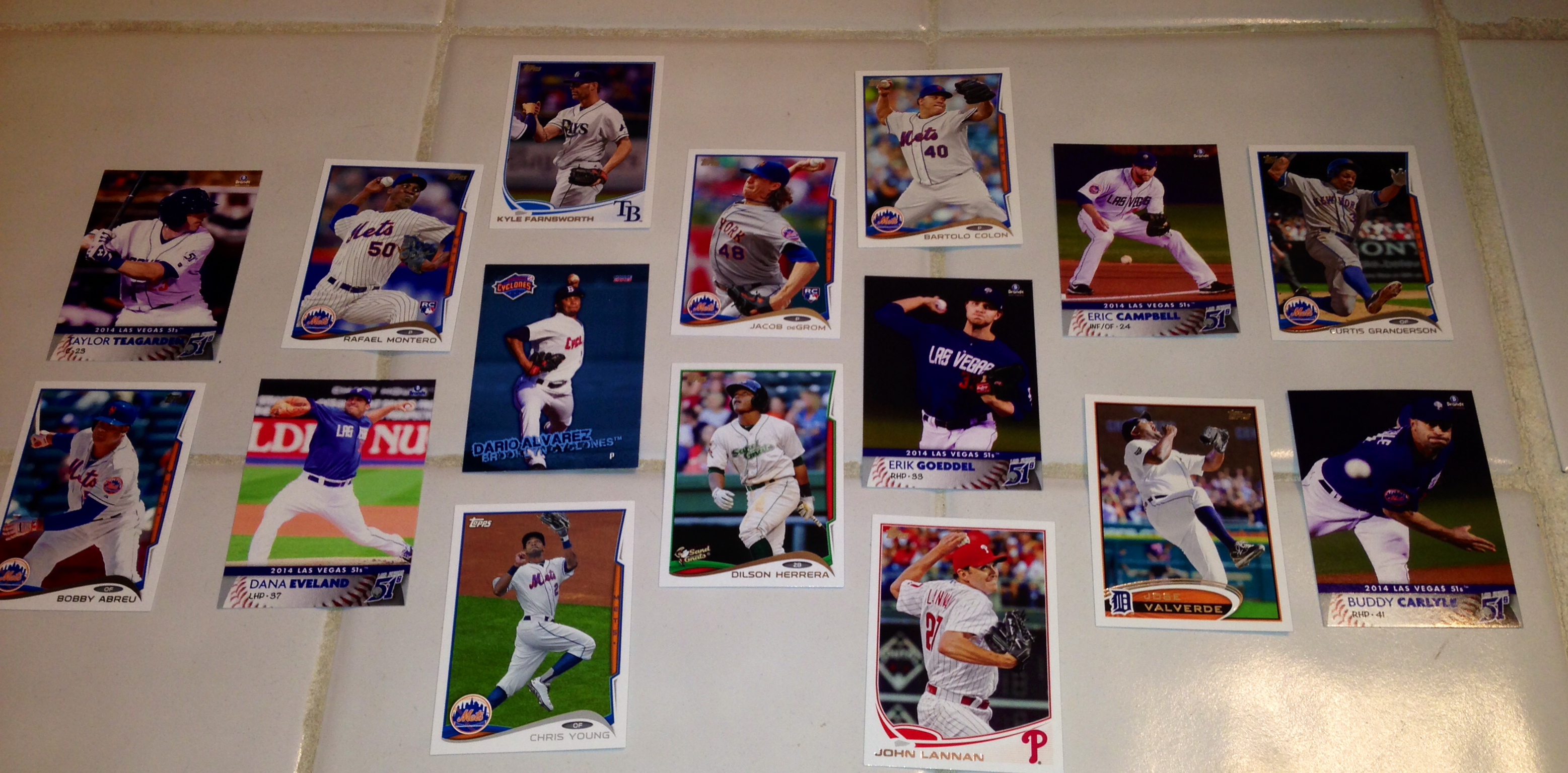
I stopped collecting baseball cards for a while after the strike, started up again as an adult in strange circumstances, and now collect what I want to collect — which invariably includes both regular Topps series and the update set. I own every Topps Mets card, and every Topps card of everybody who ever played for the Mets (with a few reprints in the mix), and have a trio of binders called The Holy Books that include cards for every Met in team history, in order of their arrival. But that’s not all. I’ve made cards for cup-of-coffee guys who never got a card even as a minor leaguer, and bought unused photos of players from Topps’s Vault eBay auctions. There’s something faintly magical about seeing a photo from the mid-1960s of an obscure Met and imagining it as a ’66 or ’67 Topps card — the photos have a certain saturated glow that identify them instantly and obviously as the work of a Topps photographer, in the same way that art historians can immediately spot, say, a Titian or a Veronese.
And Topps cards remain a happy part of my life. In the offseason, I like to scratch my Mets itch by browsing through The Holy Books, getting reacquainted with the immortals and the forgotten alike. I just did some THB upgrading via eBay, getting an Al Luplow in which he’s actually wearing a Mets uniform and eliminating a Gil Hodges with writing on the front. And I continue to make my own cards for the Lost Mets — somehow, creating a ’72 Rusty Staub or a ’75 Rich Puig feels like you’ve found something that always existed and had been merely lost.
I owe all that passion and knowledge and craziness, ultimately, to Sy Berger. He gave me my first baseball education, followed by literally decades of joy.
by Greg Prince on 12 December 2014 9:02 pm Admittedly, that new Cuddyer smell that so intoxicated our nostrils when the Mets made their loud November move has grown faint. What’s that they say about vehicles losing their value as soon as they leave the dealership? Our new (technically pre-owned) right fielder hasn’t rolled up one additional mile since he pulled into our garage, yet by being one of the first big signings of the offseason and not being paired by a second acquisition of significant size since — John Mayberry, Jr. and Sean Gilmartin notwithstanding — it’s tempting to think the Mets have done nothing.
Does loitering at a busy intersection count? Because if it does, maybe the Mets have lurched forward a bit by just standing here watching the wheels go by. Since Cuddyer came on board, look who’s gone from our general midst:
• Jason Heyward, from Atlanta
• Adam LaRoche, from Washington
• Jimmy Rollins, from Philadelphia
Those divisional deletions don’t solve all the Mets’ problems or necessarily not create new ones, given the way rosters evolve, but let’s hear it for no longer regularly seeing guys who’ve been showing up in our nightmares like clockwork for far too long.
Heyward. LaRoche. Rollins. Will SNY be able to air Post Game Live after losses without them? Heyward taking away base hits; LaRoche adding to the wrong half of the scoreboard; Rollins summoning ghosts. Their signature work accounted for a good chunk of the National League East’s anti-Mets propaganda highlight reel.
The rest of that film features Giancarlo Stanton dooming us from another stratosphere. He’s not going anywhere, at least until Jeffrey Loria twirls his mustache just before revealing his usual nefarious loopholes.
Depending on your rivals to melt around the edges is no surefire way to improve your chances, but if the Mets sought upgrades and couldn’t yet find them, then at least there’s the comforting thought that we’ll have to think less about the guys who’ve been killing us at regular intervals in the preceding seasons. Not that the teams they left behind aren’t capable of unleashing other strains of pest we’ve not yet dreamed of — the Nationals are still the Nationals and never underestimate the Phillies or Braves, even as they retrench — but no more Jimmy Rollins “doing what it takes to win”; no more Jason Heyward “diving and coming up with an unbelievable catch”; no more Adam LaRoche “going deep against Met pitching once again”.
LaRoche is tucked away on the South Side of Chicago. Rollins is a newly minted Los Angeleno. Heyward will still be wearing a distasteful uniform, but we’ll run into him relatively infrequently as a Cardinal. Has the neighborhood grown safer?
I don’t know. Too many Nationals roam the top of the division, the Marlins seem more genuinely dangerous than they have since Miguel Cabrera was young and mobile and it’s impossible to count on the Braves destroying the Braves from within. The winter we got Alomar and Vaughn, they got Sheffield and won the East; the winter we got Martinez and Beltran, they got Hudson and won the East; they’ve lately picked up Shelby Miller and Nick Markakis. Tell me for sure we won’t feel a tomahawk in our back at the hands of Shelby Miller and Nick Markakis. The Phillies, meanwhile, still maintain enough aging Rollins teammates so as to inspire reflexive shudders.
The Mets were getting better when 2014 ended, a season when they had no Harvey, no Syndergaard, no Cuddyer and only a small sample of Flores. They should keep trying to get better ahead of April 6, no doubt. But the part where we don’t have to be exposed to overly familiar nemeses for six series a year apiece…I’m marking that down as the first provisional win of 2015.
People ask me what I do in winter when there’s no baseball. I’ll tell you what I do. I take refuge inside the Mets Lounge with Taryn Cooper and talk Mets baseball with the Coop. Listen to us staring out the window and waiting for spring here, about 25 minutes in.
by Greg Prince on 10 December 2014 11:40 am Up until January 22, 1969, Gil Hodges was not a member of the National Baseball Hall of Fame in pretty much the same way you and I are not members of the National Baseball Hall of Fame. Unlike you and me, however, Hodges had played the requisite ten or more major league seasons to eventually be considered for induction, yet until that particular winter day, the former Dodger and Met first baseman (1943; 1947-1963) hadn’t been retired from playing long enough to have been on a Hall of Fame ballot whose results were known to the public at large.
On January 22, 1969, the results of the first election to consider Hodges were announced. Stan Musial and Roy Campanella were elected. Hodges wasn’t. On that Wednesday, Gil, preparing to commence his second campaign as manager of the Mets, became not a member of the Hall of Fame in a way that was different from you and me.
Over time he would be not a member of the Hall of Fame in a way different from all of us, whether we played baseball for a living or not.
Every January from 1970 through 1983, there’d be a day like January 22, 1969. Hodges would only live long enough to be told on three of those days that the Hall of Fame wouldn’t be inducting him into its ranks. He died just shy of 48 on April 2, 1972. His name remained on every Baseball Writers Association of America ballot for which he was eligible. The last of those such elections had its results announced on January 12, 1983. Brooks Robinson and Juan Marichal were chosen. Hodges, as his family and legion of fans had grown reluctantly accustomed to hearing, wasn’t.
Under the prevailing rules of the period, Hodges would next be eligible for consideration five years later by the 15-man Veterans Committee, a body whose process was less transparent than the BBWAA’s. There was no ballot; discussion and debate centered on whichever “old-time” candidates the committee cared to contemplate, a group that included managers, executives and umpires in addition to players who had not been chosen by the writers. Thus, from the late 1980s to the early 2000s, it would be mentioned on a semi-regular basis that the committee had convened and, in the course of conducting its annual business, opted to not elect Gil Hodges to the Hall of Fame.
By 2002, the Veterans Committee that had failed to elect Hodges since 1988 was disbanded. Systems that promised to be new and improved supplanted those thought to be flawed and insufficient. The bottom line of all these 21st-century transformations and tweaks? Six separate elections during which Gil Hodges was considered for the Hall of Fame and rejected for the Hall of Fame. The most recent of those decisions was announced this past Monday, December 8.
Hodges received 3,010 votes in the 15 BBWAA elections that considered him — the most any single candidate has ever cumulatively received — but never more than 60.1% in a given year, which left him short of the necessary 75%.
In the Veterans Committee votes whose totals were never publicly announced, it has been reported and repeated that he missed out by one vote at the meeting of February 23, 1993, and that the one vote belonged to a dying Campanella. Roy tried to cast it by phone but had it disallowed by influential chairman Ted Williams.
In 2003, the first of the broader post-Williams elections, Hodges received 50 votes — more than any of the 200 players considered. It was still short of the 61 required for election. A similar outcome unfolded in 2005: Hodges and Ron Santo tied for the most votes with 52; 60 were needed to gain induction. Hodges finished in the top three in 2007 and top four in 2008. A smaller electorate was impaneled to determine the class of 2012; he came in third. Only this week, when his vote total for prospective 2015 induction was announced as “three or fewer,” did Hodges not come reasonably close to election.
When viewed through the prism of Baseball Writers elections, old Veterans Committee elections, reconfigured Veterans Committee elections and so-called Golden Era Committee Elections, there have been roughly 35 chances across a 46-year span to confer Hall of Famer status upon Gil Hodges. Those who do the conferring have failed to act in the affirmative 35 times.
On some level, in a manner that almost defies belief, Gil Hodges is not a member of the National Baseball Hall of Fame like nobody else who has ever lived is not a member of the National Baseball Hall of Fame.
Gil Hodges hasn’t hit a home run since July 6, 1962. He has not been to bat since May 5, 1963. He hasn’t managed a ballgame since September 30, 1971. Yet it keeps being decided by those empowered to make such judgments that he is not a Hall of Famer. The Hall of Fame first opened on June 12, 1939; it hadn’t existed thirty years the first time those charged with determining membership denied Hodges. The Hall of Fame has existed that long and more than half as long again since its agents began making recurrently sure Gil Hodges wouldn’t get in.
Their loss.
***
We use the word “election” to describe the function of choosing Hall of Famers. It’s misleading. We have elections to determine who governs us. When those elections do not reach the conclusion we’d like, we’re not disappointed only in theory. The candidate we didn’t prefer doesn’t win, we are convinced there will be negative consequences. Our town or country, we are certain, may suffer. Our interests will conceivably suffer. But at least we had an actual say in how the vote turned out.
The National Baseball Hall of Fame does not request our input. And when our idea of a Hall of Famer doesn’t mesh with those who make those calls, there’s no substantive harm to our way of life. In that sense, it’s less important than the All-Star Game election never mind a congressional election. If we don’t pick wisely in June, our league might lose in July and our theoretical home-field advantage in the World Series would be taken from us. We’d have one fewer game to attend in late October on the off chance we’d have multiple games to attend in late October.
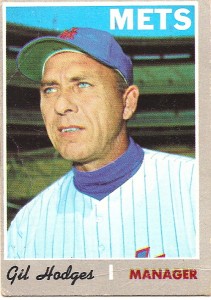 Still beloved. Still respected. Still hailed. My idea of a Hall of Famer is Gil Hodges. It’s always been, ever since I learned a) there was a Hall of Fame and b) Gil Hodges was somebody who was said to be on the verge of being elected or, perhaps more accurately stated, selected. Gil Hodges was the embodiment of Hall of Fame of greatness when I first encountered him through television and radio and newspapers and magazines and statistics and stories. My filter was Metsian, so if you want to factor in bias, feel free. We’re all biased in favor of what we care about deeply.
Kids who grew up in the same approximate era when Hodges was a living, then tragically prematurely deceased legend might not have made Gil their Cooperstown Ideal if they didn’t grow up in the New York area. That’s fair. If you were eight years old in the Twin Cities in 1971, you likely revere batting champ Tony Oliva in that fashion. If your formative baseball experience focused on Maury Wills stealing more bases than anybody had in generations, you can’t be talked out of knowing in your heart of hearts that Maury Wills — or at least his legs — should be sped upstate. Twelve in 1975 and from somewhere in New England? How can Luis Tiant not seem as worthy as anybody who ever pitched? If you were weaned on the White Sox way back when, Minnie Minoso or Billy Pierce or Dick Allen all make Hall of Fame sense to you the way Gil Hodges makes Hall of Fame sense to me.
None of the above was selected by the so-called Golden Era Committee. Not Jim Kaat, Ken Boyer or Bob Howsam, either. Ten candidates, ten honorable and outstanding careers, no dice whatsoever. The whole thing wound up an exercise in Hall of Fame self-congratulation. Look, they said, it’s a tough place to get into…why, we just went through a lengthy and detailed process of letting nobody in!
Should they be running the Hall of Fame to satisfy the inner child in every baseball fan? If they’re not to some extent, then they’re running it badly. There’s a kid I harbor in my heart of hearts. He came to baseball with Gil Hodges as his team’s manager. He saw Gil Hodges take his team to the World Series and win it when that was thought impossible. He saw Gil Hodges run that team for only a couple more years, but remembers the integrity he brought to the game and how he seemed to get the most out of his players. He never forgot the talk of what he did as a Brooklyn Dodger. He looked it up for himself and the facts aligned with the myths. That kid long ago hung a plaque for Gil Hodges. It would be swell if there was another one where more people can see it.
Whether they do or not, mine is never coming down.
***
It’s too late to electioneer — or selectioneer — but it doesn’t hurt to once again go over the basics of why Gil Hodges’s case is made over and over.
• Seven consecutive 100+ RBI seasons
• One of the top sluggers of all-time at the time of his retirement (when he delivered his 370th and final home run, it was more than any National League righthanded batter had ever hit)
• One of the best defensive first basemen ever…a Keith Hernandez quality glove, by all accounts, except it was worn on the hand less inclined to handle the position
• Key on- and off-field role on one of the sport’s most legendary powerhouse teams, contributing mightily to seven Dodger pennants and two Dodger world championships
• Universal admiration and esteem while he played and while he managed — which matters not just in the fine print and on principle but also if you’re going to hold dubious character against the ballplayers who have since statistically surpassed him
• An outstanding leader of a previously pathetic expansion team…in the American League with the mid-’60s Washington Senators
• And, not incidentally, that whole Miracle thing that unfolded on his watch during his aforementioned second campaign as manager of the Mets
As a player, the numbers shone in their time. As a skipper, nobody has been hailed as a guiding force in quite the same awed tones since. As a citizen of baseball and America, as beloved and respected as they came. The past tense isn’t really appropriate here. He’s still beloved. He’s still respected. He’s still hailed.
He just hasn’t been selected is all.
***
Somebody has to bear the burden of being the one who represents the razor’s edge. Here on one side are those few granted membership to the National Baseball Hall of Fame. Here on the other are those who aren’t getting in, which is basically everybody else. Just on the wrong side of admission, incongruously situated amid the mere mortals, stands Gil Hodges, slugger, fielder, leader, man.
We who aren’t getting in — everyone from Jerry Koosman and Cleon Jones to you and me — could do worse for someone to fall in behind.
Hodges deserves to be located among what we on Earth refer to as the immortals. That’s according to but not limited to me; we watched him manage and heard of his playing and, like the team he led, missed him terribly when he was gone. That’s also according to but not limited to me; we examine his qualifications in the context of postmodern framing and continue to find his achievements in the game extraordinary. We know he should be over there, on the other side of the line, alongside Stan the Man and Campy, keeping good company with his contemporaries and his peers.
He’s not, unfortunately. Somebody has to be the one at the front of the line, an arm’s length from the velvet rope. For a son of Indiana coal country; a Marine sergeant on Okinawa; a decorated combatant in six Subway Series; an Original Met battling a bum knee; a brand new manager elevating the stubbornly stagnant Senators; and the steady voice who told the Mets in no uncertain terms that they were ready to get real, it’s a burden easily enough borne.
Even if it’s difficult to accept that 35 times in 46 years he hasn’t been invited in.
***
The last 31 times the Hall of Fame has opted to pass on the chance to enshrine Gil Hodges, it’s been left to his family to absorb the bad news without him, which serves to make the whole ritual that much more distasteful. Starting January 24, 1973, and running through this past Monday, his wife Joan and his son Gil, Jr., have gotten the word whenever whatever body who thought about it makes its decision public. To say of your late husband or late father that “he was and forever is a Hall of Famer” would mean so much to them. You find yourself rooting for posthumous induction because of wonderful it would be for the living. Gil, Jr., however, was able put this latest disappointment in perspective: “I try to impress to my mom that he’s treated like he’s in the Hall of Fame. And that’s what she’s gotta remember.”
In Flushing, the treatment is royal enough so you wouldn’t know he’s not.
The Gil Hodges entrance anchors the first base side of Citi Field.
Gil Hodges’s likeness greets the observant visitor who turns left upon walking into the New York Mets Hall of Fame and Museum; he and George Weiss composed the sophomore class of inductees in 1982.
No. 14 above the left field wall is a 24/7 reminder that Gil managed the 1969 Mets to the unlikeliest of world championships.
At McFadden’s Citi Field on Saturday, January 10, those who attend the Queens Baseball Convention will be treated to the presentation of the Gil Hodges Unforgettable Fire Award, recognizing a Met who, when we think of him, will always warm our hearts, brighten our spirits and light our way…just as the thought of Gil himself still does. (The identity of the highly worthy recipient will be announced shortly).
Back in Brooklyn, where he defined an era every bit as much as Campy, Pee Wee, Duke and Jackie — four Hall of Famers who proudly called Gil a teammate and a friend — there’s a bridge, a park, a Little League field and street named for him.
And for what it’s worth, on July 17, 1993, I visited the Metropolitan Museum of Art to take in an exhibit of the Burdick Collection, ostensibly the world’s largest set of baseball cards. I loved it enough to buy two posters portraying the cream of the crop of those cards. Forty-two different players are featured on this pair of posters. Forty of them are in the Hall of Fame. The only outliers are Shoeless Joe Jackson, barred by dint of the Black Sox scandal, and Gil Hodges, whose 1951 Bowman image is the first one pictured in a row that goes on to include Musial, Dizzy Dean and Henry Aaron. He sits right above Bill Dickey.
Gil fit in perfectly with that crowd in 1993. He fits in perfectly with them still.
***
It was nice, I suppose, to have a reason to think about Minoso and Oliva and Kaat and Tiant and Allen and Howsam and Boyer and Wills and Pierce and Gil Hodges for a few weeks in late autumn. It would be nicer if one of them — preferably Gil, of course, but any of them — had been tabbed a Hall of Famer. They have families and fans, too. Each of them compiled a track record in the sport we love that almost nobody else has approached.
Otherwise, nothing tangibly good comes out of a process that considers ten baseball greats and selects none. Nobody wants to dwell on process. Nobody wants to be told that this one took it stoically or that one was philosophical or that next time, here’s what should be done so it doesn’t happen again. You have a National Baseball Hall of Fame so you can celebrate baseball. Leave terms-of-service minutiae to other endeavors.
The Hall is a tough ticket. It should be. How tough, I’m not certain. If it’s not going to be the Hall of Willie Mays and Tom Seaver and hardly anybody else (that train pulled out of the Cooperstown station ages ago), it can lighten up a little by my reckoning. I don’t like to play the game of “how can they keep Gil out if so-and-so is in there?” So-and-so had a fine career. So-and-so meant a lot to a lot of people. I’d rather have a Hall of Fame that’s reasonably expansive rather than overly exclusive, one that leans toward warmly welcoming as opposed to stringently discriminating. One of those ten “Golden Era” rejectees in the Hall would have made it a better institution. Any one of those ten.
Conversely, I don’t need a Hall of Fame to define greatness. The fun lies in figuring it out for yourself.
***
An unscientific sampling indicates a vast majority of Mets fans were let down and maybe offended that Gil Hodges didn’t make the Hall of Fame on his 35th try. Maybe that’s intangibly good. Not that we needed another dollop of disappointment, but it was gratifying to sense how much his legacy belongs to all of us. That includes the Mets fans who came along well after April 2, 1972. You didn’t have to be alive and sentient when he was around to appreciate Gil Hodges’s significance to the Mets and to baseball. You read and you listen and you get it. You tell the stories that have been told to you. You tell your own stories that you’ve put together on your own and those get told again. The fun lies in that, too.
You, my fellow Mets fan, have something to take uncommon pride in. You root for a team that at one of its absolute peaks was led by a manager who made all the difference in the world…a player who was among the very best at what he did…a man who hasn’t been noticeably bettered by anyone who’s followed in his wake.
That’s Gil Hodges’s legacy to us. That’s ours for keeps. It beats a plaque upstate any old day.
by Greg Prince on 1 December 2014 3:17 pm Few are the long-running sitcoms that haven’t trotted out the trope in which Thanksgiving (or perhaps some other festive gathering, but usually Thanksgiving) is imperiled because there are too many guests and not enough seats at the table or, for that matter, not enough food for all the guests squeezing their way to the table.
The Mets took their stab at this old chestnut eight months ago when they started the 2014 season with a scene at first base where there was room for only one first baseman yet they issued cordial invitations to three potential occupants.
Hilarity could have ensued. It usually has where the Mets are concerned. Instead, the situation resolved itself well in advance of the season’s first commercial break. And as the prime time schedule is constructed for 2015, we find an unlikely bedrock anchoring first base. Lucas Duda is slated to play there with no more than sporadic pre-emption.
The spirit of Mel Allen isn’t the only one asking, “How about that?”
On Black Friday, right around the time of year the Mets have been known to sort through their flurry of first base transactions (Rico Brogna, traded on November 27, 1996; Carlos Delgado, traded for on November 24, 2005), the Mets neither made a list nor checked it twice where the initial sack is concerned. Doorbusters? Lucas is their fencebuster. And he plays first.
Who knew?
In 2014, The Dudafly Effect emerged as our Nikon Camera Player of the Year — the award bestowed upon the entity or concept that best symbolizes, illustrates or transcends the year in Metsdom. Once Lucas started to soar, first base was no longer a cocoon of troubling uncertainties. And if Lucas Duda can take flight and stay aloft, who’s to say an entire team can’t follow?
 Duda, emerging from the shadows. Duda’s Met-amorphosis, in which a previously miscast outfielder who could never quite hack it for an entire major league season turned into one of the better first basemen in the National League, presaged a series of events that might not have otherwise occurred. Just consider what happened once Lucas flapped his wings.
If the Mets hadn’t settled on the possibility that Duda would settle in at first, then it’s likely Ike Davis would have stayed and thus remained more question than answer. Ike, once upon a not so long ago time, was the Mets’ first baseman of the future, except he stubbornly refused to effectively fill the role of first baseman of the present. For those of us who invested middle-of-the-order and staple-of-the-infield hopes and dreams at the sight of Ike and all he seemed to represent when he debuted so promisingly in 2010, every year after 2010, until his trade to Pittsburgh in 2014, was a little more painful than the one before it. Right up to his final truncated season as a Met, when the 27-year-old Davis’s potential was no longer sustainable versus his disappointing reality, it was hard to believe Ike hadn’t reverted to being the pre-Valley Fever Ike we wanted him to be.
Sometimes, it was uttered out of desperation as much as sound judgment, that sometimes the best trades are the ones you don’t make. That was the best reason to hang on to Ike, who had shown more than flashes of brilliance at his best. Yet on April 18, the Mets let go of the possibilities inherent in a turnaround that might never come and traded the indisputably likable Ike Davis to the Pirates for minor league pitchers Zack Thornton and Blake Taylor. Whether it’s the best trade the Mets could have made won’t be known until primary acquisition Taylor, 19, matures and pitches a lot and matures and pitches some more.
High on hindsight, we know it wasn’t much of a trade for Pittsburgh. They won a Wild Card in 2013 without Ike Davis, they won another in 2014 with Ike Davis. Ike’s .721 OPS in 397 plate appearances was hardly the determining factor in the keeping the streak alive. Less than two months after they served as Madison Bumgarner’s first postseason victim (in a game Ike watched from the PNC bench), the Bucs shipped him to Oakland…for international slot money…which on the surface sounds as silly as NBC allegedly giving Disney the rights to Oswald the Rabbit to secure the services of Al Michaels, but that was the deal the Pirates made.
Ike, a lefthanded hitter like Lucas, was the Mets’ starting first baseman on Opening Day 2014. And in their sixth game. And their ninth, eleventh and fifteenth; he was traded just before Game 16. The indisputably likable Josh Satin, meanwhile, started the second, tenth and twelfth games of the year at first; the 19th, 26th, 28th and 34th, too. Satin was part of the Three Men On First concept — you can’t call it a plan — that hovered over Port St. Lucie and drifted northward. The first three games of 2014 (all losses to Washington) featured a different starting Met first baseman, a pattern that was repeated during a West Coast swing between April 12 and 14.
Such indecision. But maybe Josh’s righthanded bat, which looked so lively and acted so selectively for a spell in 2013, was worthy of an extended audition. Maybe it could work its way into a regular rotation. Maybe Satin, who’d sipped cups of Metropolitan coffee in 2011 and 2012, could stick around for a full pot.
Alas, there was no stick to Josh Satin, 29, who batted .107 through May 9 and was thereafter stationed at Las Vegas. He returned in September, only to go hitless nine times as a pinch-hitter, watch his average sink to .086, have a fracture discovered in his right hand and find himself outrighted off the Mets’ roster after the World Series. Right around the moment Davis was learning he was an Oakland Athletic, Satin was signing with the Cincinnati Reds, where he’ll compete to back up Joey Votto.
If there’d been no Duda at first, maybe Satin would have stuck around. Had there been no injuries to Votto in 2014, maybe Satin wouldn’t have appealed to Cincy. But y’know, there was a Votto for 62 games this past season and when you look at the percentages, the four-time All-Star first baseman’s on-base and slugging numbers didn’t really outdo Duda’s. Hardly anybody among National League first basemen outdid Lucas in the realm of Adjusted OPS+, the stat that aims to take into account what a player’s home ballpark means to his production. Indexed in those terms Anthony Rizzo was the top first baseman in the senior circuit with an Adjusted OPS+ of 151, third overall among plate-appearance qualifiers in the N.L., behind only outfielders Andrew McCutchen (168) and Giancarlo Stanton (160). Indexed second among first basemen and seventh throughout the league was living, breathing nightmare Freddie Freeman at 138.
And exactly one tick behind Freeman was Duda at 137, eighth-best among all National Leaguers with at least 502 plate appearances and third-best among first base qualifiers. Not in this particular picture: Votto; Ryan Howard; Adam LaRoche; Adrian Gonzalez; Justin Morneau; Brandon Belt; Paul Goldschmidt; and any other famous first baseman you’d care to name. Lucas Duda started 136 games at first base, played 146 games there, took part in 153 games out of 162. He came to the plate 596 times and not only rustled up an impressive sabermetric marker but accumulated the kinds of numbers that have always looked sweet emanating from a first baseman who batted cleanup in nearly half of his team’s games:
• 30 home runs, third-most in the National League during a notoriously power-starved season
• 92 runs batted in, tied for fifth in the National League
• a slugging percentage against righthanded pitchers (.543) that granted you the patience to endure the .180 batting average versus lefties
• an OPS of 1.145 in the 64 PAs when there were two outs and runners in scoring position, which wasn’t a figure that necessarily got a lot of play, but provides statistical evidence to back up the most important production on Lucas Duda’s 2014 ledger.
Duda produced a feeling that, once you knew he was the starting first baseman and you got used to the idea that it wasn’t a temporary or default or honorary designation, he was going to come through. And he made good on that feeling. Maybe not always, but enough.
There was a pair of homers to deliver the Mets their first win (thus averting those haunting 0-162 thoughts) on April 4 against the Reds.
There was a 3-for-3 night versus the Braves on July 8 just as the Mets began to rise now and then to their sporadic occasions.
There was the eight-game stretch in late July when the Mets indicated their traditional second-half swoon might not be so severe. Helping lift the club toward a happier ending was Lucas, batting .310, driving in eleven runs and homering five times, including full-on difference-makers at Milwaukee on a Friday night and a Sunday afternoon.
There were offensive outbursts in Oakland and L.A. in August that yielded three and then five RBIs in respective Mets wins, the latter seeing Duda alertly throwing home to turn an around-the-horn double play into a 5-4-3-2 triple play.
And, as if to validate the Mets’ entire campaign as one lined with genuine progress, there was the rousing final weekend at home against Houston: on Saturday night, September 27, a walkoff homer down the right field line, off a lefty — and amid the distracted shrieks of Austin Mahone’s army of tweenyboppers; and on Sunday afternoon, September 28, a three-run job that landed Lucas his 30th home run and catapulted him past the 90-RBI barrier. As the Closing Day crowd chanted “Doo-DAH!” the man of the moment took a phantom car wash through the dugout (his playful teammates went hiding) and then a sincere curtain call.
It was the first time a Mets first baseman had reached those particular powerful milestones since…well, since 2012. A scant two years earlier, Ike Davis clobbered a 32nd homer and racked up a 90th ribby in Game 162. Somehow, though, Ike’s 32 and 90 never felt as real as Lucas’s 30 and 92. Ike struggled continually in 2012 but hit a bunch of home runs in between nagging bouts of futility. Lucas’s production felt born of perseverance and suggested a player who had broken through and broken out.
The totals were about more than the joyful tyranny of round numbers where Duda was concerned. Ike never seemed fully over whatever plagued him in 2012, so it wasn’t all that surprising that 2013 represented a continuation of his woes (minus the redemptive second-half power surge). Lucas, who first reached the big leagues in September 2010 yet never avoided a return trip to Triple-A until 2014, is inked in for 2015 in a way few Mets are, in that way where you go through the lineup in your head in winter and say, “OK, Duda at first…”
One less doubt, one less question, one more spot at which you nod serenely before wondering what will happen elsewhere on the diamond. When the relative certainties begin to dwarf the lingering mysteries, you can step back and convince yourself that things might be better than you’re used to. After the end of the 1983 season, in the wake of the seventh consecutive extremely sub-.500 record, a Mets fan could take stock of the pieces that were suddenly fitting into place.
Strawberry in right. Wilson in center. Foster, having rebounded from a disastrous 1982, in left. Brooks at third. Youngsters who might or might not be long-term propositions at short and second. No known catcher. But Hernandez at first.
The conclusion thirty-one offseasons ago: if they have that much, even before we get to the pitching, how bad could the Mets be?
Duda became such a staple of Terry Collins’s lineup card at first base that it’s hard to remember that in the first shaky phase of major league career, when his bat was admired but his glove was feared, he was exiled to the outfield. Auditioned in left field in 2010. Carlos Beltran’s successor in right field in 2011. Allowed to roam freely there for 81 games in 2012 (not removed for defensive purposes in the ninth inning of June 1 of that year as only the first no-hitter in Mets history hung in the balance). Shifted to left again for the first chunk of 2013. He’d played more first than outfield coming up through the minors. Then it was decided, given that Davis had put in his claim on first, to get him comfortable in the outfield.
He tried, but it never took.
For four seasons, it kept not taking.
The problem wasn’t that Lucas didn’t use two hands.
It was that he used his two hands. When the TSA ruled it was permissible to bring a baseball bat on board commercial flights, they still wouldn’t allow Lucas Duda’s glove. It was considered too lethal.
You pondered replacements, but Kirk Nieuwenhuis was going to have to heal, Matt den Dekker was going to have to hit…and Lucas Duda was going to have stand somewhere safely for the portions of the game when they took the stick out of his hand.
Then came Eric Young, Jr., who may not have been an ongoing solution in left field when he sped into town in June of 2013, but between his arrival and Marlon Byrd’s renaissance in right, Lucas was squeezed out of the outfield. Those developments, along with Ike’s endless implosion, might have been the best things that ever happened to Duda’s career trajectory. The Mets were forced to play their most viable first base candidate at first base.
And that took.
At first base, Duda’s glove is competent if not classic. At the plate, he’s not quite a classic on-base machine, but he knows how to work a count. He has hit some very long home runs in his time, though he’s not really a classic slugger. Yet his is a classic success story. He kept not making it until he made it. He made it far enough to finish Top Five in two power categories. He made it far enough to earn three points in MVP balloting (“today on the ABC Afterschool Special, ‘A Vote For Lucas’”). He made it far enough to earn a trip to the Far East on MLB’s All-Star tour of Japan. Lucas wasn’t technically an All-Star in 2014, but he played enough like one so he wasn’t stopped at customs.
Some ballplayers are clearly ballplayers. One glance tells you Juan Lagares was born to track deep flies and usher them to their leathery demise. Curtis Granderson in a business suit espousing the attributes of salmon is a ballplayer, despite playing ball at a subpar level in his first go-around as a Met. Some ballplayers you can see the ballplayer within even as you realize it’s going to requite a little waiting for that ballplayer to come out and excel. In his earliest ups, Wilmer Flores looked like he was in the middle of his own dream where he’s suddenly batting with the bases loaded and he may or may not be properly clad. Later, though, you could squint and make out shades of Kevin Mitchell or Jeff Kent, hitters who found places on the field to make themselves worth the defensive angst. If neither of his shoulders is barking, you can picture David Wright literally hopping off a train in the middle of nowhere with his bat, rolling up his sleeves and putting on a show for the folks in the sticks (and then signing so many autographs that he has to literally hop back on the train when it starts to pull out without him).
Lucas Duda looks like an igloo with legs. He’s the guy working in the back of the garage who shrugs when you ask when your car will be ready. There’s a hint of impishness (consider the Closing Day car wash, which was not just baseball-funny but truly funny) that indicates he possesses a personality, but he generally conceals it. He’s certainly not an anti-personality à la Kevin McReynolds, but he’s perfectly willing to personify the is-what-it-is ethos.
He doesn’t reply in interesting fashion to the stream of queries he elicits when he has a big game. Ike did. Not everybody does. You want color? As Joe Franklin would have advised, go to Martin Paint. You want a first baseman who can hit? You’ve got one. And whatever it is the first baseman who can hit has got, when it was left to blossom, it metamorphosed beautifully from perceived impediment to actual asset in 2014 and it doesn’t seem off base to count on it continuing in that direction in 2015. He outlasted Davis. He outlasted Satin. He still doesn’t hit lefties, but the Mets, instead of conducting their offseason as if it was Small Business Saturday, signed accomplished righty batsman Michael Cuddyer to mostly play right field but also take the odd start against southpaws at first.
The Mets are building around soon-to-be 29-year-old Lucas Duda instead of figuring out what to do to him. They’ve got d’Arnaud catching, Lagares in center, Murphy at second if they don’t trade him, Wright coming back from injury at third but still being Wright, Granderson reactivating his ballplaying self probably in left, Cuddyer mostly in right, maybe Flores for real at short.
Plus Duda at first, pasting righthanders, gobbling up more grounders than not, dependably digging low throws from the dirt and inspiring confidence every time he metaphorically flaps his wings.
There are lingering Met mysteries, to be sure, but the relative certainties are beginning to decisively outnumber them. Start piling up the things you’re pretty sure about — such as Duda — and you commence to transforming from a perennially lousy 74-88 to an encouragingly so-so 79-83. Keep piling them up, and your lately so-so squad seems destined to transform further into something undeniably good.
Which begs a simple question: if they have that much, even before we get to the pitching, how bad could the Mets be?
FAITH AND FEAR’S PREVIOUS NIKON CAMERA PLAYERS OF THE YEAR
2005: The WFAN broadcast team of Gary Cohen and Howie Rose
2006: Shea Stadium
2007: Uncertainty
2008: The 162-Game Schedule
2009: Two Hands
2010: Realization
2011: Commitment
2012: No-Hitter Nomenclature
2013: Harvey Days
Image courtesy of Getty Images.
by Jason Fry on 21 November 2014 2:27 pm My goodness, is it really the 10th time we’ve done this?
Background: I have a trio of binders, long ago dubbed The Holy Books (THB) by Greg, that contain a baseball card for every Met on the all-time roster. They’re in order of matriculation: Tom Seaver is Class of ’67, Mike Piazza is Class of ’98, Jacob deGrom is Class of ’14, etc. There are extra pages for the rosters of the two World Series winners, the managers, and one for the 1961 Expansion Draft. That page begins with Hobie Landrith and ends with the infamous Lee Walls, the only THB resident who neither played for nor managed the Mets.
If a player gets a Topps card as a Met, I use it unless it’s truly horrible — Topps was here a decade before there were Mets, so they get to be the card of record. No Mets card by Topps? Then I look for a minor-league card, a non-Topps Mets card, a Topps non-Mets card, or anything else. Topps had a baseball-card monopoly until 1981, and minor-league cards only really began in the mid-1970s, so cup-of-coffee guys from before ’75 or so are tough. Companies such as TCMA and Renata Galasso made odd sets with players from the 1960s — the likes of Jim Bethke, Bob Moorhead and Dave Eilers are immortalized through their efforts. And a card dealer named Larry Fritsch put out sets of “One Year Winners” spotlighting blink-and-you-missed-them guys such as Ted Schreiber and Joe Moock.
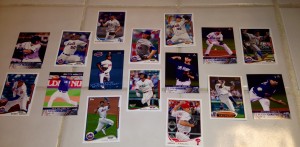 Ooh, arty. Then there are the legendary Lost Nine — guys who never got a regulation-sized, acceptable card from anybody. Brian Ostrosser got a 1975 minor-league card that looks like a bad Xerox. Leon Brown has a terrible 1975 minor-league card and an oversized Omaha Royals card put out as a promotional set by the police department. Tommy Moore got a 1990 Senior League card as a 42-year-old with the Bradenton Explorers. Then we have Al Schmelz, Francisco Estrada, Lute Barnes, Bob Rauch, Greg Harts and Rich Puig. They have no cards whatsoever — the oddball 1991 Nobody Beats the Wiz cards are too undersized to work. The Lost Nine are represented in THB by DIY cards I Photoshopped and had printed on cardstock, because I am insane.
During the season I scrutinize new card sets in hopes of finding a) better cards of established Mets; b) cards to stockpile for prospects who might make the Show; and most importantly c) a card for each new big-league Met. I also increasingly find new ways of spending money and making this insane pursuit more insane. A year ago I upped the insanity ante by acceding to Greg’s years of gentle campaigning and reworking The Holy Books so the players were in order of matriculation instead of alphabetical within the year of their debuts. This year I’ve started making sure the managers are all represented, including the interim guys. Anybody got a Salty Parker card?
(Apologies to everybody who’s read that a ton of times. Want to read it some more? Previous annals are here, here, here, here, here, here, here, here and here.)
Anyway, enough yip-yap. Let’s get to welcoming:
Curtis Granderson: The big free-agent acquisition of the 2012-13 offseason, Granderson arrived to equal parts relief that the Mets were spending money and anxiety that the Mets might be spending money on the wrong player. (See Michael Cuddyer.) He then did little to decide the argument one way or the other, alternating productive stretches with periods as an instant out while remaining unflaggingly courteous and even kindly throughout all the questions that led to. Granderson should move to left field next year and will be taking aim at fences that are closer in right-center, though hitters not wearing Mets garb will be doing the same. Round and round we go. Granderson enters The Holy Books as a Topps Series 2 Met, which means he’s actually a digitally redressed Yankee. Sigh.
Jose Valverde: Relievers attending their last rodeo are interesting exhibits in the stats vs. intangibles debate. A couple of years ago Jason Isringhausen had a serviceable final year with the Mets, but was credited with teaching Bobby Parnell the knuckle-curve and life lessons about being a closer, both of which proved extremely valuable. This year Papa Grande pitched about as well as you’d expect a 36-year-old man with a giant fork sticking out of his back to pitch, but did take Jenrry Mejia, Jeurys Familia, Gonzalez Germen and Rafael Montero under his wing as the leader of the “Dominican Mafia.” (Valverde’s term, not mine.) Germen’s year was wrecked by injuries, but all the others took small to large steps forward. So was acquiring Valverde a mistake by the Mets? That’s a more difficult question to answer than you thought a paragraph ago, isn’t it? Papa Grande will forever be a 2012 Tiger in The Holy Books, excitedly informing God that he’s just done another neat thing.
John Lannan: Lannan joined the team as one of those rotation-insurance guys, but was lit up and excused right after Tax Day. He then spent nearly two months away from Las Vegas, attending to what was described as personal/family stuff. It didn’t work out on the field; I hope it did off the field. 2013 Topps Update card on which he’s a Phillie.
Bartolo Colon: For all the complaining about Colon, he did win 15 games for a mediocre club, show every young pitcher who was paying attention that you don’t need to throw 95 to bedevil enemy batters, and give the rest of us that immortal belly-jiggle GIF. The Mets are now trying to send him elsewhere for the final year of his contract; here’s betting he winds up doing better than anyone would have thought for his new team, too. Topps Series 2 Met, which means he isn’t really a Met in his picture.
Chris Young: No, not the tall one who was hurt all the time (and had a great comeback campaign in Seattle in 2014). This Chris Young seemed like an interesting gamble to return to form after a poor run in Oakland. But he didn’t. Oh boy did he didn’t. Young dropped a ball Castillo-style to lose a game, couldn’t hit and then hung around on the roster forever, gamely answering reporters’ questions about his failures while fans lost their minds. He was finally dumped in August, hooked on with the Yankees, and of course immediately delivered a walk-off homer. The Yankees then resigned him for next year, which one imagines they’ll regret. Topps Team Set photo in which he’s a Photoshopped Oakland A. No, we still don’t have an honest-to-goodness Met photo on a card yet.
Kyle Farnsworth: If I’d told you in spring training that Farnsworth would a) be the Mets’ closer in late April and b) that he’d be the third Mets closer of the year, you’d have responded with a chorus of uh-ohs. Yeah, it was that kind of April. The Mets dumped Farnsworth in mid-May, which had less to do with his performance (he was OK and did some Valverdean mentoring in the pen) than with the “advance consent agreement” he’d signed going into the year — the Mets dropped him to avoid guaranteeing his 2014 salary. As is so often true in modern baseball, this was simultaneously a dick move and a wise one. Farnsworth, understandably furious, vowed revenge and signed on with the Astros. But his Inigo Montoya quest ended in frustration — Houston dropped him a little more than a month later, before he got a chance to face the Mets. 2013 Topps card with Tampa Bay.
Bobby Abreu: Trivia time: Abreu began his career playing for Terry Collins as an Astro facing the Mets and ended it playing for Terry Collins as a Met facing the Astros. The 40-year-old seemed like a veteran too many when he arrived in late April after not playing in 2013. But he won plaudits as a teammate and mentor — the Mets reportedly considered him when they went shopping for a new hitting coach — and as fans we gradually came around to appreciating that we were seeing the last go-round in an excellent career. Abreu exited the sport as a .291 hitter with 2,470 career hits, the last of them a single to left in the fifth inning on Closing Day. This one’s worth watching again — Abreu chugs into first then takes a couple of just-in-case steps towards second, but you can see in his face that he knows he’s never going to get there, and once he turns right instead of left that will be it. He knows it’s time, but a quarter-century of baseball still exerts a powerful pull. 2014 Topps Update card on which he is our first honest-to-goodness Met.
Eric Campbell: The inevitably nicknamed Soup followed a career path familiar to many unfortunate young Mets in recent years — get called up from the minors, hit well, get sat down by Terry Collins for an absurdly long time, hit poorly for some reason. Campbell survived this hazing to emerge as a useful contributor overall, but weren’t we just saying that about Josh Satin? Good luck, Soup. 2014 Las Vegas 51s card. (Update: Campbell got a Topps Heritage High Numbers card. Commence rejoicing.)
Rafael Montero: Montero got lost in the shuffle amid the unexpected emergence of Jacob deGrom, the waiting for Noah Syndegaard and talk-show jackals flopping onto their well-worn fainting couches whenever Matt Harvey dared to something besides sit in a dark room apologizing for having torn a ligament. (It’s fun playing in New York!) When Montero did arrive, he sometimes looked lost and sometimes looked like a world-beater — in other words, he looked like a typical starter in his first big-league go-round. Here’s hoping he isn’t a 2015 Cub or Mariner or D-back … well, unless his becoming one of those would help us by making a great shortstop into a 2015 Met. Fandom, sigh. (Really awesome) 2014 Topps Update card.
Jacob deGrom: Proof that the Mets are not, in fact, a perpetually unlucky franchise doomed to wander the Earth under a little rain cloud. Like everyone else, we’d barely heard of deGrom before this year — the first mention of him in these pages is from spring training and talks, inevitably, about his hair. So of course he wound up as the NL Rookie of the Year, seeming to get better with every start. Harvey, Wheeler, deGrom … it’s enough to make a guy go sit outside Citi Field and wait for April, after years in which attending a game was enough to make a guy go sit outside Citi Field and wait for October. 2014 Topps Update card.
Buddy Carlyle: Like pretty much everybody else, I scoffed when the Mets brought Carlyle in as the sacrificial lamb in a Verdun of a game on May 31 against the Phillies. Which didn’t seem crazy: Since posting an ERA of nearly 10 for the 2009 Braves, Carlyle had been employed by the Nippon Ham Fighters, the Scranton Wilkes-Barre Yankees, the New York Yankees (for 7 2/3 innings), the Gwinnett Braves, the Buffalo Bisons, and the Las Vegas 51s. Good times! But Carlyle didn’t instantly suck that day in Philadelphia. In fact, he got the win … and wound up posting a 1.45 ERA for the season. Guy even got a hit. Nobody knows anything, particularly when the subject is middle relievers. 2014 51s card.
Dana Eveland: See Buddy Carlyle, more or less.
Taylor Teagarden: Brought up when a struggling Travis d’Arnaud was sent to Las Vegas, the rather amazingly named career backup catcher crashed a grand slam in his third-ever Mets at-bat. Teagarden didn’t do much else in his 25 subsequent Mets at-bats and was gone after less than two weeks, but when you hit a grand slam in your first-ever game, you don’t have to do much else. 2014 51s card.
Dilson Herrera: A surprise call-up who began the year in St. Lucie, Herrera more than held his own in 66 Met ABs, showing power, speed and solid instincts. Not bad for a guy who still can’t buy a legal drink. (And points to Mr. Alderson, who got Herrera and Vic Black from the Pirates for a few weeks of Marlon Byrd and the decaying corpse of John Buck.) You never know, but here’s betting Herrera has supplanted Daniel Murphy by the All-Star Break and is a full-fledged star by 2017. 2014 Topps Pro Debut card on which he’s a Savannah Sand Gnat. It’s OK; he’ll have a better one soon.
Erik Goeddel: Who the hell is Erik Goeddel? He pitched in six games this year? If you say so. 2014 51s card.
Dario Alvarez: See Erik Goeddel. 2010 Brooklyn Cyclones card that needs to go back in its binder once Alvarez gets another card. For which a 13.50 ERA during a demitasse of cold coffee is no great guarantee.
|
|