The blog for Mets fans
who like to read
ABOUT US
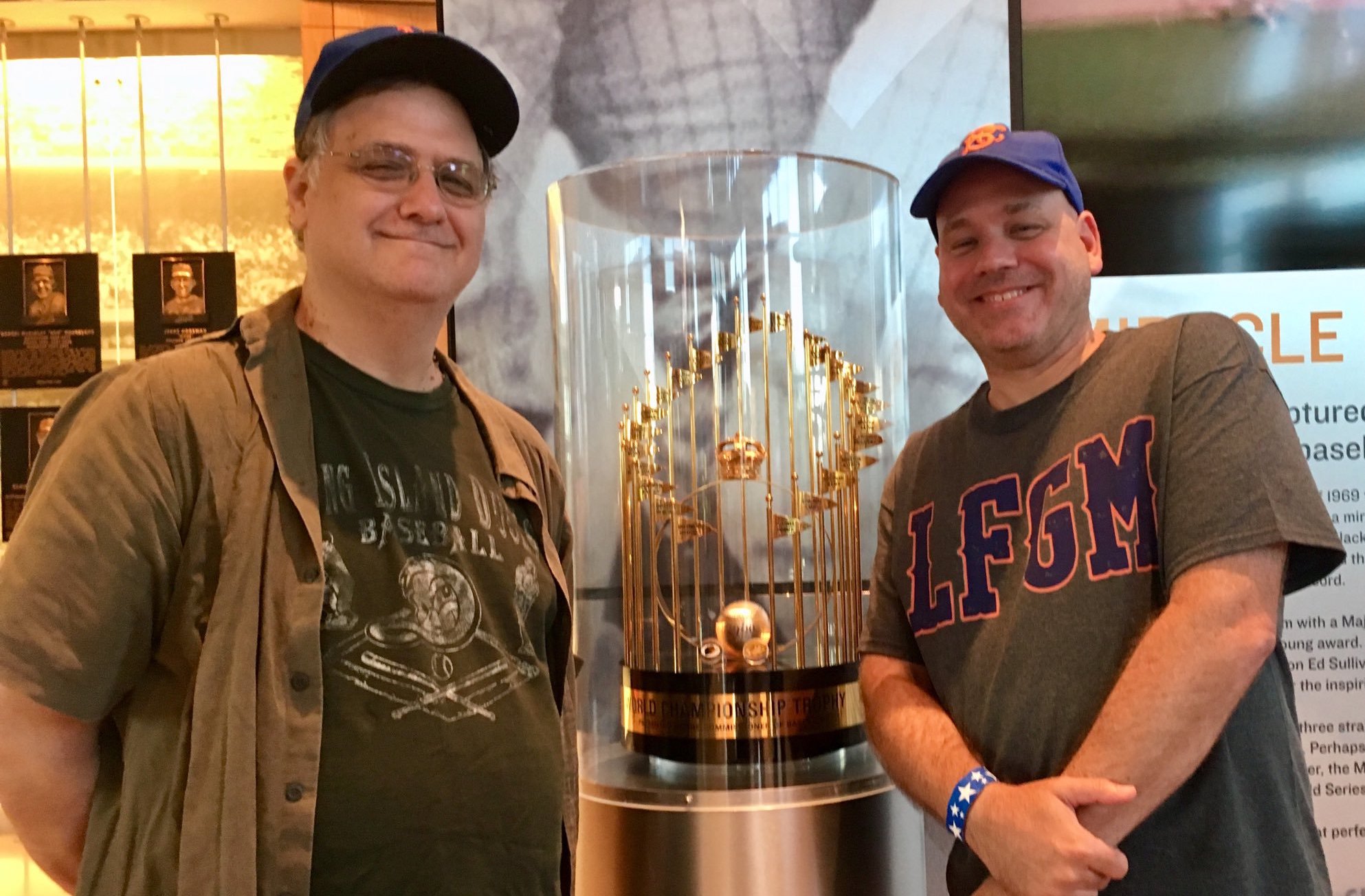
Faith and Fear in Flushing made its debut on Feb. 16, 2005, the brainchild of two longtime friends and lifelong Met fans.
Greg Prince discovered the Mets when he was 6, during the magical summer of 1969. He is a Long Island-based writer, editor and communications consultant. Contact him here.
Jason Fry is a Brooklyn writer whose first memories include his mom leaping up and down cheering for Rusty Staub. Check out his other writing here.
Got something to say? Leave a comment, or email us at faithandfear@gmail.com. (Sorry, but we have no interest in ads, sponsored content or guest posts.)
Need our RSS feed? It's here.
Visit our Facebook page, or drop by the personal pages for Greg and Jason.
Or follow us on Twitter: Here's Greg, and here's Jason.
|
by Greg Prince on 15 May 2014 9:47 am There are nights when you love how much you love sports. And then there are nights like Wednesday when you prefer to drown your sporting sorrows in prime time soap operas.
The Nets, who occasionally lift my spirits in spite of my knowing that eventually they will find a way to pull them down, mishandle them and turn them over, departed their postseason under ignominious, lead-blowing, ref-abetted circumstances. Their sudden, disgusting elimination from the NBA Eastern Conference semifinals left me in that playoffs-are-suddenly-over zone every sports fan is now and then compelled to visit, the one where you have to convince yourself not to destroy your television as you rue your failure to have added Yukon Jack to the week’s grocery list.
By the time the Nets definitively proved they couldn’t take the inevitable Heat, the Mets were still technically engaged in their relatively lower-stakes competition versus their intracity rivals, yet I had witnessed enough of it to have become resigned to the imminent expiration of the delightful six-game Subway Series winning streak Good had cobbled over Evil (or, if you’re touchy about hyperbole, Irksome). As the immediate sting of the basketball wore off, the frustration from the baseball sank in like a Ray Allen three-pointer with 32 seconds to go. I was so put out by the combination of conclusions that when both contests were over, all I could stand to do was switch to DVR mode and watch the season finale of Nashville — where melodrama always paints the corners — and try to forget about the whole thing.
What whole thing?
The Mets were a lost cause by the time the Mike Scott comparisons came rolling out of the SNY booth on behalf of Masahiro Tanaka. The Ghost of Splitters Past, sans sandpaper, was showing no mercy to the lineup that doesn’t do much at Citi Field to begin with. Hernandez, Carter and Strawberry would have flailed against Tanaka, so could you really expect a whole lot more from their less capable descendants? After the Mets captured two quintessential Yankee Stadium III slugfests, it was only fitting they returned to their home park and demonstrated complete offensive impotence.
Met starting pitching wasn’t nearly Tanakan enough to make a difference, but it looked pretty good nonetheless. Rafael Montero debuted and didn’t disappoint. The kid didn’t blow the opposition away as Matt Harvey did in Arizona two Julys ago, but I don’t think that was the long-range forecast to begin with. He was competent, poised and promising enough for now: 6 IP, 3 ER (one of them the direct result of Eric Young, Jr.’s insipid decision to dive in front of an uncatchable ball) and a lovely parting gift basket to Derek Jeter, consisting of Montero’s first major league strikeout and some fancy lotions. Overall, there was enough to make you want to see more, which is all you can ask of a recalled rookie.
We have another one of those tonight, as Jacob deGrom earned a promotion from reliever to starter by being on the premises when it was learned Dillon Gee was going to the DL with a strained right lat muscle. That’s not supposed to be a serious injury (also, Ryan Church is well enough to fly cross-country with a concussion), so I’m willing to believe Gee’s misfortune is temporary and the opportunity it grants deGrom is a bonus.
If that’s not enough hurlers in motion for you, there’s one more to consider: Kyle Farnsworth walking through the exit. Farnsworth was the closer on Monday — a successful closer in that he was on the mound as his defense notched him a save. Otherwise, he was a ticking suckbomb who Sandy Alderson defused just in time to withhold most of his pending salary.
It was one of those cold business moves a team occasionally executes because it can and you can’t really argue with it since it’s contractually valid, and lord knows when it comes to late-game clutch, Kyle Farnsworth was no LeBron James. Most of his career he’s been the guy LeBron James dunks over. It fells a little icky nonetheless. Yet within the bottom line-savvy circles where we do our hardest rooting, I don’t expect to hear, when the next late Met lead slips away, cries of “Why ever did we get rid of Farnsworth?”
So good luck to Kyle Farnsworth. At any rate, don’t strain your right lat muscle as you ratchet up your bitterness at your former employers.
Perhaps it’s discovering the sun rose this morning despite my prediction to the contrary last night, but maybe fewer leads will slip away now that our bullpen’s been revamped. Jenrry Mejia is, as Jerry Manuel and I always thought he would become, an accomplished reliever now…if we can stretch the concept of “accomplished” to encompass one encouraging appearance. Jeurys Familia has closer stuff if not control. Josh Edgin is returning, and Josh’s ability to throw with his left hand makes him, theoretically, a valuable commodity. Daisuke Matsuzaka extricated Zack Wheeler’s overcooked fat from the pitch-count fire the other night; nobody will ever fully trust Daisuke Matsuzaka but he hasn’t completely betrayed us yet. Plus, once Gee and Gonzalez Germen return to active duty, there’s every chance Jose Valverde will receive a kinder, gentler but just as definitive Farnsworthian farewell.
See? Sometimes you wait for the light of day and things do look so much better. It’s enough to make you believe Rayna James will spurn Luke Wheeler and wind up with her one true love Deacon Claybourne.
by Jason Fry on 14 May 2014 2:22 am Just for an evening, it would be pretty fun to be a big-league ballplayer. I don’t mean as a walk-on — a Joe Boyd thrust onto a stage not normally yours. I mean, wouldn’t it be fun to be an invisible traveling companion — someone who could see what the player sees, hear what the player hears and most importantly do what the player does?
Who would you choose to be? I’m sure it would be fun to be scoop up balls at third base like David Wright, or throw an ungodly slider and moonwalk off the mound like Jenrry Mejia, or even jiggle the belly fat in an impressive way like Bartolo Colon. (Though hmm, after this long on book tour I can do that one myself.)
But if I were going to get my ridealong day, I think I’d be Daniel Murphy.
When he’s on — and part of what makes Murph Murph is neither you nor he can predict when he’ll be on — no one has more fun on the field, and no one manages to be less cool about his successes. Which, endearingly enough, is very cool.
To be clear, Tuesday night wasn’t the night I’d have chosen to be Zack Wheeler. Wheeler threw 118 pitches — 64 strikes and 54 balls. He faced 24 batters and 13 of them reached base. In any normal game, that would be a recipe for absorbing a beating and huddling in dismay at one end of the bench while the regulars were excused from further duty. Tonight, though, it was enough — not to get the win, despite Terry Collins’ best efforts on Wheeler’s behalf — but to wind up on the winning side. Wheeler couldn’t screw this game up badly enough to lose, not with Murph and Ruben Tejada pulling off unlikely double plays and the Mets walloping Vidal Nuno and Alfredo Aceves. Wheeler has great stuff, and has pitched in bad luck and in front of bad defense, but tonight there was no excuse to be made for him.
No, I’d be Daniel Murphy. There was Murph in the second, smothering a Kelly Johnson grounder that was ticketed for the outfield while skidding across the Yankee Stadium infield dirt on one palm, then somehow turning and shooting a throw to Tejada before topping onto his backside. That had to hurt, I thought when I saw the replay, but Murph looked down at his palm and brushed at his forearm as if it were all a great adventure.
Or there’s Murph standing tall after Tejada grabs a short hop or watches a ball spin out of his glove but into his hand or otherwise is forced to improvise. I always worry about him standing at second with a knee locked and vulnerable, but he doesn’t seem to worry — if something happens it’ll happen. It’s the Zen of Murph, I suppose.
But the most fun moment to be Daniel Murphy on Tuesday night would of course have been the fifth inning, when he clocked a pedestrian fastball from Aceves to deep right, sending it clanging off the foul pole. High off the foul pole — this was not a cheap Yankee Stadium home run but a Mo Vaughn special, a threat to unwary hot-dog vendors in the deepest environs of the yard. Murph chugged around the bases, seemingly deep in thought about the cool thing he’d just done, until it burst out of him with a yell as he faced his own dugout.
I don’t know quite how Murph does these things; it’s fairly obvious Murph doesn’t know either. When things go badly he’s as pissed and befuddled as you are; when things go well he’s ready to leap off his couch and high-five everyone, except he was the one who just did the high-fiveable thing. You’re in awe and he’s in awe and things will go wrong again soon enough, but right now, oh my goodness isn’t it fun to be Daniel Murphy, New York Met?
Programming note: This was also gonna be about Chase Field, where I was watching the D’backs beat the Nats while listening to Howie and Josh from Yankee Stadium. But I’m way too tired and have to get up way too early. It’ll wait.
by Greg Prince on 13 May 2014 2:56 am GAME NOTES: The Mets scored nine runs Monday night at Yankee Stadium, defeating the Yankees, 9-7 … The Mets belted four home runs Monday night at Yankee Stadium, defeating the Yankees, 9-7 … Curtis Granderson, Eric Young and Travis d’Arnaud all took advantage of Yankee Stadium’s extremely generous right field dimensions, each hitting a short-porch home run that contributed to the Mets’ 9-7 defeat of the Yankees … Chris Young went deep to left field in the Mets’ 9-7 defeat of the Yankees … The Mets overcame deficits of 4-1 and 7-4 to defeat the Yankees, 9-7 … The Mets’ outfield, consisting Monday of the two Youngs and Granderson, combined to record seven hits in the Mets’ 9-7 defeat of the Yankees … Clutch relief work by newly deployed bullpen weapon Jenrry Mejia proved vital as the Mets defeated the Yankees, 9-7 … Recently recalled rookie Eric Campbell produced a key eighth-inning pinch-hit and displayed impressive baserunning acumen in the Mets’ 9-7 defeat of the Yankees at Yankee Stadium, Monday night … Lucas Duda turned a nifty 3-5-3 game-ending double play — with David Wright covering second — to seal the Mets’ 9-7 defeat of the Yankees … The Mets announced plans to promote Jacob deGrom and Rafael Montero, with the latter set to start the third game of the Subway Series that began Monday with the Mets defeating the Yankees, 9-7 … Media reports of “energy” and “electricity” at Yankee Stadium Monday night were directly attributable to the presence of the consistently enthusiastic 7 Line Army, which made its voice heard and its presence felt throughout the Mets’ 9-7 defeat of the Yankees … the New York Times reported Saul Katz is looking to sell his share of the Mets, who defeated the Yankees, 9-7, Monday night … Katz issued a denial that any sale of his ownership stake is underway, a transaction that could potentially eventually liberate Mets fans from the Wilpon family’s control of their beloved baseball team, which, despite acting as an ongoing source of aggravation in their lives, defeated the Yankees, 9-7, Monday night at Yankee Stadium … The Mets defeated the Yankees at Yankee Stadium Monday night by a score of 9-7.
by Greg Prince on 12 May 2014 1:29 pm I’m glad the Mets seem to like each other as much as they do. Or do at the moment the lot of them accomplish something unforeseeable, which is score a fifth run in an eleventh inning. When Ruben Tejada lined a single through the drawn-in Phillies infield to plate the Young who isn’t Eric as Sunday afternoon was morphing into Sunday evening, every Met on the roster and maybe a few flown in from extended spring training burst out of the dugout to embrace Ruben, perhaps out of gratitude for snapping a five-game losing streak, maybe just for letting them go home after the longest, most drawn-out three-game series in human history.
I was grateful that I got to see the Mets win in dramatic fashion not quite nineteen hours after I saw the Mets lose in excruciating fashion and less than 48 hours after they flailed in astounding fashion. The Mets are not much in fashion these days, but they do have their elements of style.
One of their signature pieces of flair, if you will, is to celebrate every walkoff win as if it had just been preceded by a ball rolling through a first baseman’s legs. Zack Wheeler laying down a perfect sacrifice bunt to have moved Young to second after the revivified Young singled may not have been the spiritual equivalent of Kevin Mitchell deciding that he, like Gary Carter, wasn’t going to make the last out of any bleepity-bleep World Series, but you go to walk off with the circumstances you have — not the circumstances you might want or wish to have at a later time.
And is there anything more exhilarating, despite what it says about personnel depletion, than a pitcher coming to bat in extra innings? Even a Mets pitcher? Take that, designated hitter rule!
Young hits. Wheeler bunts. Juan Lagares walks via the intentions of Ryne Sandberg and without objection from Chase Utley. Anthony Recker — the Mets’ Mothers Day gift to swooning moms and aesthetically appreciative dads everywhere — taps a ball Cody Asche can’t turn into an out. (I’m guessing Cody Asche will be the current generation’s default player with whom they were legendarily inundated when they grow up and reflect upon their 2010s baseball card collection: “All I ever wanted was one lousy Mike Trout, but every pack I opened had like six-dozen Cody Asches instead.”) Up steps Ruben Tejada. In steps the Phillie infield. It steps in a little further. It steps in some more until it is inside the Delta Sky360 Club asking if the kitchen is still open because, gosh, it’s getting close to dinnertime and we have quite the bus ride ahead of us and the traffic on the Turnpike is a bear and maybe you can look in the back?
The Phillies’ barely disguised desire to get this thing over with was complemented by Sandberg’s strategy of sidelining three of his usual relievers — they were supposedly tired, but who wasn’t by 5:30? — and playing the infield in. You know the old saying: when you play the infield in, you turn a .186 hitter into a .195 hitter, which is exactly what happened when Ruben laced the next pitch from Jeff Manship (not his real name; can’t be) into short left. I thought for a sec that if shallowly positioned Dominic Brown charged the ball, he might have had a play on Young, if only because the Mets are the Mets and what are the odds a fast runner from third might score on a base hit to win a game? But Brown turned away from Ruben’s souvenir with what appeared to be, from the vantage point of graciously appointed Excelsior level seats, utter disdain.
Chris makes it home. Ruben, who isn’t big on attempting to beat out grounders, makes it to first. It is officially Mets 5 Phillies 4. The final is confirmed when Randy Bachman and Fred Turner are hauled out of cold storage to perform the song that the Mets present whenever they win at home. As soon as the B and the T of BTO flip through their catalogue so as to remember what song that is — it had been so long — the first notes of that old favorite begin to blare over the Citi Field public address system.
The Mets had taken care of business. It was good to see and it was great to hear. “Takin’ Care Of Business” is positively Proustian to the Mets fan ears, instantly transporting them to a land of happy recaps and magic numbers. “Takin’ Care Of Business” evokes a division clinched inside a stadium that shook amid expectations that were regularly matched and sometimes exceeded. The 1974 classic rock staple that served to accent 2006’s N.L. East domination only sounds dated if you don’t think the Mets are supposed to take care of the business of winning ballgames.
It was nice to be rewarded for four hours and twenty-two minutes of rooting on Sunday, particularly after being punished for three hours and sixteen minutes (plus a rain delay of thirty-nine minutes) on Saturday…never mind the four hours and thirty-nine minutes of televised flagellation from Friday. It was nice to bop along with Bachman-Turner Overdrive and to shout “METS WIN!” at a register so high that the “WIN!” cracked. Losing too much unhinges a fan. Winning once in a while merely irritates a vocal cord, and that heals soon enough.
While the Mets engaged in their madcap marathon of Ruben On The Pony, my wife and I high-tenned with middle-aged moderation. I used to bring my palm(s) to Stephanie’s with force appropriate to “METS WIN!” euphoria, but I’ve learned across the exactly 27 years we’ve known each other that six balls could roll through the twelve legs of six Bill Buckners and she wouldn’t appreciate a full-on high-five because no matter the occasion, she always says, “ow.”
Sometime before the ninth, when the Mets staged the rally that lifted them from near-extinction to deadlock, I remarked to my wife that here it was, my 162nd game at Citi Field — marking a full season’s worth in my Log since the no longer new joint opened in 2009 — and I might never have borne witness to a duller one. What, she asked in all earnestness, made this game any worse than any of the others?
“I just realized something,” I said before sincerely answering her question. “All baseball games must look alike to you.”
She didn’t disagree. My wife doesn’t jot down the particulars of every game she attends in a steno notebook as I do, nor will she dissect the Mets’ ineptitude like her middle name is Elias, yet continued exposure to the Mets through the prism of marriage hasn’t disabused her of the notion that an occasional ballgame is more pleasant than painful — assuming intemperate cold winds or excessively sunlit humidity can be avoided. Neither of those meteorological conditions were in effect Sunday, and if they were, refuge awaited in the Caesars Club, an option she doesn’t avail herself of all that much, champ that she is, but she likes knowing it’s there.
As indicated above, we were celebrating our 27th anniversary of being introduced to one another. It was on May 11, 1987, that I stopped listening to Bob Murphy and Gary Thorne on my knockoff Walkman long enough to be introduced to the woman who would in an instant become the other love of my life. Stephanie, the Mets and I have been enjoying one another’s company ever since, the Mets aggravating only one of us to fleeting excess now and then.
Sunday’s synergy provided an effective antidote to Saturday’s disillusionment. I knew when we walked across Mets Plaza to inspect our brick and I hummed involuntarily along with the loop of “Meet The Mets” that no matter how disgusted I get with my team, I’ll always see through to something better than whatever they’re doing to me at a given moment. It makes me a lousy consumer but it reassures my instincts. Of course I sing in sync with the team song. Of course I bring my wife (if not my kitties) on our Night We Met anniversary to remeet our team together. Stephanie had actually requested a visit to the ol’ ballpark. She does that sort of thing after 27 years.
Her name’s Mrs. Prince, bub, and she likes me.
We went with May 11 for her 2014 debut since it’s worked so well before, not only in the sense of what I was listening to that Monday night in 1987 but where we commemorated our big date in 2008 and again in 2010. We were 2-0 at Mets games on May 11s. Now we are 3-0, a rare slice of perfection connected to a franchise otherwise allergic to flawlessness.
Those eight innings before the Mets decided to awaken (and Sandberg let Jonathan Papelbon rest) were, despite the inherent charms of a baseball-laden May 11, dull as Duda. Cole Hamels, the subject of the best t-shirt I saw all weekend — “COLE HAMELS IS A CHOKE ARTIST” — dipped his toe into recurring trouble but never got bit. He gave up a run to the Mets in the first, which is what every opposing starter does, and then nothing for the rest of seven pitchy innings. He kept throwing, the Mets kept not producing. When Curtis Granderson came up to bat for Jonathon Niese in the sixth with Eric Campbell on third and Tejada oddly on second, it was a classic encounter of lavishly compensated reputations. In this case, overpaid pitching stopped overpaid hitting and the Mets continued to trail, 3-1.
It was a quintessentially Queens version of New York on Sunday, as Bobby Darin can still be counted on to belt out — Mets offense takin’ a nap. They trailed, 3-1, forever. That’s why this game felt as if it was never going to improve, though that’s also why this game felt as if it wasn’t completely gone. Niese was solid for six and Daisuke Matsuzaka was a pro for two more. But the scoring simply ceased.
As I can attest to after a full 162 (89-73), there are worse places than Citi Field to watch the Mets avert success. I don’t know if it’s necessary to layer “Family Sunday” on top of the experience of baseball played without weather concerns, but the themed in-game entertainment was certainly poured on. Big Mom has quite the lobby in this country, so of course Mother’s Day was invoked a few thousand times on the video screen. Several Mets mentioned how much they adore their mothers. Prizes were showered on mothers. The Mets had a mother of a time doing anything with Cole Hamels. It was a very thoroughly executed theme.
We survived seven innings of Hamels and an inning of Mario Hollands besides. We somehow endured Jose “Papa Grandé” Valverde digging the Mets a slightly deeper hole to climb out from when he issued a two-out walk to Jimmy Rollins and a triple to Chase Utley (do these guys ever go away?). After Valverde walked Ryan Howard to get to Marlon Byrd, I muttered without malice, “ah, go ahead, Marlon, for old time’s sake,” thinking 7-1 wasn’t any worse than 4-1 and at least we would be guaranteed an imminent departure to that Indian restaurant in Jackson Heights where we were headed postgame.
But Valverde struck out Byrd to end the top of the ninth, Antonio Bastardo (strange choice for a day celebrating parentage) imploded to start the bottom of the ninth and the tease appeared on.
The Young who isn’t Chris doubled. The Murph who is Daniel homered as if Mets do that all the time at Citi Field. Bam, 4-3. I felt this thrill going up my leg as I recalled Robin Ventura doing something similar to Curt Schilling to rouse a similarly torpid game against this very same opponent in this very same inning in this very same month in this very same vicinity in 1999. Now I had to brush off the dullness of the first eight innings, take our chances seriously and hope somebody would emerge as our John Olerud for the current century.
The Mets wouldn’t reveal their true intentions for many minutes. They never do. A strikeout. A double. A pitching change. A pinch-hitting appearance. A soft line drive whose destination was literally and figuratively up for grabs. A diving second baseman whose glove would touch a ball but not grasp it. A baserunner who by necessity would have to hold up at third. An effectively placed grounder that tied the game. A strikeout that continued it.
Yeah, dinner would wait through the onset of extra innings, a Met threat gone awry in the tenth and a Phillie opportunity extinguished in the eleventh. But the Tandoori oven would be fired up sooner than later once Ruben Tejada refused to keep playing in the best way possible. As the English translation to Juan Lagares’s walkup music strongly suggests once one is compelled to look it up after hearing it six times in eleven innings, “I will believe, I will believe, I will believe.”
That’s how they get ya. That’s how they keep ya.
by Greg Prince on 11 May 2014 5:53 am It took only 46 seasons for me to wonder if choosing the New York Mets as the defining passion of my life represented the right call. It took perhaps the most excruciating loss I’ve witnessed to date at Citi Field to push me to question this aspect of my existence.
Saturday night was just perfect in its terribleness. It had all the ingredients: a rain delay; a traditionally reviled opponent; a sizable sprinkling of the reviled opponents’ fans; ties blown; a lead melted; opportunities squandered; and a result that dropped the Mets into last place.
I suppose it would have been worse had the Mets been playing for a postseason berth, but this is the Citi Field era. No such prize has been at stake since Shea Stadium stood. Losses at Shea tended to feel much worse. Losses at Citi Field have been something shy of consequential.
The consequences of losing to the Phillies, 5-4, may be no more than evanescent in pictures small, medium and big. A drop into last place on May 10 isn’t permanent. With 127 games remaining in 2014, everything you’ve heard about anything being possible remains valid. In addition to solely occupying last place, the Mets are also sitting only three games out of a Wild Card spot despite having lost their last five and eight of their previous nine.
Standings, however, aren’t really what’s getting me down. 16-19 isn’t getting me down. Even 1-8 since this month began doesn’t fully dictate my mood. Something about the way they let Saturday’s game get away — on top of Friday’s extra-inning loss and the series sweep with the two walkoff losses in Miami and that 11-10 debacle in Denver a week ago — has infiltrated my soul. The way it got away and the way I sat there and watched it get away and the way those around me (a handful of young, drunken, douchebag deluxe Phillies fans) were able to enjoy it and leave the premises not only cackling but carrying Nolan Ryan bobbleheads…
Say, why are Phillies fans handed Nolan Ryan bobbleheads at Citi Field and, for that matter, do the Phillies hand out bobbleheads of Ferguson Jenkins? I bring up the Cub ace of the 1960s and ’70s as a parallel regarding teams commemorating their roles in launching the careers of Hall of Fame pitchers, which is to say they brought them to the major leagues and then traded them before their greatness kicked in.
The Phillies traded Ferguson Jenkins to the Cubs and Ferguson Jenkins became a name you recognize. The Mets traded Nolan Ryan to the Angels and same thing.
I was relatively thrilled when I saw the Mets would be giving away Nolan again. It had to be better than the first time they did so, on December 10, 1971. They stressed it was 1969 Nolan Ryan, so as to add cachet to an otherwise odd promotional choice (BobbleNolan, by the by, is not bearing the MLB uniform patch that would distinguish him specifically as a Miracle Met, but we’ll let that slide). Of course Nolan Ryan packs plenty of cachet given his Hall of Fame status, an honor he earned as a California Angel, Houston Astro and Texas Ranger. There was Hall of Fame potential around Nolan Ryan as a New York Met, and Nolan Ryan contributed to a world championship — the only world championship he celebrated in 27 seasons of pitching — as a New York Met. But only a cockeyed reading of his Cooperstown credentials implies Nolan Ryan is plaqueworthy because of what he did as a New York Met.
It’s probably overly parochial to point out that if we’re immortalizing 1969 Mets besides three-timer Tom Seaver as bobbleheads, Nolan Ryan by all rights should get in line behind Gil Hodges. And Jerry Koosman. And Cleon Jones. And Tommie Agee. And Ron Swoboda. And Ed Kranepool, Donn Clendenon, Gary Gentry, Ed Charles, Art Shamsky, Ron Taylor, Tug McGraw, Al Weis…well, you get the idea. I’m so happy the Mets got religion when it comes to their bobbleheads and now commemorate eternal Mets in reality, not just my imagination, that I’m not going to quibble that Nolan Ryan didn’t exactly deserve to go second, after Seaver.
Besides, Nolan has a cookbook to promote, and judging by the CitiVision segments in which he read trivia questions and deigned to discuss the New York segment of his career, his consenting to be remembered a bit as a Met was a small price to pay when there are beef and barbecue recipes to plug.
The following pair of lists haven’t been thoroughly vetted, but I think it decently reflects reality.
TEN GREATEST MLB CAREERS THAT BEGAN WITH THE METS
1. Tom Seaver
2. Nolan Ryan
3. Jerry Koosman
4. Dwight Gooden
5. Darryl Strawberry
6. David Wright
7. Ken Singleton
8. Amos Otis
9. Tug McGraw
10. Jesse Orosco
I didn’t say “greatest players” and I haven’t looked up everybody’s WAR. “Greatest careers” implies not just statistical performance but what those careers encompassed, including team glory and individual accolades, whether accomplished as a Met or at future stops.
The first two fellows, Seaver and Ryan, are in the Hall of Fame. Koosman deserved more consideration than he received. Gooden and Strawberry are boosted here by world championships and starpower (besides fistfuls of monster seasons that tend to be overlooked amid their respective melodramas). Singleton and Otis were smaller-scale Ryans in terms of blossoming post-Met; neither was larger than life, but each was consistently excellent for very good teams. Premier closers Tug and Jesse — who pitched in more games than anybody ever — got the nods over premier closing brethren Jeff Reardon, Jason Isringhausen, Rick Aguilera and Randy Myers because, quite frankly, they’re Tug and Jesse.
And coming up fast, maybe rated a little too low in this context, is David Wright. David’s just about the best position player the Mets have ever had; that is as a Met. Greater players have spent parts of their careers as Mets and several of them have ended as Mets, but those stints were, at best, flourishes, and at worst, fadeouts. Since we had beginnings above, let’s have unvetted conclusions here.
TEN GREATEST MLB CAREERS THAT ENDED WITH THE METS
1. Willie Mays
2. Yogi Berra
3. Gil Hodges
4. Richie Ashburn
5. Gary Sheffield
6. Joe Torre
7. Carlos Delgado
8. Rusty Staub
9. Willie Randolph
10. Larry Bowa
(In case you’re itching to throw some more Hall of Famers into the discussion, Duke Snider, Warren Spahn, Eddie Murray and Rickey Henderson, to name four, left the Mets and played with other teams before retiring.)
Happy 83rd birthday from the other day (May 6) to No. 1 on this list, Willie Mays. Willie Mays the Met would look good on a bobblehead. Willie Mays the two-franchise New York National League baseball icon of icons would look great at Citi Field should the Mets decide to notice he’s 83 and there’s no time like the present to complete the trilogy of Willie Mays Nights. There was one at the Polo Grounds in 1963, one at Shea Stadium in 1973 and none at Citi Field so far.
Don’t get me started on Willie Mays or I’ll never get back to my existential crisis.
Without diving too deep into the “ended” list, everybody but Torre and Delgado made a World Series as a player. Everybody on the “beginning” list made a World Series as a player…everybody except Wright, that is. One postseason in which David Wright produces like David Wright has for a decade of regular seasons would do wonders for David Wright’s place on lists like these. All that keeps me at this juncture from already declaring David Wright the greatest position player in Mets history is the lack of a postseason that reaches beyond what David (and Delgado) achieved in 2006.
When I think about Keith Hernandez and Mike Piazza, I think of them lifting the Mets to a world or league championship. When I think about Strawberry, I think about him coming through in the most dramatic moments in service to the most lofty of goals. When I think about David Wright, I don’t get to think that. I know he has most every Met record there is and will have the rest soon enough. After hitting his long-awaited second home run of this season, he’s 28 behind Darryl for most ever hit in a Met uniform. Probably when he passes Straw for homers, I will decide no Met has ever done anything (except run) better than Wright.
But if he leads the Mets to a league or world championship, I will bump him right up against Seaver and over everybody else pronto. Because if he does that, it would do wonders for the franchise to which he is de facto betrothed for the rest of his baseball-playing days. And it would do wonders for the likes of a 46-year fan who left Saturday’s game pondering a genuine existential crisis about his life choice to be a Mets fan.
Wright was the star of the game on the Mets side. There was that homer, a two-run job in the first, propelling David from the schneid where he’d lingered since Opening Day. Even though the reborn slugger himself dismissed the event as a non-event — “I don’t build my game around hitting home runs, so it wasn’t too much of a monkey at all” — I found it sweet release to stand and applaud a David Wright home run. He’d been singling and doubling and making play after play at third, but when you’ve got the man who’s going to lead your team all-time in home runs, you want him to hit one more often than every forty days.
There was the homer in the first that tied the score at two (I forgot just how much Dillon Gee struggles against the Phillies). There was the double in the sixth that tied it at three. Then there was the single that started the eighth, the inning that was going to mean business for the Mets.
First David singles, then Curtis Granderson does the same, and there’s two on and nobody out and the Mets are golden. It’s 4-4 by now, with Eric Campbell’s bid to begin a spectacular MLB career of his own bolstered by his sac fly in the sixth and Terry Collins’s decision to replace Gee after six ultimately quality innings (81 pitches) proving quirky, to put it kindly. Scott Rice was underwhelming when asked to do more than he usually does in the seventh and our brief 4-3 lead was erased by the old dirty bastards of South Philadelphia, Jimmy Rollins and Chase Utley.
But now, in the bottom of the eighth, gold glittered just up ahead. Chris Young, the power hitter who conquered Citi Field’s far reaches on the last homestand was up, and he had every chance of…
…bunting?
Yes, Terry Collins asked his No. 5 hitter to sacrifice Wright to third and Granderson to second. And at that, Young succeeded. Would have been swell had he done more, like driven in the go-ahead run, but when you’re managing with an eye on tying — in the eighth inning, not the ninth — you can only ask so much. Two on still, but one out.
Next up was Campbell the raw rookie; the sensation of Spring Training; the John J. Murphy Award winner; the sac fly specialist from two innings earlier when he pinch-hit for Lucas Duda after Ryne Sandberg opted for lefty Jake Diekman (quite the vote of confidence for Campbell…and quite the opposite for Duda). Sandberg this time wanted righty Mike Adams to walk righty Eric Campbell to set up a double play in anticipation of the black hole known as the bottom of the Mets’ order coming up.
One ball was thrown intentionally to Campbell. But no more. Utley — not Sandberg, but Utley — figured out lefty Bobby Abreu was loosening up for the Mets, likely to pinch-hit much sooner than later. He also figured out Adams would be better off trying to get out Campbell, veteran of one major league plate appearance, than Le Grand Abreu. So Utley — not Sandberg — called off the intentional walk and Adams pitched to Campbell.
And it worked. Campbell struck out. After Wilmer Flores walked, Abreu did indeed bat for Travis d’Arnaud. And Abreu tapped out to Adams.
“That was pretty neat to watch,” said Sandberg, the Phillie manager turned trusting observer.
It wasn’t neat to watch if you weren’t in the Phillie dugout or were sitting adjacent to young, drunken, douchebag deluxe Phillie fans who didn’t need success to fuel their obnoxiousness (when they weren’t drinking or cursing or generally making a case for not being missed should they take a fatal tumble down the Promenade steps, they were relentlessly imitating a professional wrestler who repeatedly points upward and chants “Yes! Yes! Yes!”). They didn’t need a boost from their team, but they got it. The Mets, on the other hand, had a golden chance to score and didn’t score. They could have taken a lead but didn’t take a lead. They…just didn’t is what they did.
In the top of the ninth, journeyman Kyle Farnsworth records two quick outs, but the crimson-clad ODBs pull a reverse-Mets, much as they did during the last Septembers that meant anything around here. It’s Rollins walking, Utley singling, Rollins racing to third and Ryan Howard driving Rollins in. The allegedly decrepit Phillies are taming the equally allegedly rising Met tide, 5-4.
Kyle Farnsworth surrendered a go-ahead run. Go figure.
Then, in the bottom of the ninth, as “PAP!” comes on to close out the Mets, there is a glint of light. After two blink-quick outs, Jonathan Papelbon walks Daniel Murphy. Murphy takes off for second, not the keenest of concepts given a) Carlos Ruiz’s arm and b) the possibility that the batter, Wright, would be put on so “PAP!” could pitch to Granderson (who would you rather face?), but Murphy makes it and Wright is still batting and neither Utley nor Sandberg is instructing Papelbon to walk him.
And there’s Wright, almost the greatest positional Met ever, almost the greatest Met who isn’t Tom Seaver. He’s got three hits tonight. He’s so good that one of the Phillie fans is grumbling about “Captain America”. I’m thinking, this is the time, David. This is the time the greatest of Met hitters — and there haven’t been a bunch — make every difference in the world. Strawberry takes somebody deep. Hernandez lines one perfectly. Piazza flips the scoreboard.
The date was May 10. Exactly eleven years ago to the day, it occurred to me, I was at a game with my pal Joe — the same guy I was with Saturday night — that Piazza won with a tenth-inning home run off the Padres’ Jaret Wright. We as Mets fans swoon over Piazza because of home runs like that. We as Mets fans revere Hernandez, goofy broadcasting and all, because of nights like the one I experienced in 1984 when he came up four separate times with a runner in scoring position and he made certain the runner scored. I still talk about Keith’s four RBIs from thirty years ago. I still talk about Mike shifting tectonic plates in ninth innings. I can still see Darryl shocking Nolan Ryan with a home run in October 1986 when Nolan was an Astro and more seething than bobbling — and that was two days after Darryl did something spectacularly similar to Bob Knepper.
I wanted David to do at Citi Field what Darryl Strawberry and Keith Hernandez and Mike Piazza did at Shea Stadium. I wanted David to do at Citi Field what David Wright did at Shea Stadium one sunny afternoon in the old yard’s final summer. I wanted David Wright to give me a night to talk about and think about and write about for the rest of my Met life. I wanted to someday be able to remind everybody about that time Wright beat Papelbon with a two-run homer, the night he went four-for-four, the night he put the Mets on his back and kept them out of the cellar.
Though to be fair, I would have settled for a well-placed single to score Murphy. Or a walk to bring up Granderson and whatever his well-spoken .187 bat had to say for itself. I didn’t want David to foul out…which is what he did to end the game.
And that was the moment I wondered, what am I doing here? Why do I keep coming back? Will this ever get any better? As the drunken douchebag deluxe kiddie corps cackled its way to the parking lot (great, they drove), in my mind I heard the school-marmish voices of so many best-intentioned Mets fans who would not hesitate to inform me that it’s OK; that the organization is in good shape; that the current administration knows what it’s doing; that you can’t judge how well things are going by how poorly things are going. They might even find a way to explain that a perennially low payroll dependent on Kyle Farnsworths and Wilmer Floreses and Eric Campbells isn’t an indication of an inability to compete financially but the product of subtly sound judgment.
In my mind, I screamed at them like I wanted to punch out the Phillies fans.
As I hoofed out of my section, trying to ignore both “New York State Of Mind” and the Phillie fan ringleader who said he didn’t want to hear Billy Joel right now (dope, if you knew anything, that’s exactly who you’d want to hear, because it’s only played right after the last out when the Mets lose), I noticed a half-consumed fountain beverage. It took all my restraint to not grab it and hurl it at the ground. I did that at Shea once when the Mets lost in excruciating fashion…really excruciating fashion because the Mets were competing for a Wild Card. This was when I was 35 and too old to be throwing tantrums let alone beverages in public. I’m 51 now. Such behavior hasn’t grown more socially acceptable.
What linked that night in 1998 with this night in 2014 was I couldn’t bring myself to say a word to Joe as we strode silently to the train (that and Joe’s unprompted insight that “this would be a good night to throw a soda”). Taking a loss is less and less a big deal as I go along, season to season, decade to decade. The Citi Field Mets make it so routine that it almost doesn’t leave a mark. If the Mets don’t bleed to win, why should I be reaching for Band-Aids? I assume the players are bothered. I know one of them was for sure. While I clomped down the stairs, Wright stayed put in the dugout, ruminating on just missing on Papelbon’s last pitch, describing losing as something that “sucks”.
He knows. But he’ll be out there again Sunday, because he’s David Wright and it’s his job and it’s his passion.
I’ll be out there again Sunday, too. It’s not my job. It’s presumably my passion. For ten, twenty, thirty minutes, I found that hard to believe. I felt not anger but dispassion. I rifled through these past 46 seasons like they were cards in a Rolodex. I reveled in the highs, despaired of the lows and couldn’t really fit what I’d just felt into any of it. Jerks from Philadelphia were rewarded with a win. I bought my ticket, I collected my bobblehead in good historical faith, I rooted to the third power for the home team. I still had Nolan Ryan, but nothing else to show for showing up. I couldn’t imagine ever having anything to show for it. I couldn’t imagine the Mets not being a losing team. I was overcome with the sense that the two world championships I cherish from when I was 6 and 23 are never going to be joined by a third. I doubted if I’d ever see playoffs again.
I was too bothered by how this game unraveled to say I didn’t care. (Hell, I came home and produced Met-intensive lists whose topics straddle the border of obscure and obsessed.) But for maybe a half-hour I couldn’t imagine caring as much as I have anymore. Then Joe and I started talking, and even though we were both disgusted, the whole thing settled into normality: when our next game together might be and who might be pitching the eighth and ninth by then.
I will care. It’s what I do, even if it’s not my job. It doesn’t go away. Just like the losing, which, as no less an authority than David Wright can confirm, sucks.
by Greg Prince on 10 May 2014 9:37 am We’ve entered the phase of the season — roughly March 31 to September 28, give or take stray illusory weeks devoted to the reflexive heightening of fleeting false hope — where we’re less concerned about winning baseball games than simply getting them over so another season of not winning baseball games can commence (but just you wait for the year after!). Now that we’re in the reality lap…again…anything goes where the product the Mets put on the field is concerned. It’s May on the calendar but August for solution-groping. For example, why wait for the cusp of mathematical elimination to bring up the guy it is assumed can hit but nobody thinks can field to take on the most daunting defensive challenge on the diamond when we can do it now? Hell, why not? It’s not like anybody named Andrelton, Ozzie or Ordoñez was blocking his path.
When it feels like nobody is going anywhere, anything should go and does go, save for most of the runners who reach base. They go nowhere. They are a microcosm of their team year after year.
On Friday night at Citi Field, where a pair of capable lineups would have spun a dizzying 8-7 merry-go-round of action from 19 hits, 16 walks, 2 hit batsmen and 1 error, home plate remained mostly undisturbed. The Mets left 15 runners on base during 11 innings when they scored 2 runs. Those bases must be pretty nice places to kick back and just chill, for the Phillies were reluctant to leave first, second and third, too: 17 runners on in the same 11 innings, except they scored 3 runs.
The Philadelphia scoring sum proved slightly more effective than that of the True New Yorkers in the area of results, but nobody particularly outexecuted anybody else. Nevertheless, at the conclusion of the four hours and thirty-nine minutes in which each club participated — it would be hard to say “played,” for there was little playful about this foggy, sloggy morass of inertia — the Phillies emerged as the victors, 3-2, appropriately forging a tie with the Mets for the worst record in their shared division.
Neither team appeared good enough to claim it is better than the other. Or anybody. Despite the presence on the field of a handful of worthy professionals, the agglomeration of Mets and Phillies we witnessed engage in a gripping staring contest for an average of 12 minutes and 41 seconds per half-inning claimed dual possession of fourth place in the National League East on merit.
Encouragingly, the Phillies, who not long ago loomed as the unreachable star of our sector, seem as unremarkable as us now. Their immediate prospects appear as slight as their payroll commitment is hefty: $180 million, or more than twice as much as the Mets are distributing. It is indisputable that we are getting more whimper for our buck. But it should be said that the $8 million they’re paying Marlon Byrd is getting earned. Byrd, who was replaced by Curtis Granderson ($15 million), is outperforming Curtis Granderson and most Mets. Last night he fought off a very good eleventh-inning pitch from Carlos Torres and turned it into the go-ahead double that signaled this endless game would, in fact, end.
That was contingent on the Mets not scoring a matching run in the bottom of the eleventh, a contingency that did not occur. It was already a fifteen-inning affair in form if not substance. These two teams had participated enough for one night. Or week.
The bright spot of the long night’s journey into loss— besides Jeurys Familia looking extremely sharp and Keith Hernandez (sighmoan) sounding hilariously disgusted — was Wilmer Flores manning shortstop and living to tell about it. Flores replaced Omar Quintanilla on the roster but his real leapfrog target was Ruben Tejada. If Wilmer could suit up, stand convincingly between David Wright and Daniel Murphy and pick up most of the balls hit within 18 inches of either side of him, he’d be hailed as the greatest positional upgrade since Lincoln took over for Buchanan.
After one game, Wilmer Flores seems a provisional improvement over whatever we were getting from the indifferently conceived science fair experiment known as Rumar Tejntanilla. He hit the ball hard. He recorded two hits. He didn’t range particularly well to his left or his right but he didn’t embarrass himself, which, after you listened to all the assurances that all Tejada had to be was “adequate,” could be interpreted as a triumph of the Metropolitan spirit.
The suiting up may have been the kid’s only problem, given the throw from Travis d’Arnaud that bounced up and pinged Wilmer in the ol’ Elio Chacons. As Flores writhed in pain, Keith earnestly invoked “that song from The Wizard of Oz,” presumably the one that starts “Ding-Dong!” (though “If I Only Had A Brain” might have sufficed as well).
Fortunately, Flores was not dead after absorbing that wicked one-hopper and he hung in there the rest of the game. Everybody hung in there the rest of the game. It was a game designed for hanging in there, at least when your favorite team was batting. Endurance replaced offense on both sides. After a while, it didn’t much matter who won. It mattered that it ended.
by Greg Prince on 7 May 2014 11:04 pm Welcome to the 14th installment of our umpteen-part series, Better Know A Walkoff. Today: the 14th walkoff loss the Mets have suffered at the hands of the Florida/Miami Marlins since the founding of Faith and Fear in Flushing in 2005.
The fightin’ 14th!
Gosh, what can be said about this walkoff loss to the Marlins that wasn’t said here following the walkoff loss of August 1, 2006?
Here comes Josh Willingham to pinch-hit. Wagner rears back and fires and…oops.
Or September 20, 2007?
[W]atching Willie mismanage his bullpen Thursday night has put me on the other side of Randolph ridge. Strapped as he was for closers, how he could squander Feliciano on a single batter and then haul out Sosa after Sosa had been heroic for two innings the night before defied belief. When he was lucky enough to escape with only a tie, how he could expect Sosa to defy his own tired right arm and track record — Randolph had a front row seat for Brenly and Kim and the ’01 World Series — is unfathomable. It would strain credulity in May. To pull this move/nonmove on September 20 when it’s a 7-6 final in Washington and it’s no longer 7-4 in Miami…infuckingcredible.
Or April 1, 2008?
Matt Wise may or may not throw more meatballs to indifferently skilled hitters. Ryan Church may or may not give away more at-bats by pressing against relievers who’d shown themselves constitutionally unable to start every hitter with anything other than a 3-0 count.
Or August 30, 2008?
Forfeit? Not even try? Wouldn’t not showing up at the ballpark and automatically losing 9-0 be more embarrassing than letting a three-run lead slip away and going down 4-3 in the ninth?
Or April 10, 2009?
A two-out bunt, a bloop and a sharp single that went against the defense for starters; an infield single, walk and another sharp single for enders. Utterly and hideously familiar.
Or May 13, 2010?
That was a brutal way to lose a baseball game. I’m referring to tonight against Cody Ross and the Marlins…[b]ut then brutal is what happens at Soilmaster Stadium, that dispiriting, poorly lighted oddly colored den of horrors.
Or June 29, 2010?
Uggla’s ball eludes Reyes. Jesus Feliciano, in for a not completely well Pagan by the ninth, rushes it, picks it up and fires it to the plate. Cantu rounds third not looking a whole lot faster than Barajas, but he doesn’t have to be particularly speedy. Feliciano gives it one of those throws that leaves a player’s body on the ground, which is admirable but is usually futile. It wasn’t one Feliciano’s fault that for the first time in 2010 the other Feliciano gave up a ninth-inning run. It’s not either Feliciano’s fault. It’s nobody’s fault. It’s that Expo residue combined with those loathsome Marlins.
Or May 11, 2012?
Does it sound familiar that the Mets clawed back in thrilling fashion, only to spit the bit defensively and be undone by a Marlins rally? I don’t want to go back and look at how many times this has happened before, because it will just make me mad. But if memory serves I remember about 53,299 games at Soilmaster that ended with the Mets undone by little bloops, or infield hits, or HBPs, or any other variety of wretchedness that in retrospect seemed inevitable.
Or May 13, 2012?
The bottom of the ninth was a slow-motion train wreck, ended definitively and by then somewhat mercifully by something very loud and very fast.
Or October 2, 2012?
The Mets got the score to 3-3. They couldn’t do more than that, however, and eventually the Marlins — via a nostalgic Jose Reyes triple, a mystifying Jordany Valdespin vapor lock and a redemptive single from golden sombreroan Donovan Solano — skewered Collin McHugh in the eleventh and that was that for Game 161.
Or April 29, 2013?
As it gets later, a war of attrition sets in, even if both sides in this particular fifteen-inning theater of the dispiriting ran short on supplies, rations and vital ammunition fairly early. When the innings pile up, it’s not a matter of who’s better. It’s about who finds a way to win. Or in the case of the Mets versus Marlins, a way to lose. And the Mets somehow found it against an opponent whose stated business plan is to shed itself of assets. They only have one left of any note and he went out with an injury in the tenth. Bereft of Giancarlo Stanton for the final five innings, Miami brought to bear only the curse of Greg Dobbs and…I know, that’s usually enough, but c’mon — they’re the Marlins. Though I imagine wherever a hardy band of Marlin faithful gather, the thought process across the many hours this game took was likely “c’mon — they’re the Mets.”
Or April 30, 2013?
The Mets then intentionally walked Placido Polanco, a straightforward transaction that Recker managed not to fuck up, and pitched to Greg Dobbs, which any reader of this or a dozen other blogs could have told you wasn’t going to work. Would Dobbs work a 94-pitch walk? Club a grand slam that would collapse the Red Grooms sculpture on top of Lucas Duda? Stand aside as Recker somehow strangled himself with his own catcher’s equipment, requiring rescue while Pierre almost apologetically stole home? It was nothing so dramatic — Lyon’s first pitch was more than an inch from Recker’s glove, which tonight meant it was too far for him to corral. Ballgame.
Or May 5, 2014?
The bat lands in the hands of Casey McGehee, who makes optimal use of the superfluous letters in his last name. McGehee was the Marlin who hung the ‘E’ on Quintanilla in the eighth. Now, in the ninth, he banks an ‘H’ off Germen’s leg and into right field. (To be fair, it was ticketed for center if Gonzalez hadn’t put a limb in its path.) Yelich comes around to score and the Marlins hug and frolic and shower and change into collared shirts and receive VIP treatment at Marlins Park’s glamorous Clevelander night club where they dance the night away in triumph.
So you know how it works, in general.
On Wednesday, May 7, it worked like this: Zack Wheeler pitched very well, particularly in his final inning of action, the sixth. If the Mets had been ahead or had come back to win it, we’d look back on how Wheeler squirmed out of two jams — first and second via an around-the-horn DP and first and third on a grounder to first — and earned another stripe on his way to his next pay grade. Except it was 0-0 through six, since Tom Koehler was in total command of Mets hitters. Or Mets hitters had long before surrendered to Tom Koehler. Good pitching stops good hitting, and the Marlins came into this series packing good pitching. What it did to non-existent hitting was unspeakable.
Jeurys Familia was perfect in the seventh and Carlos Torres was the same in the eighth, but once Steve Cishek picked up for Koehler in the ninth and retired the top of the Met order (as if it matters where any of the ohfer gang hits), it was obvious times thirteen what was going to happen in the Marlins’ last at-bat.
Make it obvious times fourteen.
Did Torres have to give up a leadoff single to Giancarlo Stanton? I mean was it preordained? It was certainly precedented. The walk that followed to Casey McGehee…the fly to right that moved Stanton to third…the folly of Farnsworth…the deep enough ball Juan Lagares caught from Marcel Ozuna in right-center, the one that arrived near home and made it deceptively close because Stanton came down with a case of the Murphy-Pagans and tagged up indiscriminately…the corralling of the throw Anthony Recker attempted as Stanton slid…the ball trickling away as Stanton was correctly ruled safe…did all of that have to unfold? Did the Marlins have to walkoff all over the Mets yet again?
Apparently. Can’t say we haven’t come to expect it.
The Mets, who were briefly touted as one of the zippy surprises of 2014, are back under .500 after this 2-6 journey into West Oblivion and South Futility. The Marlins are now the darlin’s of the smart set. It’s a long season, so who knows what fortunes await either of them? The real (or “true”) Mets probably weren’t the 0-3 freeze kings who exhibited horrible stage fright when the curtain was lifted on the new year, yet they sure as shootin’ weren’t the 15-8 revivalists the “See?” Brigade — “See? See? They’re better than you thought!” — wished to puff up. They’re not necessarily the team that loses six of seven at a clip, either. Also, David Wright has a real good shot of increasing his season’s home run total from one to more than one, though it occurs to me that if Bobby Parnell hadn’t blown that save on Opening Day, the Captain’s lone longball wouldn’t have been launched in the tenth inning and David wouldn’t have any yet.
They couldn’t pitch in Denver. They couldn’t hit in Miami. Throw it all into a blender, designate a deserving scapegoat or two for assignment and you wind up pouring yourself a tall glass of mediocrity, which is more or less the best you could hope for in the short term. We probably figured that out in March, which doesn’t signal the end of the world, only a continuation of what was coming all along. There’ll likely be quite a bit of blending the worst we anticipated with a few not so unpleasant surprises.
Even mediocre products have their charms, but good luck putting that in a letter and getting someone to cognizantly sign his name to it.
I took part in a little Mets fan group therapy Wednesday night on the Rising Apple podcast. Listen here and heal thyself.
by Jason Fry on 6 May 2014 10:08 pm Well hello! It’s me, your prodigal blogger, stepping in to keep Greg off the ledge.
Seriously, I depart for two weeks of book tour and terrible things start happening to the Mets. Though, granted, what do you expect when the Mets head for Coors Field and the House of Loria, both famous for their soul-killing finales. We should have circled this stretch on the calendar, put skulls and crossbones all over it and just collectively agreed to find something else to do instead of endure these games.
You saw tonight’s game. I’ll make it quick.
I kept track of it through MLB At Bat while I wandered around St. Louis, alternating between Howie and Josh bubbling out of a tiny little speaker and Gameday, with its bland declarations of to-be-determined import:
IN PLAY, OUT(S)
IN PLAY, NO OUTS
IN PLAY, RUN(S)
I knew how this was gonna go; so did you. Bartolo Colon was pretty good; Henderson Alvarez was better; the Mets did very little. Yawn. Let’s move on.
In fact, let’s talk about Wrigley Field.
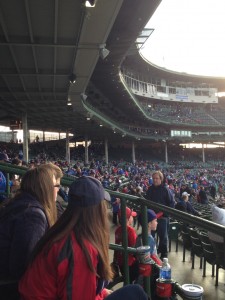 Two years ago, I was able to add three new ballparks to my list on a West Coast book tour: SafeCo, Pac Bell (or whatever it’s called now) and the Big A. This time around, I’ll be able to add four — O.co Coliseum, Chase Field, and Minute Maid Park. And Wrigley Field. (The Cardinals are in Atlanta right now, alas.) Two years ago, I was able to add three new ballparks to my list on a West Coast book tour: SafeCo, Pac Bell (or whatever it’s called now) and the Big A. This time around, I’ll be able to add four — O.co Coliseum, Chase Field, and Minute Maid Park. And Wrigley Field. (The Cardinals are in Atlanta right now, alas.)
I had to look up the names of the first three parks, because I couldn’t remember what they were called now, given the ebb and flow of corporate deals. (And I won’t commit the current names to memory, for the same reason.) But Wrigley Field? Not a problem. It’s only been called that since my late grandfather was a teenager. (Speaking of which, here’s Greg’s take.)
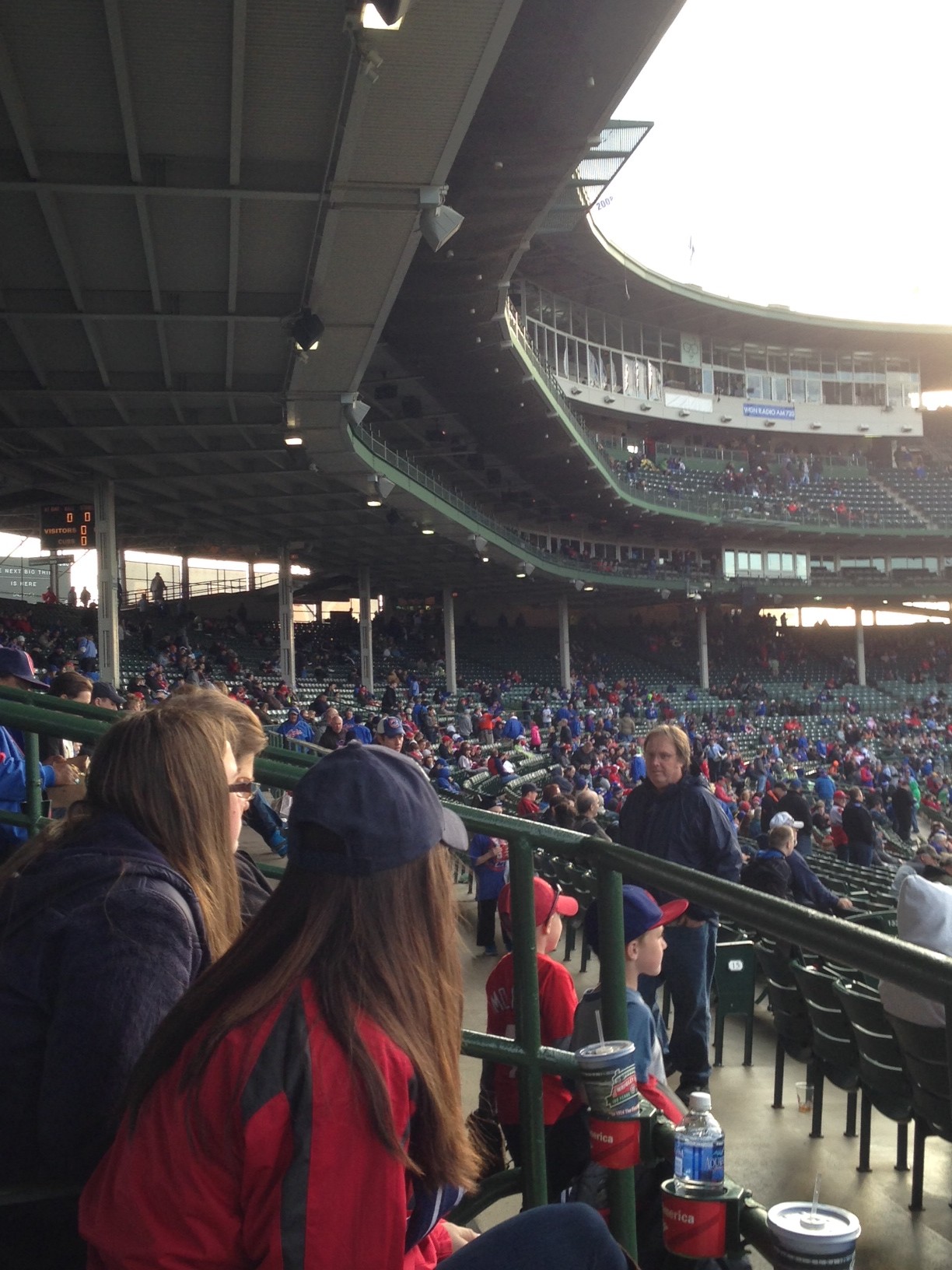
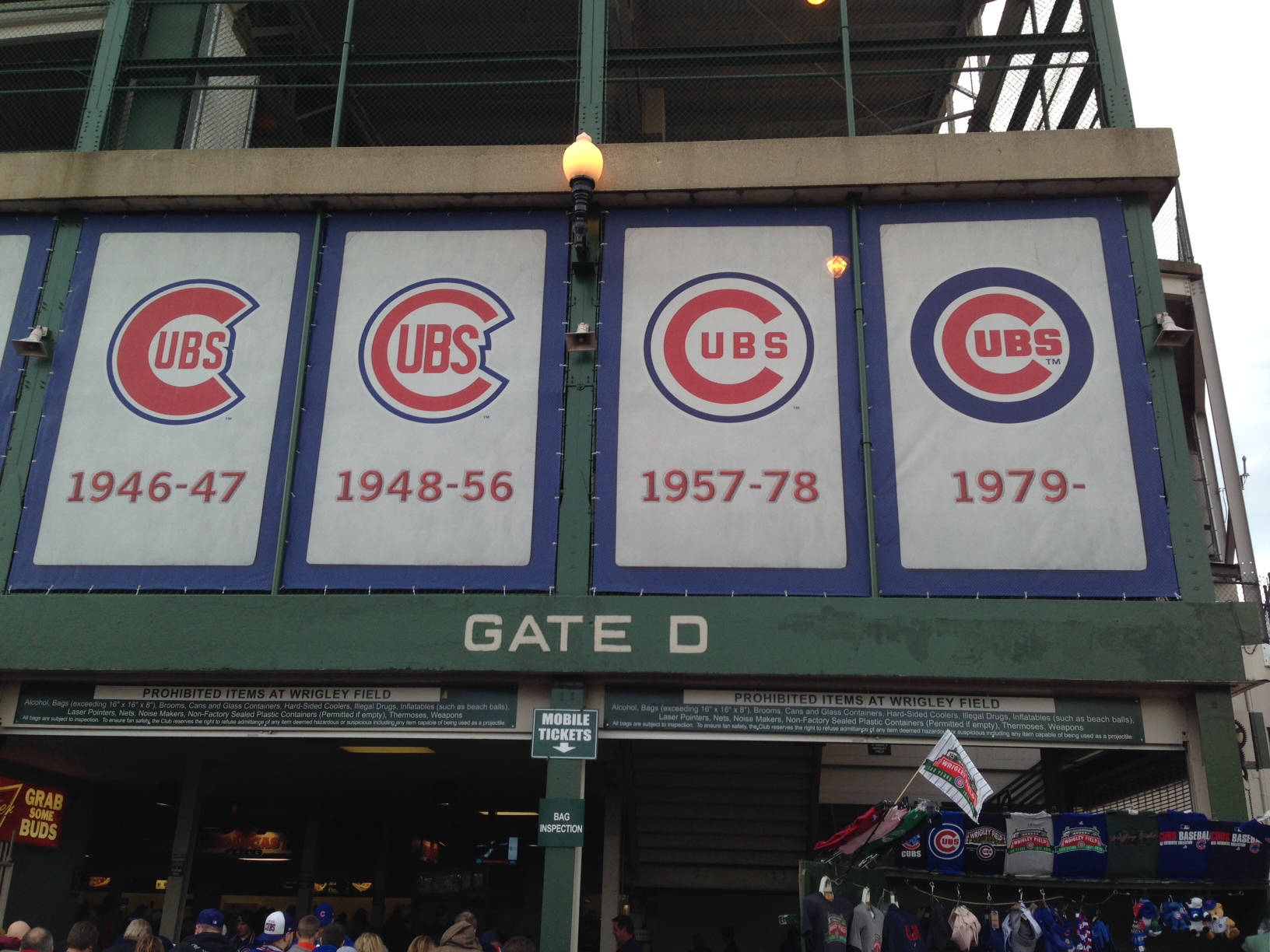
I finally got there on Sunday, for an ESPN game against the Cardinals, with both teams sporting gorgeous throwback uniforms and wearing their socks admirably high. I arrived on the el and followed the hordes, and then something odd happened … I didn’t want to go in. Instead, I took a lap of the ballpark, looking happily at the statues and the bricks and the packs of Cub faithful and the knots of Cards rooters. I knew about all this, of course, but actually seeing it up close was different — it was actually real, and I would finally get to be a part of it.
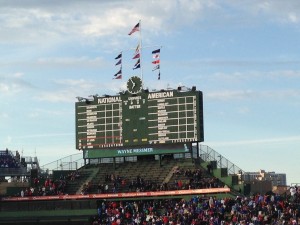 You can feel the age of Wrigley — in its slightly rounded bricks, the way it’s tucked into the cityscape without the scent of a committee designated to produce “quirkiness,” in the concourses that seem drab when we really should think of them as utilitarian — because who cares what’s backstage at the opera? Walking in at last, I kept remembering that Brooklyn once had a twin to Wrigley — Washington Park, the home of the Federal League’s Brooklyn Tip-Tops, now reduced to a wall of a Con Ed facility. You can feel the age of Wrigley — in its slightly rounded bricks, the way it’s tucked into the cityscape without the scent of a committee designated to produce “quirkiness,” in the concourses that seem drab when we really should think of them as utilitarian — because who cares what’s backstage at the opera? Walking in at last, I kept remembering that Brooklyn once had a twin to Wrigley — Washington Park, the home of the Federal League’s Brooklyn Tip-Tops, now reduced to a wall of a Con Ed facility.
I settled into my seat, happy to note that both seats and aisles were sized for plush-bottomed moderns and not the apparently rail-thin go-getters of the Gilded Age. (See Fenway Park.) Things got off to a poor start when I got a brat downstairs whose color should have warned me it wasn’t food; beneath its congealed surface things would squelch and squirt, making for a gustatory event that rivaled an outtake from Alien. That wasn’t fun, though later I had a Vienna dog that was completely delicious, and which I festooned with unlikely toppings by copying the guy in front of me. (Though not tomatoes. Ewww.)
I say the Vienna dog was delicious, though possibly the truth is more that by then I was drunk.
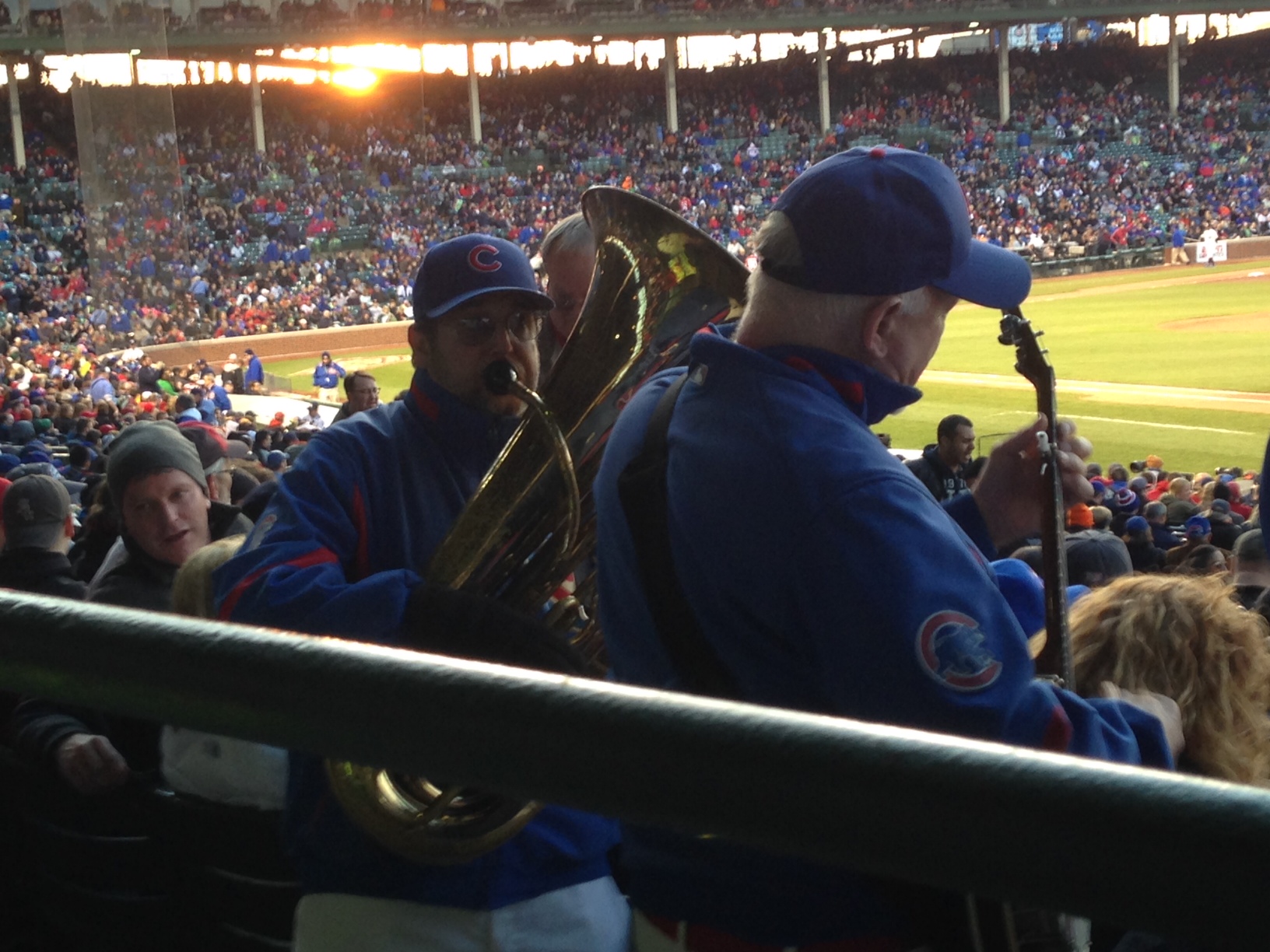
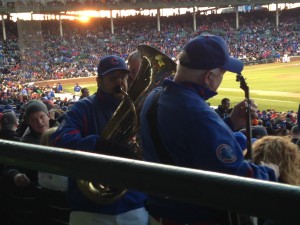 Anyone who wants to consume an enormous quantity of beer in Wrigley but fails is either an invisible mute or pathologically shy — Wrigley has an endless parade of vendors hawking raffles, beer, hot chocolate, beer, hot dogs, beer, beer and (yes) blankets. But it’s a cheerful procession. I got a ringside seat for the Cubs Dixieland Band, and then poked around the other sections of the park while the Cubs were doing inept things out there. Anyone who wants to consume an enormous quantity of beer in Wrigley but fails is either an invisible mute or pathologically shy — Wrigley has an endless parade of vendors hawking raffles, beer, hot chocolate, beer, hot dogs, beer, beer and (yes) blankets. But it’s a cheerful procession. I got a ringside seat for the Cubs Dixieland Band, and then poked around the other sections of the park while the Cubs were doing inept things out there.
There wasn’t much to find, and that’s not meant as a criticism at all. I get the need for suites and distractions for the non-baseball-inclined. I like that Citi Field has urinals instead of troughs I suspect were borrowed from Chicago’s famous slaughterhouses. Wanting to eat good food that goes beyond dogs and pretzels isn’t a badge of shame for a baseball fan. But Wrigley partakes minimally in all such modernity — not so much by way of rejection as because it was built baseball eons ago, when the game was the thing and everything else was just supporting infrastructure. Which bores me as a cri de coeur but made me happy as an onlooker. Were things better a century ago? No. That’s silly, in fact — but you can feel that way and still think that the way they do things at Wrigley Field is somewhere between perfectly all right and awesome.
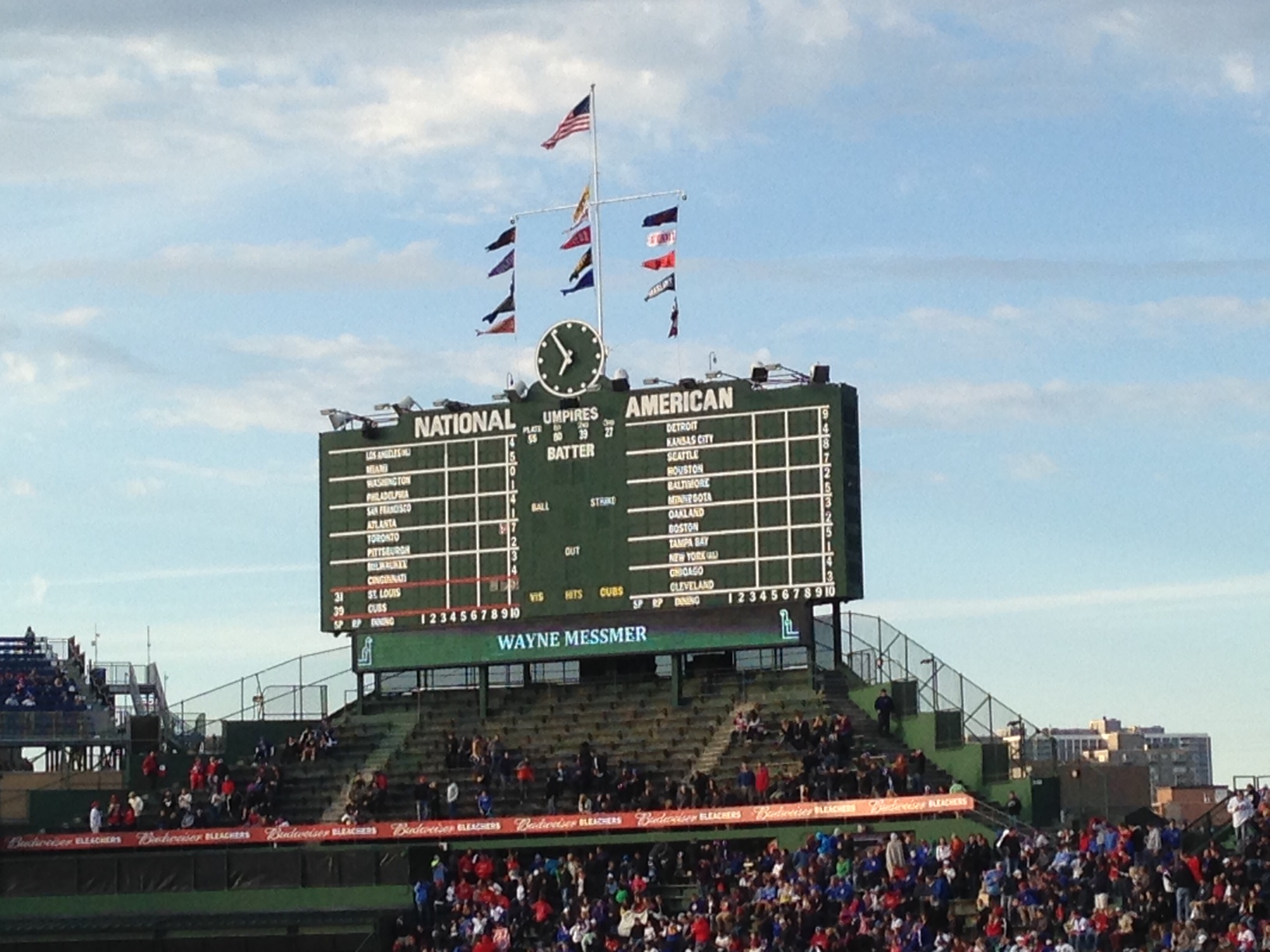
Wrigley has tacked on a few things — in the upper levels a little warren of tunnels leads you to a huddle of ATMs and a largely unoccupied cocktail deck — but you can tell they don’t mean it. You get beer or purge yourself of former beer and get back to your seat, to look at the ivy and the way the bleachers rise to the scoreboard like a prow of a great ship and to hope the Cubbies can escape the inevitable this time. It’s simple. And it’s pretty great.
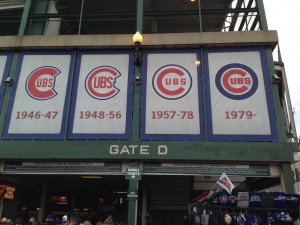 Not speaking of pretty great, oh the Cubs. I wound up sitting next to four Cubs fans in their mid-twenties, who were drinking heavily but remained perfectly affable throughout, razzing the married Cardinals fans next to them in a way that never departed from good-natured. The park was about 30% Cardinals rooters, but I didn’t see any disputes, something I attribute less to Midwestern manners than to the current state of baseball affairs. The Cardinals are a baseball machine, while the Cubs are so obviously and utterly dismal that it’s impossible to woof about them. Not speaking of pretty great, oh the Cubs. I wound up sitting next to four Cubs fans in their mid-twenties, who were drinking heavily but remained perfectly affable throughout, razzing the married Cardinals fans next to them in a way that never departed from good-natured. The park was about 30% Cardinals rooters, but I didn’t see any disputes, something I attribute less to Midwestern manners than to the current state of baseball affairs. The Cardinals are a baseball machine, while the Cubs are so obviously and utterly dismal that it’s impossible to woof about them.
The Cubs fought back in this game, but then Yadier Molina ambushed them for a two-run lead with a single that bounded inevitably up the middle. In the bottom of the ninth the Cubs drew within one, and were a lousy single away from tying it. Wrigley came to life with frantic, happy noise. I say happy, and it really was — even though as Anthony Rizzo strode to the plate it was clear to me, the quartet of Cubs rooters, the Cardinals pair, the vendors, the ushers, God and everybody else that he wouldn’t get it done, which he did not. The criticism of Wrigley is that it’s become a museum, where people’s happiness about the setting leads them to accept mediocrity at best. And I can see that. But what a museum!
And I liked my seatmates. I really did — they were doomed and funny and brined in irony. But this wasn’t the cheap irony that’s the coin of today’s shambolic realms. They’d earned it — they knew their baseball, and they knew what was coming because of history, not posturing. The guy next to me talked briefly about the Cubs, about his father and his grandfather and how they’d given up but kept coming, which meant of course they hadn’t given up … at which point he trailed off with a shake of his head. I didn’t know — my team won it all when I was 17, while no living person can remember a Cubs title — but I could guess.
Wrigley is wonderful. One day, the Cubs really will stop being the Cubs. I hope they’ll be at home when it happens. Oh my but it’ll be glorious.
by Greg Prince on 6 May 2014 1:17 am Monday’s was the kind of Mets game Don Draper would have snuck out of sober so he could get back to the office and knock out those 25 Burger Chef tags for Peggy.
It didn’t start out that way, which of course is the most generous clue that it was going to end that way. Maybe that trajectory wouldn’t seem so predictable if the venue had been Don’s beloved Shea Stadium or the Marlins’ previous home that went by many names (but we knew what it was) or even Hiram Bithorn Stadium, the cameo site of the Mets’ second of now eight walkoff losses to Florida/Miami in this decade. Monday’s game, though, took place inside the Loriatorium, the lime green vice where Met hopes go to first get squeezed and then get crushed.
What does Gonzalez Germen have in common with Frank Francisco, Manny Acosta, Collin McHugh, Shaun Marcum and Brandon Lyon, other than all of them would have been better bets than Daisuke Matsuzaka in the eighth? Each man is a member of the Marlins Park Clean Plate Club, for each has thrown a pitch that resulted in every Marlin descending clean onto home plate in groan-inducing celebration of a sudden-death Met loss. As the pieces were settling into place for this latest coming-out party — Christian Yelich shooting one up the middle to lead off the least suspenseful bottom of the ninth in human history — Terry Collins emerged to make the pitching change that would usher Germen into this ever-expanding fraternity of futility. The SNY cameras captured him nodding to umpire Bill Miller as he trotted toward the mound. I really hoped the nod was his affirmative answer to the question, “Are you just going to forfeit right now and thus spare the True New Yorkers back home the sight of another of those irritating Marlin conglomerations after somebody inevitably drives Yelich in?”
Not to be pessimistic, mind you. That was the thing. I wasn’t pessimistic for the first seven innings. I started out buoyed by Daniel Murphy’s first home run of the not so new year and elevated my mood further when Curtis Granderson (now batting .185, just .007 behind Ruben Tejada) chipped in with his third dinger of 2014. I shifted into deceptive calm as the evening went along, as if I really believed Jon Niese’s no-frills mastery of the Marlins would inoculate us against the darkness that lurks in the hearts of Fish when the Met bullpen gate eventually opens.
Niese was nice. The Mets led 3-0 for seven full innings. Combined with Dillon Gee’s performance Sunday, I got to thinking how the growing pains of Wheeler and Mejia and the physical inertia of Colon have something of a built-in antidote. On the pregame show, I heard Gary Apple refer to Gee and Niese as “veterans,” and it struck me, yeah, they really are. Not Colon-style veterans of ancient battles and all-you-can-eat buffets, but guys who’ve been around the block enough to know what they’re doing yet not so often that they’re no longer a dependable bet to do it most every time out. Gee’s 28. Niese is 27. The Mets have cultivated pitchers who’ve reached their primes in solid working order.
Imagine that.
I imagined Niese’s seven frames of five-hit, one-walk ball was the stuff of a two-game winning streak in the making. I wasn’t even troubled by the Mets having collected only one run between the top of the second and the top of the eighth, because I wasn’t watching this game with my official Marlins Park glasses. Once I put them on in the bottom of the eighth, however, I could see what was coming from a lime green mile away.
 Miami never looks good to the visiting Mets. Look! It’s Daisuke Matsuzaka!
Look! Dice-K walked the first guy he faced!
Look! Dice-K walked the next guy he faced!
Look! Giancarlo Stanton is up!
You might have seen a three-run homer coming next, but that would have been too quick and too mundane. Stanton got his hit, of course, but it drove in just one run. To spice things up, a ball would have to be struck more or less right at Omar Quintanilla, but not exactly at Omar Quintanilla. There’d be an error on Quintanilla, another run, then another hit and yet another run. The 3-0 lead had methodically melted into a 3-3 tie.
Kyle Farnsworth came in and didn’t implode, leaving matters tied. The Mets came up in the top of the ninth and went down inside of three batters, though not without a dash of flair. Travis d’Arnaud took strike three on a full count as prelude to Lucas Duda getting caught stealing. Duda, running at Colon speed, was out by a lime green mile.
The rest was another Loriatorium Last Act, predictable in destination even if you couldn’t quite map the journey in advance.
Rice gives up a sharp single to Yelich. Rice departs. Germen enters. Ed Lucas lays down the bunt that moves the Christian gentleman to second. The bat is out of Stanton’s hands as Collins orders him intentionally walked. The bat lands in the hands of Casey McGehee, who makes optimal use of the superfluous letters in his last name. McGehee was the Marlin who hung the ‘E’ on Quintanilla in the eighth. Now, in the ninth, he banks an ‘H’ off Germen’s leg and into right field. (To be fair, it was ticketed for center if Gonzalez hadn’t put a limb in its path.) Yelich comes around to score and the Marlins hug and frolic and shower and change into collared shirts and receive VIP treatment at Marlins Park’s glamorous Clevelander night club where they dance the night away in triumph.
The Mets are denied entrance and remain stuck behind the velvet rope as of this writing.
by Greg Prince on 5 May 2014 1:51 am For a pleasant change, Bichette didn’t happen to the Mets on Sunday. Unlike the first three games of their just-contested four-game in Denver, the Rockies didn’t crumble all over our starting pitcher. Our starting pitcher was Dillon Gee. While other Mets starters have seen their best days or are no doubt striding toward them, Dillon is experiencing them right now. Unlike his colleagues Colon, Wheeler and Mejia, he knows how to get through a fifth inning every time. He’s gotten way better at the sixth as well, which is an enormous help for a team that’s been tapping its closerless bullpen a little too much for comfort.
Saturday, Kyle Farnsworth’s final pitch landed in the distant shrubbery. Sunday, by contrast, everything landed beautifully…and I mean my version of everything.
• First, the Brooklyn Nets do what they hadn’t done in the seventh game of a postseason series since 1976 — and the Mets haven’t done in such a situation since October 27, 1986 — and win.
• Then, Gee leads the Mets into the seventh (inning) en route to a largely stressless 5-1 victory.
• Finally, on Mad Men, Don Draper discovers the late Lane Pryce’s beloved Mets pennant, affixes it to its place of honor on the office wall and drunkenly invites Freddy Rumsen to Shea, serenading him with a round of “Meet The Mets” when Freddy drops by to pick/sober him up.
It’s 1969 on Mad Men at the moment. May it be 1969 in modern Met-aphorical terms real soon.
If there’s a flaw Gee shares with every Met pitcher on staff, it’s the total and complete inability to hit. With his three at-bats producing no more than one solid out, the arms that are compelled to intermittently swing between throws are a combined 0-for-51. Gee’s turn to represent the hitless wonders didn’t by any means kill the Mets, but it’s embarrassing on principle.
National League baseball, fellas. Everything everybody does counts.
With that public service announcement brought to you by Citizens Forever Against The Designated Hitter made, we will gladly note that those whose primary job is hitting did hit. Juan Lagares singled twice and doubled once. Of course he did; he’s Juan Lagares. Daniel Murphy didn’t make with the swift baserunning early (tagged up hesitantly in the first, got himself Arenadoed at third) but his pair of hits, his run scored and his RBI forgives that little flareup of his inherent Murphness. David Wright didn’t homer, which sadly gets filed alongside dog bites man under events that aren’t earth-shattering, but his ringing double off the wall indicated he’ll someday soon put a ball over some fence somewhere. And, ladies and gentlemen, Curtis Granderson has crept to within .019 of Ruben Tejada’s batting average, trailing our potentially adequate shortstop .192 to .173. Neither gentleman is messing with Mario Mendoza’s meal money yet, but just you wait.
Don’t wait too long, though. The Mets return to the scene of the crime Monday night. They play at Miami, where their dignity was repeatedly stolen from them in 2013. You know how the Marlins were stupendously awful overall yet surprisingly competent against the Mets? There were nine games played between the rivals at the Loriatorium last year and the Miamians boosted six of them. (You were going to guess it was something closer to Marlins 20 Mets 0, weren’t you?)
There was some encouraging threshing of Fish at Citi Field recently, but don’t be lulled. The Marlins are about as good as the Mets to date in 2014. Actually, each combatant in the division is about as good as its competition. The N.L. East is smushed together within one-and-a-half games of itself. The Braves have been losing, the Nationals have been middling and the projected also-rans have been — depending on your perspective — encouraging or irritating in exceeding expectations. Your third-place Mets are a game from first and half of that from last. What makes the Marlins dangerous in the near term is they’ve been hellacious at home (14-5) and Giancarlo Stanton has been Giancarlo Stanton. The good news as we encounter a hot team? I count two items: Jose Fernandez won’t be phenoming against us — and there’s never a bad time to make a statement.
Does beating the Marlins in May in Miami qualify as a statement? All sorts of things needs to be stated at all intervals of the schedule. If the Mets are successful in this impending three-game series, we may not look back on it as a turning point toward winning, but you know if they find ways to not beat the Marlins in May in Miami, there’s a strong probability we’ll look back on it as a turning point toward losing.
I know a basketball team from a neighboring borough that has business in Miami this week, too. The Mets can set a fine example for the Nets, who earned themselves a date with the Heat after fending off those pesky Raptors. Then again, the Nets swept the Heat during the NBA’s regular season, so they’ve already set a fine example of how to make the most of visits to South Florida.
Let’s Go Mets. Let’s Go Nets. Let’s get Don off the bottle and out to Queens for a ballgame real soon.
|
|