The blog for Mets fans
who like to read
ABOUT US

Faith and Fear in Flushing made its debut on Feb. 16, 2005, the brainchild of two longtime friends and lifelong Met fans.
Greg Prince discovered the Mets when he was 6, during the magical summer of 1969. He is a Long Island-based writer, editor and communications consultant. Contact him here.
Jason Fry is a Brooklyn writer whose first memories include his mom leaping up and down cheering for Rusty Staub. Check out his other writing here.
Got something to say? Leave a comment, or email us at faithandfear@gmail.com. (Sorry, but we have no interest in ads, sponsored content or guest posts.)
Need our RSS feed? It's here.
Visit our Facebook page, or drop by the personal pages for Greg and Jason.
Or follow us on Twitter: Here's Greg, and here's Jason.
|
by Greg Prince on 11 May 2014 5:53 am It took only 46 seasons for me to wonder if choosing the New York Mets as the defining passion of my life represented the right call. It took perhaps the most excruciating loss I’ve witnessed to date at Citi Field to push me to question this aspect of my existence.
Saturday night was just perfect in its terribleness. It had all the ingredients: a rain delay; a traditionally reviled opponent; a sizable sprinkling of the reviled opponents’ fans; ties blown; a lead melted; opportunities squandered; and a result that dropped the Mets into last place.
I suppose it would have been worse had the Mets been playing for a postseason berth, but this is the Citi Field era. No such prize has been at stake since Shea Stadium stood. Losses at Shea tended to feel much worse. Losses at Citi Field have been something shy of consequential.
The consequences of losing to the Phillies, 5-4, may be no more than evanescent in pictures small, medium and big. A drop into last place on May 10 isn’t permanent. With 127 games remaining in 2014, everything you’ve heard about anything being possible remains valid. In addition to solely occupying last place, the Mets are also sitting only three games out of a Wild Card spot despite having lost their last five and eight of their previous nine.
Standings, however, aren’t really what’s getting me down. 16-19 isn’t getting me down. Even 1-8 since this month began doesn’t fully dictate my mood. Something about the way they let Saturday’s game get away — on top of Friday’s extra-inning loss and the series sweep with the two walkoff losses in Miami and that 11-10 debacle in Denver a week ago — has infiltrated my soul. The way it got away and the way I sat there and watched it get away and the way those around me (a handful of young, drunken, douchebag deluxe Phillies fans) were able to enjoy it and leave the premises not only cackling but carrying Nolan Ryan bobbleheads…
Say, why are Phillies fans handed Nolan Ryan bobbleheads at Citi Field and, for that matter, do the Phillies hand out bobbleheads of Ferguson Jenkins? I bring up the Cub ace of the 1960s and ’70s as a parallel regarding teams commemorating their roles in launching the careers of Hall of Fame pitchers, which is to say they brought them to the major leagues and then traded them before their greatness kicked in.
The Phillies traded Ferguson Jenkins to the Cubs and Ferguson Jenkins became a name you recognize. The Mets traded Nolan Ryan to the Angels and same thing.
I was relatively thrilled when I saw the Mets would be giving away Nolan again. It had to be better than the first time they did so, on December 10, 1971. They stressed it was 1969 Nolan Ryan, so as to add cachet to an otherwise odd promotional choice (BobbleNolan, by the by, is not bearing the MLB uniform patch that would distinguish him specifically as a Miracle Met, but we’ll let that slide). Of course Nolan Ryan packs plenty of cachet given his Hall of Fame status, an honor he earned as a California Angel, Houston Astro and Texas Ranger. There was Hall of Fame potential around Nolan Ryan as a New York Met, and Nolan Ryan contributed to a world championship — the only world championship he celebrated in 27 seasons of pitching — as a New York Met. But only a cockeyed reading of his Cooperstown credentials implies Nolan Ryan is plaqueworthy because of what he did as a New York Met.
It’s probably overly parochial to point out that if we’re immortalizing 1969 Mets besides three-timer Tom Seaver as bobbleheads, Nolan Ryan by all rights should get in line behind Gil Hodges. And Jerry Koosman. And Cleon Jones. And Tommie Agee. And Ron Swoboda. And Ed Kranepool, Donn Clendenon, Gary Gentry, Ed Charles, Art Shamsky, Ron Taylor, Tug McGraw, Al Weis…well, you get the idea. I’m so happy the Mets got religion when it comes to their bobbleheads and now commemorate eternal Mets in reality, not just my imagination, that I’m not going to quibble that Nolan Ryan didn’t exactly deserve to go second, after Seaver.
Besides, Nolan has a cookbook to promote, and judging by the CitiVision segments in which he read trivia questions and deigned to discuss the New York segment of his career, his consenting to be remembered a bit as a Met was a small price to pay when there are beef and barbecue recipes to plug.
The following pair of lists haven’t been thoroughly vetted, but I think it decently reflects reality.
TEN GREATEST MLB CAREERS THAT BEGAN WITH THE METS
1. Tom Seaver
2. Nolan Ryan
3. Jerry Koosman
4. Dwight Gooden
5. Darryl Strawberry
6. David Wright
7. Ken Singleton
8. Amos Otis
9. Tug McGraw
10. Jesse Orosco
I didn’t say “greatest players” and I haven’t looked up everybody’s WAR. “Greatest careers” implies not just statistical performance but what those careers encompassed, including team glory and individual accolades, whether accomplished as a Met or at future stops.
The first two fellows, Seaver and Ryan, are in the Hall of Fame. Koosman deserved more consideration than he received. Gooden and Strawberry are boosted here by world championships and starpower (besides fistfuls of monster seasons that tend to be overlooked amid their respective melodramas). Singleton and Otis were smaller-scale Ryans in terms of blossoming post-Met; neither was larger than life, but each was consistently excellent for very good teams. Premier closers Tug and Jesse — who pitched in more games than anybody ever — got the nods over premier closing brethren Jeff Reardon, Jason Isringhausen, Rick Aguilera and Randy Myers because, quite frankly, they’re Tug and Jesse.
And coming up fast, maybe rated a little too low in this context, is David Wright. David’s just about the best position player the Mets have ever had; that is as a Met. Greater players have spent parts of their careers as Mets and several of them have ended as Mets, but those stints were, at best, flourishes, and at worst, fadeouts. Since we had beginnings above, let’s have unvetted conclusions here.
TEN GREATEST MLB CAREERS THAT ENDED WITH THE METS
1. Willie Mays
2. Yogi Berra
3. Gil Hodges
4. Richie Ashburn
5. Gary Sheffield
6. Joe Torre
7. Carlos Delgado
8. Rusty Staub
9. Willie Randolph
10. Larry Bowa
(In case you’re itching to throw some more Hall of Famers into the discussion, Duke Snider, Warren Spahn, Eddie Murray and Rickey Henderson, to name four, left the Mets and played with other teams before retiring.)
Happy 83rd birthday from the other day (May 6) to No. 1 on this list, Willie Mays. Willie Mays the Met would look good on a bobblehead. Willie Mays the two-franchise New York National League baseball icon of icons would look great at Citi Field should the Mets decide to notice he’s 83 and there’s no time like the present to complete the trilogy of Willie Mays Nights. There was one at the Polo Grounds in 1963, one at Shea Stadium in 1973 and none at Citi Field so far.
Don’t get me started on Willie Mays or I’ll never get back to my existential crisis.
Without diving too deep into the “ended” list, everybody but Torre and Delgado made a World Series as a player. Everybody on the “beginning” list made a World Series as a player…everybody except Wright, that is. One postseason in which David Wright produces like David Wright has for a decade of regular seasons would do wonders for David Wright’s place on lists like these. All that keeps me at this juncture from already declaring David Wright the greatest position player in Mets history is the lack of a postseason that reaches beyond what David (and Delgado) achieved in 2006.
When I think about Keith Hernandez and Mike Piazza, I think of them lifting the Mets to a world or league championship. When I think about Strawberry, I think about him coming through in the most dramatic moments in service to the most lofty of goals. When I think about David Wright, I don’t get to think that. I know he has most every Met record there is and will have the rest soon enough. After hitting his long-awaited second home run of this season, he’s 28 behind Darryl for most ever hit in a Met uniform. Probably when he passes Straw for homers, I will decide no Met has ever done anything (except run) better than Wright.
But if he leads the Mets to a league or world championship, I will bump him right up against Seaver and over everybody else pronto. Because if he does that, it would do wonders for the franchise to which he is de facto betrothed for the rest of his baseball-playing days. And it would do wonders for the likes of a 46-year fan who left Saturday’s game pondering a genuine existential crisis about his life choice to be a Mets fan.
Wright was the star of the game on the Mets side. There was that homer, a two-run job in the first, propelling David from the schneid where he’d lingered since Opening Day. Even though the reborn slugger himself dismissed the event as a non-event — “I don’t build my game around hitting home runs, so it wasn’t too much of a monkey at all” — I found it sweet release to stand and applaud a David Wright home run. He’d been singling and doubling and making play after play at third, but when you’ve got the man who’s going to lead your team all-time in home runs, you want him to hit one more often than every forty days.
There was the homer in the first that tied the score at two (I forgot just how much Dillon Gee struggles against the Phillies). There was the double in the sixth that tied it at three. Then there was the single that started the eighth, the inning that was going to mean business for the Mets.
First David singles, then Curtis Granderson does the same, and there’s two on and nobody out and the Mets are golden. It’s 4-4 by now, with Eric Campbell’s bid to begin a spectacular MLB career of his own bolstered by his sac fly in the sixth and Terry Collins’s decision to replace Gee after six ultimately quality innings (81 pitches) proving quirky, to put it kindly. Scott Rice was underwhelming when asked to do more than he usually does in the seventh and our brief 4-3 lead was erased by the old dirty bastards of South Philadelphia, Jimmy Rollins and Chase Utley.
But now, in the bottom of the eighth, gold glittered just up ahead. Chris Young, the power hitter who conquered Citi Field’s far reaches on the last homestand was up, and he had every chance of…
…bunting?
Yes, Terry Collins asked his No. 5 hitter to sacrifice Wright to third and Granderson to second. And at that, Young succeeded. Would have been swell had he done more, like driven in the go-ahead run, but when you’re managing with an eye on tying — in the eighth inning, not the ninth — you can only ask so much. Two on still, but one out.
Next up was Campbell the raw rookie; the sensation of Spring Training; the John J. Murphy Award winner; the sac fly specialist from two innings earlier when he pinch-hit for Lucas Duda after Ryne Sandberg opted for lefty Jake Diekman (quite the vote of confidence for Campbell…and quite the opposite for Duda). Sandberg this time wanted righty Mike Adams to walk righty Eric Campbell to set up a double play in anticipation of the black hole known as the bottom of the Mets’ order coming up.
One ball was thrown intentionally to Campbell. But no more. Utley — not Sandberg, but Utley — figured out lefty Bobby Abreu was loosening up for the Mets, likely to pinch-hit much sooner than later. He also figured out Adams would be better off trying to get out Campbell, veteran of one major league plate appearance, than Le Grand Abreu. So Utley — not Sandberg — called off the intentional walk and Adams pitched to Campbell.
And it worked. Campbell struck out. After Wilmer Flores walked, Abreu did indeed bat for Travis d’Arnaud. And Abreu tapped out to Adams.
“That was pretty neat to watch,” said Sandberg, the Phillie manager turned trusting observer.
It wasn’t neat to watch if you weren’t in the Phillie dugout or were sitting adjacent to young, drunken, douchebag deluxe Phillie fans who didn’t need success to fuel their obnoxiousness (when they weren’t drinking or cursing or generally making a case for not being missed should they take a fatal tumble down the Promenade steps, they were relentlessly imitating a professional wrestler who repeatedly points upward and chants “Yes! Yes! Yes!”). They didn’t need a boost from their team, but they got it. The Mets, on the other hand, had a golden chance to score and didn’t score. They could have taken a lead but didn’t take a lead. They…just didn’t is what they did.
In the top of the ninth, journeyman Kyle Farnsworth records two quick outs, but the crimson-clad ODBs pull a reverse-Mets, much as they did during the last Septembers that meant anything around here. It’s Rollins walking, Utley singling, Rollins racing to third and Ryan Howard driving Rollins in. The allegedly decrepit Phillies are taming the equally allegedly rising Met tide, 5-4.
Kyle Farnsworth surrendered a go-ahead run. Go figure.
Then, in the bottom of the ninth, as “PAP!” comes on to close out the Mets, there is a glint of light. After two blink-quick outs, Jonathan Papelbon walks Daniel Murphy. Murphy takes off for second, not the keenest of concepts given a) Carlos Ruiz’s arm and b) the possibility that the batter, Wright, would be put on so “PAP!” could pitch to Granderson (who would you rather face?), but Murphy makes it and Wright is still batting and neither Utley nor Sandberg is instructing Papelbon to walk him.
And there’s Wright, almost the greatest positional Met ever, almost the greatest Met who isn’t Tom Seaver. He’s got three hits tonight. He’s so good that one of the Phillie fans is grumbling about “Captain America”. I’m thinking, this is the time, David. This is the time the greatest of Met hitters — and there haven’t been a bunch — make every difference in the world. Strawberry takes somebody deep. Hernandez lines one perfectly. Piazza flips the scoreboard.
The date was May 10. Exactly eleven years ago to the day, it occurred to me, I was at a game with my pal Joe — the same guy I was with Saturday night — that Piazza won with a tenth-inning home run off the Padres’ Jaret Wright. We as Mets fans swoon over Piazza because of home runs like that. We as Mets fans revere Hernandez, goofy broadcasting and all, because of nights like the one I experienced in 1984 when he came up four separate times with a runner in scoring position and he made certain the runner scored. I still talk about Keith’s four RBIs from thirty years ago. I still talk about Mike shifting tectonic plates in ninth innings. I can still see Darryl shocking Nolan Ryan with a home run in October 1986 when Nolan was an Astro and more seething than bobbling — and that was two days after Darryl did something spectacularly similar to Bob Knepper.
I wanted David to do at Citi Field what Darryl Strawberry and Keith Hernandez and Mike Piazza did at Shea Stadium. I wanted David to do at Citi Field what David Wright did at Shea Stadium one sunny afternoon in the old yard’s final summer. I wanted David Wright to give me a night to talk about and think about and write about for the rest of my Met life. I wanted to someday be able to remind everybody about that time Wright beat Papelbon with a two-run homer, the night he went four-for-four, the night he put the Mets on his back and kept them out of the cellar.
Though to be fair, I would have settled for a well-placed single to score Murphy. Or a walk to bring up Granderson and whatever his well-spoken .187 bat had to say for itself. I didn’t want David to foul out…which is what he did to end the game.
And that was the moment I wondered, what am I doing here? Why do I keep coming back? Will this ever get any better? As the drunken douchebag deluxe kiddie corps cackled its way to the parking lot (great, they drove), in my mind I heard the school-marmish voices of so many best-intentioned Mets fans who would not hesitate to inform me that it’s OK; that the organization is in good shape; that the current administration knows what it’s doing; that you can’t judge how well things are going by how poorly things are going. They might even find a way to explain that a perennially low payroll dependent on Kyle Farnsworths and Wilmer Floreses and Eric Campbells isn’t an indication of an inability to compete financially but the product of subtly sound judgment.
In my mind, I screamed at them like I wanted to punch out the Phillies fans.
As I hoofed out of my section, trying to ignore both “New York State Of Mind” and the Phillie fan ringleader who said he didn’t want to hear Billy Joel right now (dope, if you knew anything, that’s exactly who you’d want to hear, because it’s only played right after the last out when the Mets lose), I noticed a half-consumed fountain beverage. It took all my restraint to not grab it and hurl it at the ground. I did that at Shea once when the Mets lost in excruciating fashion…really excruciating fashion because the Mets were competing for a Wild Card. This was when I was 35 and too old to be throwing tantrums let alone beverages in public. I’m 51 now. Such behavior hasn’t grown more socially acceptable.
What linked that night in 1998 with this night in 2014 was I couldn’t bring myself to say a word to Joe as we strode silently to the train (that and Joe’s unprompted insight that “this would be a good night to throw a soda”). Taking a loss is less and less a big deal as I go along, season to season, decade to decade. The Citi Field Mets make it so routine that it almost doesn’t leave a mark. If the Mets don’t bleed to win, why should I be reaching for Band-Aids? I assume the players are bothered. I know one of them was for sure. While I clomped down the stairs, Wright stayed put in the dugout, ruminating on just missing on Papelbon’s last pitch, describing losing as something that “sucks”.
He knows. But he’ll be out there again Sunday, because he’s David Wright and it’s his job and it’s his passion.
I’ll be out there again Sunday, too. It’s not my job. It’s presumably my passion. For ten, twenty, thirty minutes, I found that hard to believe. I felt not anger but dispassion. I rifled through these past 46 seasons like they were cards in a Rolodex. I reveled in the highs, despaired of the lows and couldn’t really fit what I’d just felt into any of it. Jerks from Philadelphia were rewarded with a win. I bought my ticket, I collected my bobblehead in good historical faith, I rooted to the third power for the home team. I still had Nolan Ryan, but nothing else to show for showing up. I couldn’t imagine ever having anything to show for it. I couldn’t imagine the Mets not being a losing team. I was overcome with the sense that the two world championships I cherish from when I was 6 and 23 are never going to be joined by a third. I doubted if I’d ever see playoffs again.
I was too bothered by how this game unraveled to say I didn’t care. (Hell, I came home and produced Met-intensive lists whose topics straddle the border of obscure and obsessed.) But for maybe a half-hour I couldn’t imagine caring as much as I have anymore. Then Joe and I started talking, and even though we were both disgusted, the whole thing settled into normality: when our next game together might be and who might be pitching the eighth and ninth by then.
I will care. It’s what I do, even if it’s not my job. It doesn’t go away. Just like the losing, which, as no less an authority than David Wright can confirm, sucks.
by Greg Prince on 10 May 2014 9:37 am We’ve entered the phase of the season — roughly March 31 to September 28, give or take stray illusory weeks devoted to the reflexive heightening of fleeting false hope — where we’re less concerned about winning baseball games than simply getting them over so another season of not winning baseball games can commence (but just you wait for the year after!). Now that we’re in the reality lap…again…anything goes where the product the Mets put on the field is concerned. It’s May on the calendar but August for solution-groping. For example, why wait for the cusp of mathematical elimination to bring up the guy it is assumed can hit but nobody thinks can field to take on the most daunting defensive challenge on the diamond when we can do it now? Hell, why not? It’s not like anybody named Andrelton, Ozzie or Ordoñez was blocking his path.
When it feels like nobody is going anywhere, anything should go and does go, save for most of the runners who reach base. They go nowhere. They are a microcosm of their team year after year.
On Friday night at Citi Field, where a pair of capable lineups would have spun a dizzying 8-7 merry-go-round of action from 19 hits, 16 walks, 2 hit batsmen and 1 error, home plate remained mostly undisturbed. The Mets left 15 runners on base during 11 innings when they scored 2 runs. Those bases must be pretty nice places to kick back and just chill, for the Phillies were reluctant to leave first, second and third, too: 17 runners on in the same 11 innings, except they scored 3 runs.
The Philadelphia scoring sum proved slightly more effective than that of the True New Yorkers in the area of results, but nobody particularly outexecuted anybody else. Nevertheless, at the conclusion of the four hours and thirty-nine minutes in which each club participated — it would be hard to say “played,” for there was little playful about this foggy, sloggy morass of inertia — the Phillies emerged as the victors, 3-2, appropriately forging a tie with the Mets for the worst record in their shared division.
Neither team appeared good enough to claim it is better than the other. Or anybody. Despite the presence on the field of a handful of worthy professionals, the agglomeration of Mets and Phillies we witnessed engage in a gripping staring contest for an average of 12 minutes and 41 seconds per half-inning claimed dual possession of fourth place in the National League East on merit.
Encouragingly, the Phillies, who not long ago loomed as the unreachable star of our sector, seem as unremarkable as us now. Their immediate prospects appear as slight as their payroll commitment is hefty: $180 million, or more than twice as much as the Mets are distributing. It is indisputable that we are getting more whimper for our buck. But it should be said that the $8 million they’re paying Marlon Byrd is getting earned. Byrd, who was replaced by Curtis Granderson ($15 million), is outperforming Curtis Granderson and most Mets. Last night he fought off a very good eleventh-inning pitch from Carlos Torres and turned it into the go-ahead double that signaled this endless game would, in fact, end.
That was contingent on the Mets not scoring a matching run in the bottom of the eleventh, a contingency that did not occur. It was already a fifteen-inning affair in form if not substance. These two teams had participated enough for one night. Or week.
The bright spot of the long night’s journey into loss— besides Jeurys Familia looking extremely sharp and Keith Hernandez (sighmoan) sounding hilariously disgusted — was Wilmer Flores manning shortstop and living to tell about it. Flores replaced Omar Quintanilla on the roster but his real leapfrog target was Ruben Tejada. If Wilmer could suit up, stand convincingly between David Wright and Daniel Murphy and pick up most of the balls hit within 18 inches of either side of him, he’d be hailed as the greatest positional upgrade since Lincoln took over for Buchanan.
After one game, Wilmer Flores seems a provisional improvement over whatever we were getting from the indifferently conceived science fair experiment known as Rumar Tejntanilla. He hit the ball hard. He recorded two hits. He didn’t range particularly well to his left or his right but he didn’t embarrass himself, which, after you listened to all the assurances that all Tejada had to be was “adequate,” could be interpreted as a triumph of the Metropolitan spirit.
The suiting up may have been the kid’s only problem, given the throw from Travis d’Arnaud that bounced up and pinged Wilmer in the ol’ Elio Chacons. As Flores writhed in pain, Keith earnestly invoked “that song from The Wizard of Oz,” presumably the one that starts “Ding-Dong!” (though “If I Only Had A Brain” might have sufficed as well).
Fortunately, Flores was not dead after absorbing that wicked one-hopper and he hung in there the rest of the game. Everybody hung in there the rest of the game. It was a game designed for hanging in there, at least when your favorite team was batting. Endurance replaced offense on both sides. After a while, it didn’t much matter who won. It mattered that it ended.
by Greg Prince on 7 May 2014 11:04 pm Welcome to the 14th installment of our umpteen-part series, Better Know A Walkoff. Today: the 14th walkoff loss the Mets have suffered at the hands of the Florida/Miami Marlins since the founding of Faith and Fear in Flushing in 2005.
The fightin’ 14th!
Gosh, what can be said about this walkoff loss to the Marlins that wasn’t said here following the walkoff loss of August 1, 2006?
Here comes Josh Willingham to pinch-hit. Wagner rears back and fires and…oops.
Or September 20, 2007?
[W]atching Willie mismanage his bullpen Thursday night has put me on the other side of Randolph ridge. Strapped as he was for closers, how he could squander Feliciano on a single batter and then haul out Sosa after Sosa had been heroic for two innings the night before defied belief. When he was lucky enough to escape with only a tie, how he could expect Sosa to defy his own tired right arm and track record — Randolph had a front row seat for Brenly and Kim and the ’01 World Series — is unfathomable. It would strain credulity in May. To pull this move/nonmove on September 20 when it’s a 7-6 final in Washington and it’s no longer 7-4 in Miami…infuckingcredible.
Or April 1, 2008?
Matt Wise may or may not throw more meatballs to indifferently skilled hitters. Ryan Church may or may not give away more at-bats by pressing against relievers who’d shown themselves constitutionally unable to start every hitter with anything other than a 3-0 count.
Or August 30, 2008?
Forfeit? Not even try? Wouldn’t not showing up at the ballpark and automatically losing 9-0 be more embarrassing than letting a three-run lead slip away and going down 4-3 in the ninth?
Or April 10, 2009?
A two-out bunt, a bloop and a sharp single that went against the defense for starters; an infield single, walk and another sharp single for enders. Utterly and hideously familiar.
Or May 13, 2010?
That was a brutal way to lose a baseball game. I’m referring to tonight against Cody Ross and the Marlins…[b]ut then brutal is what happens at Soilmaster Stadium, that dispiriting, poorly lighted oddly colored den of horrors.
Or June 29, 2010?
Uggla’s ball eludes Reyes. Jesus Feliciano, in for a not completely well Pagan by the ninth, rushes it, picks it up and fires it to the plate. Cantu rounds third not looking a whole lot faster than Barajas, but he doesn’t have to be particularly speedy. Feliciano gives it one of those throws that leaves a player’s body on the ground, which is admirable but is usually futile. It wasn’t one Feliciano’s fault that for the first time in 2010 the other Feliciano gave up a ninth-inning run. It’s not either Feliciano’s fault. It’s nobody’s fault. It’s that Expo residue combined with those loathsome Marlins.
Or May 11, 2012?
Does it sound familiar that the Mets clawed back in thrilling fashion, only to spit the bit defensively and be undone by a Marlins rally? I don’t want to go back and look at how many times this has happened before, because it will just make me mad. But if memory serves I remember about 53,299 games at Soilmaster that ended with the Mets undone by little bloops, or infield hits, or HBPs, or any other variety of wretchedness that in retrospect seemed inevitable.
Or May 13, 2012?
The bottom of the ninth was a slow-motion train wreck, ended definitively and by then somewhat mercifully by something very loud and very fast.
Or October 2, 2012?
The Mets got the score to 3-3. They couldn’t do more than that, however, and eventually the Marlins — via a nostalgic Jose Reyes triple, a mystifying Jordany Valdespin vapor lock and a redemptive single from golden sombreroan Donovan Solano — skewered Collin McHugh in the eleventh and that was that for Game 161.
Or April 29, 2013?
As it gets later, a war of attrition sets in, even if both sides in this particular fifteen-inning theater of the dispiriting ran short on supplies, rations and vital ammunition fairly early. When the innings pile up, it’s not a matter of who’s better. It’s about who finds a way to win. Or in the case of the Mets versus Marlins, a way to lose. And the Mets somehow found it against an opponent whose stated business plan is to shed itself of assets. They only have one left of any note and he went out with an injury in the tenth. Bereft of Giancarlo Stanton for the final five innings, Miami brought to bear only the curse of Greg Dobbs and…I know, that’s usually enough, but c’mon — they’re the Marlins. Though I imagine wherever a hardy band of Marlin faithful gather, the thought process across the many hours this game took was likely “c’mon — they’re the Mets.”
Or April 30, 2013?
The Mets then intentionally walked Placido Polanco, a straightforward transaction that Recker managed not to fuck up, and pitched to Greg Dobbs, which any reader of this or a dozen other blogs could have told you wasn’t going to work. Would Dobbs work a 94-pitch walk? Club a grand slam that would collapse the Red Grooms sculpture on top of Lucas Duda? Stand aside as Recker somehow strangled himself with his own catcher’s equipment, requiring rescue while Pierre almost apologetically stole home? It was nothing so dramatic — Lyon’s first pitch was more than an inch from Recker’s glove, which tonight meant it was too far for him to corral. Ballgame.
Or May 5, 2014?
The bat lands in the hands of Casey McGehee, who makes optimal use of the superfluous letters in his last name. McGehee was the Marlin who hung the ‘E’ on Quintanilla in the eighth. Now, in the ninth, he banks an ‘H’ off Germen’s leg and into right field. (To be fair, it was ticketed for center if Gonzalez hadn’t put a limb in its path.) Yelich comes around to score and the Marlins hug and frolic and shower and change into collared shirts and receive VIP treatment at Marlins Park’s glamorous Clevelander night club where they dance the night away in triumph.
So you know how it works, in general.
On Wednesday, May 7, it worked like this: Zack Wheeler pitched very well, particularly in his final inning of action, the sixth. If the Mets had been ahead or had come back to win it, we’d look back on how Wheeler squirmed out of two jams — first and second via an around-the-horn DP and first and third on a grounder to first — and earned another stripe on his way to his next pay grade. Except it was 0-0 through six, since Tom Koehler was in total command of Mets hitters. Or Mets hitters had long before surrendered to Tom Koehler. Good pitching stops good hitting, and the Marlins came into this series packing good pitching. What it did to non-existent hitting was unspeakable.
Jeurys Familia was perfect in the seventh and Carlos Torres was the same in the eighth, but once Steve Cishek picked up for Koehler in the ninth and retired the top of the Met order (as if it matters where any of the ohfer gang hits), it was obvious times thirteen what was going to happen in the Marlins’ last at-bat.
Make it obvious times fourteen.
Did Torres have to give up a leadoff single to Giancarlo Stanton? I mean was it preordained? It was certainly precedented. The walk that followed to Casey McGehee…the fly to right that moved Stanton to third…the folly of Farnsworth…the deep enough ball Juan Lagares caught from Marcel Ozuna in right-center, the one that arrived near home and made it deceptively close because Stanton came down with a case of the Murphy-Pagans and tagged up indiscriminately…the corralling of the throw Anthony Recker attempted as Stanton slid…the ball trickling away as Stanton was correctly ruled safe…did all of that have to unfold? Did the Marlins have to walkoff all over the Mets yet again?
Apparently. Can’t say we haven’t come to expect it.
The Mets, who were briefly touted as one of the zippy surprises of 2014, are back under .500 after this 2-6 journey into West Oblivion and South Futility. The Marlins are now the darlin’s of the smart set. It’s a long season, so who knows what fortunes await either of them? The real (or “true”) Mets probably weren’t the 0-3 freeze kings who exhibited horrible stage fright when the curtain was lifted on the new year, yet they sure as shootin’ weren’t the 15-8 revivalists the “See?” Brigade — “See? See? They’re better than you thought!” — wished to puff up. They’re not necessarily the team that loses six of seven at a clip, either. Also, David Wright has a real good shot of increasing his season’s home run total from one to more than one, though it occurs to me that if Bobby Parnell hadn’t blown that save on Opening Day, the Captain’s lone longball wouldn’t have been launched in the tenth inning and David wouldn’t have any yet.
They couldn’t pitch in Denver. They couldn’t hit in Miami. Throw it all into a blender, designate a deserving scapegoat or two for assignment and you wind up pouring yourself a tall glass of mediocrity, which is more or less the best you could hope for in the short term. We probably figured that out in March, which doesn’t signal the end of the world, only a continuation of what was coming all along. There’ll likely be quite a bit of blending the worst we anticipated with a few not so unpleasant surprises.
Even mediocre products have their charms, but good luck putting that in a letter and getting someone to cognizantly sign his name to it.
I took part in a little Mets fan group therapy Wednesday night on the Rising Apple podcast. Listen here and heal thyself.
by Jason Fry on 6 May 2014 10:08 pm Well hello! It’s me, your prodigal blogger, stepping in to keep Greg off the ledge.
Seriously, I depart for two weeks of book tour and terrible things start happening to the Mets. Though, granted, what do you expect when the Mets head for Coors Field and the House of Loria, both famous for their soul-killing finales. We should have circled this stretch on the calendar, put skulls and crossbones all over it and just collectively agreed to find something else to do instead of endure these games.
You saw tonight’s game. I’ll make it quick.
I kept track of it through MLB At Bat while I wandered around St. Louis, alternating between Howie and Josh bubbling out of a tiny little speaker and Gameday, with its bland declarations of to-be-determined import:
IN PLAY, OUT(S)
IN PLAY, NO OUTS
IN PLAY, RUN(S)
I knew how this was gonna go; so did you. Bartolo Colon was pretty good; Henderson Alvarez was better; the Mets did very little. Yawn. Let’s move on.
In fact, let’s talk about Wrigley Field.
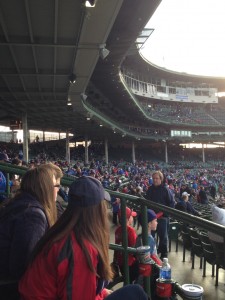 Two years ago, I was able to add three new ballparks to my list on a West Coast book tour: SafeCo, Pac Bell (or whatever it’s called now) and the Big A. This time around, I’ll be able to add four — O.co Coliseum, Chase Field, and Minute Maid Park. And Wrigley Field. (The Cardinals are in Atlanta right now, alas.) Two years ago, I was able to add three new ballparks to my list on a West Coast book tour: SafeCo, Pac Bell (or whatever it’s called now) and the Big A. This time around, I’ll be able to add four — O.co Coliseum, Chase Field, and Minute Maid Park. And Wrigley Field. (The Cardinals are in Atlanta right now, alas.)
I had to look up the names of the first three parks, because I couldn’t remember what they were called now, given the ebb and flow of corporate deals. (And I won’t commit the current names to memory, for the same reason.) But Wrigley Field? Not a problem. It’s only been called that since my late grandfather was a teenager. (Speaking of which, here’s Greg’s take.)
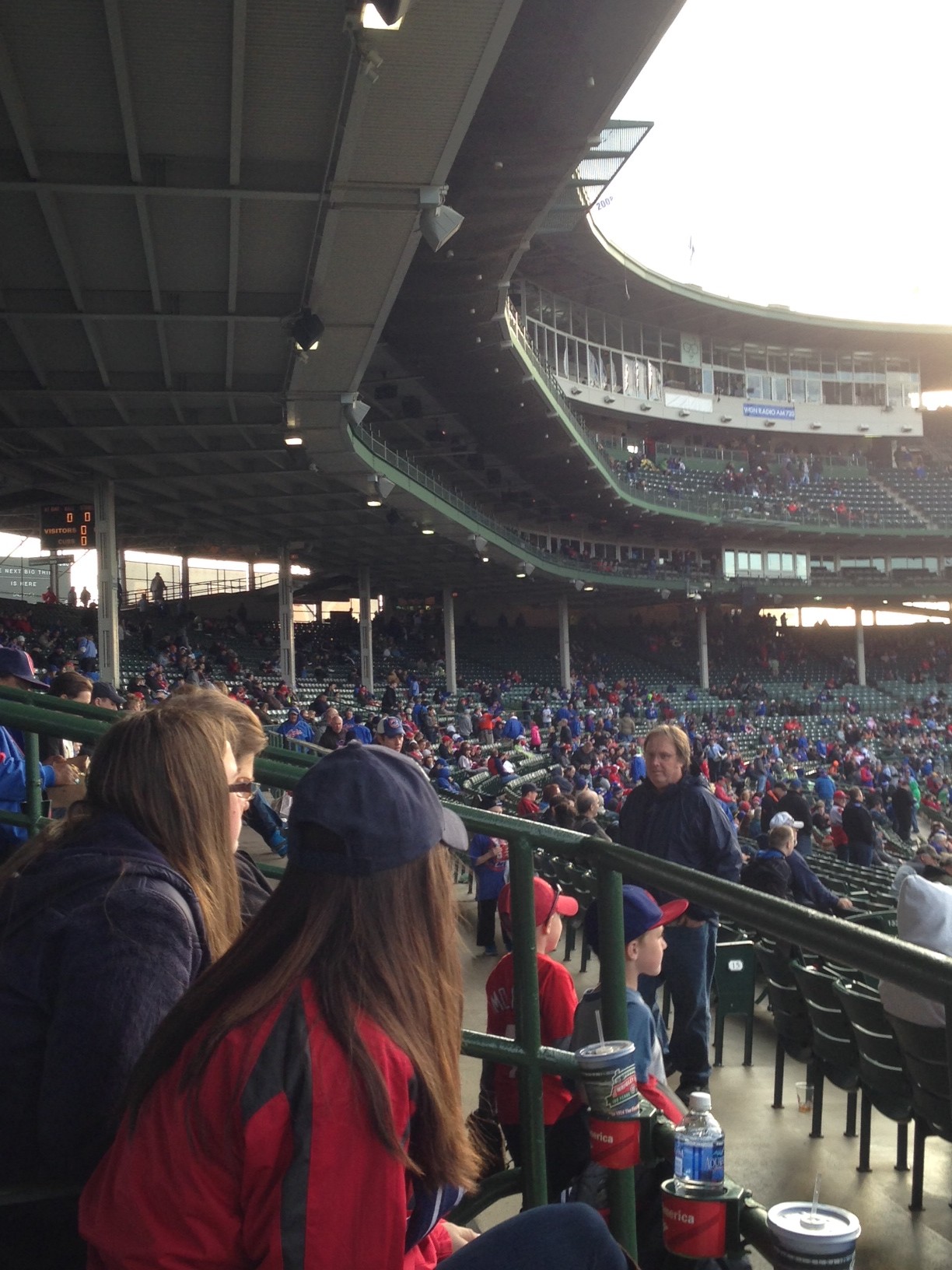
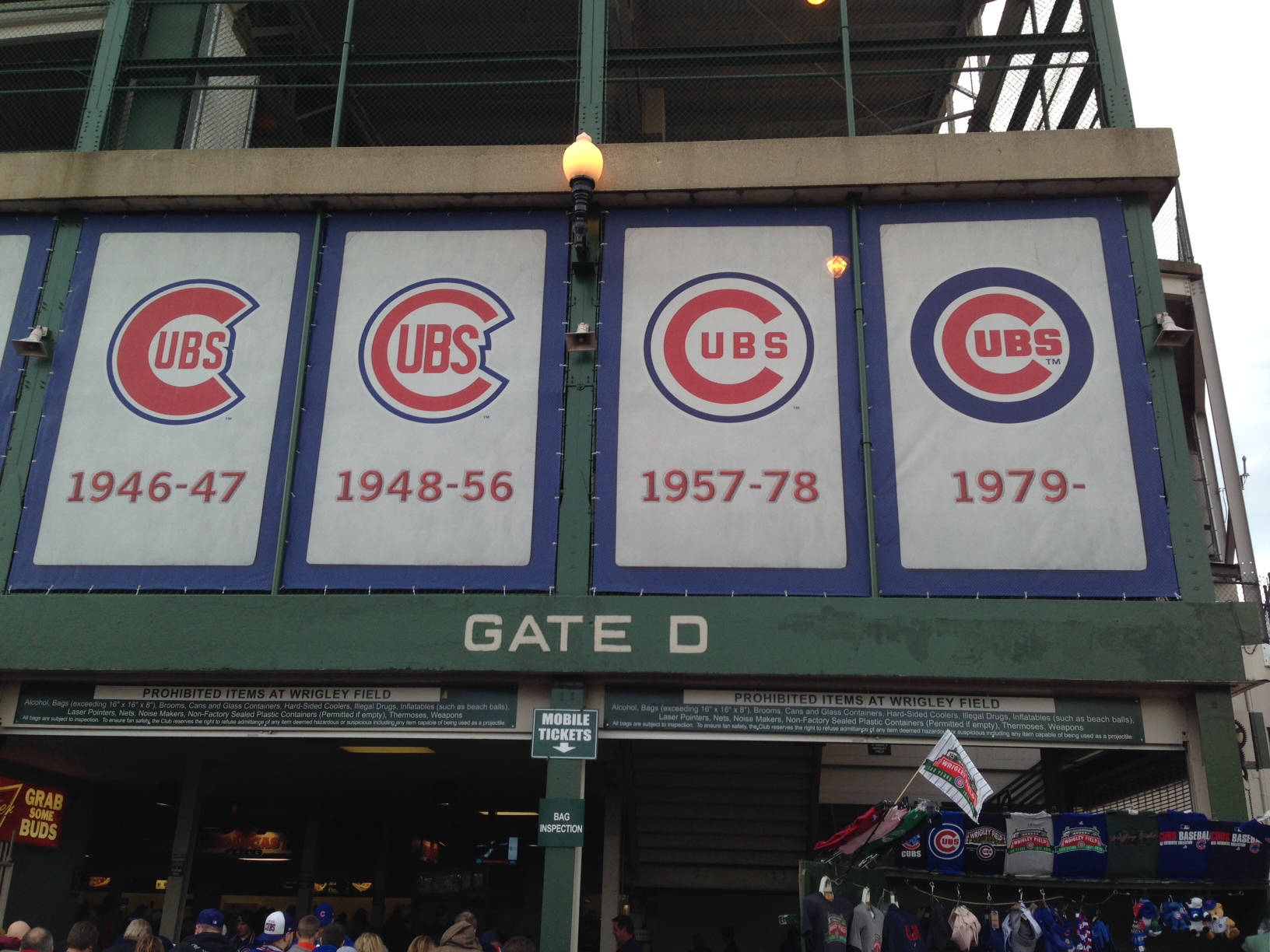
I finally got there on Sunday, for an ESPN game against the Cardinals, with both teams sporting gorgeous throwback uniforms and wearing their socks admirably high. I arrived on the el and followed the hordes, and then something odd happened … I didn’t want to go in. Instead, I took a lap of the ballpark, looking happily at the statues and the bricks and the packs of Cub faithful and the knots of Cards rooters. I knew about all this, of course, but actually seeing it up close was different — it was actually real, and I would finally get to be a part of it.
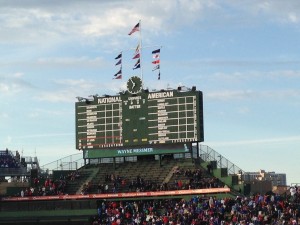 You can feel the age of Wrigley — in its slightly rounded bricks, the way it’s tucked into the cityscape without the scent of a committee designated to produce “quirkiness,” in the concourses that seem drab when we really should think of them as utilitarian — because who cares what’s backstage at the opera? Walking in at last, I kept remembering that Brooklyn once had a twin to Wrigley — Washington Park, the home of the Federal League’s Brooklyn Tip-Tops, now reduced to a wall of a Con Ed facility. You can feel the age of Wrigley — in its slightly rounded bricks, the way it’s tucked into the cityscape without the scent of a committee designated to produce “quirkiness,” in the concourses that seem drab when we really should think of them as utilitarian — because who cares what’s backstage at the opera? Walking in at last, I kept remembering that Brooklyn once had a twin to Wrigley — Washington Park, the home of the Federal League’s Brooklyn Tip-Tops, now reduced to a wall of a Con Ed facility.
I settled into my seat, happy to note that both seats and aisles were sized for plush-bottomed moderns and not the apparently rail-thin go-getters of the Gilded Age. (See Fenway Park.) Things got off to a poor start when I got a brat downstairs whose color should have warned me it wasn’t food; beneath its congealed surface things would squelch and squirt, making for a gustatory event that rivaled an outtake from Alien. That wasn’t fun, though later I had a Vienna dog that was completely delicious, and which I festooned with unlikely toppings by copying the guy in front of me. (Though not tomatoes. Ewww.)
I say the Vienna dog was delicious, though possibly the truth is more that by then I was drunk.
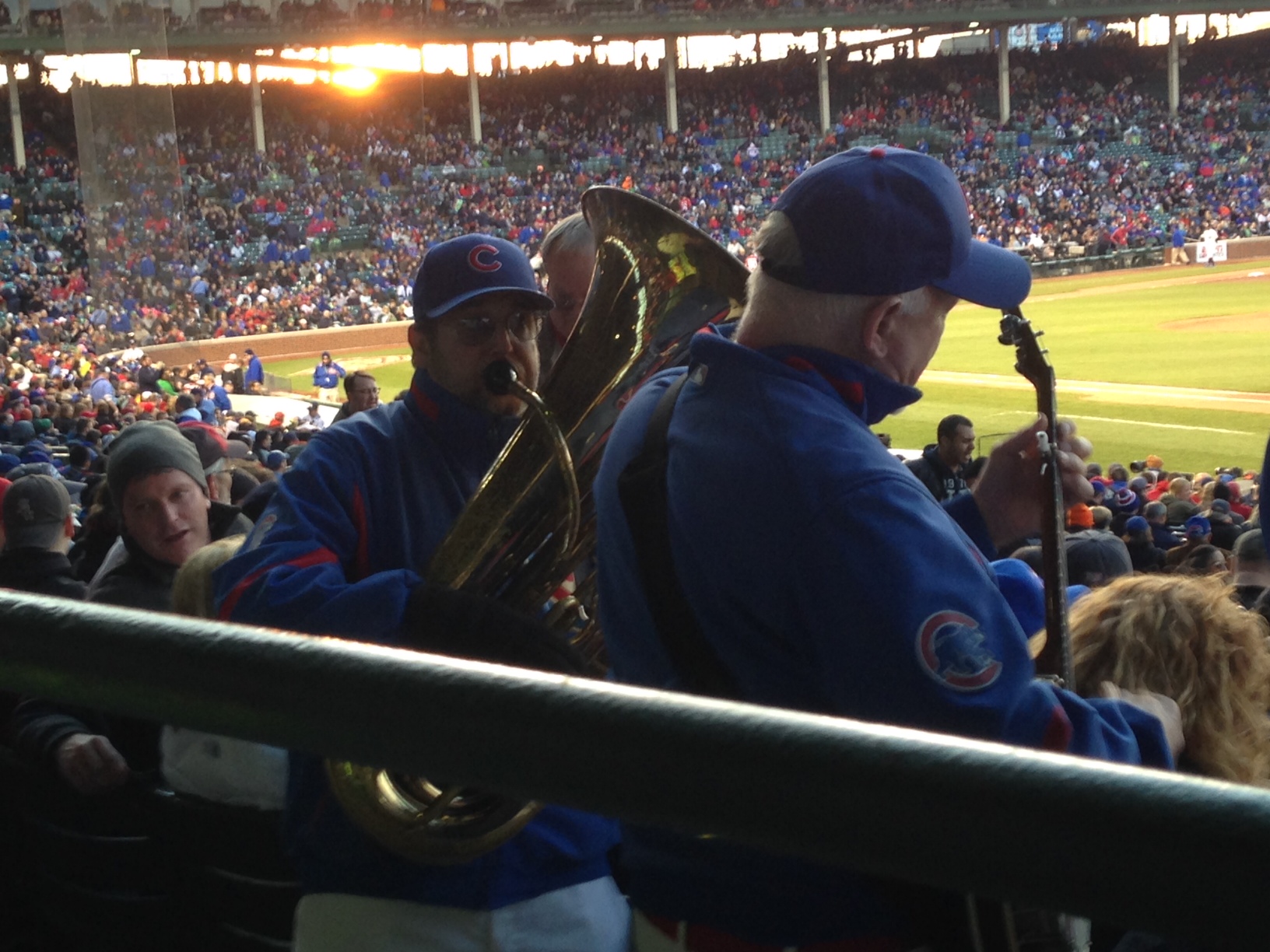
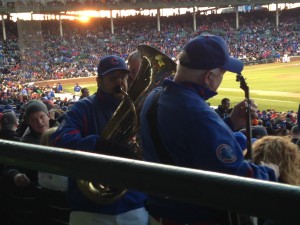 Anyone who wants to consume an enormous quantity of beer in Wrigley but fails is either an invisible mute or pathologically shy — Wrigley has an endless parade of vendors hawking raffles, beer, hot chocolate, beer, hot dogs, beer, beer and (yes) blankets. But it’s a cheerful procession. I got a ringside seat for the Cubs Dixieland Band, and then poked around the other sections of the park while the Cubs were doing inept things out there. Anyone who wants to consume an enormous quantity of beer in Wrigley but fails is either an invisible mute or pathologically shy — Wrigley has an endless parade of vendors hawking raffles, beer, hot chocolate, beer, hot dogs, beer, beer and (yes) blankets. But it’s a cheerful procession. I got a ringside seat for the Cubs Dixieland Band, and then poked around the other sections of the park while the Cubs were doing inept things out there.
There wasn’t much to find, and that’s not meant as a criticism at all. I get the need for suites and distractions for the non-baseball-inclined. I like that Citi Field has urinals instead of troughs I suspect were borrowed from Chicago’s famous slaughterhouses. Wanting to eat good food that goes beyond dogs and pretzels isn’t a badge of shame for a baseball fan. But Wrigley partakes minimally in all such modernity — not so much by way of rejection as because it was built baseball eons ago, when the game was the thing and everything else was just supporting infrastructure. Which bores me as a cri de coeur but made me happy as an onlooker. Were things better a century ago? No. That’s silly, in fact — but you can feel that way and still think that the way they do things at Wrigley Field is somewhere between perfectly all right and awesome.
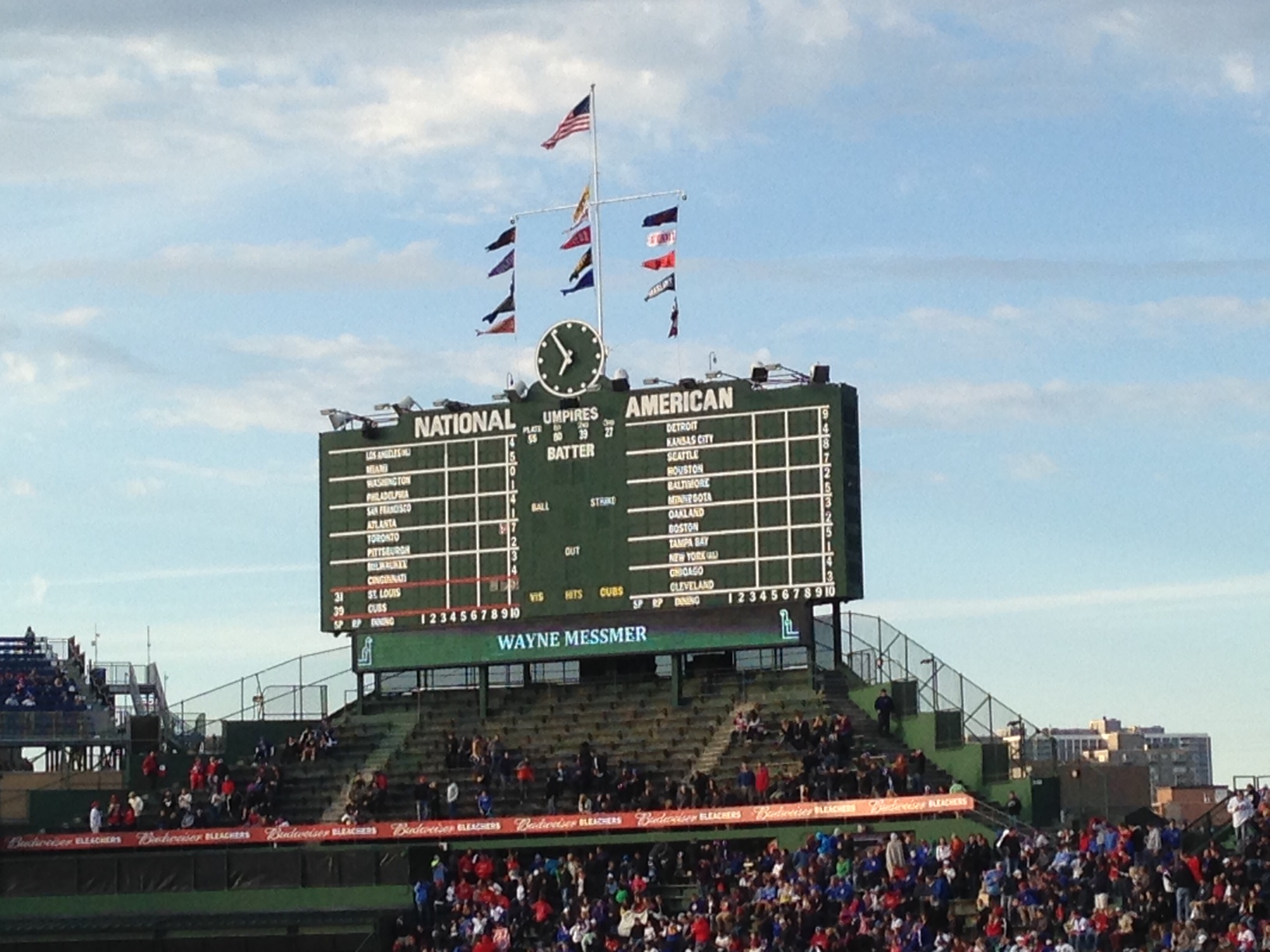
Wrigley has tacked on a few things — in the upper levels a little warren of tunnels leads you to a huddle of ATMs and a largely unoccupied cocktail deck — but you can tell they don’t mean it. You get beer or purge yourself of former beer and get back to your seat, to look at the ivy and the way the bleachers rise to the scoreboard like a prow of a great ship and to hope the Cubbies can escape the inevitable this time. It’s simple. And it’s pretty great.
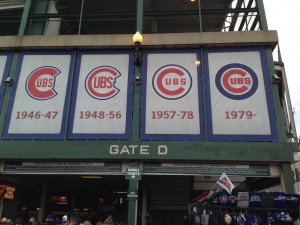 Not speaking of pretty great, oh the Cubs. I wound up sitting next to four Cubs fans in their mid-twenties, who were drinking heavily but remained perfectly affable throughout, razzing the married Cardinals fans next to them in a way that never departed from good-natured. The park was about 30% Cardinals rooters, but I didn’t see any disputes, something I attribute less to Midwestern manners than to the current state of baseball affairs. The Cardinals are a baseball machine, while the Cubs are so obviously and utterly dismal that it’s impossible to woof about them. Not speaking of pretty great, oh the Cubs. I wound up sitting next to four Cubs fans in their mid-twenties, who were drinking heavily but remained perfectly affable throughout, razzing the married Cardinals fans next to them in a way that never departed from good-natured. The park was about 30% Cardinals rooters, but I didn’t see any disputes, something I attribute less to Midwestern manners than to the current state of baseball affairs. The Cardinals are a baseball machine, while the Cubs are so obviously and utterly dismal that it’s impossible to woof about them.
The Cubs fought back in this game, but then Yadier Molina ambushed them for a two-run lead with a single that bounded inevitably up the middle. In the bottom of the ninth the Cubs drew within one, and were a lousy single away from tying it. Wrigley came to life with frantic, happy noise. I say happy, and it really was — even though as Anthony Rizzo strode to the plate it was clear to me, the quartet of Cubs rooters, the Cardinals pair, the vendors, the ushers, God and everybody else that he wouldn’t get it done, which he did not. The criticism of Wrigley is that it’s become a museum, where people’s happiness about the setting leads them to accept mediocrity at best. And I can see that. But what a museum!
And I liked my seatmates. I really did — they were doomed and funny and brined in irony. But this wasn’t the cheap irony that’s the coin of today’s shambolic realms. They’d earned it — they knew their baseball, and they knew what was coming because of history, not posturing. The guy next to me talked briefly about the Cubs, about his father and his grandfather and how they’d given up but kept coming, which meant of course they hadn’t given up … at which point he trailed off with a shake of his head. I didn’t know — my team won it all when I was 17, while no living person can remember a Cubs title — but I could guess.
Wrigley is wonderful. One day, the Cubs really will stop being the Cubs. I hope they’ll be at home when it happens. Oh my but it’ll be glorious.
by Greg Prince on 6 May 2014 1:17 am Monday’s was the kind of Mets game Don Draper would have snuck out of sober so he could get back to the office and knock out those 25 Burger Chef tags for Peggy.
It didn’t start out that way, which of course is the most generous clue that it was going to end that way. Maybe that trajectory wouldn’t seem so predictable if the venue had been Don’s beloved Shea Stadium or the Marlins’ previous home that went by many names (but we knew what it was) or even Hiram Bithorn Stadium, the cameo site of the Mets’ second of now eight walkoff losses to Florida/Miami in this decade. Monday’s game, though, took place inside the Loriatorium, the lime green vice where Met hopes go to first get squeezed and then get crushed.
What does Gonzalez Germen have in common with Frank Francisco, Manny Acosta, Collin McHugh, Shaun Marcum and Brandon Lyon, other than all of them would have been better bets than Daisuke Matsuzaka in the eighth? Each man is a member of the Marlins Park Clean Plate Club, for each has thrown a pitch that resulted in every Marlin descending clean onto home plate in groan-inducing celebration of a sudden-death Met loss. As the pieces were settling into place for this latest coming-out party — Christian Yelich shooting one up the middle to lead off the least suspenseful bottom of the ninth in human history — Terry Collins emerged to make the pitching change that would usher Germen into this ever-expanding fraternity of futility. The SNY cameras captured him nodding to umpire Bill Miller as he trotted toward the mound. I really hoped the nod was his affirmative answer to the question, “Are you just going to forfeit right now and thus spare the True New Yorkers back home the sight of another of those irritating Marlin conglomerations after somebody inevitably drives Yelich in?”
Not to be pessimistic, mind you. That was the thing. I wasn’t pessimistic for the first seven innings. I started out buoyed by Daniel Murphy’s first home run of the not so new year and elevated my mood further when Curtis Granderson (now batting .185, just .007 behind Ruben Tejada) chipped in with his third dinger of 2014. I shifted into deceptive calm as the evening went along, as if I really believed Jon Niese’s no-frills mastery of the Marlins would inoculate us against the darkness that lurks in the hearts of Fish when the Met bullpen gate eventually opens.
Niese was nice. The Mets led 3-0 for seven full innings. Combined with Dillon Gee’s performance Sunday, I got to thinking how the growing pains of Wheeler and Mejia and the physical inertia of Colon have something of a built-in antidote. On the pregame show, I heard Gary Apple refer to Gee and Niese as “veterans,” and it struck me, yeah, they really are. Not Colon-style veterans of ancient battles and all-you-can-eat buffets, but guys who’ve been around the block enough to know what they’re doing yet not so often that they’re no longer a dependable bet to do it most every time out. Gee’s 28. Niese is 27. The Mets have cultivated pitchers who’ve reached their primes in solid working order.
Imagine that.
I imagined Niese’s seven frames of five-hit, one-walk ball was the stuff of a two-game winning streak in the making. I wasn’t even troubled by the Mets having collected only one run between the top of the second and the top of the eighth, because I wasn’t watching this game with my official Marlins Park glasses. Once I put them on in the bottom of the eighth, however, I could see what was coming from a lime green mile away.
 Miami never looks good to the visiting Mets. Look! It’s Daisuke Matsuzaka!
Look! Dice-K walked the first guy he faced!
Look! Dice-K walked the next guy he faced!
Look! Giancarlo Stanton is up!
You might have seen a three-run homer coming next, but that would have been too quick and too mundane. Stanton got his hit, of course, but it drove in just one run. To spice things up, a ball would have to be struck more or less right at Omar Quintanilla, but not exactly at Omar Quintanilla. There’d be an error on Quintanilla, another run, then another hit and yet another run. The 3-0 lead had methodically melted into a 3-3 tie.
Kyle Farnsworth came in and didn’t implode, leaving matters tied. The Mets came up in the top of the ninth and went down inside of three batters, though not without a dash of flair. Travis d’Arnaud took strike three on a full count as prelude to Lucas Duda getting caught stealing. Duda, running at Colon speed, was out by a lime green mile.
The rest was another Loriatorium Last Act, predictable in destination even if you couldn’t quite map the journey in advance.
Rice gives up a sharp single to Yelich. Rice departs. Germen enters. Ed Lucas lays down the bunt that moves the Christian gentleman to second. The bat is out of Stanton’s hands as Collins orders him intentionally walked. The bat lands in the hands of Casey McGehee, who makes optimal use of the superfluous letters in his last name. McGehee was the Marlin who hung the ‘E’ on Quintanilla in the eighth. Now, in the ninth, he banks an ‘H’ off Germen’s leg and into right field. (To be fair, it was ticketed for center if Gonzalez hadn’t put a limb in its path.) Yelich comes around to score and the Marlins hug and frolic and shower and change into collared shirts and receive VIP treatment at Marlins Park’s glamorous Clevelander night club where they dance the night away in triumph.
The Mets are denied entrance and remain stuck behind the velvet rope as of this writing.
by Greg Prince on 5 May 2014 1:51 am For a pleasant change, Bichette didn’t happen to the Mets on Sunday. Unlike the first three games of their just-contested four-game in Denver, the Rockies didn’t crumble all over our starting pitcher. Our starting pitcher was Dillon Gee. While other Mets starters have seen their best days or are no doubt striding toward them, Dillon is experiencing them right now. Unlike his colleagues Colon, Wheeler and Mejia, he knows how to get through a fifth inning every time. He’s gotten way better at the sixth as well, which is an enormous help for a team that’s been tapping its closerless bullpen a little too much for comfort.
Saturday, Kyle Farnsworth’s final pitch landed in the distant shrubbery. Sunday, by contrast, everything landed beautifully…and I mean my version of everything.
• First, the Brooklyn Nets do what they hadn’t done in the seventh game of a postseason series since 1976 — and the Mets haven’t done in such a situation since October 27, 1986 — and win.
• Then, Gee leads the Mets into the seventh (inning) en route to a largely stressless 5-1 victory.
• Finally, on Mad Men, Don Draper discovers the late Lane Pryce’s beloved Mets pennant, affixes it to its place of honor on the office wall and drunkenly invites Freddy Rumsen to Shea, serenading him with a round of “Meet The Mets” when Freddy drops by to pick/sober him up.
It’s 1969 on Mad Men at the moment. May it be 1969 in modern Met-aphorical terms real soon.
If there’s a flaw Gee shares with every Met pitcher on staff, it’s the total and complete inability to hit. With his three at-bats producing no more than one solid out, the arms that are compelled to intermittently swing between throws are a combined 0-for-51. Gee’s turn to represent the hitless wonders didn’t by any means kill the Mets, but it’s embarrassing on principle.
National League baseball, fellas. Everything everybody does counts.
With that public service announcement brought to you by Citizens Forever Against The Designated Hitter made, we will gladly note that those whose primary job is hitting did hit. Juan Lagares singled twice and doubled once. Of course he did; he’s Juan Lagares. Daniel Murphy didn’t make with the swift baserunning early (tagged up hesitantly in the first, got himself Arenadoed at third) but his pair of hits, his run scored and his RBI forgives that little flareup of his inherent Murphness. David Wright didn’t homer, which sadly gets filed alongside dog bites man under events that aren’t earth-shattering, but his ringing double off the wall indicated he’ll someday soon put a ball over some fence somewhere. And, ladies and gentlemen, Curtis Granderson has crept to within .019 of Ruben Tejada’s batting average, trailing our potentially adequate shortstop .192 to .173. Neither gentleman is messing with Mario Mendoza’s meal money yet, but just you wait.
Don’t wait too long, though. The Mets return to the scene of the crime Monday night. They play at Miami, where their dignity was repeatedly stolen from them in 2013. You know how the Marlins were stupendously awful overall yet surprisingly competent against the Mets? There were nine games played between the rivals at the Loriatorium last year and the Miamians boosted six of them. (You were going to guess it was something closer to Marlins 20 Mets 0, weren’t you?)
There was some encouraging threshing of Fish at Citi Field recently, but don’t be lulled. The Marlins are about as good as the Mets to date in 2014. Actually, each combatant in the division is about as good as its competition. The N.L. East is smushed together within one-and-a-half games of itself. The Braves have been losing, the Nationals have been middling and the projected also-rans have been — depending on your perspective — encouraging or irritating in exceeding expectations. Your third-place Mets are a game from first and half of that from last. What makes the Marlins dangerous in the near term is they’ve been hellacious at home (14-5) and Giancarlo Stanton has been Giancarlo Stanton. The good news as we encounter a hot team? I count two items: Jose Fernandez won’t be phenoming against us — and there’s never a bad time to make a statement.
Does beating the Marlins in May in Miami qualify as a statement? All sorts of things needs to be stated at all intervals of the schedule. If the Mets are successful in this impending three-game series, we may not look back on it as a turning point toward winning, but you know if they find ways to not beat the Marlins in May in Miami, there’s a strong probability we’ll look back on it as a turning point toward losing.
I know a basketball team from a neighboring borough that has business in Miami this week, too. The Mets can set a fine example for the Nets, who earned themselves a date with the Heat after fending off those pesky Raptors. Then again, the Nets swept the Heat during the NBA’s regular season, so they’ve already set a fine example of how to make the most of visits to South Florida.
Let’s Go Mets. Let’s Go Nets. Let’s get Don off the bottle and out to Queens for a ballgame real soon.
by Greg Prince on 4 May 2014 10:47 am No matter which hitters constitute the heart of the Colorado Rockies order in a given series when the Mets play in Denver, the most daunting presence in the home team lineup remains Coors Field. The 20-year veteran may not intimidate in the fashion it did when it was a brash rookie, yet you can never completely shake the lurking sense of dread that if you give this ballpark the chance to beat you in the late innings, it will.
Though every stadium the Mets visit is bound to evoke its own singular set of deep-seated horrific memories (Angel Hernandez quite clearly on the take behind the plate at Turner Field in 1998; Jimmy Rollins going 12-for-12, more or less, on getaway day at Citizens Bank Park in 2007; Jeremy Reed throwing a mile past home while manning first at Dodger Stadium moments after Ryan Church’s foot couldn’t find third as 2009 descended definitively into the fiery pit of Hades), with Coors Field, everything always resets in my mind to the very first game.
April 26, 1995: both the ballpark and the season were brand new. Both were sights for baseball-deprived eyes. The long strike of 1994-95 had been settled only after the farce spring of replacement exhibitions had worn our faith in humanity down to the nub. There would be just 144 games to the upcoming schedule, but the first two for the Mets would be in this gleaming jewel of a throwback. Coors Field was the National League’s first so-called retro park, a mold-breaker along the lines of Camden Yards, Jacobs Field and the Ballpark in Arlington. When you considered how rabid the fans of Colorado had been when their expansion team played at Mile High Stadium and then combined that passion with the beauty of a cozy, old-fashioned, baseball-only playpen, well, you couldn’t believe how lucky the Mets were to be the first team to come to bat there.
Fourteen innings later, you discovered the flaw in the design of Coors Field, namely that the Mets didn’t get to be the last team to come to bat there.
• Dallas Green’s scrappy pups fell behind, 5-1, in the fifth but Todd Hundley launched a grand slam to tie it in the top of the sixth.
• The Rockies scored a run to go ahead in the bottom of the inning.
• The Mets grabbed a 7-6 lead in the top of the ninth on Bobby Bonilla’s RBI single.
• The Rockies scored a run to tie it in the bottom of the inning.
• In the top of the thirteenth, Jose Vizcaino drove in Brett Butler from second on a base hit to put the Mets up, 8-7.
• The Rockies scored a run to tie it in the bottom of the inning.
• Come the top of the fourteenth, Joe Orsulak doubled to left to bring home Ricky Otero and the Mets held a 9-8 lead.
Guess what happened in the bottom of the inning.
Bichette happened. An overgrown Cody Ross who called himself Dante Bichette — pumping his obnoxious fist in instant triumph — belted a three-run homer that soared far above Otero’s head and landed in a nearby mountain range, winning the game for the homestanders, 11-9, and giving birth to the most haunting maxim in American sport:
No lead is ever safe at Coors Field.
Not the three different one-run leads the Mets gripped on Opening Night 1995;
Not the 6-0 advantage Jenrry Mejia was seemingly cruising aboard in the fifth inning Saturday night;
And not the hard-earned 10-9 edge the Mets took into the bottom of the ninth long after Mejia gave up eight in the fifth to shove the Mets into a Bichette-sized hole.
What appeared to be shaping up as a rare 2014 Mets romp had become a 1995-style nightmare, yet it was on the road to redemption, fueled by the kind of gumption that would have made my main mid-’90s man Joe Orsulak proud.
It was in the top of the ninth that Bobby Abreu lumbered off the bench with one out to face LaTroy Hawkins for only the sixth time in a pair of careers that stretch back to the Orsulak Era. Good old Bobby (40) got the best of good old LaTroy (41) and doubled to left. Abreu was exchanged at second for Eric Young, Jr., the pinch-runner whose namesake father drove in a go-ahead run against Mets lefty specialist Eric Gunderson as a pinch-hitter when Coors Field was all of six innings old on 4/26/95. The younger Young proved fast and wily enough to take third on Josh Satin’s groundout to Nolan Arenado, whose first name I mysteriously decided was Nelson — like Casey calling for one Bob Miller or the other, I suppose — but, in light of the platinum-level glove he employs, might as well be Andrelton.
Throughout this series the Mets had been failing to cope with the rockets hit at or by the National Arenado and Space Administration. When he wasn’t robbing Chris Young (no relation to anybody as far as we know), he was mauling Mejia. Nolan’s fifth-inning grand slam was the jolt that sent Jenrry’s hair really flying out from under his cap. Arenado, Blackmon, Tulowitzki, Gonzalez…a humidor may have been installed at Coors Field to keep baseballs from acting unnaturally up, but these were the new Blake Street Bombers in the Mets’ midst. Once the fourth became the fifth, what with Ryan Wheeler leading off with a homer to make it 6-1, Jordan Pacheco singling to reset the table and everything immediately unraveling in a blur of bloops, bleeders and blasts, Mejia might as well have been taking on the reincarnations of Burks, Walker, Gallaraga and Castilla.
But even as the home side was lighting up the scoreboard like something out of a Pacheco Palace, the Mets kept fighting back admirably: first from 8-6 to tie it at 8-8 in the top of the sixth, then from 9-8 to make it 9-9 in the top of the eighth. Save for their historically futile swinging and missing pitchers (0-for-48 this year and counting), the Mets were honest-to-god hitting for once in their lives. Abreu’s double was the Mets’ fifteenth hit of the evening. Juan Lagares — who could conceivably go into the defense contractor business with Nolan Arenado and Andrelton Simmons and keep America secure for a generation — registered the sixteenth when he singled to plate Eric Young, Jr., with the run that put the Mets up, 10-9. Daniel Murphy made it seventeen Mets hits on the night, and the bases eventually loaded up for Chris Young, but Hawkins found his way out of trouble and gave the Rockies a chance to come back in the bottom of the ninth.
Of course they had a chance. They got to bat last. Batting last is the Rockies’ most potent offensive weapon. No less an authority on analyzing defeat than Terry Collins referred to Coors Field as “a park that’s known for getting your last at-bat. The last team that gets up can be the most dangerous.”
By the accepted rules of baseball, the last team that gets up at Coors Field is inevitably the Colorado Rockies. And inevitably the Colorado Rockies have Dante Bichette waiting for Mike Remlinger. Doesn’t matter that the Met closer nineteen years later was Kyle Farnsworth or that the batter who strode to the plate with a runner on second was pinch-hitter Charlie Culberson. Charlie Culberson was going to hit the home run that beat the Mets on a night like this, 11-10.
Why was it plate accompli that Culberson would successfully scale Mt. Farnsworth? Because sooner or later Bichette happens to the Mets at Coors Field. It just does.
by Greg Prince on 3 May 2014 3:24 am When I was a newly minted sophomore, I indulged my small extrovert streak and went out for a part in my high school’s Theatre Wing production of Heaven Can Wait. I read for the second lead of Mr. Jordan, but wound up with the far smaller role of Inspector Williams. I wasn’t much of a tenth-grade actor, yet when you put a suit on the 15-year-old version of me, I had a knack for appearing middle-aged. I played a series of police inspectors, senators and doctors during my brief scholastic dramatic career. If the suit fit, I wore it.
No matter that I was more utilityman than star. I was in the play. I was also in the stage crew, something I had no particular predilection for. If I wasn’t an actor by nature, I really wasn’t a handyman in any sense of the phrase. I wasn’t good at building things and I wasn’t good at moving things. I had no eye for where things went. I didn’t like tools and tools didn’t like me. But my best friend from junior high decided he wanted to be in the stage crew when we got to high school and I liked being able to hang around with somebody familiar to me, so I opted to pull double-duty.
Acting I could fake my way through (it was acting). Stage crew I was largely useless for, but I hung in there with it for however many weeks my friend remained interested. I was impressed by the job the rest of the crew was doing even if I wasn’t much of a factor in its incremental accomplishments. After a couple of afternoons of attempting to not get in the way of those who knew what they were doing with a hammer, I could see the outlines of a set coming together. I was so proud of the work to which I was nominally contributing that I suggested that night at rehearsal to our director — a very, shall we say, theatrical English teacher by day (when the kid playing Mr. Jordan suffered an injury, he cast himself as second lead) — that the stage crew was making terrific progress and fairly soon, we’d be ready to start painting.
Our director, for whom Heaven Can Wait was his umpteenth rodeo, stared at me in disbelief and informed me, “There’s a long way to go before we can start painting.”
Y’know what? He was right. And y’know what else? There’s a long way to go before the Mets can start acting indignant that every seat in their theater isn’t being filled.
They’ve begged our patience for too many years to grow antsy that they can’t move more inventory after a few weeks of solid baseball. The solid baseball is most welcome. It was so solid pre-Coors Field that I’m willing to chalk up the second consecutive messy loss at high altitude as just another of those things that materialize out of thin air. Besides, Juan Lagares is back with such force that I’d suggest officially redubbing this outfit Juan Lagares & the New York Mets, except that would probably rub at least a few of his 24 supporting players the wrong way. Plus Juan might think about going solo.
Anyway, decent start to the season 28 games in. Maybe not terribly sustainable. Or maybe sneakily sustainable. Hell, Curtis Granderson now has a second home run and a batting average (.156) that can no longer be mistaken for a Field Level seating section. With 95.67% of his contract remaining to be played out, we might eventually have something to connect him to besides his miserable April and whatever he said when he came aboard the good ship Metropolitan.
Granderson’s employers must’ve been really enamored of that business about “true New Yorkers” being Mets fans last December. They’ve produced apparel with that message, available in the Citi Field team store, and now, as you might have noticed, they are e-mailing people who are presumably Mets fans to urge them to declare that they are definitely Mets fans… or “True New Yorkers” in the Grandersonian dialect.
The come-on is very weird, and that’s grading on a steep Metsian curve for weirdness.
After adhering to a strict policy of paying minimal homage to their past, the Mets have scanned the signatures of ten Mets players associated with more successful times and pasted them to the bottom of an open letter that reads like a cry for help. They couldn’t be bothered to reunite the surviving Mets of ’62 or ’73 on their respective 50th and 40th anniversaries, but at least they gathered these guys together on a virtual page.
The message? “Update your contact information so you can be sent more commercial e-mails from mets.com and mlb.com” is implicit. The prize of two tickets to the May 14 game against the Yankees — complete with the honor of presenting Internet signatures to David Wright — is fine enough, though the sweepstakes aspect seems secondary here. The consciousness-raising of Mets fans who might be dismayed that, according to published reports, there aren’t more Mets fans amounts to an unbecoming pile of insecurity.
Somebody had a meeting and determined Mets Fan Equity lies dormant in the True New York State of Mind and the Mets marketers decided they’d be damned if they couldn’t rile it up through emotionally manipulative cues:
• “We made history together…”
• “Stand up and say you’re a true New Yorker.”
• “…players and fans together, believing in each other…”
• “We couldn’t have won without you.”
The stilted missive raises more questions than it answers…
Is there a Mets fan who hasn’t spent a lifetime feeling Met-symbiotic already?
Do the Mets not understand that this is the way a Mets fan thinks most days?
Why would I feel the need to tell the Mets I’m a Mets fan?
Putting aside the Kabuki of filling out required fields, adding an optional 50-character maximum message and showing some unspecified straw men that, gosh darn it, I believe…what is the purpose of this?
I get the purpose from the Met management side. Harvest fresh e-mail addresses. Guilt us into buying more tickets for the provisionally uplifting 2014 Mets — “We’re calling on you to give today’s club the same chance we had.” And maybe sell a few of those “True New Yorker” t-shirts that I haven’t seen worn by anybody in any of my six trips to Citi Field thus far this season. But other than the minuscule shot I would have of winning admission to the no-longer hot Subway Series and shaking Captain Wright’s hand, why would I, your average fan, feel the need to affirm a blue-and-orange oath upon a stack of revised Mets yearbooks?
With all love and respect to the vintage Mets who assure me I “have a role to play in making amazing things happen,” if this franchise doesn’t know us by now, it will never, never, never know us.
Want our loyalty, our allegiance, our Trueness? Play hard right now, improve the product as soon as possible and win like you did we looked for Ed Charles’s name on poetry rather than form letters. We’ll be there. We’ll be so present you’ll be tempted to nudge us along because Citi Field will be like a midtown coffee shop at lunch hour and you’ll need our table for those new customers lining up by the cash register.
The first line of that letter is a hoot: “The victory you earn is sweeter than the victory you’re given.” What have you, my dear Mets, done to earn our loyalty lately? 15-13 is swell, but come now. Surely you know we give you our loyalty. We gave it to you ages ago and you’ve been enjoying its residual payouts ever since. Don’t like the diminishing returns? Invest a little on your end.
We’ve met you more than halfway over this past half-decade. Now it’s your turn: continue to shape a production we swear by instead of at and don’t automatically expect us to storm the box office before the sets are truly ready to be painted. In other words, keep getting better. That will earn you so much goodwill that you can send us all the silly e-mails you want and we won’t be tempted to unsubscribe.
by Jason Fry on 2 May 2014 2:08 am Well, here’s another 2014 first: the first game that made you want to discover the ability to reach into your TV and smack Mets several time zones away.
This was the game I’d feared the Mets would play on Tuesday in Philadelphia, and was pleasantly surprised to be wrong about: a dead-eyed, slumbering, miscue-filled mess. Every team has a dozen or so of these a year, and it’s better just to avert your eyes and move on as quickly as possible. And so that’s what we’ll do, after a few pro forma observations:
- Sympathies that the Mets sat around in Philadelphia and then flew out at an ungodly hour, arriving in Denver at 5 a.m. But since the game was an early evening affair in Colorado, why the heck didn’t they stay in Philadelphia and leave in the morning? Size of the party to be accommodated? Sleep isn’t necessary for #TrueNewYorkers? EY Jr. knew this awesome breakfast place in Colorado Springs?
- Welp, when Bartolo Colon is bad, he doesn’t pussyfoot around, does he? He’s all-in bad.
- Nice to have Juan Lagares back, who looked as if he’d never left. Can the idea that Eric Young Jr. is anything more than a bench player please progress as soon as possible to the “polite fiction” phase?
- Besides Lagares, Travis d’Arnaud gets a pass for a bolt into the left-field stands that was a no-doubter in any park. Lipstick on a pig, to be sure, but any step in d’Arnaud’s development is something to applaud.
- Keith was a little dull himself tonight, though his ninth-inning fuming about Digger, the Rockies’ annoying mascot, was entertaining. (Oh wait, it’s Dinger. Not that I give a shit.)
Let’s see … that’s 317 words more than I wanted to write about this mess and you wanted to read. Lagares and d’Arnaud, you’re excused. The rest of you fellas take a lap.
Or better yet, go back to sleep.
by Jason Fry on 30 April 2014 1:13 am In recent history, the Mets haven’t led the league in much, but they’ve been a powerhouse when it comes to excuses.
Terry Collins would always sound philosophical when he noted the conditions, the weather, the late arrival, the flu, or whatever bogeyman had snuck in to sink its teeth into the Mets. It was never quite an alibi — more something Terry was noting in passing. But it grated nonetheless, because what never seemed to get discussed was how the other team had also been dealing with poor conditions, cold weather, the flu or whatever malady was at hand — none of which had prevented them from beating the Mets rather handily.
So I approached tonight’s inaugural throwdown with the Phillies with a certain dismay. It was a wretched night, rainy and packing the kind of damp chill that gets into your bones, with both the seats at Citizen’s Bank and the virtual amphitheater of Twitter all but empty. (Something to do with Rangers-Flyers, I guess.) But the Mets seemed to collectively shrug and get to work on old pal Cole Hamels, who was armed with nothing but his change-up. They worked counts and waited for fastballs they could serve over the infield, cornering Hamels until that ineffective pitch was his only option. The display of patience culminated in a three-run fifth, with the crowning blow a single by Ruben Tejada after Ryne Sandberg tried to coax one more batter out of Hamels than he was capable of. After that the Mets had an official game and the Phillies seemed content to get on with it and wait for a sunnier rematch. Which will take a while — tomorrow’s weather forecast is Biblical, with the chance of a game being played essentially 0%.
It was a messy affair from the get-go — early on a hapless ballgirl set the tone by pulling her stool out of the way of a Tejada double off the sidewall, then inexplicably trying to field the ball she’d just tried to avoid.
Well, messy except for Jon Niese.
Niese is far from my favorite Met; he gives the impression that he’s only minimally interested in the craft of pitching or anything else happening around him, which I find deeply annoying. But he was terrific today, maintaining his focus in horrific conditions while Hamels came unglued. (It’s not the first time — Niese has been good pitching in high winds at Citi Field and in Minneapolis and Denver starts that might as well have taken place in a walk-in freezer.)
It was an awful night to do anything, let alone try to play baseball. And only one team seemed ready to do that. For a change, that team was the Mets instead of their opponents. No excuses necessary. I could get used to this.
|
|