The blog for Mets fans
who like to read
ABOUT US

Faith and Fear in Flushing made its debut on Feb. 16, 2005, the brainchild of two longtime friends and lifelong Met fans.
Greg Prince discovered the Mets when he was 6, during the magical summer of 1969. He is a Long Island-based writer, editor and communications consultant. Contact him here.
Jason Fry is a Brooklyn writer whose first memories include his mom leaping up and down cheering for Rusty Staub. Check out his other writing here.
Got something to say? Leave a comment, or email us at faithandfear@gmail.com. (Sorry, but we have no interest in ads, sponsored content or guest posts.)
Need our RSS feed? It's here.
Visit our Facebook page, or drop by the personal pages for Greg and Jason.
Or follow us on Twitter: Here's Greg, and here's Jason.
|
by Greg Prince on 29 December 2013 6:43 pm  These kids, the kid in all of us and the calendar are ready for baseball to get here sooner than later already yet. The 8-8 Jets are done. The 7-9 Giants are done. My 2-10 USF Bulls remain on extended bowl hiatus since 2010. In other words, all of my parochial football interests, such as they are, have officially expired. If you still have some other team competing for a larger prize on the professional or collegiate level, that’s your business — and you should feel free to keep it to yourself — but I am, as ever, ready for some baseball.
So is the calendar.
Old friend Baseball Equinox is upon us. For those of you who aren’t familiar with our trusty time-keeping device, the Baseball Equinox endeavors to measure the precise midway point between the final out of the last Mets season and the scheduled first pitch of the next Mets season. Usually the initiative produces results that are, per Mona Lisa Vito in My Cousin Vinny, dead-on balls accurate. This year, however, there’s a Vincent Gambini-size gap in my temporal certitude.
I’m a little fuzzy on the exact spot in the cosmos where the hope of baseball commences to eclipsing the despair of no baseball because the last game of 2013 was tardy when it came to getting to first pitch. The delay was for a good cause, laid on in deference to the induction of Mike Piazza into the only Hall of Fame No. 31 is likely — thanks to rigorous observers of the human condition like Boston Globe grand panjandrum Dan Shaughnessy — to enter for a while. I believe the start of the game against the Brewers, which lasted two hours and twenty-three minutes, was pushed back to 1:40, which would, in turn, place last pitch at around 4:03 PM, September 29.
Or did it start and therefore end a scooch later? It’s a relatively infinitesimal difference, but when you’re dealing with the moon, the stars and the desire to drift toward the sun as soon as possible, the details should be sought and respected.
Sliced finely or approximately, we know this much: some Met who won’t be Matt Harvey is supposed to throw a pitch to some National who will probably be Denard Span on March 31, 2014, at 1:10 PM, and ceremonies may gently nudge that golden moment, too. So let’s say that at about 2:36 AM Eastern Standard Time on Monday, December 30, 2013, we will hit our mark, and the Baseball Equinox that brings us as close to next season as we are to last season will be in full effect.
A minute later, the past falls further behind in the loss column and the future grows close enough to start checking the out-of-town scoreboard.
Between 2:36 this morning and 1:10 on the last Monday afternoon in March, there will be markers. There will be whatever Piazzaless sham the Baseball Writers Association of America perpetrate a week from Wednesday. Three Saturdays from now, on January 18, the Queens Baseball Convention will arrive at McFadden’s Citi Field, and you should be there to greet it and enjoy it with me, with Jason and with a whole lot of good people. SABR Day comes to the Mid-Manhattan branch of the New York Public Library on January 25, and that’s a worthwhile outing, too. In the middle of February, the pitchers and catchers return to their version of Capistrano, and by the end of that month in St. Lucie, the Mets will be playing those pretend games that will seem of utmost importance until it dawns on us they don’t count even a tiny little bit.
I’m all for anything that breaks up the monotony that lies inevitably on the other side of the Baseball Equinox, but winter will inevitably continue to see its own shadow between 2:36 this morning and 1:10 the day the Mets alight in Flushing for keeps. It’s not really baseball until it’s really baseball, as I’m sure you know what I mean.
The Baseball Equinox means we’re truly on our way. It’s about time.
by Greg Prince on 25 December 2013 4:41 pm If you are a spiritual descendant of Virginia of “yes, Virginia…” fame this Christmas Day, you may want to take the following observation with a grain of salt or at least an ounce of nog.
When the Mets were done hosting Queens schoolchildren last week and the player who took on the role of Santa Claus was permitted to shed his holiday apparel and resume his civilian identity, I noticed an intern balled up the jolly just-worn costume and stuffed it in a Hefty Bag (or quite possibly its store-brand equivalent), presumably to have it laundered and eventually hung in a closet with care for the next time somebody playing St. Nicholas would search for it there.
So no, Virginia, Santa Claus didn’t wriggle down into the Acela Club through the Promenade chimney. Yet Virginia, that doesn’t mean the essence of St. Nick doesn’t exist as certainly as love and generosity and devotion exist…even at Citi Field.
It used to be John Franco portrayed Santa Claus for the Mets as regularly as Sal “Big Pussy” Bonpensiero did at Satriale’s on The Sopranos. Then, in 2004, Franco was cast out of the Met family. Unlike Big Pussy, however, he returned from his stint sleeping with the Astros. Nevertheless, somebody had to fill Santa’s boots once John was gone.
Thus was invented a stubbornly perennial point of Met reference whose mythology was long ago outpaced by reality, but when in doubt, as they say, print the legend.
The “Santa Claus curse,” which came up in Metropolitan circles yet again this December, seems to be based mostly on one episode, that of Kris Benson playing Santa at the team’s party in 2005, and then being traded before Spring Training in 2006. The deKringling of Kris seemed to be based mostly on Anna Benson taking her elf role to showy extremes; given the photos Mrs. B left behind, it’s no wonder the story gets repeated annually like it’s a New York Sun editorial from 1897.
There’ve been a couple of other post-Franco Santas who found themselves ex-Mets before the next batch of bundled boys and girls could be bused into Flushing — Mike Cameron, Jeff Francouer — and there’ve been some injuries or declines experienced by others who swaddled themselves in red velvet. Add ’em up and you’ve got yourself a curse…unless you stop to think of all the Mets who haven’t been Santas and try to figure who among the non-Clauses in the past decade hasn’t wound up aching, slumping or dispatched.
A curse or just baseball business of a Metsian nature as usual?
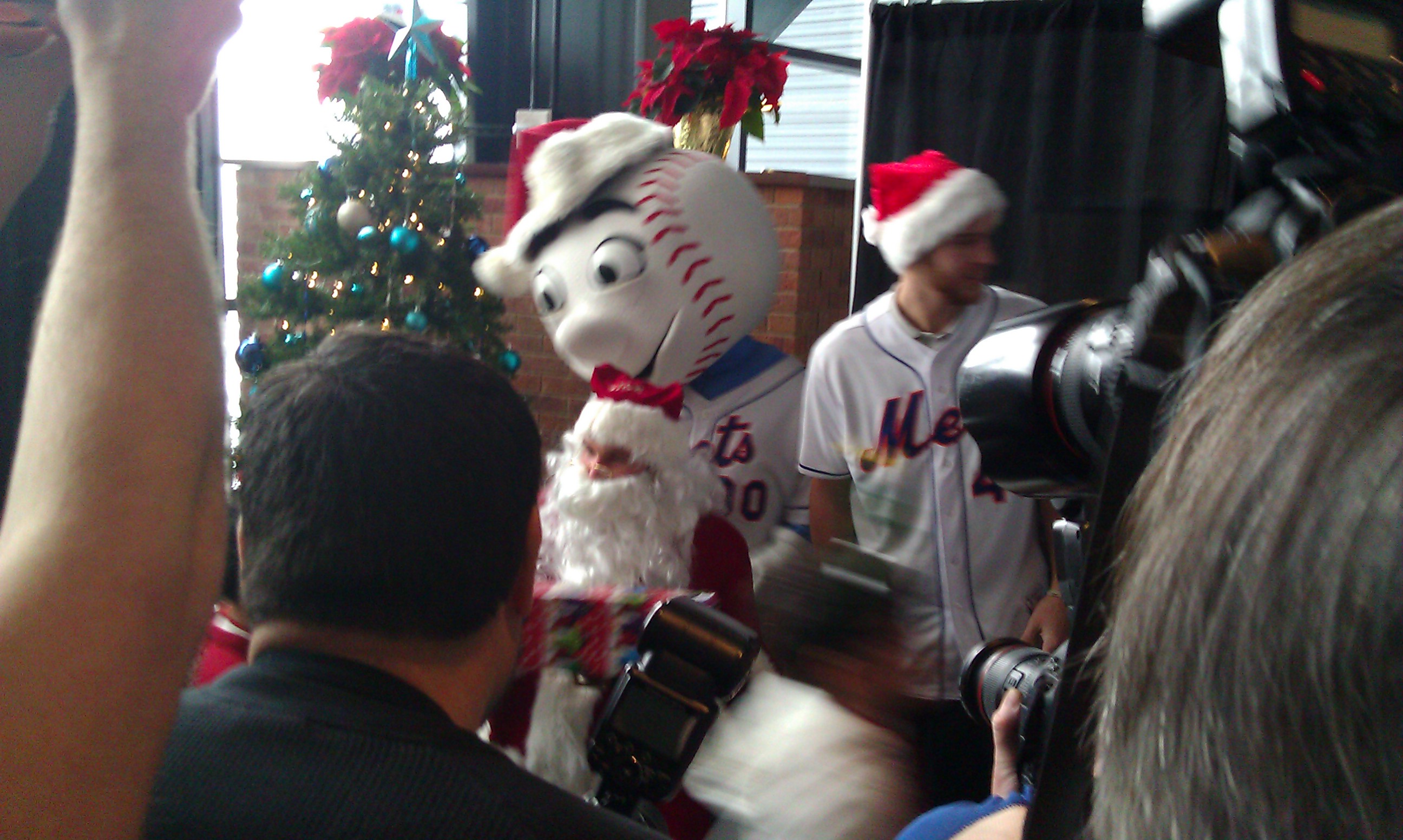
 Murph inhabits the ho-ho-(w)hole role. At this year’s holiday party, Daniel Murphy, a fellow whose name has arisen in trade rumors, donned the beard, the hat and the ho-ho-(w)hole get-up. If the swap speculation come to fruition, well, there’s your “curse” at work. If not, we’ll always have the Bensons. Anyway, for the second December in three, Murphy showed his versatility, doing his best to play a representative Father Christmas the way he has worked to succeed in left and at first, third and second. He gave kids gifts and, with the uniform of the day tucked safely in the Hefty, he gave a few of us bloggers answers to a random assortment of inquiries.
One of his responses showed why Daniel Murphy performs as a Franco-level Santa Claus.
The question in question came from young Clayton Collier of Metsmerized Online. I wouldn’t point out that Clayton is shall we say fresh-faced relative to somebody like me except for an exchange we had during some pre-event small talk. The subject of the recently partially demolished Astrodome had come up, including the time it hosted displaced residents of New Orleans after Hurricane Katrina. This line of conversation led me to recall Barbara Bush’s infamous implication that those folks were ultimately better off living in a sports arena than their own homes in their own city. Clayton was incredulous that this was actually said, earnestly explaining he didn’t really remember Katrina very well because he was only nine when it happened.
That was in 2005, back when the Bensons were in their glory, so to speak.
As I paused to do the math, Clayton added, “sorry if that makes you feel old.”
“No problem,” I said, having completed my chronological calculations. “I felt old before you were born.”
Young Clayton asked youthful Daniel a question middle-aged me didn’t think would get much of a response: “What’s Eric Young, Jr., like at second?” My cynical instinct was that Murphy wouldn’t want to say much pro or con about his theoretical competition. He had already competently fielded questions about the possibilities of being traded (he doesn’t want to go but it’s nice to know he’s “valued” around baseball) or shifted back to first (he prefers second, but if he’d have to reacclimate to one of his former positions, “at least they’d give me a bigger glove”). What benefit, I wondered silently, is there in a player who always seems to be standing on shaky organizational ground either dismissing a teammate or inflating that teammate’s reputation at his own expense in the midst of an offseason where he himself is just trying to stay put?
I couldn’t see anything more than a self-preservational route out of the question from Murphy, therefore I expected to hear something along the lines of “I can only take care of what I do” or some other benign form of jockspeak.
But if you don’t ask, you’ll never know. So Clayton asked — and Murph surprised me.
“He flipped a double play in Chicago against the White Sox that was sweet,” the incumbent second baseman said of the player who could very well replace him. Murphy, who was given most of that game off, went onto describe the play that I could vaguely envision once he mentioned it. “He got a low throw, I think, from the third baseman and he took it and he turned that thing over easy. It was impressive not because you didn’t think he could do it, but he hadn’t been there like all year. And he really wasn’t taking a whole, whole bunch of ground balls. He did some work there and turned some double plays, but to just go out there in the best league on earth, flip a double play with a guy bearing down on you…that’s what I would say is impressive.”
Yes Virginia, the guy who’d been dressed as Santa Claus actually said “whole, whole”. Actually, he said a whole lot with his answer in my estimation.
As impressive as Young’s instincts and agility from June were, Murphy’s lack of hesitancy in volunteering how good he thought EY’s DP was rated a sincere “atta boy!” on my scorecard. That showed grace, class, dignity, whatever you want to call it.
Seriously, put a circle around it.
Murph has been a true team man since 2008, playing wherever assigned without a hint of public complaint. Now, minutes after schvitzing as Santa, he was giving the gift of praise to somebody whose very presence might soon make him the former Met starting second baseman or perhaps a former Met altogether. Yet Daniel Murphy honestly assessed Eric Young’s skills and shared his impressions with a handful of strangers who, from a strictly transactional standpoint, weren’t people to whom he really needed to say anything substantive at all.
If this year’s Met Santa Claus is cursed with anything, it’s a generosity of spirit — and I’d call that a blessing.
I had a few other Met thoughts the other day and expressed on The Happy Recap Radio Show. Check ’em out, starting at around the 22:00 mark, here.
by Greg Prince on 20 December 2013 4:28 pm Carlos Beltran shouldn’t feel so bad about Mets ownership’s attitude toward him a few years ago as he counts his Yankee dollars in the present. The unfortunate Trailways Toss of his reputation — a.k.a. throwing Beltran under the bus over knees not healed and hospitals not visited — seems to have hastened a change in organizational philosophy where he used to get paid.
Instead of badmouthing their players while still under contract, the Mets now tend to wait until they’re securely out the door.
Progress!
Perhaps amid the yawning winter chasms between games and signings you’ve picked up on the tendency of “Mets people,” as they’re usually identified anonymously, to whisper sour nothings about the not-so-dearly departed to reporters and columnists. Marlon Byrd was safely ensconced in Philadelphia by the time Andy Martino of the Daily News revealed the organization’s opinion that one of their two best hitters of 2013 meddled too much in his teammates’ approach to swinging and taking. Shortly after Justin Turner was not tendered a 2014 contract, someone from within the Mets let it be know to ESPN’s Adam Rubin that the quintessential role player did not, in fact, run hard enough to maintain his spot as a modern-day Hot Rod Kanehl/Super Joe McEwing.
Should have Byrd kept his beak out of the Mets’ ongoing hitting philosophy implementation? Should have Turner hustled to first as fast as he hoofed it to the fridge in order to deliver a whipped cream pie on camera? Maybe and sure. But should have “Mets people” just kept these jabs to themselves? Why ding Byrd’s or Turner’s reputation? Just as pertinently, why become the club known for taking post-employment swipes at former associates? (Related: why weren’t the players given a chance to answer these assessments or decline comment to the respective writers?)
Since this has been bugging me a little as a fan and since I was on the same patch of Acela Club carpet the other day as Sandy Alderson, I figured I’d ask the GM if these backhanded waves goodbye to ex-Mets serve any kind of positive purpose. I don’t see how they would, but nobody this week claimed I was the best general manager in major league baseball, so maybe somebody who was indeed rated as exactly that would have more insight.
No, Alderson told me and the bloggers who joined me at the Mets holiday party on Tuesday, there’s no purpose to that sort of thing. And he indicated he’s not too happy that that sort of thing transpires. From “time to time” he expresses his disapproval internally, but as was the case nine months ago when I asked him about the impact continual leaks might have on getting things done (like trying to sign Michael Bourn, for example), he more or less said it comes with the territory. It’s New York; there’s a bounty of media. It’s hard for what amounts to office gossip to not find its way into circulation, sanctioned or otherwise.
The look on his face told me he’s definitely not in favor of it, though.
As long as I was there, I followed up with what difference it might make to a player like Ike Davis if Ike knows he’s being shopped around yet winds up still a Met in the middle of February. You’d figure that in an industry where the average annual player salary rose this year to $3.39 million, money would salve feelings just fine. But people are people…even Mets people.
According to Alderson, “healthy competition” will ensue if some player who’s been vigorously talked up as trade bait instead remains a Met when Spring Training rolls around. Still, I imagine knowing your employer is actively looking to ditch you is at the very least awkward and maybe worse for the fellow at the heart of the chatter. But I also imagine in the high-stakes world of major league baseball, it’s something these guys deal with.
“Positive resolution” would be the best possible outcome, said the GM who uses very classy phrases, not simply resolution by way of release or whatever. Besides, with the whirl of transactions and an unsuspected onslaught of injuries (because that never befalls the Mets), you never know who will be playing what for you. If Ike Davis lands at Tradition Field — if it’s still called that — instead of another camp, I hope someone will fill him in on the tale of Ray Knight, the Met the Mets tried desperately to, shall we say, positively resolve in the spring of 1986 following a dreadful 1985 but couldn’t.
Six-plus months later, Knight was accepting the World Series MVP trophy at Shea Stadium for the home team.
This season starts March 31, so any and all comings and goings are up for grabs until then when it comes to shaping an Opening Day roster. Still, with nerves wracking every minute the Mets can’t present us with a finished product, I asked Alderson if there’s kind of an internal alarm clock for someone in his position. When do you kind of, sort of need to know you’ve got the bulk of your team in order?
The general manager compared the process to the difference between a first-time marathon runner “who wants to quit after five miles” and someone who understands what it takes to persevere at the “21-, 22-mile mark”. When you’ve put together more than a few teams, he explained, you “know how to traverse late December and January.” True, the “anxiety level” ratchets up along the way, but experience helps inform the “ebbs and flows”.
So yes, Alderson is attentive to everything going on out there and continually reassesses what it means to the Mets — particularly when a division rival makes a move.
An aside that probably means next to nothing in the standings: I don’t know if Alderson is truly “the best GM in baseball,” as noted Cardinal enthusiast Will Leitch just framed him for New York magazine, but the guy certainly comes off as a mensch when you talk to him. He may not tell you what you want to hear or offer up a full pail of information brimming with signatures attached to contracts, but he always answers your question thoughtfully and respectfully. I’ve asked him probably a dozen since he came to Flushing and listened to dozens of my blolleagues come at him from multiple angles on conference calls and events like Tuesday’s, and though we’re not BBWAA members, he never scoffs or haughtily dismisses.
If Sandy Alderson’s Met tenure ends with no definitive improvement in the National League East, then that amounts to no more than a well-meaning footnote. For now, though, while he and his group are still building what we hope is a long-term winner, it’s not bad.
Only tangentially baseball-related, but you might enjoy it anyway: an article I wrote about how we never fully lose the places that are important to us even if they are no longer physically where we left them.
by Greg Prince on 18 December 2013 10:39 am I assigned myself two missions as I arrived at Citi Field Tuesday morning to cover my fourth consecutive Mets holiday party for Queens schoolchildren. One I had planned, the other developed on the fly.
The ad hoc mission involved getting out of the bitter cold after an overly literal, presumably underinstructed windbreaker-wearing guard on the other side of the Hodges entrance glass told me I couldn’t come inside until 11 AM. It was 10:30, freezing and snowing. As I peered through the pane and saw the familiar Citi Field sight of plenty of good seats still available, I shivered in surprise at the maroon-clad lady’s clinginess to rules. I’m pretty sure she relished telling me to get temporarily lost.
The following is not fanciful dialogue. It happened immediately after I tapped on the door to get her attention and interrupt the conversation she was enjoying with her colleague.
“Yes?” she asked.
“I’m here for the holiday thing,” I said.
“You’re media?”
“Yes.”
“Media can enter at eleven.”
So sitting quietly at the other end of the heated “VIP” lobby until I could be officially checked in for the Acela Club event to which I was invited by a much nicer branch of the Mets organization was not an option. Nor was picking up a walkie-talkie and seeking a supervisor’s sign-off to allow a slightly early arrival through Gil’s golden gate. I would’ve settled for being advised that the exceedingly unbusy team store was open and I could kill time/warm up in there (a conclusion I came to for myself after 15 minutes of walking around and nearly slipping on a patch of precipitation).
“You can wait in your car until eleven,” she suggested.
“I took the train here,” I said.
“Then you’ll just have to wait outside,” she responded, almost gleefully shutting the door on me before getting back to her chat.
As was the case at the Great Bar Mitzvah Caper of 2009 — when the designated entry point was the Rotunda, the lousy weather involved rain and the misguidedly vigilant guard’s windbreaker was green (whatever happened to blue and orange?) — the 30 or so minutes of Citi finickiness eventually passed, giving way to a lovely time in the Acela Club for the appointed mission. Back then it was to meet a fine young man who would go on to become one of the better parts of my future Met seasons.
Tuesday, actually, it was kind of the same thing. At that ’09 coming-of-age celebration, I met 13-year-old Ryder Chasin, who is now 17 and one of the splendid writers you’ll read from any age. In this Acela episode, the “kid” I was coming to say hi to was 23-year-old Zack Wheeler.
I look forward to him enriching my Citi Field experiences for years to come, too.
Since the Mets media relations department — incredibly nice folks who would never knowingly sanction your being pointedly instructed to go sit in a car you didn’t have with you — granted me media access to the holiday party, and since Zack was going to serve as Santa Daniel Murphy’s elf, I figured this was the moment to assess the cut of Wheeler’s jib. I couldn’t judge Zack Wheeler’s pitching from a little cluster of blogger-player Q&A, but I could attempt to gauge whether this fella, hailed since his acquisition as the future ace or co-ace of my favorite baseball team (despite its tendency to stick unpleasant people in windbreakers and hand them the keys to the offseason kingdom), has ace stuff away from the mound. I know Wheeler can throw a fastball. But can he throw off sparks?
Why does it matter to me? Because aces oughta give me the impression they are or can be larger than life, and not just in the Bartolo Colon sense. Our ace of aces was and is the gentleman whose name adorns the Seaver entrance at Citi Field. If you haven’t already, treat yourself to Pat Jordan’s visit with Tom Seaver at Sports on Earth. Tom’s 69 yet spiritually every bit the ace he was at 24. You just know it. Then go read what Dirk Hayhurst had to say about working with Pedro Martinez on TBS’s postseason studio show. When Pedro wasn’t absented by injury during his Met tenure, that man had stage presence like none I’ve ever seen. Hell, he had stadium presence. Per Hayhurst’s heartfelt testimony, he’s still got it and he’ll always have it.
Hindsight helps assess who’s been an ace and who’s been not quite that, but the personality and pitching pieces tend to fit retroactively, nonetheless. Doc Gooden may have come off as a callow prodigy at his peak and his off-field actions surely revealed deeper personal issues, but beyond the rehabilitation and behind the eyes I swear still saw the ace within when I got to sit directly across from him for a spell this summer. He knows what he did on the mound; I know that if he could restart from scratch he would do it all over again, except better. R.A. Dickey, I think we learned, was an ace just waiting for his pitch to come in. If Johan Santana didn’t require a healthy left shoulder to ply his craft, I’d bet we’d have lived through a lot more September 27, 2008s and June 1, 2012s than repeated trips to the 60-day disabled list.
You watch these guys, you listen to these guys, you read about these guys…you just feel it. I won’t invoke the widely discredited laugh line from Moneyball about “the good face,” but you know, I once heard a scout describe what he took that phrase to mean, and it wasn’t really silly. It spoke to a certain alertness and awareness that expressed engagement with the game. You’d take talent and performance into account before signing somebody, but you’d also take stock of everything you could possibly detect. It may be a bit of a reach to peer into the window of the soul like it’s the window of the Hodges entrance and say you see anything you can count on, but I really do believe — despite my logical insistence that the ace of the staff has to be whoever is pitching on a given day — that some guys are aces and other guys are trying to get by on lesser stuff, both inside and out.
Matt Harvey just spent five-sixths of a season as a state-of-the-art 21st century ace. Now he’s consigned to getting his canoodle on while we try to get by without him. That’s why I wanted to take the measure of the cut of Zack Wheeler’s jib. We’re gonna need the cut of Zack Wheeler’s jib to be razor sharp in 2014. Even when Harvey returns, hopefully in full 2013 form, we’re gonna need Wheeler to give great jib in 2015 and the years to follow.
After meeting the man and exchanging a few sentences with him, by jib, I think he’s got it.
I’m no scout or soothsayer, but I got a better feeling out of meeting Zack Wheeler than I did Jon Niese at the holiday party of 2011. Niese didn’t throw off sparks. Niese was the only player to date at one of these things whom someone from the media relations staff didn’t have to rescue from a barrage of questions. Usually you give the blogging contingent a chance to make inquiries, we won’t run out of things to ask. With Niese we did because he wasn’t much of an answerer. Not impolite (and certainly community-minded), but not really what I hoped for from a starting pitcher who was being talked up at the time as “ready to take the next step,” if I may invoke that cliché.
Everybody’s different and not every pitcher is going to parry with Pat Jordan or awe Dirk Hayhurst (or, for that matter, canoodle the good face of Anne V.). Wheeler’s not necessarily his predecessors or his most glittering contemporary, yet I trust him to take some of that next-stepping soon. I particularly liked what he answered when I asked him a process question concerning when he knows he has his “A” arsenal versus when he thinks he’s gonna have to figure things out as a game goes along. I used as an example how well he pitched at San Francisco last July, and midway through my question, I realized that was an extreme example because, duh, it was the Giants who decided they could spare him when they traded him for Ol’ Mercenary Head, a.k.a. Carlos Beltran.
Thus I amended my question as I asked it to encompass that extenuating circumstance, and Zack was more than happy to volunteer that he was really “pumped up” that day and wanted to “shove it against ’em”. They were the ones who gave up on him, after all. He hadn’t forgotten and he wasn’t shy about remembering it now.
The words might have differed coming out of different mouths, but I could hear echoes of Seaver or Martinez saying essentially the same thing. I couldn’t imagine it coming from someone like Niese. Maybe Niese would think it, but he’d never say it. That shouldn’t be a mark against Niese’s or anybody’s jib, however, for every starter, like every person, is a creature unto himself. Likewise, every Mets starter should ideally pitch like an ace but you can’t demand every Mets starter be an ace…any more than you can demand common sense be deployed by every Mets employee in an off-color windbreaker.
Just maybe, though, should fate play our cards right, we could end up with two of a kind in our long-term rotation. And wouldn’t that be a heckuva way to come out of the competitive cold?
by Greg Prince on 14 December 2013 6:31 pm As mind-blowing concepts went, none could explode the goop inside this onetime 15-year-old’s coconut quite as much as what I learned was about to take place on the first Saturday of August 1978. There was going to be a baseball card show at Shea Stadium.
Think about that:
• Baseball card show.
• Shea Stadium.
Now think about it as if you’re 15; as if baseball card shows are a relatively new and exotic concept; and Shea Stadium is Mecca. (No “as if” necessary on that last one.)
The Mets were in St. Louis. My parents were weekending in the Catskills. I asked my recently college-graduated sister if she and her boyfriend might take me to this overwhelming confluence of activity. Her boyfriend, a former Shea Stadium vendor — experience that left him chilly toward all things baseball — said sure, why not? He lived nearby, he knew the terrain and he was curious in his own way about it.
Depending on one’s perspective, the Shea Stadium Baseball Card Show that took place the first Saturday of August 1978 was either a rousing success or a crushing bore. My perspective was it was fantastic. There was a baseball card show inside of Shea Stadium. That’s pretty much all I needed. You bought a ticket labeled SHEA STADIUM SHOW. You traipsed amid what passed for the Shea Stadium ground-level concourse, which is to say inside Gates A and B directly in front of the stilled escalators. Sales tables were set up from left to right.
That was about it. I remember buying one item that day: a 1978 Topps No. 450, which featured Tom Seaver as a Cincinnati Red. It would be nice to think that was an error card, but late 1970s reality dictated otherwise. Thanks to the quarter I handed over to some vaguely sleazy fellow, I now had every Topps Seaver…the only kind of Seaver back then, come to think of it…since 1968. And I bought it at Shea Stadium, the same place where both the photograph on the card and the legend of its subject was crafted.
A rousing success!
No, it was a crushing bore, according to my sister’s boyfriend who hated baseball, but not because he hated baseball. His interest in the trip was purely observational, and like everything else that transpired at Shea Stadium, he observed that the card show represented a black mark against the human spirit. That’s it? he asked. That’s all a baseball card show is?
My sister’s boyfriend, though only 22 himself, was a veteran of gatherings of a certain strain of cinema buff: sci-fi, superheroes, westerns, “B” movies. And when those guys got together, he said, it wasn’t just about selling. Yes, there was a “dealer’s room,” but they had areas devoted to screenings and seminars and speakers. It was more than a show. It was an event. It was everything a fan could want if the fan couldn’t get enough of the stuff he sought.
Sounded great to me. It still does. And more than 35 years later, my now brother-in-law’s vision is coming true, thanks to another former Shea Stadium vendor.
I doubt my sister’s husband — who prefers to be known on this blog as Mr. Stem — has ever come across the author of Send The Beer Guy — who prefers to be known on his blog as Shannon Shark — but unwittingly, the two have shared a vision. Shannon, who you probably know from his tireless patrol on Mets Police, came to pick up the vision first expressed by Mr. Stem and ran with it. The result is coming to the ballpark that sits adjacent to the site of 1978’s SHEA STADIUM SHOW.
But it will be so much more.
On Saturday, January 18, Shannon and his co-conspirators Keith “Media Goon” Blacknick and Darren “The 7 Line” Meenan, will present the first Queens Baseball Convention, or QBC ’14, at McFadden’s Citi Field. It is shaping up as the Saturday for which we’ve all been waiting if not all our lives, then at least all our winters.
QBC is described on its site as an amalgamation of fanfest, Comic Con and Hofstra 50th anniversary conference. You don’t have to read too hard between the lines to realize QBC implicitly spells M-E-T-S. Perhaps the greatest thing about this event is it’s about our team but it’s not being put on by our team. Our team has occasionally caravanned in through the Metropolitan Area but has never put on a wintertime fanfest. When we consider that fact, we tend to kvetch and moan about their hot stove negligence. Shannon & Co. did more than complain. They got to work putting on one for us.
Hence, for one Saturday in January, starting at noon, a corner of Citi Field will come alive with the sound of baseball. With Ron Darling and Ed Kranepool on hand to share their insights and autographs. With a special salute to the memory of Gil Hodges. With Sandy the Seagull winging his way over from Coney Island. With a mob of minutiae mavens. With the jazziest jerseys. With new media and old media (including a couple of bloggers you know well if you read Faith and Fear). With trivia for adults, games for kids and the spirit of Mets fandom shaken awake from hibernation nearly a month before Spring Training.
With a 1978 Topps No. 450 for sale, for all I know.
Plenty is planned and plenty more is being planned. Shannon’s agenda is to stuff QBC ’14 so full and stack QBC ’14 so high that the Carnegie Deli would’ve been proud to have served it to Mo Vaughn in 2002. Knowing Shannon, he will succeed. He and Keith and Darren and everybody pitching in is dedicated to creating both an unprecedented experience and the template for future QBCs. I’m very excited to be in on the ground floor…a more inspiring ground floor, frankly, than the one from which that vaguely sleazy fellow sold me the ’78 Seaver for 25 cents.
Not that that wasn’t great when I was 15. But as I approach 51, my reblown mind is capable of recognizing that this will be greater. This is a genuine “by the fans, for the fans” endeavor. I’m proud to be one of the fans pitching in to put it on and thrilled to be one of the fans who will be taking it all in.
So don’t just stare out the window and wait for spring. Give your 2014 Queens Baseball battery a jump start by Convening with your fellow fans. As a certain song might suggest, everybody’s comin’ down to meet the Q-B-C of Flushing town. Step right up and greet it, too.
Information on Queens Baseball Convention tickets and events is here.
by Jason Fry on 13 December 2013 9:45 am Oh, you suddenly wacky Mets.
No sooner had I fallen back into despair and trotted out my Sandy as Charlie Brown, Jeff as Lucy cartoon than it was announced that the Mets had signed Bartolo Colon — who’s equal parts huge, old and good — to a two-year contract that, like Curtis Granderson not long before, also counted as Real Money.
If Colon does something bad to a knee in February and is damaged goods after that — a fate not exactly unknown among hefty old dudes — the deal’s a disaster. If he keeps on walking nobody and pitching ably for two years, it’s a steal. If he pitches well enough for half a season or one season or a season and a half and is then flipped elsewhere for a decent prospect, it’s a Sandy Alderson special. And will probably be a pretty shrewd one, going by past results.
But is it more evidence of the changed narrative that I was happy about last week?
I dunno. Or I keep changing my mind. Or something. The Mets have me suffering from both emotional and logical whiplash.
On the one hand, they’re actually spending money — they’ve added the non-gigantic Chris Young, Granderson, Colon, and will add a shortstop if Sandy can pull it off. That’s a far cry from your winter consisting basically of Marlon Byrd and a bunch of Triple-A guys who barely got a baseball card.
On the other hand, the Mets still aren’t spending as much money as they’ve previously said they will.
Let’s go to Howard Megdal, who keeps track of these things. In June, Alderson told Joel Sherman (who wrote a fine column the other day, BTW) that he saw 2014’s payroll at between $90 million and $100 million. Now, it seems to be $85 million. (I’ll spare you a couple of years’ worth of fiscal goalposts moving around before that.) That $85 million cap is one reason (though not the only one) that we keep hearing about Daniel Murphy being traded and Ike Davis being the misfit first baseman most likely to become someone else’s problem.
The problem isn’t the dollar amount (though it’s that too) so much as it is that the amount seems to be a constantly moving target.
If the 2014 payroll is $85 million, the Mets essentially have to move Davis or Murph or both for financial reasons if they plan to make any more moves worth caring about.
If the 2014 payroll is $100 million — the upper end of what we were told this summer — Stephen Drew comes into play without the necessity of a trade. A lot of things come into play.
But it’s no longer summer, so the payroll’s no longer $100 million. It’s $85 million. Or maybe that’s wrong now too. We’ll all have to await what Sandy says next time he’s enduring an hour with Mike Francesa or cornered by beat writers with microphones.
Money doesn’t fix everything, as a near-infinite number of self-help books and pop songs warn. It can bring its own problems, as evidenced by Mets teams that spent gobs of it and were still terrible. But a lack of money fixes nothing, and the problems it brings are predictable ones.
And not knowing how much money you have? That’s a ridiculous way to run a business — though it turns out to be an excellent way to leave a fanbase reflexively suspicious and anxious.
I pin blame for the magical bouncing payroll on the Wilpons. You can pin it on Sandy if you like — or on sunspots, the Rosicrucians, or mole men from Europa. I don’t really care anymore. All I know is I’m tired of it.
The Mets haven’t done what I feared they’d do this offseason, which was strip the team even further, shrug and wait for Matt Harvey‘s elbow to heal. They’ve spent money, and a lot of it by their recent standards. That’s changed the narrative, yes. But I still don’t know what the payroll is — or more to the point, I don’t think the general manager knows what the payroll is. That narrative is familiar, and it’s the one that really needs to change.
* * *
Here’s a Mets narrative that really has changed for the better, one you might not have noticed.
The Mets are touting their Kids Club, which now has two membership levels.
There’s a free level (blue) where you get a free ticket voucher good for any Sunday game, three buy-one, get-one-free ticket offers good for any Sunday game, and a membership card and lanyard that you can use to “check in” at Kids Club Sundays, with rewards ranging from an autographed player photo to a duffle bag depending how often you come.
There’s also a $24 level (orange) that gets you a t-shirt, four free ticket vouchers for any Sunday game, all of the above and some other neat stuff besides.
It’s a pretty great deal. But the key change is the “any Sunday game” part. Joshua used to be a Kids Club member, and in previous years the club had a fatal flaw: You could pick your free ticket from about a dozen dates scattered across various days of the week — and nearly all of them were night games.
Taking the subway back from Citi Field after a typical night game gets us home between 11:30 pm and midnight. My kid just turned 11, and having him go to bed that late is only now becoming a possibility — and even then, we have to accept a high likelihood that the morning will be a mess. A couple of years ago, preventing such a disaster would have meant leaving around the third inning, which isn’t exactly the stuff of happy baseball memories.
So the ticket part of the old Kids Club was basically worthless — if the couple of available day games didn’t fit your family’s schedule, tough. The effect of this was to undermine an otherwise nice program for children in a way that would be blindingly obvious to anyone with a child. It was baffling and infuriating.
Now, all that’s gone. There are 13 Sunday games on the 2014 schedule, they’re all day games (pending ESPN shenanigans the Mets can’t control), and you can get a free ticket to any of them.
The difference is, well, night and day — a Kids Club that’s simple, fan-friendly, and how it always should have been.
* * *
Here’s something else to lift your spirits. It’s Pat Jordan on Tom Seaver, and a little bit of Tom Seaver on Pat Jordan, and it’s smart and funny and quietly moving.
by Greg Prince on 12 December 2013 1:12 pm “Hey, do any of you guys know a pitcher named Bartolo Colon?”
“I know Bartolo Colon! I saw him drive a run in for the Angels off Mike DeJean in 2005! It was his last hit in the majors, and he’s still playing today!”
“I was at that game! Kaz Ishii struck out the side in the top of the first and had 8 K’s through five yet didn’t make it out of the sixth!”
“Colon won 12-2, and the next night Marlon Anderson pinch-hit a game-tying inside-the-park home run off Frankie Rodriguez in the ninth inning!”
“Cliff Floyd won that game in the eleventh with a home run! The next day the home plate umpire threw out Mike Piazza for questioning a strike call…in the first inning!”
“Colon won 20 games and the Cy Young that year!”
“To Bartolo Colon!”
 Did somebody mention Bartolo Colon’s name? “You guys talking about Bartolo Colon? I listened to a game where he went toe to toe with Shawn Estes in Montreal in 2002!”
“I heard that game! Colon scattered 13 hits and went the distance to beat the Mets, 2-1!”
“He stranded the bases loaded in the ninth inning when he grounded out Edgardo Alfonzo!”
“I thought the Mets had a chance for the Wild Card but they fell apart within a few weeks and Bobby Valentine got fired!”
“The Expos were about to go out of business, but Omar Minaya traded three future stars for him anyway!”
“Colon won 10 games for the Indians before the trade and 10 games for the Expos after, which made him a two-team, two-league 20-game winner!”
“To Bartolo Colon!”
“Bartolo Colon won 18 games at the age of 40 in 2013!”
“He played in a stadium that was mostly empty seats and raw sewage!”
“He was on the seventh team of a career that began in 1997!”
“He made the All-Star team a year after being suspended because of PEDs and started the first game of the playoffs for the A’s three years after not pitching at all!”
“Colon was a teammate of Dwight Gooden’s, struck out Mo Vaughn and pitched versus Pete Schourek all in the same postseason series!”
“I hear Colon gets his blood spun in a revolutionary but controversial fashion at a clinic somewhere in Boca Raton, Florida!”
“To Bartolo Colon!”
“Bartolo Colon is considered one of the most effective control pitchers in baseball!”
“Only David Price walked fewer batters in the American League last year than Bartolo Colon!”
“Only Anibal Sanchez had a lower earned run average in the American League last year than Bartolo Colon!”
“Only Max Scherzer won more games in the American League last year than Bartolo Colon!”
“Colon threw three complete games last year and every one of them was a shutout!”
“To Bartolo Colon!”
“Bartolo Colon is listed at 265 pounds but is generally believed to tip the scales at something a lot closer to 300!”
“Colon will be 41 years old next season!”
“On the day Bartolo Colon was born, the Mets beat the Dodgers in 19 innings in a game that ended at 4:47 in the morning New York time!”
“I remember that game! Chris Cannizzaro pinch-hit for the Dodgers, and he was an Original Met!”
“Did I mention Colon’s like 300 pounds? And gonna be 41?”
“Most guys his age and size would be long retired by now! But not Bartolo Colon! Colon just got $20 million for two years from a team that’s supposed to be hamstrung by limited resources!”
“Colon was considered a real catch at the Winter Meetings and it was the Mets who caught him!”
“The Mets got Colon the day after they introduced Curtis Granderson, who they’re giving $60 million to over four years — and Granderson missed more than a hundred games last year!”
“The Mets haven’t signed a pitcher for a lot of money since Oliver Perez, and they bid against themselves to sign him!”
“Oliver Perez refused to go to the minors when he deteriorated beyond repair in 2010 and wound up getting released with a year left on his deal!”
“Perez became a decent reliever with Seattle and was on the market this year, but the Mets signed Colon!”
“To Bartolo Colon!”
“Bartolo Colon’s gonna pitch for the Mets next year because they won’t have Matt Harvey!”
“Matt Harvey dates a supermodel and posed naked in a magazine!”
“Harvey was the best pitcher in the National League until he hurt his elbow in August, and he was only 24 when his season ended. Colon was 40 yet kept pitching and winning while Harvey was trying to avoid Tommy John surgery!”
“Tommy John started that 19-inning game against the Mets the day Colon was born!”
“George Stone won that game for the Mets! If Yogi Berra had started Stone in the World Series, the Mets would’ve beaten the A’s!”
“Colon’s gonna have to be at least pretty close to what he was for Oakland last year to justify his contract!”
“If the Mets didn’t get Colon, they’d have to figure out a way to hold on to a Harang or a Dice-K or rush one of their minor league pitchers!”
“It still seems like a risk to commit that much money to Bartolo Colon, though it could also work out if he stabilizes an otherwise young rotation!”
“Bartolo Colon may be older than Scott Atchison and Bartolo Colon may be bigger than Mickey Lolich but Bartolo Colon can really pitch!”
“Did somebody mention my name?”
“To Bartolo Colon!”
by Greg Prince on 11 December 2013 3:12 pm “The Mets were for the common people, I thought — the policemen and the doormen and the shoeshine boys and the newsdealers and the hot dog peddlers.”
—Ford C. Frick Award winner Lindsey Nelson, 1966
“There is more Met than Yankee in every one of us.”
—J.G. Taylor Spink Award winner Roger Angell, 1962
The hot stove season, particularly during its winter meetings interlude, seems to fit Ralph Kiner’s description of the weather in Chicago: “If you don’t like it, just wait 10 minutes.”
Great advice, Ralph! as Fran Healy might have offered in rejoinder, for stories come and go mighty quickly and my mood is blown hither and yon with just as much velocity depending upon who’s tweeting/trading who. For example, five days ago I began conceiving a piece on not taking well the news that Carlos Beltran had opted to shed his last shred of human decency and sign with the Yankees. Then I got distracted. When I returned to attempting to flesh out my thoughts yesterday, I discovered I don’t really care what Beltran does or where he does it…the fink.
OK, maybe I care a little. But not that much. On Friday I was emotionally vulnerable because of the timing. First we sign Curtis Granderson, former Tiger and whatnot, and I’m getting used to the idea that this could be a splendid acquisition. Then the other team in New York swoops in and grabs a guy who was one of our best players ever, though not a Met since the middle of 2011 and not owing me or any Mets fan any consideration regarding what he does with the rest of his career.
It wasn’t that we didn’t re-sign Beltran for the next three years, which I never thought we would. It’s not that I believed Beltran was necessarily a better option than Granderson for 2014 — if Curtis’s age and return from injuries bothers me a little, Carlos’s Atchisonian wear and tear would spook me a lot. And it wasn’t exactly that Beltran had decided to allow himself to be clad in what my blog partner now and then refers to as the raiment of the beast. Simply pinning the tail on the Pinstripes wouldn’t explain my morose state as the news sunk in. Ex-Mets from Duke Carmel to Raul Valdes have been changing at Grand Central for the uptown 4 since 1965. What the hell, they gotta eat, too.
What got to me, I suppose, was that when Beltran and the Yankees agreed to do business, it felt as if one of the happier hot stove nights of my life had been erased, that Saturday night in January 2005 when Beltran and Scott Boras told the Houston Astros “no” and the New York Mets “yes.” That was business, too, but to me it was missionary work. Carlos Beltran had looked deep within his heart, saw where his services would bring hope to the most downtrodden people and chose us. Never mind that his missionary zeal was greased by $117 million of goodness or that it came out not long after that Boras shopped him late to the Yankees for a somewhat lesser but still lucrative deal and they uttered the heretofore unimaginable words, too rich for our blood. The best player on the market, the one who had just torn up the postseason, was going to be a Met!
No, it was better than that. He was going to be a New Met! Surely you remember the shall we say money quote from his feelgreat introductory press conference of January 11, 2005:
“I feel proud to be part of the new family, the New York Mets. The New Mets. I call it ‘The New Mets,’ because this organization is going to a different direction, the right direction — the direction of winning.”
Not quite seven seasons played out, some Newer than others. By the end, when Carlos Beltran’s aging knees were traded for Zack Wheeler’s fresh arm, fortunes had grown fairly old in Flushing. Beltran joined a Mets franchise that had previously finished 71-91. He was leaving one that would wind up 77-85, and they haven’t done even that well since. He did all he could, sometimes it was almost enough, never did I think his stay wasn’t worth it. Even through these last two years when he plied his craft as a distasteful Cardinal, I could peer past the red he was wrapped in and see him mouthing that phrase as prologue to our giddy rise from endless nothing to short-lived something.
To paraphrase agent-in-crisis Jerry Maguire as it was dawning on him that his star client’s father had gone behind his back to secure different representation, I was still sort of moved by Carlos’s “New Mets” thing.
Then Friday night, he does what it was assumed he would do in 2005 and goes to the Yankees of his own free-market will. He wasn’t a selfless missionary for the greater forces of all that is good and Metropolitan anymore. He was a soulless mercenary, that nasty epithet Astros fans hung on him nearly nine years ago when he left their team to join our team. Houston’s snit constituted a sour-grapes reaction from a bunch of ingrates, I had decided. Those yahoos didn’t deserve him.
Oh, all right, Carlos Beltran was a mercenary then, too, and I knew it, but he was our mercenary, which meant he was getting paid on the side of the angels. Now he was taking the most money and running to the Bronx…except, no, he apparently could’ve gotten more money from Arizona but really wanted to be a Yankee, reportedly “over the moon” to at last don their beastly raiment.
He’s a Yankee, but so was Curtis Granderson, and that bothers me not a bit. Ex-Yankees began crossing the Macombs Dam Bridge to the Polo Grounds in 1962 when Marv Throneberry (by way of Baltimore) and Gene Woodling (Washington) made the trip. They were greeted in Upper Manhattan by their old skipper Casey Stengel and might have recognized in their midst a onetime Yankee farmhand by the name of Rod Kanehl when they arrived. It’s a recurring phenomenon now more than 50 years old. In 2013, Aaron Laffey, David Aardsma and Sean Henn all showed they knew the way to Flushing Bay: just jump off a scrap heap and transfer at Grand Central for the Queens-bound 7.
My tolerance for intracity changes of address, whether made directly or after a cooling-off period, has built to a decently sturdy level over the past couple of decades. It’s certainly been tested since the mid-1990s, when we temporarily (I still hope) stopped having better records and drawing more people than our near-northern counterparts.
Doc, Darryl, Coney…two desperately needed a job and one had developed a hired-gun reputation. I didn’t love that they (and their once-familiar eventual Hall of Fame manager) brandished shiny new World Series rings in 1996, but I didn’t love that their teammates with no Met connections whatsoever did a whole lot more.
Robin, Zeile, Oly…all arrived as the dynasty was showing cracks, each went low-profile and none thanked the good lord for making them a Yankee, popularly parroted propaganda that seemed to be in vogue among newly enriched Steinbrenner Inc. employees around the turn of the century.
Leiter? It should’ve felt harsher given all he had done for the Mets against the Yankees in the 2000 World Series, but he was from there to begin with. I gave him a pass.
Vizcaino? The crime wasn’t being a Yankee. The crime was winning Game One in 2000 for the Yankees against the Mets. Besides, he was Jose Vizcaino…y’know?
Orosco? Betcha forgot Jesse Orosco who closed out our most recent world championship was a Yankee toward the end of his exceedingly long and winding road. It was no more than a15-game moment of surreality in 2003 as the 46-year-old lefty specialist caught his breath between San Diego and Minnesota en route to retirement. No harm (12.46 ERA), no foul. His glove eternally soars over Shea.
Benitez? Take our closer. Please.
And other than particularly repellent types like post-9/11 conspiracy theorist Mike Stanton and springtime drop-in Jim Leyritz, I’ll accept converts from wherever they emanate. The David Weatherses, the Graeme Lloyds, the Ricky Ledees…I didn’t ask for papers. I just asked them to not suck a whole lot. (They didn’t always do what I asked, but they weren’t alone in that distinction.)
I wouldn’t have asked the ingratiating Granderson to say anything unkind about his former professional circumstances when he was introduced in Orlando on Tuesday, and he didn’t. But of course I kvelled when he wove a simple question about adjusting his game in deference to differing ballpark dimensions into perhaps the best preseason slogan since Baseball Like It Oughta Be.
“A lot of the people I’ve met in New York have always said true New Yorkers are Mets fans. So I’m excited to get a chance to see them all out there.”
Natch, most of the context was clipped from his response in a nanosecond and it became Curtis Granderson laying down the Subway Supremacy gauntlet or something like that. Not the most accurate of interpretations, but upon reviewing the transcript of his Q&A session, it definitely reads like a line he was determined to get on the record. Not cynically, perhaps, but probably not delivered without agenda. Sort of like Beltran after Boras first suggested he strongly consider this heretofore hapless organization that was courting him and the checkbook it was willing to wield to lure him.
But January 2005 was almost nine years ago. So was last Friday night, as far as I’m concerned. True New Yorkers aren’t terribly interested in Carlos Beltran’s whereabouts these days. True New Yorkers are instead suddenly excited to call Curtis Granderson their own.
Maybe we’ll all see him out there.
by Jason Fry on 8 December 2013 1:12 pm Sometimes you find yourself a defender of the conventional wisdom.
Here’s Brian Mangan on the Mets signing Curtis Granderson. His take is smart, and it ain’t pretty. But I’m still happy.
The baseball stuff I’ll deal with quickly: I take heart from the fact that Granderson’s nightmarish 2013 was driven by not one but two bone-breaking HBPs, the first one on the inaugural pitch he saw in spring training. (Geez, how’s that for a star-crossed year?) His skill set seems like it will age better than Jason Bay’s. (Caveat: Like my blog partner, I was in favor of the Bay deal at the time, though tepidly.) From the overlays I’ve seen, I’d expect Granderson’s power to play just fine in Citi Field. He’s a good guy in the clubhouse, a quality I don’t put enormous stock in but could be valuable if Sandy Alderson tries to move Granderson. Ideally, he’s a Cliff Floyd figure for the Mets — helps bring along some young players, does OK out on the field, and is a bridge to a better future.
But as always with the post-Madoff Mets, it’s not really about the baseball. Except this time I can say that without despair creeping into my voice.
This may be the most surreal and depressing era in Mets history. The early Mets were terrible, yes, but fans at least had the honeymoons of National League baseball returning to New York and a brand-new stadium. The Mets of various post-1986 valleys were awful, but they were big-market awful: You knew the collapses and teardowns would be followed by attempts to rise anew, however ill-conceived.
The closest comparison to the post-Madoff Mets would be the Mets of early free agency. Like this team, that one was a dreadful outfit that had alienated its fans and refused to admit economic reality: The Mets showed interest in free agent Gary Matthews by sending him a telegram asking him to contact their offices, which somehow didn’t work. They were baseball’s North Korea — but their situation was so comically awful that you knew it couldn’t last, that new ownership was going to come from somewhere.
In recent years there’s been no such promise at Citi Field. The Wilpons looked crippled, continually moving the financial goalposts on Alderson, playing accounting games with payroll and operating under the shadow of massive bills coming due. But they also looked determined to hold on at all costs, and there wasn’t even a hint that the feckless Bud Selig would pressure them into a sale. (Selig’s tenure as commissioner will be argued about for years, but even if you’re one of his defenders the bookends are pretty awful: He arrived as the product of an appalling coup and will depart having let the Mets be run like an orphanage, shrugged off the cynical shell games played by his fellow Expocutioner Jeffrey Loria and marooned the A’s in a backed-up sewer.) The Mets have looked destined to become baseball’s Chicago Blackhawks, a wreck of a franchise that only divine intervention can save.
And maybe that’s what they still are. But whatever one might think of the Granderson signing, it isn’t shopping in Scott Boras’s fruits-and-nuts aisle. It’s not two years of Frank Francisco or a flier on Shaun Marcum or maybe seeing something in Marlon Byrd. Even in today’s suddenly expensive free-agent landscape, it feels like Real Money.
As for those who scoff at the idea that there’s a value to Changing the Narrative, I’d counter that it’s sure changed mine.
I can’t recall being less enthusiastic about the Mets than I was in October and November. I missed most of the last week of the season and didn’t care. I left the blog in Greg’s capable hands for the early part of the winter because there was nothing I wanted to say about the Mets — past, present or future. Someone sent around a clip of the Ball off the Wall and I felt … nothing. Occasionally I would rouse myself to snarl something vicious on Twitter, but that was about it.
Some of those Twitter bleatings were both vicious and inaccurate. A question about where to play Young in the outfield left me snarking about not wanting Young in the starting lineup at all … oh wait a minute, he meant Chris Young. I lost my mind about what I saw as penny-pinching Justin Turner out of a job and it took me an embarrassingly long time to realize this was a good sign, as the logical read on the situation was that the Mets planned to bring in another shortstop and slide Ruben Tejada into the backup role he’s earned, making Turner superfluous. I’d stopped paying attention and started becoming a generically angry fan. Look, I’ve said plenty of stupid things over the years and will say plenty more, but I’d never fallen into that particular trap. I’d never been disengaged like that.
If the Mets do nothing else this winter, despair and apathy will beckon again. Heading into the winter meetings, they still need that other shortstop, are still shopping Ike Davis and/or Lucas Duda (with maybe Daniel Murphy headed elsewhere too), and still need a warm body or two for the Harveyless starting staff. (Please God not Mike Pelfrey.) If Granderson is their last significant move of the winter, that’s a problem. But for the first time in a long time, I’m not automatically assuming the worst. For the first time in a long time, I actually want to think about my baseball team.
That’s only my narrative. But it desperately needed changing.
by Greg Prince on 6 December 2013 4:36 pm The Mets are signing somebody! Cue the applause!
I’m clapping, and not just politely, to my mild surprise. I’m all for the Mets securing the services of better players, and I’m fairly certain Curtis Granderson is better than what they had before they got him. Perhaps because I didn’t expect the Mets to actually get him — or anybody of note — I wasn’t all that enthused when he became The Guy a few days ago, a transformation that seemed rooted in his ordering a celebrated plate of salmon and the sense that with everybody else doing something, why weren’t we?
Now that something’s been done, what the hell, I’m more or less on board. The more should be obvious, given what Granderson’s accomplished in the not altogether distant past. Why the less? Well…he was severely limited by injury last season; he’s beyond traditional “prime” age; he’s guaranteed maybe one year too many for our comfort; he’s changing addresses to dimensions that might not really play to his strengths; and I am plagued by the nagging feeling that if something can go wrong for the Mets, it will go wrong for the Mets.
Those were my concerns before Curtis Granderson said yes to the Mets. With a reported $60 million committed over the next four years, those are still my concerns.
But we did something. We got a better player than anything we had in his neck of the field when 2013 ended and 2014 approached. The economics wouldn’t be worth talking about, given that economics have blowed up real good throughout baseball, except these are the Mets and budgetary implications aren’t just the stuff of lip service. I’m still in the dark about whether paying Granderson an average of $15 million a year over the next four years will represent an untenable burden in the Land of Wilpon.
I didn’t worry about those things when Mike Piazza, Pedro Martinez and Johan Santana were all lavished in riches for what were considered, in their day, luxurious long-term deals. I never complained about their lengths, either, not even when they crossed into albatross territory. Those guys were each signed to do more than merely “something”. Piazza (seven years) and Santana (six) were convinced, respectively to stay with and join contenders and, to my mind, did all they could do up front, making their back-end decline the unfortunate cost of doing serious business. Pedro’s four years seemed excessive, as they were tendered at one of those rare moments in the sport when sanity had seeped into executive thinking and almost no starters were being signed for more than three years at a time. Pedro was marquee-level Pedro for only his first season-and-a-half, but that’s what he had to be when he had to be it most, and his presence and performance made a massive difference in the big Met picture he entered.
Granderson is not the kind of megastar those guys were. The Mets don’t point and click on such upscale merchandise anymore. But Curtis — first-name basis OK? — is star enough in this market and, I’ll say again, he’s an upgrade in the post-Byrd world the Mets had been living in. If Granderson gives us a couple of seasons akin to what Byrd gave us over five months of 2013, and does it from the left side, that will be highly valuable. Of course it won’t be as cost-effective as Byrd’s output was, but when we’re focused on the games, we’re rarely calculating price unless someone expensive is exhausting our patience.
Which inevitably brings us back to if something can go wrong it will go wrong or, to use the convenient Met shorthand, Jason Bay. That isn’t fair to Granderson, no matter that Baseball-Reference’s comps suggest the two outfielders hold very similar statistical profiles. They’re different people and different players, even if the circumstances of their arriving as Mets feel of a piece. By December 2009, the Mets didn’t really know what they were doing, so they defaulted to doing something. I kind of thought buying Bay would work. It didn’t. Now that I’m spooked that grabbing Granderson won’t work, maybe it will.
How’s that for insightful analysis?
Let’s go out on a limb and decide Granderson won’t be Piazza 2000 but won’t be Bay 2010, either. Let’s assume Granderson is simply a pretty decent version of Granderson while he’s 33 and 34 in the first two years of contract. Let’s assume that’s better than running Andrew Brown into the outfield, to name a low-profile survivor of 2013 who started 27 games in left or right. Let’s assume that means maybe not as many homers runs as he popped into the infamous short porch slightly to our north but a Byrd-plus figure in the upper 20s. Let’s throw in his established glove, his extra-base power and whatever you want to assign to his undisputed good-guy intangibles.
Do all that and pencil in a (presumably) healthy Curtis Granderson for a couple of very fine seasons. What does that do for the Mets in 2014 and 2015?
I don’t know.
It’s better than seasons that aren’t very fine from a player who is less credentialed or capable. But what does it do if these are the blah Mets we expected plus Granderson? It’s the same philosophical quandary I encountered a decade ago when the Mets were reported hot and heavy on the trail of Vladimir Guerrero for five minutes. (Except Guerrero was close to his all-world peak and the numbers being thrown around were period-reasonable.) All I could think was “the Mets suck…if they get Guerrero, they’ll still suck, but they’ll have Guerrero, and he’s really good.”
The Mets needed more than one guy then — even if he really was The Guy — and they need that now. Otherwise, you’re talking about something along the lines of Willie Montañez coming to a dreadful Mets club in 1978, driving in almost 100 runs (which was the be-all and end-all of stats in those days) and the Mets being just a tad less dreadful than they were in 1977. Or, to borrow an example my blogging partner mentioned the other day, albeit I’m sure in a differently intended context, you have Cliff Floyd in 2003 and 2004. Floyd was a good player who had, basically, good Cliff Floyd seasons. He was productive when he played, he was held back by injuries both years and the Mets were, give or take an embarrassing contretemps here and there, as dreadful as they were in 2002. Floyd came around for a Monsta year in 2005, which dovetailed with the additions of Martinez and Beltran and the blossoming of Wright and Reyes. He was 32 and in the third year of his four-year deal. The timing was great as the Mets leapt into legitimate Wild Card contention.
A year later, Floyd was hurt again and struggled. The Mets were much better overall and you didn’t really notice, if you were inclined not to want to, that Cliff wasn’t truly helping the cause. It wasn’t until he came up to pinch-hit in arguably the most dissected ninth inning in New York Mets history, Game Seven’s in the 2006 NLCS, that I realized how little I wanted our hobbled heretofore hero up in such a stressful situation.
It always comes back to October 19, 2006, in these parts, doesn’t it?
Anyway, the point, I think, is if you’re gonna pay as much as the Mets are paying Curtis Granderson, you want to believe there’s a high purpose to it. It was fun to watch Montañez drive in runs in ’78 and it was swell to see Floyd go on a pre-DL tear in ’03, but the team was still lousy. You didn’t really think about pound-per-dollar production where either of them was concerned because neither of them had been meaningfully framed as The Guy in the preceding offseason, not to the extent that we were led to believe either of them would make a ginormous difference in our lives.
Granderson, as old this coming Opening Day as Floyd was in 2006, seems to be exactly that at this December juncture, but that’s a function of the inflationary marketplace for available talent and probably as unfair as deciding he’s Bay after Bay became a synonym for everything going wrong. Problem is that without substantially more help, the Harvey-free 2014 Mets aren’t likely to contend. I wouldn’t hazard a guess about what lies beyond Opening Day 2015, except that once it gets here, Granderson will be 34. If we’re willing to believe in young pitching, speedy recoveries and a lack of prohibitive financial constraints, it’s not unreasonable to dream we might really make a run at a playoff spot by 2016 and be honest-to-goodness championship timber by 2017.
At which point Granderson will be 35 and 36 and be owed an average of $15 million annually and still employed by those wonderful folks whose last half-decade has been brought to us by Bernie Madoff.
Is there enough in the till to find enough help to make Granderson more than just an enhanced 2013 Byrd while we’re killing time wandering the competitive desert? Does this front office have the skill to parlay finite resources into infinite improvement? Did the plucking of Byrd and LaTroy Hawkins constitute the bulk of their luck for this decade? Is Granderson-Lagares-Young going to be an outfield that inspires absolutely no “what outfield” jibes?
What of the other Young and first base and shortstop and the fourth and fifth starters and who’s gonna close and close effectively if Parnell is slow to heal and is d’Arnaud gonna hit and will Murphy remain a Met long enough to make his date as the Mets’ designated Santa Claus given that it’s a role usually filled by a player who is about to be stuffed in a sack and boosted up the chimney with great care?
We’re getting into the details, and the details are potentially fun when you think you’re going in the right direction. I hope Curtis Granderson constitutes a one-way sign indicating a clear path to a club that every day in every way keeps getting better and better.
Obtaining a better player should seem like a surefire start toward that goal. With the Mets, though, I never can quite tell.
|
|