The blog for Mets fans
who like to read
ABOUT US

Faith and Fear in Flushing made its debut on Feb. 16, 2005, the brainchild of two longtime friends and lifelong Met fans.
Greg Prince discovered the Mets when he was 6, during the magical summer of 1969. He is a Long Island-based writer, editor and communications consultant. Contact him here.
Jason Fry is a Brooklyn writer whose first memories include his mom leaping up and down cheering for Rusty Staub. Check out his other writing here.
Got something to say? Leave a comment, or email us at faithandfear@gmail.com. (Sorry, but we have no interest in ads, sponsored content or guest posts.)
Need our RSS feed? It's here.
Visit our Facebook page, or drop by the personal pages for Greg and Jason.
Or follow us on Twitter: Here's Greg, and here's Jason.
|
by Greg Prince on 16 September 2013 6:02 pm Citi Field used to be Shea Stadium’s parking lot. Shea Stadium now returns the favor, but it had a moment in the sun Sunday morning, thanks to Nesquik’s organization of a Wiffle Ball game for a good cause. Jason represented Faith and Fear in one of our rare athletic endeavors. And pinch-hitting for me, sort of (I hung up my Wiffle bat a quarter-century ago), was friend of FAFIF Michael Garry. He files this report from the scene of the THWACK!
I played Wiffle Ball as a kid growing up in Queens and the Bronx in the ’60s, and more recently as a dad with my son, but Sunday morning marked the first time — it will probably be the last — that I played mostly with adults. Those adults included several Mets bloggers, notably Faith and Fear’s own Jason Fry, and we played in the presence of two Mets icons: Bud Harrelson, wearing his 1986 (not 1969) World Series ring, and Edgardo Alfonzo. They each served as “coaches,” though I think their coaching was mostly inspirational.
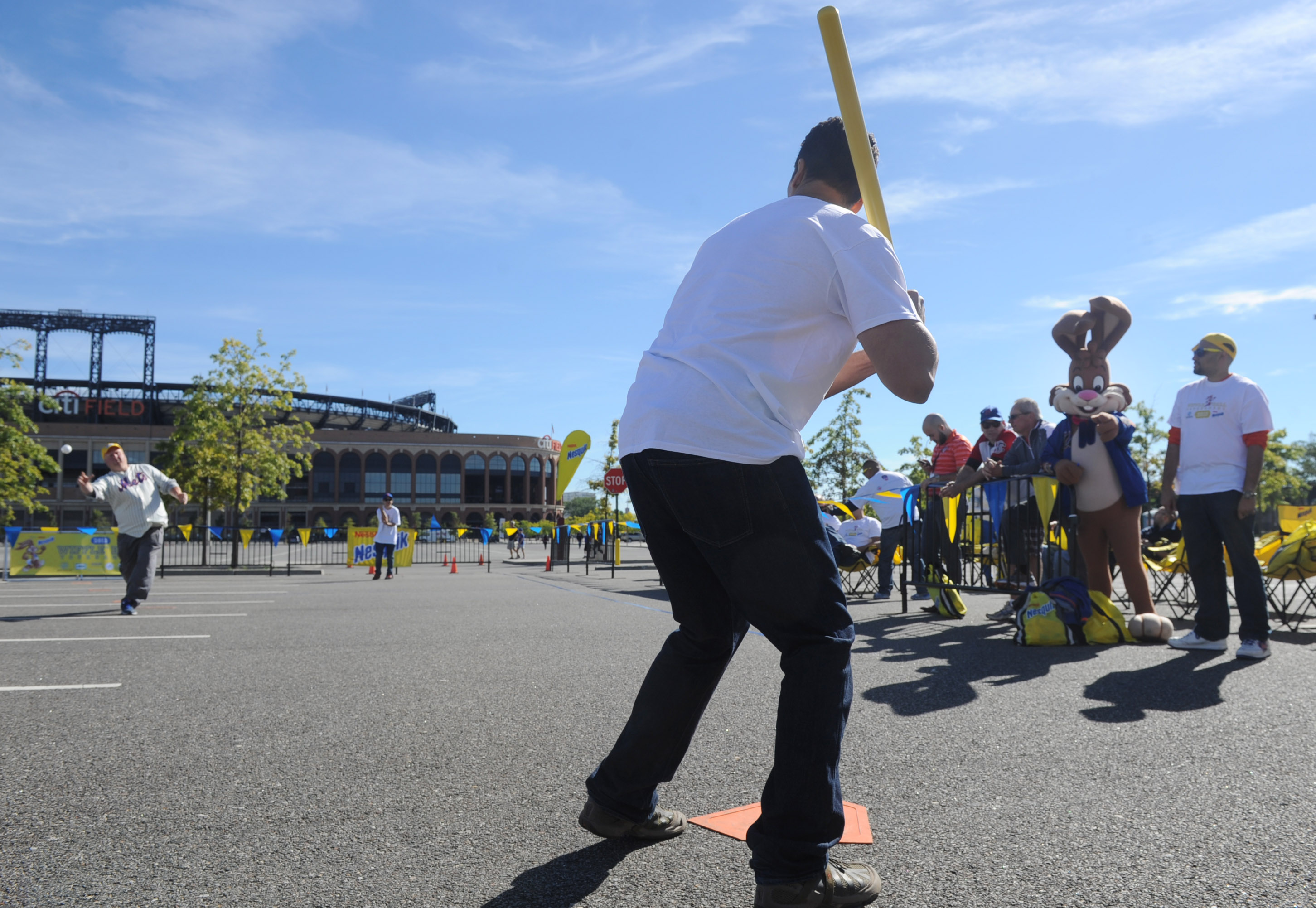
 Shea, back in action. The occasion was a Wiffle Ball tournament held in Parking Lot E next to Citi Field, more or less where Shea used to be. Nesquik, promoting the idea that kids can and should engage in easy, fun activities like Wiffle Ball as part of a healthy lifestyle, sponsored the whole affair, donating $10,000 to the Madison Square Boys & Girls Club and its seven sites in Brooklyn and the Bronx. The company, which has reduced the fat and sugar content of its chocolate beverages, gave out some free stuff, including drinks, baseball cards, hats, sunglasses, lunch and — most generously — free tickets to the Mets-Marlins contest that took place Sunday afternoon.
 Bunny! Fonzie! Buddy! The gang’s all here. I was there primarily to meet Harrelson and Alfonzo and ask them if they’d be willing to talk to me in greater depth at some later time for a book I am writing. (They said they would.) Other participants included ASPIRA New York, Hispanics in Philanthropy, Committee for Hispanic Children and Families, Urban Health Plan, Children’s Aid Society, FDNY Foundation and the NYPD. The ad hoc teams played in front of an audience of Boys & Girls Club youth who, by being top players at the internal youth Wiffle Ball tournament at the Madison Square Boys & Girls Club, won a chance to attend the morning tourney and afternoon tilt that followed.
Oh, and the Nesquik Bunny joined forces with Mr. Met to give the whole thing an extra layer of promotional flair.
A few observations:
• The two concrete fields were of modest, somewhat narrow proportions (maybe 150 feet to dead center). Batters would hit but not run; distance determined whether a single, double, triple or homer was struck.
• Fonzie’s teenage son — whose build reminded me a bit of Benny Agbayani — joined us for one of the games and rifled a drive that looked to be gone but was snagged by an outfielder in leaping, Endy Chavez style.
• Faith and Fear fans will be happy to know that Jason, showing Piazza-like strength, belted a one-handed homer in the first game. My offensive output, by contrast, amounted to a few paltry groundouts and a strikeout in which I twisted myself in Ruthian knots. I did, however, make a few nice catches in the field.
• I think the tournament ended without a winner declared. Let’s just say that everybody won.
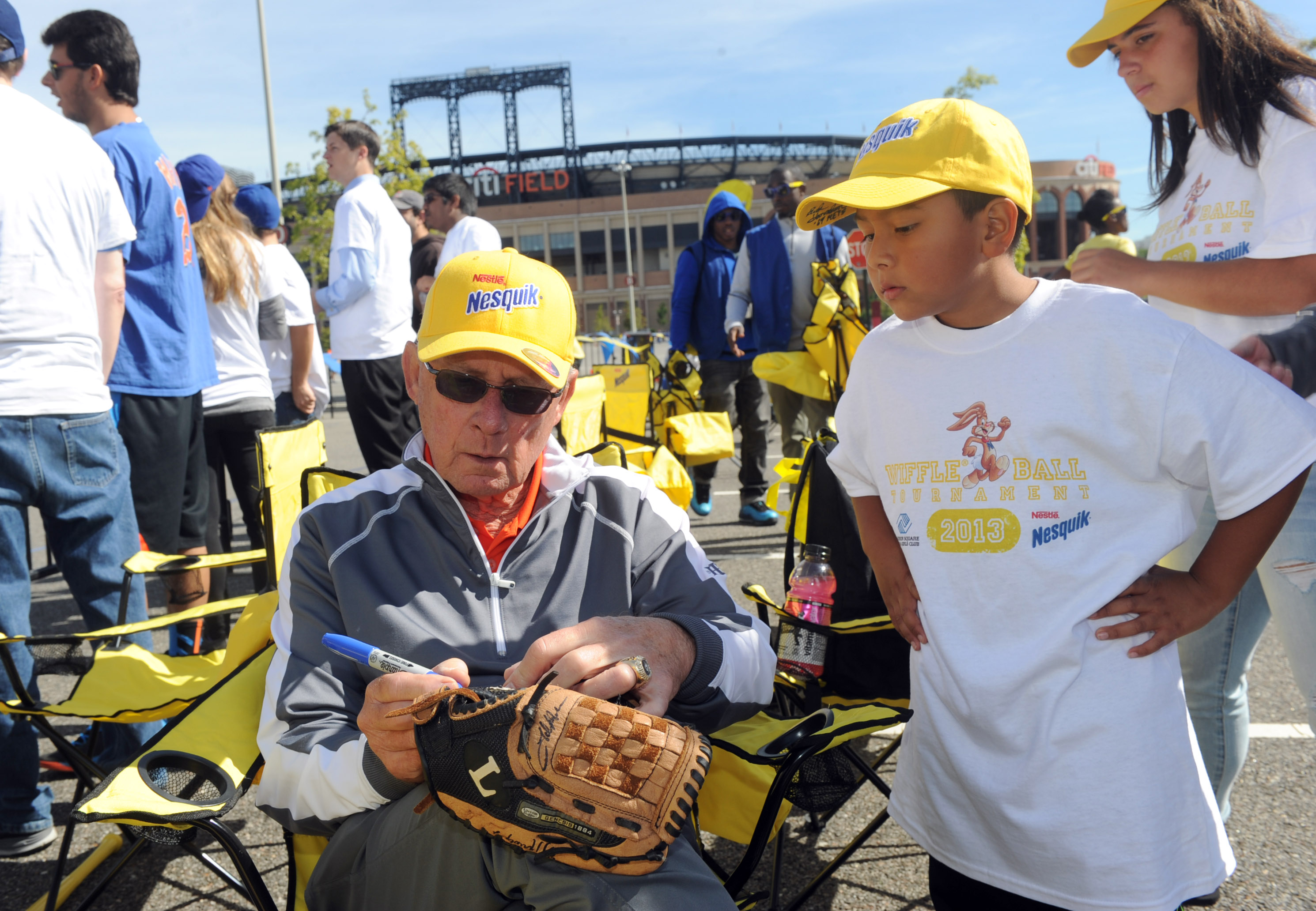
 Harrelson makes more memories. What I’ll likely always remember is the exquisite opportunity the event gave me to hang out and chat with Bud Harrelson, who was very approachable. In fact, at one point he was just standing there by himself watching the proceedings. This was my second encounter with the Mets Hall of Fame shortstop. I told him that I met him as an 11-year old one day in 1966 at the Sizzler Steakhouse in Forest Hills, where he was greeting fans and signing autographs. Back then he had been accompanied by a grizzled agent or handler who had very bad teeth.
The memory was not as vivid for Bud as it was for me.
by Greg Prince on 15 September 2013 7:30 pm The Mets and the Marlins seemed destined for history. Dillon Gee and Tom Koehler scattered baserunners with alacrity. Daniel Murphy made terrible (bad flip), spectacular (heady assist) and terrible (dropped ball) fielding plays in rapid succession. Men entered from the pen and wrote off opposing batters. At the moment it seemed certain there was no way the Mets wouldn’t put this thing away in the twelfth, they appeared determined to resist victory. Oh, this budding marathon was picking up in intensity if not speed as Travis d’Arnaud came to bat. History, I tell you, was loosening up in the tunnel and planning on playing until dark.
History!
No history at Citi Field Sunday. Just satisfaction. Force of habit now compels me to root for the Mets and the Marlins to forge 20, 22, 24 innings every time they converge. But twelve was a decent day’s work, I guess. And winning was very good. Most outstanding was Travis d’Arnaud rescuing the Mets from a very silly continuation of what we’ll loosely call hostilities. They had gone from bases loaded and none out to bases loaded and two out as the score stayed stubbornly stuck on zero-zero and the clock prepared to strike inning thirteen. The Mets have done enough marathoning with the Marlins for one season. The kid showed impeccable timing in ending it when he did.
Travis isn’t hitting yet, or he wasn’t until he delivered the game-winning single just past the diving form of Adeiny Hechavarria. Maybe he’ll commence to building his major league offensive credentials from this moment forward. More likely he’ll struggle onward for a spell. Young Jerry Grote struggled. Young John Stearns struggled. Todd Hundley was a no-tool player in his early ups. They all came around. D’Arnaud, however infinitesimal his numbers a month or so in, deserves every chance to measure up to his scouting reports.
No surprise that a fourth-place team depleted by injuries and never all that stacked to begin with should find itself scuffling for runs and depending on unproven talent to create them. We get that. We’d prefer d’Arnaud had come out of the box like 2010 Buster Posey; Juan Lagares and Matt den Dekker make like Fred Lynn and Jim Rice circa 1975; and Wilmer Flores be Scott Rolen from 1997 Jump Street. Yet we understand not all rookies are all-time rookies. It’s September and all that implies for a 67-82 outfit.
Terry Collins answers questions after games, even the wins, about how difficult all this must be. Yes, he says, it’s difficult. Gosh, he told a media inquisitor Sunday, we had to start four rookies today. He likes to say “nobody feels sorry for us,” all while strongly hinting that stinkin’ circumstances — injuries, weather, travel, whatever — are constantly conspiring against him and his team… him, most of all.
The “four rookies” aside would carry more weight if his rookies hadn’t been playing the Marlins, who’ve had four rookies in their lineup as a matter of course pretty much every other day since their founding. Again, it’s September. Everybody wants to see rookies if they can’t see a contender. Your rookies notched eight runs in four games against one of the few teams straggling to the finish line in worse shape than yours, yet still they and their handful of demi-veteran teammates eked out three wins. Say that, praise Gee, smile and enjoy the off day. Stop looking for pity while you’re insisting nobody pities you.
Collins will most likely return to manage the Mets again in 2014. I’m not exactly for it even if I’m not packing a great reason to oppose it. I can’t get excited about listening to his pregame or postgame comments and I don’t look forward to seeing him in the dugout. He’s steered three consecutive squads to losing records and might wind up bringing this one home with a lesser mark than the one before it, same as he did in his first two years. Yet I can’t really say he deserves to be let go. I’ve yet to read a single on-the-record, off-the-record, anonymous or deep-background sentiment from any Met since 2011 that finds fault with Terry Collins. Nobody who deals with him among the press corps has anything but glowing praise to offer regarding his performance and personality. His in-game management isn’t thrilling, but in my recollection, dating back to Gil Hodges, every manager has had a given moment or more of seeming to not know what they were doing, and that includes the great Davey Johnson and the great (if occasionally misguided) Bobby Valentine.
Terry will almost certainly be back. That’s not quite a torch-and-pitchfork situation, but I do wish he’d stop subtly dropping hints that when the Mets take a wrong turn, it isn’t quite his players’ fault and it’s definitely not his. In professional sports, the record tends to drown out interpretations when the record is attached to a winning percentage that permanently resides south of .500.
Twelve innings. One run. Hard to believe WFAN didn’t rush to sign up for another few years of this, eh?
Michael Malone loves his 1977 Mets clipboard, one of which I came to possess in 1979 but am pretty sure I dopily purged along the way. Read his tale of enduring promotional giveaway bliss, as published in the Times, here.
by Jason Fry on 14 September 2013 11:35 pm There ain’t much left to play for: A .500 season vanished from the realm of possibility with the afternoon’s listless defeat, and draft picks are too much of a crapshoot for me to take seriously.
But as is often the case, I think I’m moved on to acceptance. It was … kinda fun watching the Mets in the nightcap, whether the entertainment was Daniel Murphy and Lucas Duda going deep back to back, or Daisuke Matsuzaka earning the win in his second straight pretty good start, or Keith Hernandez not knowing what a mullet is. (Seriously, how has Keith Hernandez never heard this term?)
By the way, Keith described Duda’s home run as “off the snacks,” referring to the Wise sign out there in right-center. If it were April or May “off the snacks” would become a thing, with its own hashtag, t-shirts and the rest. Which suddenly makes me wish it were April or May.
Anyway, Murph’s an interesting case on a team full of them — he’s never going to be a stellar defensive second baseman, but he’s worked unbelievably hard to make himself an adequate one. He’s never going to be a great hitter and baserunner, but he’s an undeniably useful one. On a team full of problems and questions, he’s answer enough that the Mets ought to just move on from worrying about him and his position.
Matsuzaka, on the other hand … well, we’ve already been through enough that maybe we need a third hand. If the Mets had exiled Matsuzaka back to minor-league perdition after his first three awful starts, I don’t think there would have been a fan in blue and orange who would have had a cross word to say about the decision. But he stared down Cleveland and beat Miami, two teams that are good and good against us, respectively, and this last time out his fielders weren’t at risk at fossilization either. So who the heck knows? As currently constructed the Mets are going to need at least one more starter next spring, most likely two after Dr. Andrews sits down with Matt Harvey. Maybe one of them will be Matsuzaka. If you’d told me that two weeks ago I would have wailed and rent my garments, and maybe I’ll do the same if you tell me that two weeks from now, but right now it seems … like maybe not entirely such a completely and utterly awful idea?
That’s one of the things about baseball — sabermetrics, years of watching or both can give you a pretty good set of guesses, but you don’t actually know. Sometimes guys figure stuff out, or a new voice actually unlocks something in them, and you get different results. It’s madness to bank on such things, but it’s fun to hope.
Speaking of voices, the last couple of days has sure brought a lot of odd chatter to Metsland.
First off, there was today’s kerfuffle over whether David Wright should play again this year. This one has been baffled: Why the heck shouldn’t he? He’s got a hamstring strain, not a hangman’s fracture. If he should re-injure the hamstring, what? He walks around a little gingerly for the first couple of weeks of watching other teams in the playoffs? Wright, being Wright, gamely answered ridiculous questions about this, which I thought Gary Cohen did a good job dismissing: “It’s his job.”
One person Wright obviously didn’t discuss his injury with is Frank Francisco, which is best: After the Jenrry Mejia story my preference would be that no one ever talk to Frank Francisco again. Except maybe the trainer — in Game 1 Francisco took a Logan Morrison line drive off the thumb, and while I never, ever, ever cheer an injury, let’s just say I’ve seen mishaps that made me feel a lot sorrier. The thumb is reportedly bruised, so Frank Frank should only need to go on the 90-day DL until he’s feeling ready to contribute again.
Also, in case you missed it: Shut the fuck up, Shaun Marcum.
by Jason Fry on 14 September 2013 1:07 am Lucas Duda spent the spring trudging around left field until an intercostal strain and a dose of reality dictated that he stop. He then spent the summer in Las Vegas. When he returned, he went from left field to left out, with first base occupied by fellow reclamation project Ike Davis.
Then Ike strained something (the Mets are rich in young pitching and body parts that can be hurt, though I’m not sure in what order) and suddenly first base was essentially granted to Lucas by default, with the Mets all but pleading with him to do something with it. Which, for much of September, he hadn’t done.
Well, until Mister Hand, less formally known as Brad, hung a curveball in the sixth to which Duda said aloha. (I’m the first to make that joke, right? Maybe the thousandth-and-first?) Giancarlo Stanton, he of not one but two home-run balls that might have killed an outfielder unlucky enough to be in their way, actually caught Duda’s drive on the bounce, but the bounce had come off the netting atop the Mo Zone, which doesn’t count as anything except a home run unless Angel Hernandez is an attendance, which mercifully he was not.
It’s wrong to say Duda hasn’t evolved in his Mets career — he’s gone from riddle to conundrum, with a fine eye for the strike zone offset by a certain passivity at the plate. Think of him as the anti-Francoeur — a player who sometimes seems like he’s forgotten you can hit your way on base, too. More nights like tonight’s would certainly help him, though one gets the feeling that a trade to a team where he could DH would be the kindest thing of all.
Speaking of forgotten men, Duda got his chance in the sixth because Hand tiptoed around Andrew Brown, understandably spooked by a second-inning blast Brown had delivered into the second deck. (If you’re keeping score that’s two completely unoriginal jokes, sorry.) Brown’s had an odd year, too — the Mets called him up in May and he looked like he deserved a shot, particularly given the state of the outfield then, but he was shipped out in favor of Rick Ankiel, which is the kind of thing that can make you think “I’m too old for this shit” even if you’re just 28. When the Mets determined the large fork in Ankiel’s back was negatively affecting his ability to play, Brown got back to the big leagues and played well when finally given some time, only to fall on his face in September — today’s game raised his average for the month to .056.
At least he’s got plenty of company in that.
In the end, the Mets’ forgotten men were the keys to a relatively tidy, unobjectionable win, with LaTroy Hawkins striking out Stanton to lead off the ninth and avert another unwanted marathon. Then again, the lead the Mets took on Duda’s homer was their first since Sunday against the Indians — they never led for so much as a nano-second while being eviscerated by the Nats.
Which is the kind of thing you wish you could forget.
by Greg Prince on 13 September 2013 4:52 pm On Saturday, August 10, Zack Wheeler and the Mets beat the Diamondbacks, 4-1, while Phil Hughes and the Yankees lost to the Tigers, 9-3. I enjoyed both games immensely. The Mets had taken over third place in the N.L. East and sat only two games behind Washington for second. The Yankees were stuck down in fourth place of the A.L. East, seven out of the Wild Card, trailing five teams for the last available playoff spot. Better still, the Mets’ record was only 4½ games worse than the Yankees’.
My instinct was to mention this approvingly somewhere, like on this blog. Why wouldn’t I? Do you know the last season in which the Mets a) posted a better record than the Yankees AND b) finished higher in the standings than the Yankees?
1990. That’s when. That’s twenty-three years ago. As of August 10, the Mets and their young pitching were on the upswing. The Yankees were an overpriced mess. It might not constitute retaking New York, given that we weren’t going to any playoffs in 2013 either, but what a step in the right direction the process was about to start taking if the Mets could be said to have compiled a better year than the other team in town. Oh, how I wanted to make a thing of it.
But I thought better of it. You can figure out why. You just have to look at the standings as they stand right now and understand it didn’t pay to harbor those kinds of thoughts, let alone say them out loud. When good things happen — which, for us humans, sometimes includes bad things happening to those we’re not particularly crazy about — we are best off just keeping the, shall we say, Sheadenfreudic portion of our joy to ourselves…particularly when we’re in only the provisional stages of having something tangible to gloat over.
There’s a sermon somewhere in there, I imagine. It turns out I once knew someone who could have offered me some valuable insight on the matter.
No disrespect intended to the current practitioner of rabbinical duties at the Hillcrest Jewish Center in Queens, but I’m deeply sorry their Yom Kippur services will not be led by the late Rabbi Evan Radler tonight and tomorrow. I’ve never been to Hillcrest, mind you, but I knew Rabbi Radler.
Let me clarify: I knew Evan Radler. I had no idea he became a rabbi. I had no idea what he did with his life after both of us were 11 years old. I had no idea that his life ended when both of us were 42 years old, which was eight years ago. I doubt any of it would have come up had his name not popped up on Facebook a while back.
Names from the distant precincts of the past pop up on Facebook like Omar Quintanilla pops up with runners on base and two out. It just happens. On some page comprised of people with whom I went to high school, somebody mentioned Evan Radler, who I knew from day camp one summer and one post-camp event one winter’s day. Funny thing about seeing that name appear as if from out of nowhere was it wasn’t the first time in decades I had thought of him.
Now and again Evan passed through my consciousness. Some people will do that even if they’ve been out of your direct view in what seems like forever. This was 10- and 11-year-old Evan, or my conception of that person, based on what little I could recall of him. For instance, before I got to know Jason well and I was supposed to meet him outside Shea, I’d think, “What does he look like again?” and the face I’d come up with was Evan’s…and then I’d have to recalibrate and recall these were two separate people from two different periods of my life and, besides, Jason in his late 20s didn’t look or act anything like Evan the pre-adolescent.
I solved that problem given time and practice, and I’d be hard-pressed to tell you why I associated with the two, but Jason aside, Evan would come around now and again in my stray thoughts on his own. Just for a flash, usually. I went to camp with dozens of kids when I was 10. I only remember a few specifically. Hardly any of them cross my mind involuntarily. Evan would, though. That’s why it was jarring when one of my high school classmates who knew him mentioned him on Facebook. That’s why I couldn’t resist looking him up on Google. That’s why I was saddened out of proportion to familiarity never mind contemporaneousness to learn in 2012 that Evan, whom I had last seen in 1974, died in 2005.
As for Evan having become a rabbi — my first reaction was, “Really?” Evan Radler from kosher but not nuts about it Camp Avnet? Well, why not? I have no reason he shouldn’t have, save for you don’t think of 10-year-olds growing up to be rabbis. The only overtly religious components of Camp Avnet were we had to keep our heads covered and we had to say a brucha before eating. Evan, like the other kids who went to the Hebrew Academy of Long Beach (which converted to Camp Avnet during the summer) or Jewish day schools like it, speed-read those Hebrew blessings from right to left and got to their sandwiches while I, a student of the Long Beach public school system, was still stammering over the phonetics. I once told him I didn’t see any real point to making us carry out what felt like a rote ritual. He didn’t exactly proselytize in my face but made it clear he was fine with saying his prayer.
From that he became a rabbi?
Of course there was more to Evan than that transitory episode in the lunchroom. Plus he went on to adulthood and anything goes from there, I suppose. So why shouldn’t a 10-year-old grow up to be a rabbi? Studies show most adults, regardless of what they wind up doing with themselves, were — for approximately twelve months at some early stage of their lives — 10-year-old children.
I’m no authority on rabbis (and Judgment is considered in some quarters best left in the hands of a Higher Authority this time of year), yet it is my impression that Rabbi Radler did his job well. Kind and sincere words were left behind in the wake of his untimely passing. Evidence of his brand of spiritual leadership eventually went up on YouTube and from what I’ve watched, the videos suggest he surely found his calling.
If one can express one’s condolences long after the fact, I am very sorry for his family, for his congregation and for his community that he was lost so soon. No doubt it would have been interesting to have known him beyond childhood. Chances are remote I would have ever seen him again, but in the Facebook era, you never can tell.
But I did know him once and that’s the Evan Radler who sticks with me, the Evan from the summer of 1973. If the date jumps out at you right there, given what we here know about that time frame, you might think I’m suddenly talking about Evan within the context of the demi-miracle of demi-miracles that occurred for our benefit that autumn.
To which I would say: sort of.
Longtime readers might recognize “Camp Avnet” as the institution that was responsible for bringing me to Shea Stadium for my first game, July 11, 1973. I’ve written about it on multiple occasions, but I’ve never mentioned the name Evan Radler in connection with my own Book of Genesis. There’s a good reason for that.
Evan was a Yankees fan. He was a serpent in the Garden of Avnet in baseball terms. Everybody was a Mets fan in those days. Everybody at camp, anyway. Thus everybody was excited to get on that bus and ride to Shea and see the Mets play the Astros. Evan, however, was the iconoclast in our group. Evan didn’t root for the Mets.
I found that bizarre to the point of insulting. Why would anybody around here not root for the Mets? Kids in Chicago or Pittsburgh, sure, but we’re not there. We’re here. Why would anybody around here not root for my happiness? Root against my happiness? Evan wasn’t one of those “I like both teams” kids, either. He let you know who he was for and who he was against. I didn’t generally make a thing of who I was against because you hardly ever came up against their supporters.
But I had now.
I had known maybe one or two of “his kind” in elementary school to that point, but I wrote them off as sociopaths, cranks or a little dim. Evan was too nice and too smart to be so summarily dismissed among the Yankee rabble. We got along great despite our differences. He was, in the space of eight weeks worth of swimming, arts & crafts and a bus trip to a ballpark, the best friend I made that summer. I even went over to his apartment — his family lived adjacent to the boardwalk in Long Beach — one Sunday to hang out, something I didn’t do much with anybody at that age. I remember he had displayed in is room the same full-color caricatures of ballplayers that I had been collecting. These were the illustrations that had been running in the News every Sunday throughout the summer of 1973, the ones Bruce Stark drew of the Mets and the Yankees. I saved those pages because they half-featured the Mets.
But Evan preferred the halves that featured the Yankees. Like I said, bizarre.
As 10-year-olds, our allegiances were never far from our collective consciousness. We were 10. We talked about baseball. What else were we going to talk about? (As opposed to now, when I’m 50, and I’m so much more well-rounded.) Evan never seemed malicious but could dwell a bit on the acerbic side. He didn’t mind making note that as the summer of 1973 wore on, his team resided in first place in its division and my team wallowed in last place.
I liked Evan but I didn’t like that. And as August became September, and the Mets began climbing out of the basement and into the pennant race, I had my eye on two sets of standings. I wanted the Mets to win the National League East and I just as badly wanted the Yankees to lose the American League East. Not just not finish first but fall as far from the top as they could.
I got both my wishes. The Mets won their division, their league and almost the World Series. The Yankees plummeted to fourth, 17 games behind the Orioles, saddled with a losing record no less. You gotta believe it was perfect.
No, actually, it would get more perfect. As the postseason unfurled, Evan and I were in different schools, so our first opportunity for a chance meeting arose the following winter at the Hebrew Academy. To encourage return business, the school would hold a “camp reunion,” inviting back those who spent the previous summer there to get reacquainted with the idea. “Reunion” seemed kind of a stretch to use when talking about 11-year-olds getting together, but we got a notice in the mail, I told my parents I’d like to go and my father drove me across town and dropped me off for the festivities.
I wanted to go for only one reason. I wanted to run into only one kid I knew from Camp Avnet. And I got that wish, too. Evan Radler had shown up.
The second I spotted him in the Hebrew Academy gym, I ran over in his direction and announced to him the one thing I’d been waiting months to say…the only thing I still remember saying to him that Sunday afternoon in late January. It was, in essence:
HOW ABOUT THOSE METS NOW, HUH?
HUH?
OH, AND YOUR YANKEES…NOT SO GOOD, HUH?
HUH?
I had come to gloat and I was gloating. I don’t know that I had gloated much before this moment. I hadn’t all that much to gloat about, probably. I’d like to think I was raised to muster the common sense to never gloat even when your target is right in front of you and you’re infused with the righteousness of the Mets winning and the Yankees losing. Whether you’re well-versed in gloating or brand new to the discipline, it’s not a skill worth honing. The only thing I didn’t like about Evan during the summer was he rubbed the standings in my face. Why would I do something like that to somebody else, assuming he wasn’t a total jerk? Oh, this reunion between camp buddies could’ve gotten ugly. We were 11 and I was acting the part of the jerk.
But no further ugliness transpired. Evan gave me a decent-sized smile, as if he knew it was coming. I doubt he was happy with the result of the previous baseball season, at least where his team was concerned, but he sublimated it into an “I know, I know,” as if he had figured out that his haughtiness back in July and August of 1973 was perhaps misplaced. It’s even possible Evan wasn’t actually rooting against my happiness across those summer days. I don’t know, however, if I’d go that far in reconstructing the events of four decades ago.
I never saw Evan again. Couldn’t tell you what steered him into the clergy. Relevant to what we do here, I couldn’t tell you how important baseball remained to him. Perhaps it accompanied him on his journey. Perhaps he decided that after 1973 that if this was the way it was going to go — the Yankees forever blowing it, the Mets always coming out on top — maybe there were better things he could do with this passions. Or maybe he stayed a Yankees fan as a diversion from weightier matters of the soul until the day he died far too soon and thus got to enjoy the rewards of six world championships. Maybe, between learning more bruchas and marveling at Reggie Jackson homers, he allowed himself a harmlessly vengeful smirk as the Mets swirled down the toilet in the late ’70s and thought to himself, “That kid from camp in 1973…where is he now…huh?”
Perhaps I flatter myself to think any of this stuck with him. He had a life to live and by all indications he lived to it to great effect. On a panel discussion I was able to watch online, he explained why he came to support gay marriage, which, not that long ago, was something that took at least a little courage among people of his profession to declare. “Let’s move forward,” he advised the skeptics in his audience, “let’s grow up.”
I know he was talking about something else entirely, but he wouldn’t have been unjustified telling me the same thing almost 40 years ago.
Not that I would’ve listened.
by Jason Fry on 12 September 2013 11:50 pm Surprise! Aaron Harang was … not that bad.
He wasn’t great, but he pitched capably enough — a team with an iota of offense might have had a chance out there, which unfortunately doesn’t describe the current Mets. A couple of weeks ago, our young players might have frowned at hearing that baseball conventional wisdom is to pay no attention to March and September — after all, there they stood with a September essentially to themselves, with a manager and a front office desperately hoping to be impressed. Now, that “pay no attention to September” mantra must feel like a security blanket — perhaps nobody’s taking the team’s utter lack of offense too seriously, and promising to forget it by next spring.
(Well, except Terry’s definitely noticed.)
It wasn’t particularly a surprise that Frank Francisco did something rock-headed, blatantly drilling Jayson Werth in the back for some unspecified sin or another. (Possibly just being much better than anyone wearing blue and orange.) After staring at the screen in shock and dismay for a moment, I had a thought that was actually worse.
If Werth runs out to slug Frank Frank, I’m rooting for Werth.
You have to understand that I loathe Jayson Werth. My hatred for him is pure and deep. I hate him the way I hate Cody Ross, the way I hate Shane Victorino, the way I hated Michael Tucker and Jim Leyritz and (in his early years) Chipper Jones.
But Werth didn’t spend the better part of a year malingering, try to drag a young rehabbing teammate into the muck of bad citizenry with him, then come back and endanger his teammates by trying to start a beanball war. Frank Francisco did that. And now he’s doing other things, things we have to witness instead of sighing about and being glad there’s a Port St. Lucie dateline attached to the bad news. We can’t be rid of him soon enough.
At least the opprobrium has been swift and unvarnished, particularly by baseball standards. Gary Cohen wondered why Francisco would do such a thing, and Ron Darling replied, “Because he’s a fool.” Or here, reconstituted, is what a scout in attendance told Adam Rubin: “Frank Francisco is a douchebag. Almost got his shortstop’s ankle broken. It was so frickin’ obvious! Asshole almost got Tejada killed.”
As for the Mets and WFAN, to my mild surprise I can’t work up much outrage.
Like my partner, I have all sorts of good memories of listening to the Mets on WFAN, and a long record of doing silly things so I could hear the Mets on the radio.
I chose one college over another because 1050 AM came in clearly in one city but not in the other, something it took me years to admit to my mother.
I’ve stopped driving short of my destination because the signal was fading and kept driving farther than I should have because the signal was strengthening.
On weekends in D.C. I used to park my car by the Potomac River because the water amplified the signal. (I don’t know why the hell it did, just that it did.)
I’ve owned all sorts of contraptions that promised to boost a signal and made crazy antenna extenders out of tinfoil and hangars and stood on my leg like a stork for an hour because I thought it was helping reception.
I pride myself in being able to decipher what’s happening in a game even if I can only hear every fourth or fifth word amid hiss and atmospheric yowl — I’ve heard enough games to be able to intuit things from how an announcer pitches his voice and how fast he’s talking. Occasionally people marvel at this, and I admit that I let them.
But I did those things because I had to, and my nostalgia for them is colored, as is usually the case, by relief at not having to do them anymore. And note I said “listening to the Mets on WFAN,” not “listening to WFAN.” The first is a necessity; the second is a nightmare. If the Mets aren’t playing or about to play or just done playing, I don’t listen to a syllable of WFAN, because the world inflicts too many stupid and/or angry people on me as it is. Is it embarrassing that we’ve been jilted for the Yankees? I guess. But then a lot of things are embarrassing these days.
If I want to hear what people think of the Mets I come here, or to any of the wonderful sites run and read by smart, passionate fans. If I want to hear the Mets, I turn on MLB At Bat — even if I’m in the car and can get the “real” radio. At Bat is reliable, it’s cheap, it won’t kill your data plan, and when the game’s over I can switch over to any other game that’s on. (I’m listening to the Giants and Dodgers now, because I can.) I have a soft spot for remembering cheap little transistor radios under the covers or mounded up on a beach towel, sure — but if I could have listened to Vin Scully as a kid and actually been able to hear him, I’d have done that in a heartbeat. The digital age has its drawbacks and ambivalence, but I get to walk around with a Magic Baseball Machine in my pocket — something that’s quite literally a childhood dream come true.
I know exactly where the Mets will be when I want to hear them next year — they’ll be on the other side of the little headphones icon on At Bat. Howie Rose and Josh Lewin will be there, and the things they’ll be describing will be things the Mets are doing. That’s what matters to me. The rest of it stopped mattering to me a long time ago.
by Greg Prince on 12 September 2013 2:06 am There they go, off to a farm upstate, and I don’t mean Binghamton. Your 2013 New York Mets are no longer mathematically alive for postseason consideration. Spiritually they never showed much of a pulse, either, give or take a delusion or two that sprouted amidst the heat of late July. This season still somehow has 18 unplayed games packed into its tail end despite having seemed to have come to an abrupt halt the moment the phrase “partially torn” entered our reluctant conversation. There are no goals left for this team of ours other than to survive it with their hamstrings and innings limits intact.
Passing the decrepit Phillies for third place would be nice, but c’mon, let’s be realistic. We’re not really deep enough at this stage of the schedule to outdo decrepitude.
On the night the Mets succumbed to ensure they will commence 2014 eight years removed from their most recent playoff berth, Zack Wheeler wriggled out of a couple of jams and gave up but one solo home run to Davey Johnson’s hard-hitting, late-charging Nationals. It was the kind of performance that had it been surrounded by the slightest hint of life you’d take in a second as a sure sign of better days ahead, 3-0 defeat notwithstanding. If young Zack keeps throwing and keeps learning and keeps his UCL out of harm’s way, it can only be to the good in the future.
But on nights like Wednesday — which is all the Mets have anymore — it is nigh impossible to be encouraged by anything other than the fact that their 18 unplayed games are due to be reduced to 17 later this afternoon.
Wheeler almost impeding Washington’s still slim chances. Lagares putting down a very sweet bunt for a base hit in the ninth. Den Dekker and d’Arnaud allowing us the slightest of peeks at their respective potentials. Flores, if his right ankle is taped tightly enough. Vic Black’s hard stuff, more successful some outings than others. Evidence that Ruben Tejada wasn’t designated for oblivion at the ripe old age of 23. You want to see the kids in September? You got ’em this September. Yet it’s still not encouraging. How can you be dropped smack into the middle of this particular month and watch the Mets continually score nothing in front of nobody and say, “Hey, I can really feel the excitement building here!”?
The most sensitive of seismographs would be incapable of picking up an iota of enthusiasm in as morbidly lost a September as the Mets have authored in the Citi Field era — and that includes the first wretched one from relentlessly dismal 2009. Since this month began, either the Mets get mercilessly clobbered or they engage in faux pitchers’ duels, low-scoring affairs in which a Wheeler or a Gee leaves it all on the mound and whoever’s throwing for the other side outdoes our guy regardless. Our guy goes up against major leaguers. The opposing pitcher gets to face the Mets lineup. Case inevitably closed in the opposition’s favor.
Into this epic darkness, the Mets puzzlingly air between-innings come-ons for 2014 season tickets. “Enjoying what you’ve been seeing tonight? Now imagine paying for it 81 times next year!” Wait until the dead of winter and lure us while we’re vulnerable and have forgotten what Mets baseball actually looks like. Don’t run commercials for Mets season tickets during a series that is the opposite of a commercial for Mets season tickets.
Besides, aren’t the Mets set for customers? Every game this week has drawn a paid attendance of “20,000,” which is great for a team on the cusp of official elimination with 18 games to go. Capacity at Citi Field is around 42,000, so as you’ve been able to tell if you’ve watched any of these games, that means just about every other seat is filled throughout the stadium. If the Mets claim they’re drawing “20,000” now, by next year they’ll surely be jamming six figures into their brickly confines.
Finally, the Mets didn’t wear the first responder caps after BP, distancing themselves by another year from their small but meaningful heartfelt tribute in 2001 when during games they wore ballcaps representing firefighters, police officers and members of all the agencies that acted unfathomably heroically in the face of tragedy. David Aardsma says he was “contemplating” wearing his FDNY cap during the game, “but they took it from us long before we could wear it.” Totally justifiable move by MLB, since it is indeed licensing agreements that make this country great. No doubt the sight of Mets caps being used in competition Wednesday night had Mets fans everywhere rushing onto mets.com’s shopping page and clicking the icon marked “CAPS”.
It was to return previously purchased Mets caps, probably, but commerce is commerce.
by Jason Fry on 11 September 2013 1:12 am Matt den Dekker is a plus center fielder for a team that suddenly has a surplus of them, has some pop, and looks like he’s got an idea about how to approach an at-bat.
Travis d’Arnaud, despite being written off by people unfamiliar with the concept of “small sample size,” has a good arm and an unfussy swing that ought to keep him out of Ikean trouble as a hitter. He collected two hits and saw an atom ball go for naught, which might help him relax at the plate and realize that he’s here to stay, upside-down “p” and all.
Lucas Duda didn’t kill himself at first.
Beyond that, I got nothing. Justin Turner grabbed at his hamstring and departed for some to-be-determined measure of time (could be a few days, could be forever), thereby depriving us of our best hitter. I find myself writing that, somehow, with equal doses of sincerity and snark: Turner’s been on a nice roll and has grown on me as a useful, level-headed player, but he’s still Justin Turner, and the fact that he’s our best hitter right now says a lot about the current state of affairs at Citi Field.
As this strange season nears its strange conclusion, it may be that the adventures of den Dekker and d’Arnaud and d-Uda mean more than we might think. The September when den Dekker and d’Arnaud found their footing and Duda gained confidence after being freed of the outfield may prove to be time well spent next spring. If so, those fleeting memories of good things may be more important than the bad — the heinous Jayson Werth blasting balls all over Flushing on an off-night for Dillon Gee and the doleful sight of crowds that have shrunk to the Party City Deck, Cuppy and some rounding error of fans scattered elsewhere. (They’re more like gatherings.)
Or perhaps that’s the optimist in me, gazing at the glass, smiling and declaring it one-eighth full.
I’d say you be the judge, but it’s too early for a ruling — which is why this is all so strange. Ask me after this offseason, when we should have a better sense of what money will or won’t have been made available. Ask me when Matt Harvey returns. Ask me next September, when perhaps losing a utility infielder won’t feel like yet another body blow. Ask me next time we’re relevant with fall in the air.
Just don’t ask me when that will be.
by Greg Prince on 10 September 2013 3:12 pm The Mets aired their games on WMCA, 570 on your AM dial, for five seasons. They weren’t much good then, and the sound quality might have left something to be desired, but they and we survived. From 1967 through 1971, the Mets called WJRZ-AM home. As the call letters imply, ’JRZ was a Jersey-based station, in Hackensack. That was the first station on which I listened to Mets games, even if I was on Long Island. It came in OK, apparently. And its geographic location didn’t prevent 1969 from transpiring. The miracle was all right there at 970.
I listened to the Mets on WNEW-AM when they weren’t playing Frank Sinatra or Ella Fitzgerald. I listened to the Mets on WRVR-FM when they weren’t playing Miles Davis or Herbie Mann. I listened to the Mets on WNYC-AM when they weren’t airing city council hearings. I listened to the Mets on WHN before and after they went country. I listened to the Mets on a Pittsfield, Mass., affiliate when I was driving home from Boston one Sunday afternoon when I was young and daring enough to take spur-of-the-moment road trips.
Mostly, though, I’ve listened to the Mets on WFAN, which has been a four-letter acronym synonymous with my team (and there are lots of them) since July 1, 1987. Starting with the NLCS pregame Mets Extra of October 7, 1988, WFAN, formerly at WHN’s ancient 1050 slot, could be found at 660 AM. It rained that Friday night, but the Mets were back on the air at their new home on Saturday afternoon and, seemingly, forever after. With the exception of a handful of season or playoff conflicts when you’d suddenly have to rely on a WEVD or a WBBR, you could count on the Mets residing at Sportsradio 66, WFAN.
Count no more.
Word has spread that the Mets will be airing elsewhere in 2014. No more WFAN-AM. No more surpassingly handy WFAN-FM (101.9 comes in beautifully on the 7 train; who knew?). The ’FAN has opted to shift to the dark side. We don’t know yet where the Mets will land. WEPN-FM, 98.7 FM — better known as ESPN Radio — seems a logical fit. Grand old WOR-AM, 710, has been mentioned as well. Other frequencies are out there. How many are a fit for baseball remains to be heard.
This is unfortunate for all the reasons you can conjure. The WFAN brand, despite the presence of objectionable afternoon drive time hosts, is still powerful, and if you’re a sports franchise, you’d probably rather share your air with compatible programming than Rambling with Gambling (or Eye-Rolling with Michael Kay). The WFAN signal is unquestionably powerful on the East Coast, and that’s no small concern if you suddenly find yourself deprived of easy access to it. Habit may be the most powerful pull of all. You flipped to 660 without thinking for a Mets game (just as you tune out your better judgment if you decide to listen to Mike Francesa). It was simple, comfortable and an intrinsic element of the baseball season for a quarter-century.
But so were WHN and WNEW and WJRZ and the rest of the alphabet soup that informs our AM heritage. Mets games will be broadcast (by Howie Rose and Josh Lewin — the team determines the announcers, and the team does that well, at least) and somebody will plug in their microphones so they can be heard reasonably far and wide. Maybe not as clearly or as at great a distance from the originating signal as before or by quite as many people as usual, but the bulk of Mets fans will be served. And of course there’s the MLB At Bat app and SiriusXM and, as I’m sure my tech-savvy partner could rhapsodize over, emerging iFork technology all combining to make the humble radio ever more obsolete minute by minute.
We’ll survive. We always do.
by Greg Prince on 10 September 2013 2:32 am The Mets collected one hit. The Nationals hit five home runs. You do the math. Don’t let the Mets do the math. They welcomed perhaps 3,000 of us to Citi Field, yet reported a paid attendance of 20,174. Those are tickets sold. Some 17,000 humans purchased or had purchased on their behalf a ticket for the game of Monday night, September 9, 2013, and didn’t use it, according to this mathematical methodology.
The rest of us, the 3,000 of us who used a ticket somebody somewhere purchased — and I surely didn’t purchase mine — we went to the trouble of showing up, which puts us in the intimate company of Gio Gonzalez, Denard Span, Ryan Zimmerman, Jayson Werth, Tyler Moore and Wilson Ramos. Those guys showed up all over the box score. Gonzalez is the guy who gave up the one hit to the Mets over nine innings. The others mentioned hit the five home runs that accounted for the nine runs scored by the Nationals.
A sore temptation beckons to suggest the Mets didn’t show up, but no, unlike 17,000 phantoms of the Promenade, I saw ’em with my own eyes. I saw Carlos Torres, generally hyperuseful swingman, allow home runs to his first two batters and decompose from there. I saw Greg Burke, who might be more tolerable if he were Australian or a beet farmer in the offseason, pick up where he left off the last time he was around, which is to say wondering where that damn thing just landed. I saw Zach Lutz (barely) prevent a no-hitter in the seventh inning and a string of Zach Lutz’s teammates conspire to prevent saddling Gonzalez with a two-hitter.
I found Cuppy, too, but who doesn’t?
Welcome to the September of the Metropolitan soul. It’s the ninth month of every year, the sixth month of every season and, dating back to 2009, the stone from which not another drop of blood can possibly be tapped. It’s when there is no hope and no reason for any. It’s when griping is pointless because the Mets traditionally carry plastic butter knives to every gunfight every September. They’re outnumbered. They’re outweighed. They’re outpunched. They’re out of it. They’re 27 outs waiting to be registered and notarized.
It’s only sickening if you decide to be sickened by it. The Mets fan who accepts a free ticket because, darn it all to heck, he’s addicted to baseball and ballparks, shouldn’t be sickened by it. He should avoid using phrases like, “This is a disgrace.” What disgrace? The Mets entered this season with no chance to do anything and they’ve lived up to those expectations. They’ve brought it home in style by shedding themselves of able bodies and trustworthy reputations in advance of September, thereby guaranteeing that this September would proceed much as the one before it and the one before that and so on. Check the lease on the stadium. There must be a provision about hope being prohibited on the premises from September 1 forward.
And the fire code must have something to say about barring 17,000 ticketholders from entering through any gate.
But I did volunteer for this assignment. I volunteered enthusiastically. You say “Citi Field,” and I ask, “What time?” I was there well before 7:10. I listened to our starting lineup announced while walking the field level. I walked and I clapped like I meant it.
Leading off, the left fielder, Eric Young, Jr.
Batting second, the second baseman, Daniel Murphy.
Batting third, the right fielder, Andrew Brown.
Clapped for every one of them. Exuded excitement without irony as I walked. I heard nobody else clapping or exuding, not those along the concourse, not those at their seats (plenty of which were still available as the clock pushed toward seven).
Batting fourth, the first baseman, Lucas Duda.
Batting fifth, the shortstop, Justin Turner.
Batting sixth, the center fielder, Juan Lagares.
I was losing steam, but I felt if I gave my best to Andrew Brown, I couldn’t withhold it from Justin Turner. And why should I? Turner hit two home runs in Cleveland. Brown’s a really adequate fourth/fifth outfielder. I could watch Lagares throw out opposing baserunners all night…if only the baserunners weren’t legally allowed to run around the bases unimpeded once the balls they hit cleared the fence.
Batting seventh, the third baseman, Wilmer Flores.
Batting eighth, the catcher, Travis d’Arnaud.
Batting ninth and pitching, Carlos Torres.
You know how the applause swells for a Harvey or a Dickey or a Santana when they’re announced as batting ninth and pitching? It does no such thing for a Carlos Torres. That’s a shame most nights. It’s a shame the ritual of introducing the home team elicits less engagement than the finding of Cuppy. But there’s a lot of anonymity going around unless you’re hardcore. Being at a Mets-Nationals game on Monday night, September 9, 2013, doesn’t necessarily make you hardcore. Being at a Mets-Nationals game on Monday night, September 9, 2013, probably makes you the acquaintance of somebody who was looking to get rid of a ticket to that Mets-Nationals game. As the lineup’s composition was announced in full, I couldn’t get down on the 3,000/“20,174″ in attendance for not cheering and stomping and letting these Mets know we’re behind them.
You have to be hardcore to know who these guys are or what they’ve done or to have an inkling as to what they might do. Of these nine men who took the field wearing Mets uniforms in the service of keeping the Nationals’ faint playoff hopes alive, three were familiar in April. Three more are playing as part of a process intended to make them familiar in the Aprils ahead. And in between, you have guys being announced as starting for the New York Mets because the rules require nine guys start for every big league team. Even in the month of the expanded roster, deploying a competitive unit that size night after night is a daunting challenge in Flushing.
This is where I dance on the edge of disgust and dismay. This is where I reflexively caterwauler about how bad this team gets this time of year. This is where I could do without the lecture that everything is going along almost exactly as it should for the long term, save for a partially torn something-or-other, a strained thingamajig, somebody else’s strained whozits and a bad neck. Everybody’s hurt. Everybody who isn’t hurt is fragile. The future’s not now. It never was. Shame on me for flirting with disgust and dismay and sort of expecting something a little better than my Mets can give me for my non-money. Bad Mets fan! Leave the flirting to Gio Gonzalez! Shame on me as well for thinking five home runs surrendered versus one hit collected is somehow not a shining testament to how brilliantly progress is progressing for this organization. Somebody toss me a prospect list, would ya?
So as not to spiral further into darkness, I’ll close with my favorite moment of the evening, courtesy of a gentleman named Eli, which despite the spelling, is pronounced “Ellie” (short for Eliezer, I believe). Eli works in the same office as my wife, who secured us two tickets from the batch that was distributed among several of her lovely co-workers. I’ve met Eli on numerous occasions like this one and he always leaves me thinking that if I had to choose a team of Mets fans at the ballpark the way we used to choose up sides for sports in the playground, I’d choose Eli no later than second to have on my side. He’s just good at being at a Mets game, y’know? In August, I watched in awe as Eli systematically took apart a Yankees fan’s blather, ring by ring, never once not charming the pinstripes off the blowhard as he shut him up. The beauty part is by the end of every half-inning, Eli converts no fewer than five total strangers into fellow travelers on his quest to have the best time anybody can have at Citi Field.
Only problem for the usually happy-go-lucky Eli on Monday night was even his sunny Metsian disposition was taking a beating from Gio and his grisly band of sluggers. We’ve barely said hello when eight pitches have been thrown and two home runs have been blasted. Hard to maintain a boisterous vibe when Span and Zimmerman are swimming in high-fives.
Eli’s not as happy as he could be. None of us is as happy as we could be. It gets worse in the third when Werth makes it 5-0. It descends into full-out ludicrous leading off the fourth when Moore makes it 6-0. By now all we’ve got left is the Bark in the Park pups howling from the Poochie Porch and a wave that struggles around the grandstand. Nobody’s even sure if it’s going in the right direction. (That I paused to contemplate whether the wretched pox that is the wave should ripple clockwise or counter-clockwise indicates how deeply this game had swirled down the drain.)
Burke comes on in the fifth to shove a wadded-up washcloth into the six-run void. He gets the first two outs but then issues walks to Ian Desmond and Adam LaRoche. Ramos takes a strike, then two balls. A dude in our section, unaffiliated with our little group, is fed up to here (my hand is under my chin) with Nationals working counts. I can see his point. They’re up six-love and the Mets are clearly not going to return serve.
“JUST SWING!” he screams.
Ramos swings. The result is the fifth National home run of the night. Washington increases its lead to the eventual forfeit-style final of 9-0. And Eli reads the dude two rows behind us the riot act:
“That’s your fault! That’s you! You told him to swing! You told him and he listened! You gave up that home run! You gave up a three-run homer!”
If only Dan Warthen were jogging to the mound pronto to tell Greg Burke the same thing in the same tone.
|
|