The blog for Mets fans
who like to read
ABOUT US

Faith and Fear in Flushing made its debut on Feb. 16, 2005, the brainchild of two longtime friends and lifelong Met fans.
Greg Prince discovered the Mets when he was 6, during the magical summer of 1969. He is a Long Island-based writer, editor and communications consultant. Contact him here.
Jason Fry is a Brooklyn writer whose first memories include his mom leaping up and down cheering for Rusty Staub. Check out his other writing here.
Got something to say? Leave a comment, or email us at faithandfear@gmail.com. (Sorry, but we have no interest in ads, sponsored content or guest posts.)
Need our RSS feed? It's here.
Visit our Facebook page, or drop by the personal pages for Greg and Jason.
Or follow us on Twitter: Here's Greg, and here's Jason.
|
by Greg Prince on 21 August 2013 9:02 am Every year it seems we play one team far more often than we play anybody else. Or maybe every week it seems that way. Four games in San Diego felt like an eternity, and it was long ago proven the Padres don’t actually exist. Either way, WTF’s with having to play the Braves every five minutes in 2013?
This afternoon will mark the 14th time the Mets will have thrown down against the Braves over their last 81 contests. That’s more than one of every four six games in a half-season of baseball dedicated to taking on a single opponent. That’s roughly one Braves game per week if one chose to apportion them as such.
Which I don’t. I see the Braves coming and going. Suspended games. Makeup games. Walkoff games. Games in which horrific injuries are sustained, games in which first wins are gained, games in which first hits are obtained. And all the while, Braves, Braves and more Braves.
Enough already with the Braves.
Not enough already with beating the Braves, which the Mets somehow held on to do Tuesday night behind Zack Wheeler starting; Scott Rice, Gonzalez Germen and LaTroy Hawkins relieving; Eric Young and Daniel Murphy running; Marlon Byrd and Ike Davis (!) slugging; and Travis d’Arnaud naud longer going 0-for-evah. Naud complaints there. If the Mets could be said to have some contender’s number, you might say 25 guys in Flushing are carrying around a scrap of paper that has scribbled upon it a 404 area code. While the Braves have blazed to an insurmountable first-place lead, they are saddled with a losing — 7-8 — record against our intermittently scrappy ’tropolitans. You might go as far to say that the one team Atlanta wouldn’t want any part of in October would be the Mets if the stars were to align, an apocalypse were to overcome the planet, Shawon Dunston were to be activated and Wheeler could take the ball in Games One, Four and Seven.
You might, even if it would be a stretch worthy of Willie McCovey, but I like having something to feel good about amid the Braves’ march to their first National League East title in eight years, which, incidentally, looms more like their 15th divisional crown in 23 seasons. Yeah, that sounds more accurate. Has a team that’s failed to finish first for seven consecutive seasons ever seemed less deserving of “finally” getting back on top?
If you had no dog in the fight, you could imagine generating empathetic cheers for, say, the Cubs when they made their first postseason in 39 years (though it was a disgusting episode to us, since we were the ones they leapt over to do so in 1984). You could think in 1995, hey, the Yankees haven’t been to the playoffs in 14 years, there are a lot of fans who’ve hung in there with some bad teams, good for them (I didn’t think that, mind you; those are dangerous thoughts, as 1996 would prove). Completely devoid of attachments, you could look at the 2007 Phillies, out of the money every season since 1993 and…we’re not gonna do that, but you know what I mean.
But the Braves? Let them go wander in the desert for another generation. The Braves don’t know how to suffer. Their N.L. East dynasty crumbled after 2005 and they were perfectly fine by 2010. They collapsed in a heap worthy of the 1964 Phillies (and 2007 Mets) in 2011 and were back on their feet, angst-free, in 2012. They lost the first-ever Wild Card Game amid one of the most controversial postseason calls in recent memory and they picked themselves up, dusted themselves off and got on with their business. In the face of the alleged Washington Nationals behemoth, they raced out of the gate this year to a 12-1 start. Their high-priced sibling outfielders fizzled? They played indifferent ball for three months? They saw their inspirational ace go down in look-away pain? Their stone-handed second baseman used his personal days to go in for Lasik surgery? They had to replace their Hall of Fame third baseman?
It doesn’t at all matter. They’re the Borg or the Terminator or whatever science fiction thing that is grim and unrelenting, at least until the leaves start to change colors. Somebody always finds their number come October. But they sure do know how to blot out a summer.
By Friday night, the Braves will have departed Citi Field and Social Media Night will have arrived. Buy a ticket, get a Jay Horwitz bobblehead, find out if the Mets have the Tigers’ number, listen to Third Eye Blind and, mostly, lend a hand to one of the best causes imaginable: Hope Shines for Shannon, which is raising funds to help Mets communications person extraordinaire Shannon Forde in her fight against breast cancer. Please check it out here.
by Greg Prince on 20 August 2013 2:19 pm Marlon Byrd joined the Mets’ 20-home run club Monday. As exclusivity goes, it’s an honor that falls somewhere between the United States Senate and one of those Facebook groups that requires an invitation. It’s not that incredible that you’d get in, but making it there probably says something about your interests and perhaps your capabilities.
Byrd was interested in proving he was still capable of playing in the major leagues in 2013. Just getting an invitation to camp from a team whose lead executive wondered if he had an outfield at all was a small victory for Byrd. He’s certainly piled up the wins, for the Mets and for himself, ever since. With Byrd having done more as a slugger and a fielder than we would have dared dream, many among us have transitioned from wanting the soon-to-be 36-year-old wonder swapped for whatever he could bring back to mildly pining for retention of his services in 2014.
It’s not all about the 20 homers, but they help. Twenty home runs isn’t really much of a milestone for a hitter. Pitchers go for 20 with gusto. We went berserk for R.A. Dickey’s 20th victory. We mostly nodded approvingly when Marlon took Jared Burton over Target Field’s left field wall. If you still have your notes from last September, you know Dickey became the sixth Met two win a 20th game, crafting the ninth Met season in which the feat was accomplished.
The cachet for 20 home runs isn’t quite the same. Twenty isn’t a widely recognized standard for powerful performance, but within the realm of the New York Mets franchise, it rates something a bit weightier than agate type because, let’s face it, these are the Mets. They’ve rarely hit home runs by the ton, bushel or bucket.
Byrd plays right field. Right field is considered a power position. Henry Aaron played right field and hit 755 home runs. Babe Ruth played right field and hit 714 home runs. Marlon Byrd won’t be confused with either of those gentlemen, but he’s a lot closer (albeit in miniature) to their standard than any Met right fielder since Richard Hidalgo launched 21 across only 86 games in 2004. Hidalgo rode a magic carpet from Houston to Flushing. He wasn’t hitting at all as an Astro. He went gangbusters for one month as a Met (10 HR in July, including one per game in five consecutive games, three of which were Subway Series affairs) and then just kind of Daughters of the American Revolution busters the rest of the way. By the end of ’04, Victor Diaz had replaced Hidalgo as the object of our affection in right and there was no popular fervor to re-sign Richard, whose life and career took all kinds of detours after a 2005 stay in Arlington.
Before Hidalgo, Butch Huskey hit 24 home runs playing mostly right field in 1997. Technically, Butch went yard 14 times as the right fielder, 4 times as the first baseman, 3 times as the left fielder, once as the first baseman and twice as a pinch-hitter. To look at his impressive frame, you wouldn’t think Butch Huskey was as versatile as Super Joe McEwing, but you would think he’d rack up loads of home runs. Twenty-four, however, was his Met and MLB high.
The other Met right fielders to slug approximately in the tradition of Aaron and Ruth were a little more predictable. Bobby Bonilla hit 34 playing a little more right than he did third in 1993; Dave Kingman spent most of a summer in right in 1976 and belted a then-Met record 37; and Darryl Strawberry topped 20 home runs every single season he played for the Mets, walloping between 26 and 39 home runs annually between 1983 and 1990.
Straw was a singular Met when it came to four-baggers, not just among right fielders. But hoo-boy, did he break the mold as soon as he cast it. Four right fielders in 21 post-Darryl seasons have hit 20 or more home runs. That’s where the Timos, the Churches, the Frenchys, the Cedeños, the Ochoas and Greens and Burnitzes and ultimately disappointing Victor Diazes come home to roost but not to score on one swing of the bat. You don’t have to have a right fielder blasting home runs if you’re deriving your power from multiple sources elsewhere on the diamond (think Piazza, Ventura and Alfonzo all together in one place), but Byrd getting to 20 and likely beyond is a pleasant reminder that sometimes the Mets can do what other teams can do on offense.
Overall, the Mets have had only 34 players hit 20+ home runs in a season, adding up to 78 20-homer seasons in all. Strawberry leads all comers with eight such powerful campaigns. David Wright’s compiled six, same as Mike Piazza. Howard Johnson put up five. Other names you’d likely expect to see appear in multiples, too, among them Carlos Delgado, Carlos Beltran, Kevin McReynolds, Gary Carter, Todd Hundley and George Foster as well as SkyKing and Bobby Bo. The intriguing entries to me are the 16 Mets who did it once and never again, at least not as Mets. They don’t include some of the names you might guess. No Cleon Jones. No Keith Hernandez. No Rusty Staub. No Lee Mazzilli. Authors of some of the finer seasons of their eras, these Mets icons hit in the teens, but not in the twenties.
Byrd, Hidalgo and Huskey, however, are in the Twenty & Out Club. Frank Thomas founded this fraternal organization, swatting a pre-Kingman standard of 34 in 1962 before coming back to the pack in ’63. Scott Hairston was the club’s previous inductee prior to Marlon and quite the surprising entrant given his part-time status. Hairston some of us sort of wanted back in 2013 after he reached 20 homers on the final day of 2012. The Mets remained undecided on the matter long enough for Scott to sign with the Cubs. They’ve since dealt him to the Nationals. If you’re a fan of cautionary tales, he’s a dozen home runs short of 20 as we speak.
Ike Davis has one year of 20 or more home runs, also from 2012; we’ll see if he gets another. Bernard Gilkey topped 20 once; he’s widely understood to have had the season of his life for us in 1996. Eddie Murray never looked happy in his two Met seasons; he was presumably satisfied to take his business elsewhere after mashing 27 taters in 1993. Donn Clendenon took out his Scripto Pen and signed his name across the 1969 World Series with three homers to earn the Fall Classic’s MVP award; No. 22 came back and stamped 22 regular-season circuit clouts in the books in 1970.
Mo Vaughn hit 26 home runs in 2002 despite widespread rumor that Mo Vaughn didn’t manage to take the field 26 times as a Met.
That left fielder Cliff Floyd hit 34 home runs eight years ago still gratifies me. That center fielder Mike Cameron hit 30 home runs nine years ago still surprises me. That Brian McRae hit 21 home runs fifteen years ago probably speaks for what was going on throughout baseball c. 1998. That Todd Zeile hit 22 home runs as John Olerud’s first base replacement diminishes slightly my theory that Todd Zeile sucked as John Olerud’s first base replacement in 2000. That Rico Brogna hit 22 home runs in 1995 reminds me I was furious that the Mets dared replace my favorite player with some washout from Toronto. (Oly topped 20 twice as a Met and won me over pretty quickly.)
And then there’s Charley Smith, which is to say “Charley Smith?” Yes, Charley Smith. That’s Charley with an “ey,” which you don’t see much anymore. Two years in a row I’ve gotten caught up in a discussion of Mets who hit 20 or more home runs at least once as Mets and both times I completely whiffed on Charley Smith being one of those fellows. (I also forgot about Zeile — and this year Hairston.)
I won’t accept Charley Smith’s career predating my personal baseball memories as an acceptable reason for overlooking his 20 home runs from 1964. I didn’t see Frank Thomas sock any of his 34, either, and I’m plenty conscious of Frank Thomas’s slugging. I became fully aware of Smith during the Mets’ Old Timers Day in 1990…something that couldn’t happen today, I suppose. The theme of the celebration was a salute to many of the men who had manned third base as Mets in their not quite three decades of existence to date. Since the advent of Wright, we don’t grope for full-time third basemen; we grope for full-time right fielders. But it was an instant element of the Met mystique that this silly team could never find a steady third baseman and, even deep into the age of HoJo, the image stuck.
Anyway, the Mets, working with dedicated MLB sponsor Equitable, staged their Old Timers festivities around third base. Smith was a participant. Howie Rose informed the attentive listener that Charley had held the record for most home runs hit by a Mets third baseman before Johnson came along. He communicated this data with a bit of disbelief, not that Smith had once knocked 20 out of the park —erstwhile trivia answer Eddie Bressoud long held the Met shortstop home run record with 10 — but that when it came time to play the actual Old Timers game, Smith was asked to suit up with the “opponents” instead of Met alumni.
I instantly agreed a miscarriage of history had been executed…and then pretty much stopped thinking about Charley Smith. But moved by Byrd’s 20th home run Monday, I grew curious about where Smith stood in the club. Well, he was the second Met to join it, two years after Thomas. He would be the last Met to hit as many as 20 until ultimate two-timer Tommie Agee did so in 1969. By the time of the season Agee and his teammates were scaling the heights of bigger and better things that fall, Smith had taken his last swing in the bigs. His career spanned the Mad Men era, beginning in ’60, ending nine Aprils later at the age of 31 as, of all things, a ’69 Cub.
Charley, who would pass away in 1994, missed the Mets-Cubs rivalry that was about to sprout. He missed every pennant race of which he was ever in the chronological neighborhood, actually. He started with the Dodgers in one of those rare years when they weren’t going anywhere. He was a Phillie a little before they almost won the National League title. He bounced to the Yankees during their blessed fey period. His season in St. Louis (from whence he was sent packing for Roger Maris) occurred between World Series appearances. And the team that traded him to the last-place Mets, the White Sox, dispatched him early in 1964 and then sped off to win 98 games.
You might say Smith had terrible timing, but when it came to etching his name onto the Twenty & Out Club’s membership parchment he was as clutch as they came.
On Saturday, October 3, 1964, Smith hit his 19th home run of the season in service to spoiling one of his future employers’ pennant chances. The night before, Al Jackson — another guy who kept missing the big prize — shut down Bob Gibson and the Cardinals, 1-0. Now, on the second-to-last day of the schedule, the Metsies jumped all over 20-game winner and Met-to-be Ray Sadecki in a 15-5 massacre. George Altman homered. Ed Kranepool homered. Bobby Klaus homered. Joe Christopher homered. And Charley Smith added to the carnage by taking it to Miracle Met-in-waiting Ron Taylor.
Chaos loomed as the Cardinals suddenly couldn’t beat the Mets. If Casey’s boys could pull off one more October miracle on Sunday the Fourth, it was likely you’d have the Redbirds, the Redlegs and even the collapsing Phillies all tying for first. Could they wreak enough havoc to shake the senior circuit to its core and force a round-robin playoff for the flag?
No. They were the 1964 Mets, not the 1969 Mets. But although Gibby would emerge from St. Louis’s bullpen and quell the final Met threat of their 109-loss season, leading his team to an 11-5 triumph and the pennant, Smith got his. In the fourth, Charley homered off starter Curt Simmons to knot the score at one and give himself 20 dingers for the year.
How significant was it? Hell, we’re talking about it today, aren’t we?
Of surpassing significance this Friday night: Social Media Night at Citi Field. Buy a ticket, get a Jay Horwitz bobblehead, watch Marlon Byrd chase 30 home runs and a new contract, determine how good the Tigers are, listen to Third Eye Blind and, mostly, give a hand to one of the best causes imaginable: Hope Shines for Shannon, which is raising funds to help Mets communications person extraordinaire Shannon Forde in her fight against breast cancer. Please check it out here.
by Jason Fry on 19 August 2013 6:56 pm That’s the way the baseball season works — you get snowed out in a somewhat farcical early-spring trip, the makeup date gets stuck on the calendar so far off that it might as well be science fiction, and then the makeup date comes around after all, leaving you mildly surprised to realize the season has shrunk to a relatively short engagement.
The Mets picked up in Minnesota right where they left off, beating a rather horrible Twins team in their beautiful and thankfully snow-free ballgame for a three-game sweep interrupted by two-thirds of a season. Dillon Gee was superb again, Travis d’Arnaud kept getting on base despite not getting hits (just call him the Anti-Francoeur) and best of all Juan Lagares ran down everything in the outfield.
And I do mean everything. If you were a Twin, you couldn’t hit it into the gap without Lagares overhauling it like a cheetah on a motorcycle. You couldn’t hit it onto the warning track without Lagares aiming first his shades and then his glove skyward to snag it. You couldn’t hit it to the fence without Lagares being there, ball rattling around in the glove and body rattling against the fence. I’m surprised there wasn’t a hold on traffic into Minneapolis-St. Paul because of a Mets centerfielder pawing at the noses of jets that dared fly too low.
We’ve talked before about Gee, how earlier this season it looked like he’d be shunted aside, only to have him convincingly reassert his case to be a mainstay of the Mets’ rotation. Looking ahead to 2014, that side of the Mets is in very good shape indeed: Matt Harvey is Matt Harvey, Zack Wheeler is growing with each start, Jon Niese looks gratifyingly like the pitcher he was after his post-Toronto scolding in 2012, and Gee has shaken off the rust of surgery and stands alongside them. For a fifth slot, you can try Jeremy Hefner (assuming he isn’t felled by Tommy John surgery), Jenrry Mejia (assuming that bone spur is shaved successfully), or mix and match until Noah Syndergaard or Rafael Montero are ready for their hotly anticipated debuts. As baseball problems go, finding a fifth starter for half a season isn’t one to keep you up at night.
All to the good, until you naturally contrast the glittering rotation with the Mets’ rather dingy offense. But I suspect the contrast is more about luck than planning.
Before the season, the best-case scenario for the Mets involved the young pitchers developing and a trio of hitters — Lucas Duda, Ike Davis and Ruben Tejada — making strides to build on successful campaigns. The young pitchers have passed that test with high marks. The hitters, though, have flunked it.
Before he got hurt Duda was successful at getting on base but at little else, and both he and the Mets seem to have accepted that it’s cruel to him and his pitchers to put him in the outfield.
Davis’s recent rebound has been welcome, but that’s grading on the curve. Ike has shown little power and his defense has regressed, making him resemble the pre-injury Duda to a disturbing degree.
As for Tejada, he came to camp out of shape and now occupies the Met doghouse, which he might escape only because Omar Quintanilla has shown pretty conclusively that he’s not an everyday starter.
Nobody assumed those three players were going to be stars, but it wasn’t unreasonable to imagine all three developing into solid complementary players.
If that had happened, where would we be?
David Wright would still be the Mets’ lone superstar, but his reliable complement wouldn’t begin and end with Daniel Murphy. Alongside Murph you’d have Duda, Tejada and Davis, with Lagares’s unexpected claim on center field and Marlon Byrd’s one-year cameo coming as very nice surprises and d’Arnaud ready for his big-league audition. In which case the lineup would look pretty impressive, and the Mets might be in the wild-card hunt, with our fantasies of 1973 redux involving more than a late charge to a mediocre record.
None of that happened, but I don’t think that’s the failure of a plan so much as it’s baseball happenstance. Sometimes things work out, and sometimes they don’t. It’s fortunate that so far the young pitchers have developed about as well as anyone could have expected. It’s unfortunate that the relatively young hitters have come in near the bottom of expectations. The conclusion I draw? It’s that life is uncertain.
With d’Arnaud up and innings limits looming for the Mets’ Triple-A hurlers, there’s not a whole lot left to find out about this edition of the club. We want to see Wheeler keep learning his craft, for d’Arnaud to get a hit and learn a pitching staff, and to get a better read on Wilmer Flores. Beyond that, though, there’s not much beyond a cameo (with more crabbing about uniform lettering) for Matt den Dekker, which means soon we’ll be having debates about nearly half of the 2014 starting nine:
- Where do the Mets get two outfielders to flank Lagares?
- Who’s going to play short?
- Can you cobble together a decent first baseman from some combination of Davis, Duda, Flores and Josh Satin?
It’s a lot. But at least we can stop worrying about Dillon Gee.
by Greg Prince on 19 August 2013 8:58 am Unlike Bono’s testimony from when Matt Harvey warms up (at Citi Field, anyway), I can close my eyes and make it go away. Matt’s casual excellence on Sunday Harvey Sunday — 6 innings, 6 hits, 0 walks, 6 strikeouts, just enough untamed action to permit 2 Padre runs in the fifth — was going to be sufficient to earn him a win once Andrew Brown doubled as his pinch-hitter and put the Mets up, 3-2.
With the Harvey part of the story ended after the infield and the bullpen couldn’t quite smother San Diego, Matt was eventually left no-decisioned yet again. Also, the Mets lost, dropping them ten games under .500 for the year and two games under .500 on the trip, with this afternoon’s excursion to Minneapolis pending.
I literally closed my eyes and made it go away, which is to say I fell asleep last night before getting around to blogging, but it works when I’m awake, too. My eyes are figuratively closed. Yesterday’s loss…gone. This season’s trudge to contemporary oblivion…gone. The sense that all these maudlin August results will forever be interchangeable…
…going?
At first glance Sunday, the Met lineup was its usual underwhelming self, partly a function of David Wright’s uncooperative hamstring, partly attributable to the “who?” factor. I knew who these guys were, but who were these eight guys piled atop Harvey exactly? You step back from your day-to-day immersion into all things Met and you’re sorting among journeymen and unknowns. One or two of the journeymen have provided a legitimate boost to the proceedings in 2013; one or two are filling slots that weren’t supposed to require filling, but these things happen.
It’s the unknowns who entice if you keep your eyes closed. Four through seven in the order were four rookies: Satin, Flores, Lagares, d’Arnaud. Satin is hard to think of as a rookie since we had glimpses of him the past two seasons, but the other three are all still in their first tours and two carry that distinct fresh-from-the-farm aroma. Lagares the glove man now has enough experience to have a hot streak and a cold snap inked on his ledger. He’s the veteran among in-season freshman callups. Flores goes back a good couple of weeks, or long enough to make you forget he’s never been on a road trip before this one. D’Arnaud is at the very beginning of his sentence, the part that’s upper-case. The novelty of d’Arnaud simply being here hasn’t come close to wearing off.
You take in a lineup half-stocked with the rookiest of rookies and no, it’s not going to overwhelm. There’s not enough of a portfolio to tell you what you’re watching, so you kind of assume you’re not watching anything yet. But with those eyes closed, maybe these are the vague outlines of tomorrow sharpening today. Or maybe when d’Arnaud lets a passed ball bounce under his squat, Flores chooses to throw to the wrong base and California law expressly forbids Lagares from buying a hit, you close your eyes because you can’t bear to look.
Open ’em up and take a gander for the next forty games not at what these kids can’t do but at what they can do and might do. Will it be enough to help the Mets gain a steady stream of wins? To get Harvey into double-digits already?
Keep watching.
Friday night would be a good time to watch in Flushing on Social Media Night. Buy a ticket, get a Jay Horwitz bobblehead, look at some rookies finding their sea legs, determine how good the Tigers are, listen to Third Eye Blind and, mostly, give a hand to one of the best causes imaginable: Hope Shines for Shannon, which is raising funds to help Mets communications person extraordinaire Shannon Forde in her fight against breast cancer. It all adds up to a victory before you have a hint as the final score. Please check it out here.
by Jason Fry on 18 August 2013 1:20 am Remember the bottom of the first, when Travis d’Arnaud crouched down behind the plate in his very old-school catcher’s gear and made his major-league debut?
That was awesome.
Too bad the rest of the game sucked.
And it did suck — it was a sloggy, groggy mess that took the better part of forever while being alternately depressing and deeply boring. This was the kind of game you pray isn’t in the offing when you’ve got a baseball newbie on your couch or next to you at the park. It grieves me to think that was someone’s first baseball game — that unfortunate is off to MMA or Tic-Tac-Toe or something more interesting and elevating for the human spirit.
As for d’Arnaud, it feels more than a little stupid offering a scouting report off one night, but well, this is a baseball blog and I suppose the historical record compels me to put down a few thoughts. He came up empty with a chance to get the Mets back into the game but worked a couple of walks, seemed to frame pitches well, and looked nimble behind the plate. Yes, the Padres ran wild and too many balls wound up caroming around behind him, but Jenrry Mejia and David Aardsma seemed basically indifferent to the very idea of runners on first, and the Mets’ staff didn’t exactly cover itself with glory tonight. Mejia looked off from the very beginning, hanging sliders and looking fidgety and unsettled, and so it wasn’t an enormous surprise when he departed with his elbow barking. Just that bone spur those bone chips ticketed for off-season removal? Let’s be optimistic for once and assume so. As for Aardsma, was terrible, continuing a recent rocky stretch, but he was also the saacrifical laamb, brought in hurriedly and then left to take a beating. We’ll give him a paass.
D’Arnaud? Let’s say he was patient, and that impressed me. He worked counts and he made a nice play on Edinson Volquez’s spinning bunt, letting it pirouette its way into foul territory. On the day he’d have been forgiven for being jumpy and not letting the game come to him, he kept his cool.
And as we all know, if you’re going to be associated with the Mets, keeping your cool is a virtue.
Plus his parents seemed like really nice people.
by Greg Prince on 17 August 2013 11:27 am If you don’t count the L.A. portion of their itinerary, the Mets have done a nice job of sticking it to the National League West this season. Against the Giants, Rockies, Diamondbacks and Padres, their combined record after Friday night’s 5-2 win over San Diego is 15-7. So if we can just avoid drawing the Dodgers in the first round of the playoffs, we’ll be fine.
Amazing what a two-game winning streak can do for your morale and to your perspective. The Mets didn’t lose to the Padres Friday, just as they didn’t lose to the Padres Thursday and — despite so many individual Mets striking me as fodder to fill as yet undesigned Padre uniform combinations (which is to say sinking into a state of noncompetitive 10:10 PM oblivion where few north of La Jolla and east of El Cajon will be aware of their existence) — I’m feeling pretty decent about my team at the moment. This season, at roughly the three-quarters mark, is holding serve…or is not allowing its inherited demons to score, since I suppose you should use some sort of baseball metaphor if you’re going to be discussing baseball.
It’s dangerous to float too far above a state of curbed enthusiasm with these Mets, for they tend to let you down the instant your thumbs rise up. They went 16-9 from the moment Kirk Nieuwenhuis hastened Western Civilization’s decline through the sweep of the defending world champions in San Francisco. Since that exhilarating stretch, they’ve gone 16-16, the very definition of inconsistency: win one, lose one sixteen times. A month and change of .500 ball looks good when you haven’t hurdled over that bar for a full year in five years — and it’s not bad when your captain is down and your closer is out. But it’s still .500 for a month-and-change after playing at a .640 clip for a few golden weeks.
Of course 2013 was never going to be about 2013, which is easy to say when you take the sophisticated long view but difficult to deal with when you’re in trenches for all 162. That’s probably why we get overly excited with anything that breaks up the 56-64 routine on the cusp of our team’s 121st game. That’s why the birth of Travis d’Arnaud’s major league career is a bigger deal to us than anything the newly arrived Bentley Buck does short of laying down a guitar solo in diapers like that suspiciously talented baby in the heavy-rotation Pepsi Next commercial.
Our long prenatal nightmare is over and d’Arnaud joins the Mets tonight at Petco Park. John Buck can take his time with his family and Anthony Recker can take a seat. Those who are expert at proffering such observations report Anthony Recker comes equipped with a very sweet seat, but when your backup catcher goes 3-for-3 and is still batting .193, his backside can go back up against some pine. It’s Travis time!
Naturally, I hope the best thing the Mets are projected to place behind the plate since sliced Grote meets, exceeds and obliterates expectations. I hope he aids and abets Harvey and Wheeler as Buck has for most of this year and hits as Buck did for most of April. I hope this is one of those positions we can legitimately stop wondering about for the rest of the decade. I hope Travis d’Arnaud is charging out from under his mask to greet one of our fully matured young guns halfway to the mound after the Mets notch their biggest win since 2006 or 2000 or the 20th century.
If Ike Davis is a part of all that, that would be swell. I wouldn’t bet on it. I’d like to. I’d like to trust in Ike the way we wove him into our championship fantasies when Ike was the one whose promotion to the bigs signaled a brighter Met future. Ike Davis was Travis d’Arnaud in April 2010. It’s August 2013. Ike Davis is barely Ike Davis anymore.
Friday night, he was, if just in passing. In the third inning, just after Marlon Byrd homered to give Jon Niese a 2-0 lead, Ike blasted off like Ian Kennedy was Cape Kennedy. It was ground control to major GONE! They’ve brought the dimensions in at Petco Park. They could’ve pushed them back. Wouldn’t have mattered. Ike was unstoppable in that swing.
There haven’t been too many of those kinds of Ike Davis swings. Ike’s troubles have been closely monitored and well-documented. His conversion into an on-base percentage machine lately, as pleasant as it’s been, has been operated by wind turbine, with no traditional power source apparent. Ike Davis, whose portfolio bulged with 32 home runs produced in 2012, now has all of seven in 2013. For as much as he’s shed the patheticism that sent him to Las Vegas in June, he’s batting .204 and slugging .324. It’s been a slog on top of a trudge on top of valley fever on top of an ankle that crumpled in Colorado. He’s not the Gold Glove first baseman we thought he’d be. He hasn’t collected the Silver Sluggers we dreamed he might. Albert Pujols’s departure for Anaheim did not clear a space on the National League All-Star roster for him.
And when he starts to click a little, instead of being encouraged that this is it, he’s turning the corner, I mope to the opposite field. There’s something about Ike since he came back that tells me he’ll do just enough to tantalize us — we’ll be sure that finally he’ll live up to where we saw him ascending in 2010 before inevitably settling into the rut that’s defined him post-2011. We’ll instinctively anger at someone who seems like a genuinely good guy and appears to be an outstanding teammate (have you ever seen one Met offer so many other Mets “go get ’em” pats to the shoulder, back and assorted body parts?). We’ll look at Ike and dwell on what we thought he could be, not accept what he is. It’s an old Met story that could apply to almost any Met who was called up to great fanfare but delivered ultimately spotty results. Right now, recent OBP and Friday night moonshot notwithstanding, that well-worn tale feels like it looms as Ike Davis’s destiny.
Thank goodness Travis d’Arnaud could never possibly disappoint us like that.
by Greg Prince on 16 August 2013 10:20 am You know what Doc Gooden’s typical pitch count was when he was regularly registering double-digit strikeouts in 1984? Neither do I. It never occurred to me to ask. The only pitches any Mets fan was counting 29 years ago were the ones that resulted in strike three. That was the fun of the greatest new toy a Mets fan ever unwrapped and never got tired playing with.
Zack Wheeler struck out 12 Padres in six innings Thursday night in San Diego. Then he came out, because he had already thrown 115 pitches. That gets counted assiduously now. It gets counted so assiduously that it seemed surprising that he didn’t depart after five innings when he had recorded 10 strikeouts yet had already thrown 99 pitches. In 2013, letting a rookie who’d pitched that much pitch the sixth seemed to be pushing it. In 1984 — when Gooden was the last rookie Mets pitcher to strike out more hitters than Wheeler struck out last night — it likely wouldn’t have occurred to anybody to take out a pitcher with 12 strikeouts after six innings. Tom Seaver had once struck out 19 Padres in nine innings, a figure matched in Mets annals only by David Cone. Wheeler was theoretically mathematically alive to make some real team history at Petco Park.
Of course, Terry Collins wouldn’t have gotten back to the hotel alive had he thought to let him try.
Mind you, our current rookie phenom wasn’t ex-Zack-ly necessarily operating on Dwight’s level. Doc shut down the opposition totally and completely once he got rolling in his 16-K performances versus the Pirates and Phillies in September of ’84. Zack, on the other hand, gave up seven hits in his six innings and was saved from trailing only because of nifty defense on a couple of the pitches the Padres touched. Eric Young played some volleyball at the top of the left field wall in the third inning and batted Rene Rivera’s sure home run down to the ground to hold the .188-hitting catcher to a triple. It may be the only ball Young has batted with any success lately, but it was huge. So was Juan Lagares practically Puiging Tyson Ross out at home to prevent San Diego’s pitcher from scoring the go-ahead run in the fifth. Juan’s on-the-fly peg to John Buck was a beautiful strike in its own right…as beautiful as Ross’s slide into Buck’s shoes was ugly.
And speaking of ugly, how about that objectively unattractive two-out call at first blown by Brian Knight? Josh Satin had grounded to Ronny Cedeño (remember him?), who made an off-balance throw to Yonder Alonso to end the top of the fourth, except Knight mysteriously decided Alonso’s foot wasn’t on the bag, even though it probably was, and Daniel Murphy characteristically decided to keep running from second and thus crossed the plate safely. That this latest episode of human error unfolded amid a lively SNY discussion of MLB’s spectacularly flawed plan to institute instant replay on more close plays next year made the whole incident that much more delicious. That the fairly apparent mistake went in the Mets’ favor…hey, like Keith said, human error’s part of the game!
You had Young leaping. You had Lagares firing. You had Murphy with an assist from Knight. You had Mike Baxter graciously getting hit on the foot by Luke Gregerson, Murphy dutifully accepting a poorly conceived intentional walk and Marlon Byrd doubling clear over Chris Denorfia’s head in the eighth to break a 1-1 tie. You had Scott Atchison for one inning and Gonzalez Germen for two giving up nothing of substance. You even had Buck step away from Infant Watch ’13 to give birth to a bouncing baby bomb over the left field fence (it’s a solo shot!). So you had a lot of good things to count up Thursday night en route to the Mets’ 4-1 win.
But mostly you had the starter’s 12 strikeouts. Seven strikeouts swinging. Five strikeouts looking. An incredible slider working brilliantly if not overtime. The rookie’s pitch count topped a hundred in the sixth. Who would let a rookie who’s gonna need his right arm every fifth day over the next umpteen years go even that far usually? If the Mets had their usual allotment of seven ready relievers — which is to say if LaTroy Hawkins didn’t share at least one unfortunate equipment choice with Jordany Valdespin — Zack’s probably out of there after five, never mind that he raced to 10 Ks. He was definitely going to be out of there after six, his Wheeler’s Dozen notwithstanding. You don’t get rookies striking out 16 like in young Doctor Gooden’s day for two very reasonable reasons.
1) They don’t really make ’em like Dr. K anymore.
2) Even when they do, they know what the pitch counts are. They know ’em, they watch ’em and they swear by ’em. They ask for trouble when they don’t abide by ’em. They have loads of data supporting why this makes all the sense in the world. We are conditioned to nod and agree that a rookie who strikes out 12 batters in six innings almost certainly should never come back to the mound and try to strike out any more in the seventh. We understand what we didn’t decades ago that this would be reckless and that taking that kind of chance with this kind of arm would be irrational.
Progress can be a real shame sometimes.
by Jason Fry on 15 August 2013 3:18 am Every now and again your baseball team goes on a run. Maybe it’s a good run, where the players look loose and up in the stands or out there on your couch you’re confident that they’ll keep cruising to victory or come back and win. Maybe it’s a great run, which is all of the above but intensified so that all involved feel like they’re walking on water. Maybe it’s even a not-for-decades run that just has everybody shaking their heads, and leaves you walking around with the dazed grin of a lottery winner.
I wouldn’t know about the last variety, but ask a Dodgers fan to tell you what it feels like.
There isn’t much shame in getting swept by this Dodgers club right now — it would be like considering yourself unworthy for being hurled skyward by a tornado or falling down in an earthquake or getting incinerated by a volcano. They’re that good, that lucky, that on the right side of a crazy statistical anomaly, that whatever you want to call it.
The funny thing is for a while there tonight it looked like we were seeing the Dodgers’ luck finally run out. In the fourth, a bad call on Carl Crawford and some lousy baserunning by Adrian Gonzalez meant L.A. had four hits in the inning but didn’t score, and you could hear the mutters of disbelief all around Dodger Stadium — wait a minute, we fell out of a boat and actually got wet!
But it was not to be, despite Marlon Byrd’s three-run shot (the 100th of his career), another terrific start by Dillon Gee and a strong performance from Andrew Brown, who really ought to get a chance to play now that Eric Young Jr. once again resembles Eric Young Jr. Andre Ethier, perhaps auditioning for a trade to the Mets, slammed a pinch-hit home run off LaTroy Hawkins with two outs to go, sending the Mets to the familiar trudge of extra innings and the inevitability we all knew was lurking out there somewhere.
That it came via Yasiel Puig wasn’t really a surprise either. Puig’s erasure of Byrd at third base in the second inning was good enough to spark a “Holy mackerel!” from Vin Scully and an “Oh my goodness” from Howie Rose. I just shook my head, amazed above all else that Puig didn’t really cock his arm to throw — he gunned Byrd down on what looked like a short-arm. In the 12th, Puig hit a little bounder with some spin up the middle. Omar Quintanilla would have been better off if he hadn’t just tipped it with his glove, causing the ball to die in the outfield grass as Juan Lagares sprinted in and Daniel Murphy signaled frantically. Too late — there was no way to get Puig. A Gonzalez shot down the line followed, and it was good night Mets and good luck everybody else.
Don’t pinch yourself, Dodgers fans. Because why would you want to wake up from this?
by Greg Prince on 14 August 2013 8:26 am Simple explanation for Tuesday night’s loss in Los Angeles: Matt Harvey was retroactively switched with a human baby (not the Bucks’) and the human baby was incubated in a lab for more than 24 years before being smuggled into Mets uniform No. 33 and being hit hard by the Dodgers.
Just like a human pitcher.
We all know Matt Harvey ain’t human, so when a performance is rendered as such in his name, there has to be a reason. That’s the one I’ve got.
As for the rest of the Mets, they’re just regular people who are sometimes polished at their craft, sometimes overmatched by more highly skilled professionals. The Mets of August — no Wright, no Parnell, suddenly no Flores, not even a crazy Valdespin, author of the only Met RBIs to put away the Dodgers thus far in 2013 — took the field against a team that had lost all of eight times in its previous 46 outings and measured up as you might expect, which is to say not very well. Baseball doesn’t necessarily work so neatly. Heading into Tuesday night, the Houston Astros, the inversion of the Los Angeles Dodgers, had won only seven of its last 38 contests, yet they went on to beat the Oakland Athletics, a club whose record was 30 games better.
That type of books-balancing will happen periodically in this sport, but it didn’t happen in L.A. Instead a team that’s been twice as hot as its opponent ever was this season doubled that opponent’s score for the second night in a row, with one 4-2 Met loss following another 4-2 Met loss.
This 4-2 loss wasn’t as close as the 4-2 loss that preceded it, however. There was no squinting umpire to blame for Harvey being lit up a little, maybe not even time-traveling babynappers. Manful Matt took it upon himself to shoulder the responsibility — calling himself “inconsistent,” finding he “couldn’t locate anything” and (in a partial quote begging to be taken out of context) admitting “I was yanking it a bit” — but this was a team effort. Everywhere you looked if you weren’t looking at Harvey and giving him the benefit of occasional imperfection’s doubt, you realized the Mets have reverted to fighting their battles with little more than paper clips and rubber bands. That might work in the creepy world of W.B. Mason, but it’s insufficient for taking down the likes of Hyun-Jin Ryu.
And it doesn’t make West Coast start times go over any easier. We accept that the Mets are probably going to suck every now and then as they play out another sub-.500 string. But do they have to do it at midnight? Do they have to turn Danny DeVito giddy? When DeVito first came to America’s attention as Louis DePalma, he had this to say about matters of the heart:
Love is the end of happiness! The end. Because one day all a guy’s got to do to be happy is to watch the Mets. The next day you gotta have Zena in the room watching the Mets with you. You don’t know why. They’re the same Mets, it’s the same room…but you gotta have Zena there.
Now it’s goodbye Zena, goodbye Mets, hello sweet embrace of Nick Punto, hello thoroughly human Harvey, and whatever happened to our twin pursuits of second place and the best record in New York, each of which seemed within our grasp just days ago?
Oh Louie. Oh Matt.
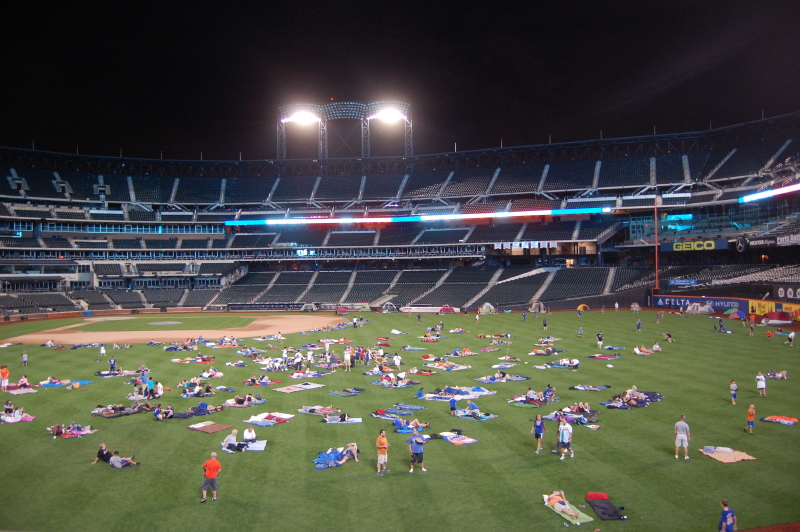
by Greg Prince on 13 August 2013 1:47 pm Considering the surfeit of extra-inning affairs the Mets have brought us in 2013, you might think something called the Citi Field Sleepover would seem superfluous. Yet the Mets scheduled one (as you may have picked up on from the handful of commercials they ran for it every five minutes), and a hardy band of Mets fans couldn’t have been happier to have plunked down a pretty penny to camp out under the Flushing sky this past Saturday night, with food, entertainment and a once-in-a-lifetime experience all included.
 Aftermath of a Civil War reenactment? Nah, it’s the Citi Field Sleepover. A pair of those Metsopotamian loyalists taking the Mets up on their unusual offer consisted of two of Faith and Fear’s favorite people: Rob and Ryder Chasin, father and son who came to our attention in the fall of 2009 when Ryder celebrated his Bar Mitzvah at an otherwise deserted ballpark and invited a flattered yours truly to the festivities. Since then, the Princes and Chasins have made a point of getting together at least once per season, almost inevitably watching the Mets and Rockies tangle on a Tuesday night in August.
When Stephanie and I were at the game with them last week, I learned the guys were going to be part of the Citi Field Sleepover. Thus I prevailed upon Ryder — these days a distinguished high school newspaper editor recently returned from a summer journalism program at Northwestern University — to serve as FAFIF’s special correspondent and let us know what this thing was all about.
Here is the stellar report Ryder Chasin filed after his and his dad’s night under the stars.
***
The Mets often keep us lying awake at night for the wrong reason.
Despite recent improvements, more than half the time they’ve played this year, they’ve lost. They’ve given up approximately a couple of dozen more runs than they’ve scored. And with nearly two months left in the season, the Braves sit above them on a pile of games a discouraging 18 wins high.
Yet Saturday night, as sleeping bags littered the Citi Field grass from foul line to foul line, fringed by a tent-decorated warning track, I didn’t want to go to sleep at all.
Maybe it was because I wasn’t tired. Maybe it was because my adolescent self thought I should be fit enough to pull an all-nighter. Maybe it was simply because I wanted to act contrary to the name of the event, “Citi Field Sleepover.”
In any case, I think I didn’t want to sleep because, amidst the many Met nightmares, it was a night surreal enough to feel like a dream. And if that was the case, if it was a dream, then I didn’t want to wake up.
The surrealistic element of the night came once my dad and I got onto the field, but we didn’t actually start en medias res. We started outside McFadden’s, behind a Shake Shack-long line of the rest of the sleepover faithful, trying to peer above heads and caps and camping packs to guesstimate the wait time until we got in. The “Sleepover Information” packet told us to get there between 5 and 6 PM, and so, evidently just like the other 398 fans on hand, we tried to beat the rush.
At the end of the 45-minute pileup, we passed through a makeshift security checkpoint and presented our waivers — yes, we had to sign waivers — to a bouncer in a maroon polo, the highlight of any sleepover.
But after that, we were in. We were in Citi Field, on a night when the Mets were in another time zone. We were trailblazers, unabashedly tearing down the wall between stadium and dormitory, outfield grass and mattress, Jumbotron and home theater.
And, furthermore, we were hungry.
So, I fixed a plate with a couple of Nathan’s franks, a few slices of Two Boots pizza and a pile of the “Field of Dreams salad” — though it didn’t live up to its cinematic predecessor, as I only dreamed that it had been built with fewer shredded carrots. Top that off with four or five bottles of water, and I had a Citi Field retail-price meal enough to be the showcase on The Price is Right. My dad’s just happy it came with the cost of admission.
On a full stomach, we made our way down to the Bullpen Gate and, quicker than I expected, to the opening in the outfield wall where we witnessed the grand, eye-level unveiling of Citi Field. Already, the grass was covered with blankets and pillows and people, and so we set up camp right in front of second base, close enough to touch the infield dirt if we had been so graciously permitted (curse those darn waivers).
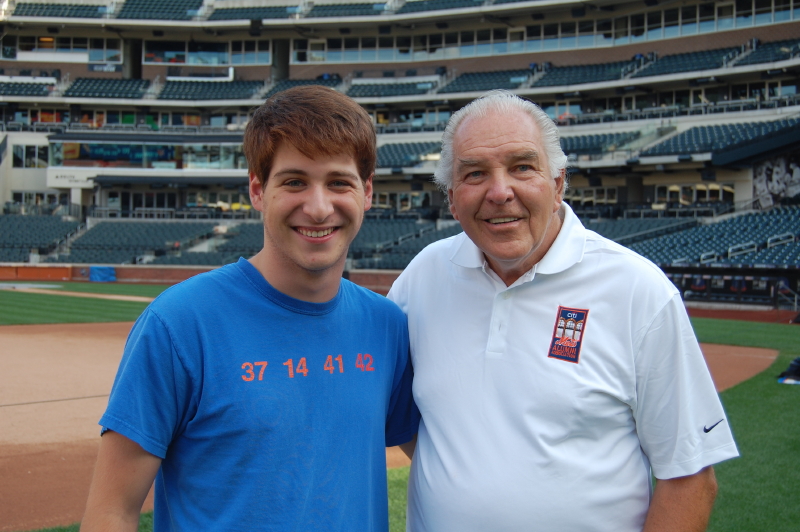
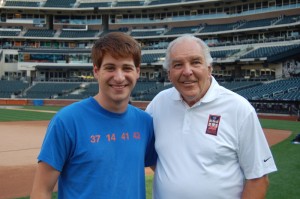 Ryder Chasin and Ed Kranepool do not let the lack of a 7 come between them. As we were finishing our setup, my dad noticed a young Mets fan, no more than 10 yards away, handing a ball and a pen to an older man in dress shoes. It was Ed Kranepool. Wearing my FAFIF shirt, I went over to take a picture with the former all-time Met hits leader.
“37, 14, 41, 42,” Kranepool said to me, pointing to each individually. “Where’s my number?”
“I don’t pick which numbers they retire,” I said, smiling. “I only wear the shirt.”
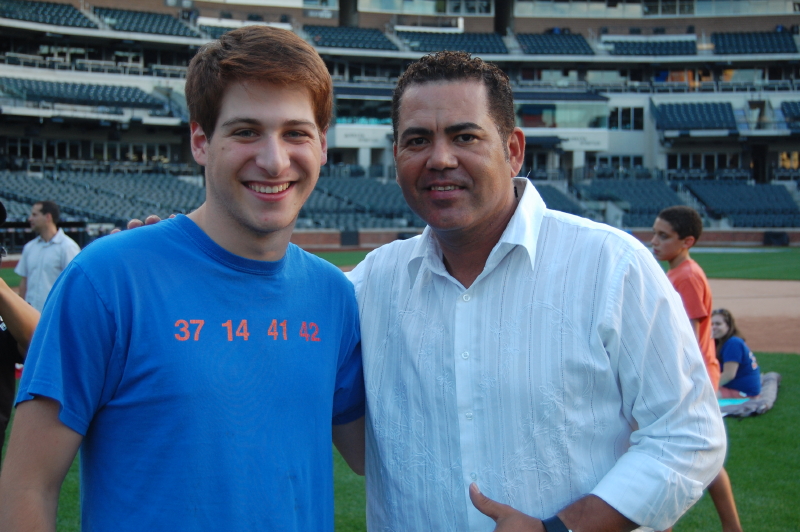
Kranepool was my first of two ex-Met pictures on the night, as I snagged one later with Edgardo Alfonzo. Most of the rest of the photography and video, however, was captured at the hallowed Dunk Tank, as I was pressured by my loving father, once again, to hit the target in the center of the clown. It took two turns in line, but I hit the peg with a 73 MPH heater, only to be outdone when a college kid in a Stonybrook T-shirt hit it at 76. We shared a playful acknowledgment of our Dunk Tank prowess, and, while he beat me in speed on the one that counts, I did reach 77 on a throw a few inches off-target. Chalk one up for personal pride, I guess.
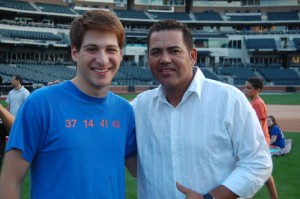 Ryder receives excellent Edgardo advice that leads to the catch of a heretofore elusive t-shirt launch t-shirt. We returned to the outfield grass around 8 o’clock to watch the game broadcast on the scoreboard, and stayed there long enough into the game for me to catch my first ever “Pepsi t-shirt launch” t-shirt, though my odds were admittedly a little better than usual. But before too long, my dad and I went back upstairs to sit in the stands and watch the rest of Zack Wheeler’s excellence, Juan Lagares’s sudden opposite-field power and — as Gary Cohen called it — LaTroy Hawkins’s “reluctant” but successful closing.
After the game, and after a trip to Mo’s Zone for midnight snacks, the second half of the double feature began. Although we were shown Cloudy With A Chance Of Meatballs, there were neither clouds nor meatballs in the New York night sky. Only stars.
That’s when it became surreal.
Lying down in the Citi Field grass, under a starlit sky in the heart of Queens, I realized how ridiculous the whole night was. Four hundred people left the comfort of their homes and their beds for a night to sleep on cold, hard ground. But not just any cold, hard ground. The Mets’ cold, hard ground. The same cold, hard ground where Johan Santana threw his no-hitter; where — to the possible dismay of Mr. Kranepool — David Wright set a new all-time Met hit record; where Matt Harvey continues to contend for the Cy Young; and where the Mets will, fingers crossed, someday win a World Series.
And for the next 50 years — or however long Citi Field sticks around — I can point from my seats at the ballpark or at the screen at a friend’s house and say that I slept right there, right behind second base, close enough to touch the infield dirt (if the waiver had let me).
When the movie was over, both scoreboards played a looping animation of a cartoon sheep jumping over a fence with an eerily superimposed Mr. Met head over where the sheep’s head should have been. Written above it was, “Get some sleep/Count some sheep.”
This mildly unsettling animation, coupled with fathers and sons still playing catch in the outfield, made counting sheep a bit difficult — let alone getting sleep. But I didn’t want to get sleep anyway.
Sure, the Mets give us a lot worth sleeping through between their string of sub-.500 records and generally underwhelming offense. But Saturday night, watching Wheeler from the outfield grass, I understood:
All that sleep doesn’t come void of dreams, even if those dreams might sometimes leave us a little less orange and a little more blue.
This time, luckily enough, I think I erred on the side of orange.
|
|