The blog for Mets fans
who like to read
ABOUT US

Faith and Fear in Flushing made its debut on Feb. 16, 2005, the brainchild of two longtime friends and lifelong Met fans.
Greg Prince discovered the Mets when he was 6, during the magical summer of 1969. He is a Long Island-based writer, editor and communications consultant. Contact him here.
Jason Fry is a Brooklyn writer whose first memories include his mom leaping up and down cheering for Rusty Staub. Check out his other writing here.
Got something to say? Leave a comment, or email us at faithandfear@gmail.com. (Sorry, but we have no interest in ads, sponsored content or guest posts.)
Need our RSS feed? It's here.
Visit our Facebook page, or drop by the personal pages for Greg and Jason.
Or follow us on Twitter: Here's Greg, and here's Jason.
|
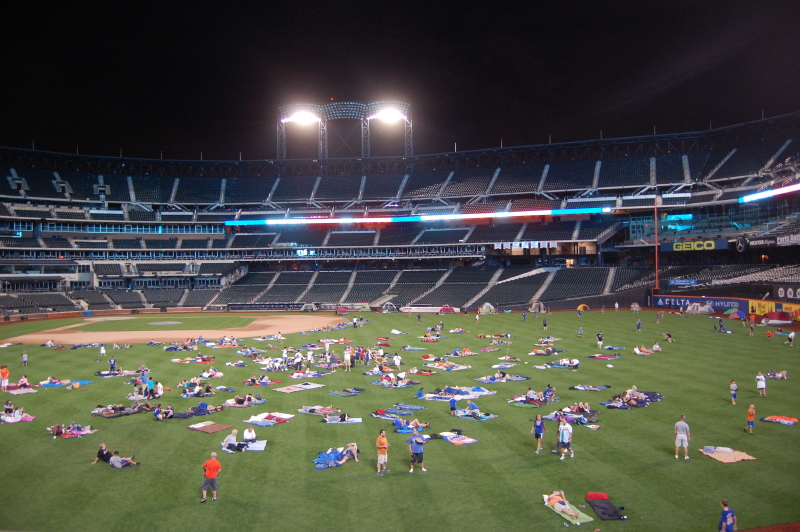
by Greg Prince on 13 August 2013 1:47 pm Considering the surfeit of extra-inning affairs the Mets have brought us in 2013, you might think something called the Citi Field Sleepover would seem superfluous. Yet the Mets scheduled one (as you may have picked up on from the handful of commercials they ran for it every five minutes), and a hardy band of Mets fans couldn’t have been happier to have plunked down a pretty penny to camp out under the Flushing sky this past Saturday night, with food, entertainment and a once-in-a-lifetime experience all included.
 Aftermath of a Civil War reenactment? Nah, it’s the Citi Field Sleepover. A pair of those Metsopotamian loyalists taking the Mets up on their unusual offer consisted of two of Faith and Fear’s favorite people: Rob and Ryder Chasin, father and son who came to our attention in the fall of 2009 when Ryder celebrated his Bar Mitzvah at an otherwise deserted ballpark and invited a flattered yours truly to the festivities. Since then, the Princes and Chasins have made a point of getting together at least once per season, almost inevitably watching the Mets and Rockies tangle on a Tuesday night in August.
When Stephanie and I were at the game with them last week, I learned the guys were going to be part of the Citi Field Sleepover. Thus I prevailed upon Ryder — these days a distinguished high school newspaper editor recently returned from a summer journalism program at Northwestern University — to serve as FAFIF’s special correspondent and let us know what this thing was all about.
Here is the stellar report Ryder Chasin filed after his and his dad’s night under the stars.
***
The Mets often keep us lying awake at night for the wrong reason.
Despite recent improvements, more than half the time they’ve played this year, they’ve lost. They’ve given up approximately a couple of dozen more runs than they’ve scored. And with nearly two months left in the season, the Braves sit above them on a pile of games a discouraging 18 wins high.
Yet Saturday night, as sleeping bags littered the Citi Field grass from foul line to foul line, fringed by a tent-decorated warning track, I didn’t want to go to sleep at all.
Maybe it was because I wasn’t tired. Maybe it was because my adolescent self thought I should be fit enough to pull an all-nighter. Maybe it was simply because I wanted to act contrary to the name of the event, “Citi Field Sleepover.”
In any case, I think I didn’t want to sleep because, amidst the many Met nightmares, it was a night surreal enough to feel like a dream. And if that was the case, if it was a dream, then I didn’t want to wake up.
The surrealistic element of the night came once my dad and I got onto the field, but we didn’t actually start en medias res. We started outside McFadden’s, behind a Shake Shack-long line of the rest of the sleepover faithful, trying to peer above heads and caps and camping packs to guesstimate the wait time until we got in. The “Sleepover Information” packet told us to get there between 5 and 6 PM, and so, evidently just like the other 398 fans on hand, we tried to beat the rush.
At the end of the 45-minute pileup, we passed through a makeshift security checkpoint and presented our waivers — yes, we had to sign waivers — to a bouncer in a maroon polo, the highlight of any sleepover.
But after that, we were in. We were in Citi Field, on a night when the Mets were in another time zone. We were trailblazers, unabashedly tearing down the wall between stadium and dormitory, outfield grass and mattress, Jumbotron and home theater.
And, furthermore, we were hungry.
So, I fixed a plate with a couple of Nathan’s franks, a few slices of Two Boots pizza and a pile of the “Field of Dreams salad” — though it didn’t live up to its cinematic predecessor, as I only dreamed that it had been built with fewer shredded carrots. Top that off with four or five bottles of water, and I had a Citi Field retail-price meal enough to be the showcase on The Price is Right. My dad’s just happy it came with the cost of admission.
On a full stomach, we made our way down to the Bullpen Gate and, quicker than I expected, to the opening in the outfield wall where we witnessed the grand, eye-level unveiling of Citi Field. Already, the grass was covered with blankets and pillows and people, and so we set up camp right in front of second base, close enough to touch the infield dirt if we had been so graciously permitted (curse those darn waivers).
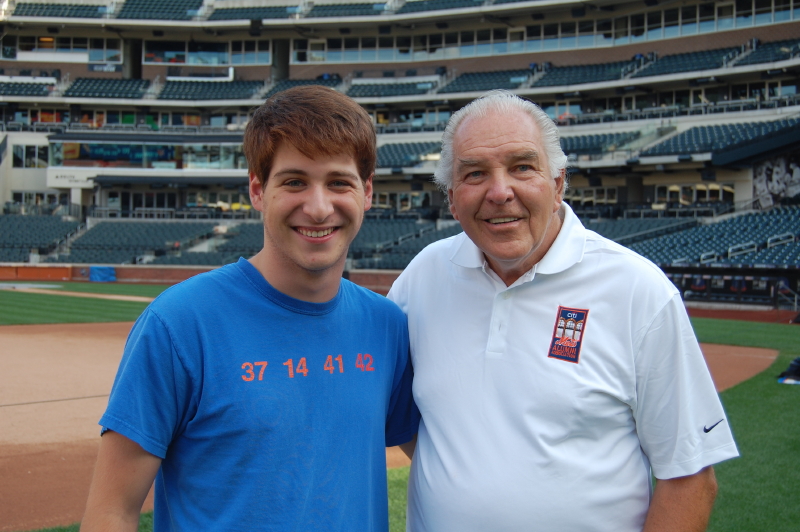
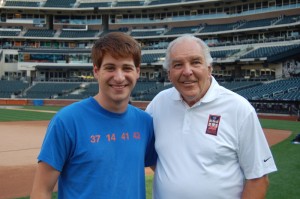 Ryder Chasin and Ed Kranepool do not let the lack of a 7 come between them. As we were finishing our setup, my dad noticed a young Mets fan, no more than 10 yards away, handing a ball and a pen to an older man in dress shoes. It was Ed Kranepool. Wearing my FAFIF shirt, I went over to take a picture with the former all-time Met hits leader.
“37, 14, 41, 42,” Kranepool said to me, pointing to each individually. “Where’s my number?”
“I don’t pick which numbers they retire,” I said, smiling. “I only wear the shirt.”
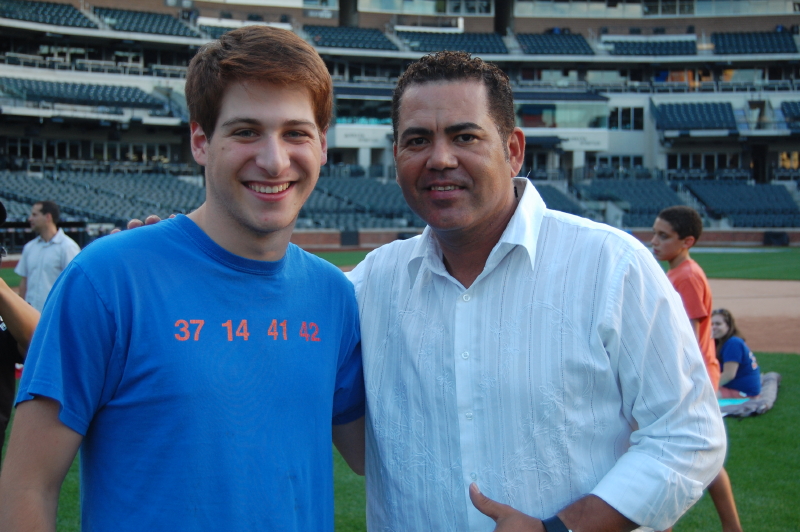
Kranepool was my first of two ex-Met pictures on the night, as I snagged one later with Edgardo Alfonzo. Most of the rest of the photography and video, however, was captured at the hallowed Dunk Tank, as I was pressured by my loving father, once again, to hit the target in the center of the clown. It took two turns in line, but I hit the peg with a 73 MPH heater, only to be outdone when a college kid in a Stonybrook T-shirt hit it at 76. We shared a playful acknowledgment of our Dunk Tank prowess, and, while he beat me in speed on the one that counts, I did reach 77 on a throw a few inches off-target. Chalk one up for personal pride, I guess.
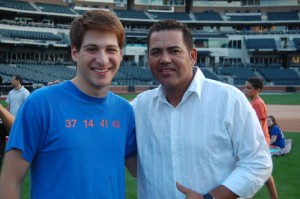 Ryder receives excellent Edgardo advice that leads to the catch of a heretofore elusive t-shirt launch t-shirt. We returned to the outfield grass around 8 o’clock to watch the game broadcast on the scoreboard, and stayed there long enough into the game for me to catch my first ever “Pepsi t-shirt launch” t-shirt, though my odds were admittedly a little better than usual. But before too long, my dad and I went back upstairs to sit in the stands and watch the rest of Zack Wheeler’s excellence, Juan Lagares’s sudden opposite-field power and — as Gary Cohen called it — LaTroy Hawkins’s “reluctant” but successful closing.
After the game, and after a trip to Mo’s Zone for midnight snacks, the second half of the double feature began. Although we were shown Cloudy With A Chance Of Meatballs, there were neither clouds nor meatballs in the New York night sky. Only stars.
That’s when it became surreal.
Lying down in the Citi Field grass, under a starlit sky in the heart of Queens, I realized how ridiculous the whole night was. Four hundred people left the comfort of their homes and their beds for a night to sleep on cold, hard ground. But not just any cold, hard ground. The Mets’ cold, hard ground. The same cold, hard ground where Johan Santana threw his no-hitter; where — to the possible dismay of Mr. Kranepool — David Wright set a new all-time Met hit record; where Matt Harvey continues to contend for the Cy Young; and where the Mets will, fingers crossed, someday win a World Series.
And for the next 50 years — or however long Citi Field sticks around — I can point from my seats at the ballpark or at the screen at a friend’s house and say that I slept right there, right behind second base, close enough to touch the infield dirt (if the waiver had let me).
When the movie was over, both scoreboards played a looping animation of a cartoon sheep jumping over a fence with an eerily superimposed Mr. Met head over where the sheep’s head should have been. Written above it was, “Get some sleep/Count some sheep.”
This mildly unsettling animation, coupled with fathers and sons still playing catch in the outfield, made counting sheep a bit difficult — let alone getting sleep. But I didn’t want to get sleep anyway.
Sure, the Mets give us a lot worth sleeping through between their string of sub-.500 records and generally underwhelming offense. But Saturday night, watching Wheeler from the outfield grass, I understood:
All that sleep doesn’t come void of dreams, even if those dreams might sometimes leave us a little less orange and a little more blue.
This time, luckily enough, I think I erred on the side of orange.
by Jason Fry on 13 August 2013 2:12 am Get out your microscopes, because we’re going to examine a very small silver lining.
For much of the spring, as horrific loss followed horrific loss, I advised you to do something else with your summer, even as I knew I wouldn’t take my own advice. I didn’t and I’m glad I didn’t, because the Mets are interesting again — they’ve got superb young pitching, a couple of interesting young hitters and a certain spring in their step.
But the downside of caring … well, it’s caring. And so when Chad Fairchild put his hand up for what sure looked like ball four on Juan Lagares, denying the Mets the tying run, I was furious, despairing, indignant, numb and then started the cycle over again. Obviously that wasn’t Chad Fairchild, but Angel Hernandez in a very lifelike Chad Fairchild mask. Chad Fairchild is obviously the love child of C.B. Bucknor and Jerry Meals. And so on.
Some buts? Oh, why not.
Contrary to the prevailing sentiment in Metsopotamia, I didn’t think Jeff Kellogg’s ruling that Lagares had gone too far on the check swing was a travesty or even obviously incorrect. Very close? Yes, but not a miscarriage of justice. As for the called third strike, I thought it bent around the plate, and once again I was left wailing for baseball to send the all-too-fallible human element packing in favor of ROBOT UMPS NOW. But the closest thing we have to robot umps is PITCHf/x, and PITCHf/x saw that Ronald Belisario pitch as catching a corner (hat tip to James Kannengeiser) meaning our new robot overlords would have sent Lagares back to the bench too. As others have noted, an overhead view might settle it and convince me that I’m wrong. In the absence of such evidence, I’m going old-school and saying that 37 years of watching baseball is worth something, that pitch was outside, and PITCHf/x needs some more tweaks. (Which isn’t meant as more than mild criticism; tweaks are how such systems get better and better.)
And whatever the outcome, ROBOT UMPS NOW. There’s evidence of why nearly every night.
There’s another useful bit of relevant baseball wisdom here, one I may or may not have imparted to my son one night when he was innocent lad of six and I was a bit drunk: When you’re going horseshit they fuck you.
Because the Mets had certainly been going horseshit. They erased a fine start by Jenrry Mejia — another fine start by Jenrry Mejia — with a nightmarish sequence in the bottom of the sixth. First a Carl Crawford bouncer up the middle just eluded Daniel Murphy, who was a little short in terms of range. Then a Mark Ellis bloop just eluded Murphy, who was a little short in terms of height. Marlon Byrd had a play on Crawford at second, but bobbled the ball and the chance was lost. Enter Adrian Gonzalez, who hit a clean single that Juan Lagares threw to third, where it skipped by Wilmer Flores and an out-of-position Mejia for two runs and a blown lead.
Throw in nine Mets left on base, a Carlos Torres gopher ball served up to Nick Punto (of all people), and you’ve got a recipe for a loss, however Chad Fairchild defines a corner. It stinks, but it’s baseball — and at least it left me feeling something. After the head-shaking surrender of the spring, I’ll take it.
by Jason Fry on 12 August 2013 12:52 am Maybe this is actually the year of the overlooked Mets pitcher.
Sure, Matt Harvey has been Olympian and each start makes Zack Wheeler looks more like the phenom he was heralded as. But the other day we were talking about Dillon Gee’s turnaround. Not so long ago Jenrry Mejia came off the prospect scrap heap to stun the Nationals. And tonight Jon Niese was back.
Some of the luster has come off Niese this year — he never really looked right, struggled with pitching in horrible conditions and eventually went on the disabled list with a partial tear of his rotator cuff, which isn’t the kind of injury where “partial” is much of a comfort. But with Jeremy Hefner on a nice run, Wheeler emerging and Harvey channeling Tom Seaver every fifth day, Niese’s loss didn’t make much of a ripple. Which would be understandable, except for the fact that it’s insane: Niese is the lone left-handed starter in the Mets’ current plans, he’s just 26, and last year he seemed to figure stuff out for the first time, winning 13 games for a lousy team and avoiding the issues with focus and preparation that had dogged him.
I’ll admit I’ve never warmed to Niese — in interviews he comes across as narcoleptic and uninterested in his craft. But I’ll also admit this is my problem, not his. Twenty-six-year-old lefties who’ve demonstrated the ability to win in the big leagues are extremely valuable commodities. Niese’s return should have been big news for me and for everybody else, but instead it merited a collective shrug.
So how was he? Eh. He got better as the night goes on, but he wasn’t particularly good — the change-up was junky and the cutter was perilous, leaving him stripped of half his arsenal, and I kept bracing for the horror show of an inning that would end with six or seven runs on the scoreboard and Niese fleeing in flames. But it never happened — instead, disaster befell the Diamondbacks, from Paul Goldschmidt’s horrifying error in the first that led to four Mets runs to Cody Ross’s frightening hip dislocation to Laz Diaz giving Ike Davis an extra strike in a big inning for the Mets. The snakes were the ones snakebit, and the best thing that happened to them was that the game ended.
By the way, I refuse to believe that there’s actually a baseball player named Tuffy Gosewisch — particularly since his given name is James. To invert Annie Savoy, you don’t need a nickname honey.
* * *
Let’s talk uniforms.
I’m going to go out only slightly on a limb and say that the Arizona Diamondbacks’ uniforms are astonishingly horrible, from the random barrage of colors to the inspid abbreviation of the team name to the horrible snake as D to the annoying “db” doing double duty as a snake head. When the Diamondbacks aren’t wearing an awful color — today’s brick red wasn’t automatically cringeworthy — it doesn’t matter because everything else is a disaster. Their colors suck, their fonts suck … everything sucks. I know that isn’t a particularly coherent argument, but the Diamondbacks don’t deserve one: This team’s brand identity is best summed up as Barfed-Up Pueblo, a dog’s breakfast of vaguely Southwestern motifs run through a blender by a meth-addled dude in a trailer. The Marlins may scale greater heights of horror, and goodness knows the Mets win no prizes for consistency, but the Diamondbacks can be relied on to look horrible in a different way each and every game.
Uniforms have been on my mind because on Friday I was out at a bar with Emily, squinted up at the TV, grimaced at the inevitable sight of the Yankees, and then did a double-take: Why the hell were the Yankees wearing white-billed caps during an actual game?
I don’t like the Yankees, as you may have heard, but I do count on them for one thing: They don’t let Bud Selig or anybody else screw around with one of the game’s classic uniforms. Baffled, I text-messaged a Yankee-fan friend of mine, who told me the caps were being worn to promote awareness of a cancer charity. I felt briefly bad, as did others, but then I stopped feeling that way. Look, everyone agrees cancer sucks and everyone wants to see it eradicated from the world, but cut a fucking check and leave the uniform alone. My friend agreed, texting me that “we are all horrified and ashamed.”
According to one report, the Yankee who didn’t go along with this sartorial misstep was Derek Jeter.
Having already praised the Yankees, I’m now going to double-down on questionable sentiments and say that I wish David Wright would take heed of this and be more Jeteresque.
After 9/11, the Mets wore the caps of New York first responders in games, defying MLB’s demands that they stop. Here’s Todd Zeile with an eloquent explanation of why: “The hats meant more than what they said on the top. I was wearing one from a kid that had lost his dad. And some of the other hats that we were wearing were hats that we traded with some rescue workers while we were down at Ground Zero. It wasn’t like they came out of a hat box. We felt that was the best way to align ourselves with those guys that were working 24/7 while we were still out trying to play baseball. I don’t think anybody expected it would have the kind of reaction, but the fact that MLB wanted to stop us, and then we decided to do it anyway, I think made it even more significant to the members of the city.”
In September 2011, a new generation of Mets wanted to wear first-responder caps to honor the 10th anniversary of 9/11. Once again MLB’s mandarins told the Mets no, except this time the team complied. It was craven bullshit — I was outraged then and am still deeply embarrassed now. A year later, in 2012, the Mets sidestepped any brouhaha by not even asking MLB for permission, which generated less adverse publicity but was actually more spineless and pathetic.
Well, it’s a month from 9/11. The Mets will be home against the Nationals, hopefully battling for second place. What are they going to do this year?
I’d like to see the Mets take the field in caps from the NYPD, NYFD, Port Authority, EMS and other agencies that did so much, at such personal cost, to help heal a wounded city 12 years ago.
Would this be a slippery slope, as MLB seems to fear? Here’s hoping it would be. In fact, let’s create one ahead of time — for one night, let uniformity take a back seat to solidarity. Let the Yankees wear the caps, since that team means so much to people in the same city, however misguided we normally think those people are. (Hell, they already wore those things with white brims.) Let the Nationals wear them to honor those who rushed to the blasted Pentagon. Let the Pirates honor first responders to recall Shanksville, where Flight 93 crashed after its passengers saved lives in D.C. in an astonishing act of bravery and sacrifice. Heck, let’s go crazy and let all 30 teams honor their local firefighters, police officers, EMTs, Coast Guard members and others, inspiring fans to remember those lost and to give thanks for the people in their hometowns whose jobs involve running towards danger instead of away from it.
And if MLB and/or some cap maker remains small-minded and hard-hearted, here’s hoping a healed David Wright gets his Jeter on.
“What’s that, MLB stooge? You want to take my NYPD cap before I head out to third base for the top of the first? Go ahead and try. I’m going out there wearing this hat, and you can fine me or my team — because I know Fred and Jeff have my back. We’ll take this to the court of public opinion, where you’ll lose in a rout and we’ll never pay one thin dime.”
That’s what I’d like to see. Let’s see what the Mets do.
by Greg Prince on 11 August 2013 11:55 am I didn’t know much about Wilmer Flores before his promotion last week, primarily because I cultivate a state of plausible deniability where the Met minor leagues are concerned. I remain mostly blissfully ignorant about Met prospects because, quite frankly, I don’t want to know. With a handful of exceptions at the Harvey-Wheeler level, I figure the kid — like the notoriously tardy Baby Buck — will get here when he gets here.
Well, Wilmer Flores has gotten here and he’s been worth however you long waited for him…which in my case wasn’t at all, making him a nice personal surprise in the vein of Juan Lagares (about whom I will admit I knew nothing upon his callup). Together Flores and Lagares drove in all four runs in the Mets’ 4-1 Saturday night victory over the Diamondbacks, a game won by fellow rookie Zack Wheeler and preserved in great part by another recent Las Vegan, the perpetually youthful Pedro Feliciano.
Lagares homered. Wheeler didn’t walk anybody as he pitched into the seventh. Feliciano negated threatening lefty Gerardo Parra with the bases loaded in the eighth. Flores, however, is the new toy and thus the one to which the eye is drawn most immediately.
Wilmer’s playing third out of necessity because of David Wright’s injury and batting sixth because he’s too good to waste further down the order. His five-game major league career has been promising enough to make one wonder where he’ll eventually fit into the lineup and defense — which is where I get twitchy.
Flores has collected eight RBIs in his first five games. Actually, they’ve come in his second four games. We spotted him his first night’s ohfer to let him get his feet wet. His small sample size since is extraordinarily large enough to get us excited at the thought that once he’s stationed at his permanent position, he could really…uh…
Say, what is his permanent position? He just turned 22. Surely we know where his future lies.
Don’t we?
Even if I had been paying attention to his minor league activities, I don’t think I would know, since nobody else seems to. He was drafted as a shortstop, but it’s been agreed he’s not really a shortstop. He’s played second base more than anywhere else, but we’ve seen that second base is not easily conquered. It’s taken Daniel Murphy close to three seasons to appear natural at second — and, hey, we have Murph at second! Wilmer’s also played a little first, the province of Ike Davis, a recent inductee into the Hall of .200, so who wants to rewrite that kind of success story?
You’re not going to keep a run-producing, franchise-changing stud out of your lineup so as not to disturb a Davis or a Murphy, but Flores is only that in our dreams right now. Mike Vail was that. Gregg Jefferies was that. Rosters were unhinged and defenses were realigned because finding those young men places to play became paramount after a few hot August nights.
Vail. Jefferies. Alex Ochoa. Victor Diaz. Mike Jacobs. Lastings Milledge. You know the drill. A stream of intoxicating at-bats. A few dreamy weeks. The future arrived. Then the future got hurt playing basketball or failed to mature fully or was swapped for Brian Schneider and Ryan Church before the future’s trade value completely disintegrated. In the shadow of all those disappointments that linger in the subconscious, Wilmer Flores rose to the major leagues with a name even I recognized on contact and is getting us going in the short term while on the verge of overheating our hopes and dreams for the long term.
But y’know what? Let him. That’s what 22-year-olds who drive in eight runs before they’ve been here a week are supposed to do.
by Greg Prince on 10 August 2013 11:54 am The fan’s instinct is to choose the following:
• Pursuing the extra base over playing it safe.
• Letting the starter pitch as long as he can.
• Extra innings in the event of a tie score in the bottom of the ninth on the road.
• Staying awake postgame in order to watch AMC’s Breaking Bad Season Four marathon to its 5 AM conclusion.
My instincts were all wrong as late Friday night became early Saturday morning. I can live with falling asleep through “End Times” and missing “Face Off” altogether because having seen them when they first aired, I know how they ended. Maybe I could have said the same thing about the Mets-Diamondbacks game in question, but baseball doesn’t work that way, no matter how cynical our team can make us.
I’ve been surprisingly free of cynicism of late where these Mets are concerned, a symptom of their recurring resilience and my satisfaction at having attended the entire loss-free Rockies series. The Mets have been drifting into that previously abandoned territory where I don’t necessarily expect them to lose every non-Harvey start. That’s a helluva leap for anybody who’s stayed awake through all their recent somnambulant Augusts.
So now that I’m watching the Mets again through the comparatively unjaded eyes of the fan I was before the events of September 30, 2007, jammed a half-decade’s worth of cynicism into my system, of course I’m all “yeah, Marlon — go!” as Byrd rounds third. But instead of the second Marvelous Marlon inside-the-park home run in franchise history, we got an out at home. Byrd’s hand may have reached the plate before Wil Nieves’s tag reached the rest of Byrd’s body, but MLB’s failure to deploy robot umpires will always be an impediment to accuracy and thus there was no run there.
That was in the second, when it was nothing-nothing. The Diamondbacks’ nothing was crafted by Jeremy Hefner, whose personal journey in my esteem has ridden from “Hefner?” to “HEFNER!” to pure performance-driven ambivalence. For four innings, I delighted in the zeroes Hef posted while wondering when the Diamondback dam would inevitably burst. Too many rockets were being launched from too many bats to not tear the roof off this Chase Field sucker. Finally, in the fifth, with two out, Patrick Corbin doubled. Patrick Corbin made the All-Star team this year…as a pitcher. Something was about to go terribly wrong, no matter how I wished it away. Yup, two more doubles followed. The Mets trailed, 2-1.
But that was OK, because when you bring childlike enthusiasm to a game, you believe in the clutchitude of Justin Turner, who I’m pretty sure I saw sitting among the day campers at Citi Field Thursday afternoon. They let the redheaded kid suit up and start at short Friday night, and in the sixth, the camper all the other campers seem to embrace drove in his second run of the night. The Mets had two on with one out and were prepared to shove Corbin into the grandest of canyon. But then Wilmer Flores lined out (that’s what he gets for staying up past his bedtime) and John Buck struck out. John Buck’s been hitting .215 for approximately nine months and nine days. Perhaps he’s been distracted by his endless wait for the arrival of a blessed event — I speak, of course, of John Buck’s next RBI.
Like the elusive big Met hit in the top of the sixth, the much-hyped baby Buck has yet to be delivered. Sources say the Mets are delaying the child’s birth in deference to the kid’s Super 2 status.
Buck not getting on base in that situation was doubly damaging because Terry Collins didn’t get the chance to pinch-hit for Hefner, which meant Hefner would return to the mound, stuffless. Still, I wanted to trust this painfully obvious wrong decision. Matt Harvey threw a complete game on Wednesday. Dillon Gee worked effectively into the eighth inning. Starting pitchers should theoretically gut it out if they can’t mow ’em down. My instinct applauded Hefner’s return.
The rest of me dreaded it, because Hefner attempting to whack the Diamondbacks resembled neither Harvey nor Gee scaling the Rockies. Sure enough, a single, a double and another double ensued. That two Diamondbacks scored was discouraging. That one of them was Cody Ross was disgusting.
At 4-2, Hefner was done by instinct and actuality. Here came the Met bullpen and its surprising competence. Feliciano, Aardsma, Germen and Rice produced three runless innings. The top of the seventh encompassed a late surge of promise when, with two out, Juan Lagares doubled deep to right, but then Juan got the Byrd fever and tried to turn it into a triple. Again, I was all “C’mon Juan!” overlooking the greeting party of Eric Chavez and a baseball awaiting him at third. But in the top of the eighth, traditional Met foil Heath Bell got crumpled but good as two runs scored on consecutive groundouts. The only thing that saved Bell’s bacon was there were two out when Buck batted to end the inning.
In the ninth of a 4-4 tie, Gary Cohen and Keith Hernandez were invoking those long nights and days the Mets and Diamondbacks unfurled at the dawn of July when every game was the wrong game to tell your driver, “I’ll only be a minute, just keep the meter running.” And once locally sourced pinch-hitter Ike Davis struck out to conclude the top of the frame — only Ike seemed surprised at the result — our last, best hope was to create more innings. Bring on a tenth, an eleventh, a fifteenth! Set the DVR for AMC! We’ve got SNY on ’til sunrise!
But then Paul Goldschmidt homered off Scott Atchison and the game was over.
At least Cody Ross wasn’t the one who knocked.
by Jason Fry on 8 August 2013 5:53 pm By now we’re used to Dillon Gee. We don’t think “My goodness, Dillon Gee is starting — I better clear my calendar.” We don’t barrage Twitter with our top-shelf material. We don’t rotate in a cheeky/blasphemous cover image for our Facebook page. It’s just Dillon Gee, after all.
Maybe we’re a little too used to Dillon Gee.
Gee was a prime candidate for demotion/dismissal/getting stuffed down the memory hole back in late May, when Zack Wheeler was trapped at Las Vegas. And it was hard to argue with that: Gee had lost a good chunk of 2012 to a blood clot in his shoulder, the same injury that once felled David Cone as a Yankee, and was now sporting a 6.34 ERA.
So what did Gee do? He went out and annihilated the Yankees, striking out 12 over 7 1/3. Counting that game, since then he’s 6-2 with a 2.42 ERA. So what was wrong? In the early going, the red light was that he’d lost a few ticks off his fastball, which reduced the spread in velocity between that pitch and his change-up, long his out pitch. (See this nice breakdown by Amazin’ Avenue here.) Looking at AA’s take, I figured Gee’s fastball velocity must have gone up since then — he’d either built up his arm strength after the layoff, put aside the understandable worries about letting it go, or both. And Gee’s average fastball velocity has improved, though not as much as I figured. (See here, pausing to admire the otherworldliness of Matt Harvey’s arsenal.)
Maybe it’s just taking a while for Gee to get that FB number up. Maybe he’s just having better luck — his early-season numbers suggested he was somewhat snakebit. The Mets’ improved defense certainly hasn’t hurt. Whatever the case, Gee’s back to being what he’s been for a while: pretty reliable, better than you think and easy to overlook. Today he made one bad pitch all afternoon — the one Corey Dickerson crushed over the fence in the fourth — though he did get lucky in the first, when DJ LeMahieu unwisely ran Colorado out of an inning.
Cases like Gee’s always remind me that baseball, despite billing itself as results-oriented, is a precarious game of reputations and prejudices. Gee is your basic mix-and-match guy who relies on changing speeds and hitting spots — the template for most pitchers who aren’t Matt Harvey. Thanks to his Olympian genetics, Harvey will get every single chance to make good on his abilities so long as his arm holds up. Because of his comparably modest gifts, Gee will not: A lot had to go right for him to get to the big leagues and stick there, and even now a poor run of early-season starts made him a candidate for the knacker’s yard.
There’s more of that in baseball than we think. What if, say, R.A. Dickey hadn’t had that near no-hitter in Buffalo when the Mets had needed a starting pitcher? What if his knuckler had been uncooperative in his first start for the Mets? What about all the guys whose modest stature, strange arm angle or other perceived shortcoming kept them from getting innings in A-ball, leaving their talent to atrophy and their professional career to crumble?
It’s a game of inches, yes. It’s also a game of assumptions, some of which get challenged and some of which don’t. And some of which have to be challenged over and over again.
by Jason Fry on 8 August 2013 12:59 am
Relax, all right? Don’t try to strike everybody out. Strikeouts are boring! Besides that, they’re fascist. Throw some ground balls, it’s more democratic. — Bull Durham
The forecast was ominous: likely rain.
Yeah right.
The raindrops remained at a respectful distance, because they — like the rest of us — wanted to watch Matt Harvey pitch.
This game didn’t have the early crackle of some of Harvey’s “event” showcases — the showdown with Stephen Strasburg that Citi Field stole with its spontaneous “Harvey’s better” chant, or the evisceration of the White Sox, to name but two. But it might have been even more impressive: Harvey mixed his pitches to bewilder the Rockies, getting them to pound ball after ball into the ground. Every few pitches Harvey was turning his head to glance with what seemed like mild curiosity at a ball ticketed for the glove of Quintanilla or Flores, and then he was walking off the mound again. (The game was done in a tidy 2:20, a welcome relief from recent sloggy Metsian miniseries.)
And yet while Harvey “only” struck out six, he was basically unhittable — Greg and I got to our seats a bit late, but the only hard-hit ball we saw all night was the one that Charlie Blackmon fired off Harvey’s kneecap with an out to go. (Harvey said it grazed him, which was nonsense, but he shooed Terry Collins and Ray Ramirez away with the Seaverian disdain we’ve come to love.)
By the late innings the crowd was revved up and driving Harvey along, with a brief pause to roar for Wilmer Flores’s double lashed into the left-field corner to drive in three and put things out of reach. (Flores’s pudgy face, I-dunno-what’s-under-this-cap mullet and expression of faint amazement remind me a bit of Mackey Sasser.) An entertaining thing to watch for on the replay of the big hit: Ike Davis comes around third with so much acceleration that he can’t really stop, winds up flinging drive-by high-fives at Juan Lagares and Marlon Byrd and then nearly decapitates poor Manny Corpas, who’s gone from backing up the plate to trying to extricate himself from a horde of Mets.
The crowd was listed at 27,581, which normally means shy of 20,000 actually there, lots of empty seats and a quiet house. But this 27,581 felt reasonably close to the actual number, and they were loud and boisterous and having fun. It was nice to look up and see them, and hear the cheers bouncing around the stadium with impressive volume.
Sure, it was a Harvey start and a beautiful night, but I’m left feeling optimistic.
Plenty of things haven’t gone right for the Mets this year, starting with Johan Santana’s injury and proceeding to regression or stasis for Davis, Ruben Tejada and Lucas Duda. And until the Mets prove that the financial goalposts have stopped moving, no one is going to trust what ownership or their representatives say about future payroll or competitiveness.
But the young starting pitching is coming along very nicely, and while the offense isn’t world-beating, at least the Mets are playing hard, with a bit of bounce in their step. I still think Eric Young, Jr. is more like the player the Rockies didn’t want than the player he’s looked like in a perilously small sample size for us, but when he scored from second last night and leapt halfway into outer space, I laughed out loud on the couch and clapped my hands. Baseball’s fun, and fun’s contagious.
We’ve never seen Citi Field on a nice summer night with something to play for. The Mets have a lot of work to do before that can happen. But you see flashes in games like the ones the Mets have played the last two nights — previews of baseball like it oughta be, and one day will be again. And that day that may not be as far away as we sometimes fear.
I mean, ya gotta believe, right?
by Greg Prince on 7 August 2013 7:58 am FLUSHING, N.Y. (FAFIF) — The Jaws of Defeat expressed bafflement after being certain it had secured the New York Mets within its formidable bite at Citi Field Tuesday night.
“Huh?” the bewildered Jaws of Defeat asked. “Where did the Mets go? I was sure I had them.”
The Mets indeed appeared all but ensconced inside the Jaws of Defeat at multiple intervals in their game against the Colorado Rockies as they built an early lead but stopped scoring; allowed the Rockies to tie them and put go-ahead runners on base; demonstrated disturbing offensive ineptitude; and let a second lead, in the ninth inning, dangle dangerously close to extinction.
“I’m telling you, I had the Mets right in here,” a visibly disturbed Jaws of Defeat insisted after New York came away with a 3-2 win over Colorado. “Right here! How could I not have them?”
Observers credited a number of factors for the Mets’ escape from the Jaws of Defeat, most notably a series of defensive plays that thwarted both the Rockies and the Jaws of Defeat. Several individual acts of defense stood out, beginning with John Buck’s pickoff of Dexter Fowler, who had walked to start the game.
“See, I thought that was weird,” the Jaws of Defeat explained. “A leadoff walk to a speedster — I was salivating already. And then in the bottom of that inning, I got another surprise.”
The Jaws of Defeat was certain that with two outs and a runner on, the Mets’ first chance to score would amount to naught when surprise-cleanup hitter Ike Davis, who entered Tuesday’s action batting .188, stepped in for his initial plate appearance.
“Ike? Batting fourth?” the Jaws of Defeat asked in a clearly mocking manner. “I try not to look ahead, but I was pretty much tying a bib around my neck.”
Davis, however, surprised the Jaws of Defeat with a double that sent baserunner Marlon Byrd to third, setting up Juan Lagares’s two-run triple. Mets starter Jenrry Mejia went back to the mound with a 2-0 lead and proceeded to retire nine of the next ten Rockies he faced. The score didn’t budge until the fifth, as the Mets couldn’t touch emergency Rockies starter Chad Bettis, while a Davis error set up Nolan Arenado’s sacrifice fly that trimmed Mejia’s advantage to 2-1.
“Ohmigod!” the Jaws of Defeat exclaimed. “Could it have been any more perfect? Another screwup from Ike, Mejia beginning to crack — I have to admit I was licking my lips.” A ground ball off the bat of DJ LeMahieu that appeared ticketed for center field, however, wound up smothered by a diving Daniel Murphy, who flipped to Omar Quintanilla to begin a rally-killing 4-6-3 double play, delivering Mejia from further trouble.
“Murphy?” an incredulous Jaws of Defeat inquired. “He can play second base like a second baseman all of a sudden? Weren’t they going to move him to third or some such ridiculousness?”
Mets manager Terry Collins had floated a number of possible scenarios to compensate for the absence of injured third baseman David Wright, without whom both the Mets defense and lineup have been severely compromised. The Mets, however, had called up top prospect Wilmer Flores, Tuesday, and left Murphy in place. Flores had a rough first day, going hitless in four at-bats and committing what shaped up as a costly error in the sixth.
“Oh, the sixth,” the Jaws of Defeat lamented. “The sixth was when I was sure I would do some serious clamping before the night was over.”
Although Mejia had been sailing along, having struck out seven Rockies in the first five innings, his momentum was disrupted when home plate umpire Manny Gonzalez suffered an unusual injury after Charlie Blackmon, pinch-hitting for Bettis to lead off the sixth, attempted to bunt his way on. The ball took an odd bounce after being bunted foul and struck Gonzalez in his jaw (no relation to those of Defeat). The game was delayed as Gonzalez was helped off the field and would be played with only three umpires the rest of the way. When play resumed, Blackmon blasted Mejia’s third pitch over the center field fence.
“The Mets were screwed, right?” the Jaws of Defeat figured. “Young pitcher, doing great and then something crazy happens. The floodgates were opening.”
After getting one out, Mejia’s sixth worsened. He allowed a single to Corey Dickerson before Flores mishandled Troy Tulowitzki’s hard grounder that scooted into left field. The pitcher then walked Michael Cuddyer to load the bases, signaling the end of Mejia’s night.
“With the bases full of Rockies,” the Jaws of Defeat calculated, “it was clearly a matter of minutes before I’d have the Mets right where I wanted and expected them.”
But to the Jaws of Defeat’s surprise, the Mets didn’t arrive as he thought they would. Wilin Rosario’s line drive to center off reliever Carlos Torres was caught by Lagares, who threw a perfect strike to John Buck, preventing any thought the Rockies had of sending Dickerson home. The throw, however, appeared a moot point one batter later when the dangerous Todd Helton produced a sinking line drive that, if it were to fall in, would score at least two of the Rockie baserunners.
“Of course it was going to fall in,” the Jaws of Defeat had predicted. “How could it not?”
Eric Young, Jr., whom the Rockies traded to the Mets in June for minor league pitcher Collin McHugh, dove and caught Helton’s ball, keeping the game tied at two.
“I did not see that coming,” the Jaws of Defeat admitted. “Why exactly did Colorado trade Young again?”
It was a question the visitors to Citi Field would be asking themselves a little later. The Rockies and Mets exchanged zeroes through the top of the eighth, New York helped along by another impressive sliding catch, this one from Marlon Byrd in right field. Torres and Scott Atchison combined to keep the Rockies off the board, while the bottom of the Mets’ order remained totally ineffective versus the Colorado bullpen.
“Think about it,” the Jaws of Defeat suggested. “The Mets score twice in the first inning and then they go into the tank. Basically nothing out of the sixth, seventh, eighth or ninth spots in the order.” Flores, Buck, Quintanilla, Mejia and pinch-hitter Andrew Brown did in fact combine to go 0-for-12 with a walk, lending a sense of inevitability to the Mets’ eventual demise.
“Half of their lineup basically didn’t exist,” the Jaws of Defeat surmised. “Naturally I thought I’d be chomping down hard.”
The bottom of the eighth proved otherwise, as the Mets scratched out the makings of a potential rally. Young singled off Wilton Lopez to lead off the inning and, with one out, tagged up on Byrd’s flyout to Fowler in deep center. Rockies manager Walt Weiss opted to intentionally walk Davis — his fourth time on base on the evening — and pitch to Juan Lagares. Lagares hit an infield dribbler that seemed to vindicate Weiss’s decision, but the rookie beat the play at first, while Young raced around third from second and scored ahead of a late throw from Helton.
“I did not see that coming, either,” the Jaws of Defeat acknowledged.
With closer Bobby Parnell placed on the disabled list earlier Tuesday, Collins entrusted the 3-2 lead to LaTroy Hawkins, which filled the Jaws of Defeat with anticipatory glee. “I won’t deny that Hawkins has been pretty decent this season,” the Jaws of Defeat reasoned. “But c’mon, LaTroy Hawkins? He’s, what, a hundred? He gave up that home run to Victor Diaz, for crissake.”
Despite Hawkins’s long and mixed track record, including the ninth-inning home run he surrendered to then-Mets rookie Diaz during the 2004 pennant race when the pitcher was a Cub, the 40-year-old righthander took the mound in search of his first save as a Met and only his second in the past four seasons. After getting two quick outs, Hawkins ran into trouble, giving up consecutive singles that put the tying run on third. Weiss called on Yorvit Torrealba to pinch-hit for Lopez.
The Jaws of Defeat referred to Torrealba’s insertion as “beautiful. I mean, this is the guy the Mets tried to sign and he sued them.” Torrealba was on the verge of becoming the Mets’ catcher in the offseason prior to 2008 but the deal was never completed and Torrealba initiated a grievance procedure against the club that was eventually dismissed. “What a Mets thing — their ancient reliever getting beat by somebody they spurned so long ago that they were actually good when it happened.”
But the Jaws of Defeat’s best-laid plans fell victim to Davis’s nifty glovework at first, resulting in a catch that stood as the last of a half-dozen outstanding plays that in one way or another thwarted a Rockie rally. Torrealba sharply lined an 0-1 pitch foul, just wide of first, where Davis dove and nabbed it for the final out of the game.
While the Jaws of Defeat expressed dismay, disbelief and frustration, Victory issued a statement of gratitude, thanking the 50-60 Mets “for snatching me the hell out of there. I know from painful experience that the Jaws of Defeat is no place for a ballgame to get trapped.”
by Greg Prince on 5 August 2013 8:43 pm Jordany, we hardly knew ye. Actually, we knew ye surprisingly well for someone who played relatively little — though I guess for all the exhibitionist Instagrams and clubhouse clucking, we didn’t know everything relevant there was to know. Now we know for certain we won’t be seeing you in September at Citi Field…though we could’ve figured that out on our own.
Las Vegas 51s infielder/outfielder Jordany Valdespin was one of a dozen players suspended for 50 games as part of Major League Baseball’s Biogenesis PED investigation. Valdespin’s legalistic statement issued upon his suspension allowed only that “I made certain errors in judgment during the 2012 season and I accept full responsibility for those errors. I look forward to regaining the trust and respect of the Mets’ organization, Mets’ fans and my family, and look forward to contributing to the Mets in 2014.”
Really sounds like something a human being would utter, doesn’t it?
There are rules against ingesting performance-enhancing drugs. There is testing for it. There are dangers to your well-being from taking them. If you still use PEDs in this environment, you proceed at your own risk on multiple fronts. If you get caught, you brought it on yourself. It doesn’t make you evil, but it does indicate you were pretty reckless in going down that road. Even accounting for whatever edge Jordany Valdespin was seeking to obtain so he could be a better baseball player and make more money, there’s no good defense for those “errors in judgment” from a player few have ever felt much need to defend.
Yet I always instinctively defended Valdespin based partly out of a sense that everybody deserves somebody sticking up for him, and partly because I really loved that home run he hit off of Jonathan Papelbon last year. I was also quite fond of that grand slam with which he beat the Dodgers this year. And I liked the occasional pinch-hit home runs in between. I hoped a few more similarly dramatic extra-base hits would jump off of his bat and thus wished he had been given more chances to start. Since there weren’t too many other Mets blasting dramatic home runs to win games, I probably gave him every benefit of every possible doubt floating around his admittedly unusual persona. Granted, I assumed all the anonymous eye-rolling from those who’d spent time in his company didn’t materialize totally without provocation, but I also had the feeling he was being overly piled on.
Translation: He hit some really big home runs that made me very happy. How bad a kid could he be?
I’ve come to realize lately how results-driven I’ve become as a fan. There are players on the Mets’ 40-man roster with whom I profess to have fallen in baseball love over the last few seasons. Then they slumped and failed to come out of it. Y’know what? I stopped being in baseball love with them. Fine fellows, I’m sure, but I guess I’m pretty superficial. Hit for me, Ike. Field for me, Ruben. Then I’ll wear the t-shirts I bought with your respective names on them with pride.
Never found a VALDESPIN 1 shirt in the team store, but I would’ve snapped one up. I seem to have a soft spot for wayward knucklehead types who produce. I used to wear a RODRIGUEZ 75, at least until he was escorted out of the ballpark in handcuffs. I removed K-Rod from my active t-shirt rotation shortly thereafter. I’d like to think I’d remove hypothetical VALDESPIN 1 in the wake of his suspension. I couldn’t prove I would.
If there were a BYRD 6 for sale and it wasn’t too expensive, I’d grab one of those, too. Marlon Byrd’s been nothing but a model citizen and cleanup hitter this season. Before this season, he was suspended 50 games for the same kinds of errors in judgment to which Valdespin copped when confronted. When Marlon made those errors (unlike the one he made in right on Sunday), he wasn’t on the Mets and I didn’t care when he was found out. Then he came to the Mets and has been as good as any Met this year not named Matt Harvey. Marlon did PEDs? Yeah, I think I heard something about that. Great guy! Great leader! Great Met! What was that again about his previous indiscretions?
Jordany Valdespin wasn’t the biggest story to come out of the Biogenesis case Monday. Nor was Cesar Puello nor Fernando Martinez nor anybody who agreed to not contest a suspension. The big name in all of this, of course, was Alex Rodriguez, America’s most notorious PED villain. A-Rod isn’t going along with his suspension for now. A-Rod has too much money on the table. We mock A-Rod because he’s so…A-Rod. The fans of his team have generally expressed disgust with him. Should Rodriguez get an injection from the fountain of youth over these final two months and lead his team out of its funk and into the playoffs, watch for him to be hailed for overcoming adversity and showing the heart of a true champion.
That’s not to indict the morality of the fans of Rodriguez’s team. We hail Byrd without thinking twice. If Valdespin somehow returned to the Mets in 2014, got clubhouse religion and regained (or gained for the first time) all that trust and respect his statement mentioned, and then went out and hit .350 for the first two weeks of April, he too likely would be judged to have overcome adversity in our eyes. And if he was still batting up a storm by the beginning of May, VALDESPIN 1 might be for sale at Citi Field and I’d probably snap it up still.
We fans are a very transactional people. I am, anyway.
by Jason Fry on 4 August 2013 11:42 pm This weekend was my annual get-together with my college pals, and while I’m never happy to miss a Mets game, Mets-Royals is about as missable as it gets.
Like my blog partner, I have nothing against the Royals — in fact, I have a certain distracted, information-free affection for them. Back in the late 1970s, a Kansas City Royals cap was the first thing I ever bought with my own money, which arrived a few days before my birthday with a note from my grandparents. My parents took me to Herman’s Sporting Goods at the Smith Haven Mall, and I returned with a deep blue hat with a white KC on it, to the bafflement of friends, neighbors and myself. Maybe I bought a Royals cap as some sort of youthful rebellion against Yankee hegemony, since they were the fated October opponent back then. Or maybe I bought a Royals cap because that was where my eye had alighted when I panicked and decided I had to make up my mind what to buy or my parents would take me home and I’d have nothing.
Let’s say I bought the Royals cap out of youthful rebellion and all that. It sounds better.
Anyway, I noted in passing that the Mets had beaten the Royals in extras one night and lost in extras the next night and David Wright had departed for the foreseeable future. Our friends dispersed and it was early Sunday afternoon and frankly it sounded pretty nice to spend a couple of hours watching the further-reduced Mets try to knock off the thoroughly anonymous Royals.
Which is where everything went wrong.
You know how in “A Clockwork Orange” Alex is temporarily cured of his drooglike ways through aversion therapy, forced to watch violent movies with his eyelids propped open until mere images make him sick? Well, if for some reason I ever need to be forcibly separated from baseball, this is the game the re-education police should pick. I think two showings of this debacle would leave me screaming and retching at the first stanza of “Take Me Out to the Ballgame.”
I mean, what a travesty. The fifth inning was the obviously excruciating part, with Marlon Byrd losing balls in the sun and John Buck chasing balls behind the plate and Royals running pell-mell around the bases — by my count Met incompetence gave Kansas City nine extra bases, which is enough to take you from incredulous to furious to numb to resigned to accepting and then back around again. Yes, Byrd’s been a wonderful find and a good leader and all that, but the Royals were playing with the same G2 star up there the same 93 million miles away, and they didn’t give the Mets any extra bases. The Mets are always tired, or beat up, or whatever the excuse happens to be, but the maladie du jour never seems to give the other guys any trouble, and I’m sick of it.
The less immediately infuriating but ultimately more aggravating part is realizing that with David Wright the Mets are a mediocre team but without him they’re fricking horrible, which is the kind of thing we all should immediately grasp but tend to forget. Wright is so modest and classy and consistent that we discount him unfairly — OK, sure, maybe he’s vanilla, but he’s the super-high-end rare Tahitian vanilla that bearded dudes here in Brooklyn sell for $18 a pint and you rhapsodize about it until all your friends are either bored into a stupor or have trucked down to Gowanus or up to Bushwick to wait in line and buy their own.
For the next month the Mets will be serving Safeway Select, and the idea of a steady diet of this is dispiriting to say the least. As Ron and Gary talked about various Frankenstein defenses of Daniel Murphy, Josh Satin, Wilmer Flores, Justin Turner, Ike Davis and Lucas Duda I found my spirits sinking until I wanted to burrow into the earth. Which combination of these players at which positions would be best? None of them, frankly — the whole thing makes me want to hibernate until Opening Day 2014.
I mean, OK, if I had to pick I’d call up Flores to play third, put Duda at first and pretend Ike doesn’t exist. But just watch the Mets return Duda to left, move Young to second and send Murphy to third, making sure every defensive position is as weak as it can possibly be. You know they’re going to do it — the only mystery is what crackpot rationale they’ll come with to try and sell it.
|
|