The blog for Mets fans
who like to read
ABOUT US

Faith and Fear in Flushing made its debut on Feb. 16, 2005, the brainchild of two longtime friends and lifelong Met fans.
Greg Prince discovered the Mets when he was 6, during the magical summer of 1969. He is a Long Island-based writer, editor and communications consultant. Contact him here.
Jason Fry is a Brooklyn writer whose first memories include his mom leaping up and down cheering for Rusty Staub. Check out his other writing here.
Got something to say? Leave a comment, or email us at faithandfear@gmail.com. (Sorry, but we have no interest in ads, sponsored content or guest posts.)
Need our RSS feed? It's here.
Visit our Facebook page, or drop by the personal pages for Greg and Jason.
Or follow us on Twitter: Here's Greg, and here's Jason.
|
by Greg Prince on 20 July 2013 8:05 pm The Mets no longer require extra innings. They make the regulation amount go on forever. In their first two games coming out of the All-Star break — one a hopeless blowout loss, the other a relatively mundane win — they donated more than seven hours to the baseball-starved denizens of Queens inside a span of less than 22 hours overall.
Would it be impolite to let them know we’re full?
It’s not the number of games we mind. We missed them when we weren’t receiving our recommended dietary allowance of one a day, but maybe we can have something that takes fewer than three hours to consume? Overcooked baseball is like overcooked anything else. It tends to lose its zest after a while.
Besides, it’s confusing. I’m not sure exactly why a win that encompassed nine runs and eschewed a bottom of the ninth took eight minutes longer to complete than a combined 21-run salute in which the home team was compelled to bat last, but I’ll take the more pleasing result.
Friday night’s 3:27 slog couldn’t help but make Nas wait given the Phillies’ ungentlemanly scoring of eleven runs in the first two innings. When Gary Cohen is left to invoke Joe Sambito, you know you’re in for a night. Opinions can differ on whether the Mets fought back to make a game of it (Terry Collins actually called the five-run defeat “impressive” for not being worse) or whether garbage time is solely a basketball pejorative, but turning an 11-0 deficit into a 13-8 final proved more about endurance than encouragement. A Hefnerrible loss, no matter how extinct we thought they’d become, is still a Hefnerrible loss.
And Saturday afternoon’s 3:35 affair? Well, that wasn’t textbook either, except in remedial class, which is where Zack Wheeler remains enrolled until further notice. This time, the Mets scored early with their Byrderers Row lineup dicing and slicing the Phillies’ Hamels until he was Cole slaw. But Wheeler failed to pitch briskly once staked to a 3-1 advantage. No doubt the kid’s got some bulldog in him, yet it’s the chasing him around the yard that’s so far exhausting. Zack needed 106 pitches — seven of which went for hits, another two to certify walks — to find himself with two out in the fifth and the bases fully infected by the crimson plague. Somehow it was only 3-2 and somehow it stayed 3-2 after the increasingly legendary Gonzalez Germen struck out Delmon Young to unjam the situation.
By then, the game was taking the scenic route, destined to roll deep into a fourth hour. The Mets pieced together a pair of runs in the fifth and seventh; Germen, Scott Rice and LaTroy Hawkins went unscored upon; the ninth arrived wrapped in an innocent 5-2 lead; and it was still taking forever.
Should’ve known it would take a little longer from there. Bobby Parnell was Bachman and Turner but delayed Overdrive for an uncomfortable interval. Josh Satin was flummoxed by a hard two-out grounder and the Pepsi Porch was dented by a harder Chase Utley homer. It was 5-4 and, after Domonic Brown doubled, an overlong afternoon was in danger of extension.
But then Darin Ruf lined one low into Daniel Murphy’s glove — shades of Bobby Richardson snagging Willie McCovey’s last gasp in 1962 — and Parnell and his teammates could stop playing ball for their own good. Sunday, which we embrace as Harvey Day, also brings Smilin’ Cliff Lee to the mound, and the last time we saw him in action, Lee and his buddies were done toying with us in 2:29. So what I guess I’m saying is save some of that stamina for tomorrow, boys…you’re probably gonna need it.
***
You needed to know the All-Stars the Mets couldn’t wait to get rid of in order to win a valuable prize on Friday and two Faith and Fear readers sure did. Congratulations to Jonathan Weber (author of the sublime blog The Ballclub) and Mathias Kook for winning our MLB Productions quiz and each gaining a DVD copy of Johan Santana’s no-hitter. The answers to yesterday’s question regarding which All-Stars the Mets swapped in the same season they were Mets All-Stars:
1) David Cone, 1992, traded to Toronto for Jeff Kent and Ryan Thompson
2) Bobby Bonilla, 1995, traded to Baltimore for Alex Ochoa and Damon Buford
3) Rick Reed, 2001, traded to Minnesota for Matt Lawton
4) Armando Benitez, 2003, traded to a local American League franchise for Jason Anderson and assorted pinstriped paraphernalia
5) Carlos Beltran, 2011, traded to San Francisco for Saturday’s starting pitcher, Zack Wheeler
You know you’re having a great season when getting rid of one of your best players from the first half makes all the sense in the world. (Sounds like a setup to discuss Marlon Byrd, but we’ll save that for another time.) Anyway, two more quizzes to come imminently for more great prizes. Stay tuned!
***
Can’t wait for my Doc Gooden bobblehead, which you probably know is the Citi Field premium Sunday. But did you know that on Tuesday night, August 27, you can pick up a Gary, Keith and Ron bobblehead? It’s part of a special offer from the GKR Foundation, the community-minded organization operated by Lynn Cohen. Fifty-nine dollars gets you a limited-edition bobblehead of the greatest television broadcast team in captivity; a ticket for the Pepsi Porch for that night’s game against these very same Phillies; the nosh of your choice (hot dog, burger or pizza slice) plus soda; and, if experience is a guide, some great company. A portion of the proceeds will support GKR’s good works.
That’s the deal, and what a deal it is. More information is available here.
by Jason Fry on 19 July 2013 11:56 pm Last Sunday I was at Citi Field for the Futures Game, and for the first time in forever I kept score, thinking that a decade from now the scorecard might be pretty amazing, with unknown last names whose first names I didn’t know having turned into acclaimed last names whose first names I didn’t need to mention. (Here’s hoping Syndergaard and Montero and Nimmo are three of them.)
The game was fun, except for the fact that it would have been cooler temperature-wise if it had been played on the surface of the sun. It also featured the rather odd experience of being in Citi Field and looking up at the big video board to see highlights … of the New York Mets playing a baseball game somewhere else. I laughed, but I was also a little wistful. Despite their frequent stumbles and valleys and perplexities in the first half, I was about to be deprived of my baseball team for the better part of a week, and it made me sad.
Monday, Home Run Derby. A ridiculous though entertaining spectacle, the baseball equivalent of eating an entire bag of Doritos while watching a sitcom. By the end you realize that yes, there is such a thing as too much of a good thing, even home runs. There was David Wright, acquitting himself reasonably well as a hitter and even better as a captain and quasi-MC, but no Mets baseball.
Tuesday, the All-Star Game. Tom Seaver hamming it up in the beginning, Matt Harvey blazing his way out of trouble in the first, David Wright accounting for a third of the NL’s offense. Well-deserved accolades for the Mets as gracious hosts. Shame that graciousness had to be displayed celebrating a Yankee. The overstuffed game ended about an hour after I stopped paying much attention to it, and of course I immediately was sad it was over. Because now we’d gone from not much Mets to no Mets whatsoever.
Wednesday, no Mets at all. Boo.
Thursday, drive to Maine for brief family vacation. You know what would liven up these endless hours on I-95? Some Mets! No Mets. BOOOOO.
Tonight … METS! THEY’RE BACK! THERE ARE PHILLIES IN THE BATTER’S BOX AND JEREMY HEFNER ON THE MOUND AND LET’S GO! LET’S GO GO GO! AND …
Ugh. Rats. Ouch. Oogh. Gah. Shucks. Sigh.
Maybe those days of Mets withdrawal weren’t such a hardship after all.
Poor Hefner just didn’t have it, which has happened to him before against the Phils. You could kind of squint and convince yourself that the first inning was an aberration, marred by an apparent misplay by Kirk Nieuwenhuis and some bad luck. You could tell yourself that even more so after Hefner got through the second unscathed. But then the third, oh man. Maybe Philadelphia had just needed an inning to rest.
Hefner’s fastball was a few ticks slow. His slider all but screamed hit me. He was awful. The nice thing, if there is a nice thing, is that Hefner’s come far enough to earn the occasional stinker, when nothing’s working and the pitcher’s left out there naked and hoping that a completely empty radar map will suddenly turn brilliant red with freak thunderstorms.
I turned MLB At Bat off when it was 11-0, thinking my parents and wife would enjoy lobster on the dock in Boothbay Harbor more without someone squinting at his phone and muttering vile things. But of course I kept checking, and brightened when it somehow became 11-3, because what’s two grand slams between friends? But then it was immediately 13-3, which meant that I was less excited when that turned into 13-4 and then 13-6 and finally a cosmetically less awful 13-8. You can clean out an entire county worth of MACs and apply lipstick until your elbow hurts and you keep slipping and falling on empty tubes, but underneath all that glop you’ll still find a pig.
by Greg Prince on 19 July 2013 1:29 pm ***WE HAVE OUR WINNERS. THANKS FOR PLAYING.***
Where’s Waldo? Who cares? We know where Matt Harvey and David Wright are, in Mets uniforms, tonight and for the foreseeable future. They were our All-Star representatives and the All-Star break is coming to a blessed end this evening at 7:10. Where else would they be but with the Mets still?
That’s not always such an easy question to answer in these situations, because five times in their history, the Mets have taken one of their All-Stars and traded him away in the same season they were so honored. Those Mets were…
Sure, I could tell you, but if you tell me, you can win a great prize!
 Thanks to the folks at MLB Productions, who are thrilled to let you know a torrent of titles from the Major League Baseball Productions Film & Video Archive are now available digitally on iTunes, we have some great Mets DVDs to give away, and we’re gonna do that right now, IF you can name the following: Thanks to the folks at MLB Productions, who are thrilled to let you know a torrent of titles from the Major League Baseball Productions Film & Video Archive are now available digitally on iTunes, we have some great Mets DVDs to give away, and we’re gonna do that right now, IF you can name the following:
• The five (5) Mets All-Stars who the Mets traded in the years they were Mets All-Stars — that is after that year’s All-Star Game and before the season in question was over;
• The team to whom each was traded;
• The year each trade took place;
• And at least one of the players each of those players brought back in trade.
For example, “1) The Mets traded Joe Schmo in 19XX to the Whatchamacallits for Frank Shank. 2) The Mets traded Bill Pill in 20XX to the Whosists for Sam Sham.” and like that. I need five of those — but the actual answers — e-mailed to faithandfear@gmail.com.
And if you tell me the five correct answers? You win a copy of Baseball’s Greatest Games: New York Mets First No-Hitter on DVD, featuring the paradigm-smashing June 1, 2012 exploits of 2009 New York Mets All-Star Johan Santana. (This baby includes the English and Spanish radio calls in addition to the SNY telecast.) Actually, we have TWO copies to give away, so we’ll take the first TWO sets of correct answers for DVDs.
AND we’ll have a couple of more contests in the coming week or so for other great prizes.
Since these DVDs are being provided to us in the interest of promoting MLB on iTunes, here is the informational copy the nice MLB Productions folks asked us to run:
Aside from MLB Bloopers and Prime 9: MLB Heroics, available programming includes The Best of the Home Run Derby and Prime 9: All-Star Moments; Official World Series Films dating back to 1947, including the 1969 and 1986 films; the first season of This Week In Baseball, which originally aired in 1977; a documentary offering a fresh perspective on Jackie Robinson’s life and career; recent productions, including a comprehensive film chronicling every era of World Series play and documentaries created to celebrate notable anniversaries for the Mets, Astros and Red Sox; bloopers titles highlighting the funniest MLB moments; and many other titles. Any of these films can now be downloaded from the iTunes store. Prices range from $1.99 for individual episodes of Prime 9 and This Week in Baseball to $19.99 for the Official 2012 World Series Film in HD.
Good luck!
***WE HAVE OUR WINNERS. THANKS FOR PLAYING.***
by Greg Prince on 18 July 2013 3:15 pm Among our regular and recurring commenters over the years, we’ve had readers who’ve identified themselves in their screen names with an array of Mets from 1962’s Ray Daviault to 2005’s Mike Jacobs. But no one has been more steadfast in his support of a particular Met than a Faith and Fear commenter you’ve seen grace our pages since the early days of FAFIF as the gentleman who’s been known as KingmanFan or, more recently, dak442.
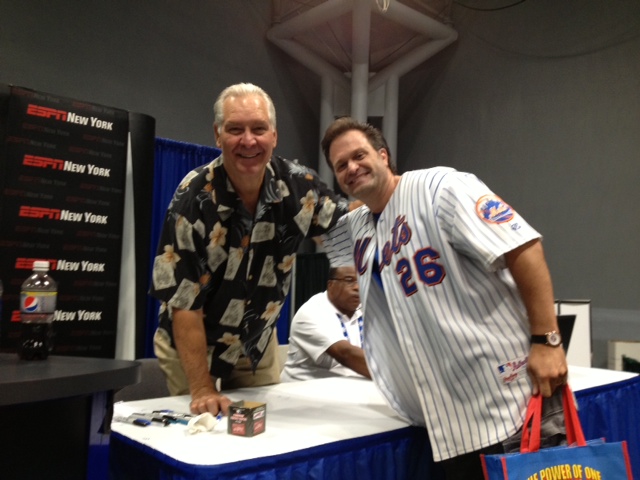
That’s not his real name. I’ve been fortunate enough to meet John Colella and discover there’s more to him than a KINGMAN 26 jersey. But for our purposes, we’re going to be superficial and take advantage of his affinity for the player we knew as Sky King or Kong or just Dave from 1975 to 1977 and again from 1981 to 1983. See, John went to FanFest with one overarching goal in mind. He let us know how that went in our comments section the other day, but since it was such a great story, I thought I’d share it here as a guest column.
***
Fan Fest was neat, but a lot of it is geared toward little kids — hitting cages, sliding drills, toss games, “instruction”. It was well worth the $10 discounted ticket I bought, but don’t know how psyched I’d be to spend $35 a head. But I was really there for one reason.
The Missus and I got in around noon. We went straight to Felix Millan’s signing. We bought his book, and he signed two Topps 1976 cards and made a nice inscription on the book as well. The lines for Cliff Floyd and Kevin Mitchell were onerous so we wandered about before stopping in to catch the end of Joe Pignatano’s Q&A. A little shopping and viewing the exhibits and then we caught Rusty Staub’s Q&A. He was interesting, particularly telling about how he reconciled with M. Donald Grant (after having been furious about being traded) and they became good friends. (Grant in Rusty’s bar: “Why the hell did I ever trade you?”).
Then, the Big Event — joint Q&A with Kingman and Cleon Jones. We stuck around after Rusty’s and got seats in front. They were both great. Cleon talked about ’69 (duh), that he knew Agee was gonna make that catch and that in general if a ball was hit anywhere near them he knew one of them would catch it. He was asked about ’73, specifically Yogi’s decision to start Seaver on short rest instead of Stone. Cleon said he wasn’t going to bury Yogi, and then pretty much did; he said the team leaders (Cleon, Mays, Seaver, couple others) met with Yogi, imploring him to use Stone who was their hottest pitcher down the stretch. Yogi refused, saying “The writers will kill me!” Both were asked about nicknames; Dave didn’t much care for any of his but didn’t mind them, Cleon said his favorite was “Beep-Beep” as in the Roadrunner, from his high school and college running days.
I wasn’t sure what to expect from Kingman. He doesn’t enjoy a good reputation from a lot of people stemming from feuds with writers. The fact that most of them were assholes who mocked him is conveniently forgotten. A guy I met online through Greg who is friends with Kingman says he is a delightful, personable, generous man.
And that was completely the case.
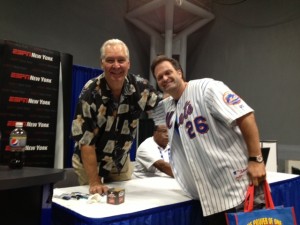 David Arthur Kingman, who hit 442 home runs, and dak442, who has smiled at least that many times this week. Dave simply couldn’t have been more pleasant, friendly, engaging and humble. When asked about his best experience in baseball, he said it was making so many good friends and staying in touch with them. When asked twice about the abrupt end to his playing career (he hit 35 HRs in ’86) he very matter-of-factly talked about collusion, said he would have liked to play two or three more years (and certainly could have), but that it’s all water under the bridge and he’s very happy with his career and his place in the game. I won’t relate the entire Q&A — it should be available on YouTube as three different guys were taping it on cameras/phones — but two things stood out.
• A guy asked Dave if he remembered visiting a kid who had had brain surgery in Montreal years ago, Dave said yes, the guy said it was him. Dave got up, walked over, gave him a big hug and they talked for a minute.
• And one guy said how he cried the night of the midnight massacre, and Dave said, “I’m not ashamed to admit — I did too. I loved it in New York.” It’s fantastic to hear that our love isn’t always one-sided.
At the end of the session, the two of them got up and stood there signing stuff for everyone. We each had baseball cards signed, and then ran to the line for the official autograph session. I’m not a big autograph guy — I’ve always found the soliciting and purchasing of them insipid, but I really just wanted to meet Dave and get a picture with him. The Fest volunteers gave specific marching orders: no pictures from the stage, only one item signed, be quick. Dave disregarded them all, graciously stood for pics with everyone, chatted with people.
The missus went first; she just said hi and I got a nice pic of them. Then it was my turn. We shook hands, I said I was a huge fan since childhood and thanked him for changing his mind and attending the last day of Shea (I decided not to ask him if my e-mail made him change his mind). He said it was a great day, he had a nice time and was glad he did. He signed a picture for me, posed for a couple of pictures, and I thanked him and began moving away. The MLB authenticator guy who was affixing little hologram stickers to all autographed items asked, “Hey, you want your jersey signed?” I hadn’t asked because they said only one item, I didn’t want to be a bother, and frankly I was a little overwhelmed. I said, “Really, you would?” and Dave said, “Sure! I have to sign a No. 26!”
I whipped it off and said, “Wow, thanks! I wear this to almost every game and always get a positive reaction.” Dave seemed surprised and pleased by that, so I said, “Absolutely! Everyone loves you!” The MLB guy said “You know, you can’t wash it anymore,” and I said “That’s OK, I hardly ever wash it anyway”, and Dave laughed and said, “Ha, we can tell”. It’s got Shake Shack residue, ketchup marks and other food stains on it from a year or two worth of ballgames. We all had a good laugh and I walked away on Cloud 9…without any of my stuff other than the jersey in my hand. The guy had to call me back first for my bag, and then for my picture.
I am generally a fairly cool customer, unfazed by anything. Except this. I was completely agog. When I came off the stage my wife laughed at me for babbling up there and forgetting all my stuff, and when I showed her the autograph she said, “Oh my God, your hands are shaking! What’s with you?!” For a couple of minutes I was a starstruck ten-year-old kid again. It’s wonderful that love of a baseball team (and player) can reduce a blasé New Yorker to a gibbering fool. I’ve been smiling for a day straight. I can’t convey enough how happy I am to have met a childhood hero who turns out to be a great guy. You hear about athletes being jerks, or just brusque (like some of the other signers), but this was just such a fabulous experience.
Now, I need to step up the campaign to get Kingman into the Mets Hall of Fame. Who’s with me?!
***
Mariano Rivera won’t be going into the Mets Hall of Fame, though it felt like he was being inducted Tuesday night. Jason gives his thoughts on the subject in the Wall Street Journal here.
Tom Seaver wore a Dodgers batting helmet a year before he was traded to the Reds. I break it gently to Uni Watch’s Paul Lukas here.
by Greg Prince on 17 July 2013 3:39 pm Prior to the All-Star Game, I heard and read that Citi Field was about to have its first “signature moment,” which I thought was a pretty misguided assessment, considering HELLO! NO-HITTER! on June 1, 2012. I’d also throw in a “hey” to that 20th win at the end of last year. I get what those takes were getting at, that Citi Field had yet to host a playoff or World Series game, thus it hadn’t really been fully observed by a national baseball audience since its opening in 2009.
People are somehow paid to contemplate those angles. As the constant fans of the home team, we don’t much care what viewers who aren’t normally interested in the Mets think of what goes on in Flushing. If what happens at Citi Field stays at Citi Field, fine. It stays with us regardless of whether anybody else is looking in.
Yes, the All-Star stuff was a big deal. So was Johan Santana’s filling of a half-century void. So was R.A. Dickey putting a round-numbered cap on a sensational campaign. So was Matt Harvey bettering Stephen Strasburg this April and almost completely stifling the White Sox in May. So were various walkoff wins and individual offensive feats (not that there’ve been a ton of the latter) that have transpired in the post-Shea era.
Some of the losses have qualified as big deals, too. I’m literally not in the business of peddling stories from games where the Mets didn’t come up winners, but those provide signature moments whether or not we choose to embrace them. Sad signature moments, like with your pen running out of ink and the last letters coming out all scratchy and illegible, do happen.
For me, in this year of Harvey Days, Harvey Nights and other scattered highlights, the first half at Citi Field was defined more than anything by one game in particular that went on. And on. And on. And, yes, on. As we prepare to commence the so-called second half of the season (a.k.a. the final 43.83%) on what we hope is a continued upswing, I’d like to use this opportunity to recall my signature moment at Citi Field thus far in 2013, one that I look forward to looking back on on someday and laughing at when we won’t be able to believe how bad the Mets once were…and how long they took to confirm it.
With apologies to Rupert Holmes, I give you “Extras (The Ruben Tejada Song),” based on an all too true story.
I was tired of my ballclub
They’d been in extras too long
Buck was mired in a deep slump
Ankiel’s swing was all wrong
So as they stood there flailing
I scrolled through Twitter instead
After a rant about Duda
There was this Tweet that I read:
“If you like Ruben Tejada
“And being tied with the Fish
“If lingering in Promenade
“Is your deepest-down wish
“If you like leaving lots of runners on
“And your train’s not ’til late
“You’re a Mets fan who’s chronic
“And you have no escape”
I didn’t think about Ike Davis
I know that sounds kind of mean
But our big slugger Ike Davis
Had fallen down to a paltry one-fifteen
Murph flied out to the Mo’s Zone
As I let out a bleat
Then I clicked on my cell phone
And typed my own little Tweet:
“Yes, I like Ruben Tejada
“And being tied with the Fish
“It’s too late to find food here
“Concessions closed in the sixth
“I’ve got to meet you by the Caesars Club
“If I can just dodge that guard
“It gets pretty pricey here
“They prefer Mastercard”
So I waited with high hopes
In this vast empty park
The game stayed very much deadlocked
The sky began to grow dark
It was my own fourth-place Metsies
And they said — “oh, what fun”
Then we laughed for a moment
It was still tied at one
“Yes, we play marathon innings
“And we can’t beat the Fish
“And it feels like forever
“Since that LaFrieda sandwich
“We’ll get you out of here by midnight
“Or by dawn — no, we swear
“Somehow you’re still a Mets fan
“Though you’ve had it up to here”
Yes, I like Ruben Tejada
Though I have to come clean
Quintanilla’s got a better bat
Of course I cheered Valdespin
Look, it’s getting close to midnight
My train’s approaching Woodside
Could you please get this over with?
Or I’m gonna need a ride
by Greg Prince on 17 July 2013 1:43 am The 2013 All-Star Game is barely over and I’ve already forgotten all but its most salient details:
• Tom Seaver threw out the first pitch, looking as robust as ever.
• Matt Harvey went two scoreless, settling down after two shaky batters, no thanks to his catcher Yadier Molina who’s supposed to be so valuable at that task but lives only to irk us.
• David Wright accounted for one-third of the National League’s three-hit attack, in rough proportion to how much of the Mets’ offense he’s accounted for in recent years.
• Some idiot in a CANO 24 shirt was tackled by Citi Field security.
• Orange and blue were in abundance.
The National League may have gone down to defeat but the evening wasn’t a total Mets loss. Inanities of the game itself aside — from the non-Mets’ pitiful showing on the N.L. side to the usual gamut of overwrought Foxian gushing to Billy Wagner’s music being cued up despite 2006 having been a long time ago — the Metropolitan stamp all over All-Star festivities sparkled. Given that I was just a tad over 18 months old in July of 1964 and therefore possess limited memory of the exploits of Johnny Callison (though I do recall something about a very sharp batting helmet), I’d always wondered what it would be like if the Mets hosted one of these babies. Once Shea went away, it became less about a burning desire to be on hand and more simple curiosity to what it would look and feel like. Would it be stupendous? Strange? Undeniably different from when it’s somewhere else? Would we, to paraphrase George Carlin, be a credit to our row and do right by the Midsummer Classic?
Yes will suffice as answer to all of those questions. The All-Star Game takes place at Riverfront Stadium in my mind, since that was the first site where I saw it on TV. It takes place in Kansas City, since that had been the last place where I saw it on TV. It took place almost everywhere that wasn’t beautiful downtown Metsopotamia. I still feel robbed that Shea Stadium never got a second crack at the darn thing (thanks again, Al Harazin). That was where I wanted to see it live. Citi Field, despite my animus toward it having mostly dissolved, just didn’t have that appeal to me personally, which I guess is why I resisted the opportunity to pony up for a ticket. It was the difference between being damn sure I was going to be at Shea’s finale and not much caring that I wasn’t at Citi’s debut — or absolutely needing to see Billy Joel five years ago this week at Shea versus altogether ignoring Paul McCartney in Shea’s successor structure four years ago. One place mattered deeply in my heart, the other is still working on it.
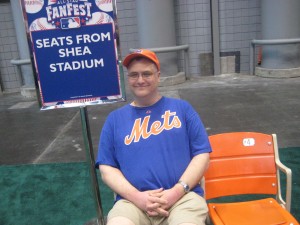 I waited decades to watch an All-Star Game from seats like these in their natural habitat, but the game never came. That said, hell yes to Citi Field having hosted the All-Star Game, even as viewed from Section LR (Living Room). Better the Mets than everybody else. Better our colors and our skyline and our captain and our phenom and our legend and our history shining in the spotlight for days on end than the rest of the world’s. Better our transit system briefly breaking down after the Home Run Derby than whatever trains might run in Minneapolis next year. Flushing — and nowhere else — is where the All-Star Game now takes place to my thinking. Give me that overwhelming parochialism when I haven’t experienced it before. Give me Seaver throwing to Wright then making way for Harvey while Gooden watches from great seats. Bleah on Kevin James, but hooray that it’s one of our celebrity fans plugging a dismal movie. And give me a seating bowl and standing room engorged with mostly Mets fans, cheering David and Matt and Tom, booing assorted interlopers and not being anybody else but Mets fans.
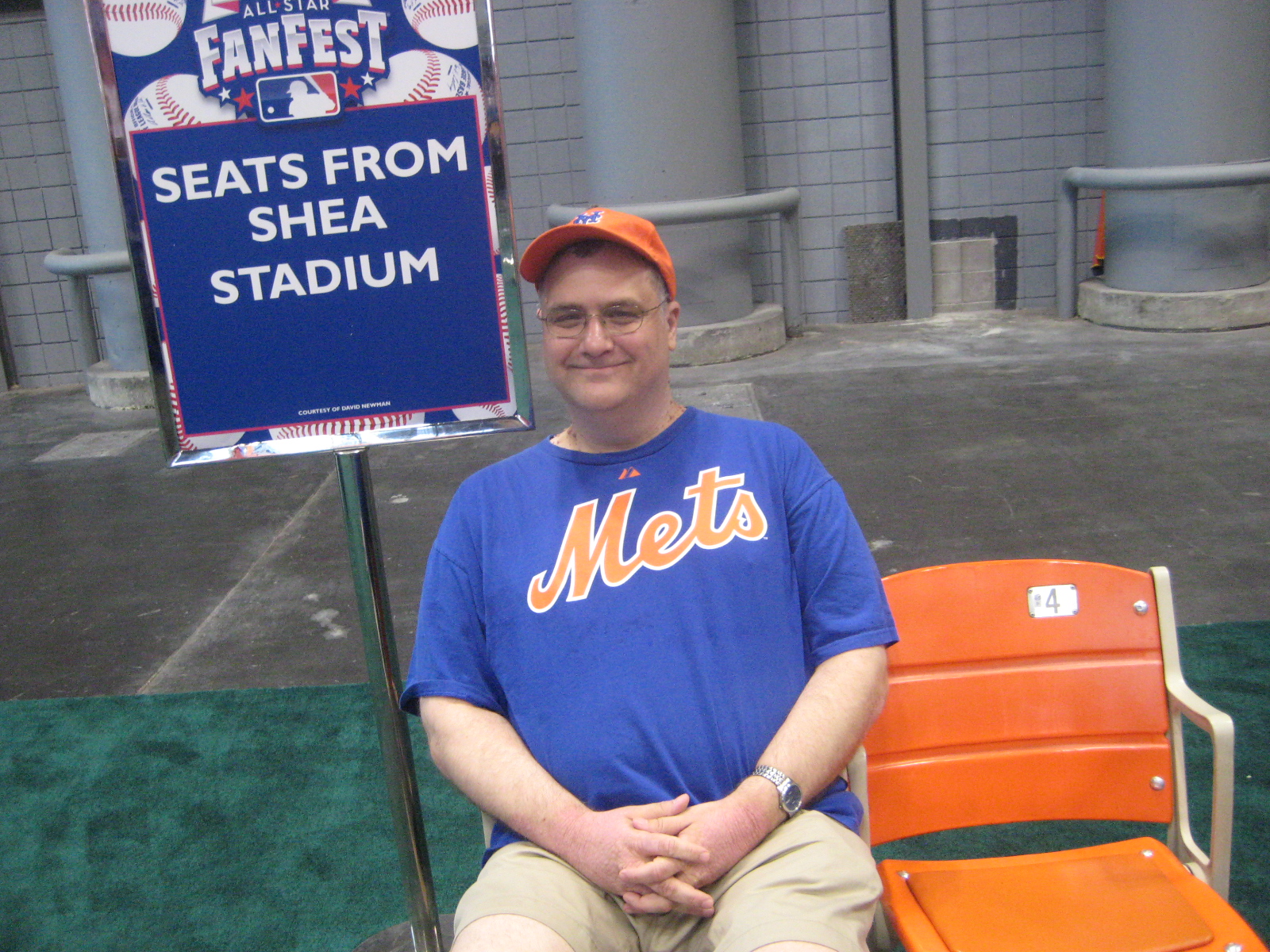
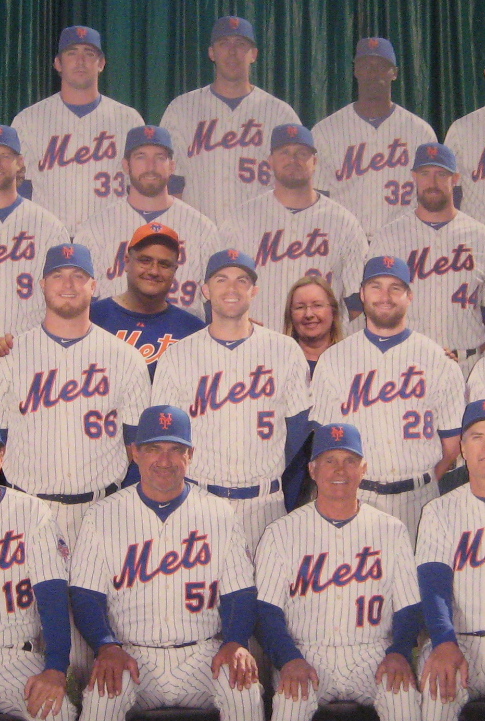
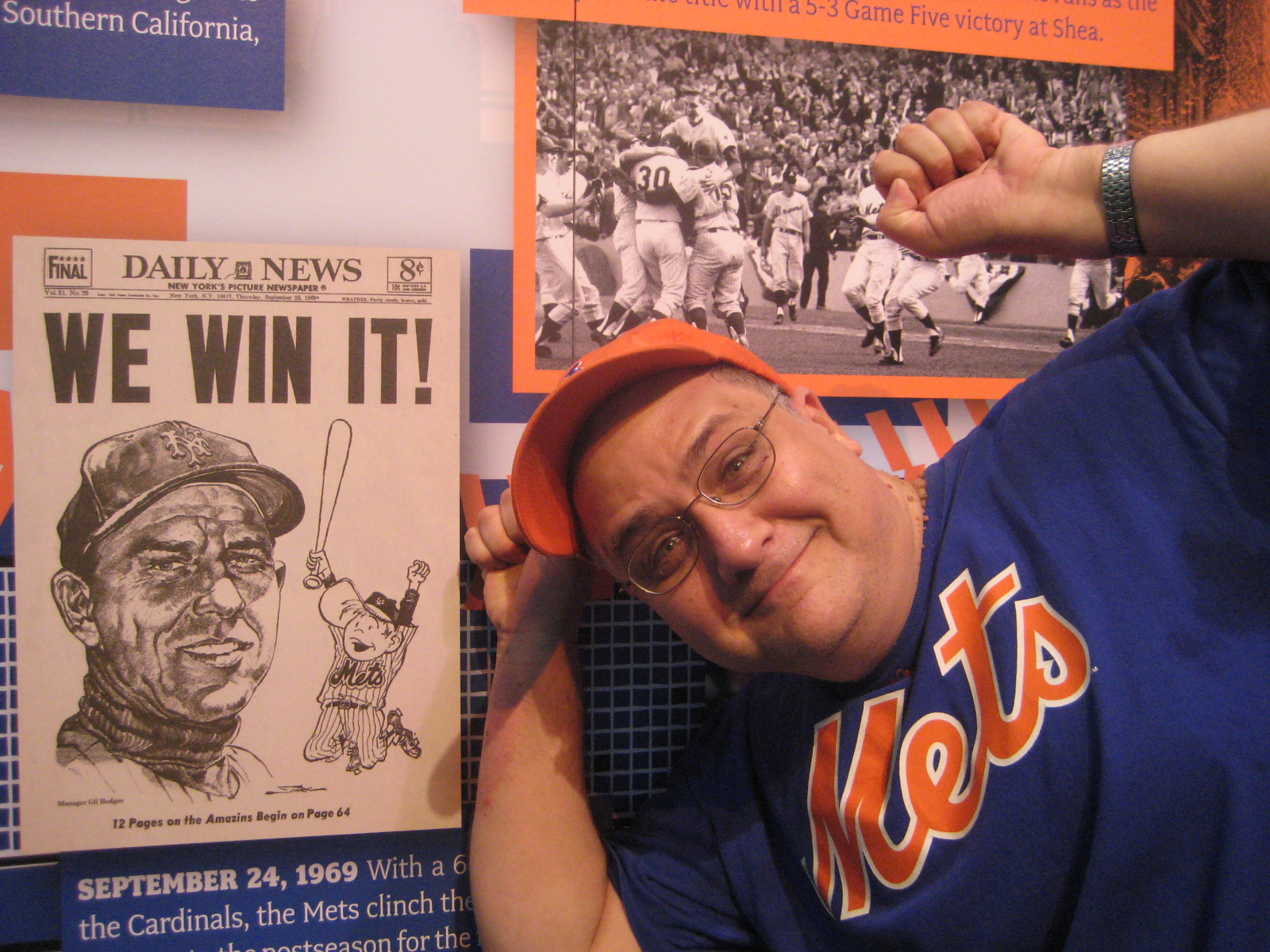
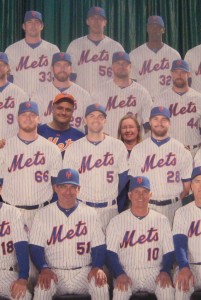 As if David Wright didn’t have enough Mets fans hanging all over him this week. Oh, and give me FanFest in Mets flavors again someday. Sorry it has to be Brigadoon and that it can’t be a sixth borough. How nice to enjoy an exposition that’s all baseball all the time for five days (I went for two). How nice that as you make your way to the Javits Center, it’s Mets fans coming, Mets fans going, Mets fans being Mets fans in broad daylight. It was as if I opened my eyes and the Metscape that exists in my wildest dreams had practically come to life. Truth be told, the depth of this FanFest felt a little shallower than in 2008, but it more than made up for its modest shortcomings with Mets, Mets and more Mets. If all I got for my ten bucks was a mural of almost accurately portrayed great Mets moments, a poseworthy cardboard cutout of the most recent (albeit slightly outdated) Mets team picture and a couple of well-preserved Shea seats, that would’ve been worth it. But I got that practically after walking in the door, and there was much beyond the entrance to savor.
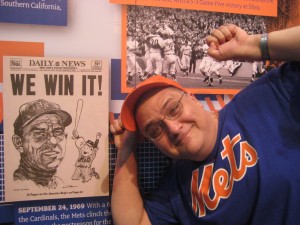 It doesn’t hurt to practice being high-profile happy, just in case it’s actually merited again someday. A chunk of what I didn’t devote to All-Star Game admission was directed instead toward various commemorative garments and tchotchkes, all of which I will enjoy wearing and/or staring at it from time to time as I dream of the day when everything Metsian is in full bloom not just for a brief spell in July, but clear across the baseball calendar…especially in October. Let’s call this week high-profile practice toward that ultimate goal.
Another way to prepare for further Met triumph: Brush up on the wins that set the stage for all the rest by reading The Happiest Recap: First Base (1962-1973), available in paperback and for Kindle from Amazon. Personally inscribed copies can be ordered from the Team Recap store.
by Greg Prince on 14 July 2013 8:16 pm Mike Piazza is a New York Mets Hall of Famer. We didn’t necessarily require official confirmation. After completing three of his eventual eight seasons wearing the orange, black and blue, his eternal status was pretty well nailed down in our eyes as well as our hearts. One can only speculate why it took the Mets six years beyond the end of his playing career to announce they would induct him, but that they will finally do on September 29, our last baseball day of 2013.
I’m ridiculously thrilled by this. I’m more thrilled by Piazza’s pending enshrinement than I am by the presence of the All-Star Game and its auxiliary activities, even as I continue to relish all that. I’m more thrilled than I am by the Mets’ perfectly satisfying Sunday afternoon victory in Pittsburgh that closed out a “first half” (technically 56.17%) that has been tentatively encouraging of late, if generally a far cry from the peak of the Age of Piazza.
Mike played on two undeniably profound Mets teams, three promising if fatally flawed Mets teams and three ultimately abominable Mets teams. Yet the Age of Piazza morphed into an exalted epoch every time Mike picked up a bat. He transcended the letdowns inherent in 1998, 2001 and 2005. He soared above the dregs of 2002, 2003 and 2004. Most enduringly, he was the signature across the bottom of the Declaration of Contention the Mets issued in 1999 and 2000. He was John Hancock in those revolutionary days when we sought to turn the world upside down. He was always out front and you couldn’t miss him.
Piazza’s Mets, when assembled directly on either side of the millennium, were way more than Mike, yet their story always radiated out from behind his chest protector. They weren’t quite the sad stray puppies Metropolitan myth has framed them as pre-Piazza — Bobby Valentine banded together a scintillating 88-74 squad in 1997 and they continued to dance above .500 as 1998 commenced — but yeah, it was dark turning to bright when word got out late on Friday afternoon, May 22, 1998, that the Mets had made a trade with the Florida Marlins. Nobody is in the habit of quoting Jeff Wilpon without preparing to stick a pin in his comic balloon, but the COO is correct in asserting that when Mike Piazza became a Met (more by the hand of Nelson Doubleday than anybody else’s), he “reinvigorated the franchise”. Rooting for the Mets had been our sacred calling regardless of who was catching or batting cleanup. Getting to root for the Mets when it was Piazza who was catching and batting cleanup? That was a seat upgrade of the most elevated order.
The pearly playoff gates raised for a wretch like us in the autumns of 1999 and 2000, lifted as high as they could possibly go by the Amazin’ grace of Mike Piazza and his disciples. They could only go so high and we could only stay Up There so long, but what a time it was. Every game mattered. Every inning was crucial. Every time Mike did something, we craned our necks to see what he wrought. You watched closely in the Age of Piazza. You celebrated at unannounced intervals, but you knew something was coming. You didn’t keep your hands in your pockets if you didn’t absolutely have to. There was too much to applaud. There was too much to high-five.
I was thrilled then. I’m thrilled now. I’ll be thrilled on September 29. Learning that Mike Piazza is on his way to a Mets game near you tends to have that kind of impact on me.
by Jason Fry on 14 July 2013 12:57 am The Mets lost to the Pirates in a quiet, unmemorable game that at least saw Terry Collins manage a bullpen the way one would like: he was cognizant of his starting pitcher’s gas tank and brought his closer in when it mattered instead of when baseball conventional wisdom (which is 90% mythical and the other half wrong anyway) told him to. It was a modest little game, but one that delivered a judgment that was both impartial and unsurprising: Don’t waste your own outs (David Wright, Ike Davis) and don’t give the other guy extra ones (Ike again).
Oh, and don’t walk guys with the bases loaded, because that’s bad.
The only bit of news, besides Ike being rather obviously still not fixed, is that Jordany Valdespin has finally been demoted after an eternity spent rotting on the bench, a Metsian habit of late with young players that I find, well, deplorable. Here’s predicting JV1 sees little or no time in Vegas — I bet the Mets trade him for some fringy prospect we never hear from again, Jordany kicks up a one-day WFAN ruckus on his way out, and then he continues becoming Victor Diaz somewhere else.
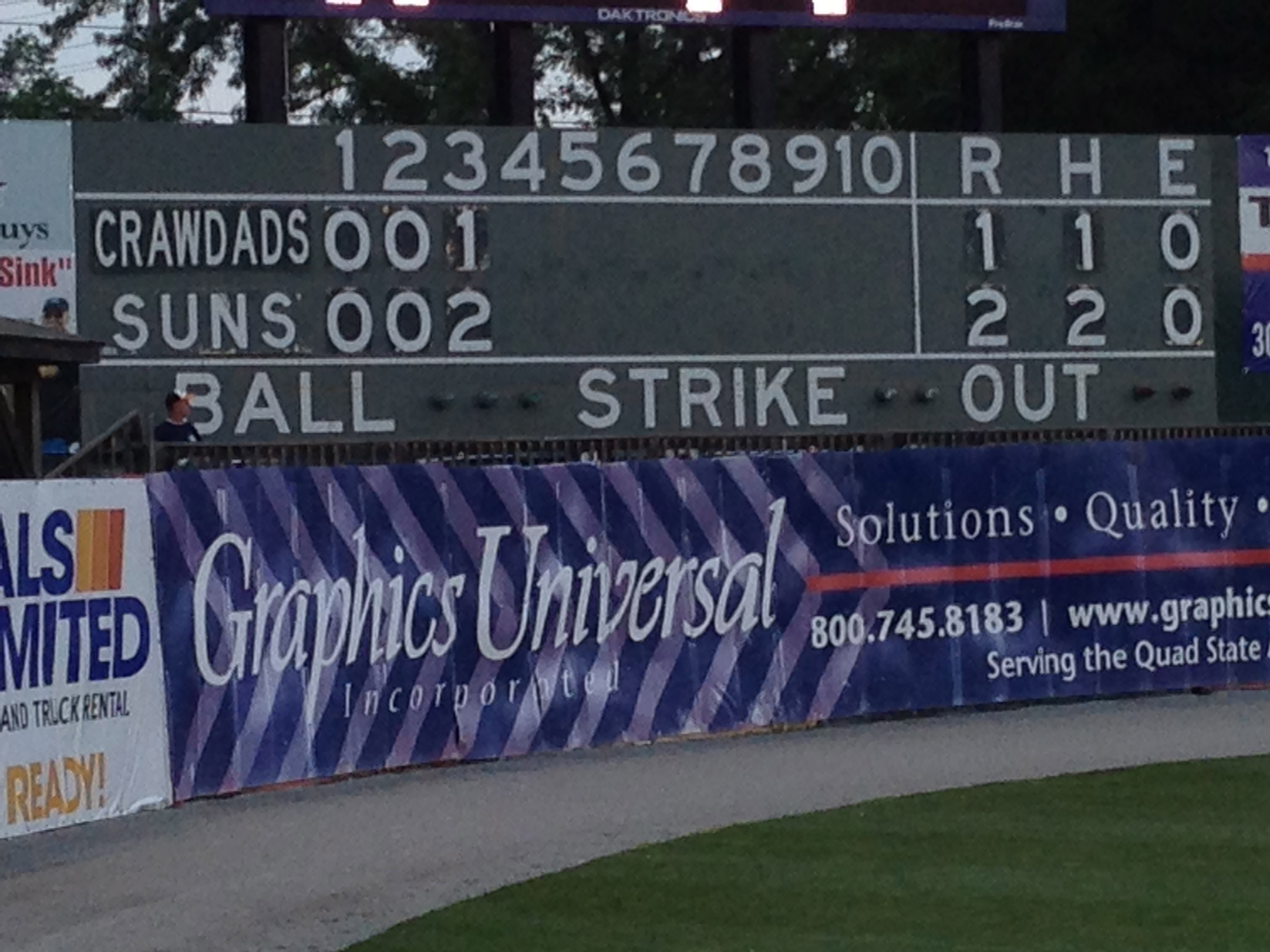
I want to tell you about Tuesday night’s game, though — no, not the Mets beating the Giants, though that was fun. I want to tell you about my night with the Hagerstown Suns and the Hickory Crawdads.
I just got back from a few days driving the backroads of Adams County, Pa., and Carroll and Frederick Cos., Md. — digging through file cabinets at historical societies and checking out old houses and former farms on both sides of “the Line.” My mother’s ancestors are from those counties — they arrived in the 18th and early 19th centuries as refugees from the Palatinate, leading quiet lives as farmers and carpenters and stonemasons amid some of the richest farmland one could imagine. In recent years I’ve become interested in learning who they were and how they lived, a search that’s taken me from the Internet to actual old documents and maps and photos.
On Tuesday night I was staying in Emmitsburg, just south of the Mason-Dixon Line. There, on a sweltering afternoon, I found the headstone of my great-great-great-grandfather John Baker in the old Lutheran churchyard, about two miles from the farm he’d still recognize as his. Then I was off in my little green rental car, climbing the Catoctins to the west in search of the graves of John’s son Joseph Baker, Joseph’s wife Lydia Sheets Baker, and several of their children. Joseph and Lydia lived in Emmitsburg, but consumption — now called tuberculosis — killed them and most of their family shortly before 1900. (One of the survivors was their eldest son, my great-grandfather Howard Baker Sr. He married a local girl and moved across the country, settling in California’s Central Valley and severing our family’s ties with the fields and farms they’d called home for generations.)
I found the graves of Joseph and Lydia and their children in Funkstown, a little town that’s escaped being eaten by sprawl because it’s tucked into a bend of Antietam Creek. The graveyard is lonely but decently kept, home to dozens of cottontails and an infinity of fireflies — not bad companions for the departed, in my opinion.
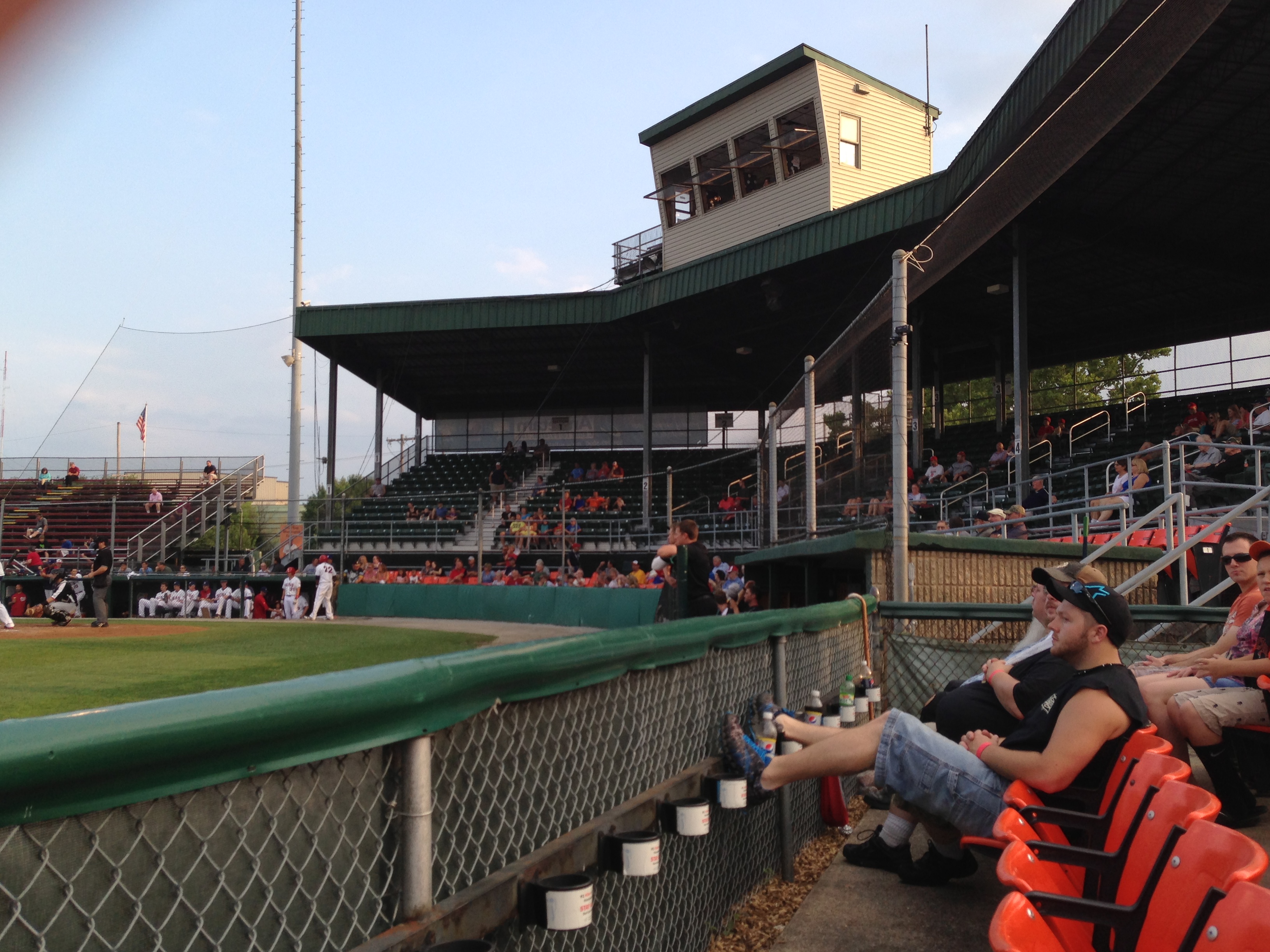
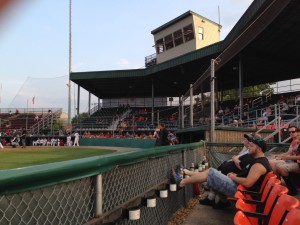 Baseball on a Tuesday night in Hagerstown Funkstown is also a mile from the home of the Hagerstown Suns. So having paid my respects, off I went for the very short drive to Municipal Stadium. Tuesday’s a discount night, so I could choose between a general-admission ticket for $4 or a front-row seat for $7. I sprang for the expensive seat, and paid $9 for 32 ounces of pretty decent beer, which left me thinking that Hagerstown was pretty much all right.
Which it is. Municipal Stadium is about as quirky as its name — there’s a shell, some bleachers and a field — but it doesn’t get in its own way, as a shell, some bleachers and a field are more than enough for baseball. The scoreboard’s hand-operated, which is a nice touch, and there are some things to read about the history of the stadium and the Suns, which is more than Citi Field managed in its first campaign.
Hagerstown has plenty of baseball history to its name: The city’s fielded pro teams since 1915, variously named the Blues, Terriers, Champs, Hubs, Owls, Packets and Suns. Hagerstown’s been a part of the Blue Ridge, Interstate, Piedmont, Carolina, Eastern and Sally Leagues, and its franchise has been an affiliate of the Tigers, Braves, Senators, Orioles, Blue Jays, Giants, Mets and now the Nats.
As for the stadium, it’s been around since 1930, and its biggest claim to fame is that Willie Mays made his professional debut there in 1950, playing with visiting Trenton. Mays was the first black player in the Interstate League, and Maryland was (and is) the South. As the Say Hey Kid recalled in 1996, it was a rough debut:
We played in a town called Hagerstown, Maryland. I’ll never forget this day, on a Friday. And, they call you all kind of names there, “nigger” this and “nigger” that. I said to myself — and this is why Piper Davis came in — in my mind, “Hey, whatever they call you, they can’t touch you. Don’t talk back.” Now this was on a Friday. And Friday night I hit two doubles and a home run; they never clapped. The next day I hit the same thing. There was a house out there in the back — I hit that twice. Now they started clapping a little bit. You know how that is, you know, they clapped a little bit. By Sunday there was a big headline in the paper: “Do Not Bother Mays.” You understand what I’m saying? They call you all kinds of names. Now this is the first two games I played. By Sunday, I come to bat, they’re all clapping. And I’m wondering, “Wait a minute, what happened to the Friday? What happened to the Saturday?”
Municipal Stadium holds 4,600 people crammed into one very small place. When I was there this week the stadium was perhaps 15% full, and you could hear individual spectators quite clearly. For Mays it must have been like playing in a banquet hall, with each and every taunt clearly audible and impossible to ignore.
On Tuesday the taunting was aboveboard — the crowd roused itself into a mild frenzy when the home-plate ump kicked a call at the plate pretty thoroughly, a Jerry Meals display of bad that gave Hickory an undeserved run. The Crawdads’ manager wasn’t happy either, lecturing the ump steadily and disapprovingly from the third-base box. His chief gripe: The ump kept falling for overly obvious framing of pitches by the Suns’ catcher. “You don’t frame strikes,” he said wearily at one point, which struck me as both true and missing the point — an objection I could have raised with him personally if I’d wanted to from my seat 12 feet or so behind him.
I hadn’t heard of any of the Suns or Crawdads, though one of them does have the memorable and spectacularly unlikely name of Will Piwnica-Worms — to quote the always-quotable Annie Savoy, “You need a nickname honey.” But I figured some of the managers and coaches might be familiar names, and so did some hurried Googling — which turned up more Mets connections.
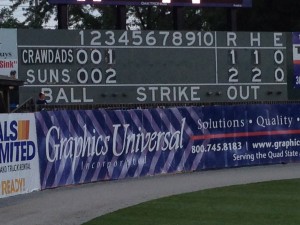 The Suns’ manager is Tripp Keister, who was drafted by the Mets back in ’92 and spent four years in their system, with teammates including Edgardo Alfonzo, Rey Ordonez, Bill Pulsipher, Jason Isringhausen and Paul Wilson. Keister made it to Binghamton before hanging it up. I didn’t remember him, but the name of the Crawdads’ manager was familiar. I tried to figure out what team Corey Ragsdale had played for, imagining him as a utility guy for the Rangers or the White Sox. Which was wrong — I was thinking too far afield. Ragsdale, as it turned out, was a 2002 Brooklyn Cyclone under Howard Johnson, and played briefly for Norfolk a couple of years later. With his bat insufficient to take him to the big leagues Ragsdale tried his hand at pitching, calling it a career after a 2009 stint with the same Crawdads he now manages. The Suns’ manager is Tripp Keister, who was drafted by the Mets back in ’92 and spent four years in their system, with teammates including Edgardo Alfonzo, Rey Ordonez, Bill Pulsipher, Jason Isringhausen and Paul Wilson. Keister made it to Binghamton before hanging it up. I didn’t remember him, but the name of the Crawdads’ manager was familiar. I tried to figure out what team Corey Ragsdale had played for, imagining him as a utility guy for the Rangers or the White Sox. Which was wrong — I was thinking too far afield. Ragsdale, as it turned out, was a 2002 Brooklyn Cyclone under Howard Johnson, and played briefly for Norfolk a couple of years later. With his bat insufficient to take him to the big leagues Ragsdale tried his hand at pitching, calling it a career after a 2009 stint with the same Crawdads he now manages.
So there they were — two former Mets farmhands, overseeing Nats and Pirates prospects in the stadium where Willie Mays made his pro debut. The baseball moved neatly along as dusk turned to dark, with the usual mix of sharp plays and misadventures you find in the lower minors. I caught a ball — my second in a month, somehow — and a hot dog in foil, tossed my way by a stadium worker wearing a cape and billing himself Hot Dog Man. (Thanks dude!) The Suns lost by a single run — that blown call at the plate was important — and I headed for my car and back over the mountains, with the Mets for company from distant San Francisco.
Between the AL and the NL and all the flavors of affiliated pro ball, I count 117 games on the schedule for Saturday night. Tim Lincecum’s no-hitter will dominate the headlines, and deservedly so. But if dissected, most if not all of those 117 games would also provide their share of storylines and history and intrigue. Which is what brings us all to the park or the couch or just to our headphones, night after night, whether we’re in New York or Pittsburgh or San Diego … or even Hagerstown.
by Greg Prince on 13 July 2013 10:55 am Mostly asleep but a little awake early this morning, I remembered I had to get up and write up one of those games I had no desire to dissect let alone relive. “That was deplorable,” I thought as I sunk back into unconsciousness, which is interesting to me since “deplorable” is a word I don’t really use. I just did a search of FAFIF — which isn’t a foolproof test — and found the last time I allegedly used “deplorable” was December 2009 in an article about Omar Minaya, except I didn’t use “deplorable” at all, just “valuable,” “improbable,” “formidable” and “Lo Duca”. “Deplorable” did come up big that July, however, in a piece citing Adam Rubin’s reaction to Minaya suggesting he (Rubin) was actually lobbying for a job with the Mets when he reported Tony Bernazard ripping his (Bernazard’s) shirt off and challenging minor leaguers to fights (good times).
Anyway, deplorable isn’t really one of my words, but let’s see if it fits.
The Mets lost to the Pirates in eleven innings. That was deplorable.
Overwrought yahoos at PNC Park were stoked by yokel announcers to boo David Wright because he did not instantly validate Pedro Alvarez’s powerful first-half production by proffering an immediate invitation to the Home Run Derby. Alvarez is now on the useless exhibition squad and booing David Wright is akin to booing warmth and kittens. That was deplorable.
Alvarez avenged the perceived Wright slight by launching a two-run home run practically into the confluence of the Allegheny and Monongahela. That was deplorable.
Jeremy Hefner settled down from enabling splashdowns into the Mighty Ohio and left the Bucs dry as a bone clear through the seventh. Obviously, that was not deplorable.
The Mets scored their first run when David politely singled home Eric Young in the sixth. Not deplorable.
The Mets tied the game when Kirk Nieuwenhuis made his case to wear a gaudy orange jersey and be robotically swooned over by Chris Berman Tuesday night. Not deplorable.
The Mets didn’t do any more with Charlie Morton over seven innings than the Pirates did with Hefner. Deplorable enough.
Terry Collins mysteriously pulled a healthy Hefner after seven innings and 78 pitches on a night when Harveycentric tinkering with the rotation and the ravages of age were going to deprive him use of Carlos Torres and LaTroy Hawkins, respectively…and a week before Hefner’s next well-rested start. Most deplorable of all.
Jordany Valdespin, the guy Collins all but begged the Pirates to plunk two months ago, did not pinch-hit a home run or anything off Mark Melancon as he batted for Hefner leading off the eighth and thus continued his descent into the state of deep uselessness that more or less dates to the Mets’ overly Victorian overreaction to Valdespin’s violation of baseball’s unwritten code of conduct. Jordany’s OBP after he homered off Jose Contreras on May 10 and Bryan Morris hit him on May 11: .735. Jordany’s OBP the morning of July 13: .570. All kinds of deplorability here, but mostly Hefner should’ve batted for himself and continued to pitch.
Solid eighth out of David Aardsma. By no means deplorable, but Hefner should’ve still been pitching.
Mets unable to touch Jason Grilli in the ninth. Last Met to touch Jason Grilli in the ninth was Mike Baxter, who currently seeks to change his luck in Las Vegas. Don’t know that it’s deplorable that Baxter isn’t back yet but it’s always deplorable being shut down by an ace reliever.
Collins empties out most but not all of the relatively reliable portion of his bullpen to rescue Aardsma after he gives up a leadoff double to Starling Marte and finds runners on first and third with one out. Aardsma out, Burke in; Burke out, Rice in; Rice out, Edgin in. The results are anything but deplorable — the Bucs load the bases but do not score — but one is left to wonder where is the most reliable Met reliever of them all, Bobby Parnell? Surely Terry, who removed an effective starter with a low pitch count after seven, isn’t saving his closer for a lead that may never come, is he? That would be deplorable.
In the top of the tenth (or as the marathoning Mets of 2013 call it, the new ninth), Juan Lagares singles to spark an eventual two-on, two-out situation for Wright, who has already recorded two hits and made two big plays, and how perfect would it be for him to drive in the go-ahead run here as the Pirate fan boos get more and more pathetic? Against Morris, the man the Mets didn’t mind teaching Valdespin a lesson, David lines a ball on the button, but it heads square into the glove of Andrew McCutchen. Deplore this.
Edgin works out of trouble in the bottom of the tenth while Parnell is preserved for a situation that has yet to arrive. Can’t deplore what Edgin’s doing. Can deplore what Parnell isn’t.
Mets do nothing against Vin Mazzaro in the eleventh. Deplorable.
Gonzalez Germen, to this point no more than a roster rumor set in agate type, makes his major league debut in the bottom of the eleventh of a tie game with McCutchen, Alvarez and Russell Martin due up. He walks the All-Star McCutchen. He strikes out the All-Star Alvarez but McCutchen steals second. He intentionally walks Martin, who won a game against the Mets with a home run in 2012. He strikes out Gaby Sanchez, who produced a .318/.403/.591 slash line in eighteen games against the Mets in 2011. He teases a weak grounder out of Jordy Mercer, but the ball had excellent vision and limped its way into center to score McCutchen from second with the winning run. Gonzalez Germen did what we shall call without irony his Parnellian best to keep the game tied. Parnell, on the other hand, saw as much action Friday night as Germen did all of his life prior to Friday night. When you’ve lost 3-2 in eleven without your best reliever getting the call, that’s deplorable.
And when Terry Collins leans back in the visiting manager’s office and explains he was going by the book by not opting for Parnell in a tie game on the road…no wonder I stirred from slumber thinking, “That was deplorable.”
Because it was.
by Greg Prince on 12 July 2013 1:02 pm Perhaps I need to be more cynical, but I’m genuinely excited that All-Star Week is upon us and around us. Is it called All-Star Week? I can’t believe it’s not. I assume it’s trademarked and MLB is cashing in on it.
MLB will be cashing in off me in two scoops when I visit FanFest twice. I know what I’m in for in terms of temptation thanks to the dry run of 2008. Even for an All-Star Week that wasn’t properly Mets-themed, that one was pretty exciting to have around.
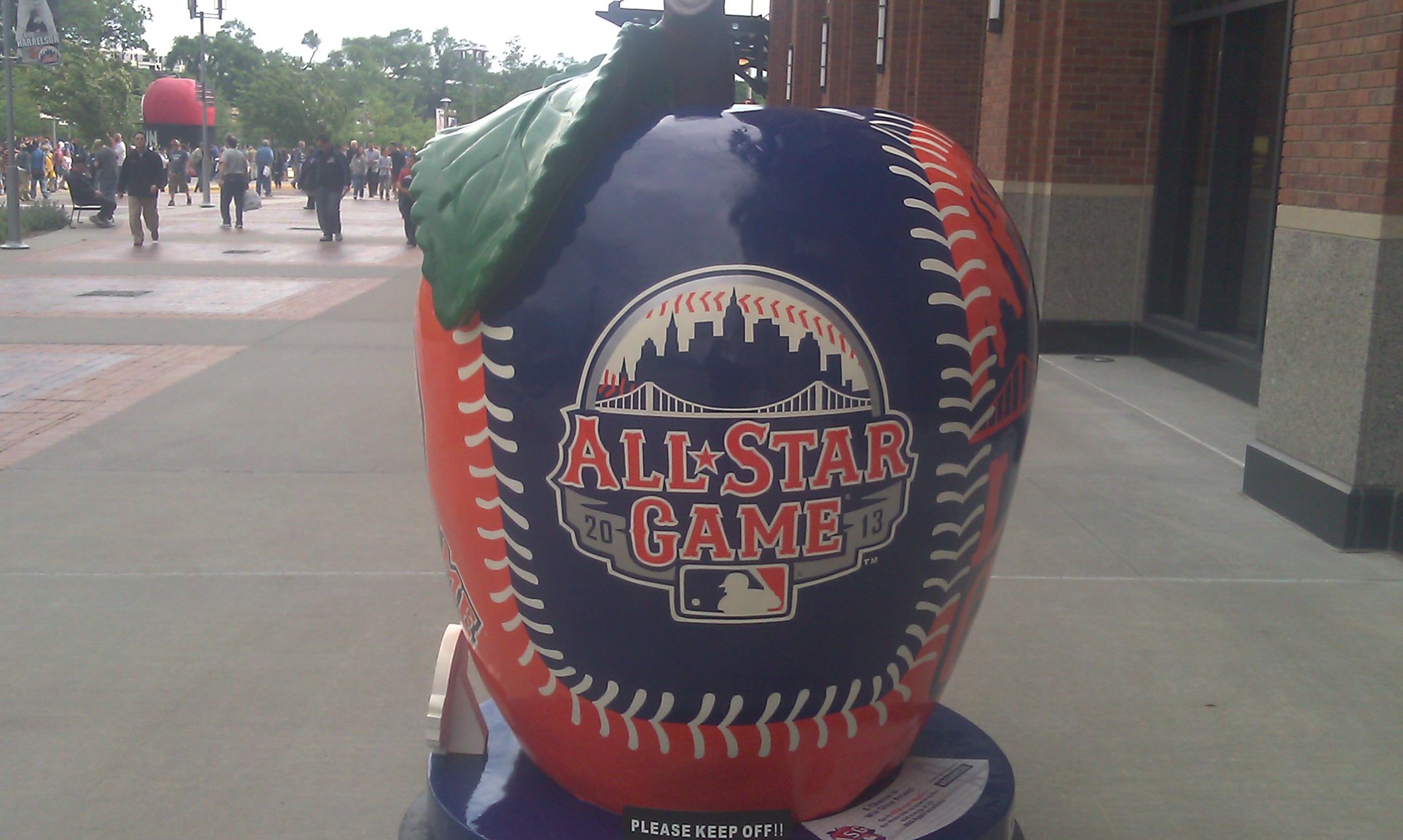
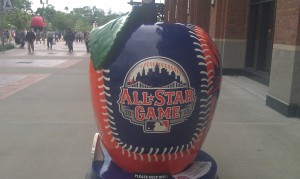 How ya like this apple? I’m in for FanFest. I’m in for examining apples should I wander across them. I’m down for most whatever’s televised. Not totally down for the ancillary stuff Sunday and Monday, but I’ll tune in. Didn’t succumb to the “strips” when I finally drew a chance to buy in for SRO access. I can sit at home for less. But you never know.
I’m letting the evanescent controversies wash over me, because a week from now they’ll be stored away. Should David Wright have picked Michael Cuddyer for the Home Run Derby? Of course not…unless he really wanted to. Should Matt Harvey be rested in deference to a blister that just happens to coincide with his opportunity to start the first All-Star Game the Mets have hosted in 49 years? Yes! No! Maybe! Whatever!
It’s all pretty silly, just like the concept that This One Counts or that Everybody Must Play or that Nobody Cares Anymore. The first All-Star Game, in 1933, was tied into the Chicago World’s Fair. Our first All-Star Game, in 1964, was played adjacent to the Flushing World’s Fair. Come see the greatest baseball players on Earth! It’s a cute, quaint concept, like picture telephones and Belgian waffles. They have the former now. Perhaps they continue to have the latter, even if you have to concoct them yourself. And we still have the All-Star Game. It’s cute, quaint and I still care as long as they care enough to dust the middle of the season with stellar powdered sugar. I mean why not? It’s just one night in July, except for us in Metsopotamia it’s a week more or less. It’s baseball all around us, colored orange and blue. It’s pretty sweet.
And what I’m really enjoying about this All-Star business, as a charter member of the Mets Fans Who Like To Read club, is the plethora of feelgood articles it has spawned. Say, you’re a Mets fan who likes to read, aren’t ya? Well, in that case, I recommend the following.
A visit with Ron Hunt, from Anthony McCarron in the News.
Great news regarding first-pitch pitcher Tom Seaver, via Bill Madden in the News.
Darryl Strawberry’s new path, marked by USA Today’s Bob Nightengale.
Willie Mays’s way, courtesy of Christian Red in the News — complete with long overdue street signs.
Johnny Callison’s moment in the Shea sun (and his unlikely role in the 1969 World Series), captured by ESPN’s Steve Wulf.
The forgotten All-Star Game at the Polo Grounds, from after the Mets left but before Shea opened, remembered by the News’s Robert Dominguez.
And if you haven’t picked one up yet, grab a copy of the 2013 All-Star Game Program, chock full of Amazin’ Mets content (including an article on Mets captains through the years in which author Jon Schwartz quotes yours truly among several others).
When you’re done reading, check out the Bergino Baseball Clubhouse for a truly extravagant All-Star Extravaganza Saturday between 11 AM and 4 PM.
|
|